INTRODUCTION
Invasive ascidians have recently become a worldwide issue in coastal waters (Whitlatch & Bullard, Reference Whitlatch and Bullard2007; Locke & Carman, Reference Locke and Carman2009). More than 60 non-indigenous ascidians have been recorded in tropical and temperate environments (Shenkar & Swalla, Reference Shenkar and Swalla2011). Non-indigenous ascidians have a rapid growth rate, short lifespan, and produce large numbers of short-lived non-feeding planktonic larvae. These characteristics, combined with the lack of significant predators, allow ascidians to be successful invaders (Shenkar & Loya, Reference Shenkar and Loya2009). Ascidians can be strong spatial competitors and, once they become established, often experience population explosions that can develop into dense stands or mats that overgrow and cover available surfaces (Whitlatch & Bullard, Reference Whitlatch and Bullard2007). A recent increase in shellfish aquaculture facilities has provided new surfaces (ropes, nets, cages and shellfishes) for colonization by invasive ascidians, resulting in overgrowth and smothering of the shellfish (Lambert, Reference Lambert2007). For instance, heavy fouling by cryptogenic species, Ciona intestinalis (Linnaeus, 1767), was associated with higher mussel mortality and lower overall size in Nova Scotia (Daigle & Herbinger, Reference Daigle and Herbinger2009). In addition, even if the ascidians have no negative effects on the bivalves directly, removal of the invasive species is costly and requires additional labour by aquaculturists (Carman et al., Reference Carman, Morris, Karney and Grunden2010). The mussel aquaculture industry has been overwhelmed by extremely large numbers of the invasive ascidian Styela clava Herdman, 1881 in Prince Edward Island (Bourque et al., Reference Bourque, Davidson, MacNair, Arsenault, LeBlanc, Landry and Miron2007), resulting in increased production costs estimated at $4.5 million per annum (Shenkar & Swalla, Reference Shenkar and Swalla2011). In Japan, some non-indigenous ascidians have been reported, such as Molgula manhattensis (DeKay, 1843) and Polyandrocarpa zorritensis (Van Name, 1931) (Tokioka & Kado, Reference Tokioka and Kado1972; Nishikawa et al., Reference Nishikawa, Kajiwara and Kawamura1993). However, no significant effects of invasive ascidians had been noted on the ecosystems or fisheries prior to the appearance of Ascidiella aspersa (Müller, 1776) (The Plankton Society of Japan and The Japanese Association of Benthology, 2009; Kanamori et al., Reference Kanamori, Baba, Hasegawa and Nishikawa2012; Nishikawa et al., Reference Nishikawa, Oohara, Saitoh, Shigenobu, Hasegawa, Kanamori, Baba, Turon and Bishop2014).
The European sea squirt, A. aspersa, is a solitary marine and estuarine ascidian that is native from Norway to the Mediterranean (Berrill, Reference Berrill1950; de Kluijver & Ingalsuo, Reference de Kluijver and Ingalsuo2004; Mackenzie, Reference Mackenzie2011). The species has been introduced to North and South America, India, Australia, New Zealand, South Africa, South Korea and Japan (Brewin, Reference Brewin1946; Kott, Reference Kott1985; Nagabhushanam & Krishnamoorthy, Reference Nagabhushanam and Krishnamoorthy1992; Carlton, Reference Carlton and Pederson2000; Robinson et al., Reference Robinson, Griffiths and Kruger2004; Tatián et al., Reference Tatián, Schwindt, Lagger and Varela2010; Kanamori et al., Reference Kanamori, Baba, Hasegawa and Nishikawa2012; Pyo et al., Reference Pyo, Lee and Shin2012; Nishikawa et al., Reference Nishikawa, Oohara, Saitoh, Shigenobu, Hasegawa, Kanamori, Baba, Turon and Bishop2014). Because there are no efficient predators, A. aspersa can form large populations and subsequent high amounts of biomass, which redirects energy to decomposers and not to higher trophic communities (Currie et al., Reference Currie, McArthur and Cohen1998). In addition, colonization by A. aspersa reduces available substrata on which other species recruit successfully (Osman & Whitlatch, Reference Osman, Whitlatch and Pederson2000). These characteristics have the potential to significantly affect species composition, reducing overall biodiversity (Mackenzie, Reference Mackenzie2011). Ascidiella aspersa also competes directly with other native filter-feeders, including economically important species such as scallops, mussels and oysters (Currie et al., Reference Currie, McArthur and Cohen1998). Therefore, A. aspersa is listed in the Global Invasive Species Database (2010), which is managed by the International Union for Conservation of Nature and Natural Resources, to increase awareness and to facilitate effective prevention and management activities.
The Japanese scallop, Mizuhopecten yessoensis (Jay, 1856), is one of the most important seafood species in Japan (Kosaka & Ito, Reference Kosaka, Ito, Shumway and Parsons2006; MAFF, 2015). Funka Bay, located in south-western Hokkaido, is one of the main commercially productive areas for scallop culture in Japan, where predominantly suspension culture techniques are used (Kosaka & Ito, Reference Kosaka, Ito, Shumway and Parsons2006). The method for culturing is called ‘Mimi-zuri’ or ear-suspended method: a small hole is drilled at the front-eared beak of the left valve and the scallop is hung on a rope by using artificial strings or plastic clips (Kosaka & Ito, Reference Kosaka, Ito, Shumway and Parsons2006).
In September 2008, A. aspersa was first found densely covering cultured scallops in Funka Bay, severely damaging aquaculture activities by causing the facility to sink and the scallops to fall off, and increasing expenses due to the need to dispose of the invasive species (Kanamori et al., Reference Kanamori, Baba, Hasegawa and Nishikawa2012; Nishikawa et al., Reference Nishikawa, Oohara, Saitoh, Shigenobu, Hasegawa, Kanamori, Baba, Turon and Bishop2014). The ascidians overgrowing cultured scallops in Funka Bay had been correctly identified as A. aspersa through observation of the characteristics of internal morphology, follicle cells of egg, and DNA analysis of mitochondrial cytochrome c oxidase subunit I (Kanamori et al., Reference Kanamori, Baba, Hasegawa and Nishikawa2012; Nishikawa et al., Reference Nishikawa, Oohara, Saitoh, Shigenobu, Hasegawa, Kanamori, Baba, Turon and Bishop2014). This is regarded as the first record of A. aspersa in the northern Pacific Ocean (Nishikawa et al., Reference Nishikawa, Oohara, Saitoh, Shigenobu, Hasegawa, Kanamori, Baba, Turon and Bishop2014). In South Korea, Pyo et al. (Reference Pyo, Lee and Shin2012) identified many specimens collected in 2010 and 2011 as A. aspersa by using morphological and molecular analysis, and concluded that A. aspersa was widespread along three coastlines of Korea. However, the relationship between the Japanese and the Korean populations is unknown. In Japan, A. aspersa has been found in Hokkaido, Aomori, Iwate and Miyagi Prefectures, and has become one of the most serious problems for bivalve aquaculture in northern Japan (Figure 1, Kanamori et al., Reference Kanamori, Baba, Konda and Goshima2014). Basic information such as reproductive season, growth patterns, maturity size and population dynamics of A. aspersa in Japanese invasive populations is critical to controlling their impact.
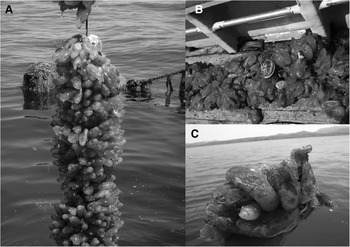
Cultured scallops, Mizuhopecten yessoensis, overgrown by the invasive ascidian, Ascidiella aspersa, in Funka Bay, Hokkaido, northern Japan: (A), (B) a cultured rope with scallops hung by using plastic clips; (C) a cultured scallop held in the hand, having shell length of ~90 mm. More than 30 ascidians were attached to the scallop in (C) when the photos were taken on 18 May 2015.

In this study, we examined the recruitment, growth, maturity and population dynamics of A. aspersa on cultured scallops in Funka Bay, and sought to relate the life history of A. aspersa with scallop aquaculture, to understand why the invasive ascidian has become a serious problem for the aquaculture industry in the bay. We also compared our results with a past study of native populations by Millar (Reference Millar1952), which is considered the most detailed account of the reproductive cycles of A. aspersa (Global Invasive Species Database, Reference Goodbody2010), to deepen our understanding of the life history traits of this global invasive ascidian.
MATERIALS AND METHODS
Larval density and seawater analyses
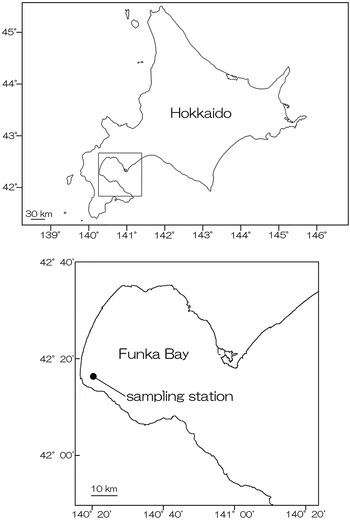
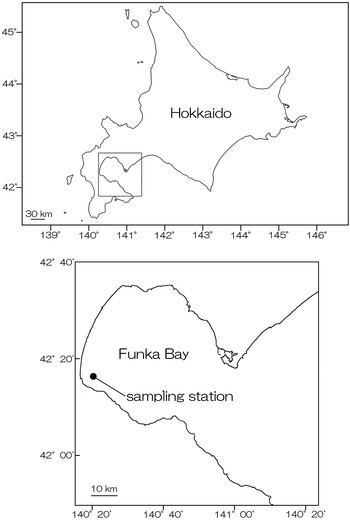
In preparation for our study, we observed the morphology of larvae and their changes during metamorphosis in the laboratory. Monthly larval surveys were conducted from July 2010 to June 2014 at the sampling station (42°16.208′N 140°20.568′E, depth = 32 m, Figure 2) to determine the reproductive period of A. aspersa. Larvae were collected in 225-mm or 300-mm diameter plankton nets (NXX13 nylon mesh, opening of 100 µm, RIGO Co. Ltd) hauled vertically from the bottom by hand. Our surveys were conducted between 11:30 and 13:30. Samples were fixed with glutaraldehyde (final concentration: 1%), and observed by stereoscopic microscope to count the number of A. aspersa larvae.
Maps showing Funka Bay, Hokkaido, northern Japan and a sampling station (42°16.208′N 140°20.568′E, depth = 32 m). Recording of environmental conditions and plankton surveys were conducted at the sampling station. Cultured scallops were collected around the sampling station to investigate the attached Ascidiella aspersa.
To determine the environmental factors that affect A. aspersa populations, water temperature and salinity were measured at every 1 m by CTD (RINKO-Profiler ASTD102, JFE Advantech Co. Ltd), and 300 ml of seawater was sampled using a Van Dorn sampler (RIGO Co. Ltd) at depths of 5, 10 and 15 m at the sampling station. Each sample was filtered using a glass microfibre filter (GF/F, 47 mm, Whatman, GE Healthcare Life Science), and chlorophyll a (Chl-a) was extracted with 10 ml of N,N-dimethylformamide (DMF) (Wako Pure Chemical Industries, Ltd). The Chl-a content was measured from the change using fluorescence (excitation 436 nm, emission 660 nm) before and after acidification by adding 0.1 ml of 5% HCl in 3 ml of the sample DMF solution. Fluorescence was measured by a fluorescence spectrophotometer (FP6300, JASCO Corp.). The concentration of Chl-a was calculated using Chl-a from chlorella (Wako Pure Chemical Industries, Ltd) as the standard.
Sampling, measurement and maturation level of A. aspersa
Five scallops, Mizuhopecten yessoensis, were collected monthly at 5-, 10- and 15-m depths from a culture rope near the sampling station between July 2010 and June 2014 (a total of 15 scallops were collected monthly). In Funka Bay, scallops are produced from a natural population of larvae, from spring to summer. Scallops are reared in cages from autumn to spring, and this is called the intermediate culture. Juvenile scallops, after an intermediate culture, are suspended for hanging culture in spring. Collection of the scallops is initiated after spring (June or July) each year, and completed the following June (from July 2010 to June 2011, from June 2011 to June 2012, from June 2012 to June 2013, and from June 2013 to June 2014). When hanging cultures are started, A. aspersa are seldom found on the scallops, which means that the ascidians found on scallops after spring are newly settled. In this study, therefore, the life history traits and population dynamics of A. aspersa were surveyed through four generations, the 2010, 2011, 2012 and 2013 cohorts.
Each scallop was placed in a zippered plastic bag to prevent the ascidians from falling off and carried to the laboratory in a cooler box. The surface of the scallop was examined by direct observation and under a stereoscopic microscope. Ascidiella aspersa were removed using forceps. The number of individuals per scallop was counted to assess seasonal variation in abundance, and the wet weight of A. aspersa was measured to assess seasonal variation in biomass. The weight of each scallop was quantified to compare it with the weight of the ascidians attached to it. Body length of each ascidian was determined within 0.1 mm using digital vernier calipers to examine size structure and growth. For small individuals (body length <5 mm) found using a microscope, body length was measured from images captured using a Digital Sight Ds-Fi1 camera with NIS-Elements software (Nikon Corporation). More than 50 A. aspersa were randomly chosen from all depths in September, December, March and June in 2010, 2011 and 2012, and fixed in 5–10% formalin seawater. After measuring body length, the specimen was dissected and genital ducts examined for eggs and sperm to evaluate the maturity. The 2013 cohort was not examined in terms of maturity. Sizes during maturity as male and female in September were analysed using generalized linear model (GLM) with a binomial error distribution. The response variable was whether eggs or sperm were in the ducts; the explanatory variable was body length, by using the statistical software R version 3.01 (R Development Core Team, 2013).
RESULTS
Larval density and environmental factors
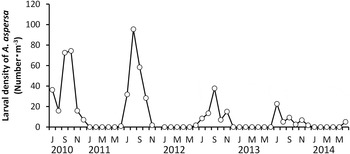
The larvae of A. aspersa appeared in July–December 2010, July–November 2011, June–December 2012 and June–December 2013 (Figure 3), and were not found in the samples from January to May each year. Densities (individuals m−3) were the highest between July and October. The highest density in each year was 74.3 in October 2010, 95.5 in August 2011, 37.7 in September 2012 and 22.6 in July 2013. Data were not collected in December 2012 because the plankton net was broken during the survey.
Seasonal variation in larval density of Ascidiella aspersa at a sampling station (42°16.208′N 140°20.568′E, depth = 32 m), Funka Bay, Hokkaido, northern Japan from July 2010 to June 2014. J, S, N, J, M, M: July, September, November, January, March, May.

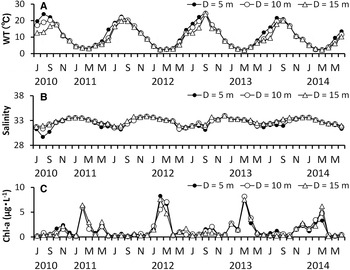
Water temperature reached its peak in August or September, except at 15-m depth in 2010 (Figure 4A). During summer 2010, a strong thermocline developed, in which the water temperature in August at 5-m depth was 23.9°C, whereas at 15-m depth, it was only 12.9°C. After the thermocline dissipated, the maximum water temperature at 15-m depth was 17.5°C, recorded in October. Water temperature was the lowest in February or March at all depths, in the range of 2.0–3.2°C. The seasonal fluctuation in salinity was stable in comparison with that of water temperature (Figure 4B). From spring to summer, the salinity was relatively low, fluctuating from 31.0 to 33.0 in part because of the inflow of the Oyashio Current, with low salinity, and in part because of the discharge of land water, including snowmelt runoff (Ohtani et al., Reference Ohtani, Akiba, Yoshida and Ohtuki1971b). From autumn to winter, the salinity fluctuated from 33.0 to 34.0 because of the inflow of the Tsugaru Warm Current, with high salinity (Ohtani et al., Reference Ohtani, Akiba, Ito and Onoda1971a). There were no obvious differences in salinity between depths, except in August–September 2010, when the thermocline developed intensely. A strong increase in Chl-a, a spring bloom, occurred between February and April every year, and the concentration of Chl-a peaked at 6–8 µg l−1 (Figure 4C). After the spring bloom, the concentration remained low in summer and had an annual variability in autumn. A difference in Chl-a concentration between depths was not noted, and the average concentrations in 5-, 10- and 15-m depths through the survey period were nearly the same at 1.53, 1.49 and 1.51 µg l−1, respectively.
Seasonal variation in (A) water temperature, (B) salinity and (C) chlorophyll-a concentration at a sampling station (42°16.208′N 140°20.568′E, Depth = 32 m), Funka Bay, Hokkaido, northern Japan from July 2010 to June 2014. J, S, N, J, M, M: July, September, November, January, March, May.

Seasonal variation in size, weight and maturity of A. aspersa on scallops
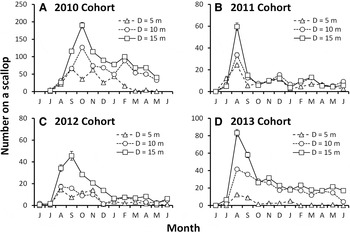
In June, few A. aspersa were found on cultured scallops, and the average number per scallop at all depths was 0–0.9 individuals. In July, the average number increased to 0.9–7.8 individuals per scallop, and A. aspersa was observed at all depths except at the 5-m depth in 2013. After July, the number of A. aspersa per scallop increased and reached its peak between August and October. The average number of A. aspersa per scallop at each depth in each year is shown in Figure 5. The maximum number per scallop on average for all depths in each year was 117.4 individuals in October 2010, 39.2 individuals in August 2011, 22.9 individuals in September 2012 and 45.7 individuals in August 2013. During the time the numbers were increasing, as water depth increased, the number of A. aspersa also increased. After that, their numbers decreased, with an especially rapid rate of decrease at the 15-m depth. Because of this trend, in winter, the difference in number between the 10-m and 15-m depths became small. The number of A. aspersa at the 5-m depth was relatively low throughout the survey. June 2011 abundance data are not represented because only five scallops were collected, without the depth information.
Seasonal variation in the number of Ascidiella aspersa on cultured scallops (first J on the horizontal axis is June of the year presented on the graph; last J is June of the following year). Average and standard error of number of A. aspersa on a scallop in each depth are shown: (A) 2010 cohort from July 2010 to May 2011; (B) 2011 cohort from June 2011 to June 2012; (C) 2012 cohort from June 2012 to June 2013; and (D) 2013 cohort from June 2013 to June 2014. For June 2012 and 2013, cultured scallops hung in the previous year and the year were collected. Scales of vertical axes are different.

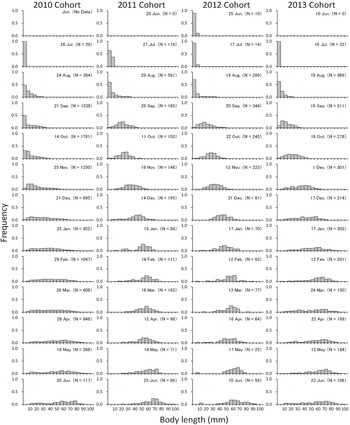
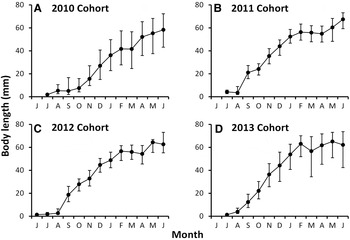
No clear variation in size structure of A. aspersa on cultured scallops was noted between depths. However, seasonal variation in the size frequency was noted when all depths were combined, as shown in Figure 6. Juvenile ascidians (body length <5 mm) dominated during the period of increasing abundance. For the 2010 cohort, many juvenile ascidians were found from August to October, whereas for the 2011, 2012 and 2013 cohorts, juvenile ascidians were found mainly from July to August. Figure 7 shows the seasonal variation in the body length of A. aspersa on cultured scallops at all depths. Ascidiella aspersa grew well until February following each season, when their body length remained unchanged or decreased slightly from February to March or April.
Seasonal variation in size frequency of Ascidiella aspersa on cultured scallops at all depths.

Seasonal variation in the body length of Ascidiella aspersa on cultured scallops at all depths (first J on the horizontal axis is June of the year presented on the graph; last J is June of the following year). The medians are shown as representative values. Bars indicate 25th and 75th percentiles: (A) 2010 cohort from July 2010 to June 2011; (B) 2011 cohort from July 2011 to June 2012; (C) 2012 cohort from June 2012 to June 2013; and (D) 2013 cohort from July 2013 to June 2014.

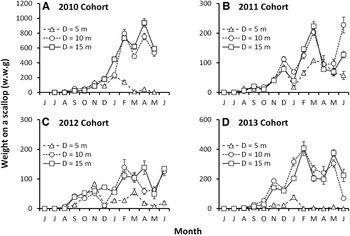
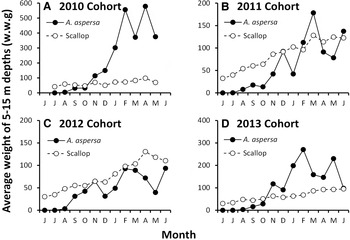
The biomass of the scallops increased steadily in each year. The biomass of A. aspersa on scallops increased, with fluctuations, until February, and after that, changes were less clear (Figures 8 & 9). For the 2010 cohort, the average weight of A. aspersa at all depths exceeded that of the scallops even in November, and was three to seven times heavier in harvest season, from December to April, meaning that the weight of A. aspersa accounted for 75–90% of the total weight of the harvest. For the 2011 cohort, the average weight of the ascidians was less than that of the scallops except in February and March. For the 2012 cohort, the average weight of the ascidians was always less than that of the scallops. The weight of the ascidians in the 2013 cohort was more than that of the scallops in and after November. June 2011 weight data are not represented because only five scallops were collected, without the depth information.
Seasonal variation in biomass of Ascidiella aspersa on cultured scallops (first J on the horizontal axis is June of the year presented on the graph; last J is June of the following year). Average and standard error of wet weight (w.w. in grams [g]) of A. aspersa per month at each depth is shown: (A) 2010 cohort from July 2010 to May 2011; (B) 2011 cohort from June 2011 to June 2012; (C) 2012 cohort from June 2012 to June 2013; and (D) 2013 cohort from June 2013 to June 2014. For June 2012 and 2013, cultured scallops hung in the previous year and the year were collected. Scales of vertical axes are different.

Seasonal variation in biomass of Ascidiella aspersa and cultured scallop, Mizuhopecten yessoensis (first J on the horizontal axis is June of the year presented on the graph; last J is June of the following year). Average wet weight (w.w. in grams [g]) of A. aspersa and M. yessoensis per month at all depths is shown: (A) 2010 cohort from July 2010 to May 2011; (B) 2011 cohort from June 2011 to June 2012; (C) 2012 cohort from June 2012 to June 2013; and (D) 2013 cohort from June 2013 to June 2014. Scallops were hung in spring each year. For June 2012 and 2013, cultured scallops hung in the previous year and the year were collected. Scales of vertical axes are different.

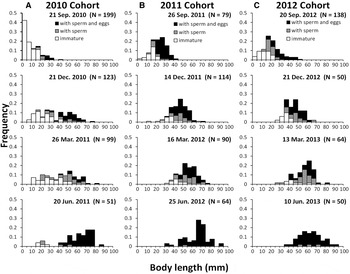
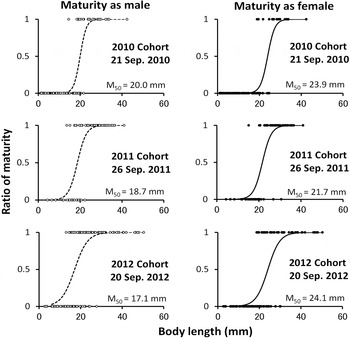
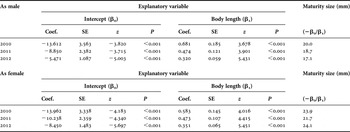
Ascidiella aspersa with eggs and sperm in the ducts were found as late as September 2010, 2011 and 2012 (Figure 10). Because there were many juvenile ascidians in September 2010, the ratio of ascidians having gametes was low (15%) at that time. On the other hand, in 2011 and 2012, the ratios were high, at 72.2 and 62.3%. Although there were few larvae and juveniles in December and March, many ascidians had eggs or sperm in the ducts. The ratios of individuals having gametes in December 2010, 2011 and 2012 were 52.0, 81.6 and 78.0%, respectively, and, in March 2011, 2012 and 2013, the ratios were 54.6, 84.4 and 87.5%, respectively. In June 2011, 2012 and 2013, the ratios were 92.1, 100 and 100%, respectively. In September, estimated 50% maturity size as male was 17–20 mm, and as female, 22–24 mm (Figure 11). The maturity size as female was ~5 mm larger than that as male, and in December and March, there were many A. aspersa with no gametes, even if the body length exceeded the 50% maturity size estimated in September. In the GLM analysis of maturity related to size as male and female in September, all of the estimated coefficients for body length were significant (Table 1, Wald test P < 0.001).
Size frequency and the presence of sperm and eggs in the ducts of Ascidiella aspersa: (A) 2010 cohort; (B) 2011 cohort; and (C) 2012 cohort. Ascidians having neither eggs nor sperm in their ducts are regarded as immature.

Relation between body length and maturity of Ascidiella aspersa in September. Maturity is assessed by the presence of gametes in the ducts. The best-fit logistic curves are shown. Maturity size (M50) indicates the size at which 50% of A. aspersa mature, estimated according to the logistic curves.

Results of generalized linear model (GLM) analysis for the maturity of Ascidiella aspersa collected in September. All of the coefficients for body length are significant (P < 0.001, Wald test). The maturity size indicates the size at which 50% of A. aspersa mature.

DISCUSSION
Life history traits and population dynamics of A. aspersa in Funka Bay
In Funka Bay, the larvae of A. aspersa appeared between June and December, and the highest density was observed between July and October. In addition, juvenile ascidians were found on cultured scallops mainly between July and October. Therefore, the reproductive period of A. aspersa is thought to be from June to December, and the main breeding season, from July to October. A study conducted from 1991 to 1997 in Long Island Sound, New England, showed that recruitment of A. aspersa started between June and July and, on average, initiation of recruitment was estimated to occur on 1 July (Stachowicz et al., Reference Stachowicz, Terwin, Whitlatch and Osman2002). The onset of recruitment of A. aspersa in Funka Bay corresponds to that in Long Island Sound. The reproductive season of ascidians usually coincides with the period of maximum food production (Lambert, Reference Lambert2005). However, this idea does not apply to A. aspersa in Funka Bay because it is between February and April that the bay has a spring bloom and conditions for filter-feeders are good. Ascidiella aspersa grew well until February following the reproductive season. Their body length remained stagnant from February to March or April, when the bay has high production. The Oyashio Current, a subarctic current, introduces cold water to the bay and water temperatures fall below 4°C in February and March. Hence, the growth of A. aspersa would be depressed by low water temperature.
In autumn, A. aspersa had eggs or sperm. Ascidiella aspersa are known to be hermaphroditic, although the male sex organs develop first (Millar, Reference Millar1952). In Funka Bay, the maturity size as males was estimated to be 17–20 mm, and as females was estimated to be 22–24 mm. Ascidians that reached these sizes in autumn had gametes and were expected to start reproduction. In December and March, there were many immature ascidians whose body length was greater than the maturity size in September. This indicated that factors other than body length influenced the accumulation of gametes. Because larvae and juvenile ascidians were scarcely found in winter and spring, the ascidians having gametes in December and March are thought to be the animals that reach maturity size in autumn and continue to have gametes after the reproductive season. In June, most of the A. aspersa had eggs and sperm, showing that the conditions needed for the maturity are fulfilled between March and June. Temperature is correlated with the timing of reproduction in many ascidian species (Millar, Reference Millar1971; Goodbody, Reference Goodbody2004; Shenkar & Loya, Reference Shenkar and Loya2008; Rius et al., Reference Rius, Carmen and Turon2009). The average temperatures found at 5–15-m depth in September, December, March and June were 21.3, 8.0, 2.6 and 11.2°C, respectively. Hence, A. aspersa stopped gamete accumulation when water temperature decreased from 21.3 to 8.0°C, and started it again when water temperature increased from 2.6 to 11.2°C. From this, we speculate that A. aspersa have a critical temperature to start or stop the gamete accumulation, estimated to be between 8 and 11°C.
The number of A. aspersa on the cultured scallops increased sharply after July and the number of juvenile ascidians increased with increasing water depth. In most cases, larval behaviour is a good predictor of adult distribution of ascidians (Svane & Young, Reference Svane, Young and Barnes1989). At first, the larvae of A. aspersa exhibit positive phototaxis and negative geotaxis; however, the reactions are reversed at later stages (Niermann-Kerkenberg & Hoffman, Reference Niermann-Kerkenberg and Hoffman1989). The reaction of larvae of A. aspersa to environmental factors may explain the difference in quantity of ascidians at varying depths in our results. In our survey, the number of juvenile ascidians did not increase in autumn 2011, 2012 and 2013, although the generation from the previous year would continue reproduction; moreover, the recruits in summer would start spawning in autumn. Ascidiella aspersa and other fouling animals settled over the surface of scallops in summer, and they may have prevented larvae of A. aspersa from settling on scallops in autumn.
In 2010, the increase in ascidians was the greatest from August to September; however, in other years, it was from July to August. In Funka Bay, warm and less saline water is found in the surface layer from spring to summer, and a strong seasonal thermocline is formed (Ohtani et al., Reference Ohtani, Akiba, Yoshida and Ohtuki1971b). The thermocline dissipates by atmospheric influences and inflow of the Tsugaru Warm Current from summer to autumn (Ohtani et al., Reference Ohtani, Akiba, Ito and Onoda1971a). The average air temperature of northern Japan in summer 2010 was the highest it had been since 1946 (Japan Meteorological Agency, 2010a), and in autumn, the temperature continued to be higher than that in an average year (Japan Meteorological Agency, 2010b). In addition, the inflow of the Tsugaru Warm Current was delayed, and not observed until mid-September (Hakodate Fisheries Research Institute, 2010). Under these conditions, the strong thermocline developed for a long time, and water temperatures in the depths below 15 m did not increase in summer. The low water temperature at deeper zones in summer 2010 may have influenced the reproduction of A. aspersa populations, resulting in the delay of A. aspersa increasing on cultured scallops.
During our survey, the Great East Japan Earthquake and the subsequent tsunami occurred on 11 March 2011. Funka Bay is ~500 km away from the centre of shock. Even so, the waves (maximum 1.6-m high) repeatedly struck the bay, damaged the facilities for scallop aquaculture, and affected coastal fauna (Japan Meteorological Agency, 2012; Natsuike et al., Reference Natsuike, Kanamori, Baba, Moribe, Yamaguchi and Imai2014). Most of the A. aspersa on the scallops at 5-m depth disappeared in and after March 2011 because the tsunami caused ascidians to drop off scallops in the shallow water. The effect on the ascidian population at 10–15-m depth appears small. The facilities damaged by the tsunami were removed and new facilities were established between 2011 and 2012 (Hokkaido Government, 2012), and consequently, many ascidians attached to the facilities were also removed. Facilities of aquaculture are considered important habitats for invasive ascidians (Lambert, Reference Lambert2005; Howes et al., Reference Howes, Herbinger, Darnell and Veraemer2007; Carman et al., Reference Carman, Morris, Karney and Grunden2010). The tsunami and the removal of damaged facilities may explain why the numbers of A. aspersa on the scallops decreased in 2011 and 2012.
Life history of A. aspersa and the process of scallop aquaculture
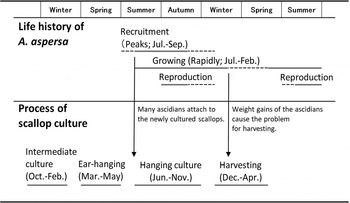
The surface of newly suspended scallops is clean because they rub against netting or other scallops in the cage during intermediate culture; thus, they become a suitable substrate for sessile organisms, especially species that begin reproduction in early summer, such as A. aspersa. Harvest season for cultured scallops in the bay is mainly from December to April in order to avoid the shellfish toxin period and competition with other areas of production (Imai et al., Reference Imai, Shimada, Shinada, Baba, Kanamori, Sato, Kuwahara, Miyoshi, Tada, Hirano, Miyazono and Itakura2014). Consequently, there is enough time for A. aspersa that have settled in summer to grow prior to scallop harvesting, and hence the harvest and shipment must be conducted after the weight of ascidians become several times heavier than that of scallops. The linking of ‘hang in spring and harvest in winter’ of the cultured scallops and ‘recruitment after spring and rapid growth until winter’ of A. aspersa results in serious problems in the aquaculture industry in Funka Bay (Figure 12). Effects of invasive organisms on an aquaculture industry depend on the relationship between the life history of the invasive species and the process of aquaculture in the introduced area. It is important to understand the life history and adaptations of invasive species in order to evaluate the risk of introduction to fisheries activities.
Life history of Ascidiella aspersa and basic process of scallop culture in Funka Bay, Hokkaido, northern Japan. Scallops hung in spring become suitable substrate for A. aspersa, which start their reproduction in early summer. The rapid growth and weight gains of A. aspersa from summer to winter cause serious problems for the scallop-harvesting season.

Comparison of life history of A. aspersa in Funka Bay and native area
The article by Millar (Reference Millar1952) is considered to be the most detailed account of the life history of A. aspersa (Global Invasive Species Database, 2010), and the description in the literature and many databases are based on this significant work (e.g. Global Invasive Species Database, 2010; Mackenzie, Reference Mackenzie2011). Millar (Reference Millar1952) studied the reproductive cycle and population dynamics of A. aspersa throughout 1950 and 1951 in Ardrossan, south-western Scotland, which is their native habitat and we summarize his findings here.
Larvae settle in the summer (July–August) and grow until the end of September. Ascidiella aspersa grow again after winter or spring. The lifespan is ~18 months, extending approximately from the middle of one summer until the winter of the following year. Ascidiella aspersa have only one spawning season, and that is in the year after A. aspersa settled as larvae. Ascidiella aspersa is hermaphroditic and protandrous, in which the male reproductive organs come to maturity before the female reproductive organs. Sexual maturity is dependent on size; sperm development occurs when the animals are about 25-mm long, while eggs are found in the oviduct when the animals are about 30-mm long (Millar, Reference Millar1952). Most of the life history traits of A. aspersa in Funka Bay seem to be essentially identical to that summarized by Millar (Reference Millar1952). However, there are some clear differences.
The estimated reproductive period (June–December) and the main breeding season (July–October) in Funka Bay is longer than the recruitment season in Ardrossan (July–August). Ascidiella aspersa grow well until February in Funka Bay, and the average water temperature at 5–15-m depth fluctuates between 4 and 21°C from July to February. In Ardrossan, A. aspersa grow until late in September. From the information in Saltcoats, a town near Ardrossan, the peak water temperature is 14°C in August, and the lowest is 7°C in March (World Sea Temperatures, 2015). This suggests that factors other than water temperature influenced the differences in growth period of A. aspersa between Funka Bay and Ardrossan. In Funka Bay, 60–70% of A. aspersa settled in summer have eggs or sperm in September, and A. aspersa would start to reproduce. From January to May, A. aspersa stop reproduction, and start spawning again in June. In contrast, A. aspersa in Ardrossan is regarded as the typical annual species, which has only one spawning season in the year after it has settled. Further, the extra generation of A. aspersa does not occur in the native population on the west coast of Norway (Dybern, Reference Dybern1969). The natural distribution of A. aspersa includes European low latitudes, such as the Mediterranean, but we have no information about the reproduction of A. aspersa in these areas. Ascidiella aspersa populations in the warmer temperature of the native range perhaps start to reproduce in the recruitment year as seen in Funka Bay. There is a possibility that the voltinism and reproductive traits of A. aspersa population is directly influenced by the habitat temperature, as discussed in the case of peracarida crustaceans (e.g. Vicente & Sorbe, Reference Vicente and Sorbe2013). Study of the life history and population dynamics of native A. aspersa population in warmer habitats is required to understand the life history strategy of this species.
The maturity size of A. aspersa in Funka Bay is ~5–8 mm smaller than that in Ardrossan. In Millar's study, the samples were fixed after they were narcotized with menthol; in our study, the samples were directly fixed, which may have led to an underestimation of the body length. The test of A. aspersa is firm, and their siphons are short. Consequently, the difference in body length between individuals narcotized and those not narcotized was small, up to 3.5 mm, when the body length was from 10.3 to 44.6 mm (N = 30, examined by MK on 14 September 2015). The differences in method of fixation would not fully account for the disagreement of maturity size between Funka Bay and Ardrossan. Millar (Reference Millar1952) also described that ascidians in Loch Sween, Argyll, western Scotland, became mature at a smaller body size than did those in any of the samples from Ardrossan. Further analysis is required to determine whether maturity size is different between Funka Bay and native ranges.
As described above, compared with the native population in Ardrossan, A. aspersa in Funka Bay has a longer reproductive and growth period, earlier initiation of reproduction, and possibly smaller maturity size. The vigour and success of invasive species has been explained by favourable environments where they are introduced and by release from natural enemies and the adaptation or evolution of increasing competitive ability (Blossey & Nötzold, Reference Blossey and Nötzold1995; Keane & Crawley, Reference Keane and Crawley2002; Colautti et al., Reference Colautti, Ricciardi, Grigorovich and Maclsaac2004). Further studies that assess environmental factors, such as temperature and food conditions, and enemies regulating the population in native regions, are necessary to compare life history traits of the global invasive species, A. aspersa, in native and introduced ranges.
ACKNOWLEDGEMENTS
We thank Professor Teruaki Nishikawa of Toho University for the invaluable information on identification of ascidians. We are also grateful to Mr Daisuke Achiya of the Yakumo Town Fisheries Cooperative, Associate Professor Isao Kudo of the Hokkaido University, and the students in Research Group of Marine Environmental Science, Graduate School of Fisheries Sciences, Hokkaido University for their helpful assistance in the field samplings. We appreciate Dr Joan Cartes and the anonymous reviewer for their valuable suggestions and comments.
FINANCIAL SUPPORT
This study was conducted as a part of the contract researches from the Hokkaido Scallop Fisheries Promotion Association in 2010, 2011, 2012 and 2013.