Introduction
The oldest old are one of the fastest segments of population worldwide. In Portugal, individuals aged 80 and plus represent 5.6% of the total population (INE, 2012). The exponential growth of the oldest old is expected to be associated with an increase of psychogeriatric illness. Several studies have consistently shown an increase in the prevalence of dementia with age (e.g. Brayne et al., Reference Brayne1995). However, this finding was refuted by other studies, which verified a general pattern of decreasing rates of these disorders with increasing age (e.g. Reynolds et al., Reference Reynolds, Pietrzak, El-Gabalawy, Mackenzie and Sarren2015). Moreover, few studies provide accurate estimates of dementia and other psychiatric disorders as depression among the oldest-old, i.e. those aged 80 years and older (James and Schneider, Reference James and Schneider2010), since much of the available literature in geriatric psychiatry ignores this age group. In addition, it is difficult to have accurate information of the rates of mental illness in the older population due to the different methodologies and populations surveyed.
As in several other European countries, in Portugal little attention has been given to the prevalence rate of mental illness among the oldest old population (Xavier et al., Reference Xavier, Baptista, Mendes, Magalhães and Caldas-de-Almeida2013). Portuguese epidemiological data on mental health disorders is scarce, and very little is known about the prevalence of these conditions among the oldest old (80+) and included age subgroups. One of the first population-based Portuguese studies about the prevalence of dementia, conducted in Northern Portugal primary care units, found a prevalence of 2.7% for dementia (DSM-IV criteria) and 12.3% for cognitive impairment without dementia (Nunes et al., Reference Nunes, Silva, Cruz, Roriz, Pais and Silva2010). A more recent study estimated in 160287 the number of Portuguese people with dementia among those aged ≥ 60 years, and revealed that more than 64% of patients with dementia are aged above 80 (Santana et al., Reference Santana, Farinha, Freitas, Rodrigues and Carvalho2015). Regarding depression, although the National Epidemiological Mental Health Study provides solid evidence about its prevalence in Portugal, geriatric depression remains poorly characterized, as the utility of the DSM-IV-TR criteria for depression can be questionable in some geriatric situations (Gonçalves-Pereira et al., Reference Gonçalves-Pereira2016); indeed, Eurobarometer studies showed a high non-specific psychological suffering (anxiety and depression symptomatology) in Portugal for older people in comparison with other European countries (European Commission, 2003).
According to the most recent national report on mental health, only a small proportion of those with mental health problems have access to public specialized mental health services, and hospitalization continues to consume the majority of resources (DGS, 2016). Although not a leading cause for hospital admissions among older persons, psychiatric disorders are an important source of mental health expenditure (Chung, Reference Chung2010; Ritter et al., Reference Ritter, Dal Pai, Belmonte-de-Abreu and Camozzato2016). Even though, the available evidence studying the prevalence of psychiatric disorders in the hospital context is scarce. Previous studies reported that the prevalence of dementia among persons discharged from general hospitals was 8%–27% (e.g. Fulop et al., Reference Fulop, Strain, Fahs, Schmeidler and Snyder1998). In a sample of patients aged ≥60 in a general hospital, Lyketsos et al. (Reference Lyketsos2000) found a prevalence of dementia among discharged patients of 3.9%, but with differences according to the age group (2.6% in the group aged 60–64 years, and 8.9% in the group aged 85 and older). Ritter et al. (Reference Ritter, Dal Pai, Belmonte-de-Abreu and Camozzato2016) evaluated trends in psychiatric bed occupancy by elderly inpatients in the Brazilian public healthcare system between 2000 and 2010, and found that schizophrenia, schizotypal, and delusional disorders were responsible for about 60% of the days spent in hospital by older inpatients.
In line with the available and inconsistent information on psychiatric morbidity in the oldest old, the burden of psychiatric disorders also remains unclear. It has been underestimated in the past because traditional approaches tend to ignore the number of years lived with disability (YLDs). However, among the ten main causes of long-term disability, five are psychiatric disorders (Caldas de Almeida, Reference Caldas de Almeida2009), which reinforce the importance of studying the impacts and burden of these disorders. Mental-health related disorders are associated with a wide range of disabilities and functional impairments, constitute one of the main causes of premature death and have an association with suicide and institutionalization (Erlangsen et al., Reference Erlangsen, Mortensen, Vach and Jeune2005; Xavier et al., Reference Xavier, Baptista, Mendes, Magalhães and Caldas-de-Almeida2013) among older persons. Disability-adjusted life years (DALYs), years of life lost to premature mortality (YLLs), and YLDs are some of the indicators commonly used to estimate the burden attributable to mental and substance use disorders. Data from the Global Burden of Disease Study 2010 found that mental and substance use disorders were the leading cause of YLDs worldwide, and accounted for 7.4% of all DALYs worldwide, being the fifth leading disorder category of global DALYs (Whiteford et al., Reference Whiteford2013). Specifically for older adults, according to a recent WHO report, neuropsychiatric disorders account for 6.6% of the total disability (DALYs) for this age group (WHO, 2016).
In addition to the impacts in disability, mental disorders are also expected to have an impact in healthcare utilization. However, data available concerning the influence of these disorders on the use of care services remains scarce (Hendrie et al., Reference Hendrie2012). Even so, available studies generally point to higher rates of hospitalization and emergency department visits, greater disability, and worse health outcomes in mentally ill older adults than in older patients with a physical condition only (Wancata et al., Reference Wancata, Windhaber, Krautgartner and Alexandrowicz2003). Concurrently, the cost per person with mental illness and a medical illness is higher when compared to patients presenting only a medical illness, and a discharge diagnosis of dementia was associated with higher per capita costs, which were likely driven directly by longer lengths of stay (Lyketsos et al., Reference Lyketsos2000; Struble, Reference Struble2016). This scenario may lead to a growing demand for long-term hospital beds specializing in the care of psychiatric patients.
The aims of this study are: (i) to describe the trend in inpatient episodes with a psychiatric disorder as primary discharge diagnosis by patients aged 80 years and over in a 15 years period [between 2000 and 2014], (ii) to analyze the most frequent psychiatric discharge diagnosis, and (iii) explore gender differences and differences among three distinct subgroups: octogenarians, nonagenarians and centenarians. It is expected that this study can add to the body of knowledge concerning the oldest old psychiatric disorders and associated hospitalizations.
Methods
This study considered administrative data from all public hospitals in the Portuguese National Health Service (NHS), located in the continent, which includes psychiatric hospitals. Data from private hospitals, and those located in Azores and Madeira Islands were not included, as they are autonomous administrative divisions and use a specific local system. In Portugal, the NHS covers the whole population, and inpatient episodes in public hospitals represent nearly 85% of all hospitalizations.
We included all inpatient admissions of individuals aged 80 years and older with a principal diagnosis of a psychiatric disorder, with a discharge date between 2000 and 2014. The unit of analysis is the hospital discharge episode. Episodes were coded by trained physicians, with specific training in clinical codification using the International Classification of Diseases 9th Revision Clinical Modification – ICD-9-CM, and classified in Diagnosis Related Groups (DRGs) (Mateus, Reference Mateus, Busse, Geissler, Quentin and Wiley2013). HCUP Clinical Classifications Software (CCS), 2014 revision, was used to cluster patient diagnoses (https://www.hcupus.ahrq.gov/toolssoftware/ccs/ccs.jsp). DRGs are a systematic classification of the hospitalized patients in acute care hospitals, and the most widely employed patient classification system in Europe (Busse et al., Reference Busse2013). Data regarding comorbidities, and more specifically the prevalence of dementia as a secondary diagnosis, was also analyzed. Comorbidities were identified using ICD-9-CM codes associated to secondary diagnoses and the Charlson Comorbidity Index (Deyo et al., Reference Deyo, Cherkin and Ciol1992). No ethical approval was required, since the study did not directly involve human participants, and the database is anonymized. Data were analyzed using descriptive statistics in order to obtain the profile of inpatient episodes with a psychiatric disorder as primary discharge diagnosis. Results were presented for the total sample, and considering a distinction between octogenarians, nonagenarians, and centenarians subgroups. A binomial test was used to explore gender differences, and χ 2 tests were performed to analyze differences between the three subgroups considered in the six most frequent diagnoses. A significance level of α = 0.05 was considered.
Results
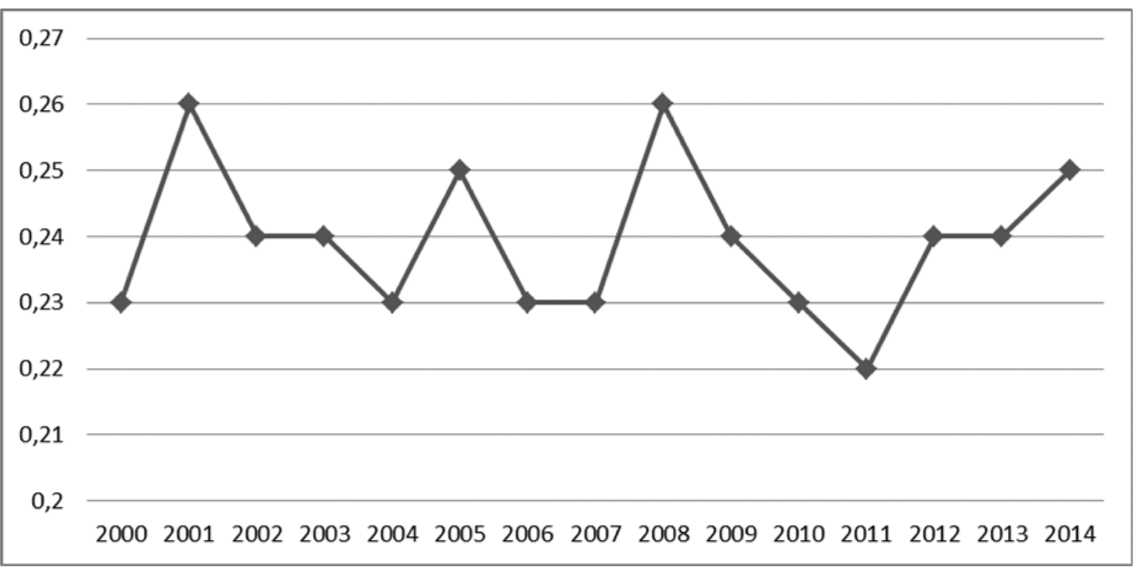
During the 15-years of the study period, 1,837.613 inpatient episodes by persons aged 80 and over occurred in Portuguese public hospitals. Among these, 16,430 (0.9%) refer to situations with a psychiatric disorder coded as primary discharge diagnosis, which corresponds to 4.6% of all inpatient admissions by psychiatric disorders in the general adult population; that is, those aged 18 years and older. The analysis of the trends in the number of these discharges points to an increase in hospital admissions among the general adult population, as well as among the oldest old subgroup. This trend seem to be more noticeable in the oldest old, since the number of admissions almost doubled from 814 episodes in 2000 to 1471 episodes in 2014, whereas in the general population the increase is less expressive (18,120 episodes in 2000 to 25,902 episodes in 2014); in some of the years a significant decrease in the inpatient episodes can be observed when compared with the immediately preceding year. However, considering that the increasing older population is expected to have an influence on the trend of these hospital admissions among older adults, we also examined the rate of episodes by the resident population aged ≥80 years (Figure 1). Findings pointed to a somewhat maintenance of the rate of these admissions by the resident population.
The rate of inpatient episodes with a psychiatric disorder as main discharge diagnosis in the resident population aged 80 and older (2000–2014, Portugal).

The analysis of inpatient admissions having a psychiatric disorder as principal diagnosis by age group revealed that 88.6% of the episodes were of octogenarians, 10.5% of nonagenarians, and 0.9% of centenarians’ patients. Significant differences in the number of admissions by gender were found in all age groups, with the overall percentage of female patients (55.5%) lower than the expected population based value (64.7%), i.e. the binomial test indicated that the proportion of female patients of 0.555 was lower than the expected value of 0.647, p < 0.001 (one-sided). The same tendency was found when analyzing each age subgroup: in the octogenarians group, the percentage of female patients (54.2%) was lower than the expected population based value (63.6%), p < 0.001 (one-sided); similarly, in the nonagenarians the percentage of female patients (68.0%) was lower than the expected population based value (71.9%), p < 0.001 (one-sided), and the same happens for centenarians, but with a much lower percentage of female patients (37.7%), when compared with the expected population-based value (82.6%), p < 0.001 (one-sided).
The analysis of the proportion of oldest old with some mental-health related principal diagnosis has also shown significant differences among octogenarians, nonagenarians and centenarians subgroups (p < 0.001). In 0.9% of the inpatient episodes by octogenarians, the patients had a principal diagnosis of a psychiatric disorder, whereas in nonagenarians this percentage was 0.6%, and in centenarians 2.4%.
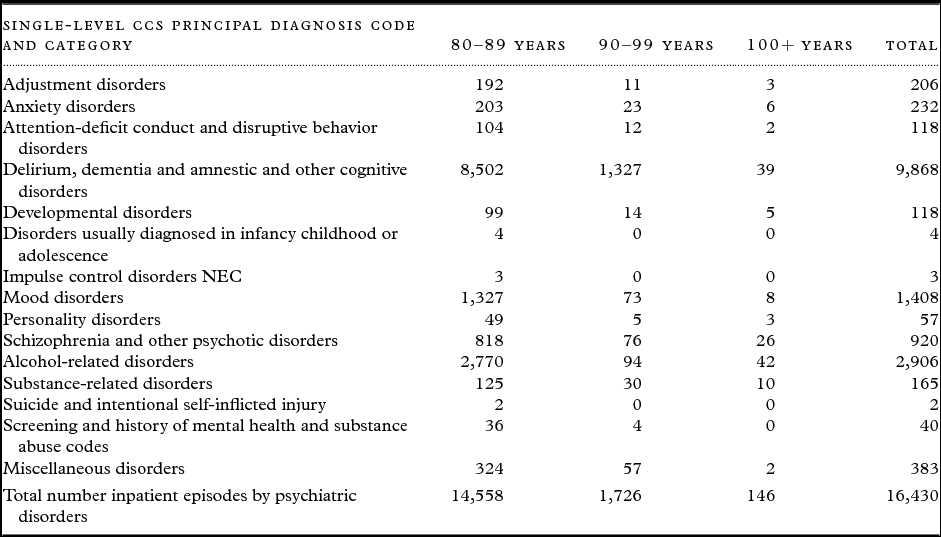
Considering the total number of inpatient admissions having a psychiatric disorder as principal diagnosis, the most frequent principal discharge diagnoses (grouped by CCS) in the oldest old were delirium, dementia, and amnestic and other cognitive disorders (60.1%), alcohol-related disorders (17.7%), mood disorders (8.6%), and schizophrenia and other psychotic disorders (5.6%) (Table 1).
Principal diagnosis for inpatient episodes by psychiatric disorders, grouped by CCS (2000–2014, Portugal)

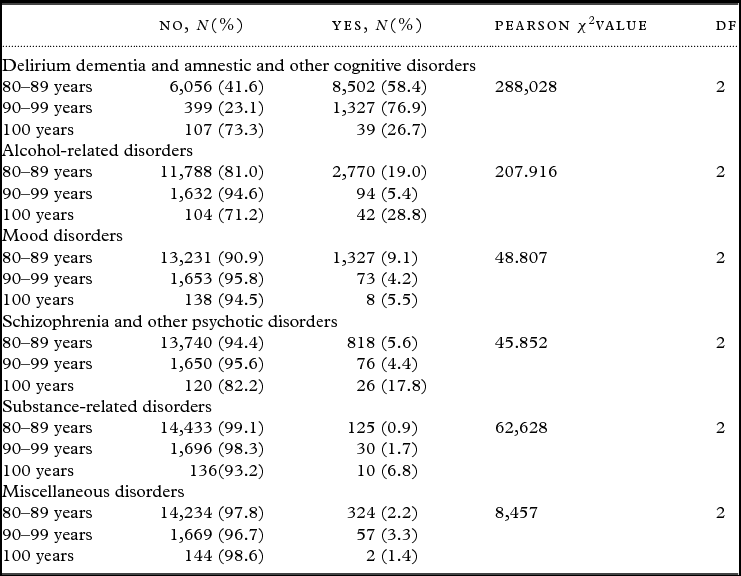
A first analysis considering a distinction between the three age groups apparently pointed to some differences in the distribution of the most common discharge diagnosis. For instance, regardless of the high percentage of cases of delirium, dementia, and amnestic and other cognitive disorders in all subgroups, the relevance of this diagnosis seems to decrease in the centenarians’ subgroup. Conversely, the frequency of alcohol-related disorders seems to be higher in the centenarians group. Considering this outlook, statistical analyses by age subgroup were conducted for the six most frequent diagnoses in the subgroups (delirium, dementia, and amnestic and other cognitive disorders; alcohol-related disorders; mood disorders; schizophrenia and other psychotic disorders; miscellaneous disorders; substance-related disorders), which corroborated the existence of significant differences (Table 2).
χ 2 tests for the most frequent principal diagnosis for inpatient episodes by psychiatric disorders

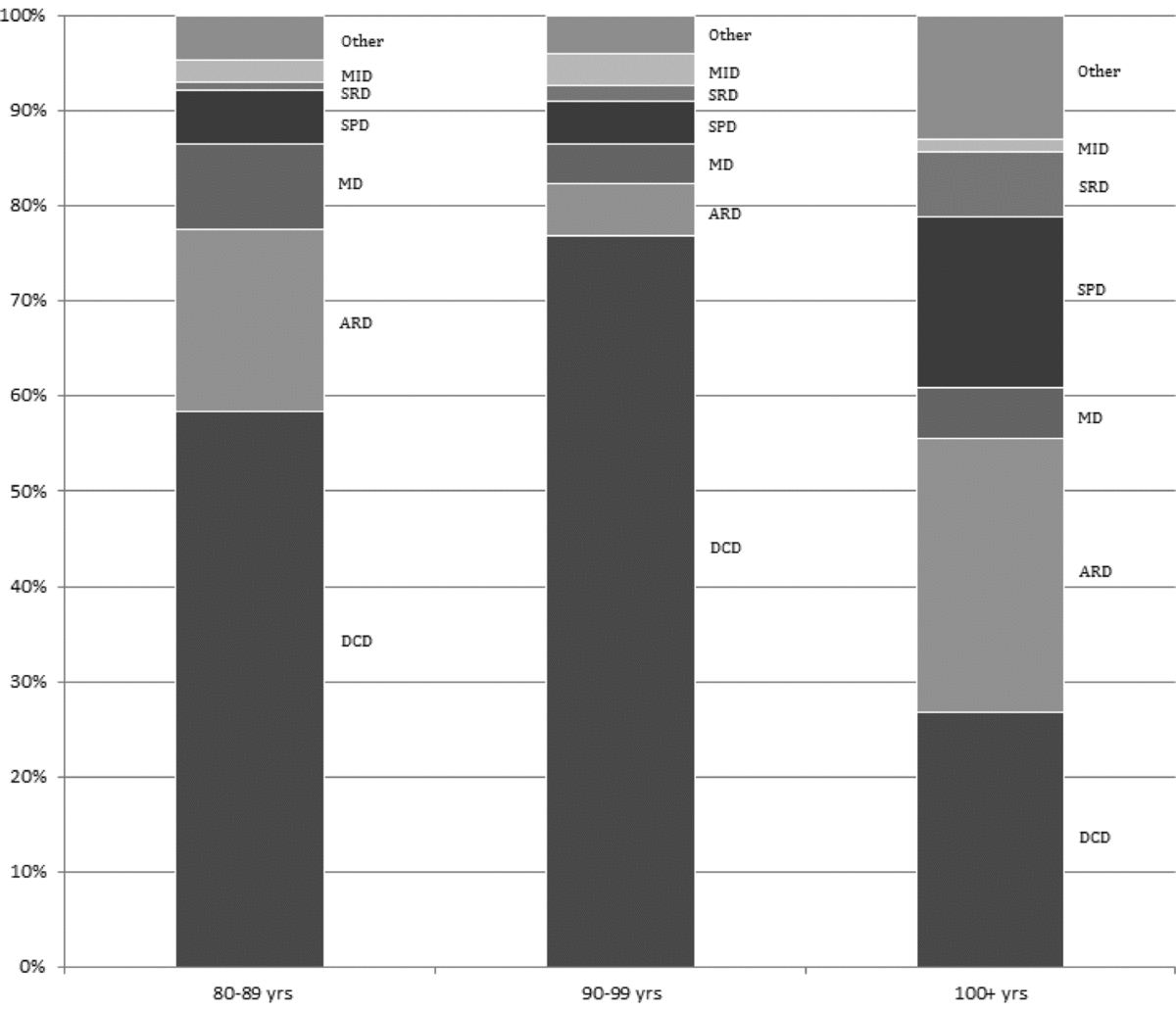
The analysis of delirium, dementia and amnestic and other cognitive disorders pointed to a higher percentage of this diagnosis among nonagenarians (76.9%), followed by octogenarians (58.4%). Alcohol-related disorders, in turn, have a higher percentage in centenarians (28.8%), followed by octogenarians (19.0%). Regarding mood disorders, the frequency of this diagnosis is higher in octogenarians (9.1%), and lower in nonagenarians (4.2%). The percentage of diagnoses of schizophrenia and other psychotic disorders, as well as substance-related disorders were higher among centenarians (17.8% and 6.8%, respectively). Finally, regarding miscellaneous disorders, the higher frequency was found in the nonagenarians group (3.3%), and the lower percentage in the centenarians group (1.4%) (Figure 2).
The six most frequent mental health diagnoses (main diagnosis) by age group DCD – Delirium dementia and other cognitive disorders; ARD – alcohol-related disorders; MD – mood disorders; SPD – schizophrenia and other psychotic disorders; SRD – substance-related disorders; MID – miscellaneous disorders.

With respect to the prevalence of dementia coded as comorbidity, data revealed that among the total number of inpatient episodes, in 6.5% dementia was coded as a secondary diagnosis. Considering a distinction between the three age subgroups, this percentage was 6.0% in octogenarians, 9.2% in nonagenarians, and 8.7% in centenarians.
Discussion
This study highlights the increasing number of inpatient admissions with a psychiatric disorder as main discharge diagnosis among the Portuguese oldest old. A first exploratory interpretation refers to the aging of the population, since it is expected to be associated with a higher number of persons experiencing some kind of mental disorder. Advancing age has been reported in some studies as a risk factor for mental disorders (e.g. James and Schneider, Reference James and Schneider2010), which along with the scarceness of psychogeriatric community programs in the national context (Caldas de Almeida, Reference Caldas de Almeida2009) and the increase in the quality of hospital-coded data (Freitas et al., Reference Freitas, Lema, Costa-Pereira and Rocha2016) can contribute to explain the increase in mental-health hospitalizations. Second, it was found a higher number of admissions among female patients. The existence of significant gender differences in the number of hospitalizations was somehow expected, considering the women´s higher life expectancy and presence of health problems commonly cited in the literature (e.g. Chatterji et al., Reference Chatterji, Byles, Cutler, Seeman and Verdes2015). Even so, research examining gender differences across late-life psychiatric disorders is still scarce, and commonly focused on mood disorders. Despite this, among the available studies, higher rates of psychiatric disorders in women can be commonly found (e.g. Byers et al., Reference Byers, Yaffe, Covinsky, Friedman and Bruce2010; Reynolds et al., Reference Reynolds, Pietrzak, El-Gabalawy, Mackenzie and Sarren2015). Biological (e.g. a stronger genetic predisposition to developing depression in women), psychological (e.g. women tend to be more ruminative) and sociocultural aspects (e.g. physicians may be more likely to make a diagnosis of depression in a woman, and when women had a psychiatric episode people are more prone to take them to the hospital) are commonly referred as possible explanations to these gender differences.
In what specifically regards to the hospital-coded diagnoses, two main results should be highlighted: (i) the importance of admissions due to neurocognitive, substance abuse and mood disorders among the Portuguese oldest old, and (ii) the existence of significant differences in the diagnoses distribution among the octogenarians, nonagenarians, and centenarians subgroups.
In a general analysis of the inpatient episodes, delirium, dementia, amnestic and other cognitive disorders, alcohol-related disorders, and mood disorders were found to be the three most common causes for hospital admission. The higher number of hospitalizations due to neurocognitive and mood disorders are in line with the available literature regarding the prevalence of such psychiatric disorders in the older population (e.g. Seitz et al., Reference Seitz, Purandare and Conn2010), and not significantly differ from that encountered in previous Portuguese reports, namely the most recent data published by the Directorate-General of Health. According to this report, the higher proportion of registration in primary care services were of patients with depression, anxiety disorders and dementia; for the older population, this report devoted a special attention to dementia, presenting preliminary results from a study conducted with a sample of 1% of the Portuguese population aged 65 and older living in the community, which verified that 35.9% of the participants were identified as having mental problems by the health professionals of primary care units (DGS, 2016). Our findings may reflect the high percentage of cases of dementia and cognitive disorders among the oldest old population, but also alert to the importance of other less studied psychiatric disorders. Within this sense, further attention should be directed to disorders related with substance abuse, and schizophrenia and other psychotic disorders in the oldest old population. The need for this crucial effort in upcoming studies has been recently exposed both for the American and the European contexts: for instance, in Reynolds et al. (Reference Reynolds, Pietrzak, El-Gabalawy, Mackenzie and Sarren2015) prevalence study of psychiatric disorders in the US, which highlighted the high prevalence of mood, anxiety, substance use and personality disorders among older adults; and in Andreas et al. (Reference Andreas2016) study in Europe, which highlighted that except for dementia and depression, little is known about common mental disorders in elderly people, namely the prevalence of mental disorders in individuals aged 85 years and above.
Another important finding from this study was the differences observed between the three age subgroups considered in the discharge diagnoses. Although in all the three subgroups the most frequent diagnoses were similar, their distribution differed across subgroups revealing an important specificity in centenarians. Delirium, dementia, amnestic, and other cognitive disorders was the most frequent diagnosis among octogenarians and nonagenarians subgroups, but among centenarians alcohol-related disorders were the principal causes of admission. Alcohol-related disorders are commonly an ignored problem in the older population, and older adults are less likely to be screened for substance use than younger adults (Emilussen et al., Reference Emiliussen, Andersen and Nielsen2017). However, population aging is concurring to a higher number of older adults with alcohol problems, which reinforce the importance of studying demographic trends of alcohol use and alcohol use problems in this specific population. One of the few existent studies demonstrated that alcohol use, binge alcohol use, and alcohol use disorders increased among older adults, particularly in females, and among older adults with multiple chronic conditions (Han et al., Reference Han2017); another study conducted with a sample of older adults with very late-onset alcohol use disorder found that using alcohol as a coping strategy was one of its main associated factors (Emiliussen et al., Reference Emiliussen, Andersen and Nielsen2017). Moreover, older persons have unique risks with alcohol consumption, and special vulnerabilities to the effects of mood-altering substances. For example, with the aging process, lean body mass and total body water decrease, and the liver loses the ability to process alcohol as well as it did in earlier age, resulting in a reduction in tolerance to these substances (Kuerbis et al., Reference Kuerbis, Sacco, Moore and Pachana2015). Furthermore, the presence of an alcohol use disorder also increases the risk of developing a comorbid mental health disorder, which can complicate the management of chronic disease (Moore et al., Reference Moore2005) and be associated with functional impairments and increased mortality risk (Holahan et al., Reference Holahan, Schutte, Brennan, Holahan and Moos2014).
Also, noteworthy from our study are the differences in mood disorders – in the octogenarians group they appeared as the third most common diagnosis, whereas in the centenarians group they appeared in the fifth position, being outweighed by schizophrenia and other psychotic disorders. Previous studies also pointed that depression may be less common in old than young adults (e.g. Bergdahl et al., Reference Bergdahl2005), and suggest that depression in older individuals has a different clinical presentation than among younger persons (Birrer and Vemuri, Reference Birrer and Vemuri2004), which can contribute to an under-diagnosis or inadequate treatments. As for the miscellaneous disorders, which were also found to be a less frequent diagnose in the centenarians group, this can suggest a more concrete diagnosis at admission among the extremely long-lived individuals. This can arguably be due to the fact that they constitute rare cases and therefore receive differentiated attention by professionals, but more information is needed to clarify this.
Regardless of the observed differences between age groups within the oldest old, these inpatient episodes are expected to be associated with situations of decompensation, with behavior changes severe enough to warrant hospitalization. However, this increasingly higher frequency of hospitalizations due to psychiatric disorders can be associated with gaps in the support to these patients and point to the inability of informal carers and/or social and health services to efficiently manage these situations. An executive summary report of the Portuguese National Mental Health Plan 2007–2016 pointed to serious deficiencies in terms of accessibility, equity, and quality of mental care services (High Commissioner for Health, 2008). In this report, a special reference to a limited response to the needs of vulnerable groups (where older persons are included) and a scariness of the scientific literature on psychiatry and health sector mental was considered. Moreover, the resources allocated to mental health are arguably low if taking into consideration the global burden of mental disorders; this lack of support for the improvement of mental health services can also contribute to explain the serious deficiencies in the national context. Healthcare services and clinicians need to be aware of the specificities of this population, and to the potential problems experienced by the oldest old during hospital admission. Even if not admitted to the hospital directly due to a mental disorder, the oldest old patients commonly present some cognitive impairment, and hospitalization usually has negative effects on these patients’ condition (Deewing and Dijk, Reference Deewing and Dijk2014).
Finally, some limitations of the present study should be addressed. Being a retrospective study, the main limitation is that it relied in information that was not purposely collected to this research. The information of hospital databases is strongly dependent on the accuracy that each hospital dedicates to the codification of its clinical information, yet some studies defend the accuracy of this data for some purposes (e.g. Sinha et al., Reference Sinha, Peach, Poloniecki, Thompson and Holt2013). The frequency of health conditions and, in particular, psychiatric disorders may be substantially underestimated because these are rates of the health professional recording, and it is likely that the true rates are higher. Moreover, as in our study the unit of analysis is the discharge episode, we are unable to specify the number of individuals covered. In addition, ageist views may affect the attention devoted to mental disorders in the older population. Some of the mental problems can be perceived as normal considering the advanced age of these patients, which can contribute to their non-codification.
Notwithstanding these limitations, we believe that our study provides important information to develop intervention programs directed to this population, as it raises the awareness on the most common psychiatric disorders responsible for inpatient admissions at very old age. In having a national scope, the study indirectly points to the need of more community mental health services. Data from the Portuguese National Mental Health Plan (2007–2016) shows that only a small proportion of those with mental disorders have access to public specialized mental health services (Caldas de Almeida, Reference Caldas de Almeida2009). In fact, many local mental health services continue to be reduced to hospitalization and outpatient mental health services, which reinforces the need of developing alternative services in the community, namely psychosocial interventions and community mental healthcare teams. These professionals can also train informal carers on how to deal with exacerbated behavior changes that can occur in these patients, expectably contributing to a lower burden on acute care hospitals. In this Portuguese report, a mention to a patient's preference for resorting to emergency services and the existence of difficulties in getting access to outpatient facilities was also stated. This can contribute to the significant number of mental-health related inpatient episodes in Portuguese hospitals found in our study – which represents about 1% of all episodes by persons aged 80+ occurred between 2000 and 2014.
Portuguese hospitals must be increasingly prepared to provide adequate care for the most common diseases affecting the oldest-old, and the number of psychiatric units in general hospitals should be improved. However, still there is an insufficient supply of trained professionals available to provide adequate mental health services to older adults (Ribeiro et al., Reference Ribeiro, Fernandes, Firmino, Simões and Paúl2010; WHO, 2016). Healthcare professionals training will enable the recognition of these disorders that (often) constitute hidden and undertreated disorders, and also allow for a more accurate codification of these hospitalizations.
Further studies regarding the psychiatric disorders and health services utilization in the oldest old population should be conducted, since it is predicted that the incidence of such disorders will continue to increase as the population ages, and accurate estimates of prevalence and needs associated with these disorders are crucial to public health planning. For example, it will be important to study the in-hospital mortality and the medical comorbidities among these episodes.
Conclusions
Currently little is known about the prevalence and course of mental disorders among the oldest old worldwide. This study provides a first look at the importance of mental disorders as primary discharge diagnosis among hospitalizations by an increasingly important age group. The study reveals trends that give rise to reflections on how the management of mental disorders in the oldest old can be improved, and alert to the need of training of health professionals on the specific care needs of oldest old during hospital admission, particularly those with mental illness. Programs and interventions in the community are commonly associated with great effectiveness and a better acceptability of patients and their families, so psychosocial support in the community, and specific geropsychiatric services and programs should be developed. Community mental health interventions and services in Portugal are scarce and need further development.
Conflict of interest
None.
Description of authors’ roles
D. Brandão conducted the theoretical review, interpreted the data, and wrote the manuscript. A. Freitas collected data, carried out the statistical analysis, and reviewed the manuscript. C. Paúl critically reviewed the manuscript and provided theoretical and interpretative inputs. O. Ribeiro participated in data interpretation and assisted with writing the paper. All authors approved the final version of the manuscript.
Acknowledgments
We thank to thank the Portuguese Ministry of Health's Authority for Health Services (Administração Central do Sistema de Saúde I. P. – ACSS) for providing access to national hospitalizations data. This work was supported by FCT (Portuguese Foundation for Science and Technology) under a Ph.D. Grant to the first author (SFRH/BD/101595/2014).