The state is a compound made of citizens; and this compels us to consider who should properly be called a citizen and what a citizen really is. The nature of citizenship, like that of the state, is a question which is often disputed: there is no general agreement on a single definition: the man who is a citizen in a democracy is often not one in an oligarchy.
Although it was written over 2,350 years ago, Aristotle's quotation raises questions about citizenship that are still very relevant today. Indeed, over the next two millennia (and especially the last 50 years), scholars have focused much more on the nature of the state than on that of the citizen. Even leaving aside modern-day oligarchies, and just focusing on liberal democracies, Aristotle's questions appear downright timely within the recent context of globalization, large-scale migration, and the decline of many elements of nation-state sovereignty. One could perhaps simply rephrase the last clause in the above quotation as follows: “the person who is a citizen in one democracy is often not a citizen in another.”
But to what extent, and for what reasons, is this the case? The answers first require some contextualization, justification, and exposition, because the cross-national study of citizenship is still relatively new. In fact, although citizenship is the most basic and fundamental starting point of a democratic polity, it has been more commonly studied within the field of political theory, where it has been a flourishing theme over the past decade, leading to valuable contributions and new perspectives.2
See, for example, Benhabib 2001, 2002a, 2002b; Beiner 1995; Carens 1995; Kymlicka and Norman 2000; Miller 2000.
See, for example, Brubaker 1992, Joppke 1999a, Feldblum 1999, Fetzer 2000, Rubio-Marín 2000, Yashar 2005.
See, for example, Hansen and Weil 2001, 2002, Aleinikoff and Klusmeyer 2000, 2001, Hanagan and Tilly 1999.
For exceptions, and valuable steps in this direction, see Cinar 1994, Herbst 2000, Koslowski 2000, and Weil 2001.
In other words, compared to such topics as political institutions, the welfare state, public opinion, and civil society—all of which have spawned multitudes of careful studies across a broad set of countries—the empirical and theoretical dynamics surrounding citizenship in a broad, cross-national perspective remain vague and poorly understood. As a result, despite its ancient and distinguished theoretical heritage, the comparative study of citizenship is still in its relative infancy.
Yet the topic of citizenship may have more relevance today than ever before. Indeed, it stands at the crossroads of a major dilemma for the advanced industrialized countries, which has significant implications for the rest of the world as well, namely the survival and future of the nation-state in international politics. On the one hand, it is indisputable that economic globalization, regional integration, and cultural cosmopolitanism have either blurred or broken down some of the clear boundaries that had existed in the classic model of singular national belonging and identification. On the other hand, those boundaries are certainly not going to disappear altogether, particularly if the mass public has a say—as was clearly shown by the French and Dutch popular rejections of the European Union (EU) Constitution—and especially in the post 9/11 world of increasing border checks, finger printing, and visa restrictions for non-citizens.
According to the first view, the nation-state is losing (and should lose) its centrality as the primary frame of reference in today's global world. According to the second, the nation-state is reclaiming (and should reclaim) its sovereignty in the face of multi-national corporations and supra-national elites and institutions. Whatever one's empirical predictions or normative preferences, continuity or change in definitions of national citizenship are tightly wrapped into these larger debates. And while the future status of the nation-state may still be uncertain, national citizenship is a theme that has emerged, and will remain, on the front lines of discussion and contestation.
This article therefore seeks to introduce a more systematic analysis of citizenship into debates in comparative politics in two different ways: first, to justify the real-world importance of citizenship—for both individuals and societies—and thereby to encourage other scholars to grapple with its manifestations and implications; and second, to present some evidence and analysis that can help to account for both historical variation and more recent change in citizenship policies across the 15 “older” countries of the EU.6
In other words, for the purposes of this article, I am focusing on citizenship policies as a dependent variable. For a convincing argument based on a systematic analysis of variation in citizenship policies as an independent variable, with different effects on state consolidation in Africa, see Herbst 2000, especially 227–247.
What Is Citizenship?
What exactly is citizenship, and what does it entail? On the most basic level, citizenship bestows upon individuals membership in a national political community.7
Lieberman 2003, 12–14.
Brubaker 1992, x.
See also Torpey 2000, 154–157.
Citizenship therefore evokes a fundamental paradox within liberal democracies, namely, what Seyla Benhabib calls “the paradox of democratic legitimacy.”10
Benhabib 2002b, 449–453.
Historically, of course, many groups—women, slaves, non-Christians, non-property owners, and others who would fit Kant's category of “mere auxiliaries to the commonwealth”—have been excluded from citizenship in democracies. See Kant 1996 [1797], 92 (cited by Benhabib 2002b, 451–452).
Brubaker 1992, 21.
In other words, my understanding and use of citizenship here is as a legal category, rather than as a feature of civil society, social capital, or state-society relations more generally—although, of course, this category has tremendous social ramifications. I focus on the rights that formal citizenship entails, and especially the formal legal requirements for having access to those rights, rather than on the beliefs or practices of citizens. Although this may deviate somewhat from some contemporary discussions that use the term citizenship as a synonym for civic engagement and related concepts, it provides a more focused and grounded definition, while staying true to the theoretical and empirical debates that started with Aristotle.
In a major contribution—one that is both theoretical and empirical—to the study of citizenship, T.H. Marshall developed a model of citizenship based on the experience of industrialization and the emergence of democracy, and his work raises questions that are still relevant for contemporary debates about the future of citizenship.13
Marshall 1950.
In recent decades, however, the development and establishment of the welfare state has created a new logic that is quite different from Marshall's historical account. In most liberal democracies today, wide-ranging civil as well as social rights are extended to almost all workers and legal residents, even if they are not citizens, and therefore do not have political rights. In other words, political rights are no longer a prerequisite for social rights. Moreover, in an increasing number of places in both Western Europe and North America, non-citizens are being granted local or regional (but not national) voting rights.14
For a list of countries and regions that allow different forms of franchise for non-citizens, see Aleinikoff and Klusmeyer 2002, 48–49.
While Marshall's historical progression may no longer apply to the contemporary situation, many scholars agree with his normative conclusions concerning social rights as the ultimate priority and objective. But this has, in turn, led some scholars to proclaim the current or impending empirical irrelevance of citizenship in the nation-state. According to this argument, since social rights can now be achieved without political rights, and since an increasing number of political rights are now available on the sub-national and supra-national level, national citizenship no longer matters. As one proponent of this view argues, “when it comes to social services (education, health insurance, welfare, unemployment benefits) citizenship status is of minor importance in the United States and in Western Europe.”15
Sassen, 1996, 95.
Soysal 1994.
Why National Citizenship Matters
For a number of reasons, however, it is far too early to dismiss the relevance of the nation-state and national citizenship. And this is even the case in the EU—where the broader umbrella of “European citizenship” entitles citizens of any EU member state to have a vast set of rights and privileges across the territory of the union—since EU citizenship is itself strictly derivative of national citizenship. As a result, “third-country nationals” (people who are not citizens of an EU country) still face limitations on their rights and opportunities, and the citizen v. non-citizen distinction therefore remains very important to them and to the society in which they live.
First, the right to vote and run for office in national elections is still extremely consequential in all countries. Non-citizens, even if they are permanent residents and long-time workers, have no opportunity to participate in the democratic process on the national level. And since citizenship, immigration, and asylum policies are generally implemented on the national level, this means that non-citizens are excluded from taking part in decisions that may directly affect their own lives.
Second, despite exaggerated claims that social rights are guaranteed to all, regardless of national citizenship, in many countries non-citizens are still excluded from significant social benefits. For example, five of the nine provinces in Austria do not provide their social assistance programs to people who are not citizens of Austria or another EU country. Many other countries place significant restrictions on the rights granted to new immigrants, particularly third-country nationals, who often receive lower benefits, and in many cases are barred from noncontributory social programs for a certain number of years after arrival.17
Aleinikoff and Klusmeyer 2002, 67–68.
Third, although citizenship is generally less relevant for most private-sector employment,18
Nonetheless, discrimination against non-citizens in private employment is not unheard of, and immigrants are generally in less secure positions than citizens. Moreover, family members of immigrants are often excluded from working altogether, even in the private sector, for a certain number of years (e.g., four to eight years in Austria). See Aleinikoff and Klusmeyer 2002, 67–68.
Aleinikoff and Klusmeyer 2002, 71–72.
A fourth reason why national citizenship is still quite significant has to do with the eventual integration of immigrants into the host society. Many scholars have argued that immigrants who become naturalized citizens are likely to become much more integrated in their new country than those who remain non-citizen residents, or “denizens.”20
For arguments and evidence about the positive effect of naturalization on immigrant integration, see Hansen 1998, Aleinikoff and Klusmeyer 2002, and Bratsberg et al. 2002. For the origin of the term “denizen,” see Hammar 1990.
A final, and much more practical and policy-oriented, dilemma facing the advanced industrialized world—and EU countries in particular—has to do with demographics. European countries have among the lowest birth rates in the world, and they desperately need more workers in order to prevent their pension systems from collapsing over the coming two decades.21
As one EU report put it, most pension systems will be facing an “unsustainable financial burden” within 10–15 years. See European Commission 2002, 11–12.
In short, whether in terms of politics and elections, welfare state benefits, public-sector employment, social integration, or demographics and pension systems, national citizenship remains an essential and enduring feature of modern life—even in the “supra-national” European Union.
Characterizing and Explaining Historical Variation
Having established the importance of studying citizenship, we can now turn to some important empirical and theoretical questions related to historical variation and relative change over time in the citizenship policies of the established 15 EU members. I focus in particular on the “EU-15” for two main reasons. First, most obviously, the EU-15 have become de facto countries of immigration, with tremendous pressures from would-be immigrants from around the world who would like to benefit from Europe's high standard of living, protection of social rights, and the need for more labor. In other words, the stakes surrounding citizenship in the EU-15 are extremely high, much more so than would be the case in less industrialized countries with few pressures for immigration and citizenship. Second, from a methodological perspective, the EU-15 constitute a relatively coherent entity, consisting of countries that face similar pressures of immigration and globalization within the common framework of the EU and its institutional and juridical “harmonization.” The EU therefore forms a useful “laboratory” for analysis, since it spans a range of variation as wide as that of the entire industrialized world: some countries have been among the most liberal—comparable to Australia, for example—and others have remained staunchly restrictive—along the lines of Japan. In other words, a careful examination of the EU-15 provides for analytically useful contrast and variation within a relatively similar set of cases with tremendous real-world importance, as highly desired destinations, thus allowing for more systematic comparisons than would be possible by looking at the entire world or the European continent.
Unlike many highly studied topics in comparative politics that contain ready-made empirical puzzles to be explained, we first need to establish an “empirical baseline” of citizenship policies across the countries of the EU. Only then can we address the related theoretical questions. This section explores the “varieties of citizenship” in historical perspective, while the following section focuses on the extent of change (and potential convergence) in citizenship policies that has taken place over the last two decades of EU integration. My goal is not necessarily to provide definitive evidence, but to present some suggestive findings that could spark debate on important questions that have so far escaped rigorous comparative analysis.
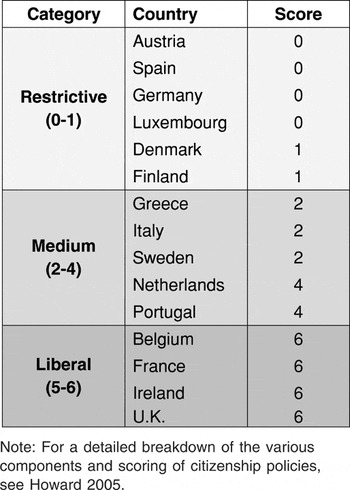
In order to make broad cross-national comparisons, and through them to draw general theoretical conclusions, it is necessary to move beyond the complex legal and technical specifics of each case, thereby to reach a better understanding of the variation in citizenship policies across countries on aggregate. Such an aggregation procedure will allow us to distinguish between countries that can be considered “liberal,” “medium,” or “restrictive” in their granting of citizenship.22
My use of the word “liberal” in this paper is mainly with reference to the issue of citizenship policies, not to the various meanings and traditions associated with the concept of liberalism. In other words, the categories “liberal” and “restrictive” are essentially measures of the inclusiveness of each country's citizenship policies.
Note that this is quite different from whether countries allow their émigrés who naturalize elsewhere to maintain their original citizenship. This form of emigrant dual citizenship comes at little direct cost to the emigrant or sending country, and it often serves to maintain and promote stronger cultural and linguistic connections to people who reside permanently in another country. Immigrant dual citizenship, on the other hand, involves the integration of foreigners as naturalized citizens who plan to live, work, and settle permanently in the host or receiving country. This distinction is very important, particularly for the historical countries of emigration—Germany, Greece, Ireland, Italy, the Netherlands, Portugal, Spain, and the United Kingdom—all of which have allowed and even encouraged their ethnic descendents or diaspora, to maintain their earlier citizenship, but only some of which have extended that option to immigrants within their borders. Immigrant dual citizenship clearly carries a much higher standard.
Although in most cases, a country's law matches its administrative practices fairly closely, I have attempted to stay true to the latter—based on secondary literature on the countries—when coding for each of these criteria, since this represents how the policy is actually carried out in practice. The only noticeable discrepancy in this regard occurs with the Netherlands, as explained below.
Based on a detailed analysis of the citizenship laws that were in place in the 1980s,25
I intentionally use the label “1980s,” rather than an arbitrary cut-off date, in order to account for any changes that may have occurred at any time during that decade. In a sense, therefore, the effective cut-off date for this time period is 1990.
To summarize briefly: jus soli is coded as either 0 (not allowed) or 2 (allowed); residency requirements for naturalization are coded as 0 (at least 10 years), 1 (6–9 years), and 2 (5 years or less); and acceptance of dual citizenship for immigrants is coded as either 0 (naturalized citizens must relinquish their prior citizenship) or 2 (naturalized immigrants can retain their previous citizenship). For a more detailed justification of this coding procedure, as well as the scoring of the individual components for each country, see Howard 2005.
For historical overviews of all 15 EU countries, see the excellent chapters in Hanson and Weil 2001.

Citizenship Policy Index for the EU-15 in the 1980s
But what explains this historical variation? Even a cursory look at the grouping of countries shows that the variation has little or nothing to do with such standard structural factors as a country's territorial or population size, the configuration of its political institutions, or the performance of its economy. But are there some coherent and systematic factors that explain why some countries developed quite liberal traditions, while others remained very restrictive?
My answer to these questions involves two main (and overlapping) historical factors, which I argue have helped to explain the trajectories that developed in each country. The first is whether or not a country is a former colonial power—on a large scale, outside of Europe, and over a sustained time period. Those countries that were colonial powers generally developed relationships with the outside world and its people. And even though these relationships were usually hierarchical, exploitative, and violent—i.e., not at all based on liberal principles—they created long-term “affinities” between colonizing and colonized countries that still exist today.28
Even the United States, which did not have a colonial past in Africa, continues to have a strong diplomatic interest in Liberia, based on earlier historical and cultural connections.
And in several cases—most notably Spain and Portugal—they have special citizenship rights as well. But note that in the empirical coding that follows, I have always adopted the most restrictive policies, as they apply to third-country nationals who do not receive any special privileges.
Note that what matters here is whether a country was a colonial power, not what type of colonial rule it imposed. In this sense, I am implicitly arguing that the differences between, say French and British forms of colonialism—which have spawned huge literatures and sparked much debate—are much smaller than those between countries that were former colonizers and those that were not.
The second, related factor involves whether a country was democratic in the nineteenth century. Early democratizers were much more likely to develop a more inclusive conception of national identity—based on civic, rather than strictly ethnic, terms. And that identity was therefore more likely to allow foreigners to be included as members of the society. In contrast, countries that only democratized in the twentieth century were more likely to solidify a conception of the national group that excluded people with different appearances, languages, and traditions. This factor is obviously closely related to the first, since most of the early democratizers were also colonial powers that accepted immigrants from their former colonies into their societies. What matters most is whether a country had both a prior experience as a colonial power and was an early democratizer, not just one of the two. And it is in these countries that one would expect to find the most liberal citizenship policies.
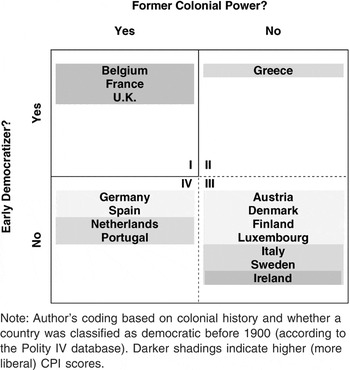
How do these arguments map out empirically? Figure 2 presents a basic 2×2 matrix, dividing up the 15 countries into four quadrants, with the key explanatory divide situated between Quadrant I and the three others (indicated by the solid lines. The columns distinguish between countries based on whether or not they used to be colonial powers, and the rows differentiate countries that had become democracies by the end of the nineteenth century.31
To determine the onset of democracy, I used the Polity IV dataset, applying the standard Polity threshold of 6 (on a scale from −10 to 10) for classifying a country as democratic. See Polity, various years.

What Explains Different Historical Patterns of Citizenship Laws?
The only country in Quadrant II—for countries that first democratized by the nineteenth century but have no past history as a colonial power—is Greece. Quadrant III presents the countries that have neither a colonial nor an early democratic experience, and indeed they are almost all at the restrictive end of the citizenship continuum. Austria, Denmark, Finland, and Luxembourg had very low citizenship index scores, and Italy and Sweden were not far ahead. The only disconfirming case here is Ireland, which is actually among the most liberal countries, despite not being classified as having had a colonial past or having been an early democratizer. But this can be explained by the fact that Ireland only became independent from the U.K. in 1922, and its laws and practices have been closely linked to British traditions.32
For an overview of the history of Irish citizenship that shows the particular closeness with British citizenship law, see Symmons 2001.
Overall, although it is not a perfect match, this analysis shows that the historical experience of individual countries—both in terms of their past experience as a colonial power and the onset of democratization—corresponds quite closely with their citizenship policies in the 1980s.
Characterizing and Explaining Recent Continuity and Change
These two historical factors seem to explain longstanding variation very well, but what about more recent changes? Over the past several decades, as the EU has been integrating and “harmonizing” in just about every area—from economic to judicial to social issues—has a similar development taken place in the realm of citizenship policy? How have countries changed their policies, and to what extent have they converged?
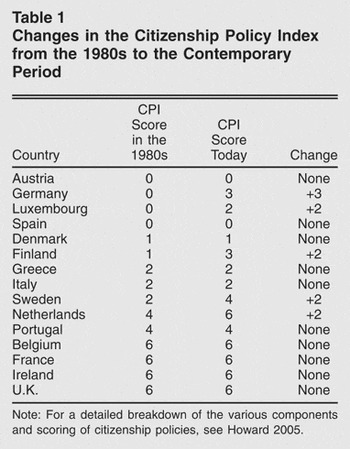
In order to answer these empirical questions, table 1 compares the CPI score in the 1980s to the current index, and then highlights any change that may have occurred. The results show that ten countries did not change at all; but the five countries that have changed all moved in the positive direction on the scale, towards increasing liberalization.33
Italy is an unusual case, in that it became more liberal on one factor, but more restrictive on another, with no overall change to its aggregate score. It began to accept dual citizenship starting in 1992, but this was balanced by the lengthening of the residency requirement for non-EU citizens, from five to ten years.
Note that while the official policy of the Netherlands still does not allow for dual citizenship, numerous exceptions were established over the course of the 1990s, resulting in a very liberal dual citizenship policy in practice. See Vink 2001.
That said, despite the initial objectives of the incoming Schröder government in 1998, dual citizenship is still not permitted for immigrants, and in fact the children of long-term legal foreign residents must choose either their parents' or German citizenship by the age of 23. In other words, the change was significant, but it was still partial in comparison to the original proposal. See Green 2000.
Changes in the Citizenship Policy Index from the 1980s to the Contemporary Period

Overall, this empirical analysis of change since the 1980s shows that some, but certainly not all, of the more restrictive countries have changed their citizenship policies significantly. And the cross-national differences are not quite as vast as they were a few decades ago, although they are still very wide.36
This latter point is strongly reinforced if one incorporates the policies of the 10 recent “accession” countries, which have quite restrictive citizenship policies. For a comparison of the accession countries and the EU-15, see Howard 2005.
Falkner et al. 2005.
As Joppke (1999b, 645) has argued, proponents of the “convergence” thesis have exaggerated the extent to which liberal countries have imposed restrictions, but the general trend among the restrictive countries has certainly been in the direction of liberalization.
But we still need to explain why change has or has not occurred across the countries of the EU. Why have some countries liberalized while others have resisted the pressures of liberalization and remained quite restrictive? Can one identify common patterns that apply across countries, despite the national idiosyncrasies that inevitably apply to policymaking? In each case, the decisive actors who determine citizenship policy are, of course, domestic political elites and political parties, but they do not act without constraints. What, then, are the factors that have influenced them, and how?
The existing literature on immigration and citizenship is much stronger on providing theoretical reasons for liberalization than for restrictiveness. Indeed, several arguments have been developed to explain increasing liberalization, with some emphasizing global causes and others stressing domestic factors. On the global level, scholars have stressed economic globalization,39
neo-functional economic cooperation,40Philip 1994.
Soysal 1994.
Freeman 1992.
Joppke 1998.
The findings shown on table 1 certainly provide support for these arguments, since the five countries that changed all moved in a liberal direction. But what about the countries that did not liberalize? What explains the resistance to liberalization, and how does it play itself out politically? These questions have been less explored in a literature that primarily focuses on (and predicts) liberalization.
Several plausible arguments could be presented, but most do not work out empirically. Structural factors such as rates of economic growth, unemployment, or immigration levels, do not shed any light on the puzzle of why, among the nine most restrictive countries with citizenship index scores in the 0–2 range in the 1980s, Finland, Germany, Luxembourg, and Sweden liberalized, but Austria, Denmark, Greece, Italy, and Spain did not. Nor do more cultural factors, such as the level of racism or xenophobia, hostility to immigrants, or general discontent with the EU—at least as measured by such public opinion surveys as the Eurobarometer or the European Social Survey—help to establish any connection to the liberalization of national citizenship policies.44
Although there is of course some variation across countries, the striking finding in these surveys is that large numbers of people across the EU are quite hostile to immigrants. See European Monitoring Centre on Racism and Xenophobia 2001; and European Social Survey 2002.
Space limitations prevent me from showing this data, but there is absolutely no relationship between any of these factors and citizenship liberalization.
What is missing from these structural, cultural, and institutional factors is the actual politics of citizenship. How have political actors navigated the potentially treacherous waters on this volatile issue? How have they dealt with the various pressures from interest groups, social movements, and public opinion? How have they made choices, and attempted to implement them politically into new laws and policies? While it is possible that lack of change simply represents a form of institutional inertia—where the old policies continue to persist simply because they already existed—it is also quite likely that elites have pursued conscious strategies and fought open battles, and that these contingent political factors were decisive.
An in-depth analysis of the politics of citizenship across the EU-15 exceeds the bounds of this article, but even a rudimentary examination of the political dynamics within countries will help to explain why some of the restrictive countries liberalized but others did not. And it allows us to draw some more general conclusions about the mobilization of public opinion on issues connected to immigration and citizenship, which generally results in the prevention of liberalization.
One way of exploring the liberalization differential between countries is to consider whether political parties of the left or right were in power. As Christian Joppke has argued, left-of-center governments are typically in favor of increasing the citizenship rights of immigrants (what Joppke calls “de-ethnicization”), whereas right-of-center governments want to resist such impulses, while simultaneously expanding the country's connections to its émigrés (what he calls “re-ethnicization).46
Joppke 2003.
My own interpretation builds on Joppke's left-right dichotomy, but I argue that the political orientation of the right is even more important than the constellation of forces on the left. And the issue is not simply whether a right-of-center government is in power, but whether it is mobilized on the issue of immigration and citizenship reform. Thus, if we accept that the liberalizing pressures mentioned above are influential in the EU-15, the question is what can counteract those forces. My answer is the mobilization of public opinion—which once again is latently hostile to immigrants throughout the EU—either in the form of a successful far right party, a popular movement, or a referendum of some kind on the issue of immigration or citizenship. In other words, the mobilization of anti-immigrant sentiment essentially “trumps” the liberalizing pressures that other scholars have identified.47
For a similar type of argument about the “salience” of immigration as a political issue, and its potential to prevent the harmonization of immigration policies in EU countries, see Givens and Luedtke 2004.
It may seem counterintuitive to focus on mobilization in the context of European politics, since public involvement has certainly not been a significant feature of EU integration, which has been widely characterized as having a “democratic deficit.”48
See, among many examples, Schmitter 2000.
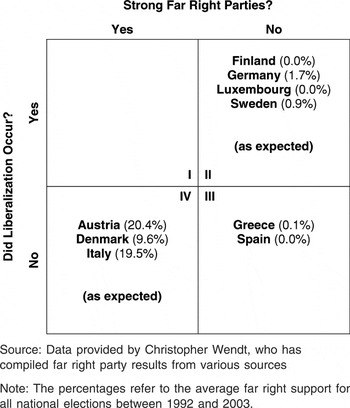
How does this argument play out empirically in the EU countries? The mobilization of anti-immigrant sentiment is very difficult to measure, since it can take on different forms. The most obvious and common form is the emergence of a far right party whose main platform emphasizes immigration and national citizenship issues. Figure 3 therefore presents another 2×2 matrix, showing the nine most restrictive countries from the 1980s,49
In other words, I have excluded the six relatively liberal countries—Belgium, France, Ireland, the Netherlands, Portugal, and the U.K.—since the question concerns the liberalization of the other countries.

The Strength of the Far Right and Its Effect on Citizenship Liberalization in the Nine Most Restrictive EU Countries
As expected, of the four restrictive countries that liberalized their citizenship laws, all are located in Quadrant II, leaving Quadrant I empty. In other words, liberalization only occurred without the presence of a significant far right party or movement. Among the five restrictive countries that did not liberalize their laws at all, the argument about the importance of the far right has some success as well. As expected, in Austria, Denmark, and Italy, which have had strong far right movements for well over a decade, the pressures for liberalization were effectively blocked by their influential far right parties. But Greece and Spain had virtually nonexistent far right movements, yet they also did not liberalize. What explains these exceptions? This question cannot be answered definitively, but I would speculate that the potential for change is still there, and that there is certainly a much greater chance for liberalization in Spain and Greece than there is in Austria, Denmark, or Italy, at least with the current constellation of political forces. In other words, the fact that they have not changed yet does not mean that they will never do so.
Moreover, if we were to consider the six relatively liberal countries in this analysis, Belgium, France, and the Netherlands—all three of which have fairly strong far right movements, with 1992–2003 average far right returns of 11.7, 13, and 6.4 percent, respectively—have seen immigration and citizenship emerge as highly polarizing political issues, and they have either experienced (in the case of France in the mid-1990s) or are currently experiencing (in the case of Belgium and the Netherlands) some tinkering with their citizenship laws as a result of the pressure of the far right. Ireland does not have an organized far right movement, but proponents of restrictions on citizenship acquisition succeeded in implementing a controversial referendum, which passed overwhelmingly (with 80 percent support) in June 2004, to limit the jus soli rights of the children of non-citizens, so that children born on Irish soil can only receive Irish citizenship if at least one of their parents has resided in Ireland or the U.K. for three of the previous four years.50
It should be pointed out, however, that while the new law is certainly more restrictive than it was previously, Ireland still grants jus soli, and in fact it is still more liberal than most other countries, such as Germany, which have lengthier residency requirements for the parents of children born in the host country, and which sometimes include employment requirements that many poorer immigrants lack.
The same phenomenon has occurred repeatedly in Switzerland—including, most recently, in September 2004—where voters have consistently rejected referenda that would liberalize the extremely restrictive Swiss citizenship law. And it should be added that Germany was close to passing a major liberalization (including full dual citizenship for immigrants) in 1998–1999, but this proposal was shelved after the opposition Christian Democrats resorted to an extremely successful petition campaign against dual citizenship, which garnered five million signatures in a matter of weeks, and succeeded in forcing the compromise law that took effect in 2000. See Green 2000.
Although this measure of the mobilization of anti-immigrant sentiment is probably the best single indicator available, it only captures part of the larger political story. The reaction of more mainstream conservative parties to the challenge of the far right's message can be just as effective in blocking liberalization. And public referenda and other forms of social mobilization, which are not captured by the far right measure, can in some ways result in more rapid and decisive restrictions than the standard process of elite and party politics.
In other words, while my argument about the impact of the far right helps to account for variation in the type of change that has or has not occurred, it certainly does not provide the final word on the topic of citizenship policies and how they have adjusted to new pressures and circumstances.52
Of course, I have not addressed the important issue of what explains variation in the strength or weakness of far right movements, but not only does this question go beyond the scope of an analysis of the causes of variation and change in citizenship policies, it has also not yet been satisfactorily answered by specialists on this topic. For a powerful critique of this literature, along with a very convincing argument—based on the contrasting case studies of Germany and Austria—that focuses on public debates, and the extent to which elites from all political parties and persuasions exclude and categorically reject the claims and strategies of the far right, see Art 2005.
Conclusion
Over the past few decades, almost every country in the EU-15 has revisited—though not necessarily revised—its citizenship law. And while the international and domestic pressures to liberalize have been significant, and sometimes decisive, they have sometimes been held in check by the countervailing pressure of a mobilized public opinion that is latently hostile to immigrants. In fact, as the evidence in this article suggests, it appears that when public opinion gets activated politically, with a concrete sponsor or means of expression, liberalization is usually stopped, or an existing law becomes even more restrictive. This was the case in Austria, Denmark, and Italy, where the far right parties have played leading roles, in Ireland, where a restrictive referendum passed overwhelmingly, and in Germany, where an unprecedented petition campaign rapidly stopped the momentum of liberalization. But if, on the other hand elites manage to pass reforms without significant public involvement—as occurred in Finland, Luxembourg, and Sweden—then liberalization will most likely be the outcome.
This brings us to a larger paradox, if not a serious normative problem: in terms of issues dealing with immigration and citizenship, a non-democratic, elite-driven process may lead to more liberal outcomes, whereas genuine popular involvement can result in more restrictive laws and institutions. In other words, proponents of liberal, inclusive outcomes should give more thought to the role of democracy—whether representative democracy that results in the inclusion of far right parties in governments and policymaking, or direct democracy that takes the form of referenda and initiatives—on issues that are prone to populism, xenophobia, and racism.53
For a more focused argument along these lines, see Howard 2001, especially 27–30.
The recent debacle of the EU Constitution provides a clear illustration of the stark distinction between the elite and mass sentiments about the EU (and one that is also closely connected to issues related to immigrants and xenophobia). Of the 13 countries that have voted on the Constitution to date, it has passed easily and overwhelmingly in all 10 countries where ratification was strictly a parliamentary matter. Of the three that have held a referendum so far, it only passed in Spain, but was rejected in France and the Netherlands. And surveys indicate that the Constitution will likely fail in most of the other countries that are scheduled to hold a referendum (the Czech Republic, Denmark, Ireland, Poland, Portugal, and the U.K.), if they are even held at all. For a regularly-updated tally of the ratification process across all 25 EU countries, see http://www.eu.int/constitution/ratification_en.htm.