Introduction
The milk production of Holstein cattle has been improved significantly during the last 4–5 decades, but the problem of bovine mastitis remains high. Mastitis is inflammatory disease of the mammary gland and is considered to be the most costly disease in dairy cows (Usman et al., Reference Usman, Yu, Liu, Wang, Zhang and Wang2014) causing approximately 35 billion dollar losses to the world dairy industry (Halasa et al., Reference Halasa, Huijps, Osteras and Hogeveen2007). The somatic cell count (SCC) in bovine milk is the best indicator for mastitis detection (Leitner et al., Reference Leitner, Chaffer, Krifucks, Glickman, Ezra and Saran2000), and there is a positive genetic correlation (0·7–0·8) between mastitis and somatic cell score (SCS) (Hu et al., Reference Hu, Wang, Li, Wang, Lai, Li and Zhong2009). Selecting against high SCC to minimize mastitis incidence has been wide practice (Rupp et al., Reference Rupp, Bergonier, Dion, Hygonenq, Aurel, Foulon and Foucras2006), however, SCC is influenced by many environmental features. Therefore, it is necessary to study additional indicators such as cytokines which are produced by various kinds of immune-related cells in the body and play vital roles by regulating defense mechanism of the mammary gland (Shuai and Liu, Reference Shuai and Liu2003). Cytokine-based marker-assisted selection could allow progress toward mastitis resistance and improvement in milk production traits. In the present study, we selected the SNPs in JAK2 from previous studies of our research team (Usman et al., Reference Usman, Yu, Liu, Wang, Zhang and Wang2014, Reference Usman, Wang, Liu, Wang, Zhang and Yu2015) due to its key role in mastitis resistance. The DGAT1 has widely been studied and reported for its role in milk production traits in dairy cattle (Grisart et al., Reference Grisart, Farnir, Karim, Cambisano, Kim, Kvasz, Mni, Simon, Frere and Coppieters2004; Schennink et al., Reference Schennink, Stoop, Visker, Heck, Bovenhuis, van der Poel, van Valenberg and van Arendonk2007; Yuan et al., Reference Yuan, Zhou, Deng, Hu and Li2007; Molee et al., Reference Molee, Duanghaklang and Na-Lampang2012). Previous research has reported that DGAT1 affects the pathways which are responsible for the regulation of immunity system (Mach et al., Reference Mach, Blum, Bannink, Causeur, Houee-Bigot, Lagarrigue and Smits2012); however, the role of DGAT1 in bovine mastitis resistance is still undefined.
Keeping in view the significance of the previously reported SNPs, we designed a Chinese Cow's SNPs Chip-I (CCSC-I) with a new technique of a microfluidic chip for screening and validation of the reported SNPs in a population of Chinese Holsteins in order to investigate their function on both milk production and mastitis resistance traits. In livestock species, SNP based genotyping is widely used in genomic selection (Martien et al., Reference Martien, Hendrik-Jan, Yalda, Wesley, LaDeana, Richard, Addie, Ron, William and Hans2011), nevertheless, a functional shortcut small chip of the sort used here has not been applied in dairy cows. In this study we used it to explore JAK2 and DGAT1 polymorphisms for mastitis resistance and milk production traits.
Materials and methods
Cattle population and samples collection
A total of 312 Chinese Holstein cattle (parities range from 1 to 3) were randomly selected from Beijing suburb farm, China, which were raised under the similar conditions. Fresh milk and blood samples were collected for each selected cow. Milk samples were collected in a 50 mL tube for each cow and mixed with 0.03 g potassium dichromate and stored at 4 °C. Then the milk samples were sent to Beijing Dairy Cattle Centre for the measurement of fat percentage, protein percentage, somatic cell count (SCC) within 48 h. SCS were measured from SCC with formula of SCS = log 2[SCC/100 000] + 3.
The blood samples were collected from the jugular vein of cows in two tubes. One was for serum isolation and the other one was stored at −20 °C for DNA extraction. For serum isolation, the blood samples were placed at room temperature for half an hour and then centrifuged 10 min at 3000 g/min to separate serum. The serum samples were stored at 4 °C for cytokines detection.
Serum cytokines detection and DNA extraction
The method used for the detection of serum cytokines was described in our previous study (Usman et al., Reference Usman, Yu, Liu, Wang, Zhang and Wang2014). In brief, serum was isolated from each blood sample by incubating at room temperature for half hour, followed by centrifugation at 3000 rpm for 10 min. The serum samples were then sent to Beijing Huaying Biological Technology Research Institute for the detection of serum cytokines (IL-6 and IFN-γ) with radioimmunoassay (Sino-UK, China). Genomic DNA of each sample was extracted from anticoagulant blood cells using Tiangen Blood DNA Kit (Tiangen Biotech Co. China) in accordance with the instructions of the manufacturer.
SNP identification and genotyping using CCSC-I
After confirmation of quality and quantity with NanoDrop™ Spectrophotometer (ND-2000, Thermo Scientific, USA), all the DNA samples were sent to Capital Bio Technology Co., Ltd, Beijing, China, for identification of the SNPs with Chinese Cow's SNPs Chip-I (CCSC-I), which were co-designed by microfluidic array techniques by Capital Bio Technology Co., Ltd (Beijing, China) and our research team. A total of 20 SNPs were designed in the CCSC-I chip, of which four SNPs in JAK2 and one SNP in DGAT1 were analyzed in the current study. The location information about SNPs in JAK2 and DGAT1 is provided in supplementary Table 1S.
Linkage disequilibrium (LD) analysis of SNPs in the JAK2 gene
To estimate the level of LD for four SNPs in JAK2 gene, pairwise LD was measured among all the four SNPs using the software Haploview 4.2 (Broad Institute of MIT and Harvard, Cambridge, MA, USA). The degree of LD is generally measured with D′ or R 2; the larger the value indicates, the stronger the LD. Moreover, the R 2 = 1 revealed the complete chain. Haplotype blocks within these SNPs were used to check their connection with the milk production, mastitis resistance, and serum cytokines traits in consequent association analysis.
RNA isolation, reverse transcription, primer designing and the quantitative RT-PCR of selected SNPs in JAK2 and DGAT1
The RNA extraction and reverse transcription was mentioned in our previous study (Usman et al., Reference Usman, Yu, Liu, Wang, Zhang and Wang2014).
Three pairs of primers designed for JAK2, DGAT1, and GAPDH, were listed in the supplementary material (Table 2S). To check the potential role of polymorphisms in JAK2 and DGAT1, four samples were selected for each genotype, and RT-qPCR was performed to find out the expression level of each genotype in SNPs of JAK2 and DGAT1 gene. The reaction and concentration for PCR was the same as described in our previous work (Usman et al., Reference Usman, Yu, Liu, Wang, Zhang and Wang2014).
Statistical analysis
The allele and genotype frequencies were tested for deviations from proportions of Hardy–Weinberg equilibrium (HWE) by χ2 test. The associations between SNPs with milk production and mastitis related traits were analyzed by the least squares method as applied in the GLM procedure of SAS (SAS Institute Inc., Cary, NC, USA) according to the following linear model
 $$P_{ijkln} = \mu + f_i + p_j + S_l + snp_k + e_{ijkln}$$
where P ijkln indicates mastitis traits (SCC, SCS or serum concentration of cytokine IL-6 and IFN-γ) or milk production traits (fat percentage or protein percentage), μ is overall mean, f i is the fixed effect of the farm, p j is the fixed effect of parity, s l is the fixed effect of season and year of calving, snp k is the fixed effect of genotype, e ijkln is the random residual error.
Additionally, the SAS 9.1 was applied to the significance test for additive (A) and dominant (D) influence of each SNP within the gene. In the above linear model, the genotype effect was further divided into A and D effects. The additive and dominant effect was calculated with formula 1 and formula 2.
 $${\rm A} = \displaystyle{{{\rm AA}-{\rm BB}} \over 2}$$
 $${\rm D} = {\rm AB}-\displaystyle{{{\rm AA} + {\rm BB}} \over 2}$$
Here, AA, AB, and BB represent the least square means of genotype AA, AB, and BB, respectively. The Student t-test was for the RT-qPCR analyses of mRNA expression levels of different genotypes of SNP4 and SNP9 in JAK2 and DGAT1 genes, respectively.
Results
SNPs identification and genotyping
Four SNPs at loci 39652267 C/T (SNP4), 39645396C/T (SNP5), 39630048C/T (SNP6), 39631175 T/C (SNP8) in JAK2 and SNP9 (A/G1801116) in DGAT1 reported by our research team (Usman et al., Reference Usman, Yu, Liu, Wang, Zhang and Wang2014, Reference Usman, Wang, Liu, Wang, Zhang and Yu2015; Wang et al., Reference Wang, Ma, Liu, Zhang, Zhang, Ding, Jiang, Wang, Zhang and Sun2015), were screened through Chinese Cow's SNPs Chip-I (CCSC-I), and genotyped in a population of 312 Chinese Holsteins. In JAK2, SNP4 and SNP5 were located on exon 16 and 20 respectively, SNP6 and SNP8 were residing in the 3′ flanking region, whereas, the SNP9 in DGAT1 was located on the promoter region (Table 1S). χ2 test showed that allele and genotype frequencies of all the SNPs were in Hardy–Weinberg equilibrium (χ2 test, P > 0.05). The genotypic and allelic frequencies of all the detected SNPs are summarized in supplementary material Table 3S.
Association of SNPs in JAK2 and DGAT1 with milk production and mastitis resistance traits
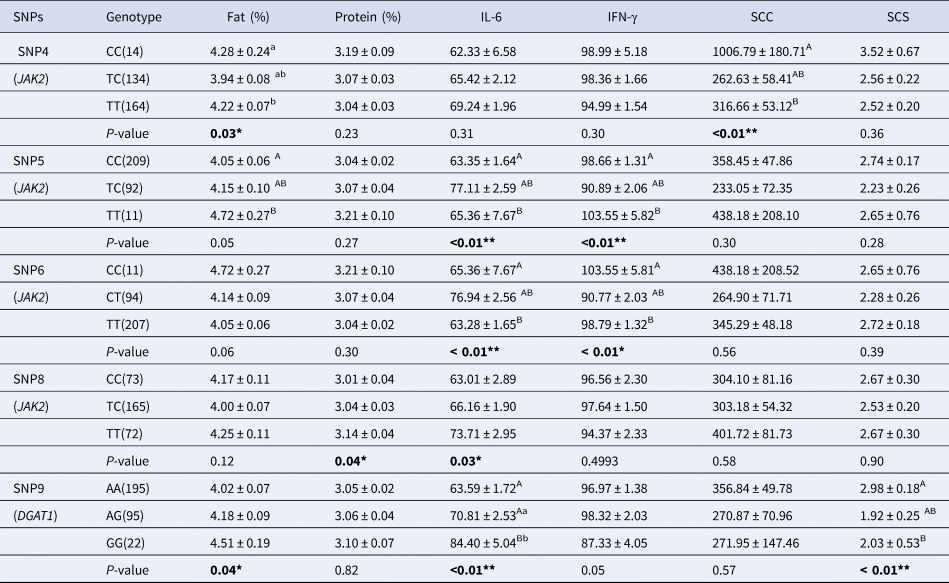
The selected SNPs in the current study were previously reported by our research team. We screened and genotyped the detected SNPs in JAK2 and DGAT1 gene through CCSP-1 in a different Chinese Holstein population. The association analysis demonstrated a significant association of SNP4 in JAK2 at loci 39652267 C/T with SCC and SNP5 (39645396 C/T) with IFN-γ and IL-6 respectively (P < 0.05). In addition, both of these SNPs were found significantly associated with milk fat percentage (P < 0.05). The SNP6 was significantly associated with IL-6 and IFN-γ, whereas, SNP8 (39631175 T/C) was in significant relation with IL-6 and protein % (P < 0.05). Statistical analysis revealed that the SNP9 in DGAT1 gene (1801116A/G) was significantly associated with milk fat percentage (P < 0.05) and mastitis resistance phenotypic traits, including IFN-γ, SCS, and IL-6 (Table 1).
Association of SNPs in JAK2 and DGAT1 gene with milk production and mastitis related traits in Chinese Holsteins

Note: Within a column in the same trait with on common superscript indicates difference at P < 0.01 (capital letter) or P < 0.05 (lowercase).
The SNP having a significant influence on any trait is shown in bold, a single asterisk (*) indicates that the effect of the locus is significant (P < 0.05), and double asterisks (**) demonstrate that the effect of the locus is highly significant (P < 0.01).
Genetic effects of SNPs in JAK2 and DGAT1 on SCC, SCS, inflammatory cytokines, and milk production traits
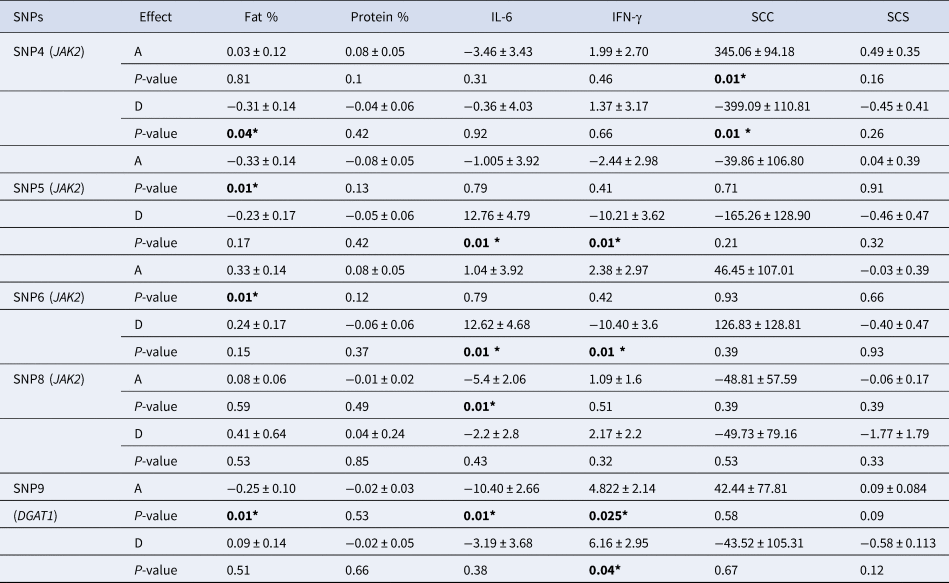
The genotype effects of SNPs in JAK2 were further evaluated in order to study their dominant and additive effect on milk production and mastitis resistance phenotypic traits. Both the additive and the dominant effect of (SNP4) in the JAK2 gene were significant on SCC, while the dominant effect was found significant with fat% (P < 0.05). The dominant and additive effect of SNP5 (39645396 C/T) was significantly (P < 0.05) associated with IL-6, IFN-γ, and fat percentage. Likewise, the dominant and additive effect of SNP6 at locus 39631175 T/C was significant (P < 0.05) on IFN-γ, IL-6, and fat percentage, whereas, the additive effect of SNP8 at locus 39630048 C/T had a significant correlation with IL-6. In addition, the In DGAT1 gene, the additive effect of SNP9 (1801116 A/G) was significantly related to fat percentage, IFN-γ, and with IL-6 (P < 0.05). Furthermore, the dominant effect in DGAT1 was also significant on the fat percentage. The relation among genetic effects of the SNPs, milk production, and mastitis resistance phenotypic traits are summarized in Table 2.
Genetic effects of the SNPs in JAK2 and DGAT1 on milk production, SCC, SCS, and serum cytokines traits in Chinese Holsteins

A, additive effect; D, dominant effect.
‘A’ means additive effect, ‘D′ means dominant effect, the A′ or ‘D’ of SNP having a significant influence on any trait is shown in bold, single asterisk (*) shows that the additive and dominance effect of the locus is significant (P < 0.05), and double asterisks (**) demonstrate that the additive and dominance effect of the locus is highly significant (P < 0.01).
Linkage disequilibrium (LD) among identified SNPs and haplotype association analysis
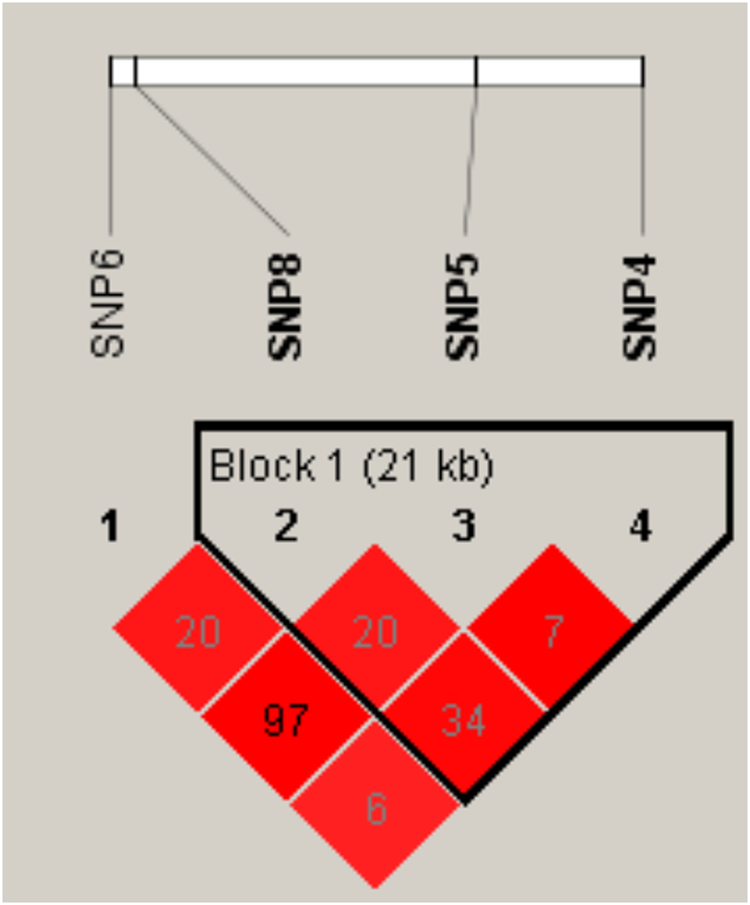
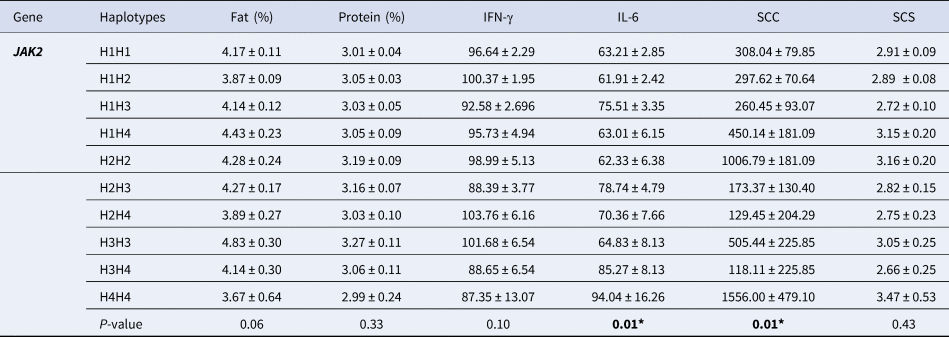
Haploview 4.2 software was used to analyze the linkage disequilibrium (LD) among four SNPs of JAK2. In the JAK2 gene, three out of four SNPs construct haplotype block (Fig. 1). Four different haplotypes i.e. CCT (H1), TCC (H2), TTT (H3), TCT (H4) with frequencies of 0.494, 0.257, 0.177, 0.064 were detected in three SNPs (39652267C/T, 39645396C/T, 39631175 T/C), respectively. The haplotype-based association analysis revealed a significant (P < 0.05) association of haplotypes in the JAK2 gene with SCC and IL-6 (Table 3).
Linkage disequilibrium (LD) among the three SNPs of bovine JAK2 gene. The values in boxes are pairwise SNPs correlations (R 2), and the bright red box without numbers indicates complete LD (R 2 = 1). The block 1 indicates the haplotype block.

Haplotype-based association analysis with milk production, SCC, SCS and serum cytokines traits in Chinese Holsteins

Haplotype-based association analysis with milk production, SCC, SCS and serum cytokines traits in Chinese Holsteins. The haplotype having a significant influence on any trait is shown in bold, a single asterisk (*) indicates that the effect of the haplotype is significant (P < 0.05)
Expression analysis of different genotypes in selected SNPs of JAK2 and DGAT1 gene
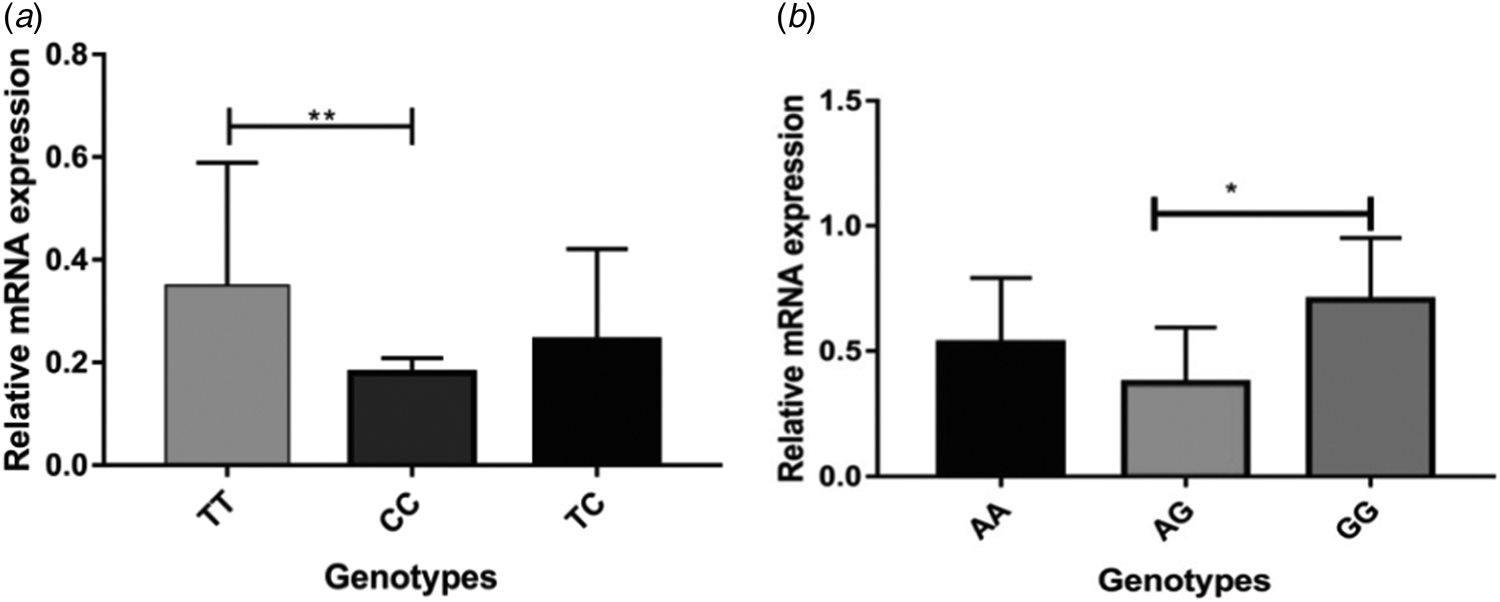
The expression regulation of the detected SNPs in JAK2 and DGAT1 through CCSC-I were measured by real-time quantitative PCR. The relative mRNA expression of genotype TT was significantly higher than CC in SNP4 of JAK2, while the GG genotype in SNP9 of DGAT1 was higher than AG genotype in the given population (P < 0.05) (Fig. 2).
The relative mRNA expression of JAK2 and DGAT1 in white blood cells of Chinese Holsteins. A = The expression difference among the three genotypes of SNP4 in JAK2. B = The expression difference among the three genotypes of SNP9 in DGAT1, ** means P < 0.01; * means P < 0.05.

Discussion
Bovine mastitis is a polygenic trait and is controlled by many genes. Marker assisted selection for improvement of milk production and against mastitis resistance in dairy cattle is an area of active interest. To our knowledge, little information is available about the importance of JAK2 in milk production. Our findings demonstrated that SNPs at locus 39652267C/T and 39645396C/T in JAK2 had a significant association with milk fat percentage. However, previously, our research group did not find any link of these SNPs in JAK2 with milk production traits, including milk fat percentage (Usman et al., Reference Usman, Yu, Liu, Wang, Zhang and Wang2014, Reference Usman, Wang, Liu, Wang, Zhang and Yu2015). In exon 16 of JAK2, phosphorylation occurs at 39652267A/G which affects the STAT gene that regulates the transcription of different genes in the nucleus and plays a key role in varieties of processes (Szewczuk, Reference Szewczuk2015). It is well established that a strong link existed between JAK2/RsaI polymorphism and milk protein, but not with milk fat percentage (Rawlings et al., Reference Rawlings, Rosler and Harrison2004). These findings reveal that the reported polymorphisms in the JAK2 gene show variations in different environments and populations. Additionally, the present study verified that selected SNPs in JAK2 from our previous studies (Usman et al., Reference Usman, Yu, Liu, Wang, Zhang and Wang2014, Reference Usman, Wang, Liu, Wang, Zhang and Yu2015) had a significant association with mastitis resistance traits (SCC). The findings of the present study confirmed that the selected SNPs in JAK2 maintained its ability for mastitis resistance even in a different population and environment.
The role of DGAT1 is well documented by a series of studies in milk fat production (Grisart et al., Reference Grisart, Farnir, Karim, Cambisano, Kim, Kvasz, Mni, Simon, Frere and Coppieters2004; Yuan et al., Reference Yuan, Zhou, Deng, Hu and Li2007; Molee et al., Reference Molee, Duanghaklang and Na-Lampang2012; Freitas et al., Reference Freitas, Gregório, Nedenia, Rusbel, Guilherme, Marina, Diercles and Humberto2016). In the current research, we also verified the association of polymorphism (1801116A/G) in DGAT1 with milk fat% which was reported in our previous GWAS study (Wang et al., Reference Wang, Ma, Liu, Zhang, Zhang, Ding, Jiang, Wang, Zhang and Sun2015) in Chinese Holstein population. The study validated that the selected polymorphism (1801116A/G) of DGAT1 could be used as a useful marker for improvement in the milk fat percentage. To our knowledge, this is the first study to report the significant association of SNP (1801116A/G) in DGAT1 with SCC. Mach et al. (Reference Mach, Blum, Bannink, Causeur, Houee-Bigot, Lagarrigue and Smits2012) noticed that DGAT1 regulated some other genes which had a key role in inflammation, immunity, and mammary gland tissue development. Based on the findings of the study, the DGAT1 seems to be a promising candidate gene for selection against mastitis susceptibility, quite apart from its role in production traits. We studied cytokine as additional potential markers of mastitis resistance. Notably, we identified novel associations between serum cytokines (IL-6, IFN-γ) and JAK2 and DGAT1 polymorphisms. Previously, it was documented that DGAT1 polymorphism influences immunity-related genes, including those encoding IFNγ and IL-6 (Ogorevc et al., Reference Ogorevc, Kunej, Razpet and Dovc2009).
In conclusion, the current research validated the pleiotropic influence of the genetic variations in the JAK2 and DGAT1 gene on milk fat percentage as well as mastitis resistance and serum cytokines traits. Additionally, we concluded that not only SCC, but also serum cytokines IL-6, and IFN-γ might be considered as powerful indicators for marker assisted selection for mastitis resistance.
Supplementary material
The supplementary material for this article can be found at https://doi.org/10.1017/S0022029919000682.
Acknowledgements
We are thankful to the China Dairy Data Center for providing DHI data. This research was financially supported by the Beijing Natural Science Foundation (6182021), National Natural Science Foundation of China (31272420), Beijing Dairy Industry Innovation Team (BAIC06), Modern Agro-industry Technology Research System (CARS-37) and the Program for Changjiang Scholar and Innovation Research Team in University (IRT-15R62). The funders had no role in study design, data collection, and analysis, decision to publish, or preparation of the manuscript.
Conflicts of interest
The authors declare no competing interests.
Ethical standards
The study was approved by the ethical committee of the College of Animal Science and Technology, China Agriculture University, Beijing, PR China.