We went to the party [Maoist Communist Centre] as a form of shelter…. There was no other political party in our area…. Only zamindars [landlords] had parties…. We had no reach in the government. We had no relations with officials.
—AY, Maoist combatant from a subaltern ethnic group Footnote 1I. Introduction
THIS article addresses the following puzzle: why some districts in India experience chronic Maoist violence whereas others do not. Maoist violence in India first broke out in 1967 and since then has escalated into civil war. But only a few districts have experienced repeat years of violence. The accumulation of deaths in these districts has pushed the conflict to the level of civil war. Explaining why these districts in particular experience chronic violence is, then, essential to understanding the Maoist civil war in India and to generating a new hypothesis about the causes of civil war more generally.
The argument, illustrated by the words of AY in the epigraph, is that chronic violence results at least in part from the failure of political parties to incorporate members of subaltern ethnic groups into key leadership positions before Maoist organizations enter the scene.Footnote 2 by ethnic groups, we mean groups in which descent-based attributes related to region, religion, sect, language, dialect, tribe, clan, race, caste, and nationality are necessary for membership. Drawing upon Fredrik Barth’s boundary-based approach to ethnic groups, this definition does not presume that coethnics share a common culture or a common set of interests—it is instead simply a common criterion for distinguishing insiders from outsiders.Footnote 3 By subaltern ethnic groups, we mean socioeconomically subordinate ethnic groups or categories. We use this rather than the term ethnic minority because that term is often understood in a purely numerical sense. By our definition, disadvantaged ethnic categories that constitute a numerical majority would count as subaltern, while advantaged ethnic categories that constitute a numerical minority would not.Footnote 4
This argument, developed through field research, integrates insights from the literature on patronage and clientelism into an account of individual-level participation in armed organizations. In patronage democracies like India, subaltern-led parties reduce the likelihood of chronic violence by providing young men from subaltern groups with some expectation of access to the state and therefore deterring them from joining armed organizations.Footnote 5 Other things equal, the stronger the presence of subaltern-led political parties in a district before armed organizations enter, the lower the likelihood of experiencing chronic violence subsequently. Timing matters. Subaltern-led parties that precede armed organizations have a deterrent effect on chronic violence, but subaltern-led parties that follow them do not: once armed organizations have taken root in a district, they are able to co-opt or intimidate subaltern-led parties that arise subsequently.
We test the main prediction of this argument—that the early incorporation of subaltern groups by political parties, other things equal, deters subsequent chronic violence—using an original district-level data set on subaltern incorporation and Maoist violence from 1967 to 2008. the dependent variable is the count of years of Maoist violence in a district. the key independent variable (subaltern incorporation) is the district-wise vote share captured by subaltern-led parties in India’s 1977–80 regional legislative elections. These elections represent a critical juncture in our analysis for two reasons: (1) they immediately preceded the entry of present-day Maoist organizations, and (2) they marked a transition from authoritarian to democratic rule that we exploit in our empirical analysis. We show that district-level subaltern incorporation at this critical juncture is negatively correlated with the accumulation of Maoist violence in subsequent years (1981–2008). To isolate the causal effect of subaltern incorporation on Maoist violence, we use a difference-in-differences design that compares levels of Maoist violence before and after the critical juncture across districts with varying levels of subaltern incorporation.
This article contributes a new, party-based explanation for the onset of civil war. Previous research emphasizes the role of structural variables as causes of civil war, including geographic factors (for example, rough terrain or natural resources), socioeconomic conditions (for example, poverty, landlessness, and property rights), historical legacies (for example, colonial rule), state capacity, development aid, prior patterns of violence, and regime type. Structural variables related to ethnicity include ethnic fractionalization, polarization, dominance, inequality, and spatial configuration. We do not contradict these structural explanations. Instead, we suggest that addressing the hitherto neglected role of political parties is one way to link structure to agency, at least in democratic systems.Footnote 6
This party-based argument also contributes to three other literatures. First, to the literature on ethnic inclusion and conflict, which focuses on the deterrent effect of inclusion of individuals in government, we contribute the new insight that inclusion in the leadership of political parties can have a deterrent effect. Moreover, although this deterrent effect is strongest when subaltern-led parties control the government, there is also some degree of deterrence associated with their presence in a district, short of winning. Second, to the literature on participation in civil war, which considers whether material or nonmaterial motivations are more important in explaining participation and focuses on what armed organizations offer to potential recruits, we contribute an argument that synthesizes both kinds of motivations. third, to the literature on patronage politics, which focuses mainly on institutionalized forms of participation, we contribute a logic linking expectations of access to patronage to civil war.
The generalizable core of this argument is the insight that to explain armed violence, we must theorize not only about what armed organizations offer to potential recruits but also about why institutionalized channels do not function as effective alternatives.Footnote 7 As we theorize, the role of political parties in providing a nonviolent outlet need not be universal. It is specific to patronage democracies, of which India is an example, as are a number of other countries in Asia and Arica. in democracies that are not patronage-based, parties may remain important, but their ideologies or platforms as signaling access to the state may matter more than the ethnicity of their leadership. and in patronage-based states that are not democratic, institutions other than parties (for example, bureaucracies or militaries) may be more viable channels of access to the state. indeed, parties in nondemocratic or partially democratic contexts may promote rather than deter insurgency because their members are blocked from access to the state. in countries with less dominant states, democratic or otherwise, organizations like trade unions or civil society associations may be more important.
The second contribution of this article is a new data set on Maoist violence and subaltern incorporation in india. the data set, which is the first to cover the history of the Maoist civil war since its inception, records all incidents (violent or otherwise) related to Maoist individuals or organizations from 1967 to 2008 using daily reports from the Times of India, which is india’s oldest English-language daily. it is also the first within-country data set on ethnic subaltern leadership in political parties. The Times of India is the standard source for coding violence in India over the long term.Footnote 8 there are, nevertheless, obvious concerns of measurement error, bias, and framingFootnote 9 in using an English-language newspaper as a source of data on violence. We address these by collecting additional data from the local Hindi-language newspaper Prabhat Khabar, from state intelligence sources, and from fieldwork for a subset of observations from the state of Jharkhand. The supplementary material elaborates on the data, compares it with the alternatives, and describes the steps we take to address these concerns.Footnote 10
Section II provides background information on India’s Maoist movement. We then introduce the puzzle of chronic violence (Section III), explain why Maoists recruit from ethnic subaltern groups (Section IV), present the logic of our argument (Section V), and describe district- level variation in subaltern incorporation (Section VI). Section VII relates our argument to the literature on civil war. We then turn to the empirical analysis, showing that there is a robust statistical association between subaltern incorporation and chronic Maoist violence (Section VIII) and use a difference-in-differences design to estimate causal effects (Section IX). Section X concludes. The supplementary material provides further detail on our data and analysis.Footnote 11
II. The Two Phases of Maoist Violence in India
The term Maoist is used interchangeably in India with the term Nax- alite to refer to organizations that originated in the splintering of the Communist Party of India (Marxist) (cpm) in 1967. The main Maoist organization in present-day India—the cpi (Maoist)—was created in 2004 by the merger of three predecessors: the CPI-ML Party Unity, the CPI-ML People’s War, and the Maoist Communist Centre (mcc). We use the term Maoist violence in a narrow sense to refer to incidents involving Maoists or Naxalites that result in deaths.
The beginning of India’s Maoist civil war is conventionally dated to a 1967 incident in which peasants organized by dissident cpm cadres in the region of Naxalbari ambushed and killed a police inspector. But as the data show, Maoist violence occurred in two phases. The first began in 1967 and ended by the mid-1970s. The second began in the 1980s after a brief transitional period. Present-day Maoist violence is more accurately traced to the 1980s.
Figure 1, which depicts the total number of deaths associated with Maoist violence from 1967 to 2008, describes these two phases. We also include, for comparison, the number of Maoist incidents, violent or otherwise.
Most of the first phase of violence occurred during the Emergency— the constitutionally mandated period of authoritarian rule declared by the Indira Gandhi-led Congress government from 1971 to 1977. During that period, elections were postponed, fundamental rights were suspended, and the state engaged in severe repression.Footnote 12 The declaration of the nationwide Emergency, which followed regional “emergencies” imposed piecemeal in individual states, was triggered by the Indo-Pak- istani War of 1971. When that war ended, Gandhi, increasingly insecure after a split in the Congress Party, kept the Emergency in force. In 1975, she declared a new Emergency with more sweeping powers of repression. The Emergency decimated the Maoist organizations of the first phase; many of their leaders were killed or arrested as part of a crackdown on internal opposition.Footnote 13
The time between 1977 and 1980 was a transitional period during which authoritarianism was dismantled. Gandhi called off the Emergency in 1977 for reasons that are opaque but unrelated to Maoist vio- lence.The most common explanations include international pressure and a miscalculation that if she held elections, she would win.Footnote 14 New elections for the national government and for all Indian states were held between 1977 and 1980. A new national government, led by the Janata Party, came to power, and between 1977 and 1980 it legislated constitutional changes that made it harder to declare an emergency in the future.
The second phase of Maoist violence followed the formal dismantling of authoritarianism. This period saw the emergence of the three organizations that later merged into the cpi Maoist. The mcc, which originated in an earlier Naxalite organization (Dakshin Desh), was revived as an underground organization in 1975 but “came into its own only in 1980–81.”Footnote 15 The cpi-ml Party Unity and the cpi-ml People’s War were founded in 1978 and 1980, respectively,Footnote 16 but began pursuing an armed struggle only after the Janata-led transition ended.
Maoist Deaths and Incidents (1967–2008)
III. The Puzzle of Chronic Maoist Violence
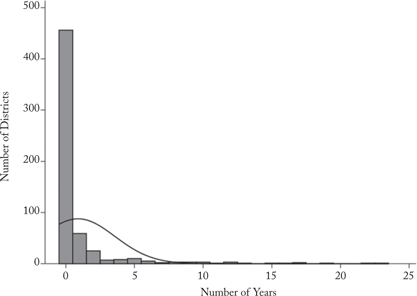
One-third of india’s districts—187 districts in 16 states—were affected by Maoist violence (that is, experienced at least one death) at some time between 1967 and 2008. But only a handful of these affected districts experienced multiple years of violence (see Figure 2). These chronically affected districts account for most Maoist-related deaths in India. Districts that experienced exactly one year of violence account for only 7 percent of Maoist-related deaths. But districts with two or more years of violence account for 93 percent, while districts with more than five years of violence account for 68 percent of the deaths.
Distribution of Years of Maoist Violence (1981–2008)a
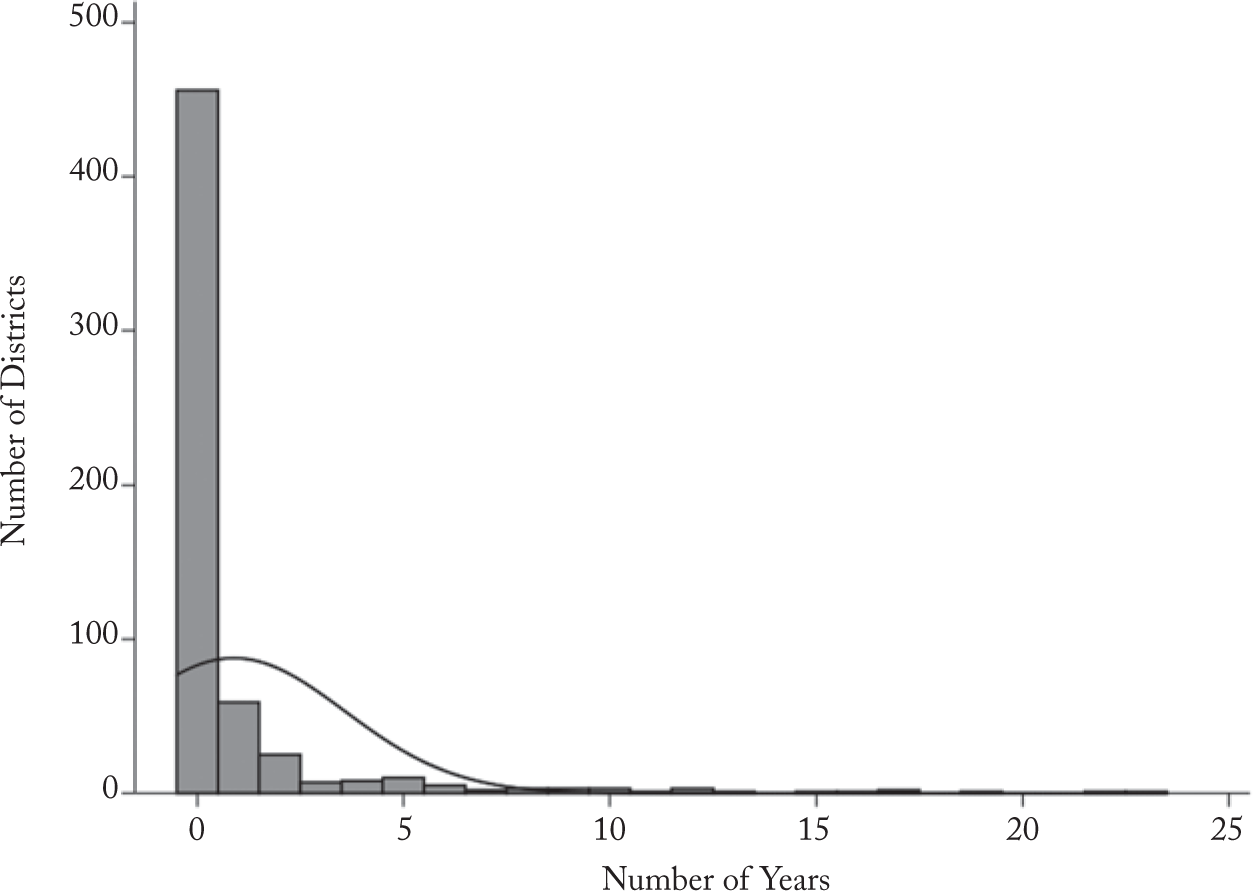
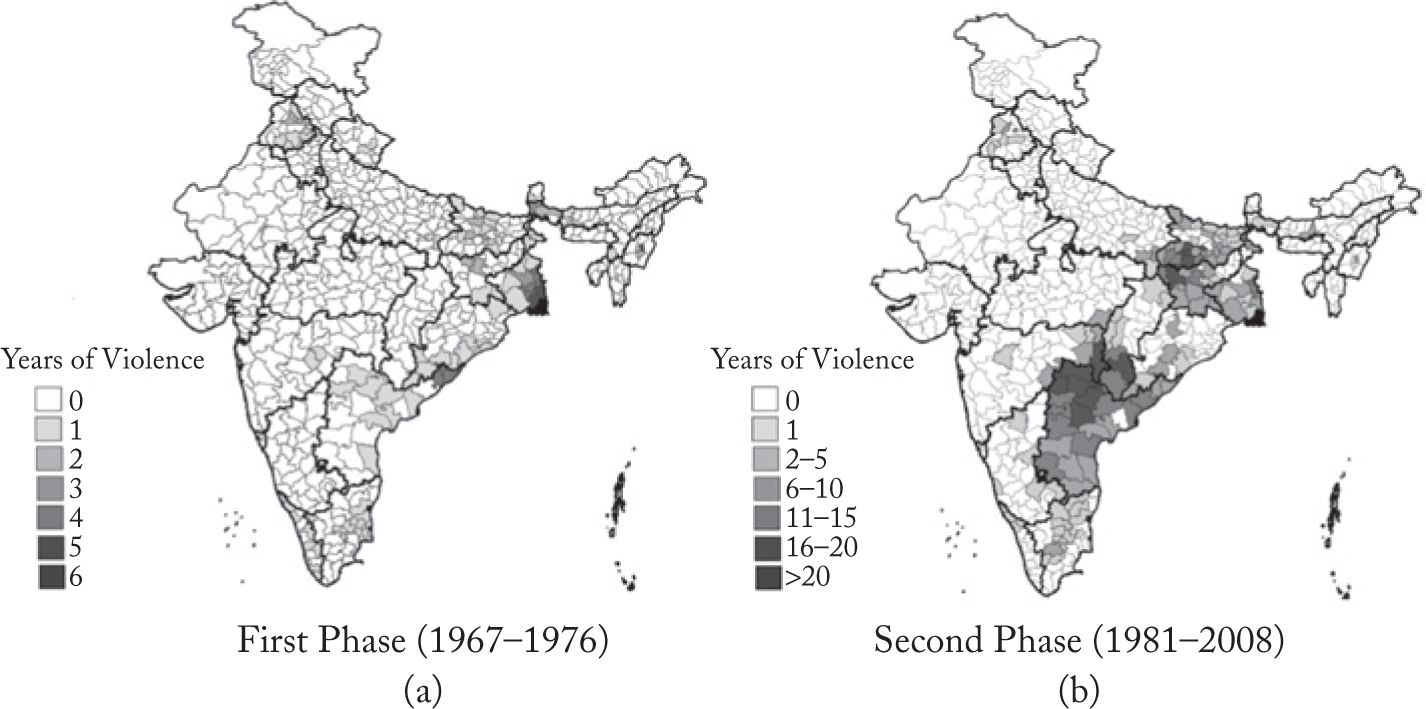
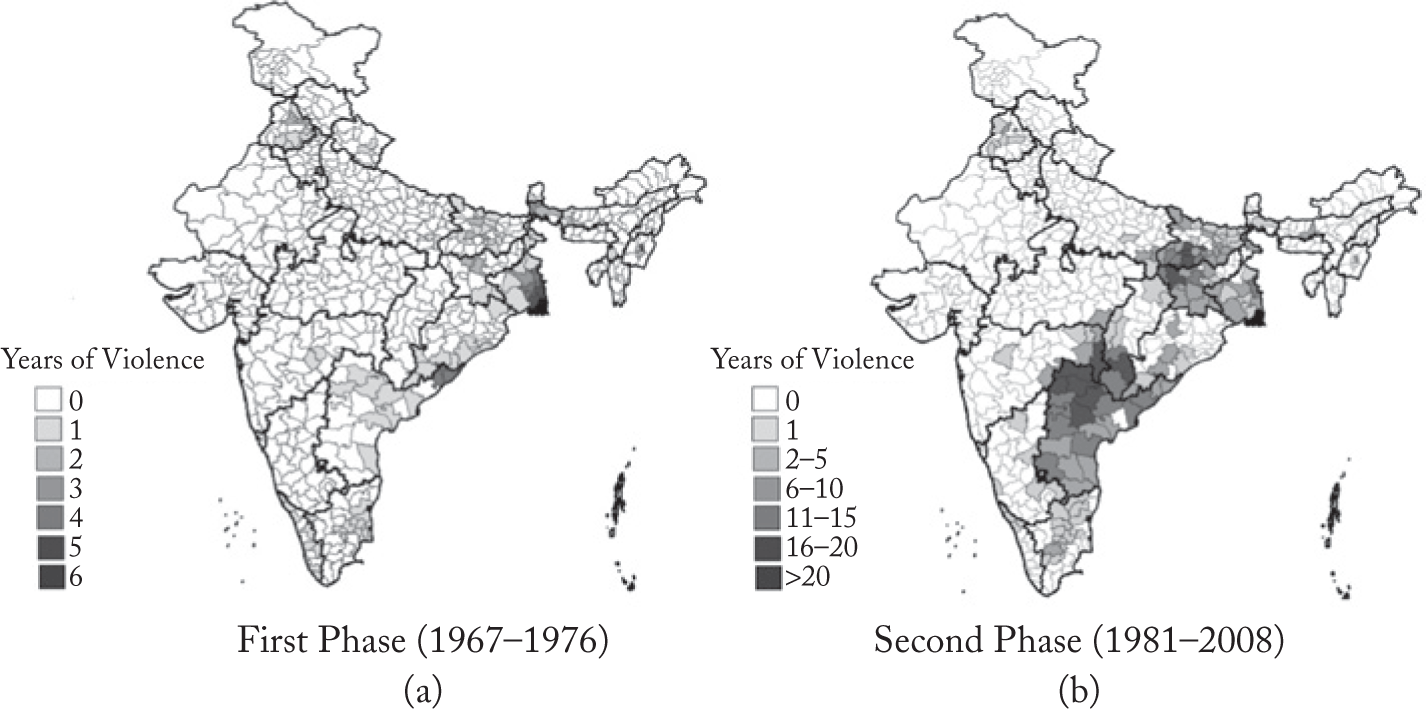
The districts with chronic violence, as Figure 3 shows, came into being in the second phase. Footnote 17 Violence during the first phase was distributed widely across India and was not chronic in most cases. our goal is to explain why some districts experience chronic violence, measured using a count of years, while others do not. We do not seek to explain why a district is affected by Maoist violence at all, but why, among affected districts, some experience multiple years of violence. This is the more important question, since the bulk of Maoist violence in India is accounted for by repeat violence in a small number of districts.
District-Level Incidence of Deaths in the Two Phases of Maoist Violence in Indiaa
We also do not seek to account for the precise count of deaths. This latter variable has greater measurement error (see the supplementary material),Footnote 18 and there may be a different explanation for the number of years a district is affected by deadly violence. We suggest that chronic, or repeat, years of violence in a district, requires a critical mass of participants available to engage in deadly violence. The precise count of deaths associated with such violence, however, may depend on considerations of tactics and military technology in addition to the existence of the critical mass. Tactical decisions about the choice of target, for example, or technological changes, such as the shift from simple rifles to semiautomatic weapons, may produce a higher death count while holding the critical mass constant.
Still, there should be some association between the count of years of violence and a measure of the accumulation of deaths over time.Footnote 19 We use the count of years as our main dependent variable because in addition to having less measurement error, it avoids the restrictive assumption that the location of recruits is highly correlated with the precise count of deaths. We show that our findings are robust to alternative dependent variables, such as an ordinal scale classifying districts as chronic according to some threshold of deaths or years of violence (see the supplementary material).Footnote 20
IV. Why Maoist Organizations Recruit from Ethnic Subaltern Groups
When Maoist organizations entered a district, their standard mode of recruitment was to mobilize class-based categories, such as peasants and workers, around the day-to-day issues that affected them, such as wages, land conflicts, and exploitation by moneylenders.Footnote 21 The imperfect correlation between class and ethnicity in India meant, however, that the de facto targets of Maoist recruitment were usually members of subaltern ethnic categories. (We do not theorize here about their decision to enter a district, which may be explained by a number of variables including a prior communist presence, which would have provided exposure to an ideology that distinguishes Maoist organizers from ordinary recruits, as well as by factors identified in the literature on civil war, such as rough terrain or land inequality. But we control for all these variables, in the empirical analysis.)
Subaltern ethnic categories in India are overlapping categories that exclude the Hindu upper and intermediate castes and include the backward castes or other backward castes, which constitute roughly 52 percent of the population, Scheduled castes (sc, 16 percent), Scheduled tribes (st, 8 percent), muslims (13 percent), christians (2 percent), Sikhs (2 percent), and buddhists (1 percent).Footnote 22 they constitute an overwhelming majority of the population in virtually all indian districts, with some variation in the mix of categories, their degree of overlap, and their relationship with class.Footnote 23
There is a great deal of diversity within and across subaltern ethnic categories in india in terms of economic resources, rituals, symbols, and so on. but they share a view of the Hindu upper castes as the outsider. in this they are no different from many other ethnic categories, most of which are distinguished by a common enemy rather than by homogeneity of culture or internal interests. A number of parties and social movements have exploited this awareness of a common enemy uniting members of diverse categories under a common ethnic label that excludes the collective enemy. these include the Non-brahmin movement, which excluded the Brahmins;Footnote 24 the KHAM (Kshatriya, Harijan, Adivasi, and Muslim) movement in Gujarat, which excluded the Patels;Footnote 25 and the Bahujan (majority) and Dalit-Bahujan (the oppressed majority), which excluded the Hindu upper castes.Footnote 26 Especially in the early stages of its movement, the Maoists were also successful in bringing together these subaltern castes under a common label that excluded the higher, landowning castes. As the main study on Maoists in the area of AY’s village points out, “[T]he ml movement in Bihar seems, whatever its other flaws, to have achieved at least some unity among ex-Shu- dras and Dalits.”Footnote 27
V. Why Ethnic Subaltern-Led Parties Crowd Out Armed Organizations
Chronic armed violence requires a critical mass of young men who participate as combatants or supporters.Footnote 28 Synthesizing debate on the subject,Footnote 29 we suggest that both material and nonmaterial needs motivate participants. Note that the material needs in question are not simply land, jobs, and access to markets, but also the provision of routine services, the protection of human security, or relatedly, a check on the ability of those in government to act with impunity. Nonmaterial needs include a desire for dignity, recognition, respect, and status.
In a patronage democracy, control of the state by coethnics provides citizens with some expectation of satisfying either or both types of needs.Footnote 30 The literature on ethnic politics makes this point in a comparative context.Footnote 31 We draw on fine-grained studies of the relation between state and citizen to show that it also applies in India.
Consider the relation between control of the state by coethnics and the ability to satisfy material needs. Craig Jeffrey and Jens Lerche show how control of the state in northern India allowed a locally dominant community (Jats) to expand and reproduce a class advantage in access to land and employment.Footnote 32 Control of the state by coethnics can also affect the provision of routine services that in principle should be universally accessible, such as whether or not a citizen is able to lodge a complaint with the police,Footnote 33 obtain a land certificate,Footnote 34 or obtain a caste certificate that is a prerequisite for accessing many public services.Footnote 35
Consequently, the expectation that citizens are more likely to have access to state services when coethnics are in power has become rou- tinized. As Francine Frankel and M. S. A. Rao note, “Even temporary control of government offices was perceived as providing important opportunities for advancing family and group interests.”Footnote 36 Testimonies of state officials confirm this expectation. one district magistrate reported in our fieldwork, for example, that after a Yadav-led government came to power in his state, yadavs in the district became more assertive in contacting him for state services and he experienced greater pressure to respond.
Consider now the relation between control of the state by coethnics and the ability to satisfy nonmaterial needs. control of the state translates into social dominance and economic opportunities for the ruling ethnic group.Footnote 37 As Simon chauchard shows, it can lead to respectful social treatment even of deeply stigmatized groups like Scheduled castes.Footnote 38 Similarly, the yadavs emboldened by a yadav-led government in the example above sought and obtained recognition of a change in their status from suppliants with needs to citizens with rights.
In the early stages of recruitment, armed organizations cannot provide material goods to the extent that the state can. They cannot provide a government job, a loan, or a land title. But they can satisfy some material needs by using violence and intimidation to redistribute land, settle disputes, and force state officials to provide services. As Nandini Sundar notes of the early activities of the maoists in the bastar region, “they held meetings in the villages at night and identified local problems. They threatened foresters and contractors who paid less than the minimum wage, teachers and health workers who neither taught nor cured but drew their salaries anyway, land revenue officials and police who demanded bribes for routine administrative work, and shopkeepers who cheated the villagers.”Footnote 39 Further, membership in maoist organizations can provide protection against incursions by those who control the stateFootnote 40 and it can enhance the member’s sense of dignity through the act of resisting perceived injustice.Footnote 41
But joining an armed organization is also risky and costly. The benefits provided are limited and can change with the shifting balance of power. Prakash Louis describes, for instance, the seesaw nature of land possession and changes in wage rates introduced by the Maoists as related to the fluctuations in their strength vis-a-vis the state.Footnote 42 Thus, the status that comes from mounting a challenge to the state can also be diminished if the balance of power changes. The fact, or expectation, of control of the state by their coethnics should, in principle, deter young men from ethnic subaltern groups from joining armed organizations.
Control of the state by subaltern ethnic groups, we propose, is established when a subaltern-led party wins control of the state-level government. Individual legislators do not have effective control of resources unless backed by clout within their parties.Footnote 43 Legislators from subaltern groups elected to state-level government through quotas have an added problem of credibility in representing coethnics because the design of the quota system often makes them dependent on noncoethnic voters. Footnote 44 Village-level quotas for Scheduled Castes and Scheduled Tribes (and sometimes other categories), implemented in India only after 1993, could not have deterred young men from joining Maoist organizations in the prior decades.Footnote 45
Indian parties are highly centralized.Footnote 46 The main party leader, therefore, and not the local district leader, legislator, or party worker, controls access to the benefits valued by voters. As a consequence, expectations of access to the state depend on the presence of a subaltern-led party in the district. Parties in which coethnics dominate leadership position(s) send the clearest and most credible signal of access to the state.Footnote 47 Parties in which subaltern ethnic groups are not represented at all or in which they share leadership with dominant groups do not send a similarly credible signal. In such parties, societal relationships of dominance and subordination are typically replicated in party structures, with the result that subaltern leaders do not call the shots.
If a subaltern-led party controls the state, individuals from subaltern groups already have the highest probability of accessing material and nonmaterial benefits, so there is little to be gained by joining an armed organization. The flow of these benefits requires a party to have a local presence. in the example above, when a Yadav-led government was in power in the state of Uttar Pradesh, the local administration was more responsive to demands made by Yadavs. But this responsiveness was maintained by the local presence of party supporters who pressured the administration and reported upward. Sometimes citizen demands were also channeled upward through party supporters. the local presence of a ruling party functions, in other words, as a channel for claim making and as a form of check and surveillance on the local representatives of the state.
If a subaltern-led party does not control the state but has some presence in the district, voters from these categories have some expectation of access to the state. Subaltern-led parties that obtain even a few thousand votes can exert leverage by influencing another party’s victory or loss.Footnote 48 This has both material and psychological effects: small parties with leverage can extract concessions for those they represent, but their king-making ability also gives the ethnic groups they represent a sense of empowerment and dignity. Indeed, even the act of voting for a subaltern-led party in an environment in which larger parties led by dominant groups prevail is an act of self-assertion. Such parties can also pressure the district bureaucracy on behalf of their supporters and at least decrease the likelihood of harassment. The cost of joining an armed organization is so high that even a minimal challenge can function as a deterrent.
But when a coethnic party does not have control of government and does not have a presence in the district, voters from subaltern groups in that district have no expectation of control of or access to the state. In such a case, they have nothing to lose and see some potential gain in joining an armed organization. Given the cost and risk this involves, only some individuals from an unincorporated group are likely to join. But small numbers can make a big difference for an armed organization, which needs only a few fighters, in contrast to political parties, which need thousands of votes.
Consequently, the stronger the prior presence of subaltern-led parties, other things equal, the higher the likelihood that armed organizations will be crowded out. And the weaker the prior presence of subaltern-led parties, the greater the likelihood that armed groups will find a critical mass of joiners.
To illustrate, let us return to Ay, who joined the mcc, and so eventually the CPI Maoist, in his mid-twenties. He was born around 1970 to a Yadav family in rural Jharkhand (then Bihar).Footnote 49 In the 1980s, the mcc began organizing agrarian agitation in this area, pitting members of the largely landless subaltern ethnic categories (the backward castes [to which Yadavs belong], Scheduled castes, and some Muslims) against upper-caste bhumihar landlords who were backed by the state. there were differences across these groups in economic resources, customs, rituals, and lifestyle. but they found a common enemy in the upper- caste bhumihar landlords, who also controlled the police, the main political party, and the surplus land in the village, as well as other shared resources.Footnote 50
At the time, there were no subaltern-led parties in AY’s area. the two main parties then, the Congress and the bharatiya Janata Party (bjp), were dominated by the upper castes. As AY said, “Only zamin- dars [landlords] had parties.”Footnote 51 Capitalizing on this vacuum, the mcc sought to mobilize the subalterns collectively and succeeded in obtaining a critical mass of recruits, including AY.
Joining the mcc boosted the material position and self-esteem of subaltern-led groups by undermining their common enemy. It provided protection against the state by making the police less likely to treat them with impunity. this affected all subaltern categories in the village, regardless of their diversity. It provided access to land by opening the way for these subaltern groups to encroach upon this formerly inaccessible set of resources. It also brought with it a sense of dignity. Once AY and his fellow joiners acquired a reputation for successfully challenging the state, they went from suffering the humiliation of beatings at the hands of the police to being treated with respect and fear. Once they joined, these young men were active mainly within their home districts, confined to local areas of activity by locally embedded networks of language, support, and information. This critical mass consequently became a background condition for chronic violence within a district.
Such critical mass, and therefore the likelihood of chronic violence, persists—not indefinitely, but roughly over the lifetime of its participants—because of the difficulty of exit. For example, a combatant who defects from an armed organization without an alternative means of protection risks retribution from, and loss of face among, his former comrades. The principal forms of exit available to him are death or a negotiated surrender. AY, for example, tried to leave the mcc at least twice but ended up returning to combat because of the threats he faced in civilian life from both the police and the mcc.Footnote 52 those who play a supporting role face a less extreme but similar quandary.
The sequencing of subaltern incorporation by political parties is important. although the presence of subaltern-led parties before Maoist organizations enter can crowd them out subsequently, subaltern-led parties that emerge after Maoist organizations enter do not have the same effect. once a Maoist organization has achieved a critical mass, it is able to co-opt or intimidate political parties, including those that later seek the support of subaltern groups. In AY’s district, once Maoist organizations garnered a critical mass of support, they were also able to intimidate or co-opt subaltern-led parties that entered the district subsequently, such as the Rashtriya Janata Dal (rjd) led by the Yadav leader Laloo Prasad Yadav. Some rjd leaders were threatened and driven out of the villages by Maoist squads, and those who remained struck a bargain with the Maoists to guarantee their safety. In other districts where Maoists were first movers, they often assassinated party officeholders and electoral candidates as a means of retaining control over the turf.Footnote 53
The existence of these bargains between Maoists and political parties in those areas where Maoists are strong is a commonly accepted fact. As one expert on the Maoist movement notes, “The ‘fear’ of violent retribution from the Naxalites plays a significant role in ‘persuading’ some political leaders to enter into a ‘partnership’ with the Naxalites…. In Bihar and Jharkhand, leaders of the Bharatiya Janata Party (bjp), Rash- triya Janata Dal (rjd), Congress (I), and the Left parties have received support from the Naxalites and had, in return, either paid vast sums of money or offered ‘concessions.’”Footnote 54
If early subaltern incorporation deters subsequent violence, as we suggest, why, then, might parties not strategically incorporate subaltern groups before violence emerges? Previous workFootnote 55 shows that the incorporation of new groups into leadership positions creates a collective action problem that parties may be unable to solve even if they are aware of the benefits. For one thing, the incorporation of new leaders usually means the displacement of old ones. Thus, even if existing party leaders support subaltern incorporation in the party as a whole, they will resist giving up their own positions. Further, they are by no means aware ex ante of the potential effects of such incorporation. the causes of an insurgency are debated as much among politicians as among political scientists, and the political discourse on Maoist violence in India usually attributes it to structural factors, such as poverty or misgovernance, rather than highlighting, as we do here, the more proximate link with political parties.
VI. Subaltern Incorporation in India, 1977–80
India is a federal system with direct elections under a first-past-the- post system for three levels of government: the national parliament, the regional (or state) legislative assemblies, and—since 1993—village councils. We focus on legislative assembly elections because regional governments have the greatest direct impact on the lives of indian citizens, and on the 1977–80 period because it immediately preceded the recruitment efforts of Maoist organizations. Each state had only one election between 1977 and 1980. Most went to the polls in 1977. Table A2 in the supplementary material lists the year of each election.Footnote 56
Sixty-two parties competed in these elections. We code the key leadership of each party in each state for all their ethnic memberships. Since some parties run in multiple states and the identity of the leadership of the same party can differ across states, the same party can be coded differently in different states. We identify the key leadership position(s) within a party by combining information about the formal position with information about de facto authority within the party, drawing on sources including the party’s constitution where it is available, secondary literature, and news reports about the party’s election campaign in the 1977–80 election.
We code a party as ethnic subaltern-led if its key leadership in that state came from any ethnic subaltern group and only from subaltern ethnic groups. This approximates the idea that the group that dominates the party leadership sends a credible signal of access to the state. Some examples of subaltern-led parties in our data include the Drav- ida Munnetra Kazhagam (dmk) (in Tamil Nadu and some additional states), the Muslim League (in seven states), the Republican Party of India and its splinters (also in several states), the Jharkhand Party (in Bihar and orissa), and the Shoshit Samaj dal (in Bihar and Uttar Pradesh). major national parties, such as the congress, Janata, and the CPI or cpm, are coded differently based on their leadership in individual states. The congress, for example, is coded as subaltern led in tamil Nadu, where it had a backward caste leadership, but not in Uttar Pradesh, where its leadership was upper caste.
We then construct a district-level measure of the strength of subaltern incorporation by aggregating the vote captured by all subaltern-led parties in a district. the district in india is an administrative unit that is larger than, and perfectly contains, electoral constituencies for state legislative assembly elections. To construct this measure, we sum the vote won by a party across constituencies in each district and then calculate its district-wise vote share. We interpret the vote share of subaltern-led parties in a district as an indicator of their strength there regardless of why individuals vote for them. this measure therefore does not make any assumptions about why subaltern-led parties obtain votes.
A more precise measure would be scaled by the size of the ethnic subaltern population in a district, but that is not possible since there is no district-level measure of the population of backward castes. nevertheless, this is not a significant concern because the subaltern population constitutes an overwhelming majority in virtually all districts.Footnote 57the analysis that follows incorporates population measures of the two subaltern categories most commonly associated with the maoist movement—Scheduled castes and Scheduled tribes—and for which census data do exist. We also include district fixed effects, which control for ethnic demography more generally.
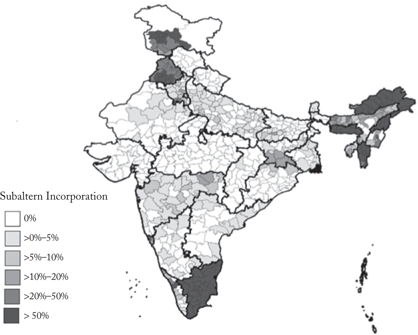
The district-wise proportion of the vote obtained by subaltern parties in the 1977–80 elections ranged from 0 to 1, with a mean of 0.14. Figure 4 describes the variation in subaltern incorporation across districts. As we observe, subaltern-led parties obtained the majority of the votes in all or almost all districts in the northeastern states of Arunachal Pradesh, nagaland, mizoram, and meghalaya, and in the southern state of tamil Nadu. In two northern states (Jammu and the single state of Kashmir and Punjab) they obtained a majority in several dis-tricts, and between 20 and 50 percent in several others. A scattered handful of states in the west, center, and north have no subaltern-led parties. Those remaining have a number of districts in which the vote share for subaltern parties is less than 20 percent.
District-Level Subaltern Incorporation: 1977–1980 State Legislative Assembly Electionsa

Because subaltern-led parties were created at different times in different regions, the pattern of subaltern incorporation developed gradually over the twentieth century. For example, the Muslim League, formally founded in 1948, had its roots in an older party founded in 1906. And the Republican Party of India, which, along with its splinter parties also shows up as subaltern led in several states, fought its first election in 1962 and had its roots in an older party founded in 1942. In addition, although this article is concerned only with the effect of subaltern incorporation at the critical juncture of 1977–80, it has since continued to evolve in a differential pattern.Footnote 58
What explains the variation in subaltern incorporation in the 197780 elections? There is no single cause. The literature on the subject attributes it to several variables activated at different points in time and space, including regional and group-specific differences in colonial rule, patterns of land settlement, access to literacy and markets, the emergence of social reform movements, government-led affirmative action policies, and organizational devices that inadvertently or intentionally solved the collective action problem described above.Footnote 59 Given its gradual evolution, there is no reason to predict that it is the product of the first phase of Maoist violence.
In the analysis below, we control, both directly and with district fixed effects, for possible underlying causes of subaltern incorporation that may be associated with Maoist violence. We also show empirically that it is not a product of prior Maoist violence. This, along with a difference-in-differences design, ensures that the relationship we discover between subaltern incorporation and Maoist violence is not confounded by the underlying causes of subaltern incorporation.
Although the vote share of subaltern-led parties increased incrementally over time, the Emergency introduced a sudden switch in the effective value of subaltern incorporation before and after the 1977–80 elections that we exploit in our identification strategy. These elections represent a switch from the authoritarianism of the Emergency to democracy. During the Emergency, Gandhi postponed elections and jailed thousands of opposition party leaders and activists, including many sitting members of parliament and members of state legislative assemblies (mlas).Footnote 60 The Emergency also shifted power from the Congress Party as an institution to Gandhi and her coterie. In the states, it shifted power from elected representatives (the chief minister and mlas) and their parties to nonelected officials and institutions, including the appointed governor, the bureaucracy, and police forces.Footnote 61
Consequently, even though there was district-wise variation in the percentage of the vote won by subaltern parties in the elections prior to 1977, the Emergency rendered parties ineffective as channels of access to the state. The effective value of subaltern incorporation during the Emergency, therefore, can be taken as zero in all districts. the introduction of democracy in elections between 1977 and 1980 restored political parties as effective channels of access to the state. consequently, the variation in the vote captured by subaltern parties across districts during these elections can be taken as the effective value of subaltern incorporation after the Emergency was over.
VII. Other Explanations
This section addresses hypotheses for chronic violence inferred from previous works on civil war. the literature is concerned with outcomes like onset, duration, and recurrence, which are different from but related to our concept of chronic violence. civil war onset is generally measured as an event that occurs when the number of conflict-related deaths crosses a threshold,Footnote 62 whereas duration and recurrence assume that civil war onset has previously occurred.Footnote 63 chronic violence in a district can produce civil war onset, and may or may not continue after such onset occurs. We can think of chronic violence, then, as part of the process that contributes to the onset, duration, or recurrence of civil war.
The hypotheses suggested by this literature identify six groups of variables as possible explanations for civil war: (1) geographic conditions, (2) socioeconomic characteristics, (3) historical legacies, (4) preexisting patterns of violence, (5) ethnic demography, and (6) political variables. our empirical analysis does not try to disconfirm these hypotheses. Instead, we show that subaltern incorporation has a direct effect on chronic Maoist violence that is not confounded by alternative accounts. Here, we elaborate on the covariates we use in the empirical analysis as well as on their link to previous theories.
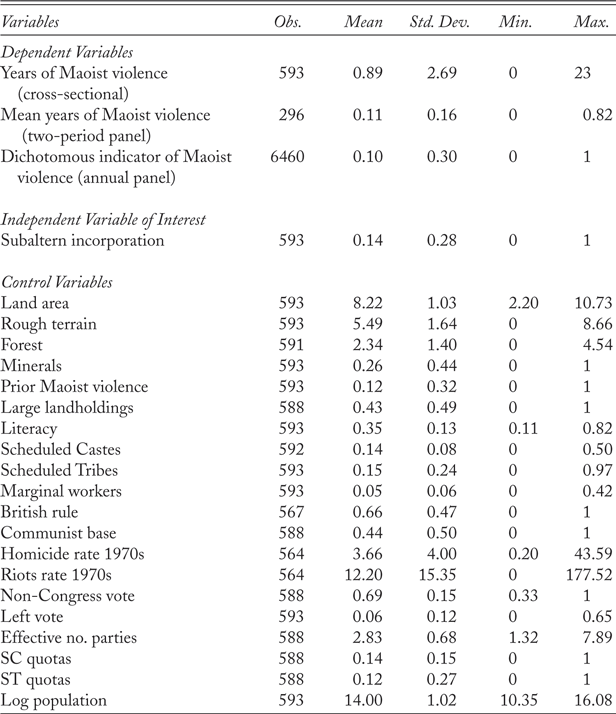
Table 1 summarizes the descriptive statistics for these variables (see the supplementary material for details).Footnote 64 All covariates are measured before the 1977–80 elections or as close to this period as the data sources permit.
Geographic conditions include a district’s land area, an index of rough terrain, the percentage of a district’s area covered by forest, and a dichotomous indicator for the presence of minerals. These variables have been highlighted as important determinants of violent conflict in both the comparative literature on civil warFootnote 65 and the literature on the Maoist insurgency in India.Footnote 66
Descriptive Statistics of Key Variablesa
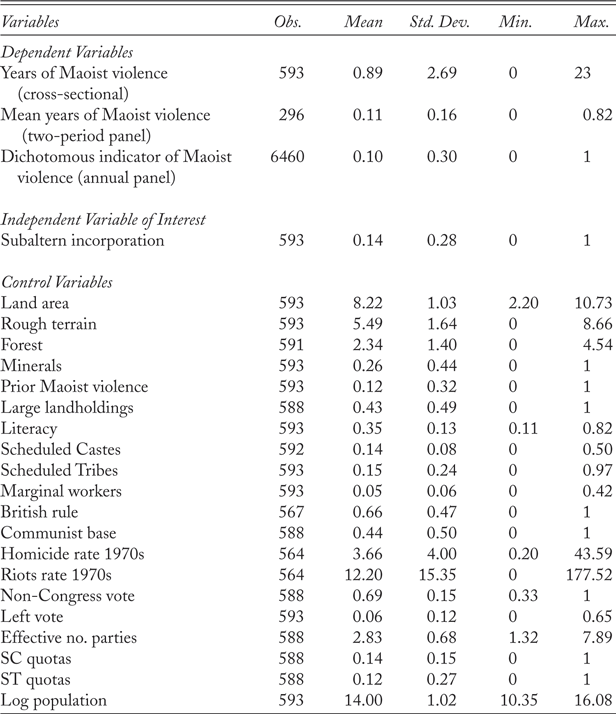
a The cross-sectional variable measuring the number of years of Maoist violence covers the 1981–2008 period for the full sample of districts (N = 593). Mean years of Maoist violence is calculated for two time periods (during and after the Emergency), and excludes districts that remained unaffected in both periods. The dichotomous indicator of Maoist violence is a district-year variable that covers the 1971–2008 period and excludes districts that remained unaffected during those years. Subaltern incorporation is the independent variable of interest and is measured as the vote share received by subaltern parties during the 1977–80 elections. Control variables are measured before the 1977–80 elections or as close to this period as the data sources permitted. See the supplementary material for variable definitions, coding rules, and data sources (Chandra and García-Ponce Reference Kanchan and García-Ponce2019b).
Socioeconomic variables include the proportion of marginal workers, a dummy for the presence of individually owned large landholdings, and the literacy rate in the district. The proportion of marginal workers (members of the workforce who have worked for less than six months in the year preceding enumeration) is a proxy for poverty,Footnote 67 which is widely seen as a cause of civil war.Footnote 68 the indicator for individually owned, large landholdings measures landlordism. It controls for the possibility, suggested both by the literature on Maoist violence in IndiaFootnote 69 and by other forms of violence in other countries,Footnote 70 that land regimes may explain violence. the literacy rate of a district is another socioeconomic factor that may be linked to Maoist violence in india.Footnote 71
We include two measures of historical legacies: a dummy for the presence of a communist party prior to 1967, which may help to provide the Maoists with their initial organizers; and a dummy for direct British rule, which captures the insight that variation in present-day outcomes may reflect the long-term effects of colonial institutions.Footnote 72
We measure prior patterns of violence in a district using the rate of homicides and riots during the 1970s. We also include a dummy for whether a district experienced prior Maoist violence. These variables capture the intuition that violence in the past may make a district more prone to Maoist violence subsequently, mirroring the hypothesis that previous war makes the recurrence of war more likely.Footnote 73 Although we measure these two types of violence specifically, the use of district fixed effects in the difference-in-differences regressions accounts for other forms of historical violence. We also show in the supplementary material that the cross-sectional results are robust to including a measure of preexisting insurgent violence.Footnote 74
We measure ethnic demography using the proportion of a district’s population that belongs to the Scheduled Castes and Scheduled Tribes.Footnote 75 The conventional view of Maoist violence in India suggests these two ethnic categories are the most important sources of recruits for the Maoist movement.Footnote 76 Our own research, corroborated by other ethnographic work,Footnote 77 indicates that the Maoists also recruit heavily among the Backward Castes. There is no district-wise data on the population of the Backward Castes in India, but since the population of this category does not vary significantly over time, the use of district fixed effects in our difference-in-differences design may address this concern.
As for political variables, we control for other forms of ethnic inclusion in governmentFootnote 78 in two ways. First, we include the district-wise fraction of seats reserved for Scheduled Castes and Scheduled Tribes (sc and st quotas) in state legislative assembly elections.Footnote 79 Second, in a separate state-level analysis, we also control for subaltern leadership in state-level government by including a dichotomous variable for whether the elected chief minister was from an ethnic subaltern group. Recall that since quotas in village-level elections were introduced only after 1993, they cannot be measured for the 1977–80 period.
We also incorporate political variables that may increase the influence of subaltern groups in government short of incorporating them into party leadership structures. These include the effective number of parties as a measure of electoral competitiveness hypothesized to decrease some forms of violence, such as riots, by making subaltern groups pivotal voters;Footnote 80 the non-Congress vote share, which rules out the possibility that our measure of subaltern incorporation is simply mirroring an opposition vote associated with violence;Footnote 81 and the vote share received by left parties—that is, the cpm and the cpi—to ensure that the effect of subaltern incorporation is not confounded by underlying support for left ideology.Footnote 82
James Fearon and David Laitin suggest that state capacity, proxied by per capita gdp, is an important variable explaining civil war onset.Footnote 83 Studies of the intensity of Maoist violence in India also suggest that aspects of state capacity (for example, public employment programs) matter, although they offer mixed results on the direction of the effect.Footnote 84 Because of the lack of data, we do not control for per capita gdp,Footnote 85 but some variables in our analysis, such as rough terrain, prior violence, and the proportion of marginal workers, may be read as proxies for state capacity. The state may be weaker in districts with rough terrain because of the difficulty of penetrating mountainous and forested areas. districts with high levels of violence in previous years, similarly, may reflect weak policing capacity. Finally, to the extent that income can be a proxy for state capacity, our alternative measure of poverty—the proportion of marginal workers—should serve as an equivalent.
Stathis Kalyvas raises the possibility that districts in which either the state or Maoist organizations are in near complete control may be more likely to experience chronic violence than districts in which either side has complete or fragmented control.Footnote 86 but there is no variation in the zones of control between the state and the Maoists in the early 1980s, when the Maoist organizations of the second phase had just been formed and the state had complete control in every district. Later on, Maoist organizations were able to build a critical mass of support in districts with low levels of subaltern incorporation and use violence to challenge state control. In this sense, chronic violence is part of the process by which zones of control emerged, rather than being a consequence of that process. but our measure of prior maoist violence should proxy for zones of control established in the first phase of the conflict.
VIII. Subaltern Incorporation and Maoist Violence: A Robust Statistical Association
This section documents a statistical association between subaltern incorporation and chronic maoist violence across indian districts. Our dependent variable is a count of the number of years that a district experienced at least one Maoist-related death from 1981 to 2008 (that is, after the end of the Emergency). The vote share captured by subaltern- led parties in a district during the 1977–80 elections measures subaltern incorporation at the critical juncture before Maoist organizations entered.
Our dependent variable is bunched around a few integers (see Figure 2). Between 1981 and 2008, 77 percent of districts experienced zero years of Maoist violence.Footnote 87 Given the mean value of 0.89 in our dependent variable, a Poisson distribution predicts that Pr(Y = 0) = e −0.89 = 0.41. Since the observed proportion is 0.77, we may have an excess zero problem; that is, the mechanism generating the zeros may differ from the one generating the positive counts.Footnote 88 This suggests that a zero-inflated variant of a count model should be considered.
A comparison of different count models based on goodness of fit suggests that a zero-inflated model is in fact the most appropriate. Figure A1 in the supplementary material shows the residuals from Poisson, zero-inflated Poisson (zip), negative binomial (nb), and zero-inflated negative binomial (zinb) regressions of Maoist violence on subaltern incorporation, using the full set of covariates.Footnote 89 The negative binomial models clearly are better at fitting the data than their Poisson counterparts, and the zinb model outperforms the standard nb. Other fit statistics (aic [Akaike Information Criterion] and BIC [Bayesian Information Criterion]) point in the same direction (see Table A3 in the supplementary material).Footnote 90 Therefore, our main results will be based on zinb regressions.Footnote 91
The zinb regression estimates a two-stage model.Footnote 92 In the first stage (the inflation model), a logit regression is used to determine whether a district experienced zero years of violence. We specify the probability of being unaffected by Maoist violence as a function of a subset of plausible structural preconditions for Maoist activity, including population size, prior Maoist violence, presence of minerals, and early establishment of a communist base.Footnote 93 In the second stage, a negative binomial regression of the following form is used to estimate the determinants of the positive counts of years of Maoist violence, conditional on the fact that the dependent variable is strictly positive:
 $$\ln E({y_i}{\rm{|}}{Z_i}){\rm{}} = \alpha + \delta subalter{n_{\rm{i}}} + {X_i}\left (\phi \right) + {\rm {ln}}(po{p_i}).$$
Here, yi represents the count of years in which district i experienced at least one Maoist-related death from 1981 to 2008. The subalterni variable measures the vote share received by subaltern parties during the 1977–80 elections in district i. The parameter of interest is δ, which captures the log point increase in expected years of violence as a result of one unit of change in subaltern. Xi is a vector of covariates that varies across specifications, popi is the district population in 1981, and Zi denotes the full set of explanatory variables. We use robust standard errors in all regressions.
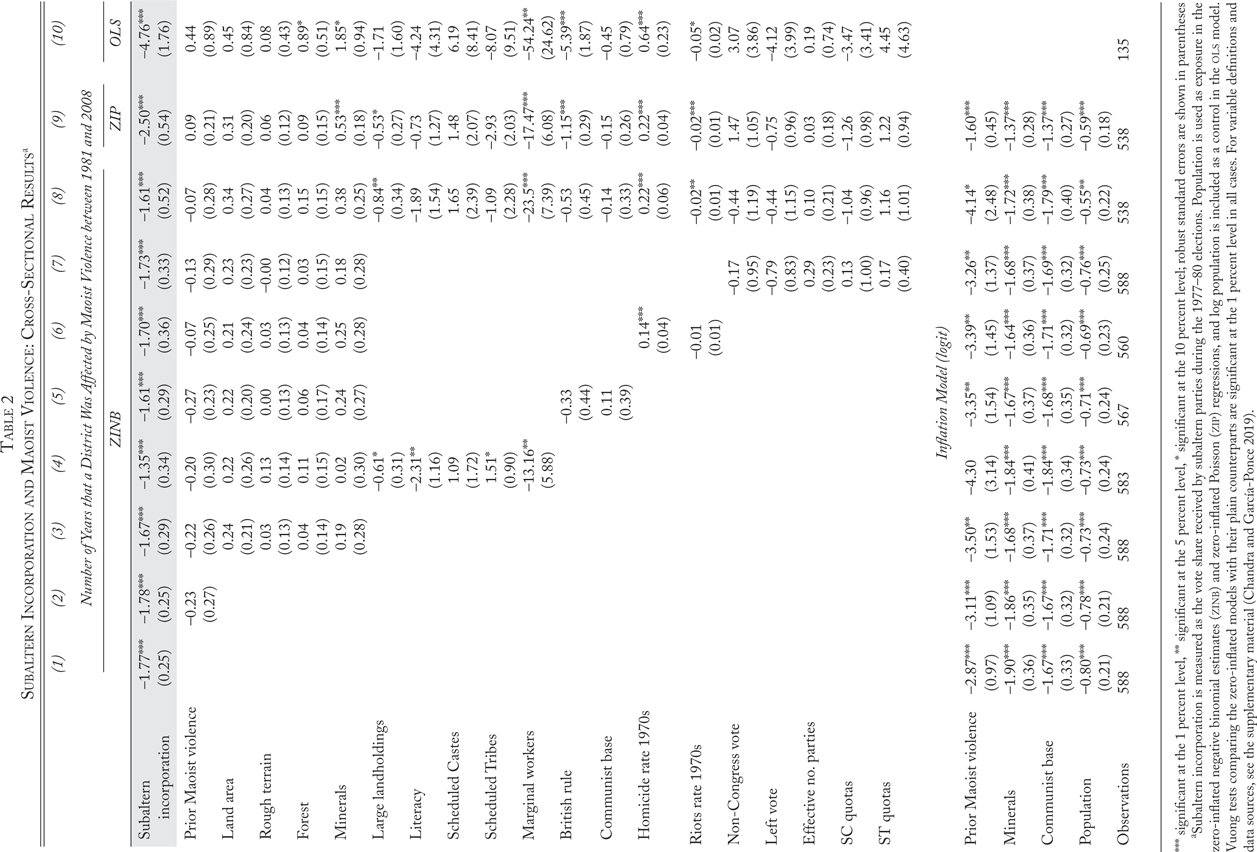
The results are reported in Table 2. We start by showing the ZINB estimates without any controls in column 1. We introduce different subsets of controls in columns 2–7, and column 8 includes the full set of controls.Footnote 94 For comparison, results from zip and ordinary least squares (ols) regressions are reported in columns 9 and 10, respectively. While the zinb and zip regressions model the large number of zeros in our data, the ols model simply excludes them.
Subaltern Incorporation and Maoist Violence: Cross-Sectional Resultsa
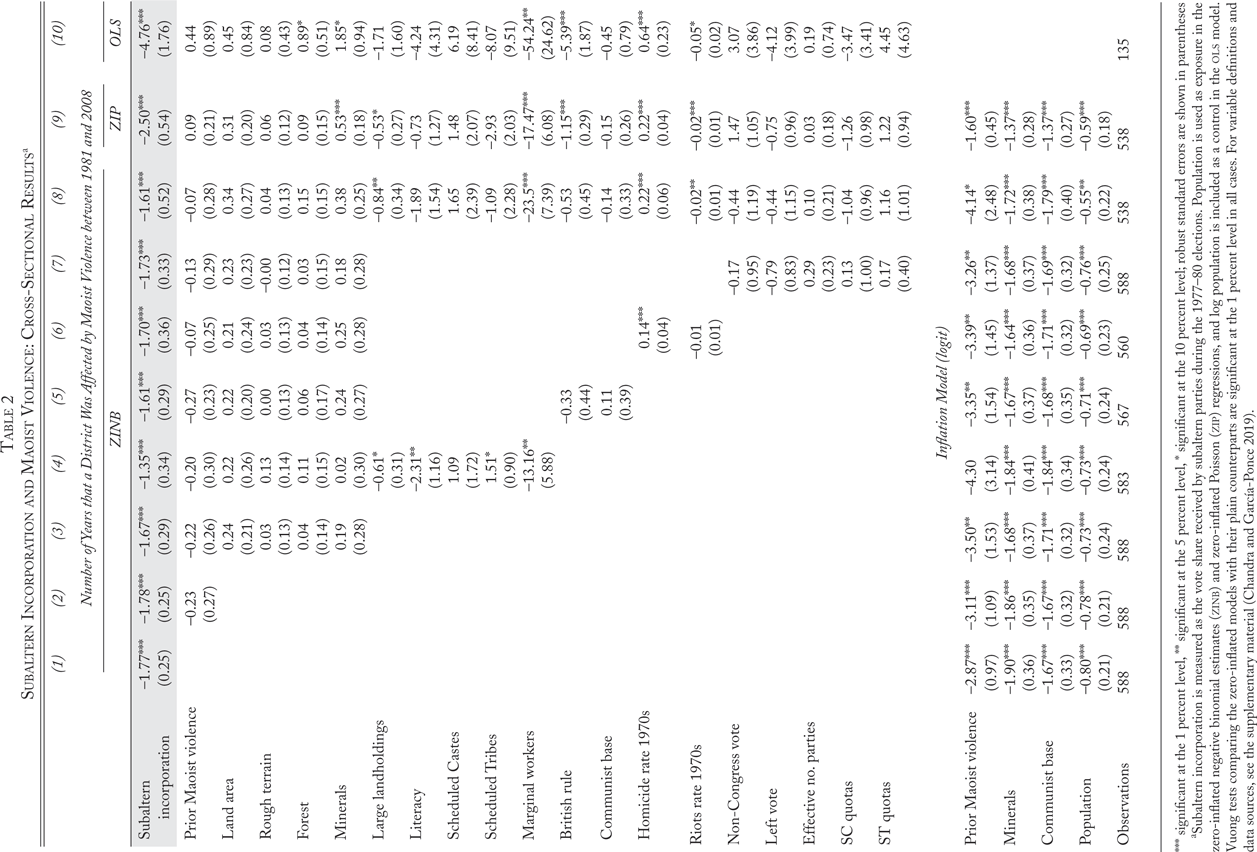
*** significant at the 1 percent level, ** significant at the 5 percent level, * significant at the 10 percent level; robust standard errors are shown in parentheses
a Subaltern incorporation is measured as the vote share received by subaltern parties during the 1977—80 elections. Population is used as exposure in the zero-inflated negative binomial estimates (zinb) and zero-inflated Poisson (zip) regressions, and log population is included as a control in the ols model. Vuong tests comparing the zero-inflated models with their plain counterparts are significant at the 1 percent level in all cases. For variable definitions and data sources, see the supplementary material (Chandra and García-Ponce Reference Kanchan and García-Ponce2019).
Conditional on having at least one year of Maoist violence from 1981 to 2008, the zero-inflated models indicate that subaltern incorporation is negatively correlated with the count of years of violence. The coefficient of interest is statistically significant at the 1 percent level across specifications. Our most conservative estimate (column 4) implies that, ceteris paribus, districts that reached 100 percent subaltern incorporation experienced a -1.35 log point decrease in violence, that is, 74 percent fewer years of Maoist violence over 1981–2008, as compared with districts in which subaltern-led parties did not obtain any votes. In the average Maoist-affected district, which experienced 3.8 years of violence, this reduces the years of violence to 1 year, thus essentially canceling out chronic violence. The zip model reported in column 9 suggests an equivalent effect of 3.5 fewer years of violence. Similarly, note that the simple ols regression restricting the sample to nonzero cases underscores the robustness of our results.
Two other variables also seem to be robust predictors of chronic Maoist violence. First, districts with higher homicide rates before 1980 experienced more years of Maoist violence between 1981 and 2008. Second, districts with a higher proportion of marginal workers experienced less violence. this is consistent with Alpa Shah, who suggests that the initial critical mass of joiners in the Maoist movement came from the relatively better off among the poor, rather than those at the very bottom of the local socioeconomic hierarchy.Footnote 95 the remaining variables identified by previous work are not significantly associated with chronic maoist violence, but we cannot rule out that they matter in ways not captured by our analysis.
It is noteworthy that alternative political channels for subaltern empowerment, including non-Congress vote, left ideology, effective number of parties, and ethnic quotas, at least as designed in india, do not have a statistically significant effect. in a separate, state-level analysis reported in table A5 in the supplementary material, we show that the effect of subaltern incorporation by political parties is not confounded by state-level inclusion in government—measured as whether the state chief minister was from an ethnic subaltern group.Footnote 96 these results do not suggest that these other forms of inclusion do not matter, but they do indicate that whatever effect they may have does not confound the significant deterrent effect that subaltern incorporation by political parties has on chronic violence.
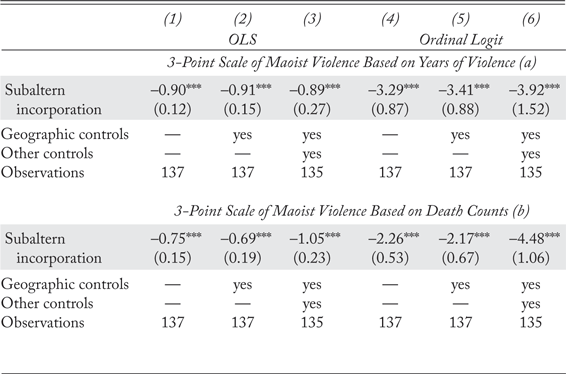
Finally, we rerun the analyses using an ordinal dependent variable, coding districts affected by maoist violence as not chronic (only one year of violence between 1981 and 2008), weakly chronic (two to five years of violence), and highly chronic (more than five years of violence). Another alternative operationalization is to use the number of deaths rather than the number of years, coding districts as low violence (if a district experienced at least one maoist-related death between 1981 and 2008), intermediate violence (if a district experienced more than one death but is located below the 75th percentile in the distribution of Maoist-related deaths), and high violence (if a district is located above the 75th percentile). We estimate ols and ordered logit regressions.
The results, as Table 3 shows, are qualitatively identical if we use these categorical variables.
Cross-Sectional Results Using Ordinal Scales of Maoist Violencea
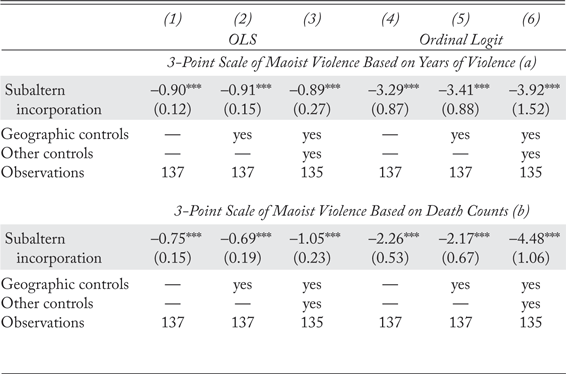
*** significant at the 1 percent level, ** significant at the 5 percent level, * significant at the 10 percent level; robust standard errors are shown in parentheses
a In panel (a), the dependent variable is equal to 1 (not chronic violence) if a district experienced at least one year of Maoist violence for the period 1981—2008; 2 (weakly chronic violence) if a district experienced between two and five years of Maoist violence; 3 (highly chronic violence) if a district experienced more than five years of Maoist violence. In panel (b), the dependent variable is equal to 1 (low violence) if a district experienced at least one Maoist-related death for the period 1981—2008; 2 (intermediate violence) if a district experienced more than one death but is located below the 75th percentile in the distribution of Maoist-related deaths; 3 (high violence) if a district is located at the 75th percentile or above. Geographic controls include land area, rough terrain, forest, and minerals. Other controls include log population, large landholdings, literacy rate, Scheduled Castes, Scheduled Tribes, marginal workers, British rule, communist base, homicide rate 1970s, riots rate 1970s, non-Congress vote, left vote, effective number of parties, Scheduled castes quotas, and Scheduled Tribes quotas. See the supplementary material for variable definitions and data sources (Chandra and García-Ponce Reference Kanchan and García-Ponce2019b).
IX. Identifying a Causal Effect: A Difference-in-Differences Design
To identify a causal effect, we must rule out the possibility that the association between subaltern incorporation and chronic Maoist violence is confounded by an omitted variable jointly correlated with the first two. This would not present a problem if subaltern incorporation were randomly distributed across districts. But since it is not, we have to address additional concerns regarding potential confounders.
We employ a difference-in-differences strategy with district and time fixed effects that exploits the change in the value of subaltern incorporation induced by the shift from authoritarianism to democracy that took place during the 1977–80 elections. This identification strategy, which compares changes in levels of violence before and after these critical elections—or, more precisely, during and after the Emergency—across districts with varying levels of subaltern incorporation, allows us to control for all time-invariant characteristics of the districts as well as for time-specific macro effects. The key assumption is that had the emergency not ended, the prospects of developing chronic Maoist violence would have been the same in districts that are otherwise identical. The results suggest that subaltern incorporation is causally linked to district-wise variation in chronic Maoist violence.
Recall that because of the switch from authoritarianism to democracy, a district’s effective value of subaltern incorporation during the emergency years can be taken to be zero. The national-level Emergency began in 1971, but the Indian government had already been implementing state-level emergencies since 1967.Footnote 97 During the 1977–80 elections, we can take the variation in the vote captured by subaltern parties across districts to be the effective value of subaltern incorporation. If subaltern incorporation has the effect we predict, then we should observe that districts with higher levels of subaltern incorporation in the 1977–80 elections experienced a relative decrease in years of violence after this critical juncture.
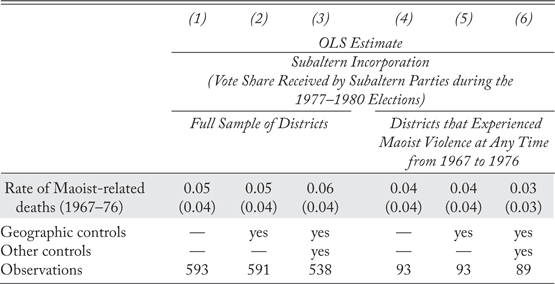
This design is a generalization of the basic difference-in-differences approach that compares a treatment and a control group (first difference) before and after a treatment intervention (second difference). In our design, the relevant comparison is across districts with different levels of treatment intensity before and after the critical elections. The electoral returns from these elections are not randomly assigned, but the evidence demonstrates that they are not endogenous to preexisting patterns of Maoist-related violence. The regression results shown in Table 4 indicate that Maoist violence during the period 1967–76 is not statistically associated with the vote share received by subaltern parties during the 1977–80 elections.
Prior Maoist Violence and Subaltern Incorporationa
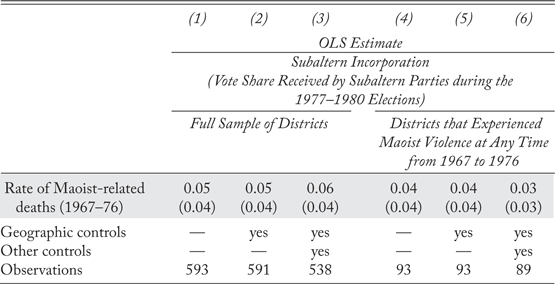
*** significant at the 1 percent level, ** significant at the 5 percent level, * significant at the 10 percent level; robust standard errors are shown in parentheses
a The rate of Maoist-related deaths (1967–76) measures the number of deaths specifically tied to the Maoist conflict per 100,000 people between 1967 and 1976. Geographic controls include land area, rough terrain, forest, and minerals. Other controls include British rule, communist base, homicide rate 1970s, and riots rate 1970s. See the supplementary material for variable definitions and data sources (Chandra and García-Ponce Reference Kanchan and García-Ponce2019b).
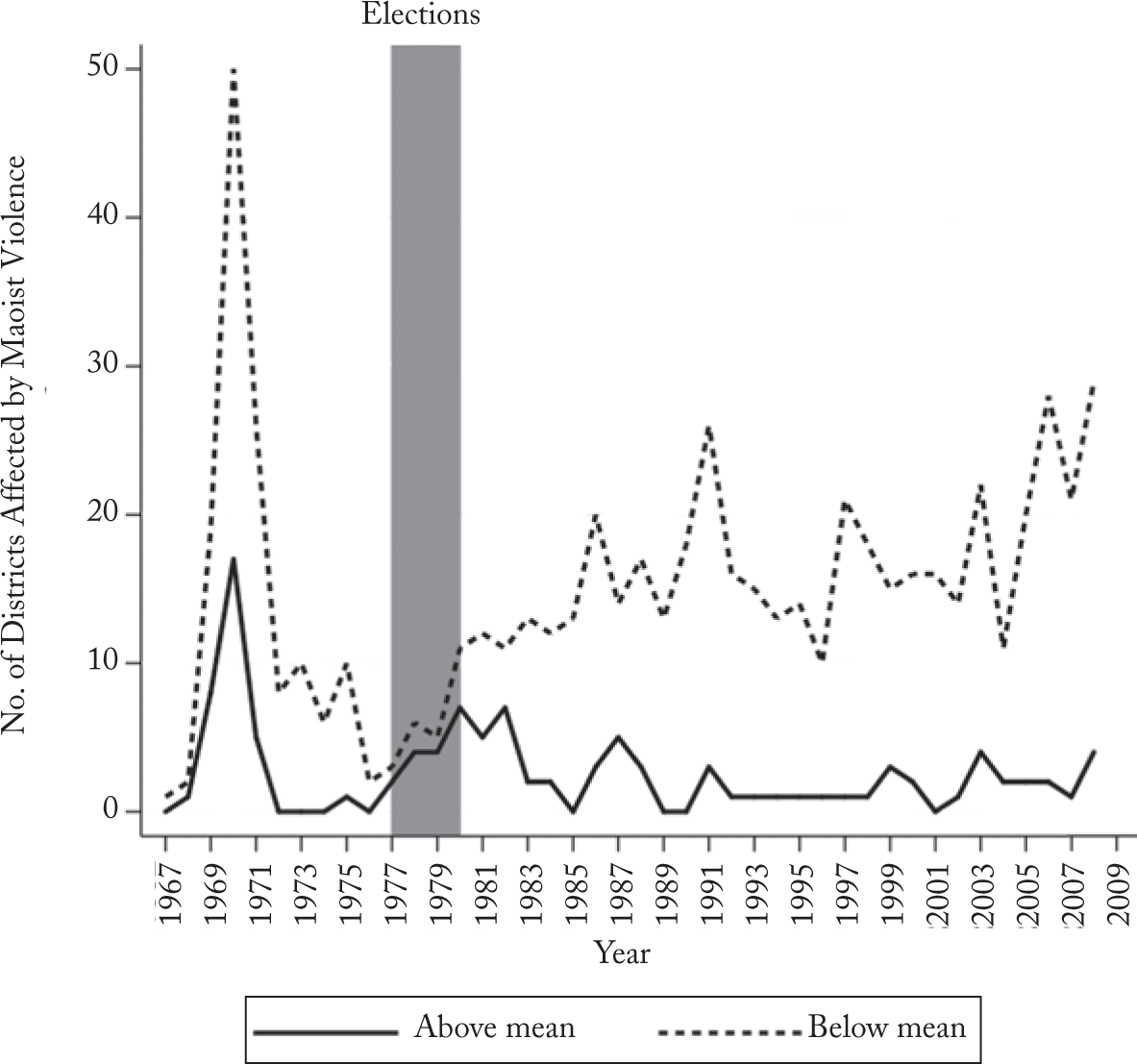
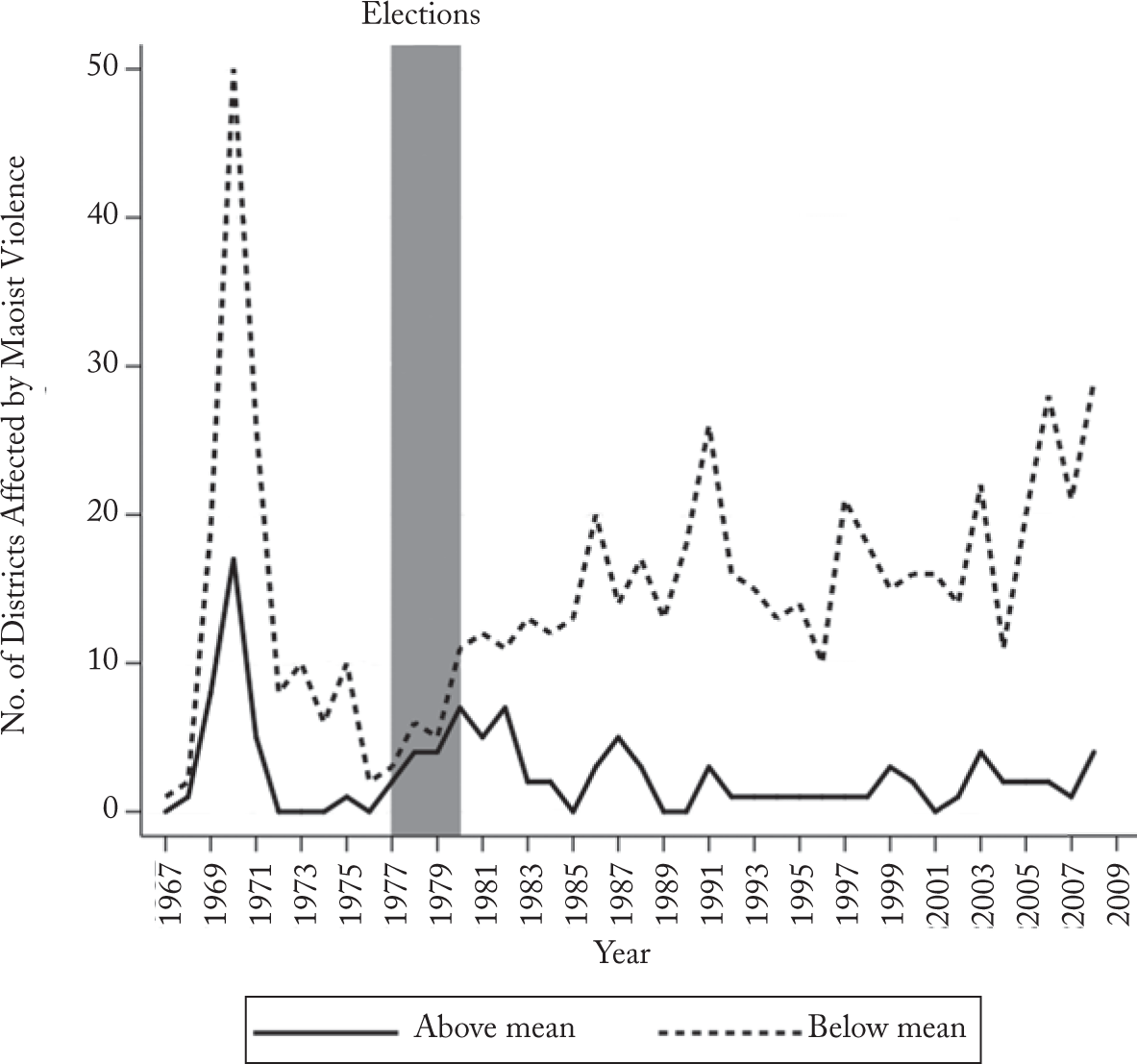
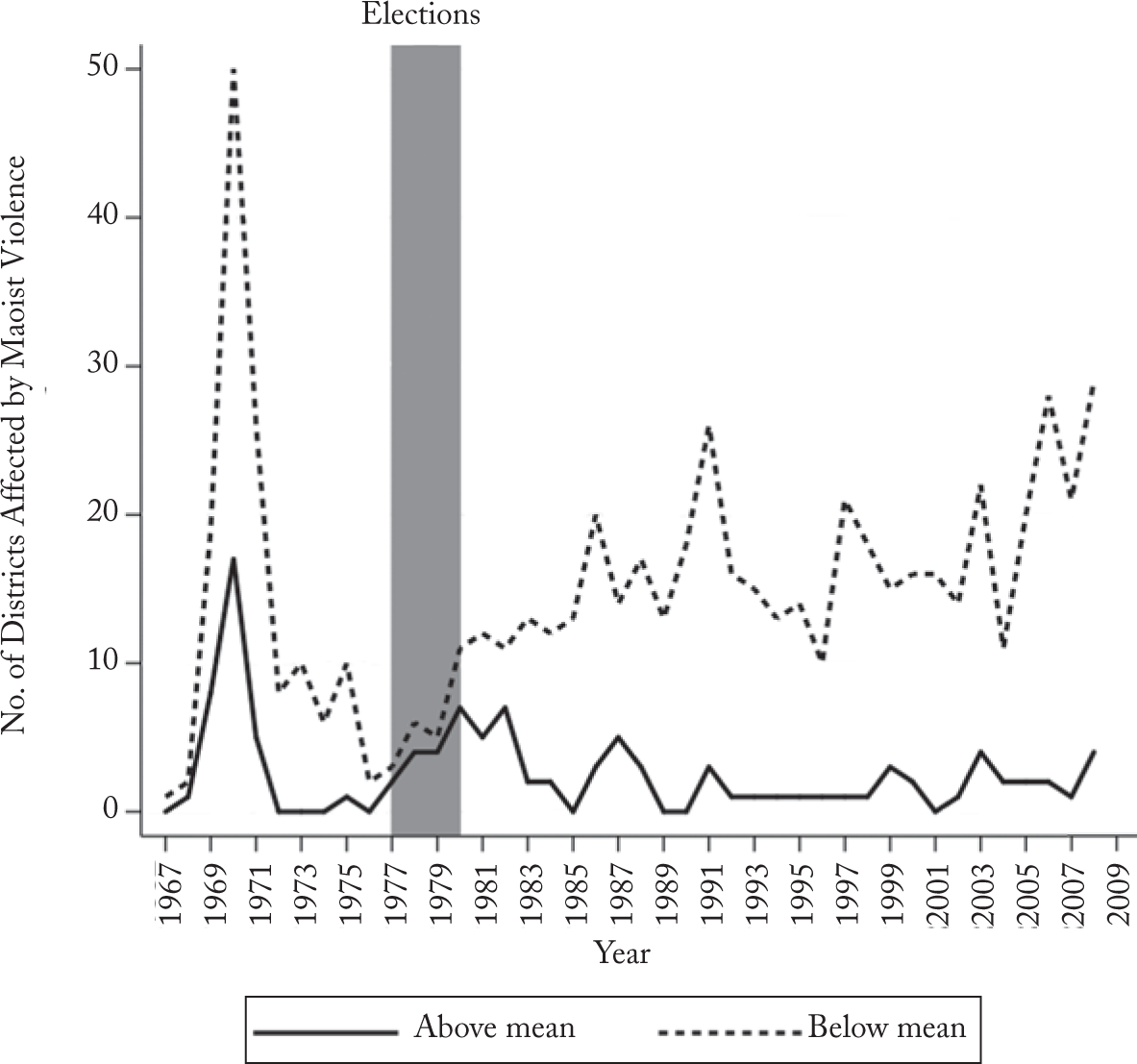
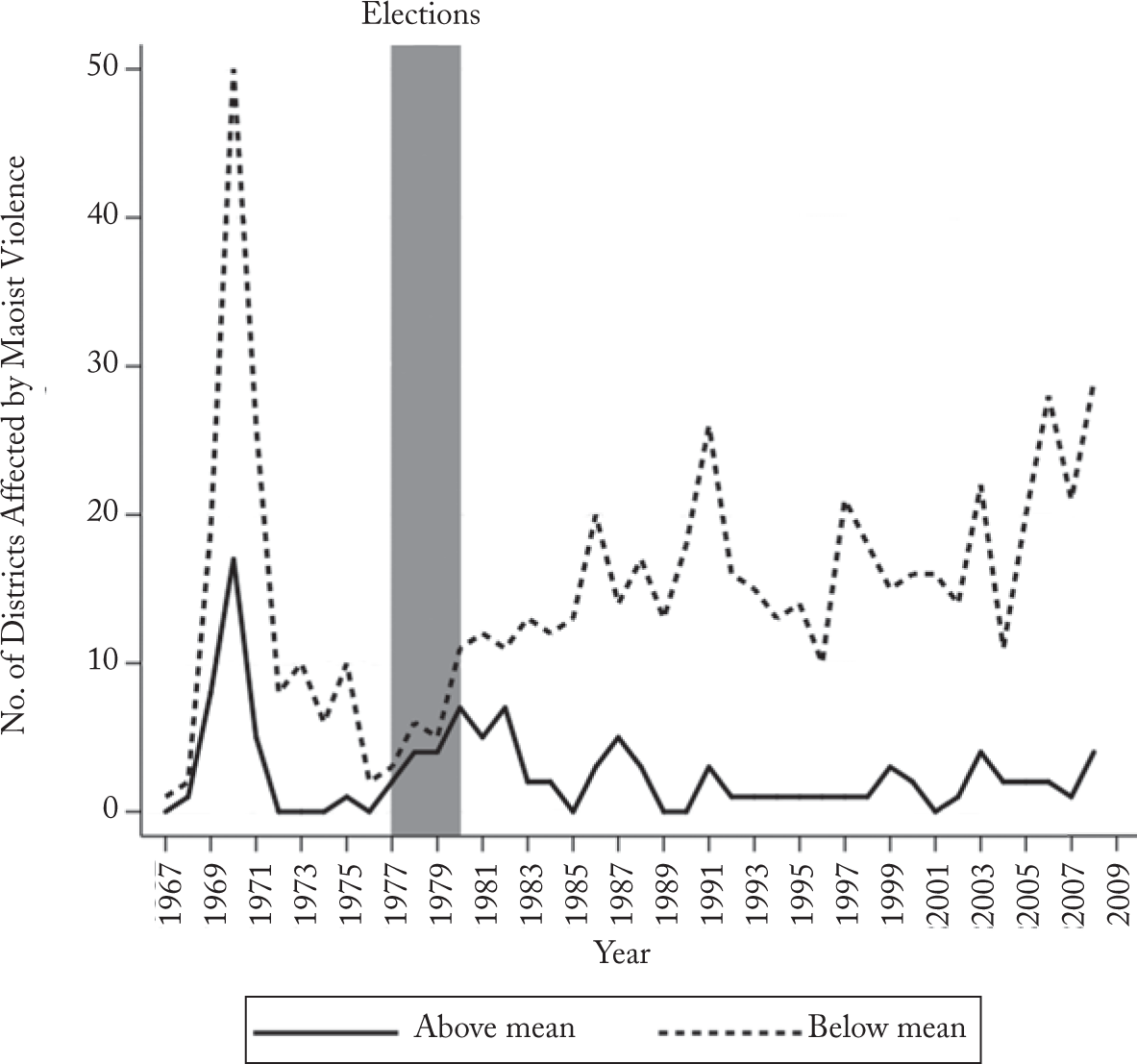
The intuition driving our design is partially captured by Figure 5, which classifies districts into two types: above and below the mean level of subaltern incorporation. It compares the number of districts of each type affected by Maoist violence in each year.Footnote 98 We say it partially captures the intuition because subaltern incorporation is a continuous variable but to depict it in the graph, we dichotomize it. Two things are worth noting. First, the incidence of Maoist violence in the two groups of districts followed parallel trends before the 1977–80 elections. Second, after this critical juncture, the number of high- incorporation districts affected by Maoist violence remained relatively stable, but the number of low-incorporation districts affected by Maoist violence began to increase. This is consistent with the argument that subaltern incorporation can have a deterrent effect on Maoist violence, other things equal.
Maoist Violence in Districts above and below the Mean Level of Subaltern Incorporationa
We estimate two equations. First, we collapse the data into a two-period district-level panel, and estimate fixed-effects regression testing for the differential effect of subaltern incorporation by comparing changes in the average number of years of Maoist violence before and after the 1977–80 critical elections in the subset of districts that experienced at least one year of Maoist violence from the beginning of the state- level emergency to 2008.Footnote 99 This approach follows Bertrand, Duflo, and Mullainathan, who suggest collapsing the time-series information into pre- and post-periods to address the concern that serially correlated disturbances in the model could bias downward the standard errors of the estimates.Footnote 100 The baseline regression to be estimated is:
 $${y_{it}} = {\alpha _i} + \left ({subalter{n_i} \times pos{t_t}} \right)\lambda + pos{t_t}\tau + {\varepsilon _{it}}.$$
Here, yt represents mean years of Maoist-related violence in district i during the time period t, that is, before or after the 1977–80 elections; aa are district fixed effects that control for time-invariant characteristics of the districts; postf is an indicator equal to 1 for the post-1980 period and 0 otherwise; subalterni X postf interacts the subaltern incorporation variable with the post-1980 indicator; and eit is the usual disturbance term. The coefficient of interest is l, which captures the differential effect of subaltern incorporation on expected levels of violence after the 1977–80 elections. We estimate this equation via ols using robust standard errors clustered by district.
We use a similar approach to assess whether subaltern incorporation achieved during the critical elections influences the probability that a district is affected by Maoist violence in a given year over 1981–2008.Footnote 101Specifically, we estimate the following equation:
 $${y_{it}} = {\alpha _i} + {\tau _t} + \left ({subalter{n_i} \times pos{t_t}} \right)\theta + {\varepsilon _{it}}.$$
Here, yt is simply a dummy equal to 1 if district i was affected by deadly Maoist violence during year t (0 otherwise); a. are district fixed effects; and Tt are year fixed effects that capture shocks common across districts in a given year. The coefficient of interest is θ, which captures the differential effect of subaltern incorporation on the probability of experiencing at least one Maoist death in any given year after 1980. We estimate both conditional fixed-effects logit and linear probability models using robust standard errors clustered at the district level.Footnote 102 The conditional fixed-effects logit model mechanically restricts the sample to districts with at least one year of Maoist-related violence throughout the period of analysis. We use this subset of observations in the linear probability models.
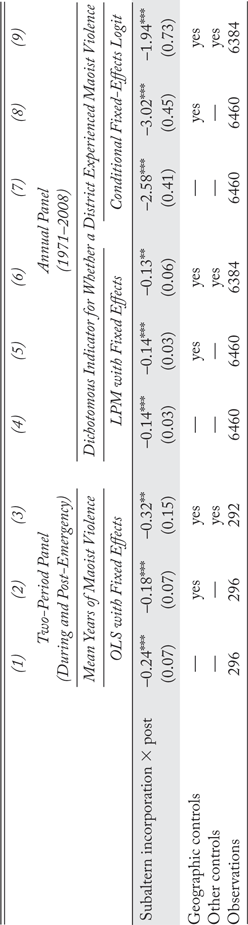
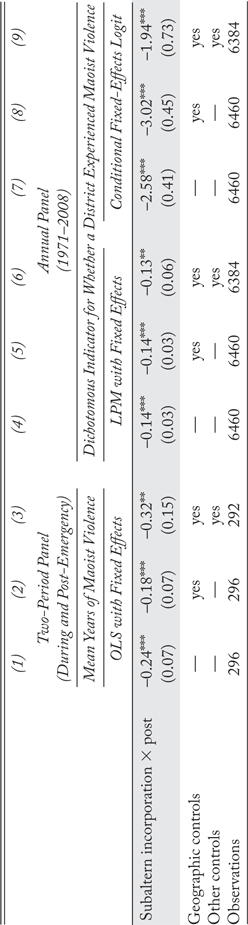
Table 5 reports estimates of equations 2 and 3. Columns 1–3 show the results for the two-period analysis, and columns 4–9, for the district-year analysis. The results confirm our previous findings. Based on the two-period analysis, the baseline coefficient estimate in column 1 suggests that a one-unit increase in subaltern incorporation leads to a 24 percentage point reduction in the fraction of years (or the average number of years) that a district experienced Maoist violence after 1980. To put these results in perspective, consider two districts: one in which subaltern-led parties obtained 0 percent of the vote (the median vote share obtained by subaltern-led parties in our sample) and one in which subaltern-led parties received 50 percent of the vote (approximately the vote share at the 85th percentile). our estimate implies that the latter district experienced about three years less of violence in the post-1980 period. If we take into consideration that the typical district in our sample was affected by Maoist violence three years on average, the estimated effect implies that going from 0 percent to 50 percent of the votes to subaltern-led parties translates into having zero years of violence instead of three. Note in columns 2 and 3 that these results are robust to the inclusion of potential confounders interacted with the post-1980 indicator.
The annual panel results underscore the plausibility of our argument. Consider the same two districts described above. The -.14 coefficient reported in column 4 implies that the probability of experiencing Maoist violence after the elections in the second type of district is 7 percentage points lower than in the first type. Based on the conditional fixed-effects logit models, the most conservative prediction—using estimates from column 9—indicates that the probability of violence is 10 percentage points lower in the second type of district as compared with the first type. These results are robust to the inclusion of controls interacted with the post-1980 indicator, showing that the effect of subaltern incorporation is unlikely to be confounded by other changes in the characteristics of the districts induced by the critical elections.
Subaltern Incorporation and Maoist Violence: Diff-in-Diff Resultsa
*** significant at the 1 percent level, ** significant at the 5 percent level, * significant at the 10 percent level; robust standard errors are shown in parentheses
a All regressions include district fixed effects and log population interacted with a post-1980 indicator. The dichotomous indicator of Maoist violence is a district-year variable that covers the 1971—2008 period and excludes districts that remained unaffected during those years. Subaltern incorporation × post is the interaction of the vote share received by subaltern parties during the 1977—80 elections with the post-1980 indicator. Lag neighbors’violence measures the fraction of neighboring (that is, spatially contiguous) districts that were affected by Maoist-related deaths during the previous year. Linear time trends by subaltern incorporation are included in columns 1, 3, 4, 5, and 9. Quadratic time trends by subaltern incorporation are included in columns 2, 3, 4, 5, and 9. Specifications without year fixed effects—columns 1—3 and 5—include a post-1980 indicator. Geographic controls include land area, rough terrain, forest, and minerals, interacted with the post-1980 indicator. Other controls include large landholdings, literacy, Scheduled Castes, Scheduled Tribes, marginal workers, British rule, communist base, homicide rate 1970s, riots rate 1970s, non-Congress vote, left vote, effective number of parties, Scheduled Castes quotas, and Scheduled Tribes quotas, interacted with the post-1980 indicator. All control variables are measured before the 1977—80 elections or as close to this period as the data sources permitted. See the supplementary material for variable definitions and data sources (Chandra and García-Ponce Reference Kanchan and García-Ponce2019b).
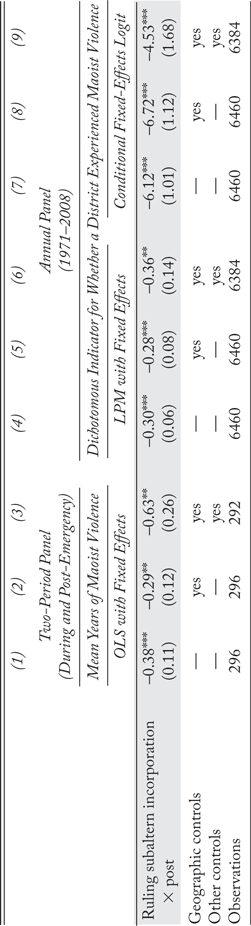
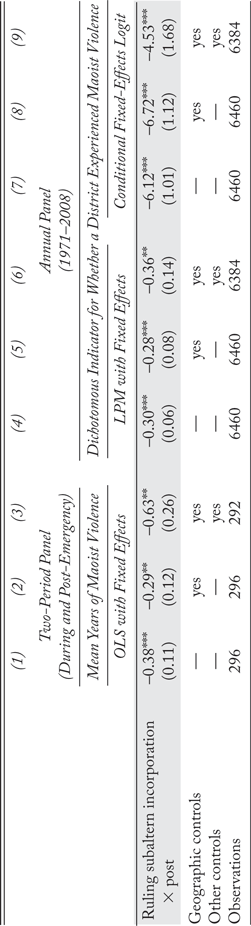
Furthermore, if our argument is correct, then the vote share associated with ruling subaltern-led parties—that is, those that took control of the state-level government—should have an even stronger deterrent effect than the vote share associated with subaltern-led parties in general. The results in Table 6 show that this is indeed the case.Footnote 103
“Ruling” Subaltern Incorporation and Maoist Violencea
*** significant at the 1 percent level, ** significant at the 5 percent level, * significant at the 10 percent level; robust standard errors are shown in parentheses
a All regressions include district fixed effects and log population interacted with a post-1980 indicator. Columns 1—3 include the post-1980 indicator, and columns 4—9 include year fixed effects. Mean years of Maoist violence is calculated at the district level for two time periods (during and after the Emergency) and excludes districts that remained unaffected in both periods. The dichotomous indicator of Maoist violence is a district-year variable that covers the 1971—2008 period and excludes districts that remained unaffected during those years. Ruling subaltern incorporation × post is the interaction of the vote share received by ruling subaltern parties during the 1977—80 elections with the post-1980 indicator. Geographic controls include land area, rough terrain, forest, and minerals, interacted with the post-1980 indicator. Other controls include large landholdings, literacy, Scheduled Castes, Scheduled Tribes, marginal workers, British rule, communist base, homicide rate 1970s, riots rate 1970s, non-Congress vote, left vote, effective number of parties, Scheduled Castes quotas, and Scheduled Tribes quotas, interacted with the post-1980 indicator. All control variables are measured before the 1977—80 elections or as close to this period as the data sources permitted. See the supplementary material for variable definitions and data sources (Chandra and García-Ponce Reference Kanchan and García-Ponce2019b).
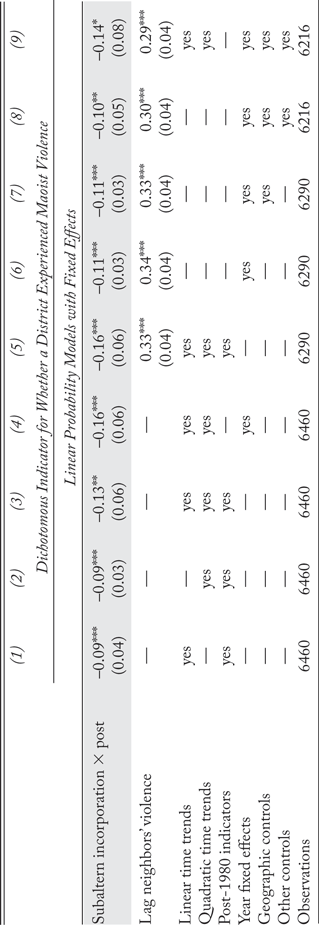
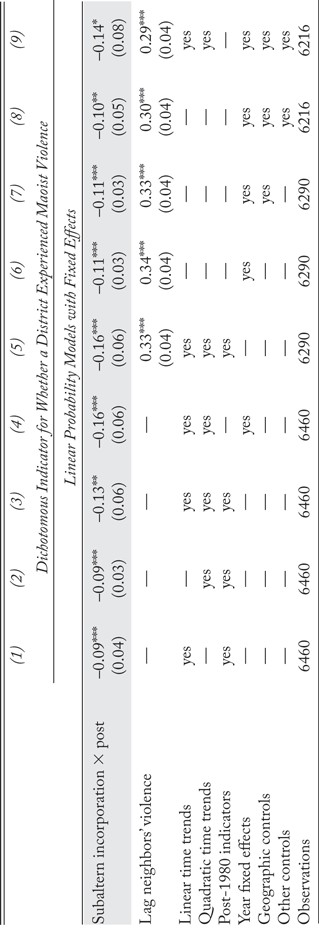
We also consider potential spatial spillovers in violence, which may serve as an alternative channel through which subaltern incorporation affects violence. For instance, if Maoist activity tends to diffuse outward or cluster territorially, then the level of incorporation of subaltern groups may initially explain variation in Maoist violence across districts, but subsequent persistence or increase in violence may reflect the diffusion of initial violence, rather than the degree of subaltern incorporation. To examine this account, for each district i, we create a measure that captures the fraction of neighboring (that is, spatially contiguous) districts that were affected by Maoist-related deaths during the previous year.
The results in Table 7 rule out the possibility that our estimates are confounded by spatial spillovers of violence and trends in subaltern incorporation after the Emergency. While there is evidence of such spillovers, the estimated coefficient on subaltern incorporation remains similar in magnitude and statistically significant, even when simultaneously controlling for linear and quadratic time trends and for the average level of violence occurring in spatially contiguous districts during the previous year.
Robustness to Time Trends and Spatial Confoundsa
*** significant at the 1 percent level, ** significant at the 5 percent level, * significant at the 10 percent level; robust standard errors are shown in parentheses
a All regressions include district fixed effects and log population interacted with a post-1980 indicator. The dichotomous indicator of Maoist violence is a district- year variable that covers the 1971—2008 period and excludes districts that remained unaffected during those years. Subaltern incorporation × post is the interaction of the vote share received by subaltern parties during the 1977—80 elections with the post-1980 indicator. Lag neighbors’violence measures the fraction of neighboring (that is, spatially contiguous) districts that were affected by Maoist-related deaths during the previous year. Linear time trends by subaltern incorporation are included in columns 1, 3, 4, 5, and 9. Quadratic time trends by subaltern incorporation are included in columns 2, 3, 4, 5, and 9. Specifications without year fixed effects—columns 1—3 and 5—include a post-1980 indicator. Geographic controls include land area, rough terrain, forest, and minerals, interacted with the post-1980 indicator. Other controls include large landholdings, literacy, Scheduled Castes, Scheduled Tribes, marginal workers, British rule, communist base, homicide rate 1970s, riots rate 1970s, non-Congress vote, left vote, effective number of parties, Scheduled Castes quotas, and Scheduled Tribes quotas, interacted with the post-1980 indicator. All control variables are measured before the 1977—80 elections or as close to this period as the data sources permitted. See the supplementary material for variable definitions and data sources (Chandra and García-Ponce Reference Kanchan and García-Ponce2019b).
In addition, we examine the robustness of our difference-in-differences results to (1) time trends, (2) the exclusion of individual states and entire regions of India, (3) the clustering of standard errors by state, (4) dropping outlier districts, (5) different time periods, and (6) the timing of elections. The results, discussed in Section 4 of the supplementary material, along with the results reported in the accompanying tables, demonstrate that our results remain substantively identical and statistically significant in all cases.Footnote 104
X. Conclusion
We have shown that the presence of subaltern-led political parties in a district before present-day Maoist organizations became active has a persistent deterrent effect on chronic Maoist violence in India’s districts. Although we provide a theoretical account and qualitative evidence for the mechanism explaining this deterrent effect, it is beyond the scope of our quantitative analysis to test for this mechanism. Two alternative mechanisms by which subaltern incorporation may crowd out armed organizations are sanctioning rather than preempting participation or promoting elite-level pacts between party leaders and Maoist organizations. The data from our fieldwork suggest the mechanism that we have outlined in this article, but our quantitative analysis cannot rule out Table 7 alternative mechanisms. Nevertheless, by providing the first evidence that subaltern-led political parties have a deterrent effect and by providing a plausible account explaining why, we hope to have made a sufficient case for collecting the large-n data that would allow a statistical adjudication between our proposed mechanism and other possibilities.
The analysis also raises the question of why subaltern-led parties emerge in some districts but not in others. A full theory of the origins of subaltern incorporation is a large subject for a different project. We have focused simply on showing that none of the variables suggested by previous works or by common sense as potential explanations confound the effect of subaltern incorporation on Maoist violence and that subaltern incorporation is not endogenous to prior violence.
Our finding that subaltern-led parties can deter armed violence is especially interesting in light of the extensive literature that suggests to the contrary that ethnic parties have a destabilizing effect on democratic systems. Parties that have an ethnic subaltern leadership are only one type of ethnic party and, because they need not be accompanied by a proethnic platform, need not be the most incendiary sort.Footnote 105 nevertheless, the finding that they can deter armed violence adds to an emerging literature that suggests that the institutionalized mobilization of ethnic identity can have a moderating effect on violence in democratic systems.Footnote 106
Finally, to the extent that ethnic representation within political parties preempts left revolutionary violence, this article suggests that we should rethink the dichotomy between ethnic and nonethnic civil wars—or ethnic and ideological civil wars—that characterizes the literature on the subject.Footnote 107 the persistence of systematic correlations between class and ethnicity, and therefore the targeting of ethnic categories by ostensibly class-based organizations, is a common feature in both communist-armed organizations and communist parties.Footnote 108 Ethnic parties and armed organizations, by contrast, often combine an appeal to identity with appeals based on class identities and material deprivation. this is not to say that civil wars framed in ethnic and ideological terms are identical. the framing itself can have long-term consequences for the length of a war, the response of the state, the networks that participants have access to, and the lives of the individuals involved.Footnote 109 But the two share some common features that are better illuminated when we avoid dichotomies and instead explore the ways in which ethnicity interacts with ideology in the production of a civil war.
Supplementary Material
Supplementary material for this article can be found at https://doi.org/10.1017/S004388711800028X.
Data
Replication files for this article are embargoed until April 1, 2021. They can be found at https://doi.org/10.7910/DVN/F3IZUF.
Acknowledgments
We are grateful to the following: for their comments, participants in seminars at the American Political Science Association Annual Meeting, the Midwest Political Science Association Annual Meeting, City University of New York, Columbia University, Dartmouth College, Harvard University, IPEG Barcelona, NYU New York, NYU Abu Dhabi, Princeton University, and the University of Michigan; for their invitations to present, Simon Chauchard, Daniel Corstange, Aina Gallego, Avital Levny, Hugo de Melo, Brian Min, Leonid Peisakhin, Melina Platas, Jacob Shapiro, and Yuhua Wang; for research assistance, Aeshna Badruzzaman, Tamar Mitts, Danielle Volinsky, and an outstanding group of students at NYU; for her generosity with data, Francesca Jensenius; and for valuable comments, Neal Beck, Johanna Birnir, Oendrila Dube, Karen Ferree, Ron Herring, Joan Ricart-Huguet, Cyrus Samii, Shankar Satyanath, Steven Wilkinson, and Yael Zeira.
Funding
Data collection was partially funded by National Science Foundation award #0924602.
Authors
Kanchan Chandra is a professor of politics at New York University New York and Abu Dhabi. She is the author of Why Ethnic Parties Succeed (2004) and the lead author and editor of Constructivist Theories of Ethnic Politics (2012) and Democratic Dynasties (2016). Her research employs a constructivist understanding of ethnic identity to explain the cause and consequences of ethnic politics. She can be reached at kanchan.chandra@gmail.com.
Omar García-ponce is an assistant professor of political science at the University of California, Davis. His research focuses broadly on the political economy of conflict and development, with an emphasis on topics related to political violence, organized crime, institutional development, and political behavior. His work uses quantitative approaches to causal inference and field research that combines qualitative and quantitative techniques. He can be reached at omar.garciaponce@gmail.com.