Introduction
Japanese quail (Coturnix japonica) are raised for egg and meat production all over the world (Minvielle, Reference MINVIELLE2004), but at such low levels when compared to the chicken that one could question its continued relevance to avian scientists. Indeed, one may estimate that world commercial production of eggs is at least 50 times higher (in numbers) for chickens than for quail, and the ratio is even larger when one considers the numbers of broilers. Moreover, the chicken appears to have recently demonstrated its predominance as a model organism, with the first avian genome sequence (International Chicken Genome Sequencing Consortium Reference INTERNATIONAL CHICKEN GENOME SEQUENCING CONSORTIUM2004) and the development of genetically modified primordial germ cells (van de Lavoir et al., Reference VAN DE LAVOIR, DIAMOND, LEIGHTON, MATHER-LOVE, HEYER, BRADSHAW, KERCHNER, HOOI, GESSARO, SWANBERG, DELANY and ETCHES2006). Consequently, the prospects for research on the chicken (Burt, Reference BURT2007) do not seem to leave much room for the Japanese quail. As expected, annual searches between 2004 and 2007 collected many more papers for chicken-focused papers than for quail. However, the 1/10 ratio of quail research articles over chicken papers was not as unbalanced as that of the commercial production of the two poultry species. There was still active research on the quail as compared to chicken, a large proportion of which, however, was not focused on quail as commercial birds (Minvielle, Reference MINVIELLE2004).
The objective of the present paper is to describe the two ways –complementarity with Gallus and feedback to Gallus– by which studies on the quail may prove indispensable to avian research, taking advantage of the phylogenetic and genomic proximity (Kayang et al., Reference KAYANG, FILLON, INOUE-MURAYAMA, MIWA, LEROUX, FÈVE, MONVOISIN, PITEL, VIGNOLES, MOUILHAYRAT, BEAUMONT, ITO, MINVIELLE and VIGNAL2006) between the two genera Coturnix and Gallus of the family Phasianidae. For that purpose, recent genetic results obtained at INRA and in collaboration with Japanese, English and French teams are summarised and discussed as examples of the specific contributions that the quail may bring to avian and poultry sciences.
Complementarity with Gallus
Coturnix has many specific features which are not shared by the chicken and are worthy of research to complement our general knowledge on poultry. The existence and potential hybridisation of two Coturnix species, the wild Common quail (C. coturnix) and the wild or domesticated Japanese quail (C. japonica), is one of them. Wild quail migrate every year to and from the Lake Baikal area, eastward to Asia for C. japonica and westward to Europe and Africa for C. coturnix (Guyomarc'h, Reference GUYOMARC'H2003). Domesticated C. japonica lines which are raised for production or for research have lost their migratory instinct, however.
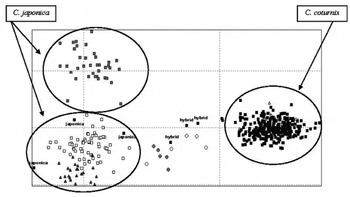
A panel of 25 microsatellites has been developed to differentiate between the two taxons and their potential hybrids, and was used on samples from quail hunted in France where hybridisation may occur between accidentally released Japanese quail and wild migrating Common quail (Chazara et al., Reference CHAZARA, LUMINEAU, MINVIELLE, ROUX, FÈVE, KAYANG, BOUTIN, VIGNAL, COVILLE and ROGNON2006). The panel made it possible to visualise different populations, and their hybrids (Figure 1), and should provide an adequate genetic tool for further studies using the quail as a model bird.
Two-dimensional factorial correspondence analysis of multiloci genotypes showing quail hunted in France (dark square ), captive C. coturnix (light triangle ), commercial C. japonica (white square ), C. Japonica from Japan (grey square ) or from INRA (dark triangle ), and INRA hybrids F1 (white circle ) and F2 (striped circle ) (Chazara et al., Reference CHAZARA, LUMINEAU, MINVIELLE, ROUX, FÈVE, KAYANG, BOUTIN, VIGNAL, COVILLE and ROGNON2006).

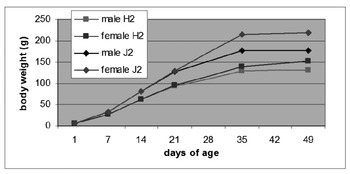
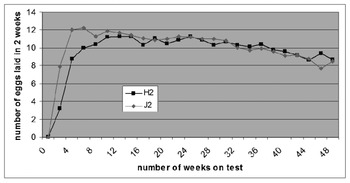
A hybrid quail INRA experimental population was set up (Minvielle et al., Reference MINVIELLE, MOUSSU, ROGNON, LUMINEAU and GOURICHON2006) and monitored for several generations, to compare its zootechnical performances and behaviour with those of a Japanese quail control line. F2 hybrids were smaller and showed less sexual dimorphism (14.2%) than Japanese controls J2 (19.4%) (Figure 2), and females reached surprisingly high levels of egg production (Figure 3). These preliminary results indicated that the two taxons were close enough for successful hybridisation, and crossing them produced hybrids with unexpectedly high performances (Minvielle et al., Reference MINVIELLE, MOUSSU, ROGNON, LUMINEAU and GOURICHON2006). Reproduction of the hybrid population became more difficult in advanced generations, possibly because of mismatches at meiosis between the coturnix and japonica caryotypes. The difference between the hybrids and the Japanese quail controls for the percentages of fertilised eggs and hatched eggs was respectively -31 and -14 in the fifth generation.
Growth curves of F2 hybrids (H2) and Japanese quail controls (J2) (Minvielle et al., Reference MINVIELLE, MOUSSU, ROGNON, LUMINEAU and GOURICHON2006).

Egg laying curves of F2 hybrids (H2) and Japanese quail controls (J2) (Minvielle et al., Reference MINVIELLE, MOUSSU, ROGNON, LUMINEAU and GOURICHON2006).

Feedback to Gallus
Obviously, quail should be a better animal model than chicken when specific quail lines have been highly selected for a special trait and have no Gallus equivalent. For example, a QTL for tonic immobility was first detected on GGA01 in a genome scan of a F2 junglefowl cross (Schütz et al., Reference SCHÜTZ, KERJE, JACOBSSON, FORKMAN, CARLBORG, ANDERSSON and JENSEN2004), and then on CJA01 in the quail lines selected by Mills and Faure (Reference MILLS and FAURE1991), in scans with AFLP® (Beaumont et al., Reference BEAUMONT, ROUSSOT, FEVE, VIGNOLES, LEROUX, PITEL, FAURE, MILLS, GUÉMENÉ, SELLIER, MIGNON-GRASTEAU, LE ROY and VIGNAL2005) and microsatellites (Minvielle et al., Reference MINVIELLE, KAYANG, INOUE-MURAYAMA, MIWA, VIGNAL, GOURICHON, NEAU, MONVOISIN and ITO2005) markers. Yet, fine mapping of this QTL is being carried out only in the quail using AIL crosses, but the homology found between GGA01 and CJA01 (Kayang et al., Reference KAYANG, VIGNAL, INOUE-MURAYAMA, MIWA, MONVOISIN, ITO and MINVIELLE2004; Reference KAYANG, FILLON, INOUE-MURAYAMA, MIWA, LEROUX, FÈVE, MONVOISIN, PITEL, VIGNOLES, MOUILHAYRAT, BEAUMONT, ITO, MINVIELLE and VIGNAL2006) should make the results with ‘emotive’ quail readily applicable to the chicken.
Using the quail rather than the chicken may be more convenient because the quail is smaller and has a shorter generation interval. Sometimes, however, new knowledge on the chicken has to come from studies on the quail because it cannot be obtained by direct studies on the chicken itself. This notion of ‘feedback to Gallus’ might appear farfetched, but recent studies on quail plumage colour have shown the validity of this strategy as reviewed below.
TYRP1 and the sex linked roux plumage colour
The roux plumage colour has no known homologous phenotype in the chicken. In the quail, it is determined by a recessive sex linked mutation (Minvielle et al., Reference MINVIELLE, ITO, INOUE-MURAYAMA, MIZUTANI and WAKASUGI2000a). This has been introduced in selected parental lines by the French company Caillor® for one day old sexing of commercial crossbred chicks because it has little detrimental effect on production traits (Minvielle et al., Reference MINVIELLE, HIRIGOYEN and BOULAY1999; Reference MINVIELLE, GANDEMER, MAEDA, LEBORGNE, HIRIGOYEN and BOULAY2000b). Recently, the roux plumage colour was found to be associated with a non-synonymous T-to-C substitution in exon 3 of TYRP1, leading to a Phe282Ser mutation (Nadeau et al., Reference NADEAU, MUNDY, GOURICHON and MINVIELLE2007). The tyrosinase-related protein 1 is a melanogenic enzyme well known in mammals, but this finding in Japanese quail was the first evidence of its role in bird pigmentation.
ASIP and the yellow and recessive black plumage colours
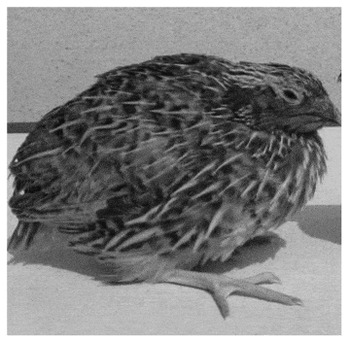
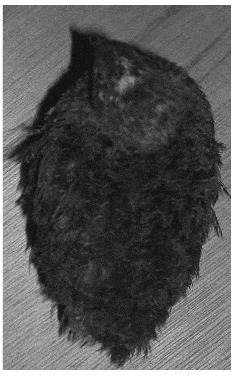
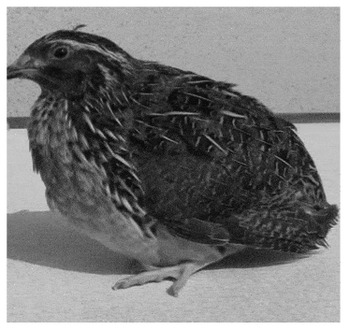
The dominant (homozygous lethal) yellow and recessive black plumage colours (Figure 4) were described independently (Homma et al., Reference HOMMA, SHUMIYA and JINNO1967; Fujiwara et al., Reference FUJIWARA, MIZUTANI, ONO and KAGAMI2005). The development of the first microsatellite-based Japanese quail genetic map (Kayang et al., 2004) made it possible to map the mutation for the yellow plumage on a quail linkage group homologous to the chicken chromosome GGA20 (Miwa et al., Reference MIWA, INOUE-MURAYAMA, KAYANG, VIGNAL, MINVIELLE, MONVOISIN, TAKAHASHI and ITO2005), where an expressed sequence tag (EST) homologous to the agouti signalling protein ASIP had been sequenced (http://chick.umist.ac.uk/). The general belief at the time, however, was that ASIP was not functional in birds (Boswell and Takeuchi, Reference BOSWELL and TAKEUCHI2005).
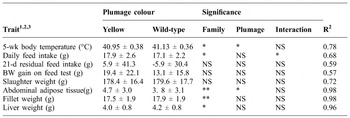
Growth and gross body composition were analysed in yellow and wild-type sibs (Minvielle et al., Reference MINVIELLE, GOURICHON, ITO, INOUE-MURAYAMA and RIVIÈRE2007a), and yellow quail had lower body temperature and more abdominal adipose tissue (Table 1), but feed intake and growth similar to that of wild-type quail.
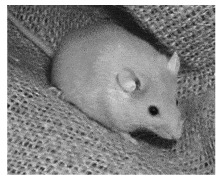
The modes of Mendelian inheritance of recessive black and yellow, their effects on plumage colour (analogous to those of agouti variants on coat colour in mice, Figure 5), the location of yellow near ASIP and its associations with physiological traits similar to those found in Ay yellow mice (Miltenberger et al., Reference MILTENBERGER, MYNATT, WILKINSON and WOYCHIK R.P.1997), led to the hypothesis that the two mutations might be associated with ASIP.
First, the yellow and recessive black mutations were shown to be allelic, and recessive black was found to be associated with a 8 bp deletion (c.373_380) in ASIP, causing a frameshift loss-of-function mutation which removed the normal stop codon (Hiragaki et al., Reference HIRAGAKI, INOUE-MURAYAMA, MIWA M., FUJIWARA, MIZUTANI, MINVIELLE and ITO2008), and hampered the normal function of ASIP as an agonist of MC1R, the gene for eumelanin production. Concurrently, the Japanese quail yellow plumage was found to be due to a >90 kb deletion upstream of ASIP, including most of the coding sequences of two other genes (Nadeau et al., Reference NADEAU, MINVIELLE, ITO, INOUE-MURAYAMA, GOURICHON, FOLLETT, BURKE and MUNDY2008). The direct consequence of this gain-of-function deletion was to place the expression of ASIP under the control of the upstream RALY promoter, leading to its up regulation and therefore to pheomelanin production, which was exactly the same mechanism as that found in Ay mice (Michaud et al., Reference MICHAUD, BULTMAN, KLEBIG, VUGT, STUBBS, RUSSELL and WOYCHIK R.P.1994). These two results on quail were the first ones to show the importance of ASIP for pigmentation in birds.
Effects of the yellow plumage colour (mean ± SD) on male Japanese quail.

1 5-wk BW was used as a covariable for the analysis of body temperature.
2 120-d slaughter weight was used as a covariable for the abdominal adipose tissue, fillet, and liver weights.
3 Fillet weight is the total weight of the right pectoralis major and pectoralis minor muscles.
* = P<0.05; ** = P<0.01; *** = P<0.001.
(Minvielle et al., Reference MINVIELLE, GOURICHON, ITO, INOUE-MURAYAMA and RIVIÈRE2007a)
From left to right: yellow, recessive black and wild-type Japanese quail males.


From left to right: yellow, recessive black and agouti mice.


Future prospects
Of course, ‘chicken-complementary’ research on the quail should not be limited to exploiting the co-existence of domesticated and wild Japanese quail populations and the comparison of the two close coturnix and japonica taxons, although this specificity of Coturnix could be explored further in several directions. First, the genetics of domestication (including the suppression of the natural migratory activity) in birds could be studied experimentally using wild Coturnix japonica as a model animal, and domesticated quail populations as controls. Such cognitive studies would also be relevant from the standpoint of modern poultry production, with its increased attention paid to the welfare and the environment provided to the commercial birds, and large wild populations of Japanese quail might constitute a rich source of genetic variability for commercial lines with a limited genetic base. Comparisons between the coturnix and japonica taxons and research on their natural and experimental hybridisation are only beginning and should bring insight on the phylogeny and the genetic management of the wild quail. One may also think of many quail-specific features, absent or quite different in Gallus and of interest in avian biology or in poultry production, but still poorly understood genetically. Of note are the unique foam production system of the male (Adkins-Reagan, Reference ADKINS-REAGAN1999), the migratory activity of wild quail (Derégnaucourt et al., Reference DERÉGNAUCOURT, GUYOMARC'H and BELHAMRA2005), the pattern of coloration of the egg, or the structural flexibility of the MHC (Hosomichi et al., Reference HOSOMICHI, SHIINA, SUZUKI, TANAKA, SHIMIZU, IWAMOTO, HARA, YOSHIDA, KULSKI, INOKO and HANZAWA2006), as examples.
As shown with the QTL for tonic immobility on CJA01, the availability of an advanced intercross line (AIL) from highly selected quail lines may dispense with carrying out the fine mapping on chicken because the quail result can be extrapolated to Gallus. A similar situation exists with the di gene for diabetes insipidus, for example. A quail line fixed for di (Minvielle et al., Reference MINVIELLE, GROSSMANN and GOURICHON2007b) is currently used for generic research on this functional mutation which is common to both the chicken and quail. The example of the two plumage colour loci in quail was even more striking, because it revealed phenotypes and underlying gene actions which were so far unknown in the chicken. Moreover, the genetic polymorphism found for ASIP in the quail might also have some potential interest in relation to lipogenesis in poultry through the possible antagonism between ASIP and several melanocortin receptors (Miltenberger et al., Reference MILTENBERGER, MYNATT, WILKINSON and WOYCHIK R.P.1997; Gantz and Fong, Reference GANTZ and FONG2003), like in mice with mutations belonging to the agouti allelic series. It is striking to note that most of these unexpected recent results could only be obtained in the quail after the first panels of specific markers and the corresponding genetic maps were produced, and despite the fact that both molecular tools were very elementary (few markers, very incomplete map). If these results are any indication of what might be gained with second generation molecular markers (single nucleotide polymorphism SNP) and maps, it signifies that quail should not be underestimated as an experimental model for the chicken.
For the quail to continue having a significant role as an experimental and competitive production bird, a better knowledge of the Coturnix genome will be indispensable. Moreover, the availability of the chicken sequence should be a further incentive to decipher the quail sequence under the leadership of an international consortium which should include WPSA scientists. Knowing the sequence and its homology with that of the chicken would also help feed new knowledge on the quail back to the chicken (and reciprocally), as the few studies on quail plumage colours, unknown in Gallus and described above, have hopefully shown. Having the sequences of two very close genera like Gallus and Coturnix would also be quite unique in avian biology and offer a new tool for studying evolution in birds.
Acknowledgements
The results summarised in this paper were extracted from published and unpublished collaborative studies conducted with the University of Gifu (S. Ito, M. Inoue-Murayama, B. Kayang, S. Miwa, T. Hiragaki), the University of Cambridge (N. Mundy, N. Nadeau), the University of Sheffield (T. Burke, S. Follett), the University of Rennes I (S. Lumineau), ONCFS (J.M. Boutin, D. Roux), INRA at Nouzilly (D. Gourichon, S. Rivière), INRA at Toulouse (A. Vignal, V. Fillon, F. Pitel, K. Fève) and INRA at Jouy-en-Josas (F. Minvielle, X. Rognon, O. Chazara). The linguistic revision of the paper was carried out by W. Brand-Williams. Financial support from the French branch of the WPSA is gratefully acknowledged.