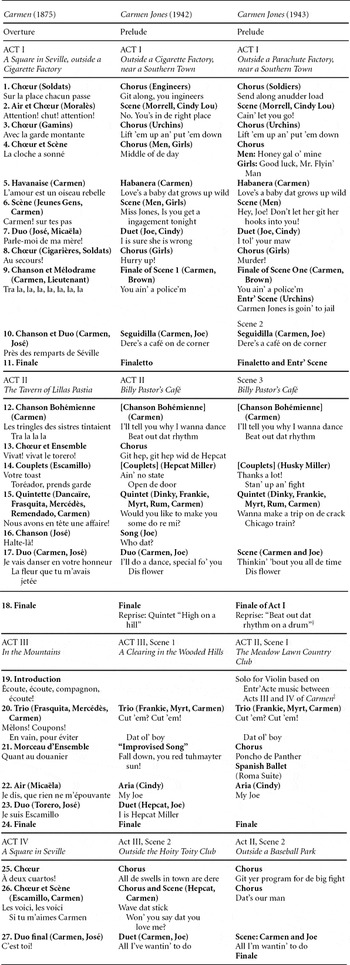
On 19 October 1943, Carmen Jones opened its tryout in Philadelphia before an enthusiastic audience that included numerous visitors from New York. Among them was the Broadway producer and film publicist A. P. Waxman, who congratulated the show's creator, Oscar Hammerstein II, for having produced “a two-fold contribution to American culture. You are the first one to make Opera in English 100% entertainment for the general public. You have also broadened the horizon for Negro talent, and gained for them the increased recognition they are entitled to.”Footnote 1 Thus Waxman identified key cultural parameters that shaped the creation and reception of Carmen Jones during World War II. If, on the one hand, Hammerstein's version of Georges Bizet's Carmen counted as an important chapter in the vexed history of European opera in the United States of America, on the other, it played a significant role in the long struggle of African American performers to gain access to, and recognition in, mainstream U.S. theaters.Footnote 2 Furthermore, both aspects were inextricably intertwined with debates about class and culture, which had become freshly acute during a global war that pitted (at least so far as American public discourse was concerned) democratic ideals against fascist totalitarianism. In crystallizing several key currents of U.S. wartime culture, the 1943 production of Carmen Jones provides a unique window on the changing social and political concerns of a country in search of a modern identity at a particular time of anxiety over the intersection of transnational, national, and local concerns.
Overshadowed since the mid-1950s by its glamorous Hollywood offshoot starring Dorothy Dandridge and Harry Belafonte, the 1943 stage production of Carmen Jones has received only scant attention from musicologists and theater historians, even though it was—at least in commercial terms—one of the most successful shows on Broadway for its run from 2 December 1943 to 10 February 1945.Footnote 3 Neither an autochthonous “folk opera” like the Gershwins’ Porgy and Bess nor a modernist work in the vein of Gertrude Stein and Virgil Thomson's Four Saints in Three Acts, Carmen Jones fits none of the categories developed to discuss opera in the United States. Nor does the work fare any better in histories of the Broadway musical, which focus mainly on the two prevalent models of revue-style shows and the “integrated” musical. As a French opera adapted for the Broadway stage and an all–African American cast, Carmen Jones falls between the cracks of music historiography, taxing the categories and narratives of musicological discourse on American music.
However, it is precisely the work's resistance to fitting into established historiographical tropes that makes it so powerful both to gain entrance to a specific historico-cultural context and as a challenge to current methodological practice. As Robert L. A. Clark has pointed out, Carmen Jones multiplied cultural identities in its transformation from Bizet's French opera mimicking and appropriating Spanish music into an English-language musical play set in the American South.Footnote 4 Hammerstein's multilayered act of textual translation was then further compounded in the stage realization when the creative team of the première inserted their own agencies into the show as producer, arranger, choreographer, stage director, dancers, and singers, with the interplay of reception in performance and criticism further enriching the contrapuntal texture of the work. Crossing these converging, but somewhat diverging, acts of creation and transformation were a number of cultural, social, and political currents relating to issues of race, class, language, identity, and artistic authority that established a force field anchored in the wartime United States but spanning the Atlantic in multiple directions and creating an example of what has been called (by Paul Gilroy) a “webbed network between the local and the global.”Footnote 5 These crosscurrents and intersections resist any one-dimensional interpretation of Carmen Jones by challenging such easily essentialized categories as authenticity, ownership, and ethnic particularity.Footnote 6
Of course, Carmen Jones was neither the first American adaptation of a European opera, nor unique in its all–African American cast. In particular, the Negro Units of the Federal Theatre Project had been active in adapting European works for African American performers, as, for example, with Macbeth in New York (1936), Fra Diavolo in Los Angeles (1937), or the Swing Mikado in Chicago, New York, and elsewhere across the country (1938).Footnote 7 Broadway, too, had its share of African American musical shows, with several produced in proximity to Carmen Jones and—in some cases—involving the same personnel.Footnote 8 Some had only short runs, including Roark Bradford's John Henry (1940, with Paul Robeson in the lead) and the 1943 revival of Hall Johnson's Run, Little Chillun (1933). Others, such as Vernon Duke's Cabin in the Sky (1940), producer Cheryl Crawford's revival of Porgy and Bess (1942), and Katharine Dunham's celebrated Tropical Review (1943) proved to be artistically and commercially successful productions. On the other hand, the early 1940s brought thriving Broadway adaptations of European operas and operettas. Most notably Rosalinda (alias Die Fledermaus) with its highly Gilbertian flavor was very successful, with a run of 611 performances between its première on 28 October 1942 and its final evening on 22 January 1944. Both these African American–cast productions and Americanized European opera thus provided a framework within which Hammerstein's version of Bizet's Carmen came to be.
By the time Carmen Jones had its Broadway première on 2 December 1943, it had gone through almost two years of gestation. A first version, completed in July 1942, failed to be produced on Broadway. It set Bizet's Carmen in rural North Carolina and—although shortening some of the original—stayed relatively close to the opera's plot, save for the ending. Hammerstein then rewrote the work for the 1943 production, introducing significant changes (including the complete relocation of the work's second half to Chicago). Three broad cultural issues dominate the reception of Carmen Jones. As a so-called musical play that transferred Bizet's opera into a setting in the contemporary United States, Hammerstein's book was scrutinized in the context of operatic translations and recent American drama. As the performance of an African American cast, the production evoked a broad response shaped by U.S. notions of black theatrical expressivity and its African roots. Finally, as an operatic soundscape, Carmen Jones relocated, at a critical point in time, a particularly prominent European score on Broadway and challenged (while still perhaps reinforcing) concepts of class and race in United States.
Hammerstein's Carmen Jones
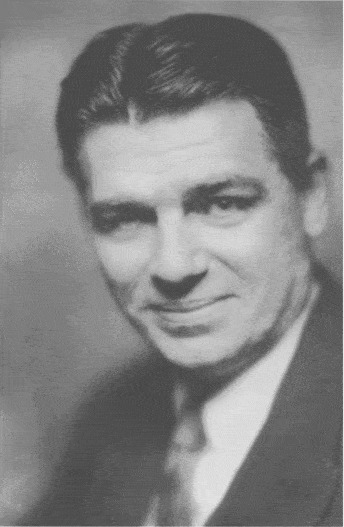
The souvenir program for Carmen Jones offers a brief explanation for the work's genesis. In 1934 Oscar Hammerstein II (see Figure 1)—a man of the musical theater with opera in his veins—had
heard a concert performance of the opera at the Hollywood Bowl. “Carmen” was played that night without sets or costumes. The principals just got up and sang when their tune came. “The music came through,” Mr. Hammerstein remembers. “And so did the story. It dawned on me then that there was something universal about this opera. It would translate. That is what I tried to accomplish in the new libretto and lyrics. I translated them. I did not adapt them. I did not change an essential note.”Footnote 9
Portrait of Oscar Hammerstein II, published in the souvenir program (1943). Courtesy of the Rodgers & Hammerstein Organization.

As brief as the comment may be, it presents a good tale of a solitary visionary's artistic program for the future of great art, one that was revealed to him at a transformational moment in his past. Although Hammerstein's story follows a standard narrative pattern of artistic revelation, it conveys much about his need, in late 1943, to cast Carmen Jones as a path-breaking production without peer or precedent when, in effect, it competed not only with Oklahoma! (another Hammerstein production that was presented as revolutionary) and Crawford's revival of Porgy and Bess, but also with several concurrent adaptations in New York and Philadelphia of European operas in vernacular English, not least Rosalinda. Hammerstein's emphasis on his artistic vision and on the uniqueness of Carmen Jones, however, was not simply a clever marketing strategy. Rather, his insistence on his artistic authority and innovative approach points toward a quest to validate the complicated period of the work's gestation, begun—as he later put it—at the “lowest part of my slump.”Footnote 10 Moreover, Carmen Jones was “the first time I ever sat down and wrote a play without first arranging for a production with a manager in advance.”Footnote 11 A lot of symbolic capital thus rode on the originality of his approach.
If the Hollywood Bowl Carmen provided the impetus for the project, however, Hammerstein later acknowledged a second key influence that sets Carmen Jones into a longer genealogy of Carmen adaptations involving African American performers. As he explained in 1959, “I wanted to do a version of ‘Lula Belle’ [sic], which was the Carmen story, and I had invited Duke Ellington to do the score with me. He was late for an appointment one day, and since he had a night club life and I like to work at 9 o'clock in the morning, I didn't think it would be a happy collaboration, and I abandoned the idea.”Footnote 12
Lulu Belle, a four-act play by Edward Sheldon and Charles MacArthur, was produced in 1926 at New York's Belasco Theatre with a cast of over one hundred African American and fifteen Caucasian actors. This adaptation of the Carmen story ran for 461 performances, transporting the plot (but only a very small amount of Bizet's music) into the black New York of San Juan Hill and Harlem, with a final act in Paris (where African American singers such as Josephine Baker had become famous in recent years).Footnote 13 The production saw the press up in arms and the audiences streaming into the theater to see for themselves a show that was dubbed by one incensed critic “the lowest descent of our stage since ‘The God of Vengeance,’” a Yiddish play whose entire cast had been arrested on obscenity charges in 1923.Footnote 14 Debates in the press focused on the staging on the one hand, and the subject matter on the other. The African American newspapers, especially, were divided over the issue of whether a Carmen transferred to the nightclub scene of Harlem was detrimental to the black cause by featuring a Creole vamp cutting a swath of sexual destruction through Harlem and Paris and thus reinforcing white prejudices about African American morals, specifically the myth of the oversexualized woman of mixed race.Footnote 15 Yet a number of black newspapers such as the Chicago Defender and the New York Amsterdam News supported the play because it featured a significant number of African American performers in a major Broadway show: “For the first time in a decade our dramatic actors will have an opportunity to measure talents with the opposite race, at a distance favorable for fair comparison.”Footnote 16 The lead roles of Lulu and her lovers, however, were performed by white actors in black makeup, which offended Sylvester Russell of the Pittsburgh Courier, who accused the show of discrimination for not casting the leads with African American actors as well.Footnote 17 The majority of critics across the spectrum of the press, however, focused on the actors’ ability to perform the roles in a dramatically credible fashion, though the difference between white leads and African American supporting cast was emphasized even in otherwise supportive reviews.Footnote 18
Actress Evelyn Mason was enthusiastic over the possibilities: Belasco had
broken down the barrier that has existed all these years, relegating our best actors to small colored houses. . . . Watch with me, dear ones, the opportunity that results from this sensational Broadway hit. I prophesy in the very near future colored casts working on Broadway under other white producers that would never have had the courage had not the “Lulu Belle” success inspired them. And many, many more avenues of employment will be opened to the colored actor.Footnote 19
Whether or not Lulu Belle was in any way the direct impetus for Broadway producers bringing out more plays with African American performers, it is striking that two major works featuring an African American cast had their premières soon after Lulu Belle: Paul Green's Pulitzer Prize–winning play In Abraham's Bosom, opening on 30 December 1926, and the Theatre Guild presenting Dorothy and DuBose Hayward's Porgy in October 1927. One intriguing possible afterlife of Lulu Belle did not materialize, however, for George Gershwin had considered turning the play in an opera before settling, with Porgy and Bess, on another Carmen-like story.Footnote 20
For Hammerstein in particular, Lulu Belle may have been a memorable model because of its historical and thematic proximity to Show Boat. Premièred less than two years after Lulu Belle, on 27 December 1927, Show Boat featured Julie LaVerne, a quite different mixed-race heroine whose desire for quasi-bourgeois normalcy stood in sharp relief from the Carmen figure. Yet in the case of Carmen Jones, Show Boat remained—on Hammerstein's part—a relatively hidden intertext, even though it continued the earlier show's themes of racial segregation in the United States. The production of Lulu Belle, on the other hand, left a number of traces in Hammerstein's adaptation, both where there were similarities—for example, in the eventual rendering of Escamillo as a boxing champion—and in their differences. In particular, Lulu Belle and its reception may have influenced Hammerstein's location of his adaptation in wholesome North Carolina instead of Harlem. Even the fleeting involvement of Duke Ellington in the project during the 1930s might have found an echo in Carmen Jones, for in the 1942 version, Escamillo was portrayed not as the boxer Husky Miller, but as Hepcat Miller, a successful bandleader. For the time being, however, the Carmen project receded under the demands of the movie studios where Hammerstein worked for much of the 1930s.
It is not entirely clear when Hammerstein picked up the Carmen project again. After his return to New York, success on Broadway remained elusive for several years, but he followed other productions closely. In October 1941, Cheryl Crawford produced Porgy and Bess for the Maplewood Theatre in New Jersey, a revival so successful that it moved to the Majestic Theatre on Broadway on 22 January 1942. Streamlined and without recitatives, Crawford's version of Porgy and Bess presented a “musical play” that pleased critics and audiences.Footnote 21 Hammerstein had seen the performance at the Majestic, and he wrote to Ira Gershwin, on 2 February 1942, about his joy at the sold-out theater, adding that “the excellence of the performance and the beauty of the opera thrilled me no more than the audience itself.”Footnote 22 Indeed, seen as an opera with spoken dialogue, the Crawford Porgy and Bess carries a strong resemblance to Bizet's Carmen, with the heroine as an outsider-temptress against the background of a conservative community. Just over two weeks after Hammerstein attended Porgy and Bess, a letter (19 February 1942) by producer Richard Berger to Mrs. Cornelius Vanderbilt Whitney (the opera singer Eleanor Searle) reveals that he and Hammerstein were starting to raise money for a new production scheduled for the fall of 1942, an African American show set in North Carolina and based on Bizet's Carmen. This letter refers already to all the key elements of the first version—from Escamillo's portrayal as bandleader to the preservation of the original musical style as operatic instead of swing—and presents it as a logical project in the wake of the Porgy and Bess revival:
Oscar Hammerstein, 2nd, who wrote SHOW BOAT and numerous other tremendous successes, and I have an idea for doing a modern version of CARMEN with an all negro cast. Briefly, our plan is to set the show in North Carolina, where CARMEN JONES, as we are going to call her, works in a cigarette factory; Don José (JOE) will be a soldier at a present day training camp; Escamillo will be a colorful figure such as Cab Calloway is, and the smugglers will be bootleggers of moonshine liquor. We plan to keep Bizet's music intact but hope to delete unnecessary repetitions, and Mr. Hammerstein is going to write modern, earthy lyrics instead of making a literal translation from the French.
We are not going to swing the score in the sense of the words, but we are going to have everything we use reorchestrated in the modern idiom. We think that CARMEN is a basically interesting story and that the already proven melodies will develop into popular hit songs, aided by the Hammerstein lyrics.
It is our desire to produce this in New York in the fall and if you think that Mr. Whitney might be interested in such a venture, I would like to have him meet Mr. Hammerstein. We are really hot about this and have great hopes for its success, particularly on the strength of the fine reception that PORGY AND BESS received on its revival.Footnote 23
Although Hugh Fordin reports that Hammerstein was sitting “alone at the farm one day in January 1942,” listening to a recording of Bizet's Carmen and setting out “to work modernizing the opera,” it was certainly not done without “saying a word about it to anyone outside his family.”Footnote 24 Indeed, Hammerstein worked toward realizing the production before even the first act of his new musical play was completed.
As he remembered later, Hammerstein took his time with the revisions given that there “was no deadline.” Certainly, “I had more pleasure than I've ever had writing anything.”Footnote 25 It is not clear when the first act was finished, but on 25 June 1942, Hammerstein wrote a letter to Hall Johnson that reveals not only that he had completed the second act and was “hard at work on the third,” but also that by then Robert Russell Bennett had become involved in the production as the score's musical arranger: “Mr. Bennett, at this point, feels that he would like to handle the whole musical job which would include the vocal as well as the instrumental arrangements.” Hammerstein's letters of late July refer to completing Carmen Jones, which was deposited with the copyright office of the Library of Congress on 31 July 1942.Footnote 26 All the while, auditions for the principal roles continued, potential financial backers of the show became involved, a new producer appeared on the scene in the person of Max Gordon, and Hammerstein started to discuss with Hollywood agent Elizabeth A. Shaw the involvement of the African American dance star Katherine Dunham.Footnote 27
At this point, Carmen Jones was significantly different from what would be the final 1943 version. A three-act “version of ‘Carmen’ for colored singers” with spoken dialogue, the work was set near an unidentified town in North Carolina.Footnote 28 The first act took place outside a cigarette factory where an Army Corps of Engineers was building a road. Obviously, the location was influenced by the fact that North Carolina was tobacco country. In its structure and themes, this act, perhaps, is closest to Meilhac and Halévy's original libretto, with characters very similar to those in Bizet's opera. In addition to Carmen Jones (Carmen) and Joe (Don José), we encounter Cindy Lou (Micaëla), Morrell (Moralès), and Sergeant Brown (Zuniga). The second act, in Billy Pastor's café, still follows the original libretto in much of its development. Frankie (Frasquita) and Myrt (Mercédès) dally with the whiskey smugglers Rum (El Remendado) and Dink (El Dancaïro); Joe gets roped into smuggling by having Carmen play on his jealousy just as in the original; and the toreador is—if anything—more dazzling than the original bullfighter in his transformation into the bandleader Hepcat Miller, whose “Toréador prends garde” becomes “Open de door,” a solo number detailing his successes in cafés playing for “white folks,” and whose family resemblance to Sportin’ Life points once again to Porgy and Bess as a prototype for Carmen Jones.Footnote 29 The last act merges Bizet's Acts 3 and 4. Scene 1, “In the Hills,” is a much shortened version of Act 3; Scenes 2 and 3 contain much of the music of Act 4 and play outside the Hoity Toity Club, a segregated establishment whose members applaud black entertainers but exclude African American patrons. (The echoes of the famous Cotton Club in Harlem are clear.) Scene 2 is the only scene with a white performer, cast as a policeman detailed to keep Hepcat Miller's African American fans in line, quite possibly a self-conscious reference to the white policemen in Porgy and Bess and further emphasizing that work's shadow looming heavily over the genesis of Carmen Jones.Footnote 30
These last scenes of Act 3 reveal much about the politics of this first version of the play in their explicit staging of racial segregation. In Scene 2, African American onlookers observe the guests entering the club (off-stage), commenting on their dress and speculating that Hepcat was going to make at least “a cool twen'y gran’!”Footnote 31 But into the banter about the sequins on women's garments and the pleasures of “classy mobsters” creep comments about segregation: a girl's sigh, “Wisht day'd let us go inside an’ watch”; the retort by her friend, “Well wish again!”; the chorus's comment, “Oh, boy! Ef we wus inside / We'd show dem dopes how to glide! / We c'd show dem how to glide / Ef we wus ever allowed inside.”Footnote 32 Scenes 2 and 3 shift seamlessly into each other by the lifting of a scrim that moves the action from the side of the club to its parking lot, where we see Hepcat's shadow conducting his band behind the “big center window with the shade pulled down,” the barrier between white and black unmistakably in place. As Hepcat plays, the chorus sings about his music. Then the onlookers “start to dance because they just can't help themselves.”Footnote 33 In this dance scene, stereotypical concepts of black physicality, primitive authenticity, and mimicry play with notions of authority and identity when three girls peek through the door of the white club and start laughing at the ineptitude of the white dancers. At the crowd's invitation to “give a imitation ob the way dey do what we do,” the women start performing white. Hammerstein's stage direction hints at the possible subversiveness of this moment: “The trio of girls and their partners now give an imitation of white folks dancing like colored folks. This is done in an extravagant spirit of travesty, and is a terrific hit with the onlookers, who start to imitate the imitators.”Footnote 34
This scene plays with the performativity of racial identity in a complex chain of doublings when African Americans imitate other African Americans imitating Euro-Americans imitating African Americans in the black stage world created by a white playwright whose own identity as a Jewish American was far from fixed in the increasingly binary world of American race relations in the early 1940s.Footnote 35 The scene becomes an object lesson in deconstruction, demonstrating Zora Neale Hurston's comment that everyone “seems to think that the Negro is easily imitated when nothing is further from the truth.”Footnote 36 Its mirroring of games with identity and cultural authority is compounded by the incongruence between sound and movement, for instead of the expected “race” music of Hepcat Miller (or his two models: Duke Ellington and Cab Calloway), the orchestra and on-stage chorus would have performed Bizet.Footnote 37 Following Susan Gubar, who explored transracial performativity in her study of “skin trade,” the play on imitations in Scene 3 might be termed “racechanges.” Carmen Jones as a whole, however, can also be interpreted as a challenge to “the color line that W. E. B. Du Bois saw as the central problem of the twentieth century” by following Bizet's opera, to cite Gubar again, “closely enough to suggest that the logic of erotic thralldom will work itself out inexorably in the lives of men and women, regardless of racial, geographic, or historical factors.”Footnote 38
Had Hammerstein's 1942 version been staged, the cultural authorities of Bizet's music and African American dance would have fused in this scene into the performance of a powerful critique of identity in the segregated United States. Here Carmen Jones touches on issues already put on the stage in Show Boat, where Hammerstein and Kern problematized perceptions of “race” and its natural expression in the second-act “In Dahomey” number, in which African Americans from New York perform as “Zulus” during the 1893 World's Fair in Chicago. Once the performers succeed, in this number, in frightening off their white audience, they reveal themselves as well-brought-up New Yorkers who prefer knives and forks to the primitivism of the “Dahomey show.” Both the fake Zulus’ lines “Let the Africans stay / In Dahomey— / Gimme Avenue A / Back in old New York,” and Kern's shift to modern ragtime at the moment when the “Dahomians” reveal themselves as African Americans, break open fixed concepts of identities in a deliberate representation of “ambivalence about the representation of black otherness.”Footnote 39 Fifteen years later, in Carmen Jones, Hammerstein expanded this chain of multiple identities by the insertion of an African American imitation of white renderings of black dance.
A number of political and aesthetic currents intercross in this complicated performance of identities, not the least Hammerstein's own interstitial identity in a culture where he was both insider (as a white man) and outsider (as a Jew). Jewishness as an “ethnoracial” category was in flux at that time as it transferred from one side of the U.S. racial binary to its white opposite.Footnote 40 As Andrea Most points out in her study of Jewish creators on Broadway, black and Jewish identity politics remained closely intertwined during the 1930s and 1940s.Footnote 41 The advent of Nazi Germany heightened awareness of the diasporic nature of Jewish communities in the United States and reinforced their precariousness. Hammerstein was a founding member, in June 1936, of the Hollywood Anti-Nazi League, which clearly addressed U.S. racial politics as much as German fascism in its revised mission statement of 1937 requiring its members to “combat racial intolerance and thus combat Nazism, which uses intolerance as a weapon to attain power.”Footnote 42 As Hammerstein's biographer, Hugh Fordin, points out, involvement in the League marked the start of the playwright's civil-rights activities. He supported African American causes both financially and in other ways. When he received the National Urban League's call for equal access to defense work for African Americans, around the time he completed the third act of Carmen Jones in July 1942, he not only made a financial contribution, but also offered nonmonetary support: “Due to pressure of other causes being made upon me, the enclosed check is all I can afford at the moment. Later in the year, however, I hope I will be able to augment this by a larger one. Meanwhile, I am so interested in the philosophy behind the movement of your League that I would be delighted to help you in other ways, if you can point out to me what I can do.”Footnote 43
That Hammerstein was aware of how segregation affected Broadway theater at the time of Carmen Jones is also borne out by a clipping in his archives of an article in Variety from July 1942 that discusses African American performance and its segregated history in New York. It recounts how the Theatre Guild had “cancelled the booking of Paul Robeson in ‘Othello’” the previous year, and predicts that because “it is an election year and feelings about race discrimination are running high, the booking of ‘Carmen Jones’ would probably create an incident. It would be magnified into national importance and perhaps taken up by both parties, who are struggling to get the Negro vote.”Footnote 44 For Hammerstein, who had already engaged with segregation in Show Boat and who counted African American artists from Hall Johnson and Duke Ellington to Todd Duncan and Paul Robeson among his friends and acquaintances, these local forms of racism seem to have had as much bearing on his treatment of segregation on the stage in Carmen Jones as national race politics and global fascism.
Once the book for Carmen Jones was completed, Hammerstein redoubled his efforts to cast a show still planned to open in fall 1942, even though he was by then also involved with a new project that would become Oklahoma! He tapped into his network of African American colleagues—including Hall Johnson in Hollywood—to find a cast of high-level black opera singer/actors, but with very little success. Despite all of his efforts, by September 1942, Hammerstein had lined up only three of the performers who would eventually appear in Carmen Jones: Carlotta Franzell, Muriel Rahn, and Napoleon Reed. Charles Holland, one possible tenor for the role of Joe, was inducted into the U.S. Army in the summer of 1942; another contender for the role, George Scott, was drafted in October 1942. Hammerstein's casting problems were systemic: Because of segregation, especially in U.S. opera houses, African American artists had little opportunity to hone their skills outside the concert stage and popular entertainment unless they exiled themselves to Europe or South America.Footnote 45 To find singers both experienced on the stage and trained as classical performers therefore proved a major obstacle.
Hammerstein had equally bad luck finding his ideal choreographer, which—given the prominence of dance in the 1942 version—was an important aspect of the preparation. After Katherine Dunham had turned him down in July because of scheduling conflicts for the upcoming season, Hammerstein approached another famous proponent of black concert dance, Asadata Dafora. A dancer and choreographer from Sierra Leone, Dafora's American career began in the 1920s with his stylized form of West African folkloric dance. Both Dunham and Dafora were among the leading dancers and choreographers of modern African American dance, grounding their work in a pronounced claim to African authenticity through either birthright or anthropological research.Footnote 46 By engaging either of them, Hammerstein would have been able to collaborate with a leading proponent of a dance style that paralleled in movement what he had created in the libretto.Footnote 47 The potential collaboration with Dafora started off promisingly in a meeting in mid-August, only to end in a disastrous audition in October: Half of Dafora's troupe did not turn up because of a car accident, and the rest performed in a manner contrary to what Hammerstein had been led to expect.Footnote 48 About a week later, Max Gordon pulled out as producer, which left the Hammerstein with barely a cast, few financial backers, and a book for which he cared deeply.
On 19 November, however, the fate of Carmen Jones began to change when Hammerstein sent his script to a potential producer who was known for his flamboyant shows—notably Jumbo (1935) and the Aquacade during the 1939 World's Fair—and his dazzling New York nightclub, the Diamond Horseshoe.Footnote 49 William Samuel Rosenberg, known to the world as Billy Rose, was enthralled by the script. Hammerstein, however, was not entirely happy with this outcome, as he confided, on 27 November, in a letter to his son Bill:
I gave Billy Rose my version of Carmen to read over last week-end. He has been chasing me ever since. He wants to produce it. He will put all the money up. He would undoubtedly exploit it to the hilt and might give it a very vital production. It is a big step for me to take, however. He is a very wearing little fellow, I mean wearing down. He is stubborn, self-assertive, and a lot of things I don't like. But he is also a lot of things I do like.
Whatever Hammerstein's misgivings, he entered into an agreement with Billy Rose on 3 January 1943 in which he gave the impresario “the right to produce” Carmen Jones, for which the playwright was “to receive a royalty of 5–1/2% based on weekly box office receipts.”Footnote 50
Billy Rose's Carmen Jones
Billy Rose was a producer “synonymous to all things spectacular in the world of theater.”Footnote 51 Known to spare no cost, his shows were lavish affairs visually as well as musically. In contrast to other Broadway producers who often created a consortium of investors to finance a show, Rose had developed enough financial resources to back any major enterprise himself, which gave him complete control over the process and—should a show be successful—significant returns.Footnote 52 With Carmen Jones, Rose's first point of action was to reassess the production needs and to slow things down as Hammerstein turned his full attention to Oklahoma! as it went into rehearsal.Footnote 53 While in the spring of 1943 Oklahoma! wound its way through rehearsals, tryouts, and première, Rose reconsidered Hammerstein's unsuccessful strategy for casting Carmen Jones, which had involved drawing on “well-known names and established personalities.” Instead, he took a leaf from the Theatre Guild's much publicized tactic with Oklahoma! by searching for untried talent, which—in the case of Carmen Jones—added a different slant to the casting that was exploited to the hilt in the publicity for the production as a “Cinderella story in multigraph—or the triumph of the obscure.”Footnote 54 No longer a show characterized by seasoned performers as in the case of Crawford's Porgy and Bess, Rose's enterprise turned the work into an “all-American” operatic success story that challenged the hallowed institution of opera precisely because of its casting strategies, staging decisions, and the location of the performance.Footnote 55
With 115 singers and dancers needed for the production, the casting posed a significant logistic challenge, for which Rose relied on the help of jazz producer John Hammond, Jr., who was well known for organizing the “From Spirituals to Swing” concerts at Carnegie Hall and who had become a board member of the NAACP in the late 1930s.Footnote 56 In what was then hyped as “one of the most exhaustive talent hunts in history,” Hammond held auditions in Boston, Philadelphia, Chicago, Detroit, Los Angeles, and “twenty-five college campuses, where music departments, choirs, glee clubs, and other singing groups might be expected to have trained voices with stamina. I visited Howard, Spelman, Talladega, Fisk, Tuskagee, and went as far west as Texas.”Footnote 57 The cast's biographies in the souvenir program focused on the regional origins and nonmusical occupations of the singers, be it Muriel Smith (Carmen) from New York, “who was employed in a camera shop at $15 a week”; Luther Saxon (Joe) from South Carolina, who worked “as a checker at the Philadelphia Navy Yard”; or Glenn Bryant (Husky Miller), who was “a member of the New York Police Department, assigned to juvenile delinquency work in Harlem.”Footnote 58 Their status as “common folk” and their lack of theater experience were emphasized throughout and picked up by the press, as in Richard Maney's article about the production in the New York Times (28 November 1943), where he provided biographical information on the lead performers and then listed other cast members as a “Detroit social worker, a Cleveland housewife, a Los Angeles chauffeur, a Buffalo bellhop.” In this story, Carmen Jones became an embodiment of the “American dream” through the Pygmalion plot of its cast, awkwardly combining the notion of racial and social uplift and “all-American” inclusiveness with one of white patronage and control.
This emphasis on the cast's inexperience was all the more noticeable as it contrasted sharply with the highlighting of the consummate professional achievement of the show's production team in the souvenir program and in reviews. With Hammerstein's return to the show's preparations after the première of Oklahoma! he and Rose started to select the production lineup, which included Charles Friedman as director and Eugene Loring as choreographer. (Loring's Billy the Kid with music by Aaron Copland had recently been revived at the National Theatre in 1942.) Hassard Short was responsible for staging and lighting; he was perhaps the best-known figure among the production team, with a long string of successful Broadway shows under his belt. The set designer, Howard Bay, was another well-known player on Broadway, who, in 1943, designed the sets for both Carmen Jones and Kurt Weill's One Touch of Venus.
With a first-rate production team in place by the middle of July 1943, Hammerstein was hard at work revising his play. He had already announced to his son Bill on 2 May that he would return to Carmen Jones: “I am going to do quite an extensive re-write on it. Reading it over after not seeing it for some time I believe I can improve it about 25%.” On 14 July, he reported to Bill: “Have finished new first act of C.J.[,] will finish second August 1st.” It was not until 30 September, however, that the new version was signed in by the copyright office in the Library of Congress.Footnote 59 Hammerstein's revisions were extensive and changed the character of the work significantly. Whereas his first version conceived Carmen Jones with Porgy and Bess as an intertext and segregation an important theme, the revised play focused on World War II and modern U.S. life as a framework for the Carmen story. The new version tightened the work by cutting several musical numbers, changing the dialogue from distant paraphrase to a wholesale new text, and combining the original Acts 1 and 2 into a new first act. Robert Russell Bennett responded to Hammerstein's plans for the revisions in the late spring of 1943: “The changes you write of are most promising. The only argument from me on fidelity to the original Carmen will come from the mutilation of music—not from cuts of whole numbers or changes in format. After all, our aim is to cash in on what we know to be a score that has proven its effectiveness and at the same time has only scratched the edge of its possibilities with the American public.”Footnote 60
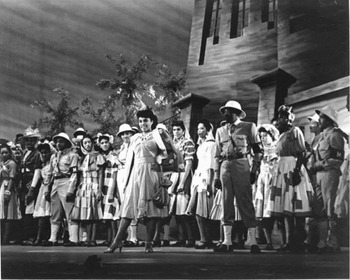
In the new version, the location is transformed into a Southern defense plant producing parachutes for both the army and the navy (see Figure 2), though Joe explains to Brown early on that it used “ter be a cigarette fac'ry before de war” (perhaps an in-joke on Hammerstein's part, and certainly one that emphasizes the wartime shift).Footnote 61 Instead of opening with black army engineers engaging in the heavy manual labor of building a road, now soldiers are standing guard at a defense plant with black workers, thus responding, at least on the stage, to the National Urban League's 1942 call for equal access to defense work for African Americans. The opening line of the play has soldiers and workers united in singing “Send along anudder load / An’ win dat war, win dat war!” Morrel's explanation that the plant is working for both the army and the navy is echoed by the Foreman, who comments “We got to do de job togedder til de job is through!”—a line that elicits “enthusiastic comments from the others, supporting this statement.”Footnote 62 Echoing the words of one of Hammerstein's war songs, Buddy on the Nightshift (1942, with music by Kurt Weill)—and also reversing the oppressive work song that begins Show Boat—this new opening was pure wartime propaganda. When the women come out of the factory to take their break, they relay how “Ain’ nuffin’ but good luck parachutes made in dis fac'ry.” Indeed, “Ev'y parachute we send out got a prayer wrapped up in it.”Footnote 63 Carmen's and Sally's altercation starts onstage now and centers around women's roles in the war effort, as expressed in Sally's sententious reminder: “How we goin’ to help de war effort if we don’ git to work on time? / You cain’ help de sojers by stayin’ home in your bed!”Footnote 64 As one critic summed up the play in that respect: “‘Carmen Jones’ is concerned with United States soldiers and a defense worker.”Footnote 65 Hammerstein's increased war work might well have been the reason behind this revised treatment of the opening. In April and May, he contributed to a film produced by the Office of War Information, and in June he became involved in another project for the propaganda agency.Footnote 66 Furthermore, he presided over the Writers’ War Board and was closely involved in the Stage Door Canteen.Footnote 67 With his son Bill enlisted in the navy and his own sense of civic responsibility, Hammerstein considered the war his most important cause.
Carmen Jones (1943), Act I, Scene 1, “Dat's Love”; Muriel Smith (Carmen Jones) and Ensemble. Courtesy of the Rodgers & Hammerstein Organization.

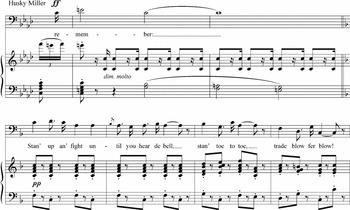
Martial sentiment also characterized the change of lyrics as Escamillo was transformed from the bandleader Hepcat Miller into the boxer Husky Miller. The new words for “Toréador, prends garde” now emphasize fighting “like hell,” as the maxim the heavyweight champion (and everyone else) “must remember” (see Example 1). This number became possibly the best-known extract of Carmen Jones, with numerous requests for performances, as, for example, by the OWI music director, Macklin Marrow, for a radio program that would have the famed baritone Lawrence Tibbett perform the song.Footnote 68
“Stan’ up an’ fight” (Husky Miller). Text: Oscar Hammerstein II; music: Georges Bizet (“Toréador, prends garde,” mm. 34–39). Based on Georges Bizet, Robert Russell Bennett, and Oscar Hammerstein II, Carmen Jones, Restored Edition. New York: Rodgers and Hammerstein Theatricals, 2007, 126–27. Courtesy of the Rodgers & Hammerstein Organization.

The war as point of reference becomes particularly poignant in the new third scene of Act 1 in which Joe tries to make the defense-plant worker Carmen understand not only that he is in the army but also that he has ambitions of getting into Officers’ Flying School.Footnote 69 According to the typescript of the new libretto, Joe knocks down Brown (the play's Zuniga figure) in a jealous rage. As he thinks about surrendering himself rather than deserting, Carmen takes the initiative in the cruelest of all deceptions by announcing to the returning crowd that Joe has just gotten news that he has been chosen for flight training and will not return to camp but leave immediately for his new assignment. Despite Joe's dazed protestations, the crowd cheers: One of theirs has been selected into the elite group of African Americans now training to become pilots. Hammerstein's words for the crowd make Carmen's deception seem increasingly unpatriotic when they exclaim: “Hot diggedy! / Joe's goin’ to be an officer! . . . Show dem Japs where dey git off!” A fellow soldier chimes in: “Hey! D'you know what dis means? We got a boy from our outfit goin’ to be a officer!”Footnote 70 The happy cheering ends in a reprise of “Beat out dat rhythm on a drum,” but the punch line of the verse is altered first into “An’ show ’em how to win de war!” and, the second time round, into “An’ kick ol’ Hitler out de door!”Footnote 71 It is not clear from the sources whether Hammerstein toned this scene down before the tryouts or only later in the process by replacing the verses referring to the “Japs” and Hitler with the more neutral reprise of “Good Luck, Mr. Flyin’ Man” in the printed version of 1945.
The rewritten ending to the scene at Billy Pastor's was, in its own way, as powerful a statement about African Americans and civil rights in the United States as was the first version's segregation finale. The year 1943 was one in which increasing attention was drawn to the abuse of African Americans in the armed forces, which had begun to enlist black soldiers after the collective lobbying of civil-rights organizations and the black press had led to the Burke-Wadsworth Draft Bill's (1940) inclusion of a mandatory 10 percent quota of African American inductees.Footnote 72 Whereas that quota was filled overall (and even doubled in service units) by 1943, only 1.1 percent of officer candidates were African American.Footnote 73 In the fully segregated armed forces, African Americans were organized in black units but usually commanded by white officers. Combat units, including the Army Air Force and the Marine Corps, were especially slow to accept African Americans, though the 99th Pursuit Squadron, established in 1941, soon became renowned as the Tuskegee Airmen for their outstanding record in the war. Flying their first battle missions in the spring and summer of 1943, the airmen became living proof of African American achievement in combat.Footnote 74 The daredevil glamour associated with the Army Air Forces—one of the deadliest combat assignments in World War II—thus contributed to the uphill battle that African Americans were fighting in the armed forces and the United States as a whole.
Hammerstein's Carmen could not have done anything more terrible than use this symbolic achievement of African Americans as airmen in her destruction of Joe. In that sense, Hammerstein's Carmen proved even more dangerous than either Mérimée's or Bizet's: There, she was a powerful woman against whom weak men had little chance; in Carmen Jones, she is an actively destructive force. In this portrayal of Carmen as villainess, war propaganda crosses powerfully with melodrama in a figure who owes her character to, among others, the stock seductresses in wartime movies who put selfish desires ahead of the needs of their country. With Cindy Lou as the quintessential and sacrificial “good girl” (with marginally more American spunk than her hapless predecessor), Carmen Jones stands out as the bogeywoman of war propaganda: the enemy within. That Hammerstein's portrayal was successful shines through the unfiltered private commentary of his wife, Dorothy, after she attended a rehearsal in Philadelphia: “Carmen is an awful character really. Oscar claims that her saving grace is her honesty, but this Carmen is even worse than the Spanish Carmen [in] that she makes Jo [sic] desert in war time. Of course you wouldn't hate her if Jo wasn't such a good boy. The cast is swell. Carmen is simply wonderful & every time Cindy Lou sings I cry.”Footnote 75
Hammerstein's revisions to Act 2 were even more extensive: No longer in rural and segregated North Carolina, it presents an even tighter plot in its new setting on the South Side of Chicago (perhaps also an echo of Show Boat), where, in the Meadow Lawn Country Club, an elegantly dressed Carmen tries to get rid of the unkempt deserter who has followed her. The club presents a modern and glitzy world of African American achievement that Carmen Jones, now turned into a social climber, wants to join. With its relocation to the outside of a baseball park, the finale of Act 2 regained some of its parentage from the opera's bullfight ending, with Carmen throwing her ring away and Joe stabbing her.Footnote 76 Despite the setting in a modern urban community in which segregation is no longer overtly represented, Hammerstein may nevertheless have chosen Chicago's South Side also as a reminder that many African Americans still lived (and died) in urban ghettos, a fact that had been driven home in June 1943, just months before the première of Carmen Jones, during the race riots in Detroit.
Billy Rose and his production team went all out to create an extravagantly stunning show that had the audiences and critics enthralled by its sheer modernist glamour. In contrast to Crawford's cash-strapped Porgy and Bess (which had downsized the work's staging to make it an economically viable enterprise), Billy Rose's Carmen Jones was the most expensive production on Broadway of its period. It had cost $176,000 by the time it had completed its tryouts and arrived on Broadway (equivalent to the purchasing power of about $2 million in 2009).Footnote 77 In comparison, the cost of Oklahoma! was between $82,000 and $84,488.Footnote 78 Whether such lavishness was due to Billy Rose's unstinting commitment to the show or whether he did not care because his money would be gone anyway, given the new tax laws during the war, Carmen Jones started life—by all accounts—in a breathtaking staging.Footnote 79
Hassard Short had developed a color concept in which each location was tinted differently, with costumes, lighting, and sets all in one matching color: yellow for the parachute factory, purple for Billy Pastor's bar, blue for the country club, and red for the sports stadium.Footnote 80 Howard Bay's sets presented a streamlined yet playful scenery, whether for the scene in rural North Carolina or the glitzy country club, and the costumes put both protagonists and supporting cast in silk, velvet, and linen (with a few cotton costumes for parachute workers and MPs).Footnote 81 Through this symbolic and unrealistic color concept, the exceptionality of the play was thus reinforced by the exceptionality of the staging. Short's concept may have been an attempt to translate on Broadway the new three-strip Technicolor in Hollywood pictures of the 1930s. Yet his use of primary colors in three out of the four sets prompted critics to delve into language that equated the use of strong colors with African American vitality, thus taming the powerful allure of the appealingly “wild” production through stereotyping it as inspired by “the Negro love for primary colors in bold combinations.”Footnote 82
With the sets and staging concepts shaping up and the work finally cast, Carmen Jones went into rehearsal on 13 September 1943.Footnote 83 The tryouts in Philadelphia and Boston were scheduled, but what would happen in New York remained unclear as all the theaters on Broadway were booked. As Hammerstein announced to Bill around 12 September: “Business for legits and movie houses alike is terrific. The streets are jammed at night, London has been the same since the blitzes subsided.” When the show opened in Philadelphia on 19 October 1943, it was a huge success. The newspapers fêted the production and its performers, and a large number of New Yorkers made the trip south to see the new hit. Moreover, the tryout version was already in excellent shape.Footnote 84 As Carmen Jones moved to the Boston Opera House on 9 November (where it gained as much success as in Philadelphia), the New York fate of the production remained uncertain. There was still no house in sight, a situation that was noted especially by the African American press.Footnote 85 Finally, Lee Shubert's Broadway Theater became available when the revue-style show Artists and Models folded on 27 November after a short, unsuccessful run.Footnote 86 Carmen Jones opened there on 2 December 1943, and it was a triumph. It played eight times a week to a packed house that seated 1,950 people. Its sheet music sold like hotcakes, and its cast and production team were treated as celebrities in newspapers from the New York Times to the Chicago Defender. Not only drama and music critics but also reporters from many other departments published their thoughts on Carmen Jones in the following months. These texts offer a fascinating window on a number of key issues in the wartime United States of 1943–44. They address in particular Hammerstein's poetic and dramaturgical choices in the text, the performance of the African American cast, and the role of Bizet's music in the show.
American Vernacular: Speaking Carmen Jones
With the entry of the United States into World War II, the discourse about the vernacular in the musical theater took on renewed urgency. Opera in English had become once more a hot-button topic that had critics, producers, and audiences alike reassessing current performance practice. Yet Hammerstein's radical adaptation of Bizet's Carmen pushed the debate also into the broader contemporary discussions about a national theater, its genres, and its languages. Indeed, in the reception of Carmen Jones, these two conversations overlapped, revealing disquiet and self-consciousness in a time of heightened nationalism when a dependence on imported cultural products—whether English theater or European opera—proved to be even more problematic than during the interwar years. With opera in particular, dependence on the canonic European repertoire remained unavoidable. Indeed, although composers such as Deems Taylor and Virgil Thomson had tried their hand composing “American opera,” the operatic canon remained almost exclusively European, and worse—with works by such composers as Rossini, Verdi, Puccini, and Wagner—dominated by Axis composers. This situation led to rhetorical contortions in justifying the continued performance of such operas and made the genre's transfer into an American vernacular realm ever more pressing. Moreover, opera could too easily be associated with a small, elite audience: As Marc Blitzstein put it polemically in 1937, in the United States, “opera means only the Met.”Footnote 87 Given that this country purportedly had joined the global conflict in December 1941 in order to save democracy, that kind of exclusive cultural practice now became tricky at the very least. Access to so-called high-brow culture on the part of the masses could no longer be solely the social concern of such New Deal agencies as the Federal Theatre Project; rather, it quickly turned into a national necessity.Footnote 88 Opera in the wartime United States thus had to respond to two interrelated issues: It needed to be both Americanized and democratized.
Advertisements and reviews pointed to fresh translations, U.S. singers, and up-to-date staging as key ingredients in the formula for turning European opera into an American art form. Thus an advertisement for performances of Il barbiere di Siviglia and Carmen in Pasadena claimed: “Grand opera, Americanized by new English translations and young American singers, will be presented by the American Music Theater of Pasadena at the Civic Auditorium in that city next month.”Footnote 89 In Washington, newspapers announced a season of “Grand opera produced in the ‘American way’” for the winter of 1943.Footnote 90 Surprisingly enough, even the Metropolitan Opera joined the trend and presented several productions in English, particularly of operas using spoken dialogue (where the vernacular could more easily be justified), ranging from The Magic Flute in 1941 to Fidelio in 1945.Footnote 91
In addition to the question of translation, the continuous touting of the successful employment of American singers added an openly chauvinist note to this discourse that could not entirely hide the insecurities about the international competitiveness of home-grown performers. In particular, the Met had been infamous for its preference for European singers, but because of the war, Europeans were no longer in easy supply after the 1941–42 season. Music critics and producers alike turned this absence into a patriotic virtue, echoing a debate favoring native artists over foreign ones that went back at least to the Dickstein “Alien Actors” Bill considered in Congress in early 1935. Sponsored by the chairman of the House Immigration Committee, Samuel Dickstein (D-N.Y.), this protectionist bill aimed at excluding foreign artists from performing in the United States. Olin Downes described the change in November 1942 as being highly beneficial: “Wartime has brought its trials, but also, on the long view, certain blessings in disguise to the Metropolitan and to American opera. . . . Up to the present time the Metropolitan has imported its principal stars from overseas. This season there has not been a single importation from Europe.”Footnote 92 This nativist emphasis on U.S. performers was even more prevalent in other companies from Philadelphia to San Francisco: The Philadelphia Opera Company prided itself, for example, on only employing native artists.Footnote 93 The advantage of this casting strategy was the creation of productions that—so the press noted—offered well-rehearsed theater by youthful “singing actors.”Footnote 94
When Carmen Jones opened in the fall of 1943, the show was embedded in a field of cultural production and reception that defined Americanized opera as an English-language work performed by U.S. singer/actors in an accessible and well-staged production. But Hammerstein's translation, with its use of African American dialect, also inscribed the reception of Carmen Jones into contemporary debates about a national theater and its use of vernacular speech. As one reviewer stated: “Mr. Hammerstein apparently understands the American idiom, whether he is writing about the West, as in ‘Oklahoma,’ or the Negro, as in ‘Carmen Jones.’ His dialogue is excitingly true and sure. His characters speak and sing words that come from the heart.”Footnote 95 References to Carmen Jones as “an American folk drama set to music” and “a folk play with music or a ‘Green Pasturized’ version of Bizet” thus placed Hammerstein's book in a long tradition of linguistic regionalism in the American theater, in particular those works that used the African American vernacular.Footnote 96 The terms “folk play” and “folk drama” also invoked broader nationalist agendas that were now hinging, precisely, on generic labels that were, in turn, strongly coded.
In what can be interpreted as an effort to read Carmen Jones as both modern and intrinsically “American,” the reviews reveal that the discourse about folk dramas underwent a subtle change in the early 1940s by merging earlier modernist tropes about the vernacular with subsequent debates in the 1930s focusing increasingly on national identity and authenticity. As Gavin Jones has pointed out in his study of dialect literature, American vernacular was a “slippery entity [whose] definition and function shifted considerably as it was made to serve a variety of cultural and ethical agendas. . . . Dialect could entertain a simultaneity of different motivations, a mixture of competing functions.” The same work could employ dialect to foster a national literary agenda while stereotyping the linguistic subaltern “along the lines of ethnicity, race, and class.”Footnote 97 In contrast to the European use of dialect—for example, in the stage works of Karl Kraus and Gerhart Hauptmann in the German-speaking countries, where its focus was mainly comic relief, idiomatic authenticity, or realist portrayal of (usually lower-class) individuals within the same linguistic orbit—U.S. English usage, especially in the 1920s, had an outspoken nationalist component in its rejection of what was perceived as the “linguistic authoritarianism” of the hegemonic standardization of English.Footnote 98 Furthermore, such dialect art often included a form of “racial masquerade” that shifted European social impersonations into ethnic or racial imitations that simultaneously celebrated the heterogeneity of U.S. society and reinforced its internal divisions, most dramatically in the use of stereotyped black speech (including its resonances of minstrelsy).Footnote 99 Yet this form of masquerade in turn was also part of an international phenomenon of modernist artistic appropriation of black art in a “cross-cultural, multimedia interchange” that proliferated “connections between Primitivism, beginnings, cultural myth, and ethnic difference” in both Europe and the United States.Footnote 100
Whereas U.S. English dialect literature in the so-called Jazz Age was characterized by the complex crosscurrents between transatlantic modernism and national identity politics, the onset of the Depression turned the focus of cultural politics inward in “a flurry of renewed national interest in indigenous folk culture.”Footnote 101 Even though dialect theater continued to cut across a wide range of ethnic linguistic origins, especially outside the more homogeneous New York stages and under the auspices of the Federal Theatre Project, the concept of folk drama became increasingly synonymous with African American vernacular speech and topics and took center stage in a larger project of building a “national art on indigenous folk traditions while simultaneously broadening the public's perceptions of America's folk to include and even privilege African Americans.”Footnote 102 African American writer Richard Wright grudgingly acknowledged this conflation in 1937 when he wrote that “Negro writers must accept the nationalist implications of their lives.”Footnote 103 This slippage between American and African American culture led to a heated debate on cultural authority and ethnic authenticity that had African American authors and journalists in particular query a white writer's ability to represent black culture authentically.Footnote 104 The issue came to the fore, for example, when the “American folk opera” Porgy and Bess presented African American life as national drama, and the work elicited impassioned comments on its ability (and right) to do so. Celebrated by the majority of critics as a “milestone in the development of a national opera,” the work was submitted to intense scrutiny as to how and whether the text and music fulfilled so lofty a goal.Footnote 105
Thus Carmen Jones rested on the shoulders of almost two decades of folk plays produced on Broadway and an even longer debate over American folk literature. By the onset of World War II, critics no longer queried either the national credentials of an African American dialect play or its modernist identity, or even, for that matter, a white playwright's justification to appropriate African American models.Footnote 106 On the contrary, in the case of Carmen Jones, reviewers celebrated Hammerstein's “ultra-modern” contribution to “20th-century American theatre” in this “contemporary Negro Fable.”Footnote 107 The conflation of “American Negro idiom” with “American idiom” tout court in the reviewers’ descriptions of the libretto indicates to what extent African American dialect had become, at least in some circles, a cipher for a national art. Robert Garland celebrated the work as an “amazing translation of the original French text into the beautiful American Negro—Southern Negro—idiom. And if you don't think this dialect is truly beautiful, read ‘Uncle Remus’ out loud.”Footnote 108 Still, the question remained whether such an adaptation was suitable for a nineteenth-century opera. The famed music critic Olin Downes, who was otherwise rather critical of Carmen Jones, nevertheless proclaimed Hammerstein's translation as the proof “that an opera which reflects some real phase of contemporaneous life, as we know it, and is sung and enunciated in a language the audience can understand, gains greatly in the force of its appeal to the public.”Footnote 109 Only one reviewer among the dozens who commented on Hammerstein's choice of dialect attacked the translation as ruining the French text of the opera through the “unlovely Negroid idiom, with all of the phonetic vulgarity inherent in this mode of speech.”Footnote 110
Most critics spent a significant amount of time discussing the specific literary achievements of Carmen Jones, although few went so far as Robert Garland, who compared extracts from Hammerstein's version both with the French original and with what he called “the hideous translation on sale at our local Opera House.”Footnote 111 African American music critic Nora Holt also dedicated a significant part of her review to the text, inviting her readers to acquire a copy of the libretto given that “the Negro idiom as Hammerstein has caught it, is so quaint and piquant it is a great joy to read it and everyone should have a copy to follow the play.” Yet with all the praise, Holt also voiced her sole but serious misgiving about Hammerstein's adaptation with respect to the final lines of Carmen Jones:
I rather take exception to the dramatic last words of Joe, who accepts with fatalistic philosophy the doom that faces him as a murderer. His final words are:
The first line is all too reminiscent of atrocities committed in the South when lynching parties occur ever and again to arouse us to shame, hatred and finally acceptance, but never forgetfulness.Footnote 112
Joe's final lines—with their echo of Abel Meeropol's “Strange Fruit,” a song made famous by Billie Holiday in 1939—had remained unchanged from Hammerstein's first version that was overtly critical of Southern segregation and may very well have been intended to evoke such atrocities deliberately as a political gesture rather than being the careless reference Holt implies. Yet in the revised version, with its emphasis on modernity and urban life, Joe's final words might indeed seem out of place without the previous social context that could have given them a critical edge.
Beyond the libretto itself, the critics tried to explore the generic implications of the adaptation of this European opera for American musical theater. Hammerstein himself addressed the matter in an interview in which he defined Carmen Jones as a “musical play” (the term recently canonized by Oklahoma!, although it was not new) as opposed to lighter genres on Broadway:
The point is that in a musical play you are asking the audience to take the characters seriously. Usually, too, the story includes several serious, or even tragic, events. . . . In “Show Boat” there was the blood scene, among others; in “Oklahoma!” there is a murder, and “Carmen Jones” has a tragic ending. These realistic twists are typical of the musical play; they give a depth and an interest it wouldn't have otherwise. . . . The blood flows redder in “Carmen” than in “Oklahoma” of course, but essentially they are the same dramatic form.Footnote 113
Instead of following Hammerstein's lead in relating Carmen Jones to Broadway musical theater, several reviewers praised the work as a powerful model in fusing folk drama and European opera into a new, hybrid form. Jerry Gahan described the work as “a genuine and successful experiment in the combining of two previously unrelated stage forms,” whereas Howard Barnes praised it as a “major theatrical event” that opened “infinite and challenging horizons for the fusion of two art forms.”Footnote 114 Indeed, Barnes rejoiced in Carmen Jones as a work that was “not ‘Carmen,’ but what ‘Carmen’ might have been had it achieved a more perfect balance of theater, spectacle, song and dancing in the first place.” He thus judged the modern American version as superior to the French original, which he regarded as trapped by nineteenth-century convention. The Boston Herald's music critic, Rudolph Elie, even called upon gendered language when he proclaimed Hammerstein's libretto the redemption of Bizet, who had been forced to content himself with the “emasculated setting” of a conventional libretto. “For the first time, perhaps, the story approached the level of the music.”Footnote 115
A single dissenting voice, however, denounced “the Afro-Americanization of Bizet's opera” as not just an expedient political maneuver but one that played into enemy hands. According to the anti-modernist critic Warren Storey Smith, “We do not have in ‘Carmen Jones’ the first instance of a brand new libretto. It has been done in the case of Weber's ‘Euryanthe’ because the original text was atrociously bad, and it has been done by both the Soviets and the Nazis for ideological reasons. Mr. Hammerstein's efforts, while transiently productive of good entertainment, filled no crying need.”Footnote 116 This sharp comment was a slap in the face for the production's creators given their own stated claim to do patriotic work by adapting a well-known “master work” for U.S. audiences in wartime, and also because Carmen Jones was no less a war play than Irving Berlin's This Is the Army (1942) or Moss Hart's Winged Victory (1943) and hence, at least in part, was explicitly ideologically motivated. However, just as the literary critic Eric Bentley accused Oklahoma!, or at least those who wrote so favorably about it, of crypto-totalitarianism (whether of the Nazi or the Soviet kind), so too, it seems, did at least one reviewer of Carmen Jones, who did not accept the work's Americanized innocence.Footnote 117
Africa Evoked: Embodying Carmen Jones
On the face of it, it would seem absurd to associate Carmen Jones with Nazi and Soviet ideologies, not least given its evident ethnic location: Clearly, Warren Storey Smith was seeking to exorcise other demons contained, he must have felt, within the work. Here issues of race, and racism, come to the fore, and although the cast of Carmen Jones, and also their envoicing, might have been viewed as benign and even praiseworthy, there was also a darker edge. What if, in the end, Carmen Jones was not at all “American,” standing outside, rather than within, the famed melting pot of social and cultural assimilations conjured up particularly during World War II as granting the force of right to the side of the United States?
If the wartime United States were the first point of the cultural triangle that shaped the creation and reception of Carmen Jones, Africa was the second. In a complex discursive pattern Africa was turned, on the one hand, into a bridge for Carmen's travel to America from Europe—almost tracing the black transatlantic Middle Passage—and on the other, into a mythical, modernist concept of authentic cultural expression that validated the Americanized production of the work. In either case, Africa was constructed as that timeless locus of unadulterated and unmediated human expression that had fascinated modernists since the late nineteenth century.
The power of Africa as a cultural marker emerges in a comment by Hammerstein to his son Bill (19 October 1943), in which he equated the recognition of some African quality in Bizet's Carmen with particularly modern insight: “Our publicity man dug up a fascinating story. He found a critique of Carmen by Nietsche [sic] who said that the music was neither French nor German—but African! I am not as original as I thought and Nietsche was ahead of his time. Furthermore, I am pretty sure I am misspelling his name.”Footnote 118 This private remark is revealing both in its reference to Africa and in its equation of this relationship with modernity. Nor is this Hammerstein's only evocation of Africa with respect to Carmen Jones. In the 1942 opening of Act 2—the scene at Billy Pastor's—Hammerstein describes the dancers as whirling “in a wild series of varied evolutions combining jive, jitters and African frenzy,” a reference deleted in the revised version.Footnote 119 What remains of the African allusion, however, are Carmen's lyrics in “Beat out dat rhythm on a drum,” which have her “feel it beatin’ in my bones, / It feel like twent'y millyun tomtoms. / I know dere's twen'y millyun tomtoms / Beatin’ down deep inside my bones!”Footnote 120 The musical effect was accentuated by the on-stage presence of renowned drummer Cozy Cole, who turned this sequence into a virtuoso showpiece, and whose increasingly dominant use of the bass drum throughout that number—sonically prominent even in the number's truncated version on the original-cast album—mimicked the sonorities of the tom-toms. According to Naomi André, Harlem Renaissance authors in the 1920s and 1930s had coded the sound of the tom-toms as embodying the essence of Africa to the point that William Grant Still opened his composition Africa with it.Footnote 121 The same would apply, ironically, to countless representations of Africa in the movies of the 1930s on, as, for example, in Johnny Weissmuller's Tarzan series (1932–48). Similarly, popular music referred to the tom-tom, famously in Cole Porter's “Night and Day” (“Like the beat, beat, beat of the tom-tom / when the jungle shadows fall”). The tom-tom thus had become a widely used sonic marker of African-ness in the 1930s and 1940s, whether as a means of African American self-fashioning or as a popularized geographic signifier.
By the time of the première, Nietzsche was quoted not only by the show's publicity people but also by Billy Rose, who was not “above citing Friedrich Wilhelm Nietzsche in his critical verdict that ‘Carmen's’ music is more African than Spanish.”Footnote 122 L. A. Sloper, the critic of the Christian Science Monitor, related African Americans to the Spanish because of their proximity to Africa, referring to Nietzsche as the authority who identified the Mediterranean quality of the music as the opposite of Wagner's broodings. Indeed, Sloper intimated that Nietzsche would have approved of Carmen Jones, for “temperamentally the Negroes are closely allied to the Spaniards. They have the capacity for expressing primitive emotion, gay or sinister. Africa borders on the Mediterranean, and this is Mediterranean music, as Nietzsche remarked. I think Nietzsche who (after he quarreled with Wagner) came to hate the Wagnerian ponderosities, would have loved this account of his favorite opera.”Footnote 123 This slippage from drama to music in the references to Africa (via Nietzsche) became even more pronounced later, in 1945, when Hammerstein justified his adaptation as born out of the music itself in his introduction to the printed libretto, where he explained that the “score of Carmen is a Frenchman's version of Spanish music. Do not forget, however, that Spanish music was deeply influenced by the Moors from Africa.”Footnote 124
Because of the association with artistic “primitivism,” Africa was not an uncontested site of reference in either the creation or the reception of Carmen Jones. This issue came to the fore especially in the opera's dances, where a “primitivist” rhetoric prompted some fascinating responses, as, for example, when Nora Holt attacked Olin Downes for his remark that the dancers’ performances were not genuine enough and carried “evidence of too much white man's training.”Footnote 125 Holt responded that African American dancers and actors were as much embedded in the modern world as any other of its citizens and therefore fully embodied modern culture:
“Carmen Jones” does not suffer from a dearth of acting, contrary to the review of one critic who thought their acting creditable but flavored too much of the white man's training. Evidently this critic is still tuned to the Negro of the minstrel era and forgets that today he, the Negro, knows, hears and sees all the nuances of the modern passing show and his reactions would obviously be a part of the modern trend.Footnote 126
Dan Burley, who reviewed Carmen Jones for the New York Amsterdam News, one of the largest African American newspapers of the 1940s, pointed to the difference between still-present minstrel traditions in contemporary theater and the modern dance of Carmen Jones: “The things Negroes are ‘expected’ to do in the theatre are conspicuous by their absence; there is no tap dancing, no crap games, no ‘amen, Lawd,’ no hand-clapping and shouting, praying and bowing and scraping. Instead there are marvelous ballets danced with precision, grace and dignity, as well as high skill by some of the best colored dancers in the country.”Footnote 127 Eugene Loring's choreography was danced by a troupe of twenty-six dancers who—so John Hammond recalled—“came from Karamu House in Cleveland, a settlement house with great creative verve.”Footnote 128 It seems, however, that Hammond's recollections were limited to the dancers he himself signed during his casting trip. Eleven members of the troupe had already performed on Broadway in such productions as Four Saints in Three Acts (1934), Cabin in the Sky (1940), and the revival of Run, Little Chillun, which ended its short run on 26 August 1943, three weeks before rehearsals started for Carmen Jones.
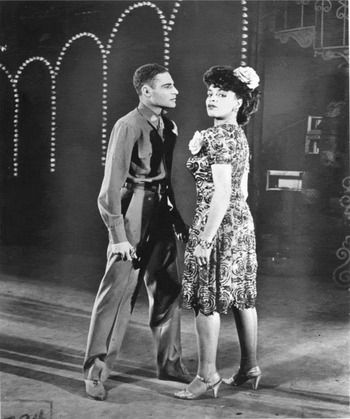
The reception of African American concert dance, as Susan Manning has observed, “underwent considerable change, and by the end of the war Negro dance had established its authority on the American stage.”Footnote 129 For Dan Burley and Nora Holt, at least, Carmen Jones was part of this positive change. Alas, Loring's papers contain barely a trace of his Carmen Jones choreography, possibly as a result of his contract that transferred sole ownership of the choreography to Billy Rose.Footnote 130 This lacuna limits the information about the dances in Carmen Jones to a handful of photographs and summary descriptions in the newspapers, although Loring's work for Hollywood immediately after Carmen Jones might offer some idea of his choreography in the exotic dances he staged in Yolanda and the Thief (1945) and, especially, the final sequence of The Thrill of Brazil (1946).Footnote 131 However, the most informative text on the choreography comes from an article based on an interview between Loring and Margaret Lloyd of the Christian Science Monitor (4 December 1943). Here we learn that Loring insisted that African American performers were individuals in their abilities and tastes and resented especially when they were “told that boogie-woogie is Negro dancing. What the serious artists among them want to develop is a Negro art dance that will be just as fine and rich in its way as ballet is in its.” Whether the words were Loring's or his interviewer's, the text makes a difference between “Negro art dance” and “ballet” that echoes other discussions about African American concert dance in the 1940s as a distinct art form on its own. According to this interview, Carmen Jones had three main ballets: a “little opening dance in waltz time” (to “Good Luck, Mr. Flyin’ Man”); a “big dance number in Billy Pastor's café” (to “Beat out dat rhythm on a drum”); and a “Spanish Dance” in Act 2 (to music drawn from Bizet's Roma Suite). As Loring pointed out in the interview, each number fulfilled a different function in the musical play.
The first was a brief number that had dancers intermingled with the chorus, who moved into a dance halfway through. The final ballet, on the other hand, provided entertainment in honor of Poncho the Panther (Husky Miller's Brazilian challenger) and hence offered “something Spanish” by dancers who were presented as performers at the “Cuba Libra Night Club.”Footnote 132 In contrast, Loring's remarks on the central ballet of Carmen Jones at Billy Pastor's café suggest his interest to choreograph a programmatic representation of racial “uplift”:
[The dance] starts with Cozy Cole's drum beats and the pulse is regular, simple, like heart beats. But the rhythms soon arouse deep instincts and emotions, causing one of the girls to come forward and do a primitive dance alone. The feeling spreads as the rhythms become wilder, and soon all are dancing their individual response to the call of the drums. There are three outstanding types—one represented by the earthy first girl giving free vent to her feelings; a second by a group who try to hide the primitive under a cloak of sophistication; and a third, feeling the urge as strongly as the others, but transmuting it into a sense of aspiration (draw what parallels to racial problems you will). The aspiration culminates in the ascent of one over the bent backs of her companions into an unusual lift. She eventually falls (rolling down over these same backs) and is caught up in the terrific physical and emotional conflict that ends in exhaustion.
Loring's rhetoric of “uplift” fits into broader discussions about representations of racial politics in music and dance in the early 1940s, whether in the performances of the Karamu Dancers at the New York World's Fair (who related African ritual to modern dance in an evolutionary sequence of numbers) or in Duke Ellington's presentation, in January 1943, of Black, Brown, and Beige in a concert at Carnegie Hall, a programmatic piece that traced African American experiences from slavery to a Utopian future in modern U.S. society.Footnote 133 As Lisa Barg has argued, Ellington's work faced the difficulty of “preserving a discrete racial and cultural identity while at the same time embracing ‘European’ evolutionist ideology”;Footnote 134 but whereas the political implications of Ellington's composition and performance shaped the work's reception, the multilayered representation of black cultural identity and its evolution as developed by Loring and his African American dancers in the “Billy Pastor” ballet in Carmen Jones remained a hidden program, at least as far as the reaction of the critics was concerned. Instead, the scene at Billy Pastor was fêted as representation of primitive dance to a music “whooped up with added jungle rhythm by Cosy [sic] Cole as a demon drummer who cuts loose in pulse-pounding fashion.”Footnote 135
A (Universal) European Soundscape: The Music of Carmen Jones
If the dancers were caught in the dichotomy between celebrations of modern dance on the one hand and expectations of “primitive” authenticity on the other, the singers found themselves in an even more complex bind, given that the music remained ostensibly European even as everything else was transferred to the United States. Viewed positively, this dialogical multivalence inscribed the singers as an embodiment of cultural hybridity between American modernity, African authenticity, and European culture; viewed negatively, it left them lost in a cultural aporia. For the most part, the positive view prevailed, as perhaps was inevitable given Carmen Jones's evident success and its wartime mission. Critics attributed a “naturalness” to the African American cast, with the result that passages “that sometimes seem out of the grasp of white singers are done effectively.”Footnote 136 Virgil Thomson declared that the “production has two elements of authenticity. One is Oscar Hammerstein's translation, and the other is the Negro company.”Footnote 137 By imbuing the African American cast with such authenticity—a wholly positive term for him in this context—Thomson and his fellow critics appropriated the work for the United States through a rhetorical twist that turned the French original into the race-changing copy, as, for example, when John Chapman reported in early 1944 that he had gone “to hear the standard, or whiteface French, version of ‘Carmen’.”Footnote 138 Deems Taylor seems to have been the source for this flipping of standard performances of Bizet's opera (as presented by the Met) into inferior and inauthentic travesties when he wrote to Hammerstein immediately after experiencing Carmen Jones for the first time: “Saw the old version of ‘Carmen’ at the Met, on Monday night. Did you know? They're doing it in white-face!”Footnote 139 Carmen Jones thus stood as a truly American alternative not only to its French original but also to the exclusive pretensions of the Metropolitan Opera House.
For this appropriation to work, however, the music needed to remain Bizet's, given that any obvious tampering with the score would undermine the work's cultural authority in this complicated web of cultural transfer. Indeed, from the very first document—Berger's letter from 19 February 1942 (cited above)—private as much as public conversations about the work emphasized the fact that Carmen Jones went against the grain and did not “swing” the score. As Billy Rose put it in an interview: “Naturally we would not dare alter the music.”Footnote 140 This “naturally” is intriguing, for it proclaims (or at least, pretends) a transcendence that protected the work from wartime anti-European sentiment (a danger even with its French origin) and also granted a U.S. appropriation some sense of universality. Hammerstein, Rose, and their publicity team refer repeatedly to Bizet's “immortal music” from, one might infer, a now-occupied country, the very survival of which was severely in doubt.Footnote 141 Hammerstein had already demonstrated his nostalgia for all things French in the lyrics of the Academy Award–winning song “The Last Time I Saw Paris” (1940, with music by Jerome Kern). Now he had gone a definite step further by choosing the most famous French opera and its timeless music for this adaptation.
The press picked up on the (supposed) fidelity to Bizet's score by insisting that save “a few minor rephrasings and a couple of cuts, for purposes of theatrical comfort, the score has been left intact,” or, in another critic's words, “the music remains untouched.”Footnote 142 According to John Chapman, “This production is no hopped-up version of an opera; it's no ‘Hot Mikado’ or ‘Swing Mikado.’ It is straight ‘Carmen.’”Footnote 143 Linton Martin for his part emphasized that Bizet's music had received far better treatment in Carmen Jones than Tchaikovsky's at the hand of arrangers: “No Tin Pan Alley twist has been given to any of the arias, dance rhythms or marches, unlike the liberties that have been taken with Tchaikovsky by the unholy hands of tawdry tunesmiths.”Footnote 144 Such claims may have been unjust: Leta Miller points out that The Swing Mikado remained surprisingly faithful to Gilbert and Sullivan save for the altered orchestration and the added swing numbers.Footnote 145 Yet the fact that they were made remains significant. In contrast to other shows such as Oklahoma! where his skill as orchestrator stood in the foreground, the praise that Robert Russell Bennett received for his arrangement of Bizet's score highlighted the fact that he remained as faithful to the original as was possible with the smaller orchestra of a Broadway show.Footnote 146
Bennett's own comments in interviews and in the souvenir program emphasized his role as a servant to great music. He pointed out that Bizet was “the combination of a great tune-writer and great orchestrator” and that in “adapting the orchestration to Mr. Hammerstein's vivid version of the drama my effort has been to carry out George Bizet's intention of color and balance. . . . Mine has been truly a labor of love.”Footnote 147 It is striking that Bennett's view of his task as a “labor of love” was so close to Hammerstein's, and in both cases the trope seems to embody claims for authenticity (here for Bizet's score) and even for artistic status. In an undated letter to Hammerstein, Bennett agreed to the wholesale cutting of numbers but added “a short list of things I don't believe in doing to Bizet's music:
1. Making jump arrangements out of melodies that will long outlive jump arrangements.
2. Interpolating songs by Jerome Romberg.
3. Building up routines by Bob Alton, with special choruses and fancy exits.
4. ‘Saving’ numbers by Hartman methods.”Footnote 148
For Bennett, his work on Carmen Jones was the fulfillment of the dream that had brought the “all-American” farm boy from Kansas to the study of classical music. Both in an interview and in his autobiography, Bennett connected his involvement in this particular project to his youthful musical aspirations and presented it as the fulfillment of his own social and cultural uplift, especially when he contrasted his making a living by working with contemporary Broadway composers such as George Gershwin, Cole Porter, and Jerome Kern with the personal form of inspiration found in studying “the scores of the great masters.”Footnote 149 Whenever Bennett discussed his work on Carmen Jones, he presented himself as a translator of Bizet into the pit of a Broadway theater, not an arranger of his music. Both Bennett and Hammerstein, it seems, felt that musically, at least, Carmen Jones remained true to its operatic type and could hence be claimed as a work sui generis that kept it equally distant from the Met's operas and Broadway's musicals.
The musical sources—so far as they survive—support the claim that Bennett's arrangement remained close to Bizet's original. As in Oklahoma!, he used a slimmed-down version of a typical symphony orchestra (no saxophones in either score), although the ensemble for Carmen Jones was larger than that of usual Broadway productions, starting out with forty musicians.Footnote 150 Bennett created his text by reworking a printed orchestral score for the available instruments, referring to it in the manuscript of some of his adaptations, for example, in the finale of Act 2 (Act 4 in Bizet) where he requested first “Copy from page 469 measure 4 to page 470 measure 3,” and then, a page later, demanded: “All down 1 ½ tones to E major.”Footnote 151 Indeed, in those musical numbers that were transferred from the opera into Carmen Jones (see Appendix), Bennett used his skill as orchestrator to reproduce the sound of Bizet's full symphony orchestra as closely as possible with the instrumentalists available, and the original-cast album that was recorded in the Broadway Theater on 17–20 September 1944 gives an excellent sense of this musical feat.
Bennett also added several extracts from Bizet's other output to the Carmen Jones score: Bizet's Roma Suite provided the “Spanish Ballet” in Act 2; an extract from La Jolie Fille de Perth seemed to have been planned as an opening to the original Act 2 (Act 1, Scene 3 in the revised version); and part of the Arlesienne Suite became Husky Miller's entrance (“new No. 19”).Footnote 152 Other fragments from Carmen were reorchestrated as underlay for melodramas, for example, the reprise of the Habanera as No. 12 after Carmen's ditty “Coupe-moi, brûle-moi” (translated by Hammerstein as “You ain’ no police'm”). According to Bennett's autobiography, he reworked the arrangement of “Beat out dat rhythm on a drum” at Billy Rose's request into a more glittering and “modern” orchestration after the Philadelphia tryouts. For Bennett, however, this change proved his point that Bizet's original scoring was more effective than any more jazzy revision, because he felt that the powerful counterpoint between Cozy Cole's “wild and wonderful” drumming and Bizet's score created a more exciting sonic result than the sleeker new version ever could.Footnote 153 In the end, Bennett was rewarded for his work on Carmen Jones with a Billboard Award for the best score.Footnote 154
The original-cast recording, which was recorded during, and released soon after the end of, the American Federation of Musicians’ (AFM) recording ban, offers a fascinating window on the music for Carmen Jones.Footnote 155 From the overture to the finale, it resembles closely the albums of operatic highlights from Carmen that were recorded by the Metropolitan Opera House and contains only numbers that were originally part of the Carmen score. The overture, in particular, could have opened a traditional operatic recording such as the one from the Met that Sir Thomas Beecham had conducted in 1943. The main difference between the two overture recordings is the slightly reduced orchestra in Carmen Jones, for which the sound engineers clearly tried to compensate to the best of their ability. The operatic quality of the music is particularly noticeable in the vocal style adopted by Muriel Smith (Carmen Jones), Carlotta Franzell (Cindy Lou), and June Hawkins (Frankie), whose enunciation and vocal production were self-consciously operatic. The odd number out in this recording is “Beat out dat rhythm on a drum,” just as it was in the stage production. Here Cozy Cole's drum kit replaces the Spanish-tinted percussion in Bizet's score and brings the world of jazz into counterpoint with Bizet's music, creating an Americanized sonority enveloping the European score. Yet the very next number, Husky Miller's “Stan’ up an’ fight,” restores Bizet's sound world through its orchestral introduction, “Spanish” triangles included.
The orchestra for Carmen Jones was integrated, with at least five African American performers, including Cozy Cole, who besides his on-stage solo played percussion in the pit, and Everett Lee, the concertmaster of the production. Apparently Billy Rose forced the hand of the AFM by insisting on their inclusion.Footnote 156 Cozy Cole's presence (especially under an on-stage spotlight during the scene in Billy Pastor's café) lent to the production the cachet of a famous jazz drummer: His drum solos during his years (1938–42) with Cab Calloway's nationally known jazz band were widely celebrated. Reviewers and audiences alike applauded him accordingly. For Everett Lee, on the other hand, Carmen Jones became a turning point in his career. In a portrait celebrating this “First Negro Concert Meister,” Nora Holt claimed that he was thus far “probably the only Negro ever to have held that title.”Footnote 157 At the suggestion of the show's main conductor, Joseph Littau, Lee also prepared himself to conduct the score should the necessity arise, which indeed came to pass about two months into the Broadway run. As his wife remembers, this “was the first time that an African American had conducted a major Broadway show.”Footnote 158
The attention of the critics focused mainly on the singers, and in particular, the principals. The uncontested star of the show was Muriel Smith, a young singer trained at the Curtis Institute, who performed the title role (see Figure 3). For Hammerstein, Smith was “probably the best [Carmen] in several generations.”Footnote 159 Smith—so one critic said—was “ideal in appearance for the part” and sang “with assurance in a mezzo-voice of agreeable quality and sufficient volume.”Footnote 160 Others called her “a remarkable combination of actress and vocalist,” praised her as “the best acted Carmen I ever saw,” and pushed alliteration in describing her as a “sexy, sinuous siren—an ideal Carmen.”Footnote 161 For Muriel Smith and her fellow singers, the point of comparison was not, in the end, a Broadway show such as Cabin in the Sky but the concurrent performance of Carmen at the Met.Footnote 162 Indeed, as Dan Burley reported, there were “veteran critics who said Miss Muriel Smith is almost sure to sing the role in the Metropolitan ‘Carmen’ next season.”Footnote 163 Of course, she never did.Footnote 164 Other performers—such as Napoleon Reed—were associated with the National Negro Opera Company, founded by Mary Cardwell Dawson in 1941 with the intention to “convince members of our racial group, and our friends among other races, many of whom are already well initiated in operatic culture, of the possibilities of our efforts in this field.”Footnote 165 For Dawson, the operatic canon was the medium of choice for engendering “racial pride,” thus imbuing classical music with the same kind of symbolic capital that W. E. B. Du Bois had ascribed to the great books of Shakespeare, Aristotle, or Dumas in his formulation of a Black University.Footnote 166 Likewise, according to Walter White in the Chicago Defender: “‘Carmen Jones’ marks a new round in the upward ladder of Negroes in the theatre. Negro actors and actresses gave new life to Shakespeare in the WPA production of ‘Macbeth’ in 1936. ‘Carmen Jones’ does the same for grand opera.”Footnote 167 Especially during World War II this discourse about racial uplift crossed with a broader, national agenda of cultural uplift through education that transferred New Deal sensibilities into a national agenda of class politics.
Carmen Jones (1943), Act I, Scene 3, “Dis Flower”; Muriel Smith (Carmen Jones) and Luther Saxton (Joe). Courtesy of the Rodgers & Hammerstein Organization.

By contrasting Carmen Jones with Carmen at the Met, critics addressed the issue of class and classical music. Carmen Jones, so wrote one critic, was “no highfalutin opera.”Footnote 168 In contrast to the usual fare at the “snooty Metropolitan Opera House,” Carmen Jones was “the greatest proof the theater has had thus far that opera can be a living art and not a museum of memories.”Footnote 169 Again, this clearly was overstated. The Met had long attempted—through its decade of broadcasts and, now, its war-generated drop in ticket prices—to contribute to the broader dissemination of opera. However, Hammerstein was glad to point out that “long-haired musicians and even the critics” had been won over by Carmen Jones, and Warren Storey Smith applauded, if somewhat backhandedly, the success of “lowbrows” in an arena “where aesthetes would fear to tread.”Footnote 170 For John Chapman it was precisely the contrast to the Metropolitan Opera stars’ vocal prowess that made the performances of Muriel Smith and Luther Saxon (Joe) so appealing, given that “the whole production has been built around this very fact, and the result is a ‘Carmen’ without heroics in which everybody seems like a living, normal person. Of how many operas you have seen can you say that?”Footnote 171 Again, an African American cast gave Carmen Jones the flavor of the natural, a view whose potential to backfire (in favor of the primitive) was mitigated by wartime inclusiveness. Moreover, Carmen Jones was now seen as the ideal opera for everyone, a truly appropriate presentation of European classical music for the needs of contemporary U.S. Americans.Footnote 172 As Edwin H. Schloss noted: “Some years ago the late George Gershwin told this reporter that Bizet's ‘Carmen’ was ‘a hit show with a dozen hit tunes—only the public doesn't know it yet.’ Now thanks to Billy Rose's cash and intrepidity, Hammerstein's uncommon skill as a librettist, Hassard Short's direction, the costumes of Raoul Pene du Bois and above all, Bizet's music, it appears the public needn't remain in ignorance much longer.”Footnote 173
* * *
The public certainly celebrated Carmen Jones in 1943 and 1944. Lee Shubert's Broadway Theater remained sold out week after week, and on one evening in January 1944, the audience even became involved in physical altercations because the box office had sold the tickets for a section of the balcony twice.Footnote 174 Capitalizing on its successful run in New York, Carmen Jones soon opened in Chicago and then went on tour across the country; after the war, the work was performed abroad, and finally, in 1954, transformed into the well-known motion picture. Yet as successful as Carmen Jones was as a musical play, it remained its own product. Contrary to Hammerstein's hopes, Americanized operatic adaptations on Broadway in the vein of Carmen Jones were the exception rather than the rule. One such work was My Darlin’ Aida (1952), which set Verdi's opera in the U.S. South during the Civil War and which involved several members of the Carmen Jones production team, including Charles Friedman (who wrote the book and directed the show), Hassard Short (as production supervisor), and Robert Shaw (as choral director). After the war, however, opera found different media to reach the masses, and even the mainstream opera houses of the United States started, albeit slowly, to engage African American singers. It is perhaps no coincidence that Hammerstein's version of Carmen more or less vanished from the American stage when singers such as Grace Bumbry set new standards for the performance of Bizet's opera. Yet, after decades of relative obscurity, both Hammerstein's concepts of operatic transfer and Carmen Jones itself have presently found a new life. Thus recent Carmen adaptations—whether Robert Townsend's Carmen: A Hip Hopera (2001) or (especially) Mark Dornford-May's South African U-Carmen e-Khayelitsha (2005)—use similar dramaturgical strategies to Hammerstein's.
As for Carmen Jones: When the Royal Festival Hall in London presented its first staged production after its extensive refurbishment, it opened, on 25 July 2007, with Hammerstein's musical play. The coproducer, populist impresario Raymond Gubbay, lauded the adaptation as “accessible and approachable for a huge and a wide public who might not ordinarily go to the opera house.”Footnote 175 In order to make the production more relevant for today's audience, the director, Jude Kelly, and her designer, Michael Vale, decided to change the setting to twenty-first-century Cuba.Footnote 176 According to Vale, adhering to the original setting of Carmen Jones in the United States of the 1940s ran “the danger of it becoming a little bit of a museum piece.” Furthermore, whereas Vale concurred that “some of the references . . . were very modern and evocative and contemporary at the time it was written in the 1940s,” he felt that they did not have “the same kind of resonance now.”Footnote 177 The cast, led by the South African soprano Tsakane Valentine Maswanganyi as Carmen, was black (as Hammerstein had stipulated should be the case for the entire cast in every performance of the work), and Jude Kelly explained in an interview with The Times that this was “partly why I chose the piece. . . . I feel strongly that there just aren't enough opportunities for black British or black American musical performers to demonstrate their talents. There aren't enough vehicles, and as a result their voices often don't get trained for demanding work like Carmen Jones. It's a circle that needs breaking.”Footnote 178 Whether in the claim to democratizing opera, in the call for musical theater to be relevant, or in the assertion of offering performance opportunities for black opera singers, the rhetoric swirling around the 2007 production of Carmen Jones presents an eerie echo of most of the discourse surrounding the original Carmen Jones in wartime New York. It seems as if even in a current production, Hammerstein's work cannot but help to be instrumentalized as a symbol of art's social dimension, just as it was during World War II in the United States.
APPENDIX: Main Musical Numbers in Carmen and Carmen Jones*
This table of the main musical numbers represents the following stages of Carmen Jones in comparison to Bizet's and Halévy's Carmen:
1. The first version (copyright libretto of 1942)
2. The revised version (copyright and production libretti of 1943). I have noted the two instances where this version differs from the final version (libretto: New York: Alfred Knopf, 1945; score: Rodgers and Hammerstein Theatricals, 2007)

* This comparative table does not list the numerous melodramas and incidental segments that Bennett added (based on Bizet's music from Carmen, L'Arlésienne, and La Jolie fille de Perth) to the Carmen Jones score, given that the sources are complete only for the final version (1945), which—in this respect—is clearly different from the earlier ones (1942, 1943) but which cannot be reconstructed based on the limited musical sources.
† In the 1945 version, this number was exchanged with “Good luck, Mr. Flyin’ Man.”
‡ Cut in 1945 version.