Research in the past decade has suggested that phonological skills, rapid naming, orthographic skills, and morphological awareness are important reading-related skills for learning to read and write Chinese (e.g., Chan, Ho, Tsang, Lee, & Chung, Reference Chan, Ho, Tsang, Lee and Chung2006; Ho, Ng, & Ng, Reference Ho, Ng and Ng2003; McBride-Chang & Ho, Reference McBride-Chang, Shu, Zhou, Wat and Wagner2005; Shu, McBride-Chang, Wu, & Liu, Reference Shu, McBride-Chang, Wu and Liu2006). In two recent attempts where these four important reading-related skills were examined in the same context, rapid naming, orthographic skills, and morphological awareness uniquely explained variance in concurrent Chinese word reading and writing to dictation (i.e., spelling) among kindergarteners (Tong, McBride-Chang, Shu, & Wong, Reference Tong, McBride-Chang, Shu and Wong2009) and Grade 1 students (Yeung et al., Reference Yeung, Ho, Chik, Lo, Luan and Chan2011) in Hong Kong. However, longitudinal data on Chinese word reading and spelling, especially among early elementary grades students, are lacking in the literature, making it difficult to examine the predictive power of the reading-related skills over time. Some models on reading and spelling acquisition suggest that there are differences in the relative importance of skills involved in learning to read and spell in different grades. Does the same situation apply to Chinese word reading and spelling development?
MODELS OF READING AND SPELLING DEVELOPMENT IN ALPHABETIC LANGUAGES
There are two main approaches to the study of reading and writing development. One is the stage or phase approach, which conceptualizes children's knowledge and strategies of reading and writing as distinctly different at different points in time (e.g., Ehri, Reference Ehri, Gough, Ehri and Treiman1992; Frith, Reference Frith and Frith1980; Gentry, Reference Gentry1982). The other approach views children's reading and spelling development as gradual buildup of different types of knowledge and strategies in a more continuous manner (Varnhagen, McCallum, & Burstow, Reference Varnhagen, McCallum and Burstow1997).
The three-phase model proposed by Frith (Reference Zhou1980, Reference Frith, Patterson, Marshall and Coltheart1985) is a classic work to explain the reading development in alphabetic languages in a stagelike fashion. In the first logographic phase, children are supposed to identify words as unanalyzed whole images and to recognize words on the basis of some salient graphic features that are not necessarily letters. It is only in the next phase, the alphabetic phase, that children begin to make use of letter identity and order to recognize words. Eventually, instead of relying on one-to-one correspondence decoding strategy, children acquire and utilize more complex orthographic knowledge, with letter groups as units of analysis and higher-order condition rules, without phonological conversion to identify words in the last phase, called orthographic phase. Other proposals on the stages of lexical development expanded more on the stages involving the acquisition of grapheme–phoneme correspondence knowledge (Ehri & Wilce, Reference Ehri and Wilce1985; Gough & Hillinger, Reference Gough and Hillinger1980; Mason, Reference Mason1980) and are compatible with Frith's three-phase model.
Frith (Reference Zhou1980, Reference Frith, Patterson, Marshall and Coltheart1985) has claimed that spelling development also involves three main phases, similar to those of reading. Spelling is first restricted to a few rote words in the logographic phase, which is followed by an alphabetic phase in which decoding takes place. Finally, decoding is increasingly replaced by lexical analogies in the orthographic phase. Other researchers proposed that spelling development involves five characteristic stages (Joshi & Aaron, Reference Joshi, Aaron, Joshi, Leong and Kaczmarek2003), namely, precommunicative, semiphonetic, phonetic, transitional, and correct/morphophonemic (Gentry, Reference Gentry1982; Moats, Reference Packard, Li, Gaffney and Packard1995). In general, an earlier developmental stage marked by phonological analysis is followed by a stage based on lexical analogies (Lennox & Siegel, Reference Lennox, Siegel, Brown and Ellis1994).
Skills important to learning to read and spell in alphabetic languages over time
According to the stage models of reading and spelling development, the dominant strategy for each stage differs. The significance of different cognitive–linguistic skills to reading and spelling performance is likely to differ in different stages. For example, visual skills (e.g., Kavale & Forness, Reference Kavale and Forness2000) and rapid naming skills (e.g., Bowers & Swanson, Reference Bowers and Swanson1991; Wagner et al., Reference Wagner, Torgesen, Rashotte, Hecht, Barker and Burgess1997), which involve direct access of simple visual forms and the corresponding sound codes, should be more significant in early stage, such as the logographic stage. Phonological skills should be of paramount importance in the alphabetic stage, where phonological strategies dominate (e.g., Bradley & Bryant, Reference Bradley and Bryant1983, Reference Bradley and Bryant1985; Wagner et al., Reference Wang, Cheng and Chen1997). Research shows that children's performance in phonological awareness tasks, assessing “the ability to perform mental operations on the output of the speech perception mechanism” (Tunmer & Chapman, Reference Tunmer, Chapman, Kirsner, Speelman, Maybery, O'Brien-Malone, Anderson and MacLeod1998, p. 366), is strongly related to success in reading and spelling (e.g., Adams, Reference Adams1990; Goswami & Bryant, Reference Goswami and Bryant1990; Rego & Bryant, Reference Rego and Bryant1993; Wagner & Torgesen, Reference Wagner and Torgesen1987). The most advanced stage, the consolidated alphabetic phase or orthographic stage, should then be marked by the prevalence of orthographic skills (Barker, Torgesen, & Wagner, Reference Barker, Torgesen and Wagner1992; Cunningham & Stanovich, Reference Cunningham and Stanovich1991; Roman, Kirby, Parrila, Wade-Woolley, & Deacon, Reference Roman, Kirby, Parrila, Wade-Woolley and Deacon2009).
Still, some researchers found that the stages are not that distinct and simple, and thus the relationships between various cognitive–linguistic skills and reading and spelling development are not that straightforward. Recent research supports a more interactive approach in which different sources of information and strategies work in parallel, instead of occurring as a clear sequence of separate stages (Aaron & Joshi, Reference Aaron and Joshi1992; Brown & Ellis, Reference Brown and Ellis1994; Perfetti, Rieben, & Fayol, Reference Perfetti, Rieben and Fayol1997; Sterling & Robson, Reference Sterling and Robson1992). Children are likely to make use of all the strategies and knowledge available to them in learning to read and spell. For example, Marsh, Friedman, Welch, and Desberg (Reference Marsh, Friedman, Welch, Desberg and Frith1980) showed that children used analogies, which should be the characteristic of the orthographic stage, in their judgment of words as early as Grade 2. In studying Chinese children in Grades 2, 4, and 6 learning to read English words, Yin, Anderson, and Zhu (Reference Yin, Anderson and Zhu2007) found that the use of orthographic analogy does not form a separate independent stage but is a concurrent strategy available even among the very young children. In examining the spelling samples of children in first through sixth grade, Varnhagen et al. (Reference Wagner and Torgesen1997) found little evidence for a qualitative change property of a stagelike theory for children's spelling development. Phonological, orthographic, and morphological spelling strategies were evident in children at all grade levels. The main differences across grades were the proportions of the different types of errors. Findings in experiments investigating children's progression from initial attempts at spelling nonwords to direct retrieval of the spellings later also showed that the trajectories for individual children are more variable than expected by a stage theory (Kwong & Varnhagen, Reference Kwong and Varnhagen2005). These results were in line with the conceptualization of the overlapping waves theory (cf. Rittle-Johnson & Siegler, Reference Rittle-Johnson and Siegler1999; Siegler, Reference Snowling, Brown and Ellis1995). Children are thought to possess different types of knowledge and strategies even from a very early age. They shift their reliance on different strategies as they learn more about the effectiveness of different strategies over time (Kwong & Varnhagen, Reference Kwong and Varnhagen2005). In general, there was increasing support for the notion that reading and spelling development can better be understood in terms of the development of interrelated knowledge and strategies.
Differences between reading and spelling
The similarities in the proposals about the stages of reading and spelling development in alphabetic languages are so evident that it was widely assumed that the processes behind reading and spelling among children are almost the same. Later some researchers started to acknowledge and to find subtle differences in the processes behind these two highly correlated literacy skills. For example, it was found that younger children are more ready to adopt a phonological strategy to spell than to read. Bryant and Bradley (Reference Bryant, Bradley and Frith1980) showed that 6- and 7-year-old children were better in spelling phonologically regular words than in reading them, reflecting children's heavier reliance on a phonological strategy in spelling than in reading. In another study with participants of roughly the same age range, Bryant and Bradley (Reference Bryant, Bradley and Martlew1983) found that phonological interference impaired children's performance in spelling task but not word reading task, which lends support to the notion that children rely on a phonological strategy to spell but not to read. Snowling (Reference Sterling and Robson1994) also argued that young children do make use of their limited phonological skills from an early stage of spelling.
CHARACTERISTICS OF THE CHINESE WRITING SYSTEM
Because the reader may not be familiar with the Chinese language, we will first briefly describe the main characteristics of the Chinese orthography. The basic graphic unit in Chinese is a character. Each character represents a syllable as well as a morpheme. There are about 4,600–4,900 commonly used Chinese characters in Hong Kong (Cheung & Bauer, Reference Cheung and Bauer2002; Lee, Reference Lee2000). Chinese characters are made up of different strokes. Strokes are combined to form stroke patterns. The number of strokes in a Chinese character is a measure of its visual complexity. The average number of strokes of the 2,000 commonly used characters is 11.2 for the traditional script used in Hong Kong and Taiwan and 9.0 for the simplified script used in mainland China (Chan, Reference Chan1982). There are some stroke order rules in writing Chinese characters. Memory of these character stroke orders is important for character spelling in Chinese. Strokes are the basic building components of radicals, which are combined in different configurations to produce the characters (Shen & Bear, Reference Shen and Bear2000). It is thus expected that the orthographic knowledge important for character spelling in Chinese includes at least three levels: stroke (including stroke order), radical, and configuration.
About 80% to 90% of Chinese characters are ideophonetic compounds, each comprising a semantic radical and a phonetic radical (Kang, Reference Kang and Chen1993). In general, the semantic radical in a Chinese character signifies the semantic category of the character. According to Chung and Leung (Reference Chung and Leung2008), 33% of the semantic–phonetic compound characters encountered by Grade 1 students in Hong Kong were transparent (e.g., the character  , “mother,” with the semantic radical
 , “female”), 22% were semitransparent (e.g., the character
 , “decay,” with the semantic radical
 , “plant”), and 30% were opaque (e.g., the character
 , “increase,” with the semantic radical
 , “soil”). The semantic radical often occupies a habitual position in a Chinese character, which is left or top. The sound of a Chinese character can be derived directly from its phonetic radical or indirectly by making an analogy with other characters having the same phonetic radical. The predictive accuracy of the pronunciation of an ideophonetic compound character from its phonetic radical is about 40% (Shu, Chen, Anderson, Wu, & Xuan, Reference Shu, Chen, Anderson, Wu and Xuan2003; Zhou, Reference Zhu1980; Zhu, Reference Zhu1987). This drops to 23% to 26% if tone is taken into consideration (Chung & Leung, Reference Chung and Leung2008; Fan, Reference Fan1986; Shu et al., Reference Shu, McBride-Chang, Wu and Liu2003; Zhou, Reference Zhu1980). Overall, semantic radicals are functionally more reliable than phonetic ones.
Many words in Chinese are formed by combining different morphemes, (e.g., “foot-ball,” “basket-ball,” “hand-ball”), and we may derive the meaning of the whole word from its constituent morphemes. Given the characteristics of the large number of homophones and word compounding in Chinese, an awareness of morphemes is particularly important in learning to read Chinese (McBride-Chang, Wagner, Muse, Chow, & Shu, Reference McBride-Chang, Wagner, Muse, Chow and Shu2005).
Skills important to word reading and spelling in Chinese
In view of the differences between the Chinese and alphabetic writing systems in the way they represent sound and meaning, cognitive–linguistic skills that are important in learning to read and write Chinese words are expected to be different from those found in alphabetic writing systems. A Chinese character is simultaneously a visual whole, a syllabic unit, and a morpheme, which contrasts with the units of writing in alphabetic scripts, letters, which indicate sound only and have no dovetailed relation with meaning (Hoosain, Reference Hue, Chen and Tzeng1991). With the script–sound–meaning convergence of the Chinese character, orthographic skills and morphological awareness are expected to be of particular importance in Chinese reading and spelling development. Chinese children would rely less on phonological skills than English children in both reading and spelling. On reviewing the findings of previous studies in Chinese, rapid naming, orthographic skills, and morphological awareness were found to explain a significant amount of variance in Chinese word reading and spelling among children in a wide age range (from kindergartens to elementary grades) whereas the significance of phonological awareness in Chinese word reading and spelling development seems to be more time limited.
Phonological awareness predicts very early reading in Chinese (e.g., Ho & Bryant, Reference Ho and Bryant1997a; McBride-Chang & Ho, Reference McBride-Chang, Shu, Zhou, Wat and Wagner2005). Ho and Bryant (Reference Ho and Bryant1997a) found that rhyme awareness was significantly correlated with Chinese ideophonetic compound reading among first graders in Hong Kong. Phonological awareness of preschool children predicted reading success at around age 5 to 7 among Hong Kong Chinese preschool children in a 4-year longitudinal study by Ho and Bryant (Reference Ho and Bryant1997b). However, phonological awareness was not a significant predictor of Chinese word reading among first graders after controlling for rapid naming, orthographic skills, and morphological awareness (Tong et al., Reference Tong, McBride-Chang, Shu and Wong2009; Yeung et al., Reference Yin, Anderson and Zhu2011). McBride-Chang et al. (Reference Moats2005) also showed that phonological awareness did not significantly predict second graders’ Chinese word recognition after controlling for vocabulary and morphological awareness. Another phonological skill that is related to reading development in alphabetic languages is phonological memory (Gathercole & Baddeley, Reference Gathercole and Baddeley1989; Gathercole, Willis & Baddeley, Reference Gathercole, Willis and Baddeley1991; Gathercole, Willis, Emslie, & Baddeley, Reference Gathercole, Willis, Emslie and Baddeley1992). There were far fewer studies on its role in Chinese word reading, and the findings were not consistent. For example, phonological memory was not a significant predictor of Chinese character reading among kindergartners in the longitudinal study by McBride-Chang and Ho (Reference McBride-Chang, Shu, Zhou, Wat and Wagner2005). In contrast, the study among Grades 1 to 4 students by Chan et al. (Reference Chan, Ho, Tsang, Lee and Chung2006) showed that phonological memory was a significant predictor of Chinese word reading and spelling in the same context with rapid naming, orthographic skills, and phonological awareness. Due to the absence of direct symbol–sound correspondence in Chinese (Perfetti & Tan, Reference Perfetti and Tan1998), the role of a phonological recoding strategy and that of phonological skills, including phonological awareness and phonological memory, are expected to be relatively limited in Chinese word reading and spelling.
Instead, rapid naming, which in part taps the ability for learning arbitrary associations between sound and script, was a robust predictor of Chinese word reading among kindergarten and elementary grade students (Chan et al., Reference Chan, Ho, Tsang, Lee and Chung2006; McBride-Chang & Ho, Reference McBride-Chang, Shu, Zhou, Wat and Wagner2005; Shu et al., Reference Siegler2006; Tong et al., Reference Tong, McBride-Chang, Shu and Wong2009; Yeung et al., Reference Yin, Anderson and Zhu2011). This seems to be inconsistent with the suggestion that rapid naming was a prereading skill that contributes significantly to orthographic skills development (Manis, Doi, & Bhadha, Reference Manis, Doi and Bhadha2000) and the finding that its importance was taken up by orthographic skills in advanced grades among English-speaking children (Roman et al., Reference Shen and Bear2009). However, no conclusions can yet be made with reference to previous findings. Though rapid naming was a strong predictor of Chinese word reading and spelling among Grades 1 to 4 students in the study by Chan et al. (Reference Chan, Ho, Tsang, Lee and Chung2006) and Grades 5 to 6 students in the study by Shu et al. (Reference Siegler2006), data from students of different grades were combined in the analyses in the former and orthographic skills was not included in the latter.
According to Castles and Nation (Reference Castles, Nation and Andrews2006), orthographic processing skills refer to the sensitivity to orthographic regularities in the language. Whereas children learning to read alphabetic languages have to pay attention to the regularities of letter combination, children learning to read Chinese need to be sensitive to the regularities of character structure and the orthosemantic and orthophonological regularities of the radicals. Knowledge of character structure was a salient predictor of Chinese character reading and spelling among participants from kindergarten to Grade 4 in Hong Kong (Chan et al., Reference Chan, Ho, Tsang, Lee and Chung2006; Ho, Chan, Chung, Lee, & Tsang, Reference Ho, Chan, Chung, Lee and Tsang2007; McBride-Chang & Ho, Reference McBride-Chang, Shu, Zhou, Wat and Wagner2005; Tong et al., Reference Tong, McBride-Chang, Shu and Wong2009). Ho et al. (Reference Ho, Wong and Chan2003) extensively investigated Chinese children's radical knowledge (both positional and functional) among Grade 1 to Grade 5 children. They showed that various types of semantic radical and phonetic radical knowledge were significantly correlated with Chinese word reading. Radical knowledge, a kind of orthographic skill, was still a significant predictor of Chinese word reading and spelling after controlling for rapid naming, phonological awareness, and morphological awareness among first graders (Yeung et al., Reference Yin, Anderson and Zhu2011).
Similar to the situation found among English-speaking children (Carlisle, Reference Carlisle and Feldman1995; Roman et al., Reference Shen and Bear2009), morphological awareness seems to be related to both early and late reading development among Chinese children (McBride-Chang, Shu, Zhou, Wat, & Wagner, Reference McBride-Chang, Shu, Zhou, Wat and Wagner2003; McBride-Chang et al., Reference Moats2005; Shu et al., Reference Siegler2006; Tong et al., Reference Tong, McBride-Chang, Shu and Wong2009; Yeung et al., Reference Yin, Anderson and Zhu2011). The major difference between the studies of the two languages is the conceptualization of morphological awareness in each language. In view of the prevalence of homophones and the fact that the component morphemes of multicharacter Chinese words are important cues to their meaning (Hoosain, Reference Hue, Chen and Tzeng1991), children's morphological awareness, including the ability to distinguish among meanings of homophones and morpheme construction skills, should be important to learning to read and spell Chinese words. The study by Shen and Bear (Reference Shu, Anderson and Wu2000) was one of the few studies examining Chinese spelling development. By analyzing the invented spellings from spontaneous samples as well as spelling tests among Chinese children in Grade 1 to Grade 6 in mainland China, they found that phonological strategies predominate in the lower elementary grades but the use of graphemic and semantic strategies increases as grade level advances. A greater overlap in the development of graphemic and semantic knowledge was found in Chinese spelling than there is in English and thus qualitative different stages are less obvious in Chinese spelling development. This suggests that orthographic skills and morphological awareness are likely to be more important in Chinese spelling in advanced grades. Unlike children in mainland China, children in Hong Kong learn to read and write Chinese words without the assistance of any phonetic system. It is thus expected that phonological skills may not play a predominant role in early elementary grades among Hong Kong children.
AIM OF THE PRESENT STUDY
The fact that most of the above-mentioned studies were conducted among children of a particular age range and employed different measures for the same type of skills makes it difficult to draw conclusions regarding the relative predictive power of each reading-related skill in Chinese word reading and spelling across different grades and over time. The main aim of the present study was to address this problem by conducting a 3-year longitudinal study to track the word reading and spelling development of a group of students from Grade 1 to Grade 4. Based on the previous findings on kindergarteners and Grade 1 students, it was hypothesized that rapid naming was a strong predictor of Chinese word reading and spelling in younger children. However, its importance was expected to be taken up by orthographic skills in more advanced grades with reference to the suggestion of the close relationship between rapid naming and orthographic skills (Manis et al., Reference Marsh, Friedman, Welch, Desberg and Frith2000). Based on previous findings and the characteristics of the Chinese writing system, orthographic skills and morphological awareness were expected to be significant predictors of Chinese word reading and spelling across grades, whereas phonological skills was expected to play a relatively limited role in learning to read and spell Chinese, especially in higher grades.
METHOD
Participants
At the beginning of the study, 271 Grade 1 Chinese children (133 boys and 138 girls) were recruited from two representative primary schools in Hong Kong to participate. The reading and spelling development of these children was followed from Grade 1 (Time 1) to the beginning of Grade 4 (Time 3) in a 3-year longitudinal study. Twenty participants (14 boys and 6 girls) dropped out by Time 3. Eventually, 251 participants (119 boys and 132 girls) remained in the study at the beginning of Grade 4 with a dropout rate of 7.38%. Multivariate analysis of variance results showed that the participants who dropped out by Time 3 and those who remained in the study did not differ significantly on age, IQ, or other measures at Time 1, Wilks λ = 0.956, F (10, 260) = 1.207, p = .287. The same pattern of results was revealed by t test analyses (ts < 1.617, ps >.05). The mean IQ scores of the children were 110 (SD = 14.19) and the mean age of the children was 6.82 years (SD = 0.32 years) at Time 1. Both schools used Cantonese as the medium of instruction for Chinese language lessons. Children in Hong Kong encountered about 1,300 new Chinese characters in Grade 1 (36% of all the new Chinese characters they are to learn in elementary grades) and around 500–600 new characters each year in Grades 2 to 4 (Chung & Leung, Reference Chung and Leung2008). Children in Hong Kong mostly learn to read Chinese characters with a “look and say” method, and there is no phonetic system, like pinyin in mainland China, to assist Chinese character learning. In traditional classroom, teachers teach writing by demonstrating writing each character stroke by stroke on the blackboard, and students learn by copying the character, following the stroke order presented by the teachers (Packard et al., Reference Perfetti, Rieben and Fayol2006). Unlike spelling in English, there is no nameable component (e.g., alphabet) in Chinese. The children were assessed on reading-related skills from the middle to the end of Grade 1 (Time 1). Their performance in word reading and spelling was measured at Time 1, at the end of Grade 2 (Time 2), and at the beginning of Grade 4 (Time 3). The children did not have experience with most of the tasks administered, except for word reading and spelling. Instructions and examples were repeated until the children understood how to do each task. To ensure that the children were familiar with the tasks, practice trials were given before the testing trials.
Measures
General intellectual ability
RAVEN'S STANDARD PROGRESSIVE MATRICES
This is a standardized test (Raven, Reference Raven1958) for measuring nonverbal intelligence. The test included five sets of 12 items each, which is a total of 60 items. Each item consisted of a target visual matrix with a missing piece. The children were required to pick, from six to eight alternatives, the best part to complete the target matrix. The test was conducted at Time 1. The short form of the test, made up of the first three sets of the full form, was administered to children who were less than 8.5 years old in the present study. Scoring procedures were based on the local norm established by the Education Department of the Hong Kong government in 1986.
Oral language skills
ORAL VOCABULARY
This task was developed to measure the expressive vocabulary of the children at Time 1. A colored picture of a classroom scenario was presented to the children. They were instructed to name the objects and to describe what was happening in the picture. Each word that was relevant to the scenario was given one mark. Repeated tokens of the same answer were not given additional marks.
Rapid naming
Children's rapid automatized naming (Denckla & Rudel, Reference Denckla and Rudel1976) was measured by a rapid digit naming task because alphanumeric naming speed was a better predictor of word reading than nonalphanumeric naming speed (Bowey, McGuigan, & Ruschena, Reference Bowey, McGuigan and Ruschena2005). The digits (1, 2, 5, 6, and 8) were printed in a 5 × 8 matrix on A4 paper. The participants were instructed to name the digits from left to right and from top to bottom as quickly and accurately as possible. They were asked to name the list twice. The average latency across the two trials was computed to the nearest 1/100 s and the errors were recorded.
Phonological skills
PHONOLOGICAL AWARENESS
A task modeled after the rhyme detection subtest of the Hong Kong Test of Specific Learning Difficulties in Reading and Writing (HKT-SpLD; Ho, Chan, Tsang, & Lee, Reference Ho, Chan, Tsang and Lee2000) was used to assess rhyme awareness of the children. In each trial, the children were presented with three Chinese syllables through a computer audio system, along with their corresponding pictures to ease their memory load. The two target syllables shared the same rhyme, whereas the rhyme of the distractor syllable differed from that of the target syllables. The tone of the three syllables in each trial was the same, whereas the onsets were different. The children were asked to choose the target answers by circling the corresponding pictures. There were 12 testing items. One mark was given for the correct answers in each trial.
PHONOLOGICAL MEMORY
A modified version of the nonword repetition subtests of the HKT-SpLD (Ho et al., Reference Ho, Chan, Tsang and Lee2000) was used to measure the phonological memory of the children. Eight sequences of legal Chinese syllables, ranging from four to seven syllables long, were presented in order of ascending length. In each sequence, syllables were of identical tone but varied in onsets and rhymes. The stimuli were presented through mp3 players to the children. A practice trial with the length of three syllables was given prior to the testing trials. In each testing trial, the children were required to orally repeat the syllables in the order presented. All stimuli were presented once. One mark was given for each successfully recalled syllable and one mark was given to each correct order of recall between two successive syllables. One mark was deducted for any extra syllable produced.
Orthographic skills
PSEUDOCHARACTER MEANING JUDGMENT
This task was adapted from Ho et al.'s (2003) study to measure the children's overall awareness of positions, functions, and semantic categories of different Chinese semantic radicals. Each pseudocharacter was composed of a semantic radical and a phonetic radical in their legal positions, but the combination was not a real Chinese character. Both lexical and nonlexical semantic radicals were used to construct pseudocharacters. In each trial, a pseudocharacter was presented together with four pictures side by side. Each picture held a semantic association with a common semantic radical. The participants were asked to circle the target picture that held a semantic association with the target semantic radical. There were 16 testing items. One mark was given for the correct answer to each item.
PHONOLOGICAL-RELATEDNESS JUDGMENT
This task was also adapted from Ho et al.'s (Reference Ho, Ng and Ng2003) study to measure the children's awareness of the function of phonetic radicals. Pseudocharacters were constructed the same way as in the pseudocharacter meaning judgment task. In each item, a target pseudocharacter was presented together with three choice characters, from which the children were to select the one that might have the same or similar pronunciation as the target pseudocharacter. The three choice characters were a character sharing the same semantic radical with the target pseudocharacter, a character sharing the same phonetic radical (the correct answer), and a control character. There were 18 testing items. One mark was given for the correct answer to each item.
Morphological awareness
HOMOPHONE AWARENESS
This task was modeled after the Morpheme Identification Test (McBride-Chang et al., Reference McBride-Chang, Shu, Zhou, Wat and Wagner2003) and was used to assess children's ability to differentiate different morphemes in homophones. In each item, three two-syllable Chinese words were orally presented to the children in Cantonese, and the words had an identical syllable at the same position. For example, the words [naam4] [tsi3] (男 廁, male washroom), [naam4] [dzai2] (男 仔, young boy), and [naam4] [gik9] (南 極, South Pole) shared the same syllable [naam4]. The syllable in the first two words shared the same meaning of male, whereas the syllable in the last word had a meaning of south. The children were asked to identify the two words that had a syllable sharing the same meaning and circle the numbers (1, 2, or 3) assigned to the words according to the presentation order. To prevent children from judging the meaning of the orally presented words by thinking of their written form, unfamiliar words based on the Hong Kong Corpus of Primary School (Leung & Lee, Reference Leung and Lee2002) were used. Two practice trials were given, and there were 15 testing items. One mark was given for the correct answer to each item. The positions of the target syllables in the words and the order of correct answers were counterbalanced across items.
MORPHOLOGICAL CONSTRUCTION
This task was adapted from McBride-Chang and colleagues’ studies (2003, 2005) to measure morphological structure awareness of the children. In each item, a novel object or concept was presented orally with a scenario in the form of a two- to three-sentence story. The children were asked to construct new compound words for the novel objects or concepts based on previously learned morphemes. Each compound word included two to four morphemes. Each answer was given 0, 1, or 2 marks. For example, “If we called a flower (花 [faa1]) that is big (大 [daai6]) and yellow (黃 [wong4]) as Big-yellow-flower (大 黃 花 [daai6][wong4][faa1]), what should we call a flower that is big and purple (紫 [dzi2])?” The correct answer for this item should be Big-purple-flower (大 紫 花 [daai6] [dzi2] [faa1]) and was given 2 marks. An answer that contained all major morphemes but did not conform completely to the morpheme construction rules (e.g., in this case, 紫 大 花, [dzi2] [daai6] [faa1]) was given 1 mark. Two practice trials were given before the testing trials. There were 12 testing items.
Literacy measures
WORD READING
The Chinese Word Reading subtest of the HKT-SpLD (Ho et al., Reference Ho, Chan, Tsang and Lee2000) was used to assess the children's word reading performance at Time 1, Time 2, and Time 3. The children were asked to read aloud 150 Chinese two-character words in the order of graded difficulty. The test was discontinued when the child failed to read 15 words consecutively. One mark was given to each word correctly read.
WORD SPELLING (I.E., DICTATION)
Participants’ word writing to dictation skill was assessed by a Chinese word spelling task consisting of two-character Chinese words selected from popular Chinese textbooks for each grade in Hong Kong. There were 13, 10, and 11 two-character words in the word spelling task for Times 1 to 3, respectively. In each trial, the participants were asked to write down the target word, which was read aloud three times by the experimenter: first in isolation, then embedded in a simple sentence, and finally on its own again. One mark was given for each correctly written character.
Procedures
All the measures were administered to the children by trained research assistants. Apart from the rapid naming, phonological memory, oral vocabulary, morphological construction, and word reading tasks, all other measures were administered in groups. Each testing session, either individual or group, lasted for about 20 to 60 min.
RESULTS
Descriptive analyses
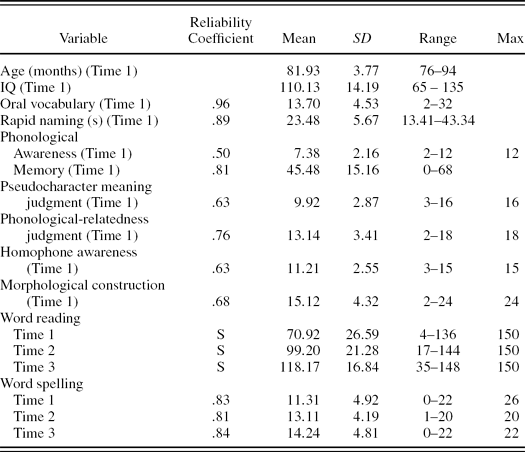
Table 1 presents the means, standard deviations, reliability coefficients, and ranges for the tasks undertaken in this study. In general, the reliability of the tasks in this study was acceptable with reliability coefficients ranging from 0.63 to 0.96 for most tasks, except for phonological awareness, with a reliability coefficient of 0.50.
Reliabilities, means, standard deviations, and ranges for measures in the present study

Note: Interrater reliability coefficient was computed for oral vocabulary. Test–retest reliability was computed for rapid naming. Cronbach alpha coefficients were computed for phonological awareness, phonological memory, pseudocharacter meaning judgment, phonological-relatedness judgment, homophone awareness, morphological construction, and word spelling. S, standardized measure with good reported reliability.
Correlation
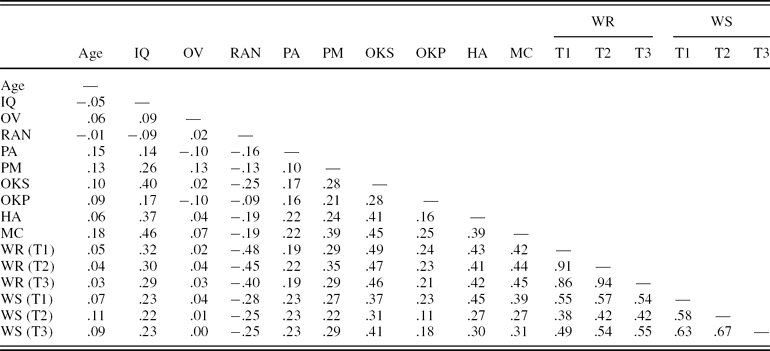
Table 2 shows the correlations among age, IQ, oral vocabulary, the reading-related skills, and literacy measures in the study. Most of the correlations among the reading-related skills measures were statistically significant, except that between rapid naming and phonological-relatedness judgment, and that between phonological awareness and phonological memory. The significant correlation coefficients among the reading-related skills were in the range of .13 to .45, reflecting low to medium strength of relationships. The literacy measures were more highly correlated with one another (rs > .38, ps < .001). Most of the correlations between the reading-related skills and Chinese literacy measures were significant (rs > .18, ps < .01), except that between phonological-relatedness judgment and Time 2 word spelling.
Correlations among all variables in this study
Note: OV, oral vocabulary; RAN, rapid naming; PA, phonological awareness; PM, phonological memory; OKS, pseudocharacter meaning judgment; OKP, phonological-relatedness judgment; HA, homophone awareness; MC, morphological construction; WR, word reading; WS, word spelling; T1, Time 1; T2, Time 2; T3, Time 3. For all variables, N = 251; correlations of magnitude .13 are significant at p < .05.
Multiple regression analyses
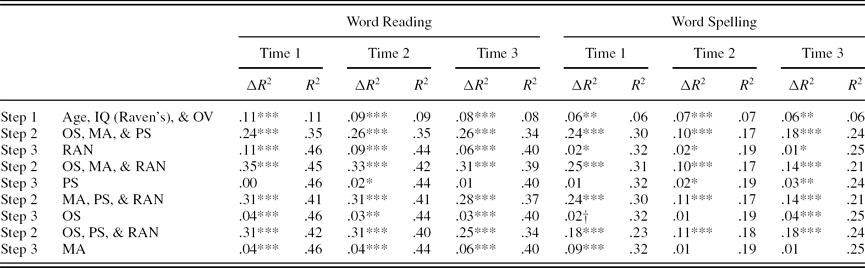
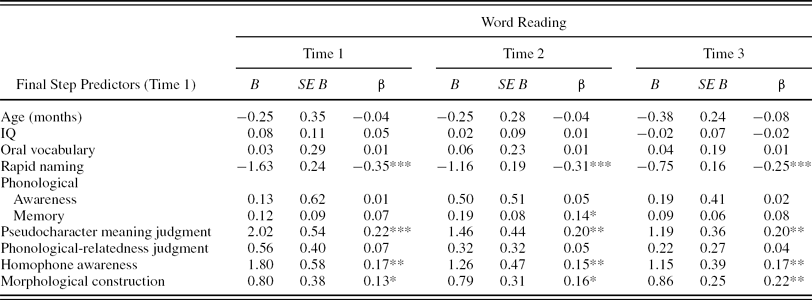
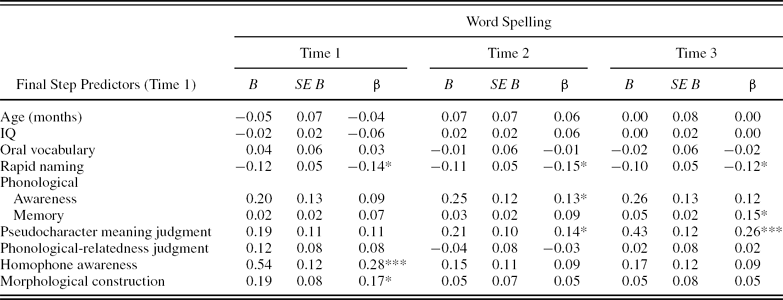
To examine the two research questions about the unique contribution of each reading-related skill to Chinese word reading and spelling across time, a number of hierarchical multiple regression analyses were conducted. Table 3, Table 4, and Table 5 show the results of these analyses with Chinese word reading and word spelling as the dependent variables. In each regression equation, the control variables of age, IQ scores, and oral vocabulary were entered in the first step. Three of the four variables (rapid naming, phonological skills, orthographic skills, and morphological awareness), which were all assessed at Time 1, were entered into the second step. One particular reading-related skill was entered into the third step in each equation. The four reading-related skills together accounted for 35%, F (7, 240) = 22.04, p < .001; 34%, F (7, 240) = 21.03, p < .001; and 31%, F (7, 240) = 17.83, p < .001, of the variance in word reading at Time 1, Time 2, and Time 3, respectively. As for word spelling, the reading-related skills together contributed 26%, F (7, 240) = 13.17, p < .001; 12%, F (7, 240) = 5.08, p < .001; and 19%, F (7, 240) = 8.69, p < .001, of the variance in it at Time 1, Time 2, and Time 3, respectively. After controlling for other variables, rapid naming, orthographic skills, and morphological awareness each made significant unique contribution to word reading concurrently at Time 1 and subsequently at Time 2 and Time 3. Phonological skills contributed a significant, though small (2%), amount of unique variance of word reading at Time 2 but not at Time 1 or Time 3.
Summary of hierarchical multiple regression equations predicting Time 1, Time 2, and Time 3 word reading and word spelling from Time 1 reading-related cognitive skills measures after controls for differences in age, IQ, and oral vocabulary (N = 251)
Note: Raven's, Raven's Standard Progressive Matrices; OV, oral vocabulary; OS, orthographic skills, assessed by pseudocharacter meaning judgment task and phonological-relatedness judgment task; MA, morphological awareness, assessed by homophone awareness task and morphological construction task; PS, phonological skills, assessed by rhyme detection task and word repetition task; RAN, rapid naming.
† p = .05. *p < .05. **p < .01. ***p < .001.
Standardized betas for regression equations predicting word reading from reading-related cognitive skills measures after controls for differences in age, IQ, and oral vocabulary (N = 251)
*p < .05. **p < .01. ***p < .001.
Standardized betas for regression equations predicting word spelling from reading-related cognitive skills measures after controls for differences in age, IQ, and oral vocabulary (N = 251)
*p < .05. **p < .01. ***p < .001.
After controlling for the effects of other variables, rapid naming consistently explained a small but significant amount of variance (1%–2%) to word spelling at Time 1, Time 2, and Time 3. Phonological skills explained a significant amount of variance in word spelling at Time 2 and Time 3 but not at Time 1. On the contrary, morphological awareness contributed a substantial amount of unique variance to word reading, 9%, F (2, 240) = 14.98, p < .001, at Time 1 but not at Time 2 or Time 3. As for orthographic skills, it contributed a marginally significant amount of variance to word spelling, 2%, F (2, 240) = 3.03, p = .05, at Time 1 and a significant amount of variance to word spelling, 4%, F (2, 240) = 7.19, p < .001, at Time 3. To sum up, rapid naming and morphological awareness were significant predictors of Time 1 word spelling. Rapid naming, phonological skills, and orthographic skills were significant predictors of Time 2 and Time 3 word spelling.
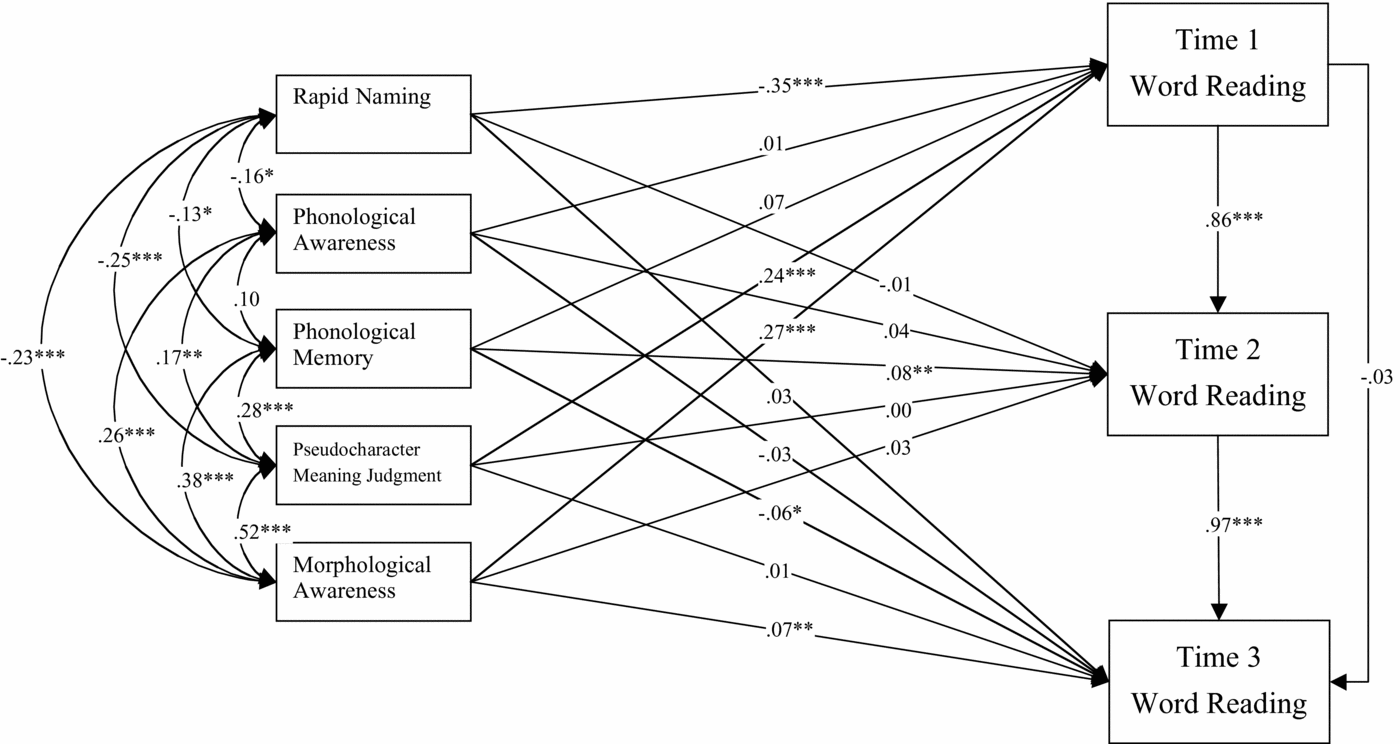
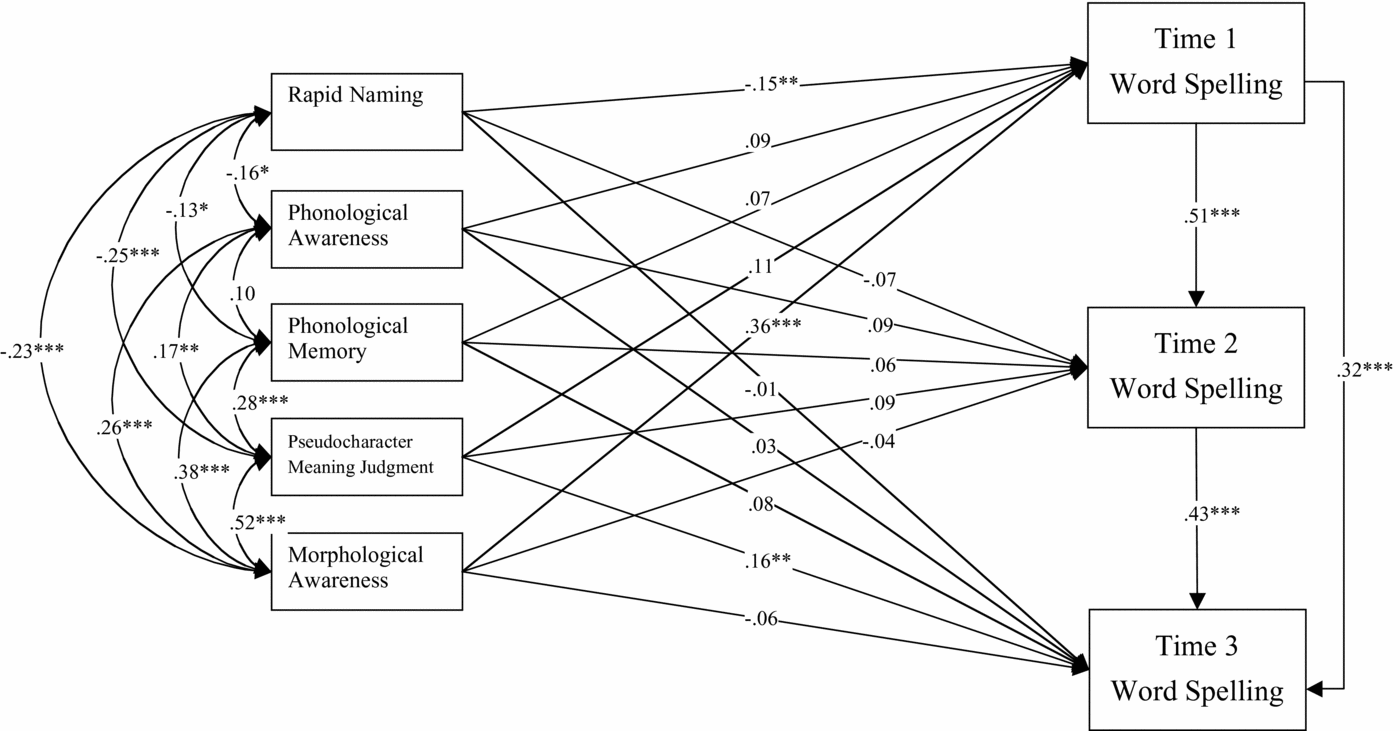
To examine the stability and change of the predictive power of Time 1 reading-related skills on Chinese word reading and spelling over time, two series of path analyses (one on Chinese word reading and one on Chinese word spelling) were conducted using LISREL 8.80, a structural equation modeling program. In these path analyses, direct paths from each Time 1 reading-related skill to Time 1, Time 2, and Time 3 word reading and spelling were postulated. Autoregressor effects, the contribution from Chinese word reading and spelling in earlier time points, were also incorporated. Because the phonological-relatedness judgment task was not a significant predictor of either Chinese word reading or spelling in the multiple regression analyses, it was not included in the path analyses. Orthographic skills were represented by the pseudocharacter meaning judgment task. Morphological awareness was represented by the average z scores of the two measures of morphological awareness (homophone awareness and morphological construction) because they both were significant predictors of Chinese word reading and spelling in the multiple regression results analyses. Path diagrams on the longitudinal predictability of Time 1 reading-related measures on
Chinese word reading and word spelling are shown in Figure 1 and Figure 2, respectively. Results from the first set of path analyses showed that rapid naming, orthographic skills, and morphological awareness have significant direct paths to Time 1 word reading. Only phonological memory has significant direct path to Time 2 word reading. The only significant direct paths to Time 3 word reading are from phonological memory and morphological awareness. One point to note was that the direct path from phonological memory to Time 3 word reading indicates a negative relationship. The direct paths from Time 1 to Time 2 word reading and from Time 2 to Time 3 word reading are significant. The direct path from Time 1 to Time 3 word reading is not significant. As for Chinese word spelling, the direct paths from rapid naming and morphological awareness to Time 1 word spelling are significant. No direct paths from the Time 1 reading-related skills to Time 2 word spelling are significant. The only reading-related skills that has a significant direct path to Time 3 word spelling is pseudocharacter meaning judgment. All the postulated paths among Time 1, Time 2, and Time 3 word spelling are significant.
Path diagram of longitudinal predictors of Chinese word reading. Morphological awareness refers to the average z score of homophone awareness and morphological construction. *p < .05. **p < .01. ***p < .001.
Path diagram of longitudinal predictors of Chinese word spelling. Morphological awareness refers to the average z score of homophone awareness and morphological construction. *p < .05. **p < .01. ***p < .001.
To sum up, the path analyses results on word reading suggest that Time 1 rapid naming and orthographic skills contributed to subsequent word reading mainly through their influence on Time 1 word reading whereas morphological awareness had both significant direct and indirect effects on Time 3 word reading. Phonological memory had a significant positive direct effect on Time 2 word reading but a negative direct effect on Time 3 word reading. As for word spelling, rapid naming and morphological awareness contributed to subsequent word spelling mainly through their influence on Time 1 word spelling. After controlling for autoregressor effects, the only Time 1 reading-related skill that had a significant direct effect on subsequent word spelling was pseudocharacter meaning judgment.
Analyses on spelling errors
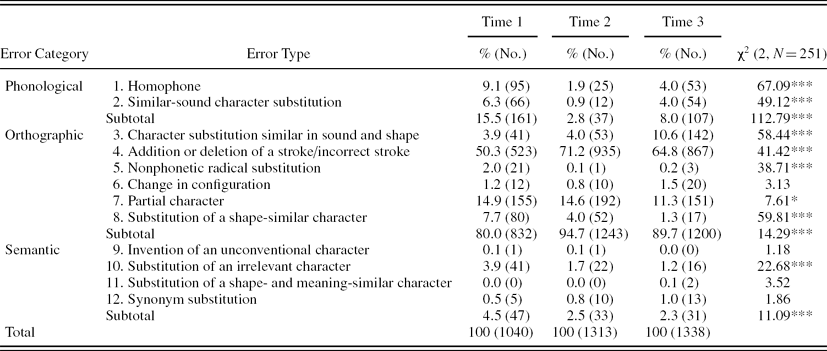
We also analyzed children's spelling errors individually. With reference to the classification system of Chinese spelling errors in Shen and Bear's (Reference Shen and Bear2000) study and Tong et al.'s (Reference Tunmer, Chapman, Kirsner, Speelman, Maybery, O'Brien-Malone, Anderson and MacLeod2009) study, spelling errors were classified into three general categories according to the linguistic principles of Chinese characters: phonologically based spelling errors, orthographic-based spelling errors, and semantic spelling errors. In the study by Tong et al. (Reference Tong, McBride-Chang, Shu and Wong2009), a single omission of the morpheme in a two-character word was categorized as a morpholexically based error, and it accounted for the largest percentages of the total errors (89.5% at Time 1 and 67.1% at Time 2). However, in the present study, we did not include single omission of characters into any category, following the practice by Shen and Bear (Reference Shu, Anderson and Wu2000). As suggested by Shen and Bear (Reference Shu, Anderson and Wu2000), blanks provide no information as to the child's knowledge (whether phonological, orthographic, or semantic) of the character, and thus further analysis of this type of spelling error is not possible. The total number of single omission of characters was 2,160, 514, and 657 at Time 1, Time 2, and Time 3, respectively in the present study. Among all 251 children's spelling samples, 51 (20.32%) were independently coded by two well-trained research assistants, and their interrater reliability was 89% (K = 0.89, p < .001). The distribution of the different types of errors across the three general categories at Time 1, Time 2, and Time 3 is shown in Table 6.
Distribution by percentage and number of different types of spelling errors and chi-square tests for differences among Time 1, Time 2, and Time 3 for all types of spelling errors in the spelling tests
Note. *p < .05. ***p < .001.
Detailed analyses of the three categories of spelling errors were adopted from the study by Shen and Bear (Reference Shu, Anderson and Wu2000). One major difference was that the pinyin substitution (i.e., using pinyin to substitute for characters), which accounted for the highest percentage of spelling errors in Grades 1 to 4 in their study, was not included in the present study. Children in Hong Kong were not taught with the assistance of any phonetic system, and this type of spelling error was not found in their responses. There were two types of phonologically based spelling errors: homophonic and similar-sound character substitutions. Children substituted characters that share the same sound (homophone) 想 [soeng2] (think) or a very similar sound (only differ from the target character in onset, rhyme, or tone) 教 [gaau3] (teach) for the target characters 賞 [soeng2] (appreciate) and 夠 [gau3] (enough), respectively. In both cases, the substituted characters were totally different in shape and meaning from the target characters. These phonologically based spelling errors accounted for 15%, 3%, and 8% of Time 1, Time 2, and Time 3 total errors, respectively.
Orthographic-based errors were the most predominant category of errors, accounting for 80%, 95%, and 90% of Time 1, Time 2, and Time 3 total errors, respectively. They include character substitutions similar in sound and shape, single stroke errors, nonphonetic radical substitutions, changes in configuration, partial characters, and substitutions of a shape-similar character. Character substitutions similar in sound and shape refer to the target character being substituted by a character that is similar in both sound and shape; for example, 霜 [soeng1] (frost) is substituted for 箱 [soeng1] (box). Single stroke errors refer to those invented spellings with one stroke added to or deleted from the target character or one incorrect stroke; for example, the characters 賽 [tsoi3] (contest) and 光 [gwong1] (light) are misspelled  and
 , respectively. This is the most common type of error across time, occupying 50%, 71%, and 65% at Time 1, Time 2, and Time 3, respectively. Nonphonetic radical substitutions refer to substitutions of graphically similar radicals that have no meaning connections; for example,
 is substituted for 冰 [bing1] (ice). Changes in configuration refer to using conventional patterns of configuration incorrectly to construct characters; for example, the character 能 [nang4] (able) is misspelled
 . Partial characters refer to a character that is represented by part of it or only one radical (but not the phonetic radical); for example, the character 施 [si1] (carry out) is misspelled
 . Substitutions of a shape-similar character refer to the target character being substituted by a character that is similar in shape but not in meaning or sound; for example, 兩 [loeng2] (two) is substituted for 雨 [jy5] (rain).
Semantic spelling errors include invention of an unconventional character, substitution of an irrelevant character, substitution of a shape- and meaning-similar character, and synonym substitution. This category of errors accounted for 5%, 3%, and 2% of Time 1, Time 2, and Time 3 total errors, respectively. Invention of an unconventional character refers to errors that are imaginary characters, showing that the children try to convey the meaning of a target character using the conventional pattern incorrectly; for example,  is substituted for 觀 [gun1] (view). Substitution of an irrelevant character refers to those invented spellings that are not similar to the target characters in sound, shape, or meaning, but involve substitutions based on children's knowledge of Chinese vocabulary; for example, 己 [gei2] (oneself) is substituted for 自 [dzi6] (oneself). Another type of error is the target characters being substituted by a shape- and meaning-similar character; for example, 圍 [wai4] (surround) is substituted for 團 [tyn4] (round). Finally, synonym substitution refers to the target character being substituted by a character similar in meaning; for example, 櫃 [gwai6] (cupboard) is substituted for 箱 [soeng1] (box).
The frequencies of the three main categories of spelling errors including phonologically based errors, orthographic-based errors, and semantic errors were significantly different, χ2 (2, N = 251) = 1037.94, p < .001 at Time 1, χ2 (2, N = 251) = 2222.81, p < .001 at Time 2, and χ2 (2, N = 251) = 1918.52, p < .001 at Time 3. Further analyses showed that all three types of errors differed from each other at all three periods of assessment (χ2s > 358.47, ps < .001). It was also found that the relation between time and the three types of errors was significant, χ2 (4, N = 251) = 138.17, p < .001. This suggested that the distribution of spelling error types changes over time.
DISCUSSION
Important predictors for word reading in Chinese in different grades
In general, the results of the multiple regression analyses and the path analyses were consistent with our hypotheses regarding the longitudinal predictive power of the reading-related skills on word reading. As expected, rapid naming in Grade 1 was a significant predictor of Chinese word reading in Grade 1 only. It ceased to have a direct effect on word reading in higher grades after controlling for the autoregressor effects. Morphological awareness in Grade 1 was a significant longitudinal predictor of Chinese word reading across time in Grade 1 and Grade 4 after the contributions by the other variables were controlled for in the path analyses. Two findings were not consistent with our hypotheses. First, though multiple regression results showed that orthographic skills in Grade 1 significantly predicted Chinese word reading from Grades 1 to 4, path analyses results suggest that it influenced word reading in higher grades mainly through its contribution on word reading in Grade 1. Second, path analyses showed that phonological memory in Grade 1 was a significant predictor of word reading in Grades 2 and 4, but the direction of relationship was negative in Grade 4.
Consistent with previous findings among Hong Kong children (Tong et al., Reference Tong, McBride-Chang, Shu and Wong2009; Yeung et al., Reference Yin, Anderson and Zhu2011), rapid naming is a strong predictor of Chinese word reading among younger participants. This shows the influence of the characteristics of the Chinese writing system. The smallest orthographic unit of Chinese is relatively coarse, and a less detailed phonological analysis is involved when reading it (Upward, Reference Upward1999). The rapid naming skill may reflect the ability of learning arbitrary associations required in early grades, whereas it may also reflect the automatic processing of orthographic information and name retrieval required in later learning (Ho, Chan, Tsang, & Lee, Reference Ho, Chan, Tsang and Lee2002; Ho, Chan, Tsang, Lee, & Luan, Reference Ho, Chan, Tsang, Lee and Luan2004). Together with the fact that the “look and say” method is the instructional method commonly found in Hong Kong classrooms, rapid naming is an important predictor of Chinese word reading. The fact that rapid naming in Grade 1 was not a significant longitudinal predictor of subsequent word reading after the autoregressor effects were controlled is consistent with the suggestion that rapid naming's contribution to word reading is taken up by the orthographic skills in higher grades (Roman et al., Reference Shen and Bear2009). To test this hypothesis, findings from future studies with the inclusion of orthographic skills in higher grades are needed.
The significant contribution of orthographic skills, in terms of knowledge related to semantic radicals, to Chinese word reading in Grade 1 was in line with the findings from previous studies (Ho et al., Reference Ho, Wong and Chan2003; Yeung et al., Reference Yin, Anderson and Zhu2011). Ho et al. (Reference Ho, Wong and Chan2003) investigated extensively children's radical knowledge among Grade 1–Grade 5 Chinese children in Hong Kong. They found that children's overall knowledge of the position, function, and semantic category of semantic radicals was associated more strongly with word reading and sentence comprehension than all other tasks assessing radical knowledge. In the context of phonological awareness, rapid naming, and morphological awareness, an orthographic knowledge of semantic radicals significantly predicted Chinese word reading and sentence comprehension among Grade 1 children (Yeung et al., Reference Yin, Anderson and Zhu2011). It is consistent with the general consensus that most Chinese semantic radicals provide a useful cue to the meaning of whole characters (Feldman & Siok, Reference Feldman, Siok, Wang, Inhoff and Chen1999). The semantic cues offered by the semantic radicals facilitate children's ability to retrieve the sound of the character via the orthography–semantic–phonology pathway. As for the orthographic skills related to the phonetic radical, findings from the present study suggest that its relationship with word reading might not be as strong as other variables. Chen (Reference Chen1993) labeled the script–sound regularity inherent in the phonetic radical in Chinese orthography–phonology correspondence rules. Some researchers considered this as the counterpart of grapheme–phoneme correspondence rules in alphabetic language (Chen, Reference Chen1993). Shu, Anderson, and Wu (Reference Shu, Anderson and Wu2000) showed that Chinese children as young as second graders are better able to read regular characters than irregular characters. Chen et al. (Reference Chen, Anderson, Li, Hao, Wu and Shu2004) and Ho et al. (Reference Hoosain1999) also showed that Chinese kindergartens and first graders were able to use the orthographic analogy strategy to read Chinese characters. As mentioned, semantic radicals are functionally more reliable than phonetic ones. Although using an orthographic analogy strategy is one useful way to infer the sound of Chinese characters, the orthographic knowledge of the phonetic radical might be less important to learning to read Chinese compared to other reading-related skills investigated in the present study. To sum up, results in the present study supported the notion that orthographic skills, including those related to the positions and functions of radicals, have a pervasive influence on learning to read Chinese at a very early age. However, path analyses results suggest that orthographic knowledge in early grades did not have a strong direct effect on subsequent reading. Given the complexity of the Chinese writing system, it takes years to develop the orthographic knowledge in Chinese. This pattern of results might reflect the fact that the orthographic knowledge required to identify the more complex words in higher grades is quite different from those used in Grade 1. This suggestion has to be verified with data from studies incorporating longitudinal measures of orthographic knowledge.
Once again, our findings supported the suggestion that morphological awareness is essential to Chinese word reading development and its influence was evident across children of different ages (McBride-Chang et al., Reference McBride-Chang, Wagner, Muse, Chow and Shu2003, Reference McBride-Chang and Ho2005; Shu et al., Reference Siegler2006; Tong et al., Reference Tong, McBride-Chang, Shu and Wong2009; Yeung et al., Reference Yin, Anderson and Zhu2011). This may be because Chinese characters represent morphemes more directly than do the graphemic units of other writing systems (Packard, Reference Packard, Chen, Li, Wu, Gaffney and Li2002). Given the presence of a large number of homophones, the ability to discriminate the meanings across homophones is important for children to establish an accurate sound–meaning mapping which in turn facilitates the mapping of meaning from printed words. At the same time, children who are aware of the fact that the same pronunciation can have distinct meanings may be more sensitive to the morphological or contextual clues that may help distinguish meaning, which surely helps their lexical development (Li, Anderson, Nagy, & Zhang, Reference Li, Anderson, Nagy, Zhang, Li, Gaffney and Packard2002). With a clear compounding morphological structure, a knowledge of morphemes allows children to have an educated guess when they encounter unfamiliar words in isolation or in a passage (McBride-Chang et al., Reference McBride-Chang, Wagner, Muse, Chow and Shu2003; Shu et al., Reference Siegler2006). In the context of the autoregressor effects and other variables, morphological construction was the only measure that longitudinally predicted word reading in Grade 4. Results from the present study supported the strong predictive power of morphological awareness in Chinese word reading across time.
One unexpected finding was that phonological memory was a significant predictor of word reading in Grade 2 but was negatively related to word reading in Grade 4. Compared to phonological memory, phonological awareness was more commonly used as a phonological skills measure in studies on Chinese reading (McBride-Chang et al., Reference McBride-Chang, Wagner, Muse, Chow and Shu2003, Reference McBride-Chang and Ho2005; Tong et al., Reference Tong, McBride-Chang, Shu and Wong2009; Yeung et al., Reference Yin, Anderson and Zhu2011). The study by Chan et al. (Reference Chan, Ho, Tsang, Lee and Chung2006) was one of the few that showed the significance of phonological memory in Chinese word reading among elementary grade students. One speculation for these intriguing results was that Chinese word reading among young children relies a lot on direct script–sound retrieval as suggested by the importance of rapid naming in early Chinese reading. The quality of their phonological representation, as reflected by their phonological memory, is likely to affect their reading ability in early grades. Besides, with the relatively smaller number of words encountered in lower grades, children can utilize their vocabulary knowledge to guess the pronunication of a two-character word based on the sound of one of the characters. However, as grades advanced, this strategy not only cannot facilitate word reading but may negatively affect their reading accuracy given the prevalence of homophones in Chinese. Instead, morphological awareness, which includes the ability to discriminate among the homophones of different morphemes, becomes more important in word recognition in higher grades. These issues need to be carefully examined in future studies.
Important predictors for word spelling in Chinese in different grades
Results of the multiple regression analyses and path analyses suggest that the longitudinal significant predictors for Chinese word spelling were not that similar to those for Chinese word reading as originally hypothesized. There have been few studies examining the significant predictors of both Chinese word reading and word spelling across different elementary grades. Previous studies focusing on participants either in lower elementary grades (Tong et al., Reference Tong, McBride-Chang, Shu and Wong2009; Yeung et al., Reference Yin, Anderson and Zhu2011) or upper elementary grades (Shu et al., Reference Siegler2006) revealed great similarities between Chinese word reading and spelling in terms of their significant predictors. The findings that longitudinal predictors of Chinese word reading and spelling differ over time in the present study reiterated the need for more research efforts on Chinese word spelling development on its own right. The major similarity between Chinese word reading and spelling lies in the results for Grade 1, where rapid naming and morphological awareness were significant predictors of both Chinese word reading and spelling. As expected, both path analyses and spelling errors analyses suggest that phonological skills are not as important as other reading-related skills in Chinese spelling development. However, path analyses showed that the only significant longitudinal predictor of Chinese word spelling in the context of autoregressor effects was orthographic skills involving the knowledge of the semantic radicals, not morphological awareness as found in Chinese word reading.
Similar to word reading, results regarding the significance of rapid naming in word spelling over time were consistent with our hypothesis. Rapid naming was a significant predictor of Grade 1 spelling. After controlling for the autoregressor effects, orthographic skills, but not rapid naming, was a significant longitudinal predictor of spelling. This was in line with the suggestion that rapid naming contributes to orthographic skills development, and its importance in reading and spelling is taken up by orthographic skills in advanced grades (Roman et al., Reference Shen and Bear2009). There are two possible reasons behind the predictive power of rapid naming on word spelling. First, Chinese classroom instruction on writing relies heavily on rote memorization. Teachers typically demonstrate how to write the character stroke by stroke on the blackboard and the children copy characters until they internalized their production as a motor skill (Packard et al., Reference Perfetti, Rieben and Fayol2006). Second, the learning of the visual form of the simple characters that made up 26% of the Chinese characters in the primary school curriculum in Hong Kong (Chung & Leung, Reference Chung and Leung2008), the 200-odd semantic radicals and around 800 phonetic radicals (Hoosain, Reference Hue, Chen and Tzeng1991), also depends a lot on rote memory. Because rapid naming is closely associated with the ability to form arbitrary relationships between visual symbol and sound, it is expected to be closely related to learning to spell Chinese characters.
Consistent with our hypothesis, phonological skills only played a limited role in Chinese spelling. Though phonological awareness and phonological memory were significant predictors of Chinese word spelling at Time 2 and Time 3, respectively, they ceased to be significant predictors of Chinese word spelling in the context of autoregressor effects according to the path analyses. Spelling errors analyses also showed that phonologically based errors only accounted for 3%–15% of the total errors in Grades 1 to 4. These findings not only differ from those in alphabetic languages but also from studies among Chinese children in mainland China (e.g., Shen & Bear, Reference Shen and Bear2000). In the study by Shen and Bear (Reference Shu, Anderson and Wu2000), phonological skills played an important role in spelling among early elementary grade students, and around 60% to 90% of the spelling errors in Grades 1 to 4 are phonologically based errors. There were two possible reasons to explain the relatively less significant role of phonological skills in Chinese word spelling among participants in the present study. First, “Chinese orthography is one of the most phonologically opaque writing systems in the world” (Packard et al., Reference Perfetti, Rieben and Fayol2006, p. 461). The consistency of the phonetic radicals in representing the phonological information in characters is relatively low compared to alphabetic languages. In other words, the orthography–phonology correspondence rules in Chinese might be less reliable in helping children to arrive at the correct spelling in Chinese. As a result, phonological skills, in terms of phonological awareness and phonological memory, are likely to be less important to learning to write Chinese than in alphabetic orthographies. Second, the findings may reflect differences in reading and writing instructions in mainland China and Hong Kong. In mainland China, children are taught pinyin, a phonetic alphabet that is used to spell the syllables, during the first 10 weeks of first grade. To aid character pronunciation, pinyin is written above all the characters in the first- and second-grade textbooks (Packard et al., Reference Perfetti, Rieben and Fayol2006). Pinyin substitution is the most common type of spelling error among Grades 1 to 4 students in the study by Shen and Bear (Reference Shu, Anderson and Wu2000). On the other hand, the majority of children in Hong Kong are taught to read and write Chinese without the assistance of any phonetic alphabetic system. Though phonological awareness was a weak but significant predictor of Chinese spelling in the study by Tong et al. (Reference Tong, McBride-Chang, Shu and Wong2009) and the present study, phonologically based errors only accounted for around 5% and 15% of the total spelling errors among Grade 1 Hong Kong children in their study and the present study, respectively.
One important finding in the present study was the predominant role of orthographic skills in Chinese spelling as compared to other reading-related skills as grades advanced. The pseudocharacter meaning judgment task, a measure of the orthographic skills, was a significant predictor of Chinese word spelling in Grades 2 and 4. Moreover, it was the only significant predictor of Chinese spelling in Grade 4 after controlling for the autoregressor effects. Orthographically based errors were the most common type of spelling errors in Grades 1 to 4. These were consistent with the findings in Shen and Bear's (Reference Shen and Bear2000) study, where children showed an increasing use of orthographic strategy as grades advanced. Other than identifying the morpheme, orthographic skills, including knowledge about the regularities of character structure and the orthosemantic and orthophonological regularities of the radicals, are important to successful retrieval of the written form of the character. Orthographic skills are acquired by repeated exposure to printed words until a stable visual representation of the whole word, or meaningful subword units, has been established (Barker et al., Reference Barker, Torgesen and Wagner1992). It takes years for sophisticated orthographic skills to develop, and the orthographic phase is the last phase of reading and spelling development in most models (e.g., Frith, Reference Frith and Frith1980). Besides, the items in the spelling task were made up of words that are of difficulty appropriate for each grade. The stimuli words in the Grade 4 spelling task were of lower frequency compared to those in Grades 1 and 2. Orthographic regularities were particularly influential in the naming of low frequency words (Hue, Reference Joshi, Aaron, Joshi, Leong and Kaczmarek1992; Lee, Tsai, Su, Tzeng, & Hung, Reference Lee, Tsai, Su, Tzeng and Hung2005). It is possible that orthographic skills about the regularities inherent in the Chinese writing system became increasingly important as the children encountered more low frequency words in higher grades.
As for morphological awareness, its importance among younger participants is understandable from the fact that about 60% of Chinese characters have homophones and almost a quarter of them have six or more homophones (Hoosain, Reference Hue, Chen and Tzeng1991). In the study by Tong et al. (Reference Tong, McBride-Chang, Shu and Wong2009), morpholexically based errors were the most dominant type of spelling errors, accounting for 73%–92% of the total errors, among Hong Kong kindergartners. Though the importance of morphological strategy in Tong et al. (Reference Tong, McBride-Chang, Shu and Wong2009) might have been inflated by the fact that omission of a single character was classified as a kind of morpholexically based errors, their findings suggest that morphological awareness does play a significant role in Chinese word spelling even among young children. Although morphological awareness was not a significant longitudinal predictor of Chinese word spelling beyond Grade 1 in the present study, it cannot be concluded that morphological awareness is not important to Chinese word spelling in advanced grades. As noted by Li et al. (Reference Lo, Yeung, Ho, Wong, Chan and Chung2002), one special feature of the Chinese writing system is that it serves to differentiate morphemes that are homophones in the spoken language. Apart from a few exceptions, each morpheme is written with its own unique character. In spelling Chinese characters, one must first be able to identify the particular morpheme of that character among the homophones having the same sound before retrieving the particular orthographic form associated with that morpheme. Therefore, the ability to differentiate the different morphemes having the same pronunciation is most basic to spelling Chinese characters. If children fail to differentiate among the homophones correctly, they will commit the phonologically based spelling error of homophone and possibly the orthographic-based error of character substitution similar in sound and shape. In other words, even when children are using a phonological strategy or an orthographic strategy in Chinese character spelling, their spelling performance is affected by their morphological awareness. Considering the importance of morphological awareness in Chinese word spelling, we not only have to pay attention to the semantic errors category (accounted for 4.5%, 2.5%, and 2.3% of total errors at Time 1, Time 2, and Time 3, respectively) but also the error types of homophone (accounted for 9.1%, 1.9%, and 4.0% of total errors at Time 1, Time 2, and Time 3, respectively) and character substitution similar in sound and shape (accounted for 3.9%, 4.0%, and 10.6% of total errors at Time 1, Time 2, and Time 3, respectively). Together these three types of errors accounted for 17.5%, 8.4%, and 16.9% of total spelling errors at Time 1, Time 2, and Time 3, respectively. This suggests that morphological awareness does have an influence on word spelling across time. There is more evidence of the importance of morphological awareness in Chinese word spelling. The orthographic knowledge about the location and function of the semantic radicals measured in the pseudocharacter meaning judgment task is closely related to children's semantic information acquisition (Packard et al., Reference Perfetti, Rieben and Fayol2006). It was suggested that the semantic radicals resemble many of the characteristics of the construct of “morpheme” because most of them signify a particular meaning (Taft, Liu, & Zhu, Reference Taft, Liu, Zhu, Wang, Inhoff and Chen1998). In this way, the fact that the pseudocharacter meaning judgment task was the only significant longitudinal predictor of Chinese spelling does not contradict our hypothesis that children make more use of semantic information as grades advance. It only suggests that semantic information in the subcharacter level is important to learning to spell Chinese words in advanced grades whereas semantic information at the character/word level, as assessed by the morphological awareness tasks, is more adeptly utilized in Chinese spelling among younger children. Because of the script–sound–meaning convergence in Chinese characters, morphological knowledge and orthographic knowledge are particularly intertwined in Chinese orthography; for example, the understanding of the role of semantic radicals was conceptualized as a kind of morphological awareness (apart from morpheme awareness and homograph awareness) in the study by Li et al. (Reference Lo, Yeung, Ho, Wong, Chan and Chung2002). Yet the radical has been shown to be an important orthographic processing unit in the study by Ho et al. (Reference Ho, Wong and Chan2003) and radical awareness is claimed to be directly related to orthographic processing (Wang, Cheng, & Chen, Reference Wang, Cheng and Chen2006). Findings in the present study reiterated the need to reconceptualize the constructs of “morphological knowledge” and “orthographic knowledge” in Chinese characters if we are to advance our understanding of Chinese reading and spelling development.
Conclusion
The present study addressed the paucity of data on the longitudinal predictive power of the four main types of reading-related skills (rapid naming, phonological skills, orthographic skills, and morphological awareness) to Chinese word reading and spelling among elementary grade students. One interesting finding was that the skills important to learning to read Chinese and those for learning to spell Chinese across time differ in significant ways. Although both rapid naming and morphological awareness in Grade 1 were significant predictors of concurrent Chinese word reading and spelling performance, Chinese word reading in Grade 4 was significantly predicted by morphological awareness, and Chinese word spelling in Grade 4 was significantly predicted by orthographic skills after controlling for autoregressor effects. Findings in the present study call for more research efforts on understanding Chinese spelling development, a relatively less explored domain, and reconceptualization of the constructs of “morphological knowledge” and “orthographic knowledge” in Chinese. The results that children's Grade 1 reading-related skills significantly predicted their reading and spelling performance reaffirmed the importance of early intervention.
Limitations and future directions
There are two major limitations in this study. First, the amount of variance in word spelling explained by the four types of reading-related skills was not so substantial. This may be due to the fact that the range of scores in the word spelling task was relatively limited. It might also suggest some factors important to learning to spell Chinese were yet to be investigated. There were at least two possible candidates, visual–motor integration skills (Berninger, Reference Berninger, Dewey and Tupper2004) and stroke order (Lo et al., Reference Manis, Doi and Bhadha2010). Second, the present study only examined word reading and spelling development from Grade 1 to early Grade 4. In the literature on alphabetic language reading and spelling development, strategy specialization between spelling and reading are transitory in nature. The various skills involved become better integrated as reading and spelling ability advances (Bryant & Bradley, Reference Bryant, Bradley and Frith1980; Lennox & Siegel, Reference Lennox and Siegel1993, Reference Lennox and Siegel1996). Data covering longer periods of development are necessary for verifying these suggestions.
ACKNOWLEDGMENTS
This research was funded by the READ & WRITE: A Jockey Club Learning Support Network from The Hong Kong Jockey Club Charities Trust. Special thanks are due to Ms. Suk-han Lee, University of Hong Kong, and Ms. Suk-man Tsang, Education Bureau, Hong Kong Special Administrative Region Government, Hong Kong, for their valuable advice and suggestions. The authors thank the teachers and students of the two participating schools for their support.