1. INTRODUCTION
In languages that exhibit a two-way laryngeal contrast among stops, there are two very common patterns. In languages such as Russian, Hungarian, French, and Spanish, which exhibit the ‘true voice’ pattern, the contrast in word-initial position is often between a series of prevoiced stops and a series of plain voiceless unaspirated stops.Footnote 2 In ‘aspirating’ languages such as German and English, the contrast in word-initial position is typically between a series of plain voiceless unaspirated stops and a series of voiceless aspirated stops. The traditional view of laryngeal contrast espoused by Keating (Reference Keating1984), Kingston & Diehl (Reference Kingston and Diehl1994) and Wetzels & Mascaró (Reference Wetzels and Mascaró2001), among others, is that the contrast in both true voice and aspirating languages is represented with the feature [voice]. More recently, many phonologists and phoneticians, including Harris (Reference Harris1994), Iverson & Salmons (Reference Iverson and Salmons1995), Jessen & Ringen (Reference Jessen and Ringen2002), Honeybone (Reference Honeybone, Oostendorp and van de Weijer2005), and Beckman, Jessen & Ringen (Reference Beckman, Jessen and Ringen2009), among others, have adopted a non-traditional view, arguing that in aspirating languages, the laryngeal feature of contrast for stops is [spread glottis], not [voice]. On the other hand, they suggest that for true voice languages, the feature of contrast in stops is [voice].
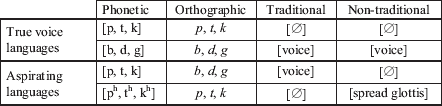
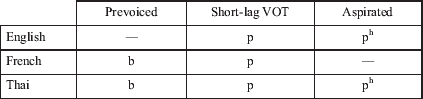
While both the traditional and the non-traditional views are in basic agreement about the representation and phonetic realization of the contrast in true voice languages, the real point of difference is in the treatment of the contrast in aspirating languages, where the mapping from feature to phonetic realization for traditionalists is very non-transparent. In the traditional view, aspirating languages, like true voice languages, exhibit a contrast between a [voice] series and an unspecified series – and this is realized as a distinction between plain voiceless and voiceless aspirated stops. In the non-traditional approach, however, aspirating languages contrast an unspecified series of plain voiceless stops with a [spread glottis] series of voiceless unaspirated stops. This is summarized in Table 1.
Traditional and non-traditional phonological representations of laryngeal contrast.
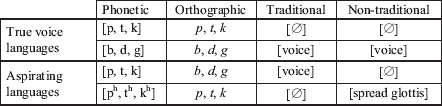
Because there are multiple phonetically distinct outcomes from an underlying [voice] specification in the traditional approach, with both prevoiced and plain voiceless unaspirated stops as possible phonetic interpretations, it can be confusing to refer to stop series with the familiar labels ‘voiced stops’, ‘voiceless stops’, etc. To avoid any possible confusion, in the languages under discussion here, we will refer to orthographic ‘b, d, g’ as lenis stops and ‘p, t, k’ as fortis stops without implying any specific phonological or phonetic interpretation or representation.
It is well known (Jessen Reference Jessen1998) that German utterance-initial stops are either aspirated (e.g. Pass [phas] ‘passport’) or voiceless unaspirated (e.g. Bass [pas] ‘bass’).Footnote 3 That is, German utterance-initial lenis stops are not usually produced with voicing during closure (negative VOT).Footnote 4 It is also well known that German intervocalic (or intersonorant) lenis stops have variable voicing (Kohler Reference Kohler1979; Jessen Reference Jessen1998, Reference Jessen2004). The fact that German intervocalic/intersonorant lenis stops are not always produced with voicing can be understood as a consequence of variable passive voicing, that is, voicing that results because of the voiced context, rather than from active voicing gestures by speakers. Thus, the claim is that speakers are not actively aiming to voice the intervocalic/intersonorant lenis stops, just as they are not actively aiming to voice the word/utterance-initial lenis stops (Jessen & Ringen Reference Jessen and Ringen2002; Jessen Reference Jessen2004). If this claim is correct, the variable voicing that occurs in German should be different from the voicing that occurs in a true voice language in which speakers are actively aiming to voice both initial and intervocalic lenis stops. Since there is little data on the relative amount of intervocalic voicing in these so-called true voice languages, however, it has been difficult to evaluate this prediction.
The purpose of this paper is to compare data on the voicing of intervocalic stops in German with data on the voicing of intervocalic stops in a true voice language.Footnote 5 We find that the differences are substantial, supporting the claim that German is not like a true voice language, in which the feature of contrast is [voice], and further, that in aspirating languages such as German, the intersonorant or intervocalic voicing is passive and very different from the intervocalic voicing that is found in a true voice language.
The remainder of the paper is organized as follows. In Section 2, we provide background on VOT and briefly review some of the arguments for the position that in the aspirating languages the feature of contrast for stops is [spread glottis], not [voice]. In Section 3 we summarize several arguments for the [spread glottis] analysis of German, and briefly review Jessen & Ringen's (Reference Jessen and Ringen2002) account of German stops. In Sections 4 and 5, we report empirical findings from investigations of voicing on intervocalic stops in German and Russian, respectively. In Section 6, we review evidence concerning the behavior of English and Russian word-initial stops in sentence-medial position. Our analysis of the empirical findings is presented in Section 7, and our conclusions in Section 8. We assume, following Mester & Itô (Reference Mester and Itô1989) and Lombardi (Reference Lombardi1991, Reference Lombardi1995), among others, that laryngeal features are privative. Our account of the difference between true voice languages and aspirating languages in Section 7 depends on this assumption.
2. BACKGROUND
2.1 Voice onset time
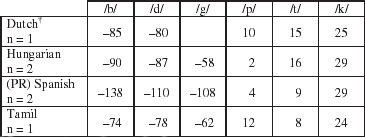
Lisker & Abramson (Reference Lisker and Abramson1964) studied Voice Onset Time of stops in utterance-initial position in eleven languages. Voice Onset Time, or VOT, refers to the timing of the beginning of voicing (usually in the following vowel) relative to the release of a stop closure, where release of the stop closure is considered to be time 0. Lisker & Abramson found two types of languages with two-way laryngeal contrasts.Footnote 6 In one type of language with a two-way laryngeal contrast, they found that in one of the stop series voicing begins during the stop closure; this means that VOT is a negative number because voicing begins before the stop is released. Stops with negative VOT are known as ‘prevoiced stops’ or as stops with voicing lead. In the other stop series in these languages, the VOT is a (relatively) small positive number. Such stops are referred to as having short-lag VOT or as voiceless, unaspirated stops. Dutch, Hungarian, Puerto Rican (PR) Spanish and Tamil are the languages in which Lisker & Abramson found one series of stops with negative VOT and the other with short-lag VOT. Hungarian, Dutch, Puerto Rican Spanish, and Tamil are all true voice languages. The VOTs reported by Lisker & Abramson (Reference Lisker and Abramson1964) for utterance-initial stops in these languages are given in Table 2.Footnote 7
Mean VOTs (in ms) for Dutch, Hungarian, Puerto Rican Spanish, Tamil.
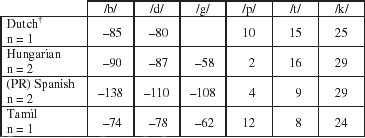
† Dutch has no laryngeal contrast in velar stops.
In the second type of language with a two-way laryngeal contrast studied by Lisker & Abramson (Reference Lisker and Abramson1964), in one series of stops, voicing begins a (relatively) long time after the stop closure is released; hence VOT is a (relatively) large positive number for stops in this series. Such stops are known as long-lag VOT or (voiceless) aspirated stops. The other stop series has short-lag VOT (voiceless, unaspirated stops). English and Cantonese are the languages in which Lisker & Abramson found one series of stops with long-lag VOT and the other with short-lag VOT. English and Cantonese are both aspirating languages.
Mean VOTs for Cantonese and English from Lisker & Abramson (Reference Lisker and Abramson1964) are given in Table 3.
Mean VOTs (in ms) for Cantonese and English.

† Some English speakers produced prevoiced stops (Lisker & Abramson Reference Lisker and Abramson1964). We report here only the means for the speakers who produced the non-negative VOTs. One speaker was responsible for 95% of the prevoiced English stops. The means for the 5% of the English stops with prevoicing were: bilabial –101, alveolar –102, velar –88.
Summarizing at this point, Lisker & Abramson studied two types of languages with two-way laryngeal contrasts:
(1) True voice languages
(a) Negative VOT in initial position (prevoiced or voicing lead)
(b) Short-lag VOT in initial position (voiceless, unaspirated stops)
(2) Aspirating languages
(a) Long-lag VOT in initial position (voiceless, aspirated stops)
(b) Short-lag VOT in initial position (voiceless, unaspirated stops)
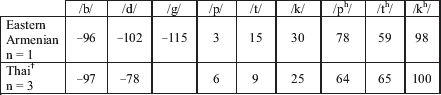
Lisker & Abramson also studied two languages with a three-way laryngeal contrast: Eastern Armenian (one speaker) and Thai (three speakers).Footnote 8 Their results are given in Table 4.
Eastern Armenian and Thai VOT values (in ms).
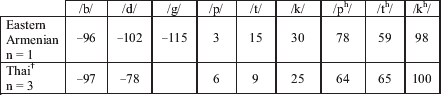
† There is no voiced velar stop in Thai.
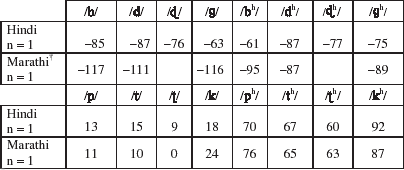
In addition, Lisker & Abramson investigated two languages with a four-way laryngeal contrast: Hindi (one speaker) and Marathi (one speaker).Footnote 9 Their results are shown in Table 5.Footnote 10
Hindi and Marathi VOT values (in ms).
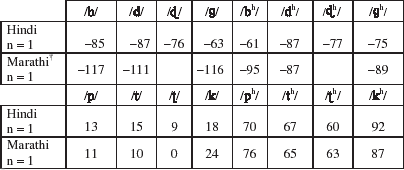
† Marathi voiced retroflex stops do not occur in word-initial position; hence, no data are reported by Lisker & Abramson (Reference Lisker and Abramson1964).
2.2 Laryngeal features
There is little disagreement in the recent literature in phonology about what laryngeal features are needed to describe contrasts found in languages of the world (see Iverson & Salmons Reference Iverson and Salmons1995): two of these features (or equivalent alternatives) are [spread glottis] and [voice].Footnote 11 The three-way laryngeal contrast in stops in Thai (long-lag, negative, short-lag) can be described with these two features: the aspirated stops are specified as [spread glottis] (henceforth [sg]), voiced stops are specified as [voice], and stops that are voiceless and unaspirated are not specified for any laryngeal feature (henceforth [Ø]).
(3) Thai (three-way contrast), assuming privative features
(a) Aspirated stops (long-lag VOT) [sg]
(b) Voiced stops (negative VOT in initial position) [voice]
(c) Voiceless unaspirated stops (short-lag VOT) [Ø] (no laryngeal specification)
The four-way contrast in Hindi stops can be described with these same two privative features, just as the Thai stops are, if the voiced aspirated stops are specified as both [voice] and [sg].
(4) Hindi (four-way contrast)
(a) Aspirated stops (long-lag VOT) [sg]
(b) Voiced stops (negative VOT in initial position) [voice]
(c) Voiceless unaspirated stops [Ø]
(d) Voiced aspirated stops (murmured) (short-lag VOT) [voice] & [sg]
Russian has a two-way contrast between stops that are voiced and stops that are voiceless and unaspirated. Most phonologists and phoneticians would, we think, agree that if features are privative, the contrast is between stops that are specified as [voice] and stops with no laryngeal specification, [Ø].
(5) Russian (two-way contrast)
(a) Voiced stops (negative VOT in initial position) [voice]
(b) Voiceless unaspirated stops (short-lag VOT) [Ø]
Icelandic, on the other hand, has a two-way laryngeal contrast between stops that are aspirated (pre- or post-) and voiceless unaspirated stops with no voicing, even in intervocalic position. Most phonologists and phoneticians would, we think, agree that the contrast in Icelandic is between stops that are specified as [sg] and stops that are [Ø].
(6) Icelandic (two-way contrast)
(a) Aspirated stops (long-lag VOT) [sg]
(b) Voiceless unaspirated stops (short-lag VOT) [Ø]
Where there is substantial disagreement, however, is about the appropriate features for languages such as German, which like Icelandic, has a two-way contrast between stops that are aspirated and stops that are voiceless and unaspirated. The main difference between German and Icelandic is that in intervocalic position, German stops are (variably) voiced, whereas no such voicing occurs in Icelandic. The traditional analysis of German, represented by Rubach (Reference Rubach1990), Lombardi (Reference Lombardi1991, Reference Lombardi1999), Hall (1992, 2001a) and Wiese (Reference Wiese1996), is that it, like Russian, Dutch, Hungarian, French, and Spanish, has a contrast in [voice].Footnote 12
(7) German: Traditional view
(a) Voiceless aspirated stops [Ø]
(b) Voiceless unaspirated stops (short-lag VOT) [voice]
The non-traditional view, represented by phonologists and phoneticians such as Harris (Reference Harris1994), Iverson & Salmons (Reference Iverson and Salmons1995), Jessen (Reference Jessen1998), Jessen & Ringen (Reference Jessen and Ringen2002), Honeybone (Reference Honeybone, Oostendorp and van de Weijer2005), and Beckman et al. (Reference Beckman, Jessen and Ringen2009) among others, is that the contrast in languages such as English and German is like that of Icelandic: stops are specified as [sg] or [Ø].
(8) German: Non-traditional view Footnote 13
(a) Voiceless aspirated stops [sg]
(b) Voiceless unaspirated stops (short-lag VOT) [Ø]
3. ARGUMENTS FOR THE [SG] ANALYSIS OF ASPIRATING LANGUAGES
Honeybone (Reference Honeybone, Oostendorp and van de Weijer2005) argues that the [sg] analysis, not the [voice] analysis, of aspirating languages is correct. He argues that on the [voice] analysis, two developments in the histories of English and German involve impossible changes. Specifically, he points out that the systems which result from ‘Inner-German Consonant Weakening’ and ‘Southern English Fricative Voicing’ under the [voice] analysis are systems in which there is a single series of voiced obstruents, a type of inventory that most phonologists would agree does not occur. He shows that, by contrast, on the [sg] analysis, these changes can be analyzed as processes that merge obstruents specified as [sg] with obstruents with no laryngeal specifications. Thus, the system resulting from Inner-German Consonant Weakening is one in which there is no laryngeal contrast in stops (in Honeybone's terms, all stops are unspecified for laryngeal features); the system resulting from Southern English Fricative Voicing is one in which there is no laryngeal contrast in fricatives (i.e., there is one series of fricatives, and they are all unspecified for laryngeal features).
Iverson & Salmons (Reference Iverson and Salmons1995), assuming privative features, present both synchronic and diachronic arguments for the position that the feature of contrast in aspirating Germanic languages such as English and German is [sg], not [voice]. Their first synchronic argument is that assimilation to the feature [voice] occurs only in true voice languages, not in aspirating languages, and this has a straightforward explanation: there is a [voice] feature available to spread in true voice languages, but no such feature is present in aspirating languages. Thus, only voicelessness ([sg]) can spread in obstruent clusters in an aspirating language. Their second synchronic argument is that with the [sg] analysis of English, we can explain both the lack of aspiration on English voiceless stops following /s/ (e.g. spot) and the (partial) devoicing of sonorant consonants following voiceless obstruents (e.g. plot). They argue that, assuming that the feature [sg] is shared in obstruent-initial consonant clusters, and that there is a constant duration for [sg] (whether in a single segment or shared in a cluster), then the lack of aspiration in voiceless stops following /s/ and the devoicing of sonorant consonants following voiceless obstruents in English can be given a unified explanation. Specifically, since the peak of glottal opening for a voiceless stop occurs relatively late in a single stop, but in a fricative coincides with the beginning of oral constriction, then in /s/ plus voiceless stop clusters, the vocal folds will be coming together for voicing earlier than in a singleton stop, and hence there will be no aspiration of the stop. Similarly, the single [sg] gesture will be shared not only between voiceless fricatives and the following stops in clusters as in spot, but also between voiceless obstruents in clusters with liquids, as in slip, shrimp and plot, and hence the (partial) devoicing of the following liquids is explained, too. They note, finally, that the fact that the liquids in street and split remain fully voiced (Repp Reference Repp1984) is also explained: the constant duration of the [sg] feature does not extend beyond the first two segments.Footnote 14
Iverson & Salmons also provide historical evidence for their account of the shared [sg] feature in obstruent clusters. They note that the exceptions to Grimm's Law are usually tied to aspiration: aspirated stops in Indo-European shifted to fricatives in Germanic (IE *pətēr >OIce faðar), but unaspirated stops did not (IE *(s)pyaw >Gothic speiwan ‘to spit’). However, the aspiration account does not explain why, in obstruent + stop clusters, a voiceless stop was subject to Grimm's Law only if it was the first member of the cluster (e.g. IE *skap-t- >OE sceaft ‘shaft, pole’). Iverson & Salmons suggest that Grimm's Law is related to aspiration in that the shift took place only when the stop was articulated with a peak glottal width. This would be the case in singleton stops, and in the first stop in a stop + stop cluster, as in the first stop in the second cluster in IE *skap-t-, because, as they note, in obstruent clusters with only a single [sg] gesture, glottal opening begins early, so only the first consonant has peak glottal opening and the glottis is not at peak opening during the second.
An additional argument for the [sg] analysis comes from Beckman et al. (Reference Beckman, Helgason, McMurray and Ringen2011), who argue, on the basis of experimental data, that in Central Standard Swedish one series of stops is specified as [voice] and the other is specified as [sg], and that in English, one series is specified as [sg] and the other is unspecified. In an earlier study, Kessinger & Blumstein (Reference Kessinger and Blumstein1997) investigated the effect of rate changes on Thai, French, and English stops. Stops found in initial position in English, French, and Thai are given in Table 6.
Utterance-initial stops in English, French and Thai.
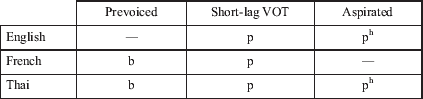
Kessinger & Blumstein (Reference Kessinger and Blumstein1997) found an asymmetric effect of speaking rate on VOT production in stops in initial position: as speech rate decreased, the amount of prevoicing increased in Thai and French; the amount of aspiration increased in Thai and English, but there was little or no change in the short-lag stops in any language.
Beckman et al. (Reference Beckman, Helgason, McMurray and Ringen2011) found that as speech rate decreased in Central Standard Swedish, the amounts of both prevoicing and postaspiration increased. They argue that their results, and those of Kessinger & Blumstein (Reference Kessinger and Blumstein1997), can be understood if laryngeal features are privative, and the features of contrast are [voice] vs. [Ø] in French, [sg] vs. [Ø] in English, [voice] vs. [sg] vs. [Ø] in Thai, and [voice] vs. [sg] in Swedish and, in slower speech, the duration of the phonetic cue for the specified feature is increased. On any other assumptions about feature specification, these changes are mysterious.
Jessen & Ringen (Reference Jessen and Ringen2002) present experimental results that support the view that German has underlying [sg] stops, not stops specified for [voice]. They point out that not only are initial lenis stops in German not voiced, but there are no voiced stops in intervocalic clusters either – the second stop in a medial cluster is always either voiceless unaspirated or voiceless aspirated. In codas, as is well known, stops are only voiceless.Footnote 15 Both of these facts, they suggest, are because there are no underlying stops specified for [voice] to start with, not because there is any phonological coda devoicing in German. Only in intersonorant position are stops (sometimes) voiced. But even in intersonorant position, many have reported that such voicing does not always occur. (See Jessen (Reference Jessen1998: 57f.) for further references.)
Jessen & Ringen (Reference Jessen and Ringen2002) suggest that such variable intersonorant voicing, especially in a context where voicing should be easiest to maintain, is the hallmark of a phonetic, not phonological, process (see Cohn Reference Cohn1993, Keating Reference Keating and Kleinhenz1996, among others). They suggest that the voicing that is found in German intersonorant stops is the result of a phonetic process, not the result of a phonological [voice] feature specification on these stops.
Jessen & Ringen (Reference Jessen and Ringen2002) also show that the [sg] analysis of German words like Han dlung (Handl+ung) ‘action’, with a voiced stop, and han dlich (hand+lich) ‘handy’, with a voiceless stop, is superior to the [voice] analysis. According to the traditional [voice] analysis, the voiceless stop in han dlich (which is underlyingly specified with [voice], cf. Händ-e [d], ‘hand (pl)’) results from coda devoicing. But the voicing of the stop in Han dlung requires the cycle (Rubach Reference Rubach1990) or unmotivated syllable structure (Vennemann Reference Vennemann1972, Lombardi Reference Lombardi1999) because the stop would otherwise also be devoiced by coda devoicing. In contrast, on the [sg] analysis, the fact that the stop in Han dlung is voiced is a result of passive voicing, a variable phonetic process to which all intersonorant stops with no laryngeal specification in German are subject. The fact that the stop in han dlich does not undergo passive voicing has a straightforward analysis as well. There is a difference between Handlung and handlich: Handlung is a single prosodic word, whereas handlich is made up of two prosodic words. An independently motivated constraint in German requires that prosodic-word final stops be specified as [sg]. Stops specified with the feature [sg] do not undergo passive voicing. Hence, the stop in han dlich is voiceless because the stop is word-final. Thus, on the [sg] analysis, there is no need to assume to a cyclic account or unmotivated syllable structure.
4. GERMAN
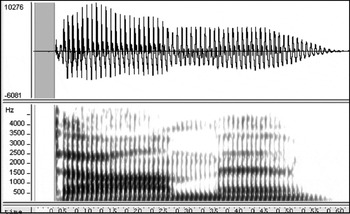
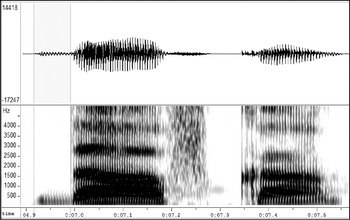
Jessen (Reference Jessen1998: 69–94) reports on the results of an experiment in which he recorded six speakers of German (four males and two females) reading a list of words. One of the goals was to measure the duration of voicing, aspiration and closure in stops. Only one subject produced more than 50% of the utterance-initial lenis stops with prevoicing. This is a surprising result if the lenis stops are specified as [voice]. On the other hand, all the subjects had aspiration of utterance-initial fortis stops (mean 74 ms), which is consistent with an [sg] specification. An example of an initial lenis stop is given in Figure 1.
German word Dame ‘lady’ (male speaker).

Figure 1 shows a waveform (upper display) and spectrogram (lower display) of the German word Dame ‘lady’ spoken in isolation. Since there is no preceding context, the lenis stop ‘d’ in that word occurs in utterance-initial position. The closure portion of that stop is highlighted in the figure (see the two vertical lines in the spectrogram and the shaded area in the waveform). The right boundary of the highlighted section represents the end of closure, which per definition is the same as the beginning of the stop release that immediately follows the highlighted section. (The left boundary of the section is arbitrary because without a preceding context it is not possible to tell acoustically where exactly the closure of the stop begins.) The highlighted section shows a flat line in the waveform and no information in the spectrogram. This clearly indicates that the initial lenis alveolar ‘d’ shown in Figure 1 is produced without any prevoicing.
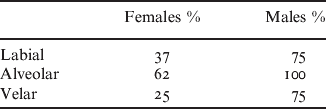
Although initial lenis stops are usually produced without prevoicing, intervocalic lenis stops usually are produced with some voicing. Jessen (Reference Jessen1998) measured closure duration and duration of voicing during closure in the following words with intervocalic bilabial, alveolar and velar lenis stops: Liebe ‘love’, Schwabe ‘Swabian’, Fieber ‘fever’, Schaber ‘scraper’, Schmiede ‘forge’, Made ‘maggot’, Mieder ‘bodice’, Kader ‘cadre’, Wiege ‘cradle’, Lage ‘situation’, Flieger ‘pilot’, and Lager ‘camp’. The token-by-token raw results were not published in Jessen (Reference Jessen1998) and no calculations of the percentage of voicing duration relative to closure duration were reported there. This calculation is reported here, i.e. for each of the 12 words given above, spoken by each of the six speakers of Jessen (Reference Jessen1998), the percentage of closure that was voiced was calculated. Subsequently, the number of tokens with full voicing (operationalized as 90% or more voicing) were counted. Tokens classified as fully voiced include those where the release was so weak that it could not be reliably measured, but where it was clear that there was no interruption of voicing from the preceding to the following vowel. Finally, the results were expressed separately for place of articulation and sex. The results are given in Table 7.
Percentage of fully voiced intervocalic lenis stops: German.
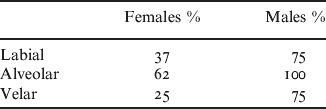
Table 7 shows, for example, that 37% of all labial lenis stops spoken by female speakers were 90% or more voiced. Averaging the results in Table 7 across place and sex, the intervocalic lenis stops had voicing of over 90% of the closure in 62.5% of the tokens. Table 7 also shows that voicing percentage is lower in female than male speech. This result is consistent with Jessen & Ringen (Reference Jessen and Ringen2002) and can (at least partially) be explained on aerodynamic grounds (quicker buildup of intraoral air pressure in the shorter vocal tracts of females compared to the longer vocal tracts of male speakers).
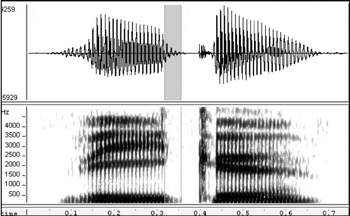
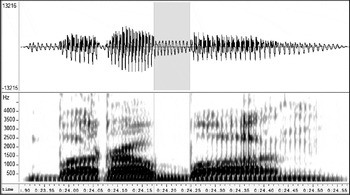
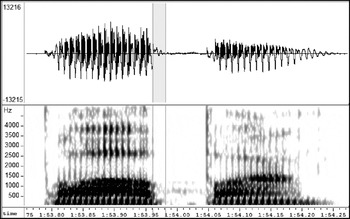
An example of an intervocalic lenis stop that is partially voiceless is given in Figure 2. This figure shows a waveform (upper) and spectrogram (lower) of the German word Wiege ‘cradle’ spoken in isolation, with voicing during closure highlighted. The left boundary of the highlighted section shows the beginning of the closure of the lenis stop ‘g’ as indicated by a rapid decrease of amplitude in the formants of the preceding vowel. The right boundary of the section shows the point where voicing ends during the closure of the stop. The end of the closure (=beginning of stop release) is not highlighted explicitly here; it occurs at the 0.4 s mark shown in the timescale below the spectrogram. The fact that voicing disappears before the end of closure is reached shows that the closure of this stop is partially voiced (highlighted section) and partially voiceless (time from end of highlighted section to beginning of release at time 0.4 s). What is also noteworthy about the example in Figure 2 is that the amplitude of the voicing cycles (most easily visible in the waveform, but also visible in the spectrogram) decreases gradually during closure until a point is reached where cyclic structure can no longer be seen reliably. This pattern of decreasing voicing amplitude occurs frequently in intervocalic German lenis stops, including in tokens (not shown here) where voicing is maintained throughout closure. This pattern of decreasing voicing amplitude is consistent with passive, rather than active, voicing. Compare this with Figure 4, below, where no significant reduction of voicing amplitude occurs in Russian, which is a language where voicing is claimed to be active. (Whether there is indeed a systematic difference in the voicing amplitude patterns of lenis stops in voice languages and aspiration languages would require a separate study.)
German word Wiege ‘cradle’ (male speaker).

5. RUSSIAN
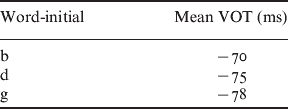
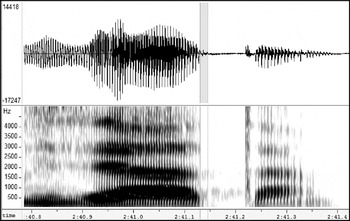
In a study of voicing with 14 speakers from St. Petersburg (six females and eight males), subjects read a word list with both fortis and lenis stops at the three places of articulation (bilabial, dental, and velar) in word-initial and intervocalic positions, mixed with fillers. Ringen & Kulikov (Reference Kulikov2012) report that Russian speakers had prevoicing in 97.5% of word-initial lenis stops. An example of the prevoicing is given in Figure 3.
Russian word davka ‘crush’ (female speaker).

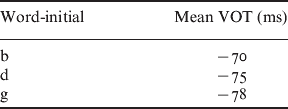
The highlighted section in Figure 3 shows prevoicing (=negative VOT), which is the time from the beginning of voicing during closure (left boundary) to the end of closure (right boundary). In this example the release of the stop is very weak, which is quite typical of prevoiced stops. The mean durations of the prevoicing are given in Table 8 (on next page).
Mean VOT for lenis stops in #CV position: Russian.
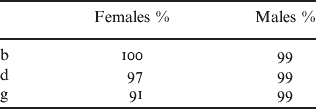
Ringen & Kulikov (Reference Kulikov2012) report that the vast majority of intervocalic lenis stops in Russian, 97.5%, were fully voiced.Footnote 16 A breakdown of the subjects is given in Table 9. A typical example of intervocalic voicing in Russian lenis stops is given in Figure 4. The highlighted section in Figure 4 starts at the beginning of closure and ends at the end of voicing, which in this token coincides with the end of closure, i.e. the stop is 100% voiced.
Russian word baraban ‘drum’ (male speaker): 100% voiced.

Percentage of fully voiced lenis intervocalic stops: Russian.
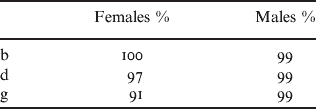
These data provide an answer to the question: Is there variation of voicing of intervocalic lenis stops in Russian, as has been found for German? The answer is clearly ‘NO’. This provides support for the position that the voicing in German intervocalic stops is the result of passive voicing and is different from the voicing found in true voice languages, which is attributable to active voicing.
6. WORD-INITIAL STOPS IN SENTENCE-MEDIAL POSITION: EVIDENCE FROM ENGLISH AND RUSSIAN
It is difficult to find systematic studies of stop voicing in intervocalic (word-medial) position in an aspirating language other than what we have just reported for German. But a similar argument can be made by considering another context, namely word-initial stops in sentence-medial position (where the preceding word ends in a vowel or sonorant consonant). Very systematic data on stops in that context have been reported for British English by Docherty (Reference Docherty1992) and can be compared with the results for Russian from Kulikov (Reference Kulikov2012).
Docherty (Reference Docherty1992) investigated a large set of obstruents spoken by five male adult speakers of Southern British English. He reports the percentage of voicing (relative to the duration of the closure) in 11 words with ‘b’, nine with ‘d’, and six with ‘g’, spoken by each of the subjects. The stops occurred at the beginning of a monosyllabic word and occurred in the context Say___ instead. Averaged across subjects and words, the percentage of voicing during closure was 51% for ‘b’, 58% for ‘d’ and 66% for ‘g’ (Docherty Reference Docherty1992: 120; see also page 158 there for a reported value of 57% across all places of articulation). In the context investigated by Docherty (the stop occurs between vowels across a word boundary) the conditions are favourable for the occurrence of passive voicing. It is expected that under these conditions the lenis stops would be partially voiced even in languages with no active voicing. Docherty's (Reference Docherty1992) results show that, on average, about one half to two thirds of the closure in lenis stops is voiced, but the remaining part of the closure is voiceless. Very similar results were obtained by Deterding & Nolan (Reference Deterding and Nolan2007) for word-initial stops in the context Now please say___ just one more time spoken by seven RP or near-RP English speakers. They found an average of 47% voicing during closure for ‘b’, 59% for ‘d’ and 67% for ‘g’.
Contrast this with the results for Russian by Kulikov (Reference Kulikov2012). Based on recordings from 14 speakers of Russian from Tambov, Russia, seven males and seven females, the percentage of voicing during closure was measured for lenis stops that occurred at the beginning of a word. The word was embedded in the carrier sentence Skazhi ___ yescho raz ‘Say ___ again’. Results were taken from a fluent speaking condition where no pause occurred between target word and the preceding context (otherwise we would effectively be dealing with a different context, namely utterance-initial/post-pausal position). Averaged across sex and place of articulation, the percentage of voicing during closure was 94.6%. This value reported for Russian is substantially higher than the average value of 57% reported for English by Docherty (Reference Docherty1992). These results further strengthen our point that stop voicing is phonologically active in Russian, but passive in English.
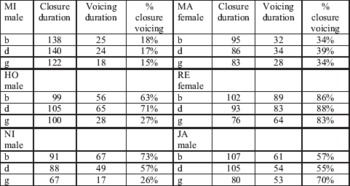
In order to determine whether the results by Docherty and Deterding & Nolan for English are similar to those from German, measurements of the percentage of voicing in word-initial sentence-medial lenis stops were made on the data corpus used in Jessen (Reference Jessen1998). In the original recording of that corpus, the same set of words that was produced after a carrier word ending in a fricative (referred to as post-voiceless position in Jessen Reference Jessen1998) was also produced after a carrier word ending in a vowel. The carrier phrase was Sage nie ___ ‘Say never ___’. These data have not been published before.Footnote 17 The results for the six speakers (four male, two female), averaged across words, but expressed separately for the three places of articulation, are shown in Table 10.Footnote 18
Percentage of closure voicing for word-initial intervocalic stops in German. (Durations are in ms; MI, MA, HO, RE, NI, JA are abbreviations for the subjects.)

The mean voicing percentages across all six speakers are 55% for ‘b’, 55% for ‘d’ and 42% for ‘g’. These results for German are quite similar to the results reported by Docherty (Reference Docherty1992) and Deterding & Nolan (Reference Deterding and Nolan2007) mentioned above (though voicing percentage in ‘g’ was lower here than in the English data). Another study of word-initial German stops preceded by a carrier word ending in a vowel is Künzel (Reference Künzel1977). Averaged across all his 26 subjects and across the three places of articulation, voicing percentage of lenis stops in this context was 53% (calculated from his table on page 128). This result is similar to the German results obtained here.
The results discussed in this section provide further evidence for the view that stop voicing is not phonologically active in the aspirating languages German or English, whereas it is active in the true voice language, Russian.
7. ANALYSIS
As noted earlier, Jessen & Ringen (Reference Jessen and Ringen2002), among many others, suggest that the feature of contrast in German is privative [sg] and in true voice languages, the feature of contrast is privative [voice]. The idea that phonologically, laryngeal features are privative – that is, they are defined by the presence or absence of a gesture – rather than binary – defined by two values with equal status – has gained support among phonologists for a purely phonological reason: it is, apparently, never necessary to refer to the minus value of a laryngeal feature in the phonology – that is, [−voice] is never ‘active’ in phonology, suggesting that it is not there (see Mester & Itô Reference Mester and Itô1989).Footnote 19
If laryngeal features are privative, there is a clear relation between the phonetic cue and the phonological feature: prevoicing in initial position will implicate the feature [voice], and aspiration will implicate [sg]. We are not suggesting that the phonological feature [voice] requires vocal fold vibration – there are other cues for [voice] (see Kong Reference Kong2009). However, the presence of prevoicing on initial stops does implicate the feature [voice], and the presence of aspiration (long lag VOT) implicates the phonological feature [sg]. Thus, the two-way contrast in languages such as German is between stops specified as [sg] and stops with no laryngeal specification, and in languages such as Russian and Hungarian, the contrast is between stops that are specified as [voice] and stops with no laryngeal specification (Anderson & Ewen Reference Anderson and Ewen1987, Harris Reference Harris1994, Iverson & Salmons Reference Iverson and Salmons1995, Jessen & Ringen Reference Jessen and Ringen2002, Honeybone Reference Honeybone, Oostendorp and van de Weijer2005, Petrova et al. Reference Petrova, Plapp, Ringen and Szentgyörgyi2006, Beckman et al. Reference Beckman, Jessen and Ringen2009).
It is usually assumed that gradience is the hallmark of a phonetic process. Jessen & Ringen (Reference Jessen and Ringen2002) suggest that, in German, passive voicing is phonetic and occurs in the laryngeally unspecified stops. Two objections to this analysis have been raised. First, Jansen (Reference Jansen2004: 48) notes that there is a difference between the fortis stops in true voice languages and lenis stops in aspirating languages: the former do not undergo passive voicing, whereas the latter do. If privative features are assumed, both are represented as laryngeally unspecified, and hence should behave similarly. Second, it has also been suggested that in languages such as Mandarin, Cantonese, and Danish, where there is clearly an aspiration contrast (Jessen Reference Jessen2001), the stops which are unspecified do not undergo passive voicing. Corroborating evidence that passive voicing occurs in English, but does not occur in Mandarin, is presented by Deterding & Nolan (Reference Deterding and Nolan2007).
Let us address each of these objections in turn. First, consider Russian, a true voice language. Unspecified (fortis) intervocalic stops do not undergo passive voicing. Examples showing that the fortis stops in Russian have only a short voicing tail in intervocalic position are given in Figures 5 and 6. (The voicing tail is highlighted in both figures.)
Russian word papa ‘Daddy’ (male speaker): VOT = 14 ms, 20% of the closure duration voiced.

Russian word vz'ato ‘taken’ (female speaker): VOT = 21 ms, 11% of the closure duration voiced.

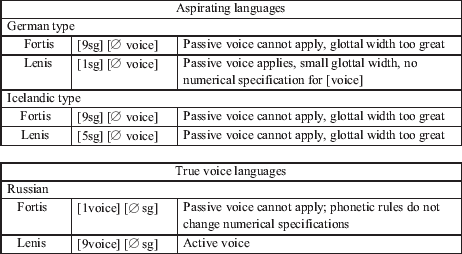
The examples in Figures 5 and 6 show that the fortis (unspecified) stops in Russian do not undergo passive voicing. Note the difference between the voicing in these examples and the German example in Figure 2 above. In a model with privative [voice] as the feature of contrast in a true voice language and [sg] as the feature of contrast in an aspirating language, both the Russian fortis stops and the German lenis stops would be unspecified for laryngeal features. Yet they behave differently. How can the passive voicing of the unspecified stops in a true voice language be prevented? In other words, the privative feature model suggests/predicts that fortis (unspecified) stops in a true voice language like Russian should undergo passive intervocalic voicing, just as the lenis (unspecified) stops of German do.
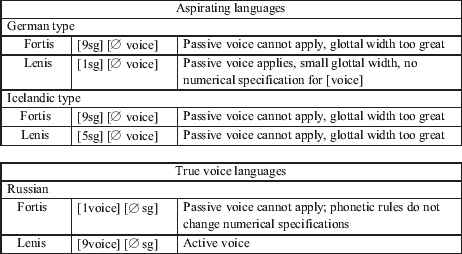
It is not difficult to see how this objection can be countered. Let us assume that features are privative and stops in a true voice language are either specified as [voice] or not specified for a laryngeal feature, and in an aspirating language, stops are specified as [sg] or not specified for a laryngeal feature. This is in the phonology. Let us assume, further, as has often been suggested, that at some level prior to the phonetics privative features are transformed into numerically specified features (see Chomsky & Halle 1968), and that every segment has to have a positive numerical specification for the feature that is active in that language – but not for any feature that is not active. This would mean that in a true voice language, a specified laryngeal feature of [voice] on stops would become something like [9voice] and the stops that lack a specification for [voice] (in the phonology) become something like [1voice]. Similarly, in an aspirating language, a specified [sg] feature would become specified for a relatively high degree of [sg], say [9sg], and the unspecified feature on stops would become something like [1sg] or [2sg].Footnote 20 Then, if as assumed in Jessen & Ringen (Reference Jessen and Ringen2002), passive voicing is a phonetic process, all that is needed is the assumption that such phonetic processes cannot change a numerically specified phonological feature. Thus, passive voicing will affect (lenis) stops in aspirating languages because they are not specified for [voice] (just [sg]), but it will not affect (fortis) stops in a true voice language because they will be specified as [1voice]. Note that, while passive voicing could, in principle, supply voicing to any [sg] stop which lacks a [voice] value, it will, in practice, only affect stops with a small numerical coefficient for [sg] in aspirating languages. Stops with large glottal spreading, and thus, a high numerical value for [sg], will not be affected by passive voicing because the glottal spreading is sufficient to inhibit voicing.
Let us turn now to the second objection: there are languages with an aspiration contrast in which unspecified stops do not undergo passive voicing. In our analysis, intervocalic stops in Icelandic would either be specified as (privative) [sg] or left unspecified in the phonology, and would subsequently be specified with numerical coefficients for [sg] at some level prior to the phonetics. The question is how to prevent the stops that are not phonologically specified for [sg] from undergoing passive voicing in the phonetics because they have no specification for [voice] to block voicing as do true voice languages.
We suggest that while in some aspirating languages, such as German, the conversion from privative features to numerically specified features would result in a relatively large numerical specification for stops specified as [sg] and a smaller numerical specification for those phonologically unspecified for [sg], in Icelandic and Danish, the stops phonologically specified as [sg] would also be specified with a relatively large numerical specification, but those phonologically unspecified for [sg] would receive a value larger than in German, say 5, sufficient to block passive voicing. Thus, none of the Icelandic and Danish (fortis or lenis) stops would undergo passive voicing: the glottal spreading would be too great.
There is evidence from EMG studies that there is active glottal spreading in Danish lenis stops (Fischer-Jørgensen & Hirose Reference Fischer-Jørgensen and Hirose1974, Hutters Reference Hutters1985).Footnote 21Hutters (Reference Hutters1985: 22) suggests that the small but active glottal spreading found in Danish lenis stops has the goal of keeping the vocal folds from vibrating during stop closure. Similarly, Pétursson (Reference Pétursson1976) found that the glottal opening for the lenis stops in Icelandic is much more substantial than what has been found for German (see Jessen Reference Jessen1998: 235 for discussion). This suggests that the glottal spreading in the lenis stops in Danish and Icelandic is greater than in German, and sufficiently large to prevent passive voicing.
Assuming that passive voicing cannot apply to stops with some crucial degree of glottal spreading, we can describe the difference between languages like German and Icelandic: passive voicing applies to stops specified with glottal spreading less than some crucial value (say 3) but does not apply to stops with glottal spreading greater than 3. This assumption is consistent with what has been found for the difference between German and Danish intervocalic stops. There is apparently a small amount of active glottal spreading in Danish lenis stops which does not occur in German, and this glottal spreading correlates with the lack of passive voicing in Danish lenis stops. Our analysis is summarized in Table 11.
Summary of the analysis.
8. CONCLUSION
We have argued that there is a difference in the intersonorant voicing in German, on the one hand, and true voice languages such as Russian, on the other. In German, only 62.5% of the intersonorant lenis stops are more than 90% voiced. By contrast, in Russian, more than 97% of the intervocalic lenis stops are fully voiced. This is consistent with an analysis in which it is assumed that the feature of contrast is (privative) [sg] in German and (privative) [voice] in Russian. In other words, the active laryngeal feature in German is [sg], and the active laryngeal feature in Russian is [voice]. Our analysis attributes the intersonorant voicing in German to (phonetic) passive voicing, rather than active voicing, as occurs in true voice languages such as Russian.
We have further argued that it is not the case that such an analysis predicts that passive voicing should be found in stops that are laryngeally unspecified in true voice languages. As long as these phonologically unspecified stops are specified as [1voice] in the phonetics, passive voicing should not apply to them because phonetic rules cannot change numerical feature specifications. We have also suggested the reason that none of the stops in Icelandic and Danish undergo phonetic passive voicing is that prior to the phonetics, they receive a higher numerical specification for [sg] than do German and English (phonologically) unspecified stops, and this specification is sufficiently large to block passive voicing.