Introduction
Social gerontological research has usefully engaged with the role of time in older adults’ lives by considering how routines and other temporal patterns shape life experiences, including those related to food, meals and eating. This paper builds upon that foundation by applying phenomenological perspectives on time to analyse idiographic data on older adults’ experiences, values, and strategies for eating and ageing.
The paper details one set of findings from doctoral research by a novice social gerontologist which employed philosophical perspectives from phenomenological ethnography to explore experiences of food, meals and eating for older adults living in rural Tasmania, Australia. These findings, presented here in the form of older adults’ stories and experiences, are permeated with the notion of time – whether in terms of quotidian, day-to-day activities and concerns, or the grand sweep of life from childhood to old age.
Background
Nutritious and enjoyable eating experiences are important for achieving good health and wellbeing in older adults (Thompson et al. Reference Thompson, Peace, Astell, Moynihan, Macdonald and Walker2014). However, it is a complex area of inquiry because food and eating in older adults has many interwoven determinants, including physiological, economic, social, geographic and policy factors, as well as subjective considerations such as life experiences, life meanings and personal values (Sylvie, Jiang and Cohen Reference Sylvie, Jiang and Cohen2013; Vesnaver and Keller Reference Vesnaver and Keller2011). Policy and programme initiatives which support community-dwelling older adults in enjoyable and nutritious eating, even into very old age, would benefit from research that engages with the implicit meanings in experiences of food and eating in this age group.
Researcher Cate Burns has called for observational and interpretative research approaches to the issue, stating:
…all the evidence indicates that it is meaning and the values we attribute to food that drive our food habits … this will mean understanding the values people bring to old age and how to help them manage the challenges to these values in a way that maintains their dignity and well-being. (Reference Burns2009: 201)
This research engages with these concerns by exploring how older adults’ intermingled life experiences and meanings intersect with their particular circumstances to shape their values and strategies for growing, shopping, cooking, sharing and eating food.
Older adults’ eating: the significance of the past
The following section observes that social gerontological research in this field has most commonly been informed by the lifecourse perspective, which underlines the significance of time for human lives. It incorporates five considerations: ageing as a life-long process over time, human lives as closely linked to others through social networks, timing of transitional life events, historical time and place in which each person lives, and personal agency in shaping individual lifecourses (Bengtson, Elder and Putney Reference Bengtson, Elder, Putney and Johnson2005).
From this perspective, human lives are shaped by the historical time in which they are embedded. Social gerontologists label this ‘generational habitus’ (Higgs et al. Reference Higgs, Hyde, Gilleard, Victor, Wiggins and Jones2009: 105) or ‘the cohort effect’; people born at a particular time share a social and cultural history which influence their ‘attitudes, behaviours, and outcomes across the entire life course’ (Bengtson, Elder and Putney Reference Bengtson, Elder, Putney and Johnson2005: 495). These effects extend to experiences of food and eating. Trajectories – defined as each person's feelings, strategies and actions that persist over time – shape food choices throughout life (Wethington and Johnson-Askew Reference Wethington and Johnson-Askew2009). Arguably, past experiences influence people's present food behaviours so profoundly that, ‘each time they choose food, people bring their past food choices, events, and experiences to the table’ (Devine Reference Devine2005: 121).
Applying the lifecourse perspective in empirical research has revealed the significance of the past for older adults’ present-day eating. Research has found that European older adults’ food habits and activities were shaped by their childhoods, which were characterised by constrained food resources and considerable ‘foodwork’ such as hunting, growing and preserving food (Sydner et al. Reference Sydner, Sidenvall, Fjellstrom, Raats and Lumbers2007). Taking this perspective in research into older adults’ kitchens, researchers gathered oral histories of past kitchens, and found that these adults seek continuity in the design elements and ways of using their present-day kitchens (Maguire et al. Reference Maguire, Peace, Nicolle, Marshall, Sims, Percival and Lawton2014).
Older adults’ eating: the significance of the present
As well as past experiences, routines in the present are also significant for older adults’ eating. Giddens (Reference Giddens1991) emphasised the importance of routines of all kinds for ensuring people's ongoing sense of coherence. Employing this perspective, Mitzen contended: ‘routines thus serve the cognitive function of providing individuals with ways of knowing the world and how to act, giving them a felt certainty that enables purposive choice’ (Reference Mitzen2006: 347). It is argued that people's routines for eating are similarly informed by this need for a sense of predictability and stability in their day-to-day lives (Jastran et al. Reference Jastran, Bisogni, Sobal, Blake and Devine2009).
Empirical research has found that preparing and eating cooked meals provides older adults with a valuable sense of regularity and rhythm in their daily lives (Quandt et al. Reference Quandt, Vitolins, DeWalt and Roos1997). Research in Nordic countries has shown that people tend to revert to more traditional, synchronous meal routines as they enter old age (Lund and Gronow Reference Lund and Gronow2014). However, the timings of such meal routines vary between countries, as they are informed by local cultural values and social organisation of food consumption (Southerton, Díaz-Méndez and Warde Reference Southerton, Díaz-Méndez and Warde2012).
The temporal aspects of consumption studies sometimes touch upon meals, comparing eating routines across decades or between weekdays and weekends. This literature largely employs a sociological perspective to theorise consumption practices and routines for human lives, and thus is primarily concerned with issues of agency, social structure and social practices (Ilmonen Reference Ilmonen, Gronow and Warde2001). From this perspective, day-to-day routines and patterns of consumption are viewed as socially informed practices, shaped by social interactions and cultural norms (Southerton Reference Southerton2013). While research into consumption is not usually focused on older adults, studies have found that the birth cohort effect influences older adults’ expenditure on household goods, including food (Higgs et al. Reference Higgs, Hyde, Gilleard, Victor, Wiggins and Jones2009).
Older adults’ eating: the significance of the future
This brief review of the literature on the role of time in older adults’ food and eating reveals that it is primarily informed by either the lifecourse perspective from social gerontology or more general sociological frameworks. Although useful and insightful, this research does not appear to have fully revealed the deeply felt meanings implicit within older adults’ lived experiences of food, meals and eating. That is, these studies do not closely engage with the question of how our human desire to go on living a meaningful life in older age profoundly shapes our quotidian experiences of food. Making this observation does not, of course, imply any particular weaknesses in the studies themselves. Rather, the fact that these studies primarily focus on issues other than older adults’ personal meanings in relation to eating is a product of their epistemological and theoretical foundations in gerontology and sociology. However, it does reveal an opportunity to build upon these studies by undertaking research into older adults’ eating which is specifically informed by perspectives from phenomenology, which is explicitly concerned with uncovering personal meanings in human lives.
As well, this research is almost exclusively concerned with older adults’ past and present – perhaps inadvertently underplaying their future. These observations reveal an opportunity to conduct qualitative research which employs philosophical perspectives from phenomenology to consider the implicit temporal meanings and values of older adults’ food-related experiences – in terms of their past, present and future lives.
Methodology
Phenomenological perspectives on older adults’ eating experiences
Phenomenology informs the intent of this research to explore older adults’ experiences of food, meals and eating from the perspective of those experiencing it. Phenomenologists Frykman and Gilje (Reference Frykman, Gilje, Frykman and Gilje2003: 15) label this strategy ‘going to the “experiencer” … making experience the starting point’. Everyday experiences are a valid source of knowledge because they contain rich insights into human phenomena (Becker Reference Becker1992).
Phenomenology is concerned with the practical activities and everyday relationships that human beings are engaged in – these are thought to hold considerable meaning and therefore provide significant insights into the nature of human ‘being’ or existence (Smith, Flowers and Larkin Reference Smith, Flowers and Larkin2009). Phenomenological ethnography is also concerned with exploring universal dimensions of human experiences but it brings ethnographic considerations to bear by viewing human experiences as situated within particular social and cultural settings (Desjarlais and Throop Reference Desjarlais and Throop2011).
Phenomenology and phenomenological ethnography view human ‘being’ as inhabiting a lifeworld (Lebenswelt). This lifeworld is immediate, spontaneous, practical and ordinary – but also the site at which humans make meaning in their lives (Frykman and Gilje Reference Frykman, Gilje, Frykman and Gilje2003). Edmund Husserl (1859–1938) conceptualised the lifeworld as the ‘grounding soil’ (Boden) for human ‘being’, through which all our perceptions and everyday experiences are made possible (Reference Husserl and Carr1970: 131). The phenomenological lifeworld consists of several interwoven structural elements, as follows: subjectivity, intersubjectivity, spatiality and temporality (van Manen Reference van Manen1997).
This paper discusses the findings related to the last of these lifeworld elements – the temporal dimension of older adults’ experiences of food, meals and eating. Phenomenology emphasises that human ‘being’ is lived through chronological time – informed by the past, enacted in the present and directed towards the future (Todres and Galvin Reference Todres and Galvin2010). These findings explore temporal meanings embedded in older adults’ everyday food-related experiences, values and activities, including growing fruit and vegetables, food shopping, cooking, eating meals and feeding others.
Setting, participants and methods
Twenty-one older adults aged 72–90 years living in rural communities in Tasmania, Australia participated in the study. Tasmania is a small island state of 68,401 square kilometres which is located 240 kilometres south of the Australian mainland. Almost half of the Tasmanian population live in the capital city of Hobart; the remainder is dispersed across the state, living in either rural areas or the regional cities of Launceston, Devonport and Burnie (Australian Bureau of Statistics (ABS) 2014). The island, with a small pre-existing Indigenous population, underwent significant British migration in the 19th and 20th centuries. This is reflected in its current population characteristics; in 2011, the state's population was 495,354 people – 89 per cent of whom were born in Australia, England, Scotland or New Zealand (ABS 2014). Tasmania has the highest proportion of older adults of any Australian state; 16.3 per cent of the population is aged 65 years and over, and the population is ageing faster than any other Australian state (ABS 2014). Older Tasmanians report high rates of obesity and chronic disease including diabetes, hypertension, stroke and heart disease (Department of Health and Human Services 2014).
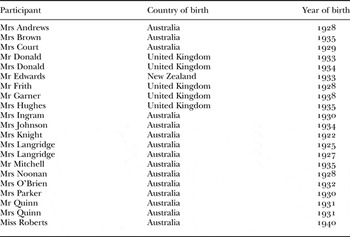
Participants were recruited through advertisements in newspapers and newsletters, letters to community groups, snowball sampling and convenience sampling. Fifteen individuals and three married couples participated in the in-depth qualitative research, after providing written informed consent. There were 14 female and seven male participants, born between 1922 and 1940. All these older adults were born in Australia, New Zealand, England or Scotland (Table 1). Of those not born in Australia, all of them migrated to Australia at least 40 years ago, mostly arriving in the 1950s and 1960s.
Country and year of birth of participants

Note: All the names of the older adults and their friends and relatives are pseudonyms.
Most of the older adults did not attend university and many did not complete high school, which is typical for this Tasmanian cohort. All the participants are retired but held a variety of roles, including farmer, religious minister, home-maker, air steward, fisherman, building engineer, teacher, small business owner, radio announcer and medical typist. Almost all live in reasonably comfortable circumstances, with most owning their homes and are readily able to meet their living costs. Others are more affluent, affording regular interstate or overseas air travel, and at least one has considerable landholdings. One married couple is in a much less comfortable socio-economic position than all the others; they depend on a government pension but rent in the private housing market and incur regular out-of-pocket medical expenses.
All the participants live in or near a rural town, and in their own homes – whether owned or rented – rather than in residential care. None live in apartments; they either live in a fully detached house, a common housing type in rural Tasmania, or a small single-storey semi-detached townhouse. All have either a garden around their house or a shared garden near their townhouse. Most have at least one chronic disease, including cardiovascular disease, type 2 diabetes, musculoskeletal conditions, and hearing or vision loss. The extent to which these diseases impinge on their wellbeing, constrain their capacity to buy food and prepare meals, and to enjoy eating does vary considerably between the older adults, as detailed elsewhere (King Reference King2014). None of the older adults identified any significant food allergies.
The research employed three complementary fieldwork methods informed by phenomenological ethnography, designed to elicit rich data on older adults’ lived experiences of eating and ageing. These were semi-structured in-depth interviews, walking interviews and informal multi-sensory observation. Potential participants were introduced to the methods via telephone conversations, follow-up letters and an information sheet, prior to being asked to provide written informed consent to participate. In 2012 and 2013, repeated interviews were conducted during visits to older adults’ homes. These involved an initial, semi-structured in-depth interview, and then a follow-up interview approximately six months later. Informed by a temporal perspective, the interview questions were designed to explore older adults’ past, present and future experiences of living and eating.
The older adults were also invited to participate in a walking interview or ‘go-along’ (Kusenbach Reference Kusenbach2003). These entailed conducting an informal interview while walking with the older adults in their gardens, neighbourhoods, towns and farms. Qualitative researchers have employed walking interviews to investigate place-based health inequalities and people's relationships with places (Evans and Jones Reference Evans and Jones2011; Garcia et al. Reference Garcia, Eisenberg, Frerich, Lechner and Lust2012), including with older adults on farms (Riley Reference Riley2010). Twelve walking interviews were conducted, with another interview cancelled twice due to inclement weather. Both the in-depth and walking interviews elicited recollections, anecdotes, opinions and descriptions from older adults of their food-related values, behaviours and strategies, and generated insights into their home environments and experiential lifeworld.Footnote 1
The home visits were conducted in a flexible and empathic manner so as to facilitate rapport with participants. During two of the home visits, older adults chose to prepare and share meals with the researcher. All interviews were digitally recorded and later transcribed verbatim, and varied in duration from 29 minutes to over five hours. Informal multi-sensory observation was undertaken during the interviews, which entailed, for example, looking at older adults’ kitchens or viewing their recipe books, smelling cooking odours, sitting on dining room furniture and tasting any proffered food. These observations were recorded as field notes after each home visit.
Analysis
The fieldwork data consisted of transcripts from the in-depth and walking interviews, and field notes of observations, which were analysed using iterative, hermeneutic and thematic techniques informed by interpretive phenomenology's aim of illuminating the meaning of lived experiences (Smith, Flowers and Larkin Reference Smith, Flowers and Larkin2009). During analysis, the findings were placed under, and moved back and forth between, four broadly pre-defined themes, according to van Manen's (Reference Baars1997) four structural elements of the human lifeworld: subjectivity, intersubjectivity, spatiality and temporality. To allow for detailed discussion, the findings reported in this paper relate only one of these four overarching themes – temporality. Findings pertaining to all four closely interwoven elements or themes of the phenomenological lifeworld are detailed elsewhere (King Reference King2014).
Findings
The findings are detailed below according to three aspects of the temporal dimension of human lives: the past, present and future. Past experiences of uncertainty and scarcity in childhood and early adulthood have shaped enduring food values of ‘being resourceful and frugal’, ‘investing effort in obtaining food’ and ‘achieving eating variety’. In the present, the older adults are focused on ‘using routines to keep going’, ‘using time well’ and ‘not feeling or acting their chronological age’. They are also oriented towards their futures, which is evident from their life strategies of ‘keeping going’, ‘eating for a healthy future’ and ‘facing fears’.
The past: experiences in childhood and early adulthood shaped enduring food values
The following findings explore how experiences from childhood and early adulthood have shaped older adults’ food values and strategies.
Uncertain times
Many of the older adults’ memories of childhood were of very uncertain, and sometimes unsafe, times during World War II. Mrs Hughes grew up in Manchester, United Kingdom (UK) and experienced repeated Axis bombing raids, often seeing bomb dropping, flames and explosions. During her childhood, seemingly comforting household items such as kitchen tables – with their promise of home-cooked food and shared meals – took on a more sombre weight during those bombing raids:
…we were under a big iron table which we had in the kitchen, in case we missed the siren and couldn't get to the shelter.
Older adults who grew up in Australia did not experience such immediate danger during World War II, however, most were adversely affected by wartime in some way. Mrs Andrews’ husband was totally and permanently incapacitated by his war service, and Mrs Court's brother died while serving at sea.
As well as growing up in times of war, participants also faced significant challenges in childhood arising from poverty and illness. Some older adults, including Mrs O'Brien and Mr Quinn, remember siblings or friends contracting polio during the mid-twentieth-century epidemics in Australia. Mrs Court grew up in rural Tasmania and her parents struggled to feed their ten children. She recalls how her mother tried to provide her family with nourishing food:
Well, my mum … would make some fantastic meals out of the most mundane sort of food, you know … I learnt a hell of a lot from her, you know, to make do and make a nourishing meal…
At 12, Mrs Court left home and moved over 80 kilometres away to the city of Hobart, Tasmania to find work because her parents ‘just could not put up with any more mouths to feed’. She remembers Hobart as a risky place for children during World War II – brothels operating in the wharf area were said to recruit young girls. However, she felt lucky to obtain work and lodgings in a guest house cooking meals. She only returned for a home-cooked meal ‘once in a blue moon’, when time and funds permitted.
Other children played a significant role in their family's food preparation at a relatively young age. At nine, Mrs Parker stopped attending full-time school in order to care for her mother who Mrs Parker thinks was probably depressed. Her role was to ensure her mother ‘didn't do anything silly’, care for younger siblings, clean the house and prepare family meals.
Scarcity and monotony of food
Rationing of food and basic resources during World War II was a significant feature of the older adults’ childhoods. They ate a fairly restricted and uninspiring diet, and often had to compromise on the quality and quantity of food. This was particularly so for those who lived in the UK. Mr Garner remembers eating powdered egg and dry hash made from corned beef mixed with potatoes and ‘maybe a few green vegetables if they were available’. For Mrs Hughes, the food shortages during her childhood were ‘a nightmare’ … reflecting that ‘we were hungry at times, then’.
However, none of the other older adults can recollect experiencing significant hunger during their childhood. Food was not always plentiful and was often lacking in variety – but was almost always sufficient. Mr Donald, Mrs Langridge and Mrs Parker said they were never hungry to the point of feeling starving. Similarly, Mr Garner and Mrs O'Brien do not remember going hungry – although the lack of variety sometimes wore rather thin:
I don't ever remember being hungry. Bored – yes! … But never hungry. No. No. We always managed to find enough. (Mr Garner)
War-time conditions did mean that children were expected to eat foods they did not necessarily like. For two participants, those food dislikes have endured into old age. At the age of six or seven, Mrs Hughes had to conform to a new family's food preferences:
…my sister and I were evacuated to the country to our auntie's place during the bombing and she made us eat porridge. And I have had an aversion to porridge ever since.
Mr Frith's vivid memories of eating one particular war-time food staple means he does not eat it as an older adult:
Ah, tripe, which I utterly and totally detest! I can't look at it now!
For all the older adults, eating pre-made or indulgent food as a child was a rare and valued experience. Mrs Parker has fond memories of devouring jam doughnuts as a treat, while Mrs O'Brien remembers:
The only highlight of our lives was … very occasionally we were allowed to buy our lunch, which would be a pie or a pastie. And neither my brother nor I ever forgot those pies … Oh, they were good. Oh, they were good.
These older adults’ childhoods were characterised by uncertainty and sometimes danger. As well, their food situation was restrained and often boring due to rationing, scarcities and sometimes poverty – although this was occasionally relieved by highly valued, pleasurable eating experiences. These older adults grew up during challenging times for Australia and the UK, which shaped their values in relation to food and to life in general, many of which have endured into old age. These values are labelled here as: ‘being frugal and resourceful’, ‘investing effort in obtaining food’ and ‘achieving eating variety’.
Being resourceful and frugal
Living in economically insecure times required adults and children to be creative, manage food resources carefully and work hard at household management. Mrs Brown recalls:
It didn't matter what it was, you used it. We had a few chooks [chickens], and when you did your veggies, the peelings went in, you cooked them, you mixed it up with pollard [meat from sheep, goat or deer] and bran, and the chooks laid eggs. Everything was utilised.
Resourcefulness and avoidance of waste infuses many of their current food strategies as older adults. Some disregard advice to throw out food past its use-by date (Mrs Brown, Mr Frith) and others freeze or preserve food to avoid throwing out leftovers or surplus home-grown vegetables (Mr Edwards, Mrs Ingram, Mrs Johnson, Mrs Hughes).
The older adults espouse and enact another enduring value of their childhoods – frugality. Mrs Parker has no difficulty affording her food shopping, but manages her money carefully and chides those who complain about making ends meet on a pension:
Oh, a lot of them growl. But I say to them, you should be thankful because you should be able to manage. You have got to be able to manage.
Investing effort in obtaining food
The substantial contribution these older adults made in childhood to their family's food-related work has informed this third enduring value. For many, hunting for food was a normal, everyday activity, as Mr Quinn and his siblings grew up doing:
Oh yes, rabbits. I tell you what, rabbits were our main diet …Trapped them, mostly. And [the] kids, we all had shanghais [sling-shots] … and we got pretty good with them.
In Australia, sourcing food from the natural environment often required curiosity, ingenuity, energy and persistence, as Mr Edward's recollection reveals:
I remember we took home what used to be mutton fish – they are abalone now. We were wading around the rocks at low tide, found these big shells and kicked them off and took them home and mum had never seen them before. She said, ‘I don't know if they are any good to eat. I had better go and ask Mrs Morgan next door’. So she walked over next door and she said, ‘Oh they are all right, but they are tough. You have got to bash them to make them tender’. So we didn't have anything square but [we did have] a round log that we chopped the wood on. So we lay the abalone on that and hit it with the back of the axe – and of course, being slippery, they'd fly off into the scrub. We'd drag it back and scrape the dirt and leaves off it, hit it again – and away it went again! So mum overcame the problem by [using] the old hand mincer that screwed to the side of the table and [she] cut it into strips and minced it and made patties – it was beautiful.
Most families grew some fruit and vegetables during older adults’ childhood, while other produced almost their entire fresh food needs. Mr Quinn and Mrs Noonan grew up in rural areas and did not remember their families buying much food – there was no need to when they could hunt it, grow it or make it themselves. Although Mrs Quinn and Mrs Brown spent part of their childhoods in urban areas, both their families maintained sizeable vegetable patches.
For those families which did not hunt or grow much food, obtaining food was often an effortful exercise for the children. Mrs Parker and her brother had significant food-shopping responsibilities during their childhood in Melbourne, Australia. To buy cheaper vegetables and meat, they walked an almost 20-kilometre round trip from home to Victoria Market, conveying their purchased food in an old wicker pram.
For many of the older adults, enthusiasm for home food production has continued into later life. They grow a wide range of fruit, vegetables and herbs, including raspberries, peaches, pears, artichokes, beans, carrots, pumpkins, oregano, thyme and parsley. For some, including Miss Roberts and Mrs Ingram, home-grown produce provides a pleasurable supplement to purchased food. Others, such as Mr Edwards, Mr Garner and Mr Quinn, grow enough fruit and vegetables to meet almost all their needs. However, in recent years, some of the older adults have stopped growing vegetables in the wake of medical conditions, including cancer (Mr Noonan, Mrs Knight) and early dementia and knee pain (Mr Langridge).
Achieving eating variety
Childhood experiences of significant monotony in the available food has informed this enduring food value. Mr Mitchell, Mrs Ingram, Mrs Hughes, Mrs Knight, Mr Garner and Mr Frith spontaneously underlined the importance of variety in their eating. Mrs Parker varies her breakfast cereal over three days, rotating through ‘Weet-Bix’, ‘Special K’ and porridge so as not to become bored. Mr Garner has developed a systematic method of ensuring variety in his after-dinner treats, rotating through carrot cake, ginger biscuits and berries throughout the week.
The present: keeping going with living and eating
The findings reveal another aspect of the temporal dimension of older adults’ lifeworlds – activities and strategies enacted in the present. Exercising daily and weekly routines for eating, housework and leisure support the older adults to keep going with their lives and day-to-day eating. These routines provide an important sense of structure and coherence at a time of life when the routines of school, work and family life have all but disappeared.
Employing routines to keep going
All the older adults maintain a regular routine of eating three meals per day, and most eat at least one cooked meal every day. Several of the widowed older adults have taken up watching television while they eat their meals, with programmes providing a useful cue to eat at regular times. Mrs Ingram and Mrs Knight both eat dinner while watching the quiz show ‘Egg Heads’ at five o'clock and Mr Mitchell prepares his evening meal in time for the seven o'clock news.
Not all the older adults employ eating routines as part of their daily lives, however. Mrs Brown was a dairy farmer and she does not want to be restricted by routines anymore, now that she has retired from milking cows:
…I don't want to be regulated – I want to be able to do something I want to do when I want to do it. You know what I mean?
Using time well
Many older adults are remarkably busy with cooking and living, well into their old age. Mr Garner is the voluntary Secretary of four Freemason Lodges and he regularly cooks Asian meals. He maintains a large and productive vegetable garden, and meticulously plans culinary trips to Japan. Mrs Ingram has an activity scheduled every day, cooks all her meals, and grows fruit and vegetables. On occasion, Mr and Mrs Court have cooked a baked meal at their home for as many as 40 members of their local Senior Citizens’ Club.
In contrast, Mrs Donald was noteworthy for her low level of food-related activity. She has had a stroke, has low vision and very poor mobility due to osteoarthritis. Now only leaving her home every few days, she spends almost all day sitting in an armchair, eating her meals there. She relies on her husband, who has bowel and lung cancer, to shop for their food and cook their meals.
Not feeling or acting their chronological age
Some of the older adults acknowledged their age during the interviews – Mrs Brown cheerfully announced ‘I am an old boiling chook!’ However, many of them do not feel as old as their stereotypical chronological age and resist external pressures to ‘act their age’. Mrs Parker is 82 years old but says she feels like she is about 25 years old, and she does not dwell on her chronological age – ‘I never think of being old’. Similarly, at 84 years of age, Mr Frith says ‘I still feel I am 21, 22. I want to go out dancing but you know you can't’.
Acting or feeling old, as opposed to being old arising from years lived, was almost universally viewed as profoundly negative and undesirable. It was often associated with having a negative mindset, complaining to others and not listening to younger people. These older adults try to avoid feeling old by exercising their will and employing strategies even as they continue to age chronologically. Mrs Parker dresses like a younger person in jeans and sneakers, and enjoys the reactions of her peers to her preference for hot salami. Her enjoyment of such food is not merely an outcome of her physiological make-up or her childhood eating experiences, but is also one element of an actively enacted strategy to dress, talk and eat in a manner that situates herself outside her chronological age bracket.
The future: eating for a healthy future and facing fears
A third aspect of the temporal dimension of older adults’ lifeworlds is their future lives. Although their thoughts about their futures are imbued with the certainty of their eventual deaths, almost all these older adults are also significantly engaged with the prospect of living – and living well – into the future.
Keeping going
Perhaps the most vivid of the future-directed themes to emerge was a commitment to carry on with life, which entailed a sense of determined persistence and avoiding excessive introspection. Mr Frith and Mr Garner explained how they will continue to manage with cooking and eating in their old age:
Just keeping going! (Mr Frith)
But while we are physically capable of doing it, I will just keep going the way I am, expanding the horizon. (Mr Garner)
Mr Garner's desire to keep ‘expanding the horizon’ is informed by his plans to consume exotic foods that he has not eaten before, including snake. For him, the prospect of experiencing culinary novelty is highly motivating – it pulls him towards his own eating future.
Eating for a healthy future
Several of the older adults have medical conditions which inform their food choices. Mr Mitchell had a heart attack and seeks out low-salt tinned food, and Mrs Brown has type 2 diabetes and eats sugar-free lollies. Many others regularly consume particular foods for more general health reasons, such as low-fat yoghurt (Mrs Parker), low-fat beef mince (Mrs Hughes), nuts (Mrs Ingram) and eggs (Mrs Knight).
Facing fears
Many of the older adults expressed fears about their future lives, including their eating, but most were facing those fears by planning for their eventual deaths. Asked about their futures in relation to food, the older adults’ answers revealed that they think about their food futures in the broader context of where and how they will be living. For many, the prospect of moving into residential care is looming large on their horizons and is often dreaded. Residential care poses a potential threat to their ability to manage their own meal-times and personal routines, including what time they eat meals, and whether or not meals will fit in well with established recreational routines such as playing lawn bowls.
Almost universally, the older adults were critical of the food in residential care. Mrs Hughes thought the rushed pace of meal-times in residential care undermined older adults’ enjoyment of eating:
The plates are whipped away. They say, ‘Oh, aren't you going to finish this?’ … If they'd been given more time … Well, the patients, they have all the time in the world. But because of the staff problems, they are not allowed that time.
For many of the older adults, their chronological age means that, regardless of their current health, their inevitable death is looming ever larger on the horizon, with the only uncertainty being its exact timing. A seemingly innocuous statement about scheduling the second interview for six months after the first interview prompted several participants to make good-humoured comments about whether they would still be alive then:
If I am still alive, yeah! (Mr Edwards)
Well, if I am still around! (Mr Frith)
That is if I am still here! (Mrs Noonan)
Geez, I could be dead by then! (Mr Quinn)
These older adults were in good health when they made these remarks, and Mr Edwards and Mr Frith were particularly physically active. Perhaps they can well afford to make light of their possible death? Others, however, including Mrs Knight, Mr Donald and Mrs O'Brien, have serious and life-threatening illnesses.
Surprisingly, several of the older adults spontaneously raised the issue of euthanasia in the context of their future food and eating. Mrs Hughes pointed out she had not been asked about euthanasia yet, even though the clearly stated theme of the interview was food and eating. She would like it to be available to her if she reaches a stage where she needs to be fed by others.
Similarly, Miss Roberts does not want any heroic measures undertaken if she becomes unwell in the future. She would prefer to be eased gently towards her death, still enjoying one of her life's simple pleasures:
There's a lady up here who's 92 and they are going to do massive heart surgery on her. Now, I think … if it was me, I would be saying, ‘Just make me comfortable and take me home and give me a long straw and a cask of red [wine]!’
Discussion
Below, the implicit temporal meanings of food and eating for older adults are illuminated by viewing the findings through a phenomenological lens. After introducing phenomenological perspectives on temporality, the discussion reflects on: the older adults’ historically and biographically informed food values and experiences; their attempts to harness time in the present; and finally, how they keep going with food, meals and eating. The findings support social gerontological research from the lifecourse perspective which stresses the significance of time for human lives across a number of domains (Bengston et al. Reference Bengtson, Elder, Putney and Johnson2005; Higgs et al. Reference Higgs, Hyde, Gilleard, Victor, Wiggins and Jones2009). The stories and life experiences of the older adults in this study highlight that people born at particular times do share a social and cultural history which influences ‘attitudes, behaviours and outcomes across the entire life course’ (Bengston et al. Reference Bengtson, Elder, Putney and Johnson2005: 495). The following discussion will shed light on how this occurs, from a phenomenological perspective.
The temporal structure of eating and ageing
The implicit meanings in older adults’ experiences of food can be illuminated by considering phenomenological theories about the profound role of time in human lives. Phenomenologists argue that the care (Sorge) that human beings direct towards their own life pertains simultaneously to their past and future lives, as well as to their present life. Indeed, Martin Heidegger (1889–1976) argued in Being and Time that human life cannot be fully understood without reference to its temporal nature – that is, life spans across time from birth to death (Heidegger Reference Heidegger, Macquarrie and Robinson1962).
Phenomenologists further theorise that human beings make sense of their lives by weaving together biographies or narratives of past events, current happenings and contexts, and anticipations and fears of the future (Schafer, Mustillo and Ferraro Reference Schafer, Mustillo and Ferraro2013). Desjarlais and Throop argue:
Our existence as humans is temporally structured in such a way that our past experience is always retained in a present moment that is feeding forward to anticipate future horizons of experience. (2011: 88)
Historically and biographically informed food values and experiences
Whilst the older adults’ birth years varied between 1922 and 1940, those years in Australia and the UK were marked by varying degrees of uncertainty, hardship and scarcity arising from the Depression, World War II, post-war austerity and rural poverty. Being born, growing up and bringing up families during those decades meant these older adults were exposed to a particular set of experiences and socio-economic circumstances which have shaped their current values and strategies for eating and living.
Providing further confirmation of the validity of the lifecourse perspective, these older adults’ vivid memories of food and eating as children and young adults have clearly informed their current values for living life and eating well into old age. These values include ‘resourcefulness and frugalness’, ‘investing effort in obtaining food’ and ‘achieving variety in their eating’.
Although shared socio-historical timing shaped food values and behaviours, these findings also reveal that idiosyncratic elements in human lives are highly significant, too. These consist of sometimes personally unique life experiences and biographies, including their opportunities for education and travel, socio-economic circumstances and gender. Mrs Hughes was a ‘finicky’ eater as a child and she may well have remained so into old age, except she married a man who had lived in Argentina and he introduced her to different cuisines. After being widowed, Mr Mitchell married again and fathered two more children in his sixties. Now aged 77, he is again widowed and, unlike others in his age cohort, still shops for food and cooks meals for his two teenage sons when they are home from boarding school.
The theories of sociologist Alfred Schutz (1899–1959) on the role of time in human lives are highly relevant to these findings. Informed by phenomenology, he theorised that a particular life situation is not a stand-alone event but is instead something that a human being ‘stands in … having gone through the long chain of his prior life experience’ (Wagner Reference Wagner and Wagner1970: 15). These links across time mean that past experiences necessarily inform present experiences, and as well, the pattern and sequence of these links is specific to each human life, so that each human being finds themselves in a unique ‘biographical situation’ (Schutz Reference Schutz1973: 243).
Harnessing present time
The older adults employ three types of shared strategies, albeit coloured by their own temperaments and circumstances, which are directed towards managing their living and eating in the present.
Firstly, they utilise daily or weekly rhythms of time to establish and maintain routines for living, cooking and eating. As noted earlier, sociology has noted the importance of routines for older adults’ lives. However, further insights are gained by bringing phenomenological perspectives to bear on routines. German historian and philosopher Wilhelm Dilthey (1833–1911) applied phenomenological concepts in his theories of the present moment, emphasising the profound human significance of the ‘quotidian unfolding of life's routines’ as well as its ‘singular, discrete moments’ (Willen and Seeman Reference Willen and Seeman2012: 4).
The second strategy these older adults employ is keeping busy or ‘using time well’. Widowed and with low vision, Mrs Parker passes the day by doing housework, going for walks and cooking herself good meals; Mr Garner has so much he wants to achieve, cook and eat; and Mr Mitchell is busy improving and maintaining his 125-year-old home, garden and farm.
The third temporal strategy employed by the older adults is labelled ‘not feeling or acting your chronological age’, which represents a form of resistance to prevailing norms for how older people should look, function and behave. A fundamentally positive strategy, it opposes stereotypical and gloomy dictates that ageing entails ever-encroaching personal negativity, resignation, acquiescence and withdrawal. These findings echo research into representations of old age, in which the older women unanimously rejected views of themselves as dependent, fragile or isolated (Quéniart and Charpentier Reference Quéniart and Charpentier2012).
Living towards the horizon
These older adults are also quite clearly oriented towards the future. Many engage with their futures, including their health and wellbeing, places of residence, inevitable deaths – and their food and eating. The findings go some way towards balancing out social gerontology's primary concern with childhood experiences and the importance of reminiscence for older adults’ lives. Focusing on the past via reminiscence work has enabled social gerontologists to engage with those older adults with poor short-term memory but good recall of their childhoods, and it has revealed how childhood experiences shape outcomes in old age. However, this primacy of the past might have developed at the expense of fully acknowledging older adults’ continued engagement with their future lives (Baars Reference Baars2012).
Older adults employed three future-directed strategies labelled ‘keeping going’, ‘eating for a healthy future’ and ‘facing fears’. The findings on healthy eating build upon earlier research findings that, while older adults have variable levels of nutritional knowledge, they are often highly motivated to eat healthily so as to remain independent in the future (Brownie and Coutts Reference Brownie and Coutts2013; Lundkvist et al. Reference Lundkvist, Fjellström, Sidenvall, Lumbers and Raats2010). Key elements of ‘keeping going’ were also identified in research into older adults’ self-perceptions and images of their peers. These older adults praised others for working hard, being physically active despite medical conditions and remaining cheerful during adversity – and they censured those who ‘gave up’ (Townsend, Godfrey and Denby Reference Townsend, Godfrey and Denby2006).
Phenomenology acknowledges the importance of the past but also emphasises the primacy of the future in human lives. Heidegger (Reference Heidegger, Macquarrie and Robinson1962) saw human existence as ‘being-ahead-of-oneself’ – that is, always and inevitably moving into the future and its possibilities. Backman explains:
Human being is essentially ahead of itself, futural – life is lived ahead, life always gains present sense or meaning from the future, from the possibilities and goals at which it is oriented, and sees its past, its already-being-lived as meaningful through the possibilities it opens up for the future. (Reference Backman2005: 244)
The findings detailed in this paper resonate with an interpretative phenomenological study of eight older women living at home with dementia (De Witt, Ploeg and Black Reference De Witt, Ploeg and Black2010). Several temporal meanings were evident in these women's lives, two of which are future-oriented: ‘limited time’, which is consistent with the older adults’ awareness of the proximity of death; and ‘dreaded time’ which encapsulates their fears of becoming severely disabled and dependent. However, in the findings detailed here, the participants’ future orientations are not overwhelmingly negative in tone: these older adults are determinedly pursuing strategies to support their eating, ageing and ‘being’ into the future.
Conclusion
Overall, the tone of the older adults’ experiences, values and strategies are quite positive and optimistic. Most see their current food environment as comfortable and favourable, especially in comparison to more challenging childhood experiences of food rationing, scarcity and sometimes significant poverty. From the 1950s, life in Tasmania and mainland Australia was characterised by peace and relative prosperity (Daniels Reference Daniels and Alexander2006), and was later coupled with expansion of the national social security system and new universal health-care coverage in the 1970s (Herscovitch and Stanton Reference Herscovitch and Stanton2008). These older adults apparently feel fairly fortunate in comparison to earlier generations and to those living elsewhere in the world – and overall, they experience food in the present as plentiful, affordable, varied and enjoyable.
Applying phenomenological ethnographic perspectives to older adults’ experiences of food has produced three key findings about the significance of time for older adults’ eating and living. As well, employing multiple qualitative research methods with a small sample of older adults has generated rich, idiographic and multi-layered data which provide insights into the temporal meanings of food and eating in older adults’ lives. Separately, each method made a valuable contribution to this research: the observations uncovered significant data on older adult's home lives and food routines; the in-depth interviews generated rich descriptions of their past, present and future lives; and the walking interviews provided insights into their physical wellbeing and relationships with rural places. Conducting two interviews six months apart further uncovered how time infuses older adults’ lives; the health and food preparation capacities of Mrs Clark, Mrs Knight and Mrs Langridge markedly declined between their two interviews, due to worsening medical conditions.
All the older adults in this research are engaged in a delicate balancing act between change and continuity in their eating and ‘being’, which is consistent with the central ideas of continuity theory (Atchley Reference Atchley1989). They are recursively drawing on past experiences and employing present-day routines, so as to achieve a sense of continuity in their eating experiences, whilst simultaneously adapting to changes brought about by ageing, as well as preparing for their unfolding eating futures.
As noted, these temporal findings are only one of four sets of findings from recent research. Elsewhere, all the findings are interwoven to inform a deeper theoretical understanding of the phenomenon of food security and insecurity in older adults (King Reference King2014). As well as considering rhythms of time, those findings explore older adults’ ageing and resilience; their gendered social roles and relationships; and experiences of migration and travel which have shaped their food tastes (King Reference King2014).
Notably, experiences of hunger were not a significant feature of these older adults’ childhoods and appear not to have affected their experiences of food in older age. Future research might usefully engage with older adults from other cultural backgrounds, whether living in Australia or elsewhere, who have experienced significant hunger either during World War II or during other periods in time, to explore how experiences of childhood hunger might affect eating in old age.
Although these idiographic data reflect quite particular settings and moments in time, the research findings do have broader implications for understandings of food-related meanings and values held by older adults living in other countries and settings. Applying phenomenological perspectives has shed light on how the experiences of eating and ‘being’ for all older adults – by virtue of being human – are necessarily infused with notions of temporality. As such, the implications of the study extend to phenomenological theory as well as the use of innovative methods such as walking interviews to provide rich insight into the lived experiences of older adults.
This research could also inform innovative policy and programme responses to unhealthy eating, loss of appetite and food insecurity which pose a threat to older adults’ health and wellbeing in a variety of contexts and locations. Regardless of the form they take, programmes such as home-delivered meals, food-shopping assistance or congregate meals should strive to respect older adults’ dignity and sense of meaning. Accordingly, they need to view older adults’ food-related experiences as immersed in and thus inseparable from their multi-dimensional experiential lifeworlds. These findings also invite us to broaden our gaze beyond eating and specific contexts to encompass older adults’ fears and anticipations of their futures, as well as their pasts and present-day experiences.
Acknowledgements
The fieldwork for this study was funded by a student allowance from the Centre for Rural Health, University of Tasmania. The first author is a recipient of an Elite Scholarship from the University of Tasmania and an Australian Postgraduate Award from the Government of Australia. The financial sponsors played no role in the design, execution, analysis and interpretation of data or writing of the study. In accordance with the requirements of the Government of Australia and University of Tasmania, this study was reviewed by the Human Research Ethics Committee (Tasmania), Australia. The ethics approval reference number for this study is H0012467. The corresponding author confirms that the co-authors have read the article and are aware of its submission. All named authors have made a substantial contribution to: (a) the conception and design, or analysis and interpretation of data; (b) the drafting of the article or revising it critically for important intellectual content; and (c) approval of the version to be published. All these conditions have been met. The authors declare they have no conflicts of interest in relation to this article or study.