Introduction
Dementia is a heterogeneous brain disorder with psychiatric, movement, and cognitive abnormalities (Cummings and Benson, Reference Cummings and Benson1992). Both the genotype and the clinical phenotype of dementia are heterogeneous, with wide variations in the age of onset, clinical manifestations, and the presence of known genetic mutations. Genetically, Alzheimer's dementia (AD) is complex and appears to follow an age-related dichotomy. In early onset familial AD (EOAD), defined as onset of dementia before the age of 60 years, mutations in different genes are transmitted in an autosomal dominant fashion, while in late onset AD (LOAD), there is no obvious familial transmission (Tanzi, Reference Tanzi1999).
The genetic association between the neurodegenerative and psychiatric illnesses remains inconclusive as far as the results are concerned. As cognitive and psychiatric features are important components of AD, there is a definite need to explore the presence of psychiatric symptoms and disorders in families of patients with AD. Significant differences have been reported in the prevalence of psychiatric symptoms between EOAD and LOAD families which may imply differential misclassification of a primary dementing disorder as a primary non-dementing psychiatric disorder (Devi et al., Reference Devi2004). Conversely, these differences may implicate shared genetic influences amongst subtypes of psychiatric symptoms and subtypes of AD. Hence, the assessment of familial aggregation of psychiatric disorders may lead to a more precise delineation of subtypes of familial AD, resulting in a more homogeneous phenotype for genetic analysis. Several studies have noted differences in clinical characteristics between EOAD and LOAD patients, particularly in symptoms and disease course. Devi et al. (Reference Devi2004) found preliminary evidence of a higher prevalence of a history of psychiatric symptoms among relatives of EOAD patients when compared to LOAD patients. Some earlier studies (Martin et al., Reference Martin, Gerteis, Gabrielli and .1988; Lawlor et al., Reference Lawlor, Sunderland, Mellow, Hill, Newhouse and Murphy1989; Li et al., Reference Li, Shen, Li, Chen, Zhau and Silverman1992; van Ojen et al., Reference van Ojen, Hooijer, Bezember, Jonker, Lindeboom and van Tilburg1995; Fahim et al., Reference Fahim1998) have shown increased occurrence of depression and other psychiatric disorders among the relatives of patients with AD. Other studies (Pearlson et al., Reference Pearlson, Ross, Lohr, Rovner, Chase and Folstein1990; Strauss and Ogrocki, Reference Strauss and Ogrocki1996) reported an increase in depression among relatives of probands with AD, specifically when the latter had co-morbid depression. The familial association between dementia and other psychiatric illnesses has not been well studied. Genetic linkage studies of psychiatric disorders such as schizophrenia and bipolar disorder have pointed to potential areas of genetic chromosomal overlap with some AD genetic studies, although the results are inconsistent and conflicting (Byerley et al., Reference Byerley, Hoff and Holik1995; Friedrich et al., Reference Friedrich, Mors and Ewald1996).
An extensive search of the literature revealed very few published studies looking at the familial co-aggregation of dementia with other psychiatric disorders. The work reported in this paper aimed to assess the familial co- aggregation of major psychiatric illnesses with dementia and to find out if there is a difference in such an association in early onset and late onset dementia proband families.
Methods
Setting
The work reported in this paper was conducted at a specialty outpatient geriatric clinic run by the Department of Psychiatry at the university teaching hospital, National Institute of Mental Health and Neurosciences (NIMHANS), Bangalore. This special clinic has comprehensive responsibility for a geographically defined catchment comprising both urban and rural areas of four adjoining southern states of India (Karnataka, Andhra Pradesh, Tamil Nadu and Kerala) (Prakash et al., Reference Prakash, Naveen, Shivakumar, Bharath and Varghese2009a).
In all patients, the diagnosis was made by a detailed face-to-face semi-structured clinical interview by resident doctors in psychiatry utilizing ICD-10 criteria. After the detailed work-up, the diagnoses were confirmed by independent review and an interview with the patient by one of the four consultant psychiatrists (MV, SB, OP and PTS) as the standard practice of care in our clinic.
Sample
All consecutive cases were recruited from patients attending the inpatient and the outpatient services of the Geriatric Clinic, between May 2007 and July 2008. The investigator (JCN) was blind to the positive or negative status of the family history of the subjects when each subject was recruited. The subjects, however, were taken consecutively irrespective of the dementia type. The controls were normal age and sex matched persons from the community and from the day care centers. Inclusion criteria for the subjects with dementia were: patients must be diagnosed as having dementia clinically as per DSM-IVTR criteria including dementia of Alzheimer's type, vascular dementia, dementia due to Parkinson's disease, Huntington's dementia, Pick's dementia and diffuse dementia with Lewy bodies; and aged above 40 years. Patients with pre-existing mental retardation, dementia due to HIV infection, head trauma, Creutzfeldt-Jacob disease, subdural hematoma, brain tumors, endocrine conditions, and deficiency states were excluded.
Clinical diagnosis and instruments
The subjects with dementia were diagnosed according to DSM-IV criteria based on the clinicians’ diagnosis at the geriatric clinic. Dementia was staged based on Clinical Dementia Rating (CDR) (Morris, Reference Morris1997) into mild, moderate and severe stages. The patients’ socio-demographic and risk factor profile were obtained using the socio-demographic and risk factor questionnaire (Prince et al., Reference Prince2007). The probands were screened using the Hindi Mental Status Examination (HMSE) (Ganguli, Reference Ganguli1995; Prakash et al., Reference Prakash, Gupta, Singh and Nagrajarao2009b) for cognitive deficits, Everyday Abilities Scale for India (EASI) (Fillenbaum et al, Reference Fillenbaum1999) for activities of daily living deficits and the Mini International Neuropsychiatric Interview (MINI) (Sheehan, Reference Sheehan1998) for psychiatric disorders. The control group which was age and sex matched was screened to rule out cognitive deficits by applying HMSE and EASI. The socio-demographic and risk factor questionnaire and MINI were administered to the control subjects.
The reliable informants of probands with dementia and the subjects in the control group were then interviewed so as to obtain a pedigree which comprises three generations of the subject and siblings, one generation above and one generation below. The Family Interview for Genetic Studies (FIGS) (Maxwell, Reference Maxwell1992) was applied on the members of the pedigree for the presence of major psychiatric illnesses in the family. If a member with a psychiatric illness could be interviewed directly, MINI was applied to find out the kind of psychiatric disorder.
Statistical analysis
The data were suitably coded and extracted on a SPSS 15.0 spreadsheet. The comparisons between cases and controls were done using prevalence of psychiatric morbidity. χ2 analysis was used for all discontinuous variables and student t-test for continuous variables. Kaplan-Meier survival analysis (Kaplan and Meier, Reference Kaplan and Meier1958) was undertaken to calculate the cumulative risk for the major psychiatric conditions. Significance testing of differences in the morbid risk estimates was performed using the generalized Wilcoxon Breslow Test (Breslow, Reference Breslow1970). Age data was inadequate (due to lack of adequate information) for the second degree relatives. Hence, the morbid risk/cumulative incidence calculation and final outcome of this study are confined to first degree relatives’ data.
Results
Socio-demographic characteristics
There were 52 probands of dementia patients and 45 controls in the study sample. The sex distribution among the cases was 27 males and 25 females; in controls it was 22 males and 23 females. The urban/rural status revealed that 57% of cases and 91% of controls came from urban areas. The mean ages were 65 and 62.5 years respectively for cases and controls. The proportion of literacy was 77% among probands and 81% among controls.
Regarding probands, the spouses and children of the patients formed 46% and 48% of the informants respectively. The rest was made up of their siblings and grandchildren. The average number of informants per proband was two. Information from the controls was obtained from the subjects themselves.
Dementia type and onset of dementia
The distribution of type of dementia in patients was as follows: Alzheimer's disease (73.1%), vascular dementia (9.6%), frontotemporal dementia (9.6%), diffuse dementia with Lewy bodies (3.8%), and Parkinson's disease dementia (3.8% each). There were 21 early onset probands and 31 late onset probands constituting 40% and 60% respectively. The distribution of various types of dementia among early and late onset subdivisions is shown in Table 1.
Distribution of various types of dementia among early and late onset subdivisions

FTD = frontotemporal dementia; DDLB = diffuse dementia with Lewy bodies; PD = Parkinson's disease.
There were four probands who screened positive for a lifetime diagnosis of psychiatric illness, all with major depression (currently in remission). The mean age at onset of depression was 28.6 years (SD = 7.4) for these subjects. One of them had recurrent episodes of depression (four episodes). The mean time since the last episode was 9.34 years and none of these subjects was under treatment currently. No subjects in the control group had a lifetime psychiatric diagnosis as screened using MINI. The number of first degree relatives was 501 for proband families and 390 for control families. The mean number of first degree relatives per family was 9.6 among proband families and 8.6 among the control families.
Morbid risk assessment
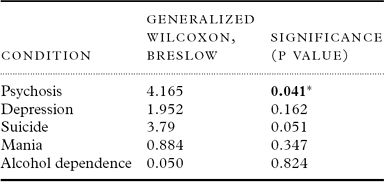
Table 2 shows the significance of difference in the survival functions between proband families and control families for various psychiatric disorders. Morbid risk and the significance testing between the groups revealed a significant difference in the presence of psychosis in the families of dementia probands versus control families (Figure 1).
Survival functions between proband families and control families for various psychiatric disorders
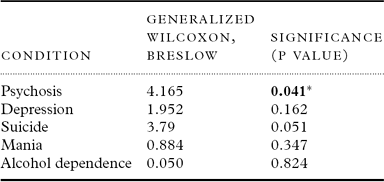
*Statistically significant.
Survival statistics for psychosis in the families.

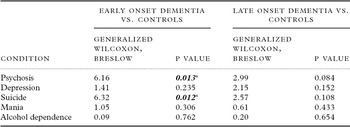
Similar comparisons between early onset and late onset dementia with controls revealed the results shown in Table 3. In this comparison, there was a significantly higher occurrence of psychosis and suicide in the early onset dementia group families when compared to the control group families.
Psychiatric disorders in the early onset and late onset dementia group families when compared to the control group families

*Statistically significant.
Discussion
The results of the present study show that there is no increase in cumulative risks for depression, alcoholism and bipolar illness in the families of probands when compared to families of controls. None of the subjects had co-morbid concurrent depression and hence this result may be interpreted as agreeing with the studies that detected depression in families of dementia probands with co-morbid depression only. Similarly, the authors do not have sufficient data to substantiate any evidence of association with alcoholism and bipolar disorder. Considering the negative finding of these disorders in families in this study also, one can assume that there is no significant genetic association between these disorders and dementia. A higher cumulative incidence of suicides in proband relatives is also an interesting finding. Even though the exact reason for suicide could be ascertained in only two relatives of probands (subsequent to psychotic illness in one and to depressive illness in the other), it still demonstrates an increase in psychiatric illnesses in proband families compared to control families.
Psychosis in families of probands with dementia: a possible explanation
What is very intriguing in the results of the present study is the finding of familial association between dementia and non-affective psychosis. A multigenerational early onset familial non-AD dementia with prominent schizophreniform psychosis has been described (Bird et al., Reference Bird1997). There is emerging evidence that Alzheimer's disease with psychosis (AD + P) is more prevalent among the affected siblings of AD + P probands than among the affected siblings of AD subjects without psychosis. Sweet et al. (Reference Sweet, Nimgaonkar, Devlin, Lopez and DeKosky2002) examined the familial risk of AD+P in a larger cohort of 371 AD probands and 461 of their siblings also diagnosed with AD, recruited and characterized as part of the National Institutes of Mental Health AD Genetics Initiative. There was a significant association between proband psychosis status and the occurrence of AD+P in siblings. Initial studies conducted in unrelated AD+P and AD without psychosis subjects has found associations of candidate genes consistent with this model. One of these, DRD3, has also been associated with a small but significant increase in the risk of schizophrenia in both case–control and family studies (Williams et al., Reference Williams1998).
If genetic factors underlying idiopathic psychoses (e.g. schizophrenia) increase susceptibility for AD+P, an increased morbid risk for idiopathic psychoses could be expected among relatives of AD+P probands. Studies by Rubin et al. (Reference Rubin, Kinscherf and Morris1993) and Mangone et al. (Reference Mangone, Castano and Levy1995) reported that EOAD patients exhibit prominent psychiatric features, with nearly 40% of patients experiencing mild EOAD also manifesting psychiatric symptoms.
Proposed model to explain the genetic association between dementia and psychosis
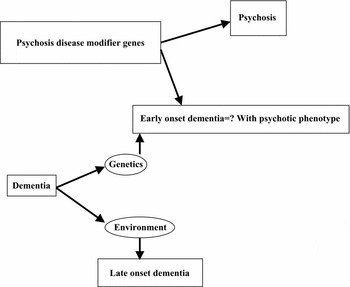
Conventionally, psychosis receives a direct etiological contribution from a neurodevelopmental basis and dementia from neurodegeneration. The theoretical framework of neurodegeneration in psychosis must also be kept in mind. When the possibility of psychosis disease modification genes (Sweet et al., Reference Sweet, Nimgaonkar, Devlin and Jeste2003) are considered, one could assume that they have a regulatory role in the non affective psychoses which bear a greater degenerative element and outcome. The dementia with a psychotic phenotype also could be receiving regulatory inputs from these genes. As some earlier studies have shown, early onset dementias manifest more psychotic phenotypes and a link can thus be drawn between such types of dementias and psychosis (Figure 2).
Proposed model to explain the genetic association between dementia and psychosis.

The study has its own limitations. First, the family history method is prone to an information (awareness and recall) bias, since not all psychiatric disorders like depression (Prakash et al., Reference Prakash, Gupta, Singh, Singhal and Verma2007) are reported by family members. Psychosis is a condition with explicit behavioral changes that can be noticed and recalled by the informants, whereas the symptoms of depression, for example, might be difficult for informants to notice. This may explain the lesser reported familial incidence of the latter condition. Secondly, there was lack of blinding for the case and control status of the subjects, which could be a cause for interviewer bias. Only two informants on average were available for the majority of cases recruited, because of practical reasons, which could have affected the sensitivity of the data collected. Since data were collected from a specialty clinic at a tertiary care center, it is possible that the cases evaluated were severe variants of dementia referred from the catchment area.
Despite these limitations, the study also has some strengths. The interviewer was blind to the family history status of probands and controls, even though blinding was not feasible for the diagnosis status of probands and controls. The sample size was satisfactory for a single-center family study which was at par for the sample sizes (of the pool of relatives) in the earlier well-conducted studies. This study used a semi-structured instrument – FIGS – to ascertain family history. Our study findings need to be replicated with cross-cultural studies, preferably population-based, in a bigger sample of EOAD and LOAD patients.
Conflict of interest
None.
Description of authors' roles
Janardhanan C. Narayanaswamy was the primary investigator of the study. The other authors, all consultants in the geriatric clinic, were involved in supervising the study, providing guidance to the principal investigator and recruiting subjects at the clinic. In addition, K. Thennarasu provided guidance with the statistical analysis.