Transcatheter pulmonary valve implantation to treat dysfunctional right ventricle-to-pulmonary artery conduits is performed typically from a transfemoral approach, although studies also report the use of the transjugular approach.Reference McElhinney, Hellenbrand and Zahn 1 – Reference Armstrong, Balzer and Cabalka 5 Other than in patients with occluded femoral veins, it is not known which group of patients may benefit from the transjugular approach. In some patients, the transjugular approach allows for an easier wire and catheter course than that achieved from the transfemoral route. Changing from the transfemoral to the transjugular site for transcatheter pulmonary valve implantation during the procedure requires a complete revision of the procedural set-up and takes significant time. Increased procedural time under general anaesthesia may put the patient at risk for procedural complications, such as brachial plexus injury. The patients who can have a faster and easier transcatheter pulmonary valve implantation from a transjugular approach compared with the transfemoral approach are not currently known. If such patients can be identified before the procedure, the case time could be decreased by preparing the transjugular site initially and avoiding prolonged attempts from the transfemoral approach. This could potentially lead to decreased radiation exposure and procedural complications. The primary objective of this study was to identify patients who may benefit from the transjugular approach for transcatheter pulmonary valve implantation. Secondary objectives were to determine the safety and efficacy of the transjugular approach compared with the transfemoral approach and to evaluate the impact of transitioning from a transfemoral to transjugular approach in the middle of a procedure, including radiation exposure and procedural duration.
Methods
After obtaining institutional review board approval, we performed a multicentre retrospective study of all attempted Melody™ Transcatheter Pulmonary Valve implantations in the right ventricular outflow tract between April 2010 and June 2012 at two large congenital heart centres. Patients were divided into cohorts based on the venous access site – transfemoral or transjugular – that was ultimately used to attempt valve implantation. Patient clinical characteristics and pre-procedural assessment of cardiovascular anatomy and physiology by echocardiogram, MRI, and catheterisation were collected. To better delineate the reasons for utilising transjugular access, we subdivided the transjugular cohort into those patients in whom the transjugular approach was used because of technical limitations – for example, inability to cross conduit or maintain wire position – versus vascular limitations – for example, femoral veins too small or known femoral venous occlusion. In addition, we subdivided the transjugular cohort into those patients in whom the transjugular approach was utilised from the onset of the procedure (transjugular only) and those patients who failed the transfemoral approach and were converted to using the transjugular approach (conversion). Procedural characteristics such as fluoroscopy time, procedural length, procedural complications, and procedural success were also collected.
Data are presented as frequency (percentage) for categorical variables and as median (interquartile range) or mean±standard deviation, as appropriate, for continuous variables. To identify the factors associated with the transjugular approach, univariate comparison between the transfemoral and transjugular approach was performed for patient and clinical characteristics. The χ 2 test or Fisher’s exact test was used for categorical variables, and Wilcoxon’s rank sum test or the t-test was used for continuous variables. Similar univariate comparison was also made in subgroups, such as transfemoral versus transjugular approach in patients with right ventricle-to-pulmonary artery conduits and transfemoral versus each transjugular subgroup, technical limitations and vascular limitations. Procedural outcomes and complications were compared among or between groups using the Kruskal–Wallis test, Analysis of variance, Wilcoxon’s rank sum test, or Fisher’s exact test, as appropriate. All the analyses were performed using SAS version 9.3 (SAS Institute, Cary, North Carolina, United States of America), with statistical significance at a p-value <0.05.
Results
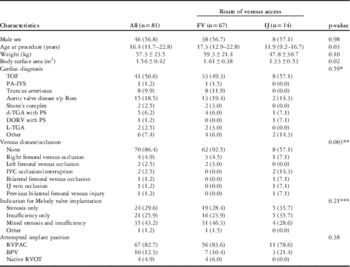
A total of 81 patients underwent attempted transcatheter pulmonary valve implantation at a median age of 16.4 years (Table 1). The majority of patients (51%) had tetralogy of Fallot, and 83% of the attempted implantations were in conduits. There was an approximately equal number of patients referred for attempted valve implantation for the indications of conduit or bioprosthetic valve stenosis, insufficiency, or mixed dysfunction.
Demographic and clinical characteristics of patients undergoing attempted Melody valve implantation: transfemoral, femoral vein (FV), approach versus transjugular, internal jugular vein (IJ), approach.
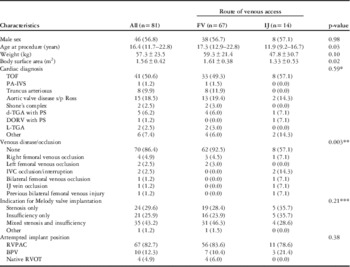
BPV=bioprosthetic pulmonary valve; DORV=double-outlet right ventricle; d-TGA=d-transposition of the great arteries; L-TGA=levo-transposition of the great arteries; PA-IVS=pulmonary atresia with intact ventricular septum; PS=pulmonary stenosis; RVOT=right ventricular outflow tract; RVPAC=right ventricle-to-the main pulmonary artery conduit; s/p=status post; TOF=tetralogy of Fallot
* Comparison was made between TOF versus all others, and p-value was from the χ 2 test
** Comparison was made between none versus yes (all others), and p-value was from Fisher’s exact test
*** Comparison was made between mixed stenosis and insufficiency versus all others, and p-value was from the χ 2 test
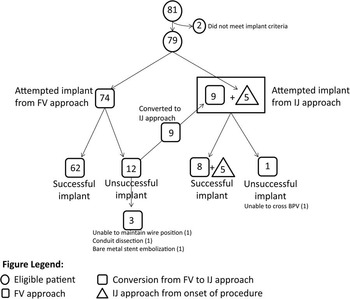
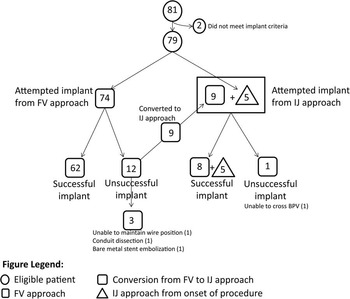
The overall success rate of transcatheter pulmonary valve implantation from a transfemoral approach was 84% (Fig 1). The transjugular approach was used in 14 patients: five patients from procedural onset and nine patients following conversion to a transjugular approach after unsuccessful valve implantation from a transfemoral approach. Valve implantation was successful in 13 of the 14 patients using the transjugular approach. Therefore, the ultimate successful rate of transcatheter pulmonary valve implantation from a transjugular approach was 93%.
Implantation success during transcatheter pulmonary valve implantation from both the transfemoral and the transjugular approaches. BPV=bioprosthetic valve; FV=femoral venous; IJ=internal jugular.
Factors associated with the transjugular approach for transcatheter pulmonary valve implantation
There were no differences in gender, cardiac diagnosis, previous cardiac surgery, or indication for transcatheter pulmonary valve implantation between the two approaches (Table 1). Patients in the transjugular cohort, however, were younger, had lower body surface area, and were more likely to have venous occlusion compared with the transfemoral cohort.
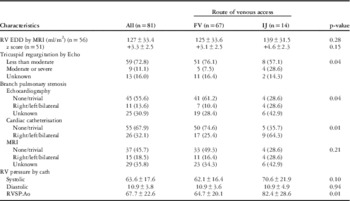
Comparing the haemodynamic and structural characteristics between the cohorts, there were no differences in right ventricular size (Table 2). More patients in the transjugular cohort, however, had moderate or greater tricuspid regurgitation and branch pulmonary artery stenosis. Although the absolute right ventricular systolic pressure was similar between cohorts, the transjugular approach was associated with a higher ratio of the right ventricular systolic pressure to systemic blood pressure.
Haemodynamic and structural characteristics of patients undergoing attempted Melody valve implantation: transfemoral, femoral vein (FV), approach versus transjugular, internal jugular vein (IJ), approach.
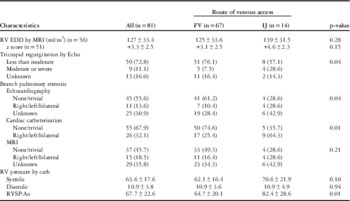
Cath=catheterisation; Echo=echocardiogram; EDD=end-diastolic dimension; MRI=magnetic resonance imaging; RV=right ventricular; RVSP:Ao=right ventricular systolic pressure-to-aortic pressure ratio (percentage systemic)
When analysing attempted valve implantation in conduits only, excluding bioprosthetic pulmonary valves or native right ventricular outflow tracts, there were no differences in the conduit type, age of conduit, conduit implant size, current conduit size, or position of the conduit – orthotopic versus heterotopic – between the transfemoral and transjugular cohorts. Similarly, in the overall cohort, there were no differences in the indications for valve implantation.
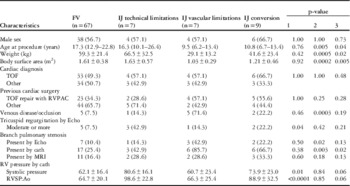
In an attempt to better understand the reasons why and how the transjugular approach was used to get better insight into the factors associated with the transjugular approach, we subdivided the transjugular cohort into two groups (Table 3). First, we separated the cohort based on the reason for pursuing a transjugular approach: technical limitations versus vascular limitations. There were seven patients in each group (Table 3). Technical limitations included inability to cross the conduit (n=4), inability to maintain distal wire position (n=1), inability to access the distal pulmonary arteries (n=1), and an undefined inability to complete the procedure from the transfemoral approach (n=1). The vascular limitations group consisted of patients with bilateral femoral venous occlusion (n=3), inadequate femoral venous size (n=3), and interrupted inferior caval vein (n=1). Comparing these subgroups with the transfemoral cohort, the technical limitations group had significantly more patients with moderate or greater tricuspid regurgitation and a higher right ventricle-to-systemic blood pressure ratio compared with the transfemoral cohort. In the vascular limitations group, younger age, lower weight and body surface area, and the presence of venous occlusion and branch pulmonary artery stenosis were associated with the transjugular approach compared with the transfemoral approach.
Patient characteristics for attempted Melody valve implantation stratified by route of venous access, reason, and timing for using the transjugular approach.
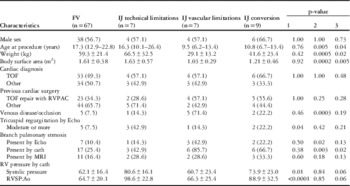
Cath=catheterisation; Echo=echocardiogram; FV=femoral venous; IJ=internal jugular; MRI=magnetic resonance imaging; RV=right ventricle; RVPAC=right ventricle-to-the main pulmonary artery conduit; RVSP:Ao=right ventricular systolic pressure-to-aortic pressure ratio (percentage systemic); TOF=tetralogy of Fallot
P-value 1 from Fisher’s exact test for categorical variables and Wilcoxon’s rank sum test or the t-test for continuous variables on comparison of each characteristic between FV versus IJ due to technical limitations of the femoral venous approach
P-value 2 from Fisher’s exact test for categorical variables and Wilcoxon’s rank sum test or the t-test for continuous variables on comparison of each characteristic between FV versus IJ due to vascular limitations of the femoral venous approach
P-value 3 from Fisher’s exact test for categorical variables and Wilcoxon’s rank sum test or the t-test for continuous variables on comparison of each characteristic between FV versus IJ conversion
The second way by which we subdivided the transjugular approach cohort was by the timing of when the transjugular approach was utilised: transjugular approach from the onset of the procedure (transjugular only) versus transjugular approach after a failed attempt from the transfemoral approach (conversion). Owing to the small number of patients in the transjugular only group, we only compared the transfemoral venous cohort with the conversion cohort. Of the nine patients in the conversion subgroup, the reasons for conversion to the transjugular approach included inability to cross the conduit (n=4), inadequate femoral venous size (n=3), and inability to access the distal pulmonary arteries or maintain distal wire position (n=2). Comparing this subgroup with the transfemoral approach group, younger age, lower weight and body surface area, and branch pulmonary artery stenosis were associated with the transjugular group.
Impact of the transjugular approach
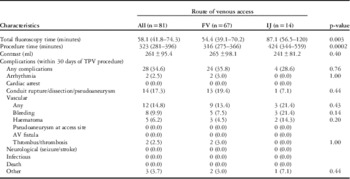
There were no differences in procedural complications between the transfemoral and transjugular cohorts (Table 4). Patients in the transjugular cohort had more fluoroscopic time and longer procedural duration. When further subdivided into groups with patients in whom the transjugular approach was used from the start of the procedure (transjugular only) and those in whom the procedure was started from a transfemoral approach and then converted to a transjugular approach (conversion), the transfemoral and the transjugular only groups had very similar fluoroscopic and procedural times, whereas the conversion group had significantly longer fluoroscopic and procedural times (Table 5).
Procedural characteristics and complications in patients undergoing attempted Melody valve implantation: transfemoral, femoral vein (FV), approach versus transjugular, internal jugular vein (IJ), approach.
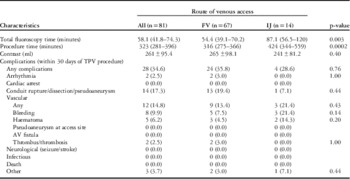
AV=arteriovenous; TPV=transcatheter pulmonary valve
Procedural characteristics in patients undergoing attempted Melody valve implantation comparing the transfemoral, femoral vein (FV), approach, the transjugular, internal jugular vein (IJ), approach from the onset of the procedure, and the transjugular approach after attempted transfemoral approach.

* P-value from the Kruskal–Wallis test or analysis of variance, as appropriate, on comparison of each characteristic among the three venous access approaches
** P-value from Wilcoxon’s Rank Sum test or t-test, as appropriate, on comparison of each characteristic between FV only versus IJ only and FV only versus FV to IJ conversion
Discussion
In patients with congenital heart disease requiring placement of a right ventricle-to-pulmonary artery conduit, conduit failure due to conduit stenosis, insufficiency, or both is inevitable.Reference Batlivala, Emani, Mayer and McElhinney 6 – Reference Wells, Arroyo, Bremner, Wood and Starnes 9 With the advent of transcatheter pulmonary valve implantation, conduit dysfunction can now be treated from a percutaneous approach.Reference McElhinney, Hellenbrand and Zahn 1 – Reference Fraisse, Aldebert and Malekzadeh-Milani 3 , Reference Armstrong, Balzer and Cabalka 5 , Reference Bonhoeffer, Boudjemline and Saliba 10 – Reference Zahn, Hellenbrand, Lock and McElhinney 15 At present, the only approved transcatheter pulmonary valve available in the United States is the Melody valve. In the experience of the two institutions participating in this study, transcatheter pulmonary valve implantation from a transjugular approach is feasible and is often successful even after unsuccessful attempts of valve implantation from the transfemoral approach. The transjugular approach has been reported in both the initial multicentre United States Investigational Device Exemption trial and the Post-Approval Study for the Melody valve, as well as in several international Melody valve implantation registries.Reference McElhinney, Hellenbrand and Zahn 1 – Reference Fraisse, Aldebert and Malekzadeh-Milani 3 , Reference Armstrong, Balzer and Cabalka 5 Although used in the minority of procedures, 2–13% of the transcatheter pulmonary valves have been successfully implanted from a transjugular approach.Reference McElhinney, Hellenbrand and Zahn 1 – Reference Fraisse, Aldebert and Malekzadeh-Milani 3 , Reference Armstrong, Balzer and Cabalka 5
Factors associated with the transjugular approach for transcatheter pulmonary valve implantation
Higher right ventricle-to-systemic blood pressure ratio was associated with the need for the transjugular approach for transcatheter pulmonary valve implantation. The causes for elevated right ventricular pressure include conduit stenosis, branch pulmonary stenosis, and pulmonary hypertension, all of which might make catheter manoeuvring and maintaining wire position difficult from the transfemoral route. The absolute right ventricular systolic blood pressure was not significantly associated with the transjugular approach, however. This may have been due to the fact that the transjugular group was overall younger and smaller, and may have had lower systemic blood pressures under general anaesthesia, causing the right ventricle-to-systemic pressure ratio to be significantly higher. In fact, for the transjugular approach patients in the technical failures subgroup, which included patients of similar age and weight to the transfemoral cohort, both higher absolute right ventricular systolic pressure and higher right ventricle-to-systemic blood pressure ratio were highly associated with the transjugular approach compared with the transfemoral approach. Branch pulmonary stenosis, assessed by echocardiogram and/or catheterisation, was also found to be associated with the transjugular approach, but this association was only seen in the vascular limitations group. When controlling for the degree of conduit stenosis, there was still a significant association between the transjugular approach and the right ventricle-to-systemic pressure ratio compared with the transfemoral approach (odds ratio 1.05, 95% confidence interval 1.01–1.09, p=0.01). Although the clinical significance and connection between higher right ventricle-to-systemic pressure ratio and difficult transcatheter pulmonary valve implantation from a transfemoral approach is not clearly understood, this finding does suggest that in smaller children with higher estimated right ventricular pressures primary implantation from the transjugular approach should be considered.
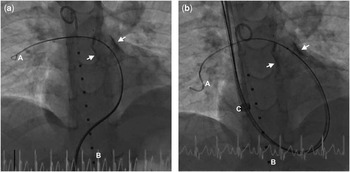
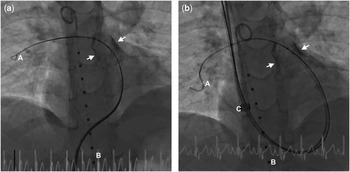
Moderate or greater tricuspid regurgitation was also more common in the transjugular cohort. Given the “S”-shaped catheter course when crossing the right ventricular outflow tract from the transfemoral approach (Fig 2a) compared with the “U”-shaped catheter course from the transjugular approach (Fig 2b), significant tricuspid regurgitation, especially in the setting of elevated right ventricular pressures, could create difficulty in maintaining stable catheter and wire positions across the right ventricular outflow tract from the transfemoral approach.
Catheter course from the transfemoral and the transjugular approaches in a patient with double-outlet right ventricle with a calcified right ventricle-to-pulmonary artery conduit (arrows). From the transfemoral approach ( a ), there is an “S”-shaped wire course from the inferior caval vein, across the tricuspid valve, and into the conduit. From the transjugular approach ( b ), the wire and catheter course is “U” shaped from the superior caval vein, across the tricuspid valve, and into the conduit. In this patient, we were unable to advance the catheter beyond the conduit, prompting the transjugular approach. A, wire position in the distal right pulmonary artery; B, multiple marker pigtail catheter in the descending aorta for angiographic measurement calibration purposes; C, long sheath positioned from the right internal jugular vein into the mid-right atrium.
Younger and smaller patients also appear to benefit from a transjugular approach. This is consistent with findings from a recent publication that assessed the feasibility of the Melody valve implantation in patients <30 kgReference Berman, McElhinney, Vincent, Hellenbrand and Zahn 4 . Technical limitations aside, vascular limitations become very important considerations during transcatheter pulmonary valve implantation in small children. The internal jugular vein is typically larger than the femoral vein, and the transjugular approach offers a smooth “U”-shaped catheter course from the superior systemic venous return into the branch pulmonary artery, typically the right pulmonary artery, in most patients.
Impact of the transjugular approach
As we observed in this study, converting from a transfemoral approach to a transjugular approach after the start of the procedure is associated with more radiation exposure to the patient and longer procedural length. Procedures that started with a transjugular approach, however, were very similar to those completed with a transfemoral approach with regard to procedural length and radiation exposure. This underscores the importance of pre-procedural planning and attempting to predict who may benefit from starting with a transjugular approach.
Overall, the transjugular approach had a similar complication profile as the transfemoral approach. More importantly, the rate of successful transcatheter pulmonary valve implantation was higher for the transjugular approach compared with the transfemoral approach, which is notable because the majority (9/14) of patients in the transjugular cohort had attempted valve implantation from a transfemoral approach. The one patient who had unsuccessful valve implantation from a transjugular approach was also in this group, where it was not possible to cross a bioprosthetic valve and maintain wire position in the patient with a large right ventricular outflow tract aneurysm. Potentially, eight patients might have required surgical conduit or bioprosthetic valve replacement, if the transjugular approach was not attempted.
There are, however, non-measured disadvantages of the transjugular approach. Most cardiac catheterisation laboratories are set-up assuming the operator is standing at the patient’s right groin. Therefore, most fixed radiation barriers are positioned based on this assumption. During cases where a transjugular approach is being used, the primary operator receives high radiation doses.Reference Chen, Yao, Zhang and He 16 Radiation shielding for the head of the table should be optimised as much as possible, especially during prolonged procedures.Reference Fetterly, Magnuson, Tannahill, Hindal and Mathew 17 In addition, the positioning of the anaesthesia equipment and other standard catheterisation laboratory equipment may not be well suited to performing procedures with long wires and catheters from the transjugular approach. In our experience, most of these barriers can be overcome but require thoughtful planning. Brachial plexus injury has also been reported during prolonged cardiac catheterisations.Reference Liu, Wong and Leung 18 Given the duration of many transcatheter pulmonary valve implantation procedures, in our study ranging from 4 to 10 hours, this is definitely a risk for our patients. Special care must be taken when working from the transjugular approach to avoid placing additional pressure on the ipsilateral arm during catheter manipulation causing iatrogenic nerve injury. Finally, maintenance of a completely sterile procedural field is paramount during transcatheter pulmonary valve implantation, especially in light of the incidence of infective endocarditis, which has been reported in nearly every follow-up study of patients after Melody valve implantation.Reference Butera, Milanesi and Spadoni 2 , Reference Fraisse, Aldebert and Malekzadeh-Milani 3 , Reference Armstrong, Balzer and Cabalka 5 To date, there has been no association between infective endocarditis and procedural technique, but this will require continued evaluation.
Limitations
The main limitation of this study is its retrospective design, which makes understanding the choice to transition to a transjugular approach challenging. Specifically, it is possible that all patients who underwent attempted or successful valve implantation from the transfemoral approach might have benefitted from the transjugular approach. Our data help in identifying specific patient factors associated with the inability to successfully implant a valve from the transfemoral approach, but it cannot determine whether all the patients would have benefitted if only the transjugular approach was utilised. This would best be evaluated with a prospective randomised study. Moreover, when broken into several subgroups, the sample sizes were small, which may have limited our ability to detect some differences between groups.
Conclusions
Transcatheter pulmonary valve implantation in small patients and in patients with elevated right ventricular pressures or significant tricuspid regurgitation may be challenging from a transfemoral approach. The transjugular approach should be considered early in these patients and may help in shortening procedural duration and lower radiation exposure to patients during these complex procedures.
Acknowledgements
None.
Financial Support
This research received no specific grant from any funding agency, commercial, or not-for-profit sectors.
Conflicts of Interest
Dr. Armstrong has a research grant from Medtronic, Inc. Dr. Zahn is a consultant for Medtronic, Inc. There are no conflicts of interest among the rest of the authors of this manuscript.
Ethical Standards
Given the retrospective nature of this research project, the research does not involve direct human or animal experimentation; however, institutional review board approval was secured at both the University of Michigan and Miami Children’s Hospital.