Introduction
Fruit flies (Diptera: Tephritidae) are medium-sized flies that have characteristic wing patterns and occur in the temperate, tropical and subtropical regions of the world (Foote & Steyskal, Reference Foote, Steyskal, McAlpine, Peterson, Shewell, Teskey, Vockeroth and Wood1987; White & Elson-Harris, Reference White and Elson-Harris1992). They are known to undergo rapid host-race formation and sympatric speciation. Host races can be described as sympatric populations with distinct host preferences that show genetic differentiation with a reduced level of gene flow (Diehl & Bush, Reference Diehl and Bush1984). Such populations can be morphologically similar (Zwölfer & Harris, Reference Zwölfer and Harris1971) and still maintain reproductive isolation through distinct host preference in the absence of other barriers to gene flow (Bush, Reference Bush and Price1975). They are considered ‘intermediates in the continuum between polymorphisms and full species’ and, therefore, provide evidence for sympatric speciation (Drès & Mallet, Reference Drès and Mallet2002). Biological attributes, such as mating on the host plant, host fidelity and positive correlation between host and mate selection, in addition to genetic control of host selection, allow the establishment and formation of new host races in areas of sympatry (Bush, Reference Bush and Price1975; Drès & Mallet, Reference Drès and Mallet2002).
A survey of the tephritids associated with thistles (Asteraceae) in Lebanon revealed 18 tephritid species associated with 21 species of thistles. Among those species, Chaetostomella cylindrica (Robineau-Desvoidy, Reference Robineau-Desvoidy1830) was found to behave as a generalist infesting six genera and ten species of thistles of the tribe Cardueae (Asteraceae: Lactucoideae) (Knio et al., Reference Knio, Kalash and White2002). These flies were commonly reared from two hosts that occurred in sympatry in May and June, Notobasis syriaca (L.) Cass. and Onopordum illyricum L. The flies reared from O. illyricum showed several morphological differences and were referred by Knio et al. (Reference Knio, Kalash and White2002) as ‘Chaetostomella cylindrica possibly lurida’. The flies reared from N. syriaca and other hosts (except Onopordum spp.) closely matched the description of C. cylindrica by having black spots at the base of the prescutellar setae and a black pattern on the mesonotum, as opposed to small faint brown spots or none at the base of prescutellar setae and grey or tan pattern on the mesonotum in the Onopordum-associated host race (Knio et al., Reference Knio, Kalash and White2002).
Comparing these two host races morphologically and morphometrically showed that the immatures of the Notobasis-associated population and the Onopordum-associated population were similar, but all stages of the Onopordum-associated race were significantly larger, reflecting the larger size of the flower heads exploited. Morphometric studies of two head and five wing measurements for 60 flies from each host plant demonstrated that the means of the seven measured characters differed significantly for males and females within and between the two populations. Canonical discriminant analysis (CDA) of the seven characters allowed differentiating between the two populations with 70% accuracy. Principal component analysis showed that the length of the preapical cross band on the wing, as well as the head width followed by the head height, were good characters to separate the two host populations. Other significant morphological differences were detected in the aculeus length and shape of the female flies. The aculeus of the Onopordum-associated flies was longer, a little wider and somewhat blunter that of the Notobasis-associated flies. This longer aculeus was needed by the females exploiting O. illyricum to insert their eggs in the larger flower-heads of their host plant (Knio et al., Reference Knio, White and Al-Zein2007).
It is not known whether gene flow exists between the Notobasis- and Onopordum-associated populations, which occur in sympatry and slightly overlap. It is also possible that the Onopordum-associated host race could be a distinct, cryptic species, possibly C. lurida. Recently, Basov (Reference Basov2000) described a new species of Chaetostomella from Russia associated with Serratula coronata L., C. zhuravlevi. This species was differentiated from C. cylindrica based on the aculeus length and shape and some other morphometric measurements (Basov, Reference Basov2000).
Therefore, Chaetostomella cylindrica appears to be a polymorphic complex of numerous host races that show different levels of reproductive isolation in the Western Palaeartic (V. Korneyev, personal communication). These populations may represent distinct cryptic species.
In this study, we report evidence that the Notobasis and Onopordum-associated host populations in Lebanon are distinct races with no or very restricted gene flow.
Materials and methods
Flower head collection and identification
Flower heads of the thistles Notobasis syriaca (L.) Cass. and Onopordum illyricum L. (Asteraceae) were collected from various sites in Lebanon, from sea level up to an altitude of 2000 m. Each sample consisted of 60–100 mature flower heads, randomly picked and then identified using Post (Reference Post1932) and Edgecombe (Reference Edgecombe1970), and by comparison with voucher specimens from the Post Herbarium (BEI).
Resource utilization studies
A subsample of the collected flower heads from each location, consisting of 40–70 flower heads, was dissected under a stereomicroscope. The following characteristics were recorded: size of the flower head (width and length); number of intact achenes; number of damaged achenes; number, stage, and position of immatures found (eggs, larvae, pupae).
Rearing of adult flies from flower heads
Flower head samples from each site were placed in glass-topped, sleeve insectary cages (35×35×37 cm) under fluorescent light (12:12 h cycle) and monitored for insect emergence (Goeden, Reference Goeden1985). The emerging flies were identified using Korneyev (Reference Korneyev1986), White (Reference White1988) and Freidberg & Kugler (Reference Freidberg and Kugler1989). The adults to be used for genetic studies were stored at −70°C. Voucher specimens of the flies were deposited in the Natural History Museum, American University of Beirut.
Comparative behavioural studies of the adults
The oviposition, courtship, mating and post-mating behaviours of adults from the Notobasis- and Onopordum-associated populations were studied both in the field and in the laboratory. In the field, courtship and oviposition behaviours were observed on the host plants. The flower heads in which females were seen to lay eggs were collected and brought to the lab to record the number of eggs laid, position of the eggs in the flower heads and how the eggs were placed. In the laboratory, courtship, mating and post-mating behaviours were studied by observing paired adult males and females from each host population. Each pair was placed in transparent plastic containers and supplied with honey and water. Cross-mating studies were attempted in the laboratory. Two sets of crosses were performed: Notobasis-associated adult males were paired with Onopordum-associated adult females (n=4), and Notobasis-associated adult females were paired with Onopordum-associated adult males (n=4) in separate transparent plastic containers and supplied with honey on the inner wall of the containers and cotton swabs wetted with water. Any interaction between the couples was recorded.
Genetic studies
Specimens
Chaetostomella cylindrica adults were reared from flower heads of N. syriaca collected from: Mount Lebanon: 1M and 1F (June 2003), 1M and 1F (June 2005) Aley, Aley Co. (June 2003); 2M (June 2005) Deir El Kamar, Chouf Co.; 2M (May 2007) Arayya, Baabda Co.; 2M (May 2007) Jounieh, Metn Co.; 1M (May 2007) Sfayla, Metn Co. Beqaa Valley: 1M and 2F (May 2007) Ammiq, West Beqaa Co. North Lebanon: 1M (April 2007) Batroun, Batroun Co.
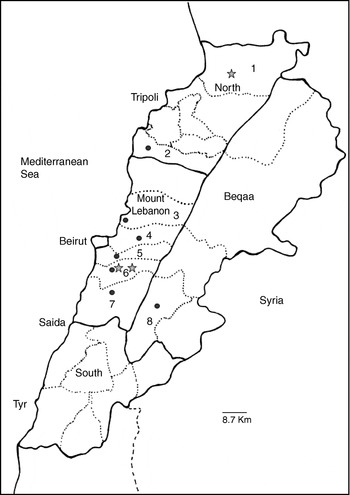
Adults of the second host race were reared from flower heads of Onopordum illyricum collected from: Mount Lebanon: 1 F (June 2002), 5 M and 2 F (June 2005) Aley, Aley Co.; 2 M (June 2005) Bhamdoun, Aley Co. North Lebanon: 4 M (August 2002) Qammouah, Akkar Co. Figure 1 shows the various collection sites for the two host plants.
Map of Lebanon showing the collection sites for Notobasis syriaca (represented as dots) and Onopordum illyricum (represented as stars). North Lebanon: (1) Akkar Co., (2) Batroun Co. Mount Lebanon, (3) Kesrouan Co., (4) Metn Co., (5) Baabda Co., (6) Aley Co., (7) Chouf Co. Bequaa Valley and (8) West Bequaa Co.

Mitochondrial DNA extraction
Fly mitochondrial DNA was extracted from frozen flies using the following method. Frozen flies were thawed, placed in 1.5 ml microfuge tubes, crushed with a glass rod, and 200 μl of grinding buffer (10 mM Tris-HCl pH 7.8, 60 mM NaCl, 300 mM sucrose, 10 mM EDTA pH 8) was added. The samples were ground further, 200 μl of lysis buffer (300 mM TrisHCl pH 7.8, 1% sodium dodecyl sulfate, 20 mM EDTA pH 8) was added and the samples were kept on ice 30 min. Each sample was centrifuged 5 min at 15,000 g; 300 μl of supernatant was then transferred to a fresh tube and 400 μl of 4 M NaCl was added with mixing. The samples were centrifuged 5 min at 15,000 g, 650 μl of supernatant was transferred to a fresh tube, and 1 ml of absolute ethanol was added. After 30 min on ice, the tubes were centrifuged 15 min at 15,000 g, the supernatant was discarded, 500 μl of 75% ethanol was added and the samples were centrifuged again for 5 min at 15,000 g. After a final wash with 100 μl of 75% ethanol, the pellet was allowed to dry in air and was resuspended in 200 μl of TE (10 mM TrisHCl pH 7.8, 1 mM EDTA pH 8). The DNA extracts were stored at −20°C.
Amplification of mtND1 gene
A fragment of the mitochondrial ND1 gene (NADH dehydrogenase subunit 1) was amplified using primers of Smith et al. (Reference Smith, Krager, Cronin and Kambhampati2002), altered to include a degenerate position in the sense primer. The antisense primer (ND1-FD) sequence is 5′-ATCATAACGAAAYCGAGGTAA-3′, and the sense primer (ND1-RD) sequence is 5′-CAA CCT TTT WGT GAT GC-3′; where Y=C+T and W=A+T. The degeneracies account for most known polymorphisms in dipterans.
PCR reactions of 20 to 50 μl used 1 μl of DNA extract and the following final reagent concentrations: 500 nM forward primer, 500 nM reverse primer, 200 μM each dNTP, 1.5 mM MgCl2, 50 mM KCl, 10 mM TrisHCl pH 8.3 at 25°C and one unit Taq (made following protocol of Engelke et al., Reference Engelke, Krikos, Bruck and Ginsburg1990). The amplifications were performed using the following program: one cycle at 94°C for 3 min; 35 cycles at 93°C for 30 s, 50°C for 30 s, 72°C for 45 s; one cycle at 72°C for 10 min.
Sequencing and phylogenetic analysis
As much as 40 μl PCR product was purified by electrophoresis through 1% agarose gels onto filter paper. The DNA was eluted from the paper by centrifugation, ethanol precipitated and resuspended in 10 μl of TE. Ethidium bromide staining of agarose gels was used to estimate sample concentrations by comparison to plasmid DNA of known concentration.
Approximately 150 pmole of PCR product was mixed with 10 pmole of primer ND1-FD, sequenced at the AUB Molecular Biology Core Service with BigDye terminator cycle sequencing (Applied Biosystems) and analyzed on an ABI3100-Avant Genetic Analyser. Sequences were visualized with ChromasLite (Technelysium). The two sequences have been deposited with GenBank under accession numbers FJ200198 (Chaetostomella cylindrica, Notobasis-associated) and FJ200199 (Chaetostomella cylindrica, Onopordum-associated).
RFLP analysis
Unpurified PCR products were digested with Tru9 I (Roche) in 20 μl reactions containing 5 μl PCR product, 2 μl 10× M buffer (Roche), 12.5 μl water, 0.5 μl Tru9 I (10 unit μl−1), at 65°C for 60 min. The complete reaction was loaded on 4% agarose (3:1 High Resolution Blend, ABgene) with 1 μg ml−1 ethidium bromide and electrophoresed using 1× TBE (0.9 M Tris-borate, 2 mM EDTA) at 10 volts cm−1 for one hour. A mixture of DNA fragments (73 bp, 174 bp, 330 bp, 488 bp) was used as size standards.
Results
Resource utilization studies
Larvae of the Notobasis-associated flies fed inside the flower heads, each infesting 3–8 achenes, and occasionally lightly scoring the base of the receptacle. An average of 1.4±0.08 (mean±SE) larvae per flower head (range: 1–3; n=49) were found inside open flower heads of average length 2.51±0.18 cm (n=49) and average maximum diameter 1.28±0.13 cm (n=49). The puparium formed inside the flower head and is probably the over-wintering stage, since late in the season when the flower heads dried pupae were found inside them.
Dissection of collected flower heads of N. syriaca from various samples demonstrated that the percent infestation of flower heads with larvae of C. cylindrica per sample averaged 9.8±1.4 (1.5–18.8%; n=14).
Larvae of the Onopordum-associated flies fed inside the flower heads, each infesting 4–2 achenes, and often scoring the base of the receptacle. An average of 3.16±0.40 arvae per flower head (range: 1–11; n=30) fed inside the open flower heads of average length 3.53±0.08 cm (n=29) and average maximum diameter 2.11±0.08 cm (n=29). The puparium formed inside the flower head and is, most probably, the over-wintering stage. This is due to the fact that late in the season, when the flower heads dried, pupae were found inside them. Compared to Notobasis, the larger flower heads of Onopordum seem to support more larvae.
Percent infestation of flower heads of O. illyricum with larvae of the Onopordum-associated host race averaged 38.9±2.8 (34.3–40.0%; n=3). This percent infestation by C. cylindrica larvae was higher in the Onopordum flower heads than in the Notobasis flower heads and could be explained by the rare and patchy distribution of O. illyricum in Lebanon, compared to the widespread and more abundant N. syriaca.
Comparative behavioural studies of the adults
Oviposition behaviour
The oviposition behaviour of C. cylindrica females from the Notobasis- and Onopordum-associated populations was found to be different. Notobasis-associated females laid their eggs mainly singly in between the bracts and on the inner side of the bracts of closed, green flower-heads of N. syriaca. In one case out of 15, two eggs were found glued sideways together. The Onopordum-associated females, on the other hand, laid their eggs glued to each other between the bracts of the closed green flower heads of O. illyricum. The number of eggs deposited per head was found to be different between females of the two host races. Notobasis-associated females usually laid one egg per flower head (10 out of 15 dissected closed heads); two or three eggs were sometimes encountered in one flower head (5 of 15 closed heads). Onopordum-associated females deposited 1–11 eggs per head, with an average of 3±1 eggs per head (n=18). The larger number of eggs deposited per flower heads could be attributed to the large size of O. illyricum flower heads compared to the flower head of N. syriaca exploited by C. cylindrica (Knio et al., Reference Knio, Kalash and White2002), which can support the larger number of resulting larvae.
Courtship behaviour
Adult males from both host races were the first to be observed in the field and the first to emerge from collected flower heads in the laboratory. Adult males started to emerge 3–6 days before adult females.
In the field, the Notobasis- and Onopordum-associated adults were observed in copula several times. The male perched on the flower head, which serves as the rendezvous site, awaiting a female. Mating, which took place on the flower head, was observed between 12:00 and 17:00. This does not necessarily indicate that mating occurs only in the afternoon, though Chaetostomella undosa males were mostly active and consequently mated in the warmer, sunny days (Steck, Reference Steck1984).
The courtship, mating and post mating behaviour of C. cylindrica from both host races were observed in the laboratory. In the Onopordum- and Notobasis-associated populations, and prior to mating, the male's abdomen was swollen laterally. The male moved towards and faced the female at a distance of about 1 cm and sometimes closer. While moving sideways in front of the female, the male opened its wings perpendicular to its body axis and raised the blade of the wing 5–10° up and to the front in half circles, as if rowing. The female stood motionless or responded with a few wing vibrations. The male then faced the female, circled to the back and mounted it.
During mating, the wings of the female were at 45° while the wings of the male were at 30–40° with the body axis. The male's head was situated at the thorax-abdomen junction of the female's body, with the male's proboscis touching the female's pre-abdomen. The female's proboscis was constantly moving. The first pair of the male's legs was situated on the female's abdomen, the second on the female's abdomen and sometimes on the substrate and the third on the substrate. From time to time, the female groomed itself. The female sometimes walked around and was able to fly away, carrying its mate, which lifted its hind legs from the substrate, with it.
A post-mating behaviour in the Notobasis-associated population was observed. The male terminated copulation by turning 180° and dismounting the female mainly to the right. The male moved backward while recoiling its aedeagus, until the genitalia of the mating couple separated. Then, the male and female turned in half a circle and faced each other. They made contact with their mouth parts, as if ‘kissing’. This is referred to as post-copulatory ‘kissing’. The wings of the female were held at 90° while the male held its wings at 45° with respect to the body axis. The male vibrated its wings in a flickering manner at an average of 1.7±0.1 vibrations per second (n=11; range: 0.9–2.2) in the Notobasis-associated population. In several cases, the male placed its head under the female's head and sometimes thorax and pushed the female upward. This was repeated several times.
A similar post-mating behaviour was observed in the Onopordum-associated flies, which also involved post-copulatory ‘kissing’. However, a slight difference was observed between the two races. Onopordum-associated males vibrated their wings faster than Notobasis-associated males. The average wing vibrations were 1.90±0.09 vibrations per second (n=16; range: 1.3–2.5) compared to 1.7 vibrations per second in Notobasis-associated flies.
Mating took 178±18 min (n=18) in the Notobasis-associated flies and 127±11 min (n=18) in the Onopordum-associated flies. Multiple mating was also observed in several cases, with re-mating taking less time than the first mating. This suggests that oviposition in these two species requires multiple matings, during which females store enough sperm in their spermatheca to serve them in fertilizing all their eggs directly after mating, and even later in the season, when the males are dead.
The post-mating behaviour observed in the two species under study, particularly the post-copulatory ‘kissing’ behaviour, has been observed in other members of tribe Terelliinae to which members of the genus Chaetostomella belong (Steck, Reference Steck1984; Thompson, Reference Thompson1998). However, it has been considered unusual in members of this genus, such as Chaetostomella undosa (Steck, Reference Steck1984).
The only difference observed in the courtship, mating and post-mating behaviour between the two host races is in the frequency of vibrations of the male's wings directly after mating. This suggests that the two species are closely related and justifies the possibility of cross-mating between adults of the two species in captivity and in the absence of the host plant, which plays an important role in recognition of members of the same species.
Cross-mating studies of adults
Cross-mating tests between adults of the Notobasis- and Onopordum-associated populations of C. cylindrica revealed that the two populations did mate in the laboratory. This is expected due to the similarity in courtship behaviour and due to the absence, under laboratory conditions, of the host plant which serves as a rendezvous site for potential mates and plays a role in species recognition (White, Reference White1988, Reference White and Cavalloro1989). It was difficult to check whether viable offspring could be produced because these are wild flies and the females did not lay any eggs on cotton swabs wetted with water. To obtain eggs, if possible, the insects should have been supplied with fresh flower heads of their host plant, but that would have been difficult because the flower heads of Notobasis were no longer in the ‘closed flower head’ stage, suitable for oviposition, at the time the cross-mating studies were done. Moreover, it is very hard to guarantee that the flower heads, if they were available, have not been previously utilized as oviposition sites without damaging the heads.
The mating of individuals of the two populations in the laboratory does not necessarily suggest a close genetic relationship, let alone membership in the same species. Even if viable offspring can be produced as a result of cross-mating, the two populations may still not meet and mate in the field, especially since non-frugivorous fruit flies heavily rely on their host plant for recognizing mates of the same species (White, Reference White and Cavalloro1989). Therefore, we assume that cross-mating is infrequent under field conditions due to the role that the host plant plays as isolation mechanism. It is also unlikely because by the time the host plants of the Onopordum-associated flies are in bloom, the flower heads of the Notobasis-associated flies would have withered.
Comparative genetic studies of the adults
DNA sequence analysis
Twenty-nine flies (15 Notobasis-associated and 14 Onopordum-associated) were used to amplify a region within the coding sequence of the mitochondrial gene ND1 (NADH dehydrogenase subunit 1). Accurate sequences encompassing a 622 bp region were obtained for two isolates of each group. This region corresponds to Drosophila melanogaster mtDNA region 11871 to 12492 (RefSeq NC_001709). Accurate sequences of a smaller region (corresponding to 12033–12402 of RefSeq NC 001709), were obtained from the remaining 25 isolates.
All specimens yielded one of two distinct sequences corresponding to the host; and, in the sequence from flies associated with Onopordum, five of those sequences showed variations with respect to one base pair (A/G at bp 12380 of the RefSeq NC 001709). In the 622 bp region, 578 nucleotide base pairs were constant and 44 single nucleotide polymorphisms (SNPs) and no indels were observed (table 1). In accordance with work with Drosophila, transversions are more common than transitions, and most transversions are A-T (Wolstenholme & Clary, Reference Wolstenholme and Clary1985). The sequences are very AT-rich; indeed, there is a strong preference for A-T where possible: 198 of 207 readable third position bases are A or T, and the remaining nine are A or T in one of the sequences. The 44 SNPs are found in 41 codons of the ND1 open reading frame, 16 of which cause amino acid replacement and 25 of which are synonymous. Eight of 16 coding changes are clearly conservative (5 phenyalanine-tyrosine, 2 leucine-valine, and 1 serine-threonine). The number of silent and conservative mutations is more than half, consistent with the expectation that the ND1 sequence is evolving neutrally (Kimura & Ohta, Reference Kimura and Ohta1974).
DNA Polymorphisms found in Notobasis- and Onopordum-associated Chaetostomella mitochondrial DNA ND1.

The mitochondrial DNA region ND1 of Notobasis- and Onopordum-associated Chaetostomella flies was amplified by PCR and the products sequenced. The base identity at each DNA polymorphic site is shown with the predicted amino acid using single letter codes. Some codons encompass two SNPs. Position numbering is by hand alignment to Drosophila melanogaster mitochondrial DNA RefSeq NC_001709 (12492-11871).
Restriction fragment length polymorphism analysis
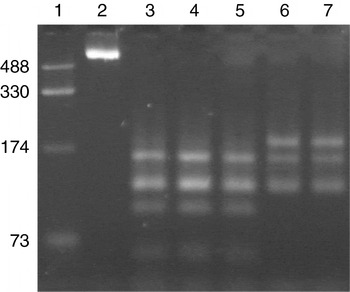
We sought to develop a simple, rapid and inexpensive method to distinguish between the two fly mtDNA sequences for future studies on the Chaetostomella cylindrica complex. We chose to test Tru9 I (an isoschzomer of MseI) because DNA sequencing of the amplified region revealed three Tru9 I restriction sites in the Onopordum-associated flies created by SNPs at 11879, 11885 and 11981 that are not present in Notobasis-associated flies. The three additional Tru9 I sites cause a 194 bp fragment in the Notobasis-associated sequence (from the 5′-end of the antisense primer at 11819 to 12012) to be cleaved into 60, 5, 97 and 32 bp fragments in Onopordum-associated sequences. Tru9 I is compatible with diluted PCR reactions, obviating the need for a purification step. Fragments of this size range are distinguishable by standard acrylamide or high percentage agarose blends (fig. 2). We found complete correspondence between observed restriction enzyme fragments and those predicted by our sequence data.
Representative RFLP results. DNA was extracted from whole flies, amplified by PCR and digested with Tru9 I. The reactions were electrophoresed and stained with ethidium bromide. Lane 1: size standards 73 bp, 174 bp, 330 bp, 488 bp; lane 2: undigested PCR product (690 bp); lane 3: Onopordum-associated; lane 4: Onopordum-associated; lane 5: Onopordum-associated; lane 6: Notobasis-associated; lane 7: Notobasis-associated.

Discussion
Notobasis syriaca and Onopordum illyricum occur in sympatry in Lebanon, and their geographic distributions overlap in such places as the Aley-Bhamdoun region (Mount Lebanon). Notobasis syriaca is widespread and very common in fields and roadsides in Lebanon and occurs from sea level to medium altitude (950 m) mountains including the Bequaa Valley, whereas O. illyricum is restricted to few patchy sites at medium to high elevations (1500 m) and does not occur along the coastal areas and hillsides. There is a slight difference in the phenology of these plants: N. syriaca blooms from late April to June (usually in April to May at the coastal areas and low elevations and May to mid June at medium elevations), while O. illyricum blooms in June to July in the mountains.
The populations of C. cylindrica associated with the Notobasis and the Onopordum hosts, though morphologically similar, proved to be morphometrically distinct, with all immature and adult stages being larger in the Onopordum host population, reflecting the larger flower head size of this host. Females from both host plants also differed in the length of the aculeus and the shape of the aculeus tip (Knio et al., Reference Knio, White and Al-Zein2007). In a previous study (Knio et al., Reference Knio, White and Al-Zein2007), we proposed a key based on morphology and morphometry to distinguish between the two host-associated populations. However, many individuals cannot be identified with certainty by inspection. We have, therefore, developed a simple PCR-RFLP method that appears to unambiguously identify individual specimens.
The variation in abundance of suitable host-plant species, as well as pressure from natural enemies and competitors, might have caused the exploitation of new hosts by C. cylindrica. It is not known what the ancestral host of C. cylindrica is, but N. syriaca seems to be a likely candidate as it is widespread and occurs in high density. However, this is tentative as the historical distribution of the two thistles is unknown.
Based on behavioural and genetic studies, C. cylindrica appears to consist of distinct host races which show very little or no gene flow. Mitochondrial DNA sequencing showed the existence of two genetically distinct lineages were in the analyzed C. cylindrica populations. The two host races differed at 44 of the 622 base pairs of ND1. Evolutionary rates of 0.8–1.6% change per million years, as estimated for Drosophila (Sharp & Li, Reference Sharp and Li1989), suggest that the time of divergence of these two mitochondrial lineages could be 4–9 million years ago. Our data suggest that the two host races of C. cylindrica could be considered as distinct species because they showed 7.1% sequence divergence. A 2% variation in mitochondrial DNA sequence has been proposed as a cutoff for species delimitation (Hebert et al., Reference Hebert, Cywinska, Ball and deWaard2003.). However, Cognato (Reference Cognato2006), who surveyed the percent DNA sequence divergence for a large number of sister species of insects, revealed 0.04–26.00 and 1.00–30.70% of intra- and inter-specific sequence differences, respectively; and, therefore, concluded that ‘a standardized percent DNA sequence difference does not predict species boundaries among economically important insects’.
The populations associated with N. syriaca fit more closely the description of C. cylindrica than the populations associated with Onopordum spp. (Knio et al., Reference Knio, White and Al-Zein2007). The two populations could be differentiated morphometrically but not morphologically (Knio et al., Reference Knio, White and Al-Zein2007). In this study, we report differences in the oviposition behaviour of the females reared from the Notobasis and Onopordum hosts. The Notobasis-associated females oviposited a few eggs (1–3) per flower head and the eggs were deposited singly and unattached; on the other hand, the Onopordum-associated females deposited a cluster of eggs (1–11) per flower head with the eggs glued to each other. The larger number of eggs and larvae found in the Onopordum flower heads reflects the larger size of the exploited host. Subtle differences were detected in the courtship behaviour, mainly in the frequency of wing vibrations in the post-mating behaviour exhibited by male flies. This justifies the occurrence of cross-mating in the laboratory and confirms the importance of the host plant as rendezvous site for these tephritid flies and as natural barrier for gene flow. The slight difference in the phenology of the hosts exploited could also be significant in preventing flies from the Notobasis and Onopordum hosts from meeting in the field.
In conclusion, we propose that the polyphagous species, C. cylindrica, be revised in the Western Paleartic. This species appears to be a polymorphic complex of species and host races associated with different host plants and having different levels of reproduction isolation in the Western Paleartic (V. Korneyev, personal communication). The Onopordum-associated flies could be C. lurida; however, the type specimen of C. lurida falls within the area of overlap with respect to the morphometric measurements of the adults, and the aculeus tip of the type specimen was partly broken. Unfortunately, the type specimen of C. cylindrica is destroyed, and this would make the revision process a difficult task. The newly described species by Basov (Reference Basov2000), C. zhuravlevi, could also be part of this complex as this new species could only be distinguished from C. cylindrica based on the aculeus shape and size and few additional morphometric measurements. The PCR-RFLP method offers promise for larger sampling, and further molecular analysis of nuclear markers should shed additional light on the evolutionary relationships within this complex.
Acknowledgements
The authors would like to thank I.M. White, V. Korneyev, D. Azar and D.A. Waller and two anonymous reviewers for their useful comments, insights and suggestions. This work was funded by the University Research Board, American University of Beirut (KMK) and the Lebanese National Council for Scientific Research (CAS).