Introduction
Non-suicidal self-injury (NSSI) represents the direct, repetitive, intentional injury of one's own body tissue, without suicidal intent, that is not socially accepted (Lloyd-Richardson et al. Reference Lloyd-Richardson, Perrine, Dierker and Kelley2007). To date, the study of NSSI, especially in relation to its differences from suicidal behavior, has been difficult because of the empirical and conceptual confounding of the variables. This conflation of suicidal and NSSI behaviors is particularly true within European countries, where the construct ‘deliberate self-harm’ (DSH) is used as an umbrella term for self-destructive behaviors regardless of suicidal intent (Hawton et al. Reference Hawton, Bergen, Casey, Simkin, Palmer, Coooper, Kapur, Horrocks, House, Lilley, Noble and Owens2007; Madge et al. Reference Madge, Hewitt, Hawton, de Wilde, Corcoran, Fekete, van Heeringen, De Leo and Ystgaard2008). Such general terms make cross-cultural comparisons of NSSI difficult, thus hampering research in this area. A considerable amount of literature has been published concerning the need to differentiate between self-injuring behavior (SIB) undertaken without suicidal intent and suicidal behaviors undertaken with the intent to die (Nock & Kessler, Reference Nock and Kessler2006; Posner et al. Reference Posner, Oquendo, Gould, Stanley and Davies2007; Silverman et al. Reference Silverman, Berman, Sanddal, O'Carroll and Joiner2007). The relationship between these entities is still subject to ongoing research and it is necessary to fully understand the worldwide phenomenon of both sets of behaviors.
Despite the need for a clear nomenclature, it should not be overlooked that NSSI needs to be understood as a potential risk factor for future suicide attempts. A few recent studies have documented the complex relationship between NSSI and suicide risk. Whitlock & Knox (Reference Whitlock and Knox2007) presented data from an internet survey (n=2875, age range 18–24 years) showing that rates of NSSI were positively correlated with risk for suicidal behavior, meaning that those who injure themselves repetitively were at an increased risk for also having made a suicide attempt. Comparable results were reported by Nock et al. (Reference Nock, Joiner, Gordon, Lloyd-Richardson and Prinstein2006) from an adolescent in-patient sample (n=89). Suicide attempts were more common in adolescents with repetitive self-injuries, who injured themselves for a longer period, used different methods of self-injury, and reported feeling no pain during the act of self-injury. Both studies are in accordance with Joiner's (Reference Joiner2005) theory that self-injury desensitizes individuals and can increase their risk of later suicide as they habituate to fear and pain. As Whitlock & Knox (Reference Whitlock and Knox2007) proposed, NSSI should be understood as a signal that the individual engaging in the NSSI is under psychological stress, which could increase risk for suicide attempts.
Prevalence rates
Recent reports have shown high rates of NSSI in the USA, ranging between 23% and 38% in community samples of adolescents and young adults (Ross & Heath, Reference Ross and Heath2002; Gratz, Reference Gratz2006; Whitlock et al. Reference Whitlock, Eckenrode and Silverman2006; Lloyd-Richardson et al. Reference Lloyd-Richardson, Perrine, Dierker and Kelley2007; Muehlenkamp & Gutierrez, Reference Muehlenkamp and Gutierrez2007), and a cross-sectional study identified a lifetime course of NSSI with high rates in adolescence and declining rates in young adulthood (Young et al. Reference Young, van Beinum, Sweeting and West2007). Thus, there seems to be consensus that adolescence is an important period in which to study NSSI. Although there are plenty of study-specific data on the prevalence of NSSI in adolescents from the USA, Canada, Australia and the UK (Patton et al. Reference Patton, Harris, Carlin, Hibbert, Coffey, Schwartz and Bowes1997; Hawton et al. Reference Hawton, Rodham, Evans and Weatherall2002; Muehlenkamp & Gutierrez, Reference Muehlenkamp and Gutierrez2004; Nada-Raja et al. Reference Nada-Raja, Skegg, Langley, Morrison and Sowerby2004; Skegg et al. Reference Skegg, Nada-Raja and Moffitt2004; Laye-Gindhu & Schonert-Reichel, Reference Laye-Gindhu and Schonert-Reichl2005), data on adolescent NSSI are scarce from other Western countries. High rates of NSSI have been found in Turkey, where Zoroglu et al. (Reference Zoroglu, Tuzun, Sar, Tutkun, Savacs, Ozturk, Alyanak and Kora2003) reported a lifetime prevalence rate of 21.4% among 839 students. A prevalence rate of 5.5% was reported among a sample of Hungarian adolescents (Csorba et al. Reference Csorba, Szelesne, Steiner, Farkas and Nemeth2005), and a rate of 24% was found among young female adults from Italy (Favaro et al. Reference Favaro, Ferrara and Santonastaso2007). Rodham et al. (Reference Rodham, Hawton and Evans2004) reported a rate of 3.7% in their British school sample of 6020 adolescents (age range 15–16 years). A Scandinavian study comparing rates of DSH ideation and acts at 12 and 15 years of age reported that, at age 12, 2.7% of the girls and 3.9% of the boys described DSH ideation and acts, whereas at age 15, 12.6% of the girls and 4.6% of the boys did so (Sourander et al. Reference Sourander, Aromaa, Pihlakoski, Haavisto, Rautava, Helenius and Sillanpaa2006). Higher rates were reported more recently by Lundh et al. (Reference Lundh, Karim and Quilisch2007), who stated that 65.9% of their Scandinavian adolescent community sample (n=123, mean age 15 years) had deliberately harmed themselves and 13.8% did so repetitively.
The variations in rates of NSSI across countries could be due to cultural influences, but it may be premature to suggest that cultural variables are to blame because there are numerous methodological variations among the existing studies. Different assessment measures and procedures are used across studies, which are frequently based on different conceptions or definitions of self-injury. For example, in the study by Lundh et al. (Reference Lundh, Karim and Quilisch2007), very high rates of self-injury were reported, and their questionnaire (the Deliberate Self-harm Inventory – simplified version) assessed a range of minor SIBs, such as interference with wound healing and sticking needles under the skin. In comparison, the study of Hungarian adolescents (Csorba et al. Reference Csorba, Szelesne, Steiner, Farkas and Nemeth2005) used the Ottawa Self-Injury Inventory (OSI) as the questionnaire that assessed more severe forms of self-harm within another time-frame. In addition, although a broad range of assessment tools do exist, only a few are validated (for a review see Cloutier & Humphreys, Reference Cloutier, Humphreys, Nixon and and Heath2008), and even fewer have been cross-validated for use with samples from multiple nationalities.
Data on NSSI from Germany have not been available until recently. The ‘Heidelberg school study’ (Brunner et al. Reference Brunner, Parzer, Haffner, Steen, Roos, Klett and Resch2007) assessed DSH within a large adolescent community sample (n=5759, mean age 14.9 year), and a 1-year prevalence of 18.9% was reported. Four per cent of the participants reported repetitive DSH (more than four times) within the year preceding the study. Suicide attempts were reported by 7.9% and suicidal ideation by 14.4% of the sample (Brunner et al. Reference Brunner, Parzer, Haffner, Steen, Roos, Klett and Resch2007). From a clinical sample of admissions (n=3694) to a German emergency department for child and adolescent psychiatry, rates as high as 57% have been reported using a German assessment instrument, the BaDo (Kirkcaldy et al. Reference Kirkcaldy, Brown and Siefen2006). However, none of the studies from these countries assessed their data with internationally validated questionnaires for self-injury. Furthermore, most of the studies included suicidal behaviors in their definitions of DSH, preventing accurate comparisons of NSSI rates to other nations. Results from the latest study comparing the prevalence of DSH cross-nationally (Portzky et al. Reference Portzky, De Wilde and van Heeringen2008) show that rates of self-harm can differ significantly between neighboring nations (Belgium and The Netherlands). A method to make accurate comparisons regarding NSSI is still needed. No known study has compared rates of NSSI, using cross-nationally validated assessment scales, between differing nations.
The primary aim of this study was to address the assessment limitations of prior international studies of NSSI by using a cross-nationally validated assessment tool to: (1) assess the prevalence of NSSI and suicide attempts in a community sample of German adolescents, and (2) compare German prevalence rates of NSSI and suicide attempts with a comparable sample of adolescents from the midwestern USA (i.e. Muehlenkamp & Gutierrez, Reference Muehlenkamp and Gutierrez2007) in order to be able to describe the phenomenon of NSSI in two different nations.
Method
Procedures
We chose to assess rates of NSSI in ninth-grade students to ensure a comparable sample to the US sample previously reported on by Muehlenkamp & Gutierrez (Reference Muehlenkamp and Gutierrez2007), which we used for comparison in the current study. All schools (with the exception of schools for the intellectually handicapped and special schools for students with disruptive behaviors) within the midsized city Ulm and surrounding rural areas in southern Germany were asked to participate in the current study. Out of 47 eligible schools within this area, 13 agreed to take part. Once a school indicated agreement to participate, all students in the ninth-grade classes were personally informed by P.L.P. about the study, and forms for active parental consent and adolescent assent were distributed. Students were informed that the study focus was on rates of NSSI and suicidal behavior as well as on depressive symptoms, and adolescents were reminded that participation was voluntary and anonymous. Congruent with German legislation on research ethics in studies with minors, participants did not receive any compensation for taking part in the study.
All assessment scales were handed out in the classroom, in sealed envelopes, to those who presented a signed parental consent and adolescent assent form. Only students participating in the study were present in the room. Because of restrictions from the federal school authorities, no personalized information could be obtained from students not participating in the study. The leader of the study (P.L.P.) was present and available in every classroom to answer any questions. After students had completed the assessments they placed their forms back in the envelopes and sealed them. Each adolescent's envelope was then collected by P.L.P. Completing the packet took about 30–45 min. The study and its procedures were approved by the school authorities and the Institutional Review Board of the University of Ulm, Germany.
Ethical issues
Although it has been argued that filling out a questionnaire concerning suicidal and self-injuring behaviors might lead to suicidal impulses, previous research has not supported these concerns (Gould et al. Reference Gould, Marrocco, Kleinmann, Thomas, Mostkoff, Cote and Davies2005; Friedman, Reference Friedman2006). Nevertheless, we chose to implement a direct and indirect way of ensuring participant safety. Every participating student was handed out a ‘Contact Card’ in a separate envelope that included contact details and telephone hours of the study coordinator, which could be used whenever the participants felt they needed to talk to somebody. As an indirect way of getting in contact with the researchers, students were able to fill out a ‘HELP’ card, which was provided in a separate envelope, by providing their email address or telephone number if they wanted to be contacted by the study team. Out of 670 participants, seven (1.04%) chose to do so. One of the requests turned out to be a hoax, two requested help with minor ailments (seeking help for problems with their friends), and four (0.6%) who requested help with SIB were provided contact to our out-patient department.
Participants
A total of 1100 ninth-grade students were available from the participating schools. On the days of assessment 1034 (94%) students were present, and the rest were missing from school that day. Approximately half of the 1034 students were female (n=521, 50.4%); 513 (49.6%) were male. Six hundred and seventy (64.8%) students were willing and able to participate in the study as they brought their signed parental consent and adolescent assent forms with them. All of these available students returned their assessment packets. Upon review of the assessment packets, one had to be excluded as only age and gender were filled out, and four packets were eliminated because of obvious nonsense or joke answers (all by male participants). This led to the inclusion of 665 participants (57.1%, n=380 female) for the current analyses. The mean age of participating students was 14.8 years (s.d.=0.66, range 14–17 years). The age of non-participating students could not be assessed because of regulations of the school authorities.
Measures
Self-Harm Behavior Questionnaire (SHBQ; Gutierrez et al. Reference Gutierrez, Osman, Barrios and Kopper2001)
The SHBQ is a self-report measure that assesses lifetime prevalence of SHB in four sections: NSSI (e.g. ‘Have you ever hurt yourself on purpose?’), suicide attempts (e.g. ‘Have you ever attempted suicide?’), suicidal threats (e.g. ‘Have you ever threatened to commit suicide?’) and suicidal ideations (e.g. ‘Have you ever talked or thought about committing suicide?’). Frequency and onset of these behaviors are assessed by follow-up questions that elicit further details about the SHB, such as need for medical attention. The SHBQ has been recommended as a brief screening measure for NSSI (Cloutier & Humphreys, Reference Cloutier, Humphreys, Nixon and and Heath2008).
In the original validation study good internal consistency was shown (Cronbach's α ranging between 0.89 and 0.96 for the four sections). This measure has been used in community studies of adolescents in the USA (Muehlenkamp & Gutierrez, Reference Muehlenkamp and Gutierrez2004, Reference Muehlenkamp and Gutierrez2007), demonstrating strong psychometric properties in non-clinical and in-patient adolescent samples (Gutierrez & Osman, Reference Gutierrez and Osman2008), and has recently been validated for use within diverse samples of adolescents (Muehlenkamp et al., unpublished observations). The SHBQ has been translated into German, using a translation and retranslation procedure, and validated for use with German samples by Fliege et al. (Reference Fliege, Kocalevent, Walter, Gratz, Gutierrez and Klapp2006). They showed a high internal consistency for the German version (Cronbach's α ranging between 0.87 and 0.96 for the four sections). It is important to note that in the German version of the SHBQ, the open-ended question inquiring about methods used for NSSI were omitted to ease completion of the questionnaire. This change proved to be particularly important for the use of the questionnaire in schools, as students often articulated their fear of being recognized (and thus not able to report truly) by their handwriting. Thus, methods of NSSI could only be assessed by the subitem of the OSI in the German sample in a standardized way.
We chose to follow the approach of Muehlenkamp & Gutierrez (Reference Muehlenkamp and Gutierrez2007), dividing participants based on their responses to the SHBQ into four groups: those with no self-harm (NoSH), those with non-suicidal self-injury only (NSSI), those with suicide attempts only (SA) and those with both NSSI and SA (NSSI+SA).
Ottawa Self-Injury Inventory (OSI; Nixon et al. Reference Nixon, Cloutier and Aggarwal2002)
The OSI is a 21-item questionnaire covering in-depth information on NSSI with regard to 1- and 6-month prevalence rates of NSSI and suicidal behavior and also functions, coping strategies and addictive features (Heath & Nixon, Reference Heath, Nixon, Nixon and and Heath2008). Although this measure has been used in a Canadian and Hungarian study (Nixon et al. Reference Nixon, Cloutier and Aggarwal2002; Csorba et al. Reference Csorba, Szelesne, Steiner, Farkas and Nemeth2005), it has not been formally validated with both German and US samples. To obtain qualitative data on methods of NSSI, we used a translation–retranslation procedure to generate a German version of the OSI. As we chose to focus on reporting and comparing prevalence rates based on measures that have been validated and used in both the USA and Germany, only data on methods of NSSI used were taken from the German-translation OSI.
Statistical analysis
Mean differences were evaluated with an analysis of variance (ANOVA), with group as the between-subjects factor (NSSI, NoSH, SA, NSSI+SA) or with t tests in the case of two groups. To detect significant pairwise differences, post-hoc contrasts were performed using the Student–Newman–Keuls test. Categorical variables were analysed by means of χ2 test for frequency tables. All statistical analyses were performed with SAS version 9.1.3 (SAS Institute Inc., Cary, NC, USA).
Results
German sample: prevalence of NSSI, suicide attempts, suicidal threats and suicidal ideation
NSSI was reported by 170 (25.6%) of the 665 students (0 missing) completing the study. Participants were asked to indicate how often they injured themselves, and 44 (6.6%) reported doing so only once, 42 (6.3%) reported having hurt themselves twice, and 21 (3.2%) did so three times. Individuals who reported four or more acts of NSSI comprised 9.5% of the NSSI group (n=63). Most of the self-injuring participants reported that they had started self-injury within 1 year prior to filling out the questionnaire (n=103), whereas fewer stated that they first injured themselves 2–3 years before (n=54), 4–5 years before (n=7), or ⩾6 years before (n=5). When asked for the 12-month incidence, 161 students (nine missing) with NSSI answered, out of which 132 (82%) reported having hurt themselves within the past year and 29 (18%) within the past 24 months. This result means that the 12-month prevalence for NSSI was 19.8% within the entire sample. Of the 170 participants who reported injuring themselves, 98 (57.6%) said that they had talked with someone about their NSSI and 72 (42.4%) said that they had not.
From the total sample, 664 students answered the question concerning the history of suicide attempts (one missing). Forty-three (6.5%) stated that they had attempted suicide, with 26 reporting having made one attempt, 12 reporting two attempts, one making three attempts, and four of the adolescents reported more than three suicide attempts. The question concerning suicidal ideation was answered by 656 participants (nine missing). Two hundred and thirty-nine (36.4%) of the students stated that they had talked about or thought about taking their lives, and 104 (15.6%) reported having verbally threatened to attempt suicide (661 responded, four missing). Most of them (n=71) threatened suicide once, 23 threatened two to three times, and nine reported four or more times (one did not report the frequency). Of note, only 44 (42.7%) reported really wanting to die at the time they made their suicide threats.
Prevalence and gender
Significant gender differences were found for rates of NSSI [50 males versus 120 females, χ2=16.86, p<0.0001, odds ratio (OR) 2.17, 95% confidence interval (CI) 1.49–3.15]. Females were also more likely than males to report talking to others about their NSSI (χ2=13.59, p<0.001, OR 3.56, 95% CI 1.78–7.1). Although more females reported suicide attempts (13 males versus 30 females), the difference was not statistically significant (χ2=2.95, p=0.09, OR 1.79, 95% CI 0.91–3.49). However, statistically significant differences were found for having threatened to attempt suicide (28 males versus 76 females, χ2=12.50, p<0.001, OR 2.28, 95% CI 1.34–3.62) and for reports of suicidal ideation (72 males versus 167 females, χ2=24.20, p<0.0001, OR 2.31, 95% CI 1.65–3.23).
Prevalence in urban versus rural areas
No statistically significant differences were found on any of the four SHBQ categories between students from town or country schools (NSSI: 89 town versus 81 country, χ2=1.01, p=0.31, OR 1.20, 95% CI 0.84–1.7; suicidal attempts: 24 town versus 19 country, χ2=0.83, p=0.36, OR 1.33, 95% CI 0.72–2.49; suicidal threats: 46 town versus 58 country, χ2=1.2, p=0.27, OR 0.79, 95% CI 0.52–1.20; suicidal ideation: 113 town versus 126 country, χ2=0.67, p=0.41, OR 0.88, 95% CI 0.64–1.20).
Clusters of self-harm
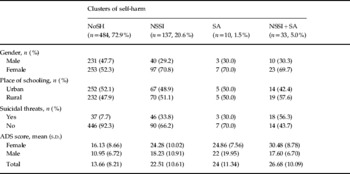
Participants were divided into four self-harm groups (NoSH, NSSI, SA, NSSI+SA; see Method section), with frequencies provided in Table 1. There was a significant association with gender, with girls showing a 50:50 ratio in the NoSH group and a 70:30 ratio in the NSSI, SA and NSSI+SA groups (χ2=17.93, df=3, p<0.001); this reflects the gender differences noted earlier. Suicidal threats were significantly related to the four clusters of self-harm (χ2=98.47, df=3, p<0.0001). There was no significant relationship between clusters and place of schooling (urban versus rural, χ2=1.43, df=3, p=0.70).
Clusters of self-harm, gender, place of schooling, suicidal threats and ADS scores

ADS, Depression scale (Allgemeine Depressions Skala); NoSH, no self-harm; NSSI, non-suicidal self-injury; SA, suicide attempt; s.d., standard deviation.
Comparison between Germany and US samples
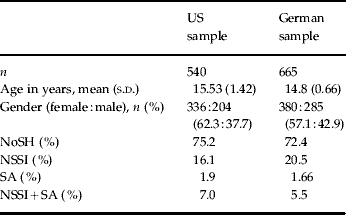
As one of the aims of this paper was to compare rates of NSSI and suicidal behavior in the USA and Germany, a closer comparison of the two populations was necessary (details are provided in Table 2). Both groups were recruited from schools situated in and around midsized cities, using similar recruitment strategies, research methodology, and active parental consent (see Muehlenkamp & Gutierrez, Reference Muehlenkamp and Gutierrez2007 for details on US methods). Although the German sample was slightly larger in size (665 v. 540 in the US sample), the gender balance was comparable in both groups (χ2=3.19, df=1, p=0.07, OR 1.24, 95% CI 0.98–1.56). Differences exist in age, with the US sample being slightly older (t=11.02, df=726, p<0.0001). When comparing the frequencies in the four clusters of self-harm, no statistically significant differences were found between the US and the German school populations (χ2=5.85, df=3, p>0.10).
US and German sample characteristics
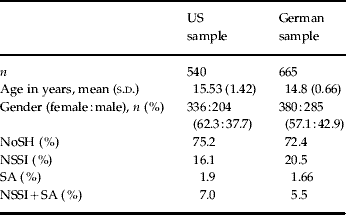
NoSH, No self-harm; NSSI, non-suicidal self-injury; SA, suicide attempt; s.d., standard deviation.
Methods of self-injury
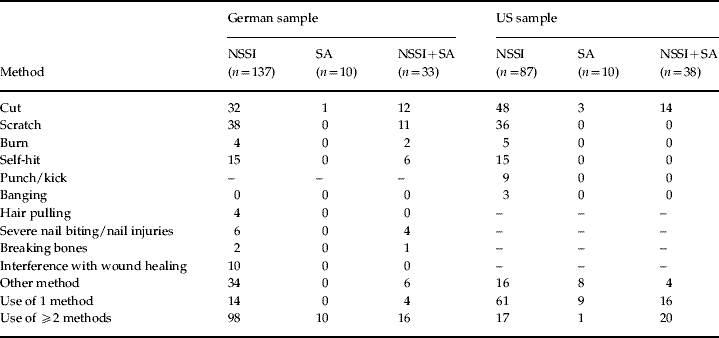
Methods used for NSSI in the German sample were assessed by using a list of 18 possible methods taken from the OSI, including both impulsive and compulsive forms of NSSI (according to Favazza, Reference Favazza1998 and Favaro et al. Reference Favaro, Ferrara and Santonastaso2007). The most prevalent methods were severe scratching (n=49, 27.22%), cutting (n=45, 25%) and hitting oneself (n=21, 11.67%). In the US sample, the methods of NSSI were assessed by an open-ended question (‘Have you ever hurt yourself on purpose? If yes, what did you do?’). The main methods of NSSI reported in the US sample were cutting (n=65, 48.15%), severe scratching (n=36, 26.67%) and hitting oneself (n=15, 11.11%) (Muehlenkamp & Gutierrez, Reference Muehlenkamp and Gutierrez2007; further details are provided in Table 3). When comparing the three most prevalent methods, we found that cutting was more frequent in the US sample (χ2=18.19, p<0.0001, OR 2.79, 95% CI 1.73–4.49) whereas no statistical significant differences were found for severe scratching (χ2=0.01, p=0.91, OR 0.97, 95% CI 0.59–1.61) or hitting oneself (χ2=0.02, p=0.89, OR 0.95, 95% CI 0.47–1.91).
Methods of self-harm in the German and US samples
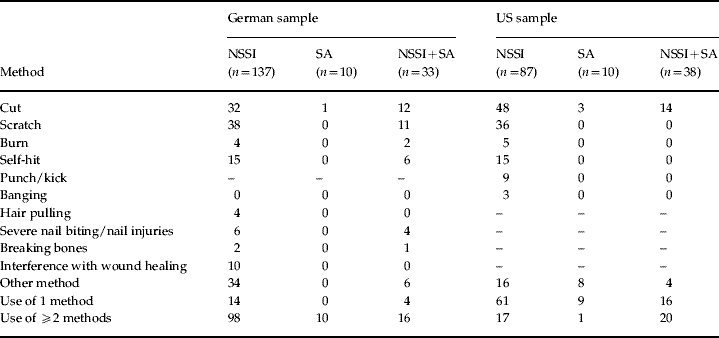
NoSH, No self-harm; NSSI, non-suicidal self-injury; SA, suicide attempt.
Methods in the US sample were assessed by using the Self-Harm Behavior Questionnaire (SHBQ); methods in the German sample were assessed by using the Ottawa Self-Injury Inventory (OSI) (methods used within the past month).
Discussion
This study describes prevalence rates of NSSI and suicidal behaviors in a German school sample and compares these rates to data from a recent US sample (Muehlenkamp & Gutierrez, Reference Muehlenkamp and Gutierrez2007) using comparable groups and study designs. Although studies on the prevalence of NSSI, or DSH, have been undertaken before, many have been restricted to English-speaking countries and failed to use cross-nationally validated assessment tools of NSSI. As a result, our findings permit more accurate comparisons between samples from different nations because a standard definition and assessment tool was used. Thus, confidence can be maintained when interpreting our findings and drawing initial conclusions about the prevalence of NSSI among adolescent populations in Western countries.
Data from the current study suggest that rates of NSSI and suicide attempts are comparable between German and US school students. Specifically, it was noted that 25.6% of the German adolescents endorsed at least one act of NSSI. This rate is consistent with rates reported across many different studies conducted from English-speaking countries (Muehlenkamp & Gutierrez, Reference Muehlenkamp and Gutierrez2004; Laye-Gindhu & Schonert-Reichel, Reference Laye-Gindhu and Schonert-Reichl2005; Lloyd-Richardson et al. Reference Lloyd-Richardson, Perrine, Dierker and Kelley2007) and is similar to the US comparison sample rate of 23.2% (Muehlenkamp & Gutierrez, Reference Muehlenkamp and Gutierrez2007). Similarly, the primary methods of NSSI (cutting, scratching, hitting oneself) were comparable between the US and the German sample, although cutting was more prevalent in the US sample. However, this difference in NSSI methods must be interpreted with caution because the assessment tool for this variable was not similar between samples, and German adolescents were asked for behaviors within the past month whereas lifetime prevalence of NSSI methods was assessed in the US sample. In general, the current data support the conclusion that the basic features of NSSI are similar between US and German students.
To date, only two known studies have compared prevalence rates of DSH in European countries, finding somewhat different results between countries (Madge et al. Reference Madge, Hewitt, Hawton, de Wilde, Corcoran, Fekete, van Heeringen, De Leo and Ystgaard2008; Portzky et al. Reference Portzky, De Wilde and van Heeringen2008). However, the definition used for DSH did not permit clear differentiation between acts undertaken with or without suicidal intent. As large differences in suicide mortality rates have been observed between Belgium and The Netherlands, these findings on self-harm are potentially confounded by suicidal behaviors (Portzky et al. Reference Portzky, De Wilde and van Heeringen2008). Thus, additional studies that use a clear distinction between self-injury and suicidal behavior, such as our own, are needed to understand the phenomenon of NSSI across cultures. Our results, in which NSSI was clearly differentiated from suicidal behaviors, indicate that significant differences in rates of NSSI and suicidal behavior between Germany and US adolescents do not exist. Furthermore, we found that the lifetime prevalence rates were similar in both the German and US samples across the different clusters of self-harm. These findings suggest that NSSI and suicidal behaviors in adolescents may represent a similar level of problematic behavior regardless of the country of origin.
In addition to finding similarities in basic rates and method of NSSI, we also found important co-occurrences between suicidal behaviors and NSSI. Globally, a majority of students who reported a suicide attempt also reported having engaged in NSSI. Additionally, suicidal ideation was more prevalent among self-injurers with a suicide attempt than those with only NSSI, and students without any SHBs. These results are consistent with previous studies exploring distinctions between NSSI and suicidal behaviors (Muehlenkamp & Gutierrez, Reference Muehlenkamp and Gutierrez2004; Nock et al. Reference Nock, Joiner, Gordon, Lloyd-Richardson and Prinstein2006; Whitlock & Knox, Reference Whitlock and Knox2007), and are in accordance with Joiner's theory (2005) suggesting that NSSI may contribute to a type of habituation that increases risk for suicidal behaviour. The consistencies across studies, and nationalities, speak to a potential uniformity of these self-destructive behaviors that implies that generalizations could be made from studies using samples of varied nationality.
In our study SIBs were particularly prevalent among female adolescents. Girls reported NSSI, suicidal threats and suicidal ideation twice as frequently as boys. However, no statistical gender difference could be found concerning suicidal attempts. Significant gender differences could be found in all clusters of self-harm (NSSI, SA, NSSI+SA), which is partly in accordance with the findings of Muehlenkamp & Gutierrez (Reference Muehlenkamp and Gutierrez2007), who reported significant gender differences in the NSSI+SA group but not in the NSSI or the SA group. Other recent studies have shown higher rates of NSSI or DSH in female adolescents (Sourander et al. Reference Sourander, Aromaa, Pihlakoski, Haavisto, Rautava, Helenius and Sillanpaa2006; Brunner et al. Reference Brunner, Parzer, Haffner, Steen, Roos, Klett and Resch2007; Patton et al. Reference Patton, Hemphill, Beyers, Bond, Toumbourou, McMorris and Catalano2007; Madge et al. Reference Madge, Hewitt, Hawton, de Wilde, Corcoran, Fekete, van Heeringen, De Leo and Ystgaard2008; Portzky et al. Reference Portzky, De Wilde and van Heeringen2008). However, studies in Swedish and US adolescents of about the same age as our sample did not reveal significant gender differences in rates of DSH or NSSI (Lloyd-Richardson et al. Reference Lloyd-Richardson, Perrine, Dierker and Kelley2007; Lundh et al. Reference Lundh, Karim and Quilisch2007), which was also the case in a study of young Scottish adults (Young et al. Reference Young, van Beinum, Sweeting and West2007). In the light of these different findings it should be noted that the question of gender differences in NSSI and DSH is still unclear, and needs to be studied further (Jacobson & Gould, Reference Jacobson and Gould2007).
The results from this study also expand our current understanding of the phenomenon of self-injury within Germany. To date there has been only one school study providing data on self-harming behaviors (DSH) in Germany (Brunner et al. Reference Brunner, Parzer, Haffner, Steen, Roos, Klett and Resch2007). Comparable rates of DSH (18.9% v. 19.8% 1-year prevalence in our sample) and suicide attempts (7.9% v. 6.5%) were found between Brunner et al.'s study (Reference Brunner, Parzer, Haffner, Steen, Roos, Klett and Resch2007) and the current study. The rates of suicidal ideation differed (14.4% v. 36.4% in our sample), which may have been due to the different assessment tools used and timelines for reporting (1-year versus lifetime). Even though different assessment tools were used, rates of NSSI and suicide attempts are similar, suggesting that the rates found in the current study may be representative of the larger adolescent population within Germany. As data of the cited study were assessed in the context of a broader study on lifestyle in adolescence, our study is the first in Germany to specifically assess NSSI in adolescents using validated tools.
Limitations
This study has some limitations that should be noted. Participation was contingent upon receiving positive informed consent of the parents and assent of the students. Although our response rate (64.8% of the students and their parents) is adequate and comparable to other studies, because of school authority regulations we have no data on the reasons for not participating in the study. Based on remarks from teachers and non-participating students, our impression was that failure to return the consent and assent forms at the chosen date was the main obstacle for the students. However, it is also possible that some of the students who did not have authorization to participate may have been those at greater risk for NSSI (Tigges, Reference Tigges2003), which could limit the generalizability of our findings. It was pointed out by Jacobson & Gould (Reference Jacobson and Gould2007) that true rates of NSSI may be higher than that assessed by school studies as students who were truant or had withdrawn from school are not included. However, it should be noted that our study was advertised as a study on self-injury, which may have created a selection bias.
Another limitation is that our study fails to provide data on ethnicity. This is due to the reality that Germany has a fairly homogeneous population, with the majority of inhabitants being Caucasian. As we were not allowed to collect data from non-participating students, question for ethnicity would have made little sense as we would not have been able to compare participants to the whole group. Another weakness of our study is that the US version of the SHBQ assesses methods of NSSI by using an open-ended question, but this question was omitted from the German version. We therefore had to compare the phenomenology of NSSI using the OSI, which diminishes generalizability of this comparison, although it is important to note that data from the two different instruments do provide information that is similar. Finally, one other limitation is that the data involved self-reported retrospective recall of NSSI and suicidal behaviors. Although self-report questionnaires are the standard methodological approach for studying such behaviors, they are subject to response biases. Requesting adolescents to report on behaviors that have happened in the past, in some cases up to 2 years prior to the survey, may have led to some memory errors. Thus, all data should be interpreted with caution.
In summary, this study adds further evidence that NSSI has to be understood as a worldwide phenomenon, at least in Western cultures. Recent studies of adolescents show high prevalence rates for NSSI (Brunner et al. Reference Brunner, Parzer, Haffner, Steen, Roos, Klett and Resch2007; Lloyd-Richardson et al. Reference Lloyd-Richardson, Perrine, Dierker and Kelley2007; Lundh et al. Reference Lundh, Karim and Quilisch2007) across continents, suggesting the need to engage in cross-cultural explorations of this behavior. It can only be hypothesized where these consistently high prevalence rates might emerge from. One hypothesis is that the worldwide distribution of NSSI may be due, in part, to findings that self-injury represents a prevalent content in the World Wide Web (Whitlock et al. Reference Whitlock, Eckenrode and Silverman2006), and people with NSSI tend to use the Internet more and make more use of chat rooms (Mitchell & Ybarra, Reference Mitchell and Ybarra2007). NSSI can also be found in certain youth subcultures (Young et al. Reference Young, Sweeting and West2006) and it is also possible that certain elements consistent within Western cultures play a role in the development of NSSI behaviors. To better understand this phenomenon and explain sociocultural and psychological factors associated with NSSI, cross-cultural studies are highly relevant and need to be conducted. To do this, a unified nomenclature is needed along with the use of standardized, cross-culturally validated assessment tools. Studies using longitudinal designs are also necessary to evaluate the life course and trajectories of NSSI among adolescents living within different countries.
Acknowledgements
This work was financed by the University of Ulm.
Declaration of Interest
None.