Implications
Linseed oil (LO) supplementation is a promising strategy to improve the milk fatty acid (FA) profile of goats from a nutritional point of view. Replacing part of the cereals with fibrous agro-industrial by-products in the concentrate would be a valuable alternative to reduce animal feed expenses, as long as the local market prices of the latter are cheaper. Regardless of the type of concentrate, LO dietary supplementation led changes in milk FA profile mostly in the same direction. This approach would enhance the nutritional value of dairy products and, at the same time, could decrease the economic impact of animal feed.
Introduction
Milk fat composition can be modulated by the inclusion of lipid supplements in ruminant diets. The addition of seeds and vegetable oils supplies unsaturated FA to the rations that may affect not only ruminal bacteria population but also lipid metabolism in the mammary gland (Chilliard and Ferlay, Reference Chilliard and Ferlay2004). Considerable research has been carried out to improve milk FA profile and, in comparison with other lipid supplements rich in oleic or linoleic acids, supplementation with LO has proven to be the most promising nutritional strategy from a human health point of view (Bodas et al., Reference Bodas, Manso, Mantecón, Juárez, De la Fuente and Gómez-Cortés2010; Martínez Marín et al., Reference Martínez Marín, Gómez-Cortés, Gómez Castro, Juárez, Pérez Alba, Pérez Hernández and De la Fuente2012). Furthermore an interaction between the lipid supplement and the forage to concentrate ratio (Mele et al., Reference Mele, Macciotta, Cecchinato, Conte, Schiavone and Bittante2008; Ollier et al., Reference Ollier, Leroux, De la Foye, Bernard, Rouel and Chilliard2009; Gómez-Cortés et al., Reference Gómez-Cortés, De la Fuente, Toral, Frutos, Juárez and Hervás2011) or the type of forage (Bernard et al., Reference Bernard, Shingfield, Rouel, Ferlay and Chilliard2009b) in the rations may affect milk fat composition.
In the Mediterranean basin, goat farms are characterized by high levels of milk production per goat. In most farms of the region, feeding of goats heavily depends on cereal-based concentrates, in order to sustain the productivity, due to the chronic shortage of good quality pasture and the limited availability of conserved forages (Ruiz et al., Reference Ruiz, Mena, Castel, Guinamard, Bossis, Caramelle-Holtz, Contu, Sitzia and Fois2009; Jouven et al., Reference Jouven, Lapeyronie, Moulin and Bocquier2010). Under such circumstances, the replacement of part of the cereals with agro-industrial by-products rich in NDF is a valuable alternative to reduce animal feed expenses while, at the same time, promotes sustainable development (Pardo et al., Reference Pardo, Martín-García, Arco, Yañez-Ruiz, Moral and Del Prado2016).
Previous studies have reported the effects of replacing part of the cereals in the concentrate with fibrous by-products (i.e. lowering the starch level and increasing the non-forage NDF level of the diet) on goat milk production and components and milk fat composition (Ibáñez et al., Reference Ibáñez, López, Criscioni and Fernández2015). Recently, Cívico et al. (Reference Cívico, Núñez Sánchez, Gómez-Cortés, De la Fuente, Peña Blanco, Juárez, Schiavone and Martínez Marín2017) have proposed individual odd- and branched-chain FA as biomarkers of the starch-to-non-forage NDF ratio of dairy goat diet. However, a detailed comparison of the FA contents in milk fat from goats fed diets with different proportions of starch and non-forage NDF is still scarce. In order to fill this gap, the current research examined the effects of dietary concentrates with different starch-to-non-forage NDF ratio, whether or not supplemented with LO, on goat performance and milk composition. Further strength of our study lies in the complete goat milk FA profile disclosed.
Material and methods
Animals, diets and experimental design
The present research was carried out at the University of Córdoba facilities in accordance with the European Union Directive 2010/63/EU for animal studies. A total of 16 Malagueña goats (initially 118±16 DIM and 52.9±3.7 kg of BW) were allocated to two experiments conducted simultaneously. Experiment 1: two treatments (A and B), two periods (1 and 2), eight animals with a total of 16 experimental units (EU) (animal×period) which gives eight EU per treatment. Experiment 2: two treatments (C and D), two periods (1 and 2), eight animals with a total of 16 experimental units (animal×period) which gives eight EU per treatment. Experimental periods lasted 25 days.
Goats were selected from a commercial farm and blocked by BW and milk production (four animals per block). Within each block the animals were randomly assigned to the treatments so all the blocks were represented in all the treatments. During the whole study, goats were placed in individual cages of 1.0×1.4 m, with slatted floor and individual water and feeding troughs. Animals were machine milked (DeLaval, Madrid, Spain) and stripped out by hand once a day before morning feeding.
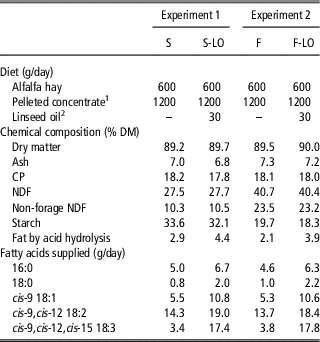
In both experiments, dietary forage to concentrate ratio was 33 : 67. The basal diet consisted of alfalfa hay and a pelleted concentrate fed separately (Table 1). In experiment 1, the concentrate consisted of maize, barley and soybean meal (high starch diet, S). In contrast, the concentrate of experiment 2 included soybean hulls, which replaced by equal parts of barley and maize (high fiber diet, F). As a result, the starch-to-non-forage NDF ratio of the diet was 3.1 and 0.8 in the experiments 1 and 2, respectively. In both experiments, basal diets were offered either alone (S and L treatments) or in combination with 30 g/day of LO (S-LO and F-LO treatments). The oil was added in the mixer, before pelleting. Rations were offered in two equal meals at 0930 and 1730 h and water was provided ad libitum.
Ingredients and chemical composition of the experimental diets

S=high starch; S-LO=high starch plus linseed oil; F=high non-forage NDF; F-LO=high non-forage NDF plus linseed oil.
1 Composition (g/kg, as fed): maize, 356.0; barley, 356.0; and soybean meal, 250.0, in the S concentrate; and maize, 178.0; barley, 178.0; soybean hulls, 356.0; and soybean meal, 250.0, in the F concentrate. Both concentrates included (g/kg, as fed): vitamin and mineral premix (Trouwmix M-3020, Trouw Nutrition, Madrid, Spain), 30.0; binder (Exal; Tolsa SA, Madrid, Spain), 7.0; and antioxidant (Luctanox; Lucta SA, Barcelona, Spain), 1.0.
2 The oil was included in the respective concentrate.
Measurements and chemical analysis
Daily DMI, milk production and diet composition were measured following Martínez Marín et al. (Reference Martínez Marín, Gómez-Cortés, Gómez Castro, Juárez, Pérez Alba, Pérez Hernández and De la Fuente2012). Fat, lactose and protein contents in milk were determined with a Milko-Scan FT120 (Foss Electric, Hillerød, Denmark). Milk fat extraction was carried out by two consecutive centrifugations and fatty acid methyl esters (FAME) were prepared by base-catalyzed methanolysis of glycerides with KOH in methanol as described previously (Martínez Marín et al., Reference Martínez Marín, Gómez-Cortés, Gómez Castro, Juárez, Pérez Alba, Pérez Hernández and De la Fuente2012). Gas chromatography with two complementary capillary columns, CP-Sil 88 (100 m×0.25 mm i.d.; Varian, Middelburg, The Netherlands) and SLB-IL111 (100 m×0.25 mm i.d., Supelco), was performed to provide a complete FA profile as described De la Fuente et al. (Reference De la Fuente, Rodríguez-Pino and Juárez2015).
Statistical analysis
Data from each experiment were subjected to ANOVA using the MIXED procedure of SAS University Edition 3.4 (SAS Institute, Cary, NC, USA), with a model that included the fixed effects of treatment, period and sequence of treatment, and the random effect of goat nested within sequence. Significant differences were declared at P<0.05.
Data were also analyzed by principal component analysis (PCA) to obtain an overview of dietary treatments and their indicative FA profile. The PRIN option of the FACTOR procedure was used to extract the principal components (PC), which were orthogonally rotated with the VARIMAX option to improve readability. According to the interpretability criteria, PC1 and PC2 were retained (Suhr, Reference Suhr2005). The PC scores were further investigated by ANOVA procedure, using treatment as fixed effect (Mele et al., Reference Mele, Serra, Buccioni, Conte, Pollicardo and Secchiari2016).
Results
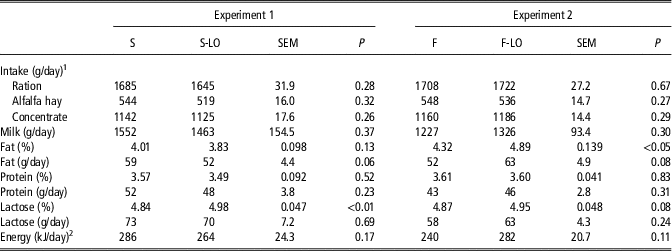
Table 2 discloses animal performance parameters and goat milk composition in experiments 1 and 2. The addition of LO to dairy goat rations did not induce significant changes, only lactose percentage in experiment 1 and fat percentage in experiment 2 increased with LO supplementation (P<0.05).
Intake and milk composition of goats fed concentrates rich in starch (experiment 1) or NDF (experiment 2) either alone or supplemented with linseed oil

S=high starch; S-LO=high starch plus linseed oil; F=high non-forage NDF; F-LO=high non-forage NDF plus linseed oil.
1 Values on air-dry basis.
2 [(Fat percentage×28.131)+74.785]×Milk production (Morand-Fehr and Sauvant, Reference Morand-Fehr and Sauvant1978).
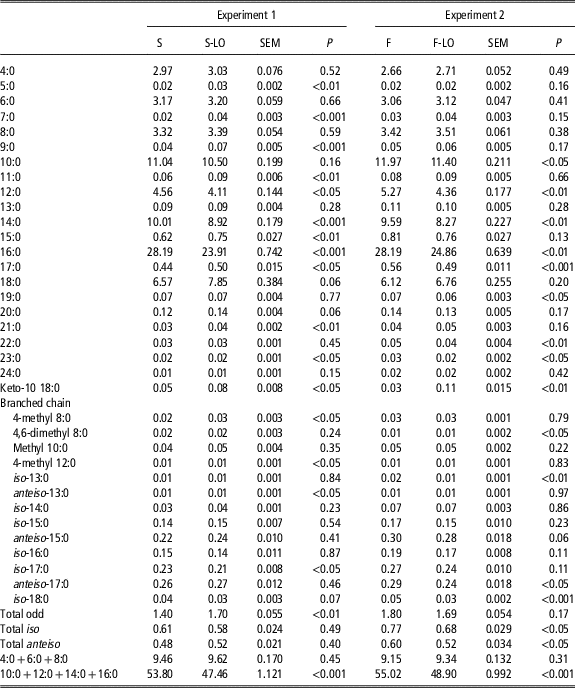
Goat milk saturated fatty acid (SFA) contents are presented in Table 3. LO did not affect short-chain SFA (4:0, 6:0 and 8:0) levels, but significantly reduced medium-chain SFA (12:0, 14:0 and 16:0) (P<0.05) in both experiments. Compared to unsupplemented rations, stearic acid was not modified in F-LO diet (P=0.20) while it tended to increase in S-LO (P=0.06). Odd-SFA did not exceed 1.8% of total FAME and their contents were only modified in experiment 1. In contrast, branched-chain FA changes were only observed in experiment 2. Other minor SFA such as keto-10 18:0 significantly increased (P<0.05) by LO addition in both experiments.
Saturated fatty acid contents (g/100 g total fatty acid methyl esters) in milk fat from goats fed concentrates rich in starch (experiment 1) or NDF (experiment 2) either alone or supplemented with linseed oil

S=high starch; S-LO=high starch plus linseed oil; F=high non-forage NDF; F-LO=high non-forage NDF plus linseed oil.
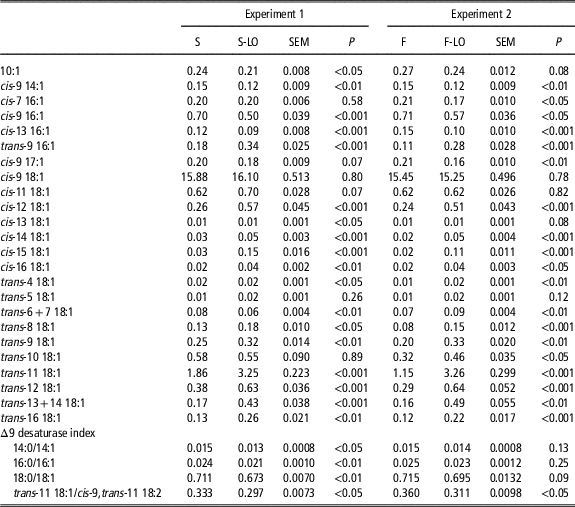
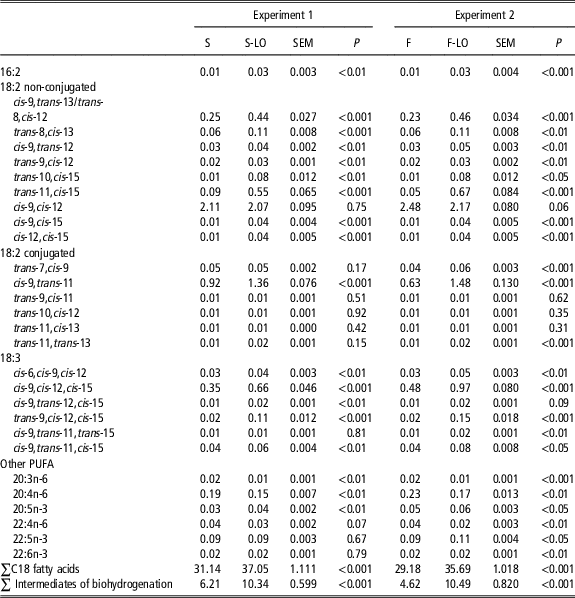
Table 4 shows the monounsaturated fatty acids (MUFA) profile of dairy goats. More than 90% of MUFA were 18-C FA and cis-9 18:1 was the most predominant. Oleic acid was not affected by the addition of LO but trans-18:1 isomers levels increased by 58 and 136% in experiments 1 and 2, respectively. Among trans-FA, vaccenic acid (trans-11 18:1, VA) was the most abundant, followed by trans-10 18:1. LO supplementation raised VA contents in both experiments while trans-10 18:1 levels were only affected in experiment 2. LO also modified milk contents of other MUFA with shorter chain length. Regardless concentrate composition, cis-9 16:1 levels decreased (P<0.05) whereas trans-9 16:1 increased (P<0.001) by the addition of LO (Table 4).
Monounsaturated fatty acid contents (g/100 g total fatty acid methyl esters) in milk fat from goats fed concentrates rich in starch (experiment 1) or NDF (experiment 2) either alone or supplemented with linseed oil

S=high starch; S-LO=high starch plus linseed oil; F=high non-forage NDF; F-LO=high non-forage NDF plus linseed oil.
Apart from linoleic acid, all non-conjugated 18:2 isomers increased with LO supplemented rations (Table 5). Rumenic acid (cis-9,trans-11 18:2, RA), the major CLA isomer, augmented 49% in experiment 1 and 136% in experiment 2 due to lipid supplementation. Compared with control diets (S and F), the addition of LO almost doubled 18:3n-3 (α-linolenic acid) milk fat levels. Other n-3 FA such as cis-9,trans-11,cis-15 18:3 and 20:5n-3, were also increased with LO supplementation (S-LO and F-LO, Table 5).
Polyunsaturated fatty acid (PUFA) contents (g/100 g total fatty acid methyl esters) in milk fat from goats fed concentrates rich in starch (experiment 1) or NDF (experiment 2) either alone or supplemented with linseed oil

S=high starch; S-LO=high starch plus linseed oil; F=high non-forage NDF; F-LO=high non-forage NDF plus linseed oil.
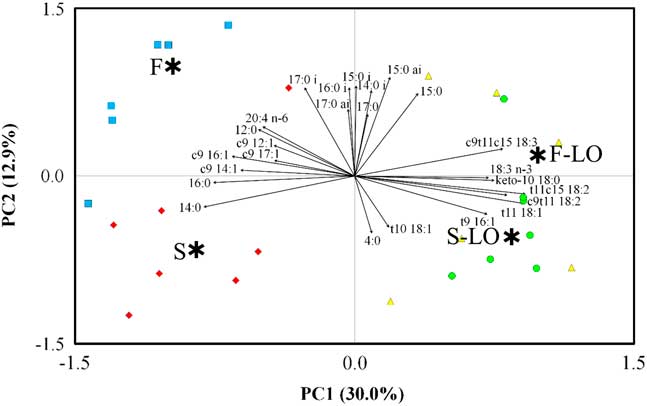
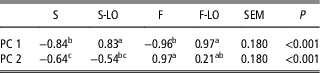
In order to differentiate experimental treatments according to their milk FA profile, a PCA was carried out. Two significant PC were retained, which described 30.0% (PC1) and 12.9% (PC2) of total variance. The score plot (Figure 1) showed four clusters differentiating the four experimental treatments (S, S-LO, F and F-LO). In general terms, milk samples were discriminated according to lipid supplementation by PC1 and according to concentrate composition by PC2. Centroids of LO supplemented treatments (S-LO and F-LO) were closer than unsupplemented ones (S and F) along PC2 axis. The ANOVA of the PC scores (Table 6) revealed that PC1 effectively separated LO supplemented from unsupplemented treatments (P<0.05) and that PC2 discriminated control samples according to the dietary concentrate (S v. F; P<0.05). However, S-LO and F-LO milk samples only tended to be different (P=0.06).
Principal component analysis (PC1 v. PC2) of milk fatty acid contents (g/100 g total fatty acid methyl esters) from goats fed concentrates rich in starch (S,  ) or NDF (F,
 ) either alone or supplemented with linseed oil (S-LO,
 ; and F-LO,
 ). Only selected fatty acids with loadings greater than ±0.4 are shown. S=high starch; S-LO=high starch plus linseed oil; F=high non-forage NDF; F-LO=high non-forage NDF plus linseed oil; i=iso; ai=anteiso; c=cis; t=trans)

Results of ANOVA of the principal component (PC) scores obtained from the principal components analysis shown in Figure 1

S=high starch; S-LO=high starch plus linseed oil; F=high non-forage NDF; F-LO=high non-forage NDF plus linseed oil.
a,b,cMeans without a common superscript letter are statistically different by Student’s t test at P<0.05.
Even saturated and monounsaturated FA from 12 to 16 C-atoms and cis-9 17:1 presented negative loadings on PC1. In contrast, odd SFA from 5 to 11 C-atoms, keto-10 18:0, several cis- and trans-18:1 FA (except cis-9 and trans-10), all non-conjugated 18:2 (except linoleic acid), RA, α-linolenic acid as well as cis-9,trans-11,cis-15 18:3 were positively correlated with PC1. Along PC2, odd SFA from 13 to 23 C-atoms, iso FA from 13 to 17 C-atoms, anteiso-15:0 and anteiso-17:0 showed positive loadings, while 4:0 and trans-10 18:1 were negatively associated. Overall, most 18-C unsaturated FA were associated to LO supplementation, whereas odd and branched-chain FA were related to high non-forage NDF concentrates.
Discussion
The novelty of this work is the detailed milk FA profile of goats fed diets with equal proportions of forage but differing in concentrate composition and lipid supplementation. A PCA of the data showed how major changes were related to oil supplementation on both concentrates. Specific responses are discussed below.
Milk composition
The increase of milk fat percentage only in experiment 2 would suggest an interaction between LO and the composition of the concentrates. Chilliard et al. (Reference Chilliard, Toral, Shingfield, Rouel, Leroux and Bernard2014) indicated that lipid supplementation hardly modifies goat milk composition but may increase its fat content. A recent meta-analysis in goat milks also reported a few changes in productive parameters with the exception of a positive response in milk fat content due to the addition of vegetable oils and seeds to the rations (Martínez Marín et al., Reference Martínez Marín, Núñez Sánchez, Garzón Sigler, Peña Blanco and De la Fuente2015b).
Saturated fatty acids
Diet supplementation with vegetable lipid source affected differently de novo FA depending on their chain length. Bernard et al. (Reference Bernard, Leroux, Faulconnier, Durand, Shingfield and Chilliard2009a) already observed that goats supplemented with LO reduce medium-chain SFA without negative effects on short-chain SFA in milk fat. A negative relationship between de novo FA percentages in goats milk with greater intensities as C-chain length increases, and dietary fat consumption was also reported (Martínez Marín et al., Reference Martínez Marín, Núñez Sánchez, Garzón Sigler, Peña Blanco, Domenech García and Hernández Ruipérez2015a). Moreover, PCA revealed a negative correlation between LO and milk medium-chain SFA. However, milk fat contents of 4:0, 6:0 and 8:0 were not modified by LO in any of the experimental treatments, which could be explained by their synthesis in the mammary gland from ruminal β-hydroxybutyrate (Palmquist, Reference Palmquist, St-Pierre and McClure2006).
Odd- and branched-chain FA contents in milk fat were differently affected in both experiments. This finding could be related to the proportions of rumen bacterial populations under the dietary conditions of each experiment. Amylolytic bacteria are relatively enriched in linear odd-chain FA while cellulolytic bacteria contain predominantly iso FA in their membranes (Vlaeminck et al., Reference Vlaeminck, Fievez, Cabrita, Fonseca and Dewhurst2006). Thus the increase of odd-chain FA in the S-LO treatment of experiment 1 and the decrease of iso FA in the F-LO treatment of experiment 2 suggests a more adverse effect of LO on cellulolytic than on amylolytic bacterial populations in both experiments (Yang et al., Reference Yang, Bu, Wang, Hu, Li, Wei, Zhou and Loor2009).
The lack of differences for 18:0 contents after LO supplementation could be justified either by an incomplete ruminal biohydrogenation of dietary polyunsaturated fatty acids or by a greater Δ9 desaturase activity in the mammary gland. Linseed oil significantly decreased the desaturation index of 18:0 in experiment 1 and increased the sum of biohydrogenation intermediates in both experiments. Thus, the absence of significant differences between stearic acid milk fat levels in experiment 2 should be mostly related to an incomplete ruminal biohydrogenation and a lower absorption of 18:0 in the small intestine. In experiment 1, the non-significant increase of 18:0 in the S-LO treatment would suggest that the lower Δ9 desaturase activity partially compensated for the lower absorption of 18:0 in the small intestine. Finally, the higher contents of keto-10 18:0 in the LO treatments would be associated to the greater amounts of oleic acid in the rations. Keto-10 18:0 is produced mainly from cis-9 18:1, via hydroxystearic acid, by ruminal bacteria (Jenkins et al., Reference Jenkins, AbuGhazaleh, Freeman and Thies2006).
Monounsaturated fatty acids
Oleic acid contents were stable in both experiments while most MUFA in milk fat increased with LO supplementation. As discussed above, these results should be attributed to an incomplete ruminal biohydrogenation of long-chain unsaturated FA (Martínez Marín et al., Reference Martínez Marín, Gómez-Cortés, Núñez Sánchez, Juárez, Garzón Sigler, Peña Blanco and De la Fuente2015c). Regarding trans-MUFA, VA was the most abundant in all rations and its contents were significantly increased by lipid supplementation. Trans-10 18:1 behavior was completely different. This isomer was strongly related to the high starch concentrate (experiment 1) and its greatest levels were detected in S and S-LO rations. The abundance of starch in the rumen modifies linoleic acid biohydrogenation pathways promoting an alternative route that generates trans-10 18:1 (Griinari and Bauman, Reference Griinari and Bauman1999; McKain et al., Reference McKain, Shingfield and Wallace2010). It would explain the observed changes in the trans-18:1 profile of milk fat.
Decreases of cis-9 14:1 and cis-9 16:1 contents should be linked to an increase of biohydrogenation intermediates reaching the mammary gland that could affect Δ9 desaturase endogenous synthesis. Bernard et al. (Reference Bernard, Leroux and Chilliard2013) suggested that the activity of lipogenic enzymes is regulated, among others, by the presence of unsaturated FA. Such regulation would intend to maintain milk fat fluidity within the physiological range. In contrast to cis-9 FA changes, trans-9 16:1 was affected by both concentrate composition and lipid supplementation. Increases of trans-9 16:1 milk fat levels have been previously reported in ruminants after dietary linseed (Luna et al., Reference Luna, Rodríguez-Pino and De la Fuente2009, Bernard et al., Reference Bernard, Shingfield, Rouel, Ferlay and Chilliard2009b). In the current research, the largest increases were observed in the LO supplemented diets. However, this response may be modulated by the forage : concentrate ratio and the type of concentrate (Ollier et al., Reference Ollier, Leroux, De la Foye, Bernard, Rouel and Chilliard2009; Saliba et al., Reference Saliba, Gervais, Lebeuf and Chouinard2014).
Polyunsaturated fatty acids
A broad spectrum of mono-, di- and tri-unsaturated FA with double bond positions between 13 and 16 showed a positive response with dietary LO in the two experiments. It would indicate that these FA derive from α-linolenic acid biohydrogenation, in accordance with previous in vitro (Wasowska et al., Reference Wasowska, Maia, Niedźwiedzka, Czauderna, Ribeiro, Devillard, Shingfield and Wallace2006; Jouany et al., Reference Jouany, Lassalas, Doreau and Glasser2007) and in vivo (Bodas et al., Reference Bodas, Manso, Mantecón, Juárez, De la Fuente and Gómez-Cortés2010; Martínez Marín et al., Reference Martínez Marín, Gómez-Cortés, Núñez Sánchez, Juárez, Garzón Sigler, Peña Blanco and De la Fuente2015c) studies. Established ruminal biohydrogenation route of α-linolenic acid lead to the formation of cis-9,trans-11,cis-15 18:3, trans-11,cis-15 18:2, cis-15 18:1 and mainly VA (Harfoot and Hazlewood, Reference Harfoot and Hazlewood1997). In the present experiments, all these n-3 intermediates showed significant increases with LO supplementation and were positively correlated with oil supplementation (S-LO and F-LO) along PC1.
The significant increase of α-linolenic acid in milk from goats fed LO rations would derive from molecules of this polyunsaturated fatty acids that escaped ruminal biohydrogenation and reached the bloodstream. This fact would be very positive from a nutritional point of view.
On the other hand, RA is an intermediary of linoleic acid ruminal biohydrogenation, but it is not produced from α-linolenic acid metabolism (Harfoot and Hazlewood, Reference Harfoot and Hazlewood1997). Experimental dietary treatments provided similar amounts of 18:2n-6 and higher levels of 18:3n-3 in LO supplemented diets. Thus, RA increases in S-LO and F-LO milk fats should be related to a higher availability of VA in the mammary gland (Bernard et al., Reference Bernard, Mouriot, Rouel, Glasser, Capitan, Pujos-Guillot, Chardigny and Chilliard2010). From the linear regression model of Palmquist et al. (Reference Palmquist2004), the estimated percentage of desaturated VA was 24% (experiment 1) and 28% (experiment 2) and the RA yield from endogenous synthesis was 71% (experiment 1) and 82% (experiment 2). These results are in agreement with Bernard et al. (Reference Bernard, Mouriot, Rouel, Glasser, Capitan, Pujos-Guillot, Chardigny and Chilliard2010) who conducted a study with dairy goats using stable isotopes to determine the extention of RA endogenous synthesis. It is also interesting to note that the inclusion of LO in both experiments decreased the Δ9 desaturation index of VA, indicating that the activity of Δ9 desaturase enzyme in the mammary gland did not respond to a higher availability of VA.
Conclusions
The inclusion of LO in goat diets led to changes in milk FA profile. Regardless the starch-to-non-forage NDF ratio of the concentrate, the presence of LO increased α-linolenic acid, VA and RA contents in milk fat while decreased those of medium-chain SFA, which would be truly beneficial from a nutritional point of view.
Acknowledgments
This work was supported by the Spanish Ministry of Economy and Competitiveness (Project AGL2016-75159-C2-2-R). Pilar Gómez-Cortés was subsidized with a Juan de la Cierva-Incorporación contract (IJCI-2014-19512). The authors wish to thank Mrs. M.V. Rodríguez Pino (CIAL, Madrid, Spain) and Mr. J.J. Pérez Hernández and Mrs. I. Andújar Ramírez (University of Córdoba, Córdoba, Spain) for their valuable technical assistance.
Declaration of interest
The authors declare no conflicts of interest.
Ethics statement
The study complied with current Spanish regulations on the protection of animals used for scientific purposes (Ley 6/2013 para el cuidado de los animales, en su explotación, transporte, experimentación y sacrificio).
Software and data repository resources
None.