Modern historians have paid scant attention to the constitutional history of Mexico prior to the establishment of the First Federal Republic in 1824.Footnote 1 This stems from the generally disdainful attitude they adopt towards Mexico's first imperial period. In traditional historiography, Iturbide's empire is generally considered to have been the antithesis of the republican state that was established in 1823.Footnote 2 Consequently, the constitutional history of this period is routinely misunderstood as a confrontation between liberalism (as represented by the republicans) and conservatism (Iturbide's supporters).Footnote 3
This paper analyses the constitutional proposals published during Iturbide's reign and sets forth an alternative hypothesis for their interpretation. To provide the necessary context, it starts with a discussion of the different forms of constitutional monarchy already in existence in the Atlantic world in 1821.Footnote 4 Following the example set by historians such as Gabriel Paquette and Matthew Brown, the aim is to demonstrate how Mexico's debates related to those raging in the rest of the Atlantic world.Footnote 5 Specifically, the paper tries to show how Mexican politicians used their knowledge of other constitutional monarchies to propose their own innovative projects.
This article analyses four constitutional projects and a number of other publications which featured constitutional arguments. Two of the projects emanate from the Constitutive Congress's Constitutional Committee: Imperial Constitution or a Project for the Organisation of the Legislative Power, published by Antonio José Valdés, and Constitutional Project Presented to the Constitutional Commission by One of its Members, often attributed to Miguel Guridi y Alcocer. Other proposals include Constitutional Project for the Mexican Republic, written by Francisco Severo Maldonado in 1822, and José María Couto's Constitution for the Mexican Empire, published in Vallodolid (Morelia), Michoacán, on 8 January 1823.Footnote 6 Among the other proposals to be examined, the most important are Juan Wenceslao Bárquera's tract Lessons in Politics and Public Law for the Instruction of the Mexican People, and Catechism of Independence in Seven Declarations, written by Luis de Mendizábel y Zubialdea under the pseudonym of Ludovico Lato-Monte.Footnote 7
This article explains how these various authors imagined the best structural organisation for the division of powers in a constitutional monarchy. It argues that the proposals for the separation of powers for the Mexican Imperial Constitution can be divided into two broad subgroups: plans for a pure division of powers built upon the division of functions, and plans for a partial separation of powers based on the British idea of balanced government. As a result, there will be some discussion of the different forms of representation proposed by each project. However, this subject will be treated solely in relation to the different forms of constitutional architecture under discussion, rather than being examined at great length.
Constitution and Politics in Iturbide's Empire
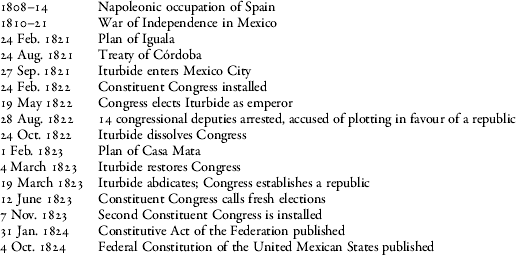
The constitutional question had always been a feature of Mexico's insurgency movement.Footnote 8 Ignacio Rayón wrote a first constitutional project in 1811.Footnote 9 In 1814 the insurgent government published the Constitution of Apatzingán, which was briefly in force in insurgent territory.Footnote 10 An independent nation needed its own constitution; thus, when Colonel Agustín de Iturbide of the Royalist army proclaimed his own independence project via the Plan of Iguala on 24 February 1821, it was imperative that he outline what form of government he wished to see adopted.
Iturbide's plan aimed to unite insurgents, Royalists and the undecided to the cause of independence, and was deliberately vague.Footnote 11 It stated that the nation's government would ‘be a moderate monarchy in accordance with the kingdom's particular … constitution’.Footnote 12 A Constituent Congress or Cortes would be convened immediately; the crown was offered to the Spanish king Ferdinand VII; and both the army and the Church were to maintain their privileges.
The Plan of Iguala proved popular and was soon adopted by the majority of Royalist commanders, who quickly invited their erstwhile opponents to join the drive for independence. Between February and June 1821 almost all local municipalities also proclaimed their loyalty to the new plan. In August, a new governor, Juan O'Donojú, arrived from Spain to take command of the viceroyalty, but faced with the reality of the situation, he opted to open negotiations with Iturbide. The result of these meetings was the Treaty of Córdoba. This document ratified many of the details set forth in the Plan of Iguala: national sovereignty, the agreement to establish a moderate monarchy and the offer of the crown to Ferdinand VII. However, it also introduced a number of new clauses: New Spain was henceforth to be known as the Mexican Empire, and if Ferdinand were to refuse the offer of the crown, it could be offered to another member of his family, or the Imperial Congress could designate anyone of its choosing as monarch. Until a Constituent Congress could be convened, a Provisional Governing Junta would undertake the legislative power while the executive power would be in the hands of a Regency made up of O'Donojú, Iturbide and the Archbishop of Puebla, Antonio Joaquin Pérez. The Treaty also specified that the imperial government should observe all existing legislation (the 1812 Constitution and colonial laws) until the empire could establish its own constitution, disregarding only the aspects of these laws that contradicted the terms of the Plan of Iguala.Footnote 13
Following his meeting with O'Donojú, Iturbide marched on Mexico City, where he appointed the members of the Provisional Governing Junta. The Junta set to work organising the election of a Constituent Congress, a task which soon illustrated the differences in opinion amongst the empire's political class concerning the best form of government for their new nation. The Junta and the Regency clashed on a number of constitutional issues: principally, the manner in which the Constituent Congress should be elected, and the form it should take.
Despite disagreements, the Constituent Congress was successfully installed in February 1822. One of its first acts was to appoint a committee to draw up a constitutional project;Footnote 14 however, political events meant that the committee and Congress spent little time on this question. Constitutional debates centred on the formation of the provisional governmental institutions. Above all, discussion focused on the question of who should appoint the magistrates of the new Supreme Tribunal of Justice (Congress or the Regency) and how the State Council, established by the Cádiz Constitution to advise the executive power, should be chosen.
Regimes, 1812–1835

These questions became all the more important after Ferdinand VII refused to recognise the Treaty of Córdoba and an alternative candidate for emperor had to be found. In May 1821 a military coup allowed Iturbide's supporters to convince the Constituent Congress to declare Iturbide the first Mexican emperor. Iturbide's supporters believed he should be the one to appoint the Tribunal magistrates. They also thought the emperor should preside over the State Council, as stipulated by Cádiz, and have the responsibility for naming the Council's secretary. Iturbide's opponents in Congress argued that they should have these powers.
The Constituent Congress's power was undermined in August when a republican plot to rebel against Iturbide was discovered. Fourteen deputies, including republican leader Servando Teresa de Mier, were arrested.Footnote 15 The assembly limped on throughout September and October, but soon lacked a basic quorum due to the absence of the imprisoned deputies and the fact that the representatives of the more far-flung constituencies opted to return home. On 24 October Iturbide dissolved the Congress, alleging that the body had not fulfilled the task with which it had been entrusted: the writing of a constitution. Later, he appointed a new legislative body, or Junta Instituyente, from amongst the former deputies.
Chronology of Key Events

Meanwhile, the constitutional committee continued its labours. In January 1823 it presented a proposal for the provisional government of the empire which formally repudiated the Cádiz Constitution. These rules reduced the prerogatives of the rump legislative power or Junta Instituyente, charging it with dedicating itself exclusively to the drawing up of the constitution and a budget. It gave Iturbide the power to veto absolutely all legislation and the prerogative to name the members of the judicial power.Footnote 16 This text was never enforced. Iturbide's government was overthrown in March 1823, and he was forced into exile. Mexico embraced republicanism and all ideas for a constitutional monarchy were abandoned.Footnote 17
Defining the Architecture of a Moderate Monarchy
The Plan of Iguala called for Mexico to adopt a moderate monarchy. In the language of the moment, this meant a form of government based on Montesquieu's theory of the separation of powers. Moderate government was widely considered to be the antithesis of absolutism as it guaranteed that the actions of the monarch would be moderated by the participation of various institutions in the exercise of government.Footnote 18
But what was the appropriate constitutional architecture for a moderate monarchy? One option was to adopt an almost pure separation of powers or division of functions. Such an arrangement required a tripartite division of powers with a corresponding identifiable function of government: legislative, executive or judicial. None of the powers should participate in the functions of the others, and membership of each power should be exclusive; no member of the legislature should serve as a minister in the executive or judicial powers. This was designed to ensure that ‘each of the branches [was] a check on the others and no single group of people [would] be able to control the machinery of state’.Footnote 19
Jean-Jacques Rousseau was one of the thinkers who was inspirational in the creation of this idea. He emphasised the importance of distinguishing between the act of deciding legislation and the act of executing it.Footnote 20 He affirmed that sovereignty remained always with the individuals of society and believed that all legislative decisions should be in the hands of citizens, who should agree on the ‘popular will’ in any subject. As a result, Rousseau's writings are often judged to be hostile to representative government. However, scholars have demonstrated that he was not adverse to government positions being held by the elite. The important detail was that the popular will was respected and consulted in all legislative matters.Footnote 21
The works of Rousseau were available in Spanish America. Antonio José Valdés had translated Du contract social while living in Cuba in 1810.Footnote 22 For his part, Francisco Severo Maldonado included a translation of various chapters of the Social Contract in his newspaper, El Fanal del Imperio, in 1821. The mode of government Rousseau suggested was generally referred to as ‘republican’ or ‘democratic’ during the wars of independence and early years of independence in Spanish America for two reasons: (a) the primordial place Rousseau awarded to the popular will, which seemed to conform to the classical definition of democracy; and (b) the modern idea, established by James Madison and the Federalists in 1787, that republican government should be based on the representation of its citizens.
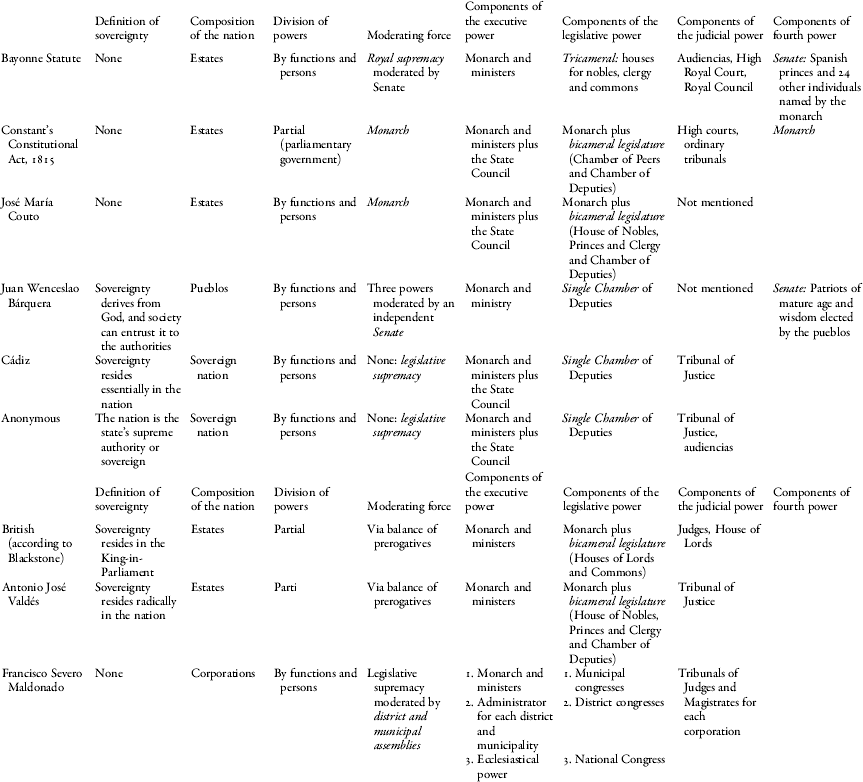
The Cádiz Constitution, in force in Spain and Mexico between 1812 and 1814 and then again from 1820, operated on the principle of the separation of functions. It specified the creation of an executive power composed of the king, his ministers and a State Council consisting of 40 dignitaries (including two bishops and two nobles). The legislature was a single chamber of deputies elected via indirect suffrage by all citizens. The judicial power was in the hands of magistrates and supervised by a Supreme Tribunal of Justice whose members were appointed by the king.
The authors of the Cádiz Constitution rejected Rousseau's ideas on sovereignty in favour of Emmanuel Sieyès' principle of national sovereignty.Footnote 23 This taught that individuals in each community were sovereign until they came together to constitute their nation. Once the nation had been constituted, individuals were no longer sovereign; rather, sovereignty belonged to the collective nation. As Fernández Sarasola explains, this meant that
the liberals distinguished between the ownership and exercise of sovereignty. The Nation, the owner, could not exercise it for itself, given its abstract personality, so as a result, it divided the exercise between diverse organisms: king, the Cortes and judges. In this way, the absolute power invested in the Nation was divided in legislative, executive and judicial powers and entrusted to different constituted authorities.Footnote 24
This arrangement created a government whereby all the powers were said to be representative of national sovereignty. However, ‘theirs was not a relation of equals, as the legislative power, being the most immediate expression of national will and the home of sovereign nation's representatives, became the state's political centre, leading to the creation of a parliamentary supremacy’.Footnote 25
In the Cádiz Constitution, the supremacy of the legislature over the executive was made clear in the sections relating to royal succession and Regency, for example. In the case of the extinction of the Bourbon family, it was the Cortes that should decide on the proper successor (arts. 180–1).Footnote 26 If the monarch was incapacitated or a minor, it was also the Cortes that named the members of the Regency (arts. 186–92). The monarch's role in the legislative process was limited to the recommendation of bills to the house and the exercise of a suspended veto (arts. 142–52 and 171). This veto could be overruled after two votes in favour of the bill in the Cortes, although these could not be immediate but rather had to be realised in different sessions (arts. 142–50).Footnote 27 The monarch was forbidden from interfering in the business of the legislature in any other way and had no power to dissolve or convoke its assembly (art. 172, part 1). All government ministers were accountable to the Cortes for their actions, although the monarch himself was guaranteed total immunity (art. 168). The monarch was to be advised by the State Council in all his actions. This body was chosen by the king from a list of candidates drawn up by the Cortes (art. 233).
Another well-known constitution practising the division of functions was the Bayonne Statute.Footnote 28 A Hispanicised version of the Napoleonic imperial constitutions of 1802 and 1804, this was written for José Bonaparte after Napoleon's invasion of Spain in 1808.Footnote 29 It rejected the idea of national sovereignty in favour of the principle of mixed government. Mixed government allowed the representation of all three classical forms of government: monarchy, aristocracy and democracy. The Statute divided the government into six institutions: the monarchy, a ministry, a State Council and a Senate, the Cortes and a judicial ‘order’. The State Council was presided over by the king and made up of between 30 and 40 individuals of his choosing (arts. 52–60). The Cortes was divided into three chambers by estate: nobles, clergy and people (arts. 61–86). The Senate was composed of the adult Spanish princes and 24 other individuals named by the monarch from amongst his ministers, the captains-general of the navy and army, ambassadors, state counsellors and royal counsellors (art. 32). The judicial power was made up of the local courts and audiencias. It also had two institutions of appeal: the Royal Council and the High Royal Court (arts. 96–114).
The Bayonne Statute adopted the opposite relationship between executive and legislative branches of government to that established by the Cádiz Constitution. The fount of legitimacy and sovereignty was the monarch, and the statute is a charte octroyée as a result.Footnote 30 Of the three chambers of the Cortes, only the popular chamber was to be elected. The Cortes's existence depended on the will of the monarch; it could only meet if convened by the king and could be dissolved on his orders (art. 77). The king chose the president of the Cortes (from a list drawn up by its members), and it was his exclusive prerogative to present bills of law to the assembly of estates (arts. 83 and 84). All government ministers could be impeached by the Cortes, but hearings into accusations of misbehaviour would be in the hands of the Royal and State Councils (art. 85).
Bayonne gave an important role to the Senate as guarantor of constitutional order. This body was charged with watching over individual liberties and those of the press (art. 39). It could also suspend the constitution on the petition of the king in case of ‘armed uprising or unrest that endanger[ed] state security’, or ‘take other emergency measures’ required to restore order (art. 38). The inspiration for these clauses can be found in the Imperial Senates established in 1802 and 1804.Footnote 31
An alternative to both Cádiz and Bayonne was Great Britain's balanced constitution. This model was also present in the French Constitutional Charter of 1814. The British Constitution was well known in the Hispanic world thanks to the eulogies of Montesquieu, the writings of Melchor de Jovellanos and the journalism of Spanish exile José María Blanco White.Footnote 32 The division of powers it was said to practise can be summed up in William Blackstone's famous description: ‘In England th[e] supreme power is divided into two branches: the one legislative, to wit, the parliament, consisting of king, lords and commons; the other executive, consisting of the king alone.’Footnote 33 Blackstone also recognised that magistrates formed the judicial power and while they were named by the monarch, they could not be removed by him, which he believed guaranteed their independence.Footnote 34 The House of Lords functioned as the highest court of justice and was also home to the most senior judges.
This constitutional arrangement was considered to be balanced because none of the parts could act without the other. It was described as a partial separation because each of the powers could participate in some of the activities assigned primarily to the others. The legislature was formed not by the representative assemblies, but rather by the meeting of both assemblies plus the monarch. The institution of ‘King-in-Parliament’ was ‘the supreme and absolute authority’ whose actions could not be restricted; however, the system was perfectly balanced through a special division of prerogatives which guaranteed that ‘all the parts … form a mutual check upon each other’.Footnote 35 In other words, unlike Cádiz or Bayonne, no one institution was granted total supremacy over the others.
The French Constitutional Charter of 1814 offered an adaptation of the British model.Footnote 36 This was established in the dying years of the Napoleonic Regime and amended by Benjamin Constant in the Additional Act of 1815.Footnote 37 It divided government into the institutions of monarchy, an executive ministry, a legislature (whose power was exercised by the king, a Chamber of Peers and a Chamber of Deputies) and a judicial power. The king named the members of the Chamber of Peers (art. 27). In 1814, membership of this house could be held for life or inherited (art. 27); after 1815, the titles of nobility were all decreed to be hereditary (art. 3). The monarch also named the members of the judicial power and was not required to consult any other institution (art. 58). Perhaps the most important innovation was the indication that government ministers should be members of either one of the legislative assemblies (art. 54).
As is well known, Constant's proposal to separate the monarch from the executive ministry was based on his observations of the cabinet system and parliamentary government in Britain during the eighteenth century. These arrangements created an executive government led by a prime minister, named by the monarch and charged with forming a cabinet from amongst the members of both Houses of Parliament. Such a government required the support of Parliament in order to survive, and its resignation could be contrived via a vote of no confidence in the House of Commons. Ministers were not only accountable to Parliament as Blackstone had described, but were also members of this institution and could take an active part in its labours.Footnote 38 Equally, the specification that French ministers should be members of one of the legislative assemblies was an attempt to move France towards parliamentary government of the type practised in Britain.Footnote 39 Constant wanted to ensure that ministers participated in the discussion and approval of legislation in the assemblies while at the same time being independent of the monarch.Footnote 40
It should be noted that the Constitutional Charter was designed not to replace but merely to amend the former Napoleonic constitutions. Thus, it maintained many of those constitutions' forms. The executive ministry was the only power able to propose legislation, and the two assemblies were confined to the roles of consultation and revision (arts. 16–22). Even so, the separation of the ministry and king meant that the rationale behind the division of powers had been subtly amended. Constant's defence of the monarch as a ‘neutral power’ meant that there was now no need for a Conservative Senate. Instead, the king – ‘being apart, superior to differences of opinion [and] having no interest but the maintenance of order and liberty’ – could now be entrusted with the guardianship of the constitution.Footnote 41
Moderating the Cádiz Constitution
The importance of Cádiz as a model for the new empire was always evident in political discussions.Footnote 42 In Mexico, the principle of legislative superiority was immediately adopted in the opening session of the Constituent Congress on 24 February 1822. Here deputies followed their peers in Cádiz by adopting the principle of national sovereignty and by further declaring that this sovereignty ‘reside[d]’ in Congress. Deputies then ‘delegated’ the exercise of the executive power to the Regency.Footnote 43 Congress's position was underlined by Iturbide's coronation as emperor by the president of Congress in July 1822.Footnote 44
Despite the importance of the Cádiz Constitution, none of the projects presented during the empire proposed its adoption without first introducing some modifications in the division of powers that it established. Chief amongst the reforms proposed was the addition of a second legislative chamber, which appeared in all the projects and publications considered in this essay. The experience of the Cádiz Constitution had convinced Mexican politicians that a unicameral legislature had few effective checks on its actions.Footnote 45 As Iturbide argued in November 1821, a partial executive veto had not been sufficient to keep the legislators in order.Footnote 46
It is clear that Mexico's politicians were mindful of the controversies surrounding the constitutional organisation drawn up in 1812. They were probably aware of Blanco White's criticisms of the single-chamber legislature and weak monarch, since his newspaper, El Español, had circulated amongst royalists and insurgents alike during the independence wars.Footnote 47 They might also have been aware of hostility to the restoration of Cádiz among some sectors of Spanish liberal thought. In 1819, a conspiracy against the absolute government of Ferdinand VII was discovered. As Claude Morange has shown, the conspirators shared Blanco White's opposition to Cádiz's separation of powers and were in favour of establishing a constitutional monarchy in the style of the French Restoration in 1819.Footnote 48
Like Spanish liberal opponents of Cádiz, many of Iturbide's supporters believed the answer was to abandon the example of Cádiz entirely in favour of balanced government. This did not appeal to those who were convinced by the idea of national sovereignty. In the constitutional project written by an anonymous member of the constitutional committee, the author argued that a legislative power divided between democratic and aristocratic elements in the manner of the ‘English or the French’ would be ‘against the very nature of representative government’.Footnote 49 It would allow the emperor to name the nobles and clergy to sit in the upper house, giving the government too much influence in the legislature. It could also lead to ‘perverse’ elements, perhaps with designs against the representative system, taking up seats.Footnote 50
Juan Wenceslao Barquera emphasised the importance of the principle of national sovereignty. In his opinion, government and ‘our representatives can only be the depositaries of public confidence if they represent the national will’. He affirmed that introducing mixed government to the Mexican constitution risked destroying representative government and returning the empire to the ‘chains of despotism’.Footnote 51
If the legislative power should not divide itself between democratic and aristocratic representation, how should it be divided? The anonymous committee member's project suggested that the principles of national sovereignty could be respected via the adoption of provincial representation in the manner of the US Constitution. He proposed a constitution in which the legislative power was divided between a lower chamber elected indirectly by the population, made up of one deputy for every 50,000 souls (art. 15), and a higher chamber elected by the provinces and composing one member per province, ‘whatever their population’ (art. 30).
In the elections for the first chamber, the committee member proposed that citizens be required to possess a property valued at 100 pesos or more, or to have ‘an office, profession or rental income which paid three hundred pesos annually’. All artisans were to be given the vote, as were all indigenous men employed in farming (art. 11). Deputies in the lower chamber should possess property valued at more than 500 pesos or an annual income of the same amount (art. 12). Members of the upper house should be over 40 years of age and have enough money to live independently (art. 30).
The proposal included no plans for amending the administrative provincial order established by Cádiz. It imagined a centralist state: provincial political chiefs were to be named by the emperor and were to function as ‘the government's agent and its means of communication with the people’ (arts. 44 and 45, part 12). A second house was included exclusively to provide balance; it was to be a revising chamber ‘in which the ardour of a heated discussion could be cooled, … any illusions of seductive eloquence could be dispelled and any party or factional spirit [apparent] amongst the deputies would be shattered’.Footnote 52 The second chamber's faculties were limited to a provisional veto over law bills presented to it by the lower house and the ability to propose legislation (art. 34).
Despite this reform, the author wished the empire to adopt the division of powers and the legislative supremacy enshrined in the Cádiz Constitution. The executive power would be made up of the monarch, his ministers and the State Council (arts. 42 and 45). Members of the legislature could not be ministers (art. 14). The emperor could name his ministers freely, but the members of the State Council would be chosen from a list presented by the legislature (art. 45, part 7). Monarchy was to be hereditary, but the succession would be decided by Congress in the event of a lack of a male heir; Congress would also appoint a Regency if the heir were still a child (arts. 47–53). The monarch should have the prerogative to propose legislation to Congress and a provisional veto over bills passed into law. This veto could be used only twice; if Congress insisted a third time, the law would have to be published (arts. 33–4).Footnote 53 Like the Spanish king, the emperor would have no powers to convene or dissolve the legislative assemblies (art. 40). There would be ministerial responsibility while the monarch would be immune from prosecution. The subordinate position of the monarch to Congress was made explicit in the project: art. 46 stated that the monarch could be reprimanded by Congress. On receiving three reprimands, he would be considered to have abdicated the throne.
Barquera wanted to conserve the basic division of powers but reduce the importance of the legislature within the framework of government. Instead of endorsing legislative supremacy, he wanted to establish ‘a fair and rational distribution of power’ by creating the right ‘balance of weights, … capable of ensuring the authority of magistrates and laws in the most vigorous possible way’.Footnote 54 He favoured the creation of a Conservative Senate of the type proposed by Sieyès in 1799. Barquera's emperor would have had the right to a suspended veto over legislative projects,Footnote 55 and the ability to dissolve the legislature in case of emergency.Footnote 56
In Barquera's model, the legislature would be elected indirectly, with one deputy representing every 40,000 people.Footnote 57 The Senate would be chosen from amongst those ‘of the most propriety, wisdom and good name’. Its members should be of a ‘mature age’ and should display ‘decided signs of patriotism’ – a quality, Barquera hastened to add, that could not be measured by ‘employments, honours or rewards’. They would receive a salary that would permit them to live independently, but could aspire to ‘no other employment, honours, pensions or titles’ and would retain their seats for life. Barquera wanted to ensure, as Sieyès had before him, that the members of his Conservative Senate would be independent of the executive: not able to be swayed through the promise of further honours, nor threatened by the loss of their seats. The Senate was also to be independent of the Chamber of Deputies. The founding members would be elected by the deputies, but vacancies would then be filled by the councils of secondary electors in the provinces from lists prepared by the deputies and the executive.Footnote 58
Barquera's independent Senate would be entrusted with overseeing elections to the legislature. It would advise the monarch on his executive appointments. Its most important power would be the faculty to judge the constitutionality of the legislative and executive branches' actions. Barquera also thought that the Senate should be charged with the guardianship of the constitution and its reforms. This institution should be able to decide when ‘all judicial and legal formalities had been met’ during the process of reform and to convene an assembly in which to discuss them.Footnote 59
Even so, Barquera did not recommend giving the Senate all the powers entrusted it by the French Imperial Constitutions or the Bayonne Statute. He did not suggest that the Senate be allowed to declare the suspension of the constitution, nor did he charge it with the protection of individual liberties, preferring to give those powers to the legislative assembly.Footnote 60
Moderation via Balanced Government
Other politicians rejected national sovereignty and a division of powers based on functions in favour of balanced government.Footnote 61 A few, like Antonio José Valdés, were close supporters of Iturbide, and it appears that the emperor himself had some sympathy for such constitutional arrangements.Footnote 62 The balanced model of mixed government allowed these individuals to support the idea of a popular representative lower chamber while also advocating a hereditary monarchy entrusted with wide-ranging powers.
This position has often been misunderstood by historians who have assumed that the desire to strengthen the role of the monarch must be indicative of a wish to transform Iturbide into a Mexican version of Napoleon. There is little evidence to suggest that Iturbide or his supporters had such plans. The only constitutional project which proposed the adoption of a constitution similar to those in force during Napoleon's rule was that of José María Couto, a cathedral canon from Michoacán and former deputy to the Cádiz Cortes. Couto did not propose to copy the unreformed Napoleonic charters, however; rather, he favoured the adoption of a system modelled on the French Constitutional Charter of 1814.
Couto's constitutional project was formed almost completely from articles selected from this French charter. He put forward a system in which the monarch should play the directing role in government and be the exclusive source of legislative projects (art. 16), while the legislature should function as an institution of revision (art. 18). He proposed that legislative power be made up of a popular chamber, chosen via indirect election (arts. 34–50), and an imperial chamber of unlimited size, named by the emperor (art. 26). However, he was not in favour of parliamentary government, as he did not include any of the articles from the 1814 Constitution that outlined how members of the legislature could be executive ministers.
Couto wanted to see an ecclesiastical presence in the second house, something not contemplated by the French charters. He indicated that Mexico's bishops and archbishops should have seats in the imperial chamber, along with a representative of each of the empire's cathedral chapters (art. 26).
Aside from Couto's plans, the only other support for French ideas during the empire appeared in El Sol. In December 1821, this publication included an editorial essay lauding Benjamin Constant's proposals for a constitutional monarchy. The article argued that balanced government could only be guaranteed by the mediation of the king, who being wholly separate from government was ‘the only one capable of acting as mediator’ due to the fact he had ‘no interest’ in provoking conflict between the other powers.Footnote 63 The editors returned to this theme in May 1822, arguing that a moderate monarchy also required the presence of ‘an intermediate body between the legislative and executive power’ in order to ‘avoid the monarch's favouritisms’ and assure ‘our liberty forever’.Footnote 64 There was no suggestion of adopting a Napoleonic solution.
Other plans which proposed mixed government favoured the British model. In Catechism of Independence, for example, Ludovico Lato-Monte argued in favour of an English-style government in which there was ‘a monarch-executor of laws, with two chambered legislature, an upper [chamber] made up of nobility and clergy and a lower [chamber] for the common estate’. The author was keen to stress the importance of the upper house within this arrangement: ‘it defends the king from the insults of the people and also the people from the tyranny of the king’. Without an upper chamber, government would necessarily fall into ‘one of two extremes, despotism or regicide’.Footnote 65
Iturbide and his fellow regent, Archbishop Antonio Joaquín Pérez, were of a similar opinion. In a text presented to the Provisional Governing Junta in 1821, they argued that the Cádiz Constitution had been unable to uphold its ‘liberal principles’ because its organisation did not provide for equal representation in government for all Spain's corporations. By creating a single-chamber legislature, it excluded the aristocrats and other privileged estates from government, thus converting them into natural allies of the constitution's opponents. The result had been the rebellion against the Constitution in 1814 and the restoration of absolutism under Ferdinand VII.
The regents also argued that a bicameral system, in which the two houses were ‘composed diversely according to the respective circumstances of the population’, was key to explaining the ‘amazing prosperity’ of the United States and Great Britain. They made no distinction between the US Senate and the British House of Lords; in fact, they appear to have believed that the US Senate was merely a republicanised version of the Lords.Footnote 66
Another partisan of British bicameralism was José Antonio Valdés, a Cuban exile and deputy for Guadalajara in the 1822 Constituent Congress.Footnote 67 During 1822, Valdés published his Imperial Constitution, as well as a pamphlet entitled The Mexican Republic. Valdés believed that ‘[t]he imitation of the Spanish constitution would be absurd for the Empire’ since its deficient organisation had been the cause of its failure to establish stable government in 1812 and again in 1820.Footnote 68 The root cause of this incapacity was the creation of an all-powerful unicameral legislature, which being unchecked by the executive was more suitable for a ‘democratic republic’ than a moderate monarchy.Footnote 69
Valdés rejected the idea of charging the monarch with the direction of the legislative power in the manner of the French Constitutional Act of 1814, as he did not consider it to moderate the actions of the monarch properly:
The French constitution offers an example of the opposite extreme [to Cádiz]. None of the chambers can present bills of law, only the king can propose them, and the chambers must reject or adopt them. In this way, … a political farce develops, … since, as a result, the king [as head of the executive] only sanctions the emanations of his own will.Footnote 70
For Valdés, a true moderate monarchy could only adopt a legislature consisting of ‘three votes of equal force in the manner of England’.Footnote 71 He proposed that the legislature be formed by three institutions: the emperor, the Senate and a House of Representatives, in imitation of the three estates present in the English constitution. The House of Representatives would be elected popularly but indirectly according to the Cádiz system: all citizens could vote in primary elections, but only those possessing ‘capital of two thousand pesos …, a state salary of more than five hundred pesos, or a profession, industry or art that produce[d] the required sum’ could vote in the secondary and tertiary stages. Deputies would have to possess capital of ‘no less than ten thousand pesos or a salary of two thousand pesos’ resulting from state employment or a ‘scientific profession’.
In his pamphlet Valdés considered three alternative compositions for the Senate:
1. From the Empire's nobility, in which case it should be permanent.
2. From individuals named by the people in the manner of the United States, or by the town councils, in which case it should be renewed by one-third every year.
3. From a selection of themselves [the deputies of the House of Representatives], elected in the first session of each legislature … with the same prerogatives as the originating house.Footnote 72
When writing his constitutional project, Valdés opted for a mixture of the first two elements while incorporating the idea that the upper house should also count on some ecclesiastical representation:
The imperial princes over the age of twenty-five, … all the Empire's archbishops …, twenty-four individuals named by the emperor from amongst the secretaries of state, the state counsellors, bishops, ambassadors, military generals, nobles, intendants [political heads of the provinces], magistrates … [and] a senator for each province named every five years by the Provincial Deputation from amongst hacienda owners, merchants, miners, lawyers and clergy.Footnote 73
All but the elected elements would be senators for life and should have the wealth necessary ‘to live decorously’ (art. 28). All but the princes should be over 30 years old (art. 29). Valdés aimed to include different interest groups and corporations in the Senate, although in a very different fashion to the British House of Lords or the organisation of estates and corporations typical during the colonial period.Footnote 74
As ‘an essential part’ of the legislative power (art. 17), the emperor in Valdés' constitution has most of the attributions believed to belong to the British monarch: immunity from prosecution, an absolute veto over all legislative projects, the prerogative to convene or extend the sessions of both chambers, and the right to dissolve the House of Representatives. He must summon the legislature every year. In the interests of balance, deputies, senators and the emperor all have the right to present bills of law; although, again in imitation of the balanced constitution, all projects concerning taxation must originate in the House of Representatives (arts. 18–24).
Despite Valdés' rejection of the 1814 French Constitution, he did partly endorse the idea of a ‘Conservative Senate’. His constitution entrusted the Senate with the supervision of ‘the conservation of individual liberties and the liberty of the press’ in the manner of the Bayonne Statute. He awarded it the same power to suspend the constitution or parts of it – on petition of the emperor – ‘in case of armed uprising, or unrest that compromises the security of the state’ (art. 38). However, Valdés' Senate was to be much more wide-ranging in its powers than that of Bayonne. It should also be the court in which all impeachments of ‘imperial persons, ministers, state counsellors, members of the Supreme Tribunal of Justice, its own members and the representatives’ were heard (art. 39). This recalled the powers of the Senate in the 1804 French Constitution (arts. 101–2).
It seems clear that supporters of a mixed version of moderate monarchy wished to create a constitution in which there were three equally important elements: the popular assembly, the aristocratic and ecclesiastical senate, and the emperor. These authors believed that this was the only way to ensure proper balance in government and to prevent either the monarch or the popular assembly from abusing its power. There was no question of making Iturbide a Napoleonic figure or allowing him unlimited power in government.
Moderation via (Enlightened) Democracy
Completely different from all the proposals studied so far was the Constitutional Project for the Mexican Republic published by Francisco Severo Maldonado in the latter part of 1822.Footnote 75 Maldonado had originally written his plan for the Spanish nation, but after independence he rewrote it for the Mexican Empire. He also wrote an extensive pamphlet entitled The New Social Pact, which he published in four parts in 1821.Footnote 76 The first three parts of the text were written for the Spanish nation, while the final part was dedicated to the Mexican Empire and was entitled The Social Pact of the Mexicans. Footnote 77 In 1823, after the establishment of the republic, Maldonado re-edited this plan once more, restyling it Contract for the Association of the Republic of the United States of Anahuác.Footnote 78
Maldonado's premise was that a constitution that sought only to rearrange the powers of government without tackling the question of social inequality was bound to fail. As a result, in 1822 he also published a plan for the reorganisation of taxation and the imperial treasury, as a complement to his political ideas.Footnote 79 Here, he argued that despotism and the oppression of civil liberties could not be destroyed without first tackling the question of land ownership. His opinion was clear: ‘the art of giving [liberty] to the people can be reduced, in the last instance, to the division of the totality of national property amongst them; without this, equality cannot be maintained … nor can liberty’.Footnote 80
For Maldonado, neither the British Constitution nor the various French charters published since 1789 had brought liberty and equality to their citizens. In his economic plan he cited the Abbé de Pradt, who maintained that the concentration of property in the hands of the English aristocracy meant the British Constitution had been completely obliterated. Its claim to represent balanced government was false, since the reality of property ownership always tipped the scales in favour of aristocratic and monarchical power.Footnote 81 Maldonado concluded that this ‘celebrated’ constitution could never be anything but ‘sterile, vague and unfruitful’, since it offered merely ‘chimerical protection’ to a people living in ‘servitude and poverty’.Footnote 82 In the New Social Pact, he paraphrased Thomas Paine's judgement that the British Constitution was no more than ‘a pact agreed between the chief and principal subjects to live at the expense of everyone else and to oppress them’.Footnote 83
Maldonado thought the French constitutions were little better. In his opinion, the first revolutionary documents had proposed ‘vain and ridiculous theories’ and established ‘extravagant and chimerical systems’ that were all ‘inapplicable to the actual state of the population’. The result had been a disaster: political divisions and rebellions had festered until France found itself once more restrained by ‘the chains of oppression’ that it had not long since thrown off. For Maldonado, the counter-revolutionary constitutions marked France's ‘violent regression into despotism’.Footnote 84
To prevent Mexico from repeating these mistakes, Maldonado advised its politicians to avoid both constitutional models and to ensure that they first tackled the question of social inequality. He proposed an economic plan whereby the state would gradually nationalise all property, renting it back on lifelong leases to its inhabitants in equal portions. Such an arrangement would not only bring social equality, but would also provide the state with sufficient income to cover its expenditure and make taxation completely unnecessary.Footnote 85 This scheme would also allow the state to finance the education of its youth, thus ensuring that it would receive all the benefits of the modern Enlightenment. In his opinion, social equality, education and prosperity would form ‘three battering rams before which any wall of despotism would disintegrate and fall’.Footnote 86
A well-educated, prosperous and equal society was essential to Maldonado's constitutional project. Seemingly inspired by Jean-Jacques Rousseau's ideas about democracy, his plan was based on the premise that the inalienable holders of sovereignty were the active members of the Mexican polity, whose general will should be the fount of all legislation.
Maldonado was quite familiar with the arguments that rejected direct democracy for large polities.Footnote 87 He believed he had managed to resolve the inherent problems of involving millions of people in the affairs of government.Footnote 88 He proposed to make the body politic a voluntary association into which all males above the age of 16 could enrol. Those who chose to remain outside the association would become passive citizens and would not be allowed to participate in the affairs of government (art. 15).
The association of citizens was to be divided into ‘political and military’ corporations formed of ‘all individuals with the same state, profession or mode of living’. In each (unspecified) locality there would be corporations of labourers (comprising property owners, sharecroppers and ranch hands), miners (mine owners and all those employed in mining), merchants, artisans (divided by their office) and domestic employees. These corporations would form the basic unit of the political nation and were also to provide services as militia soldiers in case of a foreign attack. Nationally, they were to be organised in centuries, divisions and battalions. The would-be citizen was required to take part in a lengthy ceremony of allegiance conducted by his parish priest. In the ceremony, he would choose which corporation he would join, swear his allegiance to the patria and present the weapon of his choice to be blessed by the priest (art. 32).
This nation of associated citizens was to be administered by a government divided into three branches: legislative, executive and judicial. The legislature would be made up of a series of small congresses: the first, a municipal congress in each locality in which each corporation would have a representative; the second, a district congress, formed of one representative from each municipal congress contained in its jurisdiction; the third, a provincial congress with a representative of each district congress; and finally, a national congress made up of a representative from each provincial assembly (arts. 33–45). The executive power was to be made up of the emperor and his ministers, plus an administrator for each level of government: provincial, district and municipality (arts. 123–37). Also part of the executive were a nationalised Church or ‘ecclesiastical power’ (arts. 204–41), a regular army and a nationalised education system made up of a network of educational institutes. The system imagined the provision of state primary schools in all towns, secondary education in all district capitals and state universities in all provincial capitals (arts. 138–48, 165–203). The judicial power was to be formed of judges and magistrates. Here it should be noted that judicial jurisdictions were to correspond to the different corporations individually (arts. 381–448).
None of the positions within the executive power – except that of the emperor – were to be held for life, nor should they be inherited (arts. 242–8). Maldonado proposed an elaborate scheme to create something akin to a professional civil service whereby all positions would be earned on merit and seniority. This was probably inspired by Rousseau's plans for a similar institution for the constitution for Poland.Footnote 89 The executive power would oversee all education and examinations, and only those gaining the required qualifications would be able to serve in the three branches of government. All those qualified would begin in the lowest positions of government and would gradually ascend to higher positions on the basis of longevity in service (arts. 250–66).
The members of the judicial power would be chosen in the following way. The corporations would choose the judges for each corporation via annual indirect elections in two stages. In the first stage, each corporation would select 12 electors by means of a lottery. In the second stage, each group of electors would choose five judges and two replacements for their corporation (arts. 391–3). There were also to be tribunals in each province to oversee the procurement of justice; these would be made up of judges with lifelong appointments. Maldonado did not elaborate on how they would be chosen (arts. 336–8).
To fill the provincial and national assemblies, Maldonado proposed drawing up lists of civil and ecclesiastical lawyers and members of the literary professions. The most senior of these lists would be members of the national assembly. Once all the places in this assembly were filled, the next most senior candidates would be made members of the provincial assembly. Vacancies in both assemblies would be filled in order of seniority. Maldonado did not indicate what the deputies' length of term would be.Footnote 90
The executive power was only to be concerned with administering the law – its members were to take no part in legislation, and there would be no executive veto. Bills of law were to be discussed by the national assembly. Once they had been approved, they would be passed down to the provincial, district and municipal assemblies. It would be the responsibility of these congresses to print and circulate the bills amongst the population. Citizens who wished to pass comment or object to a bill were to be invited to do so by addressing one of the congresses with their arguments in writing within 50 days of the bill's publication. When the bill was discussed in the provincial, district and municipal congress, all those who had submitted comments were to be invited to attend the congressional discussions on the subject (it is not clear if they were to be allowed to speak). District and municipal congresses would pass the results of their discussion to the provincial congress. Here the bill was to be voted on after listening to the different representations from the lower assemblies and those submitted privately by citizens. Each bill would be required to receive the approval of two thirds of the provisional congresses in order to become law (arts. 93–122).Footnote 91
Maldonado made it quite clear that this arrangement was designed to give the lower assemblies the role of constitutional guardian. They existed not only to give citizens a voice in legislation but also to moderate the actions of the national legislature or executive. Their ability to veto legislation was supposed to prevent the ‘disastrous consequences’ of any party loyalty in the national congress. Having laws approved by the provincial congresses would ‘suffocate despotism at birth, preventing intrigues, torturous manipulations and collusions between deputies against the interests and rights’ of the people.Footnote 92
The multitude of chambers involved in the legislative power would mean that the behaviour of all members of the powers could be held to account. The actions of the national executive could be impeached in the national legislature, and those of the lower administrators in their corresponding assemblies. Each provincial congress would be charged with hearing impeachments against its own member in the national legislature, while the district assembly would in turn hear the accusations against its provisional representative and so on. According to Maldonado, such an arrangement would provide the solution to one of the most difficult problems facing politicians: how to find ‘a counterweight …, a neutral power’ which ‘could maintain the balance’ between the others.Footnote 93
This role of constitutional guardian is further made explicit in the final version of Maldonado's plan, written for the republic in 1823. Here he explained that bitter experience had taught the Mexican people that their constitutions not only required ‘a moderating power, which [was] sufficiently enlightened and sufficiently strong … to keep the agents of authority within the orbits of their respective attributions’, but also needed a power that could reconstitute the state in case of an emergency (arts. 90–1). However, he continued, history had repeatedly shown this power to be ineffective in the hands of ‘senates, higher or second chambers and state councils’ (art. 102). The only solution was to give power to the provincial congresses. Provincial legislatures should have the right to impeach members of the national executive, but also the prerogative to reconstitute the national legislature in case of its dissolution by a foreign power or a despotic executive. Should this occur, each congress should name its most senior deputy as its representative to be sent to form a new national legislature. Should the national legislature become despotic, the same action should be taken in order to isolate and neutralise the tyrannical assembly (arts. 193–6).
In short, Maldonado presented a plan for a moderate monarchy in which the moderation was provided by the division of the legislative power into hundreds of smaller assemblies. He wanted to create a democratic state in which there were no elections of the type practised hitherto in the Spanish Empire. The administration of government was entrusted to the most erudite members of society, while at the same time allowing all citizens a voice in the making of laws. As a result, his plan could be fairly described as an enlightened democracy.
Conclusions
The different projects studied in this article lead to two conclusions. Firstly, it is necessary to question the emphasis currently given to the role of the Cádiz Constitution by Mexican historiography as the most significant point of reference for nation-building during the early years of independence.Footnote 94 There is no doubt that Cádiz was extremely important for Mexico's politicians; however, historians' continual preoccupation with its legacy risks creating a misleading picture of Mexican political life. Above all, such thinking may serve to perpetuate two long-debunked myths concerning the intellectual history of Spanish America: its isolation from Atlantic political debate and its capacity for independent political thought.
This article shows that the empire's politicians had many sources of constitutional ideas and knowledge other than the Cádiz Constitution. The different constitutional projects studied demonstrate that they were familiar with a number of French constitutions, the model of the British balanced constitution and the US charter. They also suggest that their authors were unwilling to accept uncritically any of the pre-existing models of government. They point to the fact that Mexican politicians, like their US, French or Spanish counterparts, debated their future constitution on the basis of the examples and political debate available to them. They did not blindly adopt any one charter nor follow any one particular thinker.
Secondly, the projects examined show that the origins of Mexico's constitutional debates can be found in the political discussion surrounding a constitution in 1822. The question of how to create constitutional government which did not allow any of its component parts to overstep the law was constant until at least 1857. Specifically, the need for an institution charged with the role of constitutional guarantor evident in the ideas of Barquera and Valdés would be revisited. A proposal for a Conservative Senate, independent of the legislature, with powers to ‘supervise the conservation of the constitutional system’, was included in the constitutional project drawn up for the Federal Republic in May 1823.Footnote 95 It also made an appearance in Lucas Alamán's plans for the reform of the 1824 Federal Constitution, published first as a series of editorials for a newspaper, Registro Oficial, in 1830 and later re-edited as a pamphlet in 1835.Footnote 96 A version of this institution was adopted in the 1836 Constitution. This created four branches of government: the traditional trinity of legislative, executive and judicial powers, and a neutral Supreme Conservative Power, whose remit included the prerogative to judge the constitutionality of the other powers' actions and to reconstitute the nation in case of rebellion or invasion.Footnote 97
To conclude, the First Mexican Empire played witness to important debates concerning the best way to organise the division of powers. These debates were based on a wide range of sources and ideas. Although the empire's politicians did not manage to draw up a constitution before the monarchy fell, they left a rich legacy upon which the new republic could establish itself.
The Division of Powers in Constitutional Monarchies (c. 1821) and in the Projects Published during Iturbide's Empire