Introduction
Adolescence is a critical period for depression risk, with roughly 20% of adolescents experiencing a major depressive episode by age 18 (Birmaher, Brent, & Issues, Reference Birmaher, Brent and Issues2007). Anhedonia is a transdiagnostic construct, a cardinal symptom of depression, and a core negative symptom of schizophrenia. Traditionally, anhedonia was defined as a lack of pleasure (Ribot, Reference Ribot1905), but current conceptualizations broaden this definition to include reduced interest and motivation for reward and reduced consummatory pleasure (American Psychiatric Association, 2013). Within the context of depression, anhedonia has been associated with poorer treatment outcomes and a more chronic depression trajectory (Moos & Cronkite, Reference Moos and Cronkite1999). Consistent with its association with pleasure and motivation, anhedonia can arise from various sources of reward-related dysfunction, including reductions in desire and motivation for reward, anticipation of reward, consummatory pleasure, and impaired reward learning (Rizvi, Pizzagalli, Sproule, & Kennedy, Reference Rizvi, Pizzagalli, Sproule and Kennedy2016). Quantifying the behavioral, affective, and biological correlates of adolescent anhedonia may improve the understanding of the etiology of depression and thus inform treatment and prevention.
Assessment of anhedonia
Most previous research on adolescent anhedonia has relied on clinical diagnostic interviews (i.e. Kiddie Schedule for Affective Disorders and Schizophrenia; K-SADS; Kaufman et al., Reference Kaufman, Birmaher, Brent, Rao, Flynn, Moreci and Ryan1997) or self-reported questionnaires (e.g. Snaith–Hamilton Pleasure Scale; SHAPS; Snaith et al., Reference Snaith, Hamilton, Morley, Humayan, Hargreaves and Trigwell1995). Although the K-SADS and SHAPS are considered ‘gold standard’ assessments (Franken, Rassin, & Muris, Reference Franken, Rassin and Muris2007), they rely on retrospective reports of ‘average’ symptoms over several weeks, which may be subject to recall bias. Additionally, questionnaires may not capture the subjective, individualized nature of what one finds exciting or pleasurable in day-to-day life. Ecological momentary assessment (EMA) is one approach to measuring subjective affective experiences in daily life. Smartphone-delivered EMA surveys can be triggered multiple times throughout the day, allowing for responses that occur in the moment and in youths' natural environments. These features allow for subjective assessments of current affect and behavior, thus minimizing recall bias (i.e. measurement error) and increasing ecological validity. EMA is ideal for examining affect during adolescence, a period characterized by increased emotion intensity and variability (Bailen, Green, & Thompson, Reference Bailen, Green and Thompson2018). Further underscoring the importance of assessing affect in the moment, particularly for adolescents with elevated depressive symptoms, a meta-analysis revealed that anhedonia in the context of depression may be more state-like than anhedonia in other disorders, such as schizophrenia (Gandhi, Mote, & Fulford, Reference Gandhi, Mote and Fulford2022). Linking traditional laboratory assessment methods to subjective affective experiences in natural environments will facilitate a comprehensive understanding of anhedonia from a multi-method, multi-context perspective.
Mechanisms of anhedonia
Reward dysfunction is considered a key mechanism for the etiology of anhedonia and depression (Pizzagalli, Reference Pizzagalli2014). Reduced behavioral response bias towards rewarding stimuli is associated with anhedonia (Pizzagalli, Iosifescu, Hallett, Ratner, & Fava, Reference Pizzagalli, Iosifescu, Hallett, Ratner and Fava2008) and depression chronicity (Vrieze et al., Reference Vrieze, Pizzagalli, Demyttenaere, Hompes, Sienaert, de Boer and Claes2013). Similarly, neural measures of reward system function are linked to depression and anhedonia (Auerbach, Admon, & Pizzagalli, Reference Auerbach, Admon and Pizzagalli2014; Keren et al., Reference Keren, O'Callaghan, Vidal-Ribas, Buzzell, Brotman, Leibenluft and Wolke2018). The nucleus accumbens (NACC), is a key brain region of interest due to its role in reward motivation, valuation, and learning (Heekeren et al., Reference Heekeren, Wartenburger, Marschner, Mell, Villringer and Reischies2007). Reduced NACC response to reward outcomes has been identified in individuals with depression (Pizzagalli et al., Reference Pizzagalli, Holmes, Dillon, Goetz, Birk, Bogdan and Fava2009), and reduced NACC response during reward anticipation predicts depression onset in adolescents (Keren et al., Reference Keren, O'Callaghan, Vidal-Ribas, Buzzell, Brotman, Leibenluft and Wolke2018). Similarly, anhedonia has been linked to reduced ventral striatum/NACC reactivity during reward and loss anticipation (Stoy et al., Reference Stoy, Schlagenhauf, Sterzer, Bermpohl, Hägele, Suchotzki and Knutson2012) and during positive prediction errors (Gradin et al., Reference Gradin, Kumar, Waiter, Ahearn, Stickle, Milders and Steele2011). Anhedonia has also been linked to medial prefrontal cortex (mPFC) hyperactivity during reward processing (Forbes & Dahl, Reference Forbes and Dahl2012). The above studies suggest that depression and anhedonia are characterized by behavioral and neural reward system disfunction. However, to gain a comprehensive understanding of anhedonia, it is critical to establish connections between laboratory-based reward processing measures and youth's subjective affective experiences in their daily lives.
By using EMA in conjunction with fMRI, we can translate biological models of psychopathology into the real-world contexts in which psychopathology occurs, improve our understanding of psychopathology, and advance progress toward biologically-informed, ecologically-valid treatments. Few studies have examined associations between EMA and brain function. EMA measures of positive affect (PA) have been positively correlated with striatal response to reward cues and/or outcomes in depressed (Forbes et al., Reference Forbes, Hariri, Martin, Silk, Moyles, Fisher and Dahl2009), healthy (Forbes et al., Reference Forbes, Ryan, Phillips, Manuck, Worthman, Moyles and Dahl2010b), and a small sample of at-risk adolescents (Olino et al., Reference Olino, McMakin, Morgan, Silk, Birmaher, Axelson and Forbes2014). However, a critical gap remains in that few studies have used multiple units of analysis (i.e. self-report, behavior, neural) to link laboratory-based assessments of anhedonia and reward function to daily subjective experiences of affect in youth across a wide range of clinical severity (from none to clinically significant symptoms/diagnosis). By addressing this gap, this study provides a more comprehensive profile of adolescent anhedonia and its impact on daily functioning.
Current study
The study uses a multi-modal approach to investigate affect and reward function in adolescent anhedonia. Consistent with the research domain criteria (Insel et al., Reference Insel, Cuthbert, Garvey, Heinssen, Pine, Quinn and Wang2010), we measured anhedonia using dimensional and categorical approaches and positive valence systems across multiple units of analysis. We tested associations between laboratory-based (i.e. self-report and diagnostic) assessments of anhedonia and (1) repeated daily EMA of PA and negative affect (NA), (2) behavioral reward learning (Pizzagalli, Jahn, & O'Shea, Reference Pizzagalli, Jahn and O'Shea2005), and (3) reward-related brain reactivity during a functional magnetic resonance imaging (fMRI) task designed to assess anticipatory and consummatory phases of reward and loss processing (Forbes et al., Reference Forbes, Hariri, Martin, Silk, Moyles, Fisher and Dahl2009). We also examined whether neural reward function was associated with (1) EMA affect and (2) behavioral reward learning. We hypothesized that anhedonia would be associated with lower mean PA and higher mean NA. We also hypothesized that anhedonia (i.e. self-report and low PA) would be associated with reduced behavioral reward learning and reduced neural response in the NACC and greater mPFC activity to reward.
Method
Participants
Adolescents aged 12–18 years old were recruited from the Boston metropolitan area across a range of anhedonia (i.e. youth were screened for anhedonia during the phone screen) for an ongoing treatment study. Potentially eligible participants completed an initial diagnostic session, after which eligible youth with anhedonia (AH; n = 41: 30 female, 11 male) and typically developing youth (TD; n = 41: 30 female, 11 male) completed an MRI scan and EMA protocol. AH participants were defined based on experiencing elevated anhedonia on the K-SADS clinical interview (anhedonia item score >1). Mean SHAPS anhedonia scores for the AH group were 35.15 (range 23–49). One additional subject who endorsed elevated anhedonia on the SHAPS but not the K-SADS was included in dimensional analyses but excluded from group-based analyses. TD participants were eligible if they reported no anhedonia and no history of any DSM-5 psychiatric diagnosis. Mean SHAPS anhedonia scores for the TD group were 18.68 (range 14–33). AH participants were excluded if they had a lifetime history of bipolar disorder, psychotic disorder, obsessive-compulsive disorder, anorexia or bulimia nervosa, past year substance use disorder, or lifetime severe substance use disorder. AH youth with current chronic depression (>2 years) were excluded due to the brief duration of the manualized behavioral intervention provided in this study (i.e. limited to 12 sessions of behavioral activation, with intervention content not designed to target depression chronicity). In both groups, youth were excluded if they had a history of head trauma with loss of consciousness >2 min, seizure disorder, serious or unstable medical illness, current use of stimulant or dopaminergic drugs, evidence of hypothyroidism, color blindness, and MRI contraindications.
The MRI visit was scheduled following the initial study visit (average days between visits = 12.6 ± 8.2). Based on the benefits of MRI simulation scanning for improving data quality in children (Laurent et al., Reference Laurent, Catanzaro, Joiner, Rudolph, Potter, Lambert and Gathright1999), youth completed a simulation scan at the beginning of the MRI visit. Youth completed an fMRI scan and completed the Probabilistic Reward Task (PRT; Pizzagalli et al., Reference Pizzagalli, Jahn and O'Shea2005) on a laptop outside the scanner. After the scanning visit, all participants completed a five-day EMA procedure consisting of 2–3 surveys per day sent via the Metricwire smartphone application (https://metricwire.com/). Participants completed an average of 9.5 out of 12 EMA surveys (i.e. 80%). The Partners Healthcare IRB approved all procedures.
Measures
Anhedonia
Anhedonia was assessed using the SHAPS, a 14-item self-report measure of anhedonia (Snaith et al., Reference Snaith, Hamilton, Morley, Humayan, Hargreaves and Trigwell1995). Youth indicated on a 4-point scale ranging from 1 (strongly agree) to 4 (strongly disagree) how much they agreed with statements probing typically pleasurable experiences (e.g. ‘I would enjoy seeing other people's smiling faces’). Items were summed to create a dimensional measure with higher scores indicating higher anhedonia. See online Supplementary Fig. S1 for a distribution of SHAPS scores for TD and AH youth.
Ecological momentary assessment measures
Positive and negative affect
During each EMA assessment, youth completed a subset of 7 items from the Positive and Negative Affect Schedule for Children (Laurent et al., Reference Laurent, Catanzaro, Joiner, Rudolph, Potter, Lambert and Gathright1999). Youth indicated how much they felt each emotion immediately before receiving the EMA survey on a five-point scale from 1 (Very slightly/not at all) to 5 (Extremely). Consistent with current conceptualizations of anhedonia as including both hedonic and motivational components, PA items included ‘Happy’ ‘Interested’ and ‘Excited.’ NA items included ‘Sad’ ‘Nervous’ and ‘Angry.’ Items were summed to create PA and NA scales and averaged across the five-day EMA period to create mean momentary PA and NA variables for each participant. One NA datapoint was windsorized to 3SD of the mean. Exploratory analyses of the variability in PA and NA were also conducted mean square successive difference (MSSD; Von Neumann, Kent, Bellinson, & Hart, Reference Von Neumann, Kent, Bellinson and Hart1941) (Supplementary material).
Behavioral measure
Probabilistic reward task (PRT)
Youth completed a computerized PRT to measure reward learning (Pizzagalli et al., Reference Pizzagalli, Jahn and O'Shea2005). The PRT consisted of two blocks of 100 trials in which cartoon faces were presented in white font on a black background. Each trial included a fixation cross (500 ms), followed by a face with no mouth. After a delay (500 ms), either a long mouth (11 mm) or a short mouth (9 mm) appeared (100 ms). Youth were instructed to indicate the length of the mouth via a keypress. They were told to maximize their earnings and that not all correct responses would be rewarded. Forty of the correct trials in each block included reward feedback (‘Correct! You won 20 cents’). An equal number of short and long mouth trials were presented; however, unbeknownst to the participants, one length was rewarded three times more frequently (i.e. rich stimulus) than the other (i.e. lean stimulus).
Response bias toward the rich stimulus was calculated using the formula,

Data were excluded based on published guidelines (Pizzagalli et al., Reference Pizzagalli, Jahn and O'Shea2005). To create a measure of reward learning, the change in response bias was calculated (i.e. response bias block 2 – response bias block 1). 75 youth had usable data for PRT analyses.
Neural measures
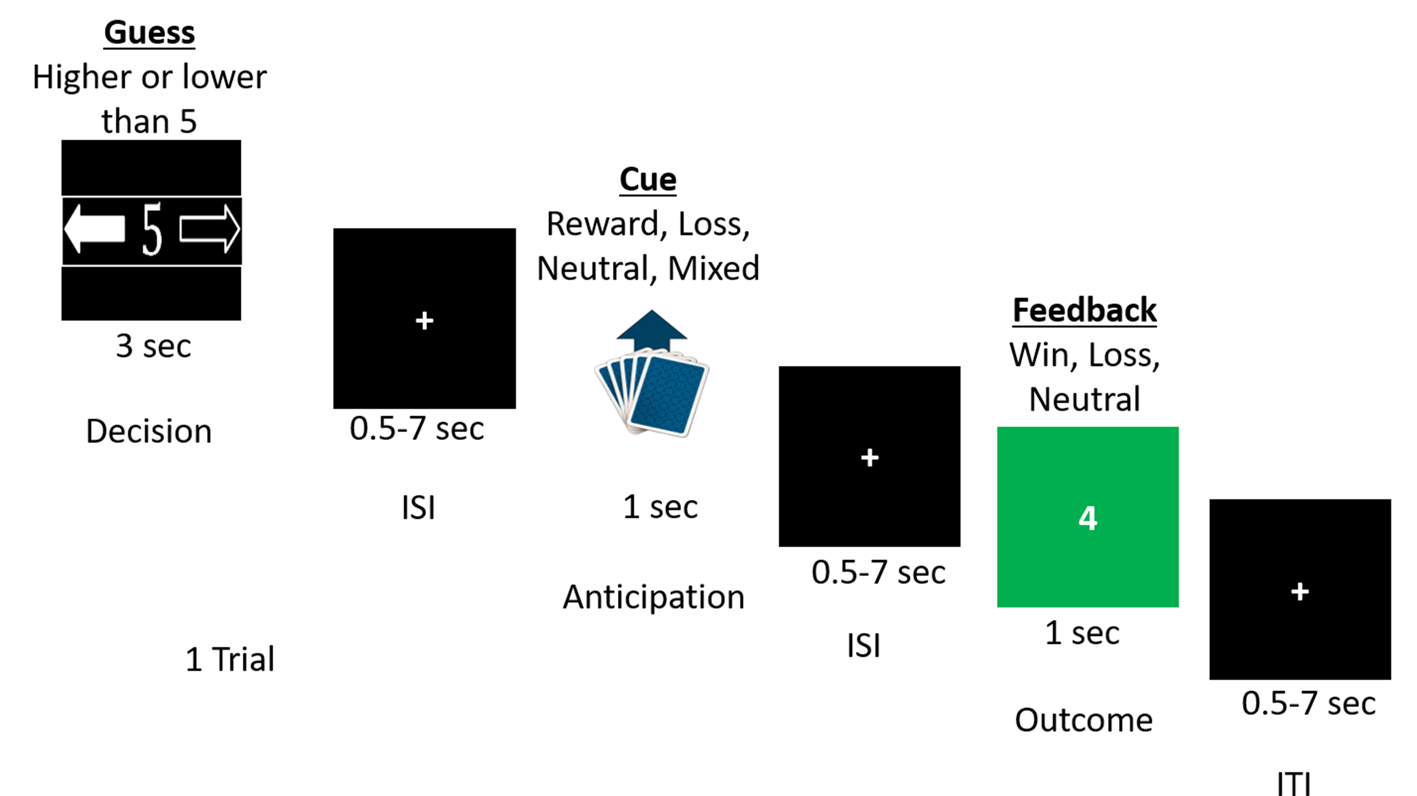
During fMRI, youth completed a slow event-related card-guessing game that measures neural response to the anticipation and receipt of monetary rewards and losses (Fig. 1; Forbes et al., Reference Forbes, Hariri, Martin, Silk, Moyles, Fisher and Dahl2009). During each trial, youth guessed via button press whether the value of a card would be higher or lower than 5 (3000 ms), viewed a fixation cross (500–7000 ms), learned the trial type (1000 ms; possible win, possible loss, or neutral/no-change trial, or mixed possible win or loss trial), viewed a fixation cross (500–7000 ms), and received feedback (1000 ms, win, lose, or no-change), followed by a jittered inter-trial fixation cross (500–7000 ms). Trials were presented in pseudorandom order with pre-determined outcomes. Correct reward trials received $1, while incorrect loss trials deducted $0.50. Youth completed four 6.5-min, 32-trial blocks. Each run consisted of 8 win outcomes (4 from reward anticipation trials, 4 from mixed anticipation trials), 8 loss outcomes (4 from loss anticipation trials, 4 from mixed anticipation trials), 8 no change/neutral outcomes (from neutral anticipation trials). Eight additional no-change outcome trials (i.e. incorrect reward trial ‘no-win’; correct loss trial ‘avoid loss’) were not used in the current analysis. This task has been used previously in studies of adolescent depression and has been shown to differentiate reward and loss processing phases and produce robust task-based activation in the striatum and prefrontal cortex (Forbes et al., Reference Forbes, Hariri, Martin, Silk, Moyles, Fisher and Dahl2009, Reference Forbes, Olino, Ryan, Birmaher, Axelson, Moyles and Dahl2010a, Reference Forbes, Ryan, Phillips, Manuck, Worthman, Moyles and Dahl2010b).
fMRI reward task. A single trial of the event-related card-guessing task. Participants completed four 32-trial runs. Youth were instructed to guess via button press whether the value of a card would be higher or lower than 5, learned the trial type (possible win, possible loss, neutral trial, or mixed possible win or loss trial), and received feedback (win, lose, or no change). Trials were presented in pseudorandom order with pre-determined outcomes. Correct reward trials received $1, while incorrect loss trials deducted $0.50.

MRI imaging acquisition
Seventeen participants completed their scan on a Siemens Tim Trio 3.0 Tesla MRI equipped with a 32-channel coil, and the remaining participants (n = 66) completed their scan on a Siemens Prisma 3.0 Tesla MRI equipped with a 64-channel coil. Identical scanning parameters and data-processing streams were used. Functional images were acquired with a multiband sequence (TR = 720 ms, TE = 30 ms, FOV = 212 mm, multiband accelerator factor = 6, voxel size = 2.5 × 2.5 × 2.5).
Image processing
Preprocessing was conducted in SPM12 (http://www.fil.ion.ucl.ac.uk/spm/). Data were gray matter segmented, realigned and unwarped with a field map, slice-time corrected, co-registered, normalized to Montreal Neurological Institute (MNI) space, and resampled to 2 × 2 × 2 mm voxels, and smoothed with a 4 mm FWHM Gaussian filter. Artifact Detection Tools software (http://www.nitrc.org/projects/artifact_detect/) was used to identify movement outliers (>3 s.d. from the mean intensity, or >1 mm movement) and create regressors in each subject's first level model. Youth with >15% outliers were excluded (n = 3).
MRI analyses
Models employing hemodynamic response functions were used to estimate condition-specific BOLD activation for each participant in SPM. Individual contrast images were used to create second-level random-effects models using one-sample t tests for the contrasts: (1) reward anticipation v. loss anticipation and (2) win v. loss. Based on prior literature implicating frontostriatal regions in reward dysfunction in anhedonia and depression (Borsini, Wallis, Zunszain, Pariante, & Kempton, Reference Borsini, Wallis, Zunszain, Pariante and Kempton2020), we examined all results within NACC and mPFC regions of interest (ROIs). The bilateral NACC ROI was derived from the Automated Anatomical Labelling Atlas 3 (Rolls, Huang, Lin, Feng, & Joliot, Reference Rolls, Huang, Lin, Feng and Joliot2020), and the mPFC ROI was defined from previous literature on reward function and adolescent anhedonia (Forbes et al., Reference Forbes, Olino, Ryan, Birmaher, Axelson, Moyles and Dahl2010a). Based on emerging literature suggesting insula dysfunction in anhedonia (Borsini et al., Reference Borsini, Wallis, Zunszain, Pariante and Kempton2020), exploratory analyses of the AAL-defined bilateral insula ROI are presented in the supplement. To calculate cluster-forming thresholds, we used the updated version of 3dttest++ with the Clustsim flag in AFNI to produce 10, 000 iterations of noise-only generated t tests and determine cluster-level threshold. Cluster thresholds were then used for final analyses in SPM (e.g. Alarcón, Sauder, Teoh, Forbes, & Quevedo, Reference Alarcón, Sauder, Teoh, Forbes and Quevedo2019; Murray, Lopez-Duran, Mitchell, Monk, & Hyde, Reference Murray, Lopez-Duran, Mitchell, Monk and Hyde2022). In 3dttest++, we used a stringent correction of voxel-wise p < 0.001 and a cluster-wise α = 0.01 for primary analyses (Bonferroni corrected three regressions on two contrasts). The resulting cluster thresholds ranged from k = 5–6 (NACC) and k = 24–27 (mPFC). Exploratory analyses used a correction of voxel-wise p < 0.001 and cluster-wise α = 0.05, resulting in cluster thresholds ranging from k = 2–3 (NACC) and k = 9–15 (mPFC).
Data analytic plan
Separate multiple regression analyses were performed using SPM12 to quantify associations between self-reported anhedonia, behavioral reward learning, and EMA PA during reward anticipation (i.e. reward anticipation > loss anticipation) and reward outcome (i.e. win > loss) in the NACC and mPFC ROIs. As a secondary analysis, we then probed potential sources of activation by examining associations between primary study variables and brain reactivity to reward and loss compared to neutral conditions. Third, although low PA characterizes anhedonia, high NA may also occur in youth with elevated anhedonia and may predict aberrant neural responses to reward and loss. Thus, we explored whether NA was associated with neural response to reward and loss. All analyses included age, sex, scanner, and pubertal development (Tanner & Davies, Reference Tanner and Davies1985) as covariates. Additional analyses also examined whether results replicated in a sample of 25 youth (11 TD, 14 ANH) recruited as a part of continued data collection (online Supplementary Table S4). Finally, analyses controlling for depression diagnosis are included in the supplement.
Results
Laboratory-administered self-report and diagnostic assessment of anhedonia
Associations with EMA affect
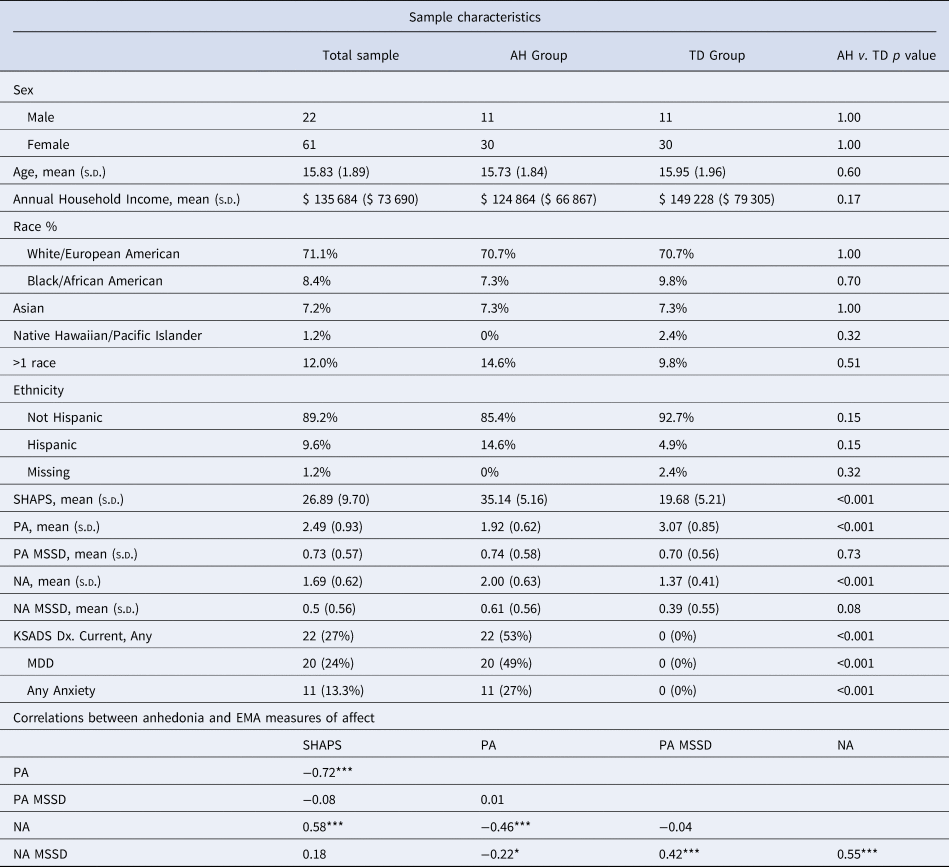
Descriptive statistics and correlations between self-reported anhedonia and EMA affect are reported in Table 1. As hypothesized, self-reported anhedonia (SHAPS) was negatively associated with EMA-derived PA (r = −0.72, p < 0.001) and positively associated with NA (r = 0.58, p < 0.001). Compared to the TD group, the AH group displayed lower PA [t(80) = −6.95, p < 0.001] and higher NA [t(80) = 5.38, p < 0.001].
Sample demographics and correlations between anhedonia (SHAPS) and EMA measures of affect

SHAPS, Snaith Hamilton Pleasure Scale; PA, Positive Affect; NA, Negative Affect; MSSD, Mean Squared Successive Difference; MDD, Major Depressive Disorder; KSADS, Kiddie Schedule for Affective Disorders and Schizophrenia.
*=p < 0.05, **= p < 0.01, ***=p < 0.001.
Associations with behavioral reward learning
Across all participants, PRT response bias was greater for block 2 relative to block 1 [t(74) = 3.15, p = 0.002] (i.e. evidence of reward learning). Yet, TD and AH youth did not display significant differences in reward learning [t(72) = 0.51, p = 0.61], reaction time [t(73) = −0.31, p = 0.76], or hit rate [t(73) = 1.68, p = 0.10]. SHAPS scores and EMA PA across the entire sample were also unrelated to PRT reward learning (p's > 0.40).
Associations with neural response to reward
Self-reported anhedonia was not associated with NACC or mPFC activity to reward anticipation or outcome compared to loss anticipation or outcome. Secondary analyses exploring associations between reward v. neutral conditions also did not reveal associations with self-reported anhedonia. Supplemental diagnostic analyses indicated that AH youth had reduced NACC activity to Win > Neutral relative to TD youth (online Supplementary Table S3).
Neural response to reward
Associations with EMA positive affect
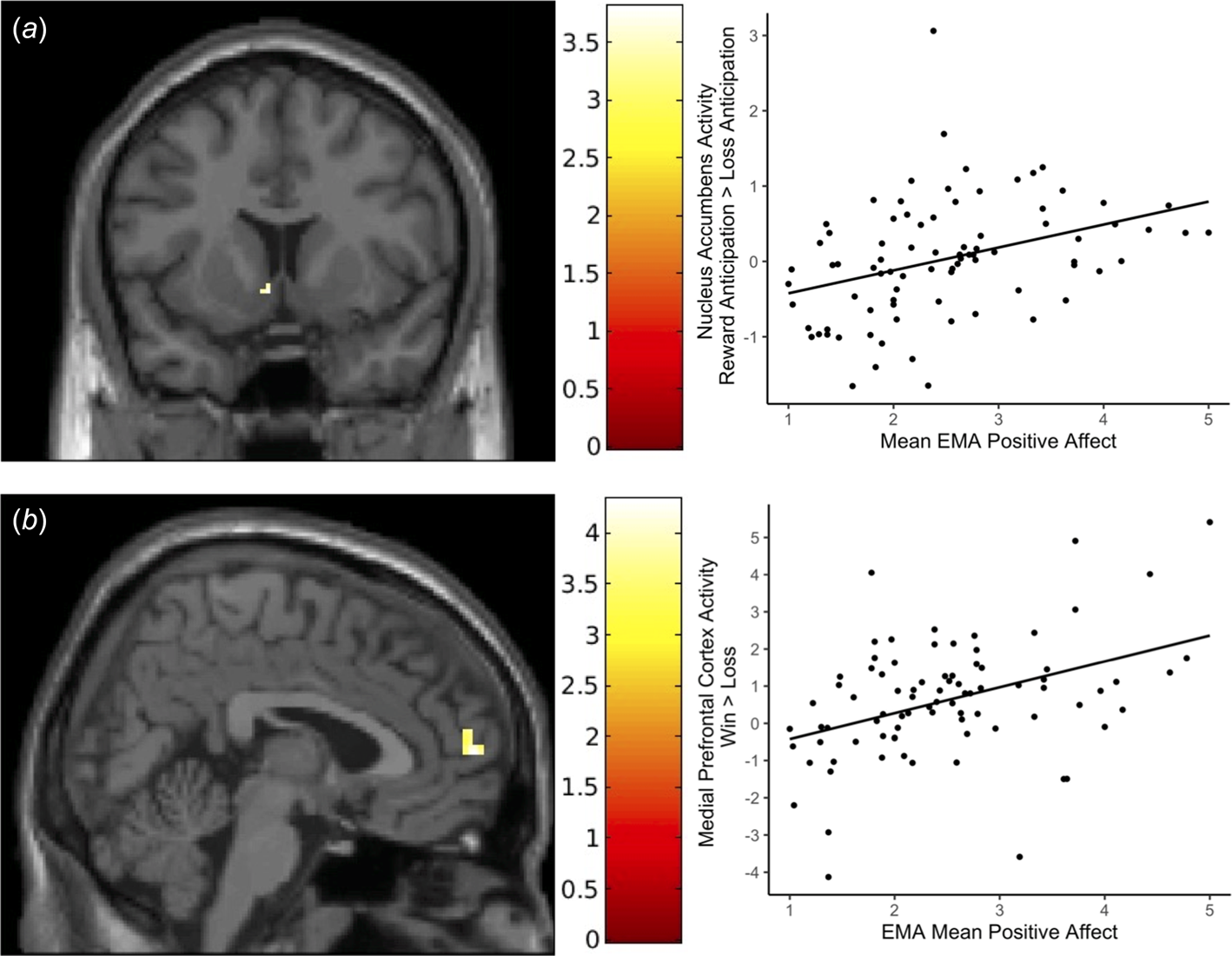
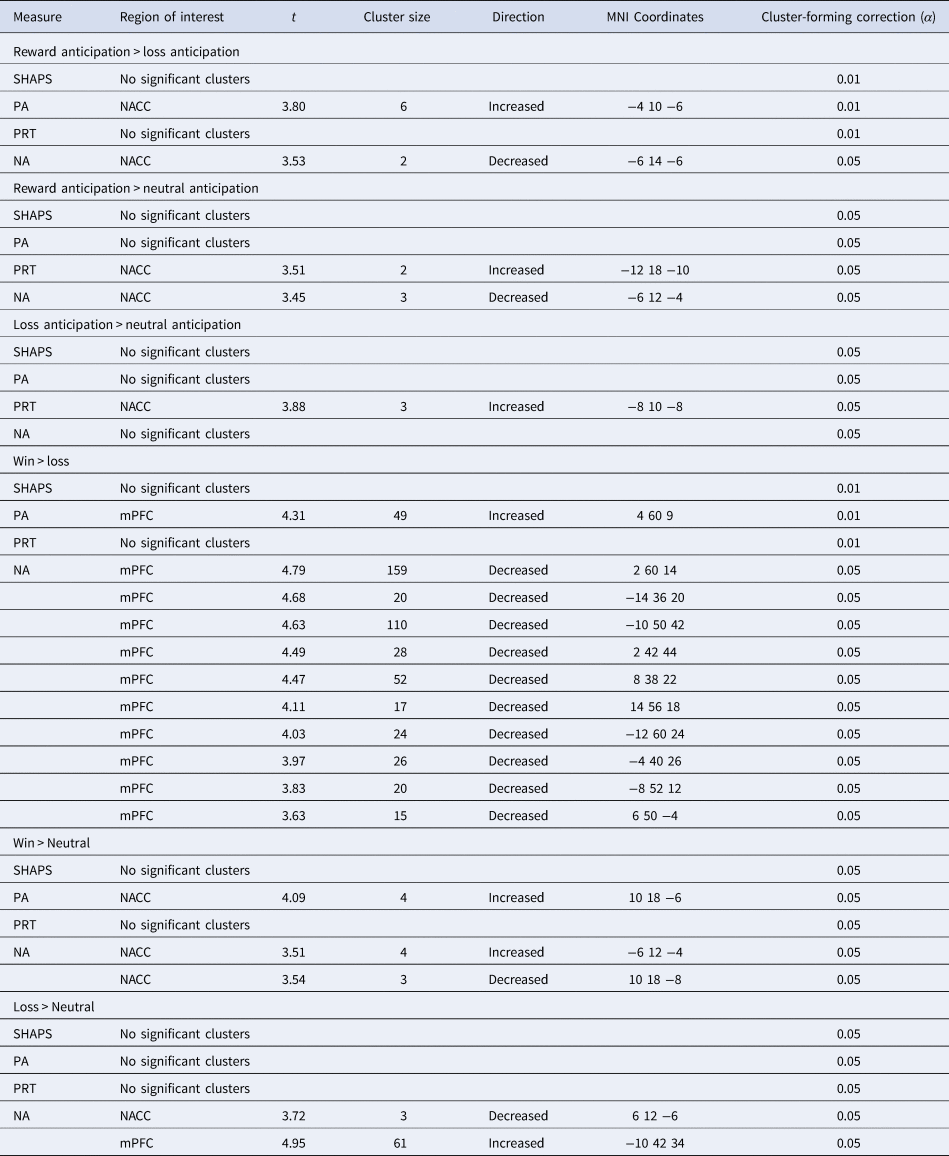
As hypothesized, youth reporting higher PA during EMA had increased NACC activity to Reward Anticipation > Loss Anticipation (Fig. 2; Table 2). EMA PA was also positively associated with mPFC activity to Win > Loss. Secondary analyses indicated that EMA PA was not associated with Reward or Loss Anticipation > Neutral Anticipation but was associated with increased NACC activity to Win > Neutral (Table 2).
Mean EMA PA and neural response to reward. (a) Association between EMA mean PA and nucleus accumbens response to Reward Anticipation v. Loss Anticipation. Scatter plot shows activation from the peak cluster (t = 4.79, k = 6, x = −4 y = 10 z = −6). (b) Association between EMA mean PA and medial prefrontal cortex response to Win v. Loss.

Associations between anhedonia, affect, and neural response to reward and loss

Associations with behavioral reward learning
PRT reward learning was not associated with NACC or mPFC reactivity to reward anticipation or outcome v. loss conditions. Secondary analyses indicated that PRT reward learning was associated with increased NACC activity to both Reward and Loss Anticipation > Neutral Anticipation.
Exploratory analyses of EMA negative affect
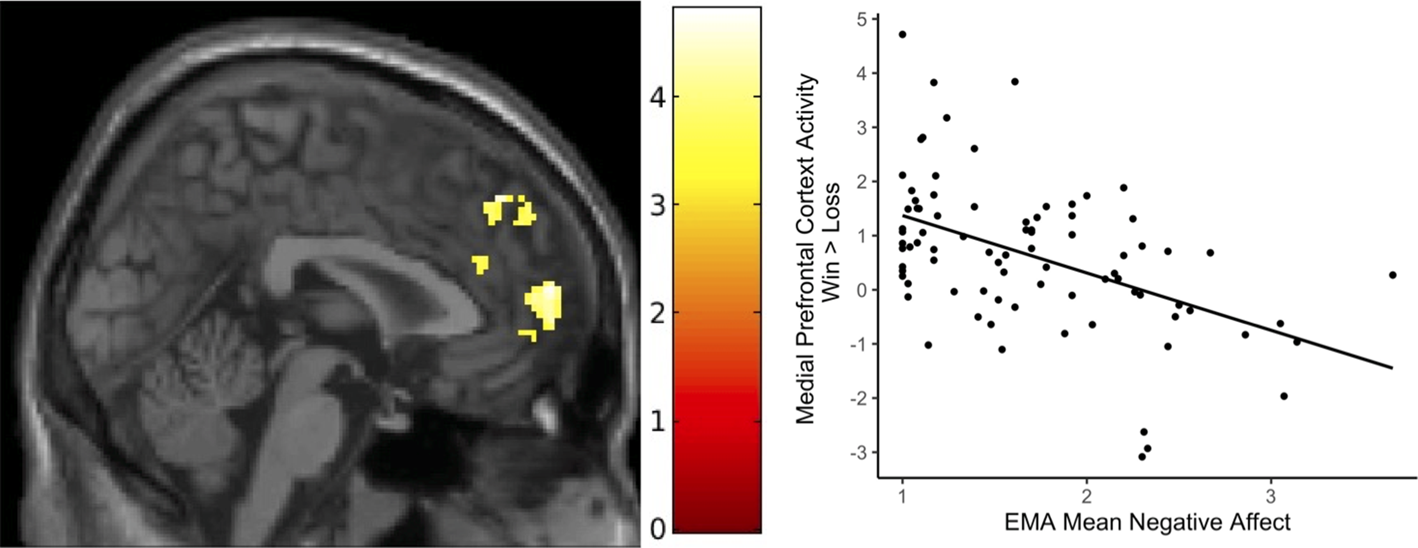
Higher EMA NA was associated with decreased NACC activity to Reward Anticipation > Loss Anticipation and decreased mPFC activity to Win > Loss (Fig. 3). These findings were driven by a reduced NACC response to Reward Anticipation > Neutral Anticipation and increased mPFC response to Loss > Neutral. Finally, higher NA was associated with decreased NACC response to Win > Neutral and Loss > Neutral (Table 2).
Mean EMA NA and mPFC Response to Win > Loss. Association between EMA mean NA and mPFC response to Wins v. Loss. EMA mean NA was associated with reduced mPFC activity during Win > Loss. Scatter plot depicts activation from peak cluster, (t = 4.82, k = 159, x = 2 y = 60 z = 14).

Replication in independent sample
Analyses of an independent sample of youth (n = 25, 11 TD, 14 AH) replicated our finding that AH youth experienced lower PA [t(23) = −2.25, p = 0.02] and higher NA [t(23) = 5.07, p < 0.001] than TD youth. Also, despite the small sample size and stringent correction for our fMRI analyses, findings of EMA PA being associated with increased NACC activity during Reward Anticipation > Loss Anticipation replicated in the holdout sample (t = 4.13, k = 4, x = −8 y = 10 z = −4; online Supplementary Table S4). This effect was driven by increased NACC to Reward Anticipation > Neutral Anticipation (t = 4.14, k = 3, x = −8 y = 8 z = −6). Replication of PRT reward learning was not possible due to missing data.
Discussion
The study used multiple assessment modalities to characterize and quantify adolescent anhedonia in laboratory and real-world contexts. As expected, traditional self-reported anhedonia was strongly associated with lower mean PA and higher mean NA. Consistent with our hypotheses, EMA PA was positively associated with NACC activity during reward anticipation, supporting the notion that youth with lower PA (i.e. a core feature of anhedonia) experience reduced neural sensitivity to reward cues. PA was also positively associated with mPFC activity to reward outcomes, which was surprising given previous research linking depression/anhedonia with increased mPFC to reward (Forbes & Dahl, Reference Forbes and Dahl2012). Finally, we found that despite conventional measures of anhedonia [i.e. self-report (SHAPS) and diagnostic (K-SADS)] being associated with lower PA and higher NA via EMA, EMA measures of affect were associated with neural reactivity to reward anticipation, whereas conventional self-reported anhedonia was not. This finding may be because EMA measures sample the momentary affective experiences of teens in their daily lives, in contrast to laboratory-administered self-report and diagnostic measures, which rely on retrospective reports that may bias recall. Supplementary analyses of categorical anhedonia assessment from the K-SADS revealed that youth with anhedonia had reduced NACC reactivity to reward outcome.
We did not find an association between anhedonia and behavioral reward learning. Prior research using the PRT has found that reward learning is linked to dopaminergic and frontostriatal function (Kaiser et al., Reference Kaiser, Treadway, Wooten, Kumar, Goer, Murray and Pizzagalli2018; Santesso et al., Reference Santesso, Dillon, Birk, Holmes, Goetz, Bogdan and Pizzagalli2008), and is impaired in anhedonia (Pizzagalli et al., Reference Pizzagalli, Iosifescu, Hallett, Ratner and Fava2008). Consistent with prior findings in adults (Santesso et al., Reference Santesso, Dillon, Birk, Holmes, Goetz, Bogdan and Pizzagalli2008), reward learning was positively associated with NACC response to reward and loss anticipation v. neutral anticipation. However, it was surprising that PRT reward learning was not associated with anhedonia in our sample, given prior research (Belleau et al., Reference Belleau, Kremens, Ang, Pisoni, Bondy, Durham and Pizzagalli2020; Pizzagalli et al., Reference Pizzagalli, Iosifescu, Hallett, Ratner and Fava2008) though see (Blain, Sassenberg, Xi, Zhao, & DeYoung, Reference Blain, Sassenberg, Xi, Zhao and DeYoung2021). One possible explanation is that the abbreviated two-block version of the task used here was too brief to assess and differentiate reward learning abilities in youth with or without anhedonia compared to the standard three-block version. However, recent evidence suggests that personality (i.e. extraversion) may be more closely linked to reward learning than depression or anhedonia (Blain et al., Reference Blain, Sassenberg, Xi, Zhao and DeYoung2021), and that Bayesian computational modeling approaches may better differentiate reward learning deficits in individuals with depression compared to controls (Lawlor et al., Reference Lawlor, Webb, Wiecki, Frank, Trivedi, Pizzagalli and Dillon2020). Alternatively, our findings may show evidence of specific anticipatory deficits in youth with anhedonia rather than reward learning. Future research leveraging computational modeling and/or personality measurements on PRT reward learning may provide a more detailed profile of reward processing dysfunction in psychopathology.
Anhedonic participants reported experiencing low PA and high NA in their daily lives, highlighting the importance of investigating neural response to both positive and negative affect. Exploratory analyses revealed that NA was associated with reduced NACC reactivity to reward anticipation v. loss anticipation (driven by reduced reward response). Supplementary analyses also indicated that NA was associated with decreased insula activity to reward outcomes (online Supplementary Table S2). Given the insula's role in attention and salience (Menon & Uddin, Reference Menon and Uddin2010), these results provide preliminary evidence that youth with higher NA may struggle to recruit regions that coordinate attention and arousal to positive stimuli in their environments.
NA was associated with decreased mPFC activity to Win > Loss, which was primarily driven by an increased response to loss. The mPFC is a core hub of the default mode network (DMN), which plays a role in self-referential processing and rumination (Buckner, Andrews-Hanna, & Schacter, Reference Buckner, Andrews-Hanna and Schacter2008; Kaiser et al., Reference Kaiser, Kang, Lew, Van Der Feen, Aguirre, Clegg and Hutchison2019). Indeed, supplemental whole brain analyses (online Supplementary Table S5) found NA was linked to increased activity in other regions of the DMN including the posterior cingulate and precuneus during loss outcomes. Thus, our findings may indicate increased self-referential processing in response to negative outcomes in youth who report more NA in their daily lives. However, given that the direction of associations between NA, PA, and mPFC reactivity reported here conflict with prior work suggesting a positive link between depression/anhedonia and mPFC to reward, our findings require additional exploration and replication.
The study has several strengths, including a dimensional assessment of anhedonia, use of multiple well-validated assessments of reward function, and inclusion of EMA measures of affect. However, several limitations should be considered. First, although we recruited for anhedonia specifically, many anhedonic youth also had depression diagnoses (49%). Thus, we were unable to fully separate whether our results are unique to anhedonia. Although we believe that our sample is a closer approximation of how anhedonia manifests in real-world clinical contexts with adolescents (i.e. highly co-morbid with depression), future research using a sample of anhedonia-only youth may be able to better differentiate the unique contribution of anhedonia on reward function.
Second, although our analyses covaried for scanner type, the MRI data were collected on two different scanners, albeit with identical protocols and preprocessing streams. Third, the MRI task used small monetary incentives which may not be as rewarding to teens as large monetary or social rewards, important targets for future research. Fourth, we employed a two-block version of the PRT task v. the standard three-block version. Although this version has previously detected expected differences in reward learning in youth at high- v. low-risk for depression (Belleau et al., Reference Belleau, Kremens, Ang, Pisoni, Bondy, Durham and Pizzagalli2020), the longer task may have yielded the hypothesized differences between AH and TD youth in our sample. Fifth, although we used a stringent correction for multiple corrections at the voxel and cluster forming threshold, several findings had small cluster sizes, particularly in the NACC. We are encouraged that our most stringently corrected findings replicated in an independent sample and are consistent with prior literature. Sixth, prior research has indicated that the reliability and stability of brain activation during many fMRI tasks is poor (Elliott et al., Reference Elliott, Knodt, Ireland, Morris, Poulton, Ramrakha and Hariri2020; Kennedy et al., Reference Kennedy, Harms, Korucuoglu, Astafiev, Barch, Thompson and Anokhin2022), which challenges the notion that task-evoked brain activation is a stable and trait-like measure and limits conclusions that can be drawn from brain-behavior findings. Seventh, our sample was 71% white with a higher average annual household income than the general US population. Our findings require replication in more representative samples. Finally, though we controlled for sex and our sample characteristics are consistent with sex-differences in depression prevalence (Avenevoli, Swendsen, He, Burstein, & Merikangas, Reference Avenevoli, Swendsen, He, Burstein and Merikangas2015), we were underpowered to detect sex-based differences in brain or behavioral correlates of anhedonia.
It is also important to note that although clinical and self-report measures of anhedonia were associated with reduced PA and increased NA in daily life, anhedonia cannot be equated with low PA and high NA. Indeed, our measures mainly assessed consummatory anhedonia (i.e. SHAPS: ‘I would enjoy seeing other people's smiling faces’) and hedonic tone (i.e. EMA PA: ‘how happy/interested/excited are you feeling right now’). It has been proposed that motivational and hedonic subsets of anhedonia should be studied separately (Treadway & Zald, Reference Treadway and Zald2011). Future research linking EMA and self-report measures of anhedonia subcomponents with reward function will provide a more detailed measure of how subjective experiences of anhedonia are linked to neurobiology.
Our findings establish links between laboratory-based measures of anhedonia and reward function and subjective measures of affect in youth's daily lives. We found youth with higher anhedonia (self-reported and clinically assessed) experienced lower PA and higher NA in their daily lives relative to youth with low levels of anhedonia. Moreover, real-world experiences of affect were related to brain reactivity. Specifically, PA was associated with increased NACC reactivity during reward anticipation, and NA was associated with increased mPFC reactivity during loss outcomes. Finally, although we did not find associations between conventional self-reported anhedonia and brain reactivity to reward, group-level analyses revealed that AH had lower NACC reactivity to reward outcome compared to TD youth. In sum, we found that anhedonia is associated with lower PA and higher NA in the daily lives of teens, which is associated with reduced NACC reactivity to reward and increased mPFC activity to loss. Thus, our findings suggest that real-world experiences of PA and NA may be associated with distinct brain reactivity to reward and loss. Moreover, we demonstrate that established models of reduced striatal activation to rewarding stimuli in anhedonia translate to real-world experiences of PA in youth. Additional research investigating the brain, behavioral, and affective correlates of anhedonia may ultimately lead to early identification of at-risk youth and the development and targeted deployment of preventative interventions.
Supplementary material
The supplementary material for this article can be found at https://doi.org/10.1017/S0033291722001222
Financial support
This work was supported by a grant from the National Institute of Mental Health (NIMH; K23 MH108752; Dr. Webb), Tommy Fuss Fund, and the Klingenstein Third Generation Foundation (Dr. Webb). Dr Murray was supported by a grant from the National Institute of Drug Abuse (NIDA; T32 DA015036; PI: Dr. Lukas). Dr. Pizzagalli was partially supported by R37 MH068376 and R01 MH101521. The content is solely the responsibility of the authors and does not necessarily represent the official views of the funding agencies.
Conflict of interest
Dr. Forbes has received consulting fees from a trial funded by Durham, NC VA, sponsorship by Otsuka Pharmaceuticals. Dr. Pizzagalli has received consulting fees from BlackThorn Therapeutics, Boehringer Ingelheim, Compass Pathways, Concert Pharmaceuticals, Engrail Therapeutics, Neurocrine Biosciences, Neuroscience Software, Otsuka Pharmaceuticals, and Takeda Pharmaceuticals; honoraria from the Psychonomic Society (for editorial work) as well as one honorarium from Alkermes for activities unrelated to the current project. In addition, he has received stock options from BlackThorn Therapeutics, Compass Pathways, and Neuroscience Software. Dr. Pizzagalli has a financial interest in BlackThorn Therapeutics, which has licensed the copyright to the Probabilistic Reward Task through Harvard University. Dr. Pizzagalli's interests were reviewed and are managed by McLean Hospital and Partners HealthCare in accordance with their conflict of interest policies. Drs. Murray, Lukas and Webb, Mss. Israel, Balkind, and Pastro and Mr. Lovell-Smith have reported no biomedical financial interests or potential conflicts of interest.