INTRODUCTION
Cancer patients experience many physical and emotional symptoms. Healthcare providers often fail to adequately document and treat these symptoms (Laugsand et al., Reference Laugsand, Sprangers and Bjordal2010). Validated patient-reported outcome (PRO) instruments are thus essential to help in screening and monitoring of symptoms.
Two of the most common symptoms in cancer patients are cancer-related fatigue (CRF) and depression (Butt et al., Reference Butt, Rosenbloom and Abernethy2008; Reilly et al., Reference Reilly, Bruner and Mitchell2013). They are both multidimensional in nature and often associated with each other (Oh & Seo, Reference Oh and Seo2011). Furthermore, although both fatigue and depression are well-accepted clinical terms in the English language, they are ill defined in many others—including Spanish, Thai, German, and Portuguese (Glaus et al., Reference Glaus, Crow and Hammond1996; Centeno et al., Reference Centeno, Portela Tejedor and Carvajal2009; Pongthavornkamol et al., Reference Pongthavornkamol, Olson and Soparatanapaisarn2012).
Brazil is the largest South American country, with a population above 200 million and thus with a considerable number of potentially affected cancer patients. The Brazilian National Cancer Institute (INCA) estimates that there will be 576,000 new cases of cancer in 2014 (Instituto Nacional do Câncer, 2014). A large proportion of new cancer patients are diagnosed at an advanced stage, and many others experience disease recurrence during follow-up. Within this context, palliative care is an emerging field in Brazil that has been gaining increased attention from the government, and it is currently represented by two very active national societies. Regarding fatigue, the Brazilian Consensus on Fatigue (Caponero et al., Reference Caponero, Mota and Melo2010) acknowledged that the term “fatigue” is probably underutilized by laypeople, but the best term to use in practice was not defined. A better understanding of how fatigue and depression should be worded in Brazilian Portuguese might allow us to better assess these symptoms in the clinical setting. Moreover, this could be used as a reference for similar studies in other Portuguese-speaking countries—like Portugal, Mozambique, Angola, and other smaller nations.
In our cross-sectional survey, we investigated the most appropriate terms to describe “fatigue” and “depression” in Brazilian Portuguese-speaking cancer patients.
METHODS
Study Design
From October to December of 2012, we conducted a cross-sectional IRB-approved study at the Barretos Cancer Hospital (São Paulo, Brazil). In compliance with the Declaration of Helsinki and Resolution 196/96 of the Brazilian National Health Council, which addresses research on human beings, the study aims were explained to participants, who then signed an informed consent form.
Sample
The inclusion criteria were the following: age above 18 years; incurable metastatic or locally advanced disease; and ability to communicate in Portuguese. Patients were excluded if they had any cognitive or psychiatric disease that would render them incapable of answering questionnaire items. Participants were recruited from the clinical oncology and radiotherapy outpatient clinics.
Measures
Patients' Opinion About Clinical Vignettes Describing Cases of Fatigue and Depression
The interviewers read to patients four different clinical vignettes, two describing fatigued patients and two describing depressed patients. We asked patients to choose from among the terms “fatigue/(fadiga),” “tiredness/(cansaço),” and “weakness/(fraqueza)” for the fatigue vignettes, and between “depression/(depressão)” and “sadness/(tristeza)” for the depression vignettes. They could also suggest other alternatives. Clinical vignettes were conceptualized based on the experience of the authors, written for laypeople, and did not contain any words that would suggest any of the investigated terms.
Instrument Containing Numeric Visual Scales to Address Cancer Symptoms
To determine the convergent validity of these terms, we asked patients to provide their average symptom intensity over the previous 24 hours using an instrument developed specifically for the present study that was based on the Edmonton Symptom Assessment System (ESAS) (Bruera et al., Reference Bruera, Kuehn and Miller1991). It contained 13 items, each with an 11-point numeric rating scale (NRS) ranging from 0 (minimum intensity) to 10 (maximum intensity). In addition to the other eight items contained in the ESAS (i.e., pain, nausea, anxiety, drowsiness, appetite, feeling of well-being, shortness of breath, and sleep), we added the terms “fatigue,” “tiredness,” “weakness,” “depression,” and “sadness.” To avoid contamination in response trends, several versions were printed with different items in random sequences.
Functional Assessment of Cancer Treatment–Fatigue (FACIT–F)
The FACIT–F contains 13 items on a 5-point Likert-type scale. It is widely employed to measure fatigue and has been validated for use in Brazil (Ishikawa et al., Reference Ishikawa, Thuler and Giglio2010). For the present study, we analyzed the FACIT–F fatigue subscale (FS), whose scores can vary from 0 to 52 (the lower the value, the lower the intensity of fatigue). We adopted a cutoff of <34 for a diagnosis of fatigue (van Belle et al., Reference van Belle, Paridaens and Evers2005).
Hospital Anxiety and Depression Scale (HADS)
The HADS questionnaire contains 14 items with a 4-point Likert-type scale and has been validated in Brazil. It is commonly utilized to assess anxiety and depression among individuals with cancer. HADS–A and HADS–D scores range from 0 to 21 (higher scores indicating greater distress). Cutoff points of ≥8 and ≥11 were employed for possible and probable depression, respectively (Zigmond & Snaith, Reference Zigmond and Snaith1983; Botega et al., Reference Botega, Bio and Zomignani1995).
Statistical Analysis
We evaluated the diagnostic accuracies for detecting CRF and depression using sensitivity, specificity, negative predictive value (NPV), and positive predictive value (PPV). We also computed the receiver operating characteristic (ROC) curve for different cutoff points for each NRS item evaluated. The differences between the area under the curve (AUC) values were then statistically evaluated.
To assess the convergent validity, the scores on the NRS for fatigue, tiredness, and weakness were correlated with NRS scores for shortness of breath and also FACIT–F FS using the Pearson correlation test. In the same manner, NRS scores for depression and sadness were also correlated with HADS–D scores. Statistical analyses were performed using SPSS (v. 19.0) and R statistical software. Values of p less than 0.05 were considered statistically significant.
RESULTS
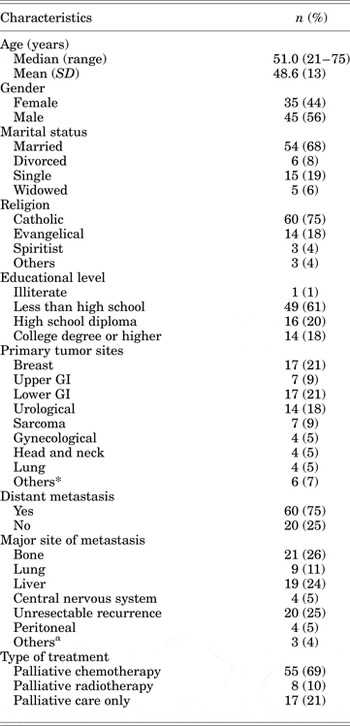
A convenience sample of 80 patients was included in the study. The characteristics of the included patients are shown in Table 1.
Clinical and sociodemographic characteristics of patients (n = 80)

Legend. GI = gastrointestinal; SD = standard deviation; PCU = palliative care unit; KPS = Karnofsky performance status score.
*Unknown primary (n = 2), melanoma (n = 3), multiple myeloma (n = 1).
aLymph node (n = 2), uterine (n = 1).
Patients' Opinions About Clinical Vignettes Describing Cases of Fatigue and Depression
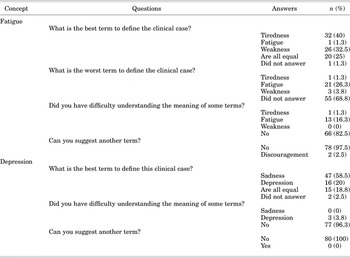
Among the 80 patients, 32 (40%) and 26 (33%) reported that the best terms in Portuguese to explain the concept of cancer-related fatigue were “tiredness” and “weakness.” Some 21 (26%) reported that “fatigue” was the worst term, and 13 (16%) misunderstood the term “fatigue” (Table 2). Regarding depression, the majority (n = 47, 59%) chose “sadness” to best describe the concept of depression, and 16 (20%) reported that “depression” was best (Table 2).
Patients' opinions about descriptors of fatigue and depression

ROC Curve Analysis
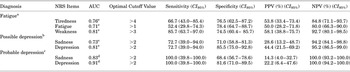
Regarding diagnostic accuracy, the ROC areas under the curve for “fatigue,” “weakness,” and “tiredness” were 0.71, 0.81, and 0.76, respectively; the AUC for “depression” and “sadness” ranged from 0.81 and 0.91 and 0.73 and 0.83, respectively (Table 3). Table 3 describes the best cutoff points for a diagnosis of CRF and depression. It also provides sensitivity, specificity, NPV, and PPV with different cutoffs.
Cutoff points, diagnostic accuracy, and area under the receiver operator characteristics curve for the three numeric rating scales for fatigue and the two numeric rating scales for depression

aFACT–F fatigue subscale <34. bHADS–D >8. cHADS–D >11.
Legend: VNS = visual numeric scales; CI=confidence interval; PPV = positive predictive value; NPV = negative predictive value.
dStatistically significant.
eStatistically nonsignificant.
Correlation Analysis
The NRS for shortness of breath was positively correlated with NRS for “fatigue” (r = 0.701, CI 95% = 0.56 to 0.80, p < 0.001) and NRS for “tiredness” (r = 0.415, CI 95% = 0.21 to 0.59, p < 0.001) but not with NRS for “weakness” (r = 0.270, CI 95% = 0.04 to 0.47, p = NS).
We also observed negative correlations among FACIT–F FS scores and NRS scores for “fatigue” (r = –0.58, CI 95% = –0.72 to –0.41, p < 0.001), “tiredness” (r = –0.67, CI 95% = –0.78 to –0.51, p < 0.001), and “weakness” (r = –0.62, CI 95% = –0.74 to –0,44, p < 0.001).
Regarding depression, there were positive correlations between HADS–D scores and both NRS for “depression” (r = 0.61, CI 95% = 0.45 to 0.73, p < 0.001) and “sadness” (r = 0.54, CI 95% = 0.37 to 0.68, p < 0.001). In addition, there were significant correlations between HADS–A and NRS for “depression” (r = 0.46, CI 95% = 0.26 to 0.61, p < 0.001) and “sadness” (r = 0.42, CI 95% = 0.22 to 0.58, p < 0.001).
DISCUSSION
In the present study, 10% of participants misunderstood the meaning of the term “fatigue” and did not answer the NRS item for fatigue, and the majority (26%) who did answer considered “fatigue” to be the worst term. Although this word is commonly employed as medical terminology in Brazil, we agree with researchers from other countries that it is probably not appropriate for use in interviews with Brazilian patients (Glaus et al., Reference Glaus, Crow and Hammond1996; Messias et al., Reference Messias, Yeager and Dibble1997; Gledhill, Reference Gledhill2005). A previous study (Hauser et al., Reference Hauser, Rybicki and Walsh2010) investigated three possible descriptors of fatigue (mild fatigue, weakness, and loss of energy) in order to identify its clinical associations within a large cohort of cancer patients. “Weakness” was the term used to describe the physical component of a multidimensional fatigue syndrome. “Weakness” was also associated with sedation, worse functional status, and shorter survival. “Mild fatigue” was associated with dyspnea and depression. Our findings suggest that a subset of patients misunderstand fatigue as dyspnea, as observed by the high correlation between these terms (r = 0.7).
CRF is a multidimensional syndrome defined as “a subjective state of overwhelming sustained exhaustion and decreased capacity for physical and mental work, which is not relieved by rest” (Cella et al., Reference Cella, Peterman and Passik1998). In Portuguese, it is common jargon used to describe one's physical and mental tiredness, but it is not usually employed to describe “mental weakness.” Additionally, patients reported a slight preference for “tiredness” over “weakness.” We also found the highest correlation scores between “tiredness” and “fatigue” on the FACIT–F. Taken together, we recommend “tiredness” as the most appropriate descriptor of CRF.
Patients tended to report lower emotional distress scores when asked about depression in comparison with sadness (data not shown). Moreover, they preferred the term “sadness” to “depression” in describing the clinical vignettes presented. However, “depression” yielded higher screening accuracy and also had a better clinical correlation with depression scores as measured by the HADS. Taking these facts into consideration, “depression” should be considered the most appropriate word in Portuguese to describe “depression.”
A critical aspect of studies of diagnostic accuracy is the proper choice of a gold standard. Regarding the diagnosis of depression, the gold standard could preferentially be a psychiatric diagnosis based on the criteria of the Diagnostic and Statistical Manual of Mental Disorders, Fourth Edition (DSM–IV). We employed the HADS instead, given its ease of administration and high degree of validation (Stafford et al., Reference Stafford, Judd and Gibson2013; Boyes et al., Reference Boyes, D'Este and Carey2013; Singer et al., Reference Singer, Brown and Einenkel2011).
Although “weakness” and “tiredness” were both considered adequate, we suggest that “tiredness” be considered the most appropriate term to describe the concept of cancer-related fatigue, and “depression,” which had a greater clinical correlation with depression scores, should be considered its own most appropriate descriptor. In conclusion, utilization of “tiredness” and “depression” can be employed as single items for screening purposes and also in future Brazilian patient-reported outcomes instruments aimed at assessing these symptoms.
CONFLICTS OF INTEREST
The authors have full control over the primary dataset and agree to allow its review if requested. In addition, they state that they have no conflicts of interest to declare.