





In recent years—accelerated by a global pivot to remote delivery in the early months of the COVID-19 pandemic—increasing numbers of academics have begun to produce pedagogical materials intended for asynchronous online use by their students. Offerings range from straightforward audio or video recordings of what would ordinarily be an in-person lecture to more interactive learning experiences. However, educators based in universities rarely receive specific training in how to produce effective online content, so are often left to figure out for themselves what works. As educators at the Open University (OU), the UK’s largest university and a global leader in the field of distance higher education, the authors of this paper—both academics in the field of Classical Studies—have many years of experience in designing and authoring learning materials for online delivery.
Drawing on this experience, we aim in this article to set out some of the key principles that underpin how we design and author online learning materials, using as a case study a suite of free, open-access courses called HeadStart Classical Studies, aimed at learners with little or no previous experience of studying the ancient world.Footnote 1 As with all of the OU’s teaching, our approach to learning design is generously informed by pedagogical research but is also built on our own experience of, and reflections on, what “works” for learners studying online. In what follows, we aim to set out our approach in a concise and jargon-free way, while also providing plenty of practical examples of our methods.
It is worth saying upfront that for anyone whose practice as an instructor has been honed in the classroom, lecture theatre or even through synchronous online teaching, the successful authoring of asynchronous online courses can require some radical shifts in pedagogical approach. Most crucially, perhaps, in-person teaching often revolves around large chunks of student activity, such as assigned reading (or other pre-class preparation), the lecture or lesson itself, and the completion of substantial assessment tasks (with other activities, such as seminars, supervisions or group work potentially forming part of the learning package, too). Asynchronous online courses such as ours typically break these activities into micro-units, employing short chunks of text or other media (audio and video), along with frequent opportunities for learner engagement, to create a far more interactive and varied learning experience. These adaptations both seek to exploit the potential of the learning platform and, importantly, to accommodate the ways in which learners read and absorb information online.Footnote 2 Another key consideration is the need for an asynchronous course to be a fully complete, finished product before it is released online. While instructors of in-person modules will typically map out their content in detail, of course, they can nevertheless make small adjustments each week, updating their material, tweaking assignments, and finalising lecture notes at the last minute, for example. Authoring an asynchronous online course is more like producing a book manuscript: every piece of text, every image or clip, every cross-reference and acknowledgement needs to be in place before the course is published to learners. Importantly, too, while instructors working in face-to-face contexts will often seek to anticipate queries and points of challenge for students in advance of their classes, this has to be done even more carefully by those authoring materials for asynchronous courses, since learners will have no easy way of raising questions or concerns. Since HeadStart courses are neither assessed nor equipped with student forums, learners also lack two common forms of motivation: the need to pass the course and the encouragement and support of a learning community. As we outline below, authors aim to compensate by finding inventive ways to engage students and motivate them to complete their learning journey. Of course, the lack of interaction between students and their instructors also affects the way in which learners experience asynchronous study: possible ways of mitigating this loss of an in-person relationship (at least in part) are also outlined below.
1. HeadStart Classical Studies and the Open University context
As part of the OU’s mission to widen access to education in the UK and beyond, the OU creates free, online content aimed at non-specialist public audiences. We are fortunate in that our institution has a ready-made platform, OpenLearn, which hosts open-access asynchronous learning materials—articles and videos as well as short courses—that are accessed by millions of learners every year.Footnote 3 While it is academics who bring the necessary specialist subject knowledge to these materials, our OpenLearn resources also benefit from the editorial input, digital expertise, and technical support of colleagues whose role is to ensure that the online content we produce is clearly presented and accessible, and that it functions correctly. The principles that we apply when authoring these courses are based on the tried-and-tested pedagogical methods which underpin the standard distance-teaching model of our undergraduate and postgraduate teaching.Footnote 4 In this article, we seek to share these methods so as to allow them to be adopted and applied by educators elsewhere who are similarly seeking to translate humanities-based content into accessible formats for online delivery.
HeadStart Classical Studies is a recent addition to a long line of Open Educational Resources produced by the Department of Classical Studies for OpenLearn (see Figure 1).Footnote 5 It is a collection of short courses on a diverse range of classical topics, each course providing learners with the opportunity to work with original sources as they examine key questions about the societies, beliefs and values of the ancient world. As we say on the HeadStart landing page, these courses are “designed for anyone and everyone who is interested in finding out more about ancient Greece and Rome” and, true to our ambition for them to provide entry-level access to the classical world, they assume no prior knowledge. The HeadStart suite consists of:
-
• Exploring Homer’s Odyssey by Emma Bridges (launched November 2023).
-
• Exploring Greek Religion by Alexandra Wilding (launched February 2024).
-
• The Many Guises of the Emperor Augustus by Ursula Rothe (launched March 2024).
-
• Herodotus and the Invention of History by Elton Barker (launched April 2024).
-
• Exploring Ovid’s Big Ideas by Marchella Ward (launched February 2026).
Figure 1.The HeadStart Classical Studies landing-page image, depicting the birth of the goddess Athena from the head of her father, Zeus (© Flaroh Illustration. For commercial reuse of this image, written permission from the artist must be sought.).


Between them, the courses cover aspects of Greek and Roman culture and beyond, and engage with both texts and material culture, the idea not only being to exercise broad appeal but also to give learners the opportunity to work with a wide range of source material. All the courses are free-standing, meaning that learners can choose to study as few or as many of them as they wish, in whatever order suits them. The approximate study time for each is 6 hours. Pleasingly for the authors of this article, including James Robson (who devised the original concept for HeadStart Classical Studies and successfully secured university backing) and Emma Bridges (who oversaw the development of the suite along with James Robson and authored the first course on Homer’s Odyssey), these courses have proven hugely successful. To date, the suite has notched up over half a million visits and has helped to secure for the Department of Classical Studies a national award for university outreach.Footnote 6
The production of OU online teaching materials aligns closely with the principles of Instructional Systems Design (ISD), on which there exists an extensive body of scholarly literature.Footnote 7 HeadStart provides an illustrative example of the ways in which some of these principles can work in practice; in the rest of this article, we set out under seven headings the key design elements that lie behind our courses, with a view to sharing our practice and offering practical tips to others engaged in the production of online learning materials.
2. Find your starting point: identify your subject matter and your “hook”
All HeadStart courses are underpinned by in-depth scholarly research on which the authors have published and spoken in traditional academic venues—monographs, journals, or lectures—yet each author chose as the starting point for their course a thought-provoking “hook” aimed at encouraging even learners who had some familiarity with the material to think about it from a different angle. Herodotus and the Invention of History, for example, engages learners with the question of how this ancient Greek historian sought to separate fact from “fake news” in order to produce a reliable and nuanced reconstruction of past events. This provides an attention-grabbing starting point from which learners can explore Herodotus’ historical methods and engage with his writings, while also reflecting on the trustworthiness of different sources of information they encounter in their own daily lives. A topic that similarly resonates in both the modern and ancient worlds provides the “hook” for The Many Guises of the Emperor Augustus, namely how people in power use clothing to cultivate their public image. Before engaging with the potentially unfamiliar world of imperial Roman dress, learners consider how a modern-day ruler, King Abdullah II of Jordan, presents himself in official images in order to appeal to different groups in Jordanian society (his clothing variously marking him out as a businessman, a Bedouin, a military man, and a pious Muslim). Importantly, these novel approaches enable the course authors themselves to engage in new ways with their material, too. This helps to keep the writing fresh, as well as helping the authors to feel connected with the learners’ own journeys of discovery.
3. Map out your course and your learning outcomes
Once you have identified your “hook,” devoting time to the planning phase of an online course will always pay dividends.Footnote 8 Allowing your ideas to change and mature—and, if possible, to be critiqued by others—is all part of the iterative process of developing a successful course. At the OU, before beginning to draft any teaching materials, we produce a short planning document (normally a couple of pages in length) which contains an overview of the course, its content, and aims under five headings:
-
• The working title of the course (preferably something pithy and/or eye-catching).
-
• A brief description of the course (100 words of student-facing text: this usefully tests whether you can pitch your concept to learners and excite them about it).
-
• Provisional Learning Outcomes (three to five bullet points, framed as “After studying this course, you should be able to: …”).Footnote 9
-
• Content outline (five to ten provisional section titles, with or without brief descriptions of content).
-
• Key resources (e.g. textual or visual sources, readings from modern scholarship, website links, audiovisual resources, and artwork, for example, maps or diagrams that need to be produced).
These categories usefully force authors to think about their course in the round. You might have a strong idea of what skills you want to teach, for example, but be less sure about the core material you will ask students to focus on to develop these. You may be confident about the strength of your subject matter—and even have a catchy title—but be less certain about how to structure the course into manageable sections with a clear through-line. The “key resources” prompt provides a reminder to include—or at least consider using—different media to appeal to different learning styles and to provide your learners with variety. Crucially, too, if any of the texts, images, or audiovisual clips you intend to use are subject to copyright, you will need to establish at as early a stage as possible whether you will be able to use them.Footnote 10 The planning document for Exploring Homer’s Odyssey can be found at the end of this article (Appendix A).Footnote 11
Ideally, your students’ learning journey will be closely aligned with your Learning Outcomes. As you develop your plans and begin to author content, it pays to keep referring back to these to ensure that what you are asking learners to do is both relevant and helpful for developing the key knowledge and skills you have identified. You might find that you need to adjust your Learning Outcomes as your ideas evolve, of course, but keeping them constantly in mind can usefully prevent you from writing (too much) about a topic that happens to interest you as a researcher but that does not strictly contribute to your learners’ development. Authors were asked to structure their courses in accordance with the HeadStart Author Guide and Template to ensure consistency of approach and learner experience (see Appendix B).
In the case of Exploring Homer’s Odyssey, initial inspiration was provided by the author’s research into the often-overlooked experiences of the figure of Penelope in the poem. However, focusing solely on one character would not enable learners on an introductory course to gain a broad enough overview of the key themes, characters, and plot of this ancient text; the “hook” needed to offer scope for wider-ranging discussion. In order to achieve this, the course invites learners to consider how they—and the ancient Greeks—might define “heroes.” It challenges them to look beyond the poem’s emphasis on its male hero, Odysseus, and to reflect on whether Penelope might also be described as heroic. A further aim here was to provide a gentle introduction to some core Classical Studies skills, in particular those relating to textual analysis and written communication. Accordingly, the Learning Outcomes for Exploring Homer’s Odyssey combine knowledge and understanding of the subject matter with these key skills. They state that, having completed the course, learners should be able to:
-
• understand the plot and structure of the Odyssey.
-
• identify some of the ways in which Homer constructs the characters of Penelope and Odysseus.
-
• read in detail short passages of text and analyse the effects of the poetic techniques used.
-
• discuss some key themes of the Odyssey, including: homecoming; disguise and recognition; gender roles; and the representation of the figure of the hero.
These Learning Outcomes are limited enough in scope to be deliverable within 6 hours of study, with clear parameters set for what the learner can expect (for example, an indication of which characters and themes they will focus on). In combination with the subject matter and the “hook,” they provided the guiding principles for the course content; each activity that learners are asked to undertake supports them in working towards one or more of these outcomes.
4. Scaffold the learning experience
The outline that you produce at the start of the planning process will inevitably remain a living document that you will tweak as you reflect on it, discuss your plans with colleagues, and move on to the writing stage. However, by keeping this overview in mind, and in particular your Learning Outcomes, you can begin to plot the learning journey and consider how you are going to support learners’ acquisition of core knowledge and skills.
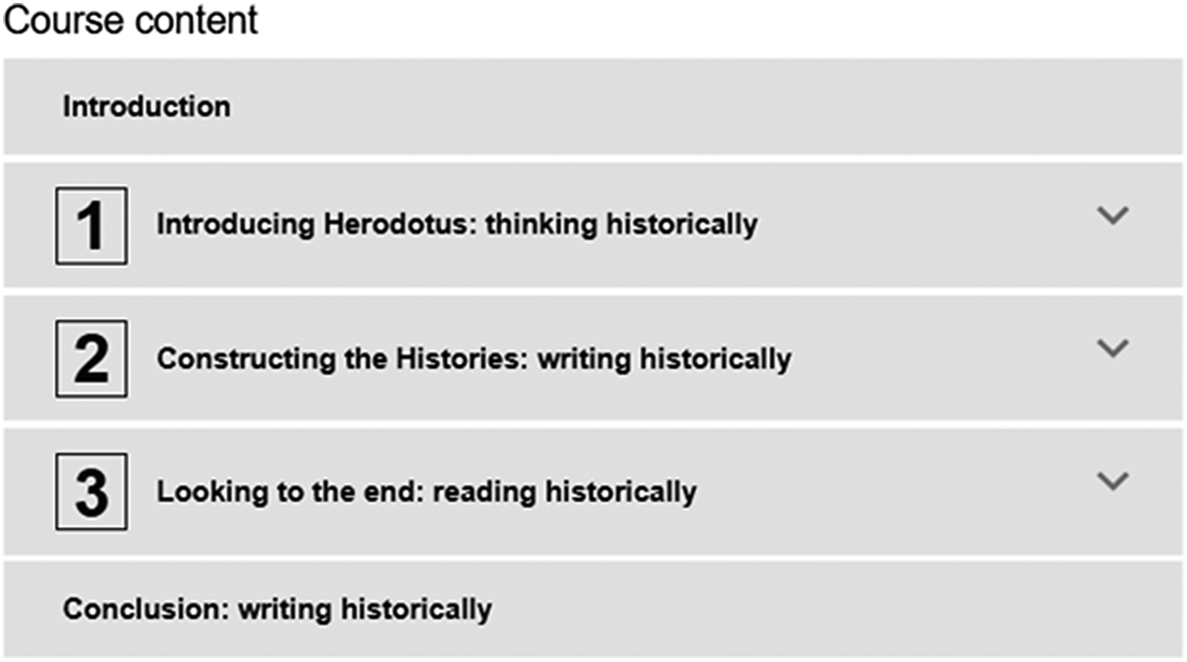
Underpinning students’ ability to achieve a course’s Learning Outcomes will be “scaffolding,” that is to say, carefully structured support in your teaching materials that incrementally “enabl[es] learners to accomplish what is beyond their current ability.”Footnote 12 The key here is to identify which concepts, tools, and tasks learners embarking on the course may not have encountered before so that you can introduce these clearly and gradually. This can be done in different ways depending on the subject matter and aims of a course. You may decide to build incrementally towards a final, sophisticated task, for example. This is the trajectory of the Augustus course, where learners gradually acquire knowledge of Roman dress and culture and develop skills of close looking before applying these to a series of statues of Augustus, considering the image he is projecting in each (e.g. military commander, father of the nation, son of a god) and their role as propaganda for his regime. Alternatively, the learning journey might be chunked into self-contained subject areas. The Herodotus course, for example, is broken down into three main sections, subtitled “thinking historically,” “writing historically” and “reading historically” (see Figure 2), while the Ovid course focuses on “big questions” that are of interest both to the contemporary reader and to Ovid’s ancient audience (“How did the world begin?”; “What makes a human human?”; and “Should we eat animals?”).
The sections making up the course content of Herodotus and the Invention of History (© The Open University).

Some examples from Exploring Homer’s Odyssey will help to illustrate this “scaffolding” approach in more detail. The course’s first activity introduces the Odyssey in an engaging way through a 2-minute animation which summarises the plot of this lengthy and complex epic poem (Figure 3). Rather than merely being asked to watch the animation, learners are given some simple prompts to write “a sentence or two, or a couple of bullet points” about each of the key characters (this turns what would otherwise be an essentially passive, “assimilative” task into a more active, “productive” task, which usefully serves to improve both learners’ engagement and their retention of information).Footnote 13
Activity 1 of Exploring Homer’s Odyssey (© The Open University).

This accessible starting point, making use of a clearly articulated activity which is limited in scope, forms the course’s first piece of scaffolding; from here, an incremental approach helps to build up learner confidence for more complex and involved tasks. Learners return to think about their notes shortly afterwards armed with further information, provided by the course author, about ancient Greek ideas of heroism. This time they engage with a different and slightly more challenging activity, one which asks them to consider which of the characters they met in the animation might be considered a hero (see Figure 4). As the course progresses, learners begin to read and respond to longer and more detailed passages of the Odyssey as they advance from responding to questions with just a few words or bullet points to writing short paragraphs in answer to more detailed prompts. The aim, of course, is to develop skills of written communication and textual analysis alongside subject knowledge, in accordance with the Learning Outcomes.
Activity 2 of Exploring Homer’s Odyssey (© The Open University).

The scaffolding of knowledge and skills continues to the end of a course, where learners are often confronted with more difficult interpretative tasks. Once again, cognitive overload can be avoided by working towards a gradual revelation of more detailed content rather than “downloading” information in large chunks. Exploring Ancient Greek Religion, for example, introduces a type of evidence—inscriptions—which can be challenging even for experienced learners to interpret. Rather than entering immediately into a discussion of a lengthy and complex inscribed text itself, the author begins by asking students to look at an image of an inscription and consider some more straightforward questions about its form and function (Figure 5): “Why might someone have chosen to set up an inscription in stone (rather than using another material, such as wood)?” and “How easy or difficult do you think it would have been to create something like this?” She then carefully builds on this by introducing more contextual information about the inscription (accompanied by a map and photographic images) before then asking learners to consider—through a series of guided questions to accompany students’ reading of the epigraphic text—what the inscription itself might reveal about religious practices.
Activity 5 from Exploring Ancient Greek Religion (© The Open University).

5. Make the learning active
As these examples from Exploring Homer’s Odyssey and Exploring Greek Religion illustrate, rather than simply being expected to absorb information passively, HeadStart learners (like all OU learners, whatever their level of study) are encouraged to participate actively in their learning. In practice, this means that any course should have a balance between exposition—that is to say, sections where the educator shares information and insights—and “activities” (which we label as such). These activities serve the important purpose of making the learner pause and apply their learning or understanding by engaging in a task connected to an element of the course content.
Figures 3–6 provide examples of how these activities are presented to HeadStart learners, the blue background flagging them up as distinct from the more exposition-orientated parts of the course, which appear on a white background. As with these examples, activities should provide clear and precise instructions about what is expected of the learner, ideally including an estimate of the time the activity should take to complete. In HeadStart courses, a free-text box is provided for learners to write their answers, and once they have saved their response, they can click to view the “discussion.” In these discussions, course authors tread a careful path, aiming to model the kinds of answers that learners might have produced, but without alienating those whose responses may have differed from the author’s own (see Figure 6). Phrases such as “You may have written…” or “Perhaps you wrote something like…” are useful here. Providing students with these discussions to reveal once they have thought about the prompts means that even those who do not wish to engage with the activities (or are unable to do so, for example because of time constraints) can still benefit from reading the author’s reflections on the questions posed.
The “discussion” text accompanying Activity 2 of Exploring Homer’s Odyssey (which features as Figure 4 above) (© The Open University).

A variety of learning experiences are provided by way of a range of activity types and of material that learners are asked to work with: for humanities students, the core skills of analysing texts and visual materials can usefully be supplemented, if budgets allow, by the inclusion of audiovisual media. Audio discussions between academic experts, short screencasts, or walkthroughs of relevant locations can all be incredibly useful. Active learning can be built around such resources if learners are given prompts to consider while watching or listening (see Figure 7).
Activity 7 from Exploring Ancient Greek Religion, which involves learners watching a video presented by the course author (© The Open University).

Alongside tasks which ask students to jot down notes or write a few sentences in response to a prompt, other activity types might involve different kinds of interaction. For example, one activity in Exploring Ancient Greek Religion, which aims to build skills in finding and handling information, invites students to read a short introductory document and then complete a passage of text on the same topic by selecting the correct words or phrases from a series of drop-down boxes (Figure 8); some of the activities in Exploring Ovid’s Big Ideas involve learners being asked to rearrange series of events or excerpts from a text in a way that makes logical sense (e.g. into chronological order or narrative order).
Activity from Exploring Ancient Greek Religion using multiple-choice drop-down boxes (© The Open University).

Other options for engaging activity formats might include:
-
• inviting learners to add entries to a table which has been pre-populated with headings and prompts,
-
• “pinning” locations on a map, and
-
• populating a timeline based on information with which they have been provided.
Using a range of activity types can helpfully allow you to broaden learner engagement beyond the “assimilative” tasks (involving the passive absorption of information) that can too often become the default option in asynchronous learning. More complex tasks might require learners to find and handle information, communicate their thoughts, and produce artefacts (e.g. a timeline or map), for example, in more hands-on (and minds-on) ways.
6. Make your material accessible
A commitment to accessibility is vital if online courses are to be truly inclusive and “open” to all. The following elements should be embedded as a matter of course into any online learning materials:
-
• materials should be formatted in such a way that they are legible to screen readers.
-
• images should be accompanied by image descriptions (these are written with visually impaired learners in mind and are usually more extensive than image captions).
-
• captions and transcripts should be provided for all audio and video resources, and
-
• authors should be encouraged to use literal language in order to avoid confusion for neurodivergent learners or those for whom English is not their native language.
Meanwhile, where possible, learners’ potential questions and anxieties should be anticipated. As HeadStart courses cater for those who have little or no knowledge of the conventions of the discipline, any specialist terminology is glossed, and pronunciation guides are included to help learners navigate unfamiliar names and places (such words are hyperlinked to audio files for ease of access). Study notes are also provided to explain common areas of difficulty, including variant spellings of ancient names and how to navigate systems of dating (see Figure 9 for an example of this). Such conventions and basic information might feel obvious to academics who specialise in the subject matter, but providing this explanatory detail to address common questions and sticking points fosters the impression that the educator is joining the learner on their journey.
Sample study note setting out key information (© The Open University).

Finally, a clear layout and structure can help the material feel manageable and navigable for learners. HeadStart courses are divided into numbered sections and sub-sections, each of the latter comprising a single web page with a unique title. There is generous use of white space and images, too, which break up the text while also adding to the visual appeal.
7. Connect with your students
One of the major challenges of creating online asynchronous teaching resources is connecting with your students. Who are they, and how can they get to know you? It is worth developing a clear idea of your target audience, perhaps by developing imaginary student profiles which capture a diversity of backgrounds and experiences, or by having in mind specific former students as potential learners. (How would I engage her with this topic? How would you explain this concept to him?) This can allow you to make decisions about your tone and approach in a more considered way. One tool which OU authors use to personalise learning is addressing students directly as “you.” Authors are encouraged to write in a conversational tone, too, with a view to conveying something of their personality to learners in a medium which might otherwise risk being impersonal.
As mentioned above, the use of open questions allowing for a personal response can help to bolster learners’ confidence by providing them with a way into the subject (“Take a few minutes to think about what the word “religion” means to you”), as can the acknowledgement of the range of possible responses from students (“I’m not sure what you came up with here, but these are my thoughts”). This approach is designed to empower learners—many of whom may have had negative experiences of education in the past—to feel confident in beginning to engage with the material, no matter the starting point from which they have approached it. In the conclusion to each course, authors draw on the Learning Outcomes to provide an overview of the skills and knowledge that learners have developed through their studies—a recognition of their achievement that aims to mirror the kind of positive feedback that students might receive in a face-to-face environment.
8. Evaluate your courses to find out what works
Once your course is live, you are likely to find yourself asking how, and by whom, it is being received. Is it attracting your intended target audience? What are your learners getting out of it? What might you do differently in future? While most web pages can track basic statistics to give you an idea of user visits, those figures only tell a small part of the story of how users are engaging with your material and how effectively it is meeting your aims. It is therefore helpful from the outset to have a plan for how you will evaluate the success (or otherwise) of your course. Ideally, you should aim to gather a mix of quantitative and qualitative feedback.Footnote 14
For HeadStart, evaluation is carried out by way of user surveys at the start and end of each course. These were devised with a view to finding out more about the audiences who are accessing our materials, as well as to assessing impacts on our learners. Importantly, too, the evaluation process has provided us with an opportunity to learn more about what is working well and what might be improved upon in future. Gratifyingly, user feedback has been overwhelmingly positive. Of 357 learners surveyed after completing a HeadStart course, 97% (346) agreed or strongly agreed that they enjoyed studying the course; 92.4% (330) said that they would recommend the course to others; 95% (339) agreed or strongly agreed that they found the materials easy to understand; and 95.5% (341) agreed or strongly agreed that they had learned new things by studying the course. Learners have also described the courses as “thought-provoking” and “completely engrossing.”
9. Closing thoughts
These positive evaluations, along with the high visitor numbers, suggest to us that the approach we have used—and that we have attempted to capture in this “how to” guide—has much to recommend it. HeadStart courses clearly have broad appeal and, pleasingly, seem capable of delivering access to the study of the ancient world in the way we hoped they would. Of course, what we have outlined in this article is only one model for creating online resources, and we are conscious that those working in different environments (especially those not able to count on the level of editorial, technical and institutional support that we at the OU are fortunate to enjoy) may find some of our methods more relevant than others. HeadStart has required a major investment of time and energy, but the substantial effort that the team has put into this suite never seems more worth it than when we receive feedback telling us that “classical learning is not as difficult as I thought,” and that HeadStart courses are “simple to understand and informative” or “really fascinating and accessible.” We look forward to more learners discovering the classical world through courses such as these, just as we look forward to developing our practice further, both through further authoring of educational resources and through continued dialogue with others working in the field of online learning.
Acknowledgements
The authors wish to acknowledge the contributions of the HeadStart course authors (listed in Section 1) and our beta reader, Danny Pucknell, as well as the input of the Learning and Development Solutions (LDS) staff to the production and editing of these courses, especially the work of the suite’s editor, Hannah Parish. We would also like to thank the journal’s editor, Jeffrey R. Wilson, our OU colleague Judith Rice, and an anonymous reviewer for their helpful feedback on earlier drafts of this article.
Author contribution
Writing - original draft: E.B., J.R.
Financial support
The authors were not in receipt of any funding for the publication of this research.
Conflicts of interest
The authors declare no competing interests.
Appendix A: Completed HeadStart unit outline template for Exploring Homer’s Odyssey
Before completing this form, you might like briefly to familiarise yourself with some recent examples of OpenLearn courses. For a recent example of a Classical Studies OpenLearn course, see Getting Started on Ancient Greek.
Working title of unit:
Exploring Homer’s Odyssey or Introducing Homer’s Odyssey or Homer’s Odyssey: who’s the hero?
Author: Emma Bridges
Brief description (draft student-facing text) [c.100 words]
This short course introduces Homer’s ancient Greek epic poem, the Odyssey, which tells of Odysseus’ long journey home after fighting in the Trojan War, and his eventual reunion with his wife Penelope. Odysseus is famous for his cunning and his courage, and for the exploits he undertakes on his travels; meanwhile, Penelope is renowned for her patience and faithfulness as she awaits his return. Meet Penelope and Odysseus and learn more about what it means to be a hero in their world as well as in our own.
Provisional learning outcomes
[3–5 bullet points]
After studying this course, you should be able to:
-
• understand the plot and structure of the Odyssey,
-
• identify some of the ways in which Homer constructs the characters of Penelope and Odysseus,
-
• read in detail short passages of text and analyse the effects of the poetic techniques used, and
-
• identify key themes of the Odyssey, including homecoming, disguise and recognition, family relationships, gender roles, and the representation of the figure of the hero [exact list tbc].
Content outline
[This does not need to be polished or long; it might usefully take the form of 5–10 provisional section titles, with or without brief descriptions of content.]
1. Introducing Homer’s Odyssey
Brief outline of the poem and its relationship to the Iliad.
2. What makes a hero?
Activities:
-
- Who or what comes to mind when you think of a “hero”? (will revisit this question at the end of the course to ask if they have a different view).
-
- Watch Troy Story II (2-min animation covering the plot of the Odyssey)—will provide a quick summary of the story so far. Did Odysseus share any of the characteristics of the image of the hero you thought of for the previous question?
3. Meet Penelope and Odysseus
Section introducing their characters and how their stories are told in the poem as a whole. Contrast of Penelope at home with Odysseus on his travels (refer back to the animation which summarises this neatly).
Activities:
-
- Reading/discussion of short sections of text introducing Odysseus and Penelope from the early part of the poem—students to think about what they are doing, how they are described, who is doing the talking, etc.
For example, opening of the whole poem (1.1–5), with some gloss (“Muse,” “man of many turns” etc) questions like “Having read these opening lines, who/what do you think this poem is going to be about?” “What impression do we get of Odysseus?”; and perhaps our first meeting with Penelope (1.325–336); “What impression do we get of Penelope?” “How is she described?”; then followed up by Telemachus’ silencing of her (which sets a pattern for the poem; I want to build up towards the point that Penelope gets little opportunity to tell her own story and that it is All About Odysseus even though she has considerable challenges of her own to face).
4. Homecoming and reunion
Although the main focus of the poem as a whole is Odysseus’ adventures, it is ultimately a poem about finding one’s way home. The point towards which the action of the poem builds is Odysseus’ return and his reunion with Penelope. Context here regarding the plot; then immediate context regarding disguise, slaughter of the suitors, etc (again, can refer back to the animation for a summary), then focus in on Book 23.
Brief summary of Book 23.
Activities:
Build discussion around a selection of passages and use them to ask learners to think about, for example, (themes tbc; unlikely I will be able to cover all of these in the time/space):
-
- disguise and recognition,
-
- representation of Odysseus and Penelope, their relationship, and their emotional responses to one another,
-
- process of reunion/homecoming, and
-
- who gets to speak, how they speak, what they say
5. Who is the hero of the Odyssey?
What happens after Odysseus and Penelope reunite? They retire to bed and then swap stories. Penelope’s story is summarised in four lines (23.302–305); by contrast, the poet spends 32 lines recapping Odysseus’ adventures (23.310–341) despite the fact that the majority of the poem so far has been about telling his story.
Activities:
-
- Why do you think the poet chose to spend less time summarising Penelope’s experience here?
-
- Fill in a table comparing Odysseus and Penelope based on what you have learned about them so far, for example:

Table 1. Long description
The table consists of three columns and six rows including the header. The first column is a header for categories, while the second and third columns are headed Odysseus and Penelope respectively. The rows are organized as follows.
* Row 1 (Header): The first cell is empty, followed by Odysseus and Penelope.
* Row 2: Actions in the poem, with empty cells for both characters.
* Row 3: Character, with empty cells for both characters.
* Row 4: Locations, with empty cells for both characters.
* Row 5: Relationships with others, with empty cells for both characters.
* Row 6: etc, with empty cells for both characters.
(Note that the above is a crude mock-up and the emphasis would depend on what I’d ended up focusing on in the earlier sections)
-
- Audio discussion (picked up from an earlier section, with the same speakers)?
(Could potentially also introduce some reception in this section in a light-touch way, for example, Dorothy Parker’s poem “Penelope,” Atwood’s Penelopiad, or other work which centres Penelope’s perspective instead of Odysseus’.)
The concluding reflection asks learners to reflect on what makes a hero (thinking back to their initial assumptions when they were asked this at the start). Have they changed their ideas about heroes? Can we see Penelope as a hero on equal terms with Odysseus? and so on.
Key resources
(i) Primary textual sources/readings
[Aim to list in as much detail as you can at this stage the ancient texts you would like to include (incl. line/section nos, etc., if possible), stating which translations you would use and/or whether you would translate the extracts yourself or use copyright-free translations; this will give us a sense of how much text we have to clear in total. NB We cannot direct students to the OU Library, so all text will have to appear within the course itself.]
1. Translation of extracts from the Odyssey to be taken from A. Verity (2016), Homer: The Odyssey. Oxford: Oxford University Press.
Provisional list of extracts as follows (book/line refs, with page nos. in brackets):
1.1–5 (p. 3); 1.325–359 (pp. 12–13); 23.88–240 (pp. 304–308).
(May also include additional extracts but in total will not exceed c. 10 pages of the published translation.)
2. Dorothy Parker, “Penelope”—full poem published in Parker, Dorothy (1928), Sunset Gun. New York: Sun Dial Press.
3. (tbc) possibly short extracts (max two pages of the published text) from Margaret Atwood (2005), The Penelopiad. Edinburgh: Canongate.
(ii) Secondary sources/readings
[Again, aim to list in as much detail as you can at this stage any extracts from modern scholarship you would like to use. NB Once more, we cannot direct students to the OU Library, so all text will have to appear within the course itself.]
None
(iii) Internal Links
[If applicable, list any OU resources you would link to within your unit. For most units we would expect to provide some “Taking it Further” suggestions at the end, but would not necessarily expect to have links to OU content within the main body of the text.]
Main unit
Taking it Further
https://www.open.edu/openlearn/history-the-arts/introducing-homers-iliad/.
(iv) External links
[If applicable, list any external resources you would link to within your unit. For most units we would expect to provide some “Taking it Further” suggestions at the end, but not to have external links within the unit itself.]
Main unit
None.
“Taking it Further.”
Possibly https://www.bbc.co.uk/sounds/play/m001brj5 (podcast: Natalie Haynes Stands up for the Classics: The Odyssey)
and https://www.theguardian.com/books/2013/nov/30/odyssey-soldier-afghanistan-military-homer.
(v) Images
[Please give an indication of the number of images you would ideally like/need in total, plus as much detail as you can about your images, including links (if possible) and copyright. Where images are copyrighted, aim to distinguish between essential and “nice to have.”]
I would like 6–10 images, including the following if possible (1–3 are core; the others would be nice to have):
3. https://www.beazley.ox.ac.uk/XDB/ASP/recordDetails.asp?id=F322BAD4-652B-4E56-AFE7-E51A636F2E81&noResults=&recordCount=&databaseID=&search= (although this is a rather unclear black-and-white version; I would prefer a colour version, although I am finding it hard to find a full-colour image with the necessary copyright details).
4. https://commons.wikimedia.org/wiki/File:%22Penelope_Unraveling_Her_Work_at_Night%22_MET_ADA6426.jpg.
5. https://commons.wikimedia.org/wiki/File:JohnWilliamWaterhouse-PenelopeandtheSuitors(1912).jpg.
7. Generic soldier/wife reunion photo, e.g. https://www.gettyimages.co.uk/detail/news-photo/british-soldier-is-welcomed-home-at-the-end-of-world-war-ii-news-photo/613491064?adppopup=true
or
8. Not essential, but I would also like some kind of montage showing modern-day “heroes,” for example, a Marvel Universe poster or something showing public service workers—I am struggling to find something appropriate but will keep looking.
I would also gladly add more images showing scenes from the Odyssey in different media/eras if the budget allows—there are lots of possibilities which could be used as “wallpaper” here.
(vi) Artwork
[Please indicate whether any artwork would need to be created in-house, for example, diagrams or maps.]
None.
(vii) Audiovisual
[State whether you would ideally like video or audio content, and what form these might take: e.g. interview, presenter-led video, screencast, and so forth Note that the budget for this is very limited.]
Two short audio files of 5–7 minutes each. Each would take the form of a conversation between two academics: Emma Bridges (unit author) and one other person (this could be an OU colleague if the budget does not allow for an external participant).
(viii) Interactive Assets
[Please detail any interactive assets you would need. Note that the budget for these is very limited.]
None.
(ix) Other
[Use this section to outline anything relevant not covered above, esp. anything with potential cost implications (incl. workload implications for others) that has not been captured already.]
N/A.
Appendix B: Author guide and template for HeadStart courses
Units should be around 5–6,000 words long, and potentially shorter depending on the nature of the activities they include. They should be structured in the following way.
Title
Introduction (c. 100 words).
Including a description of the unit and a hook to interest potential students.
Learning Outcomes (3–5 bullet points).
Section 1: [Section Heading].
Section 2: [Section Heading].
(Up to 10 sections, with subsections, if appropriate)
Each section will normally consist of:
-
• an introduction/lead-in/scene-setting text.
-
• an activity (or activities).
-
• discussion(s) (NB discussion points should match the question(s) asked in each activity in both format and content, e.g. if you have asked the learner to “jot down 3 or 4 bullet points” your discussion should do the same; and content should only include things they could have reasonably been expected to come up with based on the information you have given them. Any new/additional information can be provided in a separate paragraph after the activity.)
This may be followed by additional context and discussion (but please avoid having back-to-back activities without some summary/context for the next thing between them).
Other pointers:
-
• Occasionally a (sub-)section may not have an activity, that is, be more scene-setting, but try to avoid this where possible;
-
• Please provide appx. times for the activities (“Allow XXX minutes”) and aim to offer a variety of activities throughout the unit (e.g. reading, looking, listening, or watching using ancient or modern material). (Use the standard OU reading speed of 35 wpm for written text; multiply the length of any audio or video by two to calculate the watching/listening time);
-
• Any subsections should be labelled 1.1 [subsection heading], 1.2 [subsection heading], etc.
In wrapping up, aim to capture not just what students have learnt, but also the “so what?” What can they do now with their new-found knowledge and skills? Your conclusion should align with the LOs.
Taking it Further
A short list of suggested extension activities, usually including internal or external links. Aim to couch these in active terms for learners, for example, “Read x and think about the following ….”
References
You may also include a Glossary (of words hyperlinked in your units) and Acknowledgements.



 Open access



