Introduction
The captivating images in the publications of zoologist Ernst Haeckel are often cited in scholarship on Darwinism in German visual culture.Footnote 1 Though Haeckel's translation of Charles Darwin's works and his scientific application of Darwin's theories of natural and sexual selection were widely read, he was not the only German scientist to pursue visual representations as a means of supporting Darwinismus. Haeckel's contemporary, the physical and cultural anthropologist A.B. Meyer, received significant scholarly attention in his day both for his development of imaging techniques in the human sciences and for his application of Darwin's theories to the study of humankind. The co-founders of the German Society of Anthropology, Ethnology and Prehistory, Adolf Bastian and Rudolf Virchow, were highly sceptical of Darwin's Descent of Man and engaged in a long-running debate with Meyer – a debate which Meyer sought to resolve through his deployment of images.Footnote 2 Specifically, Meyer created new methods of visual representation for these object-centred sciences to reform existing analytical methods and introduce a new understanding of the history of humankind.
Meyer's three years of field research in Asia-Pacific significantly contributed to his understanding of racial and cultural difference and motivated him to publish heavily illustrated articles and monographs. When he combined his first-hand experience in the field with methodology established by scholars based in the fatherland, he discovered that their approach was incompatible with the new data he was gathering. The existing methods erased the historical, cultural and social details that these artefacts and human remains carried with them. They were technologies of distancing that only further defamiliarized the peoples under investigation.
The process of two-dimensional reproductions reduced the volume and materiality of the original object, transforming it into ink on paper. The success of this reductive process as an ethnographic tool was due to the production of several representations of a single object – including views from multiple angles and magnifications: the two-dimensional images comprised a training guide to reading the three-dimensional object. In some cases, these images were even included within the museum's displays. For international readers, the hope was to encourage them to visit the museum's collections in person. Dresden's ethnologists sought to correct previous scholarship that fixated on the singularity of the object and stripped away its history of production and use. Dresden scholars published multiple images of an individual object to contextualize that object as part of a particular culture.
In this essay, I discuss the use of images by the Königliches Zoologisches und Anthropologisch-Ethnographisches Museum zu Dresden (Dresden Museum for Zoology, Anthropology and Ethnography, hereafter ZAEM) in scholarly publications. The museum published scholarly articles on its latest technologies and display aesthetics to disseminate the scientific display practices most suited to a site intended for both scientific research and public education.Footnote 3 These articles were part of the museum's Abhandlungen und Berichte (Notes and Transactions) on zoology, anthropology and ethnography, which was complemented by a series of ethnographic publications on objects, and photograph albums of types. Such in-house publishing was central to the ZAEM's employees’ aim to exhibit knowledge of distant cultures to two categories of audience: visitors to the museum and potential visitors from elsewhere.Footnote 4 Image-laden scientific publications offered virtual mobility to this small museum, as well as expanded room for display.
I argue that these new image-based ethnographic methods developed out of a critique of physical anthropological methods of representation and analysis.Footnote 5 Physical anthropology and ethnology were nascent fields without standardized practices, and Meyer took advantage of their undeveloped state as an opportunity to experiment with visual techniques.Footnote 6 My focus on practices reveals that the aim of the museum was to historicize humankind by, first, providing evidence of the descent of man from apes, and second, demonstrating the varied and distinct cultural histories of the indigenes of Asia-Pacific.
It was through producing and reproducing images of three-dimensional objects that Meyer explored the limits of the existing methods of these object-based human sciences. Meyer concluded that new kinds of image were needed to convey this new knowledge of humankind. I argue that his struggle against the dominant methods used in Germany was due to his own acceptance of Darwinian evolution, a minority view among his colleagues. Meyer's travels through South East Asia and Oceania shifted his historicization of humankind from that of the linear evolutionary hierarchy, favoured by fellow anthropologists, to one of random and varied branching.Footnote 7 Meyer combined the liberal humanitarian empiricism of the German anthropologists with Darwin's argument for descent and evolutionary diversity. For Meyer, as for Darwin, images were instrumental to explaining evolution in a way that could not be achieved with text alone. Julia Voss has beautifully shown that Darwin analysed images as empirical evidence and then created images for his publications as a way to articulate his theory of random variation.Footnote 8 Meyer and his students similarly created techniques of representation to present empirical information. Through their image-based analysis of objects, they found evidence that supported non-purposive cultural variation. They then used these new techniques of representation in scholarly publications to demonstrate this variation to the scientific community.Footnote 9
To follow the trajectory of this image-based methodology and its mobilization as evidence for historicization, I discuss three different cases of the use of images in the ZAEM's scientific publications. First, I examine the case of Mafoka, a chimpanzee from Gabon displayed in the museum as a representation of an early stage in human development. Mafoka became part of the German Anthropological Society's debate on the relationship between apes and humans, and on scientific practices of observation. Second, I discuss a series of craniometry publications on Papuan skulls in Dresden's collection. Over the course of these sequential articles Meyer first accepted and then rejected the anthropological usefulness of measuring skulls and the commonly favoured imaging device for representing them. Finally, I discuss the use of images in the museum's ethnographic publications. With a focus on ethnographies of Asia-Pacific, I argue that the ZAEM relied on a variety of visual perspectives in different media to gain a complete understanding of any one ethnographic object. I show how this variety of images was intended to facilitate the comparison of decorative styles of artefacts, in order to historicize the development and transfer of material culture among the many islands and indigenous groups of the South Seas.
Descent of man: life and death in the natural-history reform movement
In 1874, the General Administration for the Saxon Royal Collections of Art and Science provided the newly hired Natural History Museum director, A.B. Meyer, with the funding for a new museum of zoology, anthropology and ethnography. The foundational collection for the new museum specialized in specimens and artefacts of the ethnic groups of New Guinea and the Philippines. Such specialization was the product of a long-standing interest in the region amongst Saxon royals and state officials, and of Dr Meyer's three years of field research in Asia-Pacific.
In the first few years of the museum's existence, many of the collections were in storage or undergoing preparation for display. However, articles and representations of these items were published from 1876 to 1878 in the museum's first series of scholarly publications. The review in Nature confirmed Meyer's assertions that establishing a journal was one of the best methods of promoting a scientific institution: ‘While the institution remains in place its journal travels about the world, makes its most recent acquisitions known to its supporters and correspondents and encourages them to promote its welfare by further donations’.Footnote 10
The second issue of the museum's journal included two articles on the anatomy of apes in the museum's collection. Meyer's article, ‘Notes on the anthropomorphic apes of the Dresden Museum’ (1876), was heavily illustrated, including thirteen paintings, drawings and photographs of different catalogued specimens. The main goal of his article was to demonstrate that Mafoka, a young female ape from the Dresden Zoological Garden, was in fact a chimpanzee.Footnote 11 Such articles on anthropoid apes were part of an anthropological argument initiated by Thomas H. Huxley and Darwin, claiming that from an evolutionary standpoint, apes and humans were closer than apes and monkeys.Footnote 12
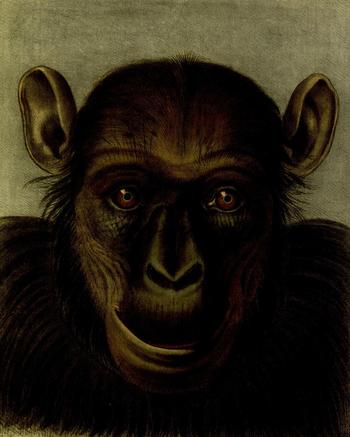
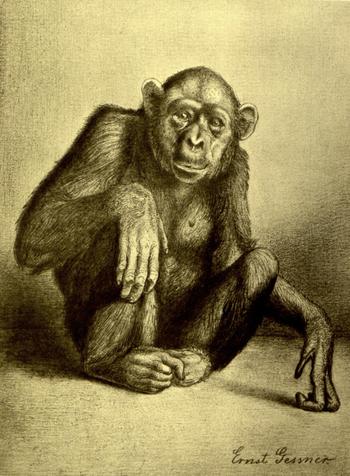
Meyer included humanized portraits of Mafoka to support his argument that she was an ancestor of humans. Mafoka is depicted in six different plates, in seven different images. The first plate is a life-sized facial portrait finished one month before her death (Figure 1). This plate was reproduced for publication as a hand-coloured lithograph, because facial hair and skin colour were considered distinguishing markers between gorillas and chimpanzees (gorillas were believed to have darker hair and skin). On Plate 12 is a lifelike drawing of the entire animal (see Figure 2). For Meyer, the facial portrait was the better imitation of Mafoka, but additional portraits were necessary because of the variability of her colouring due to age, lighting or physical or emotional state, and her status as a captive (rather than wild) chimpanzee.Footnote 13
Painted portrait of the middle-aged female chimpanzee Mafoka, by J.W. Wegener. Reproduced as a colour lithograph because Mafoka's colouring was part of the debate to classify her. From A.B. Meyer, ‘Notes on the anthropomorphic apes of the Dresden Museum’, Mittheilung aus dem k. zoologischen Museum zu Dresden (1877) 2, pp. 223–247, Plate 11.

Drawing of Mafoka by E. Gessner, reproduced as a photograph. From Meyer, ‘Notes on the anthropomorphic apes of the Dresden Museum’, op. cit., Plate 12.

Long exposure times made it impossible to photograph live animals until the technological developments of Eadweard Muybridge, E.J. Marey and Ottomar Anschuetz in the next decade. Therefore the published photographs of Mafoka were taken after death or taken from her death mask. An enlarged post-mortem photograph of Mafoka is juxtaposed with a photograph of her death mask on a single plate, following the images that depicted her in life.
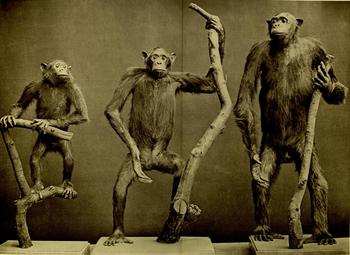
The three plates of four different images, made from four different media, ‘offer[ed] an authentic study of the outer habitus of the face’. Meyer admitted, ‘To be sure the photograph of the dead [Mafoka] leaves much to be desired in terms of clarity, and therefore is supplemented by the death mask’.Footnote 14 The following two plates in the article depict the mounted female ape placed in a vitrine between two mounted male chimpanzees of different ages. All three chimpanzees are positioned standing upright and apparently bracing themselves by holding on to a tree trunk (see Figure 3). Such imagery was a repeated visual reference to the gorilla, since chimpanzees and orangutans were usually portrayed seated.Footnote 15 Meyer's selected positioning of the taxidermized apes in the vitrine indicated that he disagreed with Huxley and Darwin's ranking of the gorilla as the closest ancestor of man. Within the article, the reader was instructed to perceive the photographs of Mafoka in relation to the three-dimensional remains in the display case. Meanwhile, visitors to the museum could view these portraits of Mafoka made during her lifetime alongside the display case of her taxidermized body.Footnote 16 To indicate their relation to humankind, the anthropoid apes were displayed between the museum's zoology and physical anthropology collections.Footnote 17
Chimpanzee display from the ZAEM's anthropology collection with Mafoka in the centre. From Meyer, ‘Notes on the anthropomorphic apes of the Dresden Museum’, op. cit., Plate 14.

In the museum's scholarly publications, as in its displays, Meyer sought to train the viewer's eye through organized arrangements that did not overwhelm the viewer with data. Mafoka was dissected into different parts for study and display. The process of this dissection was reproduced in images documenting the progression from life to multiple catalogued specimens in death. Two plates depicted the plaster casts of Mafoka's right hand and foot from above and from below. The casts were reproduced at actual size, ‘making everyone capable of comparing the hands of other anthropoids, in order to make a conclusion as to the variety of the anthropoid’.Footnote 18
Except for the first painted portrait of Mafoka, all the images were reproduced as collotypes for publication. The collodion printing process was a wet-plate photographic process capable of recording microscopically fine detail. The high-quality prints were made from a sheet of light-sensitive gelatine exposed photographically to the image without using a screen. It happened that the publisher for the Saxon court was an early specialist in the process.Footnote 19 Though the process was invented in the 1850s, it was not in widespread use because it was too expensive and inconvenient for field and studio portrait photography. However, the process was ideal for printing small batches of inanimate objects, and Meyer took advantage of this to set the small Dresden collection apart.
By the time Meyer published his selected images of Mafoka, pictures of her had already appeared in various periodicals, both popular and scholarly. The debate about Mafoka's classification drew a great deal of attention, and animal artists Paul Meyerheim, Ernst Gessner, E. Reichenheim, Heinrich Leutemann, J.W. Wegener and Gustav Mützel were all sent to the Dresden Zoological Gardens to draw her. These animal painters had shifted away from depicting animals in moral parables and comic human satires after Darwin published The Origin of Species.Footnote 20 Their portraits of Mafoka participated in a transformation of German visual culture towards examining the implications of Darwin's natural history.
One of Mafoka's visitors and portraitists was anatomy professor Dr Robert Hartmann. Hartmann argued first that Mafoka was actually a gorilla, and later changed his assessment to argue that she was a hybrid. Such interbreeding would mean that the gorilla and chimpanzee were simply varieties of the same type, which is precisely what Meyer was arguing against.Footnote 21 Hartmann stood alongside Bastian and Virchow, his fellow co-founders of the Berlin Society for Anthropology, Ethnology and Prehistory, in opposing Darwin's theory of descent. Zoologist Carl Nissle, one of the doctors who had visited Dresden to examine Mafoka, suggested that the ‘gorilla theme’ was of particular interest among Berlin scholars who had tried but failed to acquire a living gorilla for the local zoo.Footnote 22 Few had ever seen a gorilla, and the first reported case of a wild sighting turned out to be a forgery of French formalist Geoffroy St-Hilaire's reconstruction of a jarred specimen, held in the Paris Museum of Natural History.Footnote 23 Nissle, an assistant of Hartmann's, observed with some disapproval that though Mafoka was now dead (alive, she would have generated more reliable observations), ‘the entire scientific world could participate in determining her species through the evidence in faithful photographs and reported observations of her external characteristics during life’.Footnote 24
Meyer, who also preferred live observation, was critical of Hartmann's limited use of images as evidence. Hartmann used a single drawing he had made of Mafoka in profile to argue that her external features clearly identified her as either a gorilla or a hybrid, but not a chimpanzee. He described Mafoka as irrational, violent, roguish and disobedient –an ape who rejected an anthropoid classification by ripping off the Western clothes she was habitually dressed in.Footnote 25 On the other hand, men like Nissle, who argued that Mafoka was the most immediate ancestor of humans, described her as having humanoid emotions, communication, mannerisms, likes and dislikes.Footnote 26 Meyer explained that Hartmann's time with the live Mafoka was too short for him to have got an adequate image of her.Footnote 27 Thus Meyer claimed that his own images presented the real Mafoka. It was in the multiplicity of images, produced across her lifetime, that the external variability of the real Mafoka could be captured, and the close relationship between chimpanzees and humans could be established.
This disagreement between Meyer and Hartmann played out in the pages of the Zeitschrift für Ethnologie, the journal for the Berlin Society for Ethnology, Anthropology and Prehistory. Hartmann himself labelled it ‘the fight over Mafuca's [sic] corpse’.Footnote 28 The debate concerned access to Mafoka's remains, the realism of representations relative to the actual cadaver, and the creature's biological nature.Footnote 29 Hartmann insisted that Mafoka's corpse should have been sent to the Berlin anatomical museum for analysis to better clarify her taxonomy. What Hartmann was invoking was the increasing practice among museums in the nation's capital of claiming priority access to objects of scholarly interest nationwide. Meyer, who scoffed at the idea that there was any real scientific disagreement, argued that the Dresden Museum and the Dresden Zoological Garden had a long-standing relationship whereby the museum acquired the zoo's deceased animals at the going rate for such specimens.Footnote 30 Meyer explained that the acquisition of Mafoka was part of this long-term relationship and therefore ‘more natural’ than sending the cadaver to Berlin.Footnote 31
Professor Hartmann went on to attack the scientific status of Meyer's newly opened museum and asserted that the ‘material [i.e. Mafoka] should be managed by a specialized museum and thus made available for examination by subject specialists’.Footnote 32 Meyer noted in response that Mafoka's presence in Dresden had attracted several renowned specialists, and that the resultant evidence as to her nature had been presented in lectures and publications.Footnote 33 Furthermore, Meyer emphasized both the international recognition of his museum and his own willingness to make Mafoka accessible by fulfilling requests from museums across Europe for photographs, cast reproductions and even individual parts of the animal. Hartmann, as a member of the capital's political and scientific community, argued that Meyer was ‘obliged’ to send him the entire cadaver for a fourteen-day examination – not just the photographs, plaster casts or skeleton ear.Footnote 34 His argument prioritized the original, yet dead, specimen over copies, while Meyer asserted that the rest of the anatomical community accepted reproductions as equally scientifically useful. Meyer explained, furthermore, that if another scholar previously had requested to review the remains, Berlin should not oppose that request taking priority: ‘Obviously, the objects of a museum do not belong to the staff but to the entirety [Gesamtheit] and anyone who does not know that must learn it’.Footnote 35 His perspective was that scientific objects were not owned by individuals but rather by the broader community.
The debate over Mafoka shows that this reform was not just about practices of studying the specimen itself but also about representations of that specimen. For Meyer, representations of the living specimen could convey life, even though the images themselves were inert. This ability to convey life made images of the living more informative than autopsy images. Images of the living were accurate analytical tools that could be better used to understand the specimen as a living being. These representations had added value because they could travel to many scholars simultaneously in a way that the corpse could not. They contended with the notion of the importance of locality at the same time that Meyer galvanized the creation and distribution of such representations in order to reinforce local ownership of Mafoka.
The politics of this debate revolved around the struggle of a local museum against a new capital seeking to centralize resources, but also called upon notions of scientific authority, access, mobility and the authenticity of scientific data. Meyer and Hartmann's opposing views on the value of the living specimen place them on opposite sides of what Susanne Köstering, Lynn Nyhart and Oliver Hochadel have identified as a reform movement in nineteenth-century German natural history.Footnote 36 This reform movement sought to move away from the zoological emphasis on anatomical and taxonomic studies of cadavers, as practised at the university. The majority of reform movement participants, like Meyer, held PhDs in the sciences and full-time paid positions as museum curators or directors. These participants in the rise of the professional curator sought to unify the various collections of their museums according to a synthetic vision of nature. In order to present this clear scientific vision to the public, curators employed the new spatial organization of ‘dual arrangement’, which divided the museum into public displays and research collections.Footnote 37 Nyhart and Köstering have shown how, in competition with popular exhibitions of living organisms and spectacles, some museum reformers replaced the tiresome taxonomic arrangements with ‘lively’ biological group displays, including imitation natural surroundings and lifelike positions that aimed at realism.Footnote 38 Meyer adopted a dual arrangement, yet preferred the realism of the taxonomic display over the artificial design qualities of group displays.Footnote 39 His attention to accurate representation in museum displays also echoed his concerns regarding image production of skulls and drums in physical and cultural anthropology.
The failure of craniometry as a science of race
Meyer tried to reform craniometry via an attack on the images that were commonly mobilized in pursuit of this scientific activity. Over a period of several years, Meyer experimented with different imaging techniques for studying human specimens. In the museum's first journal publication, eager to publicize his successful field research, Meyer discussed 135 skulls from Papua New Guinea and Mysore Island. Of the skulls, 112 were Papuan and acquired by Meyer in Oceania. His collecting practices, which had developed out of conversations with Rudolf Virchow and the writings of A.R. Wallace, sought to supplement the few Papuan skulls dispersed across the world's museums. He argued that the large quantity of skulls he had collected from New Guinea would make it possible to determine whether and where there existed a pure Papuan race, a mixed race of Papuan and Malay, and a pure Malaysian race. He sought to answer the ‘Negrito question’ posed by Virchow's work, which postulated that the dark-skinned people of New Guinea and the Philippines originated in sub-Saharan Africa.
In this first article, Meyer followed the generally accepted measurements by Johann W. Spengel and Hermann von Ihering, which focused on the cephalic index. French anthropologist Paul Broca employed the cephalic index to provide empirical evidence for polygenism and reinforce craniometry as a science of race. The index was measured by calculating the ratio between skull length and breadth and held that the northern Europeans were dolichocephalic (long-headed) while the East Asian and Eastern European races were brachycephalic (wide-headed). Though the German Anthropological Society was officially monogenist, the society's founder, Rudolf Virchow, was a great admirer of Broca. Both the liberal Virchow and the egalitarian Broca disputed racism, yet used the cephalic index to argue for the superiority of the dolichocephalic races.Footnote 40
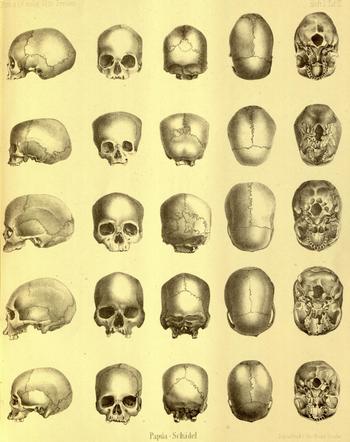
Images of the skulls were made from the Spengel-modified Lucaesian drawing apparatus and then reduced with a pantograph, a mechanical duplication instrument used for scaling. Meyer's article included four plates, each picturing five skulls from five angles; each skull is missing its lower jaw as a result of its having been preserved by the indigenous people as a trophy of an enemy (Figure 4).Footnote 41
Geometric projections of Papuan skulls, one-quarter original size, reproduced by lithograph. From A.B. Meyer, ‘135 skulls from Papua, New Guinea and Mysore Island’, Mittheilung aus dem k. zoologischen Museum zu Dresden (1876) 2, Plate 4.

Meyer's images were consistent with the practices of German anthropologists around the time of unification, which generally accepted drawing over photographs as the most accurate means of representing skulls, because of the control it allowed the expert.Footnote 42 The Lucaesian apparatus fixed the skull in relation to a glass plate, and the user viewed the skull through a lens. The skull was drawn in ink directly on the glass plate, and was then transferred onto paper. The Lucaesian apparatus produced a geometric rather than a perspectival projection.Footnote 43 Anthropologists, after much debate, agreed that this was preferable to attempting to replicate the way the human eye sees. The naturalist Karl von Baer explained, ‘it is true that only geometric drawings, and not perspectival projections, can represent the natural form of these objects’.Footnote 44 Meyer's response to von Baer's call for ‘future investigations based on large numbers of skulls and photographs’ was the conclusion that Lucae's apparatus itself was a flawed tool for skull analysis, and a flawed basis for any science of race.Footnote 45
Meyer continued his investigations in a second article, which depicted only three skulls per plate, at a larger reproduction (two-thirds of the original size) on larger paper to ‘allow for better recognition of anatomical detail’.Footnote 46 Meyer was disappointed with the results; the larger size added no detail and made comparison cumbersome. Meyer's skull measurements also followed Paul Broca's method of measuring the prominence of the chin to rank the level of prognathism, comparing different ethnicities against the chimpanzee. Anthropologists identified prognathism as a marker of intelligence – the level of prognathism was inversely proportional to intelligence. Meyer used these measurements to argue that Papuans ranked second to Europeans.Footnote 47
In his effort to reform craniometry, Meyer critiqued the use of ahistorical methods that supported a racial hierarchy. Many German anthropologists divided humankind into two main categories – peoples of culture (Kulturvölker) and peoples of nature (Naturvölker). Physical anthropologists further demarcated difference through physical attributes by analysing skulls, skeletons, skin and hair, and many explained those differences as evidence of racial difference and as indicators of a racial hierarchy.Footnote 48 They reinforced the stasis of such indicators by conveying information in the form of tables. Most anthropologists argued that the identification of static physical types, or races, was necessary for ethnographic analysis – such as determining migration patterns. Meyer contended that many physical differences could be found within one race and that some of those differences could instead be explained by ethnography, or the sociocultural practices that reshape the body during an individual's lifetime. He believed that craniometry could potentially provide information about race, but not ethnicity, and that prior ethnographic knowledge was necessary for the scholar to be able to glean craniometric information from collected skulls. In order to read the skulls, Meyer historicized each as an individual, and the first few pages of his articles focused on the ethnographic information that had guided him in his analysis. For example, when sex (Geschlecht) was not clear, it was determined based on ethnographic knowledge of gendered activities of the ethnic group, such as hunting, felling trees, building houses, participating in battles, fishing and participating in activities that generally involve exposure to wind and water.Footnote 49 Yet, for the purposes of craniometric research, Meyer's analysis of skulls to deduce the history of the individual was a means to fulfil the discursive standards of his contemporaries – the completion of craniometric tables, tables that identified categories of nature as timeless.
With each publication, Meyer presented a new technique to represent the skulls in the most legible format. In the third issue, Meyer did not follow the same methods of depiction, for various reasons. First, he believed it was more instructive to place twenty-five depictions on a smaller plate so that they could more easily be compared to one another, rather than having only fifteen on a larger plate. Second, the methods of a minimized geometric projection produced unavoidable aberrations just as large as those that accompanied perspectival photographs, and the latter, Meyer argued, were absolutely true to nature.Footnote 50 Meyer, incidentally, followed the advice in an 1861 article by Karl von Baer on using photographs for publication. Baer explained that because of the imaging process, geometric projections could not be minimized to an ideal size for comparative purposes. He recommended using photography to minimize the projection.
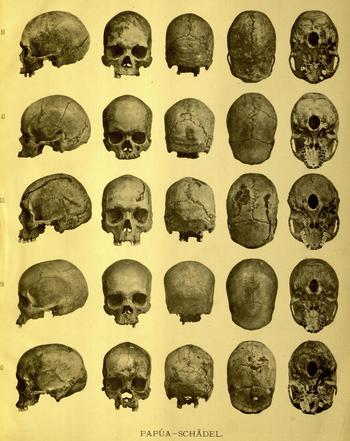
Meyer went one step further and dispensed with Lucae's apparatus altogether. Using photography, he could reduce the dimensions to 25 per cent of the original size, maintain sharpness of detail, and have adequate space for several skulls on one sheet, allowing for a simultaneous view of all angles of one skull in one row (Figure 5). Meyer noted that ‘this allowed the eyes to see easily the smallest differences – a decisive advantage for comparison’, which was the purpose of the minimization.Footnote 51 Meyer argued that the clarity of the image in the photograph made this comparison possible. He chose the collotype over the lithograph because it created a more ‘realistic’ (naturtreue) representation and it was easier to produce. He explained further that artificial treatment and irregularities of the skull could not be reproduced in a lithograph.Footnote 52
Photographs of Papuan skulls, one-quarter original size, reproduced by collotype. From Meyer, ‘135 skulls from Papua, New Guinea and Mysore Island’, op. cit., Plate 35.

The different colourations of the skulls were made visible in the photographs through light or dark tints. Meyer argued that this was more realistic than cleaning or bleaching the skulls to make them look similar to one another. He pointed out that cleaning or bleaching would ‘wash away the authenticity of their origin’, by which he meant signs of how the skulls were treated by the ethnic groups they belonged to, such as whether they were preserved in a grave site or in a house as a trophy.Footnote 53 For Meyer, the realism of the photograph meant that the history of the skull was made visible. The geometric projection erased the history of the person to whom the skull had belonged. And yet even these comparative photographic plates could not correct the limitations Meyer found in craniometry's ahistorical basis.
In 1885 the German Anthropological Society, including Meyer, signed the Frankfurt Craniometric Agreement, which officially standardized German methods for measuring skulls. However, by 1877 Meyer had expressed his frustration with craniometry's failure to produce anything fruitful. Ultimately, he was wary of how much scientific weight should be placed upon the measurement of skulls. Soon after, many other anthropologists would voice their own concerns about craniometry as the central activity of physical anthropology.Footnote 54 Aurel Török, a key figure in exposing the limits of craniometry in the late 1880s, dedicated one of his essays on reforming craniometric standards to A.B. Meyer.Footnote 55 While Meyer had used images as a means to reform, Török focused on new instruments and categories of measurement.Footnote 56
In addition to the methods and tools of analysis, Meyer questioned the study of the skull as an ahistorical object of inquiry. In the field of craniometry, like all other collection-based disciplines, anthropologists were concerned with provenance. The skull's ease of mobility as an object, and the cultural practices that fostered this mobility, raised significant anthropological uncertainty about which races or ethnic groups were represented in the collected objects. Meyer considered this the largest impediment to a serious, worthwhile craniological study of the Malay archipelago.Footnote 57
Once he had rejected craniometry, Meyer took numerous anthropologists to task, especially Armand de Quatrefages, Ernest Hamy, Virchow and Bastian, for their sloppy work and their rush to theorize the existence of new races based on a few skulls of indeterminate provenance.Footnote 58 Though Meyer's collections and written reports from the field convinced Virchow that the physiognomy of Oceanians was heterogeneous, Virchow disputed the existence of transitional forms and based his craniometrical studies on the assumption that human races were relatively stable. He found support for this in Wallace's Malay Archipelago, in which Wallace described the ‘large nose rather arched and high’, with the ‘tip of the nose being elongated’, as the identifying characteristic of the Papuan habitus.Footnote 59 Though this book had inspired Meyer's research agenda – so much so that he published his German translation of it – Meyer's own investigations disproved the essentialized Papuan form described by Wallace. Meyer countered that, given the ‘variability of Papuan body size and skin colour and the irreducible polymorphism of their physiognomy … the form of the skull cannot be regarded as a permanent character in the development of the races’.Footnote 60 Similarly, Meyer discouraged the necessity of concluding that such physical diversity should be read as a sign that Papuans were a mixed race. Meyer's critique of static racial typologies, presented using evidence of the instability of human ‘race-types’, preceded Franz Boas's oft-cited thesis by decades.Footnote 61
Many anthropologists and ethnologists had argued that the dark skin colour of the Negritos indicated an ancestral tie to sub-Saharan Africa. The European labelling of Aetas as Negritos, or ‘small black people’, perpetuated this theory. Meyer argued that ethnographic study of traditions, practices and aesthetics, as well as the Negritos’ own oral histories, failed to provide any supporting evidence of a link to Africa. However, it was his collection of skulls and skeletons from New Guinea and the Philippines that most helped Meyer to persuade Virchow.Footnote 62
Meyer's suggested reforms of craniometric images were not enough to convince him of craniometry's scientific value. The existing imaging practices erased details he found most informative, including social, cultural and historical specificity. Meyer's effort to correct the ahistorical treatment of human remains helped him refine his representation of anthropological objects in ways that demonstrated the importance of ethnography for research into the history of humankind. The use of photographs, rather than other imaging techniques, and the representation of an object from multiple angles were two developments that Meyer would apply to his ethnographic scholarship towards a non-essentialist approach to humankind.
‘Between science and art’: training the eye to historicize non-Western ornamentation
In the 1880s, the museum shifted its focus from anthropology to ethnography and began a series of publications from the Dresden Ethnographic Museum. This series provided a venue to publish beautifully illustrated monographs on ethnographic objects.Footnote 63 In his 1886 appeal for a government-funded ethnographic publication series, A.B. Meyer wrote, ‘Scientific objects are first accessible when they are represented in a certain size such that one can exactly recognize the style of decoration, construction and uniqueness of the object down to every detail for the comparative methods of ethnography’.Footnote 64 The printing techniques Meyer selected for craniometry were also deemed necessary by him for ethnographic scholarship, taking advantage of the clarity and detail of collotype reproductions of photographs to represent their ethnographic collection.
The very first monograph, Bilderschriften des ostindischen Archipels und der Südsee (Pictographs of the East Indian Archipelago and the South Pacific) (1881), investigated pictographic writing systems among different islands of Oceania.Footnote 65 Meyer paired reproductions of the pictorial writing inscriptions with textual descriptions of myths and origin stories from the different ethnographic groups. The primary question of investigation was: why did pictography, and the practice of record-keeping more generally, have such an uneven distribution across the region? On a more disturbing note he asked in addition, what should be made of the evidence of their decline and disappearance altogether? To Meyer and ethnologist Carl Semper, who had collected or recorded many of the pictographs presented in the article, the patchy existence of pictographs argued against theories of cultural diffusion but also provided material evidence of cultural degeneration through the disappearing practice of record keeping.Footnote 66
Meyer's approach addressed one of the flaws he perceived in Adolf Bastian's ethnology: the absence of efforts by indigenous peoples to document their own histories. Bastian, the founder of Berlin's ethnology museum, based his material-culture approach to studying indigenous groups on the notion that such groups did not have written documents that could be used for historical study. Bastian, in line with contemporary art historians and archaeologists, proposed this approach as a criticism of what he saw as the elitist, university-centred methods of Leopold Ranke's archival-based approach to history.Footnote 67 Several ethnographies published by the ZAEM discussed evidence of record keeping through pictographs and looked at the historical development of ornament to argue that ornament, too, was a process of record keeping, recording its own history as well as historical events.
In order to depict these forms of record keeping most accurately, Meyer specified that representations were to be guided by scientific aims rather than artistic ones. He expressed clear disapproval of the use of representations made by those who were not subject specialists, even if they were specialists in artistic representation. Images should not be reproduced through ‘artistic’ processes, namely lithography, copper and steel engraving, and the woodcut. The result of these processes was ‘capricious and clumsy with a high grade of scientific imperfection’, due to the efforts of the draughtsperson to ‘deliver something artistic and pleasing when the exact natural-scientific reproduction would be preferred’.Footnote 68 For example, representations of pictographic woodcarvings in Bilderschriften des ostindischen Archipels und der Südsee included both photographs of the museum's collected woodcarvings and photographs of Carl Semper's watercolours of woodcarvings he observed in the field. Semper's fieldwork and ethnographic publications made his manual documentation credible.
Meyer preferred the collotype over lithography because he believed that the lithographer corrupted the original information held in the image.Footnote 69 And Meyer had plenty of evidence that he was not alone in these expectations. American, English, French and German anthropologists and ethnologists consistently reviewed the publications of the Dresden Ethnographic Museum with adjectives like ‘superb’, ‘unusually fine’ and ‘of the highest standard’.Footnote 70 These reviews referred to the quality of reproductions, the clear arrangement of the plates and the organization of the textual ethnography.
Meyer's perspective reflects aspects of what Lorraine Daston and Peter Galison term ‘trained judgment’, a quality of the confident expert who ‘possessed and conveyed to apprentices the means to classify and manipulate’.Footnote 71 With respect to photography, Meyer quite encouraged human interference, rather than mechanical objectivity, in the treatment of photographic representations, including manipulation of the size of the object and cropping of the image. Photography's ability to manipulate the size of the representation was an asset. The manipulation created a tool for analysis, such as the comparative craniometric plate and ethnographic plates of objects that present multiple angles of the same object all on one plate.
When the Saxon government used the term ‘luxury publication’ to label these expensive productions, and cut funding for them, Meyer countered that this type of reproduction of ethnographic objects was an inseparable part of publication.Footnote 72 Images were used explicitly to make the scientifically valuable objects of the collection available for general knowledge. He explained further, ‘these publications stand between science and art and are bought by a public which has an artistic interest and which is used to, and loves, such a quality and style’.Footnote 73 Thus Meyer indicated that, though these publications were directed at the learned, the quality of the images appealed also to the broader public, specifically the growing middle classes that supported the widespread growth of print culture, including special-interest journals.Footnote 74
Indeed, French anthropologist Gustav Dumoutier noted in the Revue d'ethnographie that the high quality of black-and-white and colour images represented the objects in ‘unsurpassable perfection of details and wealth of tone’.Footnote 75 British orientalist H.G. Keane commended both the ‘enlightened director’ and the government:
These costly publications, which could scarcely be undertaken without the active cooperation of the General Administration of the Royal Artistic and Scientific Collections of the Saxon capital, will, when completed, prove a great boon, especially to students of eastern antiquities, and of the progress of human culture amongst the people of southern Asia.Footnote 76
These publications drew not only a broader audience, but also new donors, including German and Asian ethnologists based in South East Asia. In the competitive world of ethnographic collection, Meyer saw innovative reproduction techniques as a way for the small Dresden Museum to create a niche for itself.
After Meyer had secured government funding through an appeal to the Saxon minister of culture in 1885, he transitioned from publishing hand-coloured, full-plate photographic reproductions of objects to a more complex and explicitly more ‘scientific’ manipulation of imaging techniques and representations. The development of this process can be traced through Meyer's ethnographic publications on kettledrums of South East Asia. Meyer's Althertümer aus dem Ostindischen Archipel und angrenzenden Gebieten (Antiquities from the East Indian Archipelago and Surrounding Areas) (1884) surveyed fifty-two drums of different types located in European museums. European knowledge of the drums was so limited that items were displayed upside down as vases or kettles in the 1883 International Exhibition for Learned Societies in Amsterdam.Footnote 77 Meyer corrected the previous scholarship, which argued that these drums originated in Malaysia. Through comparative plates constructed from drawings and photographs that depicted the different drums from multiple angles, he demonstrated that the Karen drums were made in Siam or Burma. The article presented the first analytical study of the Karen drums brought to Europe at the beginning of the decade.
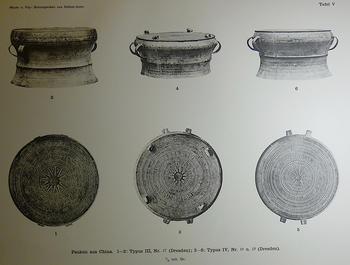
In their 1897 article, Meyer and Willy Foy re-evaluated the classifications of drum types and instead concluded that the bronze kettledrums were made in Cambodia and then travelled across different areas of South East Asia. Meyer and Foy classified the South East Asian drums into six types, each distinct in form and decoration from the others.Footnote 78 This article was the first introduction of type V, the Karen drum, as a distinct type. In this article, photographs were again used generously to provide images of the three-dimensional object from multiple angles. The photograph flattened the object, yet the multiple perspectives attempted to reconstitute the object's three-dimensionality (Figure 6).Footnote 79 In order to demonstrate the development of these different typologies, the authors included two separate plates of isolated designs. One plate of forty-seven different figures demonstrated the development of bird decorations on kettledrums; a second plate depicted twenty-nine different wave and cloud decorations. Each ornamentation also corresponds to a more general ‘type’; for example, number 38 shows a formal characteristic of ornamentation on type IV.
Chinese kettledrums. Drums labeled 1 and 2 are examples of type III; drums labeled 3–6 are examples of type IV. From Willy Foy and A.B. Meyer, Bronzepauken aus Südost-Asien: Alterthümer aus dem Ostindischen Archipel und angrenzenden Gebieten, Dresden: Stengel, 1897, Plate V.

The plate that depicts the developmental history of bird ornamentation does not demonstrate the branch-like development in any obvious way. For example, Figures 1 to 10 are different representations of birds in flight. Out of these flying bird figures, artisans developed the decorations labelled 11 to 22. Figure 20 is actually a repeat image of the back wings on bird 4 and it is repeated to show how 21 and 22 emerged from a doubling of style IV. For the second series of ornaments, which depict stationary birds, figures are also repeated as a means of showing development. For example, Figure 30 is a reproduction of Figure 25 intended to show the roots of Figure 31's development. Thus not every number and not every figure actually corresponds to a new style. Instead, the images are arranged and the styles are repeated in order to allow the reader to follow the different stages of development. A rearrangement of the figures according to the textual descriptions reveals the branchlike developmental relationship between the figures. This plate treats the kettledrum as an object to be analysed via dissection of its parts and then reconstruction; it views the object not just on its own, but also as part of a series. In the final image, Meyer and Foy chose not to explicitly show the similarity to Darwin's diagram from The Origin of Species. It is only through following the plate's textual description that the reader could perceive the relationship between each ornamental figure. Such an obscure presentation of the authors’ argument could have been a tool to engage the viewer in active engagement with the data.
Meyer and Foy's article on kettledrums also provides a good example of the incorporation of autotypes in publications in order to reproduce ornamentation designs for in-text illustrations, to complement photographs of artefacts. The autotype was a reproductive process used to increase the visibility of patterns, such as tattoos or ornamentation styles on objects. Such patterns were not consistently captured in high detail through photographic reproductions. Most articles did not explicitly articulate a typology of ornamentation styles for different ethnographic objects. But artefacts were visually dissected and ornamentation was isolated as a means to more sufficiently train the viewer's eye to read decorative styles as documentation of the actual course of events of the settlement of Asia-Pacific islands.
In his monograph Tanzobjekte vom Bismarck Archipel, Nissan und Buka (Dance Objects from the Bismarck Archipelago, Nissan and Buka) (1900) Willy Foy used similar representational methods to look at how specific ornament styles developed within a single culture. Foy very explicitly used the term ‘developmental history’ to describe his analysis and to emphasize this approach as a critique of the prevailing ethnographic methods in 1900:
It is all very well and good to get lost in the particular ornament of a particular object of a particular culture, to look for an Urmotif or earlier state of western civilization, but to do that is entirely speculative. What we need to do is look at these cultures as they are, on their own terms, as a whole culture, with their own history, and not assume that finding the same pattern in one object in a North American culture and an African culture really signals an international phenomenon. When we apply this to the comparative study of masks, it completely disrupts our theories of cultural similarities between Oceania and America and the argued historical diffusion between Africa and Oceania.Footnote 80
The ZAEM work in ethnographic images overlaps with the period in which Virchow's liberal humanitarian approach was countered by various factions. Many, including the diffusionists, embraced biological evolution and racial classification. Meyer and his students, also critical of the limited results of universalism and liberalism, went in a different direction from the Nordic racial biology that would become prevalent in the next decade.Footnote 81
Foy investigated objects of many different kinds, ranging from mouthpieces of masks to decorative facades of mask houses to boat carvings, in order to construct a developmental history of the fish ornament in northern New Mecklenburg. Foy explained that each of the plates was constructed to illuminate the local cultural context of design. The designs on each object constructed a connected, historically developing, series. Yet, as in his previous article with Meyer, Foy did not arrange the isolated patterns in an obvious demonstration of this argument. Instead, the active reader was guided toward independent discovery of this relationship through the accompanying text.
This method of training the eye through visual representations was similar to that used in the museum's early articles on anthropoids. Generally, photographs depicted the construction of the whole object, and autotypes or drawings dissected objects and magnified clues to make them legible. This approach trained the eye by not overwhelming it with a variety of data.Footnote 82 The autotype limited the viewer's attention to one particular part of the object. These visual excerpts guided the reader as to how to view the complete object in the photograph and made it possible for images to explain the argument.Footnote 83
An important example of the use of autotypes is found in the ZAEM's publication of ethnographic representations made by indigenous people. Western depictions of humans were largely absent from these articles. Swedish ethnographer Hjalmar Stolpe's article ‘Über die Tätowirung der Oster-Insulaner’ (On tattooing among the Easter Islanders) (1899) is unique for its inclusion of Western and native depictions of Easter Islanders and their tattoo patterns. The representations were a coproduction between the Europeans and Easter Islanders Stolpe met in Tahiti between 1883 and 1885. Stolpe explained that while his contacts, two police servants in Nukahiva, knew the pattern, they did not know how to draw the necessary curves of the human figure. So Stolpe showed them the contours of a male face and the necessary points like eyes, nose and mouth. Indigenous knowledge and Western knowledge were combined to record indigenous tattoo patterns:
What stems from my hand is to be understood as an exact copy of the original drawing. All the rest is drawn by Pioeva, with help from Amoi. The drawing process was very slow and thoughtful, because it concerned characteristics which had to be very particular … The two artists agreed in a unified voice that their drawing was a distinction among married men.Footnote 84
Stolpe reproduced the drawing within the text using autotype, which involved a transfer of the patterns onto wood in order to increase their visibility.Footnote 85
Pioeva and Amoi, ‘intelligent youths’ who knew much about tattoo designs, were not raised in the old traditions; ‘they were no Maoris’, and therefore could not explain the meanings at length. So instead Stolpe investigated this question further through analysis of tapas or statues that depicted the tattoo patterns found on some Easter Islanders. A discussion of the material culture of the people provided further material evidence for this argument. Stolpe demonstrated that the ‘tattoo design has the same basic character, if it is not completely identical to the decorations of the material products of the people’.Footnote 86
Previous scholarship by explorers including James Cook, Georg Forster, Otto von Kotzebue and Adelbert von Chamisso had claimed that the Easter Island tattoo ‘designs’ were ‘limited by the fancy and ability of the artist’, meaning the tattoo designer.Footnote 87 Such scholarship emphasized the individuality of the tattooist over a common aesthetic of the group. Stolpe proceeded with an opposing observation that highlighted clear, constant patterns across all those who were tattooed:
The tattoo ornament style of the Easter Islanders is autonomous like the myriad designs of the rest of the Polynesian islands. Like those, it must have had a quite independent development and it must stand in organic connection with the local culture.Footnote 88
The perceived differences in pattern are explained by the different styles for each of the tribes, only a few of which remained after the population was decimated.Footnote 89 Though Stolpe wrote a harsh critique of the existing ethnographic literature, he relied on the reproduced tattoo patterns represented in these older works in order to lay out his argument for development in tattoo practice and ornament among the Easter Islanders. For Stolpe, the images provided more reliable evidence than the texts. In order to lay out his argument of the historical development of a distinctly Easter Islander tattoo ornamentation, he included reproductions of the original figures and provided a new reading of them to indicate that though the meaning of the tattoos may have changed, a consistency of design remained.Footnote 90
A central piece of evidence for Stolpe was a demonstration of tattoos as a form of record keeping of events on the island. Through analysis of Juan Tepano, ‘a living chronicle of Easter Island’, Stolpe argued that the Polynesian tattoos were part of the archive of European–Polynesian history. In 1868, Dr J.L. Palmer visited Easter Island with the English warship Topaze. Palmer and his crew went to see the statues of Tau-ra-re-n'ga, the large stone house found on the volcano Te Rana Kau. They then carried one of the eight-foot-high, four-tonne statues to the beach, put it on board the ship and took it back to the British Museum. Tepano ‘memorialized in his skin … a completely realistic portrayal of a historic event’: the English captain and his crew as they carried the giant statue away.Footnote 91 Stolpe extrapolated from this that because of the ‘relative realism’ of ornament and its use as a form of record keeping, ornament should be considered a type of inscription that Easter Islanders carve into objects and ink into their own skin.Footnote 92 When ornament is accepted as an inscription, it can also be seen as a record of its own origin.Footnote 93 Thus Stolpe's analysis of tattoo design demonstrated that Easter Islanders had a practised means of recording history and that their historical records were still available. Furthermore, Easter Island historical record documented European activities in the region, providing confirmation of the origin of Tau-ra-re-n'ga in the British Museum as well as the evidence of a sense of history commensurate with that of Europe.
Conclusion
A constant refrain of Director Meyer was how ignorant Western scholars were of other ethnic groups, even amidst the piles of collected material. He was in awe of the diversity of New Guinea and the Bismarck Archipelago, which he considered the most ethnographically interesting region of the earth because ‘the products of artistic activity are so exceptional and the different regions of this group of islands are so distinct from one another’.Footnote 94
Using in-text autotype illustrations and full plates of photographs, the ZAEM's ethnologists demonstrated that within each culture, patterns had their own developmental history. Various forms of photography predominated in depicting the construction of an object as well as isolating and magnifying particular design or ornamental details. The goal was to train the eye, by not overwhelming it with a variety of data, to understand the history of the ethnic group in question. As such, any method of representation, including photographs, as well as drawings and watercolours, was utilized as long as it aimed at scientific accuracy. Meyer's definition of realism in images incorporated his historical approach to the study of humankind. He sought out processes which would highlight rather than erase historical evidence.
No single image could provide sufficient representation of the artefact or specimen. For the ZAEM scholars, there was an implicit assumption that the scientific information held in the three-dimensional object was hidden, even if that information was right on the surface. It was hidden by virtue of the fact that the viewer did not know how to read the object. Dresden's ethnologists produced and compiled multiple images of any one object to convey the complexity and multidimensionality of each object under study, in order to present the objects’ creators as members of complex, multidimensional ethnic groups.
Building up a discipline around the collection of objects brought to Europe from distant lands relied on the durability of the museum as an institution and the assumed capability of the objects to represent the source community. Yet it was up to the creativity of the ethnologists to reconstruct the broader culture of the source community for a European audience. Dresden resisted uncritical acceptance of the dominant ahistorical mode of understanding non-Western peoples and responded with new methods. The questions these ethnographers asked about the history of the development of material culture are bound up in their own experiments with developing techniques to represent and study ethnographic material. In this way, the practitioners of this new discipline wrote themselves into the same history of humankind that they sought through ethnographic research.