1. Motivation
A central tenet of democracy is the ability of citizens to hold politicians accountable (Fearon, Reference Fearon1999). Three distinct, but related phenomena can pervert this process. (1) Political corruption and clientelism can dissuade voters and elites from removing poor-performing incumbents, as they will no longer enjoy the favors and goods from the incumbent (Wantchekon, Reference Wantchekon2003). (2) Violence may also influence voters decisions. In situations of insecurity, citizens may support politicians with criminal or (para)military connections (e.g., a warlord or local crime boss), as they may feel they are better able to keep the peace (Wantchekon, Reference Wantchekon2004), or to avoid retribution if they were not to support a candidate with a reputation for violence (Bratton, Reference Bratton2008). (3) Citizens may also see corrupt politicians as a Faustian bargain they must endure in order to establish order, especially where justice is weak (North et al., Reference North, Joseph Wallis, Webb and Weingast2012). Thus corruption is the price that must be paid to keep various elites and armed groups in society at a relatively peaceful equilibrium.
Previous research has found that citizens are willing to overlook corruption when the economy is doing well (Klašnja and Tucker, Reference Klašnja and Tucker2013), in exchange for performance on other areas they care about (Rundquist et al., Reference Rundquist, Strom and Peters1977; Muñoz et al., Reference Muñoz, Anduiza and Gallego2012), or for clientelistic promises (Manzetti and Wilson, Reference Manzetti and Wilson2007). Yet, past studies have consistently found that voters are averse to supporting corrupt candidates (Banerjee et al., Reference Banerjee, Green, McManus and Pande2014), even if it is ex-post efficient—i.e., even if politicians otherwise perform well in office (Winters and Weitz-Shapiro, Reference Winters and Weitz-Shapiro2013). However, corruption does not exist in a vacuum, but rather reflects inefficiency costs of doing business given the current arrangement (Shleifer and Vishny, Reference Shleifer and Vishny1993). Any attempt to understand voter attitudes toward corruption must also present the counterfactual: what is likely to happen in the absence of corruption?
We address this gap in the literature by investigating whether voters are willing to make trade-offs between security and corruption in a violent context. We examine two particular mechanisms: fear generated by insecurity and crime victimization. Using a survey experiment, we test whether threats to security lead citizens to be more willing to make trade-offs for corrupt candidates in exchange for lower levels of violence, or whether citizens mobilize in the face of these threats and demand politicians fight corruption (even if this means higher levels of violence).
These questions are fundamental to understanding governance and development. Criminal organizations use violence, intimidation, and corruption to strike fear into citizenry to maintain their power (Phillips, Reference Phillips2015). The rise of organized crime has resulted in criminal-run enclaves with little state presence in various Latin American countries (Lessing, Reference Lessing2015). Violence levels in many of these places rival or exceed violence in civil wars (Kalyvas, Reference Kalyvas2015: 3–4). There is a common phrase used in Latin America to describe the trade-off faced by individuals when confronted with organized criminal elements: plata o plomo (literally, “silver or lead”), accept the bribe, or face the threat of bodily harm (the bullet) (Dal Bó et al., Reference Dal Bó, Dal Bó and Di Tella2006). Understanding how past violence and the threat of future violence influence attitudes toward corruption is an important step toward rectifying cycles of violence, corruption, and fear that are thought to corrode state capacity and negatively affect democracies (Leonardi et al., Reference Leonardi, Nanetti and Putnam2001).
In this study, we present evidence of the effects that fear and exposure to drug-related violence have on Mexican citizens’ willingness to make trade-offs between corruption and violence ahead of the 2012 presidential election. The 2012 election serves as an ideal case to study the relationship between fear of violence and attitudes toward corruption for two reasons. First, several polls and journalistic accounts suggested that the continued violence surrounding Mexico's Drug War was one of the principal concerns of Mexican voters as they cast their ballots to replace the outgoing President Felipe Calderón.Footnote 1 Second, a potential appeal of Enrique Peña Nieto, the key challenger and eventual winner of the election, was that he and his party—the Partido Revolucionario Institucional (PRI)—were implicitly offering voters lower levels of violence in exchange for increasing corruption. This was viewed as taking a more “hands-off” approach to the Mexican drug cartels, allowing them to operate with greater impunity as long as violence goes down.
We conducted two surveys a week apart before the election. First, as part of a nationally representative survey of Mexican citizens we find that fear over violence from the Drug War was positively correlated with greater willingness to accept corruption in exchange for lower levels of violence. However, this relationship is moderated by the level of violence in a respondent's municipality. To tease apart how violence and fear influence attitudes toward corruption and violence, we conducted a survey experiment in Greater Mexico City. We randomly assigned subjects to one of two manipulations: one which primed subjects for fear over the Drug War using a common emotion-priming paradigm from psychology (Ekman, Reference Ekman1992), or a neutral manipulation. Surprisingly, we find that priming fear about the Drug War either reduces fear or has no effect, leading individuals to be less willing to accept corruption in exchange for lower levels of violence. Conversely, individuals exposed to higher levels of crime victimization report higher levels of fear about the Drug War and are more willing to accept the corruption-violence trade-off.
Our findings demonstrate that the relationship between fear, exposure to violence, and political behavior is not straightforward. Victimization and response to fear appeals operate in different ways. Citizens may not be so easily swayed by fear appeals to accept corruption. However, individual victimization leads to higher levels of fear and a greater willingness to trade-off corruption and violence. From a normative perspective, these results are mixed. Individuals living in violent contexts may not be as susceptible to fear appeals as previously argued (Huddy et al., Reference Huddy, Feldman, Lahav, Taber, Fagerberg, Mowery and Nelson2003). Yet, exposure to criminal violence may increase fear and tolerance for corruption if it lowers violence.
The remainder of the paper is organized as follows. In the next section, we discuss the literature on violence, emotions, and corruption. In Section 3, we describe the context of violence under which the 2012 presidential election took place. The main findings from the national survey are presented in Section 4. The design and the results of the survey experiment conducted in Greater Mexico City are discussed in Section 5. The last section puts our results into a broader context on electoral politics, violence, and corruption.
2. Violence, emotions, and corruption
2.1 Previous literature
A fundamental function of the state is the ability to monopolize violence within its borders (Weber, Reference Weber1919). Violence perpetrated by non-state groups, such as criminal organizations, challenges this monopoly. How do citizens react when reducing corruption and increasing the capacity of the state leads to higher levels of violence in the short-term? Reno (Reference Reno1999) argues that, in the context of Africa, political reform in weak states may upset patronage networks, inducing higher levels of violence from disgruntled elites. Recent research about Mexico's drug-related violence suggests that the end of the one-party dominance of the PRI upended patronage networks and led to higher levels of criminal violence (Osorio, Reference Osorio2012; Dell, Reference Dell2015; Rios, Reference Rios2015). Public opinion data in Latin America show that crime and insecurity are consistently one of the top issues facing citizens (Zechmeister, Reference Zechmeister2014). Respondents also rank corruption as a pressing issue (below the economy, and crime and insecurity). Those most-likely to be victims of corruption also live in high-crime areas, but are also more likely to believe corruption is justified (Zechmeister, Reference Zechmeister2014: 139–154).
The evidence strongly supports that violent crime and corruption are linked, both in terms of their victims and their structural relationship. It also points to a trade-off faced by voters in Mexico and other states plagued by corruption and violence: how much do they value political reform if it means a short-term, or medium-term, spike in violence?Footnote 2 Yet, there is no direct evidence on how voters weigh this trade-off between reform and increased short-term violence, and corruption. Three different literatures—the effect of violence on political mobilization, voters evaluations of corrupt candidates, and the effects of emotions on decision-making and political behavior—point to two very different possibilities.
Previous studies in political science have documented a connection between exposure to violence and political and social empowerment. Studies have shown that exposure to violence increases voter participation (Blattman, Reference Blattman2009), and leads higher levels of ingroup cohesion (Gilligan et al., Reference Gilligan, Pasquale and Samii2014; Zeitzoff, Reference Zeitzoff2014) among affected individuals. Particularly relevant to the current study, Bateson (Reference Bateson2012) shows that being a victim of a crime leads to large increases in political participation, but also greater support for vigilantism and harsh policing tactics. Morrison and Rockmore (Reference Morrison and Rockmore2014) extend Bateson (Reference Bateson2012), and show that fear of criminal victimization drives political participation in Africa. The literature on violence would suggest that exposure to violence, or fear of victimization, leads to increased political empowerment, but is unclear whether this extends to fights against corruption—especially in the face of higher levels of violence.
Research in the political economy of development consistently finds that voters are averse to supporting corrupt politicians (Banerjee et al., Reference Banerjee, Green, McManus and Pande2014). Winters and Weitz-Shapiro (Reference Winters and Weitz-Shapiro2013) use a survey experiment in Brazil to show that voters oppose corruption even if it is ex post efficient for delivering public goods. However, others have found that voters are remarkably tolerant of corruption (Golden, Reference Golden2006). Anduiza et al. (Reference Anduiza, Gallego and Muñoz2013) suggest that this may be due to partisan bias—co-partisans are more willing to tolerate corruption. Chong et al. (Reference Chong, De La, Ana, Karlan and Wantchekon2015) use a field experiment in Mexico and show that informing voters of corrupt incumbents reduces support for incumbents, but also reduces voter turnout. They suggest that, paradoxically, informing voters of corruption may actually erode the anti-incumbent vote, by reducing confidence in the electoral process and overall turnout, thereby blunting any negative effect on the corrupt incumbent.
A separate literature in psychology and decision-making explores the role that fear and negative emotions play in influencing political behavior (Hatemi and McDermott, Reference Hatemi and McDermott2011). Emotions are thought to be adapted mechanisms that provide individuals the ability to respond to situational stimuli (Frijda, Reference Frijda1986). Different negative emotions stemming from the same violent event—such as anger and fear—can have vastly different effects on perceptions of risk and behavioral tendencies. Anger is generally thought to increase risk-taking, action-oriented emotion. Conversely, fear is thought to lead to risk-averse behavior and inhibit action (Frijda, Reference Frijda1986; Lerner et al., Reference Lerner, Gonzalez, Small and Fischhoff2003, Reference Lerner, Small and Loewenstein2004). Further research in political psychology finds that fear leads to increased conservatism (Jost et al., Reference Jost, Napier, Thorisdottir, Gosling, Palfai and Ostafin2007), greater vigilance (Brader, Reference Brader2005), and information-seeking behavior(Gadarian and Albertson, Reference Gadarian and Albertson2014; Albertson and Gadarian, Reference Albertson and Gadarian2015). In the context of foreign policy, increased (visual) threat cues are linked to a more hawkish foreign policy (Gadarian, Reference Gadarian2010).
Most extant studies on the role of emotions have focused on the context of US voting behavior (Marcus et al., Reference Marcus, Neuman and MacKuen2000). There have been few studies that have looked at the effect of emotions on political behavior in developing countries and/or violent contexts. Young (Reference Young2016) is a notable exception. She conducts a field experiment in Zimbabwe and finds that induced fear reduces mobilization as individuals become more pessimistic about others joining them in protest, and increases the perception of personal risk posed by government repression. This is a large gap in the literature, given that the stakes (and risks) involved with voting are much higher in the developing contexts,Footnote 3 and hence emotions are likened to be heightened.Footnote 4
2.2 How might fear and violence influence attitudes toward corruption?
These three literatures provide different insights into how fear and exposure to violence will affect attitudes on the corruption–violence trade-off in Mexico. The political psychology literature on emotions makes a hard prediction—people scared over violence will be more willing to trade-off higher levels of corruption in exchange for lower levels of violence. Fear is considered an inhibitory emotion—leading people to be less willing to take risks. Inducing fear over the Drug War will lead individuals to be more risk-averse, and less willing to reduce corruption if it means increasing violence. Fear will thus cause individuals to be more tolerant of corruption, if it lowers violence.
Prior research has consistently found that individuals exposed to violence are more likely to participate politically. However, the effects of increased political participation and how it translates into policy preferences is not clear. There is some evidence that exposure to (criminal) violence leads to increased support for authoritarianism and vigilantism (Bateson, Reference Bateson2012). Yet the effects of violence on the corruption–violence trade-off are an open question. Does increased violence and subsequent political participation lead individuals to be more tolerant of fighting corruption even if it means higher levels of violence? Or does it lead to individuals preferring the more risk-averse option of accepting corruption.
Our study is in a unique position to disentangle the effects of fear and exposure to violence on the corruption–violence trade-off for three reasons. (1) We explicitly frame the survey question as voters making trade-offs between corruption and violence. Conversely, most previous research only examines whether voters are willing to accept corruption if they received personal benefits (i.e., clientelism), and not the broader effect of corruption on levels of violence. (2) We measure fear over the Drug War, and use a canonical emotion-induction paradigm from psychology (Ekman, Reference Ekman1992) to test whether voters can be “scared” into accepting corruption if it means lower violence (Lupia and Menning, Reference Lupia and Menning2009). (3) Most importantly, we utilize a national survey to examine the relationship between fear and support for trading-off corruption for violence. Then, we explicitly test the causal effect of fear on this trade-off using a survey experiment.
3. Mexico's drug war and the 2012 presidential election
On 1 July 2012, Mexico held a general election to replace the outgoing President Felipe Calderón. Given electoral rules in Mexico, Calderón of the Partido Acción Nacional (PAN) could not seek a second term. His successor at the PAN, Josefina Vázquez Mota, ran against Enrique Peña Nieto of the PRI, Andrés Manuel López Obrador of the Partido de la Revolución Democrática (PRD), and Gabriel Quadri of the Partido Nueva Alianza (PANAL). Peña Nieto led for much of the campaign and eventually was declared the winner with 38.2 percent of the vote, followed by Andrés Manuel López Obrador (31.6 percent).
One of the principal anxieties Mexican voters faced as they cast their ballots in 2012 was the sharp increase in violence as a result of the Drug War initiated by President Calderón. From 2006 to 2012, Calderón's administration implemented an aggressive policy to combat organized crime, which included the use of the Mexican military in major operations against drug cartels in high violence areas such as Ciudad Juárez. The military campaign started in the states of Michoacán and Baja California in December 2006, but as time progressed, the campaign escalated by increasing the number of military troops deployed in various localities affected by organized crime (Shirk and Wallman, Reference Shirk and Wallman2015).
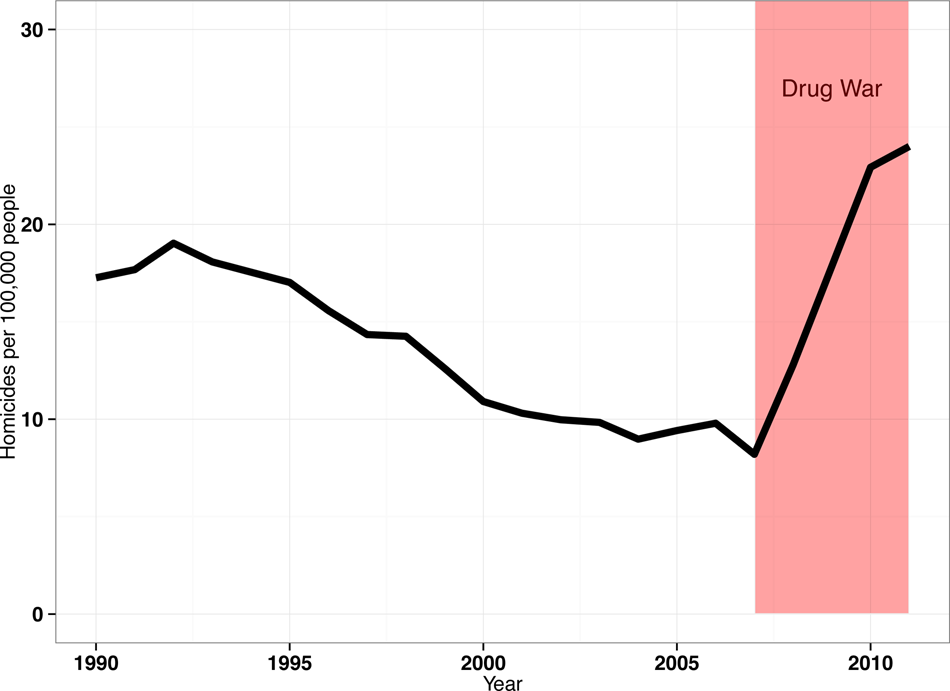
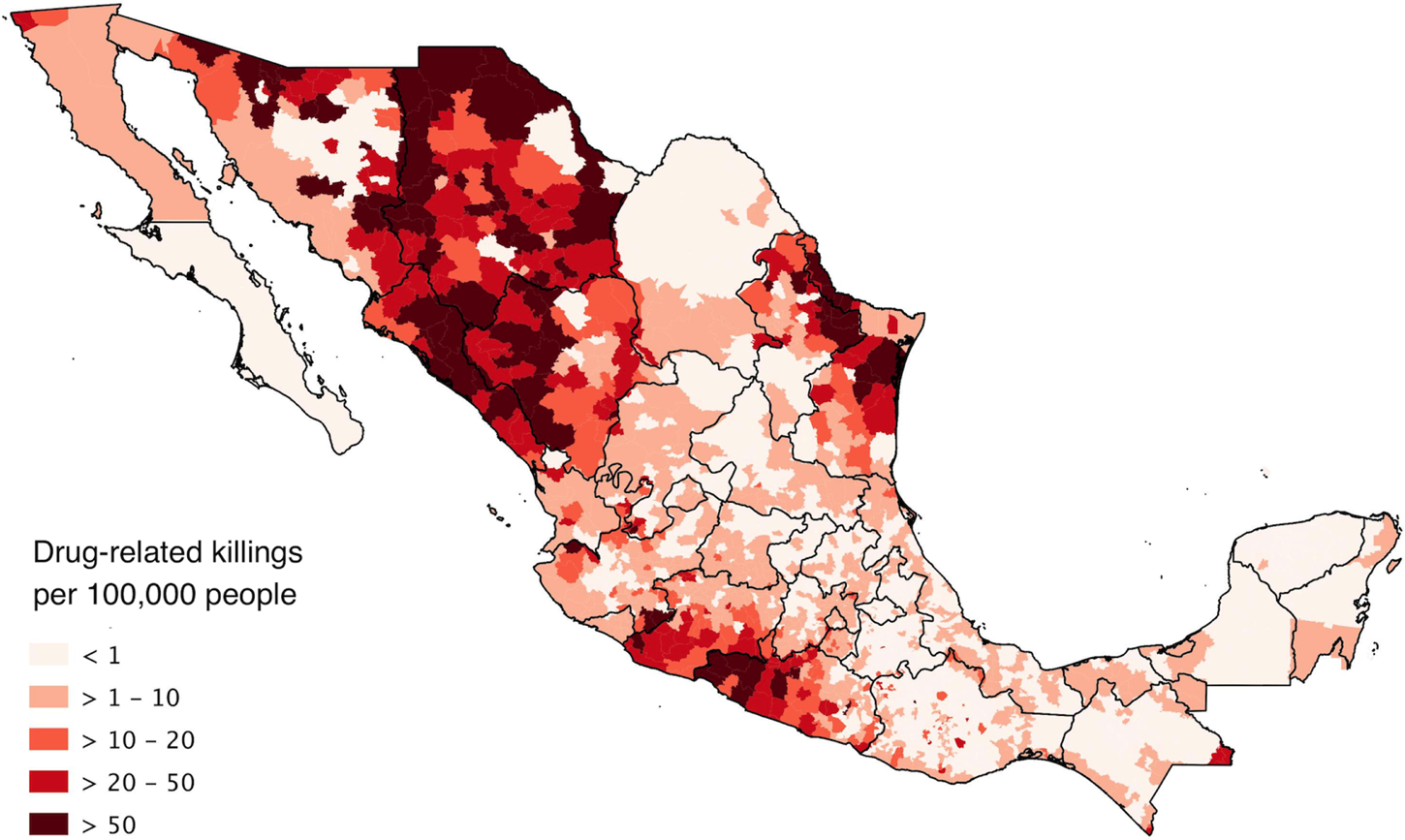
Violence and crime levels increased dramatically during Calderón's administration. As shown in Figure 1, official data from Mexico's Instituto Nacional de Estadística y Geografía (INEGI) indicate that in 2011 Mexico had reached its highest homicide rate in recent history: 24 deaths per 100,000 people. Over 95,000 people were killed in the five-year period from December 2006 to December 2011. Arguably, 60,000 of those homicides were specifically tied to the Drug War.Footnote 5 Figure 2 shows the geographic distribution of drug-related killings between 2007 and 2010, based on data from the Mexican National Security Council. There are two things worth noting here. First, while this type of violence is certainly concentrated in the northern and western part of the country, i.e. along the drug-trafficking routes into the US, there is substantial spatial variation across the Mexican territory. Drug-related violence in Mexico is not a border-specific phenomenon. Second, even within states, we observe significant variation in violence levels—peaceful localities coexist with violence hotspots in some states.
Homicide rate in Mexico (1990–2011).
Notes: Homicides per 100,000 people in Mexico between 1990 and 2011, based on data from INEGI.

Drug-related killings by municipality (2007–2010).
Notes: Annual average of drug-related killings per 100,000 people in Mexican municipalities between 2007 and 2010, based on data from the Mexican National Security Council.

Calderón continuously justified, and asked Mexicans to back, his aggressive anti-drug campaign by stating that the wave of violence in the country was a necessary stage to terminate drug trafficking in Mexico. Nonetheless, the sharp increase in violence levels—and specifically in drug-related murders—was a central concern among voters as they approached the election day. A number of polls conducted during the course of the campaign showed that public security and drug-related violence were the top issues for voters, neck and neck with unemployment and the economy (Olson, Reference Olson2012).
Signaling a shift from Calderón, Peña Nieto campaigned on reducing kidnappings and day-to-day crime, rather than going after drug lords. A concern voiced by opposition politicians, and international leaders, was that Peña Nieto would curtail the fight against organized crime in order to reduce violence and gain public support, at the expense of increased corruption. Critics viewed a PRI administration as returning Mexico to an unofficial policy of accepting bribes and allowing the organized crime to operate with a greater level of impunity in exchange for lower violence. This trade-off between high corruption and comparatively lower violence characterized the PRI's 70-year dominance of Mexican politics before the PAN wrested control of the presidency from them in 2000 (Osorio, Reference Osorio2012; Dell, Reference Dell2015).
4. National survey
Two weeks before the presidential election, as part of a nationally representative survey conducted by Buendía & Laredo (a leading survey firm in Mexico), we were able to first measure the relationship between self-reported levels of fear over the Drug War and citizens’ willingness to accept higher levels of corruption in exchange for lower levels of violence. The survey followed a random selection of citizens based on a stratified multistage cluster sampling design, using Mexico's electoral precincts as the Primary Sampling Units (PSUs).Footnote 6 In total, 800 face-to-face interviews with Mexicans 18 years old or older were conducted.
Two key questions were included aiming at measuring the extent to which fear over the Drug War correlates with willingness to trade-off corruption for violence.Footnote 7 First, we included a seven-point item that asked respondents if they would prefer lots of violence and little corruption (1) to little violence and lots of corruption (7). The exact wording was as follows:
If you had to choose between corruption and violence, on a scale from 1 to 7, where 1 represents lots of violence and little corruption, and 7 represents little violence and lots of corruption, which would you choose?
Second, to measure fear, we asked subjects to report their level of fear over the Drug War on a seven-point scale:
On a scale from 1 to 7, where 1 means “Not at all” and 7 means “A lot,” how scared are you about the violence from the Drug War?
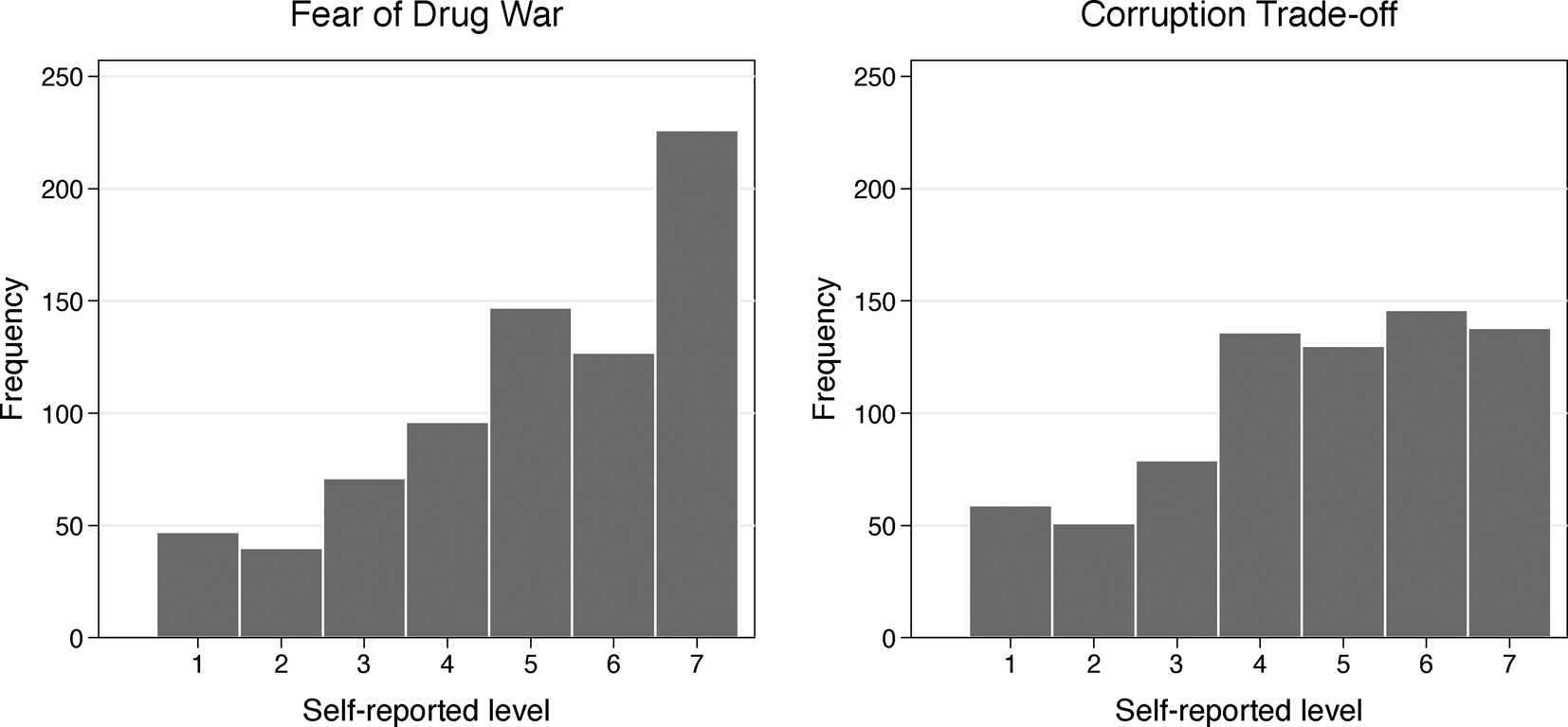
The data from the national survey indicate that a majority of the respondents tend to report relatively high levels of both fear over the Drug War and willingness to exchange corruption for lower levels of violence. As shown in Figure 3, the average level of self-reported fear was 5.04 (standard deviation = 1.83), and the median respondent reported a score equal to 5. As for the corruption trade-off question, the mean was 4.65 (standard deviation = 1.82) and the median 5. The Pearson correlation coefficient between these two sets of ratings was 0.34.
Histograms of key questions in the national survey.
Notes: Self-reported levels of fear over the Drug War and willingness to tolerate corruption in exchange for lower levels of violence.

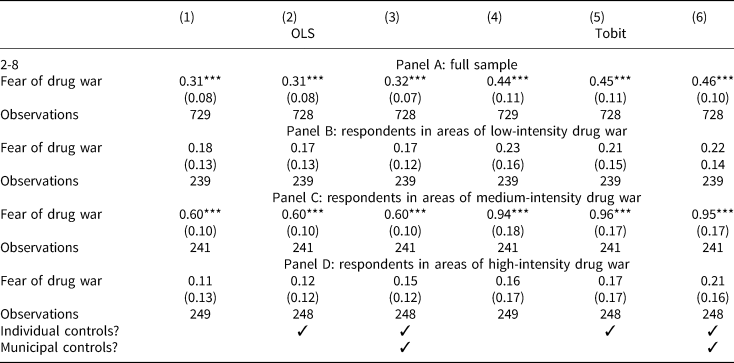
However, a more nuanced picture of the relationship between fear over the Drug War and attitudes toward corruption is observed if we break the data down by the level of drug-related violence in a respondent's municipality. Using publicly available data from the Mexican National Security Council on homicides specifically tied to the Drug War, we split the municipalities included in our sample into the following three categories: low-, medium-, and high-intensity Drug War areas, based on the terciles from the distribution of drug-related homicides per 100,000 people in 2010.Footnote 8 Table 1 shows in regression form that an individual's self-reported level of fear over the Drug War is positively and significantly correlated with her willingness to trade-off corruption for violence if she lives in a municipality that experiences medium-intensity Drug War violence, but not in other areas. This pattern holds across estimation methods (either OLS or Tobit regressions) and is robust to the inclusion of individual and municipal controls.Footnote 9
Fear over the drug war and corruption trade-off

Notes: Robust standard errors clustered by electoral precinct are shown in parentheses. *** Significant at the 1 percent level; ** significant at the 5 percent level; and * significant at the 10 percent level.
Why do we observe differential effects of fear over the Drug War on attitudes toward corruption based on levels of drug-related violence? One plausible explanation is that individuals residing in areas of low-intensity Drug War remain detached from what they perceive as a “bounded violence” phenomenon (Schedler, Reference Schedler2016), which is unlikely to directly affect them; whereas events of drug-related violence and intimidation have been normalized in high-intensity Drug War areas, to the point that individuals living in such regions see the phenomenon of organized crime with indifference.
These findings are important for two reasons. First, we show that the positive relationship between fear and support for corruption (in exchange for lower levels of violence) is moderated by the intensity of violence. This suggests that experimentally priming fear over the Drug War is likely contingent on exposure to violence or crime victimization. Second, the fact that this relationship is observed in medium-intensity violence areas suggests that regions like Mexico City (with low and medium intensities of violence) are an ideal place to experimentally test potential mechanisms. We should also take these results with caution and only as a point of departure in our analysis. Since emotions over the Drug War are not randomly induced, we cannot rule out the possibility that the observed association between fear over the Drug War and willingness to tolerate corruption is explained by a third factor linked to both variables.
5. Survey experiment in Greater Mexico City
In order to test the causal effect of fear on willingness to tolerate corruption in exchange for lower levels of violence, we conducted a survey experiment on a representative population of adults in Greater Mexico City. The survey was administered one week before the presidential election. We chose Greater Mexico City to conduct our survey experiment for three reasons: (1) Greater Mexico City contains around 21 million people, approximately one-sixth of the population of Mexico, and it constitutes a politically and socio-economically diverse region; (2) as discussed in the next subsection, Greater Mexico City has experienced varying levels of violence with respect to the Drug War; and (3) this location allowed us to ensure that both the enumerators and respondents would not be put at risk.
5.1 Sampling
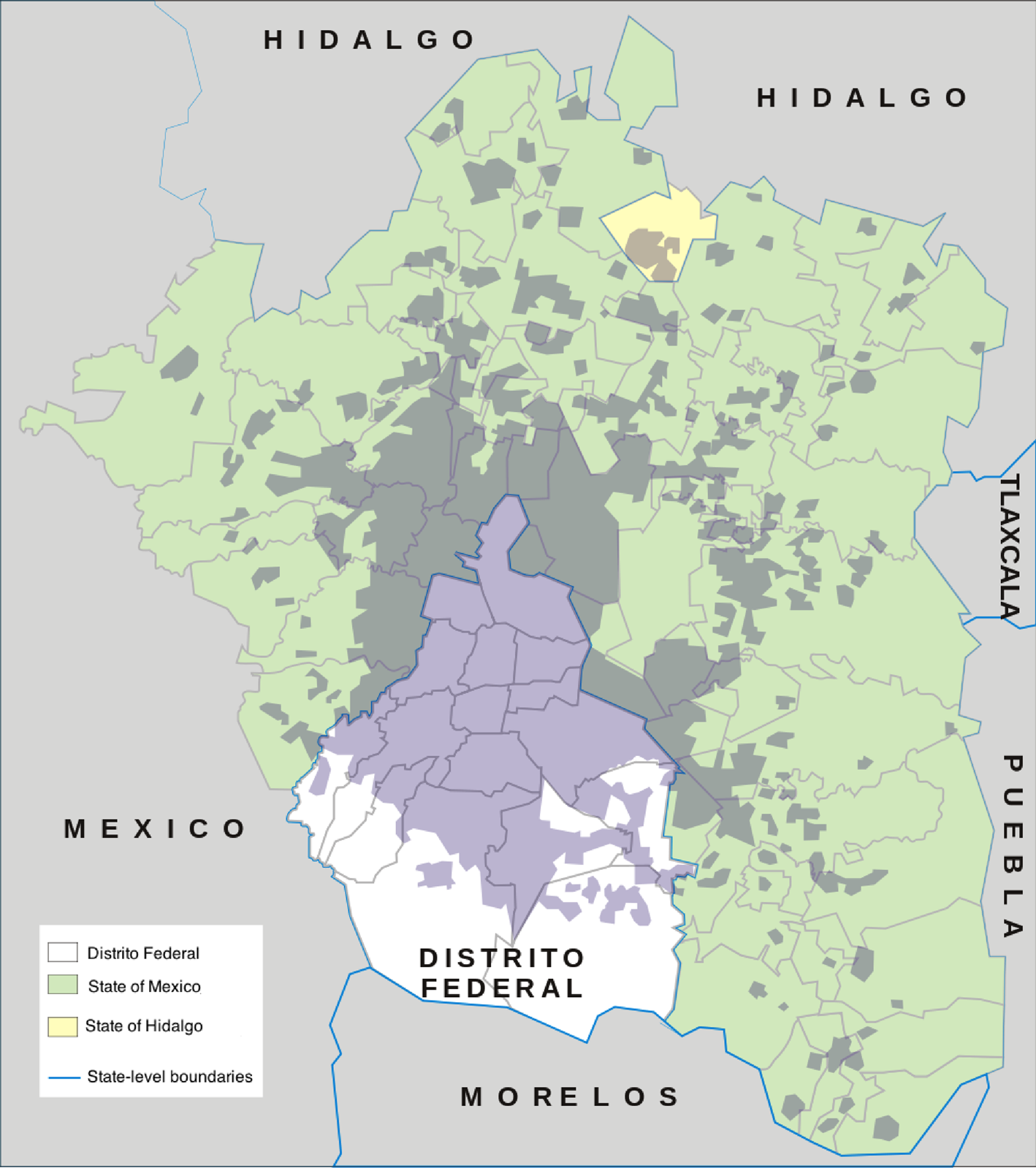
Greater Mexico City refers to the conurbation around Mexico City, constituted by Distrito Federal (which is composed of 16 municipalities) and 41 adjacent municipalities of the states of Mexico and Hidalgo (see Figure 4). The methodology employed to achieve a representative sample of Greater Mexico City is similar to that used in the national survey. We used electoral precincts as our primary sampling units, and employed a stratified multistage cluster sampling design to randomly select blocks, households, and citizens. In terms of design, the most important difference with respect to the national survey is that we stratify Greater Mexico City's electoral precincts by their level of Drug War violence and their political preferences.
Greater Mexico City.
Notes: This map shows the area comprising Greater Mexico City. Municipalities that belong to the Federal District are shown in white. Those that belong to the states of Mexico andHidalgo are shown in green and yellow, respectively. Densely populated areas are shaded in gray (Wikicommons, Public Domain).

In order to reach people exposed to different levels of Drug War violence, and to achieve a representative sample of political preferences throughout Greater Mexico City, the sampling design involved two main steps:
(1) Stratification by Drug War Intensity. We constructed a municipal measure of Drug War intensity (low, medium, and high) using the number of drug-related homicides that took place in 2010 (the nearest year for which these data were available). Specifically, we used the rate of drug-related homicides per 100,000 people and divided the full set of electoral precincts of Greater Mexico City into terciles.
(2) Stratification by Political Preferences. Since fear over the Drug War may be correlated with both attitudes toward corruption and political preferences, we also defined strata according to the winner party of the 2006 presidential election. The possible categories for winner party are PAN, PRI, PRD, and other (minor parties).
This sample design generated 12 strata in total. Within each stratum, electoral precincts were selected based on probability proportional to its size (i.e., the number of registered voters). In total, 100 electoral precincts were drawn, and eight citizens were interviewed per precinct, totaling 800 face-to-face interviews. Block selection within electoral precincts, household selection within blocks, and respondent selection within households were all based on random methods, which are described in detail in the online Appendix.
5.2 Experimental design
Once an eligible respondent assented, they were then interviewed by the enumerators. Respondents first answered orally a brief series of demographic questions including their age, household size, education level, and whether they have children or not. They were then randomly assigned to one of four experimental treatments that varied with respect to their emphasis on the upcoming elections and emotions. These manipulations were read to the subjects and also given to them. The electoral manipulation randomly assigned subjects to a treatment that primed the importance of the upcoming presidential election or one that did not.Footnote 10 We found no difference in respondents’ attitudes toward corruption and violence between the two election statements, so we omit them from the rest of the analysis.
The second manipulation respondents received was either an emotional manipulation that aimed at manipulating fear over the Drug War, or a more neutral emotion. In the “Neutral Emotion” (our control group), subjects were shown pictures of Mexico's various natural wonders (see Figure 5) and asked to write about what they think Mexico could do to better preserve them for citizens and tourists. The exact wording of the text accompanying the picture was as follows:
Mexico is a country that contains much natural and ancient beauty. From ancient ruins, canyons in the north, jungles in the south, and beaches on both the Gulf and Pacific, citizens and tourists enjoy their beauty. We are particularly interested what you think Mexico could do to further improve and maintain its natural beauty. More places reserved for national parks? Better education about the environment and Mexico's history? Please write below.
Neutral emotion (control).
Notes: This picture was accompanied by the following caption: Top: Chichen Itza in Yucatan (left) and Sumidero Canyon in Chiapas (right). Bottom: Barranca del Cobre in Chihuahua (left) and Cabo San Lucas in Baja California Sur (right).

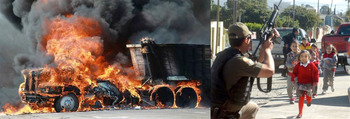
For the emotional manipulation aiming at inducing “Fear over the Drug War” (our treatment group), respondents were shown pictures of a truck on fire used as a narco-blockade and schoolchildren fleeing from a shoot out between police and DTOs (see Figure 6). They were then asked to write about what scared them the most about the narco-related violence.Footnote 11 The exact wording was as follows:
The Mexican Drug War has caused people to feel a lot of emotions. We are interested in what makes you most AFRAID about drug-related violence. Please describe in detail the one thing that makes you most AFRAID about these riots. Write as detailed a description of that one thing (that makes you most afraid) as possible. If you can, write your description so that someone reading it might become AFRAID from learning about the situation.
Fear emotion (treatment).
Notes: This picture was accompanied by the following caption: Left: A truck is lit on fire by narco-gangs to blockade a road in Mexico. Right: Schoolchildren flee as government forces confront narco-gangs.

This emotional manipulation closely mimics those used by Ekman (Reference Ekman1992); Lerner et al. (Reference Lerner, Gonzalez, Small and Fischhoff2003); Zeitzoff (Reference Zeitzoff2014); Callen et al. (Reference Callen, Isaqzadeh, Long and Sprenger2014) to manipulate targeted emotions. After the emotional manipulations, respondents were then given the key questions of interest to answer. These questions are the exact same two items that were included in the national survey: the corruption-violence trade-off, and the self-reported level of fear over the Drug War (which served as a manipulation check for the emotional manipulation). The only difference is that we use a ten-point scale. Additionally, we asked respondents whether they agree with the following statement: It doesn't bother me if the levels of corruption are high, just as long as the violence goes down. Given the levels of violence in Mexico and to ensure accuracy in response, enumerators read the questions orally to respondents and subjects filled out their own answer sheet privately on a clipboard. After the questionnaire, these response sheets were folded by respondents and placed in a sealed envelope to further protect the anonymity of the respondents.Footnote 12
Additional questions measuring respondents’ exposure to different types of crime, perceived psychological stress, and perceptions of violence and corruption in their neighborhood were included. These survey items were used to calculate indices of crime victimization, psychological stress, perceived neighborhood violence, and perceived neighborhood corruption, using principal component analysis. We also asked them about their voting preferences using a procedure that simulated a secret ballot that had the candidates’ names and party logos.
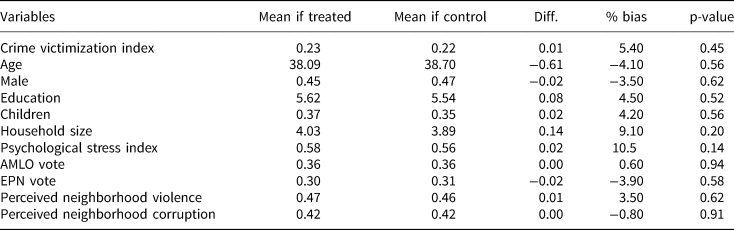
Table 2 reports covariate balance statistics comparing treated and control units. The two-tailed t-tests for equality of means show that the randomization was successful in producing treatment and control units with similar pre-treatment attributes.
Randomization check: covariate balance statistics

Notes: Two-tailed t-tests for equality of means of the treated and untreated groups based on unweighted regressions. The percent bias measures the difference of the sample means as a percentage of the square root of the average of the sample variances in the two groups (Rosenbaum and Rubin, Reference Rosenbaum and Rubin1985). The respondent's Age is measured in years; Male is equal to 1 if the respondent is male, and 0 otherwise; Education measures schooling attainment on a eight-point scale; Children is equal to 1 if the respondent has at least one child 17 years old or younger, and 0 otherwise; Household size measures the number of people living in the house; AMLO vote is equal to 1 if the respondent's preferred candidate is Andrés Manuel López Obrador, and 0 otherwise; EPN vote is equal to 1 if the respondent's preferred candidate is Enrique Peña Nieto, and 0 otherwise. The indices of crime victimization, psychological stress, perceived neighborhood violence, and perceived neighborhood corruption range from 0 to 1.
5.3 Findings
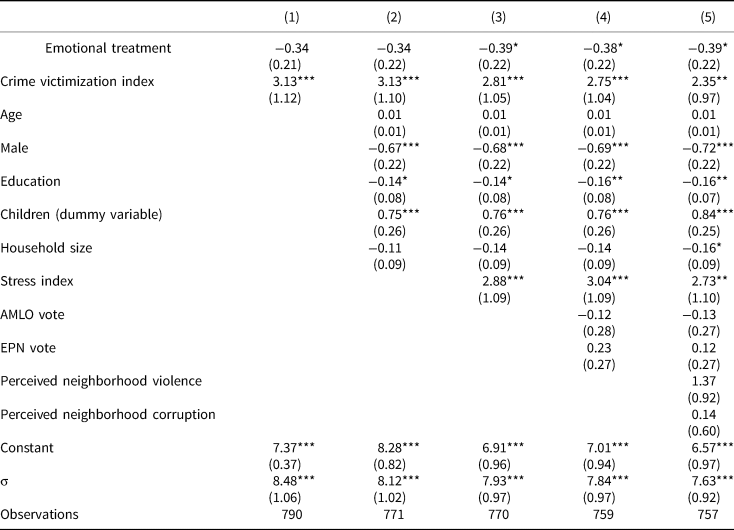
Table 3 shows the results from a series of models to estimate the determinants of self-reported level of fear over the Drug War. Since our response variable is censored by design, we fit the models using weighted Tobit regressions (applying the survey weights) with both left- and right-censoring (Cameron and Trivedi, Reference Cameron and Trivedi2005). In the online Appendix, we show that our results remain nearly identical if we use weighted least squares regressions (see Table A4). Interestingly, we find that our emotional treatment—which required subjects to acknowledge their fear over the Drug War —is weakly and negatively correlated with self-reported fear.Footnote 13 The magnitude of the treatment effect is fairly small (a five percent decrease in self-reported fear on average) and only statistically significant (at the 10 percent level) in three out of five specifications.
Determinants of fear over the drug war

All estimates are based on weighted Tobit regressions with both left- and right-censoring.
Linearized standard errors in parentheses account for clustering at the electoral precinct level.
*** Significant at the 1 percent level; ** significant at the 5 percent level; and * significant at the 10 percent level.
There are at least three plausible interpretations that may account for why a common standard emotional induction technique failed to induce fear in this context. First, it could be the case that subjects experienced a catharsis effect, which aligns with research from psychology that suggests that acknowledging and confronting fear may actually lessen it (Watkins, Reference Watkins2008). In fact, this is the paradigm for many “exposure-based” therapies designed to reduce the symptoms of anxiety and post-traumatic stress disorder (Foa et al., Reference Foa, Dancu, Hembree, Jaycox, Meadows and Street1999; Cusack et al., Reference Cusack, Jonas, Forneris, Wines, Sonis, Middleton, Feltner, Brownley, Olmsted, Greenblatt, Weil and Gaynes2016). We do not find compelling evidence supporting this interpretation since our results are not statistically significant at the conventional levels across specifications. We should therefore consider this interpretation with some caution.
Second, it could also be the case that our average treatment effects are masking some heterogeneity. For instance, based on the results from the national survey, we know that the levels of violence individuals are exposed to in their communities are likely to affect their perceptions of security and policy preferences. While our sample size is too small to allow for the estimation of interaction models, we provide preliminary evidence that our emotional treatment yields null effects when splitting the sample into low, medium, and high violence areas. Nevertheless, such null findings may result from a lack of statistical power. The results are reported in Tables A1–A3 in the online Appendix.
A third alternative is that our vignette intended to induce fear resulted in a weak treatment intervention within this context. The logic behind this explanation is that the average Mexican adult has been exposed to substantial amounts of graphic violence or violent content through the mass media and/or interactions with friends and family. This would create a situation in which the type of drug-related violence depicted in our treatment has been normalized by the average subject in our study and it is therefore unlikely to induce fear or trigger an emotional reaction in the desired direction. We believe this is a plausible interpretation, particularly within the context of Greater Mexico City, where ordinary citizens are constantly exposed to major national media outlets and have come to see victims of organized crime with indifference (Schedler, Reference Schedler2016).
The results also show that respondents who have been personally exposed to higher levels of crime report significantly higher levels of fear over the Drug War. As shown across models (1)–(5), these results are robust to controlling for demographic characteristics, political preferences, psychological stress, and perceptions of violence and corruption in the neighborhood. Substantively, based on our most conservative estimate (see column (5)), the magnitude of this effect implies that, other things equal, respondents at the 90th percentile in the distribution of the crime victimization index report one additional point in their level of fear, relative to respondents that have not experienced crime victimization. This is almost half a standard deviation in the ten-point scale measuring fear over the Drug War and represents a 16 percent increase in fear relative to the average respondent, other things equal. Thus, our results suggest that the personal experience of violence is a key determinant of fear over the Drug War. Additionally, we find that male respondents report significantly lower levels of fear, and respondents with children are more likely to report higher levels of fear. The psychological stress index is also positively correlated with the level of fear.
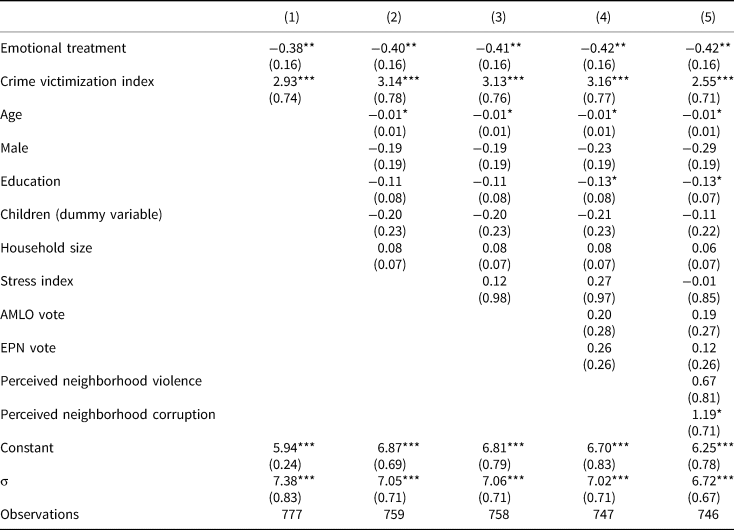
Table 4 shows regression estimates for the effects on the corruption–violence trade-off. Again, since we may be concerned about ceiling effects for our response variable (i.e., lots of people chose lots of corruption and little violence=7), we use Tobit regressions. Table A5 in the online Appendix shows that these results are also robust to weighted least squares regressions. We find that respondents who received the emotional treatment are less likely to accept higher levels of corruption in exchange for lower levels of violence. Under the assumption that our emotional treatment reduces fear, this would be in line with the idea that reducing fear makes respondents less willing to accept higher levels of corruption in exchange for lower levels of violence. However, as previously discussed, we should consider this interpretation with caution. Table A7 in the online Appendix shows regression estimates from similar specifications using levels of self-reported fear instead of the fear treatment as an independent variable. The results show that self-reported fear is positively correlated with willingness to accept higher corruption in exchange for lower levels of violence. This is consistent with the findings from the national survey.
Determinants of corruption trade-off

All estimates are based on weighted Tobit regressions with both left- and right-censoring.
Linearized standard errors in parentheses account for clustering at the electoral precinct level.
***Significant at the 1 percent level; **significant at the 5 percent level; and * significant at the 10 percent level.
We find strong evidence that individuals who reported higher levels of crime victimization are more tolerant of corruption. These findings are robust across different specifications and estimation methods. Substantively, the results are similar to those reported in Table 3. Respondents at the 90th percentile in the distribution of the crime victimization index report 1.2 additional points (in a ten-point scale) in their preference toward tolerating corruption, other things equal. These estimates are statistically significant at the 1 percent level in all cases. Note that other characteristics of the respondents seem irrelevant as predictors of their willingness to tolerate corruption.
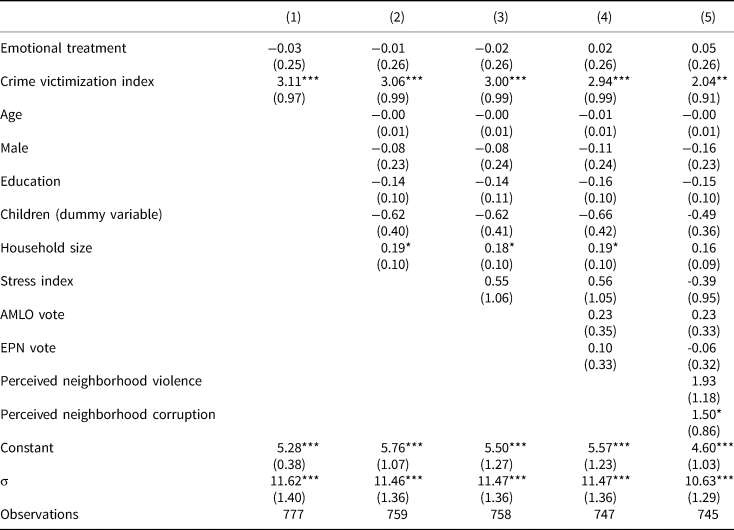
The results in Table 5 provide additional evidence that individuals exposed to crime are more tolerant of corruption. In these models, the outcome variable is based on the following question: On a scale from 0 to 10, where 0 is “I strongly disagree” and 10 “I strongly agree” Do you agree or disagree with the following statement? I don't care if the levels of corruption are high, as long as the violence associated with drug trafficking goes down. The results show that crime victimization is positively and significantly correlated with tolerating corruption as long as the violence goes down. Thus, it appears that having been victimized is an important factor driving attitudes toward the willingness to tolerate corruption.
Determinants of preference toward corruption as long as the violence goes down

All estimates are based on weighted Tobit regressions with both left- and right-censoring.
Linearized standard errors in parentheses account for clustering at the electoral precinct level.
Significant at the 1 percent level; ** significant at the 5 percent level; and * significant at the 10 percent level.
Taken together, our results show that individuals who received a common fear-inducing manipulation do not report higher levels of fear over the Drug War. Interestingly, those exposed to the treatment are less willing to tolerate corruption. In other words, voters are not easily scared and, on average, are not too afraid to fight corruption. But those who have been personally victimized are actually more likely to report higher levels of fear over the Drug War and are willing to accept higher levels corruption in exchange for lower levels of violence.
6. Discussion
Our findings show that fear and insecurity over violence are important drivers of corruption attitudes. Based on a nationally representative sample of Mexicans, we find that fear over the Drug War is positively correlated with willingness to tolerate corruption. Yet, this relationship is moderated by the level of local Drug War violence. Using a survey experiment in Greater Mexico City, we find a similar relationship between fear and acceptance of corruption. Furthermore, we find robust evidence that individuals who have been victims of crime are more fearful and exhibit greater support for corruption if it leads to lower levels of violence.
Our findings also point to a more nuanced portrait of how emotions influence political participation. Priming individuals about fear of violence does not necessarily inhibit politically risky decisions—in fact, it can galvanize them. They also provide a new direction for the growing literature on fear and threat on political behavior (Thórisdóttir and Jost, Reference Thórisdóttir and Jost2011). Much of the previous literature suggests that fear of future threats will lead people to demand forceful government responses to protect them—e.g., post 9/11 counter-terror measures (Huddy and Feldman, Reference Huddy and Feldman2011). Yet we show that context matters. In the context of instability and violence, people may in fact be willing to live with higher levels of corruption if it lowers violence. We also find that showing individuals violent images and asking them to acknowledge their fear does not lead people to demand actions that may make them safer in the short-term (accepting corruption), but rather that they may, in the short-term, be willing to accept less safety to try to rectify the violence. In this regard, we urge scholars of political violence and political development to better incorporate and measure emotions and psychological factors in their studies. They remain an understudied mechanism of political development.
Finally, we conclude on a note of cautious optimism. Much of the work in political science has suggested that elites—particularly in developing countries—can manipulate and scare voters into bad policies (Horowitz, Reference Horowitz2001; Lupia and Menning, Reference Lupia and Menning2009). Or that voters are myopic in evaluating candidates (Healy and Malhotra, Reference Healy and Malhotra2009), letting extraneous factors unrelated to the politicians influence their choices. Given the fact that many developing countries face threats from non-state actors (organized crime and rebel groups), our finding that showing citizens scary images (and asking them to acknowledge their fear) does not scare them away from fighting corruption in the face of significant negative externalities (i.e., narco violence in Mexico) is heartening.Footnote 14 Our findings indicate that voters are more strategic and resilient in the face of violence than many extant theories of political behavior suggest. Future research that looks at ways to harness emotions to enact positive political change and institutional strength may prove fruitful from both an academic and policy perspective.
Supplementary material
The supplementary material for this article can be found at https://doi.org/10.1017/psrm.2020.49.