Recently philosophers of biology have argued over whether or not Newtonian mechanics provides a useful analogy for thinking about evolutionary theory. For philosophers, the canonical presentation of this analogy is Sober's (Reference Salmon1984). Matthen and Ariew (Reference Matthen and Ariew2002) and Walsh, Lewins, and Ariew (Reference Stephens2002) argue that this analogy is deeply wrong-headed. Stephens (Reference Sober2004) defends the analogy. Here I argue that the analogy is indeed useful, however, not in the way it is usually interpreted. Thus this paper is more of a change of subject than a continuation of the aforementioned dialogue.
There are two main issues at stake here. The one that has received the most attention is the question of whether it is best to conceive of evolutionary theory as a theory of forces. I will argue for this conception, however, in a nonstandard way: I will defend a conventionalist stance toward forces within a realist perspective toward causal processes. The second issue is more important in this paper. It has to do with what constitutes the proper zero-force condition. A theory of forces does one no good if one has no idea how something would behave in the absence of forces. For example, Newton's gravitational law,  , would be meaningless if we did not know what Newton's First Law tells us: in the absence of net forces, an object's velocity remains unchanged. Thus gravitational force acting on an object changes its velocity relative to its default, or zero-force, state. In the dispute at issue in the philosophy of biology, all parties have accepted that the Hardy-Weinberg law describes the relevant zero-force condition. All parties, but one. In Brandon (Reference Brandon2006) I argued for a version of the Newtonian analogy with what I call the Principle of Drift as the zero-force law. Dan McShea and I (McShea and Brandon Reference McShea2010) generalize the Principle of Drift into what we name the Zero-Force Evolutionary Law (ZFEL). It is with respect to this law that I will defend a Newtonian analogy. As we will see, it is a Newtonian analogy that in one fundamental respect is non-Newtonian. This new perspective offers a gestalt shift in our thinking about evolution. Instead of seeing selection as all pervasive, the ZFEL view puts a more fundamental process in the background for all evolutionary systems. This is a diffusion process resulting in the increase of diversity and complexity under a wide range of conditions. In particular, diversity and complexity will increase whether or not selection favors it. Selection then becomes a special evolutionary force—invoked when and only when it is causally relevant.
1. The ZFEL
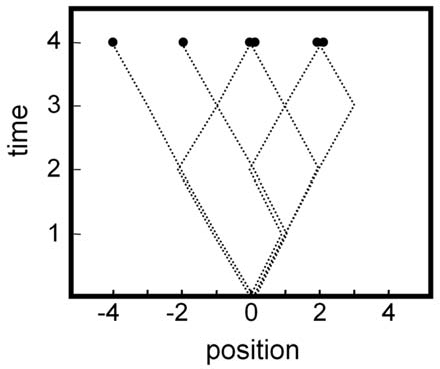
In this section I will explicitly state the ZFEL, provide a brief argument that it is true, and finally defend its role as evolution's zero-force law. The basic idea behind the ZFEL is simple. In a system with heritable variation, variation will accumulate. The following model illustrates this idea: Consider a particle moving in a two-dimensional space. Let the y-axis represent time measured in discrete steps and the x-axis represent space (see the axes in fig. 1). The particle starts at the origin and at t 1 moves one step either to the right or to the left. The probability that it moves to the right at that time is .5, as is its probability of moving left. For each n, the particle's movement at t n is governed by the same rule. Where on the x-axis will the particle be at, say, t 4? The expected outcome is that it will be at 0, but that is but one of five possible outcomes—the others being  ,
 ,
 , and
 . Given the probabilities associated with each possible transition at each time, it is easy to calculate the probabilities associated with each of the five possibilities. The expected outcome,
 , has a probability of .375. Here are the probabilities of the other possible outcomes:
 ,
 ,
 , and
 . Thus the likelihood that the particle will be in the positive region of x-space is identical to the likelihood that it will be in the negative region. There is no directional tendency. And that is true no matter how far we extend this process in time.
The increase in variance over time in an ensemble of six particles (see text).

Now consider an ensemble of such particles, as in figure 1. Ensembles, like particles, have properties, and one property of an ensemble is the mean. Notice that the mean is a property of the ensemble but not of individual particles. No individual particle has a mean at a given time. And in that sense, the mean is a property at a higher level. Also like the particles, the mean has an expected value at a given time, an expected location or value in the one-dimensional space of the model, the horizontal axis. In the model, the expected value starts and remains at zero. That is, the expectation is no directional change in the mean.
However, the dispersion of the particles around the mean does predictably increase. The dispersion, or variance, is, like the mean, a higher-level property.Footnote 1 In the technical language of statistics, it is the second moment of the distribution. As we saw above, the first moment, that is, the mean, does not change in a predictable way in this model. In contrast, the second moment does. The ZFEL governs the second moment of distributions: as we will see, it predicts ever increasing diversity and complexity in evolutionary systems.
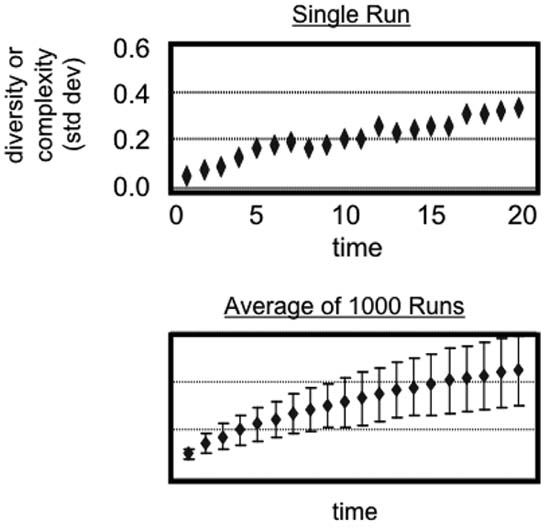
What happens if we run the model for many “generations”? Here the result is, perhaps, surprising. The variance continues to increase. The top graph of figure 2 shows the standard deviation at each time step. It trends upward, with an occasional wobble downward. The downward wobble is not unexpected since the ZFEL prediction of increase in variance is probabilistic. But even with a small number of particles and only one dimension along which they can vary, the upward trend is quite reliable. More realistic models would only strengthen this trend. For instance, if our particles were to represent species’ positions in multidimensional morphospace, then even if by chance two species were to become more similar with respect to, say, wing length, it is highly unlikely that they would also become more similar along several independent morphological dimensions (e.g., eye color and heart shape).
Top: Trajectory of diversity or complexity in an ensemble of points in a single run of the model. Bottom: The average trajectory over 1,000 runs. Error bars show 1 standard deviation of our variance measure, which is also a standard deviation. (See text.)

The bottom graph in figure 2 shows the average trajectory of the standard deviation over 100 runs of a one-dimensional model (with error bars showing 1 standard deviation on either side of that trajectory, in effect 1 standard deviation of the standard deviation). And it reveals something that some may find surprising. The initial rise in diversity or complexity is not surprising. At the start, when all points are collected at the same place, dispersion can only increase. What may be surprising is that dispersion continues to rise even later, when the points have become quite dispersed. Even when the starting condition is high diversity or high complexity, the expectation is further increase. Analytically it can be shown that this is a square root curve and that it does not asymptote. Variance rises indefinitely (McShea and Brandon Reference McShea2010, chap. 2).
What is the biological meaning of this? McShea and Brandon (Reference McShea2010) argue that diversity and complexity are to be identified with variance (in the generic sense). The first point here is completely in accord with standard usage in biology. A diverse species is one that has many different “types” of organisms. (Here we imagine our x-axis to be divided into a number of discrete types, e.g., the types in a species of social insects.) Or, a diverse species is one that has greater variation along some (number of) continuous axis(es). In the first case variation is divided into a number of discrete bins; in the second it is represented as spread along a continuum. The later way of thinking is more general, and therefore preferable, but I will not emphasize that point here.
Our approach to complexity fits less comfortably with standard usage. In standard usage, complexity denotes an uncertain mix of number of part types, high functionality, difficulty in assemblage, and much more (see McShea Reference Yang and Bielawski1996; McShea and Brandon Reference McShea2010, esp. chaps. 4, 7). Our notion is, in contrast, sparse. By complexity we simply mean number of part types within an entity or, more generally, degree of differentiation among the parts. Although it fails to capture much of what people are interested in when they talk about complexity, it has two virtues: (1) it is operationalizable and (2) it does not conflate structure and function, thus leaving open questions that should be open to empirical inquiry. For example, are complex structures typically favored by selection? If one sneaks some notion of function into one's conception of complexity, that question becomes impossible to address empirically.
Another way of thinking about our approach to complexity is to recognize that in our view complexity and diversity are one and the same, just viewed from adjacent hierarchical levels. Diversity at level n just is complexity at level  . The diversity of a group of cells that composes an organism just is the complexity of that organism (measured at the cellular level). Similarly, the diversity of organisms within a group just is the complexity of the group. This may sound odd in that we normally reserve the notion of complexity in biology for the organismic level. But, for example, students of social insects would find it perfectly natural to talk about the complexity of a social group.
Diversity and complexity are hierarchical concepts. A diverse species is one that has many morphotypes, or large variation in morphology.Footnote 2 But a diverse clade has to be conceptualized and measured differently. It is not a clade composed of diverse species. Rather, it is a clade whose species have a high level of separation in morphospace. That is, clade diversity is measured in terms of how diverse its component species are, while species diversity is measured in terms of how diverse its component organisms are. Thus it is perfectly possible for a highly diverse clade to be composed of species that are not particularly diverse.
Similarly for complexity. The complexity of a cell might well be measured in terms of the number of part types within the cell (or in the continuous case, degree of differentiation of the parts within the cell). In contrast, the complexity of an organism might be measured in terms of the number of cell types it contains. So a complex organism may, or may not, be composed of complex cells. Indeed, McShea (Reference McShea2002) has predicted that complex organisms will tend to have cells with reduced complexity compared with their ancestral state.
Thus we see that complexity and diversity are level-relative in the sense that for each level of organization they have their own definition and, further, that these definitions are incommensurable. It follows from this that they must be studied hierarchically and that a reductionist approach is a nonstarter.
We now are in a position to state the ZFEL. There are two versions:
ZFEL (special formulation). In any evolutionary system in which there is variation and heredity, in the absence of natural selection, other forces, and constraints acting on diversity or complexity, diversity and complexity will increase on average (McShea and Brandon Reference McShea2010).
This formulation is the one from which the law gets its name: it describes what happens in the zero-force condition. In evolution, the force we normally have in mind is natural selection. But we want to be open to other forces, known or unknown. For instance, biased inheritance would count as a force for us. (In our simple model above, imagine a different transition rule: move one space to the right with Pr = .9 and move one space to the left with Pr = .1. The ZFEL diffusion would still operate, but there would also be a rightward movement of the entire distribution.)
It also specifies the absence of constraints on diversity and complexity. This is a rather tricky notion. It is a conceptual impossibility to think about a system with no constraints. That is like thinking of an object with no properties. In the next section I will argue for taking systems with heritable variation as our base notion of evolutionary systems. For now, let me simply stipulate that as the meaning of ‘evolutionary systems’. It follows that all evolutionary systems have constraints. Heritability is a constraint. In the model above, heritability is represented by a particle's transition in space from one time step to the next. By the rules of the model only two such transitions are possible, a step to the right or a step to the left. This is just to say that the particle's movement through space is a Markov process. But that means that a particle's position is constrained. This is not what we have in mind when we talk of the absence of constraints.
To explain what we do have in mind, two distinctions are necessary. First, we need to distinguish real and effective constraints. Consider a genome of a certain length, L, where L is the number of nucleotides. The total number of possible genomes is 4L because there are four possible nucleotides at each position. For most genomes, the 4L limit is a real constraint in that it represents a real upper bound on diversity that cannot be crossed, given the initial conditions of four nucleotides and fixed L. But it is usually not an effective constraint. In the human genome, for example, the 4L ceiling is much higher than the population size of our species, now and in any imaginable future, so that even though every individual has a unique genotype, diversity is effectively unconstrained. The limit has not been and will never be actually encountered. In the special formulation of the ZFEL, the phrase “absence of constraint” obviously refers only to effective constraints. Constraints that are real but not effective do not limit diversity or complexity and do not need to be absent in order for the ZFEL to operate.
Second, we need to distinguish between constraints that we take to be constitutive of the system in question versus those that are imposed on the system. As mentioned above, heritability is a constraint. In our simple model above we take the rule governing the movement of particles through space as constitutive of that system. In contrast, suppose that the space were not infinite in both directions. Suppose instead that it terminates at +1,000 and at −1,000. As in our first distinction, those boundaries would not be effective for the first 1,000 generations but could become so afterward. Once effective, such boundaries would be a constraint on variation. Although this distinction is not hard and fast, it is, I think, clear enough for present purposes. The special formulation of the ZFEL applies to those cases in which there are no effective imposed constraints.
How common are such cases? Before trying to address that, let me state a second version of the ZFEL, one that is not restricted to the zero-force, zero-effective imposed constraint condition:
ZFEL (general formulation). In any evolutionary system in which there is variation and heredity, there is a tendency for diversity and complexity to increase, one that is always present but may be opposed or augmented by natural selection, other forces, or constraints acting on diversity or complexity (McShea and Brandon Reference McShea2010).
The general formulation of the ZFEL says that even when there are evolutionary forces at work and even when constraints affect diversity and complexity, the ZFEL tendency is still there, still in the background, still having an effect. The Newtonian analogy is helpful here. Newton's First Law does not suddenly become irrelevant once a Newtonian force begins to act on a body. Rather, it tells us what the default state of the object is. This is what the object would do were the force not present. And this counterfactual is not superfluous. It is the necessary background against which the particular force has its effect. Likewise, the ZFEL gives the default condition against which evolutionary forces have their effects.
The disanalogy here is important too. In Newtonian mechanics the gloss on the First Law is this: If no force, then no change (in velocity). But according to the ZFEL, the following is true of evolution: If no force, then change. The consequences of this difference are far reaching but beyond the scope of this paper (see McShea and Brandon Reference McShea2010, chap. 7). For present purposes the main point is that change cannot be seen as a signal of selection. More particularly, an increase in diversity and/or complexity cannot be taken to imply the action of natural selection. There is always and everywhere in evolution a tendency for diversity and complexity to increase. Selection may or may not favor such increases. When it does, it augments the ZFEL tendency. When it does not, it must swim upstream against the tendency. In sum, the ZFEL tendency is to be understood as a background state that is present prior to and during the imposition of any constraints or forces. In this view, the effect of any imposed constraint or force is always the resultant of two factors, one of which is the ZFEL.
One might be convinced by the above that the ZFEL tendency is always present but think that it is of only minor importance because it is always overwhelmed by selection and constraints. Space here allows only the briefest responses to this worry. First, one would not say the analogous thing about Newton's First Law just because all the objects one encountered happened to be accelerating. Newton's First Law takes no stance on the “relative frequency” issue of how many objects are accelerating versus how many are in an inertial state.
Second, there are huge bodies of data that confirm the effect of the ZFEL in evolution. McShea and Brandon (Reference McShea2010, esp. chap. 5) review this in detail. Here I will mention just two cases in which it is clear that the ZFEL applies. For symmetry's sake I will offer one case pertaining to complexity and the other to diversity. The first has to do with the evolution of pseudogenes. When “genes,” or lengths of the genome, are duplicated and inserted elsewhere in the genome, typically there is little to no selection on the duplicate. What happens next is well known: the new pseudogene differentiates from the original. There has recently been much interest in this phenomenon from the point of view of selection and adaptation. If the new “gene” is randomly changing, it may, by chance, mutate to a form that can perform a new function; this is called neofunctionalization (see Lynch Reference Lynch2007). Then selection may well take over its evolutionary trajectory. But the first part of this process is pure ZFEL-driven. The result is an increase in complexity in the genome.
We could stay at the molecular level and make a point about increasing diversity within populations and between them in noncoding regions of the genome. This is what grounds the molecular clock and is what provides some of the most powerful tools in distinguishing selection from drift (see Kreitman Reference Kreitman2000; Yang and Bielawski Reference Walsh, Lewens and Ariew2000; Hamblin, Thompson, and DiRienzo Reference Hamblin, Thompson and DiRienzo2002; Bamshad and Wooding Reference Bamshad and Wooding2003). However, the ZFEL is supposed to act at any level at which there is reproduction of heritable variation, so I will give a diversity example from macroevolution.
What explains macroevolutionary diversity? First, we need to clarify the question. In macroevolution the term ‘diversity’ has a technical meaning. The diversity of a genus is simply the number of species within it. Likewise, the diversity of a family is the number of genera within it. Diversity in this technical sense is probably correlated with the more common notion of diversity, that is, degree of differentiation of the individuals composing the group. But as Gould (Reference Gould1991) pointed out, this correlation is surely imperfect, so the term ‘disparity’ has been introduced into macroevolutionary studies. Disparity of a clade is its spread through morphospace.
The increase in diversity in the generic sense, or more precisely disparity, in evolutionary history is widely recognized. There are many current hypotheses to explain this. All, it turns out, implicitly invoke the ZFEL (see McShea and Brandon Reference McShea2010, chaps. 3, 5). The reason is that, as we shall see, there is no plausible scenario in which selection alone could explain it. Consider just one possibility—the selection for differentness. There are many reasons why selection might move two populations away from each other in morphospace. Let us take two of those reasons: (1) When two populations are well adapted to their microhabitat, then the results of interbreeding between them will have lower fitness. Thus if selection could move them apart in ways that make interbreeding less likely, it will, for example, changing flowering times so that the two no longer exchange pollen. (2) Suppose that two populations are morphologically similar and therefore compete for the same resources. Then a change that allowed one to exploit a new resource would be favored by selection (think Darwin's finches). But in both of these cases this selection would push differentness only so far. Bats and whales have a common mammalian ancestor. Imagine that this ancestral population divided into two, one that would ultimately lead to bats and the other to whales. Selection for mating avoidance, or for decreased competition, might well have acted to further separate these two populations. But it has been a long time since bat ancestors mated with whale ancestors or competed with them for a common resource. Selection of the two sorts we have been considering will have stopped a long time ago. But the differentiation of those two clades did not stop. Note that this argument does not presuppose a nonhierarchical view of selection. Individual-level selection may act against individuals that mate across microhabitat boundaries and so produce less fit offspring (reason 1 above). Lineage-level selection may act in favor of increasing specialization (in, say, diet) within competing recently diverged lineages (reason 2). The point here is not that it is conceptually or theoretically impossible for there to be selection for increasing differentiation between the clade of bats and that of whales. Rather the point is that none of the plausible selection hypotheses for increased differentiation apply to such long ago separated, ecologically distant clades.
According to our best current theories, the ZFEL drove the differentiation between bat and whale lineages. To see this, we need to return to our simple particle model. Recall that the particles moved independently according to a probabilistic rule. From where do those probabilities come? It turns out that it does not matter. Suppose that we construct a quantum-mechanical device that triggers a Geiger counter during a 1-second time period with a probability of .5. If the counter registers, then we move the particle to the right; if not, to the left. Thus the movement of the particles is governed by a genuinely indeterministic phenomenon. In contrast, suppose that we use a computer random number generator, one that operates by a purely deterministic algorithm, to govern the particles’ movement. If the number generator puts out an even number, move to the right; if not, move left. The diffusion of the particles will be exactly the same. The setup does not differentiate between the two cases. Thus the difference between pure randomness (the first case) and what we call randomness-with-respect-to-edness (the second case) makes no difference with respect to the operation of the model. At the macroevolutionary level what this corresponds to is that clades are each following their own trajectories through morphospace, trajectories that are governed by some mixture of chance and selection. What matters in our bat-whale example is not that the two clades are moving truly randomly through morphospace but rather that they are moving randomly-with-respect-to each other. And that will be true for virtually every pair of lineages you pick. This is the ZFEL explanation of macroevolutionary disparity, and it is, implicitly, the best current explanation we have.
2. Arguments against the Force Analogy and Their Refutation
There is one reasonable argument against the thinking of evolutionary theory as a theory of forces that need not concern us. That argument is based on the claims that the Hardy-Weinberg (H-W) law is no law at all: first, because it is not general and, second, because it is not true. Beatty (Reference Beatty, Wolters and Lennox1995) argued for the first claim, and I (Brandon Reference Brandon2006; McShea and Brandon Reference McShea2010) have put considerable effort into supporting the second. But all this is relevant only to the traditional formulation of the force analogy (the one that takes the H-W law as the zero-force law) not to the view I am pushing here (taking the ZFEL as describing the zero-force condition).
A second argument will also be skipped over here. Matthen and Ariew (Reference Matthen and Ariew2002, 67) argue that different components of fitness—the different “forces” that make for evolutionary change—are not comparable in the way that Newtonian forces are (vector addition). Brandon and Ramsey (Reference Brandon, Ramsey, Ruse and Hull2007) show that it is a rather trivial problem to combine the various “forces” into some “net force.” Whether addition is the mathematical operation that is always used seems to be of little import. But again, this criticism is, more or less, assuming that the H-W law is the zero-force law, so it can be ignored here.
However, there are two criticisms of the force analogy that are not tied to the H-W law and so are still relevant. The first of these is that selection and drift are not opposing forces. This point is made by Matthen and Ariew (Reference Matthen and Ariew2002) and by Walsh et al. (Reference Stephens2002). This point is both correct and important for our understanding of the relation of selection and drift. Brandon and Carson (Reference Brandon and Carson1996) had already made the point that the process of probabilistic sampling is the causal process going on and that selection and drift are both possible outcomes of this process.Footnote 3 Brandon (Reference Brandon2006) argued that drift should be taken as the default state of evolutionary systems and therefore that it should not be considered a force. The latter point still applies in the ZFEL framework. In that framework drift and, more importantly, the second moment of drift are taken as the default condition of evolutionary systems.
The second criticism I want to address is that selection is not a “real” force. To my knowledge, this argument was first made by John Endler (Reference Endler1986) where he was directly responding to Sober's (Reference Salmon1984) exposition of the force analogy. Endler argued as follows: selection is like erosion. Erosion is not a real force. Wind is a force, falling water is a force, and erosion is the result of these, and perhaps other, forces. Similarly, death by predator is a force, death by disease is a force, but selection is the result of these and many other forces. The defenders of the “statistical interpretation” of evolutionary theory (Matthen and Ariew Reference Matthen and Ariew2002; Walsh et al. Reference Stephens2002; Walsh Reference Walsh2007) endorse this argument. They think that fitness is just a statistical summary of what happened within a population and not a cause of evolutionary change. And so, obviously, not a force.
The view I want to defend here does not directly contradict this second criticism. I shall argue that selection is indeed a force in the ZFEL framework, but that is due in part to certain theoretical choices made, and that it is therefore a matter of convention (sensu Reichenbach Reference Millstein1938), not a matter of “reality.” To be clear, I want to argue for this conventionalism with respect to forces within an overall realist perspective. I think, but will not try to defend here, that causal processes are real. Baseballs and bats are causal processes. When Derek Jeter hits a home run, it occurs because two causal processes, bat and ball, interact at the plate causing the ball to reverse its trajectory and to sail over the fence (see Salmon [Reference Reichenbach1984] for a defense of causal realism with respect to processes). Bats and balls are, of course, artifacts and would not exist were it not for us. But Jeter's home run does not depend on our cognition of it. I also believe in asteroids and the planet Earth. They are causal processes, and sometimes they interact as when a large asteroid hit just off the Yucatan about 65 million years ago. That too is real.
Causal processes are real (at least, so we are supposing here). Doesn't it follow that forces are real as well? I suggest not; that what counts as a force depends on our particular theoretical framework, and that theoretical frameworks always involve an element of human choice. I will illustrate this by showing how certain choices in setting up the ZFEL framework result in selection being classified as a force.
Earlier I said that evolutionary systems are ones with heritable variation. That could be taken as an arbitrary stipulation. It is not; instead it is a well-justified choice in setting up a theoretical framework. But the fact that it is well justified does not mean it was forced; it still is a choice.
Philosophers of biology are familiar with Darwin's Three Conditions: (a) variation, (b) heredity, and (c) differential reproduction (see Lewontin Reference Lewontin1970; Brandon Reference Brandon1990). Although the satisfaction of these three conditions is not sufficient to produce evolution by natural selection, they are necessary for it. These conditions are quite abstract and so not tied to earthly biology. They are a part of universal biology, biology we can export elsewhere. Part of the motivation of McShea and Brandon (Reference McShea2010) is to state the fundamental law of universal biology. In thinking about universal biology, one is guided by what are the expected, or generic, features of living systems wherever and whenever they are found. But another main focus of our work is methodological. We aim to set out a general null model for evolutionary systems. The ZFEL-null model is designed in part to help us test for the presence of various evolutionary forces and constraints. This second aim trumps the first in setting out our basic theoretical framework.
Consider Darwin's Three Conditions. One could argue that they are to be expected wherever life is found. Assuming life begins when reproduction begins, then variation is expectable. Systems complex enough to reproduce will be error prone, and variation is therefore almost inevitable. One might think that heredity is different, that it is an evolutionary achievement, not a primitive feature of life. But that is to mistake high-fidelity reproduction for heredity. Heredity requires only a statistical association between parent and offspring in their deviation from the population mean. And that is almost inevitable, given variation and given that reproduction in biology involves material overlap between parent and offspring (Griesemer Reference Griesemer, Beurton and Rheinberger2000). But given heredity and variation, will not selection follow? Probably it will. Probably, as Darwin (Reference Darwin1859/1964) argued, some variants will be slightly better adapted to living and reproducing in their environment than some others. Thus selection is an expectable feature of life.
So why not include Darwin's clause c in our basic characterization of evolutionary systems? There is a compelling reason not to. We want to leave it an open empirical question how often selection drives the trajectories of evolutionary systems. Thus we have chosen a more minimalist characterization that leaves c out. Given our methodological goals, this is a wise choice, but it is still a choice.
As a consequence of this choice, selection gets classified as a force. Drift, and more particularly the diffusion process that many drifting means produce, gets classified as the default state. Had we chosen differently, things would get classified differently. Thus we are conventionalists with respect to forces.Footnote 4
3. Conclusion
I have rejected the old Newtonian analogy for evolutionary theory. I agree with its critics that it is deeply flawed. However, I have argued that the main flaw was in getting the zero-force law wrong. Here I have stated and defended the ZFEL. The Newtonian analogy does prove useful with it as the zero-force law. However, there is a non-Newtonian twist to this move. Stasis is no longer the default condition of evolutionary systems. Stasis is difficult to achieve and is in fact a strong signal of selection. This is something all molecular evolutionists know, but that knowledge has been slow in penetrating the population-genetic-centric view of most philosophers of biology. Evolutionary change, in contrast, is a heterogeneous category. Selection can drive change, but change will happen without it. This decisively shows that much of the accepted wisdom of the philosophy of evolution is wrong.Footnote 5