1. Introduction
Oceanic islands have long been considered as ideal places to study biogeographical patterns and processes, and to test evolutionary theories (Darwin, Reference Darwin1859; Wallace, Reference Wallace1880). A detailed knowledge of an island’s geological history and evolution is of paramount importance, influenced by the ontogenic state of the island as determined by a series of factors (e.g. geological age of the oldest subaerial lavas, terrestrial area, maximum altitude, latitude; see Whittaker et al. Reference Whittaker, Triantis, Ladle, Losos and Ricklefs2010; Fernández-Palacios et al. Reference Fernández-Palacios, Rijsdijk, Norder, Otto, de Nascimento, Fernández-Lugo, Tjørve and Whittaker2016). Such factors ultimately regulate and explain both the number of species that live on the island, as well as the functional composition of the biological assemblage itself. The marine fossil record for volcanic oceanic islands may be considered as rare or poor, especially when compared with that for vastly larger continents (Ávila et al. Reference Ávila, Ramalho, Habermann, Titschack, Kueppers and Beier2018). However, the dating of an island’s fossil fauna and flora coupled with checklists validated by experts provides valuable insights for a number of disciplines such as palaeobiogeography, palaeoceanography, phylogenetic and climate-change studies (Ávila et al. Reference Ávila, Melo, Sá, Quartau, Rijsdijk, Ramalho, Berning, Cordeiro, de Sá, Pimentel, Baptista, Medeiros, Gil and Johnson2019).
The remarkable marine fossil record of Santa Maria Island in the Azores Archipelago has been intensively studied over the last decades (for a review, see Ávila et al. Reference Ávila, Ramalho, Habermann, Titschack, Kueppers and Beier2018). The result has been 204 Pliocene and 146 Pleistocene (Last Interglacial) species and 15–20 further ichnospecies reported for the island (Santos et al. Reference Santos, Mayoral, Dumont, da Silva, Ávila, Baarli, Cachão, Johnson and Ramalho2015; Uchman et al. Reference Uchman, Johnson, Rebelo, Melo, Cordeiro, Ramalho and Ávila2016, Reference Uchman, Quintino, Rodrigues, Johnson, Melo, Cordeiro, Ramalho and Ávila2017; Raposo et al. Reference Raposo, Melo, Silva, Ventura, Câmara, Pombo, Johnson and Ávila2018). The vast majority of specimens collected are invertebrates: molluscs (Zbyszewski & Ferreira, Reference Zbyszewski and Ferreira1962; Ávila et al. Reference Ávila, Amen, Azevedo, Cachão and García-Talavera2002, Reference Ávila, Melo, Silva, Ramalho, Quartau, Hipólito, Cordeiro, Rebelo, Madeira, Rovere, Hearty, Henriques, da Silva, Martins and Zazo2015b, c, Reference Ávila, Melo, Berning, Cordeiro, Landau and da Silva2016; Janssen et al. Reference Janssen, Kroh and Ávila2008), brachiopods (Kroh et al. Reference Kroh, Bitner and Ávila2008), crustacean balanids (Winkelmann et al. Reference Winkelmann, Buckeridge, Costa, Dionísio, Medeiros, Cachão and Ávila2010), echinoderms (Madeira et al. Reference Madeira, Kroh, Cordeiro, Meireles and Ávila2011) and ostracods (Meireles et al. Reference Meireles, Faranda, Gliozzi, Pimentel, Zanon and Ávila2012). A small number of fossil vertebrate remains also have been studied, most notably cetaceans (Estevens & Ávila, Reference Estevens and Ávila2007; Ávila et al. Reference Ávila, Cordeiro, Rodrigues, Rebelo, Melo, Madeira and Pyenson2015a) and sharks (Ávila et al. Reference Ávila, Ramalho and Vullo2012). Fossil bony fishes are known from the island, but the last account for Santa Maria fossil Actinopterygii fishes dates from the 1950s and 1960s (Ferreira, Reference Ferreira1955; Zbyszewski & Ferreira, Reference Zbyszewski and Ferreira1962). With few exceptions (Ávila et al. Reference Ávila, Ramalho and Vullo2012; Betancort et al. Reference Betancort, Lomoschitz and Meco2016), the majority of the published palaeoecological and palaeobiogeographical studies on the marine fauna and flora of the Macaronesian archipelagos targeted sessile or low-motility species, such as the marine molluscs, echinoderms, bryozoans, barnacles, ostracods and algae (Meco, Reference Meco1977; Meco et al. Reference Meco, Petit-Maire, Fontugne, Shimmield, Ramos, Meco and Petit-Maire1997, Reference Meco, Koppers, Miggins, Lomoschitz and Betancort2015, Reference Meco, Lomoschitz and Betancort2016; Ávila et al. Reference Ávila, da Silva, Cachão, Landau, Quartau and Martins2008a, b, Reference Ávila, Madeira, Zazo, Kroh, Kirby, da Silva, Cachão and Martins2009a, b, Reference Ávila, Melo, Silva, Ramalho, Quartau, Hipólito, Cordeiro, Rebelo, Madeira, Rovere, Hearty, Henriques, da Silva, Martins and Zazo2015b; Winkelmann et al. Reference Winkelmann, Buckeridge, Costa, Dionísio, Medeiros, Cachão and Ávila2010; Madeira et al. Reference Madeira, Kroh, Cordeiro, Meireles and Ávila2011; Santos et al. Reference Santos, Mayoral, da Silva, Cachão and Johnson2011, Reference Santos, Mayoral, Baarli, da Silva, Cachão and Johnson2012a, b; Meireles et al. Reference Meireles, Faranda, Gliozzi, Pimentel, Zanon and Ávila2012, Reference Meireles, Keyser and Ávila2014; Ávila, Reference Ávila, Fernández-Palacios, de Nascimento, Hernández, Clemente, González and Díaz-González2013; Baarli et al. Reference Baarli, Santos, Mayoral, Ledesma-Vázques, Johnson, da Silva and Cachão2013, Reference Baarli, Malay, Santos, Johnson, da Silva, Meco, Cachão and Mayoral2017; Betancort et al. Reference Betancort, Lomoschitz and Meco2014; Johnson et al. Reference Johnson, Ramalho, Baarli, Cachão, da Silva, Mayoral and Santos2014; Rebelo et al. Reference Rebelo, Rasser, Riosmena-Rodríguez, Neto and Ávila2014; Tuya et al. Reference Tuya, Betancort, Haroun, Espino, Lomoschitz and Meco2017). Still largely unresolved, an interesting question is how the evolutionary patterns and processes inferred from these studies relate to the dispersal capabilities of species (Ávila et al. Reference Ávila, Melo, Sá, Quartau, Rijsdijk, Ramalho, Berning, Cordeiro, de Sá, Pimentel, Baptista, Medeiros, Gil and Johnson2019). This study therefore aims to: (1) review and update the status of all existing Actinopterygii fossil material from Santa Maria Island; (2) use this new data to test previous statements by several authors (e.g. Briggs, Reference Briggs1974; Santos et al. Reference Santos, Hawkins, Monteiro, Alves and Isidro1995; Domingues et al. Reference Domingues, Santos, Brito and Almada2006, Reference Domingues, Alexandrou, Almada, Robertson, Brito, Santos and Bernardi2008) who concluded that the shallow littoral fauna of the Azores was extirpated during the Last Glacial episode; and (3) compare the palaeobiogeographical and palaeoecological patterns known from sessile and low-dispersive species (e.g. non-planktotrophic marine molluscs) with that of highly motile species such as fishes.
2. Geographical and geological setting
2.a. Azores Archipelago
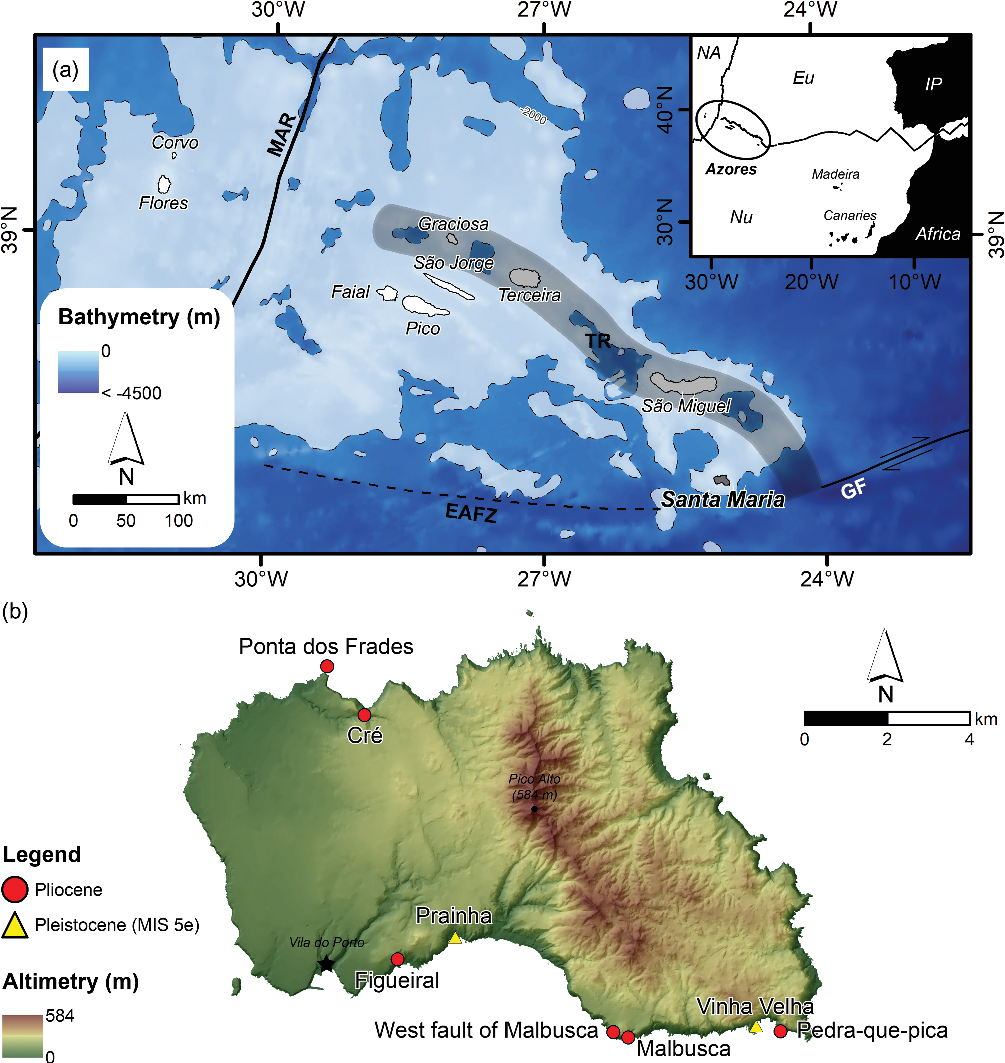
The nine volcanic oceanic islands that form the Azores Archipelago are located in the NE Atlantic Ocean (Fig. 1) and rise from a bathymetric anomaly (the Azores Plateau) with depths of c. 2000 m. The most distant islands (Flores in the western group and Santa Maria in the eastern group) are 615 km apart. Flores and Corvo belong to the North American tectonic plate, whereas the other seven islands are located around the most-studied area called the Azores Triple Junction (Laughton & Whitmarsh, Reference Laughton, Whitmarsh and Kristjansson1974), a place where three major tectonic plates – North American, Nubian and Eurasian – interact. The Azores Triple Junction is limited by the East Azores Fracture Zone to the south, the Mid-Atlantic Ridge (MAR) to the west and the Terceira’s Rift and Gloria Fault to the NE and east (Searle, Reference Searle1980; Fig. 1a). This area (i.e. the Azores Plateau, the Azores Triple Junction and the islands that comprise the Azores Archipelago), derived from a series of anomalies related to ‘crustal thickness, rock composition, basement depth, plate boundary morphology, seismicity, gravity and geoid, and upper mantle seismic velocity structure’, is referred to as the ‘Azores Geosyndrome’ (Vogt & Jung, Reference Vogt, Jung, Kueppers and Beier2018).
(a) Location of the Azores Archipelago in the NE Atlantic, plus location and geotectonic setting of Santa Maria Island within the Azores Archipelago and within the Azores triple junction, respectively. The light blue area represents the Azores plateau (see text). MAR – Mid-Atlantic Ridge; EAFZ – East Azores fault zone; GF – Gloria fault; NA – North American plate; Eu – Eurasian plate; Nu – Nubian (African) plate. (b) Location of the Pliocene (red circles) and Pleistocene fossiliferous outcrops (yellow triangles) of Santa Maria Island. The Pleistocene outcrops are restricted to the warmest interval of the Last Interglacial Period (c. 130–116 ka), which is known as MIS 5e (Marine Isotopic Substage 5e; Ávila et al. Reference Ávila, Ramalho, Habermann, Titschack, Kueppers and Beier2018).

2.b. Santa Maria Island
This island has a complex geological history (for a review, see Ramalho et al. Reference Ramalho, Helffrich, Madeira, Cosca, Thomas, Quartau, Hipólito, Rovere, Hearty and Ávila2017). It is the oldest island of the Azores Archipelago and first rose above sea level at c. 6 Ma, initially by Surtseyan activity (the Cabrestantes Formation) and then by subaerial, monogenetic volcanism associated with the Porto Formation. High rates of magma production formed a shield volcano (the Anjos volcanic complex, dating from 5.8 to 5.3 Ma), which substantially increased the area of the Santa Maria protoisland, as attested by the present-day insular shelf (Ricchi et al. Reference Ricchi, Quartau, Ramalho, Romagnoli, Casalbore, da Cruz, Fradique and Vinhas2018). Although the entire volcanic edifice has likely undergone subsidence since extrusion of the first lavas of the submarine edifice, a prolonged subsidence rate of c. 100 m Ma–1 lasted from 5.3 Ma until 3.5 Ma (Ramalho et al. Reference Ramalho, Helffrich, Madeira, Cosca, Thomas, Quartau, Hipólito, Rovere, Hearty and Ávila2017). Volcanic activity associated with the Anjos shield volcano ceased at c. 5.3 Ma and was followed by a period of c. 1.2 Ma with almost no volcanism, during which the protoisland nearly vanished due to erosion (Ávila et al. Reference Ávila, Ramalho and Vullo2012; Ramalho et al. Reference Ramalho, Helffrich, Madeira, Cosca, Thomas, Quartau, Hipólito, Rovere, Hearty and Ávila2017), thus originating a large, flat, shallow seamount. The sediments of this unit (the Touril volcano-sedimentary complex; 5.30–4.13 Ma) are highly fossiliferous and correspond to early Pliocene outcrops (Ávila et al. Reference Ávila, Ramalho, Habermann, Titschack, Kueppers and Beier2018) formerly described in the literature as being of Miocene in age (see Madeira et al. Reference Madeira, Kroh, Martins and Ávila2007 for a review). Volcanic activity initiated again at c. 4.1 Ma during the first rejuvenated stage with eruptive foci associated with the Pico Alto volcanic successions, first submarine and later subaerial in nature (Ramalho et al. Reference Ramalho, Helffrich, Madeira, Cosca, Thomas, Quartau, Hipólito, Rovere, Hearty and Ávila2017), thus causing the revival of Santa Maria as an island. This stage lasted until 3.5 Ma, when the subsidence trend was reversed and the island’s volcanic edifice initiated an uplift trend continuing to the present day. Initially, a rate of 59 m Ma–1 occurred during 3.50–2.15 Ma, and then a slower rate of 42 m Ma–1 between 2.15 Ma and the present (Ricchi et al. Reference Ricchi, Quartau, Ramalho, Romagnoli, Casalbore, da Cruz, Fradique and Vinhas2018). This uplift trend, coupled with Pleistocene glacio-eustatic sea-level fluctuations, produced a staircase of ten subaerial and five submerged marine terraces, the former particularly evident across the island’s western sector at elevations ranging from 7–11 to 210–230 m (Ramalho et al. Reference Ramalho, Helffrich, Madeira, Cosca, Thomas, Quartau, Hipólito, Rovere, Hearty and Ávila2017), and the latter on the shelf all around the island at depths ranging between 40–50 and 120–140 m below sea level (Ricchi et al. Reference Ricchi, Quartau, Ramalho, Romagnoli, Casalbore, da Cruz, Fradique and Vinhas2018). A second rejuvenated stage occurred during 3.2–2.8 Ma, associated with monogenetic volcanism of the Feteiras Formation. Uplift has continued until today, but erosion became the dominant agent impacting the island’s landscape during the last 2.8 Ma (Ramalho et al. Reference Ramalho, Helffrich, Madeira, Cosca, Thomas, Quartau, Hipólito, Rovere, Hearty and Ávila2017).
2.c. Institutional abbreviations
- DBUA-F
fossil collection of the Department of Biology of the University of the Azores (Portugal).
- LAQ-F
fossil collection of the Liceu Antero de Quental, Ponta Delgada, São Miguel Island (Azores, Portugal).
- MGM
fossil collection of the former Museu Geológico e Mineiro, now Museu Geológico, LNEG, Lisbon (Portugal).
3. Materials and methods
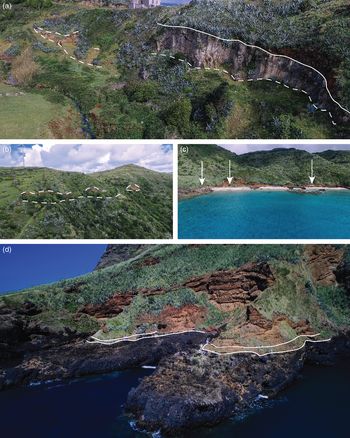
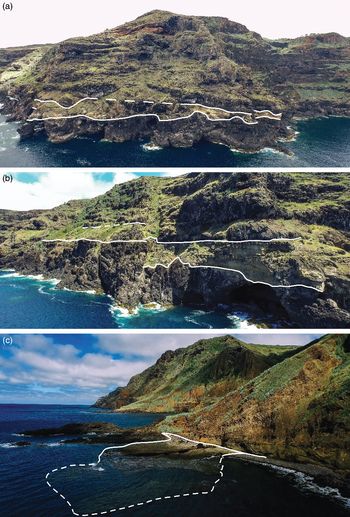
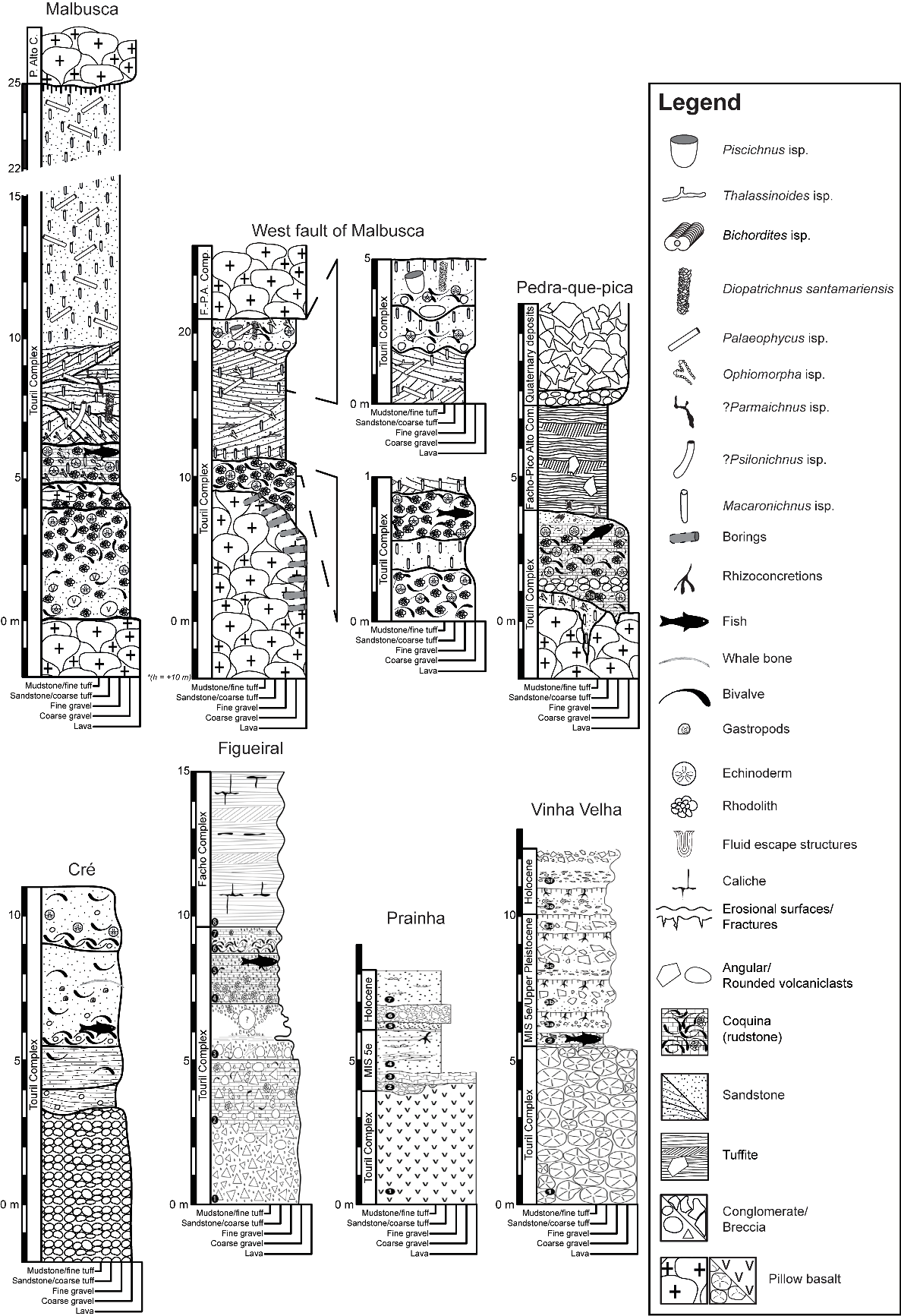
Most of the 20 known fossiliferous outcrops on Santa Maria Island are early Pliocene in age, but scattered Last Interglacial deposits from the Pleistocene Epoch are also known from the north (Lagoinhas; Ávila et al. Reference Ávila, da Silva, Schiebel, Cecca, Backeljau and Martins2009a, b) and southern shores (Prainha, Praia do Calhau and Vinha Velha outcrops; Ávila et al. Reference Ávila, Amen, Azevedo, Cachão and García-Talavera2002, Reference Ávila, Rebelo, Medeiros, Melo, Gomes, Bagaço, Madeira, Borges, Monteiro, Cordeiro, Meireles and Ramalho2010, Reference Ávila, Melo, Silva, Ramalho, Quartau, Hipólito, Cordeiro, Rebelo, Madeira, Rovere, Hearty, Henriques, da Silva, Martins and Zazo2015b; Fig. 1b). The fossil fish specimens reported here were found in sedimentary layers from a total of eight outcrops (Table 1). Six of these contain fauna that deposited during early Pliocene time: Cré (Kroh et al. Reference Kroh, Bitner and Ávila2008; Fig. 2a), Figueiral (Rebelo et al. Reference Rebelo, Meireles, Barbin, Neto, Melo and Ávila2016a; Ávila et al. Reference Ávila, Ramalho, Habermann, Titschack, Kueppers and Beier2018; Fig. 2b), Malbusca (Rebelo et al. Reference Rebelo, Rasser, Kroh, Johnson, Ramalho, Melo, Uchman, Berning, Silva, Zannon, Neto, Cachão and Ávila2016b; Johnson et al. Reference Johnson, Uchman, Costa, Ramalho and Ávila2017; Fig. 3a), West Fault of Malbusca (Uchman et al. Reference Uchman, Quintino, Rodrigues, Johnson, Melo, Cordeiro, Ramalho and Ávila2017; Fig. 3b), Pedra-que-pica (Ávila et al. Reference Ávila, Ramalho, Habermann, Quartau, Kroh, Berning, Johnson, Kirby, Zanon, Titschack, Goss, Rebelo, Melo, Madeira, Cordeiro, Meireles, Bagaço, Hipólito, Uchman, da Silva, Cachão and Madeira2015c, Reference Ávila, Ramalho, Habermann, Titschack, Kueppers and Beier2018; Uchman et al. Reference Uchman, Johnson, Rebelo, Melo, Cordeiro, Ramalho and Ávila2016; Fig. 3c), and the yet undescribed Ponta dos Frades outcrop. The two remaining outcrops (Prainha, Fig. 2c; Vinha Velha, Fig. 2d) include faunas from the Last Interglacial period (c. 130–116 ka), of which the warmest interval is known as MIS 5e (Marine Isotopic Stage 5e) (Ávila et al. Reference Ávila, Melo, Silva, Ramalho, Quartau, Hipólito, Cordeiro, Rebelo, Madeira, Rovere, Hearty, Henriques, da Silva, Martins and Zazo2015b). Figure 1b shows the geographical location of each outcrop and Figure 4 displays representative composite sections of the studied outcrops.
Relative age of the outcrops from Santa Maria Island (Azores) containing fossil remains of Actinopterygii fishes

Aerial (drone) views of the fossiliferous outcrops from Santa Maria Island. (a, b) Pliocene outcrops and (c, d) Pleistocene (MIS 5e) outcrops. The white line delimits the outcrops. (a) Cré; (b) Figueiral; (c) Prainha (the white arrows point to the areas where fossiliferous sediments are better preserved); and (d) Vinha Velha.

Aerial (drone) views of the Pliocene fossiliferous outcrops from Santa Maria Island. The white line delimits the outcrops. (a) Malbusca; (b) West fault of Malbusca; and (c) Pedra-que-pica. At West fault of Malbusca, the fossil strata are displaced by a fault slip of c. 20 m. Pedra-que-pica outcrop (c) spreads form the intertidal to about 4 m in elevation, and is probably the largest worldwide multispecific coquina ever described from a volcanic oceanic island with a total estimated area of >23 400 m2 and a total thickness of sediments of 10–11 m, 7 m of which are presently underwater (Ávila et al. Reference Ávila, Ramalho, Habermann, Quartau, Kroh, Berning, Johnson, Kirby, Zanon, Titschack, Goss, Rebelo, Melo, Madeira, Cordeiro, Meireles, Bagaço, Hipólito, Uchman, da Silva, Cachão and Madeira2015c).

Stratigraphic columns of the studied outcrops: Malbusca (Rebelo et al. Reference Rebelo, Meireles, Barbin, Neto, Melo and Ávila2016a; Uchman et al. Reference Uchman, Quintino, Rodrigues, Johnson, Melo, Cordeiro, Ramalho and Ávila2017), West fault of Malbusca (Uchman et al. Reference Uchman, Quintino, Rodrigues, Johnson, Melo, Cordeiro, Ramalho and Ávila2017), Pedra-que-pica (Ávila et al. Reference Ávila, Ramalho, Habermann, Quartau, Kroh, Berning, Johnson, Kirby, Zanon, Titschack, Goss, Rebelo, Melo, Madeira, Cordeiro, Meireles, Bagaço, Hipólito, Uchman, da Silva, Cachão and Madeira2015c), Cré (Janssen et al. Reference Janssen, Kroh and Ávila2008), Figueiral (Ávila et al. Reference Ávila, Ramalho, Habermann, Titschack, Kueppers and Beier2018), Prainha and Vinha Velha (Ávila et al. Reference Ávila, Rebelo, Medeiros, Melo, Gomes, Bagaço, Madeira, Borges, Monteiro, Cordeiro, Meireles and Ramalho2010, Reference Ávila, Melo, Silva, Ramalho, Quartau, Hipólito, Cordeiro, Rebelo, Madeira, Rovere, Hearty, Henriques, da Silva, Martins and Zazo2015b).

All specimens described were collected during 14 fieldwork campaigns of the Palaeontology in Atlantic Islands workshops, held on Santa Maria Island from 2002 to 2017. In compliance with the legislation that rules the PalaeoPark Santa Maria, all fossil specimens collected were deposited in the fossil collection at the Department of Biology of the University of the Azores (DBUA-F). Over 1300 lots containing fossil specimens collected at Santa Maria Island were screened for fossil Actinopterygii fishes, yielding a total of 42 lots containing oral and pharyngeal tooth plates. As the oral and pharyngeal tooth plates are frequently well preserved in the fossil record and display diagnostic features (Bellwood & Schultz, Reference Bellwood and Schultz1991), direct comparisons of the fossil remains with fossil and recent specimens (whenever available) were used to classify our material. Systematics for Actinopterygii conform to the World Register of Marine Species (http://www.marinespecies.org) and the teeth terminology for Scaridae is in accordance with Day (Reference Day2002).
All data generated or analysed during this study are included in this published article.
4. Results
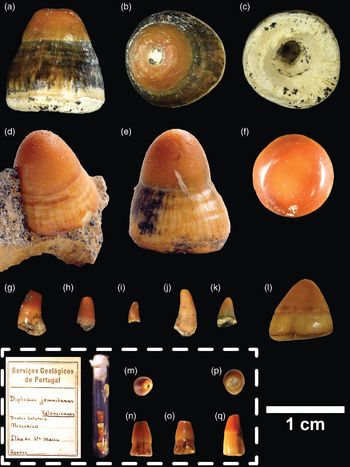
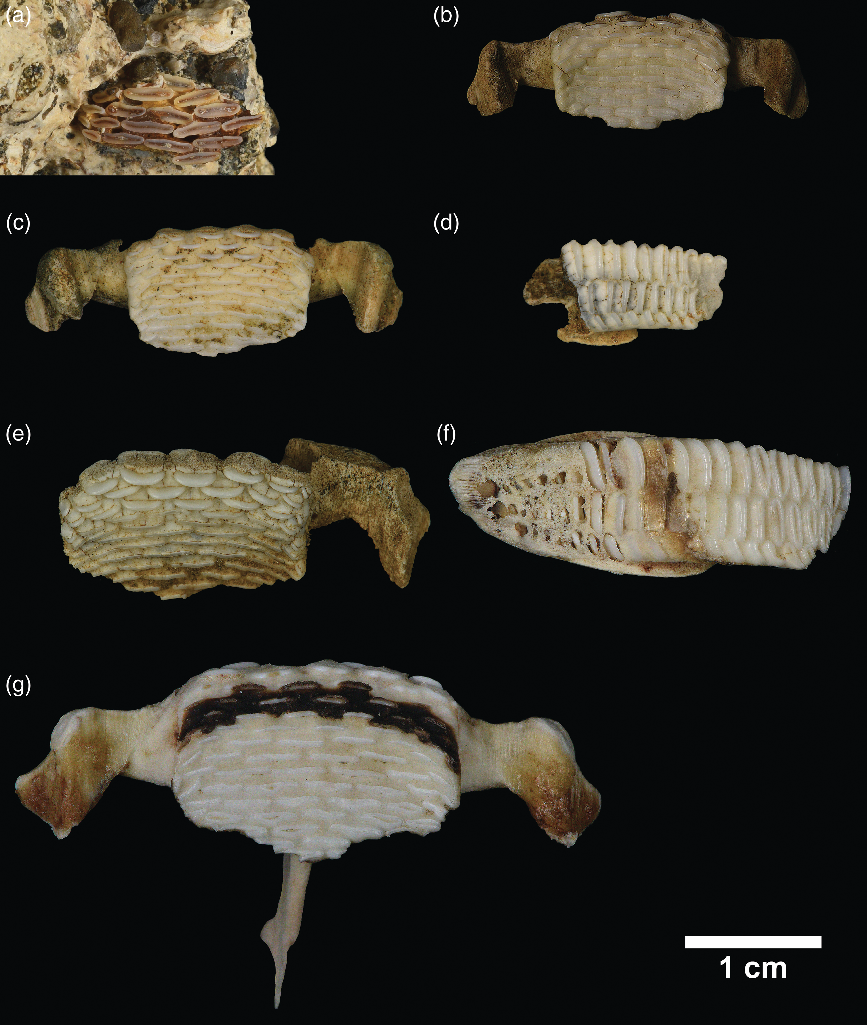
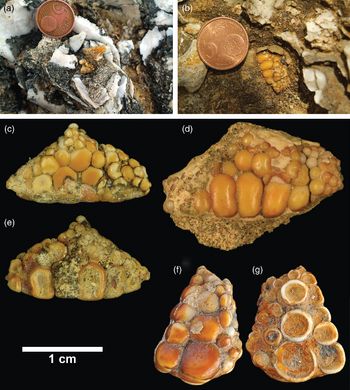
Actinopterygian fish taxa were found in the fossiliferous sediments of Santa Maria Island: at least two extinct Sparidae species with a probable Mio-Pliocene temporal range (Fig. 5a–q); Sparisoma cretense (Linnaeus, Reference Linnaeus1758) (Fig. 6), an extant Scaridae reported here for the Pliocene and Pleistocene epochs (Last Interglacial, MIS 5e) of the Azores; and Labrodon pavimentatum Gervais, Reference Gervais1857 (Fig. 7), an extinct Labridae with a Mio-Pliocene temporal range. In total, 54 teeth and several pharyngeal plates were found.
Actinopterygian fishes from Early Pliocene deposits of Santa Maria Island (Azores). (a–l) Teeth of Sparidae indet. (a–f, l) Upper lingual hemispheroidal molariform. Note the central depression in teeth photographed in (a–c) and (f). (a–c) (DBUA-F 165-1); (d, e) (LAQ, not numbered); (f) (DBUA-F 674). (g–k) Anterior teeth. (g, h) (DBUA-F 667); (i) (DBUA-F 599); (j, k) (DBUA-F 477-2); (l) (MGM 11312). (m–q) Teeth of Sparidae indet.; these specimens were collected by Georges Zbyszewski at Santa Maria Island (no information for locality) and originally referred to Diplodus jomnitanus. Original label by the former Serviços Geológicos de Portugal (presently housed at the Museu Geológico e Mineiro, Lisbon: MGM 11313). (m, p) Apical view of the teeth; and (n, o, q) lateral view.

Actinopterygian fishes from lower Pliocene (DBUA-F 825, 1069, 1214-1, 1214-2) and upper Pleistocene (Last Interglacial, MIS 5e; DBUA-F 1030) deposits of Santa Maria Island (Azores). (a) Lower grinding face view of lower Pliocene fragmentary tooth plate (DBUA-F 1069) of Sparisoma cretense. (b–e) Upper grinding face view of Last Interglacial pharyngeal plates of Sparisoma cretense. (b, c, e) Lower pharyngeal plates: (b) (DBUA-F 1030), (c) (DBUA-F 1214-1) and (e) (DBUA-F 825). (d) Upper pharyngeal plate (DBUA-F 1214-2). (f, g) Upper grinding face view of recent pharyngeal plates from a dissected S. cretense: (f) upper pharyngeal plate and (g) lower pharyngeal plate.

Actinopterygian fishes from lower Pliocene deposits of Santa Maria Island (Azores). (a–g) Labrodon pavimentatum Gervais, Reference Gervais1857. (a–e) Fragmentary pharyngeal plates collected at Pedra-que-pica outcrop: (b, d) DBUA-F 678; (c, e) DBUA-F 386. (f, g) Fragmentary pharyngeal plate collected at Santa Maria (no locality; MGM 11318). (c, d, f) Upper grinding face view of lower pharyngeal plate. (e, g) Lower grinding face view of lower pharyngeal plate.

4.a. Systematic palaeontology
Class Actinopterygii Klein, Reference Klein1885
Order PERCIFORMES Bleeker Reference Bleeker1859
Family Sparidae Rafinesque, Reference Rafinesque1818
Genera and species indet.
Figure 5a–q
Material examined. Fifty-six teeth in total: Pedra-que-pica (26 teeth), Malbusca (17), Cré (4), West Fault of Malbusca (2), Figueiral (1): DBUA-F 165-1, 165-2, 204-2, 205-2, 250-1, 260, 286, 313, 344-2, 350, 382, 448, 460-1, 477-2, 508-1, 508-2, 595, 596, 597, 598, 599, 601, 647, 667, 668, 669, 671, 672, 673, 674, 966-2, 991, 1014, 1017, 1073, 1083. Cré, formerly also known as Pedreira dos Frades (2): MGM 11311, 11312 (one spheroidal and one oval molariform teeth, respectively); Santa Maria Island (4 teeth), no locality: MGM 11313.
Description. The 50 teeth examined from the DBUA collection represent three types of dentition: molariform, conical and incisiform teeth. We have examined a total of 39 molariform teeth corresponding to the lingual series (36 spheroidal in shape, 2.87–17.34 mm in diameter; Fig. 5a–f, l; and 3 oval in shape, 5.89–11.51 mm), 9 conical teeth (Fig. 5g–k) corresponding to the labial series (2.41–7.93 mm in diameter) and 2 ‘spatulate’ incisiform teeth (1.45–1.53 mm in diameter; DBUA-F 668, 671). Some of the largest spheroidal molariform teeth exhibit a central depression; these are considered to belong to the upper lingual series (Fig. 5a–c, f). Some of the largest teeth show radial grooves at the base of the crown. The general shape and size resemble some of the teeth described by Betancort et al. (Reference Betancort, Lomoschitz and Meco2016).
The four teeth housed at MGM (Lisbon) that we examined are all lateral teeth, with a conical shape, and rounded, worn crowns (Fig. 5m–q).
Remarks. This material represents at least two taxa, including a small one and a larger one (possibly Diplodus and Pagrus, respectively). Some of these teeth might also belong to Archosargus (Cutwa & Turingan, Reference Cutwa and Turingan2000). However, any generic/specific assignment would be highly tentative without any additional osteological evidence.
Stratigraphic and geographic range. Extinct Archosargus species are reported from the Miocene and Pliocene sediments of the Mediterranean Sea (Obrador & Mercadal, Reference Obrador and Mercadal1973; Vicens & Rodríguez-Perea, Reference Vicens and Rodríguez-Perea2003; Mas & Antunes, Reference Mas and Antunes2008) and from the Miocene strata of France (Gagnaison, Reference Gagnaison2017). In the Atlantic, Archosargus species are reported from the Miocene sediments of Portugal (Zbyszewski & d’Almeida, Reference Zbyszewski and d’Almeida1950; Jonet et al. Reference Jonet, Kotchetoff and Kotchetoff1975) and Morocco (Lecointre, Reference Lecointre1952), the Pliocene strata of the Canary Islands (Gran Canaria Island) (Betancort et al. Reference Betancort, Lomoschitz and Meco2016) and from the Pliocene Series of the Azores (Santa Maria Island) (Zbyszewski & d’Almeida, Reference Zbyszewski and d’Almeida1950; Ferreira, Reference Ferreira1955; Zbyszewski & Ferreira, Reference Zbyszewski and Ferreira1962; Ávila et al. Reference Ávila, Ramalho, Habermann, Quartau, Kroh, Berning, Johnson, Kirby, Zanon, Titschack, Goss, Rebelo, Melo, Madeira, Cordeiro, Meireles, Bagaço, Hipólito, Uchman, da Silva, Cachão and Madeira2015c). The extinct species formerly known as D. jomnitanus is reported from the Miocene strata of France (Gagnaison, Reference Gagnaison2017), Portugal (Zbyszewski & d’Almeida, Reference Zbyszewski and d’Almeida1950; Jonet et al. Reference Jonet, Kotchetoff and Kotchetoff1975) and the Mediterranean Sea (Vicens & Rodríguez-Perea, Reference Vicens and Rodríguez-Perea2003), and from the Pliocene sediments of the Azores (Santa Maria Island) (Zbyszewski & d’Almeida, Reference Zbyszewski and d’Almeida1950; Ferreira, Reference Ferreira1955; Zbyszewski & Ferreira, Reference Zbyszewski and Ferreira1962). Extinct Pagrus species are reported from Mio-Pliocene sediments from the Mediterranean Sea and from Europe (Arambourg, Reference Arambourg1927; Bauzá, Reference Bauzá1948; Menesini, Reference Menesini1969; Bauzá & Plans, Reference Bauzá and Plans1973; Jonet, Reference Jonet1975; Antunes et al. Reference Antunes, Jonet and Nascimento1981).
Family LABRIDAE Cuvier, 1816
Tribe SCARINI Rafinesque, Reference Rafinesque1810
Genus Sparisoma Swainson, Reference Swainson1839
Sparisoma cretense (Linnaeus, Reference Linnaeus1758)
Figure 6
Material examined. Seven pharyngeal plates (four lower and three upper) plus one fragmentary tooth plate: Ponta dos Frades (three lower and three upper pharyngeal plates), Vinha Velha (one lower pharyngeal plate) and Pedra-que-pica (one fragmentary tooth plate): DBUA-F 825, 1030, 1069, 1214-1 to 1214-5.
Description. This species has a jaw formed from modified hindmost gill-arch, with tooth-bearing bones above, denominated upper pharyngeal plates and a large, single bone below, the lower pharyngeal plate. Our fossil specimens’ pharyngeal plates are very similar to those of Recent specimens of Sparisoma cretense. The tooth rows of the lower pharyngeal plate range from 11 to 12 in the fossil material, and from 10 (in smaller specimens) to 14 (in larger animals) in the recent material. We detected some intraspecific variation on the pharyngeal jaw elements in both fossil and recent specimens (i.e. the increasing number of tooth rows with the total length of the specimen, as well as the slightly different angles of the lateral bony articulation in smaller fossil and recent specimens), which we attribute to ontogeny. For example, a fresh specimen of S. cretense was weighted and measured (1.585 kg; 45.50 cm in total length; 40.50 cm standard length). Its lower pharyngeal plate was 4.11 cm wide, which compares with those from fossil material that measured 2.62 cm wide (DBUA-F 1030), 2.82 cm (DBUA-F 1214-1), 2.84 cm (DBUA-F 1214-2) and an inferred 3.82 cm (DBUA-F 825 broken specimen measuring 2.84 cm). The fragmentary tooth plate collected at Pedra-que-pica (DBUA-F 1069) measures 1.22 cm.
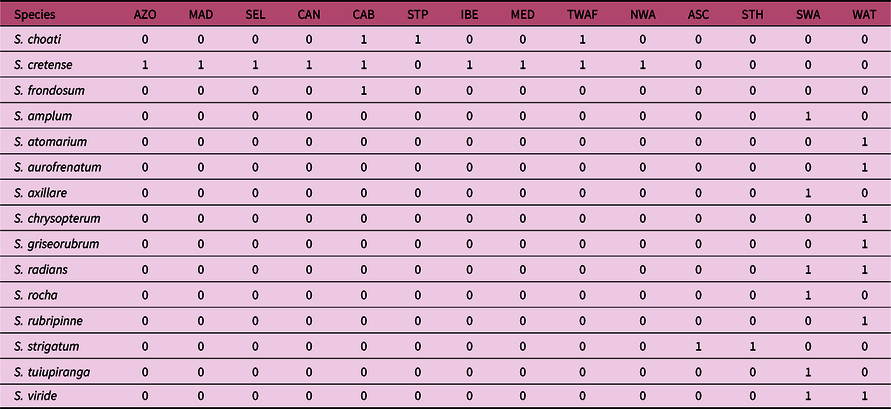
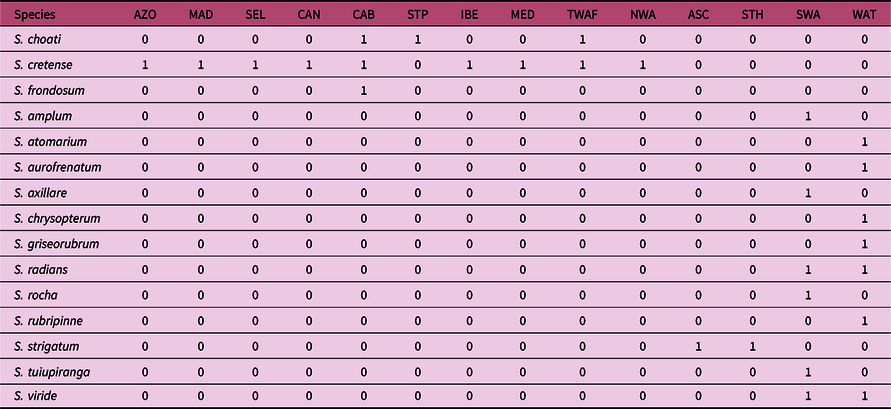
Today, there are 15 species of Sparisoma in the Atlantic Ocean and the Mediterranean Sea (Table 2). Of these, only three species are reported for the Eastern Atlantic: two tropical species (Sparisoma choati Rocha, Brito & Robertson, Reference Rocha, Brito and Robertson2012, reported for Cabo Verde, São Tomé and Príncipe and to the tropical west African shores; Rocha et al. Reference Rocha, Brito and Robertson2012; and S. frondosum (Agassiz, Reference Agassiz1831), endemic to Cabo Verde; Clements et al. Reference Clements, German, Piché, Tribollet and Choat2016); and the eurythermic S. cretense, with a wider geographical distribution, occurring in all the Macaronesian archipelagos, the Mediterranean Sea, Iberian shores and Senegal (Randall, Reference Randall, Quero, Hureau, Karrer, Post and Saldanha1990; Abecasis et al. Reference Abecasis, Bentes, Ribeiro, Machado, Oliveira, Veiga, Gonçalves and Erzini2008). The upper pharyngeal bones of S. frondosum are different from the Azorean fossil specimens; both species have three teeth on each row, but, and for the same row, the lateral tooth of S. cretense is consistently about half the size of the medium tooth, in contrast to about two-thirds the size of the medium tooth in the case of S. frondosum. We therefore identify the actinopterygian fossils of Santa Maria Island as S. cretense. No data were available in the literature to compare the fossil material with S. choati.
Present geographical distribution of the genus Sparisoma in the Atlantic Ocean and the Mediterranean Sea. AZO – Azores Archipelago; MAD – Madeira Archipelago; SEL – Selvagens Archipelago; CAN – Canaries Archipelago; CAB – Cabo Verde Archipelago; STP – São Tomé and Príncipe Archipelago; IBE – Atlantic Iberian shores from Finisterra south to the Straits of Gibraltar; MED – Mediterranean Sea; TWAF – Tropical west African shores, from Cape Blanc (Senegal) south to Angola; NWA – Atlantic coast of NW Africa, from the Straits of Gibraltar south to Senegal; ASC – Ascension Island; STH – Saint Helena Island; SWA – SW Atlantic, including Brazil and its oceanic islands; WAT – Western Atlantic, including the Caribbean Sea.
Ecology. The parrotfish Sparisoma cretense is an omnivorous daytime feeder species with specialized pharyngeal bones and muscles (Bullock & Monod, Reference Bullock and Monod1997). It is a sexually dimorphic species that lives on rocky bottoms covered by algae and sea grass beds, where it feeds on algae, sea grass and small invertebrates with its fused, beak-like jaw (Quignard & Pras, Reference Quignard, Pras, Whitehead, Bauchot, Hureau, Nielsen and Tortonese1986; Abecasis et al. Reference Abecasis, Bentes, Ribeiro, Machado, Oliveira, Veiga, Gonçalves and Erzini2008). This shallow-water species is common to about 50 m depth (Guidetti & Boero, Reference Guidetti and Boero2002).
Stratigraphic and geographic range. This extant species is presently reported from the Mediterranean Sea and from the eastern Atlantic shores of Portugal, the Azores, Madeira, Canary Islands, Cabo Verde and Senegal (Randall, Reference Randall, Quero, Hureau, Karrer, Post and Saldanha1990; Abecasis et al. Reference Abecasis, Bentes, Ribeiro, Machado, Oliveira, Veiga, Gonçalves and Erzini2008). A search for fossil Sparisoma species on the PaleoBiology Database (https://paleobiodb.org/#/) and on Bellwood et al. (Reference Bellwood, Schultz, Siqueira and Cowman2019) yielded no occurrences. With the exception of otolithes from the upper Eocene strata of France referred to Sparisoma (Nolf, Reference Nolf1988; but see remarks by Bellwood et al. Reference Bellwood, Schultz, Siqueira and Cowman2019, in whose opinion these otoliths are not secure evidence of Sparisoma), this genus is reported here for the first time from the fossil record based on dental remains. S. cretense is reported here from the Pliocene (Pedra-que-pica and Ponta dos Frades outcrops) and Pleistocene (Vinha Velha outcrop; Last Interglacial, MIS 5e) sediments of Santa Maria Island, Azores.
Tribe HYPSIGENYINI Günther, Reference Günther1861
Genus Labrodon Gervais, Reference Gervais1857
† Labrodon pavimentatum Gervais, Reference Gervais1857
Figure 7
Material examined. Two lower pharyngeal plates, both from Pedra-que-pica outcrop (Fig. 7a–e): DBUA-F 386, 678. One lower pharyngeal plate from Santa Maria Island (no locality; Fig. 7f, g): MGM 11318.
Description. The dentition of Labridae is characterized by subtriangular pharyngeal plates composed of small, contiguous, flattened teeth, which may be rounded or sub-oval in shape (Jonet, Reference Jonet1968). The two lower pharyngeal plates collected from the Pedra-que-pica coquina in Santa Maria Island (Azores), as well as that deposited at MGM collection (Lisbon), conform with both the figures and the description provided by Betancort et al. (Reference Betancort, Lomoschitz and Meco2016). Cocchi (Reference Cocchi1864) was the first to describe pharyngeal plates similar to our samples, which were attributed to Labrodon multidens (Sacco, Reference Sacco1916) and to L. pavimentatum (Simonelli, Reference Simonelli1889).
Stratigraphic and geographic range. This extinct species is reported from the Miocene sediments of France (Sauvage, Reference Sauvage1875; Gagnaison, Reference Gagnaison2017), Portugal (Jonet et al. Reference Jonet, Kotchetoff and Kotchetoff1975), Poland (Bellwood et al. Reference Bellwood, Schultz, Siqueira and Cowman2019) and the Mediterranean (Cocchi, Reference Cocchi1864; Landini, Reference Landini1977; Mas & Antunes, Reference Mas and Antunes2008). It is also reported from the western Atlantic, from the Miocene strata of Costa Rica (Laurito et al. Reference Laurito, Calvo, Valerio, Calvo and Chacón2014) and also from the Pliocene strata of Morocco (Lecointre, Reference Lecointre1952), France (de Lumley, Reference de Lumley1988) and the Azores (Santa Maria Island: Zbyszewski & d’Almeida, Reference Zbyszewski and d’Almeida1950; Ferreira, Reference Ferreira1955; Zbyszewski & Ferreira, Reference Zbyszewski and Ferreira1962; this work).
5. Discussion
This contribution expands the number of Pliocene fishes reported from the Azores to at least 11 taxa: 7 taxa of Chondrichthyes (Ávila et al. Reference Ávila, Ramalho and Vullo2012): Carcharias acutissima (Agassiz, Reference Agassiz1833–1843), Carcharhinus cf. leucas (Valenciennes, Reference Valenciennes1839 in Müller & Henle, Reference Müller and Henle1839), Cosmopolitodus hastalis (Agassiz, Reference Agassiz1833–1843), Isurus oxyrinchus Rafinesque, Reference Rafinesque1810, Otodus (Megaselachus) megalodon (Agassiz in Charlesworth, Reference Charlesworth1837), Notorynchus primigenius (Agassiz, Reference Agassiz1833–1843) and Paratodus benedenii (Le Hon, Reference Le Hon1871); and 4 of Actinopterygii (this work): at least two Sparidae indet. taxa, Labrodon pavimentatum and Sparisoma cretense. Most of these are also reported from the Pliocene sediments of Canaries (Betancort et al. Reference Betancort, Lomoschitz and Meco2016), the exceptions being Carcharhinus cf. priscus (Agassiz, Reference Agassiz1833–1843), Diodon scillae Agassiz, Reference Agassiz1833–1843 and Galeocerdo cf. aduncus Agassiz, Reference Agassiz1833–1843, which are only reported for the Canary Islands.
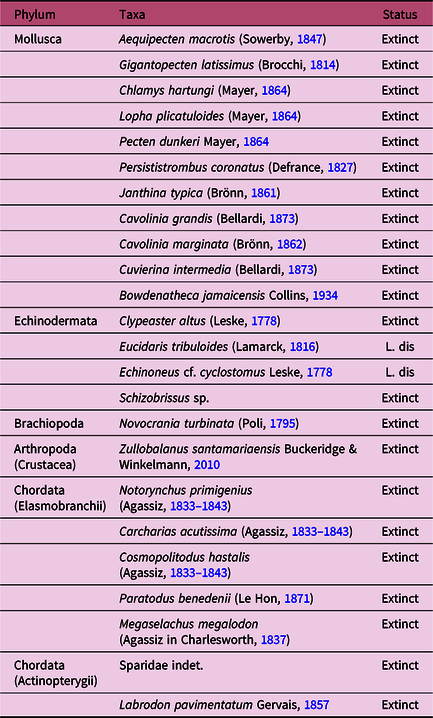
During late Miocene time, the once continuous and large tropical Miocene European-West African palaeobiogeographical molluscan province (MEWAP; Ávila et al. Reference Ávila, Melo, Berning, Cordeiro, Landau and da Silva2016) stretched between c. 50° N to the equator and further south to Angola (Baarli et al. Reference Baarli, Malay, Santos, Johnson, da Silva, Meco, Cachão and Mayoral2017) at c. 15° S (Fig. 8a). The waters around the Azores exhibited tropical temperatures during late Miocene – early Pliocene time, with mean annual sea surface temperatures (SSTs) estimated to be c. 3.7–6.3°C higher than the present-day 20.6°C (Ávila et al. Reference Ávila, Melo, Berning, Cordeiro, Landau and da Silva2016). The extinct Pliocene fish species reported from the fossiliferous sediments of Santa Maria Island in the Azores (two Sparidae indet. and Labrodon pavimentatum) add at least three more taxa to the increasing number of known thermophilic taxa that either went extinct or locally disappeared from this volcanic oceanic island (as well as from other Atlantic islands/archipelagos) during the pronounced climatic cooling events that characterized the middle Piacenzian Stage (towards the end of the Pliocene Epoch at c. 3.3–3.6 Ma, or sometime prior), a consequence of a global glaciation (the MIS M2; see Lisiecki & Raymo, Reference Lisiecki and Raymo2005; Fig. 8b). Several warm-water species are also known to have disappeared from the Canary Islands at c. 4.2–4.1 Ma (Meco et al. Reference Meco, Scaillet, Guillou, Lomoschitz, Carracedo, Ballester, Betancort and Cilleros2007). As a direct consequence of the MIS M2 glaciation, a S-directed geographical range contraction of the biogeographical provinces took place, with the appearance of the subtropical Pliocene French–Iberian Province (PFIP) located on the former northern range of the tropical MEWAP (cf. Fig. 8b; Ávila et al. Reference Ávila, Melo, Berning, Cordeiro, Landau and da Silva2016). Table 3 lists examples of several extinctions or extirpations of Pliocene species from the marine fauna of Santa Maria Island across a wide spectrum of phyla: molluscs (five bivalves, one benthic macrogastropod, one neustonic gastropod and four holoplanktonic gastropods; Janssen et al. Reference Janssen, Kroh and Ávila2008; Ávila et al. Reference Ávila, Ramalho, Habermann, Quartau, Kroh, Berning, Johnson, Kirby, Zanon, Titschack, Goss, Rebelo, Melo, Madeira, Cordeiro, Meireles, Bagaço, Hipólito, Uchman, da Silva, Cachão and Madeira2015c, Reference Ávila, Melo, Berning, Cordeiro, Landau and da Silva2016, Reference Ávila, Ramalho, Habermann, Titschack, Kueppers and Beier2018; Beu, Reference Beu2017), four echinoderms (Madeira et al. Reference Madeira, Kroh, Cordeiro, Meireles and Ávila2011), one brachiopod (Kroh et al. Reference Kroh, Bitner and Ávila2008), one barnacle (Winkelmann et al. Reference Winkelmann, Buckeridge, Costa, Dionísio, Medeiros, Cachão and Ávila2010) and five sharks (Ávila et al. Reference Ávila, Ramalho and Vullo2012). This pattern of extinctions/extirpations from volcanic oceanic islands during late Pliocene time is also reported for other Atlantic archipelagos, such as Madeira (Santos et al. 2012), the Canary Islands (Meco et al. Reference Meco, Scaillet, Guillou, Lomoschitz, Carracedo, Ballester, Betancort and Cilleros2007, Reference Meco, Koppers, Miggins, Lomoschitz and Betancort2015, Reference Meco, Lomoschitz and Betancort2016; Martín-González et al. Reference Martín-González, Buckeridge, Castillo and García-Talavera2012; Baarli et al. Reference Baarli, Malay, Santos, Johnson, da Silva, Meco, Cachão and Mayoral2017) and Cabo Verde (Baarli et al. Reference Baarli, Malay, Santos, Johnson, da Silva, Meco, Cachão and Mayoral2017).
(a–c) NE Atlantic Biogeographic Molluscan Provinces from (a) late Miocene – Pliocene time (6.0–5.33 Ma); (b) early Pliocene time to the end of the middle Piacenzian Warm Period (5.33–2.95 Ma); and (c) the present (adapted from Ávila et al. Reference Ávila, Melo, Berning, Cordeiro, Landau and da Silva2016; see ‘Discussion’ section for further explanation). (d–f) Comparison of large-scale evolutionary and biogeographical patterns as a result of long-distance dispersal of marine species between oceanic islands located at different climate settings (subtropical v. temperate latitudes) for the last 150 ka, encompassing the Last Interglacial (MIS 5e), the Last Glacial episode, and the present interglacial (adapted from Ávila et al. Reference Ávila, Melo, Sá, Quartau, Rijsdijk, Ramalho, Berning, Cordeiro, de Sá, Pimentel, Baptista, Medeiros, Gil and Johnson2019). (d) During the final phase of Termination 2 and/or the beginning of the Last Interglacial, a subset of marine subtropical species expanded their geographical ranges towards higher latitudes (red arrow), reaching temperate archipelagos and establishing viable populations in those islands (e.g. small red star). In a similar way, a subset of marine temperate species expanded their geographical ranges towards higher latitudes, reaching boreal/arctic archipelagos and also establishing viable populations (blue arrow). (e) During the course of the Last Glacial episode, the thermophilic species that established on temperate islands are extirpated; it is expected that a subset of marine temperate species (small blue circles) adapted to cool temperatures may have expanded their geographical ranges towards lower latitudes, reaching subtropical archipelagos and establishing viable populations. (f) The subsequent episode of global warming that led to the present interglacial extirpates the cold-adapted species that reached subtropical islands during the previous glacial episode, and the range expansion of species towards higher latitudes is documented. (g–i) Mobile sediment response to glacio-eustatic sea-level fluctuations (adapted from Ávila et al. Reference Ávila, da Silva, Cachão, Landau, Quartau and Martins2008a, Reference Ávila, Rebelo, Medeiros, Melo, Gomes, Bagaço, Madeira, Borges, Monteiro, Cordeiro, Meireles and Ramalho2010). (g) During the Last interglacial (MIS 5e), as a result of marine and fluvial erosion sediments are transported to the island shelf where they accumulate in the distal parts of the shore platform, with clinoforms ending at the erosive shelf edge. (h) The inception of sea-level lowstands during the Last Glacial episode promotes the remobilization and transport downslope of sediments from the island shelf, when relative mean sea level falls below the erosive shelf edge and sediments are lost to the abyssal depths that surround the insular edifice. (i) Sediments accumulate again on the island shelf as a result of marine and fluvial erosion during the present sea-level highstand.

Taxa/species reported from the Pliocene sediments of Santa Maria Island that are presently extinct or were extirpated (local disappearances) from the marine fauna of the island during the global climate deterioration that characterizes late Pliocene time. L. dis – local disappearance.
Between 5.3 and 4.13 Ma, the protoisland of Santa Maria was probably entirely destroyed, originating a large seamount where marine sediments rich in organic debris were deposited (Ávila et al. Reference Ávila, Ramalho and Vullo2012; Ramalho et al. Reference Ramalho, Helffrich, Madeira, Cosca, Thomas, Quartau, Hipólito, Rovere, Hearty and Ávila2017). In a broader palaeoceanographical context, the pattern of sea surface and bottom circulation in the area should have been different from the present day, as the connection between the Atlantic and the Pacific oceans was still open at the Central American Seaway (O’Dea et al. Reference O’Dea, Lessios, Coates, Eytan, Restrepo-Moreno, Cione, Collins, de Queiroz, Farris, Norris, Stallard, Woodburne, Aguilera, Aubry, Berggren, Budd, Cozzuol, Coppard, Duque-Caro, Finnegan, Gasparini, Grossman, Johnson, Keigwin, Knowlton, Leigh, Leonard-Pingel, Marko, Pyenson, Rachello-Dolmen, Soibelzon, Soibelzon, Todd, Vermeij and Jackson2016) and the Gibraltar Seaway had just reopened at 5.33 Ma in an event known as the Zanclean or post-Messinian flood (Blanc, Reference Blanc2002; Garcia-Castellanos et al. Reference Garcia-Castellanos, Estrada, Jiménez-Munt, Gorini, Fernàndez, Vergés and de Vicente2009). As attested by the fossil record of their geographical distribution, most of the Actinopterygii (this work) and Chondrichthyes (Ávila et al. Reference Ávila, Ramalho and Vullo2012) fishes reported from the Pliocene sediments of the Azores are also reported from Pliocene deposits in the NE Atlantic and the Mediterranean Sea, with some species also being reported from Pliocene sediments along the NW shores of Africa; no western Atlantic species have been reported. This predominantly eastern Atlantic pattern of biogeographical relationships for the Azorean Pliocene marine fauna derives from the sea surface currents set in place by the easterly trade winds that facilitated dispersal of marine species from European shores towards the western Atlantic, a few reaching and colonizing American Atlantic shores (Harzhauser et al. Reference Harzhauser, Piller and Steininger2002; Baarli et al. Reference Baarli, Malay, Santos, Johnson, da Silva, Meco, Cachão and Mayoral2017) and even the Pacific (Meco et al. Reference Meco, Lomoschitz and Betancort2016). Additionally, the high number of shared species on archipelagos over 1100 km apart such as the Azores and Cabo Verde is understandable when it is considered that all these archipelagos (i.e. the Azores, Madeira, Selvagens, Canaries and Cabo Verde) were part of the same Atlantic biostratigraphic molluscan province (the Pliocene Mediterranean-West African Province (PMWAP) of Ávila et al. (Reference Ávila, Melo, Berning, Cordeiro, Landau and da Silva2016); see Fig. 8b), sharing similar tropical palaeoclimatic conditions, during the Pliocene Epoch.
The final closure of the Central American Seaway, caused by re-emergence of the Panamanian land bridge (Briggs, Reference Briggs1995) at c. 2.8 Ma (O’Dea et al. Reference O’Dea, Lessios, Coates, Eytan, Restrepo-Moreno, Cione, Collins, de Queiroz, Farris, Norris, Stallard, Woodburne, Aguilera, Aubry, Berggren, Budd, Cozzuol, Coppard, Duque-Caro, Finnegan, Gasparini, Grossman, Johnson, Keigwin, Knowlton, Leigh, Leonard-Pingel, Marko, Pyenson, Rachello-Dolmen, Soibelzon, Soibelzon, Todd, Vermeij and Jackson2016) and the associated strengthening of the Gulf Stream, altered the north Atlantic system of sea surface circulation. Moreover, the climatic deterioration that characterized the entire Pleistocene Epoch was responsible for a further equatorial shift of the Atlantic biogeographic provinces, as depicted in Figure 8c (Ávila et al. Reference Ávila, Melo, Berning, Cordeiro, Landau and da Silva2016). The effect of a stronger Gulf Stream is testified by the shallow-water (< 50 m depth) marine molluscs of the Azores, which show an increase in the number of western-Atlantic-related species from 10.0% to 12.3% when Last Interglacial (MIS 5e) checklists of fossil marine molluscs from the Azores (Ávila et al. Reference Ávila, Amen, Azevedo, Cachão and García-Talavera2002, Reference Ávila, da Silva, Schiebel, Cecca, Backeljau and Martins2009a, b, Reference Ávila, Melo, Silva, Ramalho, Quartau, Hipólito, Cordeiro, Rebelo, Madeira, Rovere, Hearty, Henriques, da Silva, Martins and Zazo2015b) are compared with recent checklists available from this archipelago (Ávila, Reference Ávila2000; Cordeiro et al. Reference Cordeiro, Borges, Martins and Ávila2015).
Intensification of the Pleistocene glacial episodes clearly impacted the Azorean fish pool in a similar manner to that described for the marine molluscs (Ávila et al. Reference Ávila, da Silva, Cachão, Landau, Quartau and Martins2008a, b, 2009a). We expand on those conclusions, which were based on the MIS 5e mollusc fossil record from Santa Maria Island, and we postulate that range expansions of tropical and subtropical fishes with a Cabo Verdean origin probably occurred during ‘windows of opportunity’ towards the end of glacial terminations (i.e. the short periods of time, c. 6 ka, between the end of a glacial episode and the inception of a full interglacial episode). During those intervals, some fish species might have been able to reach, colonize and establish viable populations in the Canaries, Madeira and, in less numbers, the Azores Archipelago (Fig. 8d). We further hypothesize that, again in a similar manner to the marine molluscs (Ávila et al. Reference Ávila, da Silva, Cachão, Landau, Quartau and Martins2008a, b, 2009a), that during the subsequent glacial episode (1) all tropical species with a Cabo Verdean provenance that became established in the northern archipelagos (Azores, Madeira and Canaries) during the previous interglacial were extirpated (Ávila et al. Reference Ávila, Melo, Sá, Quartau, Rijsdijk, Ramalho, Berning, Cordeiro, de Sá, Pimentel, Baptista, Medeiros, Gil and Johnson2019; Fig. 8e), and (2) shallow-water fish species associated with fine sediments were functionally extirpated (i.e. locally disappeared from most volcanic oceanic islands) or their insular populations experience a ‘bottleneck’ effect, resulting in a substantial net decrease in population size. The latter event occurs because the fine-sand habitat is mostly lost whenever sea level falls below the erosive edge of the insular shelf during glacial episodes (Ávila et al. Reference Ávila, da Silva, Cachão, Landau, Quartau and Martins2008a, 2015b; Fig. 8g–i). The trigger for this outcome is when the slope of the insular volcanic edifice becomes so steep below the erosive shelf edge that it is no longer physically possible to retain fine sediments around the island, which are ultimately lost to the abyssal depths (Fig. 8h). Either way, whether post-glacial colonizers or ‘bottleneck’ glacial survivors, we predict a lower genetic diversity of the populations of shallow-water insular fish species associated with sandy bottoms – for example, the following extant species in the Azores: the European finless eel Apterichtus caecus (Linnaeus, Reference Linnaeus1758); the wide-eyed flounder Bothus podas (Delaroche, Reference Delaroche1809); the striped red mullet Mullus surmuletus Linnaeus, Reference Linnaeus1758; the Atlantic lizard fish Synodus saurus (Linnaeus, Reference Linnaeus1758); the greater weever Trachinus draco Linnaeus, Reference Linnaeus1758; and the pearly razorfish Xyrichtys novacula (Linnaeus, Reference Linnaeus1758) – when compared with continental conspecific populations. This prediction can be tested using molecular tools.
In contrast, fish species associated with algae-covered rocky shores, such as the omnivorous parrotfish Sparisoma cretense, were not affected by the drop in SSTs associated with the inception of glacial episodes, which was estimated as c. 2–3°C (Crowley, Reference Crowley1981) in the region of the Azores. The lineage that led to the two eastern Atlantic species, S. cretense (presently reported from the Mediterranean Sea and from the eastern Atlantic shores of mainland Portugal, the Azores, Madeira, Canaries, Cabo Verde and Senegal; cf. Table 2) and S. strigatum (Günther, Reference Günther1862) (endemic to Saint Helena and Ascension islands; Table 2), originated at c. 10 Ma from a west Atlantic ancestor (Bernardi et al. Reference Bernardi, Robertson, Clifton and Azzurro2000). The oldest known fossil specimens of S. cretense were collected in two Pliocene outcrops from Santa Maria Island (Pedra-que-pica and Ponta dos Frades) and dated as 4.78 ± 0.13 to 4.13 ± 0.19 Ma in age (Table 1); our data are therefore in agreement with the estimates of Bernardi et al. (Reference Bernardi, Robertson, Clifton and Azzurro2000).
Last Interglacial (MIS 5e) fossils of S. cretense were also collected from a Pleistocene outcrop (Vinha Velha; cf. Table 1). Today, S. cretense lives as far north as the eastern Atlantic shores of mainland Portugal, where it breeds during the summer from July to September (Abecasis et al. Reference Abecasis, Bentes, Ribeiro, Machado, Oliveira, Veiga, Gonçalves and Erzini2008; http://www.fishbase.org), with mean SSTs varying from 17 to 19°C. The present average SSTs range in the Azores is from 15°C in the winter to c. 23–24°C in the summer (Ávila et al. Reference Ávila, Melo, Lima, Amaral, Martins and Rodrigues2008c). The gonadosomatic index of S. cretense (which is closely associated with mean temperature) increases in the Azores from June to August and then drops to a minimum in November (Afonso et al. Reference Afonso, Morato and Santos2008). Although it mainly breeds from mid-July to mid-September, it is therefore possible that this species extends its reproductive activity through October (Afonso et al. Reference Afonso, Morato and Santos2008). In our opinion, neither temperature nor habitat shift were therefore an impediment for the survival of this species in the Azores throughout the last glacial episode. Our view differs from that of previous authors, who suggested that ‘the drop of sea temperatures … that occurred during the Pleistocene probably resulted in mass extinctions’ (of fishes) and so ‘most of the organisms now present would have reached the Azores in the last 17,000 years’ (Santos et al. Reference Santos, Hawkins, Monteiro, Alves and Isidro1995). Our reasoning also contradicts the conclusions of Domingues et al. (Reference Domingues, Alexandrou, Almada, Robertson, Brito, Santos and Bernardi2008), who stated that ‘persistence of … S. cretense in the Azores archipelago during the Pleistocene glaciations is difficult to admit’. Moreover, the very abundant and well-studied MIS 5e (i.e. Last Interglacial) fossil record from Santa Maria Island disproves the conclusions of these former authors.
The finding of fossil pharyngeal plates belonging to S. cretense in MIS 5e sediments does not necessarily preclude the hypothesis that this species locally disappeared during the Last Glaciation, only to recolonize the archipelago post-glacially. Nevertheless, we consider it more plausible to argue that such extirpation did not happen, taking into consideration the facts that: (1) detailed studies on the Azorean MIS 5e and recent marine molluscs showed that the drop of the SSTs during the Last Glaciation only affected two groups of species: the tropical species that reached the Azores probably during a ‘window of opportunity’ associated with the final phase of Termination 2, and bivalve species associated to fine-sand sediments; both groups were extirpated (Ávila et al. Reference Ávila, da Silva, Cachão, Landau, Quartau and Martins2008a, b, 2009b, 2015b); (2) as temperature is known to play a key role on marine fish species biology (Pepin, Reference Pepin1991; van der Kraak & Pankhurst, Reference van der Kraak, Pankhurst, Wood and Macdonald1997; Pankhurst & Porter, Reference Pankhurst and Porter2003; Dolomatova et al. Reference Dolomatova, Zukowb and Brudnickib2013; Poloczanska et al. Reference Poloczanska, Burrows, Brown, García Molinos, Halpern, Hoegh-Guldberg, Kappel, Moore, Richardson, Schoeman and Sydeman2016) and, in light of previously published theories (Ávila et al. Reference Ávila, da Silva, Cachão, Landau, Quartau and Martins2008a, 2009b, 2015b), the drop of SSTs was not sufficient enough to severely affect the survival, growth and reproduction of the temperate parrotfish S. cretense in the Azores during the Last Glacial episode; and (3) if S. cretense was a post-glacial colonizer of the Azores, the genetic diversity of the Azorean populations should be low in comparison to southern Madeiran populations (postulated to have been unaffected by the drop of SSTs); that is not the case, however, as pointed out by Domingues et al. (Reference Domingues, Alexandrou, Almada, Robertson, Brito, Santos and Bernardi2008). Combining our palaeontological data with ecological and genetic data from other authors (Abecasis et al. Reference Abecasis, Bentes, Ribeiro, Machado, Oliveira, Veiga, Gonçalves and Erzini2008; Afonso et al. Reference Afonso, Morato and Santos2008; Domingues et al. Reference Domingues, Alexandrou, Almada, Robertson, Brito, Santos and Bernardi2008), we therefore believe the most plausible scenario is the survival of most (if not all) temperate and subtropical fish species in the Azores during the Last Glacial episode, as long as their ecological traits were not constrained to sandy habitats.
6. Conclusions
The genus Sparisoma Swainson, Reference Swainson1839 is reported here for the first time in the fossil record. The discovery of several pharyngeal plates of S. cretense in Pliocene and MIS 5e sediments (Last Interglacial) of Santa Maria Island challenges former authors (Briggs, Reference Briggs1974; Santos et al. Reference Santos, Hawkins, Monteiro, Alves and Isidro1995; Domingues et al. Reference Domingues, Santos, Brito and Almada2006, Reference Domingues, Alexandrou, Almada, Robertson, Brito, Santos and Bernardi2008) who argued that mass extinctions affected the shallow-water marine fauna of the Azores during the course of the Last Glaciation and that, as a consequence, most of the present Azorean marine species colonized the area during the last 17–18 ka. A multidisciplinary approach, merging our palaeontological data with ecological and genetic data, offers an alternative, more plausible explanation, suggesting that most (if not all) of the Azorean shallow-water subtropical and temperate marine species living in the archipelago during the Last Interglacial (and probably also in previous interglacials) and associated with non-mobile sediments (e.g. rocky shores, covered or not by algae) were not affected by the drop in the SSTs during the Last Glacial episode.
Finally, we also predict that the only marine fish species that were extirpated from the Azores during the course of the Last Glaciation were those associated with fine sand (Fig. 8g–i) and the thermophilic species that colonized the archipelago during the Last Interglacial/Termination 2 ‘window of opportunity’ (Fig. 8d–f). Whether fish species ecologically associated with fine sediments and presently living in the Azores are post-glacial colonizers or ‘bottleneck’ survivors from the Last Glaciation should be assessed by genetic tools, and we anticipate a low genetic diversity of the Azorean populations when compared with continental counterparts.
Acknowledgments
We thank Direcção Regional da Ciência e Tecnologia (Regional Government of the Azores), FCT (Fundação para a Ciência e a Tecnologia) of the Portuguese Government and Câmara Municipal de Vila do Porto for financial support, and acknowledge the field assistance of Clube Naval de Santa Maria and Câmara Municipal de Vila do Porto. We are grateful to the organizers and participants of all editions of the International Workshop Palaeontology in Atlantic Islands who helped with fieldwork (2002–2017). We thank F Couto (Hobby Factor) for the aerial/drone photographs. We thank M Ramalho and J Anacleto (Museu Geológico, LNEG, Lisbon) for access to their historical collections. SPA acknowledges his research contract (IF/00465/2015) funded by the Portuguese Science Foundation (FCT). LB acknowledges her PhD Grant from FCT (SFRH/BD/135918/2018). CSM benefs from PhD grant M3.1.a/F/100/2015 from Fundo Regional para a Ciência e Tecnologia (FRCT). This research also received substantial support from the SYNTHESYS Project (http://www.synthesys.info/), which is financed by the European Community Research Infrastructure Action under the FP7 ‘Capacities’ Program. SPA studied the fish fossil collection at the Museum für Naturkunde, Berlin (DE-TAF-1071). This work was also supported by FEDER funds through the Operational Programme for Competitiveness Factors – COMPETE, and by National Funds through FCT under the UID/BIA/50027/2013, POCI-01-0145-FEDER-006821 and under DRCT-M1.1.a/005/Funcionamento-C-/2016 (CIBIO-A) project from FRCT. This work was also supported by FEDER funds (in 85%) and by funds from the Regional Government of the Azores (15%) through Programa Operacional Açores 2020 under the project “AZORESBIOPORTAL – PORBIOTA”: ACORES-01-0145-FEDER-000072.
Declaration of interest
SPA and RV designed the research plan. SPA, PM, RC and RV collected the fossil material. CSM constructed all figures. SPA, MEJ and RV wrote the manuscript with input from all authors, who discussed and commented on the manuscript. All authors approved the final version and they declare no competing interests.