INTRODUCTION
The genus Kogia currently contains two recognized species, the dwarf (Kogia sima) and pygmy (K. breviceps) sperm whales. Due to their small body size, cryptic behaviour and small school sizes, these whales are difficult to observe at sea, and morphological similarities make field identification to species level problematic. The majority of what is known about kogiid whales in southern Africa (i.e. Namibia, South Africa and Mozambique) results from studies of stranded specimens (e.g. Ross, Reference Ross1979a; Findlay et al., 1992; Plön, Reference Plön2004), including preliminary evidence that K. sima inhabiting the Indo-Pacific and Atlantic Oceans may be separate species (Chivers et al., Reference Chivers, LeDuc, Robertson, Barros and Dizon2005). Documenting stranding events is valuable, as it is often the only access possible to rarely seen species. In addition, analysis of long term trends in stranding records may help to identify shifts in distribution such as those associated with environmental change (e.g. MacLeod et al., Reference MacLeod, Bannon, Pierce, Schweder, Learmonth and Reid2005; Weir et al., Reference Weir, MacLeod and Calderan2009; Salvadeo et al., Reference Salvadeo, Lluch Belda, Gomez Gallardo, Urban Ramirez and MacLeod2010).
Kogia spp. are globally distributed in tropical and temperate oceans (Caldwell & Caldwell, Reference Caldwell, Caldwell, Ridgway and Harrison1989), with K. breviceps usually extending into cooler waters than K. sima (see Baird et al., Reference Baird, Nelson, Lien and Nagorsen1996; Willis & Baird, Reference Willis and Baird1998; Best, Reference Best2007 for review of distribution patterns). Both species are predominantly pelagic in their distribution occurring in deep oceanic waters off the shelf in tropical and temperate waters (Caldwell & Caldwell, Reference Caldwell, Caldwell, Ridgway and Harrison1989).
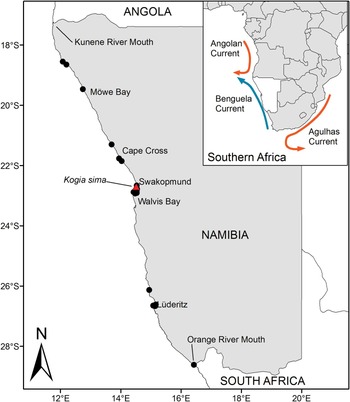
Around southern Africa, oceanic currents govern the temperature and productivity of the waters on the continental shelf and adjacent regions. These currents influence the species composition of these areas at all levels of the food chain, including marine mammals (Findlay et al., 1992; Ansorge & Lutjeharms, Reference Ansorge, Lutjeharms and Best2007) and thus deserve some discussion within the context of new species records. The warm Agulhas Current flows south-westwards along the eastern seaboard of southern Africa from the Mozambique Channel to the southern most tip of the Agulhas Bank off South Africa, at which point the majority of the current retroflects back eastwards forming the Agulhas return current (Ansorge & Lutjeharms, Reference Ansorge, Lutjeharms and Best2007) (Figure 1). Eddies formed by meanders in the current sometimes break off forming ‘Agulhas rings’ which move north and west, bringing warmer waters and sometimes associated wildlife into the South Atlantic. The Benguela Current system is an eastern boundary upwelling system. Predominantly southerly winds move surface waters northwards and offshore, resulting in upwelling of cold waters and a northward flowing current. The Benguela ecosystem is functionally split close to the South Africa–Namibia border due to an exceptionally strong upwelling cell in the Lüderitz region in southern Namibia. The northern and southern Benguela have distinct oceanographic and climatic properties with the northern showing much greater seasonality and variation (Veitch et al., Reference Veitch, Penven and Shillington2009). The northern boundary of the Benguela Current is formed by the Angola–Benguela frontal system, a dynamic boundary oscillating between 14° and 17°S (Ansorge & Lutjeharms, Reference Ansorge, Lutjeharms and Best2007). The western boundary of the Benguela Current system is more transient and ranges from roughly 200 km offshore in the south to 750 km offshore in the north, well off the continental shelf (Wedepohl et al., 2000; Ansorge & Lutjeharms, Reference Ansorge, Lutjeharms and Best2007).
Distribution of all known records of Kogia breviceps and Kogia sima in Namibia including places mentioned in text and main rivers at northern and southern borders. The Skeleton Coast National Park runs from the Kunene River to approximately 100 km north of Cape Cross.

There are no published sightings records of live kogiids of either species in South Africa or Namibia. All that is known about their distribution patterns and habitat use within these countries is based on strandings records and extrapolations from at-sea sightings further afield in neighbouring countries (e.g. Best, Reference Best2007). Kogia breviceps have been recorded from strandings on both the east and west coasts of southern Africa (i.e. in both the Benguela and Agulhas Current systems), including Namibia and South Africa and from sightings in the tropical waters of the Indian Ocean (Ballance & Pitman, Reference Ballance and Pitman1998; Kiszka et al., Reference Kiszka, Ersts and Ridoux2010). No confirmed records (sightings or strandings) of K. breviceps are available in the Eastern Tropical Atlantic (Gulf of Guinea to Angola), north of Namibia (see Best, Reference Best2007; Van Waerebeek et al., Reference Van Waerebeek, Ofori-Danson and Debrah2009; Weir, Reference Weir2010, Reference Weir2011). Kogia sima has to date only been recorded from strandings along the warmer eastern coast of southern Africa, predominantly east of Cape Point (under the influence of the Agulhas Current), as far as the Comoros Islands (Kiszka et al., Reference Kiszka, Ersts and Ridoux2010) and into the Indian Ocean (de Boer et al., Reference de Boer, Baldwin, Burton, Eyre, Jenner, Jenner, Keith, McCabe, Parsons, Peddemors, Rosenbaum, Rudolph and Simmonds2002). In the Atlantic, there is a notable absence of K. sima strandings or sightings from the area influenced by the Benguela ecosystem, with the exception of a few strandings in the southern ~100 km, between St Helena Bay and Cape Point (Findlay et al., Reference Findlay, Best, Ross and Cockcroft1992). The northernmost record of K. sima within the Benguela is from 32°36′S (Plön, Reference Plön2004; Best, Reference Best2007). Further north in the warmer waters of the Eastern Tropical Atlantic K. sima were seen exclusively in deep waters (>900 m) off Angola (while K. breviceps were never seen) during a series of predominantly deep water observations lasting >5900 hours of effort (Weir, Reference Weir2011) as well as recorded from strandings in Ghana (Van Waerebeek et al., Reference Van Waerebeek, Ofori-Danson and Debrah2009).
Stomach contents analyses show that both Kogia species are predominantly teuthivorous (although some fish and crustacean species are also consumed) and that they have one of the most species rich diets of any small odontocete in southern Africa (Sekiguchi et al., 1992). Using specimens stranded within South Africa, Plön (Reference Plön2004) described the diet of K. breviceps to include 50 cephalopod, 12 fish and 5 crustacean species, while K. sima had a narrower diet range of 32 cephalopod, 3 fish and 3 crustacean species. Numerically, squid from the families Histioteuthidae and Lycoteuthidae were the most frequently taken by both Kogia species, while hake (Merluccius spp.) was the most frequently eaten fish genus (Plön, Reference Plön2004).
This paper reports the first record of K. sima from Namibia and provides information on the basic morphometrics and diet of that record and of two recent stranded specimens of K. breviceps. All previously known records of the genus from Namibia are also collated. These data are presented and discussed within the context of known distribution patterns and environmental conditions within the southern African subregion.
MATERIALS AND METHODS
Three Kogia spp. specimens, including one K. sima (KS01) and two K. breviceps (KB01 and KB02) stranded on the Namibian coastline between June and August 2010. A series of standard photographs and measurements (Geraci & Lounsbury, Reference Geraci and Lounsbury1993) were collected from all three individuals and field necropsies were conducted to investigate health status and collect biological samples (skin, blubber, ovaries and gastro-intestinal tracts) and skeletal material. The gastro-intestinal (GI) tract was removed and frozen for subsequent analysis of tract contents. Skeletal material (skull of KB01, lower jaw of KB02, the skull having been damaging during euthanasia, and the entire skeleton including skull of KS01) were retained and are lodged in the Namibian National Museum, Windhoek (no accession numbers available as of submission).
Dietary analysis
The defrosted GI tract of each whale was opened and the contents of each stomach compartment passed through 425 µm and 100 µm mesh sieves. Nematode worms were separated from hard parts which included cephalopod beaks, eye lenses and crustacean carapaces. Hard parts and samples of nematode worms were stored in dilute ethanol prior to identification.
Beaks were counted, measured and identified by comparison with material in the Port Elizabeth Museum collections and using literature (Clarke, Reference Clarke1980, Reference Clarke1986; Smale et al., Reference Smale, Clarke, Klages and Roeleveld1993). Effort was focused on lower beaks for identification and measurement as these are most used for species identification and allow comparison between studies (Clarke, Reference Clarke1986). Upper beaks were counted but not identified to species level. Dorsal mantle length (DML) and masses of each prey item were calculated from the lower beaks using either the rostral length (RL) for squid or crest length for Octopodiae and Sepiidae (Clarke, Reference Clarke1980, Reference Clarke1986; Smale, Reference Smale1983; Smale et al., Reference Smale, Clarke, Klages and Roeleveld1993). Only data from lower beaks are presented further.
Records of Kogia spp. in Namibia
All available records of Kogia from Namibia were compiled from multiple sources; all were stranded animals and no at sea sightings could be sourced. The majority of older records (prior to 1990) are held by the Whale Unit of the Mammal Research Institute, University of Pretoria (author: P.B.B.). Records made subsequent to this are held by the Namibian Ministry of Fisheries (author: J.P.R.) and more recently by the Namibian Dolphin Project (authors: S.E. and T.G.). Variable levels of detail are available for each record due to differences in the state of decay of each specimen and the manner by which it was recorded (attended for full necropsy, reported remotely, etc.). Much of the data resulting from records prior to 1990 has contributed to other studies including Ross (Reference Ross1979a, Reference Rossb), Findlay et al. (1992), Sekiguchi et al. (1992) and Plön (Reference Plön2004).
Species identification was based on one or more of the following criteria: external—relative dorsal fin height (K. sima: >5% of total body length; K. breviceps: <5% body length); relative position of dorsal fin from snout (K. sima: anterior insertion of dorsal fin is >50% of body length from snout; K. breviceps: <50%), number and size of mandibular teeth (K. sima: 8–11 pairs, K. breviceps: 11–17 pairs); and cranial–dorsal cranial fossae cupped or uncupped, width of dorsal sagittal septum (Ross, Reference Ross1979a; Best, Reference Best2007).
RESULTS
KS01 live stranded on the 16 June 2010, 5 km south of the town of Swakopmund (22.7158°S 14.5279°E), but died in transit to the refloatation site. This is the first known occurrence of this species for Namibia and the northern Benguela ecosystem as a whole. KS01 was a 216 cm long female, pregnant with a 6 cm long foetus. Dorsal height was 19.2 cm and girth at axilla of the flippers was 124 cm. No external parasites were found, and the animal appeared in good health externally. One fresh bite on the dorsal ridge was possibly from a cookie cutter shark (Isistius spp.).
KB01 was found freshly dead on the 24 August 2010 in the town of Lüderitz in the south of Namibia. KB01 was a sexually immature female 228 cm long with a dorsal fin height of 10 cm and a girth at axilla of 139 cm; ovaries were not collected due to failing light at the necropsy site. The animal had sustained multiple lacerations on the skin during stranding.
KB02 live stranded on the 26 August 2010 in Guano Bay, Lüderitz, was refloated but restranded and was then euthanized. KB02 was a 212 cm long, sexually immature female with a dorsal fin height of 9 cm and a girth at axilla of 132 cm. Although appearing healthy and unscarred externally, KB02 had a white lumpy swelling on the lung tissues and a large number of nematodes in the stomach (100s).
Dietary analysis
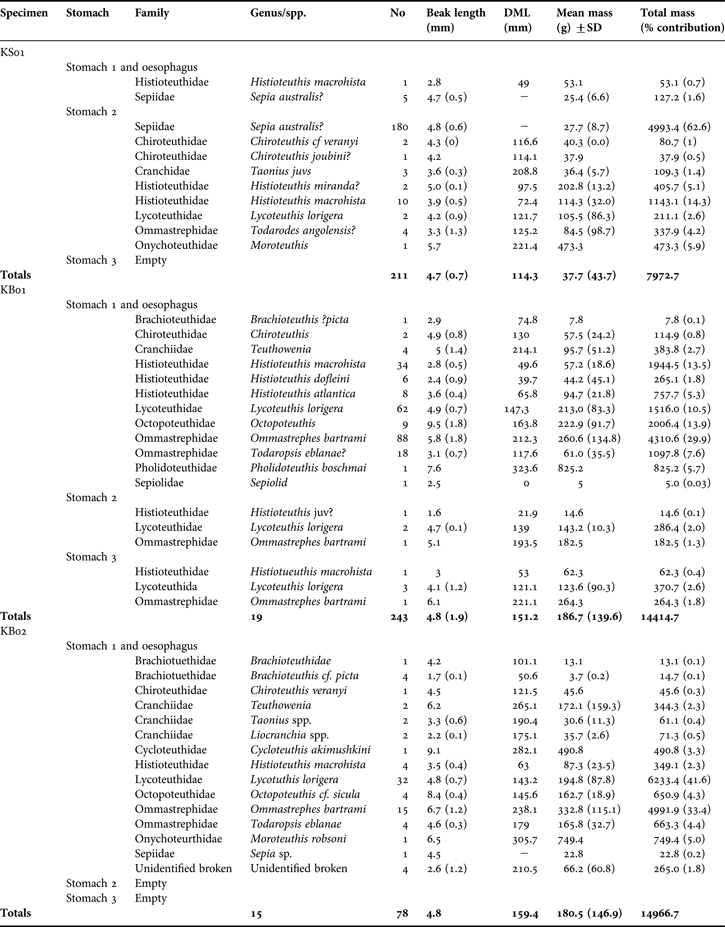
A summary of the prey identified in the stomachs of KS01, KB01 and KB02 is presented in Table 1. Eight families of cephalopod were identified from the stomach of KS01. The most numerous prey species taken by KS01 were Sepiidae (cuttlefish) most likely Sepia australis, which also made up the largest proportion of the diet by mass. Nine and ten families of cephalopod were identified from KB01 and KB02 respectively. The most numerous prey taxa taken by KB01 and KB02 were Ommastrephidae (Ommastrephes bartrami) and Lycoteuthidae (Lycoteuthis lorigera) respectively. These species, as well as Octopoteuthidae (Octopoteuthis spp.) and Histioteuthidae (Histioteuthis atlantica) made the largest contribution by mass. The estimated length and mass of prey taken by the KB01 and KB02 were considerably larger than those taken by KS01.
Cephalopod species identified from lower beaks in the stomachs of Kogia sima and Kogia breviceps stranded in Namibia, 2010. Beak rostral lengths shown are means for each species (± standard deviation (SD) where N >1) with an overall mean of all lower beaks. Dorsal mantle length (DML) and mass have been calculated from regression equations available in the literature and from existing collections held by the Port Elizabeth Museum. Regression values were obtained all from the literature (Clarke Reference Clarke1980, Reference Clarke1986), and Wolfe (1982) for Ommastrephes bartramii, and Cooper (Reference Cooper1979) for Todaropsis eblanae. Regressions for Lycoteuthis lorigera were calculated from Port Elizabeth Museum material DML (mm) = 34.6 × LRL – 21.93: mass (g) = e^(0.241 + 1.0155*LRL(mm)). Prey specimens have been identified as accurately as possible. Where confirmation of exact species was not confident (but genus was), we have indicated this with a ‘?’.

Nematode worms constituted a large proportion of the stomach contents (numbering thousands of individual worms and far outweighing the cephalopod beaks) in at least one of the three stomach cavities of all three animals examined—these samples will be analysed and discussed elsewhere. Other than parasites, the majority of food remains were cephalopod beaks, partly digested cephalopoda (tentacles, pens, eye lenses, etc) and some crustacean hard parts which were too degraded to be identified to species level. No fish otoliths were found in any of the stomachs. Differences in rate of digestion may play a role in the relative abundances of fish and cephalopod prey.
Records of Kogia spp. in Namibia
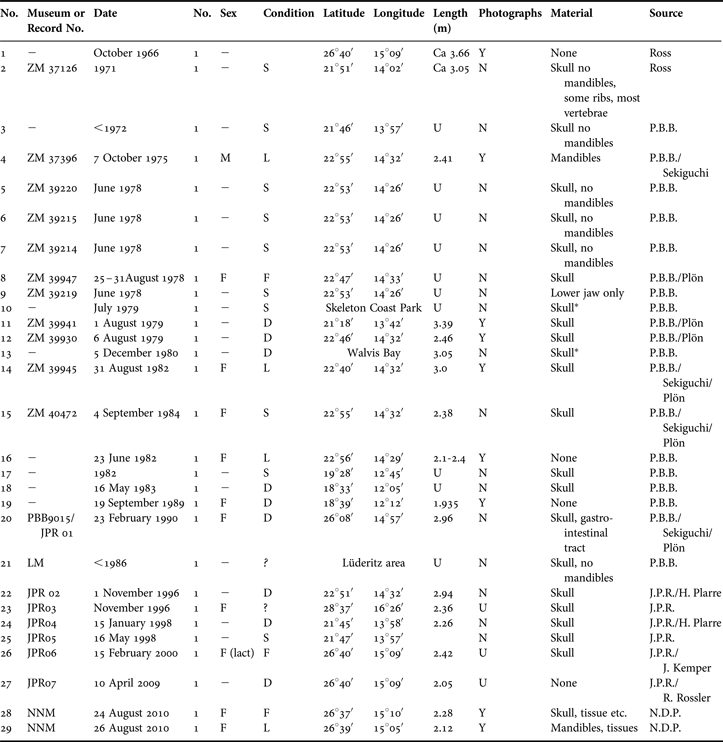
All previous records (N = 29) of K. breviceps strandings within Namibia are presented in Table 2 and Figure 1. The majority of records originate near the coastal towns of Lüderitz and Walvis Bay reflecting human habitation patterns along the Namibian coast (Figure 1). Three skulls found without any associated data in the Möwe Bay Museum in 2010 are not included as they might represent some of the specimens recorded in a visit to the same museum by P.B.B. in 1986 or reported subsequently to him from the same general locality (i.e. records numbers 17–19 in Table 2).
All known records of Kogia breviceps stranded in Namibia. Condition of specimens given as: L (live stranding); F (fresh dead); D (decomposing–dessicated); S (skeletal). Museum or Record Number refers to accessioned specimens at the Iziko South African Musem (ZM), Namibian National Museum (NNM), and those held in unaccessioned collections at the Lüderitz Museum (LM), or by co-authors (P.B.B. and J.P.R.). Source refers to person, group or paper where record was sourced (P.B.B.—Peter Best/Iziko South African Museum, Cape Town, South Africa), Ross—(Ross, Reference Ross1979a), Sekiguchi—(Sekiguchi et al., 1992), Plön—Plön (Reference Plön2004), J.P.R.—Jean-Paul Roux, NDP—Namibian Dolphin Project. Where described localities were not precise enough to calculate latitude and longitude, place names have been used.

*, skull supposed to have been collected but whereabouts unknown.
DISCUSSION
Due to their cryptic nature, studies of free ranging kogiid whales are difficult and rarely conducted. However, they are one of the most commonly stranded cetacean species globally (Cadona Maldonado & Mignucci Giannoni, Reference Cadona Maldonado and Mignucci Giannoni1999; Maldini et al., Reference Maldini, Mazzuca and Atkinson2005) and in southern Africa (Findlay et al., Reference Findlay, Best, Ross and Cockcroft1992, Plön, Reference Plön2004). Consequently, much of what we know originates from strandings data. However, there are several biases associated with using strandings data to infer distribution and natural history, which must be considered.
Survey effort and reporting of strandings may be spatially or temporally biased, related to the density of human habitation, meteorological or oceanographic influences (Brabyn & McLean, Reference Brabyn and McLean1992; Wright, Reference Wright2005; Hart et al., Reference Hart, Mooreside and Crowder2006; Witt et al., Reference Witt, Penrose and Godley2006). Stomach contents might not be truly representative of diet (Sekiguchi et al., 1992). Strandings records may not accurately reflect the species composition at sea; for example, although K. breviceps was the more common of the two Kogia species stranding on the Hawaiian Island chains, sightings surveys at sea showed the opposite pattern with K. sima making up 13 of 14 groups seen (Baird, Reference Baird2005). However, in the absence of other forms of data collection, records of stranded animals are highly valuable sources of data (Findlay et al., 1992; McLellan et al., Reference McLellan, Friedlander, Mead, Potter and Pabst2002; Maldini et al., Reference Maldini, Mazzuca and Atkinson2005; Elwen et al., Reference Elwen, Findlay, Kiszka and Weir2011).
This is the first report of K. sima in Namibia and our record extends the known species range by more than 1000 km from previous published sightings or strandings records in southern Africa. The closest published sightings and strandings of the species are in deep water (922–2105 m) off northern Angola (6–8°46′S; Weir, Reference Weir2011) and along the very southern Benguela coastline respectively (32–34°S; Findlay et al., 1992; Best, 2007). However, there have been recent sightings of K. sima offshore of the town of Benguela in southern Angola (Caroline Weir, personal communication) at around 12°S. This is at the extreme northern limit of what could be considered the Benguela ecosystem. The nearest presumed K. sima habitat to the site where KS01 came ashore is the warmer oceanic waters off the continental shelf of Namibia (Best, Reference Best2007). The records to date suggest a hiatus in the distribution of K. sima between 12°S and 32°S, possibly associated with the cool Benguela ecosystem along the west coast of southern Africa which may extend up to 750 km offshore in the northern areas (Wedepohl et al., Reference Wedepohl, Lutjeharms and Meeuwis2000; Ansorge & Lutjeharms, Reference Ansorge, Lutjeharms and Best2007). However, until dedicated cetacean surveys are conducted in these pelagic waters, we cannot conclude that K. sima is absent from this area.
Several factors may explain this new record but interpretation is hampered by the lack of scientific survey effort in pelagic waters or published sightings from platforms of opportunity such as are available for Angola (e.g. Weir, Reference Weir2007). In addition, Namibia has a poor record of strandings along the coast with no official strandings response group and very low human presence along much of the coastline. Only ~50 km of coast around Lüderitz and ~200 km of coast north of Walvis Bay are readily accessible to members of the public. Human presence in the remainder of the Namibian coastline (more than 1500 km total length) is severely constrained by physical conditions, including around 400 km of dune fields, or mining and conservation related restrictions. However, these same limitations apply to the reporting of all species and we have collated 29 records of K. breviceps from the Namibian coast (which clearly reflect a bias towards centres of human habitation: Table 1; Figure 1). By comparison, in neighbouring South Africa the two species strand with similar frequencies; Plön (Reference Plön2004) listed a total of 106 specimens of K. breviceps and 85 specimens of K. sima (both coasts combined, although the vast majority of recorded strandings occurred south and east of St Helena Bay at 32°S). The most parsimonious explanation for this novel record is that K. sima occurs rarely or at very low densities off the coast of Namibia, possibly because of the cold water temperatures in the Benguela region. Due to the paucity and uneven distribution of data, assessing changes in distribution patterns or seasonality of kogiid strandings in Namibia is not currently possible.
With the exception of Brachioteuthidae, all families of cephalopod prey found in the stomach contents of KS01 had previously been recorded in the stomachs of K. sima stranded in southern Africa (Sekiguchi et al., Reference Sekiguchi, Klages, Best, Payne, Brink, Mann and Hillborn1992; Plön, Reference Plön2004). Kogia sima is reported to have a less diverse diet than K. breviceps (Sekiguchi et al., Reference Sekiguchi, Klages, Best, Payne, Brink, Mann and Hillborn1992) and to feed on smaller prey at shallower depths (Willis & Baird, Reference Willis and Baird1998). These patterns were supported by the lower diversity and smaller size and of the prey in the stomach of KS01 in this study. The dominance of Sepia ?australis prey supports previous suggestions that K. sima, particularly juveniles, may be distributed closer inshore than K. breviceps (Ross, Reference Ross1979b; Plön, Reference Plön2004) as this species is the most common cuttlefish found on the west coast of South Africa and Namibia (Roeleveld, Reference Roeleveld1998) and is important in the regional food web (Lipinksi, Reference Lipinksi1992; Lipinski et al., Reference Lipinski, Payne and Rose1992; de Bruyn et al., Reference de Bruyn, Bester, Kirkman, Mecenero, Roux and Klages2005). Nevertheless, cephalopods associated with the continental shelf slope (e.g. Histioteuthidae, Lycoteuthidae and Ommastrephidae—see below) were also found in the stomach of KS01 and suggest that this individual had also fed near the shelf edge. It is important to note that stomach contents might not be truly representative of diet (Sekiguchi et al., Reference Sekiguchi, Klages, Best, Payne, Brink, Mann and Hillborn1992), however no other data on diet are available for kogiids in southern Africa.
All families of cephalopod found in KB01 and KB02 had been previously reported in the diet of K. breviceps in southern Africa (Plön, Reference Plön2004). The predominant taxa found such as Lycoteuthidae, Histioteuthidae and Ommastrephidae occur at the shelf break or in oceanic waters. Histioteuthidae are bathypelagic or meso-bathypelagic (Nesis, Reference Nesis1987) and are also prey of sperm whales (Physeter macrocephalus) (Clarke, Reference Clarke1980) and other odontocete and shark apex predators (Sekiguchi et al., 1992; Smale & Cliff, Reference Smale and Cliff1998). Lycoteuthidae are important prey for a variety of predators (Lipinksi, Reference Lipinksi1992; Sekiguchi et al., 1992; Smale, Reference Smale1996; Smale & Cliff, Reference Smale and Cliff1998) and have been trawled at water depths between 300 and 900 m (Roeleveld et al., Reference Roeleveld, Lipinksi, Augustyn, Stewart, Payne, Brink, Mann and Hillborn1992). The high importance of Histioteuthidae and Ommastrephidae in the stomach contents of individuals described here supports Clarke's (Reference Clarke1996) contention that these families are important to oceanic cetacean predators.
Southern Africa is recognized as a global hotspot of cetacean diversity (Pompa et al., Reference Pompa, Ehrlich and Ceballos2011) and over 25 species of cetacean have been recorded in Namibian waters alone (Findlay et al., 1992; Best, Reference Best2007). However, almost nothing is known about the abundance, stock structure or conservation status of most species within the region (Elwen et al., Reference Elwen, Findlay, Kiszka and Weir2011), which is particularly concerning in light of anthropogenic impacts on the marine environment, such as pollution, exploration and extraction of hydrocarbons and phosphate bearing sediments, marine tourism and overfished resources. The documentation of this first record of K. sima in Namibian waters highlights our lack of knowledge in this area. Dedicated surveys in offshore waters are necessary to determine distribution and relative abundance of this species.
ACKNOWLEDGEMENTS
S.E., T.G. and P.B.B. acknowledge Iziko South African Museum for logistic support in Cape Town. S.E. and T.G. thank Gwen Penry, the team of Oceans Research Interns, Rod Braby, E. and H. Brand, Walther Schafer, Charmaine Vosloo and the team at Mola Mola marine tours for their assistance in the attempted rescue and later necropsy of KS01; Rene Rossler of Sedina tours in Lüderitz for reporting the stranding of KB02; and John Paterson for facilitating the visit to the Möwe Bay museum by the N.D.P. P.B.B. acknowledges the support of the National Research Foundation, and the assistance of Rudi Loutit, Steve Braine, Roy Cruikshank, Barrie Rose, Kurt Kleyenstüber and Herman Oosthuizen in collecting or providing access to material. J.P.R. acknowledges Dave de Villiers, Heidrun Plarre and Jessica Kemper for assistance at strandings. This paper is a contribution to the SEACODE Research Group in Namibia. We thank Caroline Weir for her many useful comments in the review of this MS. This research received no specific grant from any funding agency, commercial or not-for-profit sectors.