


Introduction
Body-focused repetitive behaviours (BFRBs) such as hair pulling, skin picking, and nail biting are repetitive behaviours that lead to physical injuries, and significant socio-psychological distress and impairment (Teng et al. Reference Teng, Woods, Marcks and Twohig2004; O'Connor et al. Reference O'Connor, Lavoie, Robert, Stip and Borgeat2005; Snorrason et al. Reference Snorrasson, Ricketts, Flessner, Franklin, Stein and Woods2012). In fact, chronic and dysfunctional hair pulling and skin picking are included in DSM-5 (APA, 2013) as trichotillomania (hair-pulling disorder; HP) and excoriation disorder (skin picking disorder; SP), respectively. Pathological nail biting (NB) involves biting past the nail bed and cuticles, drawing blood and resulting in chronic scarring, or in red, sore, and infected fingers (Penzel, Reference Penzel1995; Wells et al. Reference Wells, Haines and Williams1998), which is mentioned as a potential psychiatric disorder under ‘other specified obsessive compulsive and related disorders’.
Phenomenological similarities across BFRBs
There is considerable overlap in phenomenology between BFRBs. HP, SP, and NB may each be triggered by tactile or visual cues (e.g. a kinky hair, a scab, or a hangnail), certain postures (e.g. leaning on a table with head or face in hand) or feel of imperfections (e.g. a certain type of hair) (Arnold et al. Reference Arnold, Auchenbach and McElroy2001; Odlaug & Grant, Reference Odlaug and Grant2008). All three behaviours are performed primarily when individuals are alone or are not engaged interpersonally (Christenson et al. Reference Christenson, Mackenzie and Mitchell1991; Wilhelm & Margraf, Reference Wilhelm and Margraf1993; Wilhelm et al. Reference Wilhelm, Keuthen, Deckersbach, Engelhard, Forker, Baer, O’Sullivan and Jenike1999).
Another characteristic shared by different BFRBs is that they tend to occur on a spectrum from complete awareness (i.e. focused BFRBs) to nearly complete unawareness (i.e. automatic BFRBs) (Roberts et al. Reference Roberts, O'Connor and Bélanger2013; Snorrason & Woods, Reference Snorrason, Woods, Storch and McKay2014). Automatic and focused dimensions have been supported in studies of HP and SP, but have not been explored in NB (see Roberts et al. Reference Roberts, O'Connor and Bélanger2013).
Moreover, there is frequent covariation between BFRBs, that is to say multiple BFRBs can be reported by the same individual (du Toit et al. Reference du Toit, van Kradenburg, Niehaus and Stein2001; Stein et al. Reference Stein, Flessner, Franklin, Keuthen, Lochner and Woods2008; Odlaug & Grant, Reference Odlaug and Grant2008; Snorrason et al. Reference Snorrasson, Ricketts, Flessner, Franklin, Stein and Woods2012).
The topographical similarities and frequent covariation across BFRBs supports the conceptualization of BFRBs as a group of related problematic body-focused behaviours that share phenomenology, and highlights the relevance of research into aetiological models that apply to BFRBs as a cohesive group.
Emotion regulation (ER) model
ER refers to the ways in which individuals identify and respond to emotional experiences (Diefenbach et al. Reference Diefenbach, Mouton-Odum and Stanley2002, Reference Diefenbach, Tolin, Meunier and Worhunsky2008), and the processes through which individuals influence the experience and expression of emotions (Gross, Reference Gross1998). The ER model for BFRBs follows the ER model for trichotillomania that was first proposed by Penzel (Reference Penzel2002, Reference Penzel2003). Indeed, Penzel suggested that individuals with HP pull out hair both when they are overstimulated (e.g. due to a positive or a negative excitement) and understimulated (e.g. due to boredom or inactivity) (Roberts et al. Reference Roberts, O'Connor and Bélanger2013).
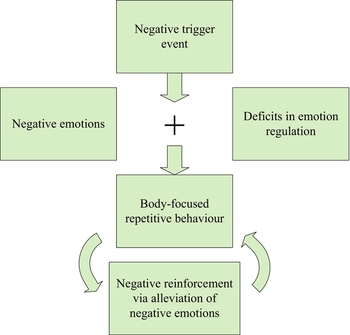
In accordance with this, the ER model for BFRBs proposes that individuals with BFRBs have difficulty regulating negative emotions and engage in body-focused behaviours to avoid or alleviate aversive affect. Thus, negative emotional experiences trigger BFRBs, and relief from negative emotion maintains and reinforces the behaviour, although stimulation may engender positive reinforcement as well. The ER model further suggests that individuals with BFRBs are characterized by a general deficit in ER (Snorrason et al. Reference Snorrason, Smári and Ólafsson2010). Episodes of BFRBs are hypothesized to result from a drive to stop experiencing a given affective state, and a lack of alternative methods for coping (Shusterman et al. Reference Shusterman, Feld, Baer and Keuthen2009) (Fig. 1).
The global emotional regulation model.

Research on ER and BFRBs
Shusterman et al. (Reference Shusterman, Feld, Baer and Keuthen2009) explored the relationship between HP and ER in an online sample of 1162 individuals reporting uncontrollable HP or urge to engage in HP and a control group. Participants completed a measure of HP severity and a measure of ability to regulate affect. Hair pullers reported more difficulty ‘snapping out [sic]’ (Shusterman et al. Reference Shusterman, Feld, Baer and Keuthen2009) of affective states than did the control group; the largest differences between groups were for anxiety, shame, tension, and boredom. Self-reported capacity for ER was correlated with HP severity, and difficulty regulating particular emotions predicted the degree to which those emotions triggered HP.
Snorrason et al. (Reference Snorrason, Smári and Ólafsson2010) compared individuals with SP causing skin damage and distress or impairment with a control group on measures of ER and emotion reactivity (the tendency to experience emotions frequently, intensely, and persistently). The SP group reported greater difficulties with ER and greater emotion reactivity than did controls. ER and emotion reactivity each contributed to the prediction of SP after controlling for anxiety, worry, and depression.
Other questionnaire studies have explored the ER model for BFRBs by retrospectively evaluating the presence and intensity of diverse emotions before, during, and after episodes of BFRB. In clinical samples, individuals with HP and SP consistently report decreases in boredom, tension, and anxiety over the course of a pulling or picking episode, and increases in guilt, shame, sadness, and relief following a BFRB episode (Wilhelm et al. Reference Wilhelm, Keuthen, Deckersbach, Engelhard, Forker, Baer, O’Sullivan and Jenike1999; Diefenbach et al. Reference Diefenbach, Mouton-Odum and Stanley2002; Neal-Barnett & Stadulis, Reference Neal-Barnett and Stadulis2006). Studies using non-clinical samples have also found that boredom, anxiety, indifference, tension, and frustration are often present prior to BFRB; these states remain stable or increase during BFRBs, and are subsequently replaced by guilt, relief, indifference, and satisfaction (Bohne et al. Reference Bohne, Wilhelm, Keuthen, Baer and Jenike2002; Mansueto et al. Reference Mansueto, Thomas and Brice2007; Duke et al. Reference Duke, Bodzin, Tavares, Geffken and Storch2009). Some individuals also report pleasure or gratification during HP or SP (Bohne et al. Reference Bohne, Wilhelm, Keuthen, Baer and Jenike2002; Snorrason et al. Reference Snorrason, Smári and Ólafsson2010).
Research on specific emotions
Experimental research on ER and BFRBs has sought to identify the specific emotions that trigger BFRB. Teng et al. (Reference Teng, Woods, Marcks and Twohig2004) used video segments to induce boredom, anxiety, and depression in non-clinical participants with and without BFRBs. The BFRB group demonstrated significantly more BFRBs in the boredom condition than in the anxiety, depression, or control conditions. Similarly, Williams et al. (Reference Williams, Rose and Chisholm2006) experimentally induced boredom and frustration in undergraduates reporting NB, and compared behaviour in the boredom and frustration conditions with behaviour in a social interaction condition and a social disapproval condition. They observed that participants were more likely to engage in NB in the boredom and frustration conditions. Furthermore, Williams and colleagues reported that participants endorsed boredom and discomfort as conditions likely to trigger NB.
These experimental results are supported by reports from individuals with BFRBs that they engage in BFRBs when they are bored, frustrated, or inactive (Bohne et al. Reference Bohne, Wilhelm, Keuthen, Baer and Jenike2002; Diefenbach et al. Reference Diefenbach, Mouton-Odum and Stanley2002; O'Connor et al. Reference O'Connor, Brisebois, Brault, Robillard and Loiselle2003; Duke et al. Reference Duke, Keeley, Ricketts, Geffken and Storch2010), or during activities requiring passive attendance or waiting (O'Connor et al. Reference O'Connor, Brisebois, Brault, Robillard and Loiselle2003). The majority of participants associated BFRB onset with a tense state (e.g. Diefenbach et al. Reference Diefenbach, Tolin, Meunier and Worhunsky2008; Shusterman et al. Reference Shusterman, Feld, Baer and Keuthen2009).
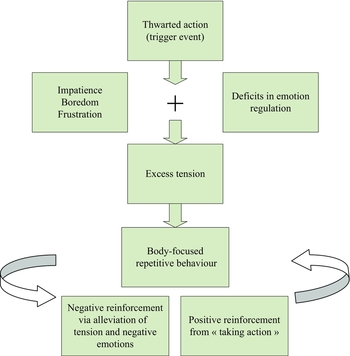
In a further experimental study, Roberts et al. (Reference Roberts, O'Connor, Aardema and Bélanger2015) reported that the BFRB group was more likely to engage in BFRBs when bored and frustrated than during relaxation. The results of research to date on BFRBs and ER indicate that deficits in ER may differentiate individuals with BFRBs from controls. BFRBs seem to decrease negative emotions such as boredom, tension, and anxiety, and trigger shame, guilt, and relief. Some evidence suggests that emotions such as boredom, tension, and frustration are particularly likely to trigger BFRBs. Further direct comparisons of ER and, in particular, the role of specific emotions in individuals with BFRBs and controls, are warranted and lead to a frustration action model of BFRB onset (see Roberts et al. Reference Roberts, O'Connor and Bélanger2013, Reference Roberts, O'Connor, Aardema and Bélanger2015). The frustrated action (FA) model proposes that individuals with BFRBs have an overprepared and an overactive style of action (i.e. they invest more effort than necessary, they try to accomplish too much), and perfectionist beliefs relating to personal organization, which, taken together, lead to a build-up in tension and frustration. Finally, the accumulated tension and frustration are regulated through BFRBs (Fig. 2).
The frustrated action model.

Current study
The current study is a preliminary work designed to test the ER model by exploring differences between individuals reporting BFRBs and a control group on measures of ER, and to test the FA model by identifying emotions particularly likely to trigger BFRBs. The study focuses on HP, SP, and NB, the BFRBs that have received the most research attention and are the most clearly defined. First, we hypothesized that the BFRB group would show greater difficulty regulating emotions, specifically boredom, tension and frustration than would controls, by scoring higher on the two ER questionnaires. Second, we hypothesized that in the BFRB group, boredom, tension and frustration would trigger BFRBs.
Method
Participants, recruitment, and informed consent
Participants were recruited via the website of the research centre of the Montreal University Institute in Mental Health; an online community bulletin board; recruitment posters in local universities, cafes, and healthcare institutions; and from lists of control participants from past or current studies at the research centre. All participants completed a 15- to 30-min telephone screening interview regarding sociodemographic variables, BFRB severity and degree of impairment, and medical variables that could contribute to BFRBs. Potential participants were screened for comorbid Axis I psychopathology using modules from the Structured Clinical Interview for DSM-IV (SCID; First et al. Reference First, Spitzer, Gibbon and Williams2002).
Inclusion criteria for the BFRB group were the following: (a) age 18–65 years; (b) current BFRB with a subjective severity rating of at least 3/10, or significant distress or impairment from BFRBs; (c) a BFRB as a primary presenting problem, even if another psychological problem or disorder was present; (d) if on psychotropic medication, medication had to be stabilized for 3 months. Inclusion criteria for the control group were the following: (a) age 18–65 years; (b) if on psychotropic medication, medication had to be stabilized for 3 months; and (c) if HP, SP, or NB were present, the behaviour had to be non-chronic, sporadic and intermittent and non-distressing and not cause significant impairment in functioning. The control group did not meet criteria for the presence of BFRBs. Although, given that some form of HP, SP, or NB is common in many populations (Hansen et al. Reference Hansen, Tishelman, Hawkins and Doepke1990; Teng et al. Reference Teng, Woods, Twohig and Marcks2002), we did not attempt to recruit a control sample with zero BFRBs. Exclusion criteria were the following: (a) DSM-IV Axis I or II disorder other than HP or SP as the primary presenting problem; (b) alcohol or drug abuse; and (c) BFRB comorbid with chronic tics or Tourette's syndrome.
Assessment measures
Subsequent to the telephone screening interview, eligible participants were mailed a questionnaire package to complete at home. The participants in the present study also participated in an experimental study (Roberts et al. Reference Roberts, O'Connor, Aardema and Bélanger2015) and received identical assessment. The assessment package included the Symptom Checklist-90 – Revised (SCL-90-R; Derogatis, Reference Derogatis2000) and the Massachusetts General Hospital Hair Pulling Scale (MGH-HPS; Keuthen et al. Reference Keuthen, O'Sullivan, Ricciardi, Shera, Savage, Borgmann, Jenike and Baer1995) and analogue SP, NB, and skin-scratching scales. Although skin scratching is a component of SP (Keuthen et al. Reference Keuthen, Koran, Aboujaoude, Large and Serpe2010a ; Tucker et al. Reference Tucker, Woods, Flessner, Franklin and Franklin2011), it is not directly addressed in the MGH scale used to measure SP. A separate scale for skin scratching was therefore included to ensure that the complete range of SP behaviour was captured. The package also included a standard consent form approved by the Montreal University Institute in Mental Health research ethics committee which participants were required to read at home prior to beginning the questionnaire battery, and it was later reviewed and signed at the research centre. Participants completed the Difficulties in Emotion Regulation Scale (DERS; Gratz & Roemer, Reference Gratz and Roemer2004), Affective Regulation Scale and Hair Pulling Triggers Scale (ARS, HTS; Shusterman et al. Reference Shusterman, Feld, Baer and Keuthen2009) at the research centre. For all but the SCL-90-R, French-speaking participants completed a French-Canadian version of the questionnaire, translated using a back-translation and consensus procedure (Vallerand, Reference Vallerand1989).
-
(1) Massachusetts General Hospital Hair Pulling Scale. The MGH-HPS (Keuthen et al. Reference Keuthen, O'Sullivan, Ricciardi, Shera, Savage, Borgmann, Jenike and Baer1995) is a 7-item self-report measure of HP behaviours, using a 5-point scale. The scale assesses the frequency and intensity of HP during the past month, producing a total HP severity score. In the current study, the MGH-HPS demonstrates good internal consistency for the total sample (α = 0.83) and test–retest reliability (r = 0.97). Participants also completed analogue SP, NB, and skin scratching scales (i.e. the MGH-HPS with the term hair pulling replaced by skin picking, nail biting, and skin scratching, respectively). Although BFRBs are heterogeneous, they can be measured along the same parameters (i.e. frequency of behaviour, subjective severity of behaviour, distress induced by behaviour). Although an SP scale has been validated (Keuthen et al. Reference Keuthen, Deckersbach, Wilhelm, Engelhard, Forker, O'Sullivan, Jenike and Baer2001), we chose to use an analogue scale for SP, as well as for NB and skin scratching, in order to obtain comparable severity scores across BFRBs.
-
(2) Affective Regulation Scale. The ARS (Shusterman et al. Reference Shusterman, Feld, Baer and Keuthen2009) lists nine emotions (bored, angry, guilty, indifferent, tense, irritable, sad, anxious, ashamed). The instruction for the participants is ‘check the circle that indicates your ability to control each of these emotions. How easily can you “snap out of it?”’. The ARS employs a five-point scale with answers ranging from ‘never able to control’ (0) to ‘always able to control’ (5). Cronbach's α of internal consistency for the current total sample was 0.83, which is satisfactory.
-
(3) Hair Pulling Triggers Scale. The HTS (Shusterman et al. Reference Shusterman, Feld, Baer and Keuthen2009) requires participants to ‘indicate how likely each mood is to cause hair pulling’. The HTS uses the same nine emotions as does the ARS, and possible answers are always, sometimes, and never. For the current study, ‘hair pulling’ was changed to ‘hair pulling’, ‘skin picking’, or ‘nail biting’. The HTS demonstrates strong internal consistency for the current total sample (α = 0.93).
-
(4) Difficulties in Emotion Regulation Scale. The DERS (Gratz & Roemer, Reference Gratz and Roemer2004) is a 36-item self-report measure which measures six dimensions of difficulties with ER, namely: (1) non-acceptance of emotional responses; (2) difficulties engaging in goal-directed behaviour; (3) impulse control difficulties; (4) lack of emotional awareness; (5) limited access to effective ER strategies; and (6) lack of emotional clarity. For the current study, the DERS demonstrates strong internal consistency for the current total sample (α = 0.94). Internal consistency for the subscales was as follows: non-acceptance of emotional responses (α = 0.81); difficulties engaging in goal-directed behaviour (α = 0.83); difficulties in impulse control (α = 0.88); lack of emotional awareness (α = 0.84); lack of access to ER strategies (α = 0.83); and lack of emotional clarity (α = 0.88).
-
(5) Symptom Checklist-90 – Revised. The SCL-90-R (Derogatis, Reference Derogatis2000; Derogatis & Savitz, Reference Derogatis, Savitz and Maruish2000) is a 90-item psychiatric self-report inventory. Participants indicate the rate of symptom occurrence during the past week using a five-point Likert scale. The SCL-90-R yields three global distress indices. French-speaking participants completed the validated French-Canadian (Fortin & Coutu-Wakulczyk, Reference Fortin and Coutu-Wakulczyk1985) version of this scale. The scale demonstrated strong internal consistency as calculated for our samples (BFRB: α = 0.958; controls: α = 0.974).
Results
In 1 year, 111 individuals responded to our recruitment advertisements. Forty-one dropped out of the study prior to or following the telephone screening interview and 22 were excluded following the interview; 48 participants (BFRB: n = 24; controls: n = 24) completed the study. In the BFRB group, six participants reported HP, six reported SP, and 12 reported NB. Given our moderate sample size, individuals with HP, SP, and NB were collapsed to form a single group of individuals with BFRBs. One control participant was excluded because she denied BFRBs during the telephone interview but endorsed significant BFRBs on all four MGH scales.
For all questionnaire measures, missing data was replaced on questionnaires that were at least 80% complete by the total sample's mean for that item. This method was chosen over other missing data approaches such as multiple imputations because of the very low ratio of missing values. All participants completed the MGH-HPS and three analogue scales. For control participants, MGH score was the mean of their scores on all four scales. For participants in the BFRB group, MGH score was their score on the scale responding to their reported habit, with several exceptions.
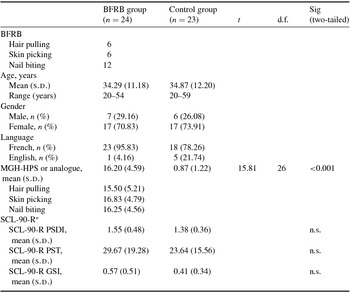
The final sample (N = 47) was primarily female (n = 34), with an average age of 34.57 years (range 20–59 years). There were no significant differences between groups in age, gender, or language. A significant difference between groups was observed on the MGH scale (t = 15.811, p < 0.001); mean score was 16.21 (s.d. = 4.59) in the BFRB group and 0.87 (s.d.= 1.22) in the control group. No significant differences in MGH score were observed between individuals with HP, SP, and NB. Scores on SCL-90-R global distress dimensions [Global Severity Index (GSI), Positive Symptom Total, Positive Symptom Distress Index] were somewhat above average but fell within the norms for the measure; between-group differences were not significant. GSI data was abnormal, and was therefore transformed using a log transformation prior to comparison of means (see Table 1).
Demographic and clinical data for the control group and body-focused repetitive behaviour (BFRB) group

MGH-HPS, Massachusetts General Hospital Hair Pulling Scale; SCL-90-R, Symptom Checklist-90 – Revised; PSDI: Positive Symptom Distress Index; PST, Positive Symptom Total; GSI, Global Severity Index.
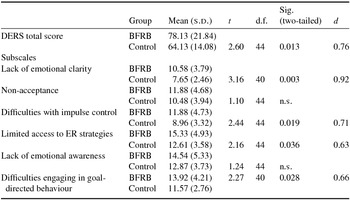
In accordance with hypothesis 1, independent samples t tests were conducted to identify between-group differences in ER on the DERS and ARS. Overall for the DERS, the BFRB group and the control group differed significantly (p < 0.02) with a medium effect size (d = 0.76). Significant differences between groups were observed on several subscales, including lack of emotional clarity (t 44 = 3.16, p = 0.003), difficulties in impulse control (t 44 = 2.44, p = 0.019), limited access to ER strategies (t 44 = 2.16, p = 0.036), and difficulty engaging in goal-directed behaviour (t 40= 2.27, p = 0.028). Effect sizes (Cohen's d) were moderate to large, ranging from 0.66 to 0.92 (see Table 2).
Differences between control group and body-focused repetitive behaviour (BFRB) group on the Difficulty in Emotional Regulation Scale (DERS)

n.s., Not significant.
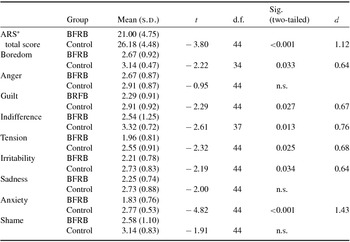
As for the ARS, the BFRB and control groups reported significant differences (p < 0.002) with an overall large effect size (d = 1.12). The BFRB group experienced more problems ‘snapping out’ of emotions. The greatest between-group differences were demonstrated for ability to regulate anxiety (t 44= -4.82, p < 0.001) and indifference (t 37 = -2.61, p = 0.013), followed by tension (t 44= -2.32, p = 0.025), guilt (t 44 = 2.29, p = 0.027), boredom (t 34 = -2.22, p = 0.033) and irritability (t 44= -2.19, p = 0.034) Between-group differences in anger, sadness, and shame were not significant. Effect sizes (Cohen's d) were medium to large, ranging from 0.64 to 1.43 (see Table 3).
Differences between control group and the body-focused repetitive behaviour (BFRB) group on the affective regulation scale (ARS) (ability to ‘snap out’ of emotions)

n.s., Not significant.
*Only 22 control participants completed this scale.
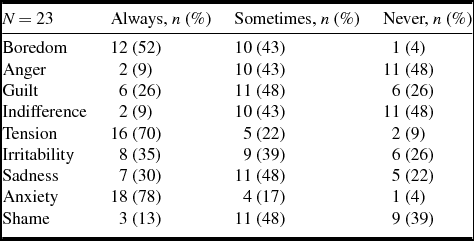
Regarding the second hypothesis, on the HTS, participants in the BFRB group reported that the affective states most likely to trigger BFRBs were anxiety, boredom, and tension. Seventy-eight percent reported that anxiety always triggered BFRBs; 70% reported that tension always triggered BFRBs, and 52% reported that boredom always triggered BFRBs. For both anxiety and boredom, 96% of participants reported that these emotions always or sometimes triggered BFRBs; 91% reported that tension always or sometimes triggered BFRBs. The emotions rated as least likely to trigger BFRBs were anger, indifference, and shame (see Table 4).
Body-focused repetitive behaviour group mood responses to ‘Please indicate how likely each mood is to cause hair pulling, skin picking, or nail biting’

Discussion
Consistent with the first hypothesis, significant between-group differences on total scores on the ARS and DERS indicated that individuals with BFRBs differ from controls in terms of ability to regulate emotions. Indeed, on the ARS, individuals with BFRBs reported greater difficulty regulating every emotion measured, with significant between-group differences in six of the nine emotions (i.e. anxiety, irritability, boredom, guilt, tension, indifference). On the DERS, significant differences between groups were observed for several subscales, including lack of emotional clarity, difficulties with impulse control, limited access to ER strategies, and difficulties engaging in goal-directed behaviour. These results suggest that individuals with BFRBs differ from controls in ability to understand emotional responses and in ability to access and implement goal-directed ER strategies. They further suggest a relationship between BFRBs and impulse control, a finding that is consistent with the categorization of HP as an impulse control disorder in DSM-IV (APA, 2000).
The second hypothesis, that BFRBs would be triggered by boredom, tension and frustration was partially corroborated. On the HTS, two thirds of BFRB group participants reported that tension always triggers BFRBs; over 50% of the BFRB group reported that boredom always triggers BFRBs. These results partially support the frustration action model (Roberts et al. Reference Roberts, O'Connor and Bélanger2013), and further data relating the ARS and DERS to style of planning and perfectionism are reported in Roberts et al. (Reference Roberts, O'Connor, Aardema and Bélanger2015).
Although participants in the present study endorsed boredom and tension as triggers for HP, SP, and NB, anxiety was the emotion reported to be the most likely to trigger BFRBs, with three quarters of the BFRB group endorsing anxiety as a regular trigger. This result may be attributable to variance between studies and between participants as to the definition of various emotions. Any study in which participants are asked to report on their emotional state presents the possibility of idiosyncratic definitions and experiences of emotions. For example, the affective state that one individual experiences as ‘anxiety’ may be defined by another individual as ‘tension’. This finding is consistent with Shusterman et al.’s (Reference Shusterman, Feld, Baer and Keuthen2009) argument that more idiographic assessment of ER difficulties is warranted for hair pullers (and by extension, to all BFRBs) and with Keuthen et al.’s (Reference Keuthen, Rothbaum, Fama, Altenburger, Falkenstein, Sprich, Kearns, Meunier, Jenike and Welch2012) comment that assessment tools that better capture ER and the full range of emotional triggers potentially related to HP (and the other BFRBs) are required.
Another possible explanation for the high score attributed to anxiety is related to the scores on the DERS. Indeed, if individuals with BFRBs present a significant lack of emotional clarity and a lack of ability to understand their emotions, they may experience a diffuse aversive arousal, anxiety or inner tension instead of a specific emotion such as anger or shame. Consequently, responses on the ARS may not represent idiosyncratic emotions. Keuthen et al. (Reference Keuthen, Rothbaum, Fama, Altenburger, Falkenstein, Sprich, Kearns, Meunier, Jenike and Welch2012) made similar comment when they found no significant correlations between ER capacity and HP measures reported at baseline. Thus, a lack of emotional awareness at baseline may skew results on ER capacity (Keuthen et al. Reference Keuthen, Rothbaum, Fama, Altenburger, Falkenstein, Sprich, Kearns, Meunier, Jenike and Welch2012), which is in line with a study conducted by Rufer et al. (Reference Rufer, Bamert, Klaghofer, Moritz, Schilling and Weidt2014) on the role played by alexithymia in hair-pulling behaviours. Rufer et al. (Reference Rufer, Bamert, Klaghofer, Moritz, Schilling and Weidt2014) found that the strongest predictor for the severity of HP was the difficulty in identifying feelings (DIF) facet of alexithymia. These findings suggest that alexithymic deficits, in particular DIF, could largely explain the difficulties with ER observed in people with HP. HP may then serve as a maladaptive coping strategy to reduce the unpleasant state induced, to a certain degree, by alexithymia. This may be relevant for both ‘focused’ and ‘automatic’ HP styles (and so for SP and NB).
All this considered, we propose the following sequence: individuals with BFRBs may experience unpleasant emotions triggered by an internal or external event; some individuals may be aware of these particular emotions, while others may not; some individuals can properly identify them, while others cannot; either way, the focused or automatic impulse to engage in BFRBs could then arise; finally, BFRBs could be used as a compensatory mechanism to regulate emotions.
Clinical implications and future research
The results demonstrate that individuals with HP, SP, and NB have difficulty with ER, and could provide support for a model of BFRBs centred around affect regulation. Future research could investigate this more specific model.
It follows that individuals with BFRBs could benefit from treatments designed to address the internal experiences. In this regard, several CBT treatments with strategies for treating ER issues should be considered. Indeed, in addition to stimulus control (SC) and habit-reversal training (HRT), which are known to be effective CBT treatments for BFRBs (e.g. Azrin & Nunn, Reference Azrin and Nunn1973; Twohig & Woods, Reference Twohig and Woods2001; Bate et al. Reference Bate, Malouff, Thorsteinsson and Bhullar2011; Schuck et al. Reference Schuck, Keijsers and Rinck2011) there are various strategies to help individuals cope with difficulties in ER, such as relaxation training, stress reducing strategies and cognitive restructuring (Woods et al. Reference Woods, Wetterneck and Flessner2006; Franklin & Tolin, Reference Franklin and Tolin2007). Likewise, in addition to SC and HRT, dialectical behaviour therapy for BFRBs (DBT; Keuthen et al. Reference Keuthen, Rothbaum, Welch, Taylor, Falkenstein, Heekin, Jordan, Timpano, Meunier, Fama and Jenike2010 b, Reference Keuthen, Rothbaum, Fama, Altenburger, Falkenstein, Sprich, Kearns, Meunier, Jenike and Welch2012) and acceptance and commitment therapy (ACT; Woods et al. Reference Woods, Wetterneck and Flessner2006) and have shown promising results. For instance, Woods et al. (Reference Woods, Wetterneck and Flessner2006) found that ACT-enhanced HRT was more effective than wait-list in reducing HP, and the treatment gains were maintained at the 3-month follow-up. Similarly, Keuthen et al. (Reference Keuthen, Rothbaum, Fama, Altenburger, Falkenstein, Sprich, Kearns, Meunier, Jenike and Welch2012) demonstrated significant improvements in HP severity and impairment, ER capacity, experiential avoidance, and mood and anxiety with a DBT-enhanced cognitive-behavioural treatment protocol. The improvements were maintained from baseline to 3- and 6-month follow-up. Moreover, changes in HP severity from baseline to 3- and 6-month follow-up were correlated with changes in ER capacity.
In sum, therapeutic approaches that support individuals with BFRBs in recognizing and differentiating feelings might be helpful in addition to the use of standard cognitive-behavioural programmes such as HRT. Future research should prospectively evaluate additional effects of interventions that specifically address the ability to regulate emotions. Another important avenue for clinical research should be to investigate the role that might be played by a lack of emotional clarity, a lack of emotional awareness and alexithymia in BFRBs. Moreover, studies on the similarities and distinctions between these phenomena are needed, as are studies on ways to properly measure them for BFRBs.
Limitations
Several limitations of the present study must be acknowledged. First, given our small sample size and the exploratory nature of the study, individuals with all three BFRBs were collapsed into one BFRB group. Although similarities across disorders have been demonstrated, it is possible that different emotional triggers are relevant in different disorders and that collapsing HP, SP, and NB into one group could obscure differences between BFRBs. Studies of ER in each BFRB separately are warranted. Moreover, due to the limited sample size, mainly composed of French-speaking individuals with large age variability, any conclusions that are drawn can be generalized.
Second, the use of certain non-validated questionnaires (e.g. the MGH-HPS modified for NB and SP) limits the validity of these measures, although the internal consistency was satisfactory or good. Likewise, the use of self-report scales does not work around the problems of subjectivity, lack of insight, and social desirability.
Third, the missing data of some questionnaires was replaced by substituting the subscale mean. This method has historically been acceptable but the use of multiple imputation methods may have been more appropriate.
Fourth, the current study did not identify participants' BFRBs as primarily ‘focused’ or primarily ‘automatic’, a distinction that might have permitted exploration of the specific ER-related functions of the two dimensions of BFRBs, and their clinical implications.
Finally, the results of the study presented here do not address the precise mechanism by which BFRBs could regulate negative affective states.
Conclusion
Despite these limitations, the present study did directly measure ER in individuals with BFRBs, and provides further evidence for the role of ER in explaining the persistence of destructive body-focused behaviours such as HP, SP, and NB. The contribution of the current study is to clarify what emotions trigger BFRBs and what emotions did not, plus noting difficulties in the BFRB group in understanding emotions and accessing goal-directed regulation strategies. The results indicate that individuals with BFRBs demonstrate greater difficulties with ER than do controls, and corroborates the findings of others studies reporting deficits in ER may contribute to the development and maintenance of BFRBs.
Summary of the main points
-
• ER plays a role in the persistence of BFRBs.
-
• Boredom, tension and anxiety were triggers for BFRBs.
-
• The BFRB group may have a lack of emotional awareness, and may also have difficulties understanding emotions and accessing goal-directed regulation strategies.
-
• Cognitive and behavioural therapies for individuals with BFRBs should target emotional awareness and the ability to regulate emotions.
Ethical standards
This study received appropriate ethical review and approval, and meets all ethical research standards.
Acknowledgements
This research was supported by grants from Fonds de la Recherché du Québec – Santé.
Declaration of Interest
None.
-
(1) Individuals with BFRBs reported more difficulties with emotion regulation than a control group on measures of emotion regulation.
-
(2) Specific emotions such as boredom, tension, and anxiety seem to partially support frustration action as a trigger for BFRBs.
-
(3) The results highlighted the importance of providing interventions for individuals with BFRBs that specifically target awareness of emotions and the ability to regulate emotions.



Comments
No Comments have been published for this article.