Introduction
Hunting is an important source of livelihoods for rural populations in tropical forests, especially in isolated regions with limited access to markets of domesticated livestock (Milner-Gulland et al. Reference Milner-Gulland and Bennett2003, Antunes et al. Reference Antunes, Rebêlo, Pezzuti, de Mattos Vieira, de Araujo and Constantino2019). Medium and large-bodied terrestrial vertebrates are the main target species (Fa et al. Reference Fa, Peres and Meeuwig2002, Jerozolimski & Peres Reference Jerozolimski and Peres2003, Milner-Gulland et al. Reference Milner-Gulland and Bennett2003), but these play key roles in important ecosystem processes, such as seed dispersal, herbivory and nutrient cycling (Redford Reference Redford1992, Turner et al. Reference Turner, Brandon, Brooks, Costanza, da Fonseca and Portela2007, Sobral et al. Reference Sobral, Silvius, Overman, Oliveira, Rabb and Fragoso2017). Subsistence hunting can lead to game depletion if it is not practised at sustainable levels (Bodmer et al. Reference Bodmer, Eisenberg and Redford1997, Ripple et al. Reference Ripple, Abernethy, Betts, Chapron, Dirzo and Galetti2016). This raises concerns over maintaining stable game populations so that they can exert their ecological functions and ensure food security for forest dwellers who depend on game meat (Muller-Landau Reference Muller-Landau2007, Nasi et al. Reference Nasi, Taber and Van Vliet2011). Therefore, it is critical that more studies address concerns regarding hunting sustainability and local food security.
Assessments of the sustainability of subsistence hunting can reveal how game harvesting impacts key vertebrate populations (Robinson & Bodmer Reference Robinson and Bodmer1999, Milner-Gulland & Akçakaya Reference Milner-Gulland and Akçakaya2001). Sustainability can be assessed by monitoring hunting yields, especially by recording the catch per unit of effort (CPUE), thereby ensuring that population trends can be quantified over time or between areas subjected to different levels of hunting pressure (Vickers Reference Vickers1988, Cowlishaw et al. Reference Cowlishaw, Mendelson and Rowcliffe2005, Ohl-Schacherer et al. Reference Ohl-Schacherer, Shepard, Kaplan, Peres, Levi and Yu2007, Kümpel et al. Reference Kümpel, Milner-Gulland, Cowlishaw and Rowcliffe2009). This requires long-term data on game offtake, which can be acquired using community-based monitoring programmes. For example, in the continental region of Equatorial Guinea, Central Africa, a decrease in CPUE (biomass per hunter) observed over 5 years represented evidence that hunting was unsustainable over time (Kümpel et al. Reference Kümpel, Milner-Gulland, Cowlishaw and Rowcliffe2009).
In the Brazilian Amazon, hunting is an essential subsistence activity to ensure the food security and sovereignty of rural population (Antunes et al. Reference Antunes, Rebêlo, Pezzuti, de Mattos Vieira, de Araujo and Constantino2019). Part of this population occupies Sustainable Use Protected Areas (SUPAs) such as Extractive Reserves (ERs), which aim to reconcile biodiversity conservation and the sustainable use of natural resources by local populations (National System of Conservation Units, Law 9985/2000). However, it is unclear whether subsistence hunting is compatible with these goals (Redford & Sanderson Reference Redford and Sanderson2000, Schwartzman et al. Reference Schwartzman, Moreira and Nepstad2000, Terborgh Reference Terborgh2000, Peres & Zimmerman Reference Peres and Zimmerman2001, Terborgh & Peres Reference Terborgh and Peres2017). Another concern relates to the legal status of subsistence hunting within these SUPAs, which is ambiguous in Brazilian Law (Antunes et al. Reference Antunes, Rebêlo, Pezzuti, de Mattos Vieira, de Araujo and Constantino2019). This makes it difficult to legally establish consistent sustainable hunting management protocols, further threatening the maintenance of this irreplaceable socioeconomic resource (Nunes et al. Reference Nunes, Peres, Constantino, Santos and Fischer2019). Therefore, it is critical to understand whether subsistence hunting is compatible with the management goals of SUPAs, further reinforcing the need for adequate public policies regulating subsistence hunting.
Here, we assess the sustainability of subsistence hunting in 30 riparian forest communities (the typical pattern of settlement within Amazonian SUPAs) within two ERs. Our assessment is based on hunting yields over 63 months using long-term hunting data derived from a community-based monitoring programme. We modelled hunting yields in terms of CPUE using a Bayesian approach applied to the entire assemblage of game species and the six most hunted species. We assume that stable or increasing CPUE during the study period represents evidence that hunting was most probably sustainable. We also assess the prey species composition within harvest profiles across different communities.
Methods
Study area
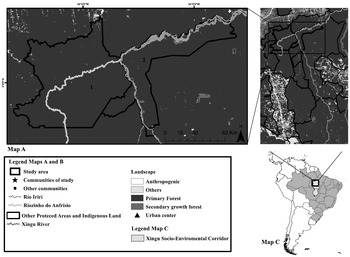
The study area comprises a c. 300-km section of the Iriri and Riozinho do Anfrísio rivers within two SUPAs: the Rio Iriri ER (363 200 ha) and the Riozinho do Anfrísio ER (736 340 ha), located in the middle portion of the Xingu River basin, state of Pará, eastern Brazilian Amazon (Fig. 1). These ERs are part of a 7 900 000 km2 region known as Terra do Meio (Fig. 1) between the Iriri and Xingu rivers. Terra do Meio is formed of a mosaic of federal- and state-level protected areas (PAs) and Indigenous lands (ILs), and it makes up one of the largest socioenvironmental corridors on Earth – the Xingu Socioenvironmental Corridor – because of its extensive tracks of pristine Amazonian forests and immense cultural diversity (Schwartzman et al. Reference Schwartzman, Boas, Ono, Fonseca, Doblas and Zimmerman2013). However, it is located within an aggressive frontier region of unconsolidated agribusiness and illegal logging and mining (Schwartzman et al. Reference Schwartzman, Boas, Ono, Fonseca, Doblas and Zimmerman2013, Doblas Reference Doblas2015, ISA 2016).
Diagrammatic maps of the study area. Map A: Locations of the two Extractive Reserves in this study: (1) Riozinho do Anfrísio and (2) Rio Iriri. Map B: Part of the Terra do Meio region. Map C: Location of the Xingu Socioenvironmental Corridor in South America.

The human population density in these ERs is currently estimated at only c. 0.113 persons/km2, consisting of 207 families, 93 within the Riozinho do Anfrísio ER and 114 within the Rio Iriri ER (Riozinho do Anfrísio and Rio Iriri Extractive Reserves Community Council, unpublished data 2019). These families are organized into c. 59 communities (35 at Riozinho do Anfrísio ER and 24 at Rio Iriri ER). The resident population, known as ribeirinhos (riverside dwellers), largely descends from rubber tappers, formed mainly of immigrants from north-east Brazil who were attracted to non-timber resource stocks (e.g., the natural latex of Hevea brasiliensis trees) during the early twentieth-century rubber boom (Almeida Reference Almeida2012). After the end of World War II in 1945, the demand for rubber declined and rubber tappers moved into alternative economic activities, including fishing, Brazil nut (Bertholletia excelsa) extraction and harvesting of cat skins for the fur industry, which was banned in the 1970s (Antunes et al. Reference Antunes, Fewster, Venticinque, Peres, Levi, Rohe and Shepard2016). Currently, the vast majority of the local population is economically dependent on the fish trade and extractivism and relies on fishing, hunting, small-scale horticulture and non-timber extractivism for subsistence (Balée et al. Reference Balée, de Oliveira, dos Santos, Amaral, Rocha and Guerrero2020, Rezende Reference Rezende2020).
The forest landscapes in the study region are dominated by upland forest (‘Terra Firme’), which is largely intact (Fig. 1). Seasonally flooded areas are more prevalent along the Iriri River, known locally as igapós and sarobais (Salomão et al. Reference Salomão, Vieira, Suemitsu, de Araújo Rosa, de Almeida, do Amaral and de Menezes2007). The climate is tropical humid, with a marked dry season from June to November. Mean annual rainfall is 2000 mm (ISA 2003). During the dry season, local river discharge can be reduced by nearly 95% (Pezzuti Reference Pezzuti2008).
Community surveys
Hunting data were obtained from the Brazilian Monitoring Program in Federal Protected Areas (Monitora Program; ICMBio/Monitora, 2018), which has the main goal of monitoring biodiversity and its uses within federal PAs at the national scale (Costa-Pereira et al. Reference Costa-Pereira, Roque, Constantino, Sabino and Uehara-Prado2013). Specifically, our data come from the Participatory Hunting Monitoring (PHM) programme, which is a part of the Monitora Program. In the study area, the PHM has been monitoring hunting and fishing activities since July 2014, and data were collected by local residents (monitors) using standardized household questionnaires at intervals of 15 days. Local monitors signed a consent form, had been previously trained and were provided with financial support and fuel to reach even remote localities where questionnaires were deployed. Unfortunately, the PHM programme was interrupted in 2020 due to drastic budget cuts at the Instituto Chico Mendes of Biodiversity Conservation, the government agency that manages all federal-level PAs in Brazil.
Questionnaires included a set of questions regarding the last hunting foray conducted by household members. A total of 252 people (predominantly hunters) from 30 communities were monitored (Fig. 1) from July 2014 to December 2019 (details in Supplementary Table S1, available online). The data collected for each hunting foray included the date, the start and end time of each activity, the number of hunters involved, hunting success and whether game pursuit was either intentional or opportunistic (i.e., interviewees were able to kill an animal while involved in other activities, such as fishing or agriculture). For successful hunts, the species and number of animals killed were recorded and, whenever possible, the local monitor weighed the animal(s) brought to the communities, most frequently without viscera and the head, using a set of size-graded scales from 1 to 50 kg. All recorded interviews were analysed for the validation of this work (see validation process in Appendix S1).
Hunting yields
Hunting yields are expressed in CPUE, which was calculated as the aggregate prey biomass (g) per hunter per hour spent hunting (g hunter–1 h–1) after hunt time was converted into decimal numbers (i.e., 6 h 30 min = 6.5 h). During interviews, local monitors recorded the species’ local name, but these names were not standardized, even with continued oversight of the monitors (Appendix S1). Whenever a taxonomic validation was necessary, prey species were assigned to genus or family (Appendix S1). CPUE was calculated for the entire assemblage of prey species (16 species, 63 months of data) and for the six most hunted species: Tayassu pecari (57 months of data), large cracids (Pauxi tuberosa or Crax fasciolata; 47 months of data), Cuniculus paca (44 months of data), Mazama spp. (42 months of data), Tapirus terrestris (38 months of data) and Pecari tajacu (30 months of data). To estimate the animal mass that was not weighed we used the mean mass of weighed animals per species (>10 individuals), and if that was not possible we used the mean of the adult body mass values from Eisenberg and Redford (Reference Eisenberg and Redford1999) and Peres and Palacios (Reference Peres and Palacios2007). Due to the exceptionally large body size of T. terrestris (c. 160 kg), the CPUE for this species is expressed as kg hunter–1 h–1.
Data analysis
To assess the abundance-weighted game species composition across the monitored communities we used the number of animals killed per species as the response variable. In order to account for interviewing effort (number of interviews per community; see Table S1) we used the overall number of animals killed on a log(x + 1) scale. Kills of both large felids (jaguar and puma), which are not consumed for subsistence, were excluded from these analyses. We performed a non-metric multidimensional scaling (NMDS) ordination based on the Bray–Curtis species similarity matrix using a bootstrapping approach with 999 permutations to assess the significance between the differences observed. These analyses were performed using the vegan package (Oksanen et al. Reference Oksanen, Blanchet, Friendly, Kindt, Legendre and McGlinn2018) in R version 3.6.1 (R Core Team 2019).
To assess the sustainability of hunting we constructed state-space models that describe the stochastic and deterministic relationships between the observed and unobserved values using a Bayesian approach (Royle & Kéry Reference Royle and Kéry2007, Kéry Reference Kéry2010). We used the monthly mean CPUE values by community as response variables throughout the entire period of study for all game species and all months of available data for the six most hunted species. To account for sampling effort (numbers of interviews), CPUE was used on a log(x + 1) scale; 261 opportunistic hunts and felid kills were excluded from these analyses. This assessment was made by estimating the exponential growth rate r of CPUE; r is generally used when direct estimates of population size are available, but it is considered feasible for indirect estimates, such as CPUE. The r value is a measure of change in population size that assumes positive and negative values in increasing, declining and stable populations, respectively, and is calculated using Equation 1:
 $$r = \log ({N_t}/{N_0})/t$$
where N 0 is the population size at the beginning of the period and N t is the population size after t time units (in this case, months; Caughley & Sinclair Reference Caughley and Sinclair1994). A time-series mean r value significantly lower than 0 can be interpreted as evidence of a decline in the evaluated parameter, whereas values equal or greater than 0 may indicate that populations are stable or growing, respectively. Thus, the r value was considered as indicative of the behaviour of CPUE over the study period. Therefore, if the mean CPUE r values over the time series are equal to 0 or positive for all game species and for each of the six most hunted species, we assume that hunting was sustainable; decreasing r values were taken to indicate otherwise.
We performed the state-space model assessment in JAGS (Plummer Reference Plummer2015) using the R2jags package (Su & Yajima Reference Su and Yajima2012) in R version 3.6.1 (R Core Team 2019; see an example of these models in Appendix S2). Non-informative priors were for the CPUE, running 200 000 Markov chain Monte Carlo iterations in two independent chains with a 100 000 burn-in and a thinning factor of 0.06. Parameter convergence was assessed by means of the Gelman–Rubin (Rhat) diagnosis (Gelman & Shirley Reference Gelman, Shirley, Brooks, Gelman, Jones and Meng2011), with Rhat being a measure of convergence for which 1.001 values indicate a satisfactory model (the closer to 1, the better the model) and for which 1.1 is the acceptable limit (Gelman & Shirley Reference Gelman, Shirley, Brooks, Gelman, Jones and Meng2011). The r value was considered significantly different from 0 if the 95% Bayesian confidence interval did not include 0. The results are expressed as means ± standard deviations, unless otherwise specified.
Results
Hunting yield and prey composition
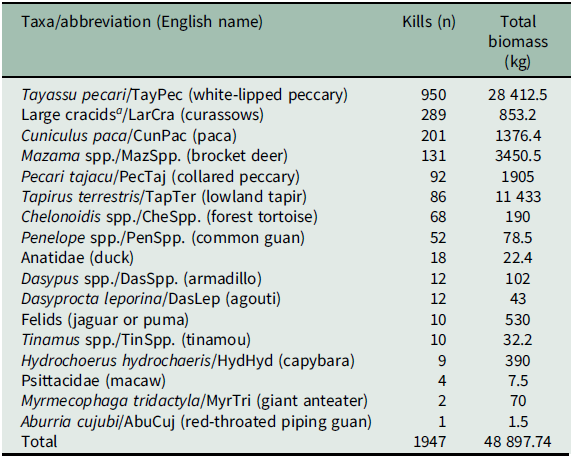
During the 63 months of the study, 3601 structured interviews were obtained from the 30 focal communities within the two SUPAs, which included 1910 (53.0%) hunting forays. Our results, however, are based on only 1770 (92.0%) validated hunting forays carried out over the entire period of study. A total of 1947 mammals, birds and reptiles of 17 species were killed (Table 1), leading to an estimated 48 898 kg of prey mass harvested. The most frequently killed species were T. pecari (white-lipped peccary), large cracids (curassow), C. paca (paca), Mazama spp. (brocket deer), P. tajacu (collared peccary) and T. terrestris (lowland tapir; Table 1), which amounted to 89.8% and 97.0% of the total number number of animals and total mass harvested, respectively. White-lipped peccary was the most hunted species, accounting for 58.0% of the overall prey mass and 48.8% of all individuals harvested (Table 1). This ungulate species also accounted for the largest number of individuals killed (18) within a single hunting event (mean = 2.25 per hunting event).
Prey species killed by local communities monitored within the Rio Iriri and Riozinho do Anfrísio Extractive Reserves through the Participatory Hunting Monitoring programme from June 2014 to December 2019. Taxa were ranked by their contribution expressed as the total number of animals killed.

a Pauxi tuberosa and Crax fasciolata.
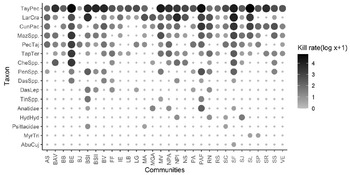
The NMDS ordination indicates that local offtakes across different game species were not significantly different among the monitored communities (stress = 0.187, p = 1.0). The most frequently harvested species were killed in similar proportions across communities, showing comparable patterns of game selectivity and a high degree of similarity in the dominant prey profiles, particularly white-lipped peccary, curassow and paca (Fig. 2).
Prey species kill rates (expressed as log(x + 1)) in 30 local communities monitored in the Rio Iriri and Riozinho do Anfrísio Extractive Reserves through the Participatory Hunting Monitoring programme from June 2014 to December 2019. Species are ordered top to bottom by their overall numerical offtakes; communities are ordered alphabetically. For species codes and Latin and English names, see Table 1. For full names of local communities, see Table S1.

Temporal trends in hunting yields
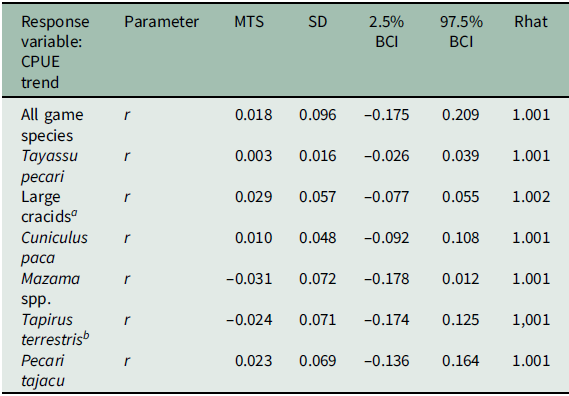
The parameter convergence was satisfactory for all Bayesian models (Table 2) and the exponential growth rate r was not different from 0 for monthly CPUE averages for the entire assemblage of game species (658.5 ± 259.8 g hunter–1 h–1), white-lipped peccary (3624.7 ± 1107.9 g hunter–1 h–1), curassow (568.8 ± 177.2 g hunter–1 h–1), paca (1377.6 ± 485.1 g hunter–1 h–1), brocket deer (355.1 ± 818.3 g hunter–1 h–1), collared peccary (3208.8 ± 1105.4 g hunter–1 h–1) and lowland tapir (21.3 ± 4.79 kg hunter–1 h–1; Table 2). These temporal trends in offtake per unit effort show that CPUE remained stable for all game species and each of the most hunted species, indicating that hunting was most probably sustainable, even if the mean time series were slightly negative for brocket deer and lowland tapir (Table 2).
State-space models examining trends in hunting yields over time in terms of catch per unit of effort (CPUE; g hunter–1 h–1) at the Rio Iriri and Riozinho do Anfrísio Extractive Reserves through the Participatory Hunting Monitoring programme from June 2014 to December 2019.

a Pauxi tuberosa and Crax fasciolata.
b CPUE (kg hunter–1 h–1).
BCI = Bayesian confidence interval; MTS = mean of temporal series; r = exponential growth rate; Rhat = convergence of the parameter; SD = standard deviation.
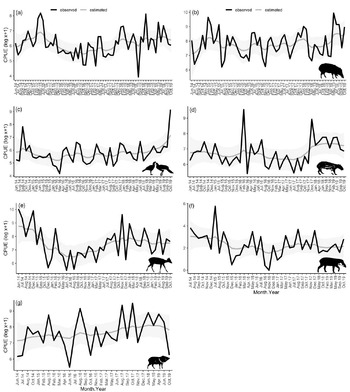
Despite the overall supra-annual stability in offtakes, monthly average CPUEs fluctuated during the monitoring period (Fig. 3). May and June 2015 and November 2018 were the months with the highest CPUE averages for the entire assemblage of game species, while for the most hunted species – white-lipped peccary – offtakes peaked between January 2015 and July 2019.
Monthly average catches per unit of effort (CPUEs; g hunter–1 h–1 (except for Tapirus terrestris = kg hunter–1 h–1) expressed as log(x + 1)) across local communities recorded in the Rio Iriri and Riozinho do Anfrísio Extractive Reserves over 63 months (June 2014–December 2019) through the Participatory Hunting Monitoring programme. Lines represent observed and estimated offtakes. (a) All game species (n = 63 months), (b) Tayassu pecari (n = 57), (c) large cracids (n = 47), (d) Cuniculus paca (n = 44), (e) Mazama spp. (n = 42), (f) T. terrestris (n = 38, kg hunter–1 h–1) and (g) Pecari tajacu (n = 30).

Discussion
Hunting yields and prey composition
The consistent dominance of only a few medium and large-bodied prey species (white-lipped peccary, curassows, paca, brocket deer, collared peccary and lowland tapir) in hunting yields combined with the similarity (Fig. 2) in quantitative prey species profiles across villages suggest that hunters across the study area are highly selective in terms of prey species pursued. Differences in the proportional number of kills per species between communities (Fig. 2) may be related to difference in monitoring effort or individual hunter preferences for less representative target species. Kills of big cats were not motivated by subsistence needs but instead by human–wildlife conflicts, which are recurrent in others ERs (Carvalho Jr Reference Carvalho2019).
The consistently high similarity and stable number of kills throughout the study period (Fig. 3b–d) for white-lipped peccary, curassows and paca suggest that these species were the most preferred prey species for household consumption. White-lipped peccary was the top-ranking source of game meat for the communities monitored and is also the most hunted species by ribeirinho and Indigenous communities in the Terra do Meio region (Ramos et al. Reference Ramos, Pezzuti and Vieira2016), suggesting that this is the most important source of terrestrial protein at the regional level.
White-lipped peccary was also the species with the highest numbers of kills in single hunting events. This species can form herds larger than 500 individuals (Scabin & Peres Reference Scabin and Peres2021). In the study area, large single-hunt slaughters of white-lipped peccaries typically occur when herds cross rivers near villages or encounter fishing boats. On these occasions, large numbers of individuals are killed with clubs and machetes or are drowned. High numbers of kills of white-lipped peccaries during single hunting forays are likely to be frequent among ribeirinhos in the Amazon (Valsecchi et al. Reference Valsecchi, El Bizri and Figueira2014). For example, as many as 20 hunters can collectively kill 82 animals or more during herd river crossings in the western Amazon (Peres Reference Peres1996).
Trends in hunting yields
The supra-annual temporal trends in prey biomass harvested per unit of hunting effort indicate that ribeirinhos largely maintained a stable harvest over as many as 63 months for all game species combined and for each of the six most harvested species (Fig. 3). However, community- or reserve-scale hunting yields displayed considerable monthly variation within annual cycles. At the species level, monthly CPUE ratios were less variable only for white-lipped peccaries (Fig. 3b), probably because of the high demand for this species as the most preferred source of game meat. As for white-lipped peccaries, the kills of curassows and paca (Fig. 3c & d) were well distributed across the entire monitoring period, further corroborating the notion that these species were the most procured game species.
The considerable variation in CPUE can be related to seasonal environmental changes that affect the subsistence activities of forest dwellers. For example, the marked seasonal fluctuation in river water levels due to patterns of rainfall in headwater catchments changes the cost–benefit ratio between fishing and hunting effort, driving the dynamics of wild animal protein exploitation across the Amazon (Endo et al. Reference Endo, Peres and Haugaasen2016). Nevertheless, CPUE peaks are also simply related to chance events during hunting forays, such as rare encounters with white-lipped peccary herds and tapirs. For example, the May 2015 peak for all game species resulted from two unusually productive hunts when many white-lipped peccaries were killed. This species also showed the highest mean monthly CPUE averages, indicating that pursuing white-lipped peccaries alone can provide the highest returns in game yields.
The stability of CPUE strongly suggests that hunting levels were probably sustainable in the study area both for all game species considered here and for each of the most hunted species. This is noteworthy because three of these six preferred target species are among the lowest-fecundity terrestrial game species in the Amazon and show clear signs of overhunting elsewhere (Peres & Palacios Reference Peres and Palacios2007). The evidence that these game species were not increasingly depleted at the landscape scale is consistent with other studies in the Amazon and Central Africa in which hunting yields have been used as indicators of sustainability (Vickers Reference Vickers1988, Cowlishaw et al. Reference Cowlishaw, Mendelson and Rowcliffe2005, Ohl-Schacherer et al. Reference Ohl-Schacherer, Shepard, Kaplan, Peres, Levi and Yu2007, Kümpel et al. Reference Kümpel, Milner-Gulland, Cowlishaw and Rowcliffe2009). Considering all game species in aggregate, our results suggest that local hunters and their families benefitted from stable access to sufficient amounts of game meat during the entire study period, with a high contribution of large-bodied ungulates such as white-lipped peccary and lowland tapir. Considering the six top-ranking species, our results suggest that hunting activity did not represent a severe threat, even for the least resilient low-fecundity species. Additional evidence can be seen in the multi-year prevalence of white-lipped peccary, curassows, brocket deer and lowland tapir in the hunting profile, as these species often drop out of the hunting profiles in heavily hunted sites (Bodmer et al. Reference Bodmer, Eisenberg and Redford1997, Jerozolimski & Peres Reference Jerozolimski and Peres2003, Peres & Palacios Reference Peres and Palacios2007).
The regional-scale socioeconomic and environmental contexts at Terra do Meio may help explain the current evidence that hunting remains sustainable in this area. Both the Rio Iriri and Riozinho do Anfrísio ERs retain high levels of well-preserved forest cover (up to 90%; Fig. 1), low human population densities (2.78 ± 2.92 people km–2 for the entire region; IBGE 2018) and are core parts of a continuous mosaic of large PAs and ILs. This configuration favours a source–sink dynamic whereby extensive areas of sparsely settled undisturbed forest may act as population ‘sources’ that can replenish ‘sink’ areas (Novaro et al. Reference Novaro, Redford and Bodmer2000), especially due to the spatial distribution of local communities along rivers. Maintaining this source–sink dynamic has been extolled as a key ingredient for long-term hunting sustainability (Novaro et al. Reference Novaro, Redford and Bodmer2000, Salas & Kim Reference Salas and Kim2002, Naranjo & Bodmer Reference Naranjo and Bodmer2007, Ohl-Schacherer et al. Reference Ohl-Schacherer, Shepard, Kaplan, Peres, Levi and Yu2007, van Vliet & Nasi Reference van Vliet and Nasi2008), which is crucial to maintaining food security for tropical forest dwellers (Sirén & Machoa Reference Sirén and Machoa2008, Nasi et al. Reference Nasi, Taber and Van Vliet2011, Antunes et al. Reference Antunes, Rebêlo, Pezzuti, de Mattos Vieira, de Araujo and Constantino2019).
The future of hunting and implications for resource management
Game harvesting at the two ERs considered here was a secondary source of food security, while fishing was the primary means of local protein acquisition (Participatory Hunting Monitoring programme, unpublished data 2020). This is consistent with other ribeirinho studies in the Amazon, where fish are typically captured as the primary source of wild protein (Henderson & Crampton Reference Henderson and Crampton1997, Fonseca & Pezzuti Reference Fonseca and Pezzuti2013, Endo et al. Reference Endo, Peres and Haugaasen2016), but game harvesting remains a critical component of food security; ensuring continuous access to viable large vertebrate populations remains essential to local livelihoods.
Maintaining the current social and environmental contexts in the study region is the best way to ensure long-term hunting sustainability. With regards to the social context, there has been a 72% increase in the number of families in this region between 2009 and 2019 (MMA/ICMBio 2010a, 2010b, Riozinho do Anfrísio and Rio Iriri ERs Community Council, unpublished data 2019); however, this is unlikely to have had serious effects on local hunting sustainability. Although population growth may be a major driver of game-species depletion (Jerozolimski & Peres Reference Jerozolimski and Peres2003, Shepard et al. Reference Shepard, Levi, Neves, Peres and Yu2012), the overall human population density in these PAs remains exceedingly low (∼0.112 people km–2), and the current number of occupants is in fact much lower than decades ago, during the rubber boom (Schwartzman et al. Reference Schwartzman, Boas, Ono, Fonseca, Doblas and Zimmerman2013, Balée et al. Reference Balée, de Oliveira, dos Santos, Amaral, Rocha and Guerrero2020). With regards to the environmental context, however, an aggressive frontier of illegal logging, mining, cattle ranching and land grabbing is rapidly expanding throughout the Terra do Meio region, and this has greatly accelerated since 2019 (ISA 2016, 2019, INPE 2020). These pressure vectors are the most important threats in this region and can severely compromise the environmental integrity and a healthy source–sink dynamic of vertebrate populations across the region.
Our multi-year results over 63 months ensured that hunting in the two ERs could be defined as sustainable (Kümpel et al. Reference Kümpel, Milner-Gulland, Cowlishaw and Rowcliffe2009). However, the absence of information on prey population densities, in particular for the least resilient low-fecundity species, limits our inferences regarding long-term population trends. For local managers, we recommend the establishment of long-term population monitoring of game species, mainly for white-lipped peccaries due to their high offtake rates, and the re-establishment of the PHM programme. We also recommend studies aimed at better understanding the retaliatory kills of large felids. Simultaneously, it is necessary to establish local community-based co-management rules of engagement and agreements to ensure the effective conservation and management of game species in the long run. This approach has been highly effective in natural resource management by traditional people, particularly in low-governance contexts (Luzar et al. Reference Luzar, Silvius, Overman, Giery, Read and Fragoso2011, Constantino et al. Reference Constantino, Henrique Santiago Alberto Carlos, Ramalho, Rostant, Marinelli and Teles2012, Vieira et al. Reference Vieira, Muhlen and Shepard2015, Campos-Silva et al. Reference Campos-Silva, Peres, Antunes, Valsecchi and Pezzuti2017, Shaffer et al. Reference Shaffer, Milstein, Yukuma, Marawanaru and Suse2017, Pezzuti et al. Reference Pezzuti, de Castro, McGrath, Miorando, Barboza and Carneiro Romagnoli2018, Oliveira & Calouro Reference Oliveira and Calouro2019). On the other hand, a rapid and efficient response to external threats from logging, mining and livestock-based deforestation is urgently needed, or else any wildlife management plan would most probably fail.
Our results also show that SUPAs embedded within a much larger mosaic of relatively intact PAs have significant potential to regulate hunting, reinforcing their role in biodiversity conservation and sustainable management (Abrahams et al. Reference Abrahams, Peres and Costa2017, Campos-Silva et al. Reference Campos-Silva, Peres, Antunes, Valsecchi and Pezzuti2017). However, the legal status of hunting regulations in SUPAs in human-occupied forest reserves in Brazil remains ambiguous, leaving this practice subject to arbitrary local enforcement (Antunes et al. Reference Antunes, Rebêlo, Pezzuti, de Mattos Vieira, de Araujo and Constantino2019). Despite these legal caveats, Amazonian SUPAs are essentially inhabited by traditional people whose lifestyles are linked to the maintenance of large areas of largely undisturbed forests (Nepstad et al. Reference Nepstad, Schwartzman, Bamberger, Santilli, Ray and Schlesinger2006, Almeida Reference Almeida2012, Schwartzman et al. Reference Schwartzman, Boas, Ono, Fonseca, Doblas and Zimmerman2013, Balée et al. Reference Balée, de Oliveira, dos Santos, Amaral, Rocha and Guerrero2020, Rezende Reference Rezende2020). This landscape context contributes directly or indirectly to maintaining the status quo of sustainable subsistence hunting. Therefore, protecting the lifestyles and cultural integrity of local communities is key to ensuring the long-term sustainability of hunting, especially when government enforcement is lacking or insufficient.
Supplementary material
For supplementary material accompanying this paper, visit https://doi.org/10.1017/S0376892922000145.
Acknowledgements
We are sincerely grateful to all of the Local Monitors and the ribeirinhos in the study area. We thank the following people and institutions for their support during this research: Tathiana C de Souza, Katia T Ribeiro, Victor Saccardi and Centro Nacional de Pesquisa e Conservação de Mamíferos Carnívoros/ICMBio. We thank three anonymous reviewers for their helpful comments on this manuscript.
Financial support
The study was conducted under licence SISBIO 17323-3. The study was conducted as part of the National Biodiversity Monitoring Program of Instituto Chico Mendes de Conservação da Biodiversidade (Programa Monitora) and was funded by Programa Áreas Protegidas da Amazônia.
Competing interests
The authors declare none.
Ethical standards
Research followed the American Anthropological Association Code of Ethics.