




No CrossRef data available.
Article contents
The clinical pathway for fast track recovery of school activities in children after minimally invasive cardiac surgery
Published online by Cambridge University Press: 18 April 2005
Abstract
Background: Minimally invasive cardiac surgery is now becoming standard in the correction of simple congenital cardiac malformations. We introduced a clinical pathway for fast track recovery of school activities in children after minimally invasive cardiac surgery, and assessed the function of the pathway in children with atrial or ventricular septal defects, comparing minimally invasive surgery to repair through a conventional full sternotomy. Methods: We studied 15 children of school age who underwent repair of an atrial or ventricular septal defect through a lower midline sternotomy, and 10 children undergoing repair through a full sternotomy. The clinical pathway was for extubation to take place in the operating room, echocardiographic evaluation on the 5th postoperative day, and discharge home on the 7th postoperative day, with return to school within 2 weeks, and resumption of all gymnastic activity within 6 weeks of the minimally invasive surgery. Results: In those having a lower midline sternotomy, postoperative hospital stay was 7.4 ± 0.8 days, with return to school 8.0 ± 2.4 days after discharge. They resumed gymnastics 41 ± 11 days after the minimally invasive surgery. In those having a full sternotomy, in contrast, these parameters were 13.5 ± 2.7, 23.1 ± 8.4, and 95 ± 43 days, respectively. Of the 15 children undergoing a minimally invasive approach, 12 (80%) fulfilled the criterions of our clinical pathway. Conclusions: We conclude that minimally invasive cardiac surgery can safely be performed in children. In addition to its cosmetic role, the technique has added value in promoting early return to normal school life, including gymnastics.
Information
- Type
- Original Article
- Information
- Copyright
- © 2003 Cambridge University Press
As the mortality and morbidity have been reduced following cardiac surgery in children, variables such as postoperative recovery time, the quality of life, including such aspects as the length of hospital stay, and cosmetic effects have become important factors to consider when evaluating the surgical outcomes. Moreover, for children of school age, a fast track recovery to school activities, including gymnastics, may also have an important role to play.
Recently, the minimally invasive approach has become increasingly popular in the field of cardiac surgery.1, 2 It is attractive to avoid full sternotomy, both to reduce complications and support early recovery. Thus, for selected congenital cardiac malformations, the use of small skin and sternal incisions have produced good cosmetic results coupled with early recovery.3–5
Since 1998, therefore, we have used a fast track clinical pathway, incorporating a minimally invasive approach, for children of school age with atrial or ventricular septal defects. We have now assessed the efficiency of our clinical pathway.
Materials and methods
Since 1998, when we introduced the minimally invasive approach for congenital cardiac malformations, 72 infants and children with simple defects underwent open heart surgery using this approach. In 15 children of school age seen consecutively, we also adopted our fast track clinical pathway. They were aged from 6 to 14 years, with a mean of 10.1 years, and 7 were boys. There was an atrial septal defect within the oval fossa in 7, a perimembranous ventricular septal defect in 4, and a doubly committed and juxtaarterial ventricular septal defect in 4. All the children with doubly committed defects had mild aortic regurgitation. As a control, we compared the findings with those from 10 of school age who underwent surgical repair of an atrial septal defect within the oval fossa through a conventional full sternotomy prior to 1998 (Table 1).
Table 1. Preoperative characteristics of the patients.

Operative technique using the minimally invasive approach
The defects were closed with a continuous suture, using autologous pericardium and Hemashield patch, respectively, through a lower median sternotomy. We created a midline skin incision ranging from 6 to 7.5 cm from the level of their nipples to the tip of the xyphoid process. A lower median sternotomy was then performed, extending from the xyphoid process to the level of the third intercostal space. In the patients with doubly committed defects who weighed over 20 kg, the left side of the sternum was split in the third intercostal space. The manubrium was preserved in all patients.
Cardiopulmonary bypass was then initiated using ascending aortic and bicaval venous cannulation. The superior caval vein was cannulated directly, or from the right atrial appendage using the original stylet. The inferior caval vein was cannulated through the small skin incision, which was also used for subsequent insertion of a pericardial drainage tube. The venous cannulas were down-sized by using vacuum drainage system with a special pressure relief valve.6 The aorta was cross-clamped, and a single bolus of blood cardioplegia was delivered antegradely.
In the patients with atrial and perimembranous ventricular septal defects, closure was achieved through a right atriotomy. A transverse incision in the pulmonary trunk was used for those with double committed ventricular septal defects.
After evacuating air from the left heart, and unclamping the aorta, cardiac rhythm was restored, and cardiopulmonary bypass discontinued. Transesophageal echocardiography was used to confirm the absence of any residual shunting or air in the heart. The sternum was closed with three or four interrupted stainless steel wires. We used only a single tube in the pericardium for chest drainage.
Postoperative care
All patients were extubated in the operating room and transferred to the intensive care unit. After the evaluation of residual shunt by echocardiography on the 5th postoperative day, they were discharged home on the 7th postoperative day. Their first visit to our outpatient clinic was made 5 to 7 days after discharge, after which we permitted them to go to school, undertaking exercise of low capacity within 2 weeks after surgery, but attending all gymnastic activities within 6 weeks of the surgery.
The time to extubation, the postoperative length of hospital stay, the period prior to returning to school after discharge, and the period until gymnastic activities were resumed were all compared to the same values in those having a full sternotomy. We also evaluated the success of our clinical pathway in those having a lower midline sternotomy.
Results
All children survived the procedure, and were discharged without any major complication. In children undergoing repair of their atrial septal defects using the minimally invasive approach, the mean period of aortic cross-clamping was 32 ± 9 minutes, and the mean period of cardiopulmonary bypass was 62 ± 6 minutes. Comparable values for those undergoing repair of ventricular septal defects were 47 ± 13.6, and 80 ± 17.8 minutes, respectively. We deemed these values acceptable. A permanent pacemaker was implanted in one child undergoing repair of a ventricular septal defect who had suffered preoperative sinus nodal dysfunction prior to the minimally invasive repair (Table 2). Of those treated in minimally invasive fashion, 11 of 15 (73%) were extubated in the operating room, compared to only two (20%) of those undergoing a full sternotomy. The difference was not statistically significant. Of those four children not extubated in the operating room, the ventilating tube was removed in the intensive care unit within five hours of the operation because of the depth of anesthesia (Fig. 1). Hospital stay after the operation was 7.4 ± 0.8 days in those having a lower midline sternotomy, and 13.5 ± 2.7 days in those having a full sternotomy (p < 0.01). Of the 15 children repaired in minimally invasive fashion, 12 (80%) were discharged within seven days of the operation. The remaining 3 children stayed in hospital for more than seven days. Of these, one with preoperative complete atrioventricular block had undergone implantation of a permanent pacemaker, and pacemaker activity was checked at the 8th postoperative day, followed by discharge. Discharge was delayed in the other two because of a urological complication and pericardial effusion, respectively (Fig. 2). The period of time to return to school after discharge was 8.0 ± 2.4 days in those having a lower midline sternotomy, and 23.1 ± 8.4 days in those having a full sternotomy. We excluded from this analysis 4 children having a lower midline sternotomy, and 3 having a full sternotomy, because surgery was performed during the summer vacation. Of eleven patients treated with the minimally invasive approach, 9 (82%) returned to school within seven days of discharge. The other two required longer than seven days for return, one hesitating to return because of dullness, and one having a persistent pericardial effusion as shown by echocardiography (Fig. 3). The period between discharge and resuming all gymnastic activities was 41 ± 11 days in those having a lower midline sternotomy, and 95 ± 43 days in those having a full sternotomy. For various reasons, we were unable to ascertain these timings in 5 children having a lower midline sternotomy, and four having a full sternotomy. Thus, of the ten children undergoing a minimally invasive approach, 8 resumed gymnastic activities within 6 weeks of surgery. Longer times were needed for the others, one delaying resumption because of dullness until 48 days after discharge, and the other delaying to 52 days after discharge because of the echocardiographic discovery of subclinical pulmonary stenosis (Fig. 4). No patient suffered any complication after they returned to normal school life.
Table 2. Intraoperative data.


Figure 1. Of 15 (73%) patients undergoing the minimally invasive approach (MICS), 11 (73%) were extubated in operation room, compared to only 2 of 10 (20%) having a full sternotomy (FULL), albeit that there was no statistical difference between the two groups.

Figure 2. The average hospital stay was 7.4 ± 0.8 days for those undergoing the minimally invasive approach, and 13.5 ± 2.7 days for those having full sternotomy (p < 0.01). Of the 15 children treated in minimally invasive fashion, 12 (80%) were discharged within seven days. Abbreviations as before.

Figure 3. The average period between discharge and going to school was 8.0 ± 2.4 days for those treated in minimally invasive fashion (MICS), and 23.1 ± 8.4 days for those having full sternotomy (FULL) (p < 0.01). Of eleven children having minimally invasive surgery, 9 (82%) resumed school activities within 7 days.

Figure 4. The average period between discharge and attending gymnastics was 41 ± 11days in those undergoing minimally invasive surgery (MICS), and 95 ± 43 days in those having full sternotomy (FULL). This difference was not statistically significant. Of the 10 children followed after minimally invasive surgery, 8 resumed gymnastics within six weeks of the discharge.
Comment
Elective surgical closure of atrial or ventricular septal defects in children of school age is now associated with minimal morbidity and mortality. If a minimally invasive approach is to be adopted in the correction of these lesions, it must be proven to be as safe and effective as a traditional median sternotomy. The minimal approach has obvious attractions, including preservation of the manubrium, this permitting much more rapid return to school activities, including gymnastics, than can be achieved when using a conventional sternotomy.
Many authors have reported their clinical experience with alternative surgical approaches to the heart, such as a mini-sternotomy,3–5 a transxiphoid approach,7 an anterolateral thoracotomy,8, 9 and video-assisted surgery.10, 11 These authors, however, largely reported cosmetic effects, with few commenting on the potential for early recovery after surgery. In our study, therefore, we investigated the role of the minimally invasive approach in promoting fast track recovery to school activities, including gymnastics.
Others have explored the impact of clinical pathways after surgery. Pearson et al.12 showed that the average post-operative length of stay could be shortened from 8.9 days to 7.5 days after introducing clinical pathways for patients undergoing coronary arterial bypass grafting, and Lee et al.13 described how one-third of the patients older than 70 years could be discharged before the fifth postoperative day. Furthermore, Vricella et al14 have described ultra fast track recovery in congenital cardiac surgery. They reviewed 198 children with simple and complex cardiac anomalies undergoing their surgical procedure through a limited sternotomy, and showed that more than nine-tenths of the patients could be extubated in the operating room, with a median length of stay of 2.0 days. We cannot compare our results with these reports in western countries, as Japanese insurance companies pay an additional fee to patients only if the stay in hospital exceeds seven days. Most patients, therefore, want to stay as long as possible. Because of this, discharge at the seventh postoperative day represents a fairly short hospital stay for Japan.
Few investigators have related fast track recovery to school activities after surgical repair of congenital cardiac malformations. Of our children, four-fifths were able to return to school within seven days of discharge, the minimally invasive approach thus conferring great benefit in respect of academic activities.
Our study was limited by its retrospective nature, our control group being an historical one. The number of patients enrolled was also relatively small, and we lost several patients to follow-up when attempting to ascertain the period needed to return to gymnastic activities.
Despite these limitations, our study has demonstrated that surgical repair of atrial and ventricular septal defects via a mini-sternotomy is a safe and reproducible procedure. Using our fast track pathway, we were able to shorten significantly the postoperative length of stay, and the length of stay until returning to school and resuming gymnastic activities.
As experience accumulates, and as instrumentation and imaging technology improves, it will be possible to repair most forms of congenital heart disease using this minimally invasive approach. Combination with fast track recovery will then improve their quality of school life.
References
Matsuda H. Minimally invasive cardiac surgery: principle and prospects. Surg Today 1998; 28: 775–779.Google Scholar
Cosgrove DM, Sabik JF. Minimally invasive approach for aortic valve operations. Ann Thorac Surg 1996; 62: 596–597.Google Scholar
Rao V, Freedom RM, Black MD. Minimally invasive surgery with cardioscopy for congenital heart disease. Ann Thorac Surg 1999; 68: 1742–1745.Google Scholar
Black MD, Freedom RM. Minimally invasive repair of atrial septal defects. Ann Thorac Surg 1998; 65: 765–767.Google Scholar
Gundry SR, Shattuck OH, Razzouk AJ, del Rio MJ, Sardari FF, Baily LL. Facile minimally invasive cardiac surgery via ministernotomy. Ann Thorac Surg 1998; 65: 1100–1104.Google Scholar
Taketani S, Sawa Y, Masai T, et al. A novel technique for cardiopulmonary bypass using vacuum system for venous drainage with pressure relief valve: An experimental study. Artificial Organs 1998; 22: 337–341.Google Scholar
Barbero-Marcial M, Tanamati C, Jatene MB, Atik E, Jatene ED. Transxiphoid approach without median sternotomy for the repair of atrial septal defects. Ann Thorac Surg 1998; 65: 3771–3774.Google Scholar
Massetti M, Babtasi G, Rossi A, et al. Operation for atrial septal defect through a right anterolateral thoracotomy: current outcome. Ann Thorac Surg 1996; 62: 1100–1103.Google Scholar
Grinda JM, Folliguet TA, Dervanian P, Mace L, Legault B, Neveux JY. Right anterolateral thoracotomy for repair of atrial septal defect. Ann Thorac Surg. 1996; 62: 175–178.Google Scholar
Chang CH, Lin PJ, Chu JJ, et al. Video-assisted cardiac surgery in closure of atrial septal defect. Ann Thorac Surg 1996; 62: 697–701.Google Scholar
Inoue Y, Yozu R, Mitsumaru A, Ueda T, Kawada S. Video-assisted cardioscopic staple closure for atrial septal defect. Artif Organs 1997; 21: 103–105.Google Scholar
Pearson SD, Kleefield MSF, Soukop JR, Cook EF, Lee TH. Critical pathways intervention to reduce length of hospital stay. Am J Med. 2001; 110: 175–180.Google Scholar
Lee JH, Swain B, Andrey J, Murrell HK, Geha AS. Fast track recovery of elderly coronary bypass surgery patients. Ann Thorac Surg. 1999; 68: 437–441.Google Scholar
Vricella LA, Dearani JA, Gundry SR, Razzouk AJ, Braner SD, Bailey LL. Ultra fast track in elective congenital cardiac surgery. Ann Thorac Surg 2000; 69: 865–871.Google Scholar

Table 1.
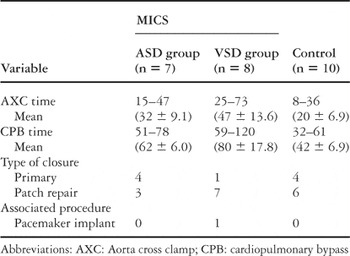
Table 2.

Of 15 (73%) patients undergoing the minimally invasive approach (MICS), 11 (73%) were extubated in operation room, compared to only 2 of 10 (20%) having a full sternotomy (FULL), albeit that there was no statistical difference between the two groups.

The average hospital stay was 7.4 ± 0.8 days for those undergoing the minimally invasive approach, and 13.5 ± 2.7 days for those having full sternotomy (p < 0.01). Of the 15 children treated in minimally invasive fashion, 12 (80%) were discharged within seven days. Abbreviations as before.

The average period between discharge and going to school was 8.0 ± 2.4 days for those treated in minimally invasive fashion (MICS), and 23.1 ± 8.4 days for those having full sternotomy (FULL) (p < 0.01). Of eleven children having minimally invasive surgery, 9 (82%) resumed school activities within 7 days.

The average period between discharge and attending gymnastics was 41 ± 11days in those undergoing minimally invasive surgery (MICS), and 95 ± 43 days in those having full sternotomy (FULL). This difference was not statistically significant. Of the 10 children followed after minimally invasive surgery, 8 resumed gymnastics within six weeks of the discharge.
 You have
Access
- 12
- Cited by