Introduction
Antimicrobial Stewardship (AS) in the intensive care unit (ICU) setting is a difficult task due to diagnostic uncertainty and perceived high-risk of poor outcomes in case of delayed or inappropriate treatment. As patients in the ICU present frequently with sepsis or septic shock, for which early use of broad-spectrum antibiotics is recommended, Reference Evans, Rhodes and Alhazzani1 high rates of antimicrobial prescription, of up to 90%, are observed in this setting. Reference Koirala, Dahal and Paneru2 These attempts to ensure timely and appropriate use of antimicrobials are an important driver of antimicrobial utilization, a recognized factor to increase antimicrobial resistance.
To address the growing threat of antimicrobial resistance in ICUs, two main strategies exist: infection prevention and control (IPC) measures and AS. Reference Reza, Dubey, Sharland and Hope3 Although IPC deals mainly with enabling hand hygiene compliance, targeted screening and isolation and environmental cleaning, AS has a multitude of possible interventions to improve antimicrobial utilization targeting the ideal scenario in which all patients with infection are appropriately treated, but for the shortest duration while avoiding unnecessary treatment. Reference Schuts, Hulscher and Mouton4 In the ICU setting, these strategies include restrictive interventions such as preauthorization, persuasive interventions such as prospective audit and feedback, enablement such as guidelines and antibiotic formularies, and structural interventions such as electronic health record (EHR)-embedded algorithms. Reference Davey, Marwick and Scott5 Other strategies include the use of biomarkers of host response and novel diagnostics, such as rapid molecular assays, which could likely improve decision-making. However, in the ICU setting, where fear of mistaking Reference Pandolfo, Horne and Jani6 and other social norms Reference Warreman, Lambregts and Wouters7 may lead to the prescription of antimicrobials, these strategies may fail despite their incorporation at different levels of maturity.
To identify the complex interplay between intensivist bedside decision-making and possible interventions for AS, we designed this critical interpretative synthesis study with the aim of identifying AS strategies for implementation in the ICU setting, reasons why they may fail in practice despite their potential or prior efficacy studies, and how they may interact with each other.
Methods
Study design
We conducted a critical interpretive synthesis (CIS) following the approach proposed by Dixon-Woods et al. Reference Dixon-Woods, Cavers and Agarwal8 This approach allows for a systematic, empirical method combining both qualitative and quantitative research with the main aim to identify and question critical assumptions present in the literature. Reference Depraetere, Keygnaert and Beken9 Although traditional systematic reviews usually focus on presenting aggregated data, a critical interpretative synthesis focuses on generating theory after a systematic search strategy. Therefore, rather than focusing on evaluating effectiveness, we identified these assumptions and ultimately came to a comprehensive framework that elucidates how AS strategies in the ICU setting may be conceptualized and operationalized. To enhance the validity of the search and synthesis output, stakeholders included clinician-scientists and expert methodologists.
Eligibility criteria
We included primary studies (both quantitative and qualitative) and secondary research (eg, systematic reviews) published as full-text articles and relevant to AS in the ICU setting. Studies limited to pediatric or neonatal ICUs, as well as those limited to assessing knowledge, attitudes, or practices without evaluating actual AS implementation or outcomes, were excluded. Opinion pieces, editorials, letters to the editor, commentary articles, author replies, and study protocols without results were also excluded.
Search strategy
A structured literature search was conducted by a methodologist after an initial exploratory scan to refine terminology. A comprehensive search was conducted in the following databases: Biblioteca Virtual em Saúde, Cochrane Central Register of Controlled Trials (CENTRAL, via Wiley), Excerpta Medica Database (Embase, via Elsevier), Medical Literature Analysis and Retrieval System Online (MEDLINE, via PubMed). A gray literature search was also conducted using Health Systems Evidence. The search strategy combined controlled vocabulary and free-text terms related to AS or rational use, antibiotics/antimicrobials, and ICUs (Supplemental File—Table S1). Searches were restricted to the year 2000 onwards to reflect contemporary stewardship practices. No language restrictions were applied.
Studies selection and data extraction
All identified records were managed using Rayyan platform. In the first stage, the titles and abstracts of the retrieved references were read to confirm eligibility. The references considered potentially eligible proceeded to full-text assessment (ie, studies that described possible AS strategies or concepts that could be applied to the ICU setting or to critically ill patients). Two independent reviewers conducted both phases. Disagreements were resolved by consensus.
In selecting studies to illustrate and discuss key concepts, priority was given to larger studies, multicenter designs, and, whenever possible, studies reflecting the context of low-and middle-income countries. More recent publications were also prioritized to ensure contemporary relevance. Core concepts were iteratively identified and consolidated until theoretical saturation was reached, that is, when additional studies no longer contributed new conceptual insights. Where evidence was more robust, we prioritized selecting systematic reviews.
Data extraction from the included studies was performed by one reviewer and checked by a second reviewer. Disagreements were resolved through consensus or consultation with a third reviewer. Data extraction and synthesis proceeded in five iterative stages, following the interpretive logic of CIS:
-
1. Initial familiarization: reviewers noted preliminary observations on how AS strategies are framed, implemented, and evaluated across studies.
-
2. Classification: the collected data included author, year, study design, strategy, concepts, and main findings.
-
3. Development of synthetic constructs: recurring ideas were compared to generate higher-order interpretations connecting interventions and main findings.
-
4. Critical Interrogation: core concepts were consolidated until theoretical saturation was reached.
-
5. Refinement: the emerging model was critically reviewed to identify gaps and strengthen coherence.
Use of artificial intelligence tools
For better structuring and categorization of the identified strategies in step 5 (refinement), these were categorized in two stages: the first stage involved the use of generative artificial intelligence chatbots on December 1st, 2025 (Google Gemini, ChatGPT, and DeepSeek) through the application of detailed prompts that either induced or did not—based on the study protocol—the creation of categories. Following the categorization rounds, one author (VC) manually reviewed and compiled the suggested categories, compared the alternative classifications, and proposed a final version based on the similarity of their attributes. The proposed categories were revised and refined by a second author (BAMPB) to propose the primary critical constructs of this critical interpretative synthesis, which were reviewed by all authors. Additional details regarding the tool versions, prompts used, and examples of outputs are available in the Supplementary Material (Additional Methods 1).
Critical appraisal
In contrast to traditional systematic reviews, which focus on methodological rigor, this study’s critical appraisal prioritized the theoretical significance of the included research and how they challenge current beliefs and clinical practice about AS strategies within the ICU. Accordingly, the main content of each study was critically evaluated against the guiding research question.
Results
Search and study selection
The initial search retrieved 41,192 records, of which 1,792 duplicates were removed. A total of 1,335 records proceeded to full-text revision after title and abstract screening. Full-text articles were read iteratively and purposively in successive batches. Although additional full texts were assessed beyond those finally included, screening continued until conceptual saturation was achieved, at which point no new themes or constructs emerged. The synthesis was therefore based on a final set of 29 full-text articles (Supplemental File—Table S2).
Main themes
Concepts with suboptimal effectiveness in practice
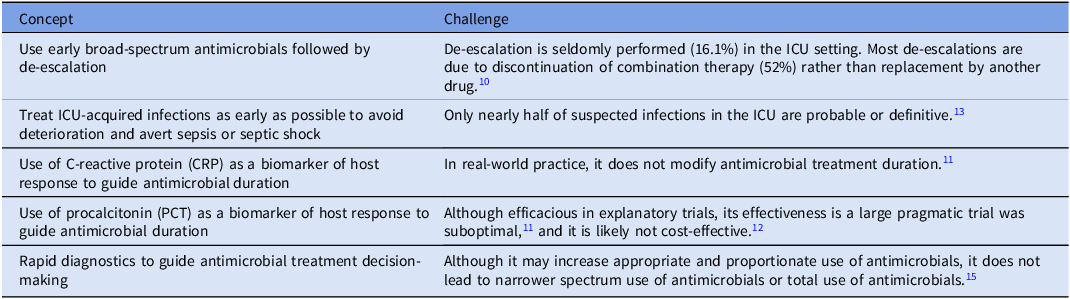
Some traditional concepts have been shown to have suboptimal effectiveness in practice (Table 1). Although sepsis guidelines recommend the early use of broader-spectrum antimicrobials to increase antimicrobial timeliness and appropriateness, Reference Evans, Rhodes and Alhazzani1 the usually proposed balancing measures may not, in practice, deliver the intended results. De-escalation occurs infrequently Reference De Bus, Depuydt and Steen10 due to limited sensitivity of microbiological cultures; biomarkers of host response to infection (CRP and PCT), although shown in earlier studies to be efficacious, have not been as effective in less controlled environments; Reference Dark, Hossain and McAuley11,Reference Stevenson, Forsyth, Hossain, Lall and Dark12 the use of novel biomarkers and syndromic molecular diagnostics, which could deal with the high uncertainty in the diagnosis of infection, Reference Cardozo Junior, Bianchini and Giovanetti13 do not necessarily translate into improved utilization of antimicrobials. Reference Hellyer, McAuley and Walsh14,Reference Enne, Stirling and Barber15
Traditional concepts challenged by empirical evidence

The poorly explored role of cognitive decision-making theory in AS
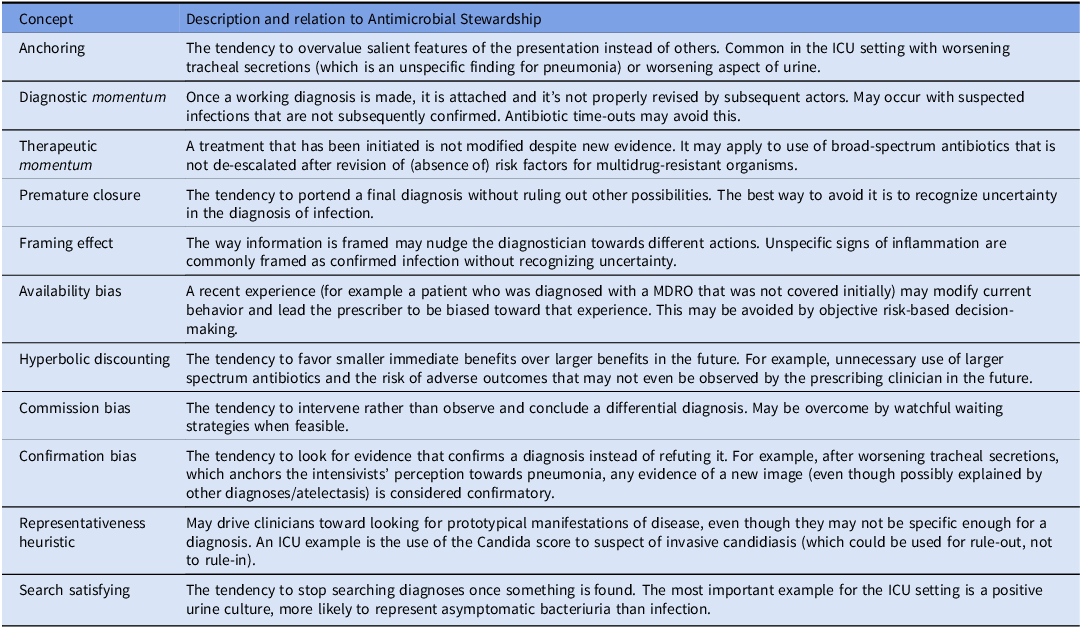
The reasons why presenting more information to clinicians does not necessarily translate into behavior modification are likely rooted in cognitive decision-making theory. Reference Croskerry, Singhal and Mamede16 Cognitive processes traditionally fall within two main categories: type 1 processes are intuitive, fast and more subject to biases in decision-making, as they are heuristic shortcuts to decision-making obtained from repeated experience; type 2 processes are analytical, slower and reflective of deductive reasoning, which is less subject to error. Reference Croskerry17 Cognitive biases in decision-making (favoring use of more antibiotics in the high-stakes scenario of the ICU setting) very likely contribute (Table 2). Reference Croskerry18,Reference Langford, Daneman, Leung and Langford19 Uncertainty in the diagnostic likelihood of infection is also an essential factor. Reference Cardozo Junior, Bianchini and Giovanetti13 Qualitative studies have shown that fear may be an important driver for more liberal antimicrobial use, Reference Pandolfo, Horne and Jani6 which leads to an anchoring bias effect towards earlier use and more broad-spectrum use of antimicrobials in ICU practice. Interestingly, even when presented with information that could discard a diagnosis of infection, clinicians rely on their first impressions, Reference Singh, Nurek, Mason, Moore, Mughal and Vizcaychipi20 ie, on type 1 cognitive processes. Reference Croskerry, Singhal and Mamede16,Reference Croskerry17
Some concepts related to cognitive biases in decision-making and how they may relate to Antimicrobial Stewardship in the intensive care setting

Strategies to deal with uncertainty and cognitive biases
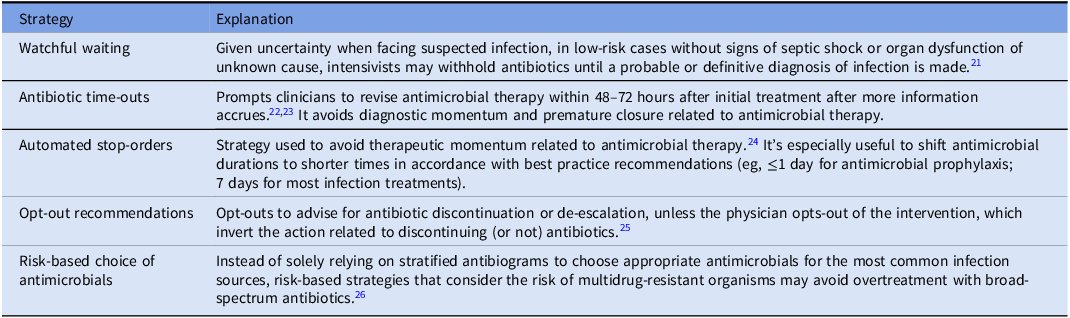
There are many possible strategies to address the uncertainty when using antibiotics in critically ill patients (Table 3). Reference Bassi, Tomazini and Carneiro21–Reference Gohil, Septimus and Kleinman26 These strategies have been described and implemented by intensivists, by other members of the interprofessional team in collaboration with intensivists, or by leveraging EHRs.
Strategies to deal with uncertainty in the diagnosis of infection in critically ill patients

The four moments of antimicrobial decision-making framework Reference Tamma, Miller and Cosgrove27 brings together some of these concepts: (i) does the patient have an infection that requires antibiotics?; (ii) were appropriate cultures ordered before starting antibiotics, and what empiric therapy should be initiated; (iii) after a day or more has passed, can antibiotics be stopped, narrowed or changed to oral?; (iv) what duration of therapy is needed for the diagnosis?
For the ICU setting, these moments include the concept of watchful waiting (moment 1), Reference Bassi, Tomazini and Carneiro21 risk-based choice of antimicrobials to avoid overtreatment (moment 2), Reference Gohil, Septimus and Kleinman26 antibiotic time-outs to revise diagnosis and treatment (moment 3), Reference Mishima, Nawa and Asada22,Reference Elligsen, Pinto, Leis, Walker, Daneman and MacFadden23 using automated stop-orders to avoid unnecessary prolonged treatments, Reference Barlam, Cosgrove and Abbo24 and favoring short-course therapies Reference Mo, Booraphun and Li28,Reference Kalil, Metersky and Klompas29 when possible (moment 4).
Diagnostic stewardship, cognitive biases, and AS
An incorrect diagnosis of infection related to positive results of cultures, even in scenarios in which it may represent contamination or colonization, may lead to increased use of antibiotics. Reference Pratt, Rehan and Xing30 Diagnostic stewardship has emerged in the literature as a new conceptual framework grounded on providing a more evidence-based approach to infection diagnosis. Importantly, it is intrinsically related to the cognitive theory of decision-making. It has been framed according to clinical pathology and laboratory medicine approach to diagnosis: preanalytical (ordering, specimen collection); analytical (specimen processing); and postanalytical (reporting and interpreting test results). Reference Fabre, Davis and Diekema31
In the ICU setting, we identified results that may be applied to antibiotic stewardship efforts from urine cultures, respiratory tract cultures, and blood cultures. Reference Pratt, Rehan and Xing30,Reference Siev, Levy and Chen32–Reference Albin, Troost and Saravolatz34 By explicitly acknowledging that preanalytical pretest probability is essential in the process to increase test results utility and reduce false-positive tests, and by avoiding reporting positive cultures that most likely represent contamination or colonization, it implicitly assumes that nudging the clinician may modify behavior. Non-culture tests, such as molecular tests or biomarkers, as described in Table 1, likely benefit from this approach as well. Incorporation of diagnostic stewardship at a lower level may provide the ground for improved effectiveness of such modern diagnostics.
Interprofessional collaboration as a safety layer in ICU AS
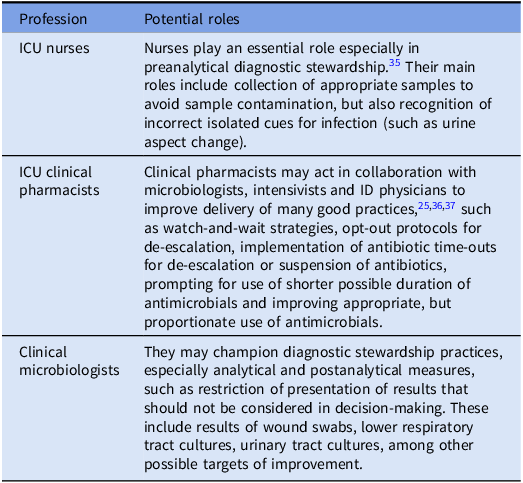
Interprofessional engagement plays an essential role in AS in the ICU setting. Nurses, Reference Bos, Schouten, De Bot, Vermeulen and Hulscher35 clinical pharmacists, Reference Díaz-Madriz, Chaverri-Fernández and Arguedas-Chacón36 and microbiologists have different roles summarized in Table 4. Collaboration among different professions has also been shown to be essential for effective stewardship in qualitative studies. Reference Barlam, Childs and Zieminski37 Their inclusion as part of AS efforts likely improves an additional layer of quality and effectiveness for base interventions.
Role of interprofessional engagement and collaboration in ICU Antimicrobial Stewardship

The role of external input to ICU antibiotic decision-making
Some strategies have known, longstanding roles to improve antibiotic utilization. Reference Schuts, Hulscher and Mouton4,Reference Davey, Marwick and Scott5,Reference Barlam, Cosgrove and Abbo24 Preauthorization is a common, effective restrictive strategy to reduce antimicrobial use. Its main downside is the risk of disruption in collaborative culture. Prospective audit-and-feedback by staff external to the ICU (ID physicians and/or ID pharmacists) is an enablement strategy considered more appropriate, though more time-demanding than preauthorization. So-called handshake rounds, in which ID physicians routinely round with ICU staff to decide on antimicrobial treatments, have been tested in a cluster-randomized crossover trial, but the results were unsatisfactory, despite the time investment. Reference Seidelman, Turner and Wrenn38 It may be possible that this approach did not deal with intensivists’ decision-making to the desired extent. Alternatively, handshake rounds could influence ID physicians’ decisions and soften their recommendations, leading to greater complacency with intensivists’ antimicrobial preferences. This reinforces the need to address intensivists’ fear when prescribing antimicrobials.
The role of EHRs and decision support systems
The EHR also plays an essential role in antimicrobial decision-making. It may operationalize all strategies presented in Table 3. EHR-embedded clinical decision support systems may facilitate the following recommendations based on local stratified antibiograms, though sustaining the effect likely requires routine updates. Reference Nachtigall, Tafelski and Deja39 A computer provider order entry set may facilitate more appropriate and proportionate use of antimicrobials, especially for community-acquired infections. Reference Gohil, Septimus and Kleinman26 However, this may also expand to the ICU setting by stratifying patients with suspected infection in different risk profiles to allow more rational use of antimicrobials.
Main argument and conceptual framework
Decision-making, overdiagnosis, and overtreatment of bacterial infections in the ICU
The previous themes converge on a main argument: antimicrobial decision-making in the ICU setting is subject to cognitive biases due to uncertainty about the likelihood of infection in patients with suspected infections, coupled with the high-stakes nature of the ICU. Although strategies to reduce uncertainty (through improved diagnostics) exist, they may fall short due to risk aversion when deciding about antimicrobials and the desire to conform to guidelines that, although targeting sepsis and septic shock, likely have spillover effects for all suspected cases of infection in the ICU setting. Ultimately, this leads to overdiagnosis and overtreatment of bacterial infections and clinicians’ defaulting to a higher-than-needed use of antimicrobials in the ICU.
Conceptual framework for rational use of antimicrobials in the ICU setting
We propose a three-layered conceptual framework for efforts to rationalize antimicrobial use in the ICU setting (Figure 1). Unless the first layer is addressed, this model suggests that subsequent layers will be less effective in real-world settings than their theoretical efficacy would suggest, or in more controlled environments.
Conceptual model for Antimicrobial Stewardship in the intensive care unit setting. Legend: ID: infectious diseases; EHR: electronic health record; This conceptual model presents potential strategies to improve Antimicrobial Stewardship in the ICU setting. It assumes that the effectiveness of subsequent strategies will be higher if the base (Tier 1) level is addressed. In tier 1 lies the need to address cognitive processes in decision-making for critically ill patients, which may be biased toward overdiagnosis and overtreatment. Along with traditional effective strategies, such as preauthorization and prospective audit and feedback, frameworks such as diagnostic stewardship (preanalytical and postanalytical) and the four moments of decision-making may help the individual clinician better rationalize their antimicrobial use. Tier 2 strategies consolidate this base layer, and Tier 3 strategies are more likely to be effective provided both Tier 1 and 2 strategies are leveraged. Within Tier 1 diagnostic and Antimicrobial Stewardship reasoning, strategies such as MRSA swabs may be very effective in practice.

Figure 1 Long description
A conceptual model for antimicrobial stewardship in the intensive care unit setting. The model is structured in three tiers. Tier 1, at the base, focuses on clinician decision-making and cognitive biases. It includes strategies like pre-authorization, prospective audit and feedback, conceptual frameworks, diagnostic stewardship, and the four moments of decision-making. Tier 2 emphasizes interprofessional collaboration involving intensivists, ID physicians, clinical pharmacists, critical care nurses, and microbiologists. It also includes EHR-leveraged strategies and external input from specialized ID support for complex cases. Tier 3, at the top, introduces novel technologies such as molecular diagnostics and biomarkers of infection. The model suggests that the effectiveness of higher-tier strategies is more likely if the strategies in the previous tiers are addressed.
At the base, cognitive debiasing strategies are essential to promote rational prescribing of antimicrobials. Reference Pandolfo, Horne and Jani6 Frameworks such as the 4 moments of antimicrobial decision-making may be employed or adapted to the ICU setting. Reference Tamma, Miller and Cosgrove27 Diagnostic stewardship principles should be embedded in this first level as they are intimately related to antimicrobial treatment decisions. Within this base level, effective interventions, such as preauthorization or others, should be employed. Reference Schuts, Hulscher and Mouton4,Reference Davey, Marwick and Scott5,Reference Barlam, Cosgrove and Abbo24
On top of this first layer, several strategies may be added. These include interprofessional collaboration (with nurses, clinical pharmacists, and microbiologists) and EHR-embedded strategies to support first-line interventions, coupled with input from ID physicians when needed. These strategies usually would focus on nudging Reference Last, Buttenheim, Timon, Mitra and Beidas40 clinicians towards appropriate use and interpretation of diagnostics and proper use of antimicrobials.
The third layer includes strategies with higher costs, such as the incorporation of novel technologies, which include modern rapid diagnostics and biomarkers. Unless intensivists’ decision-making is addressed, they may incur increased costs with no additional benefits of more rational use of antimicrobials. Their full potential for improved antimicrobial utilization may be unleashed, however, if they are placed on top of the second layer of AS strategies, leveraging decision-making, traditional AS, diagnostic stewardship, interprofessional collaboration, additional ID physicians’ input for complex cases and EHR-embedded strategies.
Discussion
This critical interpretative synthesis identified gaps in the current understanding of AS for critically ill patients. First, the classical concept of using broad-spectrum antibiotics in critically ill patients and then de-escalating them needs to be reframed. Second, the conceptually appealing use of novel diagnostics and biomarkers of infection in critically ill patients is challenged by limited effectiveness in practice, likely due to cognitive biases in intensivists’ decision-making. Third, overdiagnosis and overtreatment of bacterial infections are driven by uncertainty in the clinical diagnosis of infection in the ICU and by intensivists’ risk aversion in the high-stakes ICU environment.
Fortunately, many strategies exist that may improve more assertive decision-making when using antibiotics in the critically ill patient. Traditionally, these have been preauthorization and prospective audit and feedback, which are known to be effective, although they move the accountability for antibiotic overuse away from intensivists. Reference Jenkins and Tamma41 In this study, we also identified the need for shifting this onus to the intensivists, which needs the incorporation of cognitive decision-making theory and frameworks to be implemented as base levels along with traditional stewardship interventions.
A substantial body of evidence demonstrates that AS programs reduce antimicrobial use and improve prescribing quality at the hospital level. Reference Schuts, Hulscher and Mouton4,Reference Davey, Marwick and Scott5 However, this literature does not focus specifically on the ICU, and many interventions rely on external oversight, such as preauthorization or prospective audit and feedback by infectious diseases specialists. Our findings suggest that these approaches, while effective in general inpatient populations, may be less effective in the ICU because they do not adequately address the unique cognitive and contextual drivers of antimicrobial decision-making in critically ill patients.
The widespread adoption of sepsis guidelines Reference Evans, Rhodes and Alhazzani1 advocating early empiric broad-spectrum therapy has improved outcomes for patients with septic shock. Still, our synthesis highlights spillover effects, which reinforce behavioral and normative beliefs about antimicrobial prescribing. These guidelines may inadvertently reinforce risk-averse prescribing behaviors across the broader ICU population, including patients with low or intermediate probability of infection. AS in the ICU, partially shifting the onus for intensivists, therefore, functions as a needed counterbalance, aiming to prevent overdiagnosis and overtreatment Reference Bassi, Tomazini and Carneiro21,Reference Mo, Booraphun and Li28 while preserving timely and appropriate therapy for those who need it.
Prior work has acknowledged that the ICU represents a unique environment for stewardship, characterized by diagnostic uncertainty, rapidly evolving clinical trajectories, and a heightened fear of delayed or inappropriate treatment. Reference Wunderink, Srinivasan and Barie42 This workshop report identified intensivists as both key contributors to and potential solutions for antimicrobial overuse, highlighting fear as a major driver of prescribing behavior. In a recent systematic review focused on the ICU setting, however, the cognitive theory of decision-making applied to AS has not been recognized explicitly as a possible approach to stewardship. Reference Ntim43 Most studies relied on multi-intervention strategies, followed by prospective audit and feedback, procalcitonin protocols, and protocols for antimicrobial de-escalation. Additionally, frameworks such as the four moments of antimicrobial decision-making have been developed for the inpatient setting, Reference Tamma, Miller and Cosgrove27 and have been expanded to include the cognitive theory of decision-making to further improve these efforts, Reference Langford, Daneman, Leung and Langford19 although they do not explicitly address the ICU setting.
Failure to recognize cognitive biases and the role of social norms and behaviors helps explain why strategies that increase the amount of information available to clinicians do not necessarily lead to more proportionate antimicrobial use. Reference Mabaya44 Even when biomarkers, cultures, or molecular diagnostics reduce uncertainty, clinicians may continue to rely on initial impressions or default to more aggressive treatment (eg, broad-spectrum antimicrobials) before a diagnosis is made, due to fear of adverse outcomes. Reference Pandolfo, Horne and Jani6 In this context, stewardship strategies that focus solely on downstream correction—such as de-escalation—are unlikely to succeed consistently. Reference De Bus, Depuydt and Steen10,Reference Wunderink, Srinivasan and Barie42 Instead, interventions must target earlier stages of decision-making, including whether antibiotics are initiated at all, how diagnostic tests are ordered and interpreted, and how uncertainty is explicitly managed. Strategies such as watchful waiting, antibiotic time-outs, diagnostic stewardship, and default use of short-course therapy when supported by evidence are central to this approach.
At the institutional level, interprofessional collaboration and EHR–embedded decision support systems can facilitate these behaviors by shaping the decision environment. Nurses, pharmacists, and microbiologists play critical roles in diagnostic stewardship, antimicrobial review, and feedback, while EHR-based tools can support nudging strategies that reduce cognitive load and counteract overdiagnosis/overtreatment.
From a policy perspective, guidelines increasingly recognize the importance of AS yet often assume rational uptake of recommendations once tools and resources are provided. Although implementation and sustainability of traditional tier 1 strategies, such as preauthorization and prospective audit and feedback, are certainly needed, our findings suggest that ICU stewardship policies should explicitly acknowledge the cognitive and behavioral determinants of prescribing, particularly in resource-constrained settings Reference Salluh, Besen and Gonzalez-Dambrauskas45 where high-cost diagnostics may offer limited marginal benefit if foundational decision-making issues are not addressed.
Future research should test the components of this framework, particularly interventions designed to mitigate cognitive biases in antimicrobial decision-making. Studies evaluating nudging strategies, Reference Last, Buttenheim, Timon, Mitra and Beidas40 diagnostic stewardship, Reference Fabre, Davis and Diekema31 and EHR-based decision support Reference Gohil, Septimus and Kleinman26 should assess not only antimicrobial utilization but also how clinicians interpret and act under uncertainty. Other strategies may be borrowed from other settings Reference Jenkins and Tamma41 such as individualized feedback with peer comparison, partnering with peer champions, incentivization (financial or others), commitment strategies, reduction of cognitive overload, mitigation of diagnostic uncertainty, prescribing etiquette and hierarchy. They should be tested specifically in the ICU setting. Although artificial intelligence–based decision support tools were not identified in our synthesis, future work should explore their role as adjuncts to stewardship.
This study has a few limitations. As a critical interpretative synthesis, our findings are inherently interpretive and may reflect the research team’s perspectives and prior knowledge. However, this subjectivity is a defining feature of the method, which is designed to generate theory and identify conceptual gaps rather than to provide exhaustive or descriptive summaries of the literature. We sought to mitigate bias through systematic searching, iterative review, theoretical saturation, and engagement with stakeholders, although we did not include a formally diverse stakeholder panel, which may limit the generalizability of our framework. Finally, by design, saturation-based synthesis does not incorporate every available study, and some perspectives may have been underrepresented.
Conclusions
Uncertainty in the management of ICU-acquired infections and the fear of delayed or inappropriate treatment act together to drive a more liberal antimicrobial use in the ICU, despite improved diagnostics, availability of biomarkers, and expert external input into antibiotic decision-making. Along with traditional effective strategies such as preauthorization and prospective audit and feedback, additional frameworks for antimicrobial utilization with buy-in from intensivists are also needed to serve as cognitive debiasing strategies and further improve antimicrobial use in the ICU.
Supplementary material
The supplementary material for this article can be found at https://doi.org/10.1017/ice.2026.10459.
Acknowledgements
None.
Author contributions
Conceptualization: BAMPB and BMT; Methodology: BAMPB, IPT, RR, VC; Investigation: BAMPB, LB, IPT, VC; Formal Analysis: BAMPB, LB, BMT, and VC; Funding acquisition: BAMPB and BMT; Writing—Original Draft: BAMPB and VC; Writing—Review and Editing: All authors.
Financial support
BAMPB receives a grant from the Brazilian National Council for Scientific and Technological Development as part of the SAFE-REDUCE program. This study is sponsored by the Brazilian Ministry of Health through the PROADI-SUS (Programa de Apoio ao Desenvolvimento Institucional do Sistema Único de Saúde) program, as part of a grant for the assessment of the current state and possible strategies to address multidrug resistance in Brazilian ICUs (IMPACTO-MR research program).
Competing interests
The authors report no conflicts of interest related to the contents of this manuscript.
Generative artificial intelligence disclosure
We used Google Gemini®, ChatGPT® 4.0, and Deep Seek® during the induction step of the review as described in the Methods section and the supplemental file. We used ChatGPT 5.2 to improve clarity and conciseness in the English language. Grammarly® was used to revise the English language throughout the manuscript, with grammar checks and language editing to improve clarity and conciseness. The authors revised all suggestions and take full responsibility for the written manuscript.