Introduction
Several recent large-scale studies have indicated that gays, lesbians and bisexuals (i.e. non-heterosexuals) are at elevated risk for many psychiatric symptoms and disorders (Fergusson et al. Reference Fergusson, Horwood and Beautrais1999; Cochran & Mays, Reference Cochran and Mays2000; Gilman et al. Reference Gilman, Cochran, Mays, Hughes, Ostrow and Kessler2001; Sandfort et al. Reference Sandfort, de Graaf, Bijl and Schnabel2001; Meyer, Reference Meyer2003; Mills et al. Reference Mills, Paul, Stall, Pollack, Canchola, Chang, Moskowitz and Catania2004; King et al. Reference King, Semlyen, Tai, Killaspy, Osborn, Popelyuk and Nazareth2008; Frisell et al. Reference Frisell, Lichtenstein, Rahman and Langstrom2010; Bolton & Sareen, Reference Bolton and Sareen2011; Chakraborty et al. Reference Chakraborty, McManus, Brugha, Bebbington and King2011). For example, the meta-analysis by King et al. (Reference King, Semlyen, Tai, Killaspy, Osborn, Popelyuk and Nazareth2008) revealed that, compared to heterosexuals, non-heterosexuals are at approximately twice the risk of major depressive disorder (depression) and anxiety disorders, deliberate self-harm and attempted suicide. With non-heterosexuals comprising a substantial proportion of the population (about 3–10% depending on the definition used; Sell et al. Reference Sell, Wells and Wypij1995; Grulich et al. Reference Grulich, de Visser, Smith, Rissel and Richters2003; Zietsch et al. Reference Zietsch, Morley, Shekar, Verweij, Keller, Macgregor, Wright, Bailey and Martin2008), it is of considerable importance to understand the causes of their elevated psychiatric risk. These causes, however, remain unclear.
The dominant explanation is the ‘minority stress’ hypothesis, whereby social prejudice and discrimination provoke mental health problems in non-heterosexuals (Meyer, Reference Meyer1995, Reference Meyer2003; Mays & Cochran, Reference Mays and Cochran2001; Hatzenbuehler, Reference Hatzenbuehler2009). Two studies found that controlling for reported levels of discrimination attenuated the relationship between sexual orientation and mental health (Mays & Cochran, Reference Mays and Cochran2001; Frisell et al. Reference Frisell, Lichtenstein, Rahman and Langstrom2010). However, in both studies, even after controlling for levels of discrimination there remained a large effect, and other studies show that the relationship between sexual orientation and mental health is just as strong in The Netherlands, where there has long been greater cultural acceptance of homosexuality than in other countries (Sandfort et al. Reference Sandfort, de Graaf, Bijl and Schnabel2001; Lewis, Reference Lewis2009). Thus, it seems likely that other mechanisms (Bailey, Reference Bailey1999) also contribute to the link between non-heterosexuality and psychiatric risk, but these are only now starting to be explored.
These other possible mechanisms may involve a common cause of both non-heterosexuality and psychiatric disorder. Frisell et al. (Reference Frisell, Lichtenstein, Rahman and Langstrom2010) found that controlling for familial confounding reduced or eliminated non-heterosexuals' elevated psychiatric risk in a Swedish sample of twins, with or without adjustment for perceived discrimination or hate crime victimization. This suggests that elevated risk in non-heterosexuals is influenced by common familial factors, but it is unclear whether they have a genetic or a shared environmental basis. Twin and family studies generally indicate that genetic influences account for between a third and half of the variance in both sexual orientation (Pillard & Bailey, Reference Pillard and Bailey1998; Kendler et al. Reference Kendler, Thornton, Gilman and Kessler2000; Santtila et al. Reference Santtila, Sandnabba, Harlaar, Varjonen, Alanko and von der Pahlen2008; Zietsch et al. Reference Zietsch, Morley, Shekar, Verweij, Keller, Macgregor, Wright, Bailey and Martin2008; Langstrom et al. Reference Langstrom, Rahman, Carlstrom and Lichtenstein2010) and depression (Sullivan et al. Reference Sullivan, Neale and Kendler2000; Kendler et al. Reference Kendler, Gardner, Neale and Prescott2001; Levinson, Reference Levinson2006), which we focus on in this study. These genetic influences may overlap; Zietsch et al. (Reference Zietsch, Verweij, Bailey, Wright and Martin2011) found that genetic correlation between sexual orientation and Neuroticism, a robust predictor of depression (Kendler et al. Reference Kendler, Neale, Kessler, Heath and Eaves1993b, Reference Kendler, Kuhn and Prescott2004), was primarily responsible for elevated Neuroticism scores in both male and female non-heterosexuals. This finding provided some evidence for the existence of genetic factors that predispose to both non-heterosexuality and depression. However, potent non-genetic risk factors for depression include childhood sexual abuse and risky family environment (Felitti et al. Reference Felitti, Anda, Nordenberg, Williamson, Spitz, Edwards, Koss and Marks1998; Kendler et al. Reference Kendler, Gardner and Prescott2002, Reference Kendler, Kuhn and Prescott2004, Reference Kendler, Gardner and Prescott2006; Fergusson et al. Reference Fergusson, Boden and Horwood2008), the latter characterized by conflict and relationships that are cold, unsupportive and neglectful (Repetti et al. Reference Repetti, Taylor and Seeman2002), and non-heterosexuals are also more likely to experience childhood sexual abuse (Hughes et al. Reference Hughes, Johnson and Wilsnack2001; Tomeo et al. Reference Tomeo, Templer, Anderson and Kotler2001; Balsam et al. Reference Balsam, Rothblum and Beauchaine2005) and family instability (Fergusson et al. Reference Fergusson, Horwood and Beautrais1999) than are heterosexuals, according to self-reports. Although most non-heterosexuals do not report childhood sexual abuse, the possibility remains that childhood experiences could influence individuals' later sexual orientation in addition to increasing their vulnerability to depression.
In the current study we investigated the viability of these genetic and environmental ‘common cause’ explanations using two large community-based samples (n=6233 and 3651 individuals) of identical and non-identical twins, selected without reference to sexual orientation or depression. Individuals in both samples completed a detailed psychiatric assessment by telephone interview, and also answered questions regarding their sexual orientation and childhood experiences. Using this genetically informative data we quantified the relative involvement of genetic influences, childhood sexual and physical abuse, and risky family environment in sexual orientation, lifetime depression, and their association. We also assessed the contribution of other factors that have been thought to influence sexual orientation, including number of older brothers and parental ages, and tested whether social connectedness (close friends) could mediate the relationship between sexual orientation and depression. This is the first study to investigate the link between sexual orientation, depression and adverse childhood experiences in a genetically informative sample.
Method
Participants
Participants were two community-based samples of identical (monozygotic; MZ) and non-identical (dizygotic; DZ) twins drawn from the Australian Twin Registry (ATR), who participated in semi-structured telephone interviews aimed primarily at assessing links between psychiatric disorder and substance use. Sample 1 consisted of 6233 twin individuals aged between 23 and 39 years (mean±s.d.=29.9±2.5) interviewed between 1996 and 2000. Subjects were members of the young adult cohort of the ATR, a volunteer panel of twins born between 1964 and 1971. Twins were registered with the ATR between 1980 and 1982 by their parents in response to approaches through school systems and mass media appeals. The response rate for this study was 77% (68% complete pairs). Fourteen percent of the twins contacted refused to collaborate with the study. Further details can be found elsewhere (Nelson et al. Reference Nelson, Heath, Madden, Cooper, Dinwiddie, Bucholz, Glowinski, McLaughlin, Dunne, Statham and Martin2002; Knopik et al. Reference Knopik, Heath, Madden, Bucholz, Slutske, Nelson, Statham, Whitfield and Martin2004).
Sample 2 consisted of 3651 twin individuals aged between 27 and 37 years (mean±s.d=31.8±2.5), interviewed between 2005 and 2009. The twins were already members of the ATR. The response rate for this sample was 51%. This is lower than for sample 1 because non-response after initial contact was not followed up as extensively, as changes to the protocol necessitated a two-stage consent process whereby the ATR was required to obtain consent from twins to release their contact information whereas consent to participate in this specific study was obtained in a separate process. For both samples written informed consent was obtained from all participants and data were obtained from a comprehensive assessment by trained interviewers.
The combined sample consisted of 9884 twins: 1133 female MZ pairs, 707 male MZ pairs, 861 female DZ pairs, 555 male DZ pairs, 946 opposite-sex DZ pairs, and 1480 single twins whose co-twin did not participate. Single twins were retained as they increase precision of the threshold estimates. The zygosity of the twin pairs was determined based on their response to standard items about physical similarity, a procedure that has been found to have high (at least 95%) concurrence with DNA typing (Ooki et al. Reference Ooki, Yamada, Asaka and Hayakawa1990); the accuracy here would be even higher as the zygosity of many pairs was confirmed by further telephone queries and/or subsequent DNA testing.
Measures
For each dichotomous variable (those not listed under ‘Other variables’), the more common status (i.e. heterosexual, absence of depression and adverse childhood experiences) was used as the comparison group.
Sexual orientation
Sexual orientation was assessed with the question: ‘Do you have a sexual preference for males, females, or both?’ Previous studies (Fergusson et al. Reference Fergusson, Horwood and Beautrais1999; Zietsch et al. Reference Zietsch, Verweij, Bailey, Wright and Martin2011) indicate that homosexuals and bisexuals are at similarly greater psychiatric risk compared with heterosexuals and have combined them into one non-heterosexual category. Non-heterosexuals comprised 4.3% and 3.3% of the sample for males and females respectively.
Lifetime depression
In samples 1 and 2, respondents completed identical assessments of depression episodes. In accordance with DSM-IV criteria (APA, 2000), respondents were coded as having had depression in their lifetime if they exhibited at least five of the nine DSM-IV symptoms of depression during the same 2-week period. Also in accordance with DSM-IV, symptoms must have been present during the same 2-week period and must include at least symptom 1 (depressed mood) or symptom 2 (loss of interest or pleasure). However, our criteria do not comprise a full DSM-IV diagnosis of major depressive disorder because exclusion criteria (i.e. symptoms being distinct from those of a mixed episode, causing clinically significant distress or impairment in functioning, and depression not induced by substance use or bereavement) were not used. There was greater missingness if these criteria were included, with a concomitant cost in power. Individuals' depression status was coded as missing if they had a missing value for either of symptoms 1 or 2 above, or when they answered yes to one or both of symptoms 1 and 2, but had missing values on more than three of the nine symptoms in total. The lifetime prevalence of depression was 24% and 37% for males and females respectively. Depression rates were respectively 43% and 45% for male homosexuals and bisexuals, and 53% and 70% for female homosexuals and bisexuals. These differences in depression rates in homosexuals and bisexuals were not significant (p=0.08), and we therefore combined them into a non-heterosexual category to achieve adequate power in genetic analyses.
Adverse childhood experiences
Childhood sexual and physical abuse items were only assessed in sample 1, whereas risky childhood family environment was available in samples 1 and 2.
Risky childhood family environment
This was loosely based on factors identified in Repetti et al. (Reference Repetti, Taylor and Seeman2002). It was operationalized to include those reporting at least one of the following: that between ages 6 and 13 (1) they would often have had an unpleasant disagreement with one or both of the parents, (2) they were not at all close with their parents, (3) their parents were often fighting or arguing in front of the respondent, (4) there was a lot of tension between the respondent's parents in the household, or (5) one of the parents drank too much. These were the most extreme of several response options available for each item. The items are linked empirically [inter-item correlations (Cronbach's α=0.65), and all items were significantly correlated with each other].
Childhood sexual abuse
This was coded based on four sections of the interview regarding sexual abuse. Childhood sexual abuse was coded as present if any of the following were met: (1) the respondent reported having had sexual contact (defined as ‘their touching your sexual parts, your touching their sexual parts, or sexual intercourse’) with an adult family member before the age of 14, or non-consensual sexual contact with another child in the family; (2) a respondent reported being forced into sexual intercourse or any other form of sexual activity before the age of 14; (3) a respondent reported to have been raped or sexually molested before the age of 14; or (4) a respondent reported to have had non-consensual sex with someone at least 5 years older before the age of 14. If none of the above were reported then childhood sexual abuse was coded as not present, unless the respondent did not respond to any one of these items or failed to report the age at which the event occurred, in which case the variable was coded as missing.
Childhood sexual abuse took place at an average age of 8.7 years, well before the average age that sexual feelings developed (13.5 years; as assessed by an item in sample 2 interviews onlyFootnote †). Around half of the participants who were sexually abused participated in a follow-up interview, revealing that perpetrators were male in the cases of 94% and 98% of male and female victims respectively.
Childhood parental physical abuse
This was considered to have occurred if a respondent reported at least one of the following: that, between the ages of 6 and 13, (1) they were often or sometimes hit with a belt or stick or something like that by their parents when they did something wrong; (2) their parents often or sometimes punished them so hard that it hurt the next day; or (3) the usual way in which their parents punished or disciplined them was physical and harsh (use of weapon, punch, kick). These items were all significantly intercorrelated.
Previous research suggests that retrospective reports of adverse childhood experiences such as abuse and household dysfunction show good long-term test–retest reliability and little relationship to mood states (Dube et al. Reference Dube, Williamson, Thompson, Felitti and Anda2004; Yancura & Aldwin, Reference Yancura and Aldwin2009), suggesting that our participants probably had reasonably reliable recall of the above childhood factors.
Other variables
Variables previously linked to sexual orientation or otherwise relevant to our hypotheses were also assessed to obtain the fullest etiological picture possible from the available data. These variables were: number of older full brothers (samples 1 and 2), paternal and maternal age (i.e. age of father and mother at birth; samples 1 and 2), and number of close friends (sample 2 only). Non-heterosexual orientation has been found to be associated with having more older brothers and having older parents (Hare & Moran, Reference Hare and Moran1979; Blanchard, Reference Blanchard2004); low social connectedness (for which number of close friends is a rough proxy) has been linked with depression (Baumeister & Leary, Reference Baumeister and Leary1995) and could be relevant to the minority stress hypothesis if societal prejudice causes non-heterosexual individuals to be less socially connected on average.
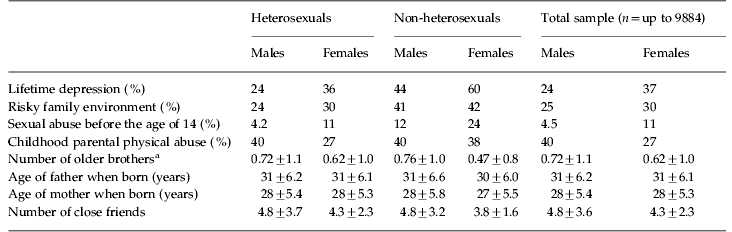
All sample 1 and some sample 2 respondents were asked directly how many full biological older brothers they had. Most sample 2 respondents were only asked about their total number of brothers; of these, those with zero brothers could be coded as having zero older brothers whereas those with a non-zero number of brothers were coded as missing. As such, the non-missing mean number of older brothers (see Table 1) is an underestimate of the true mean, although this only affects analyses involving this variable (i.e. reducing power by restricting the range).
Descriptive statistics: prevalences or means of the variables used in this study, for heterosexuals, non-heterosexuals and the total sample

Values given as percentage or mean±standard deviation.
a Mean is deflated because of non-random missingness, see Method section.
Statistical analyses
Statistical analyses used maximum-likelihood modeling procedures using the statistical package Mx (Neale et al. Reference Neale, Boker, Xie and Maes2006), which accounts for the non-independence of a twin pair. The dichotomous measures described above were analyzed in Mx as raw dichotomous data, where it is assumed that a normally distributed continuum of liability is cut in two at a certain threshold, yielding the two observed categories. In maximum-likelihood modeling, the goodness of fit of a model to the observed data is distributed as χ2. By testing the change in χ2 (Δχ2) against the change in degrees of freedom (Δdf), we can test whether dropping model parameters, or constraining them to be equal, significantly worsens the model fit. In this way we can test hypotheses regarding those parameters.
The effects of childhood experiences and other variables of interest on sexual orientation and depression were tested by modeling them as covariate effects (within the genetic models described below, according to standard procedures in Mx) and then independently dropping each covariate from the model (separately for males and females) and comparing model fit.
Genetic modeling
This study used the classical twin design, where variance in traits, and covariance between them, is partitioned into that due to genetic (A), shared environmental (non-genetic factors shared by twin pairs; C), and residual (E) sources. Non-additive genetic effects can be modeled instead of C, but previous studies (Kendler et al. Reference Kendler, Neale, Kessler, Heath and Eaves1993a, Reference Kendler, Gardner, Neale and Prescott2001; Sullivan et al. Reference Sullivan, Neale and Kendler2000) and our own preliminary modeling results found no significant non-additive genetic effects so we do not model them here. Shared environmental factors may include shared home environment, parental style and uterine environment. Residual variance includes environmental factors not shared by twin pairs (e.g. idiosyncratic experiences), stochastic biological effects and measurement error. Trait variances are standardized to equal 1, so A, C and E parameters equal the proportion of variance accounted for by each source, and A equals the heritability (h2) of the trait.
Partitioning of phenotypic variance into genetic, shared environmental and residual components can be achieved because MZ twins share all their genes whereas DZ twins share on average only half of their segregating genes. Thus, A, C and E influences predict different patterns of MZ and DZ twin correlations, and structural equation modeling is used to determine the combination of influences that best matches the observed data. Cross-twin cross-trait correlations allow us to partition covariance between traits into A, C and E in the same way as we do for variance in a single trait. In this way we can calculate the genetic correlation, a measure of the overlap in the genetic variation underlying two traits. An assumption of the classical twin design is that trait-relevant environments are similar to the same extent in MZ and DZ twin pairs; tests of this assumption for sexual orientation (Kendler et al. Reference Kendler, Thornton, Gilman and Kessler2000) and depression (Kendler et al. Reference Kendler, Neale, Kessler, Heath and Eaves1993c) suggest it is valid. Further details of the classical twin design can be found elsewhere (Neale & Cardon, Reference Neale and Cardon1992; Evans et al. Reference Evans, Gillespie and Martin2002; Posthuma et al. Reference Posthuma, Beem, de Geus, van Baal, von Hjelmborg, Lachine and Boomsma2003).
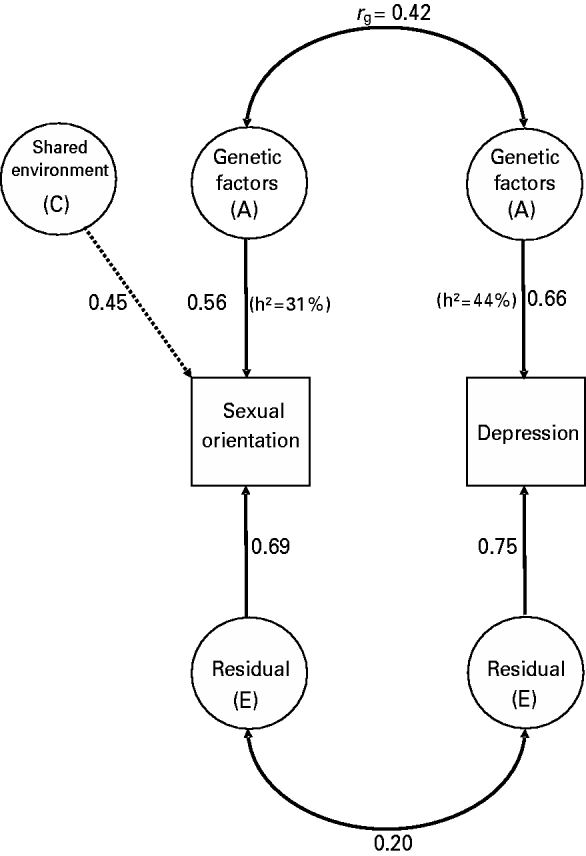
To test the significance (α=0.05) of genetic and environmental influences on sexual orientation, depression and their covariation, a bivariate Cholesky model was fitted. Sex and age effects were included as covariates. Genetic influences on each trait were tested by dropping the genetic path/s to each trait and comparing model fit. Similarly, genetic correlation was tested by dropping the genetic cross-path and residual correlation was tested by dropping the residual cross-path. Each test was performed independently, and compared to the base model. For ease of interpretation, the base model was transformed from a Cholesky form into a ‘correlated factors’ model as suggested by Loehlin (Reference Loehlin1996) (see Fig. 1). This yields the proportion of variance in each trait accounted for by genes (h2), shared environment and residual factors, and also genetic, shared environmental and residual correlations.
Correlated factors model for sexual orientation and lifetime depression. Broken lines represent non-significant paths (p>0.05). h2 (heritability) is the percentage of variance accounted for by genetic factors, and is the square of the corresponding path coefficient. The percentage of variance accounted for by the residual and shared environmental factors can also be calculated by squaring those path coefficients.

Results
Association of lifetime depression with sexual orientation
Non-heterosexuals had significantly elevated rates of lifetime depression compared to heterosexuals [males: odds ratio (OR) 2.8, 95% confidence interval (CI) 2.0–3.9, p<0.001; females: OR 2.7, 95% CI 1.9–3.7, p<0.001]. Rates of depression in male and female heterosexuals and non-heterosexuals are presented in Table 1. For males and females combined, the rates were 31% for heterosexuals and 52% for non-heterosexuals, corresponding to a tetrachoric correlation between sexual orientation and liability to depression of 0.26.
Heterosexuals with a non-heterosexual twin had a higher rate of depression (39%) than heterosexual pairs (31%) (Fisher's exact two-tailed test p=0.015). This suggests that familial (genetic and/or family environmental) factors associated with both non-heterosexuality and depression contributed to the link between them (in accordance with Frisell et al. Reference Frisell, Lichtenstein, Rahman and Langstrom2010); these factors should not include minority-related stressors because the heterosexual twin is not subject to these. We investigated what these shared risk factors might be, as follows.
Are there shared risk factors associated with sexual orientation and lifetime depression?
Factors associated with sexual orientation
The probandwise concordance rate (i.e. the probability that a twin is non-heterosexual given that his or her co-twin is non-heterosexual) was greater for MZ twin pairs (24%, 95% CI 17–31) than for DZ pairs (13%, 95% CI 7–18), suggesting a genetic component to sexual orientation, formally tested as described later.
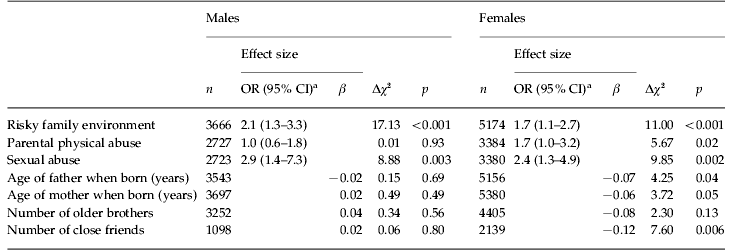
We also tested the effect of adverse childhood experiences and other variables thought to be associated with sexual orientation. The prevalence or means of each variable in heterosexuals and non-heterosexuals are presented in Table 1 and the statistical tests in Table 2. In both males and females, significantly higher rates of non-heterosexuality were found in participants who experienced childhood sexual abuse and in those with a risky childhood family environment. We examined whether a particular item in the risky family environment variable was driving the effect, but each individual item was significantly associated with sexual orientation. Furthermore, non-heterosexual women tended to have fewer close friends, younger fathers, and higher rates of parental physical abuse than did heterosexual women, but there were no such effects in men.
Association between sexual orientation and adverse childhood experiences, family composition and number of close friends

OR, Odds ratio; CI, confidence interval.
β coefficient obtained from biserial/polychoric correlations from PRELIS.
a Twin relatedness taken into account.
Factors associated with lifetime depression
The probandwise concordance rate for depression was greater for MZ twin pairs (52%, 95% CI 49–56) than for DZ pairs (36%, 95% CI 32–41), suggesting a genetic component to depression, formally tested as described later.
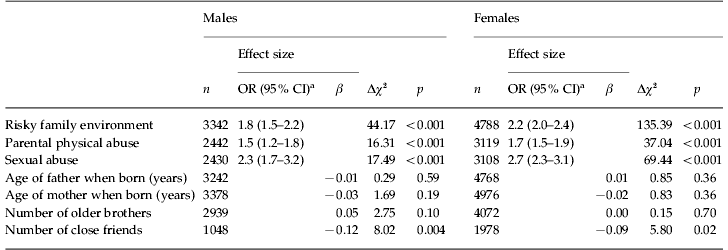
For association with lifetime depression, we tested the same variables as for sexual orientation (Table 3). Significant effects were found in both sexes for childhood sexual abuse, risky childhood family environment, parental physical abuse, and number of close friends.
Association between lifetime depression and adverse childhood experiences, family composition, and number of close friends

OR, Odds ratio; CI, confidence interval.
β coefficient obtained from biserial/polychoric correlations from PRELIS.
a Twin relatedness taken into account.
Do shared etiological factors explain the relationship between sexual orientation and depression?
In sample 1, where both childhood sexual abuse and risky childhood family environment are available, the correlation between sexual orientation and depression was 0.24 (very similar to r=0.26 in the full sample, see above). Accounting for the effects of a risky childhood family environment and sexual abuse separately reduced this correlation to 0.222 (7.7% reduction) and 0.220 (8.5% reduction) respectively, and to 0.208 (13.7% reduction) when combined. This suggests that the correlation between sexual orientation and depression can be partially explained by these adverse childhood experiences, but that most of the correlation remains unexplained. In women, we also assessed the contribution of number of close friends and parental physical abuse – respectively, these variables accounted for 2% and 9% of the correlation between sexual orientation and depression. In the following sections we assess the role that genetic factors might play.
Genetic models of the covariation between sexual orientation and depression
The heritability of sexual orientation and depression
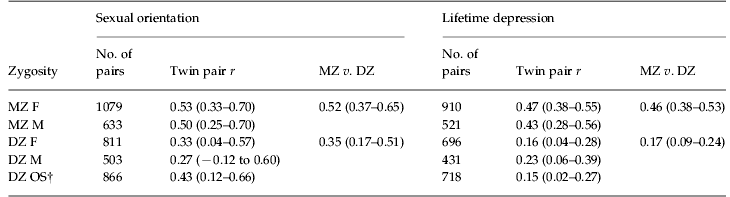
Polychoric twin pair correlations are presented in Table 4. For both sexual orientation and depression, MZ twin correlations were higher than DZ twin correlations, suggesting genetic influences. Twin correlations were not significantly different for male versus female MZ pairs, or for male versus female DZ pairs, suggesting no sex differences in the magnitude of genetic and environmental influences. We therefore equated male and female estimates of genetic and environmental influences in subsequent analyses. Furthermore, twin correlations for the opposite-sex DZ pairs were not significantly different from those for same-sex DZ pairs, suggesting that the source of genetic influences is similar in males and females and indicating that the heritability estimates of sexual orientation and depression are not being distorted by the opposite-sex DZ pairs.
Tetrachoric twin pair correlations (and 95% confidence intervals) between sexual orientation and lifetime depression by zygosity

F, Female; M, male; OS, opposite sex; MZ, monozygotic; DZ, dizygotic; MZ v. DZ=pooled MZ and DZ correlations (i.e. equated across sexes).
Genetic modeling revealed that genetic factors accounted for 31% of variation in sexual orientation (Δχ2 1=13.1, p<0.001) and 44% of variation in depression (Δχ2 2=133.1, p<0.001). Shared environmental influences on sexual orientation were not significant (Δχ2 1=1.1, p=0.29) and were estimated at zero for depression.
Bivariate genetic modeling of the relationship between sexual orientation and depression
Fig. 1 shows the bivariate model of the association between sexual orientation and depression. The genetic correlation (r g=0.42) between sexual orientation and depression was highly significant (Δχ2 1=11.6, p<0.001) and there was a smaller corresponding residual (non-genetic) correlation of 0.20 (Δχ2 1=5.5, p=0.02).
Additionally, from these estimates it is possible, using standard path analysis, to estimate the extent to which the phenotypic correlation between sexual orientation and depression (r=0.26; see above) could be attributed to genetic factors. This calculation is (0.56×0.42×0.66)/(0.56×0.42×0.66+0.69×0.20×0.75), which indicates that genetic factors account for 60% (0.155/0.259) of the phenotypic correlation between sexual orientation and depression, with the remaining 40% accounted for by correlated residual factors (i.e. E; e.g. non-shared environment).
Discussion
Our study replicated previous findings that non-heterosexuals are at elevated risk of depression, an effect that we found in both men and women. To assess the viability of ‘common cause’ explanations of this effect, we initially determined what factors were significantly associated with both non-heterosexuality and depression. Genetic factors accounted for 31% and 44% of the variation in sexual orientation and depression respectively, broadly consistent with the range of estimates from previous studies (Pillard & Bailey, Reference Pillard and Bailey1998; Kendler et al. Reference Kendler, Thornton, Gilman and Kessler2000, Reference Kendler, Gardner, Neale and Prescott2001; Sullivan et al. Reference Sullivan, Neale and Kendler2000; Levinson, Reference Levinson2006; Santtila et al. Reference Santtila, Sandnabba, Harlaar, Varjonen, Alanko and von der Pahlen2008; Zietsch et al. Reference Zietsch, Morley, Shekar, Verweij, Keller, Macgregor, Wright, Bailey and Martin2008; Langstrom et al. Reference Langstrom, Rahman, Carlstrom and Lichtenstein2010). Childhood experiences of sexual abuse and risky family environment were also significantly associated with both sexual orientation and depression. Paternal age, maternal age, and number of older brothers had little effect on either sexual orientation or depression. In men parental physical abuse and number of close friends were significantly associated with depression but not with sexual orientation, whereas non-heterosexual women and depressed women both had higher rates of parental abuse as well as significantly fewer close friends.
We then examined to what extent the factors associated with both sexual orientation and depression explain their association. A significant genetic correlation between sexual orientation and depression indicated an overlap in the genetic factors underlying the two variables. This overlapping genetic etiology accounted for 60% of the covariance between sexual orientation and depression. Further analysis revealed that childhood experiences of sexual abuse and risky family environment accounted for 8.5% and 7.7% of the covariance between sexual orientation and depression respectively, whereas number of close friends accounted for less than 2% of this covariance in women. These results suggest that genetic factors, childhood sexual abuse and risky family environment are all involved in the elevated rate of depression in non-heterosexuals.
It should be emphasized that these results do not imply that the minority stress hypothesis is false, only that other mechanisms may additionally contribute to the link between sexual orientation and depression. The elevated rates of depression in heterosexuals with a non-heterosexual co-twin suggest that familial factors not directly associated with non-heterosexuality also contribute to elevated depression rates in non-heterosexuals, consistent with the findings of Frisell et al. (Reference Frisell, Lichtenstein, Rahman and Langstrom2010). Some of these familial factors may be genetic; this is suggested by our finding that 60% of the correlation between sexual orientation and depression can be accounted for by genetic factors, and also by previous findings that elevated levels of Neuroticism and Psychoticism (trait markers for psychiatric vulnerability) in non-heterosexuals are primarily due to correlated genetic influences (Zietsch et al. Reference Zietsch, Verweij, Bailey, Wright and Martin2011). Other familial factors that seem to influence both traits involve adverse childhood experiences such as childhood sexual abuse and risky family environment. In cross-sectional twin data with ideal properties, different causal hypotheses can be formally tested, but it is not possible here because the variables have similar heritabilities and are highly skewed (Duffy & Martin, Reference Duffy and Martin1994); as such, interpretations should be made with caution.
In both males and females, adverse childhood experiences elevated the likelihood of non-heterosexuality and also of depression. Many studies have found an association of both childhood abuse and risky family environment with adult depression (Felitti et al. Reference Felitti, Anda, Nordenberg, Williamson, Spitz, Edwards, Koss and Marks1998; Nelson et al. Reference Nelson, Heath, Madden, Cooper, Dinwiddie, Bucholz, Glowinski, McLaughlin, Dunne, Statham and Martin2002; Kendler et al. Reference Kendler, Kuhn and Prescott2004, Reference Kendler, Gardner and Prescott2006; Fergusson et al. Reference Fergusson, Boden and Horwood2008). Although the mechanisms involved are not yet entirely clear, there is mounting evidence that these associations are mediated by permanent effects of repeated stressors on hypothalamic–pituitary–adrenal (HPA) axis reactivity (Heim et al. Reference Heim, Newport, Mletzko, Miller and Hemeroff2008; Pariante & Lightman, Reference Pariante and Lightman2008; Lupien et al. Reference Lupien, McEwen, Gunnar and Heim2009; Romeo, Reference Romeo2010; Young & Korszun, Reference Young and Korszun2010). In earlier studies, sexual orientation has also been linked with childhood sexual abuse (e.g. Cameron & Cameron, Reference Cameron and Cameron1995; Paul et al. Reference Paul, Catania, Pollack and Stall2001; Tomeo et al. Reference Tomeo, Templer, Anderson and Kotler2001; Balsam et al. Reference Balsam, Rothblum and Beauchaine2005; Arreola et al. Reference Arreola, Neilands, Pollack, Paul and Catania2008; see Rothman et al. Reference Rothman, Exner and Baughman2011 for a review) and, in one study, with family instability (frequent change of parents and parent criminality; Fergusson et al. Reference Fergusson, Horwood and Beautrais1999). Those studies were smaller or selected based on sexual orientation, so the present findings in a large community-based sample provide robust support for those previous findings. It is not at all clear how adverse childhood experiences might affect adult sexual orientation, and indeed the prevailing scientific view is that sexual orientation is fixed before birth (Rahman, Reference Rahman2005; Swaab & Garcia-Falgueras, Reference Swaab and Garcia-Falgueras2009). It is beyond the scope of this paper to speculate about possible explanations, but elsewhere the first author proposes a mechanism that could potentially explain how the same genes and adverse childhood experiences could influence both sexual orientation and depression (Zietsch, in press).
A dominant biological theory of male sexual orientation is not supported by the present results. The maternal immune hypothesis proposes that some mothers are progressively immunized to male-specific antigens by each succeeding male fetus, lessening sexual differentiation of the brain in each succeeding male fetus (Blanchard, Reference Blanchard2004). First, the large opposite-sex twin pair correlation (r=0.43) for sexual orientation in our data suggests that the same familial (i.e. genetic and shared environmental) factors influence both male and female sexual orientation. Second, the ‘fraternal birth-order effect’ is central to the theory and has been replicated in numerous other studies (see Blanchard, Reference Blanchard2004), but there was no such effect in our large dataset. There may be something about twin births or twin families that nullifies the relationship, although it should also be noted that there was no significant older brother effect in a recent, large (n>11 000), non-twin, probability sample of young British adults (Bogaert, Reference Bogaert2010).
This study is not without substantial limitations. First, modeling of the twin correlations suggested no C effects on depression, which seems to contradict the concurrent finding that childhood family-related experiences do affect depression. There are two explanations for this: first, a limitation of the classical twin design is that non-additive genetic effects can mask C effects (i.e. cancel them out); and second, C only includes factors that are shared within twin pairs; closeness or conflict with parents (items in ‘risky family environment’) may differ between co-twins, and indeed could index a genetic effect if tendency for closeness or conflict with parents has a genetic component. Certainly, various alternative causal explanations could play a role in the link between adverse childhood experiences and sexual orientation and depression, but these cannot be resolved in our design. Other limitations relate to statistical power. Ideally, we would perform separate analyses for male and female homosexuals and bisexuals because the relevant mechanisms could differ, but those subsamples were too small for this to be feasible. Nevertheless, twin pair correlations were remarkably similar across male, female and opposite-sex twins, suggesting that etiology in males and females has much in common. Another limitation is the lack of assessment of prejudice and discrimination experienced and of lifestyle factors (e.g. relationship history). Furthermore, measurement of adverse childhood experiences was limited by the potential for bias and inaccuracy in retrospective self-reports, and our measurement of sexual orientation was limited by being based on a single item with only three possible categories; more of the population variation would be captured with measures assessing degrees of attraction to each sex, and distinguishing between sexual attraction, fantasy, behavior and identification (Kinsey et al. Reference Kinsey, Pomeroy and Martin1948). In addition, although this was a community-based sample not selected on any of the variables of interest, the fact that some eligible participants refused means that the possibility for non-response bias cannot be discounted.
It should be emphasized that the findings of this study should not be interpreted so as to pathologize non-heterosexuality, any more than we should pathologize non-right-handedness, which is also associated with higher rates of psychiatric disorder (Elias et al. Reference Elias, Saucier and Guylee2001; DeLisi et al. Reference DeLisi, Svetina, Razi, Shields, Wellman and Crow2002). Research aiming to understand the link between sexual orientation and psychiatric disorder should not be stymied by groups that seek to misuse the findings to support an anti-gay agenda.
Overall, this study yielded several important findings from analysis of a large, genetically informative, community-based sample with information about sexual orientation, lifetime major depressive disorder, family composition, close friends, and adverse childhood experiences including sexual abuse. Genetic factors predisposing to non-heterosexuality also predispose to depression, and certain adverse childhood experiences are also associated with both traits; these findings are consistent with common causes of non-heterosexuality and depression contributing to their covariation. However, uncertainty about the causal mechanisms involved in these associations generates many new questions and possibilities that cannot be addressed with our data. In particular, how genetic factors and adverse childhood experience might relate to adult sexual orientation is very unclear. Finally, we again emphasize that our findings regarding potential common causes do not suggest that other mechanisms (e.g. minority stress) are unimportant; several mechanisms probably contribute to the elevated psychiatric risk of non-heterosexuals, and a thorough understanding of the problem will require careful investigation of numerous possibilities.
Acknowledgments
We thank the twins for their participation in this study, and N. Wray for statistical assistance. B.P.Z. is supported by a UQ Postdoctoral Fellowship. K.J.H.V. is supported by an ANZ Trustees Ph.D. scholarship in Medical Research. This study was supported in part by grants AA13446 (PI Nelson), AA07728, AA10249, AA11998 and AA13321 (PI Heath), and DA018267 (PI Lynskey) from the National Institutes of Health, Bethesda, MD.
Declaration of Interest
None.