Scholars have made much out of the ways in which forgetting and remembering are both integral components of how migrant groups may be portrayed in the historiographies of modern nations.Footnote 1 Often, this is influenced by motives behind these portrayals in accordance with prevailing objectives, such as whether they are meant to serve as ingredients for integrating minority groups into host societies, or as defensive gestures on the part of migrant groups themselves seeking to connect with their homelands as a ‘basis for self-distinction … enunciating difference in terms of a putative diasporic culture and identity’.Footnote 2 While the former commonly weaves in the story of migration within the national imaginary of the settlement country, by privileging narratives of arrival, adaptation, and settlement over those of ongoing transnational mobility and diasporic existence, the latter highlights narratives that pander more to the ‘homeland’ as a way to set migrants apart from host societies, in the process resisting assimilation and dilution of former identities.
To see these two inclinations as mutually exclusive, however, is to ignore the reality that a migrant's sense of self is often couched not only on one but many levels of identification.Footnote 3 In fact, attempts to depict migrant memory within host societies are often fraught, where the desire to remember (or forget) the past (homeland) and embrace (or not) the present (host-society) exists in perpetual tension. This results in a liminal and mediated space where migrants perpetually struggle with rather ambivalent positions, seeking constantly to find a place where they feel comfortable as themselves and still fit well within the alterity of Others. It is made even more problematic when the homeland of the migrant group is imagined vis-à-vis real, such as in situations where a political group may not (yet) be properly recognised formally, as in the case of the Moluccans.
This article draws from a larger project that examines how the Moluccan migrant community in the Netherlands has used heritage as key fodder to maintain its ethnic identity in a foreign land. This began with an assorted group of about 12,578, primarily made up of former Moluccan soldiers—and their families—serving in the Royal Netherlands East Indies Army (Koninklijk Nederlands Indisch Leger, KNIL). In 1951, they were made to embark on a journey to the Netherlands following the political exigencies of decolonisation in the Netherlands East Indies (today's Indonesia). The intention then was for this to be a temporary sojourn while negotiations for a federal status for the South Moluccas islands were under way following the independence of Indonesia in 1945.Footnote 4 The failure of these protracted discussions resulted in the Moluccans in the Netherlands having no choice but to settle in their adopted ‘home’, accepting their fates as ‘forced exiles’.Footnote 5
Today, over 60,000 Moluccans call the Netherlands home although some still yearn to return to an independent Southern Moluccas (Maluku Selatan).Footnote 6 They have struggled against challenges to maintain their ethnic identity while also becoming Dutch citizens. This article specifically examines these tensions through an analysis of the community's responses to and engagement with Barak 1B, a museum established in 2013 that pays homage to the Moluccans in the Netherlands. It should be noted that, while the museum's progenitors themselves do not claim the museum to be just for the Moluccans, the community itself perceives it as an important addition to current heritage offerings dedicated to telling their migration story. The article especially sheds light on criticisms about the museum which shows how the Moluccans may still feel ambivalent about their place in the Netherlands, and how their story is to be told, showing how the community is located in what Katharya Um calls, ‘the “space between”’, marked by ‘a feeling of belonging to many worlds, or to none’.Footnote 7 The article concludes with implications as to how Southeast Asia—the region and its many diasporas—could be studied.
The findings are drawn from fieldwork conducted between 2015 and 2020 (over periods of three to four months each year). Numerous physical visits were made to Barak 1B, where the different components of the museum were mapped out, photographed, and examined with respect to the design of the museum space, the narratives depicted, as well as the use of artefactual and curative strategies. The motivations behind the museum were gleaned from publicly available (mainly English) sources and interviews conducted with the curator of the Barak 1B, Brigitte Kok. Interviews, conducted in English and Indonesian, were also facilitated with 39 Moluccans currently living in the Netherlands (29 male, 10 female; first through third generations). Views were also gathered from chats with Dutch and Moluccan visitors over the same periods. The data collected pertained to how representative Barak 1B was in telling the Moluccan story and other issues to do with the vexed position of the Dutch Moluccans.
Moluccans as ‘forced migrants’
On 28 December 1949, the Dutch finally accepted that their rule in the Netherlands East Indies (the Republic of Indonesia) was over. One of the dilemmas they faced then was the question of what to do with the region of South Moluccas, many of whose inhabitants were seeking to be part of a federal rather than a unitary and centralised Indonesian nation. Related to this was the fact that Moluccans made up a big proportion of those serving in the KNIL that had been faithfully protecting Dutch interests till then, many then based outside of the Moluccas.Footnote 8 The Moluccan soldiers were given two options: to be demobilised where they were (for example, in Java or Sumatra) or to be naturalised into the Indonesian Republican Army. Both options, however, were unfavourable, as many wished to be demobilised in Ambon, the capital of South Moluccas. However, on 25 April 1950, the Republic of South Moluccas (RMS, Republik Maluku Selatan) was proclaimed as part of the continued resistance against being part of the new Indonesian republic. Afraid the KNIL soldiers would join up with RMS efforts against the new republic, the Indonesian government naturally prohibited it.Footnote 9
Given the impasse, in March 1951, the Dutch decided to transport these KNIL soldiers, along with their families, to the Netherlands on multiple ships to ‘cool off’. While on the ships, the soldiers were told that they were nevertheless demobilised, a decision made by the Dutch without their prior knowledge or consultation. Predictably the now former KNIL soldiers were unhappy with this decision, which meant the loss of their positions, job security and pensions as members of the Dutch army. Still they took comfort in the prospect of returning back to Ambon (and the South Moluccas) following successful negotiations for a federalised South Moluccas.Footnote 10 Upon arrival in a rather wintry Rotterdam in the Netherlands, the Moluccans were subsequently accommodated in locations throughout the country, wherever available.Footnote 11 Half of them ended up at former concentration camps left behind by the Germans after the Second World War: Schattenberg (formerly Westerbork) in the north in Hooghalen, and Lunetten (part of Kamp Vught) further south.
The Commission for the Ambonese (Commissariaat van Ambonezenzorg, CAZ) was established to take care of the Moluccans in their rudimentary accommodation.Footnote 12 There was initially a rather warm Dutch welcome for the Moluccans, and media coverage was generally positive, referring to them as ‘friendly guests’ from the Dutch East Indies because the Dutch perhaps thought they could use the Moluccans as bargaining chips to continue to maintain their influence in Indonesia.Footnote 13 Gloria Wekker reckoned it could also be due to the sense of ‘white guilt’ over the Dutch Indies during the colonial period.Footnote 14 The dream of an independent RMS was also kept alive by the arrival of RMS minister Johan Manusama in 1953 (who later became the president of the RMS-in-exile government when the first RMS president, Chris Soumokil, was assassinated in the Moluccas).Footnote 15 By then, it had already become clear that political negotiations between Indonesia and the Moluccans were failing; the Moluccans in the Netherlands were not going home.
This was when attitudes started to change both on the part of the Dutch as well as the Moluccans, now stranded in the Netherlands, leading to inevitable tensions. For the Dutch, there was the fear of now having to support the forced migrants indefinitely; Moluccans were also seen as threats to local jobs and a burden and drain on national resources since their stay thus far was fully funded by the Dutch government.Footnote 16 As for the Moluccan migrants, in addition to the disappointment of not being able to return home, there was a sense of isolation not only physically but also in terms of cultural differences.Footnote 17 Although some of the Moluccans did go to the same churches and schools as the Dutch, their lives were separate from the Dutch communities. Jobs were scarce and there was also the feeling of betrayal over their dismissal from the KNIL for which they never really received recompense. This betrayal was further compounded by the bitter disappointment that the Dutch had not enabled them, as promised, to go home without renouncing their RMS affiliations. In addition, the Moluccans were stateless and without passports, and there was protest when the government suggested the Moluccans should be better assimilated with the population, meaning loss of Dutch state financial support, and a threat to their cultural identity.Footnote 18
The Moluccans’ dissatisfaction came to a head in the 1970s, driven by the passion of the second generation of Moluccans raised in isolation from Dutch society, inspired by global uprisings and clamour for human rights, and incensed after hearing about the grievances of the older generation since the latter's arrival in the Netherlands in 1951. This led to numerous Moluccan actions (Molukse acties), including the storming and setting on fire of the Indonesian embassy in the Hague; an attack on the Indonesian ambassador's residence in Wassenaar, which resulted in the killing of a Dutch policeman; the occupation of the Indonesian consulate in Amsterdam; and the hijacking, in 1975, of a train in the north of the country by young Moluccans, which led to the death of a number of hostages. Finally, in 1977, two groups, again harking from the north, hijacked a train and occupied a primary school, taking hundreds of children and adults as hostages. The stand-off lasted nearly three weeks, gained world media attention, and only ended with Dutch military intervention. In the Dutch attack on the train six Moluccans and two hostages were killed.Footnote 19 These events put in even sharper relief issues the Moluccans were facing as forced migrants in the country, issues that the Dutch state ultimately realised they could no longer ignore.
Towards reconciliation in the 1980s
On 23 April 1986, under the terms of a Mutual Statement by the Moluccan community leader Reverend Metiarij and Dutch prime minister Ruud Lubbers, the Dutch government set up a job scheme for young Moluccans to combat unemployment, and gave Moluccans recognition as a permanent feature of Dutch society. There was also acknowledgement of past mistakes made by the Dutch for which the former KNIL soldiers were to be compensated accordingly, as atonement for their suffering. To this end, former KNIL soldiers were honoured for their services in the army through an annual pension and presented with a medallion as thanks for their service. These were meant to help turn the image of the Moluccans from ‘a somewhat alien and unwilling minority, to being viewed as a group of victims of the Dutch imperialistic regime’.Footnote 20 Media outlets dedicated platforms for the ethnic minority to raise issues and increase awareness of the Dutch about the community, and money was provided to renovate Moluccan churches and other structures. The agreement also provided the impetus for various organisations to be established so that the community could have recourse for help when needed,Footnote 21 and housing for the Moluccans was improved through provisions of new areas for the community to settle as a whole (also known as Moluccan wijken or wards).
Generally, the Moluccans were pleased the government had finally recognised the plight of the first generations even as some felt it was ‘“too little too late” or that it did not go far enough to redress injustices or the issue of RMS’.Footnote 22 Nevertheless, the Mutual Statement helped to allay many of the problems that had plagued the Moluccan community since its arrival in the Netherlands, not only in terms of formal recognition of the KNIL and its veterans, but also ameliorating some social issues they faced. As Fridus Steijlen puts it:
Until then, [Moluccans] had considered themselves as exiles with a future in the Moluccas. Now, they became migrants, still connected with the Moluccas through family and village networks, but with a future in the Netherlands.Footnote 23
The Moluccans were also provided with a memorial gesture to cater to the first generation who were worried that their memories would be lost and that the third and later generations would lose their identity as Moluccans over time. The decision was thus made to establish the Moluccan Museum (Museum Maluku or MuMa) in Utrecht in 1990 which was to also serve as a documentation centre, theatre and cultural hub.Footnote 24 Funding for the museum came from the Netherlands government,Footnote 25 as well as from municipal governments with help from the Moluccans themselves. Objects were collected from the community. Even as there were offers of collaboration from the Tropenmuseum and Museum Volkenkunde in Leiden, the Moluccans were adamant that this became a project dominated only by the community.
The museum was to be an archive to preserve Moluccan heritage for future generations, commemorate the stories of the Moluccans in the Netherlands, serve as a platform to showcase Moluccan talent, and allow the community to come together socially through activities.Footnote 26 The main attraction was a permanent exhibition which covered life in the Moluccas, decolonisation in the East Indies, the voyage to the Netherlands, the reconstruction of the temporary residences, and information about Moluccan life in the Netherlands more generally.Footnote 27 Although there was mention of the RMS and the violent actions of the 1970s, the exhibition kept this to a minimum to avoid triggering political sensitivities, thus making the museum inviting for people with different opinions on the past. More importantly, the museum focused on the community's progress since the 1970s, highlighting Moluccan achievements over the years,Footnote 28 as well as how tensions between the Dutch and the Moluccans were minimising, especially with the newer generations, such that there is now greater integration between the two groups but not at the expense of Moluccan identity. It thus served as not only ‘a living monument to tell the story of a community by the community itself’ but ‘a bridge to Dutch society’ which knew Moluccans cursorily.Footnote 29
MuMa was warmly received by the Moluccan community as a symbol of pride, a recognition of their history, and a sign that the Dutch government was finally taking the community seriously.Footnote 30 Some also commented on the museum as a sign that the Dutch were finally recognising the suffering of the community's first generation, to see the Moluccans as more than terrorists responsible for the actions of the 1970s,Footnote 31 and as a counterweight to Dutch historiography that has tended to write the Moluccan contribution out.Footnote 32 Despite all efforts, however, there were also those who perceived the museum as giving recognition to the RMS, which was not conducive to aiding relations with Indonesia. Even as MuMa may have functioned as a symbol of the ‘solidarity between the Moluccans and the Dutch’, it also ‘emphasized the difference between Moluccans and the Dutch’, underlining how the community has shifted from ‘the identity as a faithful, but betrayed soldier to identifying as a colonized people that finally had the freedom to express their own identity’.Footnote 33 Some also reflected on how the museum's curators had not provided enough information about the 1970s ‘actions’, making them seem insignificant.Footnote 34 Given that it was the first museum focused on a migrant group in the Netherlands, its first year garnered much interest, especially among the Moluccans,Footnote 35 but the interest tapered down over time perhaps due to the lack of an active museum-going culture in the Moluccan community.
It is not surprising therefore that MuMa closed down in October 2012, mainly due to financial difficulties and dwindling visitor numbers. Following the closure, the artefacts were either placed in storage or redistributed to other locations such as within the ‘Moluccan barrack’ at the Arnhem Open Air Museum. MuMa also continues to exist on a virtual platform.Footnote 36 By then, however, other forms of memory-making had taken root in the Netherlands (such as in the form of monuments and plaques) in areas where sizeable Moluccan populations were or still live.Footnote 37 Notwithstanding these more formal gestures, the community itself has also always been active in manifesting their identity in their own ways such as through events like pasar malam (night markets), magazines such as Tjengkih, and sociocultural and religious practices within the Moluccan wijken.Footnote 38 Thus, even as the centrepiece of Moluccan heritage was shut down in 2012, the heritage continues to live on in the everyday lives of the community. In 2013, another museum was set up, Barak 1B, as part of the Nationaal Monument Kamp Vught (NMKV), a section dedicated to telling the Moluccan story. It is to this museum that the rest of the article now turns.
Representing Moluccans at Barak 1B
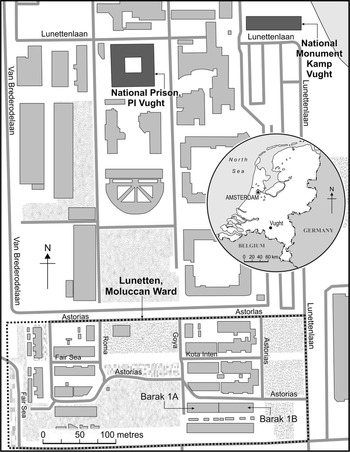
Kamp Vught was built in 1942 by Dutch contractors working for the German occupiers. During the Second World War, between 1943 and 1944, it was where not only Jews, but also other groups proscribed by the Germans such as Jehovah's Witnesses, were incarcerated. Between 1944 and 1945, at the end of the war, Kamp Vught became the reception camp for German civilian evacuees, as well as, until 1949, an internment camp for members of the National Socialist Movement in the Netherlands (NSB). In 1949 the internment camp was closed and in the beginning of the 1950s the camp was divided into three parts, one of which was for housing the Moluccan KNIL soldiers and their families, numbering around 3,000 people.Footnote 39 The NMKV was established in 1986 (fig. 1),Footnote 40 and took over some of the former Kamp Vught whilst the rest of the area was alienated for a prison and a military camp. The Moluccan community still occupy many of Kamp Vught's remaining barracks, now a ward renamed Lunetten; their housing was refurbished in 1990s, a community centre was set up and the surrounding streets were renamed after the ships the Moluccans came on.
Map of former National Monument Kamp Vught (NMKV), Lunetten and Barak 1B today (author's photograph).

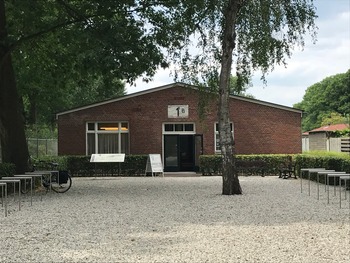
Barak (Barrack) 1A/B is located at one corner of the Moluccan ward of Lunetten and is ‘the only last barrack in the Netherlands … even on the Western side of Berlin’ (fig. 2).Footnote 41 Over the years, it has served as accommodation,Footnote 42 a church for the Moluccan community,Footnote 43 a post office, a canteen and a camp shop. In 2001, Barak 1A/B was designated as a national monument. In 2013, the decision was made to convert Barak 1B into a unique place of remembrance under the management of the NMKV.Footnote 44 The church which used to be in Barak 1B was moved to Barak 1A so that visitors could enter the museum without disrupting church activities. As the curator says, ‘it is more convenient and private … away from noise from the museum’.Footnote 45 Initially, some of the Moluccans in Vught did not want to restore Barak 1; they were afraid of the costs and did not feel the need for a museum. They relented when they realised the structure was by then decrepit and the money for its setting up was going to come through crowdsourcing and also from the government.Footnote 46 The museum can be visited with a ticket to the NMKV although Moluccans living in Vught have free admission.
Exterior of entrance to Barak 1B (author's photograph).

The museum is a complex one which covers the history of the place rather than any particular theme from the past. This means that it is a museum that showcases not only the Moluccans who were (and still are) there but also its many prior users such as those sent there during the Nazi German occupation. Upon entering Barak 1B, there is a permanent exhibition entitled Als muren konden spreken (If walls could speak) and a text on the wall that says: ‘This is the story of Barrack 1B.’ Adopting the strategy of place memories, the exhibition illustrates what it was like to live there when it was built and afterwards. Thus it does not only cover the history of the Moluccans since 1951 but also others who stayed in Vught over time such as those in the wartime concentration camp, German civilian evacuees as well as of NSB members. The exhibition covers the four periods equally, themed with their own colour and focused around stories about arrivals, lives whilst at Vught, and departures. This was done to circumvent any criticism that the museum was biased toward only one particular group who called Vught ‘home’ at different points in history.Footnote 47 Hence, place becomes central in the case of Barak 1B not only in being the original barrack but also in terms of the stories that have been placed within its walls. At the back of the museum are classrooms for seminars, and planned revolving exhibits. Despite it not being a museum only about the Moluccans, almost every Moluccan spoken to mentioned Barak 1B as one of the key spaces for learning about the community.
The story of the Moluccans as told at Barak 1B covers diverse themes beginning with the story of how the Moluccans ended up in the Netherlands in 1951, their dismissal from KNIL, the move to Lunetten, the establishment of the RMS, and how they became forced migrants in the country when the Dutch promise to send them home did not materialise. This is then followed by the story of life in Kamp Lunetten, from the quality of its food, the conditions of the small rooms and communal dormitories, the Ambonese associations formed, and the religious and recreational activities that the community engaged in. The third theme is that of the issues (unemployment, radicalisation, et cetera) that led to the actions in the 1970s as a watershed moment pertaining to the relationship between the Dutch government and the community. Finally, the museum presents stories of how the Dutch government provided the Moluccan community with new accommodation in the 1990s and how the latter has flourished since then, as evidenced by their broad integration with the Dutch population. These themes are interlaced with individual stories like that of Ton Latuhihin and how his family came to the Netherlands in 1951; Wim Manuhutu, portrayed as a key historian of Moluccan history; Louise Parihala, a guide at the NMKV and a member of the Satudarah group,Footnote 48 and Simon Tahamata who played with the Dutch national football team.Footnote 49
The decision to make it thematic was due, first and foremost, to the lack of space to tell everyone's stories. More than that, it was an attempt to ensure that all the different layers of the history of Barak 1B could be covered equally. As the curator of Barak 1B, Brigitte Kok, highlighted:
What happened to the Germans is only a few months and for the Moluccans it is 70 years and still continues. … If we do it chronologically then the whole museum will be about the Moluccans because they were the longest here. So it is not fair … we want to have all stories told that happened in this area.Footnote 50
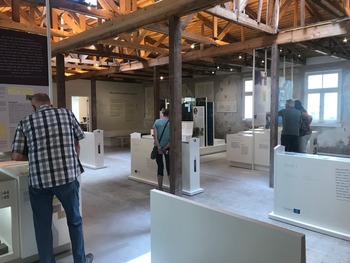
These stories were accompanied by photographs, text, oral accounts and video footage. According to the curator, Barak 1B is a good substitute for the loss of MuMa. It provides continuity not only in terms of being a place where Moluccan history can be represented, but also with regards to the artefacts there, many of which were borrowed from MuMa, thus ‘creat[ing] a connection between the old and the new and there is still a place where the stories of the Moluccans can still be told’. In addition, there is also the fact that the original people responsible for setting up MuMa were involved in Barak 1B as well. More than that, efforts were made to involve the community, such as in terms of collecting personal items to display, and gathering stories through oral interviews that would make the museum resonate better with the community (fig. 3). Even as RMS and the actions of the 1970s are portrayed, the curator claims Barak 1B as ‘a museum of everyday items of everyday personalities of the community. It is not political and it is not about the history. It is more about the people who live here and how they managed to keep their traditions alive.’Footnote 51
Interior of Barak 1B Museum (author's photograph)

Barak 1B as beacon of Moluccan identity
In the beginning it was a little bit difficult …. nobody had any idea what was going on … [the people were thinking] ‘What will be in the museum? Do we belong in the museum?’, but at the opening it was really nice … there was music, there was an old lady who handed the key over to the directors … with drums and dances. There were a lot of people there from all over the country and they came over on the day.Footnote 52
According to Barak 1B's curator, the reception to the opening was positive, even as there were those who were initially sceptical about the museum in the first place, reminiscent of Manuhutu's comments on his involvement in MuMa: ‘initially, the community was wondering why I was asking for personal effects. They did not really get the idea of a museum for Moluccans; it was not their thing.’Footnote 53 During the soft opening, to which only Moluccans were invited, many took photographs, reminisced about the past and gathered with family members. Louise Parihala, the NMKV guide whose story is depicted in the museum, said:
It was a good moment. People were going through the museum in their best [attire] and taking in the whole museum. Some of them lived in Vught and they saw this as a walk down memory lane especially since Lunetten itself has changed dramatically since the 1990s when the houses were rebuilt. But Barak 1 remained the same!Footnote 54
By 2017, more than 85,000 people, both Dutch and Moluccans, had visited Barak 1B, as walk-ins as well as part of school groups.Footnote 55 While some came just to visit Barak 1B others stumbled upon the museum serendipitously after being told at the NMKV that it was there.
Interviews conducted with Moluccan respondents also commented favourably on the ambience of the place as an example of where it all began for the community. As John said:
Lunetten is special because in the past we were first put here. Other [barracks] were dismantled (dibongkar) and Lunetten is the only one left. They tried to get us to move out but the KNIL fathers did not want that to happen … The ones in others (wijken) also tried to defend their wards but they were dismantled and had to move out.Footnote 56
Many also appreciated how the museum project helped to restore a building that was dilapidated and structurally unsafe. As Maria indicated:
Before restoration, there was a tree in the middle of the church and the community centre, and there was a hole in the roof … it was not safe. Turning it into a museum has really helped to take care of all these problems and ensure the building stays.Footnote 57
Similar sentiments related to the place played out repeatedly in the interviews, leaning towards the quality of Barak 1B and also to the salience of its location where ‘The sense of history is palpable … I know only a few places in Netherlands where this feeling is so pervasive.’Footnote 58
Others commented on the stories that have been included in the museum. According to George:
Barak 1B tells the stories of the first generation as well as the later generations and gives a good coverage of how our lives have played out in the Netherlands. There are personal stories here collected from the community who also donated many personal objects. These stories ensure that we do not forget where our forefathers came from and also how difficult it was to progress into what we are today.Footnote 59
Here, there is a sense of gratitude that the museum was set up in consultation with the community and also how important it was for such a museum to exist, especially for the younger generations who may not have experienced (or even heard about) the turbulent first decades of the Moluccans in the Netherlands. Barak 1B's curator also reiterated how important it was to have ‘a place in history for their story’.Footnote 60 Jimmy further expanded on this response by comparing it to other sites commemorating the Moluccan story:
After MuMa closed down a few years ago, we did not really have a place to tell our story until now. We have the monuments now but nowhere to learn about the history of the first generation and also about the culture of the Moluccans.Footnote 61
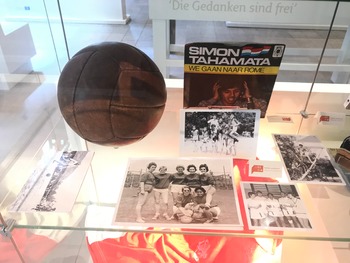
This quote also demonstrates appreciation for the museum not only in focusing on the history of the Moluccans but also their cultural achievements, showing how ‘the Moluccans have been able to remain Moluccan but still play an important role in the Netherlands such as in sports, music and the arts’.Footnote 62 Anneke reiterated this point when she said: ‘I feel proud when I read about people like Simon [Tahamata] and so on … We have done a lot in this country and contributed to its development’ (fig. 4).Footnote 63 All these sentiments thus show the salience of Barak 1B as a means of remembering and not forgetting Moluccan history and culture. It is also interesting how the site has been compared with other means of commemorating the Moluccans: such as the monuments which, as Jimmy continued: ‘just stand there with a small plaque and [are] too focused on the history with no space to talk about where we are right now!’Footnote 64
Display on Dutch national football player Simon Tahamata (author's photograph).

Respondents also mentioned the importance of sites such as Barak 1B not only for the Moluccan community—especially the younger generations who may have become very Westernised or who do not care much about history—but also as a way to let the Dutch know more about the community.Footnote 65 These sentiments emerged out of the sense that the community still sometimes feels misunderstood in the Netherlands, for example regarding the roots of the 1970s actions, and the fact that many of the Moluccans still choose to live in their own wijken, or ‘Moluccan territory’,Footnote 66 even though they are now allowed (and even encouraged) to live wherever they choose to. While Louisa said that this was because the community ‘wanted to remain where they already know many people from having lived there a long time’, it has also been perceived by some others as resistance against fully integrating with the Dutch. As such, Barak 1B can be a place where the Dutch can come to understand the community better. The desire for the Barak 1B museum to be a discursive space of engagement between the Dutch and the Moluccans was mentioned often by the respondents especially in the absence of much coverage about the Moluccans in history textbooks such that sometimes ‘we are still seen as the odd brown-skinned Dutch even though we have been here for a long time … only one, two lines’.Footnote 67 This therefore reflects upon Barak 1B as a salient bridge between the communities.
Although the research did not extensively cover the sentiments of Dutch visitors to Barak 1B, the few spoken to were highly positive about the museum even as many of them only found out about the museum extension upon arrival at the NKVM. Even so, they were pleasantly surprised to visit the museum and learn about its exhibits. It is noteworthy though that while Moluccan visitors embrace the museum as ‘their’ museum, Dutch visitors tend to see Barak 1B in its entirety: ‘as a place rich with many histories, of the German evacuees, of the Jews and of the Moluccans. I never knew how layered the place was!’Footnote 68 When asked about the depictions of the Moluccans specifically, more than a few Dutch visitors remarked also how it was important for them to know more about the community, especially since it was not something that they learn much about in their history books. As Maarten said: ‘It is funny that we see them [the Moluccans] everywhere today and we know them as being Dutch, but we do not really know much about their cultures, what they do, their practices. So it was really an eye opener for me to visit [Barak 1B].’Footnote 69 These sentiments reflect therefore the potential of the museum as a way to bring the two communities together.
Bones of contention
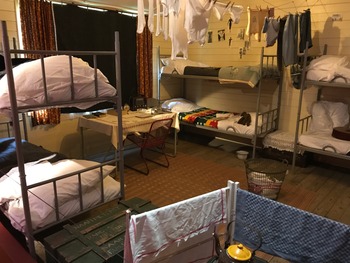
Even as many Moluccans in the Netherlands may welcome what Barak 1B symbolises and what it is seeking to do in terms of preserving the Moluccan story in the Netherlands, there were also others who felt that it perhaps did not go far enough. Despite many expressing gratitude for how the transformation helped to save a building that was crumbling, some were sad that the decision was not made to restore the building into what it was before and what the surrounding residential barracks in Lunetten looked like before these were refurbished in the 1990s, akin to how at MuMa, ‘there was at least a room that was built like an old barrack … with all the furniture and all that so as to show how we used to live’.Footnote 70 Such a realistic recreation of a barrack—as opposed to merely using the barrack as a backdrop for a more modern museum—can also be seen at the Arnhem Open Air Museum where there is a life-size diorama of a barrack where the Moluccans used to live (fig. 5).Footnote 71 In John's calculation here, despite the photographs of the old barracks (and a glimpse of the lives within them) included in Barak 1B, Moluccans do not really like to read, and so the physical recreation of the old barracks—which according to him, was a popular part of MuMa—would appeal more to the visitors. For him, given that Barak 1B forms part of an original barrack, the impact of going through it would be greater and it was therefore a missed opportunity to showcase it.Footnote 72
Recreation of Moluccan living conditions at the Arnhem Open Air Museum (Author's photograph).

Other visitors had issues with Barak 1B's historical coverage. There are those who felt that the museum had sidestepped providing too much detail about the actions of the 1970s and also about the RMS, a criticism that was also levelled on MuMa when it was still operational.Footnote 73 This lack of information could be due to the fact that there is more coverage about the 1970s actions at the Arnhem Open Air Museum, such that the curator felt it was unnecessary to duplicate it. Furthermore, the curator was clear that it was not the place of Barak 1B to tell ‘the story of the treinkaping (train hijacking) since those involved in it did not come from Vught where there is no animosity between the Moluccans and the local Dutch population’.Footnote 74 More importantly, the idea was not to belabour crises which would be counterproductive to showing how the Moluccans have become part of the Dutch community. Yet there are those who felt this was an important aspect of their history, and an exhibit about the 1970s actions could be a means to ‘clear up’ any misunderstandings the Dutch may have about the Moluccans being ‘violent’ people. As Jennifer says: ‘Since the [actions of the] 1970s, the Dutch may see us as violent terrorists but they do not really know why we did it.’Footnote 75 Matthew also highlighted how ‘not talking about the RMS shows how it did not exist … that the fight for an independent nation is not real … but the fight is still on for many’.Footnote 76 Thus some see the scant text about the RMS as a slight to their dreams of an independent Southern Moluccas.
Interestingly, however, there are those who agree with the museum curator's view about not harping on the 1970s actions or even on the RMS, as these are constant reminders of how the Moluccans do not really fit into the mould of ‘being Dutch’. As Karen, a third generation Moluccan said:
I would rather that these stories are forgotten as they show how we are always a piece that do not really fit into the national puzzle. Why remember how we are different from the Dutch? We should remember how we are now more settled here.Footnote 77
There is still a RMS government-in-exile in the Netherlands and every year there are still ceremonies to not only commemorate RMS Day but also honour the memories of those who were sacrificed during the train hijacking of 1977. Yet, it is salient to note that not every Moluccan was in favour of what happened during the 1970s and while some still harbour the thought of going back to an independent RMS, there are many others, especially from the younger generations, who are happily settled and have no memories of the homeland of their parents or grandparents.Footnote 78 Thus, for the latter, there is more the desire to focus on the positives of their lives in the Netherlands, symbolic of how the community has worked hard to integrate with the idea of being Dutch. Notably, even those who are pro-RMS were unhappy that the RMS was even mentioned. Wim Manuhutu mentioned two possible reasons why this is so: ‘first, there is the fear the Moluccans were seen as a political group which would make it hard to exist in Netherlands but also because it would prevent movement [of Moluccans] back to Indonesia’. More than that, there is also the sense that including RMS in a museum is akin to saying that it is now history; ‘as the political struggle is musealised, people thought that RMS [has lost] power and it therefore becomes part of history!’Footnote 79
These responses firstly point towards the heterogeneity of the Moluccans, particularly in terms of their affiliations to the RMS.Footnote 80 Indeed, while there are those who are still hopeful that the RMS will become a reality one day, others do not really share this view. More importantly, it shows how sites such as Barak 1B may be seen to deaden what is actually ongoing, rendering it to ‘something that happened’ rather than ‘something that is happening’. The divide between those lobbying for more about the political past and those who do not also reflect the position of the Moluccans as migrants. While the former would criticise the overt focus on portraying the community's progress in the Netherlands as something to be proud of, the latter would complain of how it masks the fact that the struggle is still real, given that the community is still fighting for the rights of the first generation of Moluccans to be honoured, and for the community to be treated equally given that most if not all have been naturalised (if not born) as Dutch citizens. This divide evidences Steijlen's idea that it was inevitable that younger Moluccans, especially those born and raised in the Netherlands, would feel more integrated in the Netherlands; although there are those clamouring for the Moluccans to be seen as different from the Dutch, others are more in favour of showing how they are the same.Footnote 81 As Elaine puts it: ‘I am glad that [Barak 1B] has decided to showcase our achievements rather than dwell on problems as this shows how we have settled into where we are now … I want to honour the first generations too but I also don't want to rock the boat again’,Footnote 82 referring to the fragile relationship between the community and the Dutch writ large.
Another issue pertains to the multiplicity of other stories told at Barak 1B such that it really does not belong solely to the Moluccan community. This relates to the Moluccan story having to share space with the stories of other groups that had also been incarcerated or housed in Kamp Vught:
Here the stories are not just about Molukkers … It is not a Moluccan museum. There are many stories there … Jewish and other people's histories here can also be found …. Barak 1B is also not our museum because it belongs to the [NMKV] … So in that sense we still feel like we do not have a museum yet.Footnote 83
This reflects upon the difficulty of the Moluccans taking ownership of the museum given that it is still managed by the NMKV. Even though it was never intended to be just a museum for Moluccans, it was noteworthy that some still felt the presence of the different histories of Barak 1B's former inhabitants had diluted the significance of the space as a ‘Moluccan’ heritage site. As Joe also said: ‘MuMa was our museum. It had financial difficulties but we managed it and it [was] about us. But Barak 1B is not only about us. Oh how I miss MuMa.’Footnote 84 Yet, there are also others who explained that having the Moluccan story as part of other more ‘Dutch’ histories is not necessarily a bad thing as it puts the community squarely as part of the historiography of the Netherlands more generally. Reflecting upon such views of Barak 1B, Wim Manuhutu retorted that
[t]he site is linked to Maluku and also WWII and many other … complementary histories. But some feel that if there are other histories, then our own history will be less at the museum. But I think different histories can help each other.Footnote 85
In fact, Manuhutu feels that more should be done to fold Moluccan history into Dutch history even further back, and to include it in the colonial history of what is today Indonesia or ‘we will not be able to understand why there are Molukkerstraat [Moluccan street] in Utrecht or why some places have Indischebuurt [Indonesian neighbourhood] … or why there are all the rich people in Amsterdam [due to colonial trade] … so including colonial history as Dutch history is good’.Footnote 86 This reaffirms the idea of how some felt it was more useful to think of Moluccan and Dutch histories not as mutually exclusive or competing, but more complex and highly intertwined, although this too can invite the criticism of the Moluccan side of the story being subsumed or overwhelmed by Dutch or wider Indonesian histories more generally.Footnote 87
A final critique of Barak 1B is that it is not really the Moluccan way of ‘doing heritage’. This is already implied above with respect to how it was a challenge to convince the community about the need for the museum, many from the community not being used to the idea of formal representations of history and culture. In their thinking, Lunetten, or as Louis Parihala calls it, Kampong Melayu di Tanah Belanda (‘a Malay village in the Netherlands’),Footnote 88 is itself a museum:
There are many new monuments in the Netherlands but for us where we are living is a monument in itself. It looks like a barrack and in the discussions about the changes in Vught, we wanted to maintain the same shape … it is all in the style of a barrack. It is a symbol that this is a former barrack … with low houses mainly and connected to one another. This is its own monument, a living monument (monumen hidup).Footnote 89
Other respondents also pointed to how the Moluccan story is already being told ‘through our elders or in the everyday things that we do in the community. Why would we need to go see what is in the museum’,Footnote 90 thus emphasising how, for them, heritage lies not in any form of bounded space but ‘from below’,Footnote 91 such as through the activities held at the community centre, pasar malams and in their own homes via stories passed down from generation to generation. The focus of heritage-making here is therefore on not only the material landscape that is Vught, but also in the social landscapes that are produced by the community on a regular (if not daily) basis that mirror what it means to be Moluccan. In fact, the sense here is that ‘the museum or any other heritage sites are just for the benefit of others … for the Dutch and tourists; not for the Moluccan people. This is still good I guess … as a way to connect the community with the Dutch community’.Footnote 92 Every Moluccan has his or her stories and it is also felt that any type of museum, given their spatial and other limits, would not really be able to tell all these stories. As Arifin pointed out, museums do tend to generalise individual stories and make them collective, and thus ‘make all Moluccans the same’.Footnote 93
Conclusion
In analysing public opinions about Barak 1B, a museum that is (partially) dedicated to telling the migration story of Moluccans over the years, it is clear how there are still tensions both between the Moluccans and the Dutch and among the community itself, somewhat reminiscent of the discussions surrounding its predecessor MuMa.Footnote 94 Even as it was largely welcomed, there were criticisms, reflecting the ways in which formal commemorative sites can be highly dissonant given the multiplicity of memories as well as memorialists.Footnote 95 It is also interesting how many took issue with having a museum in the first place, citing how this is not ‘the Moluccan way’ of doing heritage, preferring to let the adjacent Moluccan wijk (that is Lunetten) and its inhabitants itself be a living monument where ‘the home that one left behind [the Moluccan Islands itself] might feature in shaping the everyday processes of creating home in a new context’.Footnote 96 This is indeed a reminder of how museums or monuments are modern phenomena which may not align with how some minority communities see as an appropriate way of remembering the past, preferring other memorial strategies that are more performative rather than in the form of bricks-and-mortar.Footnote 97 The interviews also reflect how while the Moluccans in general are still tied to their homeland of Ambon, as clear not only in the desire to maintain the culture but also in how many of them, especially the elders, still have familial and symbolic links to their homeland,Footnote 98 they are unwilling to give up their lives in the Netherlands.
Yet, this article also shows how these criticisms were not always shared by everyone within the community. While some may see the story of the RMS as an important part of the Moluccan story here, others saw its inclusion in Barak 1B as deadening the still ongoing efforts by many for an independent South Moluccas to be realised, chipped away from the Indonesia nation. Although there are those who are disappointed that the Moluccan story had to share space with the other historical events that took place at Barak 1B, others saw this as a positive step towards finally being folded into Dutch historiography and bridging the chasm that has existed between the Dutch and the Moluccans. Finally, the Moluccan diaspora here is also torn between celebrating the achievements of the community as settlers in the Netherlands versus remembering the pain and struggle of how they got there in the first place, although this is felt more among the older Moluccans rather than among the younger generation. In any case, moving forward, it will be fascinating to see how these issues recur given the recent spate of discussions and rediscoveries in the Netherlands of Dutch colonial exploitation of the East Indies, which culminated in the Dutch king as well as the prime minister offering formal apologies in 2020 and 2022, respectively.Footnote 99 This clearly shows how, even after seven decades, old wounds have not fully healed.
Three key things may be extracted from this study. First, it reflects a heterogeneous community in terms of not only what should be remembered of the Moluccan past but also how this is to be done. Second, it demonstrates the limitations of museums as a way to showcase history and culture, especially when it is associated with a community of forced migrants, many of whom still harbour grudges for past injustices and have hopes of ‘breaking away’—in this case from both the larger home (Indonesia) and host (the Netherlands) societies. As much as the Barak 1B sought to formulate ‘a more homogenized dominant memory’, it also bears ‘marks of the omissions and erasures crucial to the production of any shared past’.Footnote 100 Finally, this article has shown how Barak 1B is symbolic of the complex worldviews of a migrant community which hovers between wanting to set itself apart from, but also desires more integration with, the Dutch. Indeed, Barak 1B demonstrates the ambivalence felt by a community neither here nor there, one that yearns for ‘an imaginary motherland, a place where they anchor their identities, but [to which they] are unwilling to return’,Footnote 101 which means any attempt to tell their stories in a formal setting will always be a contested and a problematic endeavour.
More broadly, this article demonstrates how, in the contemporary global age, the notion of a Southeast Asian region—if there ever was one—is not only porous but also transnationally distributed.Footnote 102 In the case of the Moluccan diaspora, the struggle to maintain its identity as Moluccans and, especially for the older generations, to remember its roots in Southeast Asia, continues against the difficult challenges of not only living outside of the region but also an allegiance to a ‘homeland’ that has, till today, yet to exist. It is a reminder therefore that to study Southeast Asia as merely confined to its physical boundaries is inadequate and severely myopic as ‘memory shards [of diasporic groups] necessarily locate themselves and are located in different scattered places, spaces, and acts … in the here and the there’, both within as well as without the region.Footnote 103 This article also shows how it is not enough to contemplate diasporic heritage-making as necessarily or simply tied to any one particular nation. Notwithstanding the fact that diasporas are multiple, heterogeneous and fragmented,Footnote 104 and there may be no ‘home’ nation to speak of, as is the case with the exiled Moluccans, diasporic heritage-making cannot be anything but transnational, emblematic of a people that can remain ambivalent about where their loyalties are, leading to shifting allegiances that may not go away with mere tokenistic acceptance by nations of settlement. Scholars studying diasporas would thus do well to avoid essentialising diasporic identity as the need to resist assimilation in one national context or the yearning to be in another;Footnote 105 as shown here, it commutes between the two in a journey that never arrives, especially when the destination is still somewhere unrealised, imagined rather than real.