





Autism describes neurodevelopmental differences across social, sensory and behavioural domains. Autistic peopleFootnote a have unique strengths, but frequently report lower subjective quality of life, Reference Taylor, Livingston, Clutterbuck, Callan and Shah1 and mental and physical health conditions are overrepresented in this population. Reference Hand, Angell, Harris and Carpenter2
Complex and interacting biopsychosocial factors likely contribute to overall worse health outcomes in autistic people; research indicates that autistic people are more likely to experience loneliness, Reference National Autism Society3 suicidal behaviour Reference Cassidy, Au-Yeung, Robertson, Cogger-Ward, Richards and Allison4 and chronic physical health conditions. Reference Asztély, Kopp, Gillberg, Waern and Bergman5 A unifying factor linking predisposition to mental and physical health concerns is joint hypermobility. Reference Sharp, Critchley and Eccles6 This variant in connective tissue is associated with increased rates of depression and anxiety, Reference Eccles, Quadt, McCarthy, Davies, Bond and David7 bipolar disorder specifically in neurodivergent people, Reference Bucknill, Quadt, Dew, Colasanti, Muller-Pollard and Critchley8 and chronic pain/fatigue conditions. Reference Quadt, Savage, Bond, Davies, Critchley and Eccles9 Both autism and attention-deficit hyperactivity disorder (ADHD) are also frequently underrecognised in adult psychiatric services, with evidence suggesting that a substantial proportion of patients meets criteria for neurodevelopmental diagnoses following comprehensive assessment despite lacking a prior diagnosis. Reference Eberhard, Billstedt and Gillberg10
Given these factors, we aimed to estimate how many adults presenting in acute and crisis mental health services would meet threshold screening criteria for autism, and whether joint hypermobility may be an associated factor.
Method
Regulatory approval
This service evaluation was registered with, and all procedures involving human patients were approved by, the Sussex Partnership NHS Foundation Trust Quality Improvement Team, which oversees clinical governance and supports quality improvement and patient safety initiatives across the organisation. Research ethics approval was not required. The authors assert that all procedures contributing to this work comply with the ethical standards of the relevant national and institutional committees on human experimentation and with the Helsinki Declaration of 1975, as revised in 2013.
Inclusion criteria and participant selection
We used pragmatic convenience sampling, where adults (18–65 years) accessing three acute/crisis services within the Sussex Partnership NHS Foundation Trust (emergency department referrals to the mental health liaison team (MHLT) – this team is usually the first point of contact for crisis patients and refers patients to crisis teams or in-patient wards; referrals to the crisis resolution home treatment (CRHT) team and admissions to one male and one female in-patient ward) were invited to complete a series of questionnaires. Within the MHLT and wards between April and June 2023, the administering researcher (S.C.) invited adults who were deemed well enough to participate by an experienced clinician on site. For CRHT participants, questionnaires were sent by post to all patients under the team’s care in April 2023. Figure 1 displays the flow of recruitment and participant characteristics.
Recruitment and demographics. CRHT, crisis resolution home treatment team; MHLT, mental health liaison team; RAADS-14, 14-question Ritvo Autism and Asperger Diagnostic Scale.

Measures
All participants filled questionnaires out independently, either in person with pen and paper (MHLT and ward patients) or at home (CRHT) after having been sent questionnaires via post.
Participants completed the 14-question Ritvo Autism and Asperger Diagnostic Scale (RAADS-14), Reference Eriksson, Andersen and Bejerot11 Mental Health Quality of Life Questionnaire (MHQoL) Reference Van Krugten, Busschbach, Versteegh, Hakkaart-Van Roijen and Brouwer12 and the 5-part questionnaire on hypermobility (5PQ). Reference Hakim and Grahame13 Demographic details (Fig. 1) and reason for referral were recorded.
The RAADS-14 is a validated tool for autism screening. A score of ≥14 is the recommended cut-off for further investigation of autism and the median reported score is 32 for autistic individuals. Reference Eriksson, Andersen and Bejerot11 The maximum score for the MHQoL is 21, with a higher score implying greater quality of life. A stand-alone question allows participants to rate overall psychological well-being on a ten-point scale. The 5PQ is a questionnaire used to screen for hypermobility (validated against the gold standard Beighton score Reference Beighton, Grahame and Bird14 ); its sensitivity and specificity are reported as 0.84 and 0.89). A score of ≥2 is indicative of hypermobility.
Statistical analyses
All analyses were performed with IBM SPSS version 28 for Windows (IBM Corp., Armonk, New York; https://www.ibm.com/support/pages/downloading-ibm-spss-statistics-28). Mann–Whitney U-tests compared differences in measures (quality of life, hypermobility) between groups (above or below cut-off for RAADS-14) and Spearman’s rho was used as a measure of correlation.
Data handling
Data were handled according to the European Union’s General Data Protection Regulation. Individuals’ responses were fed back to clinical teams to allow them to contextualise the scores and act on this with follow-up assessments where necessary.
Results
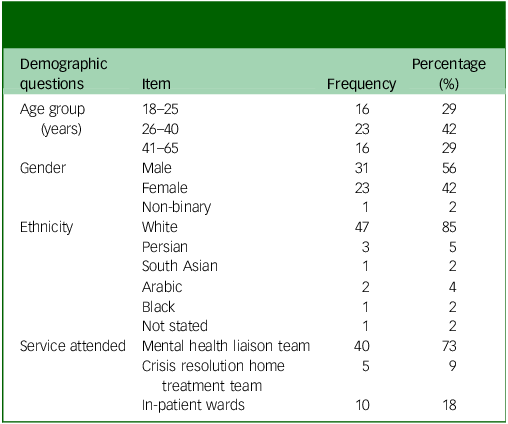
Fifty-five participants were included, with a mean age of 35.7 years (s.d. 13.8). Fifty-six per cent were male, and predominately White (47 out of 55, 85%) (Fig. 1). Most questionnaires were completed by individuals presenting to the MHLT (40 out of 55, 73%). The reason for presentation is not included in Table 1 because of incomplete answers. However, most presentations were related to low mood or attempted suicide.
The core demographic details of our responders, presenting issue not included

Table 1 Long description
A table summarizing demographic details of responders. The table has 4 rows and 4 columns. Column headers are Demographic questions, Item, Frequency, and Percentage (%). Row 1: Age group (years), 18-25, 16, 29 percent. Row 2: Age group (years), 26-40, 23, 42 percent. Row 3: Age group (years), 41-65, 16, 29 percent. Row 4: Gender, Male, 31, 56 percent. Row 5: Gender, Female, 23, 42 percent. Row 6: Gender, Non-binary, 1, 2 percent. Row 7: Ethnicity, White, 47, 85 percent. Row 8: Ethnicity, Persian, 3, 5 percent. Row 9: Ethnicity, South Asian, 1, 2 percent. Row 10: Ethnicity, Arabic, 2, 4 percent. Row 11: Ethnicity, Black, 1, 2 percent. Row 12: Ethnicity, Not stated, 1, 2 percent. Row 13: Service attended, Mental health liaison team, 40, 73 percent. Row 14: Service attended, Crisis resolution home treatment team, 5, 9 percent. Row 15: Service attended, In-patient wards, 10, 18 percent.
Among the 55 individuals who completed the RAADS-14, the mean score was 22.78 (s.d. 11.367, median 24). Of these, 43 people (78%) scored above the recommended cut-off of 14; Reference Eriksson, Andersen and Bejerot11 only 8 had a pre-existing autism diagnosis. Furthermore, we calculated how many people scored above the published median (median 32) for autistic individuals, Reference Eriksson, Andersen and Bejerot11 which 15 participants (27%) met.
Fifty-four individuals completed the MHQoL, with a mean total score of 7.87 (s.d. 4.31, median 6). The mean psychological well-being scale score was 3.23 (s.d. 2.54). Fifty-four individuals completed the hypermobility measure, with 18 (33%) screening positive.
Association between autism screening outcome, quality of life and hypermobility
Mean quality of life and psychological well-being (individual subscales of MHQoL) was lower in those screening positive on the RAADS-14, using the recommended cut-off of 14 (quality of life: 6.8 versus 11.7, Mann–Whitney U = 89, Z = 3.414, p < 0.001; well-being: U = 136, Z = 2.507, p = 0.012). RAADS-14 score was negatively correlated with quality of life (r s(54) = −0.539, p < 0.001) and psychological well-being (r s(54) = −0.335, p = 0.012).
The mean RAADS-14 score was higher among those who were likely hypermobile (35.1 versus 23.7, Mann–Whitney U = 186.5, Z = −2.53, p = 0.012). Additionally, there was a significant positive correlation between number of hypermobility features and RAADS-14 score (r s = 0.349, p = 0.01).
There was no significant relationship between mode of completion (in person or at home), age, gender or ethnicity and responses to any of the questionnaires.
Discussion
This service evaluation demonstrated a high frequency of possible autism, as measured by the RAADS-14, among adults accessing acute mental health services. Using the recommended cut-off, 78% of participants screened above threshold. Even when applying most conservative estimates, almost a third of patients met initial screening criteria. Furthermore, we found a significant association between RAADS-14 score and both lower quality of life and generalised joint hypermobility, which may be a unifying factor for mental and physical health concerns.
A key aim was to inform local policy and set the agenda for future research by determining frequency of likely autism in crisis populations. Our sampling methodology was pragmatic, utilising convenience sampling, and may have introduced self-selection bias by individuals motivated to obtain an autism diagnosis. Sample size was limited and participants were predominantly White, precluding generalisation. We also did not gather information on broader demographic characteristics, whether patients were open to mental health services before presentation or information on total referrals to services within the study’s time frame. Future studies should consider including a broader sample to estimate representativeness.
The unexpectedly high number of people screening above recommended threshold on the RAADS-14 in adults presenting to crisis services suggests a potentially substantial population of undiagnosed autism, highlighting the need to modify acute services accordingly. While recognising limitations in our estimation method, Reference Nyrenius, Eberhard, Ghaziuddin, Gillberg and Billstedt15 our findings suggest a disproportionate percentage of likely autism. Using the full RAADS-R scale of 80 items, two recent studies found that 17.6 and 22.2% Reference Bucknill, Quadt, Dew, Colasanti, Muller-Pollard and Critchley8,Reference Quadt, Savage, Bond, Davies, Critchley and Eccles9 of adults without major mental or physical health issues screened above threshold for autism. In contrast, studies using full clinical assessment in adult psychiatric populations report substantially higher rates of autism and ADHD, with up to 63% of individuals meeting criteria for diagnoses. Reference Eberhard, Billstedt and Gillberg10 Although no immediate comparison is possible because of differences in scales, these findings suggest a sizeable difference in occurrence of autism in those in mental health crisis versus the general population. Research also suggests that co-occurring ADHD may skew results and should be tested as a potential confounding variable in future studies. Reference Eriksson, Andersen and Bejerot11
The observed association between autistic traits, hypermobility and lower quality of life warrants further consideration. Hypermobility and related connective tissue differences are increasingly recognised in neurodivergent populations Reference Csecs, Iodice, Rae, Brooke, Simmons and Quadt16 and may contribute to a complex interplay of chronic pain, proprioceptive difficulties, fatigue and autonomic symptoms. Reference Quadt, Savage, Bond, Davies, Critchley and Eccles9 Such physical health burdens can compound psychological distress and functional impairment, potentially lowering quality of life and influencing patterns of crisis service use. Future research should explore how these physical health characteristics interact with autistic traits to influence risk, distress and service needs in acute mental health populations.
Our findings emphasise the importance of appropriate resource allocation, recruitment of staff with expertise in neurodivergence, education and careful consideration of the diagnostic overlap between autism and other conditions, notably personality disorders and affective disorders, Reference May, Pilkington, Younan and Williams17 and their role in potential suicides. The impact of likely undiagnosed autism in this population is probably considerable, and warrants designing appropriate multidisciplinary care and services for those in crisis.
Further studies should be conducted at scale and seek to take a rigorous approach to the measurement of an accurate prevalence of autism within adults accessing acute mental health services. Additionally, gathering detailed data on diverse characteristics such as ethnicity, age and gender would allow for more representative findings, as would impact of co-occurring ADHD. Research regarding the lived experience of individuals with mental health issues who have received adult diagnoses of autism will also be informative and can guide future practice. This has significant implications for the design of healthcare service delivery.
Data availability
The data that support the findings of this study are available from the corresponding author, J.A.E., upon reasonable request.
Author contributions
S.C., J.M.S. and J.A.E. designed the service evaluation. S.C. collected data and conducted data analysis with support from J.M.S. and J.A.E. S.C. drafted the initial manuscript. L.Q. edited and revised the final manuscript. All authors – A.R., L.A.P., R.D., V.W. and H.D.C. – were involved in editing and approving the final version of the manuscript alongside S.C., L.Q., J.M.S. and J.A.E.
Funding
This service evaluation received no specific funding. J.A.E. was supported by an MQ (Transforming Mental Helath)/Versus Arthritis Fellowship (MQF 17/19).
Ethical standards
This work was registered as a service evaluation and conducted as such. The authors assert that all procedures contributing to this work comply with the ethical standards of the relevant national and institutional committees on human experimentation and with the Helsinki Declaration of 1975, as revised in 2013. All procedures involving human patients were approved by Sussex Partnership NHS Foundation Trust Quality Improvement Team. Research ethics approval was not required. Written informed consent was obtained from all participants.
Declaration of interest
J.A.E. Chairs the Royal College of Psychiatrist’s Neurodevelopmental Psychiatry Special Interest Group.


 Open access


eLetters
No eLetters have been published for this article.