INTRODUCTION
While interest in latitudinal and elevational gradients in species richness has stoked advances in our understanding of avian diversity (Herzog et al. Reference HERZOG, KESSLER and BACH2005, Kattan et al. Reference KATTAN, FRANCO, SAAVEDRA-RODRíGUEZ, VALDERRAMA, ROJAS, OSORIO and MARTíNEZ2006, Rahbek Reference RAHBEK1995, Rahbek & Graves Reference RAHBEK and GRAVES2001, Rahbek et al. Reference RAHBEK, GOTELLI, COLWELL, ENTSMINGER, RANGEL and GRAVES2007), we know little about how other properties of avian communities vary, especially in the tropics. There are few complete descriptions of tropical avian communities published (Robinson et al. Reference ROBINSON, BRAWN and ROBINSON2000, Terborgh et al. Reference TERBORGH, ROBINSON, PARKER, MUNN and PIERPONT1990, Thiollay Reference THIOLLAY1994). However, more data are available on terrestrial insectivores, a subgroup that has been described at four sites in lowland rain forest (LRF) and one site in tropical montane cloud forest (TMCF) in terms of abundance, density, territory size and biomass (Kattan & Beltran Reference KATTAN and BELTRAN2002, Robinson et al. Reference ROBINSON, BRAWN and ROBINSON2000, Stouffer Reference STOUFFER2007, Terborgh et al. Reference TERBORGH, ROBINSON, PARKER, MUNN and PIERPONT1990, Thiollay Reference THIOLLAY1994). Thus, terrestrial insectivores have potential to shed some light on how these properties behave.
Terrestrial insectivores in LRF (along with most of the avian community) are several times more species rich than in temperate forests and have very even abundances (Karr Reference KARR1971, Karr & Roth Reference KARR and ROTH1971, Terborgh et al. Reference TERBORGH, ROBINSON, PARKER, MUNN and PIERPONT1990). Territory sizes are an order of magnitude larger (12–13 ha) than those typically observed at temperate latitudes. This pattern is constant throughout Amazonia from Manu, Peru (Terborgh et al. Reference TERBORGH, ROBINSON, PARKER, MUNN and PIERPONT1990), to Nouragues, French Guiana (Thiollay Reference THIOLLAY1994), to Manaus, Brazil (Stouffer Reference STOUFFER2007). In Panama, terrestrial insectivores are slightly less species-rich, exist at higher densities and have slightly smaller territories (Robinson et al. Reference ROBINSON, BRAWN and ROBINSON2000).
The terrestrial insectivore guild changes in a similar way as one moves from LRF up to TMCF. The terrestrial insectivore guild in Colombian TMCF (Ucumarí) consists of five species of Grallaria antpitta. Mean territory sizes are roughly three times smaller than in LRF and density per species is roughly three times higher (Kattan & Beltran Reference KATTAN and BELTRAN1999, Reference KATTAN and BELTRAN2002). In other words, values of guild properties in Ucumarí lie between those observed in Amazonian and temperate forests and, in conjunction with results from Panama, raise the question of whether or not a tropical-to-temperate pattern of covariation in guild properties is a general phenomenon. Changes in the best-studied guild property, species richness, over latitude (Hillebrand Reference HILLEBRAND2004), elevation (McCain Reference MCCAIN2009, Rahbek Reference RAHBEK1997, Terborgh Reference TERBORGH1977) and geographical features (Cracraft & Prum Reference CRACRAFT and PRUM1988, Poulsen & Krabbe Reference POULSEN and KRABBE1997), provide ample opportunities to test whether or not other guild properties vary with it in predictable ways.
This study was designed to describe the little-known properties of avian insectivore guilds in TMCF, specifically species richness, abundance, density, territory size and biomass. It also tests the hypothesis that properties of terrestrial insectivore guilds exhibit fixed, monotonic relationships to one another over varying elevations: specifically, that at higher elevations guild properties are shifted towards values observed at higher latitudes. Results from this study and all neotropical studies with sufficient data on terrestrial insectivores were compiled so that predictions about the covariance of guild properties between LRF and TMCF could be tested.
METHODS
Study site
Bosque de Cuyas and Bosque los Molinos compose a 1000-ha relict TMCF on the western slopes of the Andes, located in the province of Ayabaca, Dept. Piura, Peru (4°36′S, 79°44′W, 2200–3100 m). It is one of the most intact forests in the region that is safely accessible. The forest receives about 1000 mm of precipitation in normal years, but more during El Niño years. The rainy season is from December to May, and heaviest between January and April.
The study was conducted on a 26.2-ha plot which by TMCF standards might be considered flat. The elevation on the plot ranges from 2300 m to 2400 m. It contains secondary forest at least 60 y old and primary forest, loosely divided into the northern and southern halves of the plot; there are 12.6 ha of secondary forest and 13.6 ha of primary forest. The plot is bordered on one side by a single-lane dirt road and on its other three sides by neighbouring tracts of forest. Apart from the dirt road, it is in the approximate centre of the continuous forest.
There are two layers to most of the forest, the uppermost of which is made up of Lauraceae, Melastomataceae, Myrsinaceae, Clusiaceae, Erythrina spp., Ericaceae and Arecaceae (Vellinga et al. Reference VELLINGA, FLANAGAN and MARK2004). The understorey contains a great quantity of climbers, ferns and bamboo, which is composed by Baccharis sp., Asteraceae, Piperaceae, Solanaceae, Papilionaceae, Amaryllidaceae and Chloranthaceae (Vellinga et al. Reference VELLINGA, FLANAGAN and MARK2004). Maximum heights for the canopy and understorey are 20–30 m and 6 m, respectively (Vellinga et al. Reference VELLINGA, FLANAGAN and MARK2004), though more typically 11 m and 3–4 m. There is light cattle grazing in the understorey along the trails from late May to January, mainly in secondary forest.
Species selection
The terrestrial insectivore guild is composed of birds which move almost entirely on the ground and forage in leaf litter (Stouffer Reference STOUFFER2007). In Ayabaca the only true members of this guild are three members of the genus Grallaria: chestnut-crowned antpitta G. ruficapilla, undulated antpitta G. squamigera and scaled antpitta G. guatemalensis (nomenclature after Schulenberg et al. Reference SCHULENBERG, STOTZ, LANE, O'NEILL, PARKER and BRACK EGG2007).
In order to increase the number of species in the study and to obtain data from taxa besides Grallaria, the loosely defined guild of understorey insectivores was also studied. These birds forage between the ground and the top of the understorey, usually 3–4 m above ground, though in areas with poorly developed understorey or extremely low canopy, they may range up above that height limit (pers. obs.). Birds that often follow mixed-species flocks were excluded, as their breeding territories might be confused with the foraging territories of the flocks they follow. The remaining birds were taxonomically diverse: blackish tapaculo Scytalopus latrans, Jelski's chat-tyrant Ochthoeca jelskii, slaty-backed nightingale-thrush Catharus fuscater, grey-headed antbird Myrmeciza griseiceps, Chapman's antshrike Thamnophilus zarumae, Azara's spinetail Synallaxis azarae, line-cheeked spinetail Cranioleuca antisiensis and rufous-necked foliage-gleaner, Syndactyla ruficollis. The line-cheeked spinetail and rufous-necked foliage-gleaner are sometimes seen in mixed-species flocks, but often sing alone from high perches to indicate their breeding territories. Their inclusion as understorey insectivores is perhaps questionable too, for they frequently range up into the canopy, but the guild is somewhat arbitrary in a forest with such a low ceiling.
Census methods
The majority of data were gathered by spot mapping bird locations while the author walked along trails (Ralph et al. Reference RALPH, GEUPEL, PYLE, MARTIN and DESANTE1993, Terborgh et al. Reference TERBORGH, ROBINSON, PARKER, MUNN and PIERPONT1990). All of the trails on the plot were within a minimum of 100 m of each other, usually less, and marked at intervals of 25 m. When a singing bird was detected, its distance and bearing were estimated. Sometimes birds sang while moving, enabling partial cross-sections of their territories to be mapped. Special attention was paid to counter-singing birds, as they were critical to determining territorial boundaries. Counter-singing and singing while moving were invaluable in mapping the territories of species in which both sexes sing (e.g. Azara's spinetail, Grallaria spp.). With Azara's spinetail mapping was relatively straightforward because the pair usually sing together, but with Grallaria the situation was less obvious. Birds that were consistently spaced when counter-singing and that never fell along the path of a singing bird as it moved could be assumed to be owners of distinct territories. However, estimates of Grallaria territories are less precise than those of species in which pairs maintain close contact. Any error where a mated pair singing apart was mistaken for two separate territories should tend to overestimate population size. The chestnut-crowned antpitta presented the greatest opportunity for that sort of error because its territories were so closely spaced.
Censuses were conducted from 15 min before dawn until afternoon on 38 days between 7 November 2007 and 18 April 2008. Most singing occurred between November and January, but some species showed greater activity later in the season. The greatest song activity lasted from 15 min before dawn until about 1 h after. Where no detections had been recorded for a species or a territorial boundary was ambiguous, its territorial song was played. This revealed several territories of the otherwise taciturn Jelski's chat-tyrant, as well as some territories of the scaled antpitta, Azara's spinetail and grey-headed antbird. The undulated antpitta and Chapman's antshrike seldom sing and do not respond to playback, which makes their study problematic. Other birds almost saturated the plot with territorial songs, and thorough playback censuses added little to their territories, indicating that passive spot mapping sufficed to census individuals holding territories (Stouffer Reference STOUFFER2007). A very modest number of individuals (nine) were marked with colour bands. Movements of colour-banded birds agreed with the results of auditory spot-mapping. Mist-netting was not extensive enough to estimate how many, if any, floaters (non-territorial individuals) might have been present. Their presence was ignored because it is thought that such birds are rare in neotropical bird populations (Fedy & Stutchbury Reference FEDY and STUTCHBURY2004, Morton et al. Reference MORTON, DERRICKSON and STUTCHBURY2000). Using all methods, 1638 detections were recorded.
Data analysis
Territories were drawn around clusters of detections for each species. At least one territorial song was necessary to mark a territory. Partial territories on the plot were rounded to the nearest 0.25 (Robinson et al. Reference ROBINSON, BRAWN and ROBINSON2000, Stouffer Reference STOUFFER2007, Terborgh et al. Reference TERBORGH, ROBINSON, PARKER, MUNN and PIERPONT1990). For comparison with other studies, density, percentage of plot occupied, and biomass of terrestrial insectivores were calculated. Masses of Grallaria spp. were taken from Dunning (Reference DUNNING2008) as none was captured.
Data were compiled on terrestrial insectivores from neotropical study sites with sufficient information to test for correlations between guild properties and elevation. Variables listed as ranges in other studies (see Table 3 in Stouffer Reference STOUFFER2007) were entered as midpoints in the dataset. Abundance was not included because it is correlated with density by definition and occupancy was not included because it is not given as a continuous variable for all species in all studies. Pearson's correlation coefficient was used to determine covariance between elevation, species richness, density, territory size and biomass for terrestrial insectivores.
RESULTS
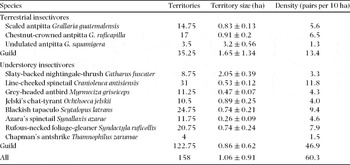
On the 26.2-ha plot that constituted the study area there were 158 whole and partial territories. Understorey insectivores occupied 122.75 of these while terrestrial insectivores (Grallaria spp.) held 35.25 (Table 1.). The mean territory size for understorey insectivores was about half that of terrestrial insectivores.
Numbers of territories, territory sizes, and densities of terrestrial and understorey insectivores in Ayabaca, Peru.

The understorey and terrestrial insectivores had similar per-species densities, the latter group's saturation of the plot compensating for their larger territories (Table 1). A narrow majority (6/11) species occupied > 50% of the plot and none of them had fewer than the 3.5 territories of the undulated antpitta. Terrestrial insectivores and most understorey insectivores showed no preference for primary or secondary forest. Azara's spinetail was the major exception, having most of its territories in secondary forest. The only territory this species held in primary forest was near a large treefall. Biomass calculated for the terrestrial insectivore guild was 2470 g in 10 ha. The numerous chestnut-crowned antpitta and scaled antpitta accounted for most of the mass, while the large-bodied but uncommon undulated antpitta made up only 15% of the total.
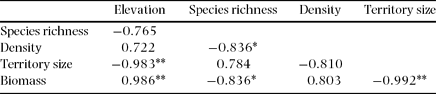
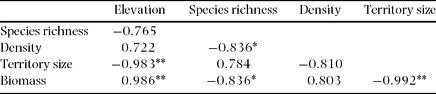
Properties of terrestrial insectivore guilds compiled from this study and five other Neotropical study sites (Table 2) varied strongly with elevation and with one another (Table 3). Increasing densities, smaller territory sizes and higher biomasses appear to have significant linear relationships with decreasing species richness and elevation (Table 3). Levels of significance vary between pairs of guild properties, but the statistical power to detect correlations with 5–6 data points is very low.
Characteristics of terrestrial insectivore guilds of neotropical forests. Numbers in parentheses include migrant species. Total species counts for Ucumarí and Manaus include species sighted off the study plot (from Cohn-Haft et al. Reference COHN-HAFT, WHITTAKER and STOUFFER1997, Gustavo Kattan pers. comm.). From top to bottom, data are from Terborgh et al. (Reference TERBORGH, ROBINSON, PARKER, MUNN and PIERPONT1990), Stouffer (Reference STOUFFER2007), Thiollay (Reference THIOLLAY1994), Robinson et al. (Reference ROBINSON, BRAWN and ROBINSON2000), Kattan & Beltran (Reference KATTAN and BELTRAN2002), and this study. Area of all plots ~100 ha with the exception of the 26.2-ha plot in Ayabaca.

Pearson's correlation coefficients between properties of guild structure across the study sites listed in Table 2. Asterisks denote significance levels: * = P < 0.05; ** = P < 0.01.
DISCUSSION
This study quantifies the structure of the terrestrial insectivore guild and partially quantifies that of the understorey insectivore guild of Ayabaca, Peru (Table 1). There was support for the hypothesis that terrestrial insectivore guild properties are correlated with one another in a monotonic fashion over varying elevation (Table 3), though the true shapes of the relationships are unknown due to a lack of data on forests from 500–2000 m and above 2500 m. Specifically, species richness and territory size show trends of decrease with elevation while per species density and biomass rise (Table 2). These results suggest that the range of intratropical variation in guild structure (from LRF to TMCF) can be as nearly as profound as it is between temperate and tropical zones, and that many guild properties change in the same direction with elevation as with latitude.
Between the two comparable TMCF sites, Ayabaca and Ucumarí, there is variability within the populations of individual species, just as in Amazonia (Stouffer Reference STOUFFER2007, Thiollay Reference THIOLLAY2002). For example, the density of the chestnut-crowned antpitta is three times higher in Ayabaca than it is in Ucumarí. The two sites share only two species in common: the chestnut-crowned antpitta and the undulated antpitta. The scaled antpitta was not present in Ucumarí, but three other antpittas were. Despite this species-level variability, terrestrial insectivores as a guild are similar between sites (Table 2). Terrestrial insectivore biomass is 13% greater in Ayabaca, but this is hardly significant considering the uncertainty in my methods compared with those of Kattan & Beltran (Reference KATTAN and BELTRAN2002), who used radio-tracking to verify territorial boundaries. Few other data are available for comparison, though the giant antpitta Grallaria gigantea occurs at densities of 1–1.5 individuals ha−1 in Ecuadorian TMCF near 2000 m (de Soye et al. Reference DE SOYE, SHUCHMANN and MATHEUS1997). This value lies in the same range as the densities of terrestrial insectivores observed in Ucumarí and Ayabaca.
Both Ayabaca and Ucumarí show markedly lower species richness and smaller territory sizes, coupled with higher densities and biomass, than studies from LRF. In terms of territory size and density per species, TMCF birds resemble temperate forest birds as much as they do LRF denizens. The 1–3-ha territory sizes of terrestrial insectivores in Ayabaca are far less than the 12–13 ha reported for LRF (Table 2). The terrestrial insectivore densities in Ayabaca and Ucumarí are as close or closer to the densities observed in temperate Białowieża, Poland (Wesołowski et al. Reference WESOŁOWSKI, TOMIAŁOJĆ, MITRUS, ROWIŃSKI and CZESZCZEWIK2002) and Hubbard Brook, New Hampshire (Holmes et al. Reference HOLMES, SHERRY and STURGES1986) as they are to LRF densities (Table 2). Occupancy among birds in Ayabaca was slightly higher than in LRF study sites, where over 50% of species occupy < 50% of the area each and many have only one territory in 100 ha (Stouffer Reference STOUFFER2007, Terborgh et al. Reference TERBORGH, ROBINSON, PARKER, MUNN and PIERPONT1990). The change in avian species richness with elevation has been well documented (Rahbek Reference RAHBEK1995, Terborgh Reference TERBORGH1977) and may have a variety of causes (Herzog et al. Reference HERZOG, KESSLER and BACH2005, McCain Reference MCCAIN2009). The higher biomass of terrestrial insectivores in TMCF than in LRF could be caused by the expansion of the guild into some of the niche space vacated by obligate ant-followers (absent in TMCF, not included among terrestrial insectivores by Stouffer (Reference STOUFFER2007)). However, explanations are lacking for changes in other properties of terrestrial insectivore guilds and for their covariance with one another.
Though this study indicates the existence of a network of correlations between elevation, species richness, density, territory size and biomass, it is unclear if each guild property is independently tied to a factor that varies with elevation (e.g. productivity, climate, evolutionary history), or if one dictates the values of the others. Recent studies indicate that evolutionary history may have scope for determining avian species richness over elevational gradients (McCain Reference MCCAIN2009), specifically between the Andes and Amazonia (Weir Reference WEIR2006). If so, a guild may have biomass proportional to available productivity regardless of its species composition. However, in forests with higher species richness, abundances and densities of each species may be lower because species are forced into tighter niches and thus can only compete for a small portion of the available productivity. This might also have the effect of driving them onto larger, discontinuously distributed territories to gather enough resources to meet energy requirements. In contrast, areas with low species:productivity ratios might be nearly saturated with the small territories of a few abundant species that have wide niches, intraspecific competition becoming pre-eminent over interspecific competition in controlling the spatial distributions of those species. Marra & Remsen (Reference MARRA and REMSEN1997) found that LRF birds have lower niche overlap and exhibit ‘tighter packing’ into their niches than temperate birds, which is consistent with the above scenario.
Are trends in terrestrial insectivore properties seen between LRF and TMCF recapitulated by the entire community? The low species richness, diminutive territories and high densities of understorey insectivores in Ayabaca suggest that trends observed in terrestrial insectivores are not limited to that guild. Understorey insectivores in Panamanian LRF have territories of 3–5 ha on average (Robinson et al. Reference ROBINSON, BRAWN and ROBINSON2000), which is far greater than the 0.86 ha in Ayabaca. The bearded guan, Penelope barbata is a large frugivore highly disparate from terrestrial insectivores in its guild membership. The bearded guan dwells at densities of at least 1 pair per 10 ha in Ayabaca (D. Kikuchi, unpubl. data), three times higher than that of any cracid on the major plots in LRF. Thus, the sparse data available on species outside terrestrial insectivores indicate that TMCF hosts relatively few species with small territories at high densities when compared with LRF. Nonetheless, it is dangerous to extrapolate data from an incomplete sampling to make comparisons between entire communities, as it has been shown that species richness changes in different ways with altitude (Terborgh Reference TERBORGH1977) and latitude (Remsen Reference REMSEN1985, Poulsen Reference POULSEN2002) between guilds.
The history of detailed descriptions of neotropical bird assemblages is one composed exclusively of unreplicated plots, and this study adds another to the list. However, as Table 3 shows, trends have emerged from these few studies that merit additional investigation. Future work should be aimed at further establishing and untangling covariance between elevation, species richness, and other guild and community properties. Mountain ranges provide a large number of replicates to do so (Grytnes & McCain Reference GRYTNES, MCCAIN and Levin2007), but to date their potential remains largely untapped. We also await a complete description of a cloud-forest bird community. Considering the catastrophic rate of deforestation in TMCF (Stattersfield et al. Reference STATTERSFIELD, CROSBY, LONG and WEGE1998), there is urgent need to advance research in this area.
ACKNOWLEDGEMENTS
I thank Miguel Rivera, Segundo Israel Crespo More, Aaron Groth, Dylan Maddox and Patti Wesley for help in the field. Many thanks to the group of landowners known as Los Aguileras who allowed me to use their tract of forest. The staff of Nature and Culture International, Jeremy Flanagan, the Peruvian Fulbright Commission, and Patrick Weatherhead provided logistical support. Comments by Allen Hurlbert, Ryan Martin and two anonymous reviewers on earlier drafts greatly improved the final manuscript. The work was funded by a US Student Fulbright Grant. The Instituto de Recursos Naturales provided a permit to conduct work in the province of Ayabaca, Peru.