1. Introduction
Research has increasingly demonstrated that pronunciation difficulties in English can seriously affect learners’ intelligibility (i.e., to what extent their spoken message can be understood/decoded by others) and ability to comprehend spoken discourse (i.e., how difficult it is for the learner to understand a spoken message) (Derwing & Munro, Reference Derwing and Munro2015; Levis, Reference Levis2018). It thus seems crucial that we find ways of helping learners of English increase their intelligibility and comprehensibility. However, despite growing efforts to assess the efficacy of pronunciation teaching interventions (for reviews, see Derwing & Munro, Reference Derwing and Munro2015; Saito, Reference Saito2012; Thomson & Derwing, Reference Thomson and Derwing2015), empirical evidence from these efforts has been, for the most part, inconclusive due to research design limitations and lack of detail in methodological frameworks (Lee et al., Reference Lee, Jang and Plonsky2015). In fact, in a recent reflection on the state-of-the-art research methodology for second language (L2) pronunciation, Munro and Derwing (Reference Munro and Derwing2015) outlined three important areas in much need of empirical evidence: classroom-based longitudinal studies on pronunciation learning, individual learner trajectories after receiving pronunciation instruction, and individual learner differences affecting pronunciation learning, including strategy use. My research work answers these calls for more rigorous and longitudinal classroom-based research designs and more investigations assessing the effects of individual learner variables on pronunciation learning.
In this plenary talk,Footnote 1 I will share short- and long-term results from my classroom-based research with the goal of increasing our current understanding of best practices for pronunciation teaching and learning. First, I will introduce the concept of pronunciation learning strategies (PLS) and provide some examples of PLS. Second, I will describe the strategy-based pronunciation instruction model that has guided my teaching and informed my research work for more than a decade: The Covert Rehearsal Model (CRM) (Dickerson, Reference Dickerson2000, Reference Dickerson and Chapelle2012). Third, I will present empirical evidence from my own published and in-progress research supporting this model and involving different pronunciation targets, classrooms, and groups of learners. Fourth, based on this cumulative body of work, I will argue for methodological refinements to the model that are likely to enhance learning for second and foreign language classrooms adopting CRM. Finally, I will conclude this talk with a discussion of these methodological refinements, and suggestions for future research.
2. PLS
PLS have been defined as ‘deliberate actions and thoughts that are consciously employed, often in a logical sequence, for learning and gaining greater control over the use of various aspects of pronunciation’ (Pawlak, Reference Pawlak2010, p. 191). This definition highlights the fact that PLS are purposeful, observable actions (e.g., repeating sounds) and unobservable thoughts (e.g., mentally applying rules to figure out how to pronounce a word) that can be combined into clusters or chains in order to increase knowledge of pronunciation features. While different taxonomies of PLS have emerged in the last two decades (e.g., Eckstein, Reference Eckstein2007; Osburne, Reference Osburne2003; Oxford, Reference Oxford2017; Pawlak, Reference Pawlak2010; Peterson, Reference Peterson2000; Sardegna, Reference Sardegna2009b; Sardegna et al., Reference Sardegna, Lee and Kusey2018), I would like to bring attention to a taxonomy I developed based on Dickerson's (Reference Dickerson and Chapelle2012) 3Ps’ (prediction, production, perception) goal for pronunciation learning. Under this taxonomy, different PLS are grouped into prediction, production, and perception strategies, as illustrated in the following examples (for more examples, see Sardegna, Reference Sardegna2009b, Reference Sardegna, Levis and LeVelle2011; Sardegna et al., Reference Sardegna, Lee and Kusey2018):
Prediction strategies:
• Use spelling rules to decide which syllable to stress in a word.
• Apply spelling rules to figure out what sounds to produce.
• After you identify phrase boundaries, determine which sounds you should link within the phrase using linking rules.
• Use contextual cues and given information to decide which word(s) should be the most prominent in any given phrase.
Production strategies:
• Practice word stress alternations using rubber bands or gestures.
• With the help of a mirror, compare your production of a sound (including what you do with your tongue, lips, and teeth) against a visual speech model.
• Practice linking sounds first using two words in isolation and then in a stream of speech.
• Read a phrase aloud using backward build-ups (e.g., dress – an exotic dress – bought an exotic dress – Susan bought an exotic dress). For each build-up, add words as you carefully monitor your production of sounds and stress, and link the words appropriately. The most important thing is to build up the phrase without distorting its intonation/phrase stress as you add more words.
Perception strategies:
• Listen to speech models and identify the most prominent words you hear.
• Listen to how stress is used to contrast information (e.g., identify the contrasts) and to organize information (e.g., identify sequencing words and how they are stressed in discourse).
• Listen to recorded material with a specific focus (e.g., a sound, phrase stress, an intonation pattern, etc.).
• Listen and discriminate between sounds using minimal pair words (i.e., two words that differ in only one phonological element).
PLS such as the ones just described are teachable and contribute to the development of both explicit, declarative knowledge (e.g., knowing how to stress a word) as well as implicit, procedural knowledge (e.g., producing the word with its correct stress in spontaneous speech) (Oxford, Reference Oxford2017). According to Skill Learning Theory (DeKeyser, Reference DeKeyser, VanPatten and Williams2015), learning involves the development of procedures that transform declarative knowledge (in this case, pronunciation rules) into procedural knowledge through practice. Thus, learners need explicit instruction and focal attention to language forms (controlled practice) before they can produce them successfully in free speech (uncontrolled situations). Also, for automatization to occur, meaningful communicative practice would need to take place after focus on forms.
It is only recently that research efforts have focused on the effectiveness of strategy instruction (see Plonsky, Reference Plonsky2011) and, specifically, in relation to pronunciation improvement (see Pawlak & Szyszka, Reference Pawlak and Szyszka2018). Much more work is needed in this area. In answering calls for PLS research that can inform classroom pedagogy (Pawlak & Oxford, Reference Pawlak and Oxford2018; Pawlak & Szyszka, Reference Pawlak and Szyszka2018; Plonsky, Reference Plonsky2011), I hope to shed light on variables that can enhance learning via CRM – a pronunciation instruction model grounded on strategy-based research.
3. CRM
Since the 1980s, Dickerson (Reference Dickerson1985, Reference Dickerson and Chapelle2012, Reference Dickerson, Reed and Levis2015) has consistently argued for a reevaluation of pronunciation instruction to include a focus on prediction skills in addition to production and perception skills. He calls this focus ‘the 3Ps’ goal.’ Acquiring prediction skills involves developing expert knowledge of pronunciation rules that can help L2 learners figure out how to pronounce a sound, word, or phrase before actually saying it aloud. Thus, as Dickerson (Reference Dickerson and Chapelle2012, Reference Dickerson, Reed and Levis2015) argues, learner friendly and orthographically motivated pronunciation rules can be both an aim and an aid of instruction.
Learner-friendly pedagogical rules are those that do not assume any prior knowledge of the English sound system. For example, learners can be taught the following four orthographic rules to guide their predictions of which sounds to link (or combine) within words and at word boundaries without changing their phonetic qualities (Dickerson, Reference Dickerson, Reed and Levis2015; Hahn & Dickerson, Reference Hahn and Dickerson1999a; Sardegna, Reference Sardegna, Levis and LeVelle2011):
1. C-V (including /y/ and /w/) Linking: e.g., give in (you will hear ‘givin’).
When the first word ends in a consonant (C) sound and the second word starts with a vowel (V) sound, the C sound attaches itself to the V sound.
2. C-sameC Linking: e.g., full load (you will hear ‘fuload’).
The sound of the final consonant in the first word continues as the second word is pronounced.
3. V-V Linking: e.g., go out (you will hear ‘gowout’).
All word-final vowels (except for word-final schwa) link to word-initial vowels using their off-glides (/w/ or /y/) as a bridge. This also happens within words: e.g., tuition.
4. Cstop-to-Cstop/nasal/affricate Linking: e.g., hard test, adept.
When a stop is adjacent to another stop (/p/, /t/, /k/, /b/, /d/, /g/), nasal (/m/, /n/) or affricate (/ʧ/, /ʤ/) sound (both across and within words), the air between the two consonants is not released.
Meaningful phrases are determined by chunking speech into grammatically and syntactically appropriate units (often called ‘thought groups’; see Murphy, Reference Murphy and Murphy2017). Students can apply these linking rules to figure out which sounds to link within a phrase or thought group. There are also learner-friendly pedagogical rules that can assist students in predicting the stress of words and phrases. For example, the Key Stress Rule – a word stress rule proposed by Hahn and Dickerson (Reference Hahn and Dickerson1999a) – directs learners to identify and stress the syllable before a key rule ending (key rule endings are -ia, -io, -iu, -ienC [consonant], as in media, radio, obedient) and then figure out the sound of the stressed syllable following orthography-based vowel quality patterns. Similarly, phrase stress rules, such as new versus old information and contrastive stress, can help learners determine which word(s) should be the most prominent in a phrase – that is, carry primary stress – in order to express the speaker's communicative intent. Hahn and Dickerson (Reference Hahn and Dickerson1999a, Reference Hahn and Dickerson1999b) offer a comprehensive coverage of learner-friendly rules guiding the pronunciation of sounds, words, and phrases in isolation or in discourse – for example, in questions, lists and series, compare and contrast phrases, parentheticals, and so forth (see also Dickerson, Reference Dickerson1990, Reference Dickerson and Morley1994, Reference Dickerson, Reed and Levis2015). (For classroom activities using pedagogical rules, see Sardegna et al. (Reference Sardegna, Chiang, Ghosh and Jones2016) and Sardegna and McGregor (Reference Sardegna, McGregor and Murphy2017).)
Yet, knowing a sound, word, or stress rule does not necessarily translate into being able to pronounce words and phrases intelligibly. Changes in pronunciation are gradual (Sardegna, Reference Sardegna2009b, Reference Sardegna2013), take time and effort (Acton, Reference Acton1984; Murphy, Reference Murphy1991), and require input (i.e., perception) and targeted focused and frequent practice with the rules (i.e., form-focused production) (Sardegna, Reference Sardegna2009b, Reference Sardegna, Levis and LeVelle2012, Reference Sardegna2013, Reference Sardegna2019); thereby the need to focus on the 3Ps. Covert/private practice affords learners a much needed focused time to apply the learned rules, plan their speech, and make controlled changes in their pronunciation in a safe environment and at their own pace. Following DeKeyser (Reference DeKeyser, VanPatten and Williams2015), it is expected that with time and frequent communicative practice, changes in pronunciation made during periods of covert rehearsal will become proceduralized and transfer to unrehearsed speech.
To guide learners’ attention to form during their covert practice, Dickerson (Reference Dickerson2000, Reference Dickerson and Chapelle2012) proposed CRM, which consists of a recursive sequence of six steps or components developed with the 3Ps’ goal in mind:
1. Find privacy: This component entails meeting minimal conditions that allow a focus on form (Dickerson, Reference Dickerson2000). That is, first and foremost, learners must find a time and place where they can focus and reflect on form, and practice.
2. Perform aloud: Saying a challenging or problematic form aloud allows learners to hear themselves saying it and feel their tongues as they pronounce it. A challenging or problematic form may involve a specific sound, word, phrase, or sentence.
3. Monitor the performance: When learners say the problematic form aloud, they can evaluate the accuracy of their performance, detect any errors, examine them, and become aware of what they may need to fix although, at this point, they may not yet know how.
4. Compare the performance with other models: Speech models, pronunciation rules, and teacher guidelines and feedback aid learners in identifying a target pronunciation for the problematic form.
5. Change the performance to match the models: Using the resources, models, and learned prediction rules and strategies, learners can make all the necessary changes, and repair utterances or predictions to match the models/target pronunciation.
6. Practice the changed performance aloud until fluent. Once students approximate or achieve the target pronunciation, they must practice saying it aloud until it becomes fluent. The goal is increased intelligibility.
The practice is initiated and maintained by the learner and generally pursued out of class – that is, when students can dedicate more time to practice and focus on form. CRM is a strategy-based model because it entails a process in which students use learning strategies/PLS (e.g., monitoring, comparing, revising, repeating, reading aloud) simultaneously or in sequence to predict, produce, and listen for one or more targets. In fact, the output of the covert rehearsal process can, and it often does, serve as the input for another round of the process, where other combinations of PLS can be used to improve the pronunciation of other speech features. For instance, the learner can first target a problematic word in isolation and use a combination of strategies to improve how to pronounce and stress that word. Then, the learner can restart the process and focus on predicting and then producing linking between the last sound in that word and the first sound in the next word (if appropriate). Alternatively, or in the next round of the process, the learner can focus on meaning and determine how to stress the word within the phrase by using discourse cues (or by listening to a speech model), and then practice reading aloud the whole phrase in its correct intonation using backward build-ups. The list of possibilities and strategy combinations is endless. It is up to the students to select, combine, and use the PLS that they find the most effective for improving their pronunciation of a problematic form (i.e., a sound, word, phrase, or sentence). The role of the teacher is to facilitate rule learning and use through the provision of instructional materials, PLS, orthographic rules, and resources that students can use as guides and models during practice. In other words, it is the job of the teacher to prepare and equip learners with the resources they need for covert rehearsal practice (Dickerson, Reference Dickerson, Reed and Levis2015).
4. Empirical evidence supporting the CRM
4.1. Research motivations and research questions
I became fascinated by CRM when I was pursuing my graduate studies in the United States. At the time, I was teaching English as a Second Language (ESL) pronunciation courses as a teaching assistant under the supervision of Dr. Dickerson, so I became familiar with the implementation of the model and could see its effectiveness first-hand. Yet, while CRM was interesting and relevant pedagogically, it lacked empirical backing in terms of its effectiveness or the effectiveness of its various components. This lack of empirical support led me to conduct a series of studies. The results of these studies not only provide support for the model but also offer some insights with respect to learner, teacher, and instructional variables that can facilitate learning in language classrooms adopting CRM.
Here, for the sake of conciseness and comparison, I will share findings from my studies involving international students pursuing degrees in the US and with a focus on three pronunciation targets: linking (also known as liaison), primary phrase stress (also known as nuclear stress and primary stress), and word stress in disyllabic and polysyllabic words. I chose to talk about these targets because of their strong impact on intelligibility. Specifically, research evidence suggests that linking is a good candidate for instruction because lack of linking makes the speech disconnected and choppy, thereby affecting learners’ speech processing, fluency, and intelligibility (Alameen, Reference Alameen2007; Alameen & Levis, Reference Alameen, Levis, Reed and Levis2015; Hieke, Reference Hieke1984; Wong et al., Reference Wong, Dealey, Leung and Mok2021). It has also been found that native speakers’ linking makes listening comprehension more difficult for English learners (Henrichsen, Reference Henrichsen1984; Ito, Reference Ito, Brown and Kondo-Brown2006; Kuo, Reference Kuo2012; Liang, Reference Liang2015) and that English learners’ listening comprehension of English speech can be improved through explicit instruction on connected speech phenomena, including linking (Alameen, Reference Alameen2014; Brown & Hilferty, Reference Brown, Hilferty, Brown and Kondo-Brown2006). In fact, teaching English linking is not just a necessity; it seems teachable and learnable if targeted through explicit instruction (Melenca, Reference Melenca2001; Sardegna, Reference Sardegna, Levis and LeVelle2011, Reference Sardegna, Levis and LeVelle2012, Reference Sardegna, Griffiths and Tajeddin2020; Sardegna & McGregor, Reference Sardegna, McGregor, Levis and LeVelle2013). Furthermore, word and phrase stress rules are also good candidates for instruction as it has been found that errors with word stress and primary phrase stress hinder speech processing and word recognition, and ultimately affect intelligibility (Benrabah, Reference Benrabah1997; Cutler, Reference Cutler, Reed and Levis2015; Cutler et al., Reference Cutler, Dahan and van Donselaar1997; Field, Reference Field2005; Hahn, Reference Hahn2004; Levis, Reference Levis2018; Zielinski, Reference Zielinski2008).
With these targets in mind, I will now draw from my published, presented, and in-progress research work to answer these two research questions:
1. What is the short- and long-term efficacy of pronunciation instruction under CRM for improving English linking, primary phrase stress, and word stress and how does it compare to that of a control group that did not receive any kind of pronunciation instruction?
2. What learner, teacher, and instructional variables facilitate pronunciation improvement via CRM?
4.2. Short- and long-term efficacy
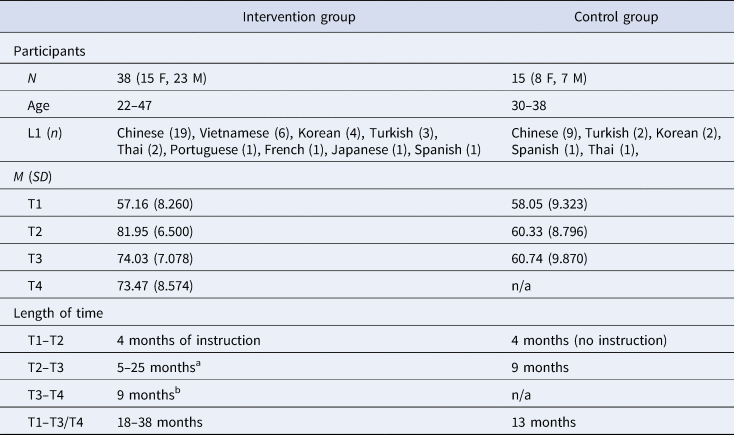
I will answer the first research question by presenting evidence from two groups of international graduate students pursuing their academic degrees at an American university: a control group (N = 15) and an intervention group (N = 38). The two groups did not differ significantly (t = −.342; p = .733; Diff = .89; d = .09) with respect to their initial proficiency (a combined read-aloud score for primary phrase stress, word stress, and linking targets). However, while both groups took field-specific courses in English for their degrees, only the intervention group attended an ESL pronunciation course that met for 50 minutes three times a week for 15 weeks. At the beginning of the course, the students were given learning priorities for pronunciation practice based on their pre-test scores. Class time was spent on teaching and modeling a wide range of pronunciation features (suprasegmental and segmental) and PLS, providing speech models to guide students’ out-of-class practice following CRM, and assigning controlled and communicative activities that allowed students to put to test what they had learned in class and during periods of covert rehearsal. Out-of-class assignments engaged students in oral drills (listen and repeat exercises) as well as in tasks that required them to make sound-, word-, phrase-, and discourse-level predictions based on pedagogical rules, and then record their predictions for teacher feedback. Throughout the semester, students received feedback via classroom activities, recorded assignments, and six individualized meetings with the instructor. Learning was thus based on students’ individual needs and scaffolded by the teacher. The control group did not receive any kind of pronunciation instruction during the study.
Pronunciation progress was assessed through a read-aloud test administered three times (pre-, post-, and delayed tests). Fifty-five percent of the students in the intervention group completed the same test a fourth time to assess long-term maintenance of improvement (see Table 1). The test consisted of a long passage (assessing linking targets), five dialogues with different communicative functions (assessing primary phrase stress targets), and 22 academic polysyllabic words (assessing word stress targets). Inter-rater reliability was high for all features and tests (ICC > .90). A series of repeated measures ANOVAs were computed to compare the two groups’ short- and long-term progress with the pronunciation targets under study.
Participants, mean scores, and length of time between tests

a Students were tested at three different times at T3 (five months, 13 months, and 25 months after T2) to test the contributions of the variable ‘time after instruction’ (see findings in Sardegna, Reference Sardegna, Levis and LeVelle2011, Reference Sardegna, Levis and LeVelle2012).
b Due to the attrition typical of longitudinal studies, only 21 of the 38 students (55%) completed the test at T4.
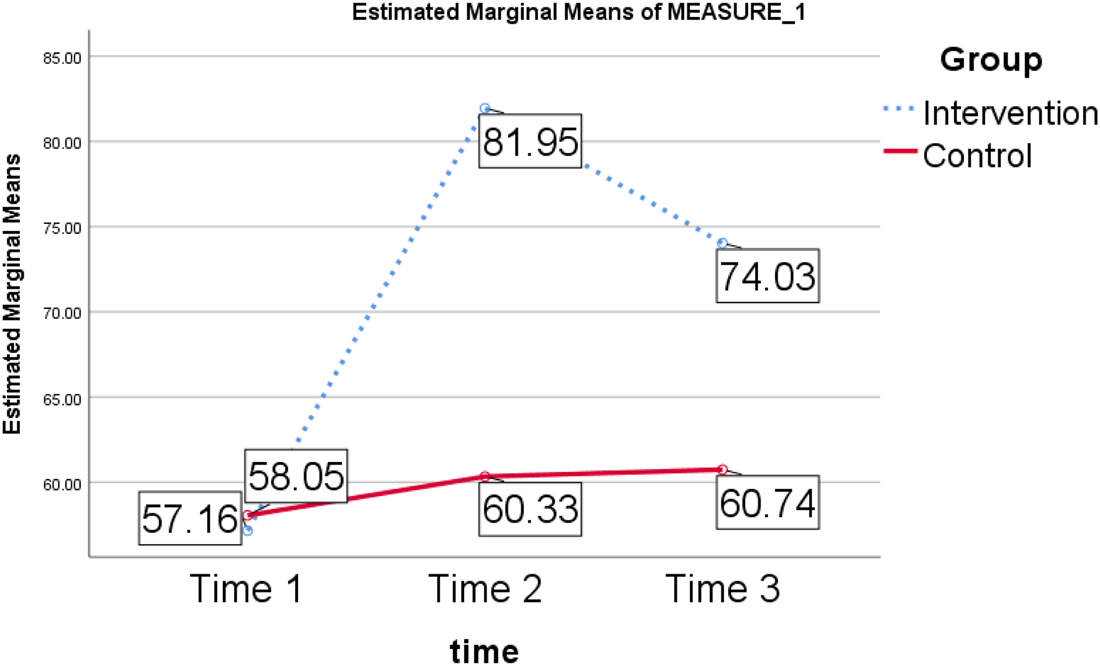
The results of a two-way repeated measures ANOVA indicated significant main effects of condition (Control vs. Intervention), F(1, 51) = 27.327, p = .000, partial η2 = .34, and time (T1, T2, and T3), F(2, 51) = 114.750, p = .000, partial η2 = .69, as well as a significant interaction of time and condition, F(2, 51) = 76.112, p = .000, partial η2 = .60. Hence, 60% of the variance in students’ accuracy scores was related to changes in both time and condition. As Figure 1 shows, the intervention group clearly outperformed the control group at T2 and T3.
Intervention vs. control groups; N = 53

A follow-up one-way repeated measures ANOVA revealed significant differences in mean scores across testing times for the intervention group, F(2, 37) = 274.499, p = .000; partial η2 of .88. Planned contrasts indicated that T2 scores were significantly higher than T1 scores, F(1,37) = 424.186, p = .000, partial η2 = .92, and this difference represented a large effect size, d = 3.00, suggesting a short-term (four months) progress of practical significance. Also, despite a significant decrease in performance after the course (from T2 to T3: F(1, 37) = 55.823, p = .000, partial η 2 = .60), T3 scores were still significantly higher than T1 scores, t(37) = −17.478), p = .000, Diff = 16.87. This difference represented a large effect size, d = 2.04, and suggested a significant progress with these targets over time (T1–T3 = 9–29 months; and regardless of time between T2 and T3; see Sardegna, Reference Sardegna, Levis and LeVelle2011, Reference Sardegna, Levis and LeVelle2012). In contrast, no significant differences were found for the control group, F(2,14) = 3.089, p = .080; partial η 2 of .32. These participants had just arrived in the US to pursue their graduate careers. Their increased exposure to English speech resulted in a slight increase in accuracy from T1 to T2, F(1,14) = 6.651, p = .022, partial η 2 = .32. Yet, the corresponding effect size of this difference, d = 0.24 (small), was minimal compared with that of the group receiving instruction (i.e., d = 3.00). Interestingly, progress with these features soon stabilized as their T2 and T3 mean scores were not significantly different, F(1,14) = .242, p = .630, partial η 2 = .017, d = 0.05. Also, despite the slight initial increase in accuracy, control group participants did not exhibit significant long-term progress with these features (T1 vs. T3 scores = 13 months), t(14) = −2.028, p = 0.062, Diff = 2.69, d = 0.29 (small effect size), suggesting that participants’ 13-month exposure to English speech was not large enough to make lasting changes in their production of English linking and stress.
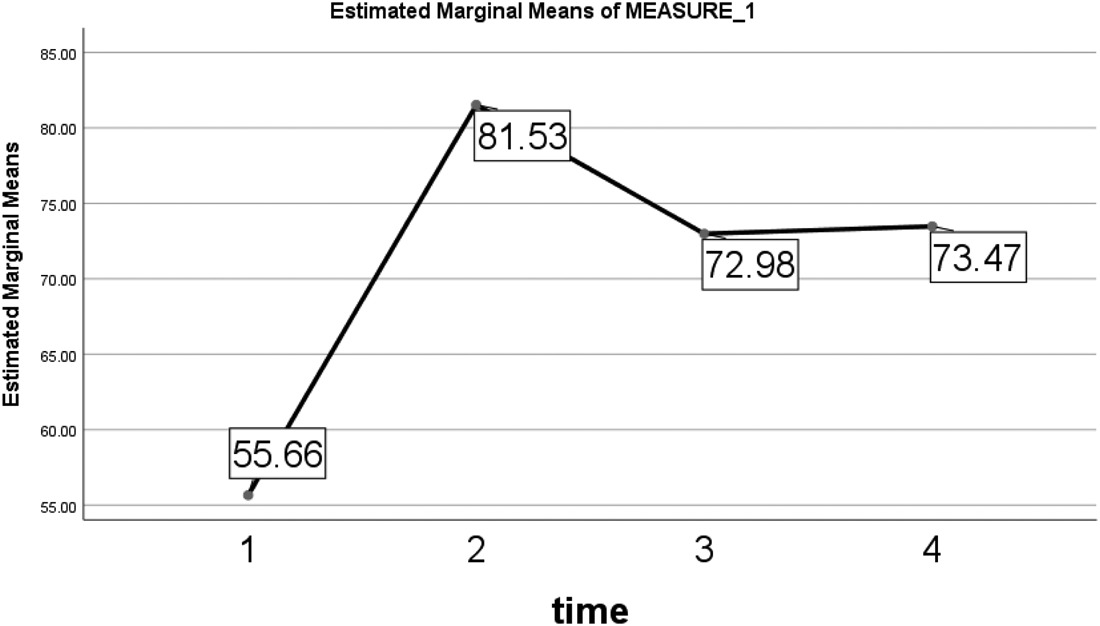
In sum, the evidence just presented strongly suggests that receiving instruction under CRM maximizes students’ chances of improving their ability to link sounds and stress words and phrases when compared with a group that was immersed in the same ESL context but did not receive any kind of pronunciation instruction. Yet, the observed drop in accuracy from T2 to T3 for the intervention group (Figure 1) motivated me to conduct a fourth test (T4) nine months later to determine whether the students’ abilities continued to decrease as time passed. While the statistical results still showed a significant difference across testing times, F(3,18) = 59.232, p = 0.000, partial η 2 of .90, there was no significant change for the 21 students taking the test at T3 and T4, t(20) = −.646, p = .526, d = 0.06 (negligible effect size), indicating a plateau – that is, progress with these features stabilized (see Figure 2). This plateau seems to take place as soon as five months after instruction because the same trend was observed in all the groups regardless of whether T3 was five months, 13 months, or 25 months after T2 (see comparative analyses in Sardegna, Reference Sardegna, Levis and LeVelle2011, Reference Sardegna, Levis and LeVelle2012). The difference between T1 (M = 55.66; SD = 9.222) and T4 (M = 73.47, SD = 8.574) mean scores for those 21 students, t(20) = −11.531, p = .000, represented a large effect size (d = 1.93). Ultimately, the fact that the students were able to maintain an improvement of practical significance long term (from 14 to 34 months after receiving instruction) provided further strong proof of the efficacy of CRM.
Improvement with all three pronunciation targets from T1 to T4; N = 21

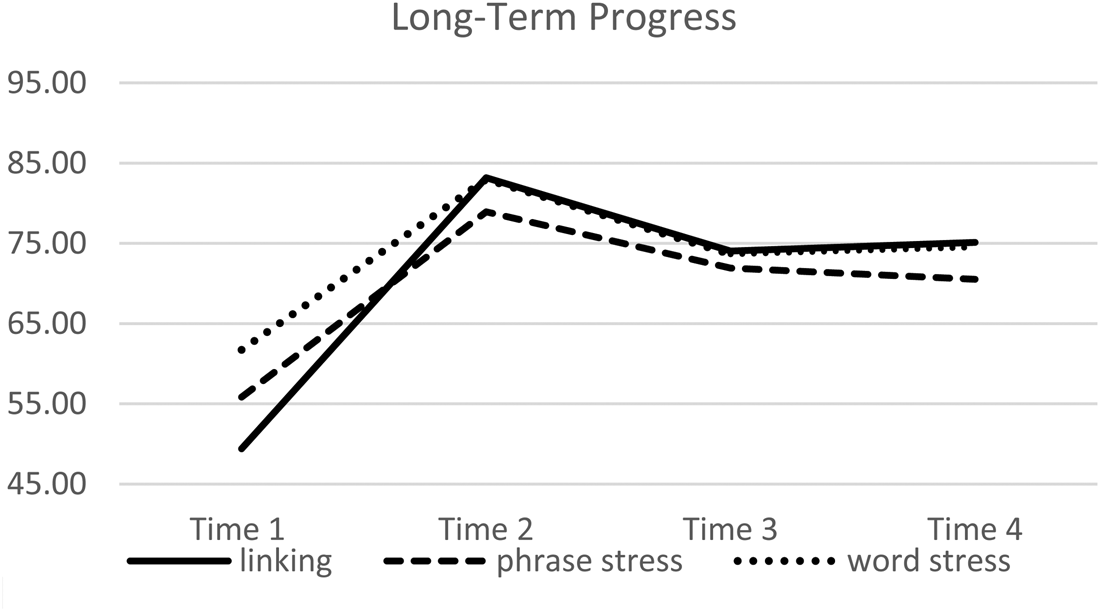
Finally, separate repeated measures ANOVAs showed that students’ scores differed significantly across testing times for primary phrase stress, F(3,18) = 25.445, p = .000, partial η 2 of .55; word stress, F(3,18) = 19.724, p = .000, partial η 2 of .48; and linking, F (3,18) = 48.331, p = .000, partial η 2 of .71. Pairwise comparisons between T1 and T4 mean scores revealed significant differences for primary phrase stress, t(20) = −4.427, p = .000, d = 0.92; word stress, t(20) = −4.946, p = .000, d = 0.99; and linking, t(20) = −7.800, p = .000, d = 2.11. As in all these cases d > 0.8, these differences represented large effect sizes indicating that the students were able to maintain a significant improvement with each of these features over time (see Figure 3).
Improvement with English linking, phrase stress, and word stress; N = 21

To conclude, as Figure 3 shows, the findings suggest a clear trend: Students tend to improve a target feature significantly during instruction; after instruction a slight decrease in accuracy is to be expected before their production reaches a plateau and stabilizes. I found a similar overall group trend with vowel and consonant sounds (Sardegna, Reference Sardegna2009a) and stress in compound words (Reference Sardegna2009b).
4.3. Variables mediating learning
4.3.1. Learner variables
CRM requires extended practice time and self-directed efforts. Hence, students’ improvement largely depends on their individual choices of what to do during covert rehearsal as well as how much, when, and how often. An exploration of the role of individual learner differences in relation to learning outcomes under CRM could offer some valuable insights regarding learner variables facilitating pronunciation improvement and suggest ways in which these variables could be exploited to maximize learning opportunities and outcomes. This hypothesis led me to conduct quantitative and qualitative analyses that triangulated learners’ pronunciation accuracy scores with their background information, reflections on learning, self-reported strategy use, and motivations and self-efficacy beliefs regarding pronunciation learning. For these analyses, I collected data from eight groups of students taking the same pronunciation course I described in answering the first research question (same teacher, teaching approach, and assessments). Findings from these analyses were comprehensibly reported and discussed elsewhere.Footnote 2 Here, I will share those in relation to learner variables (for more information, see studies identified by findings):
1. Practice efforts during the course: The extent of progress during the course was related to students’ efforts in covert rehearsal. As shown, the students were able to make large improvements in their controlled speech (monitored read-aloud production) once they learned what they needed to work on and how (raised awareness of pronunciation features and strategies), and after the teacher scaffolded and guided their practice in covert rehearsal through tailored activities and feedback during the course. Without pronunciation instruction, students often display little knowledge about what they need to do to improve their oral skills (Sardegna, Reference Sardegna2017; Sardegna et al., Reference Sardegna, Lee and Kusey2018; Sardegna & McGregor, Reference Sardegna, McGregor, Levis and LeVelle2013). This explains the findings in the control group. Also, length of students’ stay in the target language community before instruction did not affect students’ progress during the course, either (Sardegna, Reference Sardegna2009b, Reference Sardegna, Levis and LeVelle2011, Reference Sardegna2019).
2. Initial proficiency levels: The extent of progress during the course could also be predicted based on initial proficiency levels: The lower students’ initial accuracy with a target feature was, the higher their increase in accuracy with that feature tended to be (Sardegna, Reference Sardegna2009b, Reference Sardegna, Levis and LeVelle2012). This outcome may be explained by the fact that students with lower initial scores had more room to grow and, thus, their growth tended to be larger than those that had high initial proficiency (i.e., with less room to improve) (Sardegna, Reference Sardegna2017, Reference Sardegna2019).
3. Gender and language background: Progress during the course could not be predicted on the basis of students’ gender or language background (Sardegna, Reference Sardegna2009b, Reference Sardegna, Levis and LeVelle2011, Reference Sardegna2019).
4. While phonological backsliding and resistance to change are to be expected (Beebe, Reference Beebe and Beebe1988; Murphy, Reference Murphy1991), what students do immediately after instruction seems to influence the extent of their decrease in accuracy before they reach a plateau with a target feature:
(a) Self-reported practice in covert rehearsal after the course ended: Higher improvement in accuracy during the course correlated somewhat with higher decrease in accuracy from T2 to T3 for linking targets (r = −.43). Yet, practice with linking in covert rehearsal positively correlated with T2–T3 progress (r = .50), indicating that the more students practiced on their own after the course ended, the greater their improvement (Sardegna, Reference Sardegna, Levis and LeVelle2011, Reference Sardegna2017). Similar findings were found with stress (Sardegna, Reference Sardegna2009b, Reference Sardegna2019).
(b) Choice and use of PLS during covert rehearsal: More covert practice, and especially more frequent use of PLS, resulted in higher maintenance of improvement with the practiced features (Sardegna, Reference Sardegna2009b, Reference Sardegna, Levis and LeVelle2011, Reference Sardegna, Levis and LeVelle2012). Also, in addition to consistent engagement in covert practice, students’ practice choices seemed to matter. Those who mostly used listening/perception strategies, but did not actively engage in predicting and/or producing correct pronunciations, tended to have larger decreases in accuracy over time (Sardegna, Reference Sardegna, Levis and LeVelle2012, Reference Sardegna2019).
(c) High motivation to practice and practice prioritization: Highly motivated students with clear practice goals tended to decrease less in accuracy, and sometimes even continued to improve their stress and linking targets after the course (Sardegna, Reference Sardegna2009b, Reference Sardegna, Levis and LeVelle2011, Reference Sardegna, Levis and LeVelle2012, Reference Sardegna2018). (For an analysis of factors affecting learners’ motivations and attitudes towards pronunciation learning, see Sardegna et al., Reference Sardegna, Lee and Kusey2014.)
(d) Self-efficacy beliefs: High sense of self-efficacy in implementing the rules and strategies, and effecting change was also associated with higher maintenance of improvement after the course ended. Individual learners’ reports of strategy use revealed that the more confident they felt about the efficacy of the strategies they learned and used during the course, the more likely they were to continue using them (Sardegna, Reference Sardegna, Levis and LeVelle2012, Reference Sardegna2019), which ultimately increased their chances of maintaining high pronunciation scores long term (Sardegna, Reference Sardegna, Levis and LeVelle2011, Reference Sardegna, Levis and LeVelle2012, Reference Sardegna2019).
Overall, CRM highlights the important role of students’ self-regulation, engagement, and practice choices. While a decrease in accuracy after pronunciation instruction, followed by a plateau, is to be expected, what students do during and immediately after the course ultimately influences the extent of their improvement before they reach a plateau. Increased confidence in and frequent use of effective PLS seem to lead to higher long-term maintenance of improvement.
4.3.2. Teacher and instructional variables
CRM engages learners in individualized and self-directed pronunciation practice out of class. For this practice to be successful, learners need explicit information on what to do, why, and how. In other words, they need to acquire expert knowledge, engage in useful practices, and become familiar with instructional supports that can help them during their practice. With the conviction that the teacher can influence and enhance the learning process by creating learning environments and opportunities that promote and support learners’ self-teaching, self-assessments, self-regulation, and reflection, I engaged in a series of investigations to explore what good pronunciation teachers do to support learners’ practice under CRM.
First, I investigated the effects of a short-term (six-week) tutoring intervention that involved eight native English-speaking and 10 non-native English-speaking pre-service teachers taking a pronunciation teaching course for their MATESL degrees (Sardegna, Reference Sardegna, Griffiths and Tajeddin2020). Based on a read-aloud assessment, the tutors identified learning priorities for 26 ESL students, and then met with one or two tutees twice a week to: (a) teach them pronunciation rules and strategies that they could use during periods of covert rehearsal (i.e., in private and following CRM), and (b) engage them in communicative tasks that allowed them to practice in free speech what they had practiced in covert rehearsal, consolidate learning, and receive feedback. Regardless of the tutors’ and tutees’ first languages (L1s), after six weeks, the tutees significantly improved primary phrase stress (T1 Mean = 50; T2 Mean = 64; d = 0.78) and linking (T1 Mean = 53; T2 Mean = 63, d = 0.62; ICC = .936), among other features, which provided further support for CRM. This finding also indicated that short-term CRM instruction/practice can be effective, too. Additionally, a triangulation of data sources revealed that the MATESL course provided six structural supports that empowered the pre-service teachers (i.e., increased their confidence, knowledge, and agency) to teach English pronunciation to ESL learners: explicit instruction of features, strategies, and rules; a field experience; observations of teaching; feedback on teaching; reflections on own and others’ teaching; and online resources as teaching aids and speech models. The non-native English-speaking tutors, in particular, expressed that, in addition to being useful teaching aids and good speech models for practice, online resources legitimatized them as English pronunciation teachers because they validated their teaching. In the qualitative analysis of these structural scaffolds, two teacher variables (expert and pedagogical knowledge) and an instructional variable (using online resources and speech models as teaching aids) emerged as important mediating variables for successful learning under CRM.
Second, I collected pre- and post-test read-aloud scores on suprasegmental features and qualitative data from a 15-week oral communication course that prioritized pronunciation goals based on students’ needs; empowered students through explicit instruction, guided practice, and PLS; and provided students with opportunities to monitor, self-assess, and reflect on their progress (see Sardegna & McGregor, Reference Sardegna and McGregor2012, Reference Sardegna, McGregor and Murphy2017, for class activities and principles guiding instruction). The course encouraged students to work out of class with the help of pronunciation rules, PLS, speech models, and online resources – this aspect of the course resembled CRM. Just like with the other studies, the students (international graduate students, N = 30) significantly improved primary phrase stress (Z = 4.372; p = .000, r = .80) and linking (Z = 3.987; p = .000; r = 73) after receiving scaffolded pronunciation instruction and engaging in out-of-class self-directed practice (McGregor & Sardegna, Reference McGregor and Sardegna2014; Sardegna & McGregor, Reference Sardegna, McGregor, Levis and LeVelle2013). In McGregor and Sardegna (Reference McGregor and Sardegna2014), we also asked the students to rank the course components with respect to the most helpful in discovering and improving their pronunciation errors. For discovery, they selected: watching and reflecting on my video performances (60%), listening and reflecting on my speaking and/or audio recording (60%), receiving instructor feedback from video-recordings (57%), comparing my performance to a model (43.3%), and setting pronunciation priorities with the instructor (33%). For improvement, they selected: recording, revising, and rerecording before submitting (70%), rehearsing before recording (43%), noticing specific speech features in a native sample (33%), and practicing errors based on teacher feedback (33%). The identified course components suggested four main instructional variables favorably mediating learning:
1. Scaffolding learning through explicit instruction, goal prioritization, and ongoing feedback.
2. Using online resources and speech models as teaching aids.
3. Assigning guided reflections on video-recorded presentations.
4. Engaging students in focused and controlled watching, listening, and oral practice.
In Sardegna and McGregor (Reference Sardegna and McGregor2019), we found through students’ weekly reflections that ongoing teacher feedback increased students’ motivation to practice as well as their confidence in their ability to improve through practice. We also uncovered that uptake of instructor feedback and approach (a learner variable) was one of the variables that separated more successful from less successful learners.
In sum, with expert and pedagogical knowledge (mediating teacher variables), the pronunciation teacher can successfully accompany English learners on their journey to become more intelligible. In addition, the teacher can support learners’ individual efforts through the provision of instructional enhancements based on the four instructional variables identified as most positively mediating learning for students following the six steps proposed by CRM.
5. Recommendations for methodological refinements
CRM is a pronunciation instruction model that describes steps learners should follow while focusing on form in private. In other words, it describes a learner-centered strategy-based process for pronunciation improvement. My investigations provided empirical evidence of the effectiveness of this process and identified learner variables that differentiated more from less successful learners. More successful learners are those that: (a) practice much and frequently, during and after classroom instruction, using appropriate pedagogical rules and PLS; (b) are motivated to continue practicing after instruction ends because they see the value of it; and (c) have a high sense of pronunciation self-efficacy (i.e., confidence in their abilities to improve). My investigations of teacher and instructional variables positively supporting and impacting learning under CRM stressed the potential (and critical) role of the teacher in increasing the likelihood of those learner variables to emerge and, in doing so, maximizing students’ chances of success. This finding points to the need for methodological refinements to the model so that CRM includes effective classroom components and guidance for teachers.
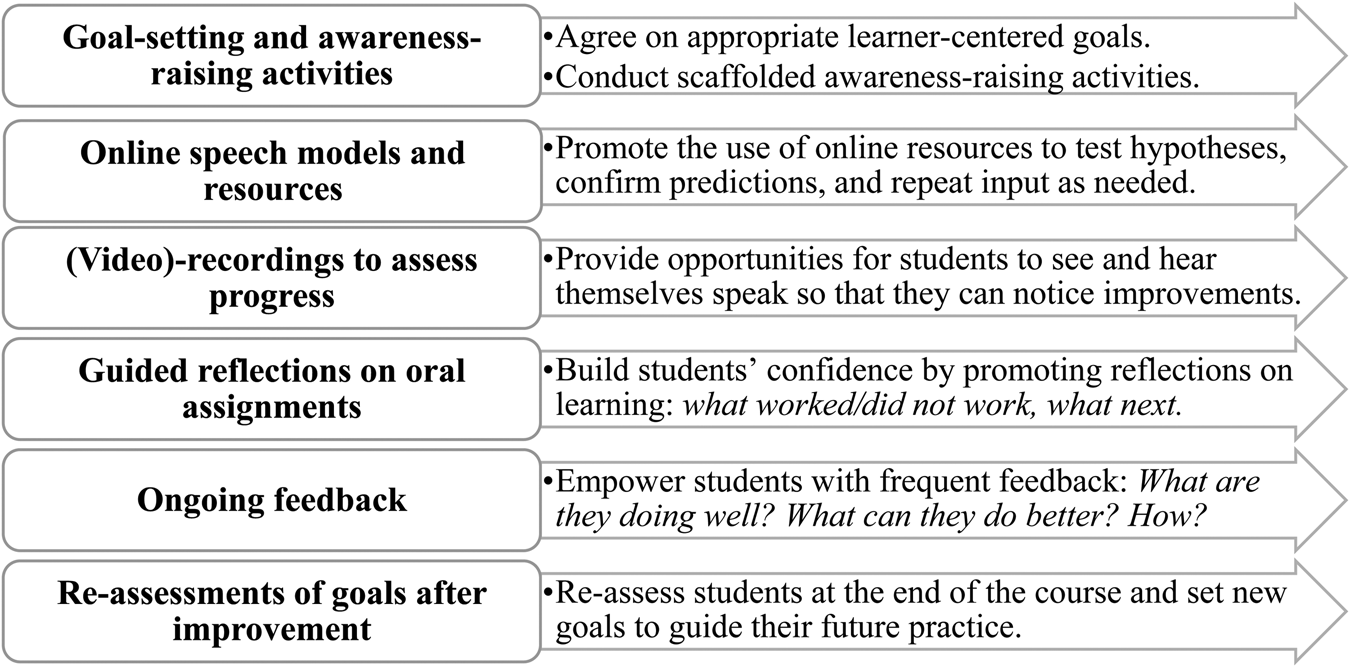
My recommendations for classroom components are displayed in Figure 4. Knowing that students’ progress largely depends on their practice choices and frequent practice, buy-in in goal setting is paramount. The teacher can help set appropriate learning goals through awareness-raising activities and facilitate the attainment of those goals through scaffolding and explicit instruction of features and effective PLS (for sample tasks for goal-prioritization, see Sardegna & McGregor, Reference Sardegna, McGregor and Murphy2017). Yet, the learners need to agree with the pronunciation goals set by the teacher. Otherwise, their focused attention may be elsewhere. Also, the teacher should consider classroom time constraints, and the age and pronunciation needs of the learners at the time of choosing learning priorities and deciding which rules to teach. We do not need to teach our students everything we know; just what will help them improve their oral intelligibility the most (for intelligibility goals, see Levis, Reference Levis2018). Also, as Dickerson reminds us, pronunciation rules should be learner-friendly and include the information necessary to work well (Dickerson, Reference Dickerson and Chapelle2012), and the teacher needs to be strategic in selecting the rules to teach so as not to overwhelm the learners with more than they can handle (Dickerson, Reference Dickerson, Reed and Levis2015). Goal prioritization based on students’ pronunciation needs becomes even more important in classrooms with little time for pronunciation teaching and practice, which is typical of some foreign language settings.
Effective classroom components and recommendations

Online speech models and resources (e.g., TED Talks) offer rich and authentic input that students can listen to as many times as needed to test their hypotheses, confirm their predictions, and imitate speech until they become fluent. Many of these resources also come with transcriptions that students can use for their covert practice. Furthermore, these resources seem particularly helpful for non-native English-speaking pronunciation teachers as the non-native pre-service teachers in my study (Sardegna, Reference Sardegna, Griffiths and Tajeddin2020) reported that these resources not only supported their instruction but also legitimatized it.
Most importantly, the statistical findings revealed that the more satisfied students are with their progress, the more confident they become about their abilities to improve on their own, and ultimately, the more likely they are to engage in covert rehearsal practice (as evidenced by correlating their motivations and self-efficacy beliefs with their self-reports of strategy use and practice under CRM). In the end, increased pronunciation practice results in increased intelligibility (as evidenced through triangulating students’ self-reports with their pre/post read-aloud assessments) (Sardegna, Reference Sardegna2009b, Reference Sardegna, Levis and LeVelle2011, Reference Sardegna, Levis and LeVelle2012). This satisfaction/confidence can be built through guided reflections on oral assignments, video-recorded assignments that afford students opportunities to see and hear themselves speak (i.e., notice improvements), and ongoing supportive feedback (Sardegna, Reference Sardegna2016, Reference Sardegna2017). These are effective and valued enhancements to the covert rehearsal process as students have indicated that reflections on video-recorded lessons and teacher feedback supported their pronunciation discoveries and improvements (McGregor & Sardegna, Reference McGregor and Sardegna2014; Sardegna & McGregor, Reference Sardegna, McGregor, Levis and LeVelle2013).
Finally, goal prioritization is also necessary after instruction. By the end of the course, students’ priorities for improvement may have shifted due to their work during the course. The teacher can help with the selection of new learning goals on the basis of post-instruction assessments and suggest useful resources and strategies for students’ self-regulated learning. Goal prioritization after improvement will offer students the support and motivation they might need to continue their pronunciation work on their own.
In terms of methodological refinements that can support learning under CRM, these are my recommendations for teacher actions/steps in view of the instructional components identified through research:
1. Raise students’ awareness of what they need to improve.
2. Help students prioritize their pronunciation learning goals.
3. Explicitly teach the pronunciation features, rules, and PLS that students need for self-teaching.
4. Assign activities that require engagement in covert practice (i.e., the six-step strategy-based process proposed by Dickerson).
5. Scaffold students’ learning with guided practice, online resources, and ongoing feedback.
6. Build students’ confidence through written and oral assignments that make them reflect on their progress (e.g., video-recorded assignments).
7. Help students set new learning goals after the course ends to guide their future self-regulated practice.
Pronunciation teaching and learning in this way (which I will call ‘enhanced-CRM’) can be integrated with the teaching of other skills (Sardegna et al., Reference Sardegna, Chiang, Ghosh and Jones2016) and be provided in short tutoring interventions (Sardegna, Reference Sardegna, Griffiths and Tajeddin2020) and still be effective.
6. Concluding remarks
Let me conclude with this final message: It is our job as teachers to empower our students and facilitate their learning while they are taking our course. Once they leave our course, they are on their own. However, if we did our job well, we will leave them with explicit knowledge of pronunciation features, a repertoire of resources, effective PLS, and learning goals that can assist them as they continue their pronunciation learning journey.
The key for success is hard work. Yes, students have to work hard. Yet, their hard work is likely to be more successful if we empower them through effective classroom instruction. Here, I have offered some insights on what constitutes effective classroom instruction by describing a successful strategy-based pronunciation instruction model (i.e., CRM) and identifying some methodological refinements that can be made to the model based on my classroom research (i.e., enhanced-CRM). This is a promising start. To increase our understanding of best practices, future research might want to look at students’ improvements in free speech after they receive instruction under the proposed enhanced-CRM. Another fruitful area of future research is to investigate the effectiveness of this model in both second and foreign language classroom settings, with extensive and limited time for pronunciation instruction, and with learners of different ages and proficiency levels. Finally, to measure the comparative effectiveness of the proposed enhanced-CRM, future research might want to compare learning under enhanced-CRM with other pronunciation instruction models.
Acknowledgements
I would like to acknowledge the powerful influence of Wayne Dickerson on this work. He has not only been a strong and invaluable model and mentor in my search for best practices in pronunciation classroom research, but also a constant source of inspiration, encouragement, and support. I also want to thank Alison McGregor for her contributions to this research.
Veronica G. Sardegna teaches second and foreign language education courses at Duquesne University, USA. She also taught English as a second language at the University of Illinois at Urbana-Champaign, and foreign language education courses at the University of Texas at Austin and the University of Pittsburgh. Her research interests are in the areas of English pronunciation and academic writing, intercultural learning, and linguistically and culturally responsive pedagogy. She evaluates learning outcomes by exploring individual learner differences, strategy instruction, and instructional technology tools that support autonomous learning. She has received International TESOL's 2021 D. Scott Enright Interest Section Service Award.