Introduction
Anxiety disorders are among the most prevalent mental disorders, with epidemiological studies estimating rates ranging from 10% to 20% in US youth and lifetime prevalence reaching 34% (Bandelow & Michaelis, Reference Bandelow and Michaelis2015; Bitsko et al., Reference Bitsko, Claussen, Lichtstein, Black, Everett Jones, Danielson, Hoenig, Davis Jack, Brody, Gyawali, Maenner, Warner, Holland, Perou, Crosby, Blumberg, Avenevoli, Kaminski and Ghandour2022; Bufferd et al., Reference Bufferd, Dougherty, Carlson and Klein2011; Egger & Angold, Reference Egger and Angold2006; Ghandour et al., Reference Ghandour, Sherman, Vladutiu, Ali, Lynch, Bitsko and Blumberg2019). These numbers are likely conservative, as a recent meta-analysis indicated the prevalence of internalizing disorders (i.e., anxiety, depression) in youth has doubled since the COVID-19 pandemic (Racine et al., Reference Racine, McArthur, Cooke, Eirich, Zhu and Madigan2021). Anxiety disorders have been shown to emerge as early as preschool (Bufferd et al., Reference Bufferd, Dougherty, Carlson and Klein2011; Egger & Angold, Reference Egger and Angold2006). Although parental history of anxiety has been identified as one of the most robust risk factors for child anxiety (Merikangas et al., Reference Merikangas, Avenevoli, Dierker and Grillon1999; Micco et al., Reference Micco, Henin, Mick, Kim, Hopkins, Biederman and Hirshfeld-Becker2009; Turner et al., Reference Turner, Beidel and Costello1987; Yirmiya et al., Reference Yirmiya, Motsan, Kanat-Maymon and Feldman2021), the processes responsible for this intergenerational transmission are not well understood. Elucidating the mechanisms responsible for associations between parent and child mental health is critical for developing targeted interventions that can improve child mental health trajectories.
One mechanism that may link maternal and child mental health is child neural processing of emotions. Children are attentive to their caregivers’ faces beginning in very early life, when neural circuits are developing to support the ability to recognize, discriminate, and allocate attention to faces and emotional expressions (Conte et al., Reference Conte, Richards, Guy, Xie and Roberts2020; Jessen & Grossmann, Reference Jessen and Grossmann2015; Xie & Richards, Reference Xie and Richards2016). Maternal anxiety may influence the programming of these circuits through compromised caregiving behaviors found at increased rates among mothers with heightened anxiety (Dib et al., Reference Dib, Padovani and Perosa2019; Stevenson-Hinde et al., Reference Stevenson-Hinde, Chicot, Shouldice and Hinde2013). Alterations in the neural processing of emotional stimuli, in turn, have been implicated in etiological and developmental models for internalizing psychopathologies (Disner et al., Reference Disner, Beevers, Haigh and Beck2011). Patterns of neural emotion processing may also influence how children respond to maternal anxiety. For example, children who exhibit a more heightened response to threatening stimuli, such as caregiver expressions of negative emotion, may be primed to be hypervigilant toward and responsive to maternal psychopathology and related caregiving behaviors, increasing their vulnerability to developing mental health problems. That is, exposure to maternal anxiety in early life may alter neural circuitry in regions involved in emotion processing, which, in turn, may magnify the impact of later exposure to maternal anxiety on child mental health risk.
Event-related potentials (ERPs), derived from EEG, can be used to study children’s neural processing of emotions beginning in early development and may be a valuable tool for examining child neural responses to emotional stimuli in this context. Emerging data suggest that differences in children’s ERP responses to facial expressions may be associated with exposure to maternal anxiety beginning as early as infancy (Bowman et al., Reference Bowman, McCormick, Kane-Grade, Xie, Bosquet Enlow and Nelson2022). Moreover, neural processing of emotional stimuli has been shown to predict children’s internalizing symptomatology (Kujawa et al., Reference Kujawa, Hajcak, Danzig, Black, Bromet, Carlson, Kotov and Klein2016; Levinson et al., Reference Levinson, Speed and Hajcak2018; O’ Toole et al., Reference O’Toole, DeCicco, Berthod and Dennis2013).
Neural responding to emotional faces and anxiety problems
ERPs are well suited for studying emotion processing and regulation, with differentiable neural responses to happy, fearful, and angry faces evident from infancy (Xie et al., Reference Xie, McCormick, Westerlund, Bowman and Nelson2019b). The ERP technique allows for measurement of time-locked neural responses to emotional stimuli with high temporal resolution (Maupin et al., Reference Maupin, Hayes, Mayes and Rutherford2015). The current analyses are focused on three components that have been most thoroughly investigated in face processing research in young children: the N290, Nc, and P400.
The N290, a negative deflection in the ERP waveform emerging around 290 ms after stimulus, has been robustly associated with the structural processing, encoding, and attention to faces early in development (e.g., de Haan & Nelson, Reference de Haan and Nelson1999; de Haan et al., Reference de Haan, Johnson and Halit2003). For example, larger N290 amplitudes have been observed in response to angry (compared to fearful) faces in 7-month-old infants (Kobiella et al., Reference Kobiella, Grossmann, Reid and Striano2008) and to angry (compared to neutral) faces in 4- to 6-year-old children (Porter et al., Reference Porter, Evans-Stout, Reschke, Nelson and Hyde2021). Similar functional signatures seen in the N290 early in life are observed in the N170 in older children and adults (e.g., Leppänen et al., Reference Leppänen, Kauppinen, Peltola and Hietanen2007). Therefore, the N290 is hypothesized to reflect a developmental precursor to the adult-sensitive N170; moreover, the amplitude of the N170 also has been found to be modulated by facial emotional expressions (Hinojosa et al., Reference Hinojosa, Mercado and Carretié2015).
The negative central (Nc) component is characterized by a negativity in the ERP waveform across frontocentral sites around 400 ms after stimulus onset. The Nc is hypothesized to reflect attentional allocation in young children and is also modulated by facial emotion (e.g., de Haan et al., Reference de Haan, Johnson and Halit2003). For example, infants display a larger Nc to fearful than happy faces, indicating increased attention to fearful faces (e.g., Grossman et al., Reference Grossman, Johnson, Vaish, Hughes, Quinque, Stoneking and Friederici2011; Leppänen et al., Reference Leppänen, Kauppinen, Peltola and Hietanen2007).
Finally, the P400, a positive maximal over posterior sites around 400 ms, has been robustly associated with facial emotion processing. Prior research has suggested that the P400 and N290 are similar face-sensitive ERP components, given their role in face processing and as potential precursors for the N170 component (de Haan & Nelson, Reference de Haan and Nelson1999; de Haan et al., Reference de Haan, Johnson and Halit2003). However, other research has suggested that the P400’s functional significance is more similar to the Nc, as greater P400 amplitude has been observed in response to salient stimuli and during sustained attention than inattention (Guy et al., Reference Guy, Zieber and Richards2016; Xie & Richards, Reference Xie and Richards2016). In emotion processing studies, the P400 was greater in response to fearful (compared to angry) faces in 7-month-old infants (Kobiella et al., Reference Kobiella, Grossmann, Reid and Striano2008), and greater P400 to fearful (compared to happy faces) was found among 4- to 6-year-old children (Porter et al., Reference Porter, Evans-Stout, Reschke, Nelson and Hyde2021). Along with the N290, the P400 is hypothesized to reflect a developmental precursor to the adult-sensitive N170 (Hinojosa et al., Reference Hinojosa, Mercado and Carretié2015). The P400 is also hypothesized to be a developmental precursor to early portions of the Late Positive Potential (LPP) in older children and adults (e.g., Dennis & Hajcak, Reference Dennis and Hajcak2009). The LPP is hypothesized to reflect several face-relevant processes, most specifically attentional processing of faces, in older children and adults.
Research in older children, adolescents, and adults has linked internalizing conditions, especially anxiety, with larger face- and attention-related ERP amplitudes (with specific components varying with developmental stage). These associations have been found most commonly in ERP responses to threatening faces (e.g., angry, fearful). Emotion researchers historically have conceptualized fearful and angry expressions as threatening stimuli. Darwin (Reference Darwin1872) hypothesized that facial fear and anger are universal expressions that communicate an individual’s motivation and the presence of an imminent threat. Therefore, facial expressions of fear and anger are two important social threat cues. A fearful face signals the presence of a threat or danger for which the source/identity is undetermined, whereas an angry face signals a direct and immediate threat to the observer (Adams & Kleck, Reference Adams and kleck2005; Kavcioglu et al., Reference Kavcıoğlu, Bublatzky, Pittig and Alpers2021). Overall, viewing fearful and angry faces may elicit feelings of threat in the observer to prompt them to prepare an adaptive response and avoid possible danger (de Gelder, Reference De Gelder2006; Kavcioglu et al., Reference Kavcıoğlu, Bublatzky, Pittig and Alpers2021).
Hum and colleagues (2013) found that, relative to non-anxious peers, anxious 8- to 12-year-old children showed greater posterior P1 and frontal N2 amplitudes, components associated with attention/arousal and cognitive control, to a Go/NoGo task using facial stimuli depicting angry, neutral, and happy expressions. Chronaki and colleagues (2018) found that larger LPP (indexes sustained attention) amplitude to angry versus neutral faces was associated with greater anxiety and depression symptoms in 6- to 11-year-old children. Similarly, in a sample of 7- to 19-year-olds with or without an anxiety disorder, Kujawa and colleagues (2015) found that those with an anxiety disorder exhibited enhanced LPP amplitude to angry and fearful faces. In a sample of 8- to 16-year-olds with or without an anxiety disorder, Bechor and colleagues (Reference Bechor, Ramos, Crowley, Silverman, Pettit and Reeb-Sutherland2019) found that those with an anxiety disorder showed larger P1 amplitude to angry compared to neutral faces, whereas healthy controls showed the opposite pattern. Relative to non-anxious peers, Bar-Haim and colleagues (2005) found that young adults with elevated anxiety showed greater P2 amplitudes to angry faces. Beyond concurrent associations, neural processing of emotional stimuli also has been shown to prospectively predict internalizing symptoms (Kujawa et al., Reference Kujawa, Hajcak, Danzig, Black, Bromet, Carlson, Kotov and Klein2016; Levinson et al., Reference Levinson, Speed and Hajcak2018). For example, O’Toole and colleagues (Reference O’Toole, DeCicco, Berthod and Dennis2013) used the N170 component to angry faces to measure threat processing in relation to anxiety over a 2-year period in 5- to 7-year-old children. Elevated baseline anxiety was associated with elevated anxiety 2 years later only among children who initially displayed greater N170 amplitudes to angry versus happy faces.
Overall, these results suggest that threat-related stimuli may elicit greater mobilization of attentional resources in individuals with heightened anxiety or vulnerability to the development of anxiety. Notably, these studies primarily have been in older children and adolescents, most often examining ERP responses in relation to concurrent symptoms/diagnoses. Research is needed to determine how ERP responses beginning in early life may predict later mental health problems. Additionally, little is known regarding the etiology of individual differences in neural responses to emotional stimuli; studies are needed to determine the factors responsible for creating response patterns that increase vulnerability to psychopathology.
Maternal anxiety and children’s neural responses to emotional faces
Although many studies have focused on maternal anxiety during pregnancy as a period of risk for later child mental health outcomes, data suggest that maternal anxiety in the first years of the child’s life may be particularly impactful (Hentges et al., Reference Hentges, Graham, Fearon, Tough and Madigan2020). This may be explained, at least in part, by the influence of the affective caregiving context. In early life, neural circuits are developing that help children to recognize, discriminate, and allocate attention to emotional expressions (Conte et al., Reference Conte, Richards, Guy, Xie and Roberts2020; Jessen & Grossmann, Reference Jessen and Grossmann2015; Xie & Richards, Reference Xie and Richards2016). Young children are attuned to their parents’ faces, with signals conveyed through facial expressions of emotion functioning as an integral form of communication (Bayet & Nelson, Reference Bayet and Nelson2019). Heightened maternal anxiety has been associated with both reduced emotional expression and greater expression of negative emotions, as well as other insensitive caregiving behaviors (e.g., increased maternal intrusiveness and decreased interactive behaviors, hostile behaviors, less affection and emotional warmth, diminished attunement and responsiveness toward their children’s facial expressions and vocal distress, more poorly coordinated emotional interactions, hyperarousal, greater overprotection; e.g., Beebe et al., Reference Beebe, Steele, Jaffe, Buck, Chen, Cohen, Kaitz, Markese, Andrews, Margolis and Feldstein2011; Clarke et al., Reference Clarke, Cooper and Creswell2013; Dib et al., Reference Dib, Padovani and Perosa2019; Hakanen et al., Reference Hakanen, Flykt, Sinervä, Nolvi, Kataja, Pelto, Karlsson, Karlsson and Korja2019; Nicol-Harper et al., Reference Nicol-Harper, Harvey and Stein2007; Riva Crugnola et al., Reference Riva Crugnola, Ierardi, Ferro, Gallucci, Parodi and Astengo2016; Stevenson-Hinde et al., Reference Stevenson-Hinde, Chicot, Shouldice and Hinde2013). These affective and perceptual experiences may shape neural activation patterns that influence how children process socioemotional signals, particularly in early development when the brain is exceptionally receptive to environmental programming.
Limited evidence for the impact of maternal anxiety on children’s processing of facial expressions of emotion, beginning in infancy, has begun to emerge. For example, in a study employing the same cohort as the present study, (Bowman et al., Reference Bowman, McCormick, Kane-Grade, Xie, Bosquet Enlow and Nelson2022) found that greater maternal anxiety was associated concurrently with larger Nc amplitude to happy and fearful faces in 5- to 12-month-old infants, even after controlling for maternal depressive symptoms and infant temperamental negative affectivity. In 8- to 10-year-old children, Kungl and colleagues (Reference Kungl, Rutherford, Heinisch, Beckmann, Fasching and Spangler2020) found that greater maternal anxiety was associated with greater N170 amplitudes to neutral and fearful faces and greater LPP amplitudes to neutral faces in a Go/NoGo paradigm. Relatedly, maternal anxiety has been associated with heightened behavioral attention to emotional faces in infancy and later childhood (Mogg et al., Reference Mogg, Wilson, Hayward, Cunning and Bradley2012; Morales et al., Reference Morales, Brown, Taber-Thomas, LoBue, Buss and Pérez-Edgar2017). These findings suggest enhanced vigilance in children of anxious mothers in response to faces, perhaps especially to threatening emotional expressions. This enhanced vigilance could predispose children to greater risk for the development of psychopathology. Moreover, heightened neural responses to threatening stimuli, regardless of the etiology of such a response pattern, may magnify the impact of exposure to maternal anxiety and associated caregiving behaviors on child mental health risk.
The current study
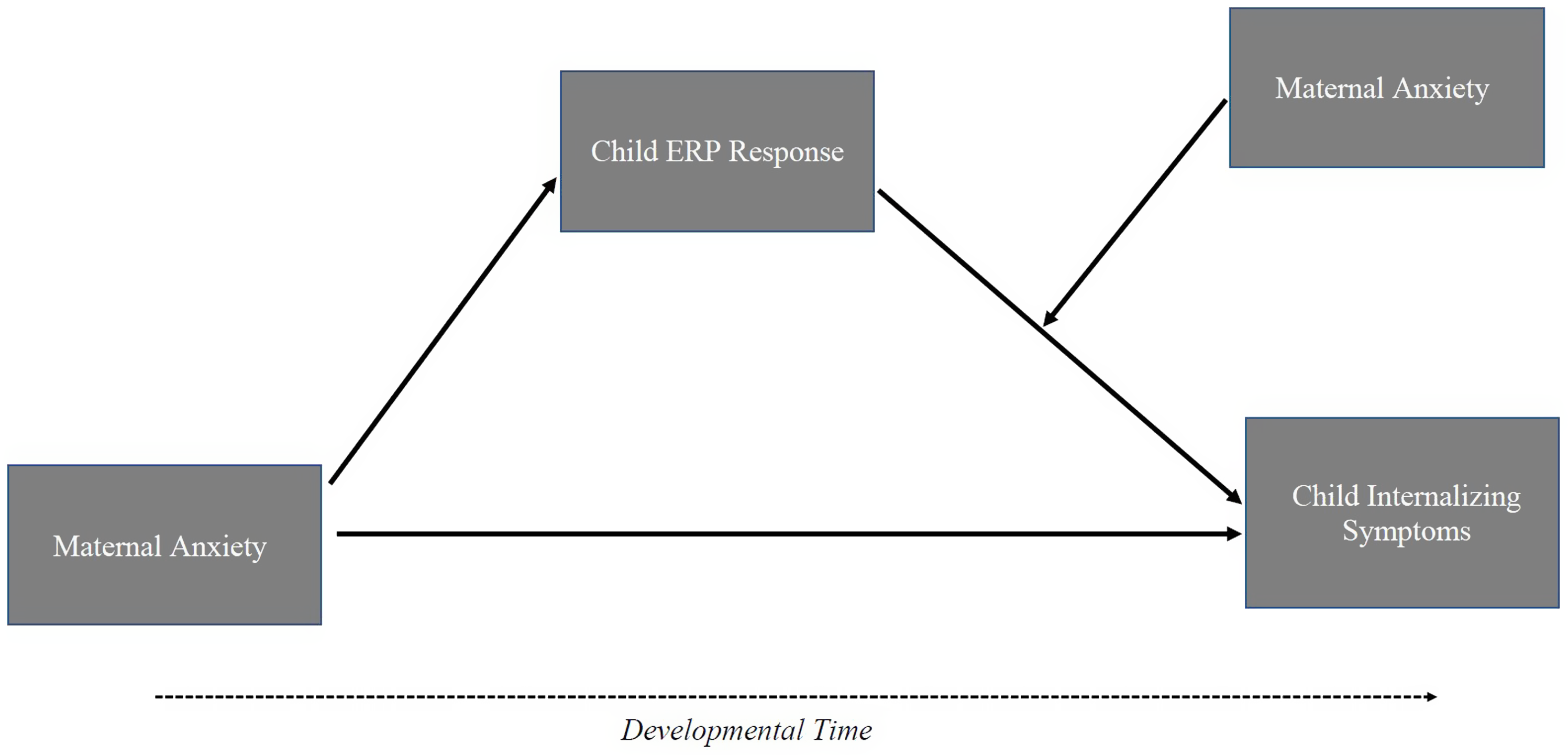
In this study, we examined associations between maternal anxiety and children’s internalizing symptomatology, focusing on the potential contributing role of child neural processing of emotion in mediating and/or moderating this association. Our overall approach (Figure 1) was informed by the Adaptive Calibration Model (ACM; Del Giudice et al., Reference Del Giudice, Ellis and Shirtcliff2011), which suggests multiple ways by which neural response patterns may play a role in the intergenerational transmission of mental health problems. First, child patterns of neural responses to threat may adapt to fit the environment, with one of the most salient environmental factors being the mental health and behavior of the primary caregiver. The resulting heightened neural responding to threat may directly increase risk for developing internalizing problems (mediation). Additionally, heightened neural responses to threat may increase the impact of exposure to maternal psychopathology, thereby magnifying child psychopathology risk (moderation). To our knowledge, the mediating and moderating effects of child neural functioning on associations between maternal and child psychopathology have not been tested in a single, longitudinal model.
Conceptual model depicting child ERP responses to emotional faces as a mediator and a moderator of the association of exposure to maternal anxiety symptoms and child internalizing symptoms.

Here, we tested whether maternal anxiety symptoms measured at infancy and at age 5 years were associated with children’s internalizing symptoms at age 5 years and whether children’s ERP responses (N290, Nc, P400) to angry, fearful, and/or happy faces at age 3 years mediated and/or moderated any observed associations between maternal and child symptoms. We hypothesized that greater maternal anxiety would be associated with greater child internalizing symptoms. We further hypothesized that greater child neural responses (i.e., larger negative N290 and Nc amplitude, larger positive P400 amplitude) to threatening faces (angry, fearful) at age 3 years would mediate the association between greater maternal anxiety in infancy and greater child internalizing symptoms at age 5 years. Additionally, we hypothesized that greater child neural responses to threatening faces at age 3 years would moderate the effects of maternal anxiety at age 5 years on child internalizing symptoms at age 5 years, such that children who exhibited both greater neural responding to threat and exposure to heightened maternal anxiety would demonstrate the highest level of internalizing symptoms. Potential differential sex effects were explored, given evidence for sex differences in response to maternal psychopathology and stress exposures more generally, beginning in early development (Bale & Epperson, Reference Bale and Epperson2015). Finally, to test the specificity of any findings to maternal anxiety exposure, we controlled for maternal depressive symptoms in sensitivity analyses.
Method
Participants
Participants were recruited from a registry of local births comprising families who had indicated willingness to participate in developmental research. Families in the current analyses participated in a prospective study to examine the early development of emotion processing. Exclusion criteria included known prenatal or perinatal complications, maternal use of medications during pregnancy that may have significant impact on fetal brain development (i.e., anticonvulsants, antipsychotics, opioids), pre- or post-term birth (±3 weeks from due date), developmental delay, uncorrected vision difficulties, and neurological disorder or trauma. After enrollment, families were no longer followed, and their data were excluded from analyses if the child was diagnosed with an autism spectrum disorder or a genetic or other condition known to influence neurodevelopment. By design, families were enrolled in the parent study and completed initial assessments when the children were 5, 7, or 12 months of age (infancy), with a smaller subsample to be followed longitudinally for in-person assessments at 3 years and 5 years of age. At the 3-year visit, one-half of the cohort participated in an EEG protocol, which included an ERP emotion processing paradigm, and the other half in a functional near-infrared spectroscopy protocol. Children were included in the current analyses if they had sufficient ERP data (n = 129) and/or 5-year child internalizing symptom data or maternal anxiety data (n = 424), for a final analytic sample of N = 464 mother–child dyads. Participants with ERP data did not differ significantly from participants without ERP data (i.e., participants who were not assigned to the ERP group or who were excluded during EEG processing) on family socioeconomic status (SES), maternal symptomatology scores at infancy or at 5 years, or child symptomatology scores at 5 years (all ps > .05).
Procedures
Parents (almost exclusively the child’s mother, > 97%, hereafter referenced as “mother”), were asked to complete questionnaires via an online survey prior to or at laboratory visits. Questionnaires relevant to the current analyses included assessments of sociodemographic characteristics (infancy), maternal anxiety and depressive symptoms (infancy and 5 years), and child internalizing symptoms (5 years). During the 3-year laboratory visit, children participated in an ERP emotion processing paradigm as part of an EEG protocol. The Institutional Review Board at Boston Children’s Hospital approved all methods and procedures used in this study, and all parents provided written informed consent prior to the initiation of study activities.
Measures
Maternal anxiety symptoms (Predictor)
Maternal anxiety symptoms were measured at infancy and 5 years via the Trait Anxiety form of the Spielberger State-Trait Anxiety Inventory (STAI-T; (Spielberger, Reference Spielberger, Gorsuch, Lushene, Vagg and Jacobs1983). The STAI is a 20-item self-report questionnaire designed to measure anxiety proneness by asking the respondent to rate the frequency of general mood states on a 4-point scale, ranging from “almost never” to “almost always.” Item scores were summed to create a total score (possible range: 20–80), with higher scores indicating greater anxiety. The median alpha coefficient of internal consistency has been reported as .90, and test–retest coefficients from .73 to .86 (Barnes et al., Reference Barnes, Harp and Jung2002). Cronbach’s alpha scores in this sample were .89 in infancy and .91 at 5 years.
Child internalizing symptomatology (Outcome)
At the 5-year assessment, mothers completed the Child Behavior Checklist 1.5-5 (CBCL/1.5-5; Achenbach & Rescorla, Reference Achenbach and Rescorla2000). The CBCL forms are among the most well-established, empirically supported questionnaires to assess child psychopathology symptoms (Achenbach et al., Reference Achenbach, Becker, Döpfner, Heiervang, Roessner, Steinhausen and Rothenberger2008), producing scores on multiple syndrome and DSM-oriented scales, as well as higher-order symptom scores. The 99-item CBCL/1.5-5 asks parents to report on their children’s behavior during the past six months, with possible item scores ranging from 0 (“not true”) to 2 (“very true or often true”). For the current analyses, the Internalizing Problems scale was utilized, which comprises the following syndrome scales, each relevant to anxiety: Emotionally Reactive, Anxious/Depressed, Somatic Complaints, and Withdrawn. Cronbach’s alpha was .82 in this sample. Subscale raw scores are calibrated and normed by child age and gender, with normed scores expressed as the standard T-score metric (M = 50, SD = 10). A T-score < 60 is suggestive of a nonclinical level of symptoms, 60-63 of borderline clinical significance, ≥ 64 of clinical significance.
ERP measures (Mediator, moderator)
ERP stimuli and task procedure
Children passively viewed emotional face stimuli while EEG data were collected, sitting approximately 65 cm from a 17-inch Tobii T120 Eye Tracking Monitor (Tobii Technology, Danderyd, Sweden) in a dark room. Children viewed a maximum of 300 images total, comprising 50 each of angry, fearful, and happy faces at full intensity; angry and fearful faces at 40% intensity; and neutral faces. Stimuli were taken from the NimStim Face stimulus set (Tottenham et al., Reference Tottenham, Tanaka, Leon, McCarry, Nurse, Hare, Marcus, Westerlund, Casey and Nelson2009). For the current analyses, only ERP data in response to the full intensity emotional faces (angry, fearful, happy) were included, given prior work in this cohort showing no differences in ERP responses when comparing 40% fearful and angry faces to neutral faces at this age (Xie et al., Reference Xie, Leppänen, Kane-Grade and Nelson2021). For the sake of parsimony, ERPs to the neutral faces were not analyzed given our hypothesis that individual differences in response to threatening faces would be predictive of child internalizing symptoms; further, ERPs to happy faces offered a test of specificity of emotion type (threatening vs. non-threatening) in our models. The emotional faces were modeled by five female adults, race-matched with the child’s mother, based on parent report of the mother’s race. The stimuli were 16.5 × 14 cm (14.3° x 11.2° vertically and horizontally), presented on a gray background in random order using E-prime 2.0 (Psychology Software Tools, Sharpsburg, PA). Each stimulus was presented for 1000ms, and the interstimulus interval ranged between 650 and 950 ms. The luminescence of the screen was matched for each stimulus. The task was framed as a “Finding Nemo” game to keep the children engaged. A research staff member sat quietly near the participant, monitored their engagement, and gently directed the participant’s attention to the screen when necessary (e.g., by pointing to the screen). To encourage continued attention to the screen, images from “Finding Nemo” (Stanton et al., 2003) were interspersed after each block. The research staff member encouraged the child to “find Nemo” whenever a fish appeared on the screen between task blocks. ERP responses to the Finding Nemo images were not assessed.
EEG recording, processing, and measurement
Continuous scalp EEG was recorded using a 128-electrode HydroCel Geodesic Sensor Net (HGSN; Electrical Geodesic Inc.) and referenced online to a single vertex electrode (Cz). Channel impedances were kept at or below 100 kΩ, and signals were sampled at 500 Hz.
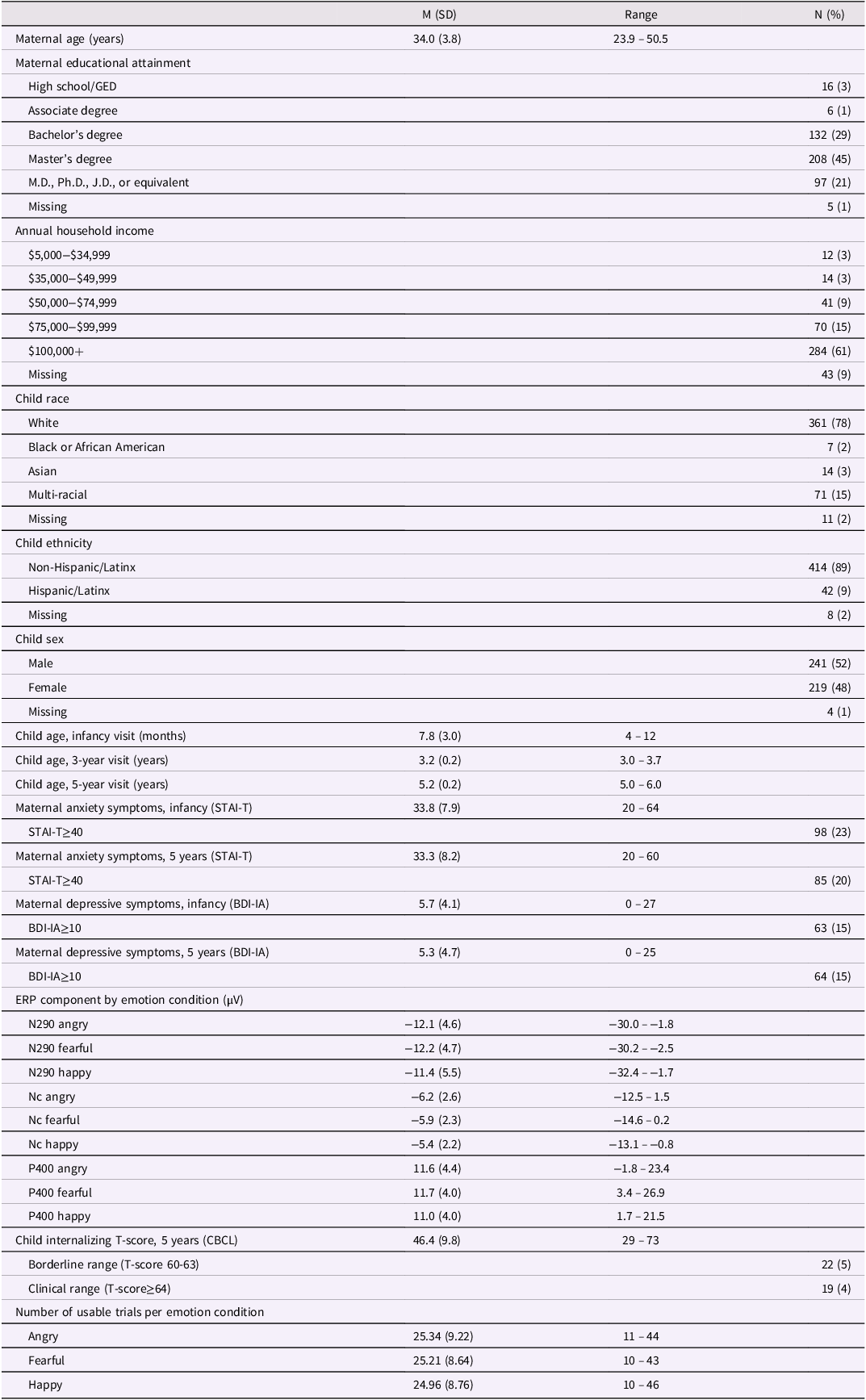
The EEG recordings were preprocessed in MATLAB (R2018a, the Mathworks, Inc.), following the same processing pipeline that has been validated in recent EEG/ERP studies (Xie et al., Reference Xie, Mallin and Richards2019a, Reference Xie, McCormick, Westerlund, Bowman and Nelson2019b), which includes functions adopted from the Maryland Analysis of Developmental EEG (MADE) pipeline (Debnath et al., Reference Debnath, Buzzell, Morales, Bowers, Leach and Fox2020). The continuous EEG data were filtered using a finite impulse response (FIR) filter with Hamming window and a passband of 0.3-.30 Hz. The filtered data were then segmented into 1-s epochs (trials) with 100 ms pre- and 900 ms post-stimulus onset. Independent component analysis (ICA) was conducted, and then SASICA (Chaumon et al., Reference Chaumon, Bishop and Busch2015) was used to identify and remove artificial components related to eye movements, blinks, and focal activity. Automated artifact detection was applied to identify individual electrodes exhibiting artificial voltage changes within each segmented epoch (i.e., EEG > 100 μV or EEG < -100 μV). Electrode interpolation was conducted using a spherical spline interpolation if there were fewer than 18 (15%) electrodes with missing or bad data (Luyster et al., Reference Luyster, Powell, Tager-Flusberg and Nelson2014; Righi et al., Reference Righi, Westerlund, Congdon, Troller-Renfree and Nelson2014). On average, 7.74 (SD = 2.95) electrodes were interpolated for each epoch across participants. If there were 18 or more bad electrodes for a specific trial, the trial was excluded from analysis. In addition, children’s looking behavior was coded trial-by-trial using video recordings of each session. Trials that did not meet inclusion criteria, that is, that the child fixated on the stimulus presentation for the first 500 ms without an eye movement or blink, were excluded from further analysis. The preprocessed data were re-referenced to the average reference. A minimum of 10 usable trials per emotion condition was required for a participant to be included in the ERP analysis. The mean number of usable trials did not differ by emotion condition. Information about the number of usable trials for each emotion condition is listed in Table 1.
Sample characteristics (N = 464)

Note. STAI-T = Trait Anxiety form of the Spielberger State-Trait Anxiety Inventory; BDI-IA = Revised Beck Depression Inventory; CBCL = Child Behavior Checklist 1½-5.
The HGSN electrodes were grouped into nine virtual clusters to cover the scalp regions commonly used to examine the N290, Nc, and P400 components in young children: N290: Temporal-Occipital_L (TO_L), Occipital-Inion_L (OI_L), Occipital-Inion_R (OI_R), Temporal-Occipital_R (TO_R); Nc: Frontal_Z (F_Z), Central_L (C_L), Central_Z (C_Z), Central_R (C_R); and P400: TO_L, OI_L, Occipital-Inion_Z (OI_Z), OI_R, TO_R (Xie et al., Reference Xie, Leppänen, Kane-Grade and Nelson2019b, Reference Xie, Leppänen, Kane-Grade and Nelson2021). The peak amplitude of the N290 component was assessed in the time window of 190 to 350 ms. The N290 peak amplitude was corrected for the pre-N290 peak, consistent with previous work (Xie et al., Reference Xie, Leppänen, Kane-Grade and Nelson2019b, Reference Xie, Leppänen, Kane-Grade and Nelson2021), to reduce the effect of positive or negative trends on the child N290 component (Guy et al., Reference Guy, Zieber and Richards2016; Kuefner et al., Reference Kuefner, De Heering, Jacques, Palmero-Soler and Rossion2010). The mean amplitudes of the Nc and P400 components were assessed in the time window of 350 to 650 ms, based on previous ERP studies on face and emotion processing in children (e.g., Conte et al., Reference Conte, Richards, Guy, Xie and Roberts2020; Kobiella et al., Reference Kobiella, Grossmann, Reid and Striano2008; Leppänen et al., Reference Leppänen, Kauppinen, Peltola and Hietanen2007; Vanderwert et al., Reference Vanderwert, Simpson, Paukner, Suomi, Fox and Ferrari2015). N290, Nc, and P400 amplitude variables for each emotion were calculated as the average amplitude across all clusters of interest. Although the N290 is often analyzed separately for left and right regions because of prominence in the temporal-occipital regions and right hemisphere dominance, previous analyses in this cohort showed no interaction effect for location (left vs. right) by emotion for N290 amplitude at age 3 years (Xie et al., Reference Xie, Leppänen, Kane-Grade and Nelson2021); therefore, the current analyses did not distinguish left versus right N290 amplitudes. Because Nc and P400 are prominent in more central regions, Nc and P400 variables were treated without separating by hemisphere (Xie et al., Reference Xie, Leppänen, Kane-Grade and Nelson2021).
Sociodemographic variables (Covariates)
As described in the Data Analytic Plan below, the main analyses included child age at the 3-year assessment, child sex assigned at birth (hereafter “sex”), and family SES as covariates. Parent-report questionnaires provided all sociodemographic data. A composite variable quantifying family SES was created from parental educational attainment (8th grade education or less, some high school, high school/GED, associate’s degree, bachelor’s degree, master’s degree, and M.D./Ph.D./J.D. or equivalent) and annual household income (9 levels, with cutoffs at $5K, $12K, $16K, $25K, $35K, $50K, $75K, and $100K). The highest education level reported for either parent was selected to minimize missingness. Education level and household income data were standardized and averaged, with higher scores indicating higher SES. The utility of using a composite of parental education and income variables to create a single, family SES variable is described by Caro and Cortés (Reference Caro and Cortés2012).
Maternal depressive symptoms (Predictor, secondary analyses)
Maternal depressive symptoms were measured at infancy and age 5 years via the Revised Beck Depression Inventory (BDI-IA; Beck, Reference Beck1979; Beck & Steer, Reference Beck and Steer1993), a 21-item self-report questionnaire that assesses the frequency and intensity of depressive symptoms in the past two weeks. Items were scored on a 4-point scale (range 0-3) and summed, with a total possible range of 0-63; higher scores indicate greater depressive symptoms. Internal consistency for the BDI-IA has been reported as .89 (Beck et al., Reference Beck, Steer, Ball and Ranieri1996). Cronbach’s alpha scores in this sample were .78 in infancy and .84 at 5 years.
Data analytic plan
Statistical analyses were performed using STATA 18.0 (StataCorp, 2023). Descriptive statistics were used to characterize the sample, correlation coefficients described the associations among the main study variables, and two-sample t tests compared sex differences of main study variables. Maternal psychopathology was recoded to missing for n = 7 children whose fathers completed these questionnaires. Nine pathway models were fit to test whether each of the nine ERP measures (3 components × 3 emotions) at 3 years functioned as (a) a mediator of the association between maternal anxiety during infancy and child internalizing symptoms at age 5 years and/or (b) a moderator of the association between maternal anxiety at 5 years and child internalizing symptoms at 5 years. To address skewness in scores and to facilitate interpretation of results, maternal anxiety scores were dichotomized based on a clinically relevant cutoff for mild to severe anxiety (STAI≥40; Grant et al., Reference Grant, McMahon and Austin2008; McMahon et al., Reference McMahon, Barnett, Kowalenko, Tennant and Don2001). Child age at the 3-year assessment, child sex, and family SES were included as covariates for the analyses where an ERP measure or child internalizing symptoms was the dependent variable. The pathway between maternal anxiety symptoms in infancy and at 5 years was constrained to be the tetrachoric correlation of these two dichotomized values. This tetrachoric correlation assumes a latent bivariate normal distribution for the two variables. Potential sex differences were tested via inclusion of relevant interaction terms (i.e., two-way effects for anxiety or ERP measures, three-way effect for ERP measures with maternal anxiety symptoms at 5 years). Sex interaction terms were retained in the models if p < .05; if not significant, sex terms were removed from the relevant model.
Full information maximum likelihood (FIML) was used to account for missing data. This method obtains less biased model results compared to listwise deletion if missing data are not missing completely at random. All tests were two-tailed, and alpha was set at .05. We report stratified ERP effects only if the interaction effect was p < .05. Stratified effects are presented for participants with low maternal anxiety at the 5-year assessment (defined by the ERP coefficient) and participants with elevated maternal anxiety at the 5-year assessment (calculated by summing the ERP coefficient and the ERP × maternal anxiety coefficient).
We conducted several follow-up sensitivity analyses. First, for any models that showed statistically significant ERP mediating or moderating effects, we added maternal depressive symptom terms (dichotomized at an established clinical cutoff for mild to severe depression of BDI≥10; Beck et al., Reference Beck, Steer and Carbin1988) parallel to the maternal anxiety symptom terms to test for specificity of any maternal anxiety findings. Second, in our main analyses, we scored maternal anxiety symptoms as a dichotomous variable, using a clinically relevant cutoff score. This approach accounted for the skewness in STAI scores and produced more easily interpretable results, particularly in the context of interpreting interaction effects. In a sensitivity analysis, we utilized the continuous STAI score (standardized with M = 0, SD = 1) in place of the dichotomous STAI score in analyses parallel to the main analyses (i.e., testing mediation and moderation effects). Third, the main analyses did not make adjustments for multiple comparisons to maximize our ability to detect any mediating and moderating effects (alpha set at .05). In sensitivity analyses that made adjustments for multiple comparisons, we report Holm–Bonferroni corrected results, where each type of effect (i.e., mediating vs. moderating) is treated as a family of nine tests. Finally, we conducted analyses parallel to the main analyses testing mediation and moderation effects, restricted to the subsample of participants (n = 92) who provided complete data.
Results
Sample characteristics and descriptive analyses
Table 1 displays the sample sociodemographic characteristics and descriptive statistics for the main study variables. Children were predominantly non-Hispanic White and of middle to high SES as indicated by parental education and annual household income.
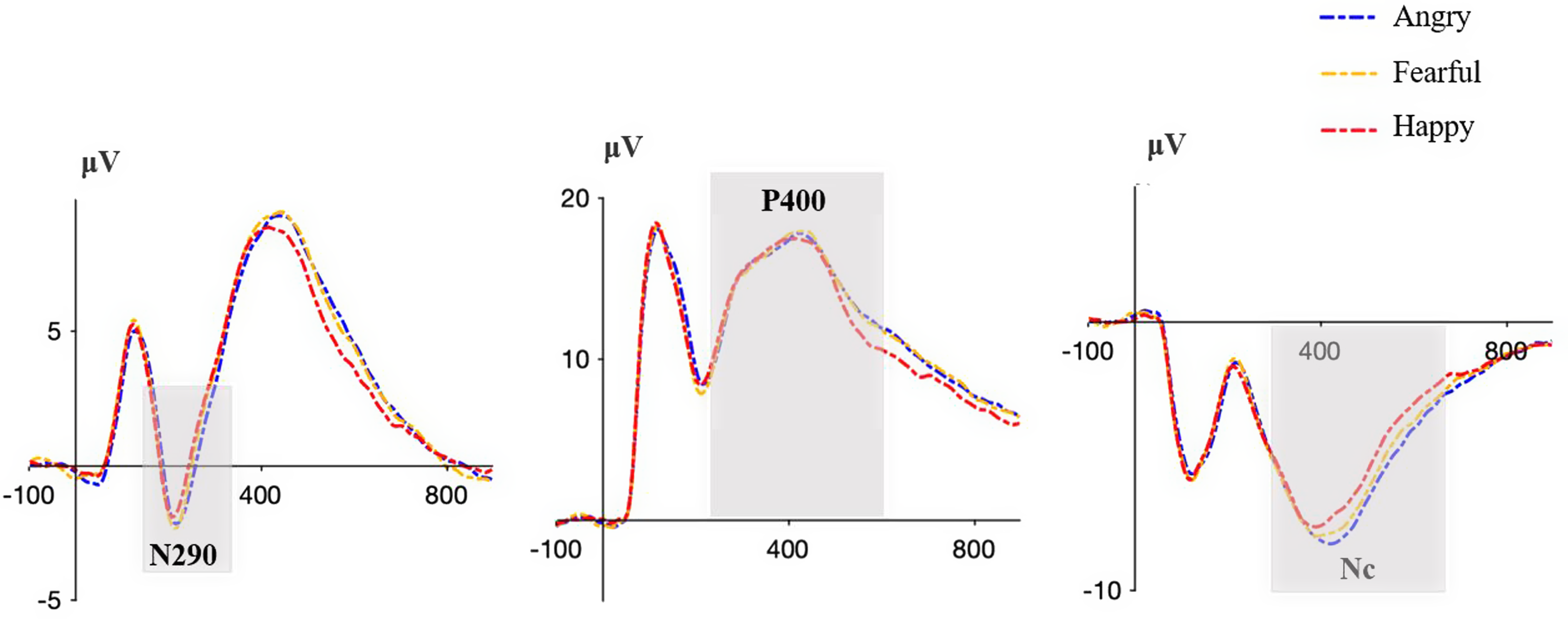
Among the final analytic sample (N = 464), n = 434 had maternal anxiety data at infancy, n = 129 had usable child ERP data at 3 years, n = 424 had maternal anxiety data at 5 years, and n = 424 had child internalizing symptom data at 5 years. An additional 84 children participated in the ERP task at age 3 years but did not provide usable ERP data due to noncompliance in sufficiently completing the task or excessive artifacts (e.g., eye and/or body movements) that resulted in an insufficient number of trials. This attrition rate is comparable to that in similar ERP studies with this age group (e.g., Brusini et al., Reference Brusini, Dehaene-Lambertz, Dutat, Goffinet and Christophe2016; Piatti et al., Reference Piatti, Van der Paelt, Warreyn and Roeyers2021; Webb et al., Reference Webb, Jones, Merkle, Venema, Greenson, Murias and Dawson2011). Figure 2 displays the grand mean ERP waveforms by emotion condition (angry, fearful, happy), plotted for each component (N290, P400, Nc) by combining across all electrodes used for the component.
Grand mean ERP waveforms by emotion condition (angry, fearful, happy), plotted for each component (N290, P400, nc) by combining across all electrodes used for the component.

At infancy, 98 mothers (23% of the sample) had anxiety symptom scores at or above the clinical cutoff (STAI-T ≥ 40), and 63 mothers (15%) had depressive symptom scores at or above the clinical cutoff (BDI-IA ≥ 10). At 5 years, 85 mothers (20%) had anxiety symptom scores at or above the clinical cutoff, 64 mothers (15%) had depressive symptom scores at or above the clinical cutoff, and 41 children (9% of the sample) had internalizing problems scores in the borderline (n = 22, 5%) or clinical (n = 19, 4%) range.
Infant age at the time of the infant assessment was not associated with maternal anxiety symptoms in infancy (p = .61). Child internalizing symptoms at age 5 years differed by sex (t(418) = −2.35, p = .02), with females having a higher average score (M = 47.5, SD = 9.2) than males (M = 45.3, SD = 10.1). Compared to males, females had smaller amplitude scores for N290 to fearful faces (Mf = −11.0, SD = 4.2; Mm = −13.6, SD = 4.9; t(127) = −3.27, p = .001) and happy faces (Mf = −10.8, SD = 4.5; Mm = −12.6, SD = 5.2; t(127) = −2.09, p = .04), as well as Nc to angry faces (Mf = −5.7, SD = 2.3; Mm = −6.7, SD = 2.8; t(127) = −2.25, p = .03). There were no other sex differences on the ERP measures.
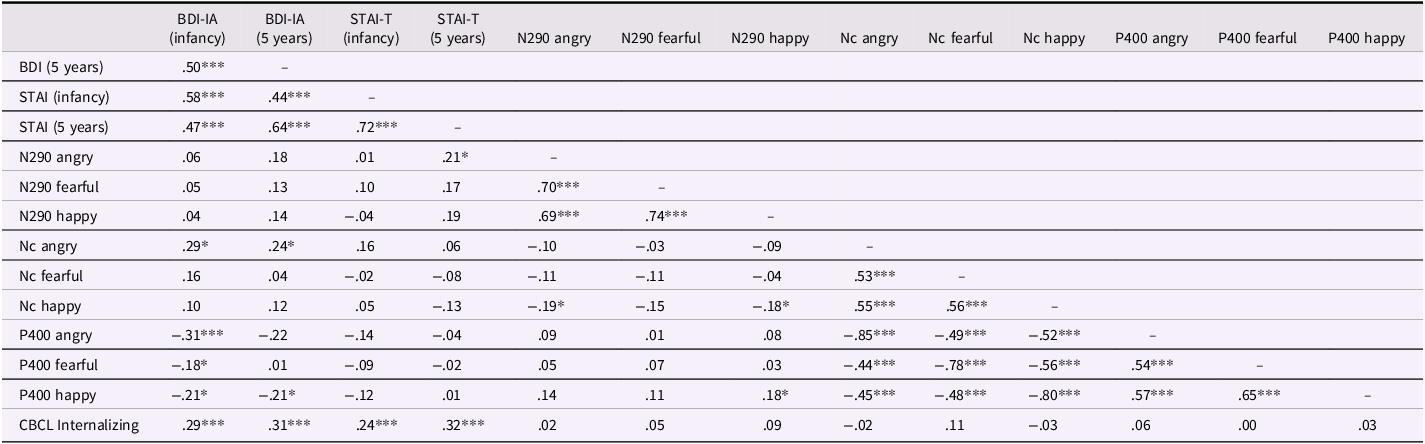
Table 2 displays the correlation coefficients among the main study variables. As expected, maternal anxiety as well as depressive symptom scores at each assessment were positively associated with child internalizing symptoms at age 5 years. Maternal anxiety and depressive symptoms were moderately stable from infancy to 5 years. Maternal anxiety and depressive symptoms were also moderately correlated with each other within and across time. Maternal depressive but not anxiety symptom scores in infancy were associated with several child ERP variables (Nc to angry faces, P400 to all emotion faces), with higher maternal depressive symptom scores associated with smaller child ERP amplitudes. None of the child ERP variables were correlated with child internalizing symptoms at age 5 years.
Correlations among main study variables

Note. BDI = Revised Beck Depression Inventory; STAI = Trait Anxiety form of the Spielberger State-Trait Anxiety Inventory; CBCL = Child Behavior Checklist 1½-5.
* p < .05, ***p < .001.
Mediation analyses
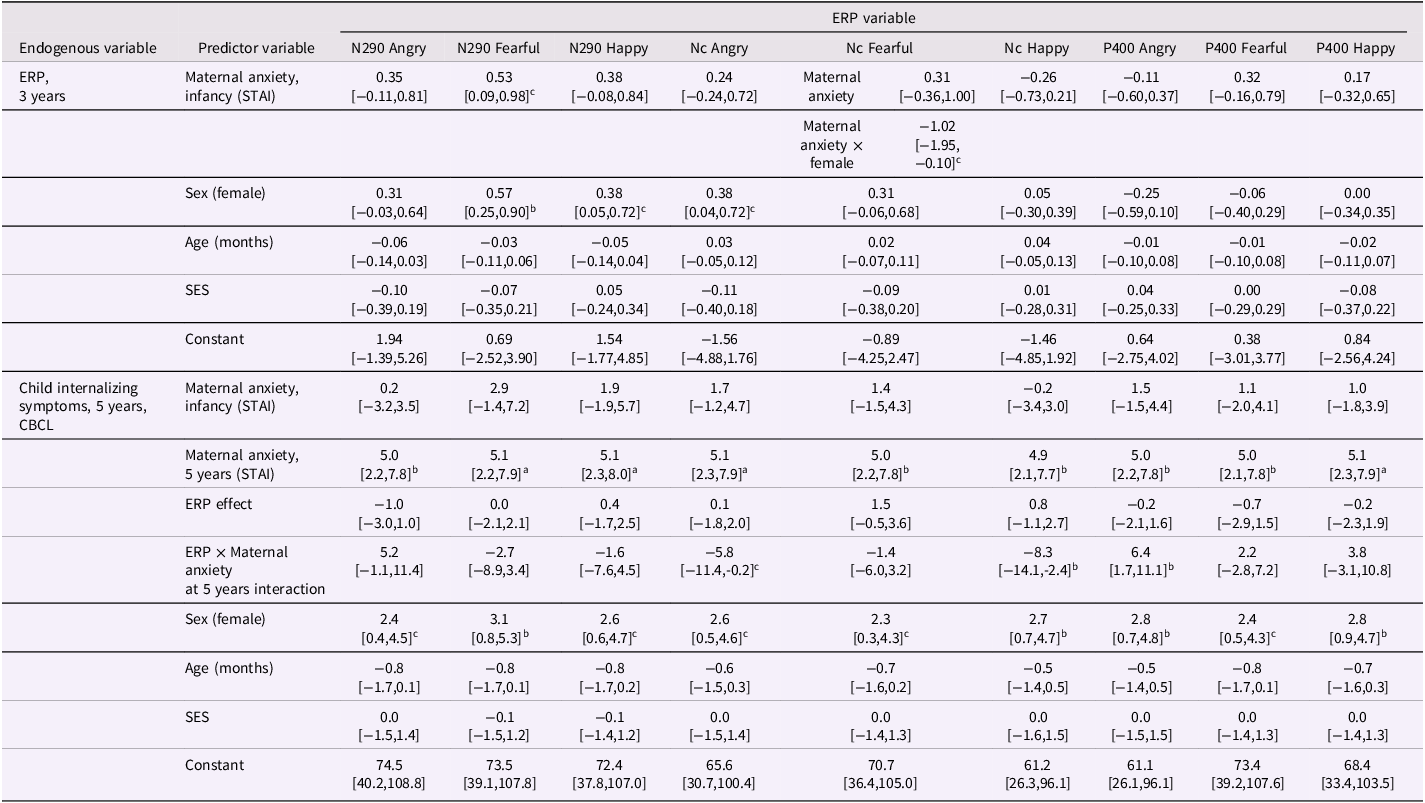
There were no indirect effects of maternal anxiety symptoms in infancy on child internalizing symptoms at age 5 years through any of the child ERP measures at age 3 years, all ps > .05. Elevated maternal anxiety symptoms in infancy were associated with smaller N290 amplitude to fearful faces at 3 years (Table 3). Among children with elevated maternal anxiety symptoms in infancy, females had larger amplitude Nc to fearful faces compared to males (Table 3). There were no other associations between maternal anxiety symptoms in infancy and child ERP measures at age 3 years (Table 3).
Pathway analysis results for exposure to maternal anxiety symptoms in infancy predicting child ERP measures at age 3 years (mediation model) and child ERP measures at 3 years and exposure to maternal anxiety symptoms at infancy and 5 years predicting child internalizing symptoms at 5 years (outcome model). Results reported as coefficient [95% confidence interval]. The pathway from maternal anxiety symptoms in infancy to maternal anxiety symptoms at 5 years was constrained in all models to be β = 0.82

Note. None of the indirect effects were significant for the mediation models. STAI = Trait Anxiety form of the Spielberger State-Trait Anxiety Inventory; SES = socioeconomic status; CBCL = Child Behavior Checklist 1½-5.
a p < .001, b p < .01, c p < .05.
Moderation analyses
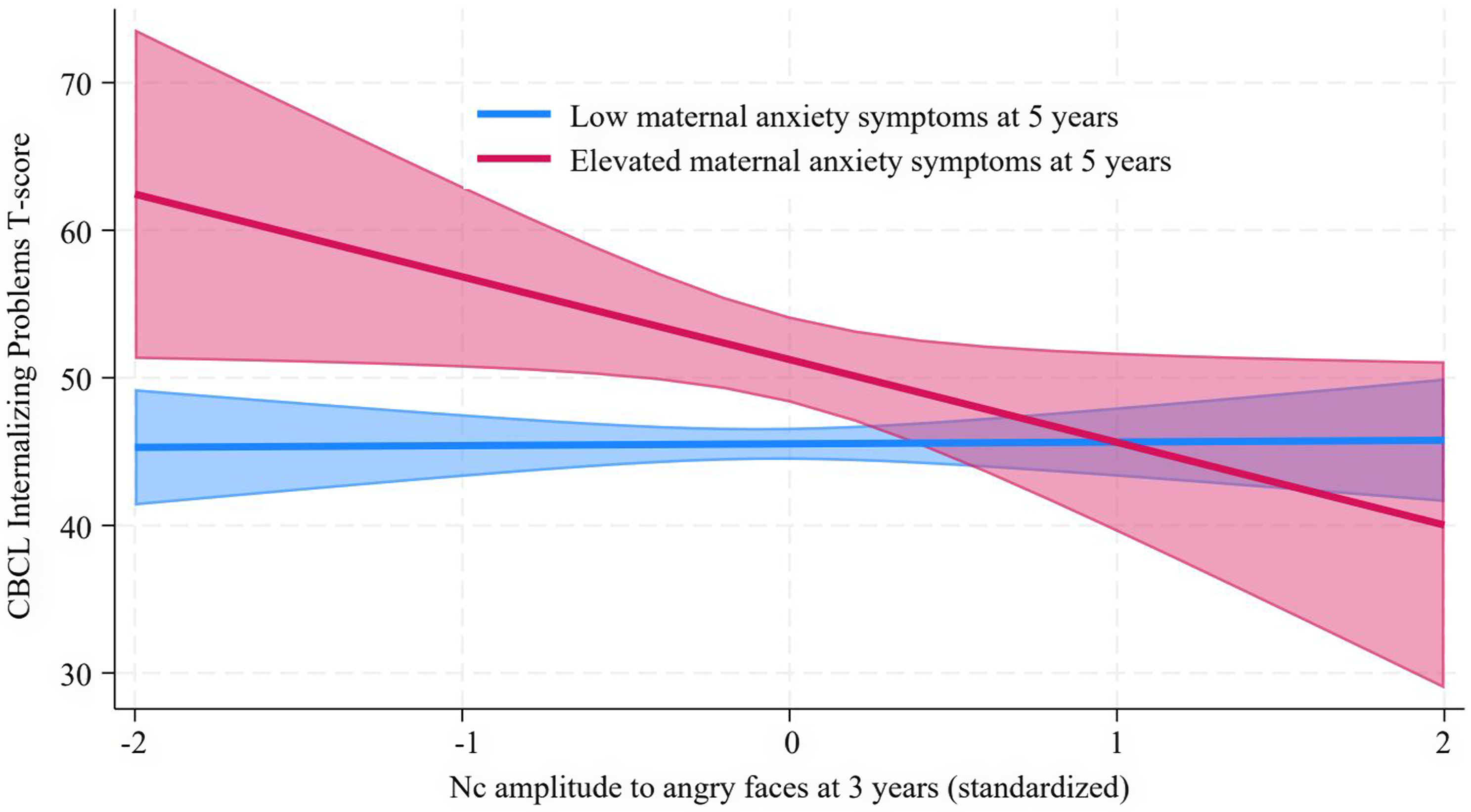
Several ERP measures moderated the effect of maternal anxiety at 5 years on child internalizing symptoms at 5 years (Table 3). Specifically, among children with elevated maternal anxiety symptoms, a one standard deviation larger amplitude (i.e., larger negative score) of the Nc component to angry faces and to happy faces was associated with a 5.7 (95% CI [0.4, 11.0], p = .04) and 7.5 (95% CI [1.9, 13.1], p = .009) point higher child internalizing symptoms score, respectively. Similarly, among children with elevated maternal anxiety symptoms, a one standard deviation larger amplitude of the P400 component to angry faces was associated with a 6.2 point higher child internalizing symptom score (95% CI [1.7,10.7], p = .007). In contrast, among children of mothers with low anxiety symptoms at 5 years, the amplitudes of Nc and P400 to angry faces and Nc to happy faces were not associated with child internalizing symptoms at age 5 years, ps > .40. There were no observed sex-specific effects in any of the moderation models.
The main effect of maternal anxiety symptoms at 5 years ranged between 4.9 and 5.1 higher child internalizing symptoms score (all ps ≤ .01), whereas maternal anxiety symptoms in infancy did not significantly predict child internalizing symptoms. The total effect of maternal anxiety symptoms at 5 years combined with an amplitude 1 SD above the mean for Nc to angry faces, Nc to happy faces, and P400 to angry faces was 10.9 (95% CI [4.7,17.2]), 13.1 (95% CI [6.8,19.5]), and 11.4 (95% CI [5.9,16.8]) higher child internalizing symptoms score, respectively. All the effect sizes described above represent more than one-half of a standard deviation on the CBCL Internalizing Problems T-Score scale. Elevated maternal anxiety symptoms at 5 years showed statistically significant (p < .05) higher child internalizing symptoms score at amplitude levels 0.2 SD below the mean and greater for all three ERP measures showing moderating effects.
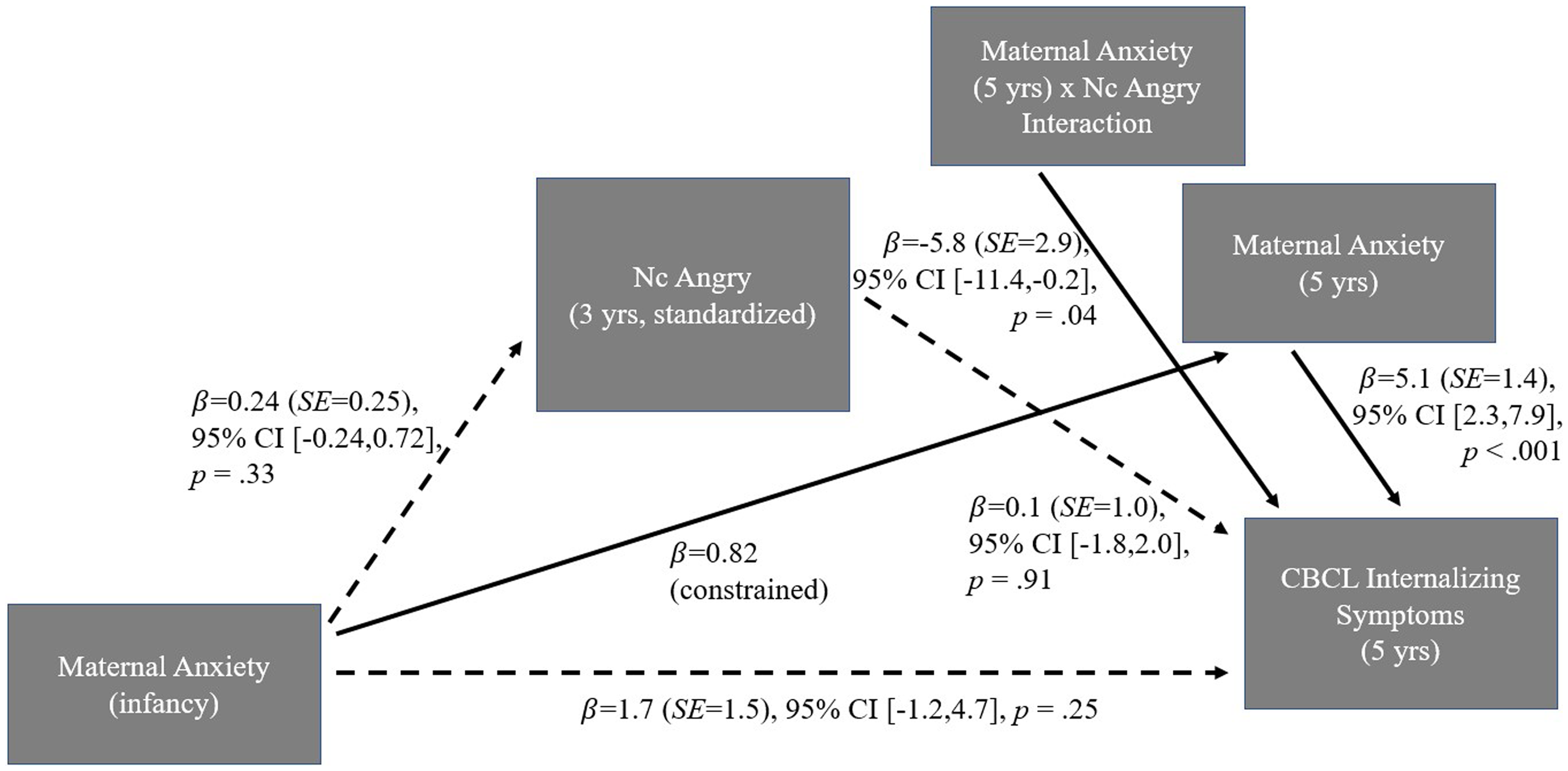
Figure 3 depicts the combined mediation and moderation analyses in pathway form for the amplitude of Nc to angry faces as an exemplar. Figure 4 shows moderation results with linear predictions of the CBCL Internalizing Problems T-Score by standardized amplitudes of Nc to angry faces in participants with low versus elevated maternal anxiety symptoms at 5 years to visually depict an exemplar of the moderation findings.
Pathway depiction of Nc amplitude to angry faces as a mediator and a moderator of the association of exposure to maternal anxiety symptoms and child internalizing symptoms. The mediation and moderation hypotheses were tested simultaneously in the depicted pathway analysis. The pathway analysis estimates two endogenous variables, the ERP measure (to test the mediation portion) and the child internalizing symptoms score (the outcome for both the mediation and moderation hypotheses).

Visual depiction of moderation results with linear predictions with 95% confidence intervals of the CBCL internalizing problems T-score at age 5 years by standardized amplitudes of Nc to angry faces at 3 years in participants with low versus elevated maternal anxiety symptoms at 5 years.

Sensitivity analyses
When pathways for maternal depressive symptoms (dichotomized) at age 5 years, parallel to those for maternal anxiety symptoms, were included in the significant pathway models described above, the effect of Nc amplitude to happy faces in predicting child internalizing symptoms at age 5 years among children exposed to elevated maternal anxiety at 5 years increased to 12.7, 95% CI [4.0, 21.3], p = .004. Although the interaction effects of Nc and P400 amplitudes to angry faces with maternal anxiety symptoms at age 5 years did not remain statistically significant, the effect sizes were similar to those described in the main analysis (5.0, 95% CI [−1.0, 11.0], p = .10 and 6.5, 95% CI [−0.5, 13.6], p = .07, respectively). None of the interaction terms of maternal depressive symptoms at age 5 years and the ERP measures were statistically significant in any of these models (for all interaction terms, p > .10). The full model results for these analyses are presented in Supplementary Materials, Supplementary Table 1.
Analyses that utilized continuous STAI scores yielded smaller interaction effects than the main analyses that used dichotomous STAI scores: Nc angry (-1.1, 95% CIs [−3.6,1.4], p = .38), Nc happy (-2.1, 95% CIs [−4.5,0.3], p = .09), and P400 angry (2.7, 95% CIs [0.6,4.7], p = .01). Therefore, the effect of ERP on child internalizing symptoms does not appear to change linearly across the range of maternal anxiety symptoms, as the dichotomized definition had greater power to detect interaction effects.
Applying a Holm–Bonferroni correction to the nine interaction effects to control for multiple comparisons resulted in the amplitude of Nc to happy faces remaining statistically significant (p = .00547, adjusted alpha = .00556), but the amplitudes of P400 to angry faces (p = .008, adjusted alpha = .006) and Nc to angry faces (p = .04, testing stopped) were not statistically significant. Finally, in a sensitivity analysis restricted to children with complete data (n = 92), we found similar interaction effects as in the main analyses: Nc component to angry faces interaction effect = 5.4 (95% CI [−0.2, 11.0], p = .07), Nc component to happy faces interaction effect = 7.8 (95% CI [1.6, 14.0], p = .01), and P400 component to angry faces interaction effect = 5.9 (95% CI [1.0,10.8], p = .02).
Discussion
Elucidating neural endophenotypes involved in psychiatric disorders is an important goal. Such measures would provide a much-needed biomarker for modeling pathological developmental processes at the level of neural circuitry and, potentially, for identifying novel causal pathways that confer liability for internalizing pathology. In this study, informed by the Adaptive Calibration Model, we examined whether child neural responses to emotional faces (angry, fearful, happy) influence the risk for internalizing problems among children of mothers exhibiting heightened anxiety. Specifically, we tested whether three key ERP components (N290, Nc, P400) in response to emotional faces at age 3 years mediated and/or moderated the associations of maternal anxiety in infancy and at age 5 years with child internalizing symptomatology at age 5 years. The results did not indicate mediating effects. We observed moderating effects, whereby greater Nc and P400 responses to angry faces and greater Nc responses to happy faces at age 3 years increased the effect of maternal anxiety at age 5 years on child internalizing symptoms at age 5 years. These findings remained consistent in sensitivity analyses with maternal depressive symptoms added, that is, the coefficients for maternal anxiety remained very similar, and the effects of maternal depressive symptoms were relatively small and nonsignificant. Thus, the reported findings appear specific to maternal anxiety. The findings also were consistent when restricted to the subsample with complete data available. Finally, we only identified one sex-specific effect: Among children of mothers with elevated anxiety in infancy, females demonstrated larger Nc amplitude to fearful faces than males at age 3 years.
The moderation effects observed were consistent with our hypotheses. These results suggest that, among children exposed to maternal anxiety at age 5 years, those who show larger ERP amplitudes to threat (reflecting increased attention to salient stimuli) at age 3 years may be particularly susceptible to the development of internalizing symptoms by age 5 years. Prior research suggests that children demonstrate consistent neural and behavioral responses to threatening faces by 3 years of age. For example, a study with the present cohort showed that associations between neural and behavioral responses to threat, assessed between infancy and age 3 years, was strongest at age 3 years. The findings suggested that children’s behavioral responses to facial emotions and their neural substrates become more stable and reliable with age, showing brain-behavior convergence by age 3 years (Xie et al., Reference Xie, Leppänen, Kane-Grade and Nelson2021), an association not observed in infancy (Peltola et al., Reference Peltola, Yrttiaho and Leppänen2018; Xie et al., Reference Xie, Leppänen, Kane-Grade and Nelson2021; Yrttiaho et al., Reference Yrttiaho, Forssman, Kaatiala and Leppänen2014). Thus, ERP responses may begin to develop trait-like stability in early childhood, contributing to vulnerability to internalizing problems by middle childhood. Further, the findings are consistent with relevant prior studies, which have shown that ERP responses, especially to angry faces, are associated with internalizing and particularly anxiety vulnerability (Hum et al., Reference Hum, Manassis and Lewis2013; Chronacki et al., Reference Chronaki, Broyd, Garner, Benikos, Thompson, Sonuga-Barke and Hadwin2018). Heightened neural responses to expressions of anger may have particular ecological relevance for young children of anxious mothers. Maternal anxiety has been associated with elevated expressions of hostility, and experiences of maternal anger may be highly aversive, signaling potential threat (e.g., aggressive caregiving behaviors). Increased attention to these signals may serve an adaptive purpose, helping the child to be able to respond to this aspect of the environment, but may also elevate risk for the development of internalizing problems.
Moderating effects were identified for two of the three ERP components investigated (Nc and P400, but not N290). Recent studies suggest that the P400 and Nc share similar functional significance, as both are involved in response to salient stimuli and during sustained attention (Guy et al., Reference Guy, Zieber and Richards2016; Xie & Richards, Reference Xie and Richards2016). Therefore, the observed relations here among maternal anxiety, children’s ERP amplitudes to emotional faces, and children’s internalizing symptomology may be a function of these specific attentional processes, as opposed to broader processes (e.g., general face processing, feature detection). However, prior research has also drawn similarities between the N290 and P400, given their sensitivity to facial expressions and potential role as precursors for the N170 component (e.g., Leppänen et al., Reference Leppänen, Kauppinen, Peltola and Hietanen2007; de Haan et al., Reference de Haan, Johnson and Halit2003). Further research should continue to investigate the functional significance of these components and their potential associations with maternal anxiety and child internalizing symptoms.
Fewer studies have investigated correlates of ERP responses to happy faces in young children, with findings mixed. For example, greater maternal sensitivity has been associated with larger infant Nc amplitudes to happy relative to neutral faces (Taylor-Colls & Pasco Fearon, Reference Taylor-Colls and Pasco Fearon2015), but positive maternal personality and infant temperament have been associated with smaller infant Nc amplitudes to happy faces compared to fearful faces (de Haan et al., Reference de Haan, Belsky, Reid, Volein and Johnson2004). A prior study using the same cohort as the present study found that greater maternal anxiety was concurrently associated with larger infant Nc to happy faces (Bowman et al., Reference Bowman, McCormick, Kane-Grade, Xie, Bosquet Enlow and Nelson2022). Thus, the implications of larger ERP responses to happy faces in early life are not well established.
No mediation or moderation effects were observed in the current study for fearful faces for any of the ERP components. Although some studies have reported associations between heightened attention to signs of fear and anxiety symptoms in children, adolescents, and adults, other studies suggest that heightened attention to fearful stimuli is adaptive in social contexts, promoting positive socioemotional competencies (e.g., empathy, prosocial behaviors; Eskola et al., Reference Eskola, Kataja, Hyönä, Hakanen, Nolvi, Häikiö, Pelto, Karlsson, Karlsson and Korja2023). The implications for mental health outcomes of greater neural responses to fearful faces need continued examination. The pattern of results observed in the current study may reflect larger ERP amplitudes to personally relevant emotional expressions at this age, as happy and angry faces are likely more prevalent than fearful expressions in the child’s day-to-day environment.
Contrary to our hypothesis, we did not find that child ERP response patterns mediated associations between exposure to maternal anxiety in infancy and child internalizing symptoms at age 5 years. Specifically, maternal anxiety in infancy was not associated with child ERP responses at age 3 years, with the exception of an inconsistent association with N290 to fearful faces (i.e., nonsignificant in correlational analyses, modest association in pathway analyses). Currently, little is known about the causes of individual differences in neural correlates of face and emotion processing (Bowman et al., Reference Bowman, McCormick, Kane-Grade, Xie, Bosquet Enlow and Nelson2022). A number of potential contributors have been implicated, including genetics, prenatal programming processes, temperament, and caregiving experiences (Bowman et al., Reference Bowman, McCormick, Kane-Grade, Xie, Bosquet Enlow and Nelson2022; Forssman et al., Reference Forssman, Peltola, Yrttiaho, Puura, Mononen, Lehtimaki and Leppänen2014; Puliafico & Kendall, Reference Puliafico and Kendall2006; Ravicz et al., Reference Ravicz, Perdue, Westerlund, Vanderwert and Nelson2015; de Haan et al., Reference de Haan, Belsky, Reid, Volein and Johnson2004). In this study, maternal anxiety was considered as a potential driving factor, with possible underlying contributing mechanisms including the affective caregiving context and shared genetics. As previously indicated, a prior study in this cohort (Bowman et al., Reference Bowman, McCormick, Kane-Grade, Xie, Bosquet Enlow and Nelson2022) found greater maternal anxiety to be related concurrently to greater Nc amplitude to happy and fearful faces in infants aged 5 to 12 months. However, maternal anxiety in infancy was not associated longitudinally with child ERP response patterns to emotional faces at age 3 years in the current analyses.
The apparent diminishing effects of maternal anxiety in infancy on child ERP responses may be caused by developmental and changing environmental factors. For example, the effects of maternal anxiety in infancy on later child neural responding may dissipate if the child’s affective context changes (e.g., maternal symptoms resolve, child has increased time and experiences with other caregivers who provide different emotional input). Also, the form, meaning, and impact of caregiving behaviors associated with maternal anxiety may change with evolving developmental needs from infancy to the preschool period. Consequently, neural response patterns to the caregiving environment may adapt accordingly. Notably, there is a normative change in the neural response to threat cues during the developmental period of the current analyses. Specifically, an enhanced neural response to threat-alerting stimuli is found in most infants during the second half of the first year, with responses to threat-alerting cues typically attenuating markedly between ages 7 and 24 months (Leppänen et al., Reference Leppänen, Forssman, Peltola, Yrttiaho, Puura, Mononen and Lehtimäki2014; Peltola et al., Reference Peltola, Hietanen, Forssman and Leppänen2013). Additionally, ERP and attention processes converge by age 3 years, evidencing development of a rapid, unified response to threatening facial expressions over this developmental period (Xie et al., Reference Xie, Leppänen, Kane-Grade and Nelson2021). Factors that influence whether an individual deviates from this expected developmental course and develops maladaptive responses to threat are not well understood. Future studies should consider the potential impact of chronicity, severity, and timing of maternal psychopathology on the development and maintenance of such response patterns. Finally, findings from studies on attentional bias to threat suggest major developmental changes in patterns related to anxiety (e.g., bias away from threat in anxious children and toward threat in anxious adults), possibly as relevant brain circuits reorganize (Lisk et al., Reference Lisk, Vaswani, Linetzky, Bar-Haim and Lau2020). Thus, the nature of associations among environmental exposures, neural response patterns, and anxiety risk may change over development, necessitating longitudinal studies that examine these relations within and across time.
The findings in the current study are consistent with patterns observed in our parallel study of the role of child autonomic nervous system (ANS) reactivity in the intergenerational transmission of internalizing symptoms in this same cohort. There, we found that increased ANS reactivity to threat at age 3 years did not mediate associations between maternal anxiety in infancy and child internalizing symptoms at age 5 years but did moderate associations between maternal anxiety and child internalizing symptoms at age 5 years (Quigley et al., Reference Quigley, Petty, Sidamon‐Eristoff, Modico, Nelson and Bosquet Enlow2023). Future studies should continue to elucidate biomarkers that increase child mental health vulnerability, particularly in the context of other risk factors (e.g., exposure to adversity). Exploring individual differences in response to emotional or threatening stimuli may be especially relevant for understanding the developmental psychopathology of anxiety.
The associations in the current study were specific to maternal anxiety, as opposed to maternal internalizing symptoms more generally. Prior findings in children and adults have shown ERP responses to threat stimuli to be enhanced in relation to various anxiety disorders but not to other forms of psychopathology and may even be blunted in depression (Bunford et al., Reference Bunford, Kujawa, Fitzgerald, Monk and Phan2018; Chronaki et al., Reference Chronaki, Broyd, Garner, Benikos, Thompson, Sonuga-Barke and Hadwin2018; Kujawa et al., Reference Kujawa, MacNamara, Fitzgerald, Monk and Phan2015; MacNamara et al., Reference MacNamara, Kotov and Hajcak2016; Michael et al., Reference Michael, Wang, Kaur, Fitzgerald, Fitzgibbon and Hoy2021). Notably, in the correlational and pathway analyses in the current study, maternal depressive symptoms in infancy were associated with more blunted child ERP responses to emotion at 3 years. Caregiving behaviors relevant for children with heightened threat reactivity, such as overprotection, may be particularly common among mothers with elevated anxiety (Clarke et al., Reference Clarke, Cooper and Creswell2013).
The outcome examined was child internalizing symptoms, as the Internalizing Problems scale from the CBCL has greater variability and robustness than specific DSM-oriented subscales, likely due to the much larger number of items in the higher order scale. The observed findings may be strengthened when tested in relation to more detailed, extensive anxiety measures in samples enriched for clinical levels of anxiety. Additionally, although some studies suggest that threat responsivity may represent a transdiagnostic biomarker common across anxiety conditions, others suggest that threat responses may vary by phenotype (e.g., generalized anxiety, social anxiety, separation anxiety, specific phobias; Salum et al., Reference Salum, Mogg, Bradley, Gadelha, Pan, Tamanaha, Moriyama, Graeff-Martins, Jarros, Polanczyk, do Rosário, Leibenluft, Rohde, Manfro and Pine2013; Waters et al., Reference Waters, Bradley and Mogg2014). Longitudinal studies that examine threat responses over time may be able to distinguish causal links among the various anxiety phenotypes in later development, as anxiety conditions emerge, evolve, and become more differentiated.
Strengths of the current study include its longitudinal design and testing of mediation and moderation models in the first five years of life. To our knowledge, this is the first study to provide evidence for a moderating role of neural processing of emotional faces in the intergenerational transmission of internalizing problems. The results provide support for the hypothesis that individual differences in neural processing of emotional faces may influence the effects of exposure to maternal anxiety on child mental health risk in early childhood. This information may inform future research to identify underlying neurobiological and psychosocial mechanisms involved in the intergenerational transmission of anxiety.
These strengths should be considered in the context of study limitations and other factors. First, reliance on parent report of maternal and child symptoms may have inflated associations or introduced bias in reporting; however, recent work suggests that mothers’ psychopathology produces minimal bias in their ratings of their children’s emotions and behaviors (Olino et al., Reference Olino, Michelini, Mennies, Kotov and Klein2021). We did not consider the potential contribution of genetic effects in our models. We did not assess maternal anxiety symptoms in pregnancy or caregiving behaviors and therefore could not evaluate their roles in the context of the study models. Examining caregiving quality would allow for characterization of the specific behaviors that influence child risk, particularly among children with greater neural responses to emotional stimuli. Future research should also explore the origins of individual differences in neural responding, including genetic factors, prenatal programming effects, and various environmental exposures.
The study sample was primarily of middle to high SES, which may limit the generalizability of the findings. The fact that moderation effects emerged despite relatively low levels of maternal symptoms suggests that even mild levels of maternal anxiety may increase child risk for internalizing problems. The larger effect sizes in analyses that utilized dichotomous compared to continuous maternal anxiety scores suggest that the effect of child ERP amplitudes on child internalizing symptoms does not change linearly across the range of maternal anxiety symptoms. Future research should replicate the current analyses in more diverse samples, including those with more severe psychopathology, to assess the generalizability of the findings. Future work may benefit from assessing influences of all the child’s caregivers to more fully examine the effects of the caregiving environment on the development of patterns of neural threat responsivity and subsequent anxiety.
Most relevant studies in the literature have focused on ERP amplitudes, as in this study. However, there is evidence that differences in ERP latencies to emotional stimuli may be associated with anxiety, at least in adults (Bar-Haim et al., Reference Bar-Haim, Lamy and Glickman2005). Further, developmental effects may be more pronounced in latency than amplitude specifically for the N290 (Di Lorenzo et al., Reference Di Lorenzo, van den Boomen, Kemner and Junge2020). We focused on amplitude to remain consistent with previous literature and to control the number of analyses conducted, but latencies may be worth considering in future research. Similarly, we did not consider ERP responses to neutral faces, but rather included happy faces as a counterpart to threatening (i.e., angry, fearful) faces. Prior studies have used various approaches when analyzing ERP responses to emotional stimuli, with some examining each emotion separately, and others testing the correlates of difference scores (e.g., ERP mean amplitude to angry faces minus ERP mean amplitude to neutral faces). We chose to examine each emotion separately, as examining difference scores would have required four outcome measures per participant per model, rather than one. Despite these considerations, our results adjusting for multiple comparisons indicate that the current findings, although providing important initial evidence, should be tested for replicability in future studies across diverse populations.
Conclusion
Our findings suggest that differences in neural responses to emotional faces, particularly threat-related, as reflected in larger ERP amplitudes to angry faces, may play a role in the intergenerational transmission of anxiety problems from mothers to children in early childhood. Specifically, we observed differences in neural responses to emotional faces in attention- and face-specific ERP components that moderated the association between maternal anxiety and child internalizing symptoms. Among children exposed to elevated maternal anxiety at age 5 years, those who exhibited greater Nc and P400 to angry faces and Nc to happy faces at age 3 years showed higher levels of internalizing symptoms at age 5 years. Our hypothesis that early exposure to maternal anxiety in infancy would be associated with greater neural responding to threat (i.e., angry, fearful faces) at age 3 years was not supported. Thus, child neural responding to emotional stimuli moderated but did not mediate associations between exposure to maternal anxiety and child internalizing symptoms. These findings were not sex-specific, suggesting that the associations among variables were similar between male and female children. Finally, sensitivity analyses suggested that the findings were specific to maternal anxiety and not more generalized to maternal internalizing problems (i.e., depression). These results have implications for identifying at-risk children in early life and for developing targeted interventions to reduce risk for psychopathology. Future work should attempt to elucidate the specific genetic and environmental factors that shape young children’s developing face and emotion neural circuitry, given its potential role in psychopathology risk, and determine if targeting relevant neural pathways interrupt risk trajectories.
Supplementary material
The supplementary material for this article can be found at https://doi.org/10.1017/S0954579424001858.
Data availability statement
The data from this study are available from the corresponding author upon reasonable request.
Acknowledgments
Study data were collected and managed using Research Electronic Data Capture (REDCap) tools hosted at Boston Children’s Hospital (Harris et al., Reference Harris, Taylor, Thielke, Payne, Gonzalez and Conde2009). We are very grateful to the parents and children who participated in this study, without whom this research would not be possible.
Funding statement
This research was supported by the NIMH (R01 MH078829) to authors CAN and MBE and by a Tommy Fuss Center Innovation Award from the Tommy Fuss Center for Neuropsychiatric Disease Research at Boston Children’s Hospital to author MBE. Manuscript preparation was supported by author FEKG’s NSF Graduate Research Fellowship (2237827). The content is solely the responsibility of the authors and does not necessarily represent the official views of the NIMH, the NIH, or the NSF.
Competing interests
The authors declare none.