Implications
To decrease production costs, co-product of agribusiness can be used in beef cattle rations. However, quality of the final product should not be reduced. Our results show new data about addition of cottonseed hulls on beef rations, complementing the existent information on co-products that help to improve farmers’ income. Studied levels did not affect consumer sensory scores but can produce differences on visual appraisal in some intermediate times of display.
Introduction
The co-products from agribusinesses may be an option to obtain higher production efficiency and a greater meat quality (Eiras et al., Reference Eiras, Marques, Prado, Valero, Bonafé, Zawadzki, Perotto and Prado2014; Polizel Neto et al., Reference Polizel Neto, Roça, Branco, Bonilha, Andrade, Corvino and Gomes2014). The United States, Brazil, China and India are not only the main beef producers in the world, but they are also the most important cotton producers with Pakistan (Food and Agriculture Organization of United Nations. Statistics Division, Reference Ferraz and Felício2015). Cottonseed hulls are a singular co-product feed. They possess feeding characteristics that are different from most other high-fibre feedstuffs. Cottonseed hulls are comprised of the seed coat with some attached lint that is separated from the cottonseed kernel during oil production. Their availability, low cost and excellent mixing characteristics have made them an important source of roughage for ruminants. The main component of cottonseed hulls is NDF that includes a relatively large proportion of ADL. Thus, cottonseed inclusion in the diet for ruminants may increase the fibre level in the high-grain diet.
The effects of those raw materials on production systems are not abundant, specifically consumer acceptability is unknown. Consumers are the last link in the food chain; and their opinion and acceptability is essential for the development of a product (Amerine et al., Reference Amerine, Pangborn and Roessler1965). Diet, production system and animal genotype could imply differences on meat sensory acceptability for consumers (Realini et al., Reference Realini, Font i Furnols, Guerrero, Montossi, Campo, Sañudo, Nute, Alvarez, Cañeque, Brito and Oliver2009 and Reference Realini, Font i Furnols, Sañudo, Montossi, Oliver and Guerrero2013; Font-i-Furnols and Guerrero, 2014). In the same way, colour is a decisive attribute when consumers make purchase decisions regarding meat (Ripoll et al., Reference Ripoll, Albertí, Casasús and Blanco2013). The visual and sensory consumers’ acceptability is modified with time of storage, which could be appreciated in different ways depending on the personal background or consumption habits of consumers. Moreover, ageing time has an influence on global acceptability scores. Usually in European countries, beef liking (overall acceptability) increases with ageing time (Pérez-Juan et al., Reference Pérez-Juan, Realini, Barahona, Sarriés, Campo, Beriain, Vitale, Gil and Albertí2014).
Brazil is not only one of the principal beef exporters, but is also a large beef consumer; this is due to the population census and socio-economic changes with an important increase in its internal development (Kirinus et al., Reference Kirinus, Fruet, Klinger, Dörr and Nörnberg2013). Thus, ~80% of Brazilian beef production is absorbed by the internal market. Because of the scarce number of studies on visual and sensorial acceptability on meat from animal fed with this kind of co-product and the importance of beef consumption in Brazil, a visual and sensorial test were conducted in order to study the acceptability of meat from crossbreed (1/2 Simmental–1/2 Nellore) young bulls fed the co-product cottonseed hull in a high-grain system, after different times of display and ageing.
Material and methods
Location, animals, diets and handling
This experiment was approved by the Animal Science Department at the State University of Maringá and was conducted at the Rosa & Pedro Sector at the Iguatemi Experimental Farm of the State University of Maringá.
In total, 30 crossbred young bulls (1/2 Simmental–1/2 Nellore) were assigned to a randomised complete factorial design composed of three diets (CH21: 210 g/kg of cottonseed hulls on a dry matter (DM) basis, CH27: 270 g/kg of cottonseed hulls on a DM basis and CH33: 330 g/kg of cottonseed hulls on a DM basis), with 10 young bulls/group reared in individual pens. The cottonseed hulls were included in the diet to provide an adequate NDF source for good animal performance. According to Mertens (Reference Mertens1994), NDF level in ruminant diets should be <1.2% of the BW and >35% on a DM basis.
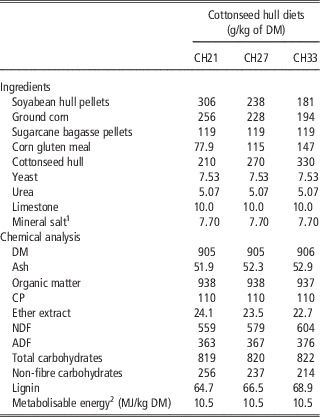
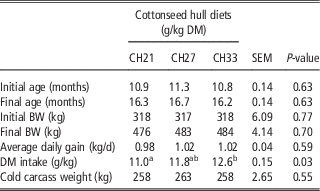
The diets, offered ad libitum, were formulated to be isonitrogenous and isoenergetic and to provide a weight gain of 1.0 kg/day according to the National Research Council (NRC, 2000) recommendations (Table 1). After a 15-day diet adaptation period, young bulls were weighed and the study was started at an average initial BW of 319±12.5 kg and an average age of 11±0.8 months. BW were recorded every 28 days and the intake of concentrate was recorded daily until 162 days of the experiment, when the animals reached a final BW of 481±22.8 kg. The young bulls were kept in individual pens (10 m2 for each animal). Data related to animal performance and carcasses are compiled in Table 2, having average DM intake of 11.8 g/kg and average daily gain of 1.0±0.25 kg.
Composition of feedlot diets (g/kg of dry matter (DM))

CH21=210 g/kg of cottonseed hull on a dry matter (DM) basis; CH27=270 g/kg of cottonseed hull on a DM basis; CH33=330 g/kg of cottonseed hull on a DM basis.
1 Mineral salt composition (per kg): calcium, 175 g; phosphorus, 100 g; sodium, 114 g; selenium, 15 g; magnesium, 15 g; zinc, 6.004 mg; manganese, 1.250 mg; copper, 1.875 mg; iodine, 180 mg; cobalt, 125 mg; selenium, 30 mg; fluorine (maximum), 1.000 mg.
2 Metabolisable energy (MJ/kg DM) was calculated from National Research Council (NRC, 2000) model.
Effect of cottonseed hull levels in high-concentrate diets on animal performance and carcass weight of young bulls

CH21=210 g/kg of cottonseed hull on a dry matter (DM) basis; CH27=270 g/kg of cottonseed hull on a DM basis; CH33=330 g/kg of cottonseed hull on a DM basis.
Adapted from Eiras et al. (2016).
a,bValues with different superscript letters in the same row were statistically different (Tukey’s test).
Diet chemical analyses
Chemical composition of ingredients were presented in g/kg of DM (Table 1). DM was determined after oven-drying at 65°C for 24 h and milling through a 1 mm screen (method 934.01, Association of Official Analytical Chemist (AOAC), 2005). Ash content was measured by combustion at 550°C for 16 h (method 942.05, AOAC, 2005) to determine the organic matter. Nitrogen concentration was determined by the Kjeldahl method (method 988.05, AOAC, 2005). Following the determination of the nitrogen concentration, the CP was calculated by multiplying the N content by a factor of 6.25. Ether extract content was determined by method 920.39 of AOAC (2005). NDF content was measured according to recommendations by Mertens (Reference Mertens2002) while using α-amylase. The ADF was measured by using the method 973.18 of AOAC (2005). Total carbohydrates were estimated by the procedure of Sniffen et al. (Reference Sniffen, O’Connor, Van Soest, Fox and Russell1992). Non-fibrous carbohydrates were determined as the difference between total carbohydrates and NDF. Metabolisable energy of feedstuffs was estimated according to NRC (2000) recommendations.
Slaughter procedure and muscle sampling
Young bulls were slaughtered at a commercial slaughterhouse 80 km from the feedlot. Upon arrival at the slaughterhouse, they were fasted from solids, kept in resting pens for 16 h and humanely harvested under Brazilian federal inspection according to the Brazilian Regulation of Industrial and Sanitary Inspection of Animal Products. Following slaughter, carcasses (265±3.0 kg) were identified and chilled for 24 h at 4°C.
After chilling, longissimus thoracis (LT) muscle from the right half carcass of each animal was excised between the 6th and 13th ribs for laboratory analysis. The pH (5.75±0.03) was measured by using a probe-type portable pH meter (Hanna Instruments, Woonsocket, RI, USA) in the LT at the 12th to 13th rib level.
Visual appraisal of the meat and willingness to buy
One LT steak (2.5 cm of thickness) from the 7th vertebra of each animal was sectioned and packaged in polystyrene trays wrapped with a retractile film (Goodyear®, Americana, São Paulo, Brazil, with oxygen permeabilities of 8200 cm3/m2 per day and rates of relative humidity of 262 cm3/m2 per day) and refrigerated in a illuminated display at 4°C and light (fluorescent lamp, 380 lux, 12 h/day) simulating typical Brazilian market conditions. Time of display for steaks was 10 days. Selection criteria for participants were availability and motivation to participate on all days of the experiment. The main part of semi-trained appraisers had previously participated in other visual assessments being familiarised with the methodology used for colour evaluation. They were asked to evaluate exclusively the colour of the samples and no other factors that can influence visual appraisal as marbling degree. Each day, the same 37 appraisers (26 women and 11 men, aged 20 to 40 years) evaluated the visual appraisal, filling a sheet with the score of acceptability of each of the 30 steaks based on a hedonic unstructured numerical nine-point scale with only whole numbers from 1 to 9 were used to evaluate colour acceptability of each sample (1=dislike extremely to 9=like extremely) and the willingness to buy each piece (yes/no). In order to avoid any consumer tendency on sample evaluations, the codes placed on the trays that identified each steak were changed every 2 days, as well as the location of samples on the meat showcase.
Consumer sensory evaluation
Four steaks (2.5 cm thickness steaks) were cut from LT between the 8th and 12th ribs from each animal. Three steaks were vacuum-packed and aged for 1, 7 or 14 days before being frozen at −18°C; they were retained for less than 3 months, and thawed at 4°C for 24 h before analysis, with the fourth steak aged for 1, 7 or 14 days depending on the animal and treatment, in order to equilibrate the statistic sensorial design. Each steak was covered with aluminium foil codified with a random three-digit code and cooked in a pre-heated grill (Philco Grill Jumbo Inox, Philco S.A., Joinville, Brazil) at 200°C until reaching an internal temperature of 70°C, monitored with a penetration thermocouple (Incoterm, 145 mm; Incoterm Ltda, Porto Alegre, Brazil). Each steak was cut into ten 2×2 cm cubes and kept warm (50°C) until consumer evaluation (<10 min after cooking).
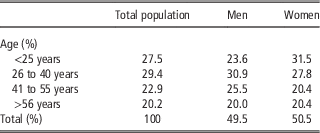
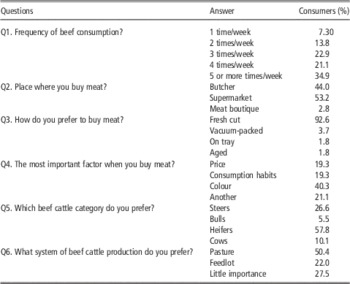
The consumer test for beef quality perception was performed during a National Livestock Exhibition in Maringá (Brazil) in a private room adequately adapted to perform a consumer sensory test. In total, 120 consumers were selected randomly within quotas of gender and age according to the Brazilian national profile; a summary of the consumer profile is shown in Table 3. Before consumer testing, a questionnaire was applied (Table 4), including closed questions with multiple choices, based on previous research on beef quality attributes (Banović et al., Reference Banović, Grunert, Barreira and Fontes2010; Behrens et al., Reference Behrens, Barcellos, Frewer, Nunes, Franco, Destro and Landgraf2010).
Characteristics (age and gender) of the consumers involved in the trial (n=109 consumers)

Answers of questionnaire about consumer preferences and habits of consumption (n=109 consumers)

Consumer experimental design
In all, 12 sessions were carried out, each with 10 different consumers. In each session, every consumer evaluated nine samples, one for each type of diet (CH21, CH27 and CH33) and ageing time (1, 7 or 14 days). Therefore, one steak from each animal on each experimental diet and with each period of ageing was evaluated. In order to reach 120 consumers and equilibrate the consumer design, a second randomly selected steak from six animals was also used per treatment.
Samples were served to consumers one at a time, following a randomised design to avoid any order or carryover effects. Consumers were asked to eat unsalted toasted bread and rinse their mouth with water before evaluating each sample, including the first one. Consumers were only informed that they would be evaluating beef. All consumers were asked to taste the meat samples and evaluate the acceptability of three attributes: tenderness, flavour and overall acceptability; this was achieved using a structured hedonic nine-point scale ranging from 1=dislike extremely to 9=like extremely, where a medium level was not included according to methodologies described by Font-i-Furnols et al. (Reference Font-i-Furnols and Guerrero2008) and Realini et al. (Reference Realini, Font i Furnols, Sañudo, Montossi, Oliver and Guerrero2013).
In total, 120 consumers participated in the sensory test; however, consumers with missing data and outliers on the questionnaire were not considered for statistical analyses, leaving 109 consumers overall.
Statistical analyses
Subsequent visual appraisal and consumer tests were assessed via ANOVA using GLM procedures with SPSS v.15.0 (IBM SPSS Statistics; SPSS Inc., Chicago, IL, USA) for Windows. Visual attributes were evaluated considering diet and time of display as fixed effects. Likewise, on consumer acceptability, diet and ageing time were considered fixed effects and the consumer was included as a random effect. Differences between means were evaluated using Tukey’s test (P⩽0.05).
Answers related to habits and preferences of consumption were analysed by frequency of response for each question.
To identify similarities between consumers on acceptability test, hierarchical cluster analysis was used to determine the different groups of consumers depending on overall acceptability using XLSTAT (v.7.5.3). The number of clusters was selected from the dendrogram, trying to find a compromise between homogeneity within clusters and heterogeneity between clusters. Principal component analysis was used to identify the relationship between treatments and meat attributes. Correlations between attributes were evaluated using the Pearson’s correlation coefficient.
For willingness to buy the statistical analyses were performed using the PROC GENMOD of SAS (v.9.0), considering willingness to buy meat as binary trait, considering a binomial distribution and the logit as the link function. Differences among diets were evaluated using χ 2 test. The likelihood test was proposed to indicate the most adequate model, considering or not the interaction between time of display and diet. Regression models were adjusted to evaluate the willingness to buy function of time of display.
Results and discussion
Visual appraisal of the meat and willingness to buy
Diet effect
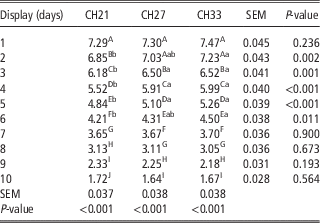
There were differences (P⩽0.05) between diets on visual appraisal during the display period from the 2nd to the 6th day (Table 5); beef from CH33 diet presented higher values than those from CH21 diet and CH27 diet showing intermediate values. Thus, increasing fibre in the diets increased shelf life from a appraiser rate acceptability point of view, of meat from bulls fed high-grain diets. Typically, increased forage ingestion allows for meat with a redder appearance (Baublits et al., Reference Baublits, Brown, Pohlman, Johnson, Onks, Loveday, Morrow, Sandelin, Coblentz, Richards and Pugh2004; Mancini and Hunt, Reference Mancini and Hunt2005). Redder meat can be attributed to increased myoglobin, decreased muscle glycogen, or both. Animals fed forage sources presented higher vitamin E content in their meat. So, their shelf life is increased and metmyoglobin is reduced. Consequently, oxymyoglobin/metmyoglobin ratio is higher giving redder colours, which are best accepted. The instrumental colour results from the present study were previously reported in Eiras et al. (Reference Eiras, Ornaghi, Valero, Rivaroli, Guerrero and Prado2016). The L* values observed at 24 h ageing time was higher (P<0.050) in the CH27 (38.1) diet, the same that redness (a*=16.5) respect to the others treatments, indicating a lighter and redder meat in CH27 than in the CH21 and CH33 diets.
Visual appraisal of meat of young bulls fed cottonseed hulls in high-grain diet during display timeFootnote 1 (n=37 appraisers)

CH21=210 g/kg of cottonseed hull on a dry matter (DM) basis; CH27=270 g/kg of cottonseed hull on a DM basis; CH33=330 g/kg of cottonseed hull on a DM basis.
A,B,C,D,E,F,G,H,I,JValues with different superscript letters in the same column were statistically different (P⩽0.05) on time of display.
a,bValues with different superscript letters in the same row were statistically different (P⩽0.05) on diets.
1 Based on a hedonic nine-point scale (1=dislike extremely to 9=like extremely).
There were no differences (P>0.1) between treatments CH21 and CH27 or CH27 and CH33 related to willingness to purchase. However, intention to buy was lower for the CH21 treatment compared with CH33 (P⩽0.05), corresponding to its lower scores on visual appraisal. When meat is displayed for 4 days, only 50% of the participants would buy meat from the CH21 diet. However, higher levels of cottonseed hulls retained an acceptable level of willingness to buy, with over 61% to 65% buying on the same day of display.
Display time effect
The sensory attributes of meat are important to consumers. Thus, Carpenter et al. (Reference Carpenter, Cornforth and Whittier2001) found a strong relationship between colour preferences and purchasing decisions of consumers, who discriminated against beef that was not red (e.g. purple or brown). Hence, visual assessments are a gold standard for measuring the success of any new production and consumer preferences and perception (Mancini and Hunt, Reference Mancini and Hunt2005).
Throughout the 10-day display period, appraiser acceptance of the meat appearance decreased gradually (P⩽0.001) for the three diets (Table 5). Each day, progressively, appraisers evaluated steaks with a significantly lower score, except for CH27 and CH33 diets, with values from the 2nd day of display not differing from the 1st day. Thus, exposure time reduced shelf life of meat as was previously observed (Vitale et al., Reference Vitale, Pérez-Juan, Lloret, Arnau and Realini2014; Prado et al., Reference Prado, Campo, Muela, Valero, Catalan, Olleta and Sañudo2015). The gradual decline in visual appraisal was expected because oxidative processes are a natural cause of meat deterioration, which is particularly relevant for meat from concentrate-fed animals, because of the lower vitamin E content in non-forage diets. The maximum time of practical exposure of meat was 4 (CH21) or 5 days (CH27 and CH33). After 6 days, all of the scores attributed by appraisers were <5, which can be considered inappropriate for human consumption.
Willingness to buy presented a similar evolution to visual score, with display being the most important effect (P⩽0.001). During the first 3 days of display, the percentage of participants that would buy beef from the three diets was high; however, on the 4th (CH21) and 5th day (CH27 and CH33) it decreased to <50% acceptance, which could be considered the limit of visual acceptability.
Consumer sensory evaluation
There was no interaction (P>0.05) between cottonseed hull diet levels and ageing time (Table 6). Thus, the results are presented and discussed separately.
Effect of cottonseed hull diets (CH) and ageing time (A) on consumer acceptability of meat from young bulls fed high-concentrate diets (n=109 consumers)Footnote 1

CH21=210 g/kg of CH on a dry matter (DM) basis; CH27=270 g/kg of CH on a DM basis; CH33=330 g/kg of CH on a DM basis.
a,bValues with different superscript letters in the same row were statistically different (P⩽0.05) on A.
1 Based on a hedonic nine-point scale (1=dislike extremely to 9=like extremely).
Diet effect
The inclusion of different levels of cottonseed hulls in the diet did not affect (P⩾0.001) meat flavour, tenderness or overall acceptabilities (Table 6). Consumers scored acceptability attributes from the three cottonseed hull diets with favourable notes, with values in all cases ranging from 6.7 to 7.2 on a hedonic nine-point scale. According to the results using the same animals, presented by Eiras et al. (Reference Eiras, Ornaghi, Valero, Rivaroli, Guerrero and Prado2016), different levels of cottonseed hulls did not modify fat characteristics (presented the three diets similar fat thickness, percentage of fat on 6th rib dissection, as well as similar fatty acid profile, which could affect flavour perception (Kerth and Miller, Reference Kerth and Miller2015). However, the slight differences observed between the different levels of cottonseed hulls on chemical composition, as percentage of moisture and total lipids, or cooking loss percentage at 1st day of ageing (Eiras et al., Reference Eiras, Ornaghi, Valero, Rivaroli, Guerrero and Prado2016) does not seem to significantly modify the texture of samples, and did not affect any of the studied parameters of consumer acceptability.
Ageing time effect
Ageing time was a significant factor (P⩽0.001) only for tenderness acceptability of meat (Table 6). Scores for flavour or overall acceptabilities did not differ (P>0.05) between 1, 7 and 14 days of ageing.
Ageing time influences the development of flavour precursors. Usually, ageing improves meat acceptability before meat reaches long maturations, which could develop off-flavours (Monsón et al., Reference Monsón, Sañudo and Sierra2005). However, in some cattle breeds consumers did not perceive the flavour evolution, and consequently did not report differences on flavour acceptability even between the periods of 1 and 35 days of ageing (Monsón et al., Reference Monsón, Sañudo and Sierra2005).
According to instrumental values (Eiras et al., Reference Eiras, Ornaghi, Valero, Rivaroli, Guerrero and Prado2016), the shear force that is necessary to cut a piece of beef decreased from the 1st to the 7th day of ageing, keeping the values low until 14 days of ageing (5.3 to 4.6 kg/cm2), similarly to consumers’ scores for tenderness acceptability, which were significantly lower on the 1st day of ageing than those values obtained at 7 or 14 days. The effect of ageing time on tenderness acceptability results are in agreement with other studies (Monsón et al., Reference Monsón, Sañudo and Sierra2005; Font-i-Furnols and Guerrero, 2014; Pérez-Juan et al., Reference Pérez-Juan, Realini, Barahona, Sarriés, Campo, Beriain, Vitale, Gil and Albertí2014), contributing to eating satisfaction (Font-i-Furnols and Guerrero, 2014) and consumers being willing to pay more if meat tenderness is guaranteed (Realini et al., Reference Realini, Font i Furnols, Guerrero, Montossi, Campo, Sañudo, Nute, Alvarez, Cañeque, Brito and Oliver2009). However, those consumer studies were developed in European countries with Bos taurus breeds. It is known that meat from zebu breeds (Bos indicus), owing to differences in protein breakdown postmortem and calpastatin-calpain activity, could be less tender than those from B. taurus (O’Connor et al., Reference O’Connor, Tatum, Wulf, Green and Smith1997). Likewise, the crossbreed improved tenderness, as well as meat ageing time (Bianchini et al., Reference Bianchini, Silveira, Jorge, Arrigoni, Martins, Rodrigues, Hadlich and Andrighetto2007). However, data obtained in this work show that consumers preferred texture from beef that had undergone a process of ageing of almost 1 week. The optimum time of meat ageing is not the same for all cattle breeds (Monsón et al., Reference Monsón, Sañudo and Sierra2005). Bianchini et al. (Reference Bianchini, Silveira, Jorge, Arrigoni, Martins, Rodrigues, Hadlich and Andrighetto2007) reported that after 7 days of meat ageing, the shear force from purebred B. indicus (Nellore) or B. taurus (Simmental), as well as their respective crossbreed, did not present any statistical differences. In addition, Ferraz and Felício (Reference Font-i-Furnols, Gispert, Guerrero, Velarde, Tibau, Soler, Hortós, García-Regueiro, Pérez, Suárez and Oliver2010) highlighted that in spite of Brazilian meat having a zebu component, it is not as tender, which could affect its acceptability in the international beef market; acceptable levels of tenderness are achieved after 7 to 14 days of ageing, which would involve the time of transportation to some international markets. Banović et al. (Reference Banović, Grunert, Barreira and Fontes2010) reported that in a sensory blind test in Portugal, consumers did not report any differences in sensory dimensions between Brazilian and national beef.
In the current study, according to Pearson’s coefficients, overall acceptability was more strongly related to tenderness (r=0.746) than flavour acceptability (r=0.487), with a lower correlation existing between texture and flavour (r=0.205). However, differences in tenderness were not enough to obtain significantly different values on overall acceptability between ageing times. As shown in other consumer studies, overall acceptability is not, in general, only modified by tenderness, but also strongly correlated with flavour (Font-i-Furnols and Guerrero, 2014; Lepper-Blilie et al., Reference Lepper-Blilie, Berg, Germolus, Buchanan and Berg2014). The lack of difference in the overall acceptability could be influenced by the breed involved (crossbreed – B. taurus) and production systems used (feedlot), because these two characteristics result in meat that is more tender than typical beef from pasturage and from older zebu animals; also, meat ageing is not a frequent practice in Brazil, and the population is used to consuming meat in the first few days after slaughter because of their habits (Mazzuchetti, Reference Mazzuchetti2004).
Principal component analyses
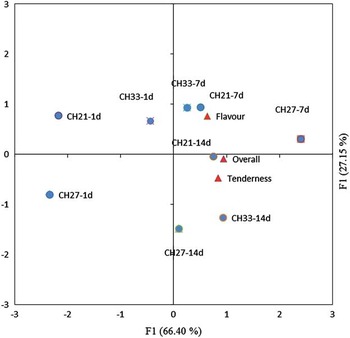
Information about diets and ageing preferences by consumers is graphically synthetised in Figure 1. The first two principal component axes explained 93.55% of the total variance. Attributes of tenderness, flavour and overall acceptability are on the right side of F1, closely located on the graph to the three diets with 7 or 14 days of ageing. Meats with short ageing (1 day) were placed on the left side of F1, inversely related to acceptability attributes. Tenderness and overall acceptability are placed on the same quadrant for beef of any level of inclusion of cottonseed hulls (CH21, CH27 and CH33) aged for 14 days; the same happened with flavour acceptability, which is located on the right top quadrant and closely associated with diets with 7 days of ageing, especially low and high levels of cottonseed hull inclusion (CH21 and CH33), as well as CH21 aged for 14 days. Intermediary levels of addition of cottonseed hulls (CH27) are inversely correlated with flavour acceptability, presented lower scores in this attribute than the other two diets (CH21 and CH33), which were inversely correlated to tenderness scores.
Principal component analysis of the scores for tenderness, flavour and overall acceptability of beef from young bulls fed cottonseed hulls (CH21: 210 g/kg of cottonseed hulls on a dry matter (DM) basis; CH27: 270 g/kg of cottonseed hulls on a DM basis; CH33: 330 g/kg of cottonseed hulls on a DM basis) and three ageing times (1, 7 and 14 days).

Consumer questionnaire
The supplementary questionnaires distributed provided information about consumer habits and preferences of consumption and buying of participants in this study (Table 4). The most frequent consumption of beef was 5 times/week and the percentage obtained (34.9%) agreed with other Brazilian beef studies (Behrens et al., Reference Behrens, Barcellos, Frewer, Nunes, Franco, Destro and Landgraf2010) and the high consumption beef rate of the country (Font-i-Furnols and Guerrero, 2014). According to Kirinus et al. (Reference Kirinus, Fruet, Klinger, Dörr and Nörnberg2013), the current socio-economic changes and the increase on the salary of Brazilian population consequently is reflected as an increase on beef consumption decreasing other basic aliment as rice or bean. The majority of consumers in the current study chose to buy their meat from a supermarket (53.2%), followed by a butcher (44.0%), with a lower percentage of consumers purchasing the meat from boutiques (2.8%). A similar tendency had been previously reported in Brazil by Kirinus et al. (Reference Kirinus, Fruet, Klinger, Dörr and Nörnberg2013) and Mazzuchetti (Reference Mazzuchetti2004). As Behrens et al. (Reference Behrens, Barcellos, Frewer, Nunes, Franco, Destro and Landgraf2010) reported the increase of purchasing meat in supermarkets is consequence of the changes on food habits and modern life style, which demands time saving efforts and reduce time available. Supermarket helped people in purchasing different kinds of products in the same establishment. Participants in the test preferred buying fresh meat (92.6%) than other packaging forms (3.7% vacuum-packed; 1.8% on tray and 1.8% aged). Nevertheless, buying meat directly on trays is an increasing habit due to it being easier to freeze and store (Velho et al., Reference Velho, Barcellos, Lengler, Elias and Oliveira2009).
In this study, many of the consumers (40.3%) considered colour to be one of the most important attributes on beef purchase intention, which is in agreement with Ripoll et al. (Reference Ripoll, Albertí, Casasús and Blanco2013). However, the lowest proportion of Brazilian participants (19.3%) considered that price is the most important factor in beef purchasing decisions, as happened with European consumers, who considered other factors such as origin or animal feed to be more important than price when choosing beef (Realini et al., Reference Realini, Font i Furnols, Sañudo, Montossi, Oliver and Guerrero2013). Regarding the kind of beef preferred, beef from heifers (57.8%) followed by steers (26.6%) was preferred compared with that from cows or bulls.
The traditional Brazilian beef production systems, due to agro-climatic conditions and pasture availability, are under extensive conditions and include zebu breeds (Ferraz and Felício, Reference Font-i-Furnols, Gispert, Guerrero, Velarde, Tibau, Soler, Hortós, García-Regueiro, Pérez, Suárez and Oliver2010). The current changes and demands have encouraged the development of highly efficient production systems in order to maximise the potential growth of the animals, reduce the age at slaughter and increase the meat quality (Prado et al., Reference Prado, Oliveira, Rotta, Perotto, Prado, Silva, Souza and Moletta2009; Ito et al., Reference Ito, Valero, Prado, Rivaroli, Perotto and Prado2012). The traditional Brazilian beef production was the best accepted by consumers. Thus, 50.4% of them answered that meat from pastures was the best option for purchase, whereas 27.5% believe that the beef production system does not influence their preferences. The feedlot (22.0%) was the least preferred production system.
Cluster analysis
Regarding beef acceptability, different groups of consumers exist, which constitute significant market segments that demand beef with different characteristics (Oliver et al., Reference Oliver, Nute, Font i Furnols, San Julián, Campo, Sañudo, Cañeque, Guerrero, Alvarez, Díaz, Branscheid, Wicke and Montossi2006); those segments also occur when consumption habits, preferences for meat choice and attitudes to certain meat attributes are considered (Schnettler et al., Reference Schnettler, Vidal, Silva, Vallejos and Sepúlveda2009; Realini et al., Reference Realini, Font i Furnols, Sañudo, Montossi, Oliver and Guerrero2013), which is important to know in order to identify different market niches.
Four different clusters of consumers, related to overall acceptability, were found in the current research (Table 7). The larger cluster (cluster 1) of consumers (40.4%) described differences (P⩽0.05) between diets, preferring the lower and intermediate cottonseed hull levels (CH21 and CH27 diets), but the acceptability scores for the three diets were higher than in other clusters, with an average of 8.1 points on a nine-point scale. Ageing did not have any effect on cluster 1. This cluster included a similar percentage of men (52.3%) and women (47.7%); however, the age range differed between sexes, with almost 70% of men being aged 18 to 25 and 41 to 55 years, and 70% of women being aged 26 to 40 years and 56 years or over.
Mean and standard error of the overall acceptability scores of beef from young bulls fed different levels of cottonseed hulls (CH) and three ageing times (A) among four consumer groups that were identified by cluster analysis (n=109 consumers)Footnote 1

CH21=210 g/kg of CH on a dry matter (DM) basis; CH27=270 g/kg of CH on a DM basis; CH33=330 g/kg of CH on a DM basis.
A,BValues with different superscript letters in the same row were statistically different (P⩽0.05) on diets.
a,bValues with different superscript letters in the same row were statistically different (P⩽0.05) on A.
1 Based on a hedonic nine-point scale (1=dislike extremely to 9=like extremely).
The second largest cluster (cluster 2) comprised 37.6% of consumers; this group did not report any differences between diets, with an average acceptability of 6.5 and showing values that were significantly higher (P⩽0.05) for meat aged for 7 days than for 14 days, presenting intermediate values for meat after 1 day of ageing, with 6.5 points of acceptability. A similar number of men (48.8%) and women (51.2%) comprised this group, with >50% of men being placed in the age group from 26 to 40 years and women being <25 years.
Cluster 3 is formed by a small percentage of consumers (11.9%); however, this segment reported differences between diets (P⩽0.01) and ageing periods (P⩽0.001). Meat from the highest cottonseed hull content (CH33) and aged 7 or 14 days was preferred, with beef aged for 1 day scoring almost 1.5 point lower than the other ages. This cluster was characterised by people younger than 40 years, with a comparable distribution of sexes (46.2% men and 53.8% women).
The last cluster of consumers (cluster 4) was comprised of those who did not report any differences between cottonseed hull diets or meat ageing periods. However, 10.1% of the population rejected the meat produced with any level of co-products, presenting scores that were <4.5 points. The characteristics of this group were that there were no men younger than 26 years or women between 26 and 40 years, with the distribution by gender of 54.4% men and 45.5% women.
Conclusions
The addition of cottonseed hulls in high-grain-diet-fed young bulls (1/2 Simmental–1/2 Nellore) produce beef with adequate visual and sensory acceptability for Brazilian consumers. Likewise, CH21 diet provides the lowest meat visual appraisal, packaged with oxygen permeable film, by appraisers during some of the intermediate display times. In addition, no differences were reported for acceptance of sensorial attributes. Ageing, with a minimum duration of 1 week under vacuum conditions, only increase tenderness acceptability. The positive results obtained on consumer acceptability are encouraging, as they make use of this kind of co-product in beef diets a viable option to reduce production costs. However, taking into account the profitability of productive parameters and sensory results, it would be recommended until CH27 diet utilised as a non-forage fibre in high-concentrate diets to young bulls in feedlot.
Acknowledgements
This work was supported by the Araucaria Foundation and the Brazilian Council for Research and Technological Development. The authors gratefully acknowledge the FORTMIX animal technology® (Maringá, Paraná, Brazil) for providing the co-products used in this research. The mention of trade names or commercial products in this publication is solely for the purpose of providing specific information and does not imply recommendations or endorsement by the Department of Animal Science, Maringá State University, Paraná, Brazil.