INTRODUCTION
Upon observing a negative relationship between Islamic culture and competitive electoral politics, scholars have proposed competing explanations for the “democracy gap” in majority Muslim countries (Karatnycky Reference Karatnycky2002). Since the third wave of democratization began in the 1970s, countries that contain a majority Muslim population have been absent from the successful cases of transition to competitive elections and expansion of human rights. While some have argued that the gap is attributable to a fundamental incompatibility of Islamic teachings and democratic theory, others have found empirical connections between low levels of democracy in Muslim majority countries and poverty, the subordination of women, and reliance on oil income (Huntington Reference Huntington1993; Fish Reference Fish2002; Ross Reference Ross2001). Others have suggested that lower public demand for political freedom hinders chances for regime change in Muslim countries (Rowley and Smith Reference Rowley and Smith2009).
Could the Muslim democracy gap have something to do with the relationship between religion and politics in those states? Fish (Reference Fish2002) claims that Muslim countries are not less democratic because they are less secular. Yet, religion continues to play a large role in the politics of Muslim-majority countries. Stepan notes the type of relationship between religion and the state that is most conducive to democracy is one in which “religious institutions should not have the constitutionally privileged prerogatives which allow them authoritatively to mandate public policy to democratically elected governments,” and individuals and religious communities should have complete freedom to worship privately, to publicly advance their values in civil society, and to sponsor organizations and movements in political society (Stepan Reference Stepan2001, 216–217). This does not rule out religion-state cooperation or religious involvement in politics, although scholars remain mixed on determining what types of relations might harm democracy (Barro and McCleary Reference Barro and McCleary2004; Driessen Reference Driessen2010; Fox Reference Fox2007; Fox and Sandler Reference Fox and Sandler2005).
This article compares Muslim majority countries to non-Muslim ones to test whether different types of regulation of religion help to explain the “democracy gap.” Using data from the Association of Religion Data Archives compiled under the supervision of Grim and Finke, I examine the effects of government control over religion in Muslim and non-Muslim majority countries. I find that while Muslim majority countries tend to have higher levels of religious regulations than non-Muslim countries, once commonly hypothesized determinants of democracy are taken into consideration, the effect of a general “Islam” variable disappears. That is, higher government regulation of religion appears to account for the effect that Islam has on democracy. Through detailed analysis of various components of religious regulation and brief case studies, I seek to explain how and why regulation in Islamic countries accounts for low levels of democracy in those countries.
In exploring the effect of different types of regulations on prospects for developing competitive electoral systems, I find that regulations are aimed at preventing the development of an independent sector of society that can challenge the state. Therefore, religious regulations harm democracy by preventing religiously-motivated individuals and groups from competing for political power. Thus, religious regulation is likely motivated more by political considerations than theological ones, for it imposes restrictions on those religious activities that may lead to oppositional mobilization. For instance, in Muslim majority countries, I find the targets of regulation often to be politically mobilized Muslims rather than non-Muslim minorities.
Following a brief review of the literatures on the determinants of democracy and religion-state relations, I describe the data I used to examine these relationships and perform multivariate analyses testing the effect of religious regulations on levels of democracy. Finding certain types of government control over religion to be most harmful to levels of democracy, I discuss how these regulations hinder political competition using examples from Muslim countries from different world regions. I conclude with suggestions for future avenues of research.
ISLAM AND THE DEMOCRACY GAP
The scarcity of democracy in Muslim-majority countries is not difficult to demonstrate. According to Freedom House, since 1972 only 11 majority Muslim countries have enjoyed periods that are classified as “free.”Footnote 1 In 2008, only two majority Muslim countries received that designation: Mali and Indonesia. In recent years, some majority Muslim countries, such as Albania, Turkey, and Senegal, have been labeled “electoral democracies” according to Freedom House, but they still lack sufficient protection of civil liberties that is found in liberal democracies.Footnote 2 The question is why these countries — especially those that have successfully instituted electoral reforms — continue to fall behind others in their ability to guarantee political rights to their citizens.
While several scholars have demonstrated empirical support for a Muslim “democracy gap” and have suggested that there is something unique to Islam that explains it, few have tested religious explanations for the result. Midlarsky (Reference Midlarsky1998) finds that Islam is negatively related to liberal democracy but not to democracy conceived more narrowly as political rights. Barro (Reference Barro1999), in a panel study on the determinants of democracy using over 100 countries from 1960 to 1995, finds that Muslim countries have a lower level of democracy than other countries, controlling for other factors. Fish (Reference Fish2002) confirms Barro's findings and tests several hypotheses to explain the results about Muslim countries. He finds weak support for the hypotheses that Muslim countries are more violent and less trusting and finds it difficult to confirm the argument of less secularism in Muslim countries on both logical and empirical grounds. Fish does present clear evidence to support his hypothesis that Muslim societies oppress women, showing that various measures of female subordination help to explain the Muslim democracy gap by reducing the magnitude of the regression coefficient of the Islam variable, but not diminishing its statistical significance. Thus, he concludes that while the subordination of women may be one reason for the persistence of authoritarianism in Muslim countries, it is not the only explanation for it. Using a larger set of determinants, Donno and Russett (Reference Donno and Russett2004) argue that the repression of women is not central to maintaining autocratic rule in Muslim-majority countries, and that these states are diverse in the ways they inhibit female empowerment.
The thesis that economic development and democracy go hand-in-hand due to the lower levels of social conflict and broader support for competitive politics that economic development brings could hold clues to the democracy gap (Lipset Reference Lipset1959; Przeworski et al. Reference Przeworski, Alvarez, Chiebub and Limongi2000). However, Stepan and Roberston (Reference Stepan and Robertson2003) find that when comparing countries along a continuum from “overachieving” to “underachieving” on political rights relative to economic development, many Muslim countries are in fact electoral overachievers with respect to their levels of development, while electoral underachievers are only found among the Arab Muslim-majority countries. Ross (Reference Ross2001) finds that oil wealth hurts democracy, not only in the Muslim Middle East, but also in other regions of the world. He later argues that the reason for women's under-representation in the workforce and government in the Middle East is due to oil, not Islam (Ross Reference Ross2008). By reducing women's presence in the labor force, oil production has both social and political consequences, leading to strong patriarchal cultures and political institutions.
Rowley and Smith (Reference Rowley and Smith2009) find there to be a subset of Muslim countries that remain at low levels of democracy despite their levels of economic development, identifying these to be part of the Islamic “heartland” — countries whose territory was part of the Islamic empire by 750 A.D. and which have not since been conquered by non-Muslims. Using survey data, the authors also observe that while Muslim publics tend to have high levels of support for democracy in theory, they have lower levels of support for freedom. They argue that because Muslim countries have less religious freedom, even when level of democracy is controlled for, this suggests that it is Islam — not other variables correlated with Islam — that explains the lack of democracy in this part of the world. They ask: “might Islam promote restrictions on religious discourse which spill over into, or serve as pretexts for restrictions on political discourse, thus preventing democratic deliberation and thwarting demand for democracy?” (Rowley and Smith Reference Rowley and Smith2009, 296). That is, they argue that the Islamic characteristic of strict enforcement of religious homogeneity cultivates anti-democratic values among Muslim publics, who then fail to demand democracy in their countries. The question remains open, therefore, to the role that enforcement of religious regulations plays in Muslim societies.
THEORIZING THE GAP: FREEDOM OF RELIGION, STATE SEPARATION, AND CIVIL SOCIETY
While the democratization literature has helped to identify requisites or correlates of democracy and has suggested looking more closely into religion-state relations, it has yet to solve the puzzle of the Muslim democracy gap. Scholars of religion and politics have presented empirical work on the types of religion-state relations in Muslim majority countries yet they have not theorized about which configurations actually influence levels of democracy. In this section, I formulate a series of expectations about how government involvement in religious affairs affects democracy in and outside of the Muslim world. I argue that religious regulation — specifically the type aimed at restricting freedom of expression and association — inhibits democracy by allowing governments to suppress potential political opposition. If we define democracy as a set of rights and procedures pertaining to competition for political power, examining how regulations on religion affect access to the political arena may help us to understand why authoritarianism persists in Muslim majority countries.
Jonathan Fox has published a number of studies using his Religion and State Dataset to document how countries around the world regulate religion. He has presented data showing that democracies tend to have greater separation of religion and state than autocracies and that Middle Eastern states have more government involvement in religion than Western democracies (Fox and Sandler Reference Fox and Sandler2005). He also confirms that Muslim states are more supportive of religion than other governments (Fox Reference Fox2006). In a recent book, Fox (Reference Fox2008) argues that while all states have some government involvement in religion, there is an upper limit for how much can exist in democracies. However, Fox does not argue that religion-state relations explain the lack of democracy in Muslim-majority countries, nor does he attempt to explain why countries choose to regulate religion. He does, however, suggest that the threat of Muslim extremism might explain the fact that increases in regulation in the Middle East over the past several years tend to be on the political and organizational side of religion (Fox Reference Fox2008, 318). Therefore, there has been some speculation in the literature that religious regulations are used to suppress political competition and thus inhibit democracy.
While scholars refrain from prescribing an ideal model of religion-state relations, most acknowledge key factors that allow religious individuals and groups to operate in democratic systems (Monsma and Soper Reference Monsma and Soper1997; Stepan Reference Stepan2001). First, democracies guarantee a series of individual rights, including freedom of religion in law and practice. A body of international law affirms these rights, although some have acknowledged that there may be cultural differences that make it difficult for Muslims to accept the Western notion of universal individual rights (Mayer Reference Mayer1991; Yousif Reference Yousif2000). Thus, countries that do violate individual rights are considered to be less democratic.
Second, democracies allow people to organize and to express themselves collectively based on religious identification. Democracy requires the ability to compete for the chance to change people's minds and a strong civil society has been noted to be one of the elements that distinguishes consolidated democracies (Linz and Stepan Reference Linz and Stepan1996). Preventing people from forming groups based on religion for the purpose of changing minds can be considered a form of political censorship. Stepan argues that stable democratic patterns of religion-state relations can be secular or non-secular, but must share the features of allowing for all religious groups to fully participate in civil society and to compete for power in political society (Stepan Reference Stepan2001). This includes not banning religious parties. Other scholars have noted the negative effect that state regulation has had on the development of Muslim intellectual activity, scientific discovery, and economics (Chaney Reference Chaney2008; Kuran Reference Kuran, Marty and Appleby1993). I argue that in countries where religious organizations dominate associational life (which is often the case in Muslim majority countries), restricting religious organizations cuts-off most opportunities for political involvement and restricts political competition. Thus, by regulating religion, authoritarian and semi-authoritarian governments can retain political power and inhibit democratic transition, which translates to lower levels of democracy.
Third, the state does not control religion in democratic societies, and religion is not allowed to control the state. However, there can be areas of cooperation. Despite the “wall of separation” that was proposed by Thomas Jefferson in the early American republic to distinguish religious and political matters, all countries have government involvement in religion and religious influence on government. Yet, the secularization paradigm that once declared the death of religious influence with modernization has been replaced with an acknowledgement of worldwide religious resurgence. There has been a debate among scholars about the need for secularism in modern states (Chaves Reference Chaves1994; Stark Reference Stark1999; Warner Reference Warner1993).Footnote 3 Moving away from the argument of strict separation, many now acknowledge that for democratic countries to thrive, they must allow a place for religion in public life. Stepan's “twin tolerations” model describes how religion and state can coexist successfully not through strict separation but through cooperation. Others have suggested a model of state “neutrality” with “government neither favoring nor burdening any particular religion, nor favoring or burdening religion as a whole or secular system of belief as a whole” (Monsma and Soper Reference Monsma and Soper1997, 6). Certain forms of religious establishment — such as religious symbols and even government funding of religion — are compatible with democracy as long as individual citizens' basic human rights are not subject to control by a particular religious worldview (Mazie Reference Mazie2004).
To reflect this acknowledgement of the need for some accommodation of religion in politics, I note that this study is not concerned with the formal role of religion in the state, such as whether states have an established religion. Previous findings have shown that there is little correlation between having an established church and low levels of democracy, and that constitutional clauses protecting religious freedom are rarely fully observed and have a limited impact on government behavior (Barro and McCleary Reference Barro and McCleary2004; Fox and Flores Reference Fox and Flores2009). Simple consideration of the fact that some of the world's most established democracies have long had official state religions (e.g., Great Britain, Norway) makes clear that this type of religion-state relationship is not the main focus of this study. Instead, this article seeks to understand the specific types of regulation of religion that are most harmful to political competition and thus inhibit democratic development. Therefore, it is more concerned with the application of particular types of restrictions on religious practice and organization rather than on de jure religion-state relations.
Taking into consideration previous research on religious freedom and religion-state relations in democracies, my argument can be summarized as follows. Religious regulations target individual rights such as freedom of expression and association, and can be used by the state to enforce the laws of a particular religion (often to the detriment of minorities). These regulations restrict political competition by preventing people from expressing oppositional views and forming groups to challenge those holding political power. A potent example of this is regulations that restrict the formation of political parties based on religion. Societies with fewer oppositional groups present less of a challenge to authoritarian rulers and are unlikely to experience democratic transition. Therefore, in these countries we see lower levels of democracy.
While it is possible that autocratic rulers may simply regulate religion more strictly in order to suppress competition and democratic governments may choose to regulate religion less, such a model is more useful in explaining the persistence of religious repression rather than predicting levels of democracy. As Gill (Reference Gill2008) argues, politicians will decide to regulate or deregulate religion to maintain their own political survival. Yet this calculation can occur in both democracies and autocracies. Differences in regulations regarding Muslim religious practices in democratic Europe provide evidence of this calculation at work (Fetzer and Soper Reference Fetzer and Soper2005). It is important to understand how religious regulations affect democracy by examining what the regulations are targeting. In this article, I argue that religious regulations often target those activities that can be used to organize political opposition. In countries that are already authoritarian or semi-authoritarian, this inhibits democratic transition. In countries that are democratic, this can have negative consequences on the quality of democracy.
DATA AND VARIABLES
The first stage of the empirical analysis involves testing the effect of Islam and religious regulation on democracy, controlling for a number of determinants of democracy found to be significant in prior studies. The dependent variable in each of the regressions below is level of democracy. Measuring the procedural aspects of democracy, the Polity IV database contains two scores: institutionalized democracy and institutionalized autocracy; both scored from 0 to 10, with 10 indicating the highest level of institutionalization (Marshall and Jaggers Reference Marshall and Jaggers2010). The institutionalized democracy score is compiled by coding the competitiveness of political participation, the openness and competitiveness of executive recruitment, and constraints on the chief executive. The institutionalized autocracy score codes the competitiveness of political participation, the regulation of participation, the competitiveness and openness of executive recruitment, and constraints on the chief executive. Polity combines the scores into a Polity2 score, which is computed by subtracting the autocracy score from the democracy score, resulting in a scale that ranges from +10 (strongly democratic) to −10 (strongly autocratic). I rescale the Polity score to range from 0 to 20, with 0 indicating a regime is considered strongly autocratic, while 20 indicates a regime is strongly democratic. Polity scores are available for 159 countries.
An alternative and commonly used quantitative scale of democracy is compiled by Freedom House, which measures “the opportunity for individuals to act spontaneously in a variety of fields outside the control of the government and other centers of potential domination.”Footnote 4 Each country surveyed is assigned two ratings based on questions covering a variety of political rights and civil liberties. Political rights questions are grouped into the categories of electoral process, political pluralism and participation, and functioning of government, while civil liberties questions are grouped into freedom of expression and belief, associational and organizational rights, rule of law, and personal autonomy and individual rights. I use only the political rights score (ranked on a scale of 1 to 7) as it more closely approximates the procedural aspect of democracy captured by the Polity scores.Footnote 5 Freedom House scores are available for 171 countries.
Categorizing countries by type allows us to observe the Muslim democracy gap more clearly. The Polity project proposes three categories of regime: democracies, anocracies (i.e., mixed or incoherent authority regimes), and autocracies. Of the 46 Muslim countries they classify, only 20% were democracies in 2006, while 48% were anocracies and 33% were autocracies. In comparison, 72% of non-Muslim countries were categorized as democracies, 20% anocracies, and 8% autocracies.
The main independent variable in this study is religious regulation, defined as restrictions placed by states on religious belief or practice. The source for data on religious regulations is the Grim and Finke (Reference Grim and Finke2006) coding of the International Religious Freedom Reports, which were prepared by the U.S. State Department.Footnote 6 In accordance with the International Religious Freedom (IRF) Act of 1998, the Office of International Religious Freedom within the State Department prepares annual reports on the status of religious freedom in countries around the world. United States embassies prepare drafts of reports based on information from government and non-governmental sources in country and send them to the Office of International Religious Freedom, which revises and publishes the reports online. The 2005 report covers the period from July 1, 2004 to June 30, 2005.Footnote 7
While there may be concerns about bias by relying on data that is reported by American embassy officials, the IRF Report is the most comprehensive single source of religious regulation that currently exists. Grim and Finke note the possibility for bias favoring countries that enjoy friendly relations with the United States, concluding that despite efforts to provide optimistic accounts of the status of religious freedom in countries such as Saudi Arabia, the reports do not fail to document actual instances of abuse. The authors do note that biases do exist in the reports, particularly with regard to the documentation of abuses in countries that have active human rights groups that monitor these issues. Therefore, some country reports may underreport the actual instances of abuse, while others may appear to over-report due to increased attention being paid to religious freedom issues.
The Grim and Finke dataset quantitatively codes the individual country reports contained in the IRF report into a composite index that measures government regulation of religion (GRI) in 2005. Government regulation is defined as “the restrictions placed on the practice, profession, or selection of religion by the official laws, policies, or administrative actions of the state” (Grim and Finke Reference Grim and Finke2006, 7). GRI includes restrictions against foreign or other missionaries, proselytizing, public preaching, conversion, government interference with the individual right to worship, government respect for freedom of religion, and government policy regarding freedom of religion.
To check the validity of the Grim and Finke data, I use an alternate measure of government regulation of religion from Fox's Religion and State (RAS) Dataset. Fox combines five elements of government involvement in religion to create a composite index (0–100). These include: the official role of religion in the state; whether the state restricts or gives preferential treatment to some or all religions; restrictions placed on minority religious practices; regulation of all religion or the majority religion; and whether the state legislates religion (Fox Reference Fox2008, 47–55). Fox's measure is more comprehensive than Grim and Finke's, yet like GRI, it captures the extent of restrictions leveled against all religious individuals and groups in a state. The latest date for which these data are available is 2002. The correlation between GRI and RAS is 0.77.
The main concern of this study is whether the level and types of religious regulations imposed in majority Muslim countries help to explain their democratic deficit. I use a dummy variable that measures whether the religion of a majority of the country's inhabitants is Islam. The coefficient on the dummy variable will thus measure how majority Muslim countries fare with regard to countries with other religious traditions.Footnote 8 There are 48 Muslim majority countries in the dataset.Footnote 9
Numerous empirical studies have tested the association between democracy and various economic, demographic, political, social, and cultural factors. As discussed above, several have found that even when controlling for various determinants of democracy, Islamic culture appears to have a negative effect on levels of democracy. To address these findings, I include several of the variables from prior studies. I measure a country's level of wealth using gross domestic product per capita.Footnote 10 I use oil and gas income per capita to test the resource curse theory (Ross Reference Ross2008).Footnote 11Gender parity in secondary education from the United Nations measures the subjugation of women.Footnote 12 An index of ethnic fractionalization helps test whether ethic heterogeneity may affect democracy negatively by increasing the possibility of conflict (Lijphart Reference Lijphart1977).Footnote 13 An index of religious fractionalization allows me to test the theory that greater religious heterogeneity leads to greater religious liberty (Gill Reference Gill2008).Footnote 14 I also control for post-communist legacy, which has been hypothesized to affect democracy negatively (Fish Reference Fish1998; Reference Fish2002). When available, the variables are lagged one year from the democracy measure to control for the direction of causality.
EXPLAINING LEVELS OF DEMOCRACY
Comparison of mean scores on GRI between majority Muslim/non-Muslim countries confirms that Muslim countries score higher on average on both indexes than non-Muslim countries. While the average GRI for non-Muslim countries in 2005 is 2.36 out of 10, it is 6.42 for Muslim-majority countries.Footnote 15 There are some majority Muslim countries that score low on GRI. Five African countries — Burkina Faso, Gambia, Mali, Niger, and Senegal — score zero on the index, while two additional countries — Sierra Leone and Albania — score less than one. The remaining countries score two or above on the index, with 38 countries scoring above five. The countries scoring the maximum on GRI are Maldives, Saudi Arabia, and Turkmenistan. There are non-Muslim countries that score high on GRI as well. North Korea and Belarus score above nine on the index, while Laos, Bulgaria, Sri Lanka, Bhutan, and Myanmar score above eight.
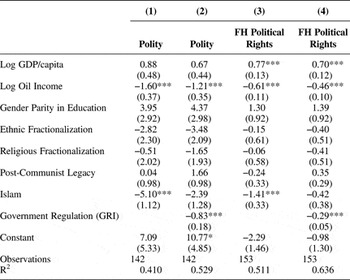
Table 1 reports the results of multivariate analyses (OLS) of democracy scores on the index measuring government involvement in religion and other hypothesized determinants of democracy. Model 1 includes all hypothesized determinants of democracy from the reviewed literature. Only oil income and Islam are statistically significant, although signs for all of the variables are in the expected directions. Model 2 adds GRI to the previous model, showing that when government regulation of religion is considered among the determinants of democracy, the variable for Muslim majority countries is no longer statistically significant. Models 3 and 4 use the Political Rights component of the Freedom House measure. Ethnic and religious fractionalization and post-communism are not found to be statistically significant in any of the models, although coefficients for each are negative, indicating that greater ethnic and religious diversity are associated with lower levels of democracy. The coefficient for gender parity in secondary education is positive in each model, although not statistically significant. While we might conclude from these results that religious restrictions trump women's rights, it is also possible that religious restrictions are related to women's rights in many countries, so accounting for them incorporates some of the effect that this measure of women's rights might have had on democracy scores.
Regressions with Government Regulation (GRI) on Democracy Scores (2006)

*p < 0.05, **p < 0.01, ***p < 0.001. Robust standard errors in parentheses.
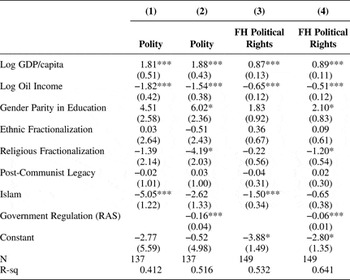
In all of the reported models, GRI remains negative and statistically significant. Higher levels of government regulation of religion therefore are associated with lower democracy scores, controlling for other determinants of democracy.Footnote 16 In the models that exclude GRI, the Islam variable exerts a large and statistically negative effect on democracy levels. However, including GRI reduces this effect and the coefficient for Islam is no longer statistically significant in any of the models that include GRI. For instance, in Model 1, the coefficient for Islam is −5.1. Once GRI is added in model 2, the coefficient is reduced to −2.39 and loses its significance. Table 2 repeats the analyses using data from Fox to measure government involvement in religion (RAS). Results are very similar to those in Table 1, with the exception of the variables for gender parity in secondary education and religious fractionalization, which are statistically significant in the models that include the RAS measure. These results indicate that as women's enrollment in secondary school increases, so do levels of democracy, while increases in religious heterogeneity decrease levels of democracy.Footnote 17
Regressions with Fox Indexes (RAS) on Democracy Scores (2003)

*p < 0.05, **p < 0.01, ***p < 0.001. Robust standard errors in parentheses.
I repeated the analyses from Tables 1 and 2 using alternative measures of some of the independent variables to check for robustness of the results. Results were similar when substituting the Human Development Index value for GDP per capita. Substituting the United Nations Gender-related Development Index (GDI) value replicated previous results, although the coefficient for GDI was positive and statistically significant in all the models. This could be a result, however, of the fact that this index incorporates Human Development Index and captures both the level of development and the status of women in a country. Moreover, the number of observations was reduced due to the fact that GDI values are only available for 139 of the countries in the dataset. Nevertheless, the results of the analyses do suggest that the status of women is likely an important determinant of democracy, although the mechanism through which it operates requires further consideration.
WHICH COMPONENTS OF GOVERNMENT REGULATION OF RELIGION ARE MOST INFLUENTIAL?
Knowing that government regulation of religion is harmful to democracy raises the questions of what kinds of regulations are imposed in Muslim majority countries and how those regulations may suppress democratic prospects. I argue that government regulation of religion inhibits democracy because it restricts political competition by cutting off the opportunity for citizens who are motivated or inspired by religion to express their ideas and pursue their interests in the public arena. I focus on these types of violations in Muslim majority countries because religion is used more often as a mobilization tool against the current regime in these settings. In countries with high levels of religiosity but low levels of opportunity for political or civic involvement, participation in religious organizations is often the only means for public participation. Moreover, Islamist groups have proven themselves to be competent providers of social services in Egypt, Lebanon, and other countries, thus acting as potential political rivals (Esposito Reference Esposito, Esposito and Burgat2003; Munson Reference Munson2001; Tamadonfar Reference Tamadonfar, Jelen and Wilcox2002). Fearing competition and threats to their power, repressive governments restrict the religious arena in order to forestall the rise of political opposition. Regulation can be in the form of complete restrictions on religious participation in politics, or limiting that participation to state-approved or controlled groups. This prevents Muslim countries — most of which are not already democratic — from being able to increase levels of democracy.
Because my main measure of GRI is a composite score capturing several aspects of religious regulation, it is possible to examine its components to verify whether the types of regulations that are more common in Muslim majority countries are the ones that are aimed at repressing speech and organizational capacity. The GRI is comprised of six separate questions. GRI_A measures whether foreign or other missionaries are allowed to operate. GRI_B measures whether proselytizing, public preaching, or conversion are limited or restricted for all or only some religions. GRI_C asks whether the government interferes with an individual's right to worship. GRI_D measures whether there are legal and practical protections for freedom of religion. GRI_E asks whether the government “generally respects”Footnote 18 religious freedom in practice, while GRI_F asks whether the report specifically mentions that the government policy contributes to the generally free practice of religion. All variables except GRI_D are coded from 0 to 1, with 1 representing the presence of the restriction or a lack of respect for religious freedom.
Of the six components of GRI, we would expect those that limit free expression by citizens to be the most influential on levels of democracy (i.e., GRI_B, GRI_E, and GRI_F). Restricting proselytizing, preaching, and conversion (GRI_B) prevents religious individuals and groups from attempting to change the minds of others. While proselytizing often refers to attempting to convert individuals to a different religion, as I will show below, laws against proselytizing can also limit the ability of religious groups to be public with their ideas regarding non-religious subjects, including politics. This can be especially pernicious when it is applied selectively to some religious groups. Government respect for religious freedom in practice (GRI_E) and policy contributing to the free practice of religion (GRI_F) measure whether existing legal protections are carried out in full faith. When government does not enforce religious freedom, we expect there to be violations of free expression and organization, and therefore, lower levels of democracy.
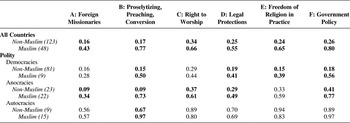
Table 3 compares means on each component of the GRI between majority Muslim and non-Muslim countries, categorized by Polity's regime types. As Muslim majority countries have higher GRI scores than non-Muslim countries on average, they also have higher means on each GRI component on average. While the difference in mean scores between Muslim and non-Muslim majority countries is significant for most components of GRI for democracies and anocracies, it is only significant for one category (GRI_B: restrictions or limits on proselytizing, public preaching, or conversion) for autocracies. Majority Muslim autocracies are highly likely to restrict these types of religious expression and this distinguishes them from non-Muslim autocracies. As Muslim anocracies and democracies are also more likely to engage in these types of restrictions, they may be affecting electoral competition in ways not seen in non-Muslim countries.
Means for Components of GRI (2005) by Polity Category

Note: T-tests indicate that the difference in means between items in bold is significant at the 0.01 level or lower. All indicators are coded 0–1. Number of countries in parentheses after each category. Countries are grouped by Polity category in 2006.
The mean scores for Muslim countries are highest for two components: limits or restrictions on proselytizing, public preaching, or conversion (GRI_B) and whether government policy plays a role in contributing to the generally free practice of religion (GRI_F). Other questions in the Grim and Finke surveys confirm the high incidence of restrictions on these types of religious expression in Muslim-majority countries. Eighty-one percent of all Muslim-majority countries limit or restrict proselytizing, 73% limit or restrict public preaching, and 62% limit or restrict conversion for some or all religions (compared to 21, 19, and 7% of non-Muslim countries, respectively). In 77% of Muslim-majority countries, government policy is not reported as “generally respecting” the right to religious freedom (compared to 20% in non-Muslim countries). Muslim countries are also more likely to have coercive bureaus that supervise religion (67 versus 22% in non-Muslim countries), and 75% of Muslim countries limit or restrict religious literature and/or broadcasting and censor the content of religious sermons, publications, and/or broadcasts (compared to approximately 30% of non-Muslim countries).
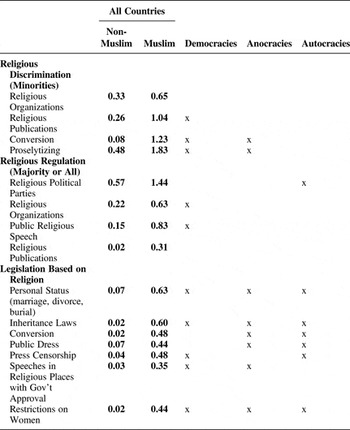
The data collected by Fox in his Religion and State Dataset confirm how regulations differ in Muslim and non-Muslim countries. Several of his individual questions address restrictions that can have the effect of curbing freedom of religious expression, religiously-based organization, and political competition. Table 4 compares Muslim and non-Muslim countries across the Polity categories on a select number of indicators from the Religion and State Dataset that may reflect attempts by the state to suppress competition from religious movements. Four indicators measure restrictions against minorities, four measure restrictions against the majority religion or all religions, and seven measure types of legislation that are influenced by religion (see Table 4). All of the restrictions occur at higher rates in Muslim countries than non-Muslim countries, and the difference across these two groups of countries is statistically significant for all of the indicators. Majority Muslim countries have higher levels of regulations against religious political parties, organizations, publications, and religious speech. Also notable is the large difference in means for all of the religious legislation indicators, indicating that a very small proportion of non-Muslim countries base their legislation on religion, while larger percentages of Muslim countries do so. However, some of the differences between the two sets of countries are not significant when grouped by regime type.Footnote 19
Means for Fox's Religion and State Dataset Indicators (2002) by Polity Category

Note: T-tests indicate that the difference in means between Muslim and Non-Muslim countries in each category in bold or marked “x” is significant at the 0.01 level or lower. Discrimination and Regulation indicators are coded 0–3. Legislation indicators are coded 0/1. Countries are grouped by Polity category in 2003. Source: Fox, Religion and State Dataset.
IMPLEMENTING REGULATIONS IN MUSLIM-MAJORITY COUNTRIES
To examine how each of these factors might affect electoral competitiveness, I look more closely at the International Religious Freedom Reports for selected countries below. Examining the text that forms the basis of the quantitative data helps to shed light on how these regulations are being implemented and practiced in order to help us better understand the ways in which they harm political competition, especially in Muslim majority countries. Because I argue that it is the application of religious regulations that is more significant than their existence, examining country reports and qualitative studies is the means through which we can analyze motivations for regulations in the Muslim world.
Closer scrutiny of regulations illustrates how political competition can be affected directly by restrictions on proselytizing, preaching, and conversion. For example, in Tunisia, the government prohibits proselytizing although there are no statutes prohibiting conversion from Islam (U.S. Department of State 2005). As the Christian community in Tunisia is small, dispersed throughout the country, and composed primarily of foreigners, religious restrictions appear to be targeted mainly toward preaching by Muslims, in particular, those that the government labels “Islamists.” The government has full control over mosques and prayer leaders, and appoints the Grand Mufti. Only government-appointed personnel may lead activities in mosques and mosques are required to remain closed except during prayer services and other authorized religious ceremonies. Political parties based on religion are forbidden, and the government has refused to register the An-Nahda party on these grounds. The party was founded in 1987 and had a strong showing running candidates as independents in the 1989 parliamentary elections (Noyon Reference Noyon2003). Noyon argues that the party was repressed by Ben Ali's government when they were perceived as threatening to his power after a strong showing in the elections. From 2001 to 2009, the IRF reports increasingly detail accounts of members of the movement being subjected to imprisonment and tight surveillance, and individuals being targeted because of their Islamic appearance or for praying frequently in mosques. During that same period, both Polity and Freedom House report a decline in political rights in the country.
All five former Soviet Central Asian countries restrict proselytizing and also restrict public preaching and conversion. All have state controlled religious boards that restrict the exercise of Islam to a single state-supported form. While some of the countries have more restrictions than others and have been firmly autocratic since independence (Uzbekistan and Turkmenistan), others were expected to transition toward democracy and were considered to protect religious freedom in general until recent years, when they have started to target independent Muslims and consolidate autocratic rule (Kazakhstan, Kyrgyzstan, Tajikistan). In all five countries, levels of government involvement in religion measured by Fox increased over the period covered by his RAS dataset (1990–2002). According to reports filed with the Forum18 News Service, an independent Christian initiative that reports on violations of religious freedom, in all of the countries restrictions on religion are explained to be a way for the state to retain control over the country — to squash opposition, especially opposition that gets ideas from foreign countries.Footnote 20 They do this by restricting religious education, training of imams, opening non-state mosques, and access to religious publications. In some of the countries, the excuse is combating extremism. The restriction of independent religious groups follows the same pattern as restriction of any other opposition group. In countries that have seen little or no alternation of power since becoming independent in 1991, religious movements are often viewed as threatening to the current regime and are therefore repressed.
The IRF reports for the Central Asian countries confirm the relatively low level of threat posed by non-Muslims in these countries and the high level of restrictions placed on Islam. In anocratic Tajikistan, religious parties are not banned, but the government closely monitors religious movements because it claims it needs to counter Islamic extremism, and prohibits political parties from being funded by religious organizations. The government registers and monitors mosques and standardizes Islamic teachings, and has reportedly used its power to restrict access of women to mosques in which they may receive messages from the Islamic Renaissance Party. While this region has had problems with foreign-funded extremist Islamic groups, area specialists agree that government repression of religious movements is often misguided and has the unintended consequence of radicalizing groups (Khalid Reference Khalid2007; Roy Reference Roy2000).
While the excuse for imposing strict regulations on religion in many countries is the need to combat religious extremism, in many cases what is being opposed is independent Islamic groups or Islamic sects. For example, in Turkey, one of the few Muslim majority countries that has had some success with democratic institutions, all religious institutions are under the control of the state's Directorate of Religious Affairs (Diyanet), including training imams, building mosques, religious education, and the content of weekly sermons. The Diyanet claims to represent all Muslims in Turkey, although it limits its direction on religion to the dominant Hanefi sect of Sunni Islam. At the same time, there are Muslim minority groups, including the Shafi sect among the Sunnis (about 6% of Turkey's population) and Alevis (approximately 12% of the population) who fall outside of the Diyanet's control but otherwise are not recognized by the state (Çarkoğlu and Toprak Reference Çarkoğlu, Toprak and Fromm2007). The institution of the Diyanet allows the state to suppress religion's independent influence while marginalizing minority sects by refusing to represent them. A potent example of this is the fact that the ruling Islamic-inspired Justice and Development Party in Turkey — somewhat surprisingly given its support for greater religious freedom in the country — has not advocated abolishing the Diyanet, as they claim that doing so could cause anarchy among Islamic communities whose services were not centrally administered (Kuru Reference Kuru and Yavuz2006). Despite recent political reforms, Turkey's level of political rights has remained steady over the past decade, reflecting the lack of attention to religious freedom (Yildirim Reference Yildirim2011).
A second component in which Muslim countries scored significantly higher than non-Muslim countries was on whether government policy plays a role in contributing to the free practice of religion. This refers to text appearing in a section of the International Religious Freedom Report entitled, “Restrictions on Religious Freedom” that details official laws, policies, and actions that restrict religious freedom. Countries scoring zero on GRI_F contain some variant of text that reads, “Government policy and practice contributed to the generally free practice of religion.” As the format for all country reports is standard, in reports that do not contain this text, the section details violations of religious freedom. While the kinds of activities that would be covered by this section of the report vary, they all point to specific ways in which government policy restricts the free practice of religion in a country, and often highlight ways in which the majority religion is suppressed. One example comes from Kyrgyzstan, where, “In April 2004, the Government signed a decree and plan of action instructing the National Security Service (SNB) to propose measures to ‘restrict and prevent the activities of missionaries who propagate religious fundamentalism and extremism as well as reactionary and Shi'ite ideas’” (U.S. Department of State 2005). Kyrgyzstan has had a recent history of issues with Islamic extremist groups, most notably the group Hizb-ut-Tahrir, a banned party that expresses the desire to rule the world under an Islamic caliphate. Nevertheless, analysts see the repressive regulations as targeting not just extremists but also any proponents of Islamic ideas that are independent of the muftiate (the state religious board) (Rotar Reference Rotar2006). Of note also is the inclusion of “Shi'ite ideas” with fundamentalism and extremism, again suggesting the desire to quell Islamic pluralism.
Not all Muslim majority countries have high levels of religious regulation, however. Among the Muslim majority countries, only eight were described as ones in which government policy generally contributes to the free practice of religion: Tunisia, Guinea, Sierra Leone, Albania, Burkina Faso, Gambia, Mali, Niger, and Senegal. Of note is that none of these countries is located in the Middle East or Central Asia, and only one comes from an Arab cultural tradition. These countries (with the exception of Tunisia) also lack restrictions against proselytizing, preaching, and conversion and are described as having a situation in which the government generally respects religious freedom in practice. This suggests the possibility of either a cultural or neighborhood effect at work. As most of the countries are located in Africa, have a relatively shorter history with Islam, and have greater religious and ethnic diversity, it is possible that the practice of Islam in these countries, and its relationship to government regulations, is friendlier to democracy than in other regions where Islam is prevalent. However, as many regulations were found to have political rather than religious motivations, it is likely that the motivations for the regulations can be found in other factors that affect political competition, including the distribution of scarce resources and access to alternative sources of information. Further analysis of these issues is outside of the scope of the current study, but deserves greater attention in future research.
CONCLUSION
Examining the impact of government regulation of religion in the context of previously hypothesized determinants of democracy demonstrated that taking government regulation into account moderates the negative impact of an often unspecified “Islam” variable on democracy. The fact that ethnicity and female status variables are not found to be statistically significant in many of the regressions containing government regulation of religion suggests that the variable might also capture differences in the ethnic composition of societies and the status of women. That is, regulation of religion might reflect government attempts to deal with ethnic heterogeneity while also affecting how women are perceived and treated in society. However, further analysis is required to confirm such speculations.
This article has also considered how Islam and government regulation of religion might function in interaction with one another. That is, it asks how majority Muslim countries apply religious regulations and questions the motivations for them. Looking to the specific types of regulations that are more likely to exist in Muslim majority countries, I examined the sources of religious restrictions by considering the targets of them. The results suggest that the reasons behind regulations in these countries are largely directed at suppressing political competition rather than limiting non-Muslim religious practice. I demonstrated this by looking at the types of regulations that are more prevalent in Muslim countries as well as listing specific instances of how they are applied in selected countries. Governments that restrict proselytizing, preaching, and other forms of dissemination of religious ideas are in effect controlling what should be an independent voice in society. This impedes the development of alternative voices that can question and perhaps even challenge authority. Even if such societies were to allow for competitive elections, religious regulations would make it difficult for a legitimate opposition to mobilize. Recognizing that religious leaders may be among the few who could mobilize people in majority Muslim societies, governments attempt to restrict those leaders in order to prevent them from gaining too much power and challenging the regime. Those that are able to survive despite restrictions are often the extremist groups, which governments then use as justification for imposing further regulations. Regulation thus becomes a self-fulfilling prophecy, fostering the sorts of groups it was originally intended to quell.
This article contributes to the expanding empirical and theoretical literature on the relationship between religion and politics, and strives to bring attention to the importance of state policies toward religion in understanding how democracies are created and sustained. Given the relative paucity of democracy in the Muslim world, further research into the impact of religious regulations on democratic politics may help scholars and policymakers find ways of increasing freedom and pluralism in Muslim countries in order to pave the way for more open and competitive politics.