Introduction
Caucasian rock lizards (Darevskia spp.) are small lacertids from western Asia and south-eastern Europe. Although they are ecologically similar to European rock lizards they include not only bisexual species but also parthenogenetic forms (Darevsky, Reference Darevsky1967; Ananjeva et al., Reference Ananjeva, Orlov, Khalikov, Darevsky, Ryabov and Barabanov2006; Arnold et al., Reference Arnold, Arribas and Carranza2007; Tarkhvishnili, Reference Tarkhvishnili and Jenkins2012). Among the former, D. rudis (Bedriaga, 1886) is a common species that occurs in northern coastal Turkey, Georgia, Russia and Azerbaijan (Eiselt & Darevsky, Reference Eiselt and Darevsky1991). This species ranges from sea level to 2400 m above sea level (asl), inhabiting rocky areas in temperate forests, but also montane-steppes, and walls and other human structures (Akarsu et al., Reference Akarsu, Tuniyev, Anajeva, Agasyan, Orlov and Tuniyev2009; Kaska et al., Reference Kaska, Kumlutaş, Avcı, Üzüm, Yeniyurt and Akarsu2009).
Little attention has been paid to the parasites of Darevskia lizards, and thus no helminthological data are available for most species. Published studies are restricted to taxonomic and faunistic aspects (Schad et al., Reference Schad, Kuntz and Wells1960; Markov & Bodganov, Reference Markov and Bodganov1962; Sharpilo, Reference Sharpilo1962, Reference Sharpilo1976; Saygi, Reference Saygi1993; Roca et al., Reference Roca, Jorge, Ilgaz, Kumlutas, Durmus and Carretero2014). Preliminary helminth community data are available for parthenogenetic forms of Darevskia and their bisexual relatives (Sargsyan & Vardanyan, Reference Sargsyan and Vardanyan2011; Sargsyan & Harutyunyan, Reference Sargsyan and Harutyunyan2012; Sargsyan et al., Reference Sargsyan, Arakelyan, Danielyan and Vartanyan2014).
Only a recent study by Sargsyan (Reference Sargsyan2013) has suggested the influence of abiotic factors on the parasite infection in Darevskia raddei (Boettger, 1892). However, evidence from other small lacertids certainly indicates that helminth communities are sensitive to local climatic conditions, the presence of alternative hosts and the degree of isolation (Roca & Hornero, Reference Roca and Hornero1994; Roca et al., Reference Roca, Foufopoulos, Valakos and Pafilis2009; Carretero et al., Reference Carretero, Jorge, Llorente and Roca2014). Moreover, helminth infracommunities in lacertids are also known to vary according to host traits, such as body size, sex and diet (Sanchis et al., Reference Sanchis, Roig, Carretero, Roca and Llorente2000; Martin & Roca, Reference Martin and Roca2004; Martin et al., Reference Martin, Llorente, Roca, Carretero, Montori, Santos and Romeu2005; Roca et al., Reference Roca, Carretero, Llorente, Montori and Martin2005).
Thus, in this study, we quantitatively analyse the infection of several populations of D. rudis by helminths, specifically addressing the following issues: (1) basic characterization of the helminth community in terms of species richness and diversity patterns; (2) characterization of the helminths parasitizing the host as either specialists or generalists; (3) characterization of the helminths as core, secondary or satellite species; (4) assessment of the influence of host sex, size and environmental (climatic) factors (varying across host populations) on parasitism; and (5) characterization of the pattern of parasite infection of D. rudis, comparing the helminth community with that of European and other Caucasian rock lizards.
Materials and methods
Collection and examination of lizards
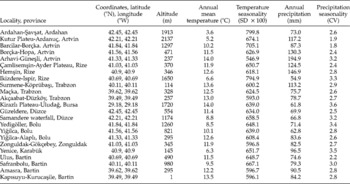
A total of 308 adult lizards (148 males and 160 females) of D. rudis, from the herpetological collection of the Fauna and Flora Research and Application Centre, Dokuz Eylul University (Ízmir, Turkey), was examined. This sample was taken from 23 lizard populations and collected across the range of species in North Anatolia in spring (table 1). In a previous study by Arribas et al. (Reference Arribas, Ilgaz, Kumlutas, Durmus, Avcı and Üzum2013), specimens from northern Anatolia and the Middle Taurus Mountains in Anatolia were examined for external morphology and osteology, and Darevskia bithynica was raised to species rank, with two subspecies: D. b. bithynica and D. b. tristis in the western and Black Sea Region of Anatolia. Following this taxonomic arrangement, some populations, such as those from Kirazlı Plateau-Uludağ to Kapısuyu-Kurucaşile (see table 1), examined for parasites would be ascribed to D. bithynica. However, in the absence of molecular evidence supporting such specific separation, this study follows a conservative approach, retaining all the populations within D. rudis sensu lato.
The localities of host populations of Darevskia rudis and corresponding environmental traits. Temperature seasonality: standard deviation (SD) of the weekly mean temperatures expressed as a percentage of the mean of those temperatures. Precipitation seasonality: coefficient of variation (CV) as the standard deviation of the weekly precipitation estimates expressed as a percentage of the annual mean.

Populations were sampled along a 1000-km range in North Anatolia, with altitude levels ranging from sea level to 2137 m asl. In this region climate gradually changes from Mediterranean in the west to Oceanic in the east, with a more abrupt transition between the temperate humidity of the Black Sea coast to the arid continental climate of the slopes facing the Anatolian Plateau (Şensoy et al., Reference Şensoy, Demircan, Ulupınar and Balt2008). Such conditions provide a good representative spectrum of the bioclimatic range where this species occurs. To quantify these environmental characteristics, four bioclimatic variables for all localities were downloaded from the Worldclim database (http://www.worldclim.org/bioclim; Hijmans et al., 2005), namely, annual mean temperature, temperature seasonality, annual precipitation and precipitation seasonality, which were introduced in subsequent analyses (table 1).
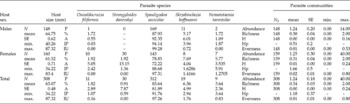
To assess host size, the snout vent length (SVL) of each lizard was measured with a digital calliper to the nearest 0.01 mm (see table 2). Gender and sexual maturity of the host were assessed from body size and gonad inspection (Carretero & Llorente, Reference Carretero and Llorente1993; Arribas et al., Reference Arribas, Ilgaz, Kumlutas, Durmus, Avcı and Üzum2013; Gül et al., Reference Gül, Özdemir, Kumlutas and Ilgaz2014). Populations from Hemşin and Surmene-Köprübaşı were removed from analyses because their host samples lacked representatives of both sexes.
Descriptors of helminth species and communities in Darevskia rudis, relative to host size, based on snout vent length, and sex. N, number of hosts examined; N 2, number of helminth infracommunities quantified; P, number of parasites; SE, standard error; %, prevalence; A, relative abundance; IP, probabilistic index; IU, resource use index; H, individual host diversity; Hp, host population density (following Jover, Reference Jover1989).

Helminthological procedures
Lizards were dissected for parasitological examination. This method ensures better detection and quantification of intestinal parasites with a few specimens than some non-invasive techniques (Jorge et al., Reference Jorge, Carretero, Roca, Poulin and Perera2013). Helminths were processed following Hornero (Reference Hornero1991). The parasite vouchers were deposited in the parasitological collection of the Department of Zoology of the University of Valencia, Spain.
Data analysis
The following descriptors were calculated for the helminth infracommunity of the pooled sample as well as separately for sex and locality: prevalence (%, percentage of infected hosts in the sampled population), abundance (A, percentage of the total number of parasites in a given host sample) and resource use index (IU; Jover, Reference Jover1989). The latter index emphasizes the homogeneity (of parasitization across the host sample) as a criterion for evaluating the importance of different parasite species (Carretero, Reference Carretero2004; Martin et al., Reference Martin, Llorente, Roca, Carretero, Montori, Santos and Romeu2005; Roca et al., Reference Roca, Carretero, Llorente, Montori and Martin2005; Carretero et al., Reference Carretero, Roca, Larbes, Ferrero and Jorge2011, Reference Carretero, Jorge, Llorente and Roca2014). Mean intensity and mean abundance of infection were calculated following Bush et al. (Reference Bush, Lafferty, Loft and Shostak1997). Prevalence of 10% was adopted as the lowest limit in identifying satellite species (Kennedy & Bakke, Reference Kennedy and Bakke1989). Species with values of prevalence between 10% and 30% were assigned as secondary species (Hanski, Reference Hanski1982; Roca, Reference Roca1993). Species with prevalence of 30% or higher were considered as core species (Roca, Reference Roca1993). The criteria of Edwards & Bush (Reference Edwards and Bush1989) and Roca & Hornero (Reference Roca and Hornero1994) were used in the consideration of the helminth species as specialists or generalists. Brillouin's indices were applied for calculating diversity and evenness of parasite communities, according to Magurran (Reference Magurran2004). Host population diversity of parasites (Hp) was also estimated by a jackknife resampling procedure (Jover, Reference Jover1989; Carretero, Reference Carretero2004; Martin et al., Reference Martin, Llorente, Roca, Carretero, Montori, Santos and Romeu2005; Roca et al., Reference Roca, Carretero, Llorente, Montori and Martin2005; Carretero et al., Reference Carretero, Roca, Larbes, Ferrero and Jorge2011, Reference Carretero, Jorge, Llorente and Roca2014) and compared between sexes by t-tests (corrected for false discovery rate, FDR; Benjamini, & Hochberg, Reference Benjamini and Hochberg1995) due to the non-additive nature of diversity (Carretero, Reference Carretero2004; Martin et al., Reference Martin, Llorente, Roca, Carretero, Montori, Santos and Romeu2005; Roca et al., Reference Roca, Carretero, Llorente, Montori and Martin2005; Carretero et al., Reference Carretero, Perera, Harris, Batista and Pinho2006, Reference Carretero, Roca, Larbes, Ferrero and Jorge2011, Reference Carretero, Jorge, Llorente and Roca2014). All the remaining variables were calculated as mean individual values and compared through two-way analysis of variance (ANOVA) with sex and host population as factors. These analyses were performed in STATISTICA 12 (StatSoft Inc., 2013).
Relationships between abiotic factors and parasite species and helminth community traits (see above) were represented using canonical correlation analysis (CCorA; Legendre & Legendre, Reference Legendre and Legendre1998); to test the significance of the observed correlation between canonical vectors, a permutation procedure with 1000 permutations was performed in XLSTAT 2014, evaluation version (http://www.xlstat.com; accessed 12 March 2014). Finally, similarities between helminth communities of the different host populations were estimated through the inverse of Pianka's overlap index (Pianka, Reference Pianka1973) applied on the IU values of each parasite species (Carretero et al., Reference Carretero, Perera, Harris, Batista and Pinho2006) using Ecosym 7.0 (Gotelli & Entsminger, Reference Gotelli and Entsminger2001). The subsequent 1-overlap matrix obtained was then correlated with the matrix of geographic distances between localities, calculated in QGIS v. 2.2.0-Valmiera, using a Mantel test with 10,000 permutations performed in XLSTAT 2014.
Results
Helminth composition
Five helminth species, one cestode, Nematotaenia tarentolae López-Neyra, 1944 and four nematodes, Spauligodon saxicolae Sharpilo, Reference Sharpilo1962, Skrjabinelazia hoffmanni Li, 1934, Oswaldocruzia filiformis (Goeze, 1782) and Strongyloides darevskyi Sharpilo, Reference Sharpilo1976, were found in D. rudis. All species occupied the small intestine, except S. saxicolae which was found in the caecum. The descriptors of parasite species and communities for the pooled host sample and separately for male and female hosts are shown (table 2). The overall prevalence of infection was 32.1%. Mean intensity and mean abundance of infection were 3.9 ± 4.7 (1–40) and 1.2 ± 3.2 (0–40), respectively. Spauligodon saxicolae constituted the main component of the helminth communities of D. rudis, whereas the other helminth species infected less than 3% of their host population (table 2). Five species of helminths were identified in the host populations of D. rudis, which exceeded both a mean of 0.34 and a maximum of 2 species per individual lizard. Values of helminth richness, abundance, diversity and evenness are indicated (table 2).
Helminth variation with host traits
Intraspecific variations between host sexes but, mainly, between host populations were examined for species- and community-level comparisons (table 2). Once host populations from Hemşin and Surmene-Köprübaşı (which lacked males and females, respectively) were removed from the analysis, sexual size dimorphism (larger males) and geographic variation in size were detected, but the first remained invariant across sites (ANOVA, sex: F 1,259= 11.40, P= 8 × 10− 5; population: F 20,259= 15.45, P< 10− 6; sex × population: F 20,259= 0.89, P= 0.59). Regardless of their sex, lizards from localities Barcilar, Borçka to Çamlisemşin-Ayder Plateau were especially large. Infection by the most abundant helminth, S. saxicolae, varied with population but not with sex (ANOVA, sex: F 1,259= 2.30, P= 0.13; population: F 20,259= 1.90, P= 0.01; sex × population: F 20,259= 1.28, P= 0.196). Oswaldocruzia filiformis displayed variation mainly due to higher infection values in the females of the population from Kapısuyu-Kurucaşile (ANOVA, sex: F 1,259= 5.56, P= 0.02; population: F 20,259= 4.63, P< 10− 6; sex × population: F 20,259= 4.66, P< 10− 6). The infection by N. tarentolae was higher in localities Kirazlı Plateau-Uludağ, Yedigöller and Yiğilca-Alaplı (ANOVA, sex: F 1,259= 3.55, P= 0.06; population: F 20,259= 3.32, P= 5 × 10− 6; sex × population: F 20,259= 3.49, P= 2 × 10− 6; Scheffé post-hoc tests: P< 0.05). By contrast, S. hoffmanni did not show any variation, either with population or with host sex (ANOVA P > 0.42 in all cases).
Helminth communities
Species richness also varied between host populations but not between host sexes (ANOVA, sex: F 1,259= 0.71, P= 0.40; population: F 20,259= 2.12, P= 0.004; sex × population: F 20,259= 0.98, P= 0.49). No significant variation was detected for parasite abundance, infracommunity diversity or evenness (ANOVA P > 0.10 in all cases). Host population diversity of parasites was moderately correlated with infracommunity diversity (r= 0.53, r 2 = 0.28, P= 0.009) and also lacked significant variation across host sexes and populations (multiple t-tests FDR-corrected, P>0.18). Remarkably, values of host population diversity of parasites exceeded by 5–10 times those of infracommunity diversity (tables 2 and 3). No correlation between parasite species abundances or any of the community descriptors and host size (SVL) was detected, either considering values for individual host or for host population (r< 0.12, P > 0.34).
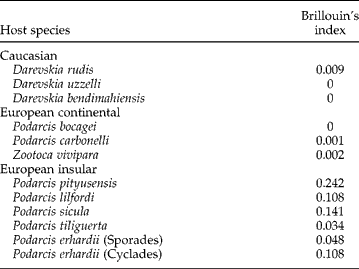
A comparison between Brillouin's diversity indices of helminth communities in Caucasian and European lacertid lizards.

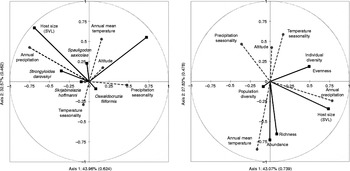
The canonical correlation analysis (CCorA) between parasitization and enviromental variables for each lizard population produced divergent results whether applied to parasite species abundance or to the parameters of parasite community (fig. 1). The enviromental signal on the infection by the different parasite species was weak: only N. tarentolae showed some trend to be more abundant at higher altitudes, S. saxicolae in warmer environments and S. darevskyi in rainy areas. Strongyloides darevskyi was also associated with large host body sizes. However, a clearer scenario emerged from the analysis of communities, since lizard populations occurring in warmer areas harboured more abundant and richer parasite assemblages, while higher precipitation had an effect on host size but not on parasite communties. Finally, Mantel tests did not detect correlation between the community dissimilarities and geographic distances matrices (r= − 0.025, P= 0.69).
Canonical correlation analysis (CCorA) between host/parasite traits (squares) and environmental variables (circles) for helminth species (left) and communities (right). Variance percentages are indicated after the axes and eigen values follow, in parentheses.

Discussion
All the helminths found in D. rudis are also common in reptiles from south-east Europe and the former USSR (Schad et al., Reference Schad, Kuntz and Wells1960; Markov & Bodganov, Reference Markov and Bodganov1962; Sharpilo, Reference Sharpilo1976; Saygı, Reference Saygi1993; Sharpilo et al., Reference Sharpilo, Biserkov, Kostadinova, Behnke and Kuzumin2001; Yildirimhan et al., Reference Yildirimhan, Bursey and Altunel2011; Roca et al., Reference Roca, Jorge, Ilgaz, Kumlutas, Durmus and Carretero2014).
The most common helminth in the communities of D. rudis sensu lato is the pharyngodonid nematode S. saxicolae, which should be considered as a rock lizard specialist (sensu Roca & Hornero, Reference Roca and Hornero1994), since it has been recorded from Darevskia and Podarcis species (Sharpilo, Reference Sharpilo1976; Roca et al., Reference Roca, Lluch and Navarro1986, Reference Roca, Foufopoulos, Valakos and Pafilis2009). Strongyloides darevskyi seems a true Darevskia specialist as it has been recorded only in D. saxicola and D. rudis. The remaining helminth species have been recorded from several other lizard genera, so they appear to be generalists (Roca et al., Reference Roca, López-Balaguer, Hornero and Ferragut1990; Roca & Hornero, Reference Roca and Hornero1992; Yildirimhan et al., Reference Yildirimhan, Bursey and Altunel2011). No other species of Pharyngodonidae were found in D. rudis. This contrasts with the usual pattern found in different European lacertid lizards, in which other species of Spauligodon frequently share reptile hosts with species of the genera Skrjabinodon (but see Jorge et al., Reference Jorge, Roca, Carretero, Perera, Harris and Poulin2014) and Parapharyngodon (Roca et al., Reference Roca, Lluch and Navarro1986, Reference Roca, Foufopoulos, Valakos and Pafilis2009; García-Adell & Roca, Reference García-Adell and Roca1988; Roca & Hornero, Reference Roca and Hornero1994; Yildirimhan et al., Reference Yildirimhan, Bursey and Altunel2011).
The total number of helminth species in the populations of D. rudis greatly exceeded both the average and the maximum number of species per individual lizard, with no single infracommunity presenting all species locally available. This marked variation in infracommunities is also supported by the low ratio between infracommunity and host population diversity of parasites obtained for all host populations. The upper limit of species richness is not usually attained (Poulin, Reference Poulin1998). This agrees with observations of Gallotia spp. (Martin & Roca, Reference Martin and Roca2004) and seems also to be a typical pattern of many European lacertid lizards (Roca & Hornero, Reference Roca and Hornero1994; Sharpilo et al., Reference Sharpilo, Biserkov, Kostadinova, Behnke and Kuzumin2001; Martin & Roca, Reference Martin and Roca2004; Yildirimhan et al., Reference Yildirimhan, Bursey and Altunel2011).
Most helminth species found in D. rudis occurred at low prevalence. Only S. saxicolae can be considered as a core species, whereas the remainder are satellite species. This, again, differs from the typical pattern of helminth infection in many reptiles, i.e. few species occur frequently, few species occur with moderate prevalence and many species are rare (Aho, Reference Aho, Esch, Bush and Aho1990; Roca & Hornero, Reference Roca and Hornero1994; Sharpilo et al., Reference Sharpilo, Biserkov, Kostadinova, Behnke and Kuzumin2001; Yildirimhan et al., Reference Yildirimhan, Bursey and Altunel2011). In the case of D. rudis, no secondary species were found in their helminth infracommunities.
The observed low diversity of the intestinal helminth community of D. rudis points to a depauperate isolationist community, being in accordance with the general pattern observed in reptiles (Aho, Reference Aho, Esch, Bush and Aho1990; Roca & Hornero, Reference Roca and Hornero1994). However, some differences have been observed among distinct European lacertid lizards (see Roca et al., Reference Roca, Foufopoulos, Valakos and Pafilis2009). Insular lizards show higher values for both helminth diversity (table 3) and prevalence than continental ones, which is probably due to unusual insular conditions concerning hosts, such as lizard population densities, food strategies and prey availability, as well as ecological conditions concerning parasite recruitment opportunities (Martin & Roca, Reference Martin and Roca2004; Roca et al., Reference Roca, Foufopoulos, Valakos and Pafilis2009). On the other hand, continental European lacertid lizards have low values of Brillouin's index of diversity, with the parthenogenetic Darevskia spp. (and Podarcis bocagei) being those with extremely impoverished helminth communities. Several factors have been cited as possible causes of very low helminth diversity in continental lacertid lizards, i.e. small body size of the host, low number of interactions with other reptile or amphibian species, and low opportunities for parasite recruitment due to habitat conditions (Galdón et al., Reference Galdón, Roca, Barbosa and Carretero2006; Roca et al., Reference Roca, Jorge, Ilgaz, Kumlutas, Durmus and Carretero2014). Although D. rudis shows low values of helminth diversity, they are still higher than those of other European lizards and also higher than those of parthenogenetic congeneric species (Roca et al., Reference Roca, Jorge, Ilgaz, Kumlutas, Durmus and Carretero2014). This suggests more opportunities for parasite recruitment, which is in accordance with the widest geographical distribution of this species among the Caucasian rock lizards, and the high diversity of habitats occupied within this range.
Since phylogeny is a determinant factor for a modular structure in networks between parasites and hosts, and the formation of modules consisting of groups of hosts and parasites that are intimately related (Krasnov et al., Reference Krasnov, Fortuna, Mouillot, Khokhlova, Shenbrot and Poulin2012), we expected that certain lineages of parasites were more likely to exploit Darevskia spp. as a particular lineage host. The most probable lineages of parasites involved in this situation are the nematode species belonging to the genera Spauligodon, Strongyloides and Skrjabinelazia, since species of each genus have been recorded parasitizing other Darevskia species (Sharpilo, Reference Sharpilo1976; Roca et al., Reference Roca, Jorge, Ilgaz, Kumlutas, Durmus and Carretero2014; Roca et al., unpublished data).
Notwithstanding the low complexity and heterogeneity of the parasitization between individual lizards (see above), host intraspecific variation was detected. This was mostly due to differences between lizard populations, while the effect of host sex was negligible. Interpopulation host variation affected not only the most abundant species, S. saxicolae, but also N. tarentolae. Since canonical correlation analysis (CCorA) detected little climate signal in the infection by individual parasite species, such variation could be due to local changes in infection opportunities for each parasite, due to variations in microhabitat, and intermediate, paratenic and alternative definitive hosts (Roca & Hornero, Reference Roca and Hornero1994; Martin & Roca, Reference Martin and Roca2004; Roca et al., Reference Roca, Foufopoulos, Valakos and Pafilis2009). Similarly, Sargsyan (Reference Sargsyan2013) did not observe a clear association with either temperature or precipitation when analysing the infection of five popualtions of D. raddei by S. saxicolae in Armenia. In contrast, CCorA showed evidence of an increase in the parasite abundance and richness at community level in warmer localities. Precipitation also had a positive influence on host size, presumably due to high prey availability (Pianka, Reference Pianka1986). However, such an effect did not have repercussions on parasite communities since no correlation between infection variables and lizard size was found, although it has been reported for other lacertids (Sanchis et al,. Reference Sanchis, Roig, Carretero, Roca and Llorente2000; Martin et al., Reference Martin, Llorente, Roca, Carretero, Montori, Santos and Romeu2005; Roca et al., Reference Roca, Carretero, Llorente, Montori and Martin2005; Carretero et al., Reference Carretero, Perera, Harris, Batista and Pinho2006, Reference Carretero, Roca, Larbes, Ferrero and Jorge2011, Reference Carretero, Jorge, Llorente and Roca2014). Such an effect is generally due to the low parasitization of juvenile lizards, which were not analysed in our study. Finally, the lack of significance in the Mantel tests allows us to discard biogeographical trends, at least at the scale of the study region.
In summary, the lacertid D. rudis harbours a depauperate helminth community, composed of both specialist and generalist species whose variation between host populations is more dependent on local ecological conditions and climate than on biogeographic units. This contrasts with the results of the analysis of insular and continental populations of the Mediterranean lacertid Podacis erhardii (Roca et al., Reference Roca, Foufopoulos, Valakos and Pafilis2009) which displays a strong biogeographic signal of insularity on parasitization. Further studies on multipopulation and multispecies host datasets are crucial to elucidate the relative contributions of ecological and historical factors to the formation of reptile helminth communities.
Acknowledgement
Special thanks to B. Presswell who revised the language.
Financial support
This research was supported by the projects ‘Biodiversity, Ecology and Global Change’ co-financed by the North Portugal Regional Operational Programme 2007/2013 (ON.2 – O Novo Norte), under the National Strategic Reference Framework (NSRF), through the European Regional Development Fund (ERDF), PTDC/BIA-BEC/101256/2008 of FCT (Portugal), FCOMP-01-0124-FEDER-007062 COMPETE programme and ‘Preserving Armenian biodiversity: Joint Portuguese –Armenian program for training in modern conservation biology’ of the Gulbenkian Fundation (Portugal). F.J. was funded through a doctoral grant (SFRH/BD/77 332/2011) under the Programa Operacional Potencial Humano – Quadro de Referência Estratégico Nacional funds from the European Social Fund and Portuguese Ministério da Educação e Ciência. This work also forms part of a project (Project No. 2009, K.B.FEN.003) supported by the Scientific Research Project Coordination Unit, Dokuz Eylül University, Turkey.
Conflict of interest
None.