INTRODUCTION
Fiddler crabs Uca rapax Smith, 1870 are distributed along the Western Atlantic (Florida, Gulf of Mexico, Antilles, Venezuela and Brazil – from the state of Pará (north) to the state of Santa Catarina (south)). This species dwells in galleries excavated in mud, or muddy sand, near mangroves. It also inhabits these same substrates along rivers, streams and ponds. It is usually the most abundant species of the Uca along the Brazilian coast (Melo, Reference Melo1996).
Species of Uca feature a marked sexual dimorphism, with males holding one of their chelipeds hypertrophied, which can reach one third of their body mass (Rosenberg, Reference Rosenberg2001). The large cheliped is modified for intrasexual fights, defence and courtship, while the smaller one is used for eating (Crane, Reference Crane1975). Also, according to the same author, females have a pair of small chelipeds, similar to the male's small pincer.
Certain bodily changes, such as prepubertal or pubertal molt, can be abrupt and may reflect a critical stage during ontogeny in Brachyura (Hartnoll, Reference Hartnoll1974). In such an ontogenetic shift, the proportions of body structures are changed while size increases (Hartnoll, Reference Hartnoll1978, Reference Hartnoll and Abele1982). Brachyura males, for instance, showed changes in the cheliped proportions before and after the puberal molt (Hartnoll, Reference Hartnoll1974). Male fiddler crabs do not exhibit distinct sexual dimorphism in the early development stages (first three stages of crab after megalopa), i.e. chelipeds are still symmetrical, similarly to females (Hyman, Reference Hyman1920).
Morgan (Reference Morgan1920, Reference Morgan1923) was one of the first to report anomalous cases in the chelipeds of fiddler crabs. Morgan (Reference Morgan1920) observed two variations: (1) both the male's chelipeds remain small, similarly to the one that normal males use for feeding; and (2) both the chelipeds become hypertrophied in a similar way to the major one of normal males, naming these two cases as ‘intersexual’ and ‘super-males’, respectively.
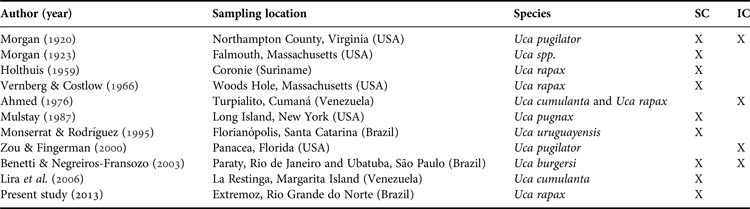
Several cases of cheliped abnormalities in fiddler crabs have been reported for the Americas: in New York (USA) with Uca pugnax Smith, 1870 (Mulstay, Reference Mulstay1987); in Florida (USA) with Uca pugilator Bosc, 1802 (Zou & Fingerman, Reference Zou and Fingerman2000); and in Margarita Island (Venezuela) with Uca cumulanta Crane, 1943 (Lira et al., Reference Lira, Hernández and Hernández2006). For the Uca rapax, cases were reported in: Coronie (Suriname) (Holthuis, Reference Holthuis1959); Massachusetts (USA) (Vernberg & Costlow, Reference Vernberg and Costlow1966); and in Cumaná (Venezuela) (Ahmed, Reference Ahmed1976). In Brazil, Uca burgersi Holthuis, 1967 has been reported in the south-east of Brazil (Paraty, Rio de Janeiro, Ubatuba, São Paulo) (Benetti & Negreiros-Fransozo, Reference Benetti and Negreiros-Fransozo2003) and Uca uruguayensis, in the south of Brazil (Monserrat & Rodríguez, Reference Monserrat and Rodríguez1995) (Table 1). For other localities, there are cases where Uca vocans (Takeda & Yamaguchi, Reference Takeda and Yamaguchi1973), Uca lactea (Yamaguchi, Reference Yamaguchi1977) and Uca arcuata (Yamaguchi, Reference Yamaguchi2001; Yamaguchi & Henmi, Reference Yamaguchi and Henmi2001) has been reported in Kyushu (Japan). Therefore, this work aims to report the first case of bilateral hypertrophy in the fiddler crab species Uca rapax from the Brazilian coastline.
Species records with abnormal chelipeds for the Americas, according to classification proposed by Morgan (Reference Morgan1920), SC, super-male chelipeds and IC, intersexual chelipeds. Bold records for the species Uca rapax.

MATERIALS AND METHODS
Fiddler crabs were manually collected at low tide every three months between March 2010 and August 2013, in a mangrove area of the Rio Grande do Norte, north-east Brazil (05°42′21″S 35°18′10″W), on the right bank of the Ceará-Mirim River (Figure 1A, B). The abnormal specimen was collected in a deactivated reservoir used for shrimp farming, which is directly connected to the lower reaches of Ceará-Mirim River's estuary. The abnormal specimen was stored in a plastic bag inside a cooler box and taken to the laboratory where it was identified according to Melo (Reference Melo1996) and sexed (by observing the number of pleopods; four for females and two for males). The specimen is kept in the carcinological collection of the Grupo de Estudos em Ecologia e Fisiologia de Animais Aquáticos of the Federal University of Rio Grande do Norte (voucher number GEEFAA/UFRN-071). The crab was measured using a digital calliper (Western®) with an accuracy of 0.1 mm. Measurements included: carapace length (CL), carapace width (CW), right cheliped length (RCL), right cheliped height (RCH), left cheliped length (LCL) and left cheliped height (LCH).
Geographic distribution of Uca rapax (Melo, Reference Melo1996) and record of abnormal chelipeds to genus Uca for the Americas. Primary data – present study. Secondary data – literature records. All registries, except Uca burgersi, had their localities estimated due to the lack of geographic coordinates in the literature records.
RESULTS
During the sampling period, only one abnormal male (CW 16.8 mm; CL 11.3 mm) was collected in August 2013. Chelipeds were similar in shape and size (LCL 15.8 mm; LCH 7.2 mm; RCL 15.4 mm; RCH 6.9 mm) (Figure 2). Thus, the specimen was a representative of the super-male anomaly according to Morgan (Reference Morgan1920).
Uca rapax Smith, 1870. Super-male specimen (voucher number GEEFAA/UFRN-071) collected in the Rio Grande do Norte, north-east Brazil. (A) Dorsal view, (B) frontal view and (C) ventral view.
DISCUSSION
Ahmed (Reference Ahmed1976) suggested that Uca males are polymorphic, with four distinct forms: larger right cheliped, larger left cheliped, both chelipeds reduced and both hypertrophied. Moreover, the author states that ‘super-males’ can be an abnormal case related to the embryonic or chromosomal level. In a later study, the same author affirms that an influence of hormonal and genetic alterations exists (Ahmed, Reference Ahmed1978). Morgan (Reference Morgan1920) mentions that abnormal forms in Uca pugilator may be the result of genetic and ontogenetic changes. Zou & Fingerman (Reference Zou and Fingerman2000), studying an U. pugilator ‘intersex’ male suggested that this change might be related to endocrine factors. Temperature, lack of resources, pollution, directional selection (selection by an extreme phenotype) and inbreeding are some external factors that could influence gene expression, by causing those extreme variations (Chippindale & Palmer, Reference Chippindale and Palmer1993).
The origin of handedness in the chelipeds’ hypertrophy of fiddler crabs was analysed by Yamaguchi (Reference Yamaguchi1977) and Ahmed (Reference Ahmed1978). The authors observed the following in their experiments on magalopae and young males: when a cheliped is removed, the other (intact) is hipertrofied. However, in natural conditions, the loss of chelipeds in young males between 2.3 and 5.2 mm causes hypertrophy to the other (Yamaguchi, Reference Yamaguchi1977). After the establishment of laterality (asymmetry of chelipeds), no possibility of reversal or ‘compensatory regulation’ (alternation in laterality after loss of hypertrophied cheliped) exists. The aforementioned fact is evidence for the genetic basis of the genus Uca (Von Hagen, Reference Von Hagen1962; Yamaguchi, Reference Yamaguchi1977, Reference Yamaguchi2001; Mariappan et al., Reference Mariappan, Balasundaram and Schmitz2000). This pattern is not reported in other taxa of decapods characterized by heterochely (Wilson, Reference Wilson1902–1903; Cheung, Reference Cheung1976; Hamilton et al., Reference Hamilton, Nishimoto and Halusky1976; Simonson, Reference Simonson1985; Govind et al., Reference Govind, Wong and Pearce1988; Haefner, Reference Haefner1990; Yamaguchi, Reference Yamaguchi1995). Based in Yamaguchi (Reference Yamaguchi1977), the specimen collected in the present study has probably not gone through this stage and both chelipeds have undergone hypertrophy, or changes possibly occurred in the expression of genes such as the Hox genes, responsible for the expression of body architecture, including the development of thoracic appendices (Averof & Patel, Reference Averof and Patel1997; Kaufman & Abzhanov, Reference Abzhanov and Kaufman2000) or Sp-IAG genes, responsible for the androgenic gland hormone expression that operates in the development of sexual characteristics (Zhang et al., Reference Zhang, Qiao, Wang, Peng, Shan and Wang2014).
However, Scholtz et al. (Reference Scholtz, Ng and Moore2014) affirm that abnormalities described in crustaceans are, apparently, majorly caused by mechanical or chemical perturbations during development or regeneration and non-mutant defects in the genetic level. Thus, consideration has been taken on the role of the androgenic gland in decapod crustaceans in sex differentiation (development of male sexual characteristics), such as colouring, morphotypes and modifications to the size and shape of chelipeds, and the control of sex reversal (King, Reference King1964; Khalaila et al., Reference Khalaila, Kaltz, Abdu, Yehezkel and Sagi2001; Okumura & Hara, Reference Okumura and Hara2004). Based on this, the specimen collected may have suffered a dysfunction of this gland, which has exacerbated this characteristic. Within the framework of endocrine factors, we should also mention the effect of the Methyl Farnesoate hormone, the main terpenoid hormone of crustaceans (LeBlanc, Reference LeBlanc2007), regulating male reproductive morphology and copulatory behavior (Laufer et al., Reference Laufer, Sagi and Ahl1994, Reference Laufer, Demir, Pan, Stuart and Ahl2005; Laufer & Biggers, Reference Laufer and Biggers2001; Ventura et al., Reference Ventura, Manor, Aflalo, Weil, Khalaila, Rosen and Sagi2011). This hormone is sensitive to changes in signalling pathways by environmental factors, and doses for glandular dysfunction can result in abnormalities in ontogeny, sexual maturation and sex determination (Rotllant et al., Reference Rotllant, Takac, Liu, Scott and Laufer2000; Laufer et al., Reference Laufer, Ahl, Rotllant and Baclaski2002; Olmstead & LeBlanc, Reference Olmstead and LeBlanc2002; LeBlanc, Reference LeBlanc2007). Therefore, changes in signal pathways and hormone dosage could generate different allometric patterns and morphological abnormality, such as the one reported in this study.
Adult males with both chelipeds hypertrophied are uncommon (Morgan, Reference Morgan1923; Vernberg & Costlow, Reference Vernberg and Costlow1966; Yamaguchi, Reference Yamaguchi1977). Normal males in the same study area (Ceará-Mirim River estuary, north-east Brazil) exhibited mean values of 16.23 ± 3.10 mm (CW), 10.63 ± 1.97 mm (CL) and 17.99 ± 10.30 mm (MCL – major cheliped length) (data not published). In light of these figures, the abnormal male captured exhibited body dimensions close to the population mean body size.
One of the main relevant aspects of the occurrence of bilateral hypertrophy is related to daily activities such as feeding. Usually, the non-hypertrophied cheliped in normal males is adapted to that function (Crane, Reference Crane1975; Yamaguchi, Reference Yamaguchi2001). Furthermore, another key point about the reproduction for that species deserves reflection: could the super-male specimen have the advantage in courtship behaviour with females and/or agonistic encounters with normal males? Considering the aforementioned issues, it becomes clear that more physiological, genetic and behavioural studies are necessary for a better understanding of such abnormality.
ACKNOWLEDGEMENTS
We would like to thank Caroline G.B. de Moura for her logistical support and the members of the GEEFAA (Grupo de Estudos em Ecologia e Fisiologia de Animais Aquáticos) for their support in the laboratory activities. The authors declare no conflicts of interest.