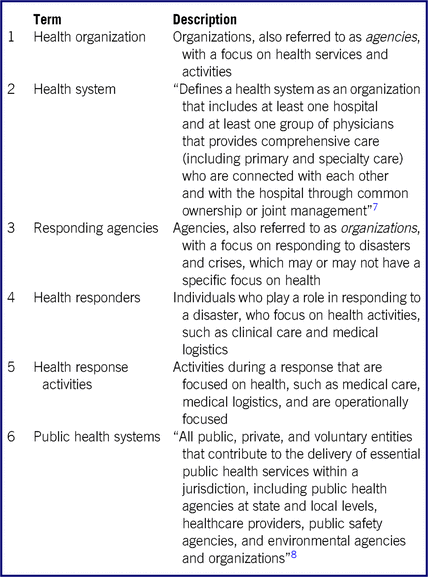
Every year there are larger and more severe natural disasters affecting countries around the world, including the continental United States (US) and its territories. 1,2 During these times, emergency response organizations and public health systems (PHS) struggle to identify high priority health needs and respond with appropriate services and supplies to keep hospitals and health systems running. 3,Reference Redlener and Reilly4 (See glossary of terms in Table 1.) Key infrastructure such as communication lines and power sources are often damaged, further exacerbating this challenge. The systems themselves, whether in the United States with agencies such as the Federal Emergency Management Agency (FEMA) or global humanitarian response agencies such as the United Nations Office for the Coordination of Humanitarian Affairs (OCHA) aim to meet these ongoing challenges. Both systems quickly identify emerging and outstanding needs (eg, surgical services, power supplies for ventilators and dialysis care) while prioritizing needs within the broader disaster context, taking into account resources, human capacity, and financial limitations. 5,6
Glossary of Terms

Lessons learned from previous disasters have shown that responding to the acute and ongoing medical needs of those affected by crises is often inadequate. The 2010 Haiti earthquake triggered a global response with involvement of US-responding agencies. Trauma and injury care was the primary essential service needed early in the response, but health agencies were challenged with providing surgical services in a severely damaged environment with limited infrastructure. For example, managing traumatic injuries after a large-scale earthquake, along with providing ongoing dialysis for individuals with renal failure, requires managing the deployment of skilled and trained doctors, nurses, and allied health professionals. Obstetrics and maternal child health were important ongoing needs, extending weeks to months after the initial earthquake, which were under-resourced, despite being an essential service. Reference Goyet, Sarmiento and Grünewald9 Physical therapy and rehabilitation care services were unique essential services post-earthquake, but identifying services were challenged by the lack of information on postoperative care needs. Reference Landry, O’Connell, Tardif and Burns10 By October 2010, cases of acute watery diarrhea were reported, marking the beginning of the first and largest cholera outbreak in Haiti. Lack of coordination further complicated the ability of the PHS to direct health organizations to provide public health and medical services. Reference Goyet, Sarmiento and Grünewald9 These examples exemplify some of the challenges that PHS face after a disaster, which can significantly impact morbidity and mortality.
A crucial overarching challenge is getting the right health information to the right medical and public health service personnel at the right time. For instance, the role of information and data in shaping a humanitarian response was most recently highlighted in the West Africa Ebola response, where inadequate, delayed, and at times, contradictory information, impacted the multi-national response in Sierra Leone, Liberia, and Guinea. Reference Waugaman and Fast11 The PHS of affected countries struggled to trace, predict, and contain the spread of disease. Government and non-governmental organization (NGO) data systems remained siloed, limiting the sharing of essential health information updates between nations and organizations. This negatively impacted the overall awareness of the spread of Ebola, slowing coordination between health organizations, and an awareness of how organizations were responding.
In the United States, disasters are often affected by the burden of chronic diseases that are acutely exacerbated by the crisis environment. National and local responding agencies face challenges in effectively gathering information on medication needs, such as insulin and blood pressure medication. 6,12‐Reference Collins, Pang and Lindsell14 In the aftermath of Hurricane Katrina, different stakeholders, including health professionals, logistics organizations, and coordinating bodies, needed this information to prescribe, procure, and deliver appropriate medication to shelters to support the chronic medical needs of those with diabetes and hypertension. Reference Arrieta, Foreman, Crook and Icenogle15,Reference Sharma, Weiss and Young16 Similar challenges reoccurred several years later in the aftermath of Hurricane Sandy where health responders faced a lack of relevant information, such as where to find additional supplies of chronic medication for affected individuals. Reference Redlener and Reilly4 Making key decisions with limited, outdated, or irrelevant health information can negatively affect health response activities, and subsequently impact the morbidity and mortality of those affected by disasters. Reference Powell, Hanfling and Gostin17 Given the complexity of quickly gathering information during chaotic times of disasters, there is an opportunity to leverage non-traditional data sources to enrich situational awareness in both US disasters and global humanitarian responses.
REQUIREMENTS TO MEET THE INFORMATION NEEDS OF HEALTH PROVIDERS
Getting the right health information to the right health providers at the right time also affects how health organizations coordinate with one another. Although response agencies (eg, OCHA, FEMA) broadly support and advocate for improved coordination in the aftermath of disasters, challenges remain and criticism continues. Evaluation and “lessons learned” reports document the need for improved information sources, which play a role in strengthening the coordination of organizations within PHS in these dynamic environments. Reference Goyet, Sarmiento and Grünewald9,Reference Waugaman and Fast11,Reference Bennett, Bertrand and Harkin18 The Tsunami Evaluation Coalition Report evaluated the global humanitarian response to the 2004 Indian tsunami disaster and identified multi-level coordination challenges between the United Nations, international NGOs, and governments where duplicative service efforts occurred at various locations. Medical team deployments did not match the health needs in numerous affected locations, and, at times, incoming and temporary medical teams displaced the local functioning health systems. 19 In the US disaster context, delayed evacuations of patients from health facilities continue to be a persistent problem. For example, during Hurricane Katrina, Superstorm Sandy, and Hurricane Irma, delayed evacuations have resulted in morbidity and mortality. 3,Reference Redlener and Reilly4,20,Reference Rabin21,Reference Dosa, Hyer and Brown22 In the aftermath of Hurricane Irma, 12 individuals at a rehabilitation center died due to the lack of temperature control caused by power outages. The acute needs of this vulnerable population were not quickly identified by the PHS. Reference Wright23 Crucial and related emergency infrastructure activities such as power, water, and road infrastructure are examples of the complex response environment for which health agencies and responders need to make timely decisions. These examples indicate a need for an improved way to achieve health situational awareness during disasters. With a more accurate and timely understanding of evolving situations, health care coordinating bodies can better direct resources and services to hospitals and communities with the greatest need, while using limited resources in the most effective way. Reference Goyet, Sarmiento and Grünewald9,Reference Powell, Hanfling and Gostin17,Reference Hullah, Llewellyn and Aryal24‐Reference Gates26
THE PARADOX OF INFORMATION SCARCITY AND OVERLOAD
During disasters, gathering both timely and relevant health information is a challenge due to the paradox of information scarcity and information overload. In some humanitarian environments where protracted conflict or restrictive settings predominate, limited health information is common. Health information from North Korea has been limited to a few organizations with access to health information (eg, UNICEF, World Health Organization [WHO], World Bank). Reference Grundy, Biggs and Hipgrave27 Mortality studies in Iraq also exemplify the challenges that researchers and health organizations face in quantifying the impact of complex humanitarian crises on the lives of those affected during war and conflict. Reference Tapp, Burkle and Wilson28‐Reference Burnham, Lafta, Doocy and Roberts30 Limited access to mortality data due to a paucity of comprehensive or updated information can result in a limited situational awareness of the greatest needs for health services and the most vulnerable groups at risk for disease and injury. US disasters have faced similar challenges of information scarcity contributing to not only challenges, but also controversy in determining the number of deaths due to a natural disaster. Early reports of death counts after Hurricane Maria in Puerto Rico varied from 64 to estimates of up to 8498, due to difficulty in accessing reliable information about deaths after the disaster. Final government estimates of 2975 were released almost 1 year after the hurricane. Reference Kishore, Marqués and Mahmud31,Reference Santos-Burgoa, Sandberg and Suárez32,Reference Robles, Kenan, Fink and Almukhtar33
In contrast, the presence of information often does not equate to an improved awareness of the disaster environment. Reference Waugaman and Fast11,Reference Crowley and Chan34,Reference Altay and Labonte35 In the past decade, digitally enabled information channels have grown exponentially with access to the Internet, mobile phones, and other digital devices. As a result, the post-disaster environment is frequently affected by information overload. During the aftermath of the 2010 Haiti earthquake, for which both global and US disaster response systems activated, the growth of digital information in the form of mobile communications, web-based information systems, geographic information, and digital volunteer activity resulted in not only unprecedented large volumes of information, but also the recognition by the humanitarian community of the information ecosystem and challenges that lie ahead. Reference Crowley and Chan34,36 In this complex health information environment, achieving public health situational awareness with both information overload and scarcity depends on small and large-scale human and automated efforts to collect, filter, and organize conventional and unconventional forms of health information. Social media such as Twitter streams, considered by many as an unconventional health information stream, provide an abundance of big data and new opportunities. For example, more than 20 million Twitter posts (tweets) were generated within a week during Hurricane Sandy, which overwhelmed US response teams in filtering relevant signals (eg, updates on medical facilities) from the noise (eg, prayers, jokes). Reference Purohit, Castillo and Diaz37
OPPORTUNITY: COLLECTING UNCONVENTIONAL INFORMATION STREAMS
There are a variety of unconventional digital data streams available for consumption in both US and global contexts, including social media (eg, Twitter, Facebook), news, RSS feeds, blogs, and official agencies’ situation reports. These new information streams can potentially improve situational awareness by providing enhanced, aggregated overviews of common information from the diverse streaming sources. As a result, it opens up opportunities to help explain the emerging needs and potentially support decision-making among emergency response teams. Reference Van de Walle, Brugghemans and Comes38
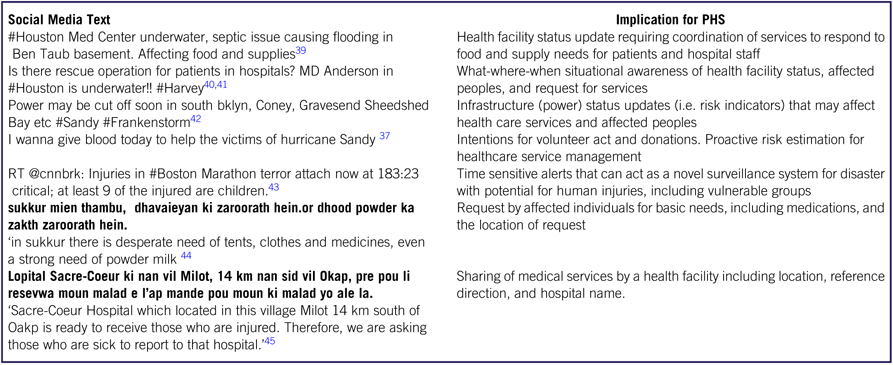
Social media and Web data streams can provide an unconventional, alternative source of information for health response activities in a disaster (see examples in Table 2). It also opens up novel opportunities to addressing some of the challenges in collecting the right information at the right time. By collecting relevant information about evolving needs for medical supplies, patient transport services, or health concerns, improved health-focused situational awareness can potentially impact the decision-making of public health and medical responders. Big data from social media present opportunities to extract valuable information (ie, defined as content that can influence disaster response planning and operations). It is often dependent upon computing techniques that can process large-scale data streams (ie, information overload) to filter and extract relevant information to address the existing challenge of low signal to noise ratios. The resultant relevant information may be of value to the health responders (eg, doctors, national and international emergency responders) who are coordinating health services (eg, medical supplies) and also coordinating with local and national public health offices.
Examples of social media messages from recent disasters and their implication for health services.

Social media platforms provide application programming interface (API), which facilitate the collection of these large public data streams so that they can be interpreted and analyzed for various purposes. Because there is such a large volume of data that can be collected during disasters, there are 2 major computational methods for filtering event-relevant data streams. Geo-fencing filtering is a method in which a specific disaster area is defined by a boundary for which the data are filtered. Keyword-based filtering is a method in which a given set of relevant keywords is used to narrow down the volume, such as the name of the disaster (eg, “Nepal earthquake,” “Hurricane Sandy”) or the sector of response (eg, “health,” “hospital”). Additional filtering can be done using metadata of social media posts, where information is collected for each unit of social media communications (ie, Tweet, Facebook post) such as author and time. Depending on the application, further task-specific information extraction and filtering methods are required. All of these filtering techniques can begin to address the challenges of information overload seen in social media-based big data during disasters.
CURRENT USE IN CONTEXT
The adoption of unconventional social media information into organizational practice has lagged behind the adoption of digital data collection tools such as electronic medical records and telemedicine, but remains an opportunity for further development. Currently, research groups are mining large volumes of social media information for epidemiologic surveillance while few organizations are monitoring social media feeds to help inform their situational awareness during responses.
The most studied use of social media information in public health practice lies with investigating the role that social media can play in epidemiology, public health surveillance, and detection of disease outbreaks. For instance, the HealthMap tool has primarily focused on epidemiologic surveillance by mining large volumes of health-related information from Web sources, including Twitter, to track and monitor emerging infectious diseases, including influenza. Reference Paul, Sarker, Brownstein, Altman, Dunker and Hunter46‐Reference Bennett, Olsen and Harris48 Despite these advances in mining social media for health purposes, future research is needed beyond epidemiologic surveillance research. In disaster settings, epidemiologic surveillance for emerging outbreaks of disease and PHS is interrelated but represent a subset of essential services for a comprehensive health response. According to the Sphere Handbook and the WHO Emergency Response Plan, control of communicable diseases is one component of overall essential health services and is interrelated with broader PHS. 6,49 Expanding and further developing computation techniques to mine social media data beyond epidemiologic usage to essential health services, including health logistics and health coordination, are areas of important research exploration.
More broadly, existing techniques and tools (eg, Hootsuite, TweetDeck) for basic social media filtering have been adopted in the operational environments of response organizations. Reference Reuter, Ludwig, Kaufhold and Spielhofer50‐Reference Houston, Hawthorne and Perreault52 Disaster management organizations, both globally and at the national, state, and local health levels, are increasingly engaging in social media to communicate with the public during disasters and explore ways in which information can be extracted to influence their response activities. Reference Markenson and Howe53‐Reference Sutton, League, Sellnow and Sellnow55 The United States Health and Human Services investigated the role of tweets during the 2012 Hurricane Isaac disaster, using key word searches, and determined that non-traditional data sources can provide valuable health information. Reference Bennett, Olsen and Harris48 During the Nepal earthquake response, ACAPS, a humanitarian organization focused upon providing situational awareness to responding agencies during crises, evaluated the use of social media. Reference Luge51 The evaluation found that social media could help organizations gain a better understanding of the public’s reaction to media reports but found limited use in understanding the needs of those affected.
However, such tools, experiences, and early research are highly limited to the basic key-word-driven searches for accessing relevant content, as well as basic descriptive and trend analyses. Incorporating timely information in response coordination tasks such as caring for the rescued patients from a disaster zone, as well as responding to help calls seeking medical help, is primarily manual and labor-intensive. Reference Morrow, Mock, Papendieck and Kocmich56 There is a need to design automatic techniques for real-time filtering of relevant social media content and open web streams using health terms and public health knowledge to drive the way computers filter out noise and capture important information that can be operationally relevant for health responders.
FUTURE RESEARCH CHALLENGES TO EXTRACT RELEVANT INFORMATION FOR HEALTH PROVIDERS
To enable a more health-specific approach to social media analysis during a crisis that can further improve how non-traditional data can be consumed by health responders, 2 major challenges should be addressed: (1) advancing mining methodologies that can extract health meaning and creating relevant knowledge bases focused on US response and global response systems for action, and (2) expanding current research design and approaches to focus on public health and health activities, specifically operational response.
Challenge 1: Mining for Health Meaning and Relevant Knowledge Bases for Action
Crisis informatics, “a multidisciplinary research field combining computing and social science knowledge of disasters that focus on how people use personal information and communication technology to respond to disaster in creative ways to cope with uncertainty,” is a known area of specialty in information sciences, computer science, and social media and emergency management.Reference Palen and Anderson57 It has been extensively studied in these disciplines but less developed within humanitarian health and public health disciplines. Crisis informatics currently focuses on broader disaster information categories such as calls for help and message spreading rather than health content and health trends as a central focus. Prior research in crisis informatics on social media has focused on mining topics of conversations, understanding general public behavior, as well as modeling information credibility and trustworthiness of information sources.Reference Castillo58,Reference Imran, Castillo, Diaz and Vieweg59 Although general approaches to analyzing and processing social media information exist, they lack the level of specificity and actionability required for extracting health-focused information during disasters, which can be used by health responders.
One important implication of these studies suggests a need to transform social media information into not only a consumable form, but also a health relevant form for public health providers and medical responders. Using new research methodologies that focus on health content, the resultant information can be vetted for trustworthiness and organized into existing knowledge management structures for the information systems of health responders. But before this goal of mining relevant information for health services can be accomplished, understanding social media data characteristics that are unique to frequently used text with informal language is necessary. Texts often contain slang words, abbreviations, and different conventions to express topics. Hashtags are an example of a newer convention that relates to topics of conversation. The streams of text data also include links to other content on the Web. Such characteristics of social media text are further complemented by multimedia content containing images and videos. Altogether, the complexity of the characteristics of both general text and multimedia challenges the processing of social media streams for identifying relevant information. In addition to the data characteristics, there is a further limitation in the direct application of standard tools such as natural language processing (NLP) methods that are developed on well-formatted, grammatically correct text. Thus, the high volume, variety, and velocity of noisy social data streams overload and exhaust the human resources of many health organizations for information processing to extract and filter the needles of relevant information for health responders from the haystack.
Currently, different kinds of analyses have been performed with a focus on extracting general disaster information from various sources to provide some degree of structure to the large volumes of big social media data during disasters. The resultant efforts from these methods are to develop a general disaster knowledge base. In addition, current research focuses on qualitative and quantitative content-driven analysis of information within social media for extracting general disaster topics and events (eg, damage-related) and general behaviors (eg, for user trust and information sharing).Reference Castillo58 These studies have helped provide an overview of the types of general behaviors and sentiments that emerge in social media during disasters. What is lacking is a necessary specificity in the information extraction, behavior mining, and real-time analytics that is specific to health situational awareness for both US and global response activities during disasters. For example, sentiment of fear identified in social media analysis needs to be interpreted within the health and public health risks for potential disease outbreaks and potential health services’ resource needs. For example, the emotions of fear, sadness, and hope without references to child illness, health facility status, or medication access are much less relevant for public health and medical responders.
Challenge 2: Intention of Use Problem
Advanced research that currently provides a general approach to mining and extracting social media information in disasters requires further refinement and focus on the intention of use of social media for health response. The intention of public health providers and medical responders is to get the right, relevant health information to the right medical and public health service personnel at the right time, rather than a focus of a broad overview of general disaster information. There is a lack of attention given to the research on big data analytics to mine and organize relevant information from social media that will assist disaster health responders in the identification of critical public health information needs beyond epidemiologic surveillance. Further development is needed to integrate extracted health information into the existing information systems of public health services, both in the US context and globally. While knowledge of emerging, infectious diseases from social media play a role in the overall health response during disasters, health providers and medical responders also seek actionable knowledge about essential health services, medical logistics and transportation, and coordination activities for public health response within the systems that they work in. Recognizing these specific intentions for use of social media information can help further advance research approaches to extracting information that will complement traditional reports as novel information sources improve situational awareness.
However, mining relevant user intentions from the content of social media messages is challenging, given the complexity of natural language understanding – one of the key problems of artificial intelligence.Reference Purohit, Pandey, Agarwal, Dokoohaki and Tokdemir60,Reference Allen61 For example, in social media environments, individuals and groups will express their intent for needs and information in varying ways based upon culture, language, and colloquialisms. It is an emerging research area with multiple challenges in efficiently mining the sense from the content with two major issues. In particular, when there is not enough data for computers to adequately enable it to learn specific patterns for the associated meaning of words, then it causes a sparsity issue. Also, NLP is challenged with language and word sense ambiguity, which is often the way people express themselves on social media, with informal language. Ambiguity and sparsity are two particular issues while dealing with mining intentions from social media text that should be addressed along with the health-specific context of the intention of use.Reference Purohit, Dong and Shalin62
CONCLUSION
The opportunities to leverage insights from social media data during disasters lie beyond extracting general information using existing research techniques of NLP and text mining. It will require new approaches and methodologies that address the major challenges of language understanding in artificial intelligence. New research will need to first focus on the primary goal of public health providers and medical responders whose priority is to get the right health information to the right medical and public health service personnel at the right time. This “intention of use” challenge will expand current social media research to focus on and include health service planning, coordination, and medical logistics, to name a few. This will further develop ways to efficiently and accurately retrieve information that is not only health focused, but also operationally relevant with actionability.
Future research will also require new scientific approaches and computational techniques to be more successful at mining health meaning during disasters. Adapting to the complex and heterogeneous ways that text and multimedia are used informally by people on social media during disasters will be essential to address for the new data filtering systems. The resultant extraction of value-added information into knowledge bases will provide an environment for which health responders can access information from social media in practical ways. These new tools will help get the right health information to the right people at the right time. In turn, the broader response community will benefit from the power and skills of both humans and computers to improve the lives and health of those affected by crises.
Funding Statement
Purohit thanks US National Science Foundation grants IIS-1657379 and IIS-1815459 for partial research support.
Conflict of Interest Statement
The authors have no conflicts of interest to declare.