1. Introduction
In recent years, there has been growing discussion in scientific and policy circles of the need for adaptation to climate change. These arguments take various forms, the most reasonable of which is that climate change is already under way, and even with a strong program of greenhouse gas mitigation, we will be facing further unavoidable changes arising from the long residence time of greenhouse gases in the atmosphere (IPCC Reference Hawkins and Sutton2007; Solomon et al. Reference Smith2007).Footnote 1 However, this is not a new insight: the UN Framework Convention on Climate Change, adopted at the Rio Earth Summit in Rio de Janiero in 1992, acknowledged even then that responding to climate change would involve some degree of adaptation.Footnote 2
Today, as we look to the future, it is not a question of either/or—mitigation or adaptation—it is a matter of both/and. We will need to mitigate to avoid the worst case scenarios for future climate change, and we will need to adapt to the climate change that is now unavoidable because of our past and current use of greenhouse gases and changes in land use. All of this is taken as given among most scientists and others now involved in climate science and policy. Lately, however, some have been suggesting that adaptation is the preferred route to dealing with climate change. Adaptation, some argue, is more politically realistic and will be more cost effective and less economically disruptive than emissions control.
This argument has been particularly promoted by the libertarian think tank, the CATO Institute, but some environmentalists accept it as well (e.g., Schellenberger and Nordhaus Reference Ramanathan and Feng2007).Footnote 3 When the Los Angeles Times summarized the views of advocates of adaptation, they glossed it this way: “Just deal with it” (Zarembo Reference Wigley2008). This gloss might be viewed as a bit misleading, because by and large advocates of adaptation are not arguing for simply responding to changes after they occur; they are arguing for preparing to adapt. But arguments for preparing for the consequences of global warming—rather than trying to prevent them—rest on the assumption that we know what “they” are. That is to say, they rest on the assumption that we can reliably anticipate the changes to which we will be adapting and therefore that we can sensibly plan for those changes. Do climate models give us the information we would need to accurately estimate the costs of adaptation and effectively prepare for the consequences of climate change? In this article, we argue that they do not.
First, while climate models consistently suggest that the mean global temperature of the planet will rise, mean global temperature is not what any one person, state, or nation will be adapting to. Human beings will be adapting to changes in the weather at the places where they live and a host of concomitant local effects of climate change that ensue from such changes. While there is broad consensus on the expected change in average global temperature, there is much less agreement between models regarding these local changes and concomitant effects. In particular, there is widespread divergence in model simulations of the impact of global warming on regional precipitation, a variable that is at least as important for human activities as temperature, if not much more so. Furthermore, models show systematic errors in the global mean temperature similar in magnitude to the size of the historical change we are seeking to understand. Models do not agree on the absolute value of the twentieth-century global warming temperature, but they do show close agreement on the size of the change over the past century. That is to say, while scientists agree that warming is underway, and broadly agree on the amount of anthropogenic change that has occurred to date, when we get down to the details of future changes and therefore anticipated future states, there is much less clarity and therefore much less agreement.
Second, there is a gap between the scale on which models produce consistent information and the scale on which humans act. Planning for adaptation requires information on the scale over which human organizations and institutions have authority and power: towns, cities, states, provinces, and nations. The IPCC argues that current global circulation models (GCMs), with typical horizontal resolutions of 100–500 kilometers, provide “credible quantitative estimates of future climate change, particularly at continental scales and above”; phrasing that nods to the debates in the modeling community over their forecast skill on subcontinental scales (IPCC 2000).Footnote 4 Thus, while the reality of mean global warming is essentially undisputed, the future impacts on the scale at which humans would have to prepare for and adjust to them are still the subject of considerable research, inquiry, and debate (Oreskes Reference Oreskes2004, Reference Oreskes, DiMento and Doughman2007).
Third, existing models are unable to simulate realistically (much less evaluate the likelihood of) extreme outcomes—a rapid disintegration of the West Antarctic Ice Sheet, for example, a major dieback of the Amazon, or a sudden increase in release of stored greenhouse gases from arctic permafrost. Yet, from a moral, ethical, and practical standpoint, our thinking must consider the finite (that is to say, nonzero) possibility that such outcomes may occur (Gardiner Reference Davis, Knappenberger, Michaels and Novicoff2004). Our global models give us little relevant information regarding such perhaps unlikely, but potentially grave, impacts.
One thing, however, is virtually certain: the less we mitigate, the more we shall have to adapt. Furthermore, the less we mitigate, the more likely we are to face challenges that surpass our capacity to adapt without pain and suffering. Broadly speaking, the greater the burden of greenhouse gases in the atmosphere and the oceans, the greater the environmental impact will be. So the less we control those gases, the more likely it is that the ensuing climate changes will be difficult to manage. If we do nothing at all, the odds of catastrophic outcomes increase substantially, and in the face of such outcomes our ability to “just deal with it” may well vanish entirely. Furthermore, the impacts of climate change—and thus the burden of adaptation—will be distributed without regard to prior greenhouse gas contributions, so the unjust ethical impacts of climate change increase as well. And the less we mitigate, the more burden there will be.Footnote 5
2. Is Adaptation More Realistic?
There is broad agreement among climate scientists that we have already incurred a nontrivial climate commitment (Wigley Reference Nations2005), or—as the 15-year-old daughter of one of us puts it—a climate “sentence” (Solomon et al. Reference Smith2007, 5; Ramanathan and Feng Reference Pielke, Prins, Rayner and Sarewitz2008).Footnote 6 Even had greenhouse gas concentrations been stabilized at year 2000 levels, existing atmospheric greenhouse gases would have produced temperature changes and concomitant environmental effects of a magnitude requiring significant adaptation. And emissions were not stabilized; they continue, today, to rise. The 1992 UN Framework Convention on Climate Change commits its signatories to preventing “dangerous anthropogenic interference with the climate system” (United Nations Reference Tebaldi, Nychka and Mearns1992, 4), and while “danger” is a value judgment, many have expressed the view that dangerous anthropogenic interference may start around a 2°C increase over preindustrial levels. This is an alteration to which we may well already be “sentenced” (Commission of the European Communities 2005).Footnote 7 James Hansen has argued that we are either at or near a tipping point beyond which changes will ensue that “constitute practically a different planet” (Reference Giorgi2005, Reference Hansen2006; see also Connor 2007; Mann Reference Lomborg2009). Veerabhadran Ramanathan and Inez Feng (Reference Pielke, Prins, Rayner and Sarewitz2008) have expressed the opinion that dangerous anthropogenic interference is most likely already in our rearview mirror.
Given this sobering information, several commentators have suggested that mitigation has failed and that efforts to address global warming through adaptation should be strengthened and perhaps become our primary focus. In July 2000, for example, Daniel Sarewitz and Roger Pielke Jr. (Reference Rahmstorf2000) argued that reducing vulnerability by preparing for the possible effects of climate change—increased hurricanes, flooding, and mud slides and an expanded range of insect pests and tropical diseases, for example—offered a way out of the he said/she said framework of climate science and science denial and the political impasse of doom mongering versus cornucopia. More recently, they have suggested that since climate change is now unavoidable, we have no choice but to focus on resilience and diminution of vulnerability, regardless of its cause (Pielke et al. Reference Parry, Canziani, Palutikof, van der Linden and Hanson2007).Footnote 8
We agree with the value of attention to resilience and diminution of vulnerability. However, such arguments can—and often are—interpreted to imply or suggest a more radical view: that the failures of efforts since the Framework Convention to control greenhouse gas emissions implies that mitigation is hopeless and that adaptation should now become our primary focus. That is to say, because we have tried and failed to mitigate, we now know that that strategy does not work, and therefore we must turn to adaptation as a preferred alternative. This, of course, is an arguable point: past failures ensure continued failure no more than past success ensures continued success. (Certainly there were many attempts to secure the vote for women before it was enshrined into U.S. law with the Nineteenth Amendment in 1920 and international law in 1948; one could think of numerous other historical examples.)
In the mass media, Pielke's position has been characterized as the conclusion that “it is cheaper and more effective to adapt to global warming than to fight it” (Zarembo Reference Wigley2008). On his Web site, Pielke rejects this characterization, saying that “it is a strawman to argue that strong support for adaptation means that one cannot also provide strong support for mitigation.”Footnote 9 We agree. However, it is not a straw man to note that resources and attention are limited and that any argument for focusing greater attention on adaptation may easily be read as an argument for focusing attention away from mitigation—as indeed the Los Angeles Times reporter did.
Moreover, others have presented adaptation as a dichotomous alternative—and a better one—to mitigation. In particular, some vocal commentators have claimed that adaptation will be much cheaper. In his widely cited book, Bjorn Lomborg made the unqualified assertion that “it will be far more expensive to cut CO2 emissions radically than to pay the costs of adaptation to the increased temperatures” (Reference Lawson2001, 318).Footnote 10 Nigel Lawson, the former British chancellor of the exchequer has also argued that “adaptation is far and away the most cost effective approach” (2006, 6; see also Lawson Reference Lawson2009). These claims that adaptation is easier, cheaper, or more reasonable presuppose that we know what we will need to adapt to, that adaptation is possible, and that the costs are known accurately (and are relatively small). This implies that we have a good handle on the implications of change on the scale at which human decisions are made and actions are taken. Do we?
3. IPCC Precipitation Projections
Consider precipitation. One of the most important aspects of climate—affecting water supply, agricultural productivity, and risk of floods and droughts—is summer precipitation. How will summer precipitation change in response to global warming over an area such as the U.S. Midwest?
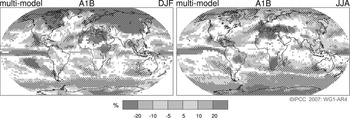
Figure 1 is taken from the “Summary for Policymakers” of the “Fourth Assessment Report” of the IPCC (Reference Hawkins and Sutton2007, 16). It presents results of projected patterns of precipitation changes based on multimodel averages for December–February and June–August for the entire globe. These results are averages of 21 different models. The stippled areas represent regions where more than 90% of the models agree on the sign of the changes (i.e., wetter or drier). The white areas denote grid points where at least one-third of the models disagree with the majority on the sign of the changes. While agreement among models does not ensure knowledge, lack of agreement establishes fundamental uncertainty, if not outright ignorance.
Relative changes in precipitation (%) for 2090–99, relative to 1980–99. Values are multimodel averages based on the SRES A1B scenario for December–February (left) and June–August (right). White areas are where less than 66% of the models agree on the sign of the change, and stippled areas are where more than 90% of the models agree on the sign of the change (IPCC Reference Hawkins and Sutton2007, 16). Figure reproduced according to the permissions policy of the Intergovernmental Panel on Climate Change, http://www.ipcc.ch/publications_and_data/publications_and_data_figures_and_tables.htm.

Consider the results for summer in North America. Over a large portion of North America—including most of the American Midwest—the model results are in disagreement. That is to say, the models do not just disagree about the magnitude of the change, they fail to agree on its direction. In effect, this says that rational adaptation would require us to prepare for both more rain and less—and such white regions are spread around the globe. Much of sub-Saharan Africa, Australia, Arabia, India, and a large swath of Russia and eastern Europe are characterized by this degree of model disagreement.
4. A Scale Gap
A second problem arises from issues of scale. Global warming is often discussed in terms of changes in mean global temperature and mean global sea level, but from the perspective of adaptation, global means are not particularly informative. Adaptation will involve changing crops planted and processed, building sea walls, installing irrigation systems, and so on; pertinent information will be on the scale of human institutions: neighborhoods and nations, parishes and provinces, cantons and countries. What do we know about expected changes on such scales?
The answer is not much. The IPCC readily acknowledges the large degree of uncertainty of model estimates on subcontinental scales. “There is considerable confidence that climate models provide credible quantitative estimates of future climate change, particularly at continental scales and above,” they state, implicitly acknowledging the difficulties that remain in simulating smaller scales (Solomon et al. Reference Smith2007, 10).
If we needed to plan for adaptation on the scale of a continent, we might feel confident that we had credible quantitative estimates of what we needed to plan for (and this might be reassuring for the prime minister of Australia). But adaptation (even in Australia) will necessarily take place at much smaller scales: states, provinces, cities, towns, and even individual homes and farms. Whether, when, and how climate models could provide the necessary information to inform realistic decision making on the scale at which human action occurs is still a question of significant debate.
Could this problem be resolved through model ensembles? No, inasmuch as much of the ambiguity in model simulations arises from structural errors, which are not well accounted for, and therefore are not resolved simply by running more models or running them over a wider range of parameter space. The Andes, to give just one example, are not realistically resolved in current GCMs. If we were to use model simulations for adaptation, we would have to assume that this lack of fine-scale detail would not lead to missing a feedback of any relevance, locally or globally. And, of course, there are known processes that are just plain missing from our ensemble of models. The IPCC explains: “The effects of uncertainty in the knowledge of Earth system processes can be partially quantified by constructing ensembles of models that sample different parameterizations of these processes. However, some processes may be missing from the set of available models, and alternative parameterizations of other processes may share common systematic biases. Such limitations imply that distributions of future climate responses from ensemble simulations are themselves subject to uncertainty (Smith Reference Seager, Kushnir, Ting, Cane, Naik and Miller2002) and would be wider were uncertainty due to structural model errors accounted for” (Solomon et al. Reference Smith2007, 797). Model ensembles that explore a wide range of physically plausible input conditions may help us to capture a range of physically plausible outcomes, but they will not correct systematic bias, error or distortion, or unresolved interactions and feedbacks, or account for missing processes. Any structural errors in the models will be recapitulated in ensemble runs, and omitted processes will still be omitted.
Climate scientists can sometimes estimate the probability of important behavior that may result from omitted processes, providing more information for decision makers than is extractable from the models. Nevertheless, the range of possible conditions for adaptation could well be larger than indicated by the model results, and it may be that for some decisions that range is already too large to give us confidence that we know what we will be adapting to.
An example may help underscore the point. Stainforth (Reference Stainforth, Downing, Washington, Lopez and New2010) has discussed the results of model runs from the grand ensemble collected by the public participation project (http://climateprediction.net; see also Stainforth et al. Reference Stainforth, Olsen, Kiang and Waskom2005, Reference Solomon2007). This ensemble shows a wide range of precipitation response over the central North American region. For these runs, performed under a single model structure, precipitation response varies over a range of plus or minus tens of percentage points. That is to say, under one particular set of model versions, the range of possible outcomes for central North America is very great, and it remains unclear whether adaptation will require responding to wetter or drier conditions. Should we add a wider range of model structures over a range of plausible climate sensitivities, we would likely get a still larger range of uncertainty.
Given the state of the art of climate modeling, this is neither surprising nor damning of this particular structure; using another model, it has been shown that model error is expected to limit seeing impacts as “small” as the 1930s dust bowl (Seager et al. Reference Schellenberger and Nordhaus2008). Moreover, there is no contradiction with the scientific basis for recognizing global warming: it is quite possible that current models are informative for risk management in mitigation without being able to provide the fine-scale details required for adaptation.
This provides a response to the question of whether adaptation will be cheaper than mitigation. The correct response is that we just do not know. If we do not know whether conditions will be wetter or drier—or perhaps both—then we cannot know how much it will cost to respond to those altered conditions. Similar arguments could be made about uncertainties in sea level rise, summer maxima, winter minima, and agricultural viability of annual and perennial crops. To assert that adaptation will be cheaper than mitigation is to suggest a degree of certainty in future outcomes that we simply do not have.
5. Is Adaptation Realistic?
Could we say that adaptation is more realistic than mitigation even if we could accurately predict the direction, if not the magnitude, of future change? That is to say, if we knew for sure that future summer conditions in California would be drier overall, could we then assert that adaptation would be cheaper and easier than mitigation? The answer here is also no because adaptation strategies will not necessarily always be available, even if we know what we need to do. Some agricultural crops, such as almonds and apricots, are not easily moved. Even if farmers could move their trees in response to temperature changes, other constraints, such as sunlight, soil type, timing of pollinators, and weather variability, will restrict adaptation options, as will the existence of national boundaries. Farmers in Washington state will not necessarily be able to move to British Columbia, and it appears unlikely that Mexican farmers will be given free reign in California.
Some might claim that, given sufficient funds, agriculturalists may be able to adapt to almost anything. Soils can be modified, plants can be moved into greenhouses, and artificial sunlight might even be employed in warm, dark, northern climates. This is true, but it undermines the presumption that adaptation will necessarily be cheap.
Moreover, ecosystems are a different matter. Much—in fact we would argue nearly all—of the discussion advocating adaptation centers on human adaptation. However, much of the impact of climate change is expected to fall on other species. IPCC Working Group II addresses impacts, adaptation, and vulnerability; their “Summary for Policymakers” of the “Fourth Assessment Report” outlines extensive impacts on biological populations, including timing and distribution of bird migration and egg laying; poleward and elevation shifts in the ranges of plant and animal species; changes in the abundance and range of fish, algae, and plankton populations; and more (IPCC Reference Hawkins and Sutton2007). These shifts show that nonhuman species are already being affected and, in some cases, are adapting by shifting their ranges or timing of biological activities. But is it realistic to think that most species have the adaptive capacity of humans? Organisms at their geographic or elevation limits may have nowhere else to go; the observed changes imply adverse effects on those species that are unable to move or adjust, with the risk of diminution or extinction. There is no reason to suppose an adaptation strategy that preserves global biodiversity exists.
A critic might argue that our argument here presupposes that adaptation need be preemptive and that often people (and perhaps other species) can respond to events after they have occurred. (After all, organisms that have shifted their range in the past did so, presumably, without having predicted the need.) For those who survive these events, at least, this is true, but as recent events in New Orleans have demonstrated, post hoc responses can be costly in terms of dollars, livelihoods, and lives. Tens of billions of dollars in damages from hurricanes might have been averted by hundreds of millions of dollars spent on levees, sea walls, and evacuation plans.Footnote 11 Adaptation to current conditions is sensible, and the costs of adaptation to local conditions 100 years from now can only be deemed small if one claims to know the local conditions to be faced 100 years from now.
Moreover, most of the proposed adaptive responses to climate change do imply anticipating events and preparing appropriate responses. Under circumstances of high uncertainty, a rational decision maker might wish to prepare for a range of plausible outcomes, and the cost of rational adaptation will increase in such cases as the range of plausible outcomes increases. In southern California, for example, there have been discussions of the need to prepare for future droughts through the capture, purification, and reuse of domestic wastewater. Such systems cost billions of dollars and are highly unpopular politically—hence, the moniker “toilet to tap”—but they would almost surely be warranted if we knew that future conditions would be consistently drier. However, wetter conditions, or a winter shift from snowfall to rainfall, could mean greater risk of floods and mud slides, perhaps warranting investment in reservoirs, flood control, and slope stabilization. Is it realistic to expect civic leaders to extract sufficient funds to build desalination plants beside larger reservoirs?
6. Sea Level Rise
One of the most serious potential effects of mean global warming is sea level rise caused by thermal expansion of seawater and mass addition to the oceans from continental ice sheet melting. How will sea level rise around the globe?
The IPCC does not have a figure for sea level that corresponds to the one for precipitation discussed above, indicating local regions where the model variation would require a large range of adaptive responses. Moreover, many people assume that sea level is a simple matter: the ocean will rise, like a bathtub being filled, so the direction of change is certainly known, and regional variations should not be a significant problem. This turns out not to be true. There are significant regional variations in sea level associated with possible changes in ocean circulation patterns, the gravitational attraction of ice sheets, and other effects (Milne et al. Reference Michaels and Balling2009). Local adaptation would have to consider this range of variation, with additional uncertainties in storm surge and a host of onshore details that will affect how much a given sea level rise will affect a given coastal community. This introduces a significant range of potential impacts against which human communities will need to protect. As with precipitation, the costs of covering this range of coherent responses increases as the range itself increases.
7. What about Regional Models?
There are of course strategies for assessing impacts on smaller scales, and a good deal of work over the past decade has focused on developing assessments to predict impacts on regional scales (National Assessment Team Reference Milne, Gehrels, Hughes and Tamisiea2000; Giorgi et al. Reference Giorgi and Mearns2001; Giorgi and Mearns Reference Geisl2002; Tebaldi, Nychka, and Mearns Reference Stainforth2004; Hawkins and Sutton Reference Hansen2009). The IPCC dedicates chapter 11 of the “Fourth Assessment Report” to regional projections, which it describes as “increasingly reliable … for many regions of the world” (Christensen et al. Reference Christensen2007, 849). However, the “regions” to which they refer are very broad, and the conclusions about them very general.
The executive summary of chapter 11 presents four “important themes”: (1) that warming over land areas is greater than the global mean average (as one would expect due to evaporative cooling and the relative thermal inertia of oceans); (2) that warming generally increases the spatial variability of precipitation, so that, for example, rainfall is reduced in the subtropics and increased at higher latitudes; (3) that the poleward expansion of subtropical highs creates “especially robust” projections in these regions; and (4) that there is a tendency for monsoonal circulation to result in increased precipitation, despite an overall weakening of the monsoons themselves, although “many aspects of tropical climatic responses remain uncertain” (Christensen et al. Reference Christensen2007, 849). No doubt this is valuable information, and it may be further refined in years and decades to come, but it remains extremely broad and leaves decision makers with little practicable information on the scales over which they have jurisdiction. The “subtropics,” for example, may be a meaningful category to a meteorologist, but is not a meaningful category of governance.
The IPCC authors draw on additional evidence to refine their projections of regional scale change. These include techniques developed for probabilistic assessment and “downscaling” of information derived from Atmosphere-Ocean General Circulation Models (AOGCMs), as well as physical intuition about likely outcomes and evidence from historical climate change. The probabilistic approaches are described as remaining “in the exploratory phase.”
The first approach, dynamic downscaling, uses a nested, independently run regional model; that is, outputs from a simulation under a lower-resolution global model are coupled (one way) to a higher resolution (e.g., 50 km) covering only a limited area of the globe. Thus, the regional model takes its boundary conditions from the original AOGCM and can supply some local details, on the assumption that there are no important feedbacks from the regional impacts on the global flow. The second uses empirical/statistical methods to relate local climate to parameters on the larger scale, typically using historical climate data and drawing on techniques used in weather prediction. The obvious problem with the first approach is that if the boundary conditions derived from the AOGCM are in error, then any nested model built on them will recapitulate those errors. The difficulty with the second approach is that the parameters appropriate for the projected (changed) climate may fall outside the range for which the statistics were developed and therefore be of uncertain validity (IPCC 2000). Thus, when it comes to making specific predictions for specific locales over which a person, group, or agency might exercise jurisdiction, the IPCC acknowledges that large-scale AOGCMs “remain the primary source of regional information on the range of possible future climates” (2000), leading us back to scale gap. The information we have is simply not on the same scale as the information we need.
8. Extreme Outcomes
Arguments in favor of adaptation rather than mitigation must also address the possibilities of extreme outcomes, about which there is very little consensus in the scientific community. For example, a major obstacle in predicting future sea level rise involves the numerical models that simulate and attempt to predict ice sheet behavior. Current ice sheet models are not up to the task of reproducing the observed ice dynamics, much less detailed prediction; IPCC scientists working on the “Fourth Assessment Report” were unable to agree about the future contribution to sea level rise from the West Antarctic or Greenland ice sheets for the twenty-first century (or beyond; IPCC Reference Hawkins and Sutton2007; Solomon et al. Reference Smith2007, 337–432).Footnote 12 Accordingly, they prepared sea level rise estimates assuming that no further changes would occur in continental ice sheet behavior. In effect, they achieved consensus by omission: because they could not agree on a value for the dynamic ice sheet contribution to sea level, they offered none (Oppenheimer et al. Reference Oppenheimer, O’Neill, Webster and Agrawala2007). While a choice of this type permits the achievement of consensus on the phenomena under discussion and avoids the pitfall of making a quantitative estimate that might be very much in error, the omission of known phenomena on which there is no consensus reduces the relevance of numbers in the reports for risk management and adaptation more generally.
Moreover, there is empirical evidence that continental ice sheet behavior is changing and that the rate of ice sheet contribution to sea level rise may be increasing (Rahmstorf Reference Rahmstorf2007; see also Meehl et al. Reference Mann2005). IPCC scientists were not unaware of this information; they simply could not agree on how to make use of it appropriately (O'Reilly, Oppenheimer, and Oreskes, Reference Nordhaus and Yoheforthcoming). The point here is that rapid destabilization of the continental ice sheets is physically plausible and could lead to substantial additional sea level rise, perhaps as much as 5–6 meters globally (Solomon et al. Reference Smith2007, 819). Is it likely that adaptation to a 6-meter sea level rise would be cheap—either in dollar value or in social and cultural terms?
Arguments for mitigation stress that it is sensible to follow pathways that reduce the probability of high-impact events whenever the probability of those events is not vanishingly small. We know an effective method for significantly reducing that probability, even if we are unsure of its absolute value. It falls on those who argue for adaptation rather than mitigation, or even adaptation as a primary response to climate change, to establish either that such outcomes are extremely implausible or that their impacts can be handled more cheaply than avoiding them in the first place.
Conventional wisdom holds that an ounce of prevention is worth a pound of cure; those who focus primarily on adaptation are suggesting instead that an ounce of cure is worth a pound of prevention.Footnote 13 Moreover, an approach that forgoes or minimizes mitigation in favor of adaptation implicitly assumes that no outcomes will exceed our ability to manage. Outcomes with truly extreme costs may be unlikely in the current climate, but they certainly exist: in addition to those science has considered, there are no doubt others we have not thought of yet. Basic physical arguments suggest that the likelihood of unmanageable outcomes increases as the concentration of greenhouse gases increases. The less we mitigate, the more greenhouse gases will accumulate in the atmosphere, and the more likely we are to face extremely unpleasant outcomes. Quantitative cost-benefit analysis is not required to embrace this conclusion.
9. Conclusion
Is adaptation cheaper and more feasible than mitigation? The answer is that we do not know, and this fact alone means that an approach based primarily on adaptation is not realistic or, as it stands, rational. Without mitigation, the range and scale of impacts will be much greater, and the costs of adaptation—both monetary and otherwise—will rise, and eventually our capacity to respond will fall. If we focus on adaptation to the exclusion of mitigation, then we can be almost certain that the impacts to which we will have to adapt will be much greater. Indeed, they might be beyond our ability to cope without incurring substantial human suffering, economic costs beyond anything known in history, and social and political upheaval on a global scale. We can all agree that immense impacts are bound to kick in at some level of global warming; the question is, at what level? In a risk-management framework, uncertainty in the science suggests the need for mitigation with adaptation, and the greater the uncertainty, the greater the need for mitigation. A rational preference for relying on adaptation as the primary response requires a deep certainty as to the impacts to be adapted to; today's science cannot provide that basis. Reducing emissions may be a daunting political and social challenge, but without it the prospects for successful adaptation become even more daunting.
At present, it is highly misleading to claim that adaptation will be easier or more cost effective then emissions control. Since we do not know what adaptations will be required, we cannot say whether they will be harder or easier—more expensive or less—than emissions control. Whatever improvements in regional predictive capacity may come about in the future, the lack of current predictive capacity on the relevant scale is a strong argument for why we must both control greenhouse gas emissions and adapt.