I. London's Modernity
The 1880s and 1890s were years of extraordinary innovation within photographic and camera technologies. New photographic plates were developed that were easier and faster to handle; exposure times were shorter; and cameras became smaller and lighter and could be held in the hands rather than needing to be supported on a tripod. New camera designs appeared with incredible rapidity, and photography changed from being a medium of the professional to being a popular amateur pastime. These innovations in instantaneous photography provided the precedent for film. Advances in the manufacture of roll film and projector technology enabled strips of film to be drawn through the machine and across a lens and, projected at a steady rate, gave the illusion of continuous, uninterrupted movement. By the middle of the 1890s, ongoing attempts to film and project moving photographic images were successfully realized, and the first short films were shown to paying public audiences in Europe and North America. It is no exaggeration, therefore, to say that by 1896 modern visual culture had been transformed and that individuals and societies were the subject of representational practices that were without precedent in their nature and scope.
What follows is an account of those changes and their impact on the perception and representation of contemporary urban life in the metropolis circa 1900. The images and debates that were generated by these technologies constitute a unique archive of the history of London in this period that, I would argue, possesses a richness and complexity that sets it apart from other metropolitan archives. The particular wonder of cinema was recognized at the time by its first audiences.Footnote 1 Films of street life revealed people and objects moving through time and space in a way that was both strikingly lifelike and strangely unfamiliar. These were ambiguous and unsettling images that insisted at once on the presence of the figures represented and their physical absence as mere photographic images. The temporal complexity of early film still strikes viewers now, over a century after their first exhibition. Again people are brought to life, animated, as the film unfolds, and yet viewing late Victorian actuality films today can seem like an uncanny encounter with the dead as the time of the past intrudes within the time of the present in a particularly poignant and vivid manner. It is this temporal relationship, created by the moving image, between the figures on the screen and the audience that makes film a dynamic and compelling historical archive. This article addresses the temporal complexity of images of London on camera circa 1900 by offering a historical contextualization of their emergence and an analytical reading of the photographs and films themselves.
It is surprising that this regime of images and image debates has been curiously underexploited by urban historians. Wrenched from its original contexts and structures of meaning, it has been reduced to little more than supporting illustration for written documentation. In the 1890s, still photography and film gave the metropolis a visual form and presence; they actively constructed the image of the modern imperial city and mediated its meaning for viewers and audiences. Once treated as dynamic representations as opposed to passive illustrations, this body of images gives access to an account of the nature of urban modernity that challenges some of the tropes that have come to dominate recent cultural history and to constitute an intellectual orthodoxy.
Many recent accounts of modernity have, to varying degrees, conformed to a model of historical break and cultural rupture, suggesting that major Western cities such as London underwent an overwhelming transformation at the end of the nineteenth century. According to these accounts London, Paris, and Berlin underwent extraordinary changes in the last years of the nineteenth century. These changes were expressed most vividly in terms of a transformation in the pace of life. It became faster and more dynamic, and urban experience in this environment was one of hyperstimulation and a constant bombardment of the senses. In order to adapt to the conditions of the modern world, a new urban subjectivity developed to manage and protect itself from the psychological effects of sensory overload. Cultural historian Leo Charney puts it simply and unambiguously: “The post-1870 transformations of modernity generated a perceptual climate of overstimulation, distraction, and sensation.”Footnote 2 Within this analytical model, one text, or rather, one passage from one text, has played a crucial role. This is the paragraph from Georg Simmel's now well-rehearsed essay “The Metropolis and Mental Life” (first published in 1903), albeit refracted through the subsequent work of his student Siegfried Kracauer and of Walter Benjamin. The passage goes like this: “The rapid crowding of changing images, the sharp discontinuity of the grasp of a single glance, and the unexpectedness of onrushing impression. These are the psychological conditions which the metropolis creates. With each crossing of the street, with the tempo and multiplicity of economic, occupational and social life, the city sets up a deep contrast with small town and rural life.”Footnote 3 I am interested in the ways in which texts and fragments of texts take on a life of their own and speak for volumes. Their circulation and repetition render them canonical, orthodox accounts of historical moments. Simmel's powerful evocation of the modern urban experience has been taken as an accurate description of the nature and experience of cities circa 1900. Certainly, the “Metropolis” essay offers a compelling account of the formation of metropolitan subjectivity, and elsewhere in his work Simmel draws this transformation of individual existence into a wider network of economic and social exchange. The problem arises when Simmel's work is adopted literally as an account of the nature of the city at the turn of the twentieth century and of the spatial and temporal qualities of urban space in this period. Moreover, cinema has been drawn into this narrative as the preeminent medium of this age. For example, in Giuliana Bruno's otherwise exquisite account of early Neapolitan cinema, she states, “Simmel speaks the language of motion pictures.”Footnote 4
The problem here is twofold, involving a historical and a cultural conflation. Simmel's analysis has been taken out of its original context and been drawn into the world of 1920s cinematic culture. Film can be said to express this reading of modernity when the filmic language concerned is one of formal experimentation, radical editing, and montage. But it does not work when the modernity concerned is that of London and the visual forms are those of instantaneous photography and the earliest projected moving film. By drawing on this visual archive it is possible to challenge both this lumpen analysis of modernity and the city and to offer a different account of the metropolis circa 1900, with a more varied concept of its temporality. Streets have a depth of time and social use; not only are they crowded and stressful, they are also places of stillness, amusement, and interactions that, in London's case, seem to belong more to the world of Mayhew than of Simmel. This means understanding the concept of “the city” in a culturally and topographically more diverse way and appreciating that modernity is a process of historical fits and starts.
Like Janus, London's modernity faced in two opposite directions: toward the nineteenth century and toward the twentieth century. For most of Victoria's reign, the image of the metropolis had been forged and reworked to meet the changing requirements of an imperial nation. It was the largest city in the world; its needs were immense; and its scale sublime.Footnote 5 It had been improved and it was modern, and yet its distinctive character lay in its individual personalities and residual forms. It was in the side streets and on the street corners, as much as in the new roads and thoroughfares, that London's special qualities could be found.
It is this dialectic of change and continuity that characterizes nearly all representations of London in the late Victorian and Edwardian years. As a representational trope, it was well established and required only minor adjustments by authors in the period. Perhaps one of the most successful users of this form was Mrs. Emily Constance Cook, whose many handbooks to London convey a strong sense of the modern city as a combination of dynamic commercial life side by side with antiquity and conservatism. In Highways and Byways in London (1902), the varied nature of London's space and temporality required Cook to adopt different forms of urban practice as she moved her reader around the city. Her preferred mode of travel was “wandering and leisured perambulation,” but for the business thoroughfares of the City of London she recommended “the top of an omnibus.”Footnote 6 It was precisely these changes of space and pace that, for Cook and other writers in the period, distinguished London from other capital cities.
Victorian photographs and films of London do so much more than show us images of the city, or what places, things, and people actually looked like. Individually and collectively, they reveal far more fundamental and structural conceptions of the city. They convey the social topography of the period and the changing patterns of observation and visibility in the urban context. They expose modern subjectivity in its individual forms and in its relation to the crowd. The new photographic practices forced a reassessment of social behavior in the city streets and of individual rights to a private self within public space. These concepts were a critical dimension of the experience of urban modernity that can only really be accessed through the contemporary debates concerning visuality and representation. For visual representation had never before been so potent and omnipresent. Still and moving images subjected the smallest gestures of everyday life to a new visual scrutiny. The most insignificant details of behavior were recorded and viewed over and over again, creating a new, common rhetoric within the everyday. Small, handheld cameras made the streets alive to the possibility of being seen without knowing. Films exposed the complex temporality of those individual actions and social relations and gave contingency and the everyday a new topicality and currency.
II. The Hand Camera
By the second half of the 1880s, photography was half a century old. It had become a familiar aspect of Victorian culture and had infiltrated both domestic and public relations. It was the medium for expressing emotive life and for giving form to civic and social power. It was, by this time, both an old and familiar technology and in the middle of revolutionary innovation. These changes affected both the camera apparatus and its image-making techniques. Most significantly, the older style of wet-glass plates had been replaced by a system using gelatin dry plates. This liberated the photographer from a complex chemical process that required bulky equipment and immediate development of the image. The subsequent advent of roll film simplified the photographic process even further and continued the detachment of the photographer from the technical aspects of image development and production. With simplified processes and shorter exposure times, cameras became far more portable; hand cameras appeared at the beginning of the 1880s, and photography became “instantaneous.”Footnote 7 The new technology was cheaper, easy to use, and incredibly successful. New models and designs were continuously advertised, but the market was effectively cornered by the American camera and film manufacturer, George Eastman.
Eastman's first Kodak camera appeared in the late 1880s, marketed with the slogan: “You press the button, we do the rest.” The phrase encapsulated the significant implications of the new technology: photography was no longer a specialist practice; it was easy to use; and it was popular and accessible. More people than ever before could take photographs, and new subjects had been opened up to the photographic apparatus. The revolution in visual representation was thus twofold. First, it created a new aesthetic and a new way of looking; second, it expanded the range of possible subjects that could be turned into an image. It was a matter of both the figure behind the camera and its relationship to the subjects in front of the lens. This was acknowledged in Eastman's account of his invention in 1888 of the name “Kodak”: “[It was] terse, abrupt to the point of rudeness, literally bitten off by firm and unyielding consonants at both ends, it snaps like a camera shutter in your face. What more could one ask?”Footnote 8 Eastman fully understood the social implications of his new “in your face” camera. Metaphorically, at least, it seemed that the new hand cameras had broken down the tacit distance and norms of social interaction that had evolved among individuals in social space.Footnote 9 Their speed and intrusion into new areas of representation transgressed and subjected to scrutiny an assumed sense of decorum that had come to define the conduct of social relations in the mid-Victorian period, and nowhere was this confrontation between modern technology and social behavior keener than on the city streets.
The technical advantages of the hand camera were believed to be most suited to the demands of street photography. From its inception, photography had sought to record the appearance of modern life as seen in the major cities of the industrial world. But with the long exposure times and awkward equipment of the medium's first decades, the resulting images were aesthetically limited. The qualities of Victorian street life seemed, to some photographic writers of the period, to demand a distinctive point of view or perspective: one that would allow the viewer to be drawn into the crowd and to be a part of the street. In 1899, the British Journal of Photography—arguably the most important periodical publication in the period for professional photographers—recommended stereoscopic photography for street scenes.Footnote 10 Here, two slightly discrepant images of the same subject were taken and when viewed through a special device (the stereoscope) were superimposed to approximate binocular vision. The illusion was of three-dimensional space and of figures located in that space and almost tangible to the viewer.Footnote 11 Whether taken from the top of an omnibus, viewed in a stereoscope, or projected as a lantern slide, the pedestrians and vehicles of the city streets required a different kind of image and aesthetic from those offered by traditional pictorial media.
The hand camera provided an unrivaled technique for drawing the photographer and the viewer down on to the streets and capturing the special character of contemporary urban life. Walter D. Welford, perhaps the greatest exponent in the 1880s and 1890s of hand-camera photography and editor of the Photographic Review, explained its advantages over other forms of picture making:
What wealth of subject lies here [in the streets of London], often touched, but, oh! to what a slight degree. The varying incidents of every-day life, the characters we know by sight… and the thousands of things we see and know so well in our daily life. The painter oft depicts them, but he needs much study of surrounding, much help of models and months of labour. The hand-camera worker secures a pictorial note of the scene in a moment. The ordinary camera man can by dint of careful posing, a certain amount of cheek, and several little dips into his pocket, get sometimes a really good street incident. But the hand-camera worker troubles no one, he merely waits his opportunity, and when it comes seizes it, then passes on without anyone being the wiser.Footnote 12
For Welford, the hand camera operates within the boundaries of an already-defined rhetoric of picturesque imagery, but the vital new ingredient that creates the distinction between instantaneous photography and other media is that it is unnoticed. It is fast, unseen, and its subjects cannot pose or prepare themselves to become pictures. For the first time, in theory at least, the city's inhabitants could be captured pictorially, without prior knowledge of or agreement to the process, for if the camera could not be seen, then the subjects did not have to give their consent. Instant photography exposed the ethical dimension of image making and disturbed the hitherto neglected question of individual rights to privacy in the public urban sphere.
The expressed goal of the hand-camera photographer was the unstudied, or unposed, qualities of everyday life. Freed, at last, from the long exposure times and formal conventions of studio photography and previous outdoor work, they sought animation and natural effects, bound together with “character” and “variety.”Footnote 13 Expertly used, the new technology eliminated the subject's self-awareness, and, by creating images of individuals prior to their self-fashioning, it could reveal a new and hitherto unrecordable aspect of the modern city.
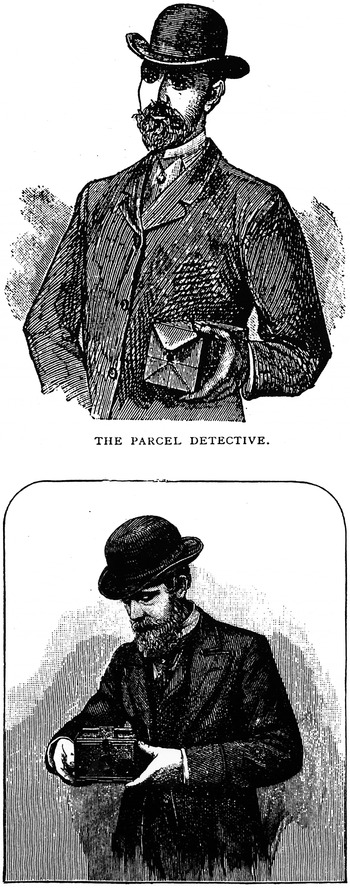
The nature of this technology, therefore, was that is should be operated surreptitiously. What made it different, as a commodity, was its secrecy. The concept of the detective camera was thus simply an elaboration of what had always been acknowledged to be the prime attraction of hand cameras in general. Detective cameras exploited the voyeuristic pleasures of hand-camera technology—of small gadgets hidden from the public eye, enabling observation without the operator being observed. The cameras were disguised about the body of the photographer, in hats and cravats, and in the form of bodily accessories such as parcels, books, and walking sticks (plate 9, top). The “Pic-Nic Basket Detective Camera” was advertised as “Most Deceptive in Appearance” and “Unobtrusive. Free from Observation” and was specifically recommended for use in “thronged thoroughfares.”Footnote 14 Reading the photographic press and publications from this period, it is easy to get the sense of a public world obsessed with photographic technology, and perhaps this is not too far from the truth. Within a few years, photography had been transformed into a popular, amateur activity that had opened up new types of demand in the market.Footnote 15 Cameras were ubiquitous and at the same time invisible, creating an environment that was always alive to the presence of a camera.
—Top, From Walter D. Welford, comp., The Photographer's Indispensable Handbook: A Complete Cyclopaedia upon the Subject of Photographic Apparatus, Material and Processes (London, 1887), p. 63. —Bottom, From Walter D. Welford, The Hand Camera Manual: A Beginner's Guide to Photography in Its Connection with the Hand Camera (London, 1893), p. 72.

With the first appearance of detective cameras, the focus on concealment inevitably also brought discomfort and voices of disapproval. Among the advocates of instantaneous photography were many who were keen to distance themselves from the sneaky connotations of detective cameras. Welford explained his dislike of the designation, if not the practice,
It implies a use of the instrument for purposes to which some of the public emphatically object, viz.:–the securing of scenes or incidents, pleasant or otherwise (in their minds generally very much otherwise) which could not be obtained by other means… a hand-camera by real workers, at all events, is very little utilized for purposes of that sort. True, we may all of us occasionally indulge in surreptitious shooting, but it is not necessary to emphasize the fact by proclaiming ourselves “Detectives”… Tell a man that it is a Detective Camera and he averts his face, turns his head, or bolts down the nearest street.Footnote 16
Welford's tone of disapproval is compromised by his inability to resist the temptation of “surreptitious shooting” and his regret that once a subject realizes there is a detective camera around they will flee rather than be photographed. Welford's ambivalence is hardly surprising, however. All hand cameras were potential detective cameras, since the designation was primarily a question of intention and use, rather than distinctions in technology. This was made explicit in Welford's subsequent advice to beginners with the hand camera: “Every endeavour… should be made to prevent the people in the scene knowing that they are ‘going to be took.’” But rather than hiding the camera he recommends a number of “wiles and tricks” that can be used to distract subjects from the photographer's true purpose: “Anything and everything in fact to cheat the public, to deceive them as to purpose.”Footnote 17
If further confirmation of the sneaky motives of the hand-camera worker was needed, it could be found in their bodily deportment. Welford offered one more, rather curious, piece of advice: “avoid looking at the subject any more than is absolutely necessary. I don't mean on the finder or through the camera, but with the eyes.”Footnote 18 The avoidance of eye contact was a bodily enactment of the shifty activities of the hand-camera photographer. The technology required a new bodily practice in which the camera apparatus was taken from the body's symbolically exalted site of reason—the eye and the head—and withdrawn to the debased site of the belly and torso. In order to keep the camera steady and to avoid drawing attention to it, hand cameras were generally held under the arm by the side of the body, or clasped to the stomach (plate 9, bottom). Although this made framing the scene very difficult, it concealed the fact that a photograph was being taken. And as the technology necessitated physical repositioning from high to low, it became part of a cultural and corporeal hierarchy.Footnote 19 The photographer, clutching a camera to their stomach or side and wandering the streets of the city waiting to snatch a photograph of an unwitting subject, was the perfect physical embodiment of the debased nature of modern commercial culture.Footnote 20 If late Victorian culture imagined technology as a kind of prosthetic enhancement of the body, then the hand camera was an appalling and aberrant prosthesis in which enhanced sight was no longer an extension of the eye but had evolved as a projection of the belly.Footnote 21
The symbolic properties of the hand camera surfaced most explicitly in contemporary debates concerning the obtrusiveness of the photographers and the rights of individuals in the street not to be photographed without their consent. Predictably, the issue mattered most when the subjects belonged to the respectable middle classes for whom character and reputation were believed to matter most. The working classes were generally regarded as a cast of picturesque types who could not possibly object to being photographed unless they were being deliberately awkward. Reflecting on this issue, the specialist journal Photography concluded “that although the vast majority of the British public, especially those of the lower orders, are only too pleased to be ‘took’ in a picture they can never have the pleasure of looking upon, still, all persons are not constituted that way, and many have strong objections, which objections it is the duty of all photographers and gentlemen to consider.”Footnote 22
Appropriate behavior was a key issue in this situation because individuals had no other protection from the promiscuous photographic activities of the hand-camera worker. In the course of half a century, the photographic image had been transformed from the formalities of the studio portrait to the apparently unposed informalities of the instantaneous process. The minutiae and incidental aspects of contemporary life were the purpose and driving motive of the new handheld cameras that were redefining the value of everyday life. Whereas in the 1850s the question of respect for privacy had never really arisen due to the technical limitations of the medium, instantaneous processes had forced apparently shared assumptions concerning social morality and decorum into the open. Quoting an article from an American journal, the Amateur Photographer represented the view that “the rights of private property, personal liberty and personal security… are distinctly inconsistent with the unlicensed use of the instantaneous process.”Footnote 23 But these terms had less resonance in Britain than in the United States. With no written constitution upholding “personal liberty,” respectable British citizens depended on “morality and discretion” to protect their privacy and freedom.Footnote 24 Even so, there was little consensus among photographers concerning the nature of individual privacy and subjectivity in the context of Britain's city streets at the end of the nineteenth century. Photography attempted to formulate a consistent position for its readers in an article published in 1891: “We do not consider that any one has a right to steal a photograph of another person, except as an adjunct to an ordinary view; and most certainly we have no right to snatch a photograph of a person in any compromising position or circumstances. Persons walking the streets are objects of public view, and conduct themselves with a knowledge that they are so, but to us it appears the height of impertinence to take surreptitious shots at—for example—ladies bathing, and unaware that they are the victims of such indecent officiousness.”Footnote 25
The issue hinged on how much privacy an individual could claim in the public sphere. On the streets, people were aware that they were exposed to public view and might justifiably be expected to present themselves appropriately; exposure to the camera in this context should not require a change of conduct. In contrast to this constant state of readiness and alertness to public visibility, the paper lists other situations in which, although public, people might reasonably expect not to be exposed to photographic scrutiny. Such a compromise was necessary to protect the photographer of “street life,” in which individuals might find themselves an extra in a general tableau of modern urban life. The situation was further complicated by the fact that these kinds of photographs were not necessarily intended for private viewing but frequently appeared as lantern slides, projected to an audience at an evening's public entertainment. Hand cameras introduced a new promiscuous visual environment in the city streets. Uncertainties concerning both who was making and who was the subject of the photographic image created an intense awareness of the possibilities of being part of visual representation that was itself exploited by commercial culture. In 1899, the photographic press reported a sales gimmick that had been introduced by some “yellow journals” in New York. A young woman was paid to walk around the city streets; her photograph was published daily, and a reward was offered to the first person who stopped and identified her.Footnote 26 This simple and now familiar newspaper ploy testifies to the ways in which photographic technologies participated in and affected the nature of urban modernity at the end of the nineteenth century. Passersby could be unknown to each other, but they could also be the subject of unprecedented self-awareness and public scrutiny.
Whereas some appealed to professional dignity, self-discipline, and etiquette to control the situation, others felt that only legislation could address the unruly social relations that had emerged with the new technology.Footnote 27 As it stood, the law seemed ill-equipped to deal with the kinds of offense created by the new photographic technology. Although the rights of individuals photographed by hand cameras could be protected by recourse to libel or copyright legislation, this did not address the many, varied disputes that could and did arise in the context of street photography.Footnote 28 Libel could only be claimed if it could be proved that a photograph had damaged the reputation of the individual concerned, and copyright was more concerned with the image as property and in establishing ownership of the image than with the offense of taking it. The idea of privacy and intrusion into the personal life of individuals was thus exercised on the pages of the photographic and national press but was not taken up by the judiciary. In the 1880s and 1890s, instantaneous photography and the detective camera dragged into the foreground the question of rights and consent in relationship to the photographic image and unsettled the stable social relations embodied in the studio dynamic of photographer and sitter. Correspondence in the period's photographic press reads, at times, like an agony column, as professional and amateur photographers waded through the minutiae of copyright legislation to clarify what they were and were not able to do. And on the other side of the lens, individuals expressed helpless outrage when confronted by their photographic image, taken without consent and exhibited in a public context.Footnote 29
If the law had been slow to respond to the implications of instantaneous photography, then it was completely unprepared for the cinematograph. Here were moving images, made explicitly for public exhibition that could capture individuals in time, offering narrative episodes rather than frozen details and gestures. The matter was drawn to the attention of the British press by the case of Madame Dreyfus, who, following the committal of her husband for treason, had been photographed and filmed during her visits to him in prison. The British Journal of Photography declared, “To be snap-shotted against one's will by hand cameras is bad enough, but being cinematographed is infinitely worse. Hand-camera pictures, as a rule, are principally confined to private collections. Not so, however, with cinematographs, they are taken for exhibition at places of public entertainment. Madame Dreyfus has our sympathy.”Footnote 30 In the last years of the nineteenth century, changes in photographic technologies exposed inconsistencies and tensions in the forms of social etiquette relating to urban space. To what extent could an individual in a public thoroughfare be said to be always already on show, and what rights did they have to prevent their image being taken and exhibited without their consent? There was power in the act of observation, particularly when it was itself unobserved, but could photographers be trusted to exercise this power responsibly, or should the law be forced to intervene?
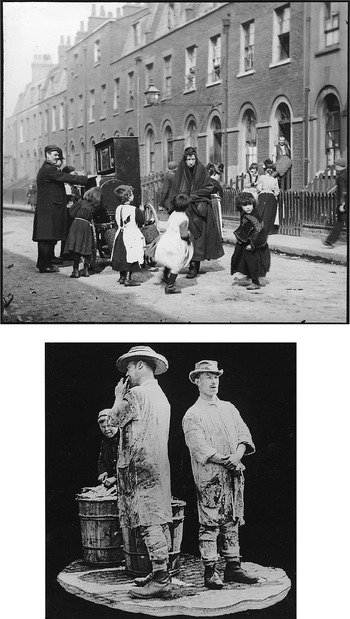
These issues and questions coalesce in the person of Paul Martin, a photographer whose images of London street life have become a staple of heritage representations of the late Victorian metropolis (plate 10, top). Martin's career mirrors the growing dominance of photography in the second half of the nineteenth century. Trained as a wood engraver producing images for the illustrated press, he took up photography as a hobby but later set up in business in the 1890s as a freelance photographer.Footnote 31 Martin's preferred camera was the “Facile,” a detective camera that was camouflaged in a brown-paper parcel with a strap around it. With holes for the lens and viewfinder, there was little to give away the presence of a camera, and Martin was able to move around London without suspicion, with what looked like a parcel of books tucked under his arm. Martin did everything he could to conceal the camera mechanism and the photographic process; in his brief autobiography, he describes holding the camera on its side to prevent the thud as the plates dropped down.Footnote 32 His subterfuge was highly successful, yielding both unsuspecting subjects and intense personal pleasure. “It is impossible to describe the thrill which taking the first snaps without being noticed gave one.”Footnote 33
—Top, Paul Martin, Dancing to the Organ, 1893. Courtesy of Harry Ransom Humanities Research Center, University of Texas at Austin. —Bottom, Paul Martin, Loading Up at Billingsgate Market: Cut-Out Figures, n.d. Courtesy of Harry Ransom Humanities Research Center, University of Texas at Austin.

Martin evolved a pragmatic response to the contingencies of instantaneous street photography in the 1890s. Broadly speaking, the difficulties boiled down to what might be defined as the extrinsic or incidental details of the image. As an editorial in the British Journal of Photography put it, “how is it possible for any one to secure instantaneous street scenes, say, in such places as Cheapside, the Strand, Regent-street, &c., without including the pedestrians and vehicles passing at the time, and by the score, too? In a good photograph the persons will be perfectly recognisable. Now, can any one, or all, of these persons so depicted prohibit the pictures being publicly shown?”Footnote 34 It was the figures on the margins of the image that were at the center of the debate. Photography's relentless ability to record everything placed before the lens had produced an excess of detail and a surplus of meaning that had to be reigned in or eradicated.
Martin eliminated potential legal challenges by concentrating on London's working classes. The curbsellers, itinerant musicians, and street urchins fitted easily into existing anecdotal genre formats and satisfied contemporary taste for character, life, and variety in metropolitan representation. Moreover, they would never see the resulting publications or exhibits, which ruled out the possibility of legal claims. But this still left the possibility of rogue background details: unnoticed faces, trade names, and passing presences, caught forever by the lens of Martin's parcel detective camera. His solution was extraordinary. In the middle of the 1890s, he developed a novel technique for making images for lantern slides. Given the recent arrival of film on the London entertainment scene, the need for novelty in the more traditional media had become even more pressing. Martin's slides were derived from existing images of statues in which all but the statue and pedestal were painted out of the picture. As Martin explained at the time, “When I first saw one of these slides the idea struck me… that living objects might be substituted for the statues.”Footnote 35 Working with his hand camera, Martin photographed street characters and then painted around the figures and wiped out the background with Indian ink (plate 10, bottom). In transforming his subjects into “imitation statuary,” Martin effectively eradicated the volatile elements of instantaneous photography. Wrenched from all historical context, the figures look like ceramic statuettes, petrified within a late Victorian taxonomy of social investigation. At some level, Martin evidently understood the implications of his method; he reflected on other suitable projects for his technique: “I would have made a set of slides of animals at the Zoo.”Footnote 36
Martin's search for a means of representing everyday urban life had finally led him to a method of pictorial embalming rather than animation. Elsewhere, however, photographers of the metropolis endlessly sought to capture its life and movement. But movement was precisely the fatal paradox of late Victorian street photography. On the one hand, it was photography's ultimate, chimeric, object, but, on the other hand, movement was unpictorial; it dismantled composition and resulted in unwanted formal relationships and obtrusive details. The noted photographer T. C. Hepworth concluded that instantaneous street photography was doomed to failure: “so rigid is it in arrested motion… nature is burlesqued.”Footnote 37
In the light of these debates, it is easy to make a teleological move from the failure of still photography to represent the urban everyday to the subsequent success of film. Indeed, I will go on to present a highly modified version of this argument. But historically it is important to stress the coexistence of these media and their context within highly developed structures of commercial entertainment. Still photographs were commonly presented as lantern slides, and magic lantern shows in the late 1890s included film projections. Individual careers in these years moved from photographer or lanternist to filmmaker. But as well as being part of this continuum of late Victorian visual culture, film also represented a significant historical break. Like the impact of hand camera technology, film changed the landscape of representational practice. It offered new ways of seeing the city and of conceiving individual subjectivity within a modern urban context. Film drew the camera-sensitive populations of the metropolis from the streets and into the music halls, where it further eroded the distinctions between the experience of urban space and its representation. Film spectators not only had the pleasure of watching scenes of urban life through which they had only just passed on their way to the theater or hall, but they were also enticed by the narcissistic possibilities of seeing themselves, filmed shortly before, projected on the screen.
III. The Cinematograph
The history of the city and the history of the cinema are closely interwoven. Film found its earliest homes in the music halls and other spaces of entertainment that already existed in the major cities of Britain, and, in turn, street life (particularly that of the metropolis) and the urban everyday were among the most popular subjects of the first filmmakers. And yet, the question remains: what can these short films, made in the first years of cinema, tell us about the nature and experience of the cities that they represent? Films at the turn of the century were short, often well under a minute, and camera work was pretty minimal, frequently nothing more than a static camera and a single shot filmed without editing and in real time. In spite of, or perhaps because of, this apparent simplicity, however, these first films of the city offered a new and distinctive way of interpreting the experience of the modern metropolis that could not be found in other forms of visual or textual representation. They gave the everyday movement and the passage of time. Unlike other modes of visual representation, films release new kinds of representations of people in space; they make visible the idea of inhabiting and being in the city which other forms of visual representation do not. The urban everyday has a long tradition of visual representation within what might be described as the long history of modernity from the end of the seventeenth century to the middle of the twentieth century. It has been the subject of successive new forms of mass-produced imaging, from prints and engravings to photography and projected images. Each medium responds differently to the potential of the city and contributes, within the parameters of its particular form, to the development of cultural conceptions of the urban.
In 1901 George R. Sims—one of the most prolific journalists and editors of the period—introduced a new fortnightly series called Living London. With its magazine format and uncritical medley of articles on the capital, Living London must surely have been an easy and reliable source of income to a professional journalist whose career embraced a wide range of genres including novels and poetry, social reform, and investigations of London slum life. In his first editorial, Sims drew on the metaphor of film to convey the realism of the writing that would be found in its pages: “In [these pages] we are to find a breathing, pulsing panorama of Living London. Panorama is hardly the word—cinematograph would be a better one, for it is not a London of bricks and mortar that will pass before our eyes, but a London of flesh and blood.”Footnote 38 Sims rejected the panorama because it could only provide a backdrop of the built environment. The cinematograph animates the city; it gives depth and a rounded corporeality to the place. So, in the year of Victoria's death, film represented the apogee of lifelike representation. It was novel and part of the fabric of modern urban life. But it also bore the traces of the previous century. It came out of at least a century of optical experiments and drew on a Victorian, as much as an Edwardian, tradition of pictorial representation. In this way, its history shares a common structure with the history of the metropolis.
In spite of the celebration of the centenary of cinema in 1995, film historians now agree that cinema did not suddenly appear on the scene in 1895, when the Lumière brothers projected animated photographs onto a screen in front of an audience at the Grand Café in Paris. Projected images have a long history; cinema came out of a tradition of older, popular forms of entertainment such as the magic lantern show. But while it is important to acknowledge the longer tradition to which cinema belongs, it is also true that in the mid-1890s certain conditions were in place that facilitated and made possible the success of the new medium. In his book Mass Entertainment: The Origins of a Modern Industry (1960), Asa Briggs has suggested five economic conditions that are necessary for the development of a mass entertainment industry: (1) a “large, concentrated urban population,” which can constitute the new “great audience”; (2) a sufficient level of income, which could enable a large section of this public “to buy regular, cheap entertainment”; (3) an increase in “available leisure time” open to commercial exploitation; (4) improved “urban public transport systems” that would allow, for example, night travel from city centers to the suburbs; and (5) technological developments that would impact on the entertainment industry.Footnote 39
All five of these factors were present together in London and other urban centers by 1896. In February of that year, the Lumière Cinématographe was shown to the London press at the Polytechnic in Regent Street and in March opened to the public at the Empire Music Hall in Leicester Square. In exactly the same months, the British inventor Robert Paul's Theatrograph was demonstrated at the Egyptian Hall in Piccadilly and became a regular item at the Alhambra Music Hall. This was a world of vibrant, modern, mass entertainment, driven by the engines of competition and novelty. Cinema provided exactly the right ingredient to music hall proprietors wanting to perk up flagging audiences or to maintain healthy takings.Footnote 40
Music hall programs in this period were full and varied. They were pacey, drawing on a wide range of turns to keep their audiences entertained. Cinema was drawn into this style of programming. Film was treated as one other kind of variety turn within the mixed program. So, for example, a selection of half a dozen, or so, short films might be wedged between a juggling act and a dance troupe.Footnote 41 But what film offered that the more traditional acts did not, was topicality, combined with the latest technology, features that were always emphasized in the venue's publicity. Thus, the Alhambra promoted Robert Paul's films of the Derby in terms of “Constant Change… The Prince's Derby, will be run Daily” and “Scenes of London Life. Selections from 50 Stirring Subjects.”Footnote 42 It was even suggested that Paul had set up his camera on the roof of the Alhambra so that he could maintain the production of new films of the city for audiences hungry for the spectacle of moving images of their own lives, or, at least, of lives much like their own. Everyday life was turned into a cultural commodity for fairly immediate consumption. Filmmakers used various strategies to cut down the period between production and consumption and to introduce “local actualities” into the programs of regional venues.Footnote 43
So, by 1896, the new camera technologies—the hand camera with its instantaneous photographs and the cinematograph and its derivatives with their moving pictures—had created a different visual regime for the representation of the city. It was a regime that drew on decades of development in optical technology but that was relentlessly marketed in terms of the new. The urban everyday was a central theme for these technologies, but it is in the earliest films of London that we can perhaps find the richest representation of the specific qualities of modern life circa 1900.
In the last years of the 1890s, operatives from the Lumière company made a number of films of London street scenes.Footnote 44 These might have been seen as part of a music hall program in London, but they could also have been shown in cities in Europe, Asia, or America. In London, their appeal would have been the immediate topicality of life as it goes on outside the doors of the theater; abroad, they would have taken on the different fascination of foreign travel and the spectacular sights of the world's leading imperial metropolis.Footnote 45 The success of the Lumière company rested both on the nature of the machine that it had developed and its organization of the business of making and exhibiting films. The special feature of the Cinématographe was that it was a camera, printer, and projector in one. It was lightweight and allowed specially trained operatives to travel all over the world, making films on the spot, developing them and showing them to local audiences. In this way, they regulated quality and, as one film historian has put it, “[collapsed] the functions of filmmaker, distributor, exhibitor, and projectionist into a single individual.”Footnote 46 Like the hand camera, the public world was the movie camera's habitat, and together they gave the city and its inhabitants an unprecedented visibility and turned everyday life into the most significant theme of popular leisure.
The Lumière company made a significant number of films of London.Footnote 47 Not surprisingly, perhaps, their subjects conformed to the familiar itineraries of “handbook” or tourist guide London: the Thames, Regent Street, Piccadilly Circus, and the city of London, with special attention to ceremonial and royal London.Footnote 48 There is a spatial and temporal richness in these films that offers the viewer a more complex representation of the city than is encompassed in the notion of speed and more diverse social interactions than relations of indifference or marginality. The forms of Victorian social ethnography are combined with the signs of urban modernization to express a unique view of the contemporary metropolis.
Empire Theatre, Leicester Square (France, 1896) is a single-shot film of street traffic and pedestrians outside the theatre; the camera is still, while figures and objects move in and out of, and across the range of the lens. The film is evidently the kind of local actuality that was a feature of many film programs in this period, complete with a nice plug for the Lumière Cinèmatograph on the canopy at the entrance to the theatre and the recognizable figure of the manager of the theatre—a detail that was picked up by reviews of the program.Footnote 49 Early film programs would often open with a film shot at the entrance of the theater; it was a device that drew the spectators into spatial and temporal proximity to the images projected on the screen and that created a continuity between the physical and imaginary experiences of the city outside and of the theater within.Footnote 50
To look at films of this kind is to witness the historical past drawn into the time of the present. The viewer's gaze is drawn to the details of gesture, expression, and appearance that exist momentarily within the space of the screen: the pleasure of two women who cross the road, realize they are being filmed, and salute the cameraman; or the lingering trail of cigar smoke from a gentleman who has passed out of view. Roland Barthes has described the power and affect of this kind of moment in the still photograph as the “punctum”; that is, the individual detail that escapes the conventional language of the image and addresses the viewer in a direct and physical way—a real gut reaction.Footnote 51 Barthes, of course, suggested that the punctum was an effect of the still image rather than the moving image. But I find myself agreeing with Mark-Paul Meyer, who suggests that there are casual moments in early nonfiction film that possess precisely the qualities of the punctum as defined by Barthes.Footnote 52 This might have been part of the delight of contemporary audiences at the Empire. The magic lanternist G. R. Baker was among a number of contemporary commentators who were astonished by the rendering of detail in moving pictures: “The marvellous detail, even to the puffs of smoke from the cigarette, spoke volumes for the perfection of the apparatus employed.”Footnote 53
Part of the affective power of these films also lies in their reproduction of real time. The time of the film is the time of the actions, movements, and gestures caught by the camera as they took place on the street. Although the scene is not necessarily spontaneous and may have been orchestrated by the filmmaker, the film itself is not cut or edited; it is not shot fast or slow but purports to be an unmediated moving image of an actual episode of modern urban life. In films such as this, the contingencies and minutiae of everyday life were caught on camera and shown to audiences over and over again, even within a single program.Footnote 54 Audiences could identify with the figures recorded on the film, and, in turn, those in the street would catch the eye of the camera and seem to stare out at the audience. In these moments, in which passersby acknowledge the act of being filmed, the image captures the temporal process of self-conscious awareness, of a give-and-take between camera and pedestrian that testifies to the fact that in the city you are seen as well as see. In this sense, the urban subject is differently positioned by film than by hand-camera photography. Although both technologies stage identity in terms of visual observation, in the still image the subject should not know that they have been taken, whereas in the moving image temporality is dramatized by the representation of the individual's realization that they are in the frame.
Time and space are caught in the film's act of representation. Andrei Tarkovsky captured this quality definitively when he wrote, “time lives within [the image]…. The dominant, all powerful factor of the film image is rhythm, expressing the course of time within the frame… and rhythm is determined not by the length of the edited pieces, but by the pressure of time that runs through them.”Footnote 55 It is these concepts of rhythm and time that begin to convey the special qualities of early film representations of the city. There is a spatial and temporal depth to these short films that gives access to a diverse and varied picture of modernity circa 1900. Lumière films frequently use a diagonal axis to organize the composition and the movement. Figures move across this depth of field; they approach the camera from a deep space within the image and pass across and beyond the camera's frame. In Lumière street scenes, there is a domain of selected and composed images and an aleatory register of unwitting intrusion within the frame or unplanned engagement between passerby and camera. And always, the frame of the image or, more accurately perhaps, the aperture of the lens, provides a stable boundary. At no point is the viewer able to forget the act of filming. There is a constant interplay between that which is within the view of the frame and that which lies beyond it. Figures and objects deep within the space of the image move forward and out of our field of vision, and, for a moment only, the film retains a trace of their presence after they have moved into the unseen zone beyond the frame. The films are snatches of a historical present that is past—traces of an urban everyday that existed once and that continues to exist within the frames of the film.Footnote 56
The projection of the pressure of time—in all its diversity—within the modern metropolis is unique to film representations of the city. London Street Dancers (France, 1896) was shot within the vicinity of the Empire theater and shows an itinerant musician and dancers on a street corner.Footnote 57 The subject was a conventional one, a generic feature of London literature by writers such as George R. Sims and Mrs. Cook and in the photographic snapshots of Paul Martin (see plate 10, top) and others. But the film gives the viewer just enough time to notice the man choreographing the dancers and gesturing them back into the frame of the lens; the top-hatted gentleman who crosses from the foreground, momentarily blocking the camera, and stops with patriarchal assurance at the front of the watching crowd; and the glistening surfaces of the pavements, wet from recent rainfall. Films capture something of the rhythm and changing intensities of life in different parts of the metropolis circa 1900. This was not a world of ceaseless traffic and constant speed but of haste and arrest, of street dancing and of lounging.
By the end of Victoria's reign, Piccadilly Circus had become the physical and symbolic heart of commercial London. The Eros monument to Shaftesbury had been erected in 1893, and soon after the island on which it stood became a place of momentary stasis in the midst of the constant bustle of Regent Street, Piccadilly, and Shaftesbury Avenue. For Mrs. Cook Piccadilly Circus was the core of London, a site of continuous movement and change: “a restless activity reigns here all through the long hours of day and night… people seem to swarm incessantly, to go and come, in consequent but feverishly active sequence.”Footnote 58 Again, the fixed camera position of the Lumière film, Piccadilly Circus (France, 1896), conveys something of the diverse nature of metropolitan life, even at its center. As a result of an unusually low and tight camera angle, the viewpoint seems literally absorbed into the passage of people and things. Women walk toward the camera and out of view, blocked momentarily by passing traffic. And in the background, figures lounge around the Eros Fountain, taking time out from the circulation of goods and people.
Simmel has limited use as a means of understanding these images. More specifically, his essay “The Metropolis and Mental Life” flattens possible readings of urban space circa 1900. What is clear is that these films and the aesthetic with which they are involved do not articulate metropolitan life in simple terms of sensory bombardment or neurasthenia; it is necessary to look elsewhere for a methodological framework for a historical analysis. I want to move to Gaston Bachelard's Dialectic of Duration—a book first published in French in 1950, as a sustained critique of Henri Bergson's notion of temporal continuity.Footnote 59 For Bachelard, all time is polymorphous, comprising “a duality of events and intervals… a precise, concrete duration that [teems] with lacunae.”Footnote 60 Time will necessarily comprise a plurality of durations “that have neither the same rhythm nor the same solidity in their sequence, nor the same power of continuity… all true duration is polymorphous.” While there is much in this work that can be dismissed as essentialist or sentimental, Bachelard's chapter on “Rhythmanalysis” is highly suggestive for revising “Simmelian” accounts of urban modernity. (The theme was taken up by Henri Lefebvre and Michel de Certeau but is, arguably, most exciting in its “raw” state in Bachelard's work.) Rhythmanalysis is concerned with the diverse speeds and intensities within any given temporality; time—even modern time—is a question of stasis, repose, and intertia as much as speed, productivity, and stimulation. Victorian films convey something of the rhythmic diversities of London circa 1900. To put it simply, they are evidence of the diversity of urban rhythm, for example, of street corners, close to Piccadilly Circus, where musician and cameraman orchestrate dancers in an urbanized jig, where passersby stop and smile for the camera.
The changes in social relations brought about by these shifts in modern urban visuality were acknowledged almost immediately. These were issues concerning privacy, rights, and representation in the public sphere that had been raised but left hopelessly unresolved in relation to instantaneous photography and that reappeared in different forms in connection with the moving images of film. In the very first years in which filmed street scenes were being exhibited to paying audiences, a new type of urban myth appeared based on the theme of accidental encounters or confrontations made possible by the arbitrary presence of individuals within the crowds of the actuality scenes. Short stories, novels, and even films themselves repeated the narrative of prodigal children reconciled with their families through being seen on the screen after years of absence.Footnote 61 More sensationally, adulterous affairs were exposed by the unfaithful partner being unintentionally caught with their lover by the film camera and projected to an audience including the deceived husband or wife. The point of these narratives is that film conveyed a sense of modern urban life as unpredictably interconnected rather than as alienated or indifferent. The contingent was the site of an endless production of significance in which any individual might find themselves caught up in urban drama.
Victorian actuality films reversed the conventional values of the banal and the extraordinary within contemporary life. Mundane, everyday life was recorded and monumentalized, and the exceptional was subjected to endless repetition. The films subjected the small, unobtrusive gestures of daily life, and the minutiae of social interaction on the city streets, to unprecedented scrutiny. In another cultural field, too, apparently insignificant everyday forms were being watched as Freud interpreted this repertoire of accidental actions as symptoms that manifested everyday disturbances of thought. If the flow of city crowds provided the subject for spectacular commercial entertainment, then it also exposed the “field of phenomena” defined by Freud in 1901 as The Psychopathology of Everyday Life: “the irritating and clumsy process of dodging someone in the street, when for several seconds one steps first to one side then to the other, but always to the same side as the other person, till finally one comes to a standstill face to face with him (or her)—this ‘getting in someone's way’… is once more a repetition of an improper and provocative piece of behaviour from earlier times and behind a mask of clumsiness, pursues sexual aims.”Footnote 62 By 1900, the conduct of everyday urban life had become the subject of photographic technologies that exposed the smallest and most contingent gestures to examination and interpretation. Everyday life expressed both modernity's surface appearances and its unconscious origins and drives.
IV. Postscript
But if the cameramen of the 1890s took snapshots and made films in order to capture “Living London,” a city of “flesh and blood,” as Sims described it, then there is surely also something spectral and deathly about these figures who still yield to the viewer's fascinated gaze.Footnote 63 As instantaneous photographs and actuality films strove to endow the image with life and animation, they also confirmed that they were only representations, simulacra, and never life itself. And for all the first accounts that emphasized the realism and lifelike qualities of early film, I find myself most drawn to a report describing something quite different in the photographic figures on the screen. In the summer of 1896, Maxim Gorky watched the first Lumière program shown in Russia and wrote,
Last night I was in the Kingdom of Shadows…. When the lights go out in the room in which Lumière's invention is shown, there suddenly appears on the screen a large grey picture…. As you gaze at it, you see carriages, buildings and people in various poses, all frozen into immobility. But suddenly a strange flicker passes through the screen and the picture stirs to life. Carriages coming from somewhere in the perspective of the picture are moving straight at you, into the darkness in which you sit; somewhere from afar people appear and loom larger as they come closer to you…. All this moves, teems with life and, upon approaching the edge of the screen, vanishes somewhere beyond it…. Before you a life is surging, a life deprived of words and shorn of the spectrum of colours–the grey, the soundless, the bleak and dismal life. It is terrifying to see, but it is the movement of shadows, only of shadows.Footnote 64
In this compelling piece of writing, we begin to come close to the uncanny effect of looking at late Victorian photographs and films of the metropolis, an effect that was expressed in the late 1890s and can be experienced now. We know that these people were once there, but the closer the images get to simulating life, the more we are reminded of their spectral presence and of death. As Gorky's words and the photographic images of the archive demonstrate, the streets of modern London were not simply living and breathing, they were also the habitat of colorless ghosts.