This response offers a critical appraisal of the claim of Albrecht Ritschl to have found a possible resolution to what he calls the Anglo-German industrial productivity puzzle, which arose as the result of a new industrial production index produced in an earlier paper by the same author.Footnote 1 Projection back from a widely accepted 1935/36 benchmark using the Ritschl index showed German industrial labor productivity in 1907 substantially higher than in Britain. This presented a puzzle for at least two reasons. First, other comparative information from the pre—World War I period, such as wages, seems difficult to square with much higher German labor productivity at this time.Footnote 2 Second, a direct benchmark estimate produced by Stephen Broadberry and Carsten Burhop, using production census information for Britain and industrial survey material of similar quality for Germany, suggested broadly equal labor productivity in 1907.Footnote 3 Broadberry and Burhop also showed that if Walther Hoffmann's industrial output index was used instead of the Ritschl index for Germany, the puzzle largely disappeared.Footnote 4
Ritschl now proposes some further changes to the German industrial output index, which move it closer to the Hoffmann index.Footnote 5 However, to remove the remaining discrepancy, Ritschl proposes a number of amendments to the 1907 benchmark.Footnote 6 In this reply, we argue that most of the proposed changes to the benchmark are unwarranted. We also show that applying a uniform weighting scheme to the branch output series used in the new Ritschl industrial production index removes most of the remaining discrepancy.
PROPOSED CHANGES TO THE 1907 BENCHMARK
The first basic difference between the Broadberry and Burhop and Ritschl benchmarks concerns our preference for the German industrial survey sources wherever possible.Footnote 7 This is important because it means that we can be sure that the output and employment refer to the same production units. In our view, it is not worth sacrificing this advantage to obtain data for 1907 rather than 1908 or some other alleged benefit of an alternative source of employment data. Furthermore, if anything, this reliance on the German industrial surveys is likely to bias our benchmark in favor of Germany, because these surveys excluded the craft sector and most small firms, where productivity was lower than in the large industrial firms.
To ensure consistency of sources for output and employment, we used data for 1908 and 1910 for some German industries. Ritschl argues that this biases our results against Germany on the grounds that these industries went into recession after 1907.Footnote 8 Yet it is clear from Hoffmann's data on both output and employment that labor productivity continued to increase after 1907, so that our use of later years for Germany must bias the benchmark in favor of Germany.Footnote 9 Ritschl's cyclical adjustment nevertheless somehow raises the German productivity lead from 5 percent to 12 percent, or about one-third of his total proposed adjustment.Footnote 10 This is wholly inappropriate, and any adjustment would have to be in the opposite direction.
Ritschl draws attention to the issue of multiproduct firms and asserts that this leads us to overstate employment in Germany because not all workers were producing the final product.Footnote 11 However, the direction of the bias is unclear. If workers were allocated to the industry in which they were mainly engaged, then for any particular industry there would be both included workers who were not producing wholly for that industry (hence leading to an understatement of productivity) and output produced by workers who were allocated to other industries (hence leading to an overstatement of productivity). And for industry as a whole, any increase in productivity in one branch must surely be offset by a decrease in another branch, because the net effect of reallocating labor across multiproduct firms must be zero. This spurious adjustment adds another 8 percentage points to the German productivity advantage.
Ritschl also proposes an adjustment to take account of the smaller cutoff point in the size of firms in the German occupation census.Footnote 12 This adds another 8 percentage points to the German productivity lead, which is completely out of line with similar adjustments for other comparisons, including that of Rainer Fremdling, Herman de Jong, and Marcel Timmer for the 1935/36 Anglo-German benchmark.Footnote 13 But, more importantly, the adjustment is totally unwarranted because we relied mainly on the industrial surveys, which had a higher cutoff point than the British production census. If anything, the adjustment should be in the other direction, but in any case much, much smaller.
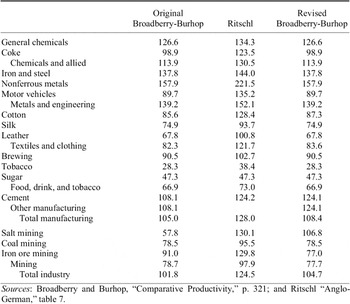
Nevertheless, Ritschl does provide a useful critical survey of our estimates for particular industries and we have taken on board some of his suggestions.Footnote 14 As a result, we provide an updated version of our 1907 benchmark in Table 1, together with our original estimates and Ritschl's proposed revisions. The changes that we have made in response to Ritschl's critical evaluation are limited to four industries: cotton, cement, salt mining, and iron ore mining (details are provided in the longer version of this note).Footnote 15 The overall effect is to raise the German/U.K. labor productivity lead in 1907 from 5 percent in our original study to 8.4 percent.
COMPARATIVE GERMAN AND BRITISH LABOR PRODUCTIVITY CIRCA 1907 (United Kingdom = 100)

Sources:
Broadberry and Burhop, “Comparative Productivity,” p. 321; and Ritschl “Anglo-German,” table 7.
PROPOSED CHANGES TO THE GERMAN PRODUCTION INDEX
Ritschl is critical of Hoffmann's treatment of the metal processing industry, where output is measured by labor income and the assumption of a constant labor income share.Footnote 16 Instead, Ritschl uses volume series for mechanical engineering, electrical engineering, motor vehicles, and shipbuilding.Footnote 17 Here, we accept the use of Ritschl's volume series, but impose a uniform weighting scheme.
The starting point for the weighting scheme is Hoffmann, where the weights for each industrial branch are calculated as the product of the value added per employee of this branch in 1936 and its employment in 1907 (weights for the years 1896–1925) and 1933 (weights for the years 1925–1959), respectively.Footnote 18 However, Hoffmann's original weighting scheme is modified to incorporate Fremdling et al.'s corrections to value added per employee in 1936 (as a result of distortions arising from war planning) and Fremdling's corrections to labor force estimates between 1925 and 1939 (as a result of confusion over boundary changes).Footnote 19 In addition, we apply the same weighting scheme used for the industrial sector as a whole to the aggregation within metal processing. This is in contrast to Ritschl, who first combines output of the mechanical and electrical engineering industries using gross output in 1913 as weights and then combines the resulting index for mechanical and electrical engineering with the sub-indices for motor vehicle production and shipbuilding using 1928 weights.Footnote 20
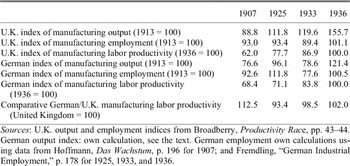
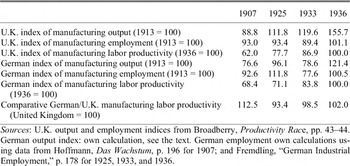
With 1913 = 100, our new index of metal processing output takes a value of 95.9 in 1925 compared with Hoffmann's index value of 1925 = 131.4.Footnote 21 On the other hand, the new index is somewhat higher than Ritschl's index, which had a level of 1925 = 84.4.Footnote 22 We then incorporate this new index for the metal processing industry into a new index for manufacturing output in Germany for the period 1895–1938 using the same weighting scheme. Our recalculation of manufacturing output confirms qualitatively one of Ritschl's central results, that manufacturing or industrial output was lower during the interwar period than suggested by Hoffmann's figures. According to the new index, by 1936 output was nearly 13 percent lower than Hoffmann believed. However, this does not translate into a 13 percent effect on labor productivity, because the new output weights are derived from changes to the employment data. This, in turn, has implications for the main focus of this note, the comparative German/U.K. manufacturing labor productivity level. The results are presented in Table 2.
INDEXES OF GERMAN/U.K. COMPARATIVE LABOR PRODUCTIVITY IN MANUFACTURING
Sources:
U.K. output and employment indices from Broadberry, Productivity Race, pp. 43–44. German output index: own calculation, see the text. German employment own calculations using data from Hoffmann, Das Wachstum, p. 196 for 1907; and Fremdling, “German Industrial Employment,” p. 178 for 1925, 1933, and 1936.
Starting from the widely accepted German/U.K. comparative labor productivity level in manufacturing of 102 in 1936, the new time series projection for 1907 of 112.5 is quite close to our revised 1907 benchmark estimate of comparative manufacturing labor productivity of 108.4. What happens here is that over the long period 1907–1936, Hoffmann's overestimation of output growth is partly cancelled out by his overestimation of employment growth, so that the long-run comparative labor productivity picture is much as suggested by Broadberry.Footnote 23
CONCLUSION
In this note, we reaffirm the central claim of Broadberry and Burhop that manufacturing labor productivity was broadly equal in Britain and Germany during the first half of the twentieth century.Footnote 24 We first reject Ritschl's attempt to revise our 1907 benchmark substantially upwards.Footnote 25 We then show that applying a uniform weighting scheme to Ritschl's new output series for metal processing removes most of any remaining inconsistency between time series projections and benchmarks.