Bullying has been defined as a phenomenon of intentional aggression by one or more people against another person or persons, repeated and sustained over time, in which there is a power imbalance between the aggressor – or bully, and the one trespassed against – or victim (Olweus, Reference Olweus1993). This may include hitting, threatening, rumor spreading, and other actions. The reported prevalence rates of this phenomenon have varied widely as a function of the country where the research was conducted, its sample’s age, the tools it used to measure the harassment, and the timeframe about which data was collected. Accordingly, incidence rates of 4 to 62.2% have been reported for victims, 2 to 7% for bullies, and 18% for adolescents who are simultaneously victims and bullies (Caravaca et al., Reference Caravaca, Falcón, Navarro-Zaragoza, Luna, Rodriges and Luna2016; Díaz-Aguado, Martínez, & Martín, Reference Díaz-Aguado, Martínez and Martín2013). While the phenomenon of youth bullying has been widely studied, there is growing interest in investigating its cybernetic forms (cyberbullying). As in face-to-face bullying, the reported prevalence rates of cyberbullying vary widely, with recent data suggesting cyberbullying may be on the rise among adolescents, likely due to their increased access to electronic devices and lower parental supervision. Garaigordobil (Reference Garaigordobil2011) conducted a review of national and international epidemiological research about the percentage of people involved in cyberbullying situations. They found that 20-50% reported experiences of victimization, but only 2-7% were victims of severe cyberbullying. Incidence rates of 31.4% for cyberbullying (Buelga, & Pons, Reference Buelga and Pons2012) and 24.6% to 30.2% (Buelga, Cava, & Musitu, Reference Buelga, Cava and Musitu2010) for cybervictimization have been reported as well. Garaigordobil and Aliri (Reference Garaigordobil and Aliri2013) found that 10.3% of their sample had been implicated, either as bullies or as victims. In any case, results have confirmed these phenomena are highly prevalent, leading researchers to conclude that they represent a troubling reality in schools worldwide (Garaigordobil, Reference Garaigordobil2011).
Despite how important and prevalent these phenomena are, and that various studies have reported co-occurrence of bullying and cyberbullying (Del Rey, Elipe, & Ortega-Ruiz, Reference Del Rey, Elipe and Ortega-Ruiz2012; Katzer, Fetchenhauer, & Belschak, Reference Katzer, Fetchenhauer and Belschak2009; Mitchell, Finkelhor, Wolak, Ybarra, & Turner, Reference Mitchell, Finkelhor, Wolak, Ybarra and Turner2011; Waasdorp, & Bradshaw, Reference Waasdorp and Bradshaw2015), there have been contradictory results regarding the similarities and differences in the nature and predictors of bullying and cyberbullying. Along those lines, Mitchell et al. (Reference Mitchell, Finkelhor, Wolak, Ybarra and Turner2011) argue that similar intentions on the part of the aggressor (to shame, humiliate, or threaten), co-occurrence of victimization and cybervictimization, and evidence of a possible common etiology altogether suggest cyberbullying is an additional manifestation of face-to-face bullying, one where the Internet provides an efficient platform for attack. Similarly, Waasdorp and Bradshaw (Reference Waasdorp and Bradshaw2015) reported a large degree of overlap between bullying and cyberbullying. However, other research has suggested that while cyberbullying and traditional bullying have certain features in common, they differ in important ways (Katzer et al., Reference Katzer, Fetchenhauer and Belschak2009; Pyzalski, Reference Pyzalski, Hällgren, Dunkels and Frånberg2011). One clear distinction is a perceived anonymity sometimes accompanying cybernetic harassment (Kowalski & Limber, Reference Kowalski and Limber2007); it expands the pool of individuals who can potentially participate in online harassment. Moreover, most traditional bullying takes place in school during the school day; cybernetic harassment, on the other hand, can happen anytime day or night (Nansel et al., Reference Nansel, Overpeck, Pilla, Ruan, Simmons-Morton and Schmidt2001).
Another aspect that needs further clarification is what psychological variables are associated with these behaviors. Various studies have demonstrated that personality differences predict aggressive and antisocial behaviors; far fewer have examined the relation between personality and bullying – especially between personality and cyberbullying. Furthermore, research in this area has tended to analyze isolated personality variables; more integrative studies are needed to organize relevant variables according to a general model of personality. With that in mind, the five-factor model (FFM) (Goldberg, Reference Goldberg1990; McCrae, & Costa, Reference McCrae and Costa1987) has demonstrated its validity as a taxonomic framework for personality traits in recent decades, and it has been useful in organizing results from multiple areas of research (e.g., Boudreaux, Reference Boudreaux2016).
Looking at personality variables in the context of traditional bullying, a recent meta-analysis reported that low levels of agreeableness (which entails low sensitivity to others and little conciliatory attitude), low levels of conscientiousness (which presents a challenge to appropriate behavioral self-control), high neuroticism (which includes difficulty with emotional regulation), and high levels of extraversion (implying a tendency for excitement- and stimulation-seeking) are associated with bullying and victimization (Mitsopoulou, & Giovazolias, Reference Mitsopoulou and Giovazolias2015) alike. De Angelis, Bacchini, and Affuso (Reference De Angelis, Bacchini and Affuso2016) reported similar results: lower conscientiousness and agreeableness seem to be responsible for lower sensitivity to moral norms, in turn driving harassment. Moreover, other research conducted outside the Big Five framework has yielded results consistent with it. For instance, Machiavellianism, psychopathy, sadism, and low empathy (personality traits all associated with low agreeableness), as well as impulsiveness and hyperactivity (associated with low conscientiousness) have all been linked to traditional bullying (Casas, Del Rey, & Ortega-Ruiz, Reference Casas, Del Rey and Ortega-Ruiz2013; van Geel, Goemans, Toprak, & Vedder, Reference van Geel, Goemans, Toprak and Vedder2017). With respect to other dimensions of the Big Five, such as openness to Experience, studies have been few and inconclusive about their relation to bullying and victimization in the school context (Mitsopoulou & Giovazolias, Reference Mitsopoulou and Giovazolias2015).
With respect to cyberbullying, past research has reported that, in term of the FFM, victimization relates to higher neuroticism and agreeableness, and lower openness to experience and conscientiousness (Çelik, Atak, & Erguzen, Reference Çelik, Atak and Erguzen2012). The results regarding extraversion have been contradictory: Some studies have linked cybervictimization to low extraversion (Smith, Reference Smith2015), while others have reported the opposite, relating it to high extraversion (Peluchette, Karl, Wood, & Williams, Reference Peluchette, Karl, Wood and Williams2015). In addition, studies conducted beyond the limits of the Big Five have found results that support a relation between cybervictimization and increased neuroticism (e.g., anxiety, social anxiety, depression, low self-esteem, increased isolation, and greater anger-in and anger-out; Ak, Özdemir, & Kuzucu, Reference Ak, Özdemir and Kuzucu2015; Fredstrom, Adams, & Gilman, Reference Fredstrom, Adams and Gilman2011).
Like cybervictims, cyberbullies appear to exhibit higher neuroticism and lower conscientiousness (Çelik et al., Reference Çelik, Atak and Erguzen2012; Smith, Reference Smith2015), but they differ in that cyberbullies score lower on the agreeableness and extraversion dimensions (van Geel et al., Reference van Geel, Goemans, Toprak and Vedder2017). Additionally, they exhibit traits like machiavellianism, narcissism, and psychopathy (emotional callousness), once more connecting cyberbullying to the (low) agreeableness domain (Goodboy, & Martin, Reference Goodboy and Martin2015).
Thus, though some studies have drawn relationships between bullying or cyberbullying and personality variables, their results have not been entirely conclusive. Furthermore, multiple variables have been analyzed separately, but research is needed to thoroughly examine how bullying and cyberbullying relate to the FFM (McCrae & John, Reference McCrae and John1992), not just the five major personality domains it proposes, but also the set of facets comprising each one. According to the FFM, each factor includes six facets that may be differentially associated with the study’s variables (bullying, cyberbullying, victimization, cybervictimization). In adjacent fields of research (on aggression and psychopathy), it has been found that within a given factor, its facets may differentially relate to criterion variables (Lynam, & Widiger, Reference Lynam and Widiger2007; Miller, Lynam, & Leukefeld, Reference Miller, Lynam and Leukefeld2003). Hence, past studies (e.g., Hayward, Taylor, Smoski, Steffens, & Payne, Reference Hayward, Taylor, Smoski, Steffens and Payne2013; Samuel & Widiger, Reference Samuel and Widiger2008) have repeatedly suggested incorporating FFM facets into the study of behavioral disturbances.
Using the FFM will help us organize results as they are generated about personality and bullying/cyberbullying, and allow us to benefit from the most current knowledge about the basic dimensions of personality.
On another note, previous literature has not paid sufficient attention to those youths who simultaneously engage in (cyber)bullying and (cyber)victimization Footnote 1 (Diepenhorst, Reference Diepenhorst2014). Overlooking the co-occurrence between (cyber)bullying and (cyber)victimization could even explain some of the contradictions often afflicting results in this area.
Bearing in mind these limitations of earlier research, the present study pursued the following objectives: (1) Examine the relationship between bullying and cyberbullying in adolescents; (2) analyze the way bullying and cyberbullying relate to the different domains and facets of the FFM.
Based on the FFM, taking into account its general factors and more specific dimensions, this study will take an integrated, systematic approach to examine the relation between personality traits and the phenomena of bullying and cyberbullying. Furthermore, by addressing bullying and cyberbullying in the same study, we can determine to what extent correlates of cyberbullying are the same as, or different from, those of traditional bullying. On another note, given the frequency with which the same individual plays the role of (cyber)aggressor and (cyber)victim, this study will not just examine personality in (cyber)bullies and (cyber)victims, but also adolescents who engage in bullying as well as victimization.
Bearing in mind the findings of past research, we expect to find co-occurrence of bullying and cyberbullying phenomena given that they share certain characteristics, and because the literature to date suggests the profiles of bullies and victims (and cyberbullies and cybervictims), too, are similar in certain ways. Also, according to the literature to date and the nature of the traits studied, we expect to find that bullying and victimization are positively associated with neuroticism and extraversion, and negatively associated with the agreeableness and conscientiousness dimensions. With regard to cyberbullying, we expect that cybervictimization will negatively correlate with openness and conscientiousness, and positively correlate with neuroticism and agreeableness. In addition, we expect that cyberbullying will positively correlate with neuroticism, and negatively correlate with conscientiousness, agreeableness, and extraversion.
Method
Participants
Participants in this study were 910 adolescents (474 girls, or 52%; and 434 boys, or 48%; two participants did not report their gender) ranging in age from 12 to 19 years old (mean 14.57; SD =1.57) and attending one of nine different schools in Galicia, Spain. All participating schools were public, and located in peri-urban or semi-urban areas of Galicia in predominantly lower-middle class neighborhoods.
To recruit a sample, various schools in the Autononomous Community of Galicia were contacted and asked to participate. At the schools that responded with interest, the procedure was then explained more thoroughly. An active family consent form was written for each school, stating the research objective, the implications for participants, and their right to confidentiality. Adolescents whose parents or guardians signed the consent form then participated in the study. The schools’ participation was completely voluntary; they were given no institutional privileges or report of their results in exchange for their involvement in this research.
Measures
FFM personality traits. To evaluate personality traits, a short form of the NEO PI-R for youths was used, (JS NEO-S; Ortet et al., Reference Ortet, Escrivá, Ibáñez, Moya, Villa, Mezquita and Ruipérez2010). It is made up of 150 items, with a 5-point Likert-type response format ranging from strongly disagree to strongly agree. The JS NEO-S was developed as an adaptation of the NEO PI-R for youths (Ortet et al., Reference Ortet, Ibáñez, Moya, Villa, Viruela and Mezquita2012), and evaluates five dimensions: neuroticism (overall tendency to experience negative feelings like fear, melancholy, shame, anger, guilt, and disgust), extraversion (tendency to be active, enthusiastic, assertive, and self-confident), agreeableness (concern about and sensitivity toward others and their needs), conscientiousness (autonomous, orderly, precise, abides by the rules and one’s commitments), and openness (includes intellectual aspects, creativity, cultural interests). Moreover, the JS NEO-S scores 30 facets: six facets per FFM factor. The short and long forms of this questionnaire have demonstrated, appropriate psychometric properties. The usefulness of these questionnaires is supported by various studies’ results (e.g., Ortet et al., Reference Ortet, Escrivá, Ibáñez, Moya, Villa, Mezquita and Ruipérez2010). In the present study, the dimensions’ corresponding alpha coefficients ranged from .80 (Openness) to .89 (Conscientiousness). Alpha coefficients for the different facets, meanwhile, ranged from .49 (N5-impulsiveness) to .77 (N3-depression). Alpha coefficients on 24 of the 30 facets were greater than or equal to .60; the ones with coefficients under .60 were N5-impulsiveness (.49), O3-feelings (.50), A4-compliance (.52), N1-anxiety (.53), N2-hostility (.53), and C1-competence (.56). That being said, low alphas were expected on some scales given their low number of items, and results were similar to those of instrument validation studies (Ortet et al., Reference Ortet, Escrivá, Ibáñez, Moya, Villa, Mezquita and Ruipérez2010).
Bullying. The Spanish version of the European Bullying Intervention Project Questionnaire (EBIPQ) (Ortega-Ruiz, Del Rey, & Casas, Reference Ortega-Ruiz, Del Rey and Casas2016) was used to assess bullying behavior. In this study, its 14 items were answered on the following response scale: Never (0 times) (0), once or twice (1 or 2 times) (1), once or twice a month (3 to 5 times) (2), once a week (6 to 10 times) (3), and more than once a week (more than 10 times) (4) in the past six months. The questionnaire covers two dimensions: Victimization and abuse, with alpha coefficients of .87 and .86, respectively. For both dimensions, items refer to actions like hitting, insulting, threatening, stealing from, cursing, excluding, or spreading rumors (e.g., “Alguien me ha insultado [someone has insulted me]”; “He amenazado a alguien [I have threatened someone]”).
Cyberbullying. To assess cyberbullying behavior, we utilized the Spanish version of the European Cyberbullying Intervention Project Questionnaire (ECIPQ) (Del Rey et al., Reference Del Rey, Casas, Ortega-Ruiz, Schultze-Krumbholz, Scheithauer, Smith and Plichta2015). The 22 items of the cyberbullying scale in this study had response options spanning never (0 times) (0), once or twice (1 or 2 times) (1), once or twice a month (3 to 5 times) (2), once a week (6 to 10 times) (3), and more than once a week (more than 10 times) (4) in the past six months. The questionnaire’s two dimensions – cybervictimization and cyberabuse – had alpha coefficients of .90 and .92, respectively, in this sample. For both dimensions, items refer to actions like cursing, excluding or spreading rumors, impersonating someone, etc., all using electronic devices (e.g., “Alguien ha colgado información personal sobre mí en Internet [Someone posted personal information about me online]”, “He excluido o ignorado a alguien en una red social o chat [I have excluded or ignored someone on social media or in a chat]”).
For bullying as well as cyberbullying variables, a timeframe of six months (instead of two) was utilized, to detect general trends rather than sporadic behaviors. That was consistent with conceptions of bullying and cyberbullying as repeated, not isolated, forms of violence.
Procedure
Questionnaires were completed in the classroom, at school, between the months of October, 2015 and February, 2016, supervised by a member of the research team. This was only after obtaining consent from the adolescents themselves, and their parents. The anonymity and confidentiality of all participant data were safeguarded.
To study the different roles implicated in bullying and cyberbullying, the sample was divided into bullying and cyberbullying groups (victims, aggressors, aggressor-victims, non-aggressor non-victims), following the established guidelines for the assessment instruments (EBIPQ and ECIPQ). Accordingly, respondents who marked once a week or more on one of the (cyber)abuse scales, and once or twice a month or less on all items of the (cyber)victimization scale were considered (cyber)aggresors; those who marked once a week or more on any item of the (cyber)victimization scale and once or twice a month or less on all items of the (cyber)abuse scale were deemed to be (cyber)victims; anyone who marked once a week or more on one or more items on both the (cyber)abuse and (cyber)victimization scales belonged to the hybrid (cyber)aggressor-(cyber)victim group; and finally, adolescents who answered once or twice a month or less on all items of the (cyber)abuse and (cyber)victimization scales comprised the non-(cyber)aggressors non-(cyber)victims group.
Statistical Analysis
Preliminary analyses examined descriptive data pertaining to bullying/cyberbulling variables. Since the sample was made up of male and female adolescentagers of different ages, the bullying/cyberbullying groups were compared as a function of sex and age using chi-square testing and ANOVA, respectively. The strength of association between bullying and cyberbullying was also analyzed, using contingency tables and the chi square statistic. Last, to determine how the different bullying and cyberbullying groups were defined (victims, aggressors, aggressor-victims, non-aggressor non-victims) as a function of personality traits, multivariate analyses of variance (MANOVAs) were carried out, controlling for the effects of age and sex. On each MANOVA, pairwise comparisons were made using post hoc Tukey tests and applying a significance level of alpha equals .05. Analyses were carried out using the SPSS 20 statistical package.
Results
Descriptive Statistics in the Bullying/cyberbullying Groups, and Relation to Sex and Age
In keeping with the criteria enumerated in the Statistical Analysis section, the sample was divided into aggressors, victims, aggressor-victims, and non-aggressor non-victims. The number and proportion of adolescents in each traditional bullying group were as follows: Victims (N = 179; 21%), aggressors (N = 50; 5.9%), aggressor-victims (N = 161; 18.9%), and non-aggressor non-victims (N = 464; 54.3%). With respect to the comparable cyberbullying groups, participants were distributed as follows: Cybervictims (N = 63; 7.3%), cyberaggressors (N = 25; 2.9%), cyberaggressor-cybervictims (N = 83; 9.6%), and non-aggressor non-victims (N = 696; 80.3%).
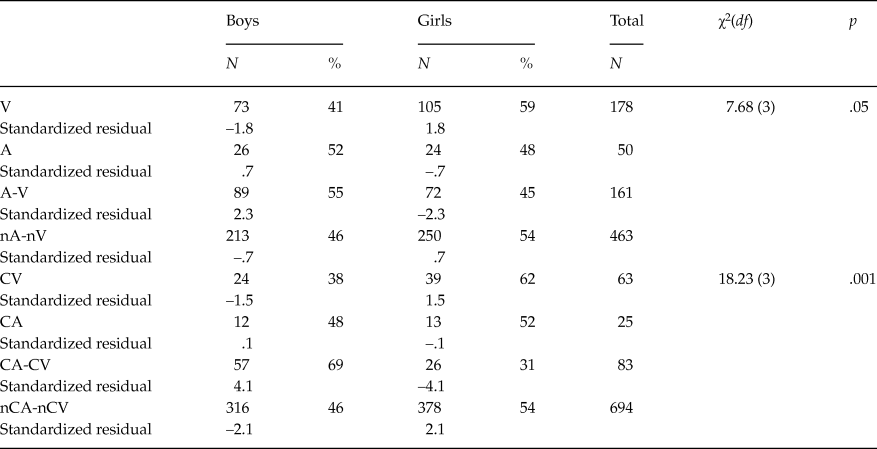
Table 1 presents participants’ distribution as a function of sex into the different bullying and cyberbullying groups.
Frequency and Proportion of Boys/girls in Each Bullying/Cyberbullying Group

Note: V = Victim; B = Bully; A-V = Aggressor-victim; nA-nV = non-Aggressor non-Victim; CV= Cybervictim; CA = Cyberaggressor; CA-CV = Cyberaggressor-Cybervictim; nCA-nCV = non-Cyberaggressor non-Cybervictim.
Considering the results of Pearson’s chi-square test, and the adjusted standardized residuals found, we observed a higher percentage of men in the aggressor-victims group. In terms of cyberbullying, we likewise found a higher percentage of boys in the cyberaggressor-cybervictim group, and a higher proportion of girls in the non-cyberaggressor non-cybervictim group.
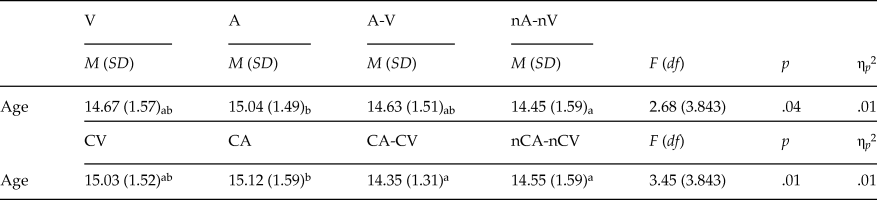
With regard to age differences, Table 2 presents our analysis of age differences between bullying groups (aggressor, victim, aggressor-victim, and non-aggressor non-victim), and cyberbullying groups (cyberaggressor, cybervictim, cyberaggressor-cybervictim, and non-cyberaggressor non-cybervictim).
Differences between Bullying and Cyberbullying Groups by Age

Note: V = Victim; A: Aggressor; A-V = Aggressor-victim; nA-nV = non-Aggressor non-Victim; CV = Cybervictim; CA = Cyberaggressor; CA-CV = Cyberaggressor-Cybervictim; nCA-nCV = non-Cyberaggressor non-Cybervictim
Means with subscript (a, b, c) showed significant differences (p ≤ .05) in pairwise comparisons, according to post hoc Tukey HSD test.
As shown in Table 2, the differences observed between bullying groups as a function of age were statistically significant (p < .05). The highest mean age was observed in the aggressors group, whereas the non-aggressor non-victims group had the lowest mean age.
Differences between cyberbullying groups as a function of age were statistically significant (p < .05), too. The highest mean age was observed in cyberaggressors, and the youngest group was the combination cyberaggressor-cybervictims. That was distinct from the traditional bullying context where non-aggressor non-victims had the youngest average age.
Test of Bullying and Cyberbullying Co-ocurrence
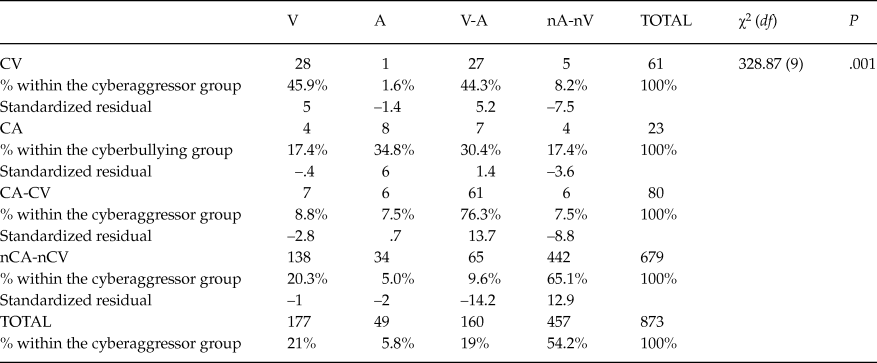
Table 3 presents an analysis of contingency between bullying and cyberbullying groups.
Contingency between Belonging to the Bullying and Cyberbullying Groups

Note: V = Victim; A = Aggressor; A-V = Aggressor-victim; nA-nV = non-Aggressor non-Victim
CV = Cybervictim; CA = Cyberaggressor; CA-CV = Cyberaggressor-Cybervictim; nCA-nCV = non-Cyberaggressor non-Cybervictim.
Notice the significant association between roles in the bullying and cyberbullying contexts: Results indicate an overlap between an adolescent’s “status” in one bullying modality and the other. Accordingly, and bearing in mind the corrected standardized residuals found in this analysis, we observed overlap between cybervictims and the victims and aggressor-victims groups; between cyberaggressors and the aggressors group; between cyberaggressor-cybervictims and the aggressor-victims group; and between non-cyberaggressor non-cybervictims and the non-aggressor non-victims group.
Comparison of Bullying/cyberbullying Groups in Terms of FFM Personality Variables
Comparison of bullying groups acccording to the FFM. Last, we examined differences between the various bullying/cyberbullying groups in terms of FFM personality variables. Considering the aforementioned significant associations we found between bullying/cyberbullying, age, and sex, and previous studies’ findings that FFM traits are also significantly associated with age and sex (Romero & Alonso, Reference Romero and Alonso2017), analyses were conducted to control for both those variables. Given the large number of variables to examine, and in an effort to control the potential rise in Type-1 error, multivariate analyses were conducted, before univariate analyses, addressing all five personality domains.
Table 4 presents a comparison of bullying groups in terms of different personality variables, controlling for the effects of age and sex.
Comparison of Bullying Groups on Various Personality Variables, Controlling for Effects of Age and Sex

Note: V = Victim; A = Aggressor; A-V = Aggressor-Victim; nA-nV = non-Aggressor non-Victim.
Means with subscript (a, b, c) showed significant differences (p ≤ .05) in pairwise comparisons, according to Tukey’s post hoc HSD test.
Multivariate analyses detected significant differences for the five sets of variables.
Turning our attention to the neuroticism domain, all univariate F values were significant, and post hoc analyses showed that on the total neuroticism factor, victims and aggressor-victims scored relatively high, whereas aggressors and non-aggressor non-victims were the groups that scored lowest on this dimension. Analyzing the individual facets of neuroticism, we found that victims scored highest on anxiety, while aggressors and non-aggressor non-victims scored the lowest. Victims also scored high on the depression and social anxiety facets, while simultaneous aggressor-victims scored notably high on hostility. Compared to other facets of the neuroticism dimension, hostility had the largest effect size (partial eta squared = .10).
Next, addressing the traits – or facets – in the extraversion domain, univariate analyses indicated significant effects of activity, and excitement seeking. However, post hoc analyses only detected significant differences between groups on excitement seeking: non-aggressor non-victims scored the lowest, on average, whereas aggressor-victims had the highest mean.
Now addressing traits within the openness domain, victims scored highest on this dimension overall, while aggressors and aggressor-victims scored lowest. Univariate analyses showed significant effects of all facets except actions. Yet post hoc analyses revealed the following differences: victims scored higher than aggressor-victims on the aesthetics, feelings, and values facets. Meanwhile, aggressors had the lowest average score on ideas, and non-aggressor non-victims scored highest on that scale.
On the agreeableness dimension, overall, the groups who scored highest were victims and non-aggressor non-victims, whereas the aggressor and aggressor-victim groups scored lowest. Post hoc analyses of agreeableness traits, meanwhile, indicated significant effects of all facets: victims and non-aggressor non-victims scored higher than aggressors and aggressor-victims on straightforwardness, altruism, and modesty. On the facets of trust and compliance, significant differences occurred between aggressor-victims and non-aggressor non-victims such that the latter group scored higher. And finally, on the tendermindedness facet, victims scored higher than aggressor-victims, who scored the lowest on average. Of the various facets of agreeableness, compliance had the largest effect size (partial eta squared = .10).
Regarding the fifth and final dimension, conscientiousness, overall the aggressor-victims scored lowest on average, and non-aggressor non-victims scored highest. Post hoc analyses indicated significant effects of all conscientiousness facets. Competence and order followed the same pattern as total conscientiousness, with aggressor-victims scoring lower than non-aggressor non-victims. Meanwhile, on dutifulness, achievement striving, and self-discipline, victims and non-aggressor non-victims scored higher than aggressors and aggressor-victims. Last, the non-aggressor non-victims group scored higher than the others on deliberation. Among the various facets of the conscientiousness dimension, deliberation exerted the largest effect size (partial eta squared = .08).
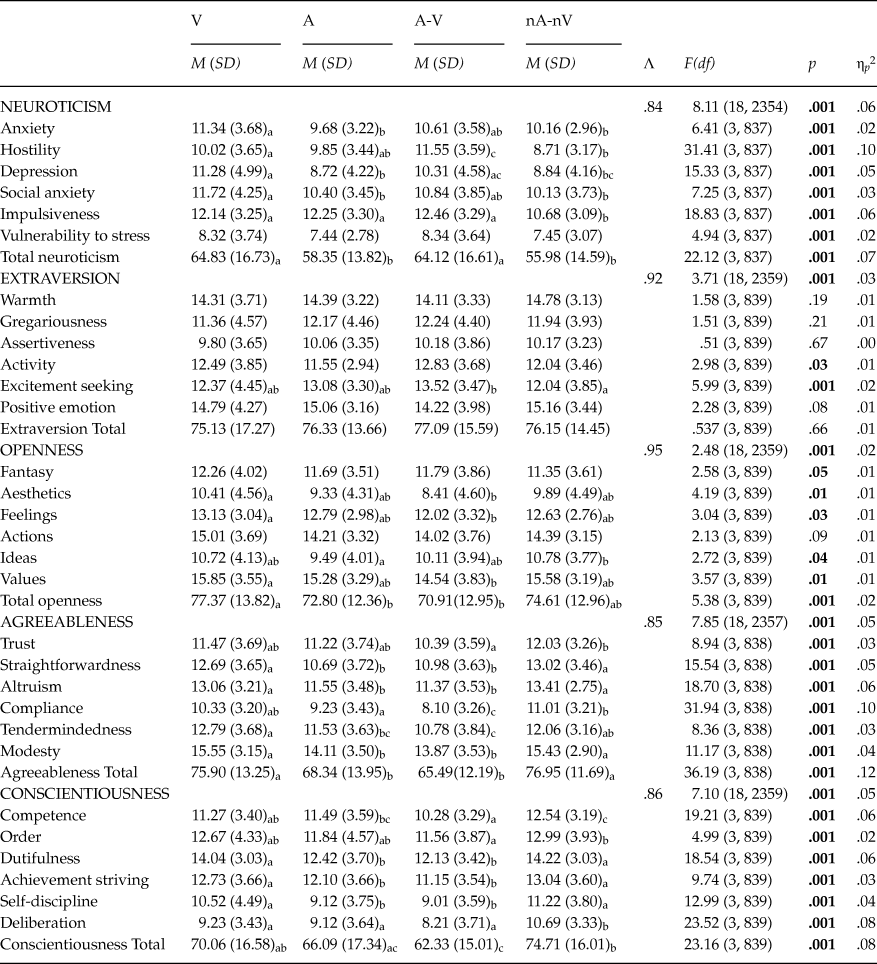
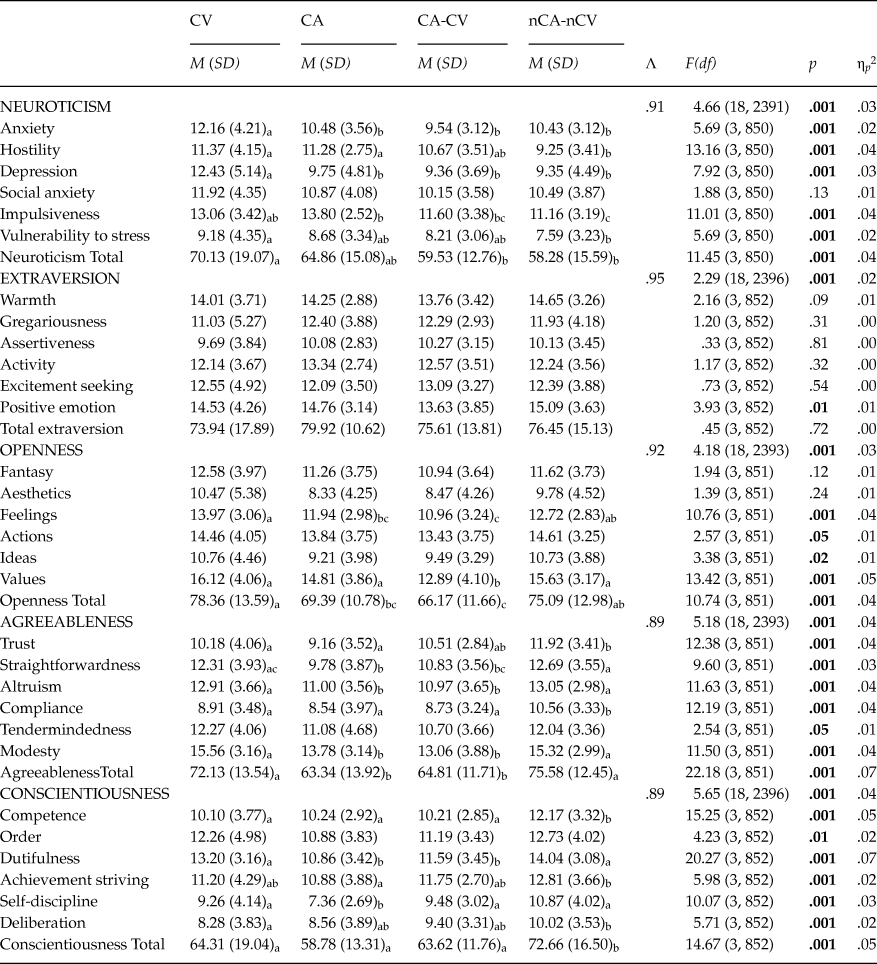
Comparison of cyberbullying groups acccording to the FFM. Table 5 presents a comparison of cyberbullying groups in terms of different personality variables, controlling for the effects of age and sex.
Comparison of Cyberbullying Groups in Terms of Various Personality Variables, Controlling for the Effets of Age and Sex

Note: CV = Cybervictim; CA = Cyberaggressor; CA-CV = Cyberaggressor-Cybervictim; nCA-nCV = non-Cyberaggressor non-Cybervictim.
Means with subscript (a, b, c) showed significant differences (p ≤ .05) in pairwise comparisons, according to Tukey’s post hoc HSD test.
Multivariate analyses detected significant differences as a function of the five sets of variables. As in the case of traditional bullying, cybervictims scored higher than cyberaggressor cybervictims and non-cyberaggressor non-cybervictims on overall neuroticism. Regarding its facets, post hoc analyses showed significant effects of all but social anxiety. Results indicate that cybervictims scored higher than the other cyberbullying groups on anxiety, depression, and vulnerability to stress. On hostility, conversely, cybervictims and cyberaggressors scored higher than the non-cyberaggressor non-cybervictim group. Finally, cyberaggressors scored higher than non-cyberaggressors non-cybervictims on the impulsiveness facet.
With regard to the extraversion domain, multivariate analysis indicated significant differences, and univariate analyses showed significant effects of the positive emotions facet. However, post hoc analysis did not indicat any differences between groups.
Multivariate analysis detected differences as a function of traits in the openness domain. Specifically, cybervictims scored highest on total openness, and cyberaggressor-cybervictims scored lowest. Univariate analysis revealed significant effects from all facets but fantasy and aesthetics. However, post hoc analyses identified the following differences between groups: Cybervictims scored highest on feelings, and cyberaggressor-cybervictims scored lowest. Cyberaggressor-cybervictims also scored lower on values than the other groups.
In terms of agreeableness, the groups who scored highest on this dimension overall were cybervictims and non-cyberaggressor non-cybervictims; meanwhile the lowest-scoring groups were cyberaggressors and cyberaggressor-cybervictims. Univariate analysis indicated that all agreeableness facets rendered significant effects. Cybervictims and non-cyberaggressor non-cybervictims scored higher on altruism and modesty than the other two groups. As for trust, non-cyberaggressor non-cybervictims scored highest as a group, over and above cybervictims and cyberaggressors. Last, non-cyberaggressor non-cybervictims scored higher than all other groups on straightforwardness and compliance.
On the final dimension, conscientiousness, the non-cyberaggressor non-cybervictim group scored highest overall. Univariate analysis suggested that all facets bore significant effects. According to post hoc analyses, non-cyberaggressor non-cybervictims as a group scored highest on competence. On dutifulness, meanwhile, cybervictims and non-cyberaggressor non-cybervictims scored higher than cyberaggressors and cyberaggressor-cybervictims. Also, non-cyberaggressor non-cybervictims scored highest on achievement striving, as compared to cyberaggressors. Cyberaggressors were also the group that scored lowest on self-discipline. And finally, cybervictims scored lower on the deliberation facet than the non-cyberaggressor non-cybervictims group. Dutifulness had the largest effect size among facets in the conscientiousness dimension (partial eta squared = .07).
Discussion
This study’s first objective was to ascertain the relationship between bullying and cyberbullying in adolescents. Results reflect considerable overlap in the roles of aggressor and victim in traditional bullying and cyberbullying contexts.
While some studies have demonstrated that face-to-face victims tend to become cyberaggressors themselves (Ybarra & Mitchell, Reference Ybarra and Mitchell2004), our results and those of other studies (e.g., Del Rey et al., Reference Del Rey, Elipe and Ortega-Ruiz2012) indicate a certain overlap between bullying and cyberbullying, likely because youths who are bullied in real life tend to receive additional intimidation on the electronic devices they use to communicate. The present study’s results support the idea that when harassment migrates into information and communications technology, the central roles of aggressor and victim remain, and harassment may become more frequent (Casas et al., Reference Casas, Del Rey and Ortega-Ruiz2013).
This study’s second objective was to analyze the association between bullying and cyberbullying and the different personality domains and facets of the FFM. With regard to traditional bullying, we found that these victims exhibit relatively high levels of neuroticism (anxiety, social anxiety, and depression), openness (aesthetics, feelings, and values), agreeableness (straightforwardness, altruism, modesty, and tendermindedness), dutifulness, achievement striving, and self-discipline. This entails that victims tend to strictly abide by their ethical principles, and show a good capacity for self-motivation to achieve their goals. Our finding of elevated neuroticism is consistent with past research findings (e.g. Mitsopoulou & Giovazolias, Reference Mitsopoulou and Giovazolias2015) and with the description of victims as insecure, anxious adolescents depicted in the literature to date (White, Reference White2015). As for the openness domain, unlike past studies that reported no significant differences (Polo, León, Fajardo, Felipe, & Palacios, Reference Polo, León, Fajardo, Felipe and Palacios2014), these results indicate greater openness in victims. That result might at first seem contrary to expectations, but bear in mind that victims, due to social anxiety, may be more isolated from their surroundings. That might precipitate greater imagination and more daydreaming as a means of avoidance, plus greater receptiveness to their inner worlds, in which case they might experience emotions more deeply. That could, in turn, produce more anxiety and depression in response to negative emotions. Finally, victims exhibited high agreeableness overall, but that was not the case for the hybrid bully victims. Perhaps elevated tendermindedness is precisely the mechanism that protects “pure” victims from becoming bullies themselves.
With respect to aggressors in cases of traditional bullying, we found that they exhibit low neuroticism, specifically low anxiety, which is consistent with previous studies (Albores-Gallo, Sauceda-García, Ruiz-Velasco, & Roque-Santiago, Reference Albores-Gallo, Sauceda-García, Ruiz-Velasco and Roque-Santiago2011). It has been proposed that anxiety, which implies sensitivity to punishment, may inhibit direct aggression (Kerr, Tremblay, Pagani, & Vitaro, Reference Kerr, Tremblay, Pagani and Vitaro1997). Maybe low anxiety, in combination with other traits that stoke antagonism toward others, also promotes bullying behavior. Furthermore, with respect to the openness domain, aggressors were characterized by low curiosity and limited, conventional fields of interest. They also exhibited low agreeableness, showing little inclination to express their true feelings, little engagement with other people’s problems, and a tendency toward narcissism. This finding is consistent with the literature to date (e.g., van Geel et al., Reference van Geel, Goemans, Toprak and Vedder2017).
Regarding the aggressor-victims group, our results indicate that in terms of overall personality domains, they are characterized by high neuroticism and low conscientiousness, openness, and agreeableness. As for the specific facets, this group displays high hostility, or in other words, a propensity for anger, frustration, and/or rancor. On the other hand, we found relatively high levels of excitement seeking in this group, which is in line with studies that have reported a higher propensity for antisocial behavior among sensation seekers (Luengo, Sobral, Romero, & Gómez-Fraguela, Reference Luengo, Sobral, Romero and Gómez-Fraguela2002). Aggressor-victims were also characterized by low openness in terms of aesthetics, indicating insensitivity to and disinterest in art; low scores on feelings, displaying emotional weakness and placing little importance on feelings; and low openness in the form of values. Meanwhile, all across the agreeableness domain, on all facets (straightforwardness, trust, altruism, compliance, tendermindedness, and modesty), aggressor-victims scored lower than any other group. Last, aggressor-victims exhibited low competence, order, dutifulness, achievement striving, and self-discipline – all belonging to the conscientiousness domain. We observed that these adolescents – at once victims and aggressors – are the group with the most unfavorable personality indicators, the ones traditionally associated with psychosocial dysfunction. These results are coherent with past studies reporting aggressor-victims had an especially high risk of developing emotional disorders like anxiety, depression, psychosis, substance abuse, and antisocial personality disorder (Sourander et al., Reference Sourander, Jensen, Rönning, Elonheimo, Niemelä, Helenius and Almqvist2007), higher than pure victims and pure bullies.
Finally, as expected, we found that the non-aggressor non-victims group had the healthiest personality, with relatively low neuroticism scores and comparatively high agreeableness and conscientiousness.
In addition to analyzing the relationship between traditional bullying and the FFM, this study analyzed cyberbullying in relation to that model of personality. Results indicate that cybervictims show: Higher levels of neuroticism – specifically, high anxiety, hostility, depression, and vulnerability to stress – in a manner consistent with previous research findings (Fredstrom et al., Reference Fredstrom, Adams and Gilman2011; Çelik et al., Reference Çelik, Atak and Erguzen2012); high agreeableness – specifically altruism and modesty; and higher levels of openness (more openness to a wider range of feelings). This association could be explained by the same hypothesis proposed above, about victims of traditional bullying: Imagination and daydreaming as a means of avoidance. Furthermore, these adolescents tended to score high on dutifulness, supporting Khosa’s (2016) findings that individuals who score high on conscientiousness are more likely to experience more frequent cybernetic harassment.
This study’s results indicate that cyberaggressors show low agreeableness (low levels of altruism and modesty), which is coherent with previous research findings (Smith, Reference Smith2015; van Geel et al., Reference van Geel, Goemans, Toprak and Vedder2017). They also scored low on facets within the conscientiousness domain (dutifulness, achievement striving, and self-discipline). Considering that many of the studies conducted to date concluded that agreeableness and conscientiousness are the two domains most closely linked to antisocial behavior (e.g., Klimstra, Akse, Hale III, Raaijmakers, & Meeus, 2010), all signs seem to indicate that they also favor cyberbullying, which definitely constitutes behavior that violates social norms. Cyberaggressors, furthermore, scored high on hostility and impulsiveness; those facets of the neuroticism domain are characterized by negative emotions toward others, rather than directed at oneself (e.g. depression and anxiety) (Lynam & Widiger, Reference Lynam and Widiger2007), which are more characteristic of cybervictims. Therefore, by incorporating the entire FFM, we were able to finetune the conclusions of past research, and discern which particular aspects of neuroticism may be more closely associated with one or another role in cyberbullying.
Cyberaggressor-cybervictims were characterized by low scores on the neuroticism, openness, and agreeableness domains, and on dutifulness.
Finally, like the adolescents who were neither victims nor aggressors in traditional bullying, their cyberbullying counterparts – the non-cyberaggressor non-cybervictims group – exhibited a healthier personality characterized by low neuroticism (lower hostility and impulsiveness), higher conscientiousness (higher levels of competence, dutifulness, achievement striving, and deliberation), and more agreeableness (higher levels of trust, straightforwardness, altruism, modesty, and compliance).
Upon comparing the features of the various bullying groups to their equivalent cyberbullying groups, we discover that victims and cybervictims have a similar personality profile (high neuroticism, agreeableness, and openness). By the same token, aggressors and cyberaggressors display a similar profile: low agreeableness, dutifulness, achievement striving, and self-discipline. Nevertheless, they differ in that face-to-face aggressors show low openness, specifically low openness to new ideas, and low neuroticism, specifically low anxiety. Therefore, the traditional bully’s personality profile seems closer to what has historically been called “sociopathic” (e.g., Lykken, Reference Lykken1957). Perhaps face-to-face bullying is more closely associated with psychopathic traits than cyberbullying, where the violence is more indirect and thus can be done even without the emotional coldness typical of sociopathic personality profiles. In any case, these results suggest a need for research to more directly address emotional callousness in bullies and cyberbullies alike, so this hypothesis can be more systematically explored. Aggressor-victims and cyberaggressor-cybervictims are alike in their low openness and agreeableness. However, aggressor-victims also displayed low conscientiousness, which their cyber counterparts did not. Another distinction we observed was in neuroticism. Cyberaggressor-cybervictims scored low on this dimension whereas aggressor-victims scored high. With that in mind, aggressor-victims in the traditional bullying context seem to exhibit a higher number of peculiar personality traits indicative of psychosocial maladjustment. Perhaps belonging to the cyberaggressor-cybervictim group has a lower threshold for personal dysfunction than engaging in traditional bullying as an aggressor-victim does. Anonymity and distance from the victim may disinhibit aggression that would be harder to let fly in face-to-face interactions; these acts of cyberbullying could also entail a higher probability of victimization. The non-aggressor non-victims and non-cyberaggressor non-cybervictims groups were the most alike. They both presented low neuroticism, and high agreeableness and conscientiousness. Those domains comprise what has been called an alpha superfactor, linked to positive expression of socially desirable traits and indicating good socialization (Digman, Reference Digman1997).
This study has certain limitations that warrant consideration. They include the sole use of self-report measures, given the potential threat of social desirability effects. While self-report measurement has demonstrated validity in the field of bullying/cyberbullying, it would be interesting to collect additional information from parents, teachers, and peers. Next, some of the facets we studied have psychometric limitations – specifically, low internal consistency indices – that may have affected the strength of the associations we found. Another limitation to consider is that a longitudinal research design was not used, which would add depth to the prediction of bullying and cyberbullying based on personality. For instance, prospective research could help elucidate to what extent victims’ high anxiety should be considered an antecedent versus consequence of victimization. On another note, ideally other pertinent roles would be incorporated, like witnesses of (cyber)bullying, for a more thorough examination of psychosocial factors that either promote or protect against (cyber)bullying. This study identified general profiles associated with each pattern of bullying/cyberbullying, but it is possible that multiple differential profiles exist within each group (for example, hostile/neurotic aggressor versus sociopathic aggressor), and to pursue that line of inquiry would necessitate future studies with methods of analysis that identify homogenous sets of people within each role (e.g., cluster analysis or latent class analysis).
Despite those limitations, this study provides a broad, systematized perspective on the personality traits associated with various roles in traditional bullying and cyberbullying. One of this study’s main, original contributions is its thorough assessment of personality traits, including their constituent facets, in a study of bullying and cyberbullying in conjunction. Very few studies indeed have analyzed the relation between cyberbullying and the Big Five model (Goodboy & Martin, Reference Goodboy and Martin2015; Smith, Reference Smith2015); moreover, to our knowledge, this is the first to analyze the complete five-factor model (including facets as well as domains) in connection with cyberbullying. This study made another novel contribution: A personality-based analysis of adolescents who are simultaneously (cyber)victims and (cyber)aggressors. Considering the high prevalence of this group that simultaneously engages in both roles, higher than the percentage of (cyber)victims and (cyber)aggressors separately, it seems relevant to analyze their personality profile. In light of the results, we deduce that this personality pattern is more indicative of psychosocial maladjustment in the context of traditional bullying than cyberbullying.
This study provides a map of useful personal descriptors that can definitely guide future research on the etiology of and intervention in these phenomena. Given the co-occurrence between bullying and cyberbullying, if one of the two phenomena is detected in youths, it is entirely possible that the other is present, too. Furthermore, interventions that focus on (cyber)victims and (cyber)aggressors join the literature with growing frequency, whereas far fewer interventions have been devised for youths who play the dual role. As our results show, they exhibit a more dysfunctional personality profile, so they probably require a different intervention than pure victims or pure aggressors.