Introduction
An increasing number of children around the world, including Japanese children, are being educated entirely in a second language (L2) while at the same time learning and developing their first language (L1) (Ministry of Foreign Affairs in Japan, 2011). This L2 learning in primary school settings raises interesting questions about how/whether developing L2 knowledge of vocabulary both influences and is influenced by L1 knowledge when the two languages are typologically distant (Menyuk & Brisk, Reference Menyuk and Brisk2005; Paradis, Reference Paradis, Hoff and Shatz2007). Investigating the nature of vocabulary knowledge in these L2 children is important particularly as they face the significant challenge of acquiring L2 vocabulary adequately in order to handle school work in subject-matter areas. Moreover, in developing vocabulary, children acquire multi-faceted word knowledge which includes phonological and orthographic representations, together with syntactic and morphological properties, which characterises their vocabulary learning as a gargantuan task (Snow & Kim, Reference Snow, Kim, Wagner, Muse and Tannenbaum2007). One essential dimension, which is the focus of the current study, is morphological awareness, i.e., the ability to distinguish and manipulate the structure of morphemes, the smallest meaning-bearing units in language (Kuo & Anderson, Reference Kuo and Anderson2006). One goal here is to investigate this word-specific knowledge, which includes knowledge of inflectional (forget → forgot; yomu “to read” → yonda “read, past tense”) and derivational forms of a word (forget → unforgettable; atatakai “warm” → atatakasa “warmth”) in both English and Japanese. The rationale behind this focus is to expand on past research in two primary ways. Morphological awareness has typically been researched in the context of either inflectional or derivational morphology, rarely both. Considering that there are significant differences between inflectional and derivational morphology, it is necessary to include a greater range of measures that tap into the complexities of both morphological systems, which should in turn provide a more complete picture of the development of morphological awareness (Ramirez, Chen, Geva & Kiefer, Reference Ramirez, Chen, Geva and Kiefer2010). In addition, by looking at children who began learning an L2 which is typologically distant from the L1 at an early age, this study is capable of illuminating the potential impact of early L2 learning on the development of the L1, and vice versa. To that end, we investigated different aspects of morphological awareness in two groups of bilingual children with differing L1s and language learning backgrounds.
Defining bilinguals
Various definitions and typologies of bilingualism have been advanced to date, ranging from having native-like competence in two languages (Bloomfield, Reference Bloomfield1935) to a minimal competence in at least one of the domains in the L2 (e.g., speaking and reading) (Diebold, Reference Diebold1964; Macnamara, Reference Macnamara1967). Between these two extremes lie various other definitions allowing for different degrees and dimensions of bilingualism. These definitions reflect the notion that most bilinguals typically use two languages to different degrees and at different frequencies, depending on the context (e.g., school and home) and domain (e.g., speaking and writing), thus leading them to have various degrees of proficiency in two languages (see García, Reference García2009; Hamers & Blanc, Reference Hamers and Blanc2000, for a review).
One dimension relevant to the current study is the classification of child bilinguals in terms of age of acquisition (Hamers & Blanc, Reference Hamers and Blanc2000): (i) simultaneous bilinguals (developing two languages since birth); (ii) child L2 acquisition (or consecutive bilinguals) (L1 acquired first, followed by L2 acquired before the age of 10/11 years). This classification is important as it hypothesises substantial differences that may exist in the course of acquisition and ultimate attainment achieved in both languages across different types of bilinguals, yet evidence of this matter from linguistic research is still scarce (Meisel, Reference Meisel, Bhatia and Ritchie2004). Hence there is an increasing need for investigating variability within bilingual populations without necessarily referencing a monolingual norm, but rather trying to better understand the particular characteristics of the linguistic development of these children in their own right (Cook, Reference Cook and Cook2003; Jean & Geva, Reference Jean and Geva2009). To this end, simultaneous bilinguals involved in the current study are those who have been exposed to both English and Japanese since birth in England. In this context, English is the dominant language, being the language of instruction in school, whereas Japanese, an ethonolinguistically minority language in the UK, has been learnt mainly through parental input at home, being the first language of the mother. Simultaneous bilingual children learning Japanese in this environment are, in the current study, termed as learners of Japanese as a Heritage Language (JHL). Child L2 learners in this study are those who had extensive exposure to Japanese (e.g., grammar, phonology and vocabulary) through parental input and nursery in Japan before arriving in the UK at four years of age on average and starting to learn English as an L2, hence termed as ESL children.
The development of morphological awareness in L1 children
Morphological awareness concerns the ability to manipulate the structure of morphemes, the smallest meaning-bearing units in language (e.g., un- and -kind in unkind), and includes knowledge of inflectional (forget → forgot) and derivational (forget → unforgettable) forms of a word (Kuo & Anderson, Reference Kuo and Anderson2006). This type of knowledge facilitates the comprehension of texts which include morphologically complex words. In this respect, morphological awareness could be indicative of depth of vocabulary knowledge (or richness of knowledge about words) (Kieffer & Lesaux, Reference Kieffer and Lesaux2008). Moreover, a large body of evidence supports the importance of morphological awareness in relation to its contribution to the development of other literacy-related skills such as word reading, reading comprehension and writing, over and above other variables including phonological awareness, non-verbal intelligence and verbal short-term memory (Carlisle, Reference Carlisle1996; Green, McCutchen, Schwiebert, Quinlan, Eva-Wood & Juelis, Reference Green, McCutchen, Schwiebert, Quinlan, Eva-Wood and Juelis2003; Mahony, Singson & Mann, Reference Mahony, Singson and Mann2000; Nagy, Berninger & Abbott, Reference Nagy, Berninger and Abbott2006; Singson, Mahony & Mann, Reference Singson, Mahony and Mann2000).
Children's morphological awareness (especially of derivations) accelerates in middle childhood and continues developing through adolescence along with vocabulary knowledge (Anglin, Reference Anglin1993; Carlisle, Reference Carlisle2000; Carlisle & Fleming, Reference Carlisle and Fleming2003; Mahony, Reference Mahony1994; Mahony et al., Reference Mahony, Singson and Mann2000; Singson et al., Reference Singson, Mahony and Mann2000; Tyler & Nagy, Reference Tyler and Nagy1989). During this developmental process, children typically learn morphologically simple or transparent words to start with, followed by more morphologically complex, opaque words. When different aspects of morphological awareness were investigated, it was its productive aspect, not receptive, that was predictive of the children's ability to define morphological complex items (Carlisle, Reference Carlisle2000). Carlisle (Reference Carlisle2000) explained this relationship by suggesting that producing inflectional/derivational forms involves processes similar to those for defining lexical items via requiring knowledge of both semantic and syntactic roles of the affixes, as well as the meaning of the base morpheme. Duncan, Casalis and Colé (Reference Duncan, Casalis and Colé2009) argued for a special difficulty in producing morphologically complex items over recognising morphemes. This difficulty in production was argued to stem from a need to tap into a more explicit level of morphological awareness, thus placing greater metalinguistic demands on these children. Hence, considering both receptive and productive dimensions is important in that it adds a more detailed picture to our understanding of the nature of morphological awareness in children. More recently, Bowers and Kirby (Reference Bowers and Kirby2010) demonstrated that explicit instruction about the morphological structure of words had positive effects on children's skills at conducting morphological analysis and defining morphologically complex items. This positive role of enhanced explicit knowledge of morphemes was observed in the context of English-L1 children.
What warrants further investigation is the extent to which children's skills at conducting morphological analysis in L2 words differs from those in L1. Much more evidence of this issue is needed particularly from L2 children learning two typologically distant languages (Pasquarella, Chen, Lam, Luo & Ramirez, Reference Pasquarella, Chen, Lam, Luo and Ramirez2011). In doing so, it is essential to measure morphological awareness both for recognition and production, as each may be demonstrable to varying degrees and also be related to vocabulary knowledge in different strengths, as observed in Carlisle (Reference Carlisle2000) and Duncan et al. (Reference Duncan, Casalis and Colé2009).
Morphological development in the L2 and cross-linguistic influence
In the current study, we define transfer in line with research in educational psychology and psycholinguistics. That is, we interpreted, as evidence for transfer, unique variance explained by a predictor in one language in a regression model predicting an outcome variable in the other language, over and above within-language predictors (Wang, Ko & Choi, Reference Wang, Ko and Choi2009).
A few examples of research on morphological transfer include a study by Deacon, Wade-Woolley and Kirby (Reference Deacon, Wade-Woolley and Kirby2007) on the development of morphological awareness (inflections) among French immersion children (L1 English), and also a study on derivational morphology in Spanish-speaking English Language Learners (ELLs) by Ramirez et al. (Reference Ramirez, Chen, Geva and Kiefer2010). The Deacon et al. (Reference Deacon, Wade-Woolley and Kirby2007) study demonstrated that, after controlling for vocabulary, phonological awareness and non-verbal IQ, the Grade 1 measure of English morphological awareness explained unique variance in Grades 1–3 French reading. Moreover, Grades 2–3 measures of French morphological awareness were significant predictors of Grades 2–3 English reading. This study thus demonstrated bidirectional transfer of morphological awareness of inflections (i.e., French ↔ English) among children in the early school years. More recently, Ramirez et al. (Reference Ramirez, Chen, Geva and Kiefer2010) studied Spanish-speaking ELLs in the later primary school years and demonstrated unidirectional, cross-linguistic contributions of morphological awareness, using receptive and productive measures of English and Spanish derivational morphology. The results showed that the productive measure of Spanish morphological awareness was predictive of English word reading after controlling for non-verbal IQ, vocabulary, phonological awareness and English morphological awareness. However, English morphological awareness did not predict Spanish word reading, which Ramirez et al. explained by suggesting that morphological transfer might occur from a language with more complex morphological systems (Spanish in this case) to the other with less complex systems (English). These studies could be expanded on further by looking at different aspects (i.e., recognition and production) of both inflections and derivations. Considering the varying nature of derivational and inflectional morphology, one might reasonably assume that, when both inflections and derivations were taken into account, contributions of morphological awareness to the development of other literacy-related (or linguistic) skills might be manifested differently from the aforementioned studies.
These studies looked at children learning two alphabetic languages (French and Spanish). Another important aspect of morphological transfer is the potential impact of learning languages with different scripts. This importance is highlighted, for instance, in a within-language study on four groups of children with differing L1s (English, Korean, Mandarin and Cantonese) by McBride-Chang, Cho, Liu, Wagner, Shu, Zhou, Cheuk and Muse (Reference McBride-Chang, Cho, Liu, Wagner, Shu, Zhou, Cheuk and Muse2005). In this study, morphological awareness was positively related to reading for the Mandarin and Cantonese groups, whereas it was phonological awareness that correlated significantly with reading for the Korean and English groups. Drawing on this finding, one could predict that the positive role of morphological awareness in vocabulary development may be more pronounced in Japanese-L1 (or Japanese dominant) children, who use morphographic (modified Chinese characters called kanji) as well as syllabic (more strictly, mora-based) scripts (kana writing), than English-L1 (or English dominant) children. Such language- (or script-)specific nature of morphological awareness could then potentially result in limiting the occurrence of transfer between these languages. Guglielmi (Reference Guglielmi2008), for instance, showed that the concurrent and longitudinal (from Grades 8–12) relationships between L1 proficiency and L2 reading skills were identified in the Hispanic sub-sample but not in the Asian sub-sample. Guglielmi attributed this finding partly to the lack of shared writing systems between English and their L1 (e.g., Chinese, Korean and Japanese).
There is, on the other hand, emerging evidence for the occurrence of morphological transfer across languages with different scripts. Wang, Cheng and Chen (Reference Wang, Cheng and Chen2006) demonstrated that English morphological awareness was a significant predictor of Chinese character reading and reading comprehension in Chinese ESL children in the US context, whereas transfer in the other direction (Chinese → English) was not identified. A more recent study by Pasquarella et al. (Reference Pasquarella, Chen, Lam, Luo and Ramirez2011) identified reciprocal relationships between English morphological awareness and Chinese vocabulary knowledge in Grades 1–4 bilingual children. These results not only suggest the influence of L2 morphological awareness on L1 literacy-related skills but also interdependent relationships between L1 and L2 academic proficiency.
These findings are congruent with theoretical underpinnings of the relationship between L1 and L2 knowledge in bilinguals. Cummins (Reference Cummins and Rivera1984) proposes the notion of common underlying proficiency, claiming that L1 competence at the start of extensive exposure to the L2 provides a facilitative knowledge basis for the development of L2 academic proficiency. The more dynamic nature of L1–L2 relationships is encapsulated in the notion of multicompetence (Cook, Reference Cook1991, Reference Cook and Cook2003). This notion encompasses the view that, in the bilingual mind, different degrees of L1 and L2 knowledge ranging from separation to integration can exist, depending on the domain concerned (e.g., phonology, morphosyntax) and the stage of L2 development (Cook, Reference Cook and Cook2003, for a discussion of various other factors). Combined with the empirical studies as reviewed above, these theoretical assumptions highlight another important factor which may influence the nature of transfer, namely, relative competence in each language. As observed in the Wang et al. (Reference Wang, Cheng and Chen2006) study, a shift in language dominance from L1 to L2 could lead to the occurrence of revere transfer (L2 → L1). The current study set out to investigate these issues in the context of morphological awareness in Japanese and English among bilingual children, a context which has received little attention, to the best of our knowledge. To that end, a brief overview of Japanese morphology is given below.
Japanese morphology
As in English, Japanese morphemes can be glued together by using both prefixes and suffixes as a common word formation process (Iwasaki, Reference Iwasaki2002; Shibatani, Reference Shibatani1990; Tsujimura, Reference Tsujimura2007). Both inflectional and derivational affixes are found in Japanese morphology.
Inflectional suffixes
Japanese inflectional suffixes represent variants of a word within its syntactic category as in English inflectional morphology. Many of the morphemes involved in verbal and adjectival conjugations are examples of inflectional morphemes, particularly those in the present tense (verbal morphology (VM): tabe-ru “to eat”, nom-u “to drink”; adjectival morphology (AM): ooki-i “big”) and the past tense (VM: tabe-ta “ate”, non-da “drank”; AM: ooki-katta “it was big”) (Iwasaki, Reference Iwasaki2002; see Shibatani, Reference Shibatani1990, for different theoretical models of Japanese morphology). The formation of a past tense verb involves several phonological changes. The above example nom-u “to drink”, where the root ends in a consonant, undergoes two changes: the ending of the verbal root m changes into n and the voiced tense marker -da is attached to it, resulting in non-da “drank” (see Tsujimura, Reference Tsujimura2007, for more examples). The inflectional ending -ta marks past tense also for adjectives, although the -ta in an adjective must be preceded by another inflectional suffix -kat, whereas the verbal inflection -ta can immediately follow the root. Some morphological processes involved in Japanese inflections lack their inflectional counterparts in English. For instance, Japanese nouns lack the equivalent of the singular and plural distinction in English, such as -e(s) (e.g., book → books). The use of plural marking is limited to person nouns (e.g., kodomo “child” → kodomo-tachi “children”). Moreover, unlike in English (e.g., I walk → She walks), there is no inflectional marking of subject–verb agreement in Japanese.
Derivational affixes
Japanese derivational prefixes, which may be either of native or foreign origin, are generally attached to a noun or noun equivalent (e.g., o-share “dressing up”) (Iwasaki, Reference Iwasaki2002). Sino-Japanese prefixes (i.e., those of Chinese origin; e.g., mu-, hu- and mi-) are among the very few examples of class-changing derivational prefixes (from noun to adjectival noun) that can be found in Japanese, such as shinkei “nerve” → mu-shinkei “insensitive” (see Kageyama, Reference Kageyama1982; Nomura, Reference Nomura1973, for more examples). Japanese morphology also represents derivational suffixes, which are more numerous and productive than prefixes, as follows (Iwasaki, Reference Iwasaki2002):
(1) N(oun)-forming suffix
atataka-i (Adj) “warm” → atataka-sa “warmth”
(2) V(erb)-forming suffix
kira (N) “shine” → kira-meku “to shine”
(3) Adj(ective)-forming suffix
tabe-ru (V) “to eat” → tabe-ta-i “want to eat”
(4) Adv(erb)-forming suffix
ooki-i (Adj) “big” → ooki-ku “big”
Some issues should be raised when it comes to measuring morphological awareness using the Japanese writing system. The Japanese writing system consists of three different scripts: modified Chinese characters called kanji and two phonology-(mora-)based scripts called hiragana and katakana. Contemporary usage of the scripts is characterised by the use of hiragana and kanji in combination in running text, whereas katakana are used primarily to write non-Chinese loan words. Phonology-based kana (i.e., hiragana and katakana) are used for function words, grammatical endings and particles, whereas morpheme-based kanji are used for lexical stems (Coulmas, Reference Coulmas1989). A problem here is that, to take the consonant-ending verb yomu “to read” (読 む in Japanese scripts) for example, it is segmented as yom-u through the use of the alphabet. However, in kana writing, the syllable mu (む) cannot be broken down into any smaller units (i.e., ×mu → m + u), and hence the root and its inflectional suffix are not discernable in the same way that they are in the alphabet (Shibatani, Reference Shibatani1990). Moreover, the segmentation 読 + む /yo + mu/ is more consistent with how the inflectional system is traditionally taught (Coulmas, Reference Coulmas1989) and hence should not be interpreted as incorrect. An additional problem concerns the validity of morphological segmentations for items presented in the combination of hiragana and kanji, as in 読 む. The learner might segment the item merely by relying on the graphical difference between kanji and hiragana. Furthermore, Japanese morphemes are typically multi-syllabic: even a mono-morphemic word such as は な /hana/ “flower” consists of two syllables ha-na. In this respect, presenting (especially morphologically less complex) items in hiragana alone could potentially lead to syllabic segmentations. One way to keep these possibilities to a minimum is to ensure that test items represent a good range of internal morphological complexities (e.g., 考 え る /kangaeru/ “to think” and  /fusawashii/ “appropriate”).
Summary
The importance of morphological awareness is well-documented in both L1 and L2 studies, as it is associated with the development of vocabulary knowledge and other literacy-related skills. Emerging evidence, although still scarce, suggests that this positive association may be unique to a certain aspect of morphological awareness, due to varying levels of cognitive demands which receptive and productive tasks place on children, with greater demands required in the latter (Carlisle, Reference Carlisle2000; Duncan et al., Reference Duncan, Casalis and Colé2009). The current study offers further evidence of this matter by using both morpheme recognition and production tasks to measure morphological awareness of inflections and derivations in English and Japanese.
An additional focus in the current study is on examining the nature of cross-linguistic transfer of morphological awareness between Japanese and English, a pair of typologically distant languages which have received little attention in research on morphological transfer to date. A few postulations can be made based on past research on different language pairs, as follows. The degree of complexity in morphological systems may determine the nature of morphological transfer between languages. Japanese morphology, the predominant typology of which is agglutinative, accommodates a rich inventory of various kinds of inflections and derivations, and hence could be considered more morphologically complex than English. In this respect, one could predict that an awareness of Japanese morphemes may result in positive transfer to demonstrating English morphological awareness. This type of positive transfer, however, presupposes that bilingual children are sufficiently proficient in Japanese. For those who have experienced a shift in language dominance to English, transfer in the other direction (English → Japanese) could be more robust, as suggested in Wang et al. (Reference Wang, Cheng and Chen2006). It is rather difficult to hypothesise results regarding the impact of different scripts on the nature of transfer, due to some conflicting evidence in the literature. While there is evidence of transfer across languages which use different scripts (e.g., Chinese–English), the lack of shared writing systems may inhibit L1 knowledge from transferring to L2 academic skills, as argued in Guglielmi (Reference Guglielmi2008). In this respect, it is to be stressed that the examination of morphological transfer in the current study is exploratory in nature. It is hoped that, by offering preliminary evidence, the current study can provide a useful stepping stone for future research.
The current study
The current study set out to investigate different aspects of morphological awareness in Japanese and English among two different types of bilingual children: those who were learning English as an L2 (ESL) and those learning Japanese as a heritage language (JHL) in the UK. This study also examined potential evidence of morphological transfer in the statistical sense. With reference to the existing evidence for the role of vocabulary knowledge in morphological development, we included measures of Japanese and English vocabulary knowledge (lexical meanings). A composite score of receptive and expressive tests was used as the children's overall vocabulary knowledge in each language. The receptive scores from English and Japanese standardised vocabulary tests were each used as a proxy for general proficiency in each language (Dunn, Dunn, Whetton & Burley, Reference Dunn, Dunn, Whetton and Burley1997; Ono, Shigemasu, Hayashibe, Okazaki, Ichikawa, Kinoshita & Makino, Reference Ono, Shigemasu, Hayashibe, Okazaki, Ichikawa, Kinoshita and Makino1989). The specific research questions (RQs) the current study addresses are as follows:
RQ1. What is the nature of morphological awareness of inflections and derivations in each language among respective groups of ESL and JHL children?
RQ2. (a) Is there evidence of morphological transfer, where morphological awareness in one language acts as a significant predictor of morphological awareness in the other language? (b) If so, does the nature of transfer differ between groups?
Method
Measures
Non-verbal ability task
Raven's Educational – Standard Progressive Matrices Plus (SPM+) (Raven, Rust & Squire, Reference Raven, Rust and Squire2008) was administered to assess children's non-verbal ability to ensure that all participating children fell within the typical range for general cognitive capacity. Due to practical issues surrounding the schools’ and parents’ schedules, the SPM+ was used with a 20-minute time limit, with reference to past research supporting the reliability and validity of the SPM as a timed test across a wide range of populations (Rushton, Čvorović & Bons, Reference Rushton, Čvorović and Bons2007).
Morphological tasks
The Word Segmentation (WS) task was adapted from a base identification task (Bowers, Reference Bowers2006; Bowers & Kirby, Reference Bowers and Kirby2010) and a WS task (Hayashi & Murphy, Reference Hayashi and Murphy2011). The WS task involved recognising the structure of morphemes, in which sense it was used as a measure of morpheme recognition. The children were asked to segment each test item into its base (i.e., a root/stem, an irreducible core part of a word) and inflectional and/or derivational morpheme(s). Examples include the following:
(i) A stem + an inflectional suffix
wondering → wonder + ing
考 え る /kangaeru/ “to think” →
考 え /kangae/ + る /ru/
(ii) A root + a derivational suffix
arrival → arriv + al
き ら め く /kirameku/ “to shine”
→ き ら /kira/ + め く /meku/
The Japanese version of the WS task was of the same format, the only difference being that it had two age bands: one for Years 3–4 (age 8–10 years) or younger children and the other for Years 5–6 (age 10–12 years) or older children. This was due to the availability of the comprehensive list of Japanese vocabulary classified by school year (National Institute for Japanese Language and Linguistics (NINJAL), 2009).Footnote 1 The English equivalent of such data was not available, to our knowledge. Morphological complexities in Japanese test items differed from those in their English counterparts, since multi-morphemic words (those consisting of more than three morphemes) were not well represented in the data on Japanese vocabulary for educational purposes (NINJAL, 2009).
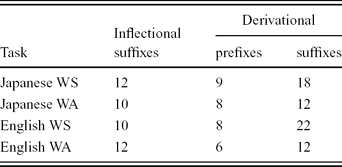
The Word Analogy (WA) task was modelled on analogy tasks developed by Nunes, Bryant and Bindman (Reference Nunes, Bryant and Bindman1997, Reference Nunes, Bryant and Bindman2006) and Roman, Kirby, Parrila, Wade-Woolley and Deacon (Reference Roman, Kirby, Parrila, Wade-Woolley and Deacon2009), respectively (e.g., anger: angry :: strength: ______ (strong)). The WA task involved producing the missing item in a target pair, on the basis of the morphological relationship between two items in the immediately preceding pair and thus was used as a measure of morpheme production. All the items in the WA task were checked to ensure that the children could not figure out the target items correctly by simply using phonological knowledge, as in walk: walked :: talk: ______ (talked). The same consideration could not be applied to the Japanese WA task, however. This was due to the fact that Japanese verbs and adjectives, in particular, always end with the same sound in the present tense (i.e., -u for verbs and -i or -na for adjectives) and also in the past tense (-ta for both verbs and adjectives). The test items were constructed so that the items in the preceding pair and those in the target pair were phonologically different except for the item-final sound, while morphologically related to one another, such as yasumu “to rest”: yasunda “rested” :: ugoku “to move”: ugoita “moved”. Like the Japanese WS task, the Japanese WA task was divided into two age bands: one for Years 3–4 (age 8–10 years) or younger children and the other for older children. Both the English and the Japanese morphological tasks were completed in writing. The number of target inflectional and derivational morphemes included in each task is given in Table 1. It should be noted that in this table the total number of target morphemes to be segmented in the WS task differs from the number of target items (30) since the former reflects the internal morphological complexities of a word, which varies across words, such as unkind (two morphemes) and irregularly (three morphemes) (see Appendices A and B for the complete lists of target items in the Japanese and English WS and WA tasks).
Number of inflectional and derivational morphemes in morphological tasks.
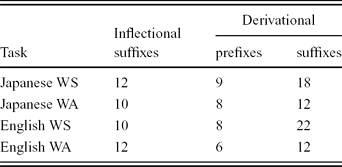
WS = word segmentation; WA = word analogy
The English and Japanese morphological tasks were all piloted on a small group of four ESL and four JHL children, prior to the main study. Although no modifications were made to the target items in either language, some modifications were necessary for the practice items in the Japanese WA task. All the children struggled to understand the following pairs: 色 (/iro/ “colour”): 無 色 (/mu-shoku/ “colourless”) :: 親 切 (/shinsetsu/ “kind”): 不 親 切 (/fu-shinsetsu/ “unkind”). Therefore, these pairs were replaced with the following pairs, which were all listed in the Japanese data for children (NINJAL, 2009): 関 係 (/kankei/ “relationship”): 無 関 係 (/mukankei/ “no relationships”) :: 自 由 (/jiyū / “freedom”): 不 自 由 (/fujiyū / “restricted, disabled”).
Vocabulary tests
A further two vocabulary tests were administered in each language, which were designed to measure receptive and expressive vocabulary knowledge.
The British Picture Vocabulary Scale II (BPVS; Dunn et al., Reference Dunn, Dunn, Whetton and Burley1997) and Expressive Vocabulary, the Test of Word Knowledge (TOWK; Wiig & Secord, Reference Wiig and Secord1992) were used as a measure of English receptive and expressive vocabulary, respectively. Both are standardised measures of vocabulary knowledge. The former required the children either to say the number of the picture (out of four) that matched the meaning of the word that the child heard or to point to the picture. The latter was designed to orally name pictures of activities and objects using a single most descriptive word per picture.
The Test of Japanese Language Abilities (TJLA; Ono et al., Reference Ono, Shigemasu, Hayashibe, Okazaki, Ichikawa, Kinoshita and Makino1989) is a standardised test of Japanese vocabulary and was used as a measure of Japanese receptive vocabulary. The TJLA has been widely used in contexts comparable to the current context, such as L2 learners of Japanese in Japan and Japanese ESL children in Japanese complementary (Saturday) schools abroad (see e.g., Kataoka, Koshiyama & Shibata, Reference Kataoka, Koshiyama and Shibata2005; Ono, Reference Ono1988). The TJLA is a written test and required the children to circle the number that corresponded to the meaning of the target item. The TJLA for primary school children is divided into three Japanese school-year bands: (i) Years 1–2 (age 6–8 years); (ii) Years 3–4 (age 8–10 years); and (iii) Years 5–6 (age 10–12 years). An appropriate version was administered according to the child's chronological age.
The Test of Japanese Expressive Vocabulary (TJEV), developed for this research, was used as a measure of Japanese expressive vocabulary. It involved providing word completions in a short sentence. In order for the TJEV to be comparable with the TJLA, two age bands were developed: one for Years 3–4 (or younger) children and the other for Years 5–6 (or older) children. Both age bands were piloted and modifications were made where necessary by removing pictures and making this test consist entirely of short sentences.
Sampling test items
The test items to appear in the Japanese morphological tasks were selected with reference to the NINJAL (2009) data, which contain three (out of seven) different sources of Japanese vocabulary to be acquired during the primary school years. (The other sources were relevant to vocabulary levels of nursery and secondary education.) Due to the lack of corpora on British English for school-age children, the English test items adapted from the previous studies were checked with the existing three sources of adult English for frequency (i.e., triangulation). This was to ensure that most of the items were frequently used in present-day British English, with reference to the British National Corpus (BNC; Leech, Rayson & Wilson, Reference Leech, Rayson and Wilson2001), Lancaster–Oslo/Bergen Corpus (Johansson & Hofland, Reference Johansson and Hofland1989) and the Brown Corpus (Hofland & Johansson, Reference Hofland and Johansson1982). Some low-frequency items used in the original tasks were retained as long as they were used in British English, so that the target items would represent a range of frequencies (frequent and less frequent). An overall frequency of 20 per million words was used as a cut-off point between high-frequency and low-frequency items, as used in the compilation of the BNC spoken and written corpora (Leech et al., Reference Leech, Rayson and Wilson2001). The number of high-frequency (HF) and low-frequency (LF) words in each morphological task was 20 (HF) and 10 (LF) in the WS task, and 17 (HF) and 13 (LF) in the WA task. It should be noted that investigating frequency effects was beyond the scope of this study.
Participants
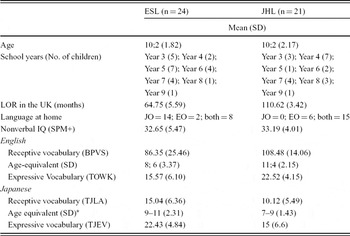
The measures described above were administered to 24 ESL and 21 JHL children, as shown in Table 2. Both groups were recruited in England, UK. The ESLs had been learning Japanese as an L1 in Japan before they came to England and started learning English as an L2 (mean Age on Arrival (AOA) = 4;08, SD = 3.74). Thus, they had a certain degree of Japanese entrenchment prior to their arrival in the UK. Their parents were both Japanese and most of the ESLs came to the UK due to their father's job. Twenty-nine ESLs were originally recruited for the study but the data from five ESLs were removed for the following reasons. Three of those removed ESLs went to a full-time Japanese school in England, where English was learnt as the language of the larger community, a language learning environment significantly different from the rest of the ESLs. Two other ESLs were excluded: one child was too young (six years old) to complete all the measures; and the other was thought by his parents and teachers to have some form of dyslexia.
Background statistics for the participating children.

*The range of age-equivalent scores was each calculated based on the school-year equivalent scores (4.8 (ESLs) & 2.8 (JHLs)) given in the TJLA manual.
JO = Japanese only; EO = English only; LOR = Length of Residence
Note: Maximum scores for each of the tests are as follows: 60 (SPM+); 168 (BPVS); 32 (TOWK); 30 (TJLA & TJEV).
Each of the JHLs was from a bilingual family where the mother was Japanese and the father was British. The JHLs had been exposed to both languages since birth. However, according to their teachers and parents, Japanese was the less dominant language, being learnt as a heritage language (or an additional language). Three of the JHLs were born in Japan and moved to the UK within about 18 months (mean AOA = 1;05, SD = 2.65). Both groups attended a local (English-medium) primary/secondary school during the week and a Japanese complementary school on Saturdays, apart from six ESLs who were learning Japanese through private tuition at home.
It proved very difficult to recruit ESLs and JHLs through local state schools in England, mainly due to their tight schedules. These children were, therefore, recruited via multiple sources including Saturday schools, Japan-related organisations, societies, and word-of-mouth. This resulted in a group of ESL/JHLs with a wide age range (from 7 to 14 years). Parental consent was obtained prior to the study, either via the schools which had distributed the consent form on behalf of the researchers or via the parents’ direct contact with the first author. All children involved were typically developing children without learning or reading disabilities (e.g., dyslexia) or specific language impairments.
Procedures
The ESLs/JHLs attended the testing session either individually or in a small group, depending on where it was held (e.g., at their home, school or the Department of Education, University of Oxford) and on the arrangements requested by the parents or school teachers. A brief interview was held at the beginning of the first session, with the mother present, to obtain information about the children's background (e.g., language spoken at home, AOA and Length of Residence (LOR) in the UK). After the interview, the non-verbal ability task SPM+ was administered either individually or in a small group. No children fell below the normal range and hence their scores were all included in the subsequent analyses. After appropriate instruction and practice trials, the ESLs and JHLs were administered the two morphological tasks and two additional vocabulary tests per language. The oral tests (i.e., BPVS and TOWK) were administered individually. The total duration of the testing sessions was approximately two hours with a few breaks (one-to-three in total) between the sessions.
Results
Scoring systems
All the responses were marked by the first author, a native speaker of Japanese, compared against those provided by three other judges: two native speakers of English (for the English tasks) and one native speaker of Japanese (for the Japanese tasks), all of whom had expertise in applied linguistics. In addition to the segmentations given by the judges, etymological segmentations given in an English language dictionary (Konishi & Minamide, Reference Konishi and Minamide2007) were included as correct segmentations for the English WS task. Performance on the vocabulary tests, such as BPVS and TJLA, was marked as follows: each response was awarded one point if it was correct, and zero points if it was incorrect or if the child gave no response or responded with “I don't know”.
As in Webb (Reference Webb2008) and Hayashi and Murphy (Reference Hayashi and Murphy2011), two scoring systems – crude and sensitive – were employed for the English and Japanese WS tasks. In the crude scoring system, responses were marked as either correct (one point) or incorrect (zero points), based on the segmentations given by the judges and the dictionary. In the sensitive system, a total score was calculated on the sum of points awarded to each morpheme correctly identified through segmentation. Points were awarded to base morphemes as well as inflectional and derivational morphemes in the WS task, in order for the WS task to tap into the children's ability to differentiate affixes from the base morpheme to which they are attached.
Employing two scoring systems is important for the following two reasons. One is to allow for the task to capture different degrees (i.e., explicit and less explicit) of knowledge of the morphological structure of words. Another reason is that using only the strict scoring system, which is reflective of how adults might segment the items, together with etymological segmentations given in the dictionary, might not necessarily accurately represent the way school-age children segment these items. In addition, depending on the item and its morphological complexity, it can be difficult to reach “the segmentation”: there may well be different ways of segmenting, none of which can be dismissed as “incorrect” altogether and awarded zero points. To take the word irregularly as an example, using the crude scoring system only would completely ignore such segmentations as irregular + ly or ir + regularly, due to these being different from the judges’ segmentation ir + regular +ly.
Sensitive (component) scores – scores awarded on each morpheme type – were used when investigating effects of morpheme types on children's performance (RQ1 above). Crude and sensitive (total) scores were used when examining whether each set of scores would exhibit different relationships with vocabulary knowledge and patterns in morphological transfer (RQ2). Only the crude scoring system was applied to the WA task, since a target item was cued by the presentation of a pair which preceded the target pair as follows: teach :: teacher: invent :: ______ (inventor).
Due to the small sample size, p-values greater than .05 and below .08 (i.e., .05 ≤ p ≤ .07) were reported as a value nearing significance in the following statistical analyses (Daniel, Reference Daniel1998; Larson-Hall, Reference Larson-Hall2010), a practice also employed in relevant studies (e.g., Deacon et al., Reference Deacon, Wade-Woolley and Kirby2007; Proctor, Uccelli, Dalton & Snow, Reference Proctor, Uccelli, Dalton and Snow2009).
Morphological awareness within language
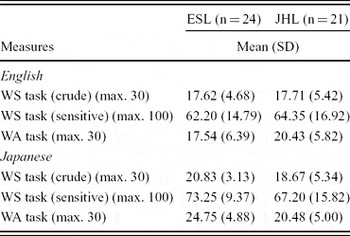
The reliability of each experimental task was measured by the Cronbach Alpha coefficient. Recall that each Japanese morphological task came in two age bands: (a) for children in Years 3–4 (age 8–10 years or younger); and (b) for those in Years 5–6 (age 10–12 or older). A high degree of internal consistency across the items was observed in the following Japanese tests: the WS task (a) = .77, the WA task (a) = .86, the WA task (b) = .90. The reliability of the WS task (b) was not as high, Cronbach's α = .65. The English WS and WA tasks were each reliable, .82 and .90, respectively. Means and standard deviations (SD) for each morphological task are given in Table 3.
Means and standard deviations for English morphological tasks.

WS = word segmentation; WA = word analogy
English morphological task results
In relation to RQ1, component scores of WS sensitive scores were used to investigate the children's performance by morpheme type (i.e., base, inflectional and derivational morphemes) in the WS task. To this end, a repeated-measures Analysis of Covariance (ANCOVA) was carried out with a within-subjects variable, Morpheme Type (base, inflectional and derivational), together with Group (ESL and JHL) as a between-subjects variable. The WA task results were analysed in a similar way, except that two types of morphemes, inflectional and derivational, were focussed on, since the task involved producing an item which correctly represented the inflectional or derivational relationship between items in the target pair.
Judging purely by the receptive vocabulary scores in Table 2, we could infer that the bilingual groups differed in proficiency in each language at the time of testing. The level of Japanese proficiency was higher in the ESL group than the JHL group, t(43) = 3.98, p < .001, d = 1.2, whereas, conversely, English proficiency in the JHL group was higher than the ESL group, t(43) = 3.74, p = .001, d = 1.1. These differences were taken into account when examining performance on the morphological tasks by including the BPVS/TJLA scores as a covariate, together with two additional covariates, age and non-verbal IQ.
The English WS task results
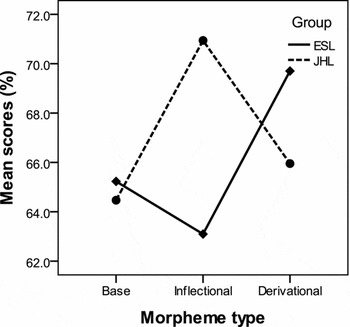
As illustrated in Figure 1, after controlling for age, non-verbal IQ and English proficiency, there was a main effect for Morpheme Type, F(2,80) = 9.6, p < .001, ηp2 = .19. Neither a main effect for Group nor a significant Morpheme Type × Group interaction was identified, F < 1. When examining within-group performances, the smallest difference, which lay between the base and derivational morphemes, was significant in the ESL group, t(23) = 7.0, p < .001, d = 1.0. Thus, the bigger differences were also significant, suggesting that the ESLs performed significantly better on the inflectional morphemes than any other morpheme type, and that their awareness of base morphemes was more demonstrable than was that of derivational morphemes. Similarly in the JHL group, the smallest difference between base and derivational morphemes was statistically significant, t(20) = 2.13, p = .046, d = .33. In short, both groups demonstrated their morphological awareness of inflections most accurately and derivational morphemes least accurately.
Mean scores across morphemes in the English WS task.

The English WA task results
The English WA analysis yielded a main effect for Morpheme Type, F(1,40) = 13.19, p = .001, ηp2 = .25, indicating that both groups typically performed more highly on the inflectional than derivational morphemes (Mean (SD) = 76,59 (15.7) – 54.69 (15.19) (ESLs); 73.98 (15.57) – 51.52 (15.43) (JHLs)). Neither Group effects nor a Morpheme Type × Group interaction reached statistical significance, F < 1.
Japanese morphological task results
Next, we carried out similar ANCOVAs on the Japanese WS (sensitive component scores) and WA tasks, respectively. Age, non-verbal IQ and Japanese proficiency (TJLA scores) were used as covariates.
The Japanese WS task results
There was a main effect for Morpheme Type, F(2,80) = 6.76, p = .002, ηp2 = .14, and a marginal effect for the Morpheme Type × Group interaction at the nearing significance level, F(2,80) = 2.78, p = .057, ηp2 = .07. These effects are illustrated in Figure 2. No significant Group effects were observed on any morpheme type, F < 1. Paired-samples t-tests indicated that the performances of the ESL group did not differ significantly across morpheme types, p > .05. The JHL group, in contrast, yielded higher scores on the inflectional morphemes than the base morphemes, t(20) = 2.06, p = .05, d = .32. This was the only significant difference found across morpheme types. In short, the JHL group's performance was highest on the inflectional morphemes, consistent with the pattern identified in the English tasks. The ESL group, in contrast to their performance on the English tasks, demonstrated their morphological awareness in a comparable manner across morpheme types.
Mean scores across morphemes in the Japanese WS task.

The Japanese WA task results
The Japanese WA analysis identified a main effect for Morpheme Type, F(1,40) = 4.28, p = .04, ηp2 = .10, thus indicating that, as was observed in the English WA task, both groups typically performed better on the inflectional than derivational morphemes (Mean (SD): 85.06 (12.64) – 76.96 (13.87) (ESLs); 79.93 (12.73) – 68.0 (14.01) (JHLs)). A marginal effect for Group was also identified, F(1,40) = 3.73, p = .06, ηp2 = .09. The ESL group yielded marginally higher scores than did the JHL group on the derivational morphemes at the approaching significance level, as indicated by planned contrasts, t(40) = 2.02, p = .05, d = .60. No significant Morpheme Type × Group interaction was identified.
Summary of ANCOVA results
In the English morphological tasks, both groups identified inflectional morphemes most accurately and derivational morphemes least accurately. This pattern was mirrored in the Japanese WA task. Slightly different patterns were identified in the Japanese WS task especially in the ESL group. While the JHL group's performance was highest on the inflectional morphemes, as observed in the other tasks, the ESL group's scores were comparable across morpheme types. Hence, these results suggest that the ESL group demonstrated the language-specific nature of morphological awareness through segmentation. While no significant between-group differences were identified in English, the language of instruction at school for both groups, there could potentially be a group difference in the ability to produce derivational morphemes in Japanese in favour of the ESL group.
Cross-linguistic influence in ESL/JHL children
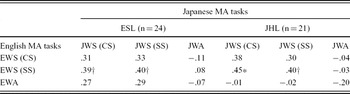
In relation to RQ2, the relationship between English and Japanese morphological awareness was examined. To this end, partial correlations were performed first, controlling for age and non-verbal IQ, as presented in Table 4. The ESL results indicated that the Japanese WS crude and sensitive scores were each positively related to the English WS sensitive scores, at the approaching significance level (p = .07). Similar patterns were identified in the JHL results, except that the positive relationship between the Japanese crude scores and English sensitive scores reached statistical significance. Thus, these relationships indicate potential cross-linguistic contributions of morpheme recognition in both groups, which could vary in strengths between crude and sensitive scores.
Correlations between Japanese and English morphological awareness

*p < .05; * *p < .01; * * *p < .001; † .05 ≤ p ≤ .07
JWS & JWA: Japanese Word Segmentation & Japanese Word Analogy tasks
EWS & EWA: English Word Segmentation & English Word Analogy tasks
CS = crude scores; SS = sensitive scores
Regression analysis predicting Japanese and English morphological awareness
As a next step, a series of multiple regression analyses were carried out via path diagrams in AMOS (Analysis of Moment Structures) for two primary purposes. One was to examine the extent to which each aspect of morphological awareness in one language was explained by variance in morphological awareness in the other language, over and above the control predictors (e.g., age and non-verbal IQ). Another purpose was to examine whether the magnitude in the cross-linguistic contribution of morphological awareness differed between groups. This was achieved by looking at differences in the regression coefficients of the between-language morphological predictor. In doing so, regression weights were constrained to be equal across groups in the first nested model, followed by examining the extent to which allowing a particular coefficient (e.g., the between-language morphological predictor) to vary in another nested model would significantly improve model fit to the data, as indicated by chi-square difference tests (Δ χ2) (Byrne, Reference Byrne2001; Schumacker & Lomax, Reference Schumacker and Lomax2004).
Past research suggests that the association between morphological awareness and vocabulary knowledge may differ when each is broken down into different aspects (e.g., receptive/productive) (Carlise, Reference Carlisle2000; Duncan et al., Reference Duncan, Casalis and Colé2009). In order to further examine this, both receptive and expressive vocabulary scores were taken into account. The BPVS/TOWK scores and TJLA/TJEV scores were each combined into a composite score, due to their significant correlations with one another in both groups. English raw scores were converted into z-scores as they were on different scales. The aggregation of vocabulary scores was necessary also from the viewpoint of achieving a parsimonious model with few meaningful predictors, as running a model with a small sample size could potentially overestimate effect size and also decrease the accuracy and stability of a path analysis (Field, Reference Field2009; Stage, Carter & Nora, Reference Stage, Carter and Nora2004).
The WS crude, sensitive and WA scores in each language were entered separately (i.e., one set of scores at a time) in a model, when used as a predictor and/or an outcome variable. One reason for this procedure is that the WS and WA scores were not significantly correlated within language. Another reason is related to the finding that Japanese WS crude and sensitive scores were each related to the English sensitive scores only but not crude scores, as given in Table 4. However, for simplicity, crude scores alone will be reported, unless they showed different results to sensitive scores.
Regression analysis predicting English morphological awareness
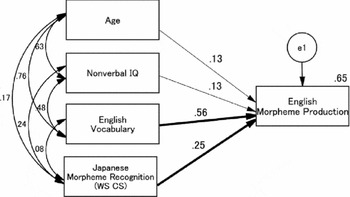
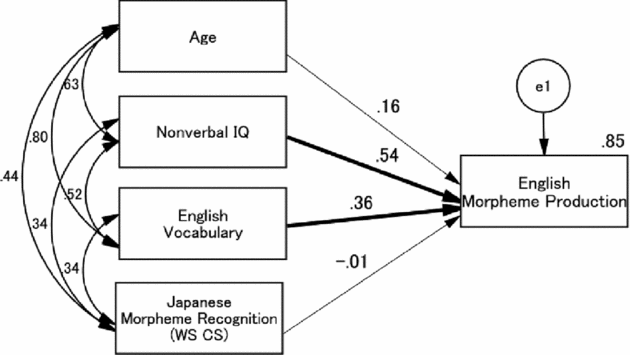
In predicting English morpheme production, Japanese vocabulary did not make a significant contribution in either group. Re-running the model without it produced the same pattern of relationships. In order to keep the model as simplified as possible, particularly due to the small sample size, the model without Japanese vocabulary is reported below. A nested model, where the regression coefficients for Japanese morphological predictor (WS crude scores) were set to vary across groups, provided an improved fit to the data, relative to the initial nested model (where all coefficients were set to be equal), Δ χ2(2) = 9.81, p = .007. As illustrated in Figures 3 and 4, the significant contribution of the Japanese morphological predictor was identified only in the ESL group and its magnitude was significantly larger than it was for the JHL group. The pathway from non-verbal IQ to English morpheme production was significant only for the JHL group. English vocabulary was a significant predictor in similar magnitude for both groups. These results were mirrored in a separate model, where the Japanese WS crude scores (i.e., the between-language predictor) were replaced with sensitive scores. Thus, the identified pattern of regression weights suggests the following. While the role of English vocabulary is similar across groups, the ability to produce English morphemes is likely to be influenced by non-verbal IQ in the JHL group, whereas it is likely to be influenced by the ability to recognise Japanese morphemes in the ESL group.
A path diagram predicting English morpheme production (ESL model).

Fit statistics (for Figures 3 and 4). χ2(2) = 2.93, p = .23; RMSEA (90% CI): .10 (.00 –.34), Pclose - fit: .27; GFI: .97; CFI: .99. RMSEA = root mean square error of approximation; CI = confidence interval; GFI = goodness of fit index; CFI = comparative fit index
A path diagram predicting English morpheme production (JHL model).
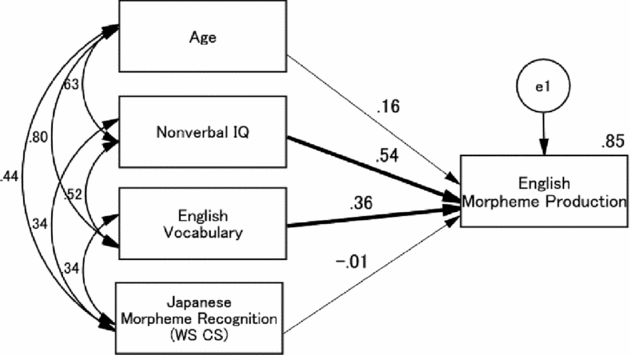
A point of note with this model is the high correlations between age and English vocabulary for both groups at r = .76 and .80, which suggests collinearity problems. When the seriousness of it was checked by computing Variance Inflation Factor (VIF) and tolerance values, they were below the cut-off points for concern (a VIF value of 10 or higher and tolerance values below .2) (Menard, Reference Menard1995; Myers, Reference Myers1990): VIF = 1.07–2.81; tolerance = .41–.94. Another point of note is that this model may lack precision in reflecting model fit in the populations, due to the upper bound of the Confidence Interval (CI) exceeding .10 (Kline, Reference Kline2011). However, one limitation of RMSEA estimates is that they can underestimate model fit in small samples, particularly as CIs can be seriously affected by sample size and model complexity (MacCallum, Browne & Sugawara, Reference MacCallum, Browne and Sugawara1996). The GFI (.97) and CFI (.99) are both relatively insensitive to model complexity and sample size (Byrne, Reference Byrne2001) and these indices suggest that the model examined was a well-fitting model (see Hu & Bentler, Reference Hu and Bentler1998; Marsh, Hau & Wen, Reference Marsh, Hau and Wen2004, for a review of fit indices).
Regression analysis predicting Japanese morphological awareness
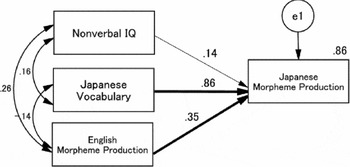
When predicting Japanese morphological awareness using WA scores, age did not make a significant contribution in any nested model. Age was then dropped and SPM raw scores were replaced with SPM standard scores, to retain some control over potential age effects. This did not alter the pattern of the relationship initially found and hence is reported below. The nested model where the coefficients for Japanese vocabulary and English WA scores were each set to vary across groups provided the best fit to the data, Δ χ2(2) = 7.73, p = .02. In this model, the cross-linguistic contribution of English morpheme production was significant only for the ESL group, as illustrated in Figure 5. The contribution of Japanese vocabulary was larger for the ESL group but was also significant for the JHL group (b = 2.21, β = .71, t = 4.21, p < .001). The contribution of non-verbal IQ, which was similar in magnitude between groups, was nearing significance (p = .06). No group effects were identified in predicting Japanese morpheme recognition.
Fit statistics. χ2(1) = .00, p = .99; RMSEA (90% CI): .00 (.00 –.00), P_close - fit: .99; GFI: 1.0; CFI: 1.0.
A path diagram predicting Japanese morpheme production (ESL model).

Summary of morphological transfer results
The analyses above depicted the group-specific nature of morphological transfer between Japanese and English. Evidence of transfer was more robust in the ESL group in both languages as follows. The ability to identify Japanese morphemes through segmentation was predictive of the ability to produce morphologically complex words in English. Furthermore, the ability to produce morphologically complex items may be transferrable across languages, as indicated by the English WA scores being a significant predictor of the Japanese WA scores. No significant transfer effects were identified in the JHL group, however. A contribution unique to the JHL group was identified in the pathway from non-verbal IQ to English and Japanese (with approaching significance) morpheme production. To reiterate, these results should be viewed as preliminary or suggestive evidence owing to the models lacking statistical power due to the small sample size. A much larger sample would be needed for these relationships to be more representative of the relevant populations.
Discussion
The nature of morphological awareness of inflections and derivations
Two groups of school-age Japanese–English bilingual children demonstrated a more accurate understanding of inflectional morphemes than derivational morphemes in English. This is congruent with the agreed-upon view that derivational morphemes, which are more numerous and idiosyncratic than inflectional morphemes, take longer to acquire, accelerating in the late primary school years and into adolescence (e.g., Anglin, Reference Anglin1993; Carlisle & Flemming, Reference Carlisle and Fleming2003; Tyler & Nagy, Reference Tyler and Nagy1989). The results of the Japanese Word Segmentation (WS) task might not fully be explained by this trend, however. The ANCOVA analysis showed marginal interaction effects, indicating that the performance of the ESL group was not affected by morpheme type, whereas the JHL group performed more highly on the inflectional morphemes, as they did in the other morphological tasks. In this respect, the ability to identify morphemes through segmentation perhaps tapped into language-specific skills in the ESL group.
These language-specific effects of morpheme types could be attributed in part to the fact that the majority of the test items in the Japanese WS task were bi-morphemic and hence represented a reduced range of morphological complexities, relative to the English WS task. This in turn might have made the ESL group's performance less sensitive to morpheme type. However, there remained morpheme type effects for the JHL group. As reviewed above, the learning of derivations, which are varied and idiosyncratic in nature, places more difficulty on children and mastering them occurs at a later stage of language development than inflections. If this held true also in the Japanese context, one could argue that the JHLs were at the stage of morphological development where the acceleration of morphological awareness of derivations had not yet taken place. At this stage, demonstrating morphological awareness of derivations could pose significant challenges especially in a cognitively demanding task (Duncan et al., Reference Duncan, Casalis and Colé2009), such as the WA task used in the current study. The WA task required the children to produce a derivational (or inflectional) form by themselves, based on its semantic and syntactic relationship with another morphologically-related item. This could be one underlying factor of the between-group difference on the derivational items in the Japanese WA task.
It should be noted, however, that neither the Morpheme type × Group interaction in the Japanese WS task nor the Group effect in the Japanese WA task was significant at the .05 level, but both were significant at the .05–.07 levels. It was decided that these p-values were too close to the threshold to ignore, considering the small sample size used (Daniel, Reference Daniel1998; Larson-Hall, Reference Larson-Hall2010). These results should therefore be interpreted as preliminary or suggestive evidence.
Preliminary evidence for morphological transfer
Bidirectional transfer in the ESL group
Morphological transfer between Japanese and English may be a phenomenon unique to the ESL group. The regression analyses indicated that Japanese morphological awareness, as measured by two levels of sensitivity (crude and sensitive scores), was each found to be a significant predictor of English morpheme production (WA scores). Furthermore, English WA scores uniquely predicted Japanese WA scores. Thus, these bidirectional (i.e., Japanese ↔ English) relationships for the ESL group could represent the following. The ability to recognise the morphological structure of Japanese words at both levels of sensitivity may increase along with the ability to produce morphologically complex English items. In addition, the ability to produce morphologically complex items may be susceptible to positive transfer between Japanese and English.
This bidirectional morphological transfer might not be explained sufficiently solely in terms of the difference in morphological systems, as posed by Ramirez et al. (Reference Ramirez, Chen, Geva and Kiefer2010), who suggest that transfer tends to occur from a language with more complex morphological systems to one with less complex systems. In view of this, the transfer from Japanese to English in the ESL group could be interpreted as the positive transfer of Japanese, the more richly inflected and complex language, to English morphological awareness. However, this alone does not help to understand the occurrence of the transfer observed in the other direction. Nor does it help to explain the lack of transfer identified in the JHL group.
One alternative explanation for the observed bidirectional transfer could be relative competence in Japanese. The ESL children's proficiency in Japanese was higher than the JHL group and was demonstrated at the age-appropriate level, as indicated by the school-year equivalent TJLA scores (see Table 1 above). This result seems to support the assumption that morphological transfer from the more complex morphological system requires certain degrees of proficiency in that language, as suggested in Ramirez et al. (Reference Ramirez, Chen, Geva and Kiefer2010). In view of this, one could argue that the level of Japanese proficiency in the ESL group was above the proficiency threshold for transfer from Japanese to English to occur. Although the exact level required remains unclear, it could be set as high as levels comparable to monolingual peers who are age-matched or one school year below (Ono, Reference Ono1994, 1997; Ono et al., Reference Ono, Shigemasu, Hayashibe, Okazaki, Ichikawa, Kinoshita and Makino1989). Extending this to the lack of transfer in the JHL group, one could argue that Japanese proficiency in the JHL group may not have reached this threshold yet. This positive role of L1 proficiency is in accordance with the theoretical model of interdependent relationships between L1 and L2 academic proficiency (Cummins, Reference Cummins and Rivera1984).
The evidence of transfer in the other direction (English WA scores → Japanese WA scores) is consistent with the existing evidence of the influence of the L2 on the L1. As suggested by Wang et al. (Reference Wang, Cheng and Chen2006), this could be explained by a shift, or the emergence of a shift, in language dominance from Japanese to English in some of the ESL children, especially those who had been schooled in English for several years prior to the study (see Table 1 for the standard deviation of LOR).
Differential contributions of morpheme recognition and production
As suggested in the Carlisle (Reference Carlisle2000) and Duncan et al. (Reference Duncan, Casalis and Colé2009) studies, respectively, morpheme recognition and production were differently associated with vocabulary knowledge within each language in the current study and it was the production task that was uniquely predicted by vocabulary.
Such differential contributions of morpheme recognition and production were identified in the transfer results. The Japanese → English transfer in the ESL group was characterised by the contribution of morpheme recognition (the ability to segment words into morphemes) in Japanese to morpheme production in English. Morphological segmentation requires analysing the morphological structure of a word, in which respect it involves the use of formal or explicit knowledge of morphemes (Bialystok, Reference Bialystok2001). Therefore, as predicted, the children's attentiveness to Japanese morphemes seems to be positively transferable to English morphological awareness.
The productive skills that the WA task tapped into were transferrable in the other direction, from English to Japanese. This could be explained in part by the argument that morpheme production tasks pose a special difficulty for children by placing greater metalinguistic demands than recognition tasks (Carlise, Reference Carlisle2000; Duncan et al., Reference Duncan, Casalis and Colé2009). In this respect, the English WA task may have tapped into a growing metalinguistic awareness of English morphemes with which the ESL children were equipped through experience of schooling in English. It is reasonable to assume that the ESL children did not necessarily possess the equivalent metalinguistic skills required in morpheme production in Japanese, the L1 which they had acquired rather naturally and implicitly in Japan. This leads to the question of effects of different types of instruction across languages, an issue which will be discussed later in this paper.
Lack of transfer for the JHL group
Evidence of morphological transfer was not established in either direction for the JHL group. The JHL group was highly proficient in English and yet transfer from the more proficient language to the less proficient did not occur. Hence, their relative competence in each language alone may not be explanatory here. An alternative viable account could be that the morphological tasks perhaps tapped into the constructs of morphological awareness which were developing in one language independently of the other language. Related to this assumption is the finding from the McBride-Chang et al. (Reference McBride-Chang, Cho, Liu, Wagner, Shu, Zhou, Cheuk and Muse2005) study, which suggests that the development of morphological awareness may play a more important role in vocabulary development in children with a morphographic L1 (e.g., Chinese and Japanese (kanji)) than those with a phonographic L1 (English). Ramirez et al.'s (Reference Ramirez, Chen, Geva and Kiefer2010) view could then be elaborated on by adding the following two accounts. One is that morphological transfer could occur in both directions between a morpholographic language (Japanese in this context) and a phonographic language (English), supposing that the learner is proficient in the former and is also receiving extensive exposure to the latter. An additional account is that morphological transfer between phonographic and morphographic languages is less likely to occur in phonographic L1 (or dominant) learners and therefore morphological awareness might increase in an independent fashion across languages in this L1 group.
Multicompetence model
The varying nature of transfer identified across groups could be contextualised via the notion of multicompetence (Cook, Reference Cook1991, Reference Cook and Cook2003). Multicompetece embodies the view that different degrees of L1 and L2 knowledge (separation to integration) can exist in the bilingual lexicon. The group-specific nature of morphological awareness observed in this study could then be illustrated as in Figure 6. As is emphasised by Cook (Reference Cook and Cook2003), degrees of integration of L1 and L2 knowledge can vary from domain to domain (e.g., morphosyntax, phonology) and can also be influenced by various other within-subject factors (e.g., motivation, preference). It should be therefore stressed that the model illustrated here is specific to morphological awareness. The overlapping areas are reflective of the unique variance explained by the relevant predictor.
E. Vocab. = English vocabulary; J. Vocab. = Japanese vocabulary.
The integration continuum of L1 and L2 morphological awareness (MA), based on the multicompetence model (Cook, Reference Cook and Cook2003, p. 9).

The differential contexts of L2 learning
The different levels of Japanese proficiency between groups might be attributable to the varying nature of the Japanese learning environment outside their (week-day) school. One relevant aspect is the nature of Japanese use at home. The JHL group was from a Japanese–English bilingual family and their use of Japanese at home was much more limited. Although 15 JHLs spoke both languages at home, they all used English as a family language (i.e., when all family members were present) and hence English use was much more frequent than Japanese use. Thus, the home environment for Japanese support was perhaps richer for the ESL group, aided by the more consistent interaction in Japanese with their Japanese parents and other family members.
Another essential aspect is the type of L2 instruction received by the children (English for the ESLs and Japanese for the JHLs). One of the two Japanese Saturday schools involved had two divisions in each school year, consisting of the Japanese-medium division (called futsūka) (i.e., the mainstream of the Saturday school) and Japanese language division (nihongoka). (The other school involved had the former division only.) Six of the ESL children in this study attended this school and all belonged to the former division, where teaching was delivered in accordance with the content of the Japanese national curriculum, a context which approximates the naturalistic environment in Japan. In this context, textbooks used are endorsed by the Japanese government and thus they are the same as those used by their monolingual peers in Japan. Eleven JHLs were recruited from the same school and all belonged to the latter division, where Japanese was taught as a subject, not used as the medium of instruction, through the use of a textbook designed for learners of Japanese as a second (or foreign) language. While receiving formal instruction in Japanese on weekends, the ESL children were exposed extensively to English via schooling with their monolingual and JHL peers. Thus, exposure to the L2 (English) was much more extensive and academic-oriented (i.e., formal) for the ESL group than it was for the JHL group (Japanese). One outcome of such differences could be a manifestation of varying degrees of metalinguistic awareness, depending on the language that the children were tested in, as well as task type (see also Murphy, Reference Murphy and Macaro2010, for a review on child L2 learning across contexts).
The ESL children were developing Japanese in the curriculum which does not feature the tradition of teaching morphemes explicitly in a way consistent with the nature of the morphological tasks used in this current study (Coulmas, Reference Coulmas1989). The JHL children were also unfamiliar with the type of morphological tasks used, from which we inferred that neither their Japanese nor their English learning featured explicit instruction about morphemes. It would be worthwhile to examine the extent to which targeting morpheme recognition and production in teaching would affect the degree of morphological transfer in each group.
Limitations
This study is not without limitations. The transfer effects in particular need to be confirmed with a much larger sample, while taking into account the effects of a more comprehensive set of control measures (e.g., phonological awareness, working memory, knowledge of kanji). In addition, each of the two groups represented a wide age range, which highlights the need to confirm these findings in a study with different age groups. Moreover, when it came to the WS task, all the items were bi- or multi-morphemic, a condition whereby it was obligatory for the children to carry out segmentation. By also including mono-morphemic words (e.g., plenty, flop), children would be required to judge the morphological segmentability of items, thus allowing for the observation of a more accurate understanding of morphemes. Lastly, the Japanese morphological tasks were piloted on a small group of Japanese–English bilingual children. This warrants a much larger-scale validation study in order to establish normative data.
Conclusion
The current study contributes a fresh picture to the existing evidence of the nature of morphological awareness of inflections and derivations across a pair of typological distant languages with differing morphological complexities. As an exploratory study, it also offers preliminary evidence for the transferability of morphological awareness in the context of Japanese and English, a pair of languages under-investigated in the field of morphological transfer to date. The findings overall suggest that one substantial difference between the two groups of bilinguals may lie in that the development of morphological awareness in Japanese and English could potentially be reciprocal in nature for the ESL group, whereas perhaps independent of one another for the JHL group. This result could lead one to assume that the foundation of L1 academic proficiency at the start of schooling in the L2 may help maintain and continue developing L1 word-specific knowledge, while at the same time developing L2 morphological (and other aspects of vocabulary) knowledge adequately. Our next step would be to confirm this unique morphological contribution by taking into account the effects of a more comprehensive set of non-linguistic and linguistic factors, such as children's motivation and parents’ attitude towards L1 maintenance, and children's phonological awareness.
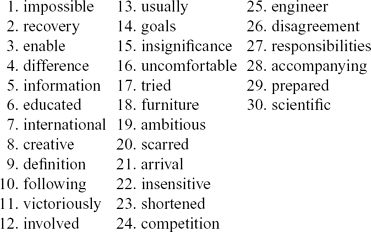
Appendix A. Examples of Japanese and English WS tasks
(Please contact the first author for more information about the WS and WA tasks.)
Japanese

English

Appendix B. Examples of Japanese and English WA tasks
Japanese
English