INTRODUCTION
Few dispute that President Obama is a transformational figure in U.S. politics or that his election as the forty-fourth president of the United States is historic, owing to his biracial heritage and self-identification as African American. Accordingly, there has been much speculation in the popular press regarding what Obama's election means—both in terms of what it says about a changing U.S. electorate (Connelly Reference Connelly2008) and in terms of how it may affect race relations and opportunities for Blacks in U.S. society (Page Reference Page2008). In this study, we focus primary attention on the latter. More specifically, we ask, how much importance do Americans accord to Obama's victory as a sign of progress for Blacks? Do Americans believe the Obama presidency will improve or hinder U.S. race relations? And, do Americans think racial equality and opportunities for Blacks will advance or retract as a result of Obama's presidency?
Our primary focus is on how race/ethnicityFootnote 1 matters for these issues. That is, do non-Hispanic Whites, African Americans, and Hispanics differ in their outlooks on the meaning of an Obama presidency? We focus on race for a variety of reasons, including (1) the special meaning of the 2008 presidential contest by virtue of Obama's candidacy, (2) the known potency of the Black/White racial divide in shaping political views and behavior (Manza and Brooks, Reference Manza and Brooks1999), (3) the recent growth of the Hispanic population in the United States and its implications for a changing U.S. electorate (De la Garza et al., Reference De la Garza, DeSipio, Garcia, Garcia and Falcón1992; Pedraza and Rumbaut, Reference Pedraza and Rumbaut1996), and (4) our wish to add to a growing body of multiethnic studies of sociopolitical attitudes (Bobo and Hutchings, Reference Bobo and Hutchings1996; Hughes and Tuch, Reference Hughes, Tuch, Sears, Sidanius and Bobo1999; Oliver and Wong, Reference Oliver and Wong2003) emerging in response to the growing racial/ethnic diversity of U.S. society.Footnote 2 Put simply, knowing more about how Whites, Blacks, and Hispanics differ in their assessments of the meaning of Obama's win can tell us much about the 2008 election outcome and the possible impacts of an Obama presidency.
We also explore the implications of race by examining how respondents' perceptions of the prevalence of racial discrimination and inequality in the United States shape their attitudes toward an Obama presidency. Given the strong “social progress” narrative in which most journalists have framed Obama's candidacy, and the debates over whether we have entered a “postracial” political age (Williams Reference Williams2008; Schorr Reference Schorr2008), analyzing how respondents' perceptions of racial inequality and discrimination shape their views of Obama stands to tell us much about the degree to which optimism about an Obama presidency is rooted in beliefs about current racial barriers in society (and what might be done about them). Put simply, how do beliefs about racial discrimination and inequality affect peoples' beliefs about the effect Obama's victory will have on race relations? And, given the substantial racial/ethnic differences that exist in perceived discrimination (Hunt Reference Hunt2007), alongside possible group differences in its meaning (Cose Reference Cose1993; Tropp Reference Tropp2007), exploring how its effects may differ across racial/ethnic lines is important.
To investigate these issues, we use data collected by the Gallup Organization during the summer of 2008. The Gallup study was designed to examine racial minority rights and relations in the United States and contains large samples of African Americans, Hispanics, and non-Hispanic Whites. The data include responses to questions about the importance of an Obama win, the impact of an Obama presidency on race relations, and the implications of an Obama win for African Americans' opportunities in the arenas of employment and politics. In addition, because the data were collected almost five months before the general election, they provide a truly prospective picture of the perceived meaning of an Obama presidency. In the following section, we discuss additional research, providing background for our key research questions and expectations. Then, we turn to an explanation of our data, measures, and analytic strategy, followed by a description of our results, a discussion of key findings, and concluding speculations.
BACKGROUND
Among the most powerful social cleavages shaping public opinion and political behavior is the Black/White racial divide, as documented by research on voter choice, partisan affiliation, political participation, and public policy views (Kinder and Sanders, Reference Kinder and Sanders1996; Manza and Brooks, Reference Manza and Brooks1999). The racial divide is traceable both to contemporary race-based inequalities (Hughes and Thomas, Reference Hughes and Thomas1998) and to the historical treatment and marginalization of Blacks in major arenas of U.S. society (Conley Reference Conley1999; Massey and Denton, Reference Massey and Denton1993). As a result, African Americans, relative to other racial/ethnic groups, generally (1) perceive more discrimination in society, (2) are more likely to attribute current inequalities to “structural” causes, and (3) are more supportive of government efforts to ameliorate inequalities (Krysan Reference Krysan2000; Schuman et al., Reference Schuman, Steeh, Bobo and Krysan1997). In addition, social identity research on linked fate (Dawson Reference Dawson1994) and group identification (Hunt Reference Hunt1996) suggests that as members of a disadvantaged status group in the United States, Blacks tend to exhibit more consensus on sociopolitical attitudes across social class and other structural lines than do other ethnoracial groups (rendering SES and other sociodemographic factors less potent explanatory factors among Blacks). Thus, we explore to what extent attitudes toward an Obama victory are structured by the racial divide in the United States.
An Obama victory likely has special meaning for members of racial minority groups, especially African Americans; it is a tangible sign of social progress given the historic oppression of Blacks, which included legalized segregation and limited civil rights within the very lifetimes of many who voted in the 2008 election. Others have pointed out Obama's importance as a role model (Christian Science Monitor 2008) and the example his victory provides for minority children that—to quote Obama from his acceptance speech—“all things are possible.” The win will also likely challenge negative racial stereotypes about Blacks, thus possibly expanding opportunities for racial minorities in various societal arenas.Footnote 3 For these and other reasons, we expect Blacks to accord more symbolic significance and importance to Obama's win, relative to other ethnoracial groups. However, given Blacks' greater experiences with, and distinctive outlooks on, racial discrimination (Krysan Reference Krysan2000; Hunt Reference Hunt2007), whether Blacks believe Obama's presidency will expand their opportunities in the United States remains an open and an important question.
Another issue garnering increasing attention by political scientists and sociologists is the rapidly growing Hispanic population in the United States, who surpassed Blacks as the largest minority group for the first time as of the 2000 census (Alba and Nee, Reference Alba and Nee2003). Given the implications of this change for electoral politics in the United States, it is important to ascertain whether and how Hispanics differ from non-Hispanic Blacks and Whites in their views of Obama and the implications of his presidency. Few nationally representative studies of Hispanics' political views exist to guide our expectations (but see De la Garza et al., Reference De la Garza, DeSipio, Garcia, Garcia and Falcón1992; Jones-Correa Reference Jones-Correa1998). However, Susan Welch and Lee Sigelman (Reference Welch and Sigelman1993) provide an important exception with their analysis of 1980s U.S. survey data by suggesting that relative to non-Hispanic Whites, Hispanic voters (with the exception of Cubans) are more aligned with the Democratic Party and are more liberal on issues involving government spending. Further, other recent analyses (Yancey Reference Yancey2003; Hunt Reference Hunt2007) suggest that Hispanics' sociopolitical attitudes generally occupy a middle ground between those of non-Hispanic Whites and African Americans; though in many cases they are more similar to the former's. Thus, we expect Hispanics will most likely fall between non-Hispanic Blacks and Whites in their views of Obama. Though, whether Hispanics' views more closely resemble one or the other group is another open and important question.
Our examination of perceived discrimination and inequality stems from past research showing a positive association between the perception of race-based barriers in society and support for redistributive social policies (Bobo and Kluegel, Reference Bobo and Kluegel1993; Krysan Reference Krysan2000). Put simply, the more racial discrimination is perceived (and believed responsible for Black/White inequality), the more support is seen for a progressive social agenda aimed at ameliorating racial/ethnic disparities. Thus, given Obama's general platform (and personal embodiment) of “change,” we expect that those who perceive more racial discrimination in society will see Obama's election as more important and will be more optimistic about the prospects for racial progress during an Obama administration.Footnote 4 However, whether the effects of perceived discrimination and inequality are similar for Whites, Blacks, and Hispanics is an open question. Few studies ask this sort of question, explicitly or implicitly, assuming that the determinants of sociopolitical attitudes do not vary across racial/ethnic lines (Hunt et al., Reference Hunt, Powell, Steelman and Jackson2000).Footnote 5 Given the distinct experiences of racial/ethnic groups in the United States, alongside evidence challenging such an “assumption of racial/ethnic similarity” in the determinants of other key beliefs and attitudes (Hunt Reference Hunt1996, Reference Hunt2007; Schnittker et al., Reference Schnittker, Freese and Powell2000; Steelman and Powell, Reference Steelman and Powell1993), we examine possible racial/ethnic differences in the relationship between perceived racial discrimination in society and attitudes toward an Obama win.
Why expect such differences? For one, various theories of “new racism” (Bobo et al., Reference Bobo, Kluegel, Smith, Tuch and Martin1997; Bonilla-Silva Reference Bonilla-Silva2003; Kinder and Sanders, Reference Kinder and Sanders1996; McConahay Reference McConahay, Dovidio and Gaertner1986) point to some manner of “denial of racial discrimination” as a component of Whites' contemporary racial attitudes (e.g., opposition to race-targeted policies, explanations for racial inequality). Thus, the extent to which some non-Hispanic Whites are sensitive to what they see as an illegitimate focus on Obama's race (especially by the media) could contribute to a unique association between perceived discrimination and attitudes toward Obama's election; that is, Whites who believe that discrimination is less prevalent may see the focus on Obama's accomplishment as relatively unimportant, following a belief that race no longer plays a significant role in society, including politics. The other side of this is that Whites who perceive more discrimination and inequality may be (compared with racial minorities) relatively optimistic about Obama's ability to improve race relations, owing to a belief that racism is primarily attitudinal (rooted in prejudice) and interpersonal, rather than institutional. In contrast, African Americans understand racial discrimination as more structural and almost certainly more firmly and existentially rooted in the exigencies of daily life (Cose Reference Cose1993). As such, Blacks may be less sanguine than Whites may be about the possibilities of Obama's presidency transforming systemic inequalities in the short term, and they may instead frame the meaning of an Obama win as a welcomed and important symbol of more general racial progress.
DATA AND MEASURES
Data
To answer our research questions, we draw on data from the 2008 Gallup Minority Rights and Relations/Black-White Social Audit, conducted in a USA Today/Gallup Poll between June 5 and July 6. The data were gathered through telephone interviews with 1935 national adults, aged eighteen years or older, including oversamples of Blacks and Hispanics. Our analytic sample is composed of non-Hispanic Whites (n = 710), non-Hispanic Blacks (n = 608), and Hispanics (of any “race”) (n = 503).Footnote 6 These data are ideally suited to the current study, given our goal of comparing how non-Hispanic Whites differ from the two largest racial/ethnic minority groups in the United States, as well as how the two racial minority groups differ from each other. The data are also ideal as they derive from one of the few national studies conducted during the election year that asked questions about the importance and possible implications of an Obama presidency.
Dependent Variables: Perceptions of the Impact of an Obama Presidency
Our dependent variables derive from five questions asking about a hypothetical Obama presidency (see Appendix). Our first outcome is measured with a question asking about the perceived importance of an Obama victory for Blacks' progress, with response options: “one of the two or three most important advances for Blacks in the past one hundred years” (coded 3), “important, but not one of the two or three most important advances” (coded 2), or “not that important” (coded 1). For our regression analyses, we computed a dummy variable to identify those respondents who felt an Obama victory would be “important” (coded 1) or “not that important” (coded 0); thus, higher values indicate greater perceived importance. Our second dependent variable is measured with a five-point scale derived from a question asking whether an Obama victory will improve or worsen race relations. Response options range from “will get a lot better” (coded 5) to “will get a lot worse” (coded 1). Thus, higher values indicate greater optimism regarding the improvement of race relations. Our final three dependent variables derive from a set of questions asking respondents whether they thought an Obama win will (1) “be a sign of progress in racial equality,” (2) “make it easier for Blacks to advance in their own careers,” and (3) “open up opportunities for other Blacks in national politics.” Response options for each question were “yes” (coded 1) and “no” (coded 0). Thus, higher values indicate greater perceived optimism regarding racial progress and opportunities stemming from an Obama presidency.
These items can also be understood along an abstract-concrete continuum regarding beliefs about an Obama win. Arguably, the most abstract is the “progress for Blacks” outcome, followed by the “progress in racial equality” and “race relations” items, respectively. Most concrete are the two questions asking about effects on careers and opportunities in national politics for Blacks. As such, these outcomes may also capture a spectrum of beliefs about different kinds of change—symbolic versus substantive—in the sense that one can view Obama's win as important and symbolically significant in terms of social progress without necessarily endorsing the view that an Obama presidency will meaningfully transform opportunity structures.
Independent and Control Variables
Race/ethnicity is based on self-reports and is measured with two dummy variables, coded non-Hispanic Black = 1, Other = 0; and Hispanic = 1, Other = 0. Thus, non-Hispanic Whites represent the excluded category in the reported regressions. To gauge perceptions of racial discrimination and inequality we utilize ten survey items (see Appendix) asking about factors such as whether Blacks suffer a disadvantage in the realms of employment, education, and housing; whether racial discrimination is a factor in Blacks' lower average educational attainments and income and higher average incarceration rates; and whether the U.S. justice system is biased against Blacks. We combine responses from these items to form a perceived discrimination and inequality (PDI) index ranging from 0 to 10, with higher values indicating greater perception of racial discrimination and inequality (α = 0.830).Footnote 7
We also control for a range of sociodemographic and other factors known to affect sociopolitical attitudes. Gender is dummy coded (male = 1) to differentiate male respondents (47%) from female (53%). Age (M = 46.8; Mdn = 46) is measured in years. Education (Mdn = post–high school level) is a nine-point ordinal measure of the respondent's highest level completed.Footnote 8 Income (Mdn = $30,000–$50,000) is a five-point ordinal measure based on respondent's reported income level.Footnote 9 Region is dummy coded (South = 1) to differentiate those living in the South (35%) from nonsoutherners (65%). Self-reported Social Class Identification (SCI) is a five-point ordinal measure based on response categories of lower (7%), working (34%), middle (42%), upper-middle (15%), and upper (2%) class, and is coded such that higher values indicate higher SCI. Interracial contact is a five-point ordinal self-report measure indicating how much contact respondents say they have with people of races different from their own. The response categories are “a great deal” (51%), “a fair amount” (27%), “not much” (18%), and “none at all” (4%) and are coded so that higher values represent more contact. Political party identification is dummy coded (Republican = 1) to differentiate self-identified (nonleaning) Republicans (23%) from respondents who identify as Independents (41%), Democrats (36%), or “Other” (< 1%) political affiliations. Political ideology is measured with a standard five-point scale with response categories of very liberal (7%), liberal (18%), moderate (42%), conservative (26%), and very conservative (6%), and is coded so that higher values indicate greater self-reported liberalism. Finally, we include a dummy variable for “race of interviewer” (Black interviewer = 1), given the known effects of interviewer race on responses to race-related questions (Davis Reference Davis1997a, Reference Davis1997b; Krysan and Couper, Reference Krysan and Couper2003). Black interviewers conducted 43% of interviews.
Analytic Strategy
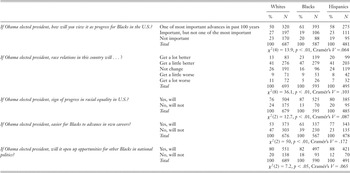
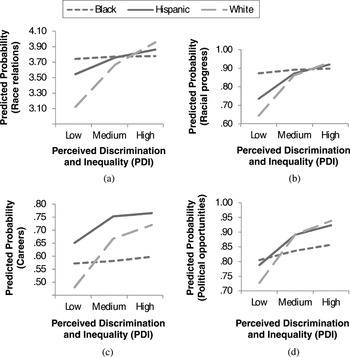
Table 1 presents descriptive statistics for our dependent variables to assess whether Whites, Blacks, and Hispanics differ in their views of an Obama presidency.Footnote 10 Then, we present three additional tables (Tables 2–4) containing regression results designed to examine (1) whether any observed racial/ethnic differences hold net of sociodemographic and attitudinal controls and (2) whether and how perceptions of discrimination and inequality shape beliefs about Obama (overall and by race/ethnicity). For each outcome, we present results from three hierarchical regression models, designed to assess the explanatory value of variables added at each stage (Tabachnick and Fidell, Reference Tabachnick and Fidell2007). Model 1 contains only race/ethnicity—Black and Hispanic dummy variables—as predictors. Model 2 adds sociodemographic and attitudinal controls to see if any observed racial/ethnic differences persist. Model 3 adds the PDI index to see if this factor matters net of the other predictors and whether it explains any racial differences from Model 2. Finally, to test whether the effects of the PDI index vary by race/ethnicity, we ran additional regressions specifying Race × PDI interactions. These results are discussed in the text (full results are available from the authors), where we focus primarily on Black (and Hispanic) differences from Whites as there is only one significant Black/Hispanic slope difference (see note 13). We present the significant interaction effects using graphic illustration procedures suggested by Jacob Cohen et al. (Reference Cohen, Cohen, Aiken and West2003) (see Figure 1).
Beliefs about an Obama Presidency, by Race/Ethnicity

Prediction Estimates for Beliefs about an Obama Win by PDI and Race/Ethnicity

RESULTS AND DISCUSSION
Table 1 presents descriptive statistics (by race/ethnicity), significance test (χ2) results, and association measures (Cramér's V) for our five dependent variables concerning beliefs about the impact of an Obama presidency. We present these results by racial/ethnic group to address our initial research question regarding group differences in perceptions.
First, regarding the “progress for Blacks” outcome, Blacks rank highest and Whites lowest on this measure. Specifically, 61% of Blacks say a victory will be “one of the two or three most important advances for Blacks in the past 100 years,” while 58% of Hispanics and 50% of Whites agree with that statement. In addition, Blacks are most optimistic that race relations will improve with an Obama win. Specifically, 70% of Blacks say race relations will “get a lot better” or “get a little better,” compared with 61% of Hispanics and 54% of Whites. Blacks are also most supportive of the view that an Obama victory will represent a sign of “progress in racial equality” (87%), while 80% of Hispanics and 76% of Whites share this view. Interestingly, Hispanics are most likely to endorse the idea that an Obama win will make it easier for Blacks to “advance in their own careers.” In fact, 77% of Hispanics hold that view, compared with 61% of Blacks and 53% of Whites. And, Hispanics are also most sanguine regarding the belief that an Obama win will open up opportunities for other Blacks “in national politics”; 88% of Hispanics hold that view, compared with 82% of Blacks and 80% of Whites. Thus, Blacks score highest on three outcomes referring to more abstract notions of perceived importance and symbolic progress, while Hispanics score highest on two outcomes referencing improvements in opportunities for Blacks in specific areas. Whites consistently report the lowest perceived importance and optimism regarding an Obama victory.
Before turning to the regression analyses, we note that significant racial/ethnic differences, F(2,1570) = 92.5, p < 0.01, η2 = 0.11, also exist on the ten-item index constructed to measure PDI (see Appendix Table A.1). Not surprisingly, Blacks (M = 7.5, SD = 2.1) perceive the most discrimination and inequality, followed by Hispanics (M = 5.8, SD = 2.5), and non-Hispanic Whites (M = 4.8, SD = 2.7), respectively (see the Appendix for more information on the items composing the PDI index).
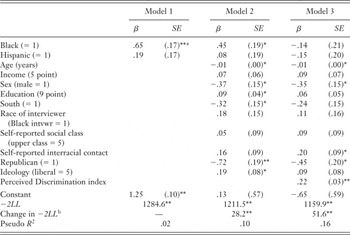
Table 2 reports estimates from the regression of the “progress for Blacks” outcome on three sets of predictors. Model 1 replicates group rankings seen in Table 1 and demonstrates that Blacks perceive significantly more importance in an Obama victory than do Whites (and Hispanics). Model 2 introduces sociodemographic and attitudinal controls and shows that the Black/White difference is reduced somewhat but remains statistically significant (unlike the Black/Hispanic difference), lending support to the linked-fate and group-identification interpretations of minority attitudes (Hunt Reference Hunt1996; Dawson Reference Dawson1994). In addition, Model 2 suggests that younger, female, more educated, nonsoutherner, non-Republican, self-reported liberals are significantly more likely to see an Obama victory as important in terms of progress for Blacks. Model 3 introduces the PDI index, which shows a significant, positive effect. Thus, as expected, greater perceived discrimination translates into greater perceived importance of an Obama win. Introduction of the PDI index also reduces the Black/White difference to nonsignificance, suggesting that racial/ethnic differences in PDI account for a significant portion of the formerly observed Black/White difference (Sobel z test = 9.93, p < 0.01).Footnote 11
Logistic Regression Estimates of Perceived Importance of an Obama Victory for Progress for Blacks (N = 1364)

a Hispanic and Black slopes differ significantly (p < 0.05).
b Change in −2LL is based on a chi-square test with k degrees of freedom (k = number of newly estimated coefficients).
* p < 0.05;
** p < 0.01
To test for differences in the effect of PDI by race, we ran an additional model adding Black × PDI and Hispanic × PDI interaction terms to the set of predictors from Model 3. These results demonstrate that neither Blacks nor Hispanics differ significantly from Whites in the effect of PDI: Black × PDI (b = −0.06, ns) and Hispanic × PDI (b = −0.04, ns). In addition, models run separately by racial/ethnic group—i.e., tests of simple [group] slopes (Aiken and West, Reference Aiken and West1991)—confirm that the impact of PDI is similar in magnitude, positive, and significant in each group: White (b = 0.20, p < 0.01), Black (b = 0.17, p < 0.01), and Hispanic (b = 0.23, p < 0.01). Thus, among Whites, Blacks, and Hispanics, higher levels of perceived discrimination and inequality translate into a significantly greater perceived importance of an Obama victory in terms of progress for Blacks.
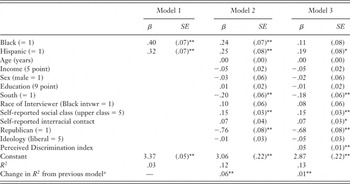
Table 3 reports results from the regression of the “race relations will improve” outcome on the same sets of predictors. Model 1 shows that Blacks and Hispanics are both significantly more optimistic than Whites that an Obama win will mean improvements in race relations; Blacks and Hispanics do not differ significantly on this outcome. Model 2 shows that the race/ethnicity effects are reduced somewhat, but retain their significance when controlling for other sociodemographic and attitudinal factors; thus, for this outcome, both minority groups show effects of linked fate/group identity that transcend other social structural divides (Dawson Reference Dawson1994; Hunt Reference Hunt1996). In addition, Model 2 shows that nonsouthern residence, higher SCI, and non-Republican affiliations all significantly predict the expectation of improved race relations following an Obama win. Model 3 introduces the PDI measure which, again, shows a significant, positive effect. Thus, greater perceived discrimination is associated with greater optimism that Obama's presidency will improve race relations. Controlling for PDI also moves the Black/White difference to nonsignificance (Sobel z test = 9.2, p < 0.01), while reducing the magnitude, but not significance, of the Hispanic/White difference (Sobel z test = 1.57, ns).
OLS Regression Estimates of Predicted Improvement in Race Relations Following an Obama Victory (N = 1371)

a Change in R 2 is based on an F test with k and m degrees of freedom (k = number of newly estimated coefficients, and m = sample size minus estimated coefficients, including the intercept).
* p < 0.05;
** p < 0.01
Additional analyses (see Figure 1a) reveal significant effect modification by race in the impact of the PDI index. Specifically, Black × PDI (b = −0.09, p < 0.01) and Hispanic × PDI (b = −0.06, p < 0.05) interactions show that the effects of PDI are significantly weaker (i.e., closer to zero) for Blacks and Hispanics than for Whites. And, regressions run separately by race/ethnicity confirm that the impact of PDI is significant only among Whites: White (b = 0.07, p < 0.01), Black (b = 0.00, ns), Hispanic (b = 0.04, ns). Thus, relative to the racial minorities, Whites who perceive more discrimination appear more likely to believe Obama will be transformational when it comes to race relations. One possible explanation for this finding is different meanings accorded to the PDI index by race/ethnicity. That is, if Whites have a primarily attitudinal conception of racism (i.e., White prejudice as the culprit), it follows that the change of heart required of Whites to elect a Black president may generalize to improve race relations in the larger society. In contrast, PDI's weaker effect among racial minorities may stem from a more structural understanding of discrimination and inequality, which is less likely to translate into optimism about an Obama presidency improving race relations.
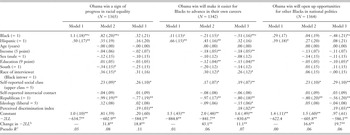
Table 4 reports the estimates from the regression of the final three dependent variables (presented together because they derive from the same set of survey questions). First, regarding the relatively abstract “sign of progress in racial equality” outcome, Model 1 (left-most columns) shows that both racial minorities are significantly more optimistic than Whites (and Blacks are also significantly more optimistic than Hispanics). Further, Blacks' differences from both other groups hold with Model 2 controls, while the Hispanic/White difference moves to nonsignificance. Thus, the group-identification interpretation of minority attitudes holds only for Blacks in this case. In addition, Model 2 shows that a nonsouthern residence, Black interviewer, higher SCI, and non-Republican affiliations predict optimism on this outcome. Model 3 introduces the PDI index, which shows the now familiar positive effect, along with a significantly diminished Black/White difference (Sobel z = 9.96, p < 0.01). Additional analyses (Figure 1b) reveal that Blacks, again, show a significantly weaker PDI effect: Black × PDI (b = −0.2, p < 0.01) than Whites.Footnote 12 Further, regressions run separately by race/ethnicity confirm that the impact of PDI is significant only among Whites and Hispanics: White (b = 0.21, p < 0.01), Black (b = 0.00, ns), Hispanic (b = 0.22, p < 0.01). Thus, Blacks who evidence higher levels of perceived discrimination and inequality demonstrate comparatively less optimism than their White and Hispanic counterparts regarding an Obama win as a sign for progress in racial equality.
Logistic Regression Estimates of Beliefs about the Implications of an Obama Victory for Racial Progress and Opportunities for Blacks

Note: Cell values are β coefficients and their associated standard errors (in parentheses).
a Hispanic and Black slopes differ significantly (p < 0.05).
b Change in −2LL is based on a chi-square test with k degrees of freedom (k = number of newly estimated coefficients).
* p < 0.05;
** p < 0.01.
The middle columns of Table 4 report estimates from the regression of the “easier for Blacks to advance in their own careers” outcome. Here, Model 1 shows that Hispanics are significantly more likely than Whites (and Blacks) to believe that an Obama victory will help Blacks advance in their careers; Whites and Blacks do not differ significantly on this outcome. The Hispanic differences persist with Model 2 controls; thus, across various social structural divides, Hispanics appear relatively optimistic about the meaning an Obama victory will carry for African Americans' career opportunities. Model 2 also shows that respondents with a lower income, lower education, Black interviewer, higher SCI, and non-Republican affiliation are significantly more likely to believe that Obama's win will enhance work-related opportunities for Blacks.
As with the prior outcomes, Model 3 reveals a significant, positive effect of the PDI index. In addition, controlling for PDI moves the White/Hispanic difference to nonsignificance (p = 0.052, and Sobel z = 1.55, ns) and reveals a significant, inverse effect for the Black variable (though importantly, and as with the prior two outcomes, Model 3 masks significant effect modification of the PDI predictor by race). Additional analyses (Figure 1c) demonstrate that the effect of PDI is significantly weaker (i.e., closer to zero) for Blacks than for Whites: Black × PDI (b = −0.12, p < 0.05). And, regressions run separately by racial/ethnic group confirm that PDI significantly predicts this outcome only among Whites and Hispanics: White (b = 0.17, p < 0.01), Black (b = 0.05, ns), Hispanic (b = 0.13, p < 0.05). Thus, as with the prior outcome, it is only Whites and Hispanics for whom the perception of greater discrimination and inequality significantly increases optimism regarding racial change—in this case, belief that an Obama victory will meaningfully shape employment trajectories and possibilities for African Americans. In short, while Blacks perceive the most racial discrimination and inequality in society, these beliefs do not meaningfully shape their outlooks on the likely impacts of an Obama presidency on the structural issue of employment opportunities for African Americans.
Finally, Table 4 (far-right columns) reports estimates from the regression of the “open up opportunities for other Blacks in national politics” outcome. Model 1 shows that Hispanics are significantly more optimistic than Whites on this front; and neither Hispanics nor Whites differ from Blacks on this outcome. However, Model 2 controls move the White/Hispanic difference to nonsignificance, suggesting that other modeled factors largely explain Hispanics' relative optimism. In addition, Model 2 shows that higher SCI and non-Republican affiliations significantly predict this outcome. Model 3 documents the now familiar positive effect of the PDI index and, as with the prior outcome, reveals a significant inverse effect of the Black variable (though again masking important effect-modification by race in the impact of the PDI index). Further analyses (Figure 1d) reveal that, as with prior outcomes, Blacks show a significantly weaker effect of PDI than Whites: Black × PDI (b = −0.18, p < 0.05). And, models run separately by race/ethnicity again reveal that PDI positively affects the modeled outcome only for Whites and Hispanics: White (b = 0.25, p < 0.01), Black (b = 0.07, ns), Hispanic (b = 0.20, p < 0.01). Thus, we again see results suggesting “Black exceptionalism” in the way that perceived discrimination and inequality affect (or fail to affect) beliefs about the implications of an Obama presidency. In this case, it is only among Whites and Hispanics that higher PDI increases the belief that an Obama victory will expand opportunities for other Black candidates in national politics in the United States. Blacks, on the other hand, may be more likely to view Obama's victory as an anomaly that will not necessarily affect opportunities for other Black political candidates on the national scene.
CONCLUSIONS
This study examines how race/ethnicity and perceptions of racial discrimination and inequality shape beliefs about the meaning of an Obama presidency. We examine five outcomes ranging from the relatively abstract perceived importance of an Obama victory for Blacks' progress to more concrete beliefs about the effects such a victory will have on employment and political opportunities for Blacks in U.S. society. As expected, African Americans are most likely to view Obama's victory as an important advance for Blacks, most likely to believe that it will improve race relations, and most likely to believe it represents progress toward racial equality (in the abstract). In contrast, Hispanics are most likely to believe that an Obama win will expand opportunities for Blacks in the specific areas of careers and national politics. Thus, Hispanics fit our expectation of “falling between” non-Hispanic Whites and Blacks on only three of the five outcomes. In addition, where Hispanics do occupy a middle ground between Whites and Blacks, no clear picture emerges regarding which other group they more closely resemble. What is clear is Hispanics' distinctiveness reinforces calls for separate examinations of Hispanics in studies of public opinion and political behavior.
That Blacks rank relatively high on the more abstract outcomes (compared to the outcomes related to specific opportunities) suggests that African Americans' views of the Obama victory may be rooted more in their belief of its symbolic social significance than in their faith of its transformational power vis-à-vis race relations on the ground. Further, it is also the more abstract outcomes for which observed Black/White differences are generally not attributable to other (Model 2) sociodemographic and attitudinal factors, lending support to arguments that Blacks exhibit a strong sense of collective identity and shared fate with fellow race-group members that shape certain political views across major structural divides (Dawson Reference Dawson1994; Hunt Reference Hunt1996).
Hispanics, perhaps not surprisingly, are less likely than Blacks to exhibit such group-identification effects, though we do see evidence supporting such an interpretation for the “career opportunities” outcome. One possible explanation for this is that issues of work and the economy may be particularly salient to Hispanics—perhaps, in part, owing to the substantial immigrant presence in this racial/ethnic group. Thus, beliefs about career opportunities may represent part of a schema about economic matters that resonates with a sense of shared fate among Hispanics. Of course, we cannot tell from these data whether Hispanics' strong sense that Obama's win “will make it easier for Blacks to advance in their own careers” is rooted in a sense of economic solidarity or competition. It seems plausible, however, that Obama is seen by many Hispanics as someone whose economic platform (e.g., a more progressive tax plan, major public works projects, etc.) will disproportionately benefit persons of color and the relatively disadvantaged, in general. In any event, given the growth of the Hispanic population and their preference for Obama over McCain in the general election by a nearly two-to-one margin, additional research on the political views of Hispanics is clearly warranted if our understandings of U.S. politics are to keep pace with a rapidly changing electorate.
Our results also demonstrate that perceptions of racial discrimination and inequality (PDI) have potent effects on beliefs about Obama—but primarily for Whites (and to a lesser extent Hispanics). That is, our analyses demonstrate that (with the exception of the “progress for Blacks” outcome) Blacks show significantly weaker (and in some cases actual “null”) effects of PDI on beliefs about Obama. Thus, while Blacks score highest on the PDI index overall, variation on this factor does not help explain Blacks' views on the outcomes examined in this study. We speculate that this racial/ethnic difference could stem from divergent meanings attached to the items composing our PDI index. That is, Whites' beliefs about Obama may be particularly associated with PDI because, for them, this index captures a conception of racism that is primarily attitudinal in nature. Thus, if Blacks have fewer opportunities to succeed and are held back by discrimination, Whites may see this as primarily the result of prejudiced attitudes and unfair interpersonal treatment by a minority of Whites who harbor racism (i.e., a few “bad seeds”). Accordingly, Whites' perceptions of Obama's capacity to transform race relations and expand opportunities in society may flow naturally from a sense that if White prejudice can be reduced sufficiently to elect Obama, we should also be able to make real progress on race relations in other ways (i.e., if we can “transcend” race by electing Obama, issues of race in the larger society will also improve).
In contrast, African Americans' beliefs about Obama may be least explainable with respect to the PDI index because it captures their more structural understanding of the contemporary workings of racism. As such, Obama's election (albeit a momentous change, full of social significance) may not be seen as particularly likely to change everyday life on the street—or opportunities in workplaces or politics—overnight. Put another way, the overall pattern of results seen in this study supports the conclusion that—relative to their White and Hispanic counterparts—Blacks see Obama's win as primarily symbolic rather than substantively transformational. For African Americans, Obama's win is clearly viewed as important and carries special meaning regarding race relations and societal “progress.” There is no question that Obama's election is a major milestone in U.S. society, and Blacks appreciate this fact as much or more than anyone does. However, the perceived significance of Obama's win does not necessarily carry over to optimism about expanding opportunities for Blacks in the larger society. On that front, we suspect that African Americans will take a more cautious “wait-and-see” attitude, given the United States' painful racial legacy and the uncharted territory that President Obama is entering.
Finally, our results raise a number of questions about the implications of Obama's victory that future researchers should consider. First, given Blacks' strong sense of the importance of Obama's win as a symbol of progress for Blacks, how might Obama's election affect African Americans' sense of political trust and efficacy, civic engagement (e.g., volunteerism and political participation), and/or sentiments such as patriotism and national pride? That is, has the election of a self-described African American to the highest political office in the United States changed Blacks' perceptions of how the political system works and whether it should be trusted? Further, will the observed across-race consensus on the perceived importance of Obama's victory (Table 1) give rise to new feelings of solidarity, linked fate, and collective identification that transcend racial/ethnic lines? That is, in social psychological terms, will the salience of a panracial “American” identity increase for Whites, Blacks, and Hispanics alike? We suspect that some movement in this direction is plausible, though the still substantial racial divide in material conditions of existence and experiences and understandings of racism will likely limit its extent. That is, until we address the structural facts (e.g., spatial segregation; economic and political cleavages) underlying Americans' very different lived experiences by race, there will be real limits on our ability to narrow ongoing racial divides in the larger society. Thus, perhaps the most important question to emerge from Obama's win is whether and how Americans' understandings of race and inequality will change. Will new conversations about the causes and consequences of well-documented racial disparities be possible? Or will Obama's administration reinforce color-blind ideologies, stressing the diminished significance of race in U.S. life and politics? Answers to such questions may go a long way toward explaining how Obama's presidency is experienced—perhaps very differently—across racial/ethnic lines.
APPENDIX
ITEMS USED AS DEPENDENT VARIABLES AND IN CONSTRUCTION OF PDI INDEX
Dependent Variable Items and Coding
If Barack Obama is elected president, how will you view it in terms of progress for Blacks in the United States? As one of the two or three most important advances for Blacks in the past one hundred years; as important, but not one of the two or three most important advances for Blacks; not that important. (Recoded for regression analysis: important = 1, not that important = 0.)
Descriptive Statistics for PDI Index, by Race/Ethnicity

Note: ANOVA results for comparison of three racial/ethnic group means F(2,1570) = 92.5, p < 0.01, η2 = 0.11.
If Barack Obama wins the presidential election, do you think race relations in this country will…? Get a lot better = 5, get a little better = 4, not change = 3, get a little worse = 2, get a lot worse = 1
If Barack Obama is elected president, do you think it will or will not be a sign of progress in racial equality in the United States? (yes, it will = 1; no, will not = 0)
If Barack Obama is elected president, do you think it will or will not make it easier for Blacks to advance in their own careers? (yes, it will = 1; no, will not = 0)
If Barack Obama is elected president, do you think it will or will not open up opportunities for other Blacks in national politics? (yes, it will = 1; no, will not = 0)
PDI Index Items and Coding
Do you think that Blacks have as good a chance as Whites in your community to get any kind of job for which they are qualified, or don't you think they have as good a chance? (don't have as good a chance = 1)
Do you think that Black children have as good a chance as White children in your community to get a good education, or don't you think they have as good a chance? (don't have as good a chance = 1)
Do you think that Blacks have as good a chance as Whites in your community to get any housing they can afford, or don't you think they have as good a chance? (don't have as good a chance = 1)
Do you feel that racial minorities in this country have equal job opportunities as Whites, or not? (do not have equal opportunities = 1)
Do you think racism against Blacks is or is not widespread in the U.S.? (yes, is widespread = 1)
Do you think the American justice system is—or is not—biased against Blacks? (yes, is biased = 1)
Do you think racial discrimination against Blacks is a major factor, a minor factor, or not a factor in lower average education levels for Blacks in the U.S.? (is a factor = 1)
Do you think racial discrimination against Blacks is a major factor, a minor factor, or not a factor in lower average income levels for Blacks in the U.S.? (is a factor = 1)
Do you think racial discrimination against Blacks is a major factor, a minor factor, or not a factor in lower average life expectancies for Blacks? (is a factor = 1)
Do you think racial discrimination against Blacks is a major factor, a minor factor, or not a factor in the higher percentage of Blacks in U.S. prisons? (is a factor = 1)