The first two decades of the twenty-first century witnessed how China built up solid economic relations with countries in Latin America and the Caribbean (LAC). During this period, between 2001 and 2020, trade between China and the region grew from US$21 billion to US$330 billion; Chinese foreign direct investment (FDI) in LAC was approximately US$158 billion between 2005 and 2020.Footnote 1 China has also played an important role in the provision of finance via its development banks and has granted loans to LAC amounting to approximately US$130 billion between 2001 and 2020.Footnote 2
During this twenty-year period, China acquired valuable knowledge and expertise in the field of International Economic Law (IEL), partly due to the groundwork it completed to meet the requirements for its accession to the World Trade Organization (WTO). Joining this multilateral institution in 2001 provided Chinese legal experts with an outstanding opportunity to grow their confidence and negotiate numerous free trade agreements (FTAs) and bilateral investment treaties (BITs), which have helped to expand Chinese trade, investment, and finance across the globe.
It might be thought that the increasing economic activities between China and LAC in the last twenty years were also a response to China's embracing attitude towards IEL's formal rules, principles, and practices. However, the extent which IEL has contributed to the expansion of China's economic exchange with LAC is an issue that has not been fully explored by the literature. This article aims to fill this gap by reviewing the strategies and mechanisms employed by China to promote trade, investment, and development finance in LAC. Its central argument is that China has opted to engage with LAC using an eclectic platform that combines the formal instruments and institutions of IEL as well as other more informal tools.
This article is divided into five parts. The first section briefly outlines the context of China-LAC relations. The second section analyses IEL in the context of China's economic relations with LAC. The third section discusses some of the factors that explain the model used by China to nurture its economic links with LAC. The fourth section reviews the mechanisms deployed by China to build its economic relations with LAC. Finally, the fifth section presents the conclusions.
I. China's Rediscovery of Lac
One of the first chapters in the history of the economic relations between Asia and LAC can be traced back to the sixteenth century when, under the control of the Spanish Empire, the Manila galleons facilitated trade between Acapulco and Manila by bringing Chinese goods to the Americas.Footnote 3 However, it was during the Qing Dynasty in the nineteenth century that China commenced formal relations with Brazil, Chile, Cuba, Mexico, Panama, and Peru. After the Republic of China was established in 1912, it formalized diplomatic ties with Argentina, Bolivia, Chile, Costa Rica, Ecuador, the Dominican Republic, Guatemala, Nicaragua, and Venezuela.Footnote 4
After the founding of the People's Republic of China, most countries in LAC maintained diplomatic and economic links that aligned closely with the United States and cultivated relations with the Taiwanese government.Footnote 5 LAC was not a priority for China's foreign policy between the 1950s and 1990s. After Richard Nixon's visit to Beijing in 1972, LAC countries progressively commenced building diplomatic relations with China while severing ties with Taiwan; however, there were no major changes in the engagement between LAC with China.Footnote 6
It was not until the end of the 1990s that China started paying more attention to the region.Footnote 7 Indeed, the first decade of the twenty-first century has been called “Latin America's China decade”.Footnote 8 The arrival of China was welcomed by many people in the region.Footnote 9 The Americas had suffered multiple economic and financial crises during the 1980s and 1990s and there was widespread discontent with the so-called “Washington Consensus”. Many saw China as a new alternative to engage in trade, investment, and cooperation for development.Footnote 10 Neither the Bush nor the Obama administrations considered China's engagement with LAC a major threat, and the United States’ disinterest facilitated the rapid expansion of Chinese economic interests in the region.Footnote 11 It is in this context that interactions between China and LAC took off quickly during the 2000s.
The timid position towards Chinese operations in LAC changed during President Donald Trump's administration, whose representatives often voiced disagreement with China's activities in the region. To illustrate, former Secretary of State, Rex Tillerson, called China “the new imperial power” in LAC, and Vice-President Mike Pence accused China of engaging in “debt diplomacy” to compel small countries to sever ties with Taiwan.Footnote 12 The Trump administration claimed that “China seeks to pull the [Latin American region] into its orbit through state-led investments and loans.”Footnote 13
II. IEL in the Context of China's Relations with LAC
While there is no consensus on the concept and limits of IEL, it has traditionally been defined as the set of rules and principles that regulates the economic relations between states and between states and individuals and firms.Footnote 14 Most IEL scholars agree that the field includes at least four areas: international trade law, international investment law, international monetary law, and international development law.Footnote 15 The scope of the field has been progressively expanded to study the intersections between the traditional areas of IEL and other issues associated with international labour law, environmental law, and corporate social responsibility, to name a few.Footnote 16 However, most experts are still attracted to traditional IEL fields.Footnote 17
Classical formalistic approaches to IEL, inspired by liberal economic theories and positivist lawyers, have dominated this field of study for years.Footnote 18 This classical view considers that trade liberalization and the promotion and protection of foreign investment are the main aims of IEL. The formalistic IEL perspective focuses on black-letter analyses of the formal rules and institutions governing international trade and investment, including FTAs, BITs, treaties establishing international financial institutions, and decisions made under the WTO dispute settlement system, to mention but a few.
A critical mass of the legal literature on IEL in the Chinese context has followed a formalistic approach that addressed issues such as accession to the WTO, negotiations of FTAs and BITs, and the protection of intellectual property rights.Footnote 19 However, China's intersections with IEL go beyond what is found in the texts of hard law treaties. China's initial experience with international law was traumatic and is remembered by the country as the “century of humiliation” – during that period, law was used by the colonial powers to coerce China into entering into unequal commerce treaties, forcing the nation to open its ports to international trade under very disadvantageous terms.Footnote 20
Despite the negative experience, IEL became critical for China in the context of the opening up of reforms that were being implemented at the end of the 1970s under the leadership of Deng Xiaoping. Changes were adopted to transition to an economic model based on manufacturing industries and the export of goods as well as to integrate the country with the global economy. Two other external driven factors that intensified the interest of the Chinese legal community in IEL were the need to attract foreign investment and financing for development and the WTO accession process.
The implementation of economic reforms created a growing interest from the Chinese legal community in understanding the international framework for trade and investment, and the need to build institutional capacity in this field.Footnote 21 During the first few decades of economic reforms, China was an avid taker of IEL to train and educate human resources on intellectual property law. For example, China sent delegations to Japan, the United States, France, West Germany, Switzerland, Australia, Brazil, Romania, and Yugoslavia at the end of the 1970s.Footnote 22 Furthermore, the State Education Commission of China established IEL as an independent discipline in 1982.Footnote 23 Later, in 1992, IEL was merged with International Law and Private International Law.Footnote 24 The government made the study of IEL in law schools compulsory and made it an assessed subject in the national bar examination in 2000.Footnote 25 This initial stage culminated with China's accession to the WTO in 2001, after the country overhauled its legal system for trade and investment to meet international standards. Since joining the WTO, China has rapidly developed the country's institutional capacity to deal with the international legal framework, and engaged in the negotiations on a myriad of FTAs and BITs. China has also been involved in disputes as the complainant and respondent under the WTO dispute settlement system.Footnote 26
Classical formalistic IEL approaches could be relevant to understanding China's engagement with important global players such as the United States, Japan, and European countries as well as regional blocs like the European Union and the Association of Southeast Asian Nations (ASEAN). These perspectives have also contributed to the exploration of China's role in traditional international financial institutions (e.g. the International Monetary Fund (IMF) and the World Bank).Footnote 27 However, in building connections with LAC, China has adopted theoretical approaches and practices that cannot be easily studied using a formalistic framework. The Chinese model towards LAC employs a combination of hard and soft law instruments, which is understandable considering that both China and LAC have painful memories of their experiences with international treaties and international financial institutions led by Western nations. Thus, a formalistic approach that limits the enquiry to the analysis of hard law treaties may not suffice to understand the economic relations between China and LAC. A socio-legal perspective that not only looks to formal international rules and institutions, but also considers the context in which international economic relations are developed, thus seems more suitable to explore the interactions of China with LAC.Footnote 28
The adoption of a social-legal enquiry to study IEL in the context of China-LAC relations permits an analysis that goes beyond the formal texts of treaties and reaches, for instance, documents such as the White Paper on LAC (“the White Paper”).Footnote 29 This document outlines China's foreign policy towards LAC. It includes goals and strategies for the promotion of trade, investment, and development finance. In the White Paper, China does not set the legalization of economic relations with LAC as a priority, although it does leave open the possibility to subscribe to FTAs. China seems to place more importance on South-South cooperation. This strategy is consistent with the various mechanisms of engagement used by China in LAC, forming an eclectic platform.
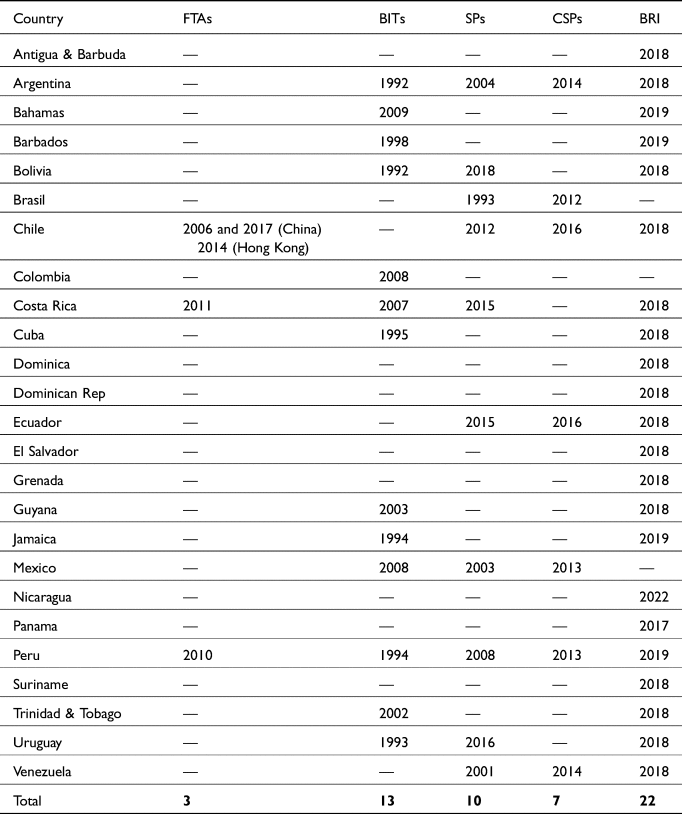
As shown in Table 1, China has used soft law instruments (e.g. strategic partnerships (SPs), comprehensive strategic partnerships (CSPs), and the Belt and Road Initiatives (BRIs)) more often than hard law IEL instruments (e.g. FTAs and BITs).Footnote 30 Under China's eclectic model, regional multilateral organizations and legal agreements have had limited application in expanding China's trade and investment in LAC. Soft law instruments have worked more effectively to explore new business and cooperation opportunities in the region.
China's mechanisms of economic engagement with LAC

Source: The Organization of American States, SICE, Foreign Trade Information System, United Nations Conference on Trade and Development, Investment Policy Hub, and press articles and public statements made by the government of the People's Republic of China. The table includes the year in which each agreement was made. Bahamas and China signed a BIT in 2009, but it has not been ratified. China and Chile signed a BIT in 2012, but it was terminated; the FTA signed between both nations in 2017 includes an investment chapter. Ecuador terminated a BIT agreed with China in 2015.
To sum up, adopting a mere formalistic IEL approach to study the economic relations forged between China and LAC in the last two decades would provide an incomplete analysis. Using a social-legal approach that facilitates the utilization of non-formalistic elements and considers the context of China-LAC relations will facilitate a better understanding of the strategies and practices deployed by China to promote trade and investment in the region.
III. Key Factors to Understanding China's Engagement Strategy
This section will explore some of the factors influencing China's preference for a dual model approach that combines hard and soft law instruments to nurture its economic relations with LAC.
A. South-South Cooperation
China has developed its relations with LAC following the Five Principles of Peaceful Co-Existence developed in the 1950s; namely, mutual respect for sovereignty and territorial integrity, mutual non-aggression, non-interference in each other's internal affairs, equality and mutual benefit, and peaceful coexistence.Footnote 31 These principles are aligned with those advanced by the so-called new international economic order promoted by many developing countries from more than six decades ago.Footnote 32 Most of these principles were incorporated into the Charter of Economic Rights and Duties of States approved by the United Nations (UN) General Assembly in 1974.Footnote 33
In the White Paper, the Chinese government confirmed its commitment to nurturing its relations with the Americas, a region considered essential for the development of China.Footnote 34 The White Paper also declared that China was progressing to a new stage in its relations with the region, strengthening a comprehensive and cooperative partnership characterized by sincerity and mutual trust, win-win cooperation, mutual reinforcement between China's cooperation with the region and its bilateral relations with each country, and a commitment to the One China policy.Footnote 35 The White Paper stressed the priority placed by China in creating a cooperation network and stated that:Footnote 36
China will promote collective cooperation with Latin America and the Caribbean mainly through the platform of [the] China-CELAC [Community of Latin American and Caribbean States] Forum, and strengthen dialogue and cooperation with relevant sub-regional organizations and multilateral financial institutions, so as to create a balanced, all-round network of collective cooperation between China and Latin America and the Caribbean.
The main purpose behind the White Paper was to build a comprehensive and cooperative partnership within the region to work on multiple areas of mutual interest between China and LAC. The document also emphasized the importance of amicable relationships and “promoting the harmonious coexistence of different civilizations in the world”.Footnote 37 It downplayed potential conflicts and disputes and indicated that “[t]rade frictions will be properly handled to promote sound and balanced development and structural diversification of trade between the two sides”.Footnote 38 The White Paper highlighted the importance of establishing amicable, harmonious, and non-contentious relations with its LAC peers, which demonstrates Confucianism's influence in Chinese diplomatic relations with this region.
Furthermore, the White Paper proposed the Cooperation Plan 2015–2019 (“the Cooperation Plan”), guided by a “1+3+6” structure:Footnote 39 “1” referred to a single agreed plan that set the development priorities for LAC; “3” referred to the key factors – trade, investment, and finance – that were critical to promoting growth; and, finally, “6” alluded to the priority areas that should be addressed by China-Community of Latin American and Caribbean States (CELAC) cooperation, namely energy and resources, infrastructure, agriculture, manufacturing, scientific and technological innovation, and information technologies.
In addition, the Cooperation Plan promoted the One China policy, which has been effective in reducing to eight the number of countries in the region that still support the Taiwanese government. The Chinese government employs a holistic approach to its relations with its LAC peers based on principles that are familiar to most governments in the region that supported the approval of the UN Charter of Economic Rights and Duties of States. The model prioritizes not the legalization of economic relations but, rather, the use of multiple bilateral and multilateral mechanisms to advance its interests in the region.
The strategy of grounding economic relations on a South-South cooperation platform rather than exclusively relying on a formalistic IEL approach was appropriate when China started redoubling its efforts to expand trade and investment in LAC at the beginning of the twenty-first century. At that time, the continent experienced a “left turn” in politics that witnessed socialist parties winning elections and assuming government in several countries (e.g. Venezuela, Chile, Ecuador, Bolivia, Argentina, Uruguay, Peru, and Brazil).Footnote 40 One of the factors that prompted the so-called “pink tide” was the discontent due to the implementation of policies associated with the Washington Consensus sponsored by the Bretton Woods institutions (i.e. the IMF, the World Bank, and, to some degree, the WTO) that required domestic legal reforms to liberalize trade, finance, and investment. As pointed out by some commentators, IEL became the main vehicle through which to embed the principles of the Washington Consensus in legally binding international rules.Footnote 41
After numerous failures in the implementation of neoliberal reforms in the 1980s and 1990s, countries in LAC sought alternative mechanisms to reduce their dependency on traditional international financial institutions, regain autonomy to design and implement public policies, and move away from international agreements to promote trade.Footnote 42 The moment was well understood by China, which decided to build its relations with the region using other non-binding rules, and, to a lesser degree, formal instruments of IEL
B. China’s Legal Culture
China's legal culture has also played a key role in how the country has fostered its relations with LAC. Legal scholars have highlighted the importance of Chinese legal cultural influences in the context of IEL.Footnote 43 This point is apparent in the eclectic approach employed by China to interact with the region. While China has embraced hard law mechanisms such as FTAs and BITs, and has joined regional multilateral organizations such as the Inter-American Development Bank (IDB), it has given more importance to the development of informal networks such as the China-CELAC Forum.
Picker explains that China's legal cultural heritage “may provide the best clues to how to best understand the essential aspects of the Chinese legal cultural framework related to China's present and future relationship to the IELO [international economic legal order]”.Footnote 44 The influence of Confucianism, for example, is relevant in this historic moment when China has become more assertive and has started to play a more active role as a maker of the international economic order. Picker mentions harmony and the avoidance of formal dispute settlements as examples of Confucian features that are essential in the context of IEL.Footnote 45 This aspect distinguishes China's engagement with LAC. For example, China has not initiated any dispute under the WTO dispute settlement system against a LAC member, although three countries have started disputes against China (namely, Brazil, Guatemala, and Mexico). As mentioned earlier, the White Paper stresses the relevance of boosting harmonious relations with diverse cultures and addresses differences and conflicts via amicable and non-contentious mechanisms. The same principle of harmony has been embedded in the partnerships forged by China across the region as well as in the memorandums of understanding signed under the BRI.
China's IEL approach to LAC has been based on strengthening informal networking, the promotion of harmonious relations, and solving differences via amicable methods.Footnote 46 It has placed other formal mechanisms at the second level of priority. These features of China's engagement with LAC will be explored in more detail in the following sections.
C. The United States’ Impact on Relations between China and LAC
Another factor that has influenced the design of the foreign policy towards LAC is the historic role played by the United States in the continent. As explained earlier, most countries in LAC followed American foreign policy towards China until the end of the twentieth century. Most nations in the region recognized the Taiwanese government rather than the Chinese government until the 1970s. With the exception of Chile and Cuba, other countries only established formal diplomatic relations with China after the United States started official exchanges with it.
Although the Bush and Obama administrations did not openly oppose China's expansionism in the region between 2001 and 2017, the United States was still influential in many of the formal regional forums in which the Americans had veto powers (e.g. the Organization of American States (OAS) and the IDB).Footnote 47 The participation of the United States in these organizations was not always welcomed by the other members. The rejection of American influence led to the collapse of the negotiations of the Free Trade Area of the Americas in the 2000s. It also contributed to the proliferation of new regional organizations without American membership, such as CELAC, the Union of South American Nations (UNASUR), and the Bolivarian Alliance for the Peoples of Our America (ALBA).
This context facilitated the full entrance of China into the Americas, a region that suffered multiple economic and financial crises at the end of the last century. As indicated earlier, there was widespread discontent with the Washington Consensus and its supporters, including the United States. FTAs were not popular and the region distrusted international organizations such as the WTO, the IMF, and the World Bank, where the region had limited influence in the decision-making process.
Only a small group of countries followed the path of strengthening their IEL to promote trade and investment, including Chile, Colombia, Costa Rica, Mexico, and Peru. While most countries preferred to stay away from the United States’ influence, many saw China as a new alternative to engage in trade, investment, and cooperation for development. China had an excellent understanding of the situation and, although it joined formal regional organizations controlled by the United States, it sponsored the creation of an informal network, the China-CELAC Forum, to interact with LAC without the interference of other global powers.
The next section will review the different mechanisms China employs in its economic engagement with LAC and the role played by the three factors explained in this part in its strategy. It will be noted that formal instruments are limited to its membership in the IDB, in which China has played a low-profile role due to its lack of voting power to influence the decision-making process, and its subscription to FTAs with three economies: Chile, Costa Rica, and Peru. On the other hand, soft law mechanisms that promote South-South cooperation, harmonious relations, and the exclusion of the United States are characteristics of the tools China has mainly used to nurture its economic relations with the region.
IV. China's Mechanisms of Economic Engagement with Lac
This section will focus on some of the hard and soft law mechanisms used by China to advance trade, investment, and finance in the Americas.
A. China’s Membership in Regional Institutions and Forums
China has built relations with LAC, joining formal regional institutions as well as creating new multilateral mechanisms to engage with the region. China has exercised caution in its approach to traditional regional organizations such as the OAS and the IDB, in which the United States, Canada, Japan, and European countries are members. China has instead preferred to play a low-profile role in these institutions.
In the case of the IDB, for example, China joined the organization in 2008. This regional development bank founded in 1959 is currently owned by forty-eight member states, of which twenty-six are regional-borrowing members. The IDB is governed by a legally binding treaty and operates under a well-developed governance structure.Footnote 48 China has subscribed to IDB shares valued at US$200,000, which represents 0.004% of the voting power of the institution – well below the participation of the United States (30%), Japan (5%), and European countries.Footnote 49 Because of its small-subscribed capital, China's voting power is extremely limited in influencing decision-making and it does not have the right to appoint one of the fourteen members of the Board of Executive Directors responsible for the bank's operations.Footnote 50
While the IDB is one of the major multilateral platforms from which other Asian countries such as Japan have financially engaged with LAC, the major contribution of China to the bank is in the form of a co-financing fund that supports projects in education, water conservation, and energy. Under this fund, by February 2018 the IDB had approved fifty-one projects in eighteen countries costing US$1.23 billion.Footnote 51 This scheme is one of the credit facilities offered by the Chinese government in the context of the China-CELAC Forum, which will be discussed shortly. China has also contributed US$175 million to co-finance IDB projects in energy, infrastructure, micro-finance, and personnel exchanges.
The limited influence of China in the IDB was exposed in March 2019, when the bank decided to cancel the annual meeting that would have been held in Chengdu, based on the Chinese government's negative attitude towards issuing a visa to the representative of the Venezuelan interim government led by Juan Guaidó.Footnote 52 China followed its traditional position of non-interference in the internal affairs of other countries and recommended not issuing visas to any Venezuelan representatives.Footnote 53 Prior to the onset of the Venezuelan crisis, the United States had already opposed the IDB holding its annual meeting in China.Footnote 54 The Venezuelan crisis may have been used as an excuse by the American government and its allies to torpedo China's relations with its LAC partners. The appointment of an American as the IDB president in September 2020 by the administration of former president Trump was considered as a sign of the United States’ intent to use the bank for political and geopolitical purposes. It was the first time that a non-Latin American was appointed president.
China has preferred to engage with LAC by way of the China-CELAC Forum, which does not have representatives from other developed countries. This informal instance has its antecedents in CELAC, which is a relatively new regional group launched in Caracas in 2011 by thirty-three members from LAC. CELAC was the successor of the Rio Group and the Latin American and Caribbean Summit on Integration and Development and was promoted by late Venezuelan president Hugo Chávez as an alternative to the United States-controlled OAS.
CELAC was established by a declaration of the heads of states instead of a legally binding treaty. CELAC does not have a legal personality or formal structure; it operates through different levels of meetings and with a pro-tempore presidency that is rotated among the members every year.Footnote 55 The main goal of CELAC is to promote political, economic, social, and cultural integration to improve standards of living, stimulate economic growth, and advance the well-being of people.
CELAC's members agreed with China to create the China-CELAC Forum in 2014 as a mechanism to enhance cooperation. The China-CELAC Forum was established using soft law via a Joint Statement agreed at the end of the China-LAC Summit held in Brasilia in 2014. The forum does not have legal personality. Since its inception, China has labelled the forum as “the main platform to promote China-Latin America overall cooperation”.Footnote 56
The main body of the forum comprises the Ministerial Meetings, which have met three times. In the first meeting held in Beijing in January 2015, the members approved the Institutional Arrangements and Operating Rules, which is a set of soft law provisions that regulates the functioning of the forum and its meetings.Footnote 57 The first meeting also agreed on the Cooperation Plan which established thirteen priority areas for cooperation, including: trade, investment and finance, infrastructure and transportation, energy and resources, agriculture, industry, science and technology, aerospace and aviation, and poverty eradication and health.Footnote 58
The Second Ministerial Meeting was held in Chile in January 2018. The Final Declaration signed at the end of the Second Meeting upheld some of the principles of the Charter of Economic Rights and Duties of States and called for the protection of developing countries’ sovereignty, the right of self-determination, and the right to choose their own political, social, and cultural systems.Footnote 59 China and its LAC counterparts also confirmed their status as developing and emerging countries that work together for the attainment of sustainable development, the eradication of poverty, and the growth of their economies. Further, all parties confirmed their commitment to multilateralism and called for the promotion and protection of the WTO system, the UN Charter, the Paris Agreement on Climate Change, and the 2030 Agenda for Sustainable Development. The Final Declaration included a formal invitation from China to the CELAC members to join the BRI.Footnote 60
The Second Meeting approved a new Joint Plan of Action for Cooperation on Priority Areas (2019–2021) (the “Joint Plan 2019–2021”). This new plan reduced the priority areas to seven: politics and security; infrastructure and transport; trade, investment and finance; agriculture; industry, science, and technology; cooperation for environment; and cultural exchange.Footnote 61
In the area of trade, investment, and finance, the Joint Plan 2019–2021 did not propose the negotiation of hard law multilateral agreements and used terms such as “schemes” and “mechanisms” to refer to options for the promotion of trade, investment, and finance among parties. It recognized the importance of the existing multilateral trade system and the WTO framework. It called for the parties to intensify cooperation and dialogue within the WTO system and raised the level of trade facilitation by combating protectionism, establishing bi-regional cooperation mechanisms to properly deal with trade disputes, and simplifying procedures related to tariff and non-tariff barriers.Footnote 62 The Joint Plan 2019–2021 also sought to promote investment via the protection of the rights and interests of businesses and states through national legislation.Footnote 63 China also agreed to strengthen the advantages offered by its financing options for LAC to support socioeconomic development in the region. Areas related to trade that are priorities for other countries such as the protection of intellectual property rights, were not mentioned in the Joint Plan 2019–2021.
Through the China Forum, China has launched at least four credit facilities for CELAC members, including China's Preferential Loan Program (US$10 billion), the Special Loan Program for China-Latin America Infrastructure (US$20 billion), the China-Latin America Cooperation Fund (US$5 billion), and the China-Latin America Special Agricultural Cooperation Fund (US$50 million).Footnote 64
More recently, the China-CELAC Forum has served to coordinate the initial support provided by China to the region to fight COVID-19, and China has highlighted the importance of the BRI for post-COVID recovery efforts in the region.Footnote 65 Most countries in LAC are relying on China for vaccines, test kits, masks, ventilators, and medical supplies.Footnote 66 Even Bolsonaro's administration, which initially referred to the virus as the “Chinese virus”, later accepted Chinese donations and medical supplies to combat the pandemic.Footnote 67 The willingness of China to continue supporting the region to overcome the COVID-19 crisis was confirmed in the Declaration of the Third Ministerial Meeting of the China-CELAC Forum, held online in December 2021.Footnote 68
China also joined the Forum for East Asia-Latin America Cooperation (FEALAC) which was launched in 1999. The group has 36 members, encompassing 16 from the Asia-Pacific region including Australia, New Zealand, and Japan, and 20 LAC nations. The FEALAC is another informal grouping that lacks an institutionalized structure other than a cyber secretariat. The purpose of the forum is “to promote understanding, political and economic dialogue and cooperation in all areas so as to achieve effective and fruitful relations and closer cooperation between [East Asia and Latin America]”.Footnote 69 Areas of cooperation include economics, trade, investment, finance, science and technology, environmental protection, culture, sports, tourism, and people-to-people exchanges.
It has been difficult for members of the FEALAC to find shared interests to invigorate the forum's agenda. The FEALAC has not achieved positive results other than the establishment of the FEALAC-UN multi-donor trust fund under a partnership with the UN Economic Commission for LAC and the UN Economic and Social Commission for Asia and the Pacific in 2017. This fund was established to support projects that are inter-regional and enhance mutual understanding between East Asia and Latin America.Footnote 70 Other projects that have been conducted under the FEALAC's umbrella are national in nature and are sponsored by each state, comprising mainly people-to-people exchanges that focus on technological and environmental issues.
In 2013, China joined the Pacific Alliance as an observer, which is an initiative of regional integration formed by Chile, Colombia, Mexico, and Peru as members, and Australia, Japan, New Zealand, the United States, and other countries as observers. The Pacific Alliance describes itself as “an open and inclusive integration process, formed by countries with alike views on development that are free trade promoters”.Footnote 71 Some experts believe that China has little to gain from playing an active role in this bloc.Footnote 72 For China, the China-CELAC Forum represents a more inclusive space to advance its agenda for LAC.
Of all the formal and informal regional groups that China has joined in LAC, the China-CELAC Forum is the most strategic. China is the major force behind the China-CELAC Forum, establishing the main items of the agenda for ministerial meetings, hosting the website of the forum,Footnote 73 producing documents and reports, and designing the finance instruments available for CELAC members. In spite of the relatively weak institutional framework of the CELAC in comparison to other formal regional organizations, China has preferred to champion the China-CELAC Forum because it can play a more active role in shaping its own cooperation agenda with LAC, without any form of interference from other global powers, especially the United States. The forum also provides China with flexibility in managing of its relations with its regional partners since it does not involve binding obligations or a clear set of rules to deal with disputes. The Institutional Arrangements and Operating Rules of the Forum also confirms China's preference for framing the group in the context of South-South cooperation and the priority to work in harmony with regional governments.Footnote 74
B. FTAs, BITs, and SPs
It was in the late 1990s that trade between China and LAC started to increase, eventually making China the second major trading partner for the region. LAC exports to China are concentrated in a few categories, such as soybean, oil, copper, and iron ore, and only a few countries in the region had a trade surplus with China in 2020 (Brazil, Chile, Ecuador, Guyana, Peru, Suriname, and Uruguay). China has also expanded its investment portfolio in the region. According to the National Bureau of Statistics of China, the country's FDI in Latin America grew from US$1.7 billion in 2004 – the first year the agency published disaggregated data per region – to US$4.0 billion in 2018, with a peak of US$27.2 billion in 2016.Footnote 75 These numbers may not fully reflect the real extent of Chinese money in LAC, considering that Chinese investors often use a subsidiary located in a third country to invest in the region. The Brazilian Central Bank has reported that approximately 90% of Chinese direct investment is channeled to Brazil through a third country, mainly Luxembourg.Footnote 76 Between 2005 and 2020, mergers and acquisitions in the region that involved Chinese companies were concentrated in two countries, namely Brazil (58%) and Peru (18%), while investments in new projects were mainly focused on Brazil (26%), Mexico (23%), and Peru (18%).Footnote 77
The flourishing Chinese trade and investment in LAC has not been driven by hard law agreements. China has only signed three FTAs in the region, namely with Chile (2006),Footnote 78 Peru (2010), and Costa Rica (2011), and it does not have FTAs with any of the four major economies on the continent (namely, Brazil, Mexico, Argentina, and Colombia). The three economies that have FTAs with China represented 20% of the total volume of trade between China and LAC in 2020. Brazil and Mexico, which had 36% and 19% of the total volume, respectively, did not have a FTA with China. Chile, Costa Rica, and Peru experienced increases in trade volumes with China after the completion of FTAs, but so have the other economies in the Americas.
Several factors have been identified to explain the lack of a formalization of trade relations between China and LAC. Wise argues that Chile, Peru, and Costa Rica had significantly advanced in the implementation of economic reforms, market liberalization, and building strong institutions when they signed FTAs with China.Footnote 79 Consequently, these countries were highly motivated to enter into FTAs with China to open up new markets for their products.Footnote 80 The conditions have not existed in other countries such as Argentina, Brazil, Colombia, or Mexico. Thus, not many LAC economies have incentives to negotiate a FTA with China. For example, Brazil and Mexico have well-developed manufacturing industries, and local pressure has been exerted on the government to avoid the negotiation of FTAs with China. Another factor that has affected trade deals with South American partners is the situation with Paraguay, which is a member of MERCOSUR and maintains diplomatic relations with Taiwan, thus making it difficult to establish a FTA with this regional bloc, which also includes Argentina, Brazil, Venezuela, and Uruguay.Footnote 81 Other experts have indicated that small Central American countries do not have strong reasons to negotiate FTAs with China considering the limited capacity of their economies and industrial sectors.Footnote 82
Geopolitics has also played a role in discouraging FTAs promoted by China. The United States has pressured countries on the continent to avoid relations with China, and has also criticized China for using financial and economic power to force small countries to break relations with Taiwan.Footnote 83 The geopolitical factor may have greatly influenced Colombia – one of the United States’ closest allies on the continent that has not joined the BRI or negotiated a FTA with China. However, the assistance provided by Beijing to help Colombia fight the COVID-19 crisis may have contributed to improved relations between the two countries. It is probable that Colombia will join the BRI sooner rather than later.Footnote 84
China's capacity to negotiate FTAs has progressively improved, and this is reflected in the FTAs the country has signed in LAC. For instance, the initial agreement signed with Chile in 2006 could be labelled as “basic” and addressed mainly market access for goods and only partially covered services. It did not include a chapter on investment protection. The original FTA also included Chapter XIII, which focused on cooperation in multiple areas such as economic and investment cooperation, research, science and technology, education, labour, social security and the environment, small and medium-sized enterprises, cultural cooperation, intellectual property rights, and mining and industrial cooperation.
The limitations of the China-Chile FTA prompted both countries to sign a protocol to amend the original document in 2017 to better tackle several issues and enhance the liberalization of trade in goods and services, rules of origin, customs procedures and trade facilitation, and economic and technical cooperation. The updated agreement also covers the protection of investment.
In the case of the investment promotion and protection, China has agreed on thirteen BITs with LAC partners, of which seven were established in the 1990s when Chinese investment in the region was almost non-existent, and China was more interested in attracting FDI (see Table 1). Six other BITs were completed after 2001, namely with Trinidad and Tobago (2002), Guyana (2003), Costa Rica (2007), Colombia (2008), Mexico (2008), and The Bahamas (2009).Footnote 85
Of the countries that have BITs with China, only Argentina, Peru, and Mexico attracted Chinese investments totalling more than US$1.5 billion between 2005 and October 2017. Brazil, the main destination for Chinese investment in the region in the same period (US$65.5 billion or 55% of the total for LAC) does not have a BIT with China.
SPs are another mechanism used by China to promote trade, investment, and development finance in LAC. This method is less formal (legally speaking) and more political than FTAs and BITs. According to Feng and Huang, the Chinese dictionary defines huoban (partnerships) as “those who have joined the same organization or are engaged in the same activities”.Footnote 86 Feng and Huang affirm that the word zhanlue (strategy) refers to a plan with overarching, comprehensive, and decisive implications.Footnote 87 In the context of Chinese diplomacy, a SP refers to a group of countries that engage in a plan that has multiple implications. Former Chinese Premier, Wen Jiabao, perhaps best defined the term of a CSP, stating that:Footnote 88
[b]y ‘comprehensive’, it means that the cooperation should be all-dimensional, wide-ranging and multi-layered. It covers economic, scientific, technological, political and cultural fields, contains both bilateral and multilateral levels, and is conducted by both governments and non-governmental groups. By ‘strategic’, it means that the cooperation should be long-term and stable, bearing on the larger picture of China-EU relations. It transcends the differences in ideology and social system and is not subjected to the impacts of individual events that occur from time to time. By ‘partnership’, it means that the cooperation should be equal-footed, mutually beneficial and win-win.
SPs are non-binding bilateral commitments that set the framework for development and economic and social cooperation between China and its partners. They can be categorized as soft law instruments and do not contain legally binding obligations for the parties. SPs and CSPs are a relatively new development in China's diplomacy which enable it to prioritize bilateral relations. Xiang explained: “[i]n Chinese diplomatic parlance, a strategic partnership not only stresses a kind of special economic relationship but also includes the idea of exchanging, sharing, and even coordinating views and policies on bilateral relations and major international issues”.Footnote 89
SPs generally involve a broad agenda that cover several areas for cooperation such as trade, investment, development assistance, finance, education, strategies for international organizations, and health. Generally, the Chinese government plays a leading role in these partnerships and drafts joint action plans establishing priorities for bilateral cooperation. It is unclear whether LAC governments open a space locally for the public discussion of these documents, as would be the case with a FTA or BIT.
China has built partnerships in LAC using a two-level system that reaches key regional economies such as Argentina, Brazil, Chile, Ecuador, Mexico, and Peru (see Table 1). The entry level for a partner willing to cooperate with China is represented by SPs. China grants the status of strategic partner to those countries with which it wants to prioritize its relations. The highest level, a CSP, is given to countries that demonstrate a solid record of cooperation with China, and who build trustworthy relations.Footnote 90 However, the strategic partner has limited influence as to when an association becomes a CSP. The geopolitical factor may be critical, as demonstrated in the cases of Chile and Venezuela. The latter became a strategic partner in 2001 and a comprehensive strategic partner in 2014, in contrast to Chile which achieved those positions in 2012 and 2016, respectively, in spite of Chile's solid record of cooperation with China since 1970.Footnote 91
Another important factor for China when considering SPs is the possibility of obtaining access to energy and geopolitical positioning with regard to the United States.Footnote 92 This point may explain why FTA countries such as Peru, Chile, and Costa Rica were late to establish SPs in 2008, 2012, and 2015 respectively, compared to Brazil (1993), Venezuela (2001), and Argentina (2004). China has widely used this two-tier system in LAC, whereby it has collaborated with ten countries, of which seven have achieved the level of CSP (see Table 1).
Unlike FTAs and BITs, Chinese partnerships are not approved by legislative bodies in LAC. They might be considered partnerships constituting an initial step in the negotiation of a FTA; however, the record in LAC does not support this idea. Only Peru had a SP with China before completing a FTA, while Chile and Costa Rica first entered into a FTA with China before becoming strategic partners.
Unlike FTAs, which are hard law international agreements that are publicly available and legally binding, SPs and CSPs are based on content that is not officially published and is usually announced by a joint communique. Such a joint declaration is generally vague and does not provide sufficient information about the partnership.Footnote 93 For instance, the China-Brazil CSP was introduced via a joint press release published at the end of the meeting of the leaders of both countries in 2012. The press release made a brief reference to the parties’ intention to upgrade their alliance to a “global strategic partnership”.Footnote 94
The Action Plan 2012–2021 (the “Action Plan”) agreed between China and Brazil is more informative in understanding the scope of the CPS.Footnote 95 This plan establishes five priority areas for cooperation: science, technology, innovation, and space; mines, energy, infrastructure, and transport; investments and finance; economic and commercial cooperation; and cultural, educational, and peer-to-peer cooperation. In addition, the Action Plan outlines the principles under which both countries will develop their foreign policies towards multilateral institutions like the WTO, the IMF, and the World Bank.
In the economic and commercial cooperation space, China and Brazil promised to continue promoting economic and trade relations so as to increase commerce between both countries. One key aspect that China and Brazil agreed on was to resolve trade issues through dialogue and consultations to avoid trade protectionism. This part highlights China's preference for avoiding formal and contentious procedures for the resolution of disputes. However, the CSP did not prevent Brazil from bringing a dispute against China in 2018, which concerned a safeguard measure imposed by China on imported sugar.Footnote 96 The Action Plan also refers to the protection of intellectual property, although it does not provide details of the priorities in this area. Finally, China and Brazil promised to coordinate their actions in the context of the WTO with a view to jointly safeguard the general interests of developing countries.
In the investment, industrial, and financial cooperation realm, the China-Brazil Action Plan confirmed both countries’ desire to promote mutual and joint investment. To achieve this goal, China and Brazil agreed to exchange information regarding law and regulations on FDI via the Investment and Trade Subcommittee's Working Group on Investment, which serves as a consultative instance to facilitate the implementation of investment projects.
From the analysis above, it can be concluded that hard law international agreements have been of limited use in expanding China's trade and investment in LAC. The employment of FTAs has been reduced to three those economies that represent 20% of the total Chinese trade with the region, while Brazil – which attracts more than 50% of Chinese investment in LAC – does not have a BIT or FTA with China. Beijing has nurtured its economic relations with bigger economies by entering into SPs. Such partnerships stress South-South cooperation based on the Five Principles of Peaceful Coexistence without creating legally binding obligations. They also provide for the amicable resolution of disputes and place great importance on high-level commissions and working groups. At the bilateral level, SPs reinforce the links built by China at a plurilateral level in the China-CELAC Forum, far from the influence of the United States and other global powers.
C. The BRI
The BRI was originally proposed by Chinese President Xi Jinping in 2013. It comprises the Silk Road Economic Belt and the 21st Century Maritime Silk Road.Footnote 97 The BRI is an ambitious project that seeks to promote trade, investment, and finance across multiple continents.Footnote 98 The BRI did not require the negotiation of a hard law treaty. It generally involves a subscription to a memorandum of understanding between China and its partners, and the use of the existing legal framework for international trade, investment, and cooperation for development (e.g. the WTO, FTAs, and BITs) and other mechanisms designed by the Chinese government, including the Asian Infrastructure Investment Bank (AIIB), regional forums (e.g. the Chinese-CELAC Forum), and SPs. Wang argues that by using a combination of institutional and less institutionalized mechanisms, as well as a mix of hard and soft law tools, China is provided with the flexibility to tackle any uncertainty and the challenges posed by the BRI.Footnote 99
This mixed approach is reflected in the BRI Action Plan, which encourages participants to intensify customs cooperation and work on the mutual recognition of regulations and the assistance of law enforcement and, in general, guarantees that the WTO Trade Facilitation Agreement takes effect and is implemented.Footnote 100 In the investment space, the BRI Action Plan recommends the elimination of investment barriers and the negotiation of bilateral agreements for the protection of investment and the avoidance of double taxation. China also sees the BRI as an instrument to strengthen bilateral and multilateral cooperation via memorandums, plans, and other multilateral fora such as ASEAN Plus China, Asia-Pacific Economic Cooperation, the Asian Cooperation Dialogue, and the China-Gulf Cooperation Council Strategic Dialogue, among others.Footnote 101
The BRI initially envisioned the interconnection of Asia, Africa, and Europe; LAC was not mentioned in the original plan. In 2017, during a meeting with former Argentinean President Mauricio Macri, Chinese President Xi Jinping declared that LAC was a natural extension of the Maritime Silk Road.Footnote 102 This declaration was followed by a formal invitation to join the BRI – made by Chinese Foreign Minister Wang Yi – to LAC governments in January 2018 during the Second Ministerial Meeting of the China-CELAC Forum.Footnote 103 The invitation was widely welcomed in the region, and twenty-two countries have since joined the BRI (Table 1). Interestingly, three of the four largest economies have not joined the initiative: Brazil, Colombia, and Mexico.
Each of the countries in LAC that joined the BRI signed a memorandum of understanding – which are not always made public. One of the few documents publicly available online is that signed by China and Panama in 2017.Footnote 104 From the analysis of this instrument it is clear that the memorandum constitutes soft law. This document outlines the objectives and principles that guide cooperation between both countries, areas and modes of cooperation, and the resolution of disputes.
The China-Panama BRI memorandum indicates that the key aim of the cooperation between both nations is to work together within the BRI framework to achieve development. The main principles that support the cooperation include respects for each other, decisions based on mutual deliberations, respect for national and international law, and obtaining mutual benefits, which are aligned with the Five Principles of Peaceful Coexistence. The areas of cooperation listed by the memorandum include development policies, connectivity and infrastructure, trade and investment, finance, and person-to-person exchanges. Rather than setting goals associated with the subscription or the negotiation of hard law agreements, the parties agreed that the main mode of cooperation would be advanced through high-level visits. China and Panama concur that any disputes associated with the memorandum will be solved via friendly consultation. In summary, the BRI memorandum contains goodwill declarations, but it does not have any binding legal obligations.
Another mechanism that is gaining increasing importance for the BRI is the AIIB, a multilateral financial institution created under the leadership of China. This organization was created by a formal treaty, and six LAC nations have joined the organization so far: Argentina (2021), Brazil (2020), Chile (2021), Ecuador (2019), Peru (2022), and Uruguay (2020). These decisions to join the AIIB by these countries seems to be more of a symbolic act than an expression of any serious intent to actively participate in the direction of the new institution. Together these LAC countries represent less than 1% of the total voting rights of the AIIB. The AIIB has approved Bolivia and Venezuela to join the Bank as members, but they have not completed the formalities to become members by paying their subscriptions.
Since the Second Ministerial Meeting of the China-CELAC Forum, held in 2018, China has placed more importance on the BRI framework. In the Third Ministerial Meeting of the China-CELAC Forum, held in December 2021, the signatories of the final declaration agreed that they would continue to deepen cooperation based on the BRI platform.Footnote 105 This confirmed the priority given by the Chinese government to the BRI to build international cooperation.Footnote 106
It is evident from the number of LAC nations that have joined the BRI that the initiative has had an initial success in the region and that of the twenty-five countries that have diplomatic relations with China, twenty-two have supported the Chinese scheme. For many LAC governments, the BRI looks attractive as a framework that proposes collaboration by adopting a South-South cooperation approach, and can be joined it without meeting any conditions – other than having diplomatic relations with China. The BRI does not resemble any other proposals led by international organizations, or the United States, that may demand political or economic reforms, or by meeting certain criteria that may undermine the autonomy of governments.
V. Conclusions
Exchanges between Asia and LAC have flourished in the first two decades of the new millennium, led by China's rise as a major global power. The growing size of the trade between China and LAC, and the increasing volume of Chinese investment in the region, suggest that China will continue to play a critical role in the development of the Americas. This article has found that the entrance of China in the region has not been entirely supported by the IEL framework, at least not in the way classical formalistic scholars understand the field.
Until very recently, China was a rule taker on the international stage, but it has lately become more assertive and has taken a more proactive approach to redefining the borders of IEL and the ways it engages with other nations. This is evident in the strategy that China has followed to engage with LAC, using an eclectic platform that combines hard law and soft law instruments. China's approach has been influenced by some of the legal principles advanced by developing countries with the new international economic order movement as well as its legal culture, including Confucianism. The United States’ leadership in the continent has also affected China's choice of strategy.
Under the eclectic approach, China has used the formal instruments of IEL and, for instance, has joined formal regional multilateral organizations such as the OAS and IDB. It has also negotiated FTAs and BITs with regional partners. Regardless of China's adoption of formal mechanisms, it has not widely employed them to engage with LAC. In fact, China has subscribed to a limited amount of IDB shares and has played a limited role in the organization. Additionally, FTAs and BITs have not been critical to the economic relations with major regional economies.
China has placed more emphasis on informal mechanisms to nurture relations with its Latin American counterparts and has favoured the China-CELAC Forum as the main platform through which to engage with the region. Since the United States, Canada, and Japan do not participate in this forum, China can act more assertively and drive its own agenda in LAC. Furthermore, partnerships, another form of soft law mechanism, have been widely used by China to define a broad cooperation agenda. CSPs have played a key role in China's relations with its major partners in the region, particularly with Brazil, a nation that does not have a FTA or a BIT with China. Despite a lack of formalization of economic relations with Brazil, this country is the major recipient of Chinese investment in the region (58%) and is China's major trade partner, representing 36% of China's trade with LAC.
Since 2018, LAC partners have started to join the BRI, another soft law scheme launched by the Chinese government. It is still too early to predict how the Chinese government will incorporate LAC into this ambitious initiative, but the first actions suggest that it will continue employing existing soft law instruments such as the China-CELAC Forum and other partnerships to connect with the region. The wide support for the BRI in LAC prompted the United States to launch a similar programme called America Crece (Growth in the Americas), which has thus far attracted support from eight countries.Footnote 107 Similar to the BRI, America Crece does not involve a treaty and has been promoted in LAC as an opportunity to update infrastructure. For LAC this is a positive development and a source of healthy competition for development finance and the redefinition of the borders of IEL
The COVID-19 crisis has provided China with another opportunity to strengthen its economic relations with LAC. Beijing has shipped tonnes of medical supplies to countries in the region to assist with the health crisis caused by the pandemic. Even governments that were not very close to China have benefitted from its assistance (e.g. Brazil, Colombia, and Mexico). In the Declaration signed at the end of the Third Ministerial Meeting of the China-CELAC Forum held in December 2021, the BRI was mentioned several times and it is likely to become the spearhead mechanism of China's economic engagement in the region in a post-pandemic era.
Whether China will continue expanding its trade, investment and influence in LAC will also depend on various factors, including how the increasing animosity between China and the United States might affect Chinese companies operating in the Americas. Another point of concern that may have implications for China-LAC relations is how China will manage recent domestic developments, particularly in the construction sector where the Evergrande crisis may affect the Chinese economy and, consequently, commodity-exporting nations such as Brazil, Chile, and Peru.
Acknowledgements
I thank the two anonymous reviewers for their valuable comments that contributed to improving the quality of this article.
Funding statement
None.
Competing interests
None.