CMC and textual language
Since its coinage by Hiltz and Turoff (Reference Hiltz and Turoff1978) the term computer-mediated communication (CMC) has been adapted and broadly conceptualised as interactive communication by and among human beings via networked computers and mobile devices. Several definitions of CMC have been offered in the literature but Herring's (Reference Herring2007) definition of CMC as ‘predominantly text-based human–human interaction mediated by networked computers or mobile telephony’ is adopted in this article because it stresses the textual aspect of the communicative interaction and accommodates all forms of textual language use mediated by the Internet, the World Wide Web and mobile technologies. This approach to CMC focuses on the production, transmission and exchange of naturally-occurring text-based human language and highlights the fact that human beings (as opposed to automated or artificial systems) are both the agents or initiators and recipients of the communication under investigation. Although communication is not unique to humans, the ability to use human language for meaningful social interactions is the exclusive preserve of the human species. Thus the perspective human beings bring to virtual interactions is accounted for in CMC. Internet interlocutors (also known as online interactants, netizens or textizens in the case of regular SMS texts composers/senders) employ textual data to convey and exchange their thoughts, opinions, observations, feelings as well as messages from other people or sources (Ifukor, Reference Ifukor2011). These interactive possibilities make CMC a technology, medium, and engine of social relations (Jones, Reference Jones and Jones1995:11) and language use is at the core.
Text-based CMC then refers to the production of human language mostly in typed form (comprising alphanumeric characters), visually displayed on a computer or mobile phone screen(s) and the dissemination of such via networked computers or wireless technologies. If the message is read in real-time and an instantaneous response is given, it is called synchronous CMC because both or all interlocutors are simultaneously online. If the message is read or responded to at a later time, it is called asynchronous CMC because the recipient(s) is/are offline when the message is sent. Therefore, the timing of message receipt and/or response is very crucial to the synchronicity versus asynchronicity of CMC. Real-time interaction fosters synchronicity just as delayed-time correspondence relates to asynchronicity. Synchronous CMC includes Internet Relay Chat (IRC), instant messaging (IM) and ICQ (‘I Seek You') while examples of asynchronous CMC include email, listserv, weblog (blog), online discussion forums and SMS text messaging.
In terms of modality, textual CMC undeniably has the form of writing and simulates some features of speech. It is inherently a virtual, visible and visual representation of human language as well as the attendant discursive nuances of face-to-face interactions (cf. Mitton, Reference Mitton1996). All forms of writing systems are actually attempts to simulate human language or communication patterns by the innovative and ‘conventional use of visible symbols for the recording or transmission of ideas, or of ideas and sounds … or of sounds unaccompanied by ideas’ (Edgerton, Reference Edgerton1941: 149) but the previously held assumption that spelling is ‘the use of conventionalized writing systems that encode languages’ (Perfetti et al, Reference Perfetti, Rieben and Fayol1997: xi) is being challenged by different writing practices available in CMC data. Halliday (Reference Halliday1978) considers large-scale deliberate deviation from the norm as ‘anti-language', Sebba (Reference Sebba, Androutsopoulos and Georgakopoulou2003) calls it ‘spelling rebellion' while Shaw (Reference Shaw2008) views it as identity representation through ‘accent'.
Empirical evidence from Nigerian CMC data shows that non-standard spellings do more than highlighting CMC language as a virtual vernacular of some sort. In fact, informal Internet discourse provides the means for visualising regional accents of Nigerian English (NigE) and playfully simulating some phonological features of face-to-face communicative behaviours of Nigerians. As Sebba (Reference Sebba2007: 6) rightly points out about writing in general, the visible representation of language in CMC is ‘where issues of language as a formal object and of language as a social and cultural phenomenon intersect. It touches on matters of social identity, national identity, cultural politics, representation and voice. It foregrounds familiar linguistic issues of dialect and standard, of “norm” and “variation”. It affects, and is affected by, technology and economics.’ The conclusion that can be drawn from our observations of writing patterns in several CMC data sets is that the twin factors of digitally-aided freedom of expression and linguistic economy constrain the spelling peculiarities of textual CMC.
Nigerian CMC corpus creation criteria
The data presented in this paper are selected from a larger corpus of Informal Nigerian Electronic Communication (INEC). Apart from being the acronym for an on-going linguistic project at the University of Osnabrück in Germany, INEC resonates well with Nigerians especially in the first decade of the twenty-first century because that is the same acronym as Nigeria's electoral agency. While there is a deliberate play on the acronym, the choice also indicates that the corpus is authentically Nigerian. Its composition began as this author was looking for authentic informal written data by Nigerians to illustrate certain linguistic phenomena in use of languages by Nigerians. By lurking online in several Nigerian discussion forums and weblogs for a couple of months, the author was convinced that the World Wide Web offers interesting and inspiring data for linguistic investigation. INEC thus comprises systematically but intermittently trawled and culled synchronous and asynchronous data from numerous representative Nigerian personal emails, listservs, online discussion forums, instant messaging, Web 2.0 technologies and SMS text messages. Some INEC data display hybridity with humour just as the concept of playfulness adopted for building the corpus is anchored on two principles: playful expressivity (Danet, Reference Danet1995, Reference Danet2001) and text-based linguistic creativity. The first incorporates any one of three essential features of playfulness: spontaneity, manifest joy and a sense of humour (Lieberman, Reference Lieberman1977: 6) while the second principle combines creativity with speech simulation. Danet's (Reference Danet2001) work on Cyberpl@y demonstrates how emotional representation integrates linguistic and socio-typographical aspects of virtual communication as performance by enunciating the ‘overt manifestations of more or less spontaneous playfulness on the computer screen’ (p. 10). Moreover, pertinent to the INEC corpus is McDowell's (Reference McDowell and Bauman1992: 139) conceptual framework of playfulness which is ‘[t]he creative disposition of language resources; the manipulation of formal features and processes of language to achieve striking restructuring of familiar discourse alignments’.
Spelling peculiarities of informal CMC
The following are some of the recurrent spelling patterns in the Nigerian CMC:
1. Standard spelling eg. TXT 001: Thanks bro, we are all doing well. God is helping us (Received by the author on 15 November 2008 at 16:31 CET).
2. Phonetic representation –No wahala, pls! Neva said I wont. Bt just dt, tins are a bit tight now. … I'll try 2 meet up (Received on 25 November 2008 at 14:21 CET, emphasised words underlined. Wahala = ‘problem’) — TXT 002
3. Alphanumeric and rebus abbreviation –Tnks. Hope u re nt scared of height cos u r movin up! Hop u can dance cos u v 2 celebrate. Hop u re strng, cos u v got 2 carry exces blesns 4rm nw onward, hpp new yr (Sent by a fellow Nigerian in Germany to the author on 1 January 2009 at 23:59 CET in response to the author's text message) — TXT 003
4. Clippings e.g. pls, Bt in TXT 002 and Tnks, strng, nw, hpp, yr in TXT 003.
5. Ideograms and emoticons – e.g. TXT 004 below received on 2 June 2004 at 10:13 GMT + 1 by a Nigerian in Lagos:
“+ ” ). “+. “+. “+. “ + “. ( “ + “.
.+ BRIGHT DAY +'
“, +‘ “ . ‘+ “. ‘ + “ +.
* May Ur Day * Be Bright Like Stars & May GOD Grant U Favor Always,
+ **Amen** +
These are not unrelated to similar features that have been discussed by Awonusi (Reference Awonusi, Awonusi and Babalola2004a), Chiluwa (Reference Chiluwa2008), Deuber & Hinrichs (Reference Deuber and Hinrichs2007) and Taiwo (Reference Taiwo, Kelsey and St Amant2008).
Phonological shibboleths and Nigerian English
Shibboleth, biblically, refers to a phonological test word in Judges Chapter 12 for in-group/out-group identification or social stratification. The ability to properly pronounce the fricative /ʃ/ in that word is indexical of social identity. Today, shibboleth is associated with pronunciation patterns that indicate one's national, regional or ethnic origin. It is in this sense of depicting regional accents or ethnic variations in NigE that the term ‘phonological shibboleth' is used here. As part of its nativisation and standardisation, NigE phonetically and phonologically aggregates some indexical features of Nigerian indigenous languages, especially those of Hausa, Igbo and Yoruba. In fact, Bamgbose's (Reference Bamgbose and Spencer1971: 42) observations almost four decades ago are still relevant in characterising indexical features in spoken NigE.:
The greatest influence on the pronunciation of English by Nigerians is the sound systems of the vernacular languages. Most of the phonetic characteristics in the English language of Nigerians can, of course, be traced to the transfer of features from their first language. Many people claim that they can tell what part of the country a Nigerian belongs to from the way he speaks English.
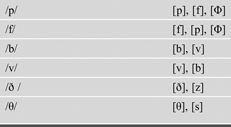
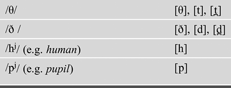
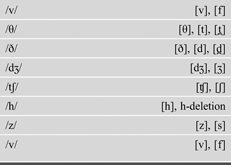
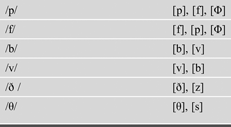
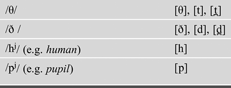
Moreover, regional accents of NigE are products of a number of other factors: historical differences in the time and manner of exposure to the English language and the pedagogical practices of its instructors, which vary from one region of Nigeria to another. Nonetheless, the NigE continuum forms a cluster of regional and social varieties (Jibril, Reference Jibril1986). Compared to RP, NigE has fewer vowels and some consonants are realised differently regionally. As shown in our CMC data, the regional variations are mostly accentuated in consonants. For instance Tables 1, 2 and 3 are some of the consonantal variations in Hausa, Igbo and Yoruba English respectively (adapted from Jibril, Reference Jibril1986; Gut, Reference Gut, Schneider, Burridge, Kortmann, Mesthrie and Upton2004).
Realisations of consonants by Hausa speakers of NigE
Igbo realisations of some consonants of NigE
Yoruba realisations of some consonants of NigE
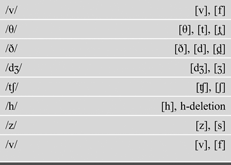
These variations support the argument that NigE phonetically and phonologically aggregates some indexical features of Nigerian indigenous languages. They are also in line with Simo Bobda's (Reference Simo Bobda2007: 297) observation that ‘[t]aking RP as a reference, NigE shares a wide range of its rules, does not apply some, applies others differently, and sometimes has rules not found in RP’. Turning to our CMC data, it should be mentioned that a speech-like spelling pattern has already been reported in the consonantal representation of some Hausa speakers of English, as Awonusi's (Reference Awonusi, Dadzie and Awonusi2004b: 211) comments suggest : ‘[i]t has also been found out that, in writings by Hausa speakers, some p-words are spelt as f in English, e.g. defuty governor; flaza cinema, flatter, we are fraying, etc.’ He adds that ‘[s]uch cases provide examples of phonological spelling’. These assertions are not only consistent with findings from our CMC data, but imply that the writing of some Hausa speakers is considerably influenced by the way they speak the English language. Such pronunciation-induced spellings may reflect the educational status of such writers (which is presumed low as this does not reflect the writings of well-educated Hausa people).
Shibboleths in weblog: context and content
Please refer to the screenshot of the principal weblog for this study. Weblog (blog for short) as a genre of CMC is a diary-like website with the distinctive formatting feature of reverse chronological journalling. The authors of blogs are known as bloggers and blogging, therefore, is the act of writing online journals to chronicle and communicate one's thoughts (on issues of personal interests, events and news) to either a specific target audience or the wider reading public (Ifukor, Reference Ifukor2010). Blogs can be classified into one of three major types: filters, personal journals and k-logs (Herring et al., Reference Herring, Scheidt, Bonus and Wright2005). Filter blogs primarily contain observations and evaluations of external, predominantly public events; personal journals are used to report events in the blogger's life as well as the blogger's cognitive states; and k-logs (short for knowledge blogs) focus on information and observations focused around an external topic, project or product (e.g. software or a research project). Personal journal blog types are the most common of the three and these are the ones included in INEC. As mentioned earlier, CMC textual data are used to convey and exchange Internet interlocutors' thoughts, opinions, observations, feelings as well as messages from other people or sources. The author of the blog post under consideration (Odukoya, Reference Odukoya2007) uses the blogosphere to relay a lighthearted message sent to his personal email account but acknowledges that the content is fictional. The URL is: http://www.tayoodukoya.com/2007/05/acceptance-speech-of-president-elect. The html was composed on 5 May 2007 with the title ‘Acceptance Speech of the President Elect’:
Sank you, sank you, my pellow Naijurians por ze goodwill messages.
I want to sank you por not boting por me as fresident of ze Pederal Refublic of Naijuria. But I received ze most imfortant botes prom Fresident Obasanjo and INEC. Zis is why I have now been declared ze winner of ze elections and ze fresident-elect of ze Pederal Refublic of Naijuria. Nagode to Obasanjo and nagode to INEC, for zia beri beri imfortant suffort.
Ze pirst task of my new gwament is to fray por feace and stability in Naijuria. I will now ask all ze depeated fresidential candidates to join me in a gwament of national unity. So I will bring back my priends like Atiku, General Babangida and Buhari into my new gwament.
I sink Atiku will be good as ze new head of ze EFCC. Fresident Obasanjo should not worry about my gwament frobing him, gaskiya, at least until apter May 29. Babangida will be ze new minister por pinance, and Buhari will be in charge of ze ministry of War Against Indiscifline.
My fipul, ze task bepore us is a great one, walahi talahi. I don't know where to start, but I want to ashuwa you zat I will act in consultation with all ze emirs and imams.
I am now going to Germany por treatment por exhaustion prom making zis sfeech. I shall be back por ze swearing in ceremony, inshallah.
One Nigeria, one Fee-Di-Fee, Fower to ze fipul.
Umaru Yar'Adua
Fresident-Elect
[Meanings: nagode ‘thanks’, gaskiya ‘honestly’, Fee-Di-Fee ‘P-D-P’]
The Fictional Speech in Standard Spelling
Thank you, thank you, my fellow Nigerians for the goodwill messages.
I want to thank you for not voting for me as president of the Federal Republic of Nigeria. But I received the most important votes from President Obasanjo and INEC. This is why I have now been declared the winner of the elections and the president-elect of the Federal Republic of Nigeria. Thanks to Obasanjo and thanks to INEC, for their very very important support.
The first task of my new government is to pray for peace and stability in Nigeria. I will now ask all the defeated presidential candidates to join me in a government of national unity. So I will bring back my friends like Atiku, General Babangida and Buhari into my new government.
I think Atiku will be good as the new head of the EFCC. President Obasanjo should not worry about my government probing him, frankly speaking, at least until after May 29. Babangida will be the new minister for finance, and Buhari will be in charge of the ministry of War Against Indiscipline.
My people, the task before us is a great one, honestly. I don't know where to start, but I want to assure you that I will act in consultation with all the emirs and imams.
I am now going to Germany for treatment for exhaustion from making this speech. I shall be back for the swearing in ceremony, God willing.
One Nigeria, one P-D-P, Power to the people.
Umaru Yar'Adua
President-Elect
It should be noted that the blog post is situated within the Nigerian 2007 General Elections discourse. The 2007 elections were a landmark transitional event because they marked the first time in the country's history that one civilian government was handing over the baton of power to another civilian government. Elections for the 36 State Governors and 990 Legislators in the 36 State Houses of Assembly were held on 14 April 2007 and elections for the President of Nigeria, 109 Members of the Senate and 360 Members of the House of Representatives took place on 21 April 2007. With copious evidence, local and international election observers reported several voting irregularities leading to a lukewarm reception of the results by the Nigerian masses and the eventual legal disputes that have trailed the results ever since. Some of them were still being nullified by the courts three years after the exercise. The winner of the presidential election was Alhaji Umaru Musa Yar'Adua, a former academic specialist in Analytical Chemistry, from Katsina State, northern Nigeria. Although he was sworn in on 29 May 2009, his ascension to the presidency as the democratically and legally elected President was affirmed by the Nigerian Supreme Court on 12 December 2008, almost 20 months after the presidential election.

The fictional speech does not in any way reflect the regular spoken English of former President Yar'Adua. He spoke fluent and internationally intelligible English and actually approximated RP more than most Nigerians, but, like many Nigerians, he was a multilingual with Fulfulde, Hausa and English prominently in his linguistic repertoire and when he spoke English it was easy to tell that he was from northern Nigeria. The speech accentuates pronunciation features of some educated Hausa speakers of NigE, as cited in table 1.
Casual speech features in informal CMC
The dichotomy between casual and careful spoken English by Nigerians is highlighted in our CMC data as the primary blog post for this paper simulates the former. The speech contained in the blog depicts some peculiarities of informal CMC writings. However, the standard spelling rendition of it has been provided. The speech is composed with a lot of pronunciation-induced spellings as part of the accentuation of shibboleths in the spoken English of some educated northern Nigerians. The consonantal peculiarities of spoken Hausa English accentuated in the blog post have a higher frequency word-initially as follows (using RP phonemes as the base for projecting the corresponding spoken realisations) :
/p/ → [f]
Word-initially
fresident, fresident-elect, fresidential, fray, feace, frobing, fipul, Fee-Di-Fee, Fower
Intervocalically (i.e. between vowels)
suffort
Word-medially
repubflic, imfortant, Indiscifline, sfeech
/f/ → [p]
Word-initially
pellow, por, Pederal, prom, pirst, priends, pinance
Intervocalically
depeated, bepore
Word-medially
apter
/v/ → [b]
boting, botes, beri
/ð / → [z]
ze, zia, zat, zis
/θ/ → [s]
sank, sink
The only pair not reflected in the speech is the /b/ → [b] or [v] variants. However, Nigerian is realised thus: /naɪdʒɪrɪən/ → /naɪdʒurɪan/ highlighting the accentuated rules /ɪ/ → [u] and /ɪə/ → [ɪa] in the middle and final syllables respectively.
There are two interesting examples of phonetic re-spelling: ashuwa and gwament. And there are Hausa lexical items to flavour the speech: nagode (thank you) and gaskiya (honestly). The phrase walahi talahi (frankly speaking) and inshallah (God willing) are part of the vocabulary of northern Nigerians.
The blog readers' responses suggest that the blog post is taken for what it actually is – a jovial simulation of casual speech:
~Mimi~ said…
Lol … I can imagine how many good jokes will come out of this one
Fee Di Fee!!!!!!! Frogress!!! LMAO
akin aworan said…
Yeye joker!! :-)
Niyi said…
hahahahahaha.. that was hilarious.
catwalq said…
u guys are naughty.
who sat down to make this one now?
truth said…
hey Tayo. That was hilarious. who ‘stewed' that up? good read though.
Anonymous said…
lmao that was so funny lol
aloted said…
Roflol..this is so funny…ah! I hope our new president will not be giving speeches like this in real life o!!! LOL
Aloofa said…
So Funny. Whoever did that must be really weird.
Conclusion
Spelling systems are attempts to simulate human language or communication patterns and it has been argued that the twin factors of digitally-aided freedom of expression and linguistic economy constrain the spelling peculiarities of textual CMC. As illustrated in the foregoing, NigE phonologically aggregates some indexical features of Nigerian indigenous languages and CMC spelling can simulate NigE regional pronunciation patterns. Nigerian CMC data like the ones presented in this paper provide real data for the teaching and investigation of linguistic phenomena in NigE. Although the data exhibit features of humour and informality, these do not in any way downplay the reality and characteristics of regional accents (and perhaps idiolectal variations) in NigE. Playful CMC data therefore can simulate abstract psychological language processes and accentuate the underlying representations of sound segments (or lack of them) in lects of NigE. Researchers and instructors of varieties of English can now turn to CMC data as pedagogical examples for illustrating linguistic phenomena they teach. On a lighter note, some of the phonological features of regional accents of NigE which speakers are not normally conscious of will resonate as the playful shibboleths' simulation is presented to them or when they read the text themselves. This further strengthens the argument that some CMC platforms are avenues for deliberations on and discussions about real issues in the real world (Crystal, Reference Crystal2001: 171).
 PRESLEY IFUKOR obtained a Bachelor of Arts degree in English from the University of Lagos, Nigeria and enrolled at the University of Osnabrück, Germany for a Master's degree in the International Cognitive Science Programme specialising in computational linguistics, language and communication. He completed a PhD thesis at the same university on Nigerian Internet and SMS discourse. Some of his research interests are multilingual Internet discourse analysis and digitally-aided discursive democratisation. He has published articles in: Journal of Cognitive Science, TRANS. Internet-Zeitschrift für Kulturwissenschaften, Bulletin of Science, Technology and Society, and Pragmatics and Society. Email: pifukor@yahoo.com