

Why there is no Rajni [sic] statue in Madam Tussaud’s yet? Because Rajni’s heat would melt all the other statues in the museum.
Rajinikanth memeFootnote 1Rajinikanth once shot down a German fighter plane with his finger, by yelling, “Bang!”
Post to the Facebook group “Rajinikanth Jokes”Footnote 2In April 1999, five months before assembly elections in the south Indian state of Tamil Nadu, the then, and now, preeminent hero-star of the south Indian Tamil film industry, Rajinikanth (born Sivaji Rao Gaekwad in 1950), released Padaiyappa. Marking Rajinikanth’s twenty-fifth year in the Tamil film industry, Padaiyappa—his one hundred fiftieth film—broke all box-office records in Tamil cinematic history (Dhananjayan Reference Dhananjayan2011, 206).Footnote 3 It also marked a high point of speculation that Rajinikanth, like a number of other actors from south Indian film industries before him, would imminently enter electoral politics.Footnote 4
In the film’s dramatic preclimax, the hero Padaiyappa (played by Rajinikanth) arrives at the marriage venue of Chandru, the son of his cross-cousin Suryaprakash (played by Nasser), a powerful government minister and politician. Padaiyappa has come to stop the marriage and instead marry Chandru to his daughter, whom he recently discovered to be lovers.Footnote 5 When Suryaprakash’s sister and Chandru’s aunt Neelambari (memorably played by Ramya Krishnan), the villainess of the film, threateningly commands her brother and the nearby police—who are there to provide security—to beat up and chase Padaiyappa off, Padaiyappa/Rajini responds by laughing and saying, “Yes dear, I’m a single man, but take a look [−hon.] at all the people who are willing to give their lives to this single man” (Heh! Nān tani āḷ tān-mā, ānāl inta tani āḷukkāka uyirē koṭukka ettanai āḷuṅka irukkāṅka ṇṇu koñca eṭṭippāru).Footnote 6 The low-angle midshot initially only shows us the “single man,” Padaiyappa/Rajini, against a blue cloudless sky (fig. 1, top left). Like Sanzio’s Plato, Padaiyappa’s/Rajini’s arm and index finger rise as he delivers this line, as if pointing to the heavens above (fig. 1, top right). The camera, on a zip crane, rises up and follows after his fingertip as it gestures upward and then behind him (fig. 1, middle left). The continuous shot reveals a massive crowd standing behind Padaiyappa/Rajini (fig. 1, middle right), sprawling down the road leading to the marriage hall (fig. 1, bottom). It is at this crowd that Padaiyappa/Rajini points with his index finger, though only with a little help from the camera, which redirects the vector of his pointing finger toward the crowd with a near ninety-degree pan to the right.
Rajinikanth’s index finger in the preclimax of Padaiyappa (1999; director: K. S. Ravikumar).
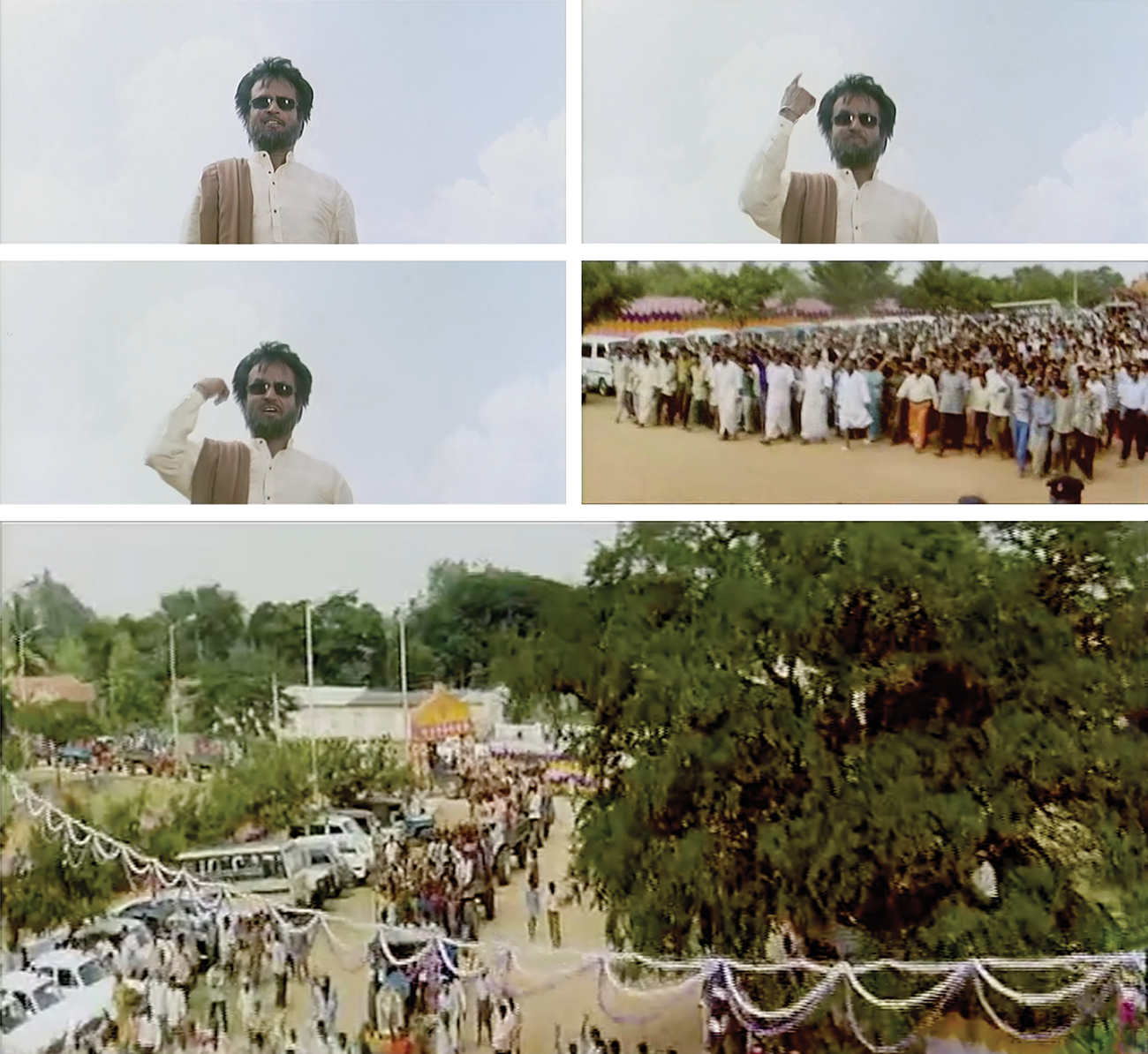
What kind of gesture is this extended index finger? And what kind of finger is it? From this brief description, we can readily apprehend this gesture as a cinematically mediated act of deixis, an act of reference that ostends, or points to, its object: the “people” behind this “single man.” Such a finger is a canonical example of what Charles Sanders Peirce called “indexicality,” that semiotic ground between a token sign-vehicle and its object based on a “real connection” (Reference Peirce, Hartshorne, Weiss and BurksCP 2.287) or “existential relation” (Reference Peirce, Hartshorne, Weiss and BurksCP 2.243), such as causality, copresence, or contiguity (Reference Peirce, Hartshorne, Weiss and BurksCP 2.306; also see Jakobson Reference Jakobson[1957] 1984, 43; Silverstein Reference Silverstein and Blount[1976] 1995, 204, 212; Hanks Reference Hanks1990, Reference Hanks1999). In this case, it is the spatial copresence and temporal contiguity in the diegetic world of the film—and on the film set—between Padaiyappa/Rajini’s finger, the crowd, and the moving camera that ground this indexical act of deixis.
Yet such a relatively straightforward and intuitive description, while not false, occludes something more profound; it predecides what I hope to show is at issue with Rajini’s finger: the question of presence and existence itself, that is, the very possibility of indexicality as a semiotic ground. At play in this scene is a particular metaphysics of presence, a particular conception of what entails existence and what existence entails, one that, in certain measure, is distinct from our default notions of presence and representation, and thus, indexicality.Footnote 7 As I detail in what follows, filmic images of south Indian hero-stars like Rajinikanth are not only (or even primarily) representations of characters in a film, nor even of his absent star body; rather, they are presencings of his being. This presencing constitutes Rajini’s fingers as indexical signs of a particular sort: performatively potent fingers that not only deictically point in the diegetic world of the film but also point beyond it (as we will see, at the audience qua electorate) and that not only visually point but haptically touch, grab, and encompass their onscreen/offscreen objects (cf. Casetti Reference Casetti and Buckland[1983] 1995; Metz Reference Metz[1987] 1991), incorporating them into the very being of the ultimate ground of those indexical acts: Rajinikanth himself.
This mode of being functions in scenes such as this as what I call a “metapragmatics of presence” (cf. Silverstein Reference Silverstein and Blount[1976] 1995, Reference Silverstein and Lucy1993): a reflexive frame that mediates, and constitutively enables, acts of presencing and thus the very possibility of this kind of indexicality. My suggestion is that metapragmatics do not just construe indexicalities by fixing their value vis-à-vis some context (Silverstein Reference Silverstein and Lucy1993, Reference Silverstein, Schieffelin, Woolard and Kroskrity1998b) but that they must also, logically and in empirical fact, construe a semiotic ground as an existential relation of some kind or other, specifying what (and how it) “is” such that particular indexical effects become possible at all (Ball Reference Ball2014). To speak of a metapragmatics of presence—rather than a metaphysics of presence (Derrida Reference Derrida1976), here understood as a cultural ontology of being and presence—is to speak of how presence, as a pragmatic process and phenomenological achievement, is metasemiotically mediated in and across particular events. Indexical relations are always mediated by some such metapragmatics.
Accounting for the indexicality of Rajini’s fingers, then, demands an ethnographic account of being and presence. What or when, indeed, is a “real connection” or an “existential relation”—that is, what and when are presence and being—such that any variety of indexicality could be possible in the first place? While linguistic anthropologists and other semiotically inclined scholars (see Stasch Reference Stasch2011; Fleming and Lempert Reference Fleming, Lempert, Enfield, Kockelman and Sidnell2014; Leone and Parmentier Reference Leone and Parmentier2014; Chumley Reference Chumley2017 and references therein) have had much to say on the first part of this question—namely, how presence is (meta)semiotically mediated and manifested through indexical and iconic processes of various sorts (most powerfully, in treatments of ritual; see, e.g., Hanks Reference Hanks1990; Silverstein Reference Silverstein and Lucy1993, Reference Silverstein2004; Eisenlohr Reference Eisenlohr2015; cf. Tambiah Reference Tambiah1985; Taussig Reference Taussig1993; Nakassis Reference Nakassis2013)—they have less often focused attention back on the analytics that are employed to reconstruct such forms of mediation, namely, the metaphysics of presence presupposed by the notion of indexicality itself (but see Ball Reference Ball2014; Nozawa Reference Nozawa2015; Bauman Reference Bauman, Carr and Lempert2016). What are, in fact, the concepts of presence and existence that underwrite our default analytic conceptualization of indexicality, and how do they square with our own commitments to the ethnographic study of semiotic mediation? What does it mean to theorize mediation (existential relations, real connections) by positing as its “ground” seemingly self-evident immediacies (real connections, existential relations)? As these questions suggest, inherent to indexicality is a tension, an ambivalence that is often unreflected upon.
Instead of making indexicality the way we understand sociocultural modes of existence and presence, then, what if we suspend our assumption that we know what indexicality is and instead interrogate questions of how existence and presence are made to be such that indexical relations and effects become possible? Such an inquiry would refuse to leave indexicality as a self-evident, pregiven analytic with some essential unity but would instead interrogate it as an open ethnographic question. This demands not just an appeal to a notion of semiotic ideology—conceptualizations about what (indexical) signs are—but also requires us to appeal to the metasemiotic grounding of the ground itself, to an account of what existence is, which is to say, an ideology of being as an ontology of semiosis (Hanks Reference Hanks1999, 125; Kockelman Reference Kockelman2015). As my analysis of Rajini’s fingers suggests, opening up the question of existence and presence ethnographically allows us to unearth other flavors and qualities—other semiotic “grounds”—of indexicality and representation beyond those that we all too often take for granted.
Rajini’s Fingers
Rajinikanth’s Padaiyappa (1999) was the last in a series of big-budget, megahit action films in the 1990s that catapulted Rajinikanth to a new level of stardom, confirming his status as the “Superstar,” as he is called, of the Tamil film industry.Footnote 8 At this point in his career, Rajini came into his own as a “mass hero” (Pandian Reference Pandian1992; Srinivas Reference Srinivas2009; Krishnan Reference Krishnan, Chatterjee, Guha-Thakurta and Kar2014; Prasad Reference Prasad2014), a term used in south India for an actor who is a “hero” to the “masses,” and whose “mass”—or power, charisma, and popularity—has a gravitational pull on all those caught in his orbit, be they fans or filmmakers, voters or governments. Onscreen, mass heroes are bombastic and larger than life, hypermasculine, and all powerful, subordinating the laws of narrative, realism, and physics to their offscreen status and personage as statusful celebrities (Nakassis Reference Nakassis2016a).
South Indian film industries, and the Tamil film industry in particular, are historically known for producing these auratic celebrity figures, figures who are not just film stars but who also harbor a “cine-political” surplus, to use Madhava Prasad’s (Reference Prasad2014) term: a potency to leverage their screen image so as to segue from the film industry to populist electoral politics. This cine-politics, as Prasad (Reference Prasad2014) and S. V. Srinivas (Reference Srinivas2009, Reference Srinivas2013) have argued, is a postindependence phenomenon, made possible both by particular hero-focalizing textual practices and by the historically contingent lamination and realignment of the (Tamil) language community (sensu Silverstein Reference Silverstein1998a), the electorally organized state (i.e., Tamil Nadu), and the political economy of film distribution and exhibition (as coterminous with both; cf. Chakravarthy Reference Chakravarthy, Khattab and Ibrahim2002, 236). In this subnational postcolonial context, it is the textual body and embodied image of the mass hero-star through which political community has been consistently, though not exclusively, imagined and enacted (cf. Anderson Reference Anderson1991).
The most famous, and first, Tamil hero-star called on by the masses to represent them on and off the screen was M. G. Ramachandran (1917–87), or MGR, the Puraṭci Talaivar (Revolutionary leader) and Makkaḷ Tilakam (Tilakam of the people).Footnote 9 MGR dominated Tamil cinema from the 1950s to the late 1970s as its preeminent action hero. From the early 1950s, he was an active and important member of the regional DMK party (Dravida Munetra Kazhagam ‘Dravidian Progress Federation’), whose ethnonationalist political platform his early films propagated (Hardgrave Reference Hardgrave1971, Reference Hardgrave1973, Reference Hardgrave1979). With increasing popularity, and with his films more and more oriented around his image as a populist leader (rather than to DMK ideology per se; Sivathamby Reference Sivathamby1981; Pandian Reference Pandian1992), MGR’s relationship with the DMK leadership became strained, eventually leading him in 1972 to leave the party and form his own—the A(IA)DMK (All India Anna[durai] Dravida Munetra Kazhagam)—largely out of his extensive fan club network (Dickey Reference Dickey1993a). Contesting state elections after the Emergency in 1977, MGR went on to serve as Tamil Nadu’s chief minister until his death in 1987.Footnote 10
It is from MGR that Rajinikanth inherited his cinematic crown as the predominant mass hero of the film industry (though this was not a foregone conclusion at the time), and to MGR that all other actor-politicians have oriented as citational touchstone: most explicitly perhaps, the actor-politician Vijayakanth (b. 1952; also known as Karuppu MGR ‘the dark-skinned MGR’) and Rajini’s prince-heir, Vijay (b. 1974), whose onscreen and offscreen activities often cite and emulate both MGR and Rajinikanth (Rajanayagam Reference Rajanayagam2015; Nakassis Reference Nakassis2016a, 169). MGR’s political crown and party, however, were captured by his former onscreen (and rumored offscreen) romantic interest, J. Jayalalitha (1948–2016), who—in a telling indication of the gendering of cine-politics—disavowed (rather than embraced) her cinematic past in order to be groomed for politics by MGR (Prasad Reference Prasad2014, 186–92; cf. Nakassis Reference Nakassis2015).
In the mid- and late 1990s, with films like Padaiyappa (1999) Rajinikanth seemed poised to enter electoral politics and follow in MGR’s footsteps, as indicated by a series of veiled and not-so-veiled onscreen and offscreen references to the state’s political situation and, in particular, to Jayalalitha, who had been chief minister of the state from 1991 to 1996 (see, e.g., Tamilvānan Reference Tamiḻvāṉaṉ2002, 214–28; Sreekanth Reference Sreekanth2008, 125–32; Krissna and Rangarajan Reference Krissna and Rangarajan2012, 70–71). Rajini’s onscreen allusions—for example, in films like Annamalai (1992), Muthu (1995), Arunachalam (1997), and perhaps most explicitly Padaiyappa (1999)—were mirrored by Rajini’s own offscreen political comments (famously saying in 1996, e.g., “Even God cannot save Tamil Nadu if AIADMK returns to power”) and his public campaigning in support of the anti-AIADMK alliance (which won the 1996 elections in a landslide because, it is often opined, of Rajini’s support).
Ultimately, however, to the dismay of his fans, Rajinikanth did not enter into electoral politics, nor has he since, deferring the possibility to some vague future or the will of the divine.Footnote 11 Three years after Padaiyappa, Rajini released his next film, Baba (2002), a politically equivocal film and a shocking box-office failure.Footnote 12 Since then, Rajini has only off and on made reference to entering electoral politics, just as his films have less explicitly served as, and been read as, intimations to his political plans.Footnote 13
What interests me here is less the question of why Rajinikanth did not enter electoral politics in the 1990s or since (on this, see Krishnan Reference Krishnan2007; Rajanayagam Reference Rajanayagam2015), or how to evaluate the cine-political fate of his image in the postliberalization context (Prasad Reference Prasad2014; Srinivas Reference Srinivas2016) of digital media (Rajadhyaksha Reference Rajadhyaksha, Dutta, Bhaumik and Shivkumar2013), where, arguably, the mass hero is “dead” (Kurai Reference Krissna2012). Rather, my interest is how Rajinikanth’s films at the height of his popularity and political possibility were framed by and staged within a particular metapragmatics of presence, and how this metapragmatics vests images of Rajinikanth with a particular kind of indexicality and performativity.
This metapragmatics underwrites Rajini’s as yet unredeemed cine-political potential, lending him an “auratic presence” (Power Reference Power2006, 55–95) in the theatrical event of his image’s appearance. This, as I argue through an analysis of some of Rajini’s gestures below, enables his fingers to figurate the encompassment and incorporation of his audience into his body politic, forging a unique semiotic “ground” to his thereby indexical acts. As we will see, such performative, indexical acts are complex achievements, acts whose possibility is stretched over multiple cinematic texts. While every image of Rajini potentially presences him, this presence is the effect of a compulsive intertextuality, or interdigitation we might say, across his extensive film oeuvre. This interdigitation manifests as and in his cinematic image, in and as his potent pointing fingers.
Poetics/Politics of Presence
The narrative structure of Rajinikanth’s films from the 1990s onward unabashedly orbits around his star celebrity and massive personage as the Superstar. Often negatively characterized in liberal media as a form of “hero worship,” such films’ narratives and poetics “build up” the “heroism” of the star’s image, maximizing his exposure onscreen (in terms of screen time and area taken up on the screen) and figurating him as a charismatic, all-powerful entity that triumphs over all. Mass heroes never lose to the villain, never fail to achieve their goals, never die onscreen, nor do they act as mere characters in realist diegetic worlds—at least, not without risking fan ire and box-office failure (Pandian Reference Pandian1992; Nakassis Reference Nakassis2016a, 211). As Prasad (Reference Prasad2014) has suggested, such “mass films” position not only the spectator but also other characters (and actors) in the film, and even its director (see Krissna and Rangarajan Reference Krissna and Rangarajan2012, 32, 81, 88, 177), as the hero-star’s “fans” and the hero-star as their talaivar (leader), an appellative often used to address and refer to mass heroes such as MGR and Rajinikanth.
As I have shown elsewhere (Nakassis Reference Nakassis2016a, 188–223), the poetics of this type of film work through, and over and above, its narrative, with every hero-character always already an avatar of the star celebrity (Dyer Reference Dyer[1979] 1998, 98). Such a form of textuality is constituted as a series of openings and perforations of the narrative, of presencings of the star within the world of the film in ways that consistently strain the narrative coherence and logic of the diegetic world on its own (non-star-centered) terms.Footnote 14 But this, of course, is the point: this is never a world on its own terms, but always already on his terms, a world that serves him and obeys his will, that lifts him up so that he may transcend it and survey its bounties and rectify its ills.
As this implies, each mass-hero film is a vehicle for the avatar of a being that exists across the worlds of his films, that is, as an intertextual principle that is iterated across his films (Chakravarthy Reference Chakravarthy, Khattab and Ibrahim2002; cf. Dyer [Reference Dyer1979] 1998; Nozawa Reference Nozawa2013). And indeed, Rajini’s films of this era and since are highly generic and deeply intertextual (“formulaic” in their plots and the tropes they deploy, as both sanguine industry insiders and exasperated film critics put it), just as the moments when he breaks from the narrative and his character and presences himself as Rajinikanth the Superstar are highly ritualized (in multiple senses: as routinized, as a reflexively zoned site of poetic performativity, and as the source from which other cultural forces emanate; Silverstein Reference Silverstein2013). This ritualized intertextuality is central to the metapragmatics that ground moments of Rajini’s revelation and presencing and thus the indexical acts that occur in his wake.Footnote 15
Below I explore some of these stereotyped moments that build up the hero and presence the star: the title-credit sequence of his films that heralds his arrival; his introductory sequences, where his face is first made visible; and his encounters with the villains of his films, wherein he delivers his signature “punch dialogues” and “stylish” mannerisms (also see Nakassis Reference Nakassis2010, 150–220; Reference Nakassis2016a, 203–5). These are moments when Rajini steps into the audience’s presence, recognizing and addressing them as in his presence and as part of his being. By focusing on these moments, I work toward an analysis of Rajini’s highly charged and stylized gestures, with an eye to his acts of pointing in particular. While such acts are not the only moments when Rajini presences himself, Rajini’s gestures are a highly stereotyped and insistently iterated site of his image work, and thus serve as a useful entry point into the (meta)semiotic dynamics that are at issue in this article.
In the Name and Orbit of the Superstar
Since reaching his apogee in the 1990s, Rajini’s appearance in a film is never simply as a representation of a character, for every such film is always already a Rajinikanth film, a star vehicle that takes place in his proper names.Footnote 16 While this fact is apparent from the publicity and marketing that appear before the film is released (or even made), it is also entextualized at the paratextual edge of his films, announced at the outset of its reels, as shown in figure 2.
Rajinikanth’s 1990s-era title-credit sequence: “SUPER STAR” is written, dot by dot, onscreen followed by the letters R – A – J – N – I [sic] that fly toward the audience, one at a time, accompanied by a laser sound-effected swoosh, and then return altogether to sit between “SUPER” and “STAR.” A bright white outline lights up the edges of the word “RAJNI,” and then subsides. “RAJNI” then flies off the screen into the background as “ரஜனி” (Rajini), his name in Tamil script, flies in to replace it. It too is then emblazoned by a white outline.
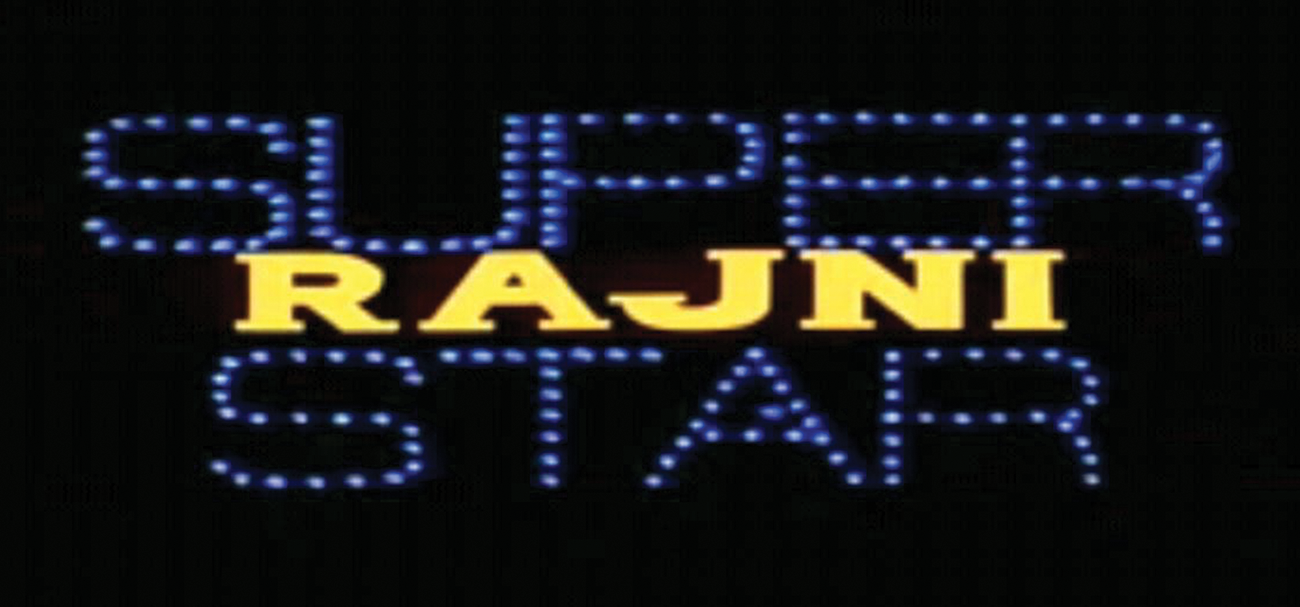
This 28-second animated sequence, with attendant theme music, comes before the film proper begins. It often follows a number of other precursory images—the censor-board certificate, credits to financiers, images honoring very important persons, the production house’s introduction logo, the film’s title card—though it may also precede them, as in Padaiyappa where Rajini’s Superstar sequence comes after the censor-board certificate but before both the production house’s logo and the film’s title card. The first of the artists’ and technicians’ credits (the last of which is always the director’s), this sequence heralds the appearance of the hero-star with his proper (nick)name “Rajni” and sobriquet “Superstar.” While Rajinikanth began to be referred to as the Superstar as early as 1978 (in posters and other cinema metadiscourse; see Kalaipuli Thaanu Reference Guna2007, 172–74), it wasn’t until the early 1990s that this star-designating epithet mandatorily appeared onscreen before his films began, starting with the 1992 Suresh Krissna directed film Annamalai, which first used the animated sequence depicted in figure 2 (Krissna and Rangarajan Reference Krissna and Rangarajan2012, 89; cf. Kalaippul Thaanu Reference Guna2007, 174). The use of this sequence has continued since, though with updated graphics and sounds since the mid-2000s.
As Krissna describes in a collection of remembrances about the films he made with Rajinikanth in the 1990s and early 2000s, “Surely Rajnikanth, who was becoming a phenomenon, warranted a unique logo to go with his name, I thought” (Krissna and Rangarajan Reference Krissna and Rangarajan2012, 89). Likening it to the classic James Bond title sequence, Krissna narrates how he pitched the idea to Rajini: “Till now you’ve been described as the Superstar by a few. But the time has come for the status [i.e., Superstar] to precede your name in the titles. So I’ll create a logo and a signature tune for it, which will announce the arrival of Brand Rajni. The impact will be magical” (Krissna and Rangarajan Reference Krissna and Rangarajan2012, 90). Supplanting and enveloping the name of the actor, this “status” englobes the film that follows in the name of Rajini’s star image, as an iteration of what has come before and what is to come in the future, a compilation of his previous characters and more, his transtextual identity as the Superstar.Footnote 17
At this first moment of revelation, audiences clap, throw confetti, whistle, and yell (e.g., “Rajini vāḻka! Talaivar vāḻka” [Long live Rajini! Long live our leader!]), responding to and welcoming this virtual/semi-presencing of the hero-star before he can finally be seen onscreen. As Naren, a close friend and former ardent Rajini fan in his teenage years (in the 1990s) said in 2016, the claps begin with this moment because “it’s our [incl.] leader’s name, our leader the Superstar. Our leader is going to come, a new joy, the film’s begun. He’s arrived!” (Atu talaivan peyar, talaivan Superstar. Talaivan varappōṟāru, putu uṟcākam, paṭam ārambicciruccu. Vantuṭṭāru!). Here Naren’s slippage between narrating a future act of presencing (varappōṟāru, ‘come.inf.-go.pres.3s.hon.’) and a completive one (vantuṭṭāru, ‘come.avp.-compl.pst.3s.hon.’) figurates how Rajini’s proper names bear some quantum of his presence. Rajinikanth is in the building.
Introducing Rajini in the Cinematic Flesh
If the title-credit sequence heralds the hero-star and his “status” as a being that will “rise up and open itself” to the spectator (Heidegger Reference Heidegger, Young and Haynes[1938] 2002, 68), in Rajini’s 1990s films it is his introduction sequence and opening song that first fully presences him onscreen and in the theater. Consider, for example, the opening scenes of Baashaa, Rajinikanth’s 1995 super hit (directed by Suresh Krissna). After the requisite credit sequences, the film begins with two scenes where the hero’s sidekick, played by Janagaraj, is giving money to the needy (first to a fellow auto-rickshaw driver who needs dowry money on his daughter’s wedding day, then to the wife of an auto-rickshaw driver who needs her husband’s hospital bills paid) on behalf of an absent Manikkam, an auto-rickshaw driver who the savvy audience can assume is our hero, played by Rajini. Hearing about the big-hearted Manikkam from praising others, seeing his honorable deeds carried out by his associate, these scenes intentionally defer Rajini’s appearance, kindling our nagging desire of what we already know to be on our phenomenological horizon: a chance to see our hero, to be in his presence (Nakassis Reference Nakassis2016a, 163–64).Footnote 18
As with Rajini’s Superstar sequence, the deferral of the hero’s entry is not simply, or even primarily, the setting up of a narrative space within which the actor is to perform and the hero to enter. This is because this is not a story within which our hero acts. Rather, it is a story and a world that exists so that he may come upon us and presence himself. As we see below, it is with the hero’s entry that the narrative proper begins.Footnote 19 The narrative text, and the very representational space of the film, is inaugurated by and encompassed within the hero’s star presence; and while already a foregone conclusion, this presencing still requires a “buildup,” a dialectic and fine balance between our pressing desire to see him and its deferral, so that when the hero-star finally does appear our elevated level of excitement finds its equal in the grandiosity of his “entry.”Footnote 20
In Baashaa, after seeing Manikkam’s sidekick act on his behalf and in his name at the hospital, the doctor treating the auto-rickshaw driver voices, in Tamil, the audience’s demand: “Where is he (hon.)?” Janagaraj excitedly explains with a knowing smile: “Today is ayuta pūjai [a day to worship and give thanks to the tools/machines through which one earns], so our older brother [aṇṇan] is at the auto-stand tearing it up [paṭṭaiya keḷappikkiṭṭiruppāru].” Cut to the auto-stand (named, as we see later, “MGR auto-stand”). We hear a rousing percussive cadence as we are shown a close-up shot of a hand beating a drum, which zooms past to a picture of the deities Lakshmi, Ganapathi, and Saraswati. The shot then cuts to the ground, pumpkins flying into the frame, broken in worship. We then see a close-up of an auto-driver ecstatically playing the drum. Cut to two women doing a tiruṣṭi (evil eye) ritual on an auto-rickshaw with a pumpkin as a small crowd watches on, smiling. We again see the excited faces of the drummers. The two young women throw the pumpkin up in the air, captured by an extreme high-angle shot from above. Cut to the pumpkin flying in the air from below, and then to white sneaker–clad feet running toward the camera. Cut to the pumpkin on its downward descent. We then see a profile midshot of Rajini jumping in the air, with a crowd of auto-rickshaw drivers eagerly looking on and cheering. Rajini smashes the pumpkin with his head (fig. 3).Footnote 21
Enter Rajini: Rajini/Manikkam smashing the tiruṣṭi pumpkin in Baashaa (1995; directed by Suresh Krissna).
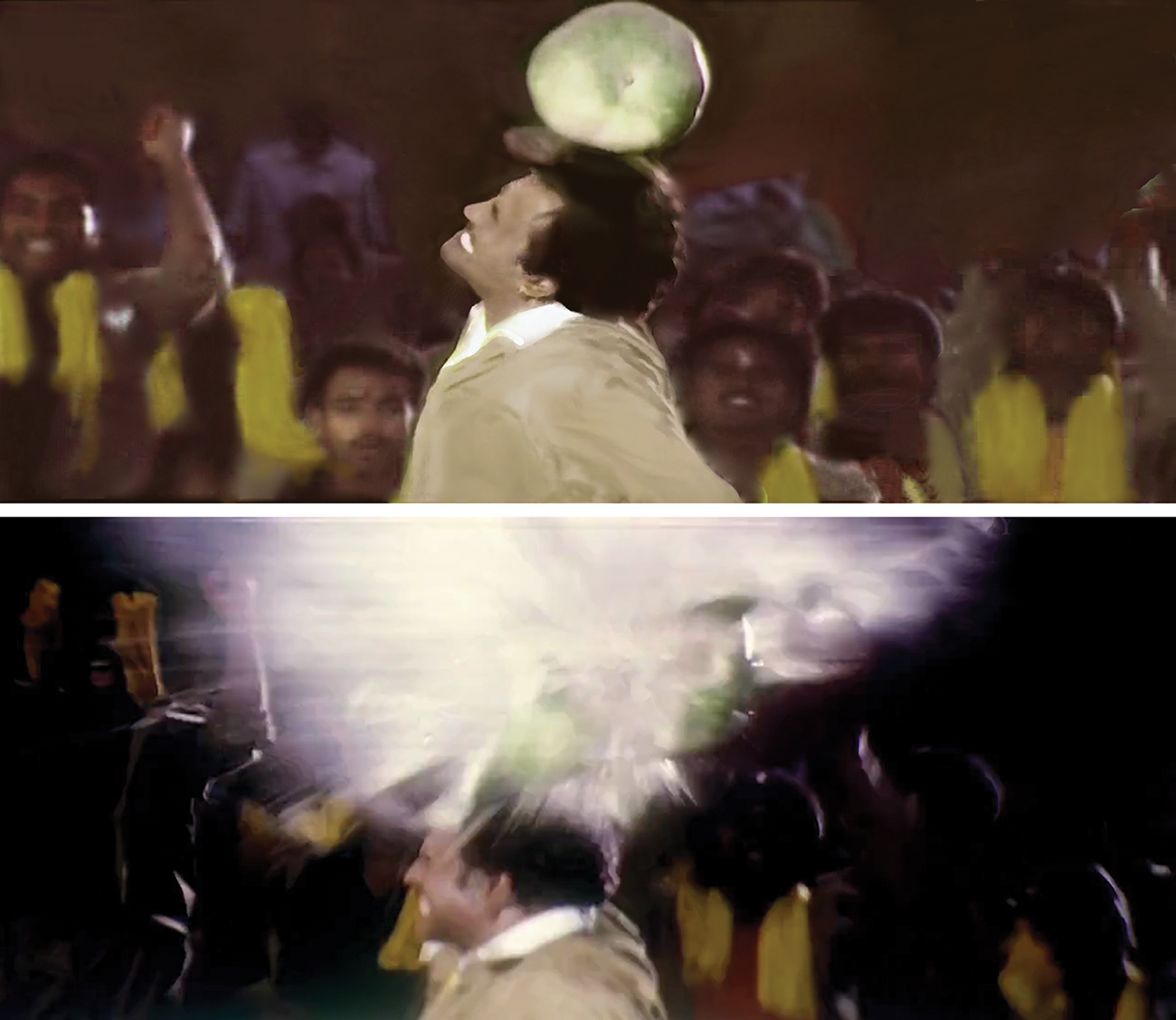
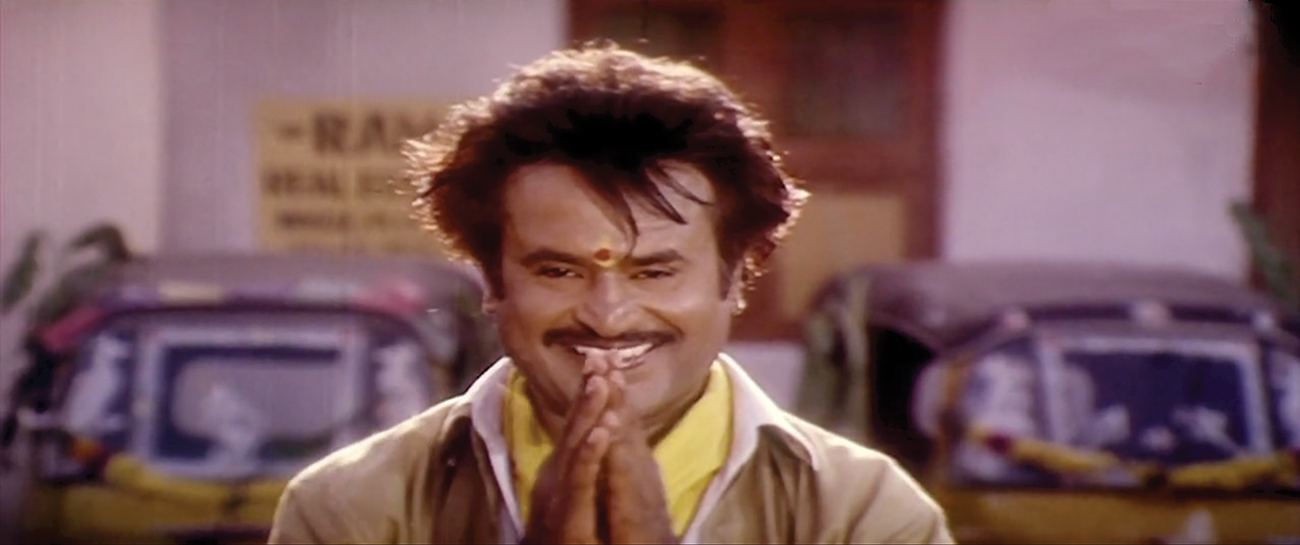
Next, we see a midclose frontal shot of Rajini landing on the ground. In slow motion, Rajini passes before the camera in his descent, his eyes, still unseen by us, downward cast at the ground. At the nadir of his landing his brow is just below the frame of the shot. As he slowly bounces back up, the camera frames him in a full-frontal bust shot, his eyes now directly looking at the camera, his face smiling. The film seems to slow down even further as his hands raise in a vaṇakkam gesture (a traditional gesture of greeting and worship/supplication), his smiling eyes lingering on us as we linger on him (fig. 4). This particular series of shots, as Naren noted to me in a conversation about Baashaa, is the peak (uccam) of the film’s introductory sequence, its affective zenith. With this near-frozen image, the drums segue into the introductory song, “Naan autokaaran” (I’m an auto-driver) and its accompanying dance sequence.
Rajinikanth’s revelation: greeting the audience in Baashaa (1995) after making his grand entry.
In revelatory moments such as this, the hero-star’s appearance onscreen is not just a sight to behold. It offers an occasion for interaction with him. As with Rajini’s title-credit sequence (though with more intensity), Rajini’s “entry” in the theater is greeted by the audience with whistling, clapping, throwing confetti, jumping up and down, touching the screen, and yellingly addressing and praising him: “Talaivā!” (Leader [voc.]!) or even “Manitakaṭavuḷ!” (Human god!), as Naren reported from his remembrances of watching Baashaa in the 1990s (fig. 5;Footnote 22 also see Srinivas Reference Srinivas2009; Gerritsen Reference Gerritsen2012).Footnote 23 (I heard similar vocatives yelled in the theater at the 6:00 a.m. first-day show of Rajini’s 2016 film, Kabali, in Madurai.)
Screenshots of fans throwing confetti, clapping, and yelling praise at Rajini’s introduction sequence in a re-screening of Baashaa; source: https://youtu.be/RKJKHxsiqn0, uploaded by Vijay Andrews, November 6, 2011.
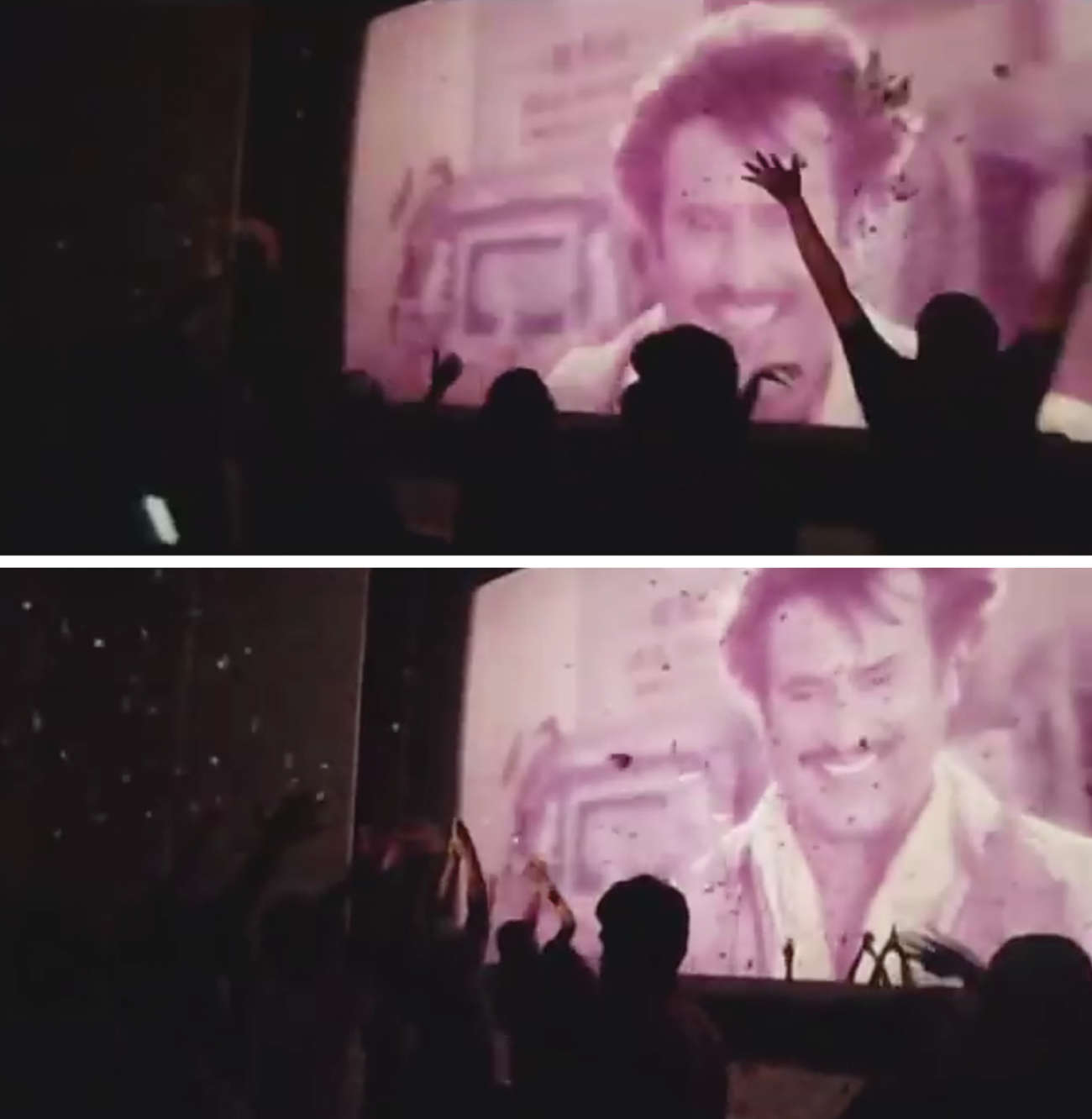
This image responds. As figures 4 and 5 show, this proleptic response takes the form of an aesthetics of frontality that continually shows us the eyes and face of the hero-star as he looks straight at us (Kapur Reference Kapur1987; cf. Leone and Parmentier Reference Leone and Parmentier2014, S5). It may also include direct address to the audience or even reference to the time and place of theatrical viewing,Footnote 24 as with the image that Rajini’s fans are addressing in figure 5 which, as we saw above, finishes with a traditional gesture of greeting (vaṇakkam) to the camera/audience (fig. 4). The director of Baashaa, Suresh Krissna comments on this shot: “We had Rajini looking into the lens with a smile, which made viewers feel he was looking directly at them, and putting his hands together as if to greet them. At the editing table, I found the gesture so effective that I extended the screen time of the shot. And it secured the response I sought!” (Krissna and Rangarajan Reference Krissna and Rangarajan2012, 143).Footnote 25
When Rajinikanth is onscreen in such moments, he is present.Footnote 26 He is close to us. Rajini is with us in the theater: seeing us, addressing us, touching us. This is not just a physical co-presence. It is also an affective intimacy, even cosubstance. As Naren noted, when you see Rajini looking at you, when he [hon.] comes down from the screen to talk to you (iṟaṅki pēsuvāru), to directly order you (nēraṭiyā order pōṭuvāru), we feel that are we in the presence not only of a “big man and a great leader” (oru periya āḷu, periya talaivan), but also of “our [incl.] elder brother” (namma aṇṇan), “someone from our house, someone that we’re really close with” (namma vīṭle oruttar, romba nerukkamānavar; cf. Dickey Reference Dickey1993b, 351, 356).
To say that Rajini is with us in the theater, then, is to say that the sign of Superstar Rajinikanth is, in some measure, Superstar Rajinikanth himself. As Vivek, a middle-class friend and Rajini fan in his early twenties, put it to me in 2008, echoing Suresh Krissna’s own statement of the design of such images, when he saw Rajini’s introductory shot in his 2008 film Kuselan he felt he was in the presence of a divinity, an affective stance to the image also reported by Naren in reflecting on seeing Baashaa in the 1990s. Naren said, “It’s like he’s looking at us. They always have a close-up of Rajini. They’ll show his eyes. … A lot of people say it: seeing his eyes is like seeing a god” (Nammaḷe pākkuṟa mātiri irukkum. Rajinikku eppavumē close-up vaippāṅka. Kaṇṇayē kāṭṭuvāṅka. Niṟaiya pēr solluvāṅka: avaru kaṇṇa pāttavuṭanēyē oru kaṭavuḷai pārttatu mātiri anta viṣayam).
So different from our classical understanding of representation—namely, that the sign is not its Object—this understanding of the cinematic sign is often framed in academic accounts—and in the accounts by fans themselves, as with Vivek and Naren above (also see Kalsy and Pal Reference Kalsy and Pal2015)—by appeal to the Hindu notion of darśan (Eck Reference Eck1997; Jacob Reference Jacob2009; cf. Taylor Reference Taylor and Ramaswamy2003; Ram Reference Ram and Velayutham2008, 55–56; Nakassis Reference Nakassis2016a, 271 n. 4), that tactile visual modality through which devotees and deity transact substance, where the idol-sign is its Divine Object (cf. Armstrong Reference Armstrong1971, Reference Armstrong1981; Belting Reference Belting[1990] 1994; Leone and Parmentier Reference Leone and Parmentier2014). Whether we hold that such a modality of vision is fundamentally religious in nature or that the religious and the cinematic here share a convergent semiotic ideology and phenomenology (to say nothing of participation framework), what I want to underscore is that such images are less something to be seen as such (at least, as we typically understand vision) than they are figurations of, and thus in certain contexts are, haptic forces that entangle and encompass, reach out to grab and act on who and what is seen (cf. Davis Reference Davis1999; Pinney Reference Pinney, Ginsburg, Abu-Lughod and Larkin2002; Jain Reference Jain2007; Shulman Reference Shulman2012, 51–53).Footnote 27 As Naren said, “In [Rajini’s] eyes, there is some kind of power” (Etō oru sakti irukku kaṇṇule).
It is this presence that grounds Rajini’s onscreen indexical acts, rendering them not simply past performances captured on film and projected for us here and now but perpetually performative image-acts in the moment of their apperception. When Rajini greets and gestures (or even cuts cake; see n. 24), the indexical ground of his fingers, hands, and words are not simply on the set before the camera, nor are they simply transposed into the fictional world of the film. Rather their ground is also, as a function of these multiply laminated origos,Footnote 28 immanent in the theater itself, scaled to the chronotopic envelope of the moment of the spectator’s engaged regard, to the viewer and his relationship to Rajini and, ultimately, to Rajini himself, as I discuss in the next section.
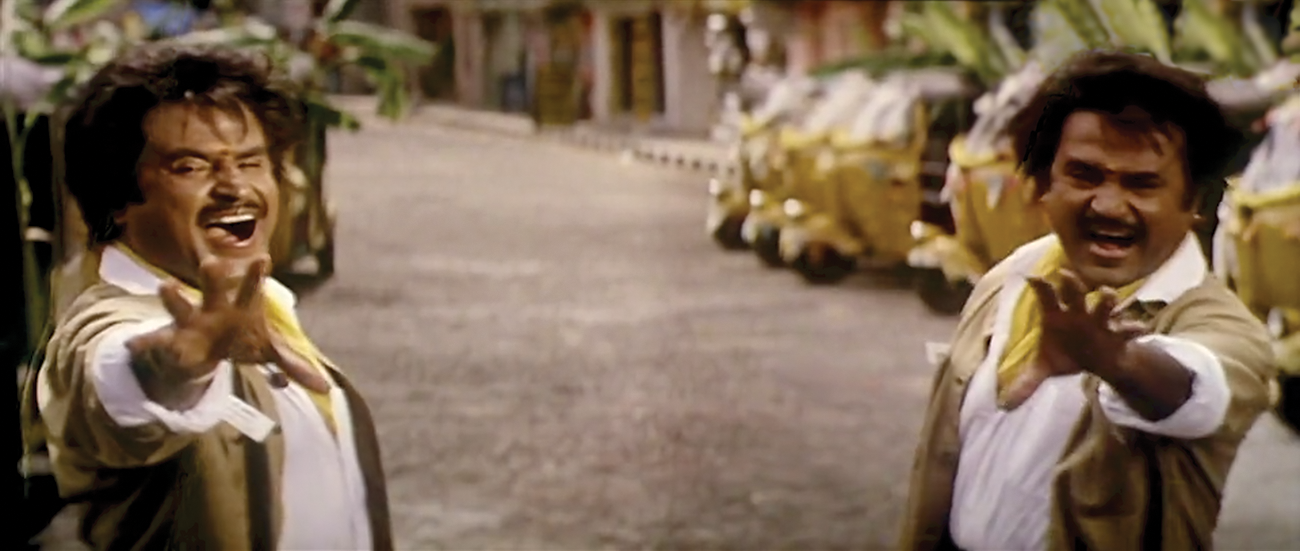
At the end of Baashaa’s introductory song, “Naan autokaaran,” we are left with a final shot (fig. 6). In it, Rajini’s body is doubled. One Rajini is facing us, the other with his back to us. Each turns toward and away from us in a loose oscillating synchrony, singing the chorus’s rhythmic refrain (“accukka gumukku”) until (almost) in unison each reaches his hand out to grab the other side of the screen while yelling “Ha!” on the final beat of the song. With this cry, with these two Rajini’s looking at and reaching toward us, the moving image comes to a standstill, frozen onscreen for a near second in poetic parallelism to Rajini’s introductory revelation (which inaugurated the song; fig. 4). With the fourth wall not just broken but crossed by Rajini’s outstretched fingers, the introductory song of Baashaa concludes, and the story begins.
“Ha!” Rajini at the end of the introductory song “Naan autokaaran” (I’m an auto-driver) from Baashaa (1995), multiplied onscreen and reaching out to touch you.
Dialogues That “Punch,” Fingers That “Do Style”
Rajinikanth’s most elaborated and emblematic hand gestures are typified by his Tamil film publics as “style” (Nakassis Reference Nakassis2016a). Style is an English borrowing whose meaning in Tamil is closely associated with Rajini (ibid., 7), characterized by his fans (as well as by the characters in his films) as simply what Rajini does and is, though it is more typically used to denote any number of his idiosyncratic, signature actions: from his finger-twirling gestures to the way he rotates his sunglasses around in circles while putting them on; from the way he flips his bangs back to the way he throws a towel onto his shoulders. Through their energized elaboration and enthusiastic flair, such acts of style reflexively draw attention to themselves as acts by Rajinikanth, functioning as quasi-proprietary signs of Rajini’s personage (“Brand Rajini,” as director Suresh Krissna called it above) in all its “pathological particularity,” as Venkatesh Chakravarthy (Reference Chakravarthy, Khattab and Ibrahim2002) has put it.
Rajini’s stylish gestures often go along with his “punch dialogues”: poetic and forceful aphorisms and catchphrases that every Rajinikanth film since the 1990s has featured three, four, five, or even six times. Such stylish speech acts are also repeated across films, both by Rajini and by other film actors (Nakassis Reference Nakassis2016a, 207–12). In the diegesis, such stylish dialogues and fingers typically punctuate the hero’s confrontations with and triumphs over his enemies, forming a poetic motif that tracks alongside both the hero’s narrative and the film’s build up of Rajini’s star image.
Consider an example from the first half of Padaiyappa (1999), where Padaiyappa/Rajini, after thrashing his paternal uncle’s (cittappā) henchmen (brought to beat up Padaiyappa and force him to sign over some of his family’s property), scolds his uncle, delivering a philosophical monologue on justice that concludes with the film’s signature punch dialogue. He sets up the punch dialogue by saying, in Tamil, “I don’t interfere with anyone, but if anyone crosses my path …” In lieu of spelling out what happens to those who cross his path, Rajini/Padaiyappa rapidly spins a cigar around his upward-turned index finger for nearly three seconds (moving so quickly as to generate a swoosh sound effect) (fig. 7), his power and prowess intimidating his uncle and shocking and impressing his cousins.
Rajini/Padaiyappa rapidly spins a cigar on his index finger for 2.8 seconds of reel time, intimidating his uncle and shocking and impressing his cousins in Padaiyappa (1999). Arrows are added by the author.
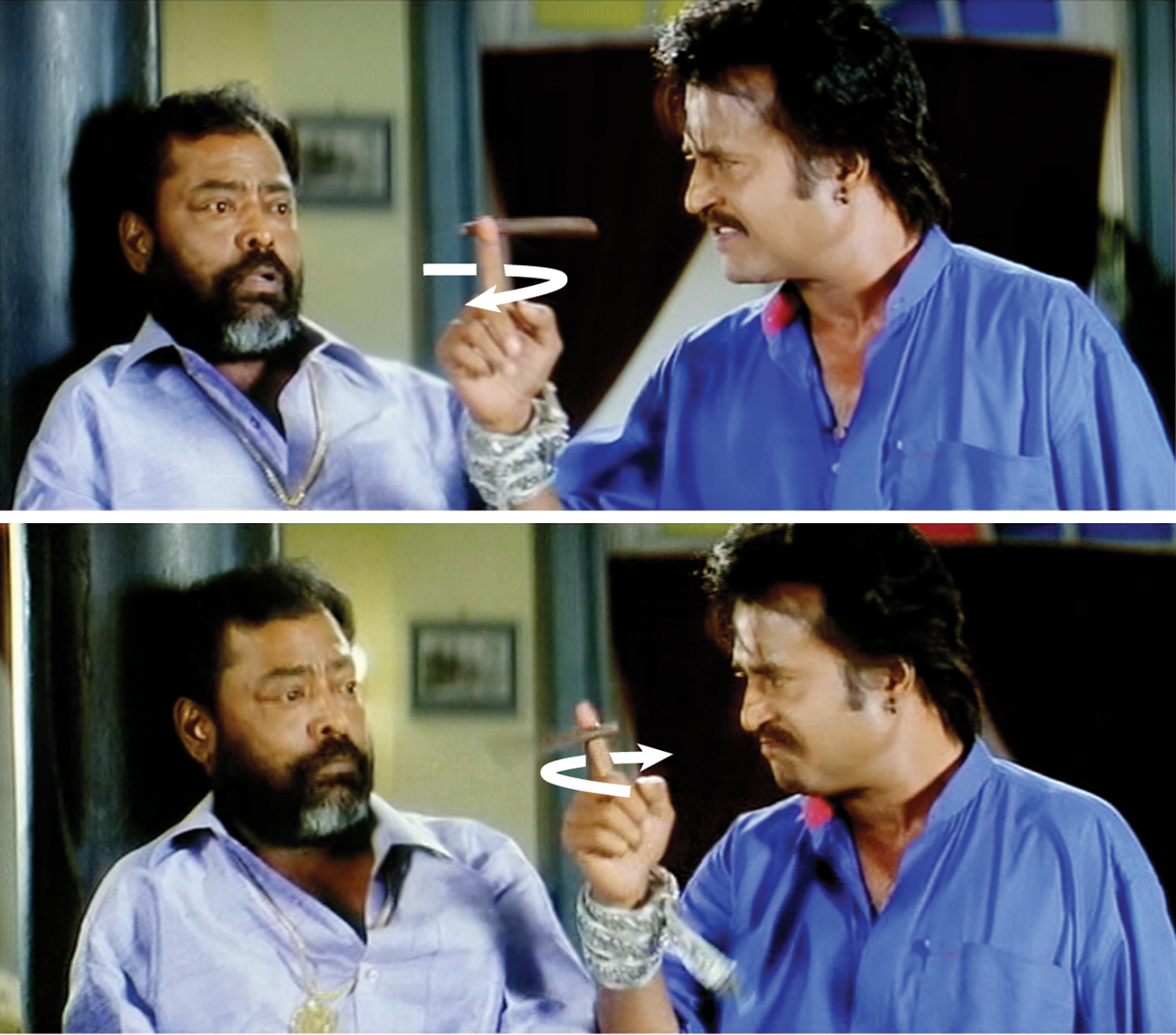
Rajini/Padaiyappa proceeds to flick the cigar into his mouth from a distance (Rajini’s most repeated and emblematic act of style), the shot repeated twice, first in a medium close-up and then in a medium shot. After another cutaway to his awestruck cousins, the camera cuts back to Rajini/Padaiyappa, who strikes a match off his uncle’s shoulder and lights his cigar. Rajini/Padaiyappa then says to his uncle, in Tamil, “You understand, right?,” and turns away from him. The camera then cuts to an extreme low-angle, mid-close shot of Rajini’s body as he rapidly turns back around (again, with an accompanying swoosh sound effect). This exact shot is repeated twice and spliced together by a jump cut, figurating Rajini’s speed and potency and indicating that something important is about to happen. Rajini then delivers the film’s punch dialogue, his previously dry, unaffected voice dropped in pitch and drenched with grave reverb: “En vaḻi tani vaḻi. Maṟakkātīṅka” (My way/path is a unique way/path. Don’t forget [it]).Footnote 29 He begins the punch dialogue with his hands at rest as he says, “En vaḻi” (My way/path; fig. 8,a). This is followed by a 1.5-second pause in speech during which his right arm quickly moves to his left and then rapidly sweeps across his body (along with a swoosh sound effect), his palm and fingers rigidly extended and facing downward (fig. 8,b). His fingers then curl as his index finger remains stylishly extended. His wrist moves up and then down as he says, in synchrony with the gesture, “tani vaḻi,” his finger iconically tracing his “unique way/path” (fig. 8,c). Following a near second-long pause, he then finishes the punch dialogue with a caution, “Maṟakkātīṅka” (Don’t forget [it]), as his wrist and upwardly pointing index finger wave back and forth—right, then left, then back right (each stroke’s endpoint syncing with the stressed syllables ma, kkā, and tīṅ), symbolically diagramming the negative imperative (fig. 8,d).
Rajini’s punch dialogue and accompanying gestures from Padaiyappa (1999). Gesture and paralanguage are in <angle brackets> and correspond with superimposed numbers and arrows in the film stills to the left; the Tamil punch dialogue is in the line below (onset of syllables/words aligned with the co-occurring gesture annotation in the line above), followed below by the interlinear gloss (see n. 6 for abbreviations). Right (R) and left (L) are from Padaiyappa/Rajini’s perspective.

In delivering punch dialogues such as this one, which precede and follow from his physical displays of dominance (in this scene, the dialogue comes after he has single-handedly dispatched ten hired rowdies), Rajini fully reveals his “mass” (and again, to ear-splitting whistles, claps, and yelling from the audience). Critical to this revelation are Rajini’s stylish fingers.
Underwriting the performativity of such acts is their citationality. As noted above, Rajini’s punch dialogues, like his stylish finger-twirling gestures, are incessantly repeated within and across his films (and by other actors as well), forming dense intra- and inter-textual linkages that are eagerly expected by fan audiences. Like Rajini’s proper names, such interdiscursive signs come to function as rigid designators—signs whose reference is indexically “fixed” by/to a putative baptismal moment and thereby stabilized across “possible worlds” (Kripke Reference Kripke1981)—linking each iteration back to, even as they build up, the identity/essence that holds them together (Žižek Reference Žižek1989), namely, Rajini’s transtextual personage as the Superstar (Chakravarthy Reference Chakravarthy, Khattab and Ibrahim2002, 231; Nakassis Reference Nakassis2016a, 210–11).
Rajinikanth’s mass and his auratic presence in any particular token event of viewing, then, are not present in any simple or immediate way. Not simply mediated by the camera, diegesis, and the screen, Rajini’s presence is deeply mediated through multiple not-nows and not-heres that culminate in this moment here and now. This presence is entailed by the fact that Rajini’s face, fingers, and voice—as well as his characters and character names, dialogues, musical motifs, visual tropes, shots, and mis-en-scène (Nakassis Reference Nakassis2016a, 209)—are multiplied within and repeated across and outside of his films (159–87), each reanimation of him by him conserving and citing the others through their repetition. As the hero-actor Karthi Sivakumar put it,Footnote 30 describing the audience for whom such moments give pleasure, “They call it film history. You have a history of films. And that works when you say a dialogue. When you say something, he [the viewer] imagines (all) the others characters are all saying that line.” And using the same finger, we might add.
Out of this citational interdigitation every token image, gesture, and utterance by Rajini instantiates and is his auratic presence, that mass that has accumulated and been curated over more than 150 films over multiple decades. As Rajini’s memorable punch dialogue from Baashaa states alongside his rapidly twirled, raised index finger: “If I say it once, it’s like I said it a hundred times” (Nān oru taṭave sonnā nūṟu taṭave sonna mātiri; fig. 9).
Iterations of a punch dialogue: “If I say it once, it’s like I said it a hundred times” from Baashaa (1995). Of this punch dialogue (authored by Rajini himself), the director of the film, Suresh Krissna notes that, “Rajini doesn’t use the power-packed line too many times in the film [NB: only four times], but every time he does, force—both physical and mental—emanates from it” (Krissna and Rangarajan 2012, 147).
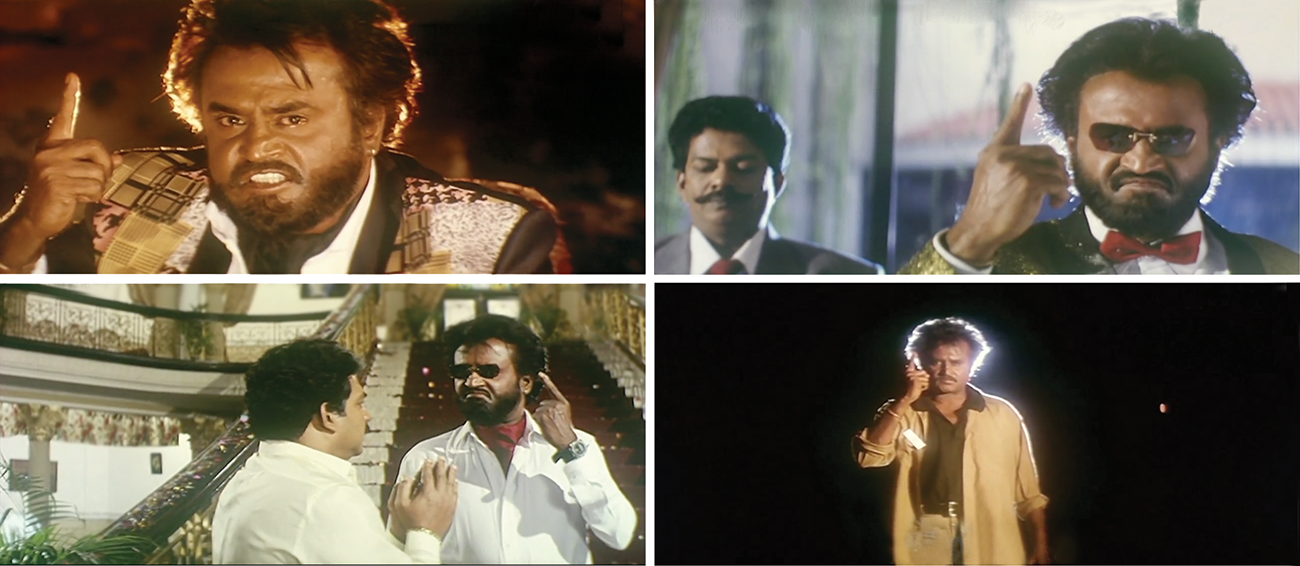
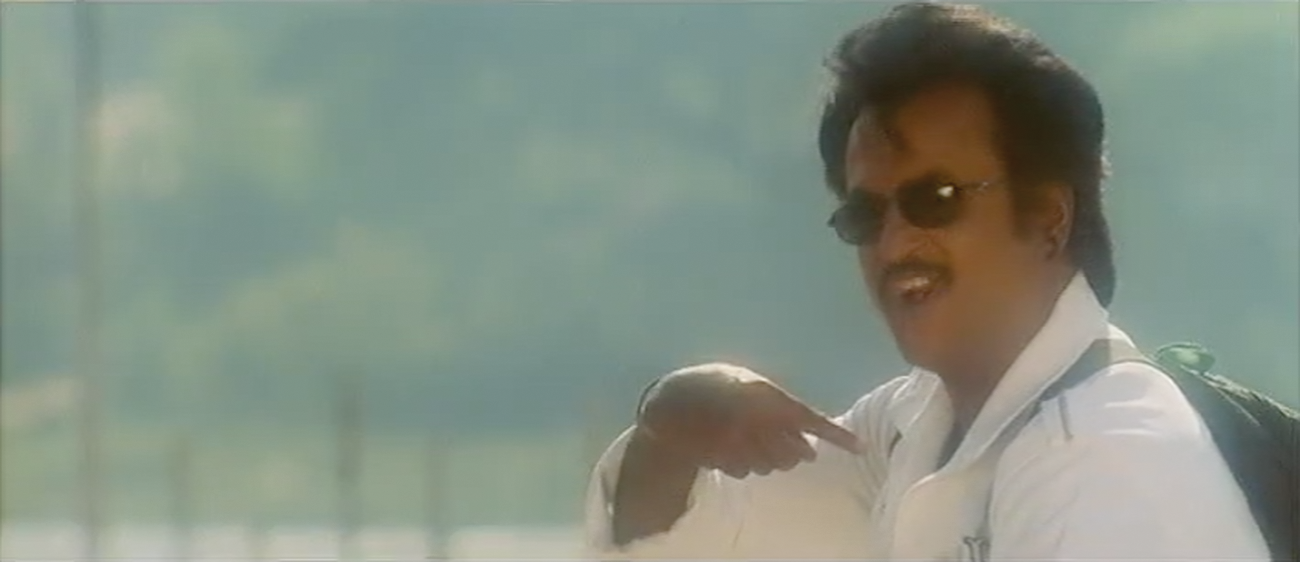
Rajini’s stylish fingers, then, among a battery of other poetic signs, suture together his various manifestations into a single Form, one that ascends beyond any particular film text so that it may hover above and manifest in every single one of them. Such fingers don’t simply point to some referent in their deictic field or iconically outline its contours. They also tangle and laminate multiply superimposed indexical relations: between Rajini’s fingers and the deictic field within the diegesis (and the film set), between and across episodes within the film text, across his films, between his films and those of other heroes who cite him, between the screen diegesis and theater exhibition, and beyond. The most basic of these relations is also their telos: Superstar Rajinikanth himself. Indeed, the ultimate ground and final referent of Rajini’s finger is Rajini, as his films not infrequently remind us at their outset with shots of him pointing to himself as he tells us his character’s (and the film’s) name (figs. 10–11).Footnote 31
“I’m Arunachalam, man!,” from the opening Tamil lyric of the introductory song “Athanda ethanda,” Arunachalam (1997; director: Sundar C.).
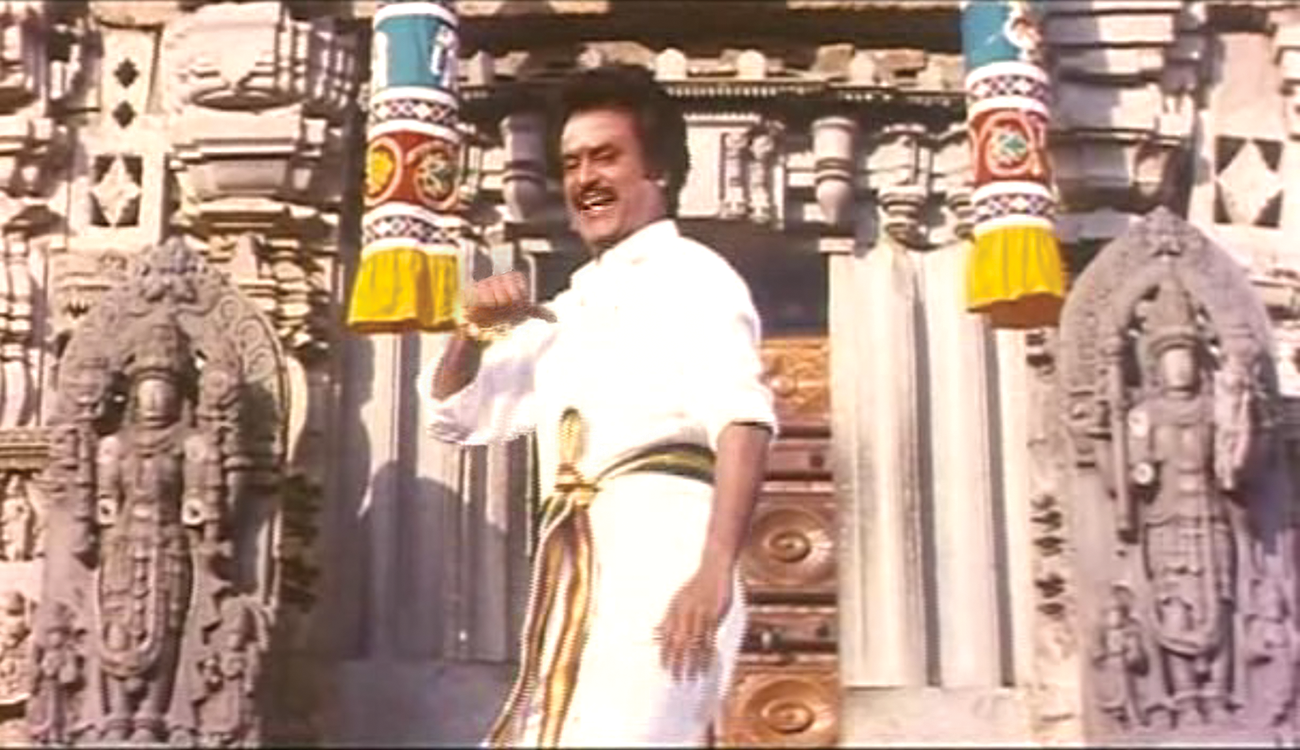
“My name is Padaiyappa!,” from the eponymous introductory song “En peru Padaiyappa,” Padaiyappa (1999).
If, then, Rajini’s finger is contiguous with his audience (and even with “himself”), it is because of a citational relay through a series of other scenes and other fingers, a relay that spirals around and always returns to Rajini himself, not as a body, nor as a filmic image of a body, but as an essence that commutes itself within a larger political economy of cinema, continually splitting, multiplying, and disseminating itself on, across, and outside the screen. In the next section I show how this essence, by being immanent in the moment of its onscreen revelation, entails a particular kind of “existential relation” for Rajini’s acts of pointing: a relation of encompassment and incorporation.
Standing Behind and Thus In the Body Politic of the Superstar
As we have seen, Rajinikanth’s finger is used in a number of different ways, many of which are not deictic pointing gestures: as a dance move, as a gesture of emphasis or threat, as a salute, as an icon of some linguistically denoted entity, or simply as a stylish mannerism. What I suggest in what follows, however, is that these ostentatious fingers cannot be thought of independently of Rajini’s acts of ostension (and vice versa), for it is through his ostending index finger that Rajini’s presence can encompass the scene of his appearing. This encompassment, I argue, enables Rajini’s cine-political potential.
This encompassment is perhaps most manifest in acts of Rajini pointing directly at his Tamil audience, often while describing himself as nourished by them, as one of them, or as working on their behalf. Such overtures are important precisely because Rajinikanth is not ethnolinguistically Tamil. He is from a Maharashtrian background, born in the neighboring state of Karnataka. While ethnolinguistic belonging has never been a criterion for a mass hero standing in for the polity (MGR too was known not to be ethnolinguistically Tamil), in Tamil Nadu—where electoral politics has been defined around the Dravidian movement’s championing of the Tamil language (Ramaswamy Reference Ramaswamy1997; Bate Reference Bate2009)—alignment with the Tamil language community is. By professing allegiance to the language community while pointing at what is figured in such films as its theatrical proxy—the audience—Rajinikanth enacts both his encompassment by the language community and his encompassment of it, entering it as a stranger king while staying on as intimate kin (as Naren noted above), standing beyond and above while also within it.
Consider, for example, a shot (fig. 12, top) from the introductory song of Annamalai (1992), “Naan vantheendaa, palkaaran” (I, the milkman, have arrived, man!), which is also reprised as the concluding shot of the film (fig. 12, bottom).Footnote 32
Top: shot of Rajini pointing at the camera/audience as he sings “Ennai vāḻa vaittatu Tamiḻ pālu” (I have been nourished and raised by the milk/essence of the Tamil people); from the introductory song, “Naan vantheendaa, palkaaran” (I, the milkman, have arrived, man!) of Annamalai (1992); bottom: the last shot of Annamalai. This final scene reprises the introductory song and ends with Rajini singing the same line and pointing gesture as above. When Rajini completes the line, the image freezes for nine seconds as the phrase “… Tamiḻ pālu” echoes and the production house’s credit (“A Kavithalayaa Production”) appears onscreen.
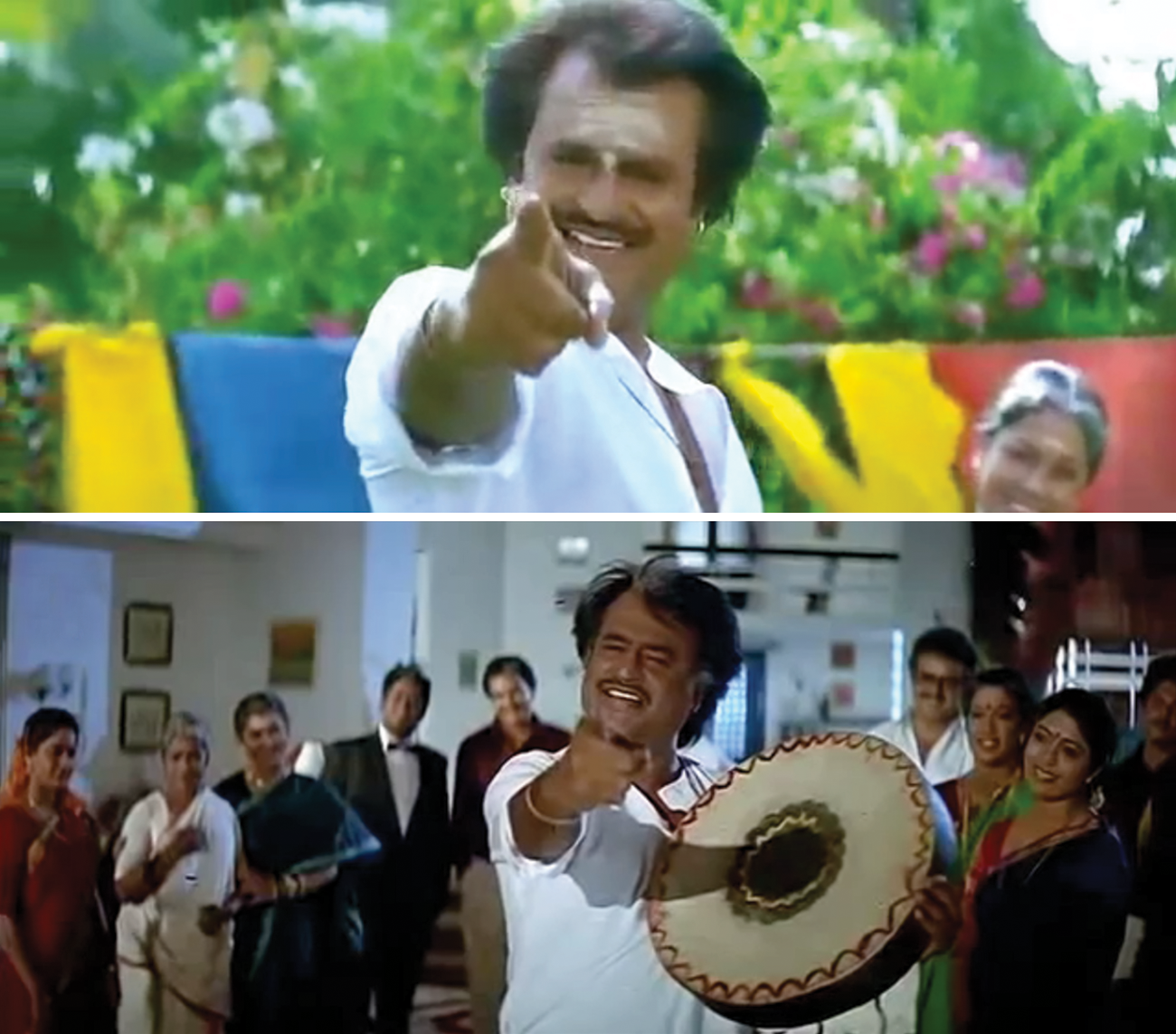
Both iterations of the song highlight a medium shot of Rajini smiling and facing the camera/audience as his index finger points at them. As director Suresh Krissna reports having told Rajini during shooting, the shot would “thrill” the “masses … because it will seem as though you are looking directly at them” (Krissna and Rangarajan Reference Krissna and Rangarajan2012, 33–34). “For viewers, it established a direct connection with their hero on screen” (34; also see discussion of Baashaa’s introductory song above). In both iterations, the shot co-occurs with the same line of the song (penned by the lyricist Vairamuthu “to boost Rajini’s image as a mass hero of the Tamils” [32]). Rajini/Annamalai, the milkman announces, “I have been nourished and raised by the milk [or essence] of the Tamil people” (Ennai vāḻa vaittatu Tamiḻ pālu).Footnote 33 The end of the line, “Tamiḻ pālu” (literally “Tamil milk,” or “the essence of the Tamil people”), is sung as he produces the pointing gesture at the audience. In the final shot of the film, the image freezes on this gesture for nine seconds, as if to fix the audience as the permanent indexical target of Rajini’s finger,Footnote 34 the phrase “Tamiḻ pālu” echoing seemingly into infinity, temporally draped over Rajini’s ever smiling face and pointing index finger. This is the last image and sound of the film.
Important is how both shots are close enough to highlight Rajini gazing and pointing at the audience—as the ones who brought him into being with their milk/essence—but far enough to allow the viewer to see various approving onlookers who ratify this gesture by approvingly standing behind Rajini: in the first instance, his diegetic mother (played by the late veteran Tamil actress Manorama); in the second, a crowd of onlookers that include his mother, sister, lover, sidekick, and best friend/erstwhile rival. As Rajini addresses the theatrical audience, these intimate onlookers are themselves positioned as an audience for his outward-facing act of direct address, functioning as a mirror to our own act of seeing (and perhaps admiring approval of) Rajini (also see fig. 13).
Rajini walking toward the camera (top) while pointing at (bottom) and singing to us in the song “En peru Padaiyappa” (My name is Padaiyappa!), from Padaiyappa (1999): “Is it not right for me to sacrifice my body and soul to the cause of the Tamil language and people?” (En uṭal poruḷ āviyai Tamiḻukkum Tamiḻarkkum koṭuppatu muṟai allavā?).
Such acts of pointing at the audience position the audience not as simple spectators (i.e., those who watch the screen from its other side) but as those who, by being pointed at and by seeing proxies of themselves watching Rajini pointing with approval and admiration, welcome Rajini into the consanguineal ethnolinguistic community as their (adopted) kin and willing martyr. In doing so the film invites its spectators to pass through the screen so as to stand behind and with Rajini. And we might add, so that Rajini may come to stand as their political representative. As Naren said of such scenes, “When he’s looking at and speaking to the people, we’ll think like, he’s a hero for us, a hero who speaks for us” (Makkaḷai pāttu pēsum pōtu, nammaḷukkāna hero, nammaḷukkāka pēsuṟāru appaṭi nnu ninaippōm). Rajini speaking to us, for us; being for us, and now even one of us—here we find a complex transposition and series of transactions across the screen’s multiple sides. The aura of Rajinikanth, presenced through the screen by his fingers, acts to incorporate this indexed object—his audience—into his complexly mediated being, entailing a consubstantiation between sign and object that makes this object into his image (fig. 14; cf. Reference Peirce, Hartshorne, Weiss and BurksCP 2.748).
Made into his image: the images in this figure are from the colorful and spectacularly picturized song “Balle Lakka,” the opening song of Sivaji: The Boss (2007), the chorus of which articulates an updated neoliberal vision of Rajini as developmental savior and leader of Tamil Nadu (the lyrics accompanying these shots translate as “Hey Bale Lakka Bale Lakka; To Salem, Madurai, Madras, Trichy, or Thiruthani; Hey Bale Lakka Bale Lakka; For all the people, if our elder brother [Rajini] comes, the whole of Tamil Nadu will become America!”). The bodies that stand behind, beside, and in front of Rajini have tiger heads and makeup (a cinematic retooling of the folk dance puliyāṭṭam, or ”tiger dance,” the tiger being a symbol of ferocity and power), their naked torsos each adorned with a unique rendering of Rajini’s face (instead of a tiger’s, as in puliyāṭṭam). During this sequence, the feline bodies jump up and down, causing the plump paunches of the male dancers, these Rajini simulacra—whose hearts and guts have been painted over with Rajini’s smiling face—to nod along with Rajini, their model, as he frenetically points in every direction, including at the camera/audience (right).
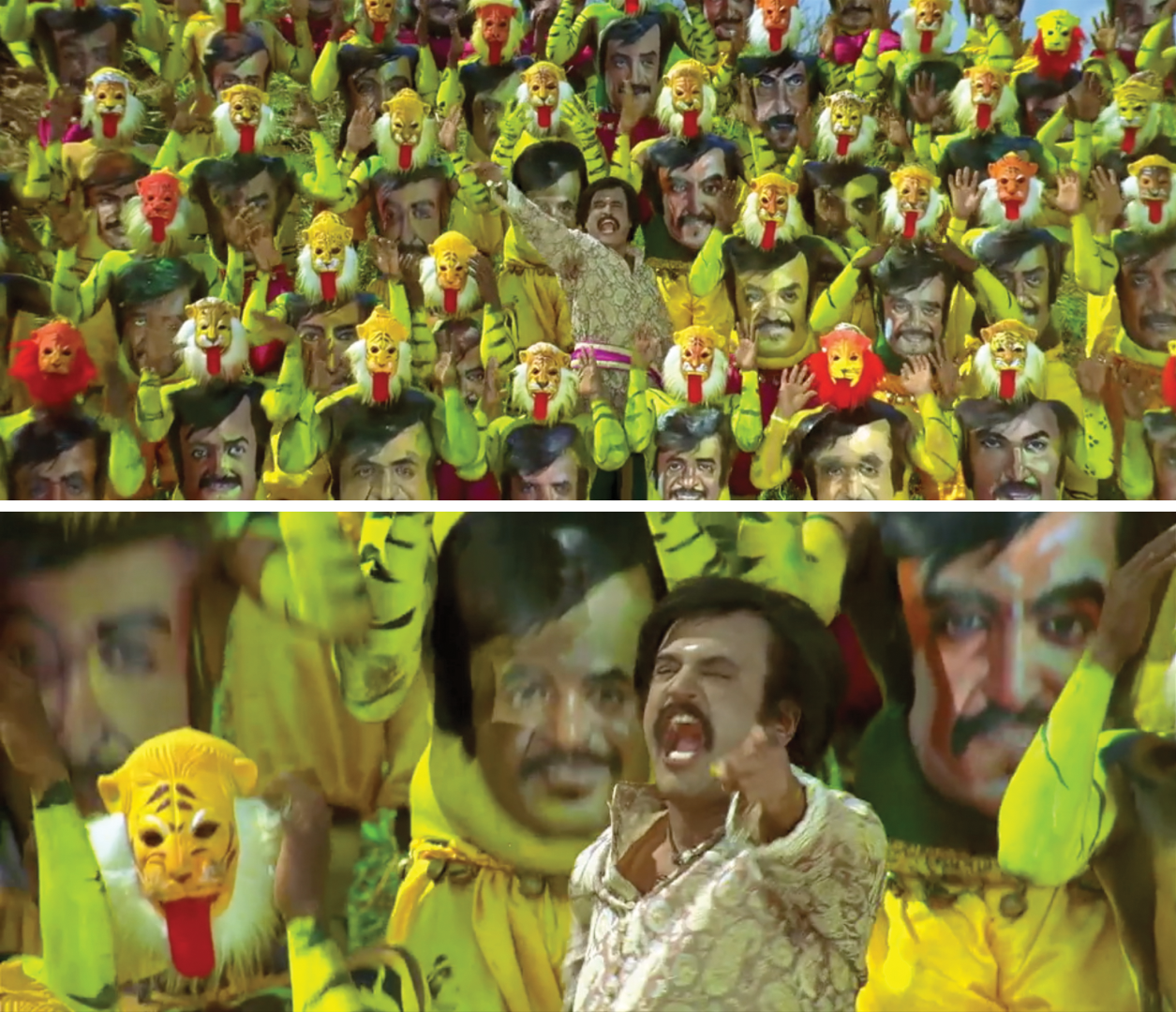
As figurated in these moving images, to be in Rajini’s presence is to stand behind and thus in him, as a piece of his mass, his body politic. Here, the “existential connection” of Rajini’s index finger is one of encompassment and incorporation, a replication and extension of his cinematic and political will.
Let me conclude this discussion by looking in detail at one final set of ostensive gestures, those of the preclimax sequence of Padaiyappa (1999) with which I began the article. In this sequence, the existential connection of incorporation and encompassment that I have been describing is reflexively narrativized by the film, functioning as an allegory for the very cine-politics that it performatively enacts.
At the time of its release, Padaiyappa as a whole, and the preclimax sequence in particular, was transparently seen by audiences and the press as a political commentary, with the film’s female villain taken as a stand-in for the former actress and political leader J. Jayalalitha.Footnote 35 As the reader will recall, in the preclimax sequence after the villainness Neelambari (read: Jayalalitha) threatens to have Padaiyappa/Rajinikanth run off, Rajini laughs and responds, in Tamil, “Yes dear, I’m a single man, but take a look at all the people who are willing to give their lives to this single man.” As he says this, his index finger points upward (see fig. 1). Dramatic horns and strings enter with a rising melody as the camera follows Rajini’s fingertip up and then “behind” him, panning to the right to reveal a sprawling mass of people (farmers, we later overhear a constable telling the police inspector in charge of security) with their hands raised in the air, yelling in a single but unintelligible voice. It is at them that Rajini (and the camera) points.
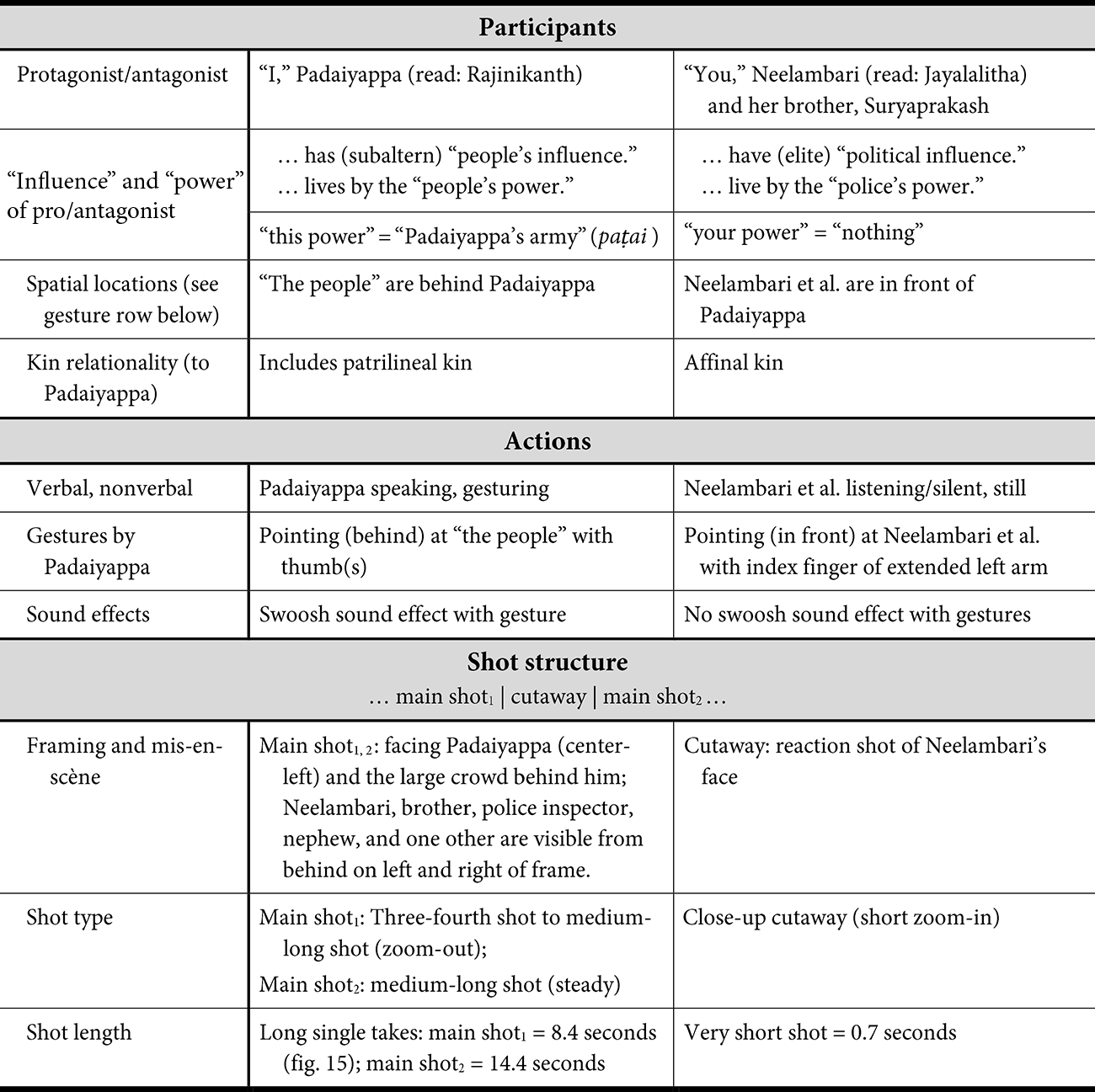
This lengthy single crane shot that moves from Rajini to the subaltern people that support him runs for 50 seconds as the camera snakes along the long winding road that leads to where Rajini is standing. During this shot, the dramatic background score segues into a haunting voice singing the melodic motif of the song “Vetri kodi kattu” (Raise the victory flag), from earlier in the film, over a spare drum rhythm. All along the road, throngs of people are coming toward Rajini, on foot or riding on tractor-pulled flatbeds. After a series of shots of Neelambari, the press, and the police reacting to the crowd, the camera cuts back to Rajini at the head of this Leviathan as he addresses the villainess Neelambari (see fig. 15 for Rajini’s monologue).
Rajini/Padaiyappa’s “trailer” for the “main picture.” NB: the onset of the gesture in the center column syncs with the dialogue and pauses in the left column. English glosses of the Tamil lines are in the right column.
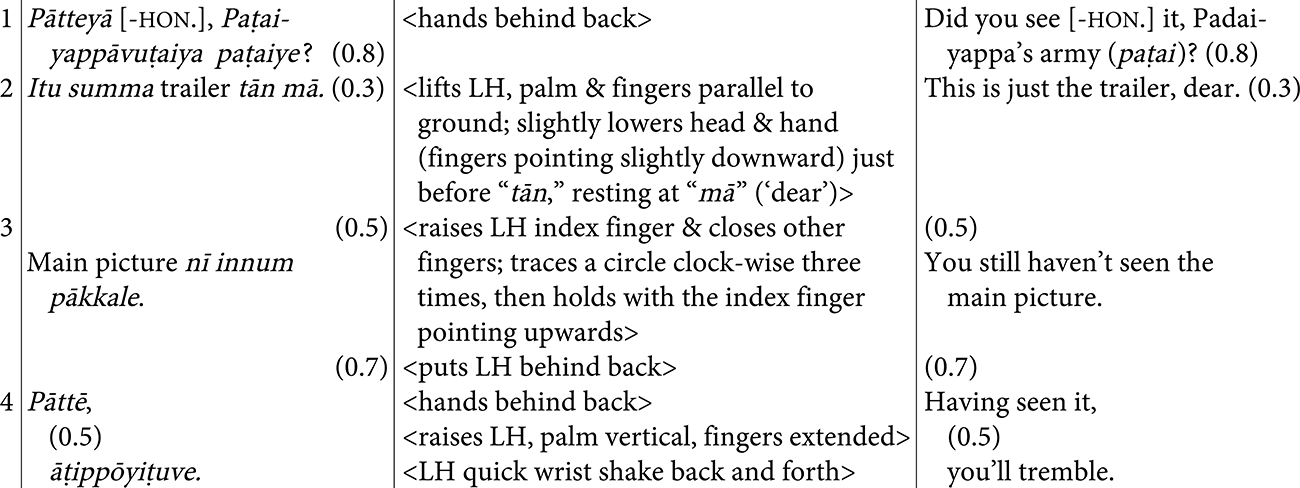
In this monologue Rajini puns on his character’s name, Paṭaiyappā, which is composed of the lexemes paṭai ‘army’ and appā(n), here ‘lord’ or ‘general’. Together they reference the god of war Murugan, also known as Ārupaṭaiyappā, the Lord of the Six Abodes (also Padaiyappa’s full name in the film). The subaltern masses (“army”) that Rajini/Padaiyappa points to are already in and with him, they stand behind him and in his divine name.Footnote 36 Rajini/Padaiyappa makes this explicit in what follows through a set of poetic contrasts (fig. 16).

Rajini/Padaiyappa contrasts the villainness and her family (his affinal kin)—at whom he points with his left index finger (fig. 17)—as having political influence (“uṅkaḷukku arasiyal selvākku” [you have political influence]), while he, he says while pointing at the crowd behind him with both his thumbs (the speed and gravity of his gesture accompanied by a swoosh sound effect; see fig. 19, bottom), has the people’s influence (“enakku makkaḷ selvākku” [I have the people’s influence]).
Rajini/Padaiyappa points at Neelambari and others with his left index finger while saying, in Tamil, “You have political influence”; from Padaiyappa (1999).

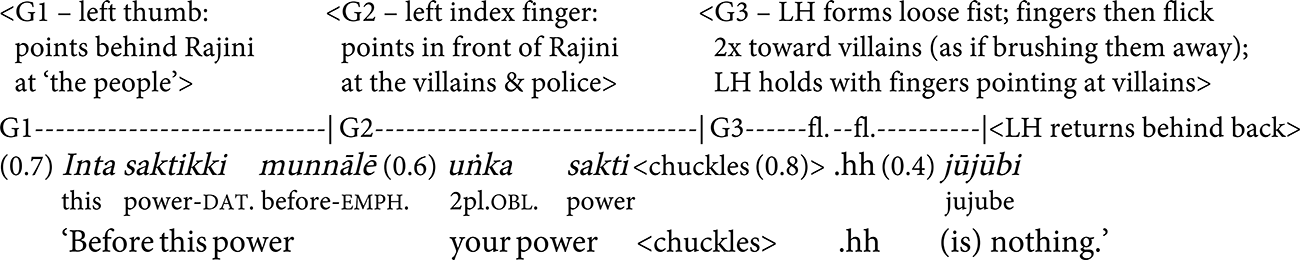
You live by the police’s power (police-yōṭa sakti), he continues, with his hands now behind his back, while I live by the people’s power (makkaḷōṭa sakti). In a simultaneously direct and deferred ostension (Quine Reference Quine1969, 39), Rajini/Padaiyappa then points at “the people” behind him for a second time, this time with only his left thumb (again, accompanied by a swoosh sound effect), and says, in Tamil, “Before this power …” (see fig. 18). He then fully extends his left arm as he points with his index finger (palm down) at the villains in front of him (no sound effect), and says, “… your power. …” He begins chuckling as his index finger retracts (his arm still extended), his fingers forming a loose fist (palm down, thumb over his fingertips), which then flick twice toward the villains while he laughs and then audibly inhales. Rajini’s second flick holds with all his fingers extended at the villains as he completes the utterance “… is nothing.”Footnote 37 In this precisely orchestrated, multimodal act, each gesture’s stroke precedes and is held across the discourse that it calls forth, produced in the pregnant pauses in Rajini’s speech. These stylish gestures proleptically parallel and punctuate his utterance, providing their own gestural proposition alongside his verbal pronouncement.
Rajini’s verbal and gestural opposition of his/the people’s and the villains’ power. NB: G1, G2, G3 in the second line of the transcript indicate onsets of the gestures described in the first line; -----| indicates a hold or continuation of a gesture; fl. = onset of flicking gesture.
When the political minister Suryaprakash (Padaiyappa’s cross-cousin and Neelambari’s brother) orders the police to shoot into the crowd, individual members at the head of the crowd (Padaiyappa’s patrilineal kin and friends) step forward and take up Rajini/Padaiyappa’s interpellative pronouncement. They declare their willingness to be shot in support of Rajini/Padaiyappa and threaten to rip the minister and his family to shreds, if only Rajini/Padaiyappa gives the word. The rest of the crowd applauds, as Rajini/Padaiyappa stands confidently in silence. Standing behind and incorporated into Rajini, the crowd is an extension of his will, at his fingertips (and the tip of his tongue), ready to do his bidding.
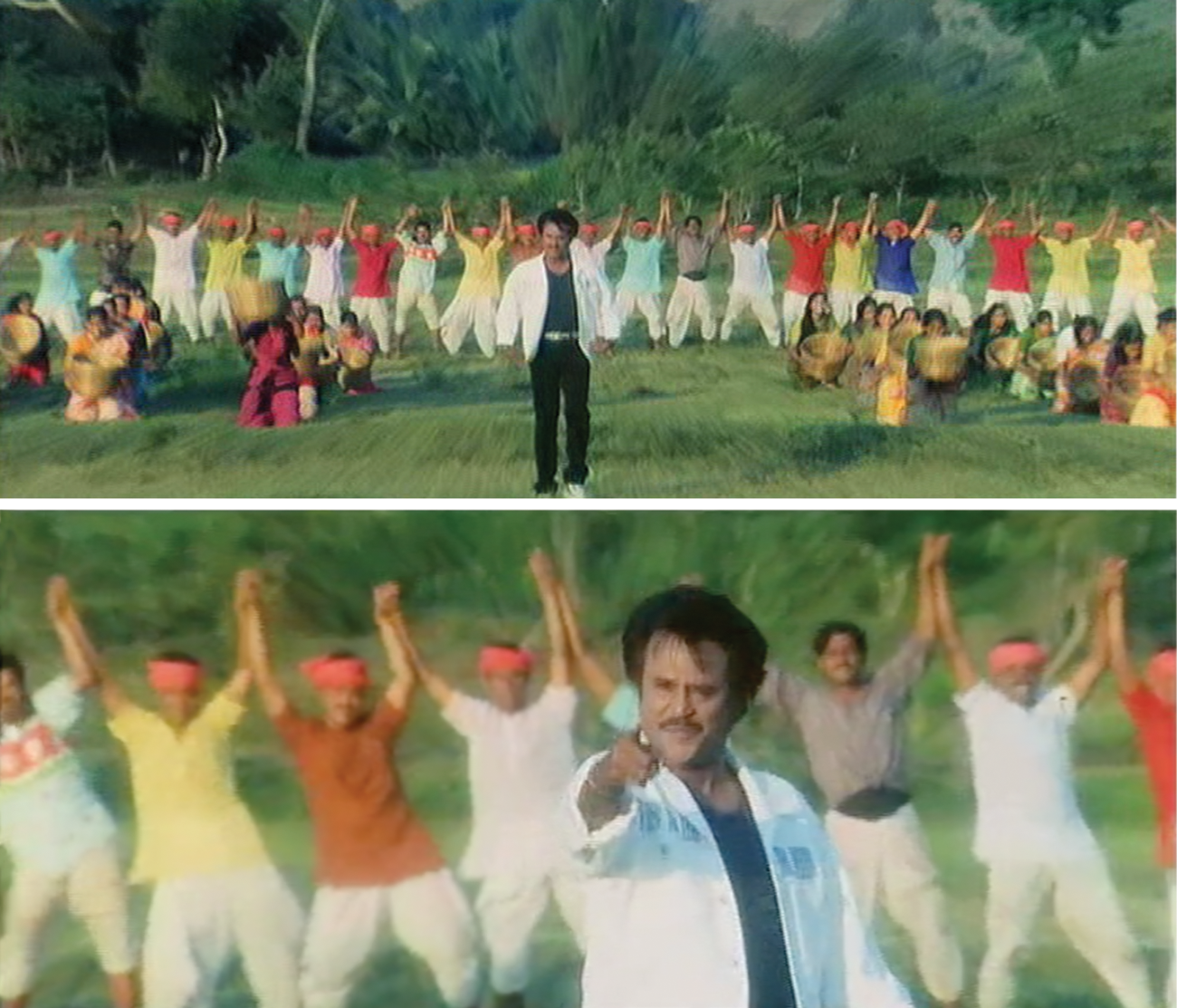
This incorporating finger is already anticipated in the film’s introductory song, “En peru Padaiyappa” (My name is Padaiyappa; figs. 11, 13). In this song Rajini/Padaiyappa describes his youthful gait (naṭai); his affectionate and simple nature; and the hundred armies (paṭai) standing behind him (“pinnāl nūṟu paṭai-yappā,” also interpretable as “the hundred Padaiyappas behind [me]”), as well as sings the praises of Tamil Nadu. The lyric “one hundred armies stand behind me [Padaiyappa]” co-occurs with a close-up shot of Rajinikanth pointing backward with both his thumbs (fig. 19, top), a gesture identical to the two-thumbed pointing gesture in the preclimax discussed above (fig. 19, bottom). The former image is superimposed over a shot of a huge mass of individuals at whom, through these images’ juxtaposition, he is spectrally pointing. This background image anticipates the preclimax shots of “the people” behind Rajini/Padaiyappa (in particular, the throngs of people winding down the road toward the marriage hall in the long 50-second shot [fig. 1]). Together, these images prefigure at the outset of the film what is to come at the outset of its conclusion.
Top: “One hundred armies that stand behind Padaiyappa”; bottom: “I have the people’s influence.” The top image is from the opening song of Padaiyappa (1999), poetically prefigured as the “trailer” to the preclimax (“Did you see Padaiyappa’s army?”) in the bottom image.
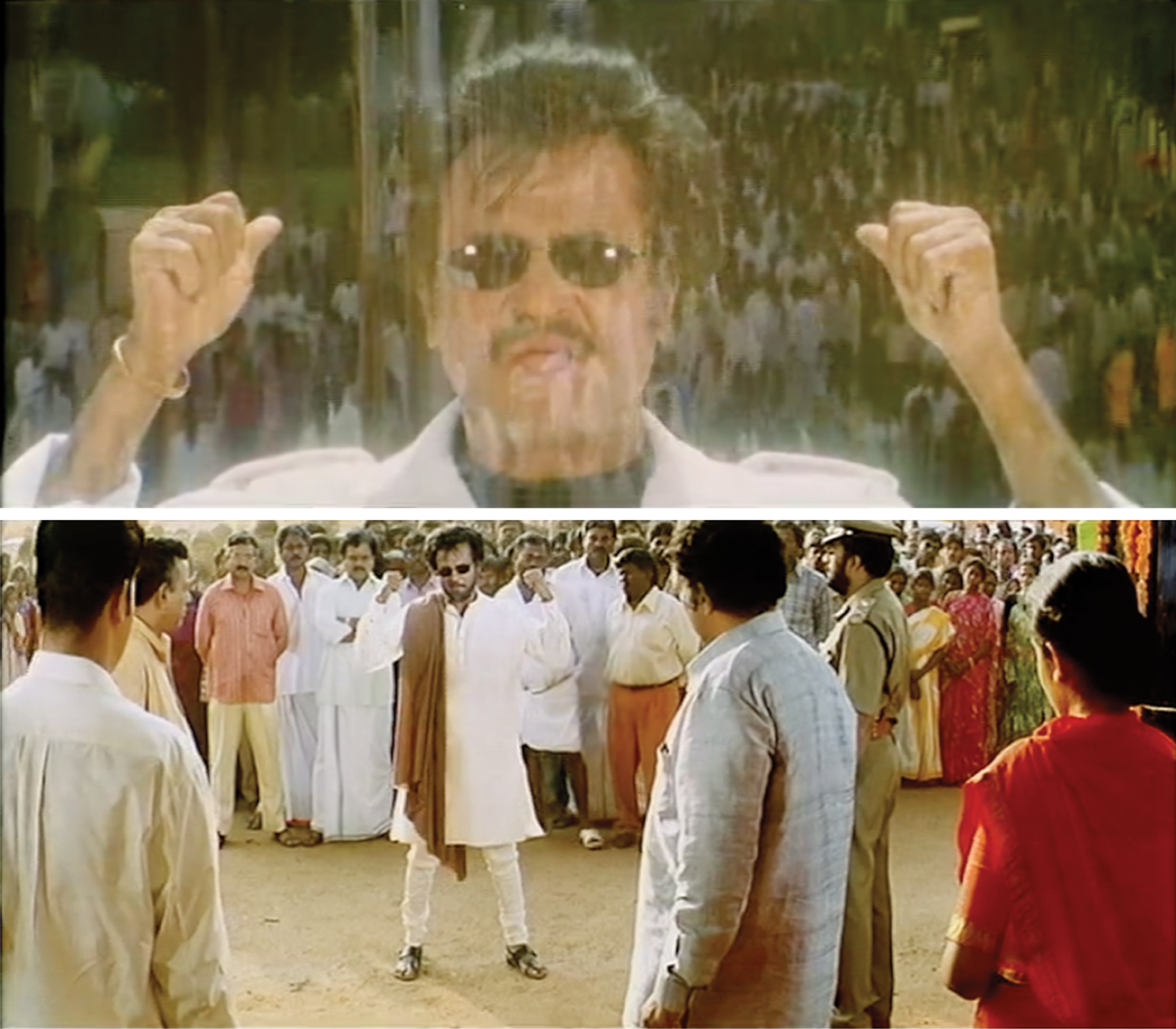
Providing the “trailer” for the film’s preclimax—itself a “trailer” for Rajini’s implied descent into offscreen electoral politics (i.e., the “main picture”; see fig. 15)—in the opening song of the film Rajini points at those who are behind, in, and all around his image. By gesturing behind himself while facing the camera, Rajini points at the people to whom he has given over his body and soul (recall the Tamil lyric from the song “En peru Padaiyappa” [fig. 13]: “Is it not right for me to sacrifice my body and soul to the cause of the Tamil language and people?”), that is, to the audience before him and at whom he gazes, who—both in this song and in the preclimax scene—are invited to join Rajini and become part of his spectral, yet substantial, being.
The audience, then, like Rajini, stands on both sides of the screen, in front and behind Rajini, even as he in turn encompasses them by standing between “the people” onscreen and the people/audience offscreen. This passing through and standing across the screen, as transduced through Rajini’s pointing fingers, is an incorporation into the mass hero’s body, a body politic that faces outward to and for us in the transformative mirror of the cinema. The indexical ground here isn’t of contiguity, but of entanglement, encompassment, incorporation. This follows from Rajini’s distinct form of being and presence, one curated on and across the diaphanous skins of the screen.
Conclusion
Indexicality is an ambivalent semiotic ground. As a “real connection” or an “existential relation” it traffics between immediacy and mediation. On the one hand, as a mode of representation, indexicality is a mediated and mediating semiotic relation, a Thirdness irreducible to any direct, unmediated contact. At the same time, as Peirce tells us, it presumes upon an immediated moment of co-presence, contiguity, causality, a Secondness that resists mediation. The indexical sign depends on, and is defined by, this Secondness. Hence it cannot be fully specified solely by appeal to transcontextual law (Thirdness) or essence (Firstness) but only ever relative to its particular contexts of use, that is, to other arrays of sign tokens that, in their indexical corelatedness, reflexively frame and determine the value/reference of such an indexical sign (if only for then, there, and them). But if indexicality sunders itself, displacing itself by being in the hands of and mediated by other signs and sign users, and if indexicality does so by ultimately falling back onto self-evident notions of existential connection and immediated copresence, then perhaps we can begin to understand its foundational, and perhaps paradoxical, ambivalence, for the irony of this semiotic relation itself points—this time from fingertip to wrist, to borrow a late Wittgensteinian trope (Reference Wittgenstein1958, §185; see Staten Reference Staten1984, 2; Engelmann Reference Engelmann2013)—to an implicit metaphysics of presence that it conserves and problematizes at once.
Willard Quine (Reference Quine1960, Reference Quine1969) long ago underscored this irony in his discussion of the “inscrutability of reference” (also see Jakobson Reference Jakobson, Lévi-Strauss, Jakobson, Voeglin and Sebeok1953, 21). Recall the problem of “undetached rabbit parts” and other ontological and epistemological perversions that he famously pointed out through his thought experiment of the anthropological linguist trying (and failing) to determine the referent of a “native’s” utterance of “Gavagai” while pointing to a white rabbit scurrying by—namely, that the indeterminacy of indexical acts makes any presumed existential relation problematic and yet also unable to be unappealed to. Immediacy must be mediated by some always potentially (and perhaps in principle) nonpresent set of relations and events (e.g., Quine’s “collateral knowledge” or “background language”; Silverstein’s [Reference Silverstein and Lucy1993, Reference Silverstein, Schieffelin, Woolard and Kroskrity1998b] “metapragmatics” or “ideology”; Leone and Parmentier’s [Reference Leone and Parmentier2014] “circle of semiosis”), and thus there is no existential relation except as achieved across signs/acts that are curiously absent from each other while made present and relevant to each other (Silverstein Reference Silverstein2005). If indexicality depends on a real connection, an existential relation, this reality, this existence is itself always underdetermined, not present to itself.
To say this, however, is to not to subscribe to familiar antirealist, constructionist stances about the nature of reality. Rather, it is to argue that the self-evidence of notions like “existential relation” and “presence” can and should be the site of ethnographically based and semiotically informed (i.e., pragmatically deconstructive) analysis, put to the grist of our semiotically realist mill. This both serves as a caution to our own uses of analytics like indexicality, as well as to point outward to the richness of the ethnographic worlds we study, to open up new vistas for the study and theorization of semiosis beyond those that our analytics may obscure from our vision and deaden to our touch. In this article, I have attempted to do this by unpacking the presence, indexicality, and performativity of Rajini’s finger. This gesturing finger cannot be reduced to any simple notion of copresence, contiguity, or causality. Emanating from his massive screen presence, and standing under a particular metapragmatics of presence (qua ontology of the image; cf. Bazin Reference Bazin and Gray[1967] 2004; Cavell Reference Cavell1979; Morgan Reference Morgan2006), this finger touches and punches, ascending to the heavens and (con)descending and returning to fix us as and at its tip. This is a finger that encompasses its object, a finger that is not simply represented on the screen but reaches through it, that presences itself and grabs and holds us. It does so through the camera, through the screen, and through Rajini’s filmic oeuvre, that dense poetic web of interdigitated references that builds up his mass within and across his films.
In short, Rajini’s finger forces a recognition that the very ground of indexicality always stands under some metapragmatics of being, a metafunctionality that mediates what and when an existential relation “is,” what it means and does to be and be present, and thus to see and sense, represent and act. To grasp this requires that we provide an ethnography of presence; in this case, detailing the linkages between historical and cultural modes of film spectatorship, (inter)textual and generic film forms, and ethnographies of “reception” and uptake as they conspire to underwrite the image-act onscreen. While these existential grounds are not particular to Tamil cinema (we find them wherever we look, point, and touch), they take reflexively elaborated, cinematic form in the image and body of Rajinikanth, institutionalized as a cine-political resource to the multiform projects that emanate from him, be they film production, fandom, or political mobilization.