





Sleep is a fundamental physiological necessity that substantially impacts cognitive function, emotional regulation, immune competence and metabolic homeostasis. Reference Nistor, Chang-Kit, Nicholson, Anderson and Stranges1,Reference Ma, Liang, Zheng, Shi, Zhong and Xie2 Inadequate or disrupted sleep is associated with marked impairments across multiple domains of health and functioning in ageing populations. Reference Zaidel, Musich, Karl, Kraemer and Yeh3 Globally, population ageing is accelerating at an unprecedented rate, with individuals aged ≥65 years projected to comprise 16% of the world’s population by 2050, compared with 10% in 2022. Reference Nations4 This demographic shift highlights the urgent need to investigate health challenges in later life, particularly in regions where epidemiological data on ageing-related conditions remain limited. Reference Khan, Addo and Findlay5 Although age-related changes in sleep architecture are normal, clinically significant sleep disturbances are characterised by daytime functional impairment and should not be confused with normal ageing, thereby warranting clinical attention. Reference McCarthy6 Sleep disorders are independently associated with increased mortality risk, cardiovascular morbidity, cognitive decline, reduced quality of life and higher fall risk in older adults. Reference McCarthy6,Reference Windred, Burns, Lane, Saxena, Rutter and Cain7 They are also highly prevalent, affecting 36–69% of older adults depending on diagnostic criteria and assessment methods. Reference Smagula, Stone, Fabio and Cauley8 Approximately 50% meet diagnostic criteria for clinically significant insomnia disorder, with symptomatic sleep disturbance being more common. Reference Brewster, Riegel and Gehrman9 This increased vulnerability reflects several ageing-related factors; these include altered circadian rhythms, chronic medical conditions, psychiatric comorbidities such as depression and anxiety, polypharmacy and neurobiological changes that affect sleep–wake regulation. Reference Zaidel, Musich, Karl, Kraemer and Yeh3,Reference Nakad, Booker, Gilbertson-White, Shaw, Chi and Herr10
Pain is a common problem in older adults, with chronic pain affecting a large proportion of this population. Reference Nakad, Booker, Gilbertson-White, Shaw, Chi and Herr10 It is closely linked to sleep disturbances, because these conditions share a bidirectional neurobiological relationship. Reference Goral, Lipsitz and Gross11 Chronic pain disrupts sleep continuity and quality through nociceptive activation and inflammatory pathways. In turn, sleep deprivation weakens descending pain inhibitory systems and promotes central sensitisation, thereby increasing pain perception and lowering pain threshold. Reference Kourbanova, Alexandre and Latremoliere12 This reciprocal relationship perpetuates both conditions and substantially reduces functional independence, psychological well-being and quality of life. Reference McCarthy6,Reference Chen, Lee, Schade, Saito, Chan and Buxton13
Mental health disturbances, particularly depression, anxiety and stress, are common comorbidities in older adults and often co-occur with sleep disorders and chronic pain. Reference Zaidel, Musich, Karl, Kraemer and Yeh3,Reference Goral, Lipsitz and Gross11 Depression shows a bidirectional relationship with sleep disturbance, because depressive symptoms are linked to both insomnia and hypersomnia whereas insomnia increases the risk of incident and recurrent depression (adjusted hazard ratio 2.27). Reference Zaidel, Musich, Karl, Kraemer and Yeh3 Anxiety disorders are also associated with difficulties in sleep initiation and maintenance. Reference Goral, Lipsitz and Gross11 In combination, sleep disorders, chronic pain and mental health disturbances create a cumulative burden that impairs functional independence, cognitive performance and social engagement and increases healthcare utilisation and costs. Reference Nistor, Chang-Kit, Nicholson, Anderson and Stranges1,Reference McCarthy6
Demographic and social factors consistently associated with sleep disturbance include older age, female gender, poor marital quality and low social engagement. Reference Smagula, Stone, Fabio and Cauley8 These factors may influence sleep through psychological stress, reduced physical activity, circadian disruption and hormonal pathways, although the mechanisms remain incompletely understood in older adults. Reference Rodrigues, Nicholson, Wilk, Guaiana, Stranges and Anderson14
Despite international consensus on the substantial health burden associated with sleep disorders, chronic pain and mental health disturbances among older adults, epidemiological research from the Middle East and North Africa region remains limited. In Jordan, existing studies have largely examined sleep problems, pain or mental health conditions independently or within specific clinical populations. Reference Hamdan Mansour, Shehadeh, Puskar, El-Hneiti and Haourani15,Reference Shehadeh, Malak and Ayed16 By comparison, evidence from neighbouring countries such as Saudi Arabia has begun to highlight important interrelationships among these conditions in older adults. For example, a cross-sectional study conducted among adults aged ≥65 years attending an ambulatory clinic in Riyadh reported a significant association between poor sleep quality and subjective memory complaints. Reference Alodhayani, Almofarej, Alotaibi, Alobaid, Alotaibi and Siddiqi17 The study also found that sleep quality interacted with age, gender and educational level, collectively contributing to variability in cognitive-related outcomes among older adults. Reference Alodhayani, Almofarej, Alotaibi, Alobaid, Alotaibi and Siddiqi17 However, similar integrated analyses examining the clustering and interplay of sleep disturbances, pain and mental health conditions in community-dwelling older adults remain scarce in Jordan and the broader region. Cultural norms related to symptom reporting, inequities in healthcare access, economic barriers to preventive care and features of the Jordanian healthcare system may further shape how these interrelated conditions present, and their overall burden. Reference Shehadeh, Malak and Ayed16 As a result, findings from Western populations may not be directly generalisable to Jordan and therefore rigorous studies in Jordanian older adults are needed to better characterise the disease burden, identify key risk factors and inform evidence-based interventions and policy recommendations.
This cross-sectional study thus focuses on community-dwelling older adults in Jordan to address these gaps in regional evidence. This study aims to investigate the prevalence of sleep disorders and their association with chronic pain and mental health symptoms (depression, anxiety, stress) among community-dwelling older adults in Jordan. We hypothesise that: (a) sleep disorders are highly prevalent in this population; (b) chronic pain severity is independently and significantly associated with greater sleep disturbance severity; and (c) depression, anxiety and stress symptoms are independently and significantly associated with sleep disturbance severity after controlling for demographic and health-related factors.
Method
Design and participants
This cross-sectional study was conducted in accordance with the Strengthening the Reporting of Observational Studies in Epidemiology guidelines. Reference von Elm, Altman, Egger, Pocock, Gøtzsche and Vandenbroucke18 Sample size was determined using G*power 3.1.9.7 software for Windows, considering an effect size of 0.15 and 15 potential predictors; a minimum sample of 123 participants was required to achieve 80% statistical power. Reference Faul, Erdfelder, Buchner and Lang19
Ethical standards
This study was approved by the Institutional Review Board (IRB) at the Jordan University of Science and Technology (approval no. 2023/868). All participants provided written informed consent prior to data collection. The study purpose and procedure were explained thoroughly to all potential participants before enrolment. Participant anonymity and data confidentiality were ensured. Each participant was assigned a unique identification code, and all data were stored securely with access restricted to the research team.
Inclusion and exclusion criteria
Participants eligible for inclusion were those aged ≥60 years and with preserved cognitive function, defined as a Mini-Mental State Examination score of >25. This threshold was used to ensure intact global cognition, and to minimise the potential influence of subtle cognitive impairment on self-reported and functional outcome measures. Participants were excluded if they had progressive medical conditions (e.g. malignancy); a history of continuous sleep medication use for at least 6 months; acute or unstable medical conditions such as cardiac, respiratory, gastrointestinal or renal disorders; or severe psychiatric illnesses. Detailed information about the study was provided to all participants, and written informed consent was obtained before enrolment.
Data collection
Eligible participants were identified by the research team through geriatric clinics and rehabilitation centres. Standardised recruitment procedures were applied across all sites, with no site-specific differences in strategy. Data collection was conducted between February and June 2025. Eligible participants were informed in detail about the study objectives and procedures before participation. Following informed consent, validated questionnaires assessing demographic and clinical characteristics were administered. All assessment tools were presented in a standardised manner to ensure consistency and reliability across participants. Testing sessions lasted approximately 20–30 min, allowing sufficient time to complete all measures comfortably. To maintain consistency and accuracy in data collection, a trained research assistant conducted the interviews by reading verbatim all questionnaire items and response options.
Assessment and outcome measures
This study employed a self-reported questionnaire that included the following components.
Demographic information
Including age in years, gender (male, female), educational levels, employment status (employed or retired) and marital status.
Lifestyle and health factors
Including smoking status, body mass index (BMI), number of comorbidities and number of medications used.
Sleep-specific measures
Pittsburgh Sleep Quality Index (PSQI; dependent variable): PSQI is a 19-item, self-administered questionnaire assessing sleep quality over the past month, generating a global score and 7 component scores (subjective sleep quality, sleep latency, sleep duration, sleep efficiency, sleep disturbance, use of sleeping medications and daytime dysfunction). Each component is scored from 0 to 3 with the global score ranging from 0 to 21, where higher scores indicate poorer sleep quality. A PSQI global score of >5 demonstrates 89.6% sensitivity and 86.5% specificity for distinguishing poor from good sleepers, and is the clinically established threshold in research and practice. Reference Mollayeva, Thurairajah, Burton, Mollayeva, Shapiro and Colantonio20
Insomnia Severity Index (ISI): an eight-item measure assessing insomnia symptom severity over the past 2 weeks, with higher scores indicating greater severity. Scores of 0–7 indicate no clinically significant insomnia, 8–14 indicate subthreshold insomnia, 15–21 indicate moderate clinical insomnia and 22–28 indicate severe clinical insomnia. ISI demonstrates excellent psychometric properties and is widely used in both clinical and research settings to evaluate insomnia severity and monitor treatment response. Reference Bastien, Vallières and Morin21
International Restless Legs Syndrome Severity Rating Scale (IRLS): a ten-item measure assessing restless legs syndrome symptoms severity over the past week, with higher scores indicating greater severity. Scores of 0–10 indicate mild, 11–20 moderate, 21–30 severe and 31–40 very severe symptoms. IRLS has been extensively validated, demonstrating strong reliability to change and discriminative validity in both clinical and research settings for quantification of sleep-related RLS symptom burden. Reference Bogan22
Epworth Sleepiness Scale (ESS): ESS is an eight-item, self-administered questionnaire designed to assess daytime sleepiness by measuring the likelihood of dozing off in a variety of everyday situations (e.g. sitting and reading, watching TV, riding as a passenger in a car). Each item is rated from 0 (would never doze) to 3 (high chance of dozing), resulting in a total score ranging from 0 to 24, with higher scores indicating greater subjective sleep propensity. A total score of 11 or higher is frequently used as the clinical threshold for identification of excessive daytime sleepiness, which may reflect underlying sleep disorders. Reference Johns23
Mental health symptoms
Depression Anxiety Stress Scale (DASS-21): DASS-21 is a 21-item, self-reported questionnaire designed to measure the severity of symptoms related to depression, anxiety and stress over the past week. It comprises three subscales, each containing seven items rated on a four-point Likert scale (0 (did not apply to me at all) to 3 (applied to me very much or most of the time)). Subscores are calculated by summing the scores for relevant items and multiplying by 2, yielding a final score ranging from 0 to 42 for each domain. Higher scores denote greater symptom severity. DASS-21 has demonstrated excellent internal consistency (Cronbach’s alpha ranging from 0.88 to 0.95 for the three subscales) and good construct validity in both clinical and general older adult populations. Reference Henry and Crawford24
Pain
Brief Pain Inventory (BPI) is a widely validated, self-reported questionnaire that assesses both the intensity of pain (pain severity) and the extent to which pain interferes with daily activities (pain interference). Pain severity is calculated as the mean of four 0–10 numeric rating scale items assessing worst, least, average and current pain over the past 24 h. Pain interference is calculated as the mean of seven 0–10 items assessing how pain affects general activity, mood, walking ability, normal work, relationship, sleep and enjoyment of life. Higher scores on either domain reflect greater pain severity or greater functional interference. BPI has demonstrated strong reliability and validity in diverse populations, including in older adults and those with chronic medical conditions. Reference Cleeland and Ryan25
Statistical analysis
Data analyses were performed using IBM SPSS Statistics, version 27 for Windows (IBM Corp., Armonk, New York, USA). Descriptive statistics were calculated for all study variables. Continuous data are presented as means and standard deviations; categorical variables are presented as frequencies and percentages.
The normality of continuous variables was assessed using the Shapiro–Wilk test and confirmed by visual inspection of histograms. Pearson correlation coefficients were used to examine the bivariate association between PSQI scores and potential predictor variables. Correlation strengths were interpreted as follows: 0.1 ≤ r < 0.3 indicates a weak association; 0.3 ≤ r < 0.5 represents a moderate association; and r ≥ 0.5 signifies a strong association.
Multiple linear regression analyses examined the association between independent variables and sleep quality (PSQI). Predictor selection was informed by prior literature and clinical relevance. Separate models were constructed for (a) demographics (age, gender, education, employment status, marital status); (b) lifestyle and health (including smoking status, BMI, medication count, comorbidity count); (c) sleep-specific measures (ISI, IRLS, ESS); (d) mental health (depression, anxiety, stress); and (e) pain (BPI severity and interference). All variables within each domain were entered simultaneously within respective models. A comprehensive model including all predictors from five domains was also tested to evaluate their combined association with sleep quality outcomes. Results are reported as unstandardised regression coefficients (B), standard errors (s.e.), standardised coefficients (β) and p-values. Model fit was described with R 2, adjusted R 2 and F-statistics. Statistical significance was set at p < 0.05. Multicollinearity was monitored using variance inflation factors (VIFs), with VIF values <2 considered acceptable, indicating no significant multicollinearity.
To enhance the robustness and reliability of our regression estimates, stratified bootstrap resampling with 1000 iterations was performed, incorporating gender and smoking status as stratification variables to preserve their respective subgroup proportion.
Results
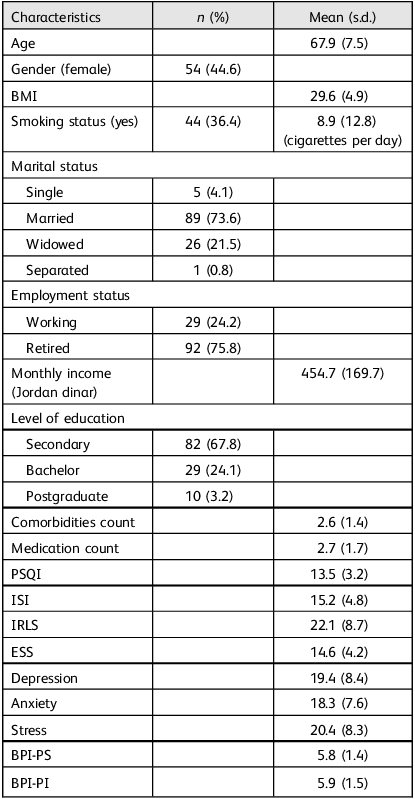
A total of 121 participants were included in the study. The mean age was 67.9 ± 7.5 years, and 44.6% were female. The average BMI was 29.6 ± 4.9 kg/m2. Smoking was prevalent, with 36.4% of participants identified as current smokers, consuming an average of 8.9 ± 12.8 cigarettes per day. Most participants were married (73.6%), and 21.5% were widowed. Regarding employment status, 75.8% were retired and the mean monthly income was 454.7 ± 169.7 Jordan dinar. With respect to educational attainment, 67.8% had completed secondary education and 24.1% held a bachelor’s degree. Participants reported an average of 2.6 ± 1.4 comorbid conditions and took an average of 2.7 ± 1.7 medications.
Sleep-related measures indicated overall poor sleep quality, with a mean PSQI score of 13.5 ± 3.2. Insomnia severity was moderate (ISI mean 15.2 ± 4.8). Restless legs syndrome symptoms were, on average, severe (IRLS mean 22.1 ± 8.7), and daytime sleepiness was high (ESS mean 14.6 ± 4.2). Depression, anxiety and stress subscale scores from DASS-21 indicated moderate severity (19.4 ± 8.4, 18.3 ± 7.6 and 20.4 ± 8.3, respectively). BPI scores showed moderate pain severity (5.8 ± 1.4) and pain interference (5.9 ± 1.5). Complete participant characteristics are provided in Table 1.
Participant characteristics (N = 121)

Table 1 Long description
The table presents participant characteristics for 121 individuals. It includes various demographic and health-related measures. The table has 21 rows and 3 columns. The columns are labeled Characteristics, n (%), and Mean (s.d.). The rows are grouped into categories such as Age, Gender, BMI, Smoking status, Marital status, Employment status, Monthly income, Level of education, Comorbidities count, Medication count, PSQI, ISI, IRLS, ESS, Depression, Anxiety, Stress, BPI-PS, and BPI-PI. Each row provides specific data for these characteristics. For example, the mean age is 67.9 with a standard deviation of 7.5. The percentage of females is 44.6 percent. The mean BMI is 29.6 with a standard deviation of 4.9. The percentage of smokers is 36.4 percent, with an average of 8.9 cigarettes per day. Marital status includes categories like Single, Married, Widowed, and Separated, with respective percentages. Employment status includes Working and Retired, with respective percentages. The mean monthly income is 454.7 Jordan dinar with a standard deviation of 169.7. Level of education includes Secondary, Bachelor, and Postgraduate, with respective percentages. The mean comorbidities count is 2.6 with a standard deviation of 1.4. The mean medication count is 2.7 with a standard deviation of 1.7. The mean PSQI score is 13.5 with a standard deviation of 3.2. The mean ISI score is 15.2 with a standard deviation of 4.8. The mean IRLS score is 22.1 with a standard deviation of 8.7. The mean ESS score is 14.6 with a standard deviation of 4.2. The mean depression score is 19.4 with a standard deviation of 8.4. The mean anxiety score is 18.3 with a standard deviation of 7.6. The mean stress score is 20.4 with a standard deviation of 8.3. The mean BPI-PS score is 5.8 with a standard deviation of 1.4. The mean BPI-PI score is 5.9 with a standard deviation of 1.5.
BMI, body mass index; PSQI, Pittsburgh Sleep Quality Index; ISI, Insomnia Severity Index; IRLS, International Restless Legs Syndrome Severity Rating Scale; ESS, Epworth Sleepiness Scale; BPI-PS, Brief Pain Inventory – pain severity; BPI-PI, Brief Pain Inventory – pain interference.
Association with sleep quality
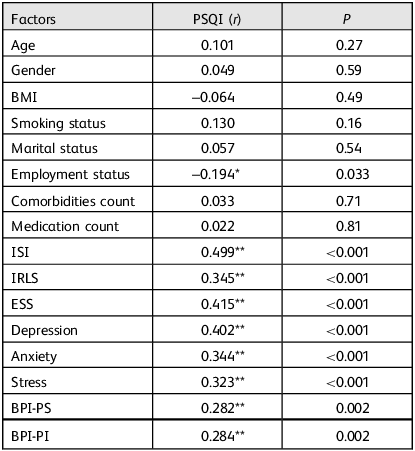
Correlation analysis was performed to identify factors associated with poor sleep quality (PSQI). There was a strong positive correlation between PSQI and insomnia severity (r = 0.499, p < 0.001). Restless legs syndrome symptoms (r = 0.345, p < 0.001) and daytime sleepiness (r = 0.415, p < 0.001) were moderately correlated with PSQI. Depression (r = 0.402), anxiety (r = 0.344) and stress (r = 0.323) also showed moderate positive correlations with PSQI (all p < 0.001). Pain severity and pain interference exhibited positive correlations with PSQI (r = 0.282 and 0.284, respectively, both p = 0.002). No significant correlation was observed for age, gender, BMI, comorbidities or medication count (Table 2).
Correlation summary of factors associated with poor sleep quality

Table 2 Long description
A table with 14 rows and 3 columns. The columns are labeled Factors, PSQI, and P. The table lists various factors and their correlation values with poor sleep quality (PSQI) and the corresponding p-values. Row 1: Age, 0.101, 0.27. Row 2: Gender, 0.049, 0.59. Row 3: BMI, -0.064, 0.49. Row 4: Smoking status, 0.130, 0.16. Row 5: Marital status, 0.057, 0.54. Row 6: Employment status, -0.194, 0.033. Row 7: Comorbidities count, 0.033, 0.71. Row 8: Medication count, 0.022, 0.81. Row 9: ISI, 0.499, <0.001. Row 10: IRLS, 0.345, <0.001. Row 11: ESS, 0.415, <0.001. Row 12: Depression, 0.402, <0.001. Row 13: Anxiety, 0.344, <0.001. Row 14: Stress, 0.323, <0.001. Row 15: BPI-PS, 0.282, 0.002. Row 16: BPI-PI, 0.284, 0.002.
PSQI, Pittsburgh Sleep Quality Index; BMI, body mass index; ISI, Insomnia Severity Index; IRLS, International Restless Legs Syndrome Severity Rating Scale; ESS, Epworth Sleepiness Scale; BPI-PS, Brief Pain Inventory – pain severity; BPI-PI, Brief Pain Inventory – pain interference.
*p < 0.05, **p < 0.001 (two-tailed).
Predictors of sleep quality
Multiple regression analysis was conducted to identify independent predictors of sleep quality.
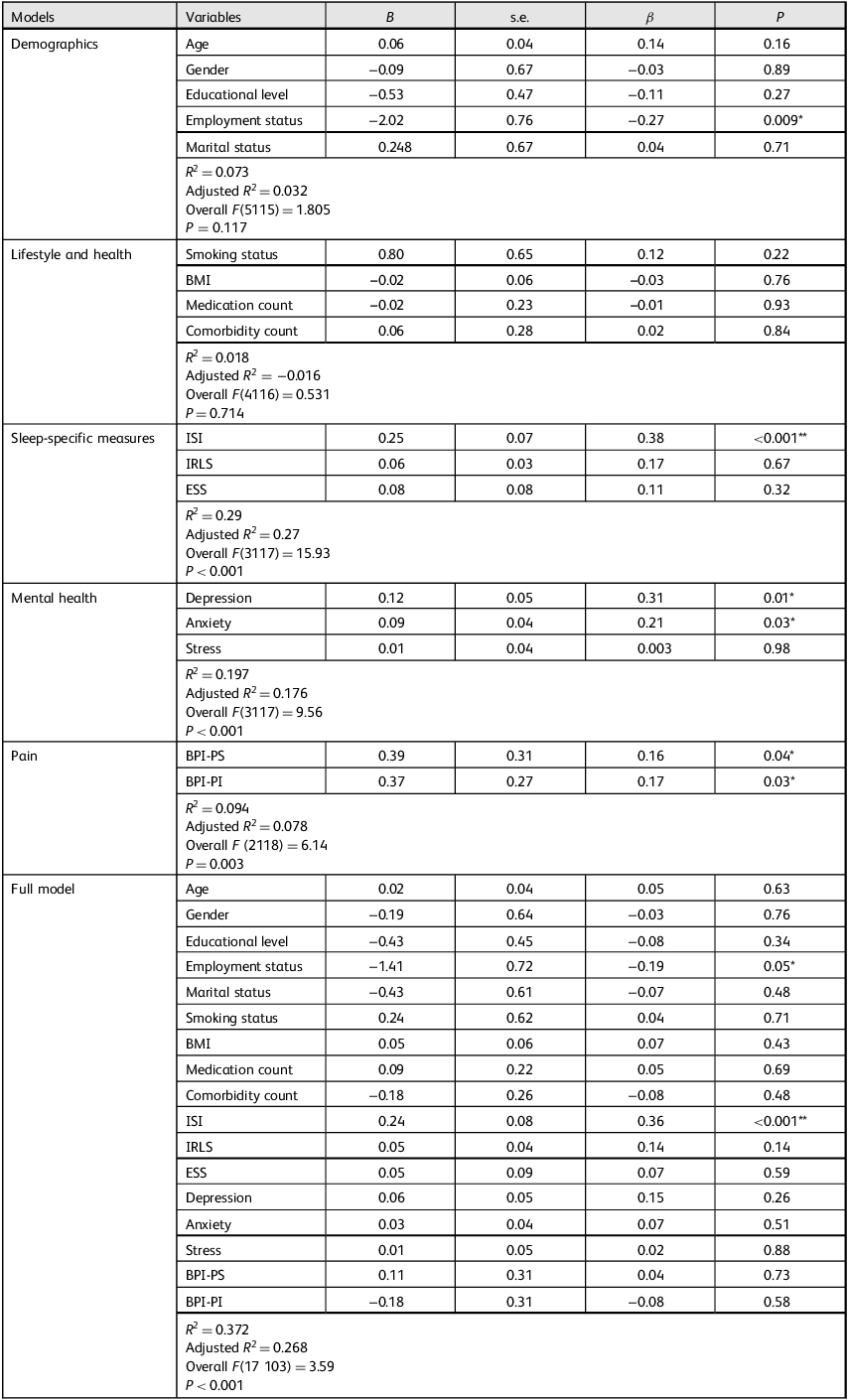
The demographic model, including age, gender, educational level, marital status and work status, did not significantly predict sleep quality (F [5, 115] = 1.805, adjusted R 2 = 0.032, p = 0.117). Within this model, retirement status was a significant independent predictor: retired participants had poorer sleep quality than employed participants (B [s.e.] = −2.02 [0.76], p = 0.009). Other demographic variables were not associated with PSQI.
The lifestyle and health model, which included smoking status, BMI, medication count and comorbidity count, did not significantly predict sleep quality (F [4, 116] = 0.531, adjusted R 2 = −0.016, p = 0.714), indicating no meaningful variance explained by the model.
The sleep-specific model accounts for the greatest proportion of variance in sleep quality (R 2 = 0.29, adjusted R 2 = 0.27). Insomnia severity demonstrated a significant positive association with poorer sleep quality (B [s.e.] = 0.25 [0.07], p < 0.001). Restless legs syndrome symptoms and daytime sleepiness were not significant predictors in the adjusted analysis.
The mental health model showed that depression and anxiety were associated with higher PSQI scores (B [s.e.] = 0.12 [0.05], p = 0.01) and (B [s.e.] = 0.09 [0.04], p = 0.03, respectively). Stress did not reach statistical significance. The model explained 19.7% of the variance in sleep quality (R 2 = 0.197, adjusted R 2 = 0.176).
Pain severity and pain interference (pain model) showed a significant association with increased PSQI scores. Higher pain severity is associated with increased PSQI scores (B [s.e.] = 0.39 [0.31], p = 0.04] and pain interference (B [s.e.] = 0.37 [0.27], p = 0.03). The model contributes 9.4% to the variance (R 2 = 0.094, adjusted R 2 = 0.078).
The full multivariable model, which incorporated demographic, lifestyle and health, sleep-specific, mental health and pain predictors, explained 37.2% of the variance in sleep quality (F [17, 103] = 3.59, adjusted R² = 0.268, p < 0.001). Insomnia severity remained the only strong and significant independent predictor (B [s.e.] = 0.24 [0.08], p < 0.001], with employment status (employed versus retired) showing a borderline association (B [s.e.] = −1.41 [0.72], p < 0.05). No other variables reached statistical significance in the full model (Table 3).
Summary of regression models for sleep quality

Table 3 Long description
The table presents a summary of regression models for sleep quality, focusing on different predictors. It has 23 rows and 6 columns. The columns are labeled as Models, Variables, B, s.e., Beta, and P. The table is divided into several sections: Demographics, Lifestyle and health, Sleep-specific measures, Mental health, Pain, and Full model. Each section lists specific variables along with their respective coefficients (B), standard errors (s.e.), beta values (Beta), and p-values (P). Notable trends include significant p-values for certain variables such as Employment status in the Demographics section, ISI in the Sleep-specific measures section, Depression and Anxiety in the Mental health section, and BPI-PS and BPI-PI in the Pain section. The Full model section integrates all predictors and shows the overall impact on sleep quality.
B, unstandardised coefficient; β, standardised coefficient; BMI, body mass index; ISI, Insomnia Severity Index; IRLS, International Restless Legs Syndrome Severity Rating Scale; ESS, Epworth Sleepiness Scale; BPI-PS, Brief Pain Inventory – pain severity; BPI-PI, Brief Pain Inventory – pain interference.
*p < 0.05, **p < 0.01 (N = 121).
Stratified bootstrap resampling (1000 iterations) confirmed the robustness of these results; confidence intervals were consistent with the conventional estimates (see Supplementary Table 1).
Discussion
This study comprehensively examined demographic, clinical, lifestyle, pain-related, sleep-specific and psychological correlates of sleep quality among community-dwelling older adults in Jordan, using the PSQI global score as the primary outcome. Correlation analyses showed that insomnia severity, restless legs syndrome symptoms and daytime sleepiness were significantly associated with poorer sleep quality; depression, anxiety, stress and pain interference were also significantly related to poorer sleep quality. By contrast, demographic, lifestyle and health-related factors did not show significant associations. Across the domain-specific regression models, insomnia severity emerged as the strongest predictor of poor sleep quality. Depression and anxiety were significant contributors within the mental health model, whereas pain severity and pain interference showed modest associations with sleep quality. Furthermore, the demographic and lifestyle/health models were not significant, except for an isolated association with retirement status.
In the full multivariable model that included all domains, insomnia severity remained the only independent predictor of sleep quality, with the effects of psychological symptoms, pain characteristics and daytime sleepiness not persisting following adjustment. These findings indicate that, although multiple variables correlate with sleep quality at the bivariate level, insomnia severity represents the primary independent determinant of sleep disturbance in this population. Other factors, including mood symptoms, pain and sociodemographic characteristics, may affect sleep quality indirectly, potentially through insomnia severity. This suggests that sleep quality is influenced more by modifiable sleep-specific factors than by demographic or general health characteristics.
The strong influence of insomnia severity on sleep quality observed in this study is consistent with previous findings. Insomnia is an independent and robust predictor of sleep outcomes, even after controlling for demographic, clinical, lifestyle and psychological variables. Reference Windred, Burns, Lane, Saxena, Rutter and Cain7,Reference Zhang, Zhu, Huang, Sang, Wang and Li26 Higher ISI scores were strongly associated with poorer sleep quality, consistent with earlier studies. Reference Glueck, Pluim McDowell, Quiroz, Cronin-Golomb and Duffy27,Reference Jesudoss, Rathinasamy Lazarus and Wahid28 By contrast, depressive and anxiety symptoms, stress and pain measures were associated with sleep quality in bivariate analyses but did not remain significant in the fully adjusted model. Previous literature suggests that insomnia symptoms may act as a key mechanistic pathway linking emotional distress, chronic pain and daytime dysfunction with adverse sleep outcomes. The effects of depression and anxiety are often mediated by insomnia severity. Reference Haidary, Arif, Hossaini, Madadi, Akbari and Rezayee29 Similarly, pain-related variables may influence sleep at the bivariate level, but their effects attenuate once insomnia is accounted for. Taken together, these findings position insomnia as a central mechanism through which psychological and pain-related factors influence sleep quality. From a clinical perspective, these findings highlight insomnia as an important target for assessment and intervention in community-dwelling older adults. Incorporating standardised measures of insomnia into routine care could help identify individuals at risk for persistent sleep difficulties and inform the development of targeted management strategies. However, given the observational nature of this study, further longitudinal and interventional research is needed to determine whether addressing insomnia leads to improvements in sleep health and related outcomes.
Insomnia severity emerged as the strongest and most consistent predictor of poor sleep quality, remaining significant in the fully adjusted model and underscoring its central role in sleep disturbance. Other factors, including restless legs syndrome symptoms, daytime sleepiness, mental health variables and pain, showed associations in univariate or domain-specific models but were attenuated following adjustment for insomnia severity. This pattern suggests that targeting insomnia may yield the greatest improvement in perceived sleep quality. Reference Scott, Webb, Martyn-St James, Rowse and Weich30 The borderline association between retirement status and poorer sleep suggests potential lifestyle or psychological influences that warrant further investigation, although this effect was not robust.
In this cohort, demographic variables, lifestyle factors, comorbidities and medication use were not independently associated with sleep quality in the fully adjusted model. This suggests that their effects may be indirect, potentially mediated through insomnia, psychological distress or pain rather than acting as direct determinants of sleep quality. Although BMI, comorbidity burden and medication count are often linked to sleep disruption, Reference Figorilli, Velluzzi and Redolfi31 these were not significant after adjusting for insomnia and mental health variables. This finding is consistent with evidence that general health and demographic factors act as distal contributors, whereas sleep-specific factors play a more proximal role in perceived sleep quality. Reference Muhammad, Pai, Ahire and Sharma32 Greater insomnia severity, reflected in higher ISI scores, remained independently associated with poorer sleep quality, reinforcing its central role in sustaining sleep disturbance. Reference Yi, Yang, Luo, Li, Kong and Cheng33
An additional finding was the borderline association between retirement status and poorer sleep quality. Prior work has reported mixed effects of employment and retirement on sleep. Reference Myllyntausta and Stenholm34,Reference van de Straat, Platts, Vahtera, Westerlund and Bracke35 Some studies suggest that retirement may disrupt sleep through changes in daily structure, social engagement or psychosocial stressors; Reference Rahmana, Widyasaria, Pranataa and Lina36 conversely, others indicate that retirement can improve sleep by reducing work-related stress and increasing flexibility for rest. Reference Litwiller, Snyder, Taylor and Steele37 In the present cohort, the association may reflect underlying lifestyle or psychosocial vulnerabilities; however, the effect was attenuated following adjustment. These findings suggest that retirement status may serve as a marker of vulnerability rather than a direct determinant of sleep quality. Overall, demographic and lifestyle factors appear secondary to core sleep-specific and psychological variables such as insomnia symptoms and mental health burden. Future research should further examine whether retirement has independent effects on sleep quality beyond its associations with insomnia and related disturbances. This could be achieved by including measures of daily activity, social engagement and psychological stress. Such approaches may help identify potential confounders and inform tailored interventions.
This study also demonstrated a significant positive association between daytime sleepiness and poorer sleep quality. This finding is consistent with evidence from low- and middle-income countries, including one study from India, which reported that excessive daytime sleepiness is more likely to be a manifestation of underlying sleep disturbances rather than a primary cause of impaired sleep. Reference Maithani, Prabhu and Pant38 Similarly, evidence from Saudi Arabia has shown that sleep quality is significantly associated with related cognitive and functional outcomes, further supporting the role of disturbed sleep as a key driver of daytime impairment in older adults. Reference Alodhayani, Almofarej, Alotaibi, Alobaid, Alotaibi and Siddiqi17 Repeated findings link daytime sleepiness with poorer sleep and functional impairments, including reduced cognitive performance and altered mood. These results highlight its value as a clinical indicator of disrupted sleep processes rather than an independent determinant of sleep quality. Reference Temporini, Bottignole, Balella, Ughetti, Pollara and Soglia39 Within this framework, daytime sleepiness may be best interpreted as a consequence or marker of underlying sleep dysfunction. This further reinforces the central role of insomnia and other sleep-specific disturbances as key intervention targets.
Age, gender, comorbidity burden and medication count were associated with poorer sleep quality in some univariate or domain-specific analyses, but lost significance in the full multivariable model. The observed pattern suggests that the effects of these variables are mediated primarily by sleep-specific and psychosocial factors, including insomnia severity, depression, anxiety and pain. Previous studies have similarly identified these factors as major contributors to sleep quality. Reference Gu, Sautter, Pipkin and Zeng40 In contrast, demographic characteristics and general health measures appear to have a weaker influence once core sleep-related factors are considered. Collectively, these results highlight the importance of targeting modifiable sleep-specific and psychological factors to improve sleep quality in community-dwelling older adults. Such an approach may also enhance associated functional outcomes. By contrast, relying solely on demographic or static health characteristics may be less effective.
Strengths and limitations
This study has several strengths. The use of validated sleep measures, including PSQI and ISI, enabled a comprehensive assessment of both global sleep quality and insomnia severity, and the inclusion of a broad set of demographic, lifestyle, clinical, mental health and pain-related variables allowed a multidimensional evaluation of contributors to poor sleep. The relatively large and diverse sample of community-dwelling older adults enhances the generalisability of findings within the Jordanian context.
However, several limitations must be considered. The cross-sectional design precludes causal inferences and prevents assessment of changes in sleep quality over time, underscoring the need for longitudinal studies to clarify the causal pathway between insomnia, pain and mental health. All measures of sleep and symptoms were self-reported and may be subject to reporting bias, and no objective assessment, such as actigraphy or polysomnography, was included. Although a wide range of potential predictors were examined, unmeasured factors, including detailed lifestyle routine, social engagement and specific comorbidity subtypes, may influence sleep quality and should be addressed in future research. One further methodological limitation relates to the use of assessment instruments with different recall periods, including 1-month PSQI, 2-week ISI, 24 h BPI and ESS general tendency. This heterogeneity in recall timeframes may affect the comparability between constructs and should be considered when interpreting the relationships among sleep quality, insomnia severity, daytime sleepiness and pain outcomes. Although an a priori power analysis indicated that a minimum of 123 participants was required to achieve 80% statistical power, the final analysed sample consisted of 121 participants. This slight shortfall may have marginally reduced the statistical power of the study and should be considered when interpreting the findings.
Conclusion
The findings of this study have important clinical implications for managing poor sleep quality in community-dwelling older adults. Insomnia severity emerged as the central and modifiable determinant of sleep quality, whereas demographic and general health characteristics played a secondary or indirect role. Clinical assessment of sleep in community-dwelling older adults should therefore prioritise systemic evaluation of insomnia symptoms while also screening for co-occurring mental health problems and pain that may exacerbate or maintain sleep disturbance. Targeting these modifiable contributors through evidence-based interventions is likely to provide the greatest benefits for improving sleep quality, daytime functioning and overall well-being in this population.
Supplementary material
The supplementary material is available online at https://doi.org/10.1192/bji.2026.10127
Data availability
The data that support the findings of this study are publicly available from the first author (M.A.-W.) upon reasonable request.
Acknowledgements
The authors thank the Deanship of Research and Graduate Studies, Jordan University of Science and Technology, and all older adults who generously contributed their time to this study.
Author contributions
All authors meet the International Committee of Medical Journal Editors criteria for authorship. M.A.-W. and H.A. conceptualised the study. M.A.-W., N.A.A.-T. and H.A. contributed to the study design and data collection. M.A.-W. and H.A. performed the data analysis and interpretation. All authors contributed to the interpretation of findings and critically revised the manuscript. M.A.-W. drafted the manuscript, and all authors critically reviewed, revised and approved the final version.
Funding
This research did not receive any specific grant from funding agencies in the public, commercial or non-profit sectors.
Declaration of interest
None.
Ethical standards
This study was approved by the IRB at the Jordan University of Science and Technology (approval no. 2023/868). Written informed consent was obtained from all participants prior to inclusion in the study. All procedures were conducted in accordance with the ethical standards of the institutional and national research committees, and with the Declaration of Helsinki (1975, as revised in 2013).
Transparency declaration
The lead author (M.A.-W.) affirms that this manuscript is an honest, accurate and transparent account of the study being reported; that no important aspects of the study have been omitted; and that any discrepancies from the study as planned have been explained.
Analytic code availability
The analytic code used to generate the results of this study is available from the corresponding author (M.A.-W.) upon reasonable request.


 Open access


eLetters
No eLetters have been published for this article.