Introduction
In 2007 to 2008, just after the beginning of this millennium, the world had to face a deep economic crisis that started in the United States and, like an epidemic, rapidly involved Europe and other major countries since 2008.
The main and immediate effect of the related recession, still unresolved especially in several weak economies, was the increased rate of unemployment, that became particularly impressive among young people everywhere except Germany,1 but that reached dramatic peaks even in middle-aged subjects. However, even those individuals who did not lose their job had to cope with unavoidable reorganization in different sectors leading to more difficult contexts, characterized by enhanced workload and more competition, coupled to reduced rest and holidays. The opposite effect also occurred for other reorganization strategies and outsourcing, so that the maintenance of the work was assured, but sometimes in a lower position, with a cut of work time and consequent reduction of salaries. Obviously, there was a significant loss of income for families especially belonging to the middle class or with one salary: in many cases, such individuals suddenly realized that they had become poor. Again, for the first time in Europe, a traditionally protected category, such as that of the public workers, lost some securities and benefits, and the latest employers had to accept short-time contracts.Reference Benach, Vives and Amable2 All these factors together had and have a great impact on mental health worldwide.Reference Giorgi, Arcangeli and Mucci3 A series of studies in some European countries, particularly vulnerable to recession effects, such as Greece, Spain, Italy, and Northern Ireland, reported increased rates of work-related stress and of mental disorders,Reference Giorgi, Arcangeli and Mucci3–Reference Cordoba-Dona, San Sebastian and Escolar-Pujolar7 but the same phenomenon was spread in all major economies including the United States.Reference Forbes and Krueger8, Reference Ayers, Althouse and Allem9 In any case, the pre-existing economic conditions and the impact of the crisis on these countries are very heterogeneous, so that these findings, that in any case are intriguing, have been questioned.Reference Buffel, Dereuddre and Bracke10 Indeed, these authors, after carefully analysing data from different nations, on one side corroborated existing findings, and, on the other, provided more characteristics and specifiers, as well as highlighted the limitations of the reviewed studies.Reference Buffel, Dereuddre and Bracke10
There is a general agreement that unemployment is related to increased mental health problems, mainly depression, while promoting a diffuse sense of insecurity, helplessness, and hopelessness for the future.Reference Janlert and Hammarström11, Reference Blomqvist, Burström and Backhans12 Not surprisingly, unemployment has also been related to significant increase in suicide rate in EuropeReference Cooper13 and in the United States.Reference Chang, Stuckler and Yip14 Unfortunately, the mental health services worldwide resulted inadequate and somewhat incompetent to understand and to manage the diffuse problems related to economic crisis. This was also amplified by the reduced individual resources and the difficulty to seek for specialized treatment, as well as by the decreased public investments in those countries with social health policies. In some Italian regions, the depression and increased numbers of suicides among business persons were considered a real emergency. Such situation led to the creation of dedicated telephone numbers and/or listening centers by private or charity associations, mainly held by volunteers, often with no psychological background. Both unemployment and funding cuts in healthcare can be detrimental to mental health, and may lead to an increase in deaths due to alcohol abuse and suicide. In Italy, the “National Plan for prevention 2010-2012” put the suicide prevention among the main plans in its agenda. Similarly, in the European Pact for Mental Health and Wellbeing, the European Commission identified “depression and suicide prevention” as one of the five prior topics.Reference de Belvis AG, Ferre and Specchia15 However, the still existing social stigma about mental disorders prevented several individuals to contact psychiatric services with detrimental consequences.Reference Calear, Batterham and Christensen16–Reference Cagney19 If it is true that the worst year was 2009, the economic crisis is still ongoing and the positive signals of recovery are very limited. No prediction can be done on how long it lasts or when it goes to an end. Indeed, in our country, according to a document of ECOFIN of July 2019,20 the economic outlook for 2020 has been predicted as negative and latest EUROSTAT data certify that the poverty is still increasing in 2019.21
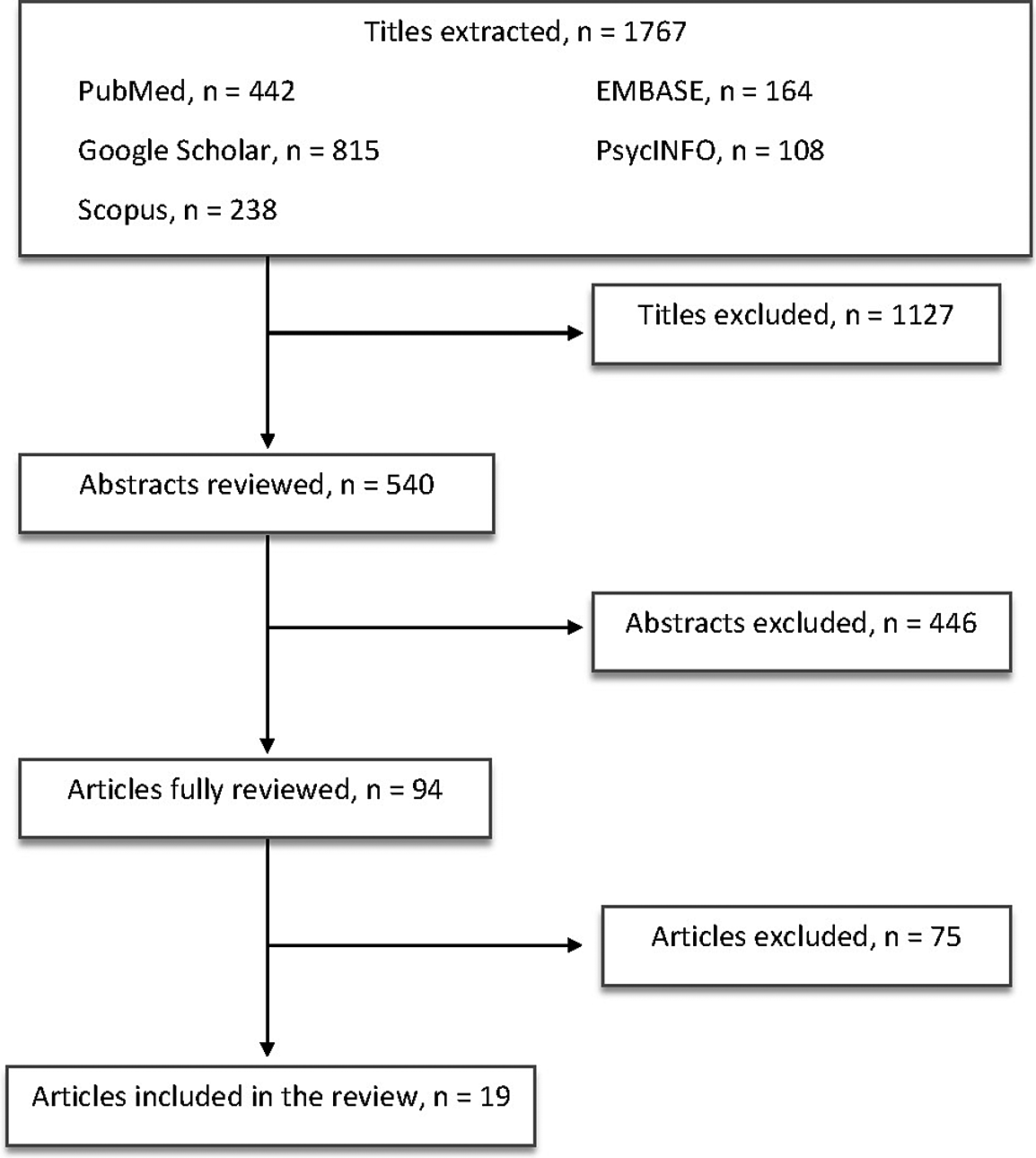
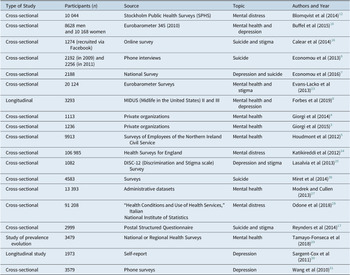
Therefore, the aim of this paper was to review and discuss the literature exploring the link between the economic crisis that began in 2007 to 2008, and the potential effects on people’s mental health, giving a particular focus on depression and suicide. A brief commentary including some suggestions of possible strategies to manage these conditions, from the psychological/psychiatric point of view is also presented. According to the PRISMA guidelines,Reference Moher, Liberati and Tetzlaff22 the databases of PubMed, Scopus, Embase, PsycINFO, and Google Scholar were accessed in order to research and collect articles that were published only in English language. Free text terms and MeSH headings were combined as it follows: “(economic crisis OR financial crisis OR crisis OR recession) AND (work-related stress OR stress OR mental health OR suicidality OR depression).” All the authors agreed to include in the review conference abstracts, posters, and case reports if published in indexed journals. The following inclusion criteria were adopted: studies carried out in clinical sample of adults; reliable diagnosis of psychiatric disorders according to structured interviews and standardized criteria; and reliable assessment of outcome measures. All the authors equally contributed in identifying potential information specific to this topic among the titles and abstracts of the publications. The first selection excluded 1127 titles because: (a) duplicates; (b) not concerning the scope of the paper; and (c) not informative enough. Furthermore, all papers with a publication date prior to 2010 were excluded by taking in account that the year 2008 has been repeatedly referred to as the year of the beginning of the economic crisis (albeit different scholars report the first signs of recession in 2007). The second selection excluded 446 abstracts after being read and reviewed, as the information reported did not fulfill the scope of our paper and/or the presented information did not seem relevant to the discussed topic. Subsequently, 75 more publications were excluded after being completely read and evaluated, as they did not provide enough information and/or resulted sufficiently in line with our review. Finally, 19 papers from countries representing all continents except Africa were included in the present review (Figure 1). The search was last updated in September 2019 (Table 1).
Article selection flow chart.

Summary of the Studies Included in the Review.

Body
Mental health and economic crisis
Growing evidence suggests that economic factors influence mental wellbeing,Reference Bartley32 indeed, after the economic crisis started in 2008, a rise in poor mental health was observed worldwide in different countries.Reference Odone, Landriscina and Amerio28, Reference Tamayo-Fonseca, Nolasco and Moncho29
It is still unclear to fully understand the impact of unemployment, as its prevalence is heterogeneous in different countries, largely depending on global level of wealth and its distribution, welfare measures, as well as on the economic cycle. However, it is generally believed that unemployment could be regarded as a primary factor influencing mental health status, being often correlated with a worsening in mental health conditions, with men being more affected than women, in spite these last are more at risk for mental disorders (17% vs 4%, in Italy; 5.3% vs 0.2% in England).Reference Katikireddi, Niedzwiedz and Popham24, Reference Odone, Landriscina and Amerio28
In the United Kingdom, a rise in poor mental health status was observed in the postcrisis period (25.7% vs 29.5%, respectively), regardless of regions, social class, and occupational class.Reference Astell-Burt and Feng33 An American study analyzed work stress among people in firms that underwent downsizing, by using work stress questions given to over 14 000 employees from 2008 to 2012. The results showed that, after 2009, workers of sites with major layoffs presented more stress than those of plants without the same high layoffs. In 2010, workers of firms with high layoffs found their works to be more stressful than workers at nonhigh layoff sites, and this result was also replicated in 2011 and 2012.Reference Modrek and Cullen27
Different factors, besides unemployment, include low household income, work-related features, and poor social support.Reference Katikireddi, Niedzwiedz and Popham24, Reference Tamayo-Fonseca, Nolasco and Moncho29, Reference De Moortel, Vandenheede and Vanroelen34 With regard to working conditions, being the main contributory earners, low household income, lack of participation and representation, and part-time (voluntary or not) work are all factors related to poor mental outcomes. No impact on mental wellbeing appeared to exist for unemployment duration, while receiving benefits were protective for mental distress with no gender differences.Reference Paul and Moser35 As for marital status, single, especially if unemployed, men tended to exhibit a poor mental wellbeing.Reference Paul and Moser35
As far as welfare measures are concerned, no differences between unemployed receiving benefits and employed were reported in women, while men seemed to be more vulnerable than their female counterparts when unemployed and did not receive any economic support. In particular, men manual workers showed higher risk of poor mental health than those in nonmanual group (adjusted odds ratio [OR] = 6.56 vs adjusted OR = 2.88, respectively).Reference Paul and Moser35 According to a meta-analysis, unemployment seems to play a significant role in determining mental distress with losing job being associated with an increased level of poor mental health, and finding a new job after being fired reducing mental distress.Reference Paul and Moser35 In any case, the effect of unemployment varies depending on the economic context, being boosted in countries with a low gross domestic product (GDP) per capita and vice versa, being high economic development a protective factor. Similarly, the unemployment protection seems also important in preventing the negative consequences on mental health with significant differences between countries with low and high specific measures.Reference Paul and Moser35
Different economic factors related to the quality of work were also associated with a reduced mental wellbeing. In particular, low household income, irregular working hours, and lack of representation and participation were significantly associated with poor mental health in European populations, while part-time employment (voluntary or involuntary) impacts on mental wellbeing in women but not in men.
An American study investigated the link between economic contraction and mental health (such as mood and anxiety disorders) through an Internet query-based surveillance about psychological distress (PD), which may be influenced by the changes in economic trends. Data were downloaded on a monthly basis (2004-2010) from “Google Insights for Search” and were validated with “Google Awards.” Not surprisingly, a PD-query increase occurred at the end of 2008, and decreased in parallel with the economic stabilization, although remained 20% higher than prerecession trend.Reference Ayers, Althouse and Allem9
In 2011, Dunlop and Mletzko predicted that, in the near future, men would have been the most affected by the changes set by the economic crisis in the Western countries. According to them, this could have been explained, among other intuitive work factors, by the role shifting between men and women that would have led to a turn in the self-perception and identity. Men, forced to stay at home due to job loss and variations in the socio-economic environment, find themselves playing a feminine role (housekeeping and raising children), and are therefore subjected to psychological, physical, and hormonal changes that could result in the onset of mood disorders.Reference Dunlop and Mletzko36 This represents (and will likely represent in the years to come) a breaking point with the past, since the epidemiology of the last decades reports that women are twice as likely to suffer from major depression (MD) at some point in their lives, as compared with men.Reference Piccinelli and Wilkinson37
It is noteworthy that the rate of unemployment was more marked in workers already suffering from mental disorders in the years 2006 to 2010, while increasing from 13.7% to 21.7%, as shown by a study analysis data collected from 27 countries in the Eurobarometer survey.Reference Evans-Lacko, Knapp and McCrone23 This suggests that times of recession provoke severe consequences in more vulnerable individuals, such as those with pre-existing mental health problems.
Depression
The connection between the economic crisis and mood disorders has been deeply investigated in different countries, so that the relationship between the so-called “great recession” and depression is supported by a consistent literature.
A large amount of studies focused primarily in those countries most affected by the world crisis, such as Spain and Greece, where the population has been hit the most by financial difficulties. However, it should be underlined that even stronger economies and countries like the United States and the United Kingdom were not immune to the mental outcomes, such as crisis-induced depressive symptoms or full depression.
In Greece, a significant correlation was observed between financial hardship as measured by the Index of Personal Economic Distress (IPED), and an increased risk of developing a MD episode, being unemployed subjects more affected than economically active and inactive individuals.Reference Economou, Angelopoulos and Peppou38 Another Greek study conducted on a representative sample, randomly selected and phone interviewed (n = 2188), found that financial difficulties increased the risk of developing MD (OR = 1.16), while a high income is a protective factor (OR = 0.37), although this effect was more evident in men compared with women. Specifically, it showed a significant increase in the 1-month prevalence of MD from the outset of the crisis to 2016 (3.3% vs 12.3% in 2016, respectively).Reference Economou, Peppou and Souliotis39
In Spain, the prevalence of depressive disorder has raised significantly in the years 2006 to 2010 (major depressive disorder (MDD), 19.4%; dysthymia, 10.8%; p < .0001) with men experiencing a higher relative increase in MD episode and dysthymia, as compared with women.Reference Gili, Garcia Campayo and Roca40 In addition, there was an overall increase of other mental disorders, such as GAD (8.4%), claustrophobia (6.4%), alcohol abuse (2.4%), and use disorder (4.6%). Globally, mental disorders increased by 21% in men and slightly more in women (21.7%) with some gender differences, being dysthymia more frequent in women compared with men, while alcohol-related disorders were more common among men. Simultaneously, the antidepressants (ADs) use increased proportionally.Reference Gili, Garcia Campayo and Roca40
In Portugal, the rate of hospitalization for MD went up between 2008 and 2013 (25.60 vs 26.17 per 100 000 inhabitants, respectively). In particular, although women between 35 and 54 years of age showed a higher global frequency of hospitalization compared with men, the latter experienced a higher increase in hospitalization rate due to MD. However, regional differences were reported, being less urbanized, low-density population areas the most affected by the crisis.Reference Rodrigues and Nunes41
A study conducted on 3579 workers in Alberta (Canada) by means of a phone survey on the prevalence of MDD revealed a rise from 5.1% in January 2008 to 7.6% in October 2009. Even dysthymia showed a significant increase from 0.4 % to 1.5 %. The authors suggested that the rise of the two disorders might be due to increased layoff in the country that had begun in 2008. The increase in mood and anxiety disorders was more consistent in married people and in workers in a common-law relationship. In times of uncertainty, these categories felt the weight of the responsibility of providing support to their family, and experimented more fear of losing job.Reference Wang, Smailes, Sareen, Fick, Schmitz and Patten31
Similarly, an Australian longitudinal study conducted on 1973 older adults, by means of a latent difference score models, showed an increase in depression and anxiety, measured by Goldberg Depression and Anxiety scale, between 2005 to 2006 and 2009 to 2010, as a result of the economic slowdown.Reference Sargent-Cox, Butterworth and Anstey30
Taken together, these studies support the notion that depression is a common consequence of the recent economic crisis that is present in all examined countries and should be promptly recognized and treated not to worsen the already-existing discomfort and suffering of affected individuals. Interestingly, an international survey shows how depression represents “a barrier to social participation… and integration.”Reference Lasalvia, Zoppei and Van Bortel25 Obviously, this becomes worse in time of economic crisis.Reference Evans-Lacko, Knapp and McCrone23
Suicide
The relation between economic crisis and suicidality is complex and, so far, controversial. While some studies reported increased suicide rates during recession periods, other failed to replicate them.Reference Miret, Caballero and Huerta-Ramirez26, Reference Mattei, Ferrari, Pingani and Rigatelli42–Reference Basta, Vgontzas and Kastanaki45
A comprehensive study investigated suicide trends at a global level for the years 2000 to 2007 and for the year 2009, collecting data from 27 European and 27 non-European countries (these latter included 18 American, 8 Asian countries, and 1 African country).Reference Chang, Stuckler and Yip14 An increase in suicide rate was noted after 2008 especially in men in the United States and in countries with higher levels of job loss. This analysis is likely to represent an underestimation, as it did not collect data from Italy and Australia, which are two of the countries most affected by the crisis. The authors underlined that their study observed only the actual committed suicides, but that there is a submerged and much bigger part of failed suicide attempts and suicidal thoughts.Reference Chang, Stuckler and Yip14
Baumbach and GulisReference Baumbach and Gulis46 drawing data from the EUROSTAT database relatively to the years 2007 to 2010, observed an increasing in suicide mortality in Germany, Poland, Czech Republic, Slovakia, and Portugal. The positive correlation between unemployment and suicide mortality was stronger in those countries where the social spending was low, which emphasizes the double-bond relationship between psychological and social factors.
According to data of the Spanish Statistical Office, suicide mortality rate increased significantly after economic crisis, particularly in 2011 and 2014. A significant association emerged between unemployment, per capita GDP, and suicidalityReference Alvarez-Galvez, Salinas-Perez and Rodero-Cosano47; however, other Spanish studies did not confirm these findings.Reference Miret, Caballero and Huerta-Ramirez26, Reference Borrell, Marí-Dell’Olmo and Gotsens48
A Greek research based on phone interviews, conducted between 2009 and 2011 on 2192 subjects aged 18 to 69 years, reported a significant increase in last-month suicidal ideation (6.7% vs 5.2%). In particular, suicidality increased in married men, aged 55 to 64 years, and in those treated with psychotropic drugs.Reference Economou, Madianos and Peppou6 However, the same authors also reported an inverse trend in a more recent study with suicidal ideation rate decreasing to 2.8% in 2013.Reference Economou, Angelopoulos and Peppou38 A subsequent research reported an increase in suicide attempts (with a peak in 2012), being the most utilized suicide attempt method medication overdose (74.4%) with a significant association with unemployment rates.Reference Benioudakis, Lykiardopoulos and Georgiou49 Interestingly, a relationship was described between suicide rates and type occupation between 2000 and 2013 with clerks showing the higher increase.Reference Alexopoulos, Kavalidou and Messolora50 Income turns out to impact on suicide rates, even adjusting for confounding factors, in men but not in women.Reference Economou, Peppou and Souliotis39 Data from the Athens Department of Forensic Medicine, retrieved between 2008 and 2012, highlighted how seasonality played a significant role on suicide rates during the crisis with peaks in May and June.Reference Christodoulou, Efstathiou and Michopoulos51
Interestingly, a review of all suicide cases in the island of Crete (the largest island of Greece with the highest suicide mortality rates) between 1999 and 2013 reported no significant increase in suicides during the considered period, while suggesting a significant role of sociocultural factors, family ties, opportunity to emigrate, gun ownership, different expectations depending on one’s age and gender. Finally, the bigger increase in suicides was registered in Eastern Crete, suggesting the impact of the lack of mental health services in that region.Reference Basta, Vgontzas and Kastanaki45
In the United Kingdom, a study reported an increase in suicides, especially among men, in the years following the beginning of the economic crisis. The increase in suicides affected the regions characterized by the biggest rises in unemployment.Reference Barr, Taylor-Robinson and Scott-Samuel52 In this period, each annual 10% increase in the number of unemployed men was associated with 1.4% increase in the number of male suicides.Reference Barr, Taylor-Robinson and Scott-Samuel52
In the United States, increased suicidal rates were reported after economic crisis. A study on data collected from different databases, reported a significant association between total foreclosure rate and suicide rates. In line with other findings, the middle-aged group (46-64 years) are the most affected.Reference Houle and Light53
By contrast, no increase in suicide attempts rates was found in a study carried out in Iceland, on the basis of data retrieved from the National University Hospital in Reykjavik, although this country was strongly and negatively affected by the economic crisis.Reference Asgeirsdottir, Asgeirsdottir and Nyberg43
With regard to Asian countries, a South Korean time-series, conducted between 2003 and 2011 on data retrieved from the National Statistical Office of Korea revealed a global increase in suicide rate among working-age adult population, particularly, manager and unemployed women.Reference Chan, Caine and You54
An Italian analysis of data from the Institute of Forensic Medicine of Milan (Northern Italy), reported neither significant increase in suicide rate before (2002-2007) and after (2008-2013) the economic crisis, nor any association between employment status and suicide risk.Reference Merzagora, Mugellini and Amadasi44 Other data taken into account the years 2000 to 2010 showed that the overall number of suicides remained stable, but there was an increase in suicides due to financial causes, especially among men mainly from the North-East part of the country, who had huge losses of money. It is interesting to note that, during the crisis, the use of ADs increased.Reference Mattei, Ferrari, Pingani and Rigatelli42
In conclusion, the available data indicate that economic crisis may increase the rate of suicides particularly among men and in those countries with less protective and personal supports.
Future perspectives
The economic recession of the last 10 years provoked and still provokes detrimental effects on mental health across several countries worldwide, mainly in Europe, but also in the United States, Australia, and different Asiatic nations. It is evident that the combination of job loss, individual fragility boosted by social insecurity, stress and weak or no health policies produce a negative impact on subjective sense of wellbeing, and a deterioration of mental health. The increased numbers of unemployment and poverty represent a real challenge not only to socio-political domains, but also to psychiatry, given the related raise in depression and suicides.
Therefore, as psychiatrists dealing with and taking care of persons in their broader sense, that is to say while considering their interactions with the environment, we have the duty to propose some possible interventions.
After reviewing the literature, we cannot neglect the obvious heterogeneity of the specific situations in different countries and even in regions within nations, as well as the cultural factors influencing subjective and public behaviors and outcomes. In any case, some general proposals can be drawn herein.
• It is evident that governments should set up and implement specific programs to reduce the social impact of unemployment through both potentiating or tailoring existing protection measures, and assisting people in finding a new job. Focused measures, such as the unemployment insurance system and active labor market programs supporting job search and reintegration into work appear particularly useful.
• Instead of reducing social and mental health welfare, as it happened in different European countries, more resources should be directed toward supporting individuals to face the stress and the problems related to the crisis through specific psychological/psychiatric interventions. Indeed, available data indicate that there is an increase in mental disorders requiring more care. This is a crucial issue, as it clearly urges policy makers to take into account possible health externalities associated to inadequate social protection systems.
• These interventions seem crucial and necessary in more vulnerable individuals, such as those with pre-existing psychiatric disorders that are basically more impaired in finding new jobs, but also may harbor a social stigma preventing them to consult psychologists/psychiatrists.Reference Evans-Lacko, Knapp and McCrone23
• Specific campaigns should be promoted to increase awareness of the psychological/psychiatric problems related to economic crisis with more supports from government funds to face and manage them.
Conclusions
Converging data gathered in different European and non-European countries show how the economic crisis of the last decades, that is still ongoing, provoked a progressive and diffuse increase in unemployment and deterioration of lifestyle with negative impact on mental health.
Men appear more vulnerable than women to develop a poor mental health in time of recession, while becoming more at risk for developing both depression and suicide, especially if left alone with no public protective measures, or with no family ties.
However, if it is really complex to ascertain if and how economic crisis per se may provoke mental disorders, or induce them in vulnerable individuals, it is also evident that there is an urgent need to carry out systematic studies, all using the same assessment instruments, to explore more thoroughly the impact of economic crisis on mental health. In an addition, psychiatric associations should devote much attention to implement appropriate strategies to face and to manage this sort of depression epidemic induced by economic crisis.
Disclosure
The authors do not have any disclosures, and they do not have any affiliation with or financial interest in any organization that might pose a conflict of interest.